
Life sciences Grade 12 CAPS structured, clear,
OM
Published · 93 slides · 0 views
1 / 1
Description
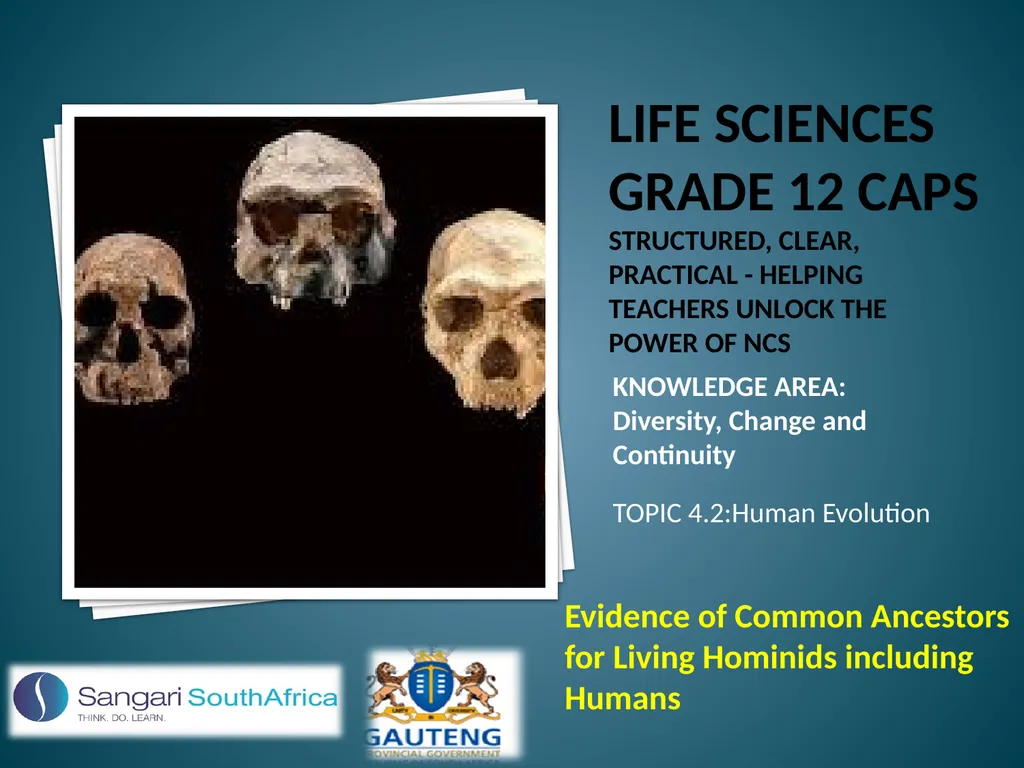
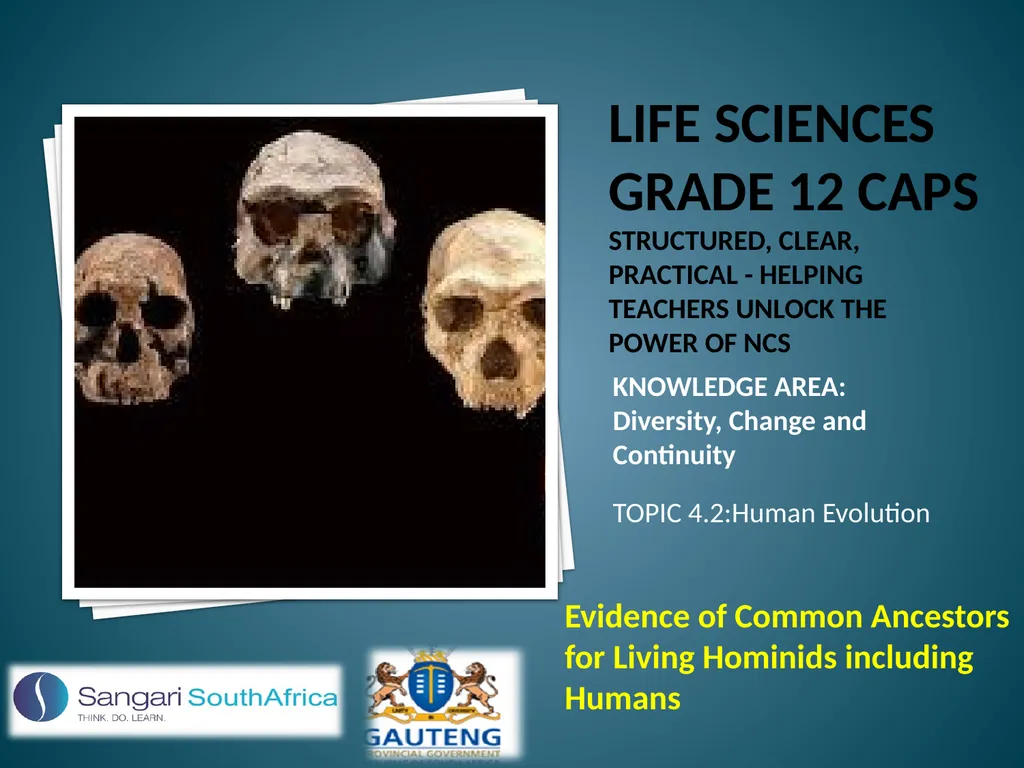
Life sciences Grade 12 CAPS structured, clear, practical - Helping teachers unlock the power of NCS KNOWLEDGE AREA: Diversity, Change and Continuity TOPIC 4.2:Human Evolution Evidence of Common Ancestors for Living Hominids including Humans
Related Topics
Share
Embed code
Download this presentation From Below
"Life sciences Grade 12 CAPS structured, clear," is the property of its rightful owner. Permission is granted to download and print the materials on this website for personal, non-commercial use only, and to display it on your personal computer provided you do not modify the materials and that you retain all copyright notices contained in the materials. By downloading content from our website, you accept the terms of this agreement.
Presentation Transcript
01
Life sciences Grade 12 CAPS
structured, clear, practical - Helping teachers unlock the power of NCS KNOWLEDGE AREA:
Diversity, Change and Continuity
TOPIC 4.2:Human Evolution Evidence of Common Ancestors for Living Hominids including Humans<br>
Diversity, Change and Continuity
TOPIC 4.2:Human Evolution Evidence of Common Ancestors for Living Hominids including Humans<br>
02
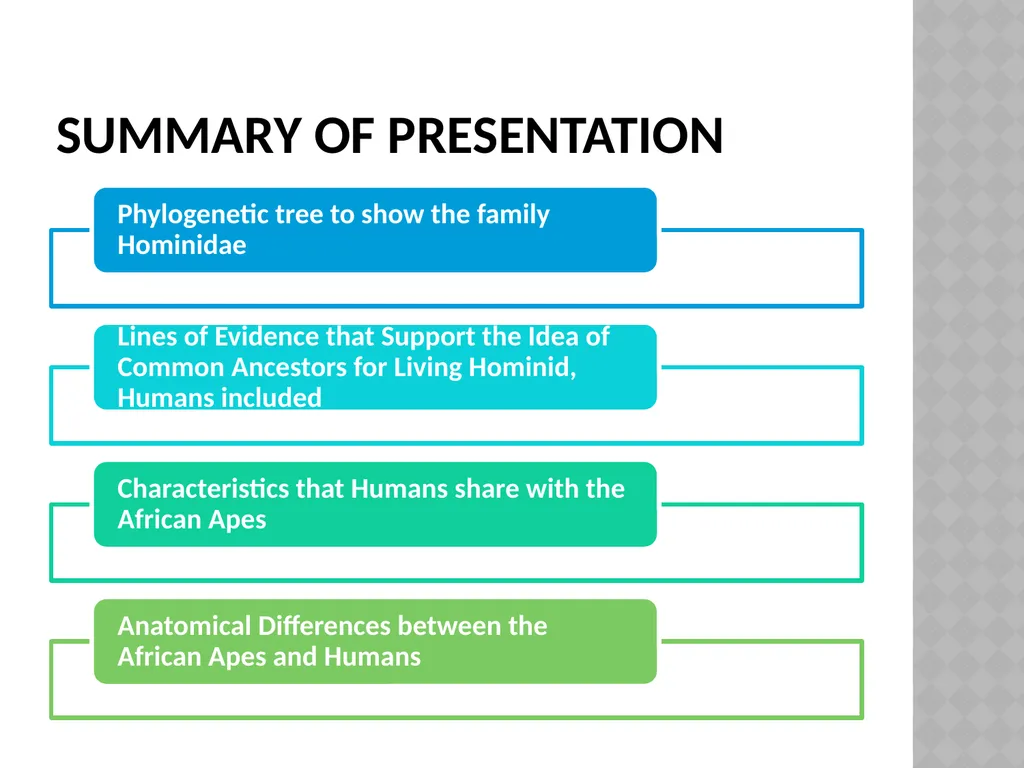
Summary of presentation<br>
03
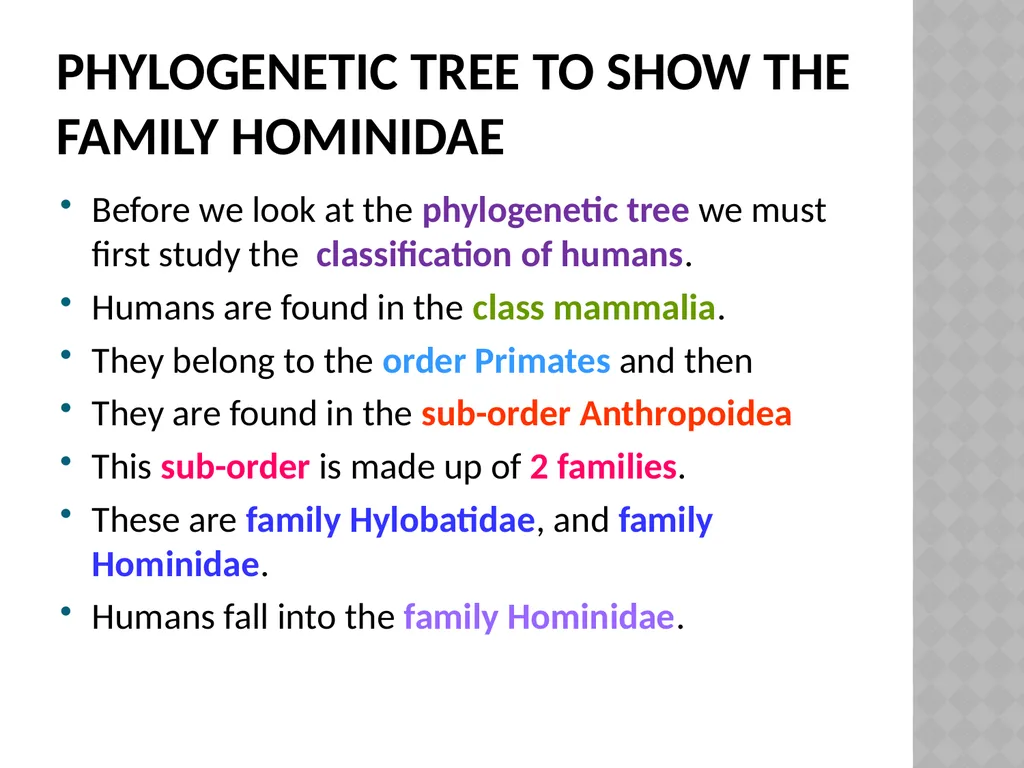
Phylogenetic tree to show the family Hominidae Before we look at the phylogenetic tree we must first study the classification of humans.
Humans are found in the class mammalia.
They belong to the order Primates and then
They are found in the sub-order Anthropoidea
This sub-order is made up of 2 families.
These are family Hylobatidae, and family Hominidae.
Humans fall into the family Hominidae.<br>
Humans are found in the class mammalia.
They belong to the order Primates and then
They are found in the sub-order Anthropoidea
This sub-order is made up of 2 families.
These are family Hylobatidae, and family Hominidae.
Humans fall into the family Hominidae.<br>
04
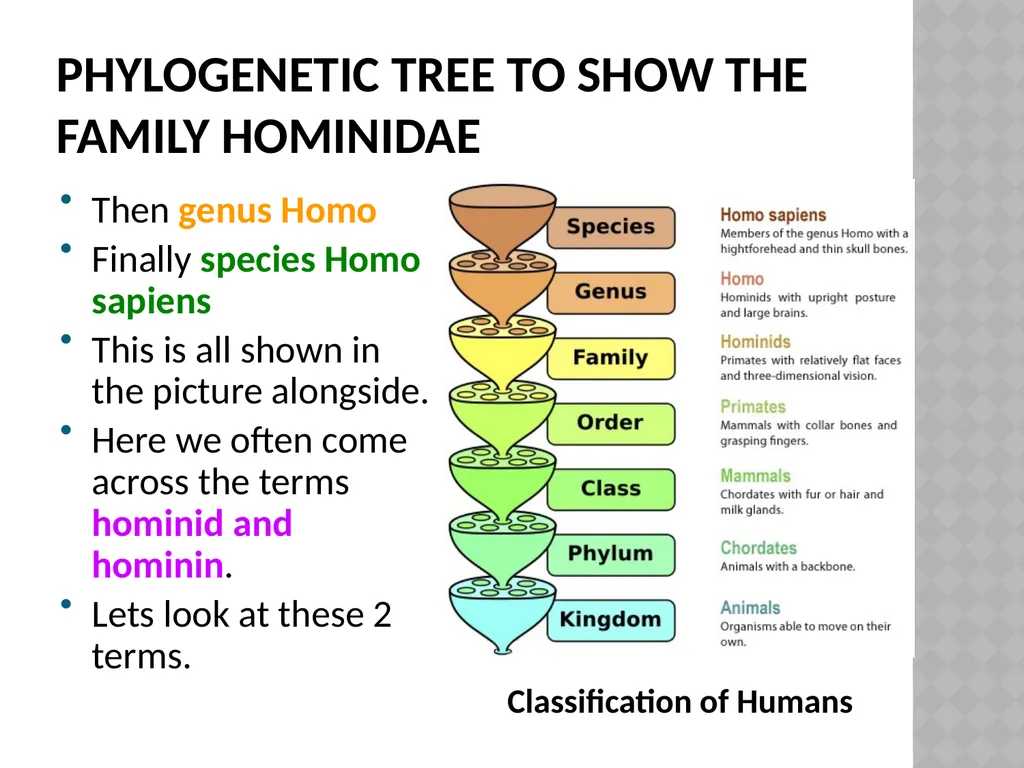
Phylogenetic tree to show the family Hominidae Then genus Homo
Finally species Homo sapiens
This is all shown in the picture alongside.
Here we often come across the terms hominid and hominin.
Lets look at these 2 terms. Classification of Humans<br>
Finally species Homo sapiens
This is all shown in the picture alongside.
Here we often come across the terms hominid and hominin.
Lets look at these 2 terms. Classification of Humans<br>
05
Phylogenetic tree to show the family Hominidae Hominid refers to the group which contains modern humans, chimpanzees, gorillas and orangutans.
It also includes all their immediate ancestors.
In other words all the organisms found in the family Hominidae.
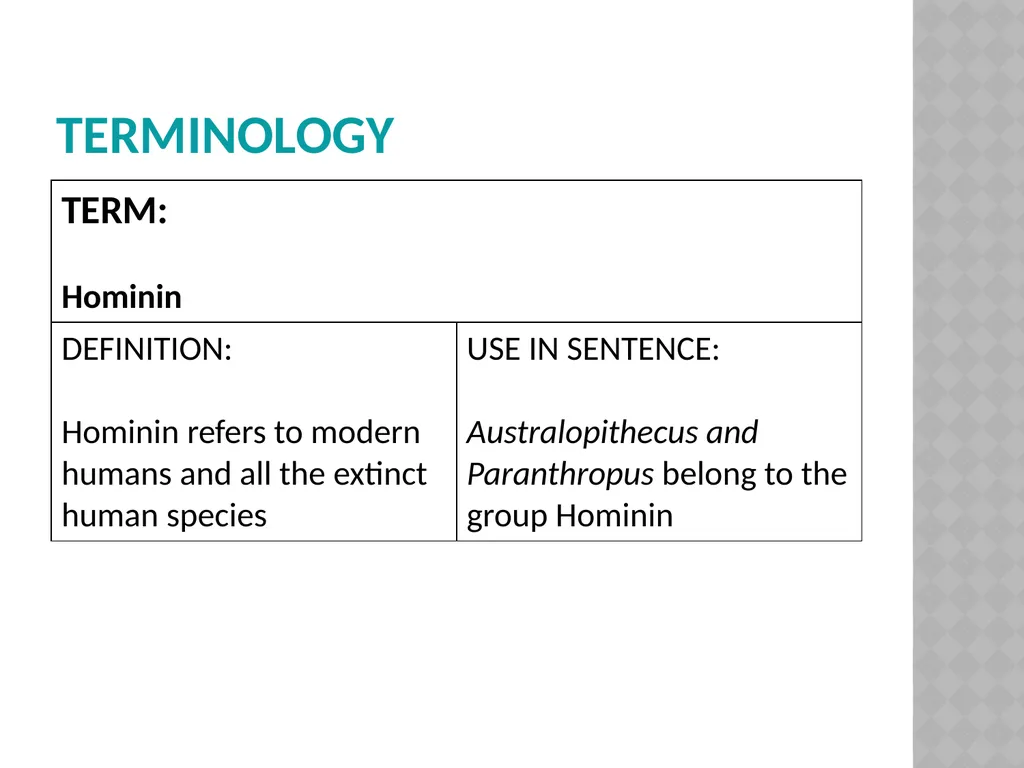
Hominin refers to modern humans and all the extinct human species.
It also includes all our immediate ancestors.
Now will look at how the humans are similar and different to the African apes.<br>
It also includes all their immediate ancestors.
In other words all the organisms found in the family Hominidae.
Hominin refers to modern humans and all the extinct human species.
It also includes all our immediate ancestors.
Now will look at how the humans are similar and different to the African apes.<br>
06
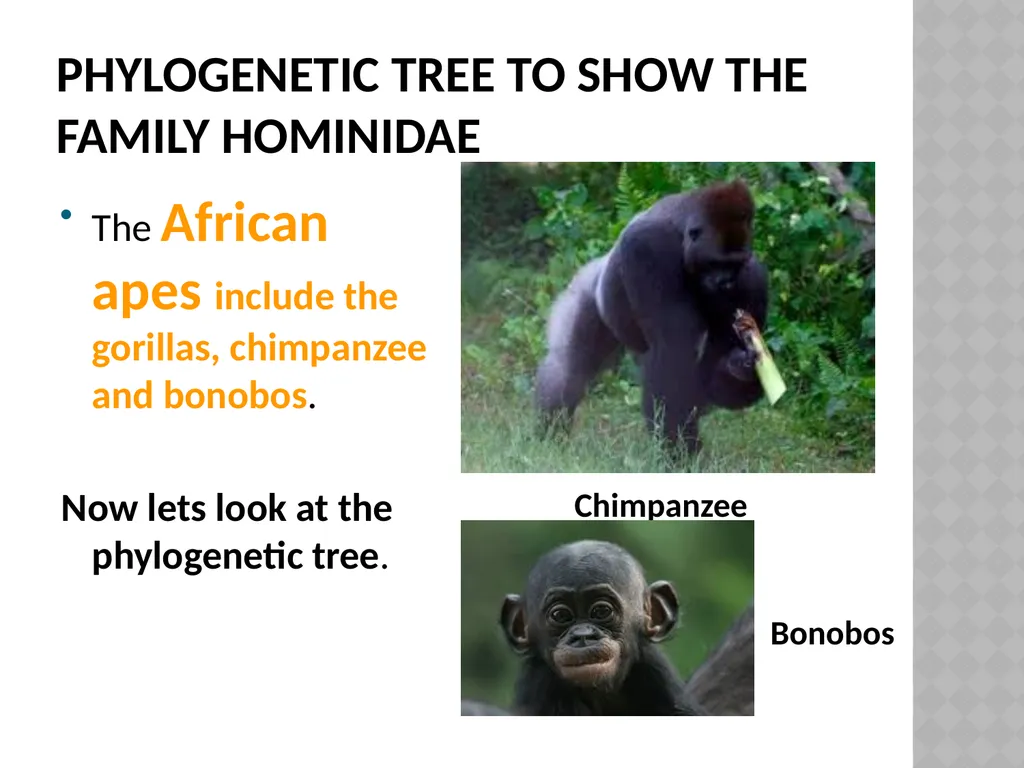
Phylogenetic tree to show the family Hominidae The African apes include the gorillas, chimpanzee and bonobos.
Now lets look at the phylogenetic tree. Chimpanzee Bonobos<br>
Now lets look at the phylogenetic tree. Chimpanzee Bonobos<br>
07
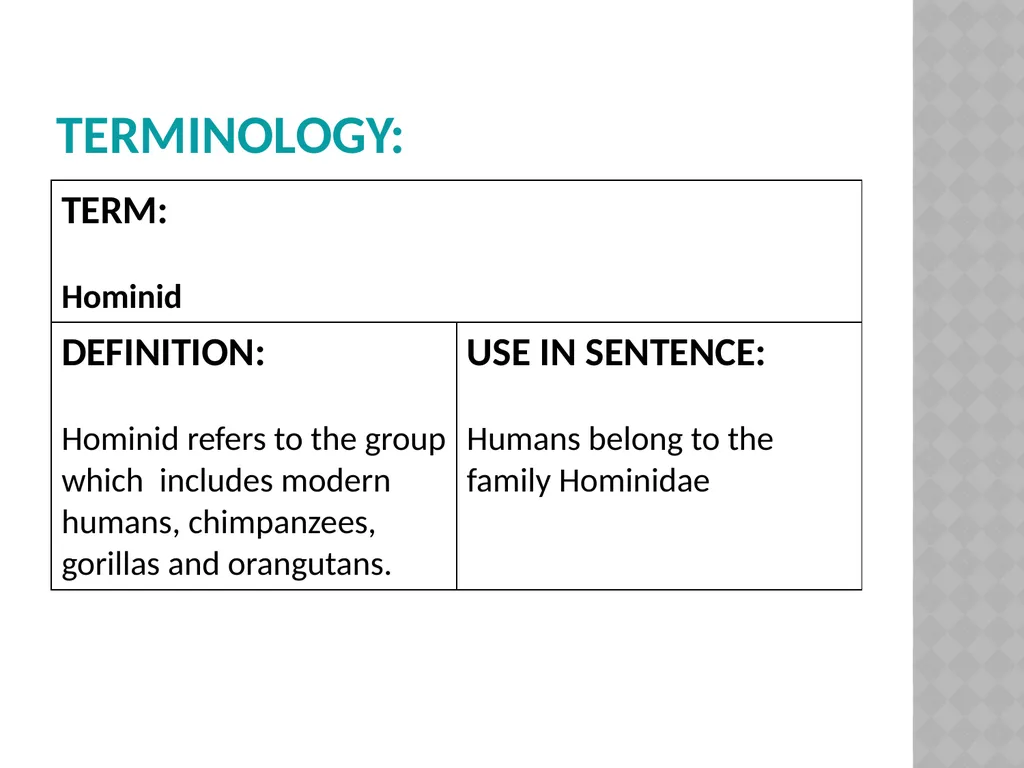
Terminology:<br>
08
terminology<br>
09
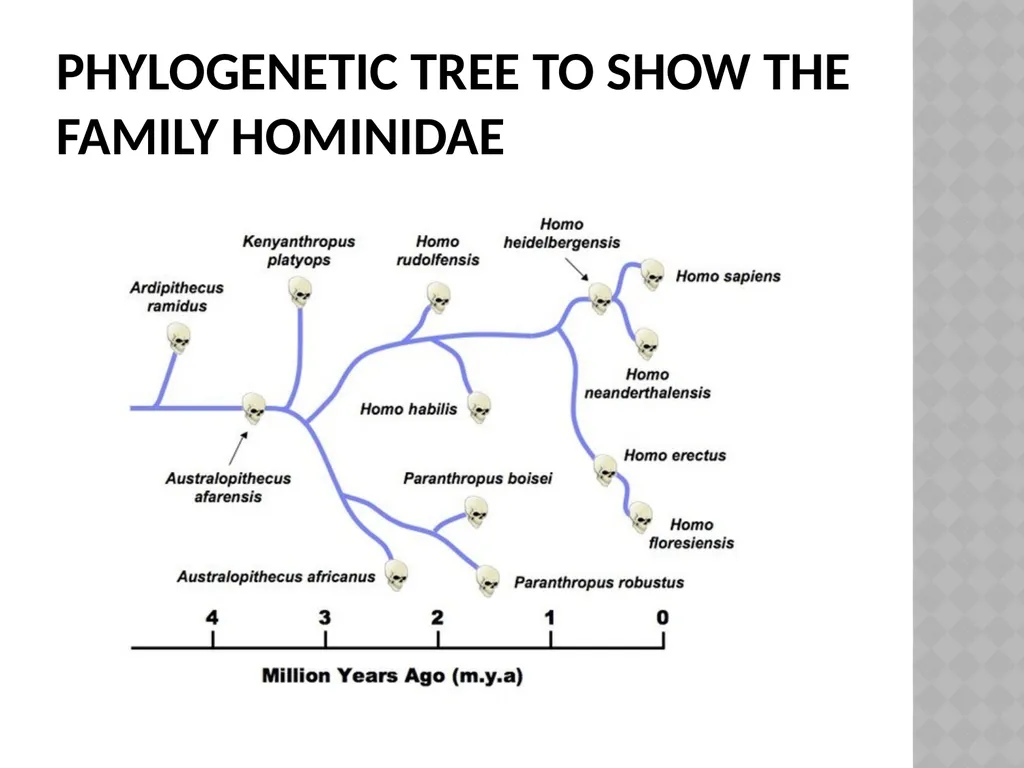
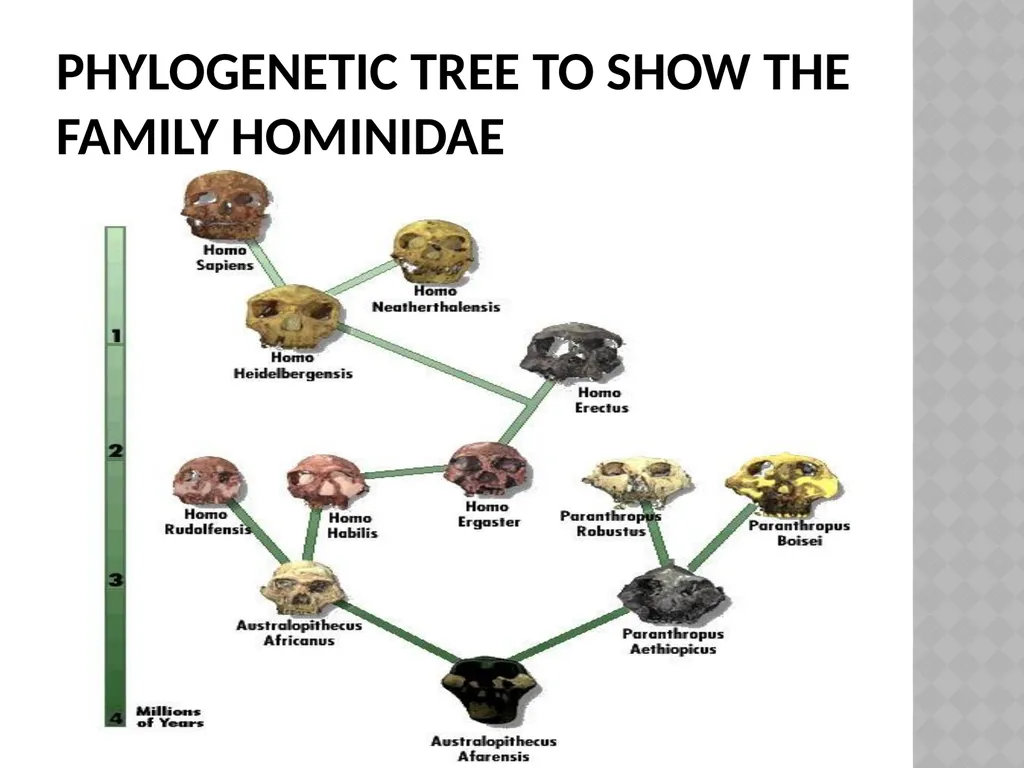
Phylogenetic tree to show the family Hominidae The phylogenetic trees on the next 2 slides gives some information on human evolution.
We will use both these trees to trace human evolution from about 6 million years ago.<br>
We will use both these trees to trace human evolution from about 6 million years ago.<br>
10
Phylogenetic tree to show the family Hominidae<br>
11
Phylogenetic tree to show the family Hominidae<br>
12
Phylogenetic tree to show the family Hominidae Between 6 to 7 mya the first bipedal primates appeared.
These organisms had the following features:
Small brain size
Foramen magnum had a forward position.
Small canine teeth
Then about 4mya Australopithecus appeared.
They had features of both primitive apes and modern humans.
They had the head of primitive apes and from the neck down they looked like the modern humans.
Therefore they are often called ape-men.<br>
These organisms had the following features:
Small brain size
Foramen magnum had a forward position.
Small canine teeth
Then about 4mya Australopithecus appeared.
They had features of both primitive apes and modern humans.
They had the head of primitive apes and from the neck down they looked like the modern humans.
Therefore they are often called ape-men.<br>
13
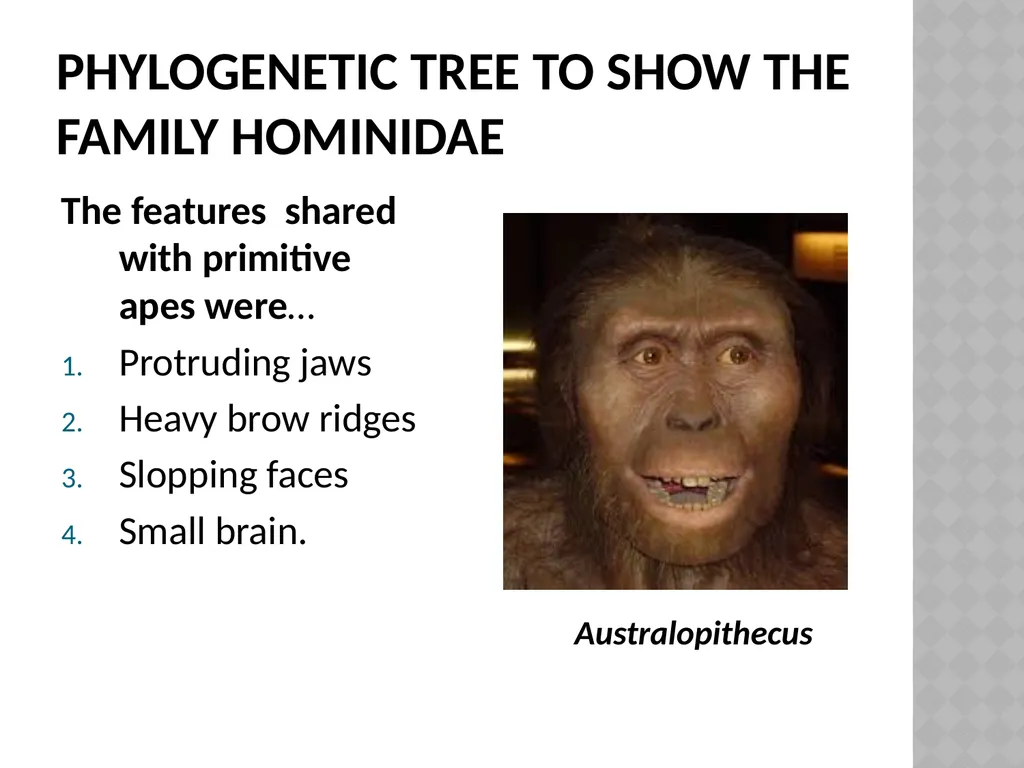
Phylogenetic tree to show the family Hominidae The features shared with primitive apes were…
Protruding jaws
Heavy brow ridges
Slopping faces
Small brain. Australopithecus<br>
Protruding jaws
Heavy brow ridges
Slopping faces
Small brain. Australopithecus<br>
14
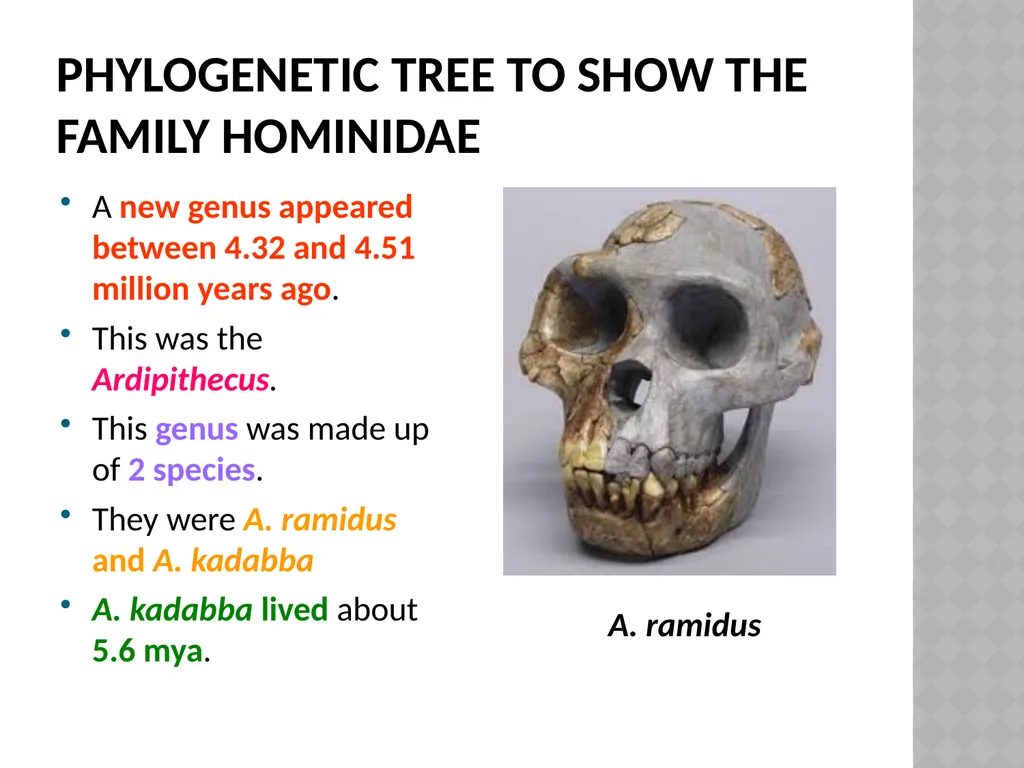
Phylogenetic tree to show the family Hominidae A new genus appeared between 4.32 and 4.51 million years ago.
This was the Ardipithecus.
This genus was made up of 2 species.
They were A. ramidus and A. kadabba
A. kadabba lived about 5.6 mya. A. ramidus<br>
This was the Ardipithecus.
This genus was made up of 2 species.
They were A. ramidus and A. kadabba
A. kadabba lived about 5.6 mya. A. ramidus<br>
15
Phylogenetic tree to show the family Hominidae A. ramidus had the following features…
A small brain
A pointed face and poorly developed chin
A grasping big toe for swinging from branch to branch of trees.
It was also adapted for bipedalism.
Then about 2 mya the australopithecines gave rise to Homo habilis (the handy man)
H. habilis was referred to as the handy man because fossil evidence showed that they used tools.
H. habilis was first of the early humans.
H. habilis was different from the australopithecines in the following way…<br>
A small brain
A pointed face and poorly developed chin
A grasping big toe for swinging from branch to branch of trees.
It was also adapted for bipedalism.
Then about 2 mya the australopithecines gave rise to Homo habilis (the handy man)
H. habilis was referred to as the handy man because fossil evidence showed that they used tools.
H. habilis was first of the early humans.
H. habilis was different from the australopithecines in the following way…<br>
16
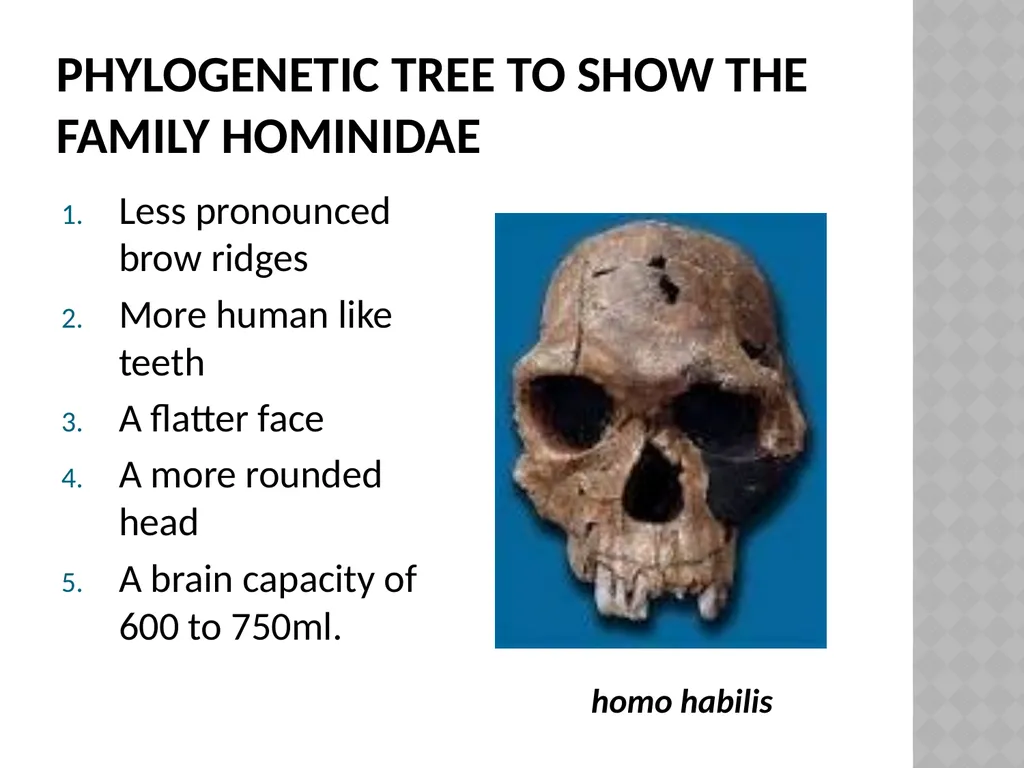
Phylogenetic tree to show the family Hominidae Less pronounced brow ridges
More human like teeth
A flatter face
A more rounded head
A brain capacity of 600 to 750ml. homo habilis<br>
More human like teeth
A flatter face
A more rounded head
A brain capacity of 600 to 750ml. homo habilis<br>
17
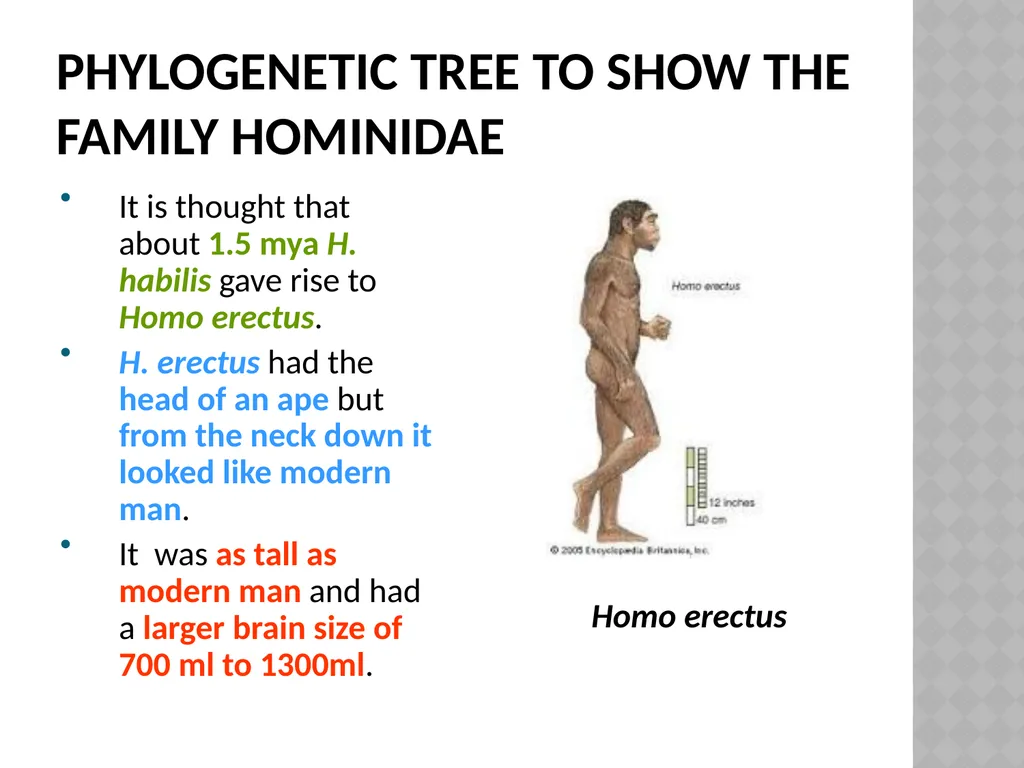
Phylogenetic tree to show the family Hominidae It is thought that about 1.5 mya H. habilis gave rise to Homo erectus.
H. erectus had the head of an ape but from the neck down it looked like modern man.
It was as tall as modern man and had a larger brain size of 700 ml to 1300ml. Homo erectus<br>
H. erectus had the head of an ape but from the neck down it looked like modern man.
It was as tall as modern man and had a larger brain size of 700 ml to 1300ml. Homo erectus<br>
18
Phylogenetic tree to show the family Hominidae Then about 150 000 to 200 000 years ago h. erectus gave rise to Homo sapiens.
We will look at these in a little more detail later on.<br>
We will look at these in a little more detail later on.<br>
19
Lines of Evidence that Support the Idea of Common Ancestors for Living Hominid, Humans included Two groups of the African apes share a common ancestor with humans.
These 2 groups of apes are the chimpanzee and bonobos.
We want to look at evidence that support the idea of a common ancestor.
We look at 3 lines of evidence.
These are …
Fossil evidence
Genetic evidence
Cultural evidence
Lets look at each of these in some detail.<br>
These 2 groups of apes are the chimpanzee and bonobos.
We want to look at evidence that support the idea of a common ancestor.
We look at 3 lines of evidence.
These are …
Fossil evidence
Genetic evidence
Cultural evidence
Lets look at each of these in some detail.<br>
20
Lines of Evidence that Support the Idea of Common Ancestors for Living Hominid, Humans included Fossil Evidence:
From our earlier discussion we can see that many hominin fossils have been discovered over the years.
Hominin fossils belong to at least 20 species.
These fossil provide evidence for a close evolutionary relationship between humans and the great apes.
The fossils use anatomy to show this relationship.
The fossils provide 2 lines of evidence.<br>
From our earlier discussion we can see that many hominin fossils have been discovered over the years.
Hominin fossils belong to at least 20 species.
These fossil provide evidence for a close evolutionary relationship between humans and the great apes.
The fossils use anatomy to show this relationship.
The fossils provide 2 lines of evidence.<br>
21
Lines of Evidence that Support the Idea of Common Ancestors for Living Hominid, Humans included These are…
Transitional fossils:
This refers to the immediate fossils between a group and their ancestor.
In this case the transitional fossils have characteristics of both the apes and humans.
The great –ape characteristics are also found in the common ancestor, but
The human characteristics occur only in the hominins.<br>
Transitional fossils:
This refers to the immediate fossils between a group and their ancestor.
In this case the transitional fossils have characteristics of both the apes and humans.
The great –ape characteristics are also found in the common ancestor, but
The human characteristics occur only in the hominins.<br>
22
Lines of Evidence that Support the Idea of Common Ancestors for Living Hominid, Humans included The Oldest fossils:
These fossils have more characteristics of the great apes than the younger fossils.
These younger fossils are more like the modern human.
Over a period of time we see that the fossils become more human like than ape like.
We shall look at the similarities and differences between the great apes and humans a little later.<br>
These fossils have more characteristics of the great apes than the younger fossils.
These younger fossils are more like the modern human.
Over a period of time we see that the fossils become more human like than ape like.
We shall look at the similarities and differences between the great apes and humans a little later.<br>
23
Lines of Evidence that Support the Idea of Common Ancestors for Living Hominid, Humans included Genetic Evidence:
The DNA base pairing of humans and the Great apes are almost identical.
The human DNA sequence is most similar to the chimpanzee.
Humans and chimpanzee have 98.76% of the base pair sequence in common.
Since DNA sequence is so similar it provides evidence for a close relationship between humans and chimpanzees.<br>
The DNA base pairing of humans and the Great apes are almost identical.
The human DNA sequence is most similar to the chimpanzee.
Humans and chimpanzee have 98.76% of the base pair sequence in common.
Since DNA sequence is so similar it provides evidence for a close relationship between humans and chimpanzees.<br>
24
Lines of Evidence that Support the Idea of Common Ancestors for Living Hominid, Humans included Cultural Evidence:
Fragments of sticks, burned bones, stone weapons and tools etc, were used as cultural evidence for human evolution.
Chimpanzees also use tools , for example using stones to open nuts.
Young chimpanzee learn behaviour from watching their mothers.
Therefore it is believed that the common ancestor of humans and chimpanzee also used similar tools in a similar way.<br>
Fragments of sticks, burned bones, stone weapons and tools etc, were used as cultural evidence for human evolution.
Chimpanzees also use tools , for example using stones to open nuts.
Young chimpanzee learn behaviour from watching their mothers.
Therefore it is believed that the common ancestor of humans and chimpanzee also used similar tools in a similar way.<br>
25
terminology:<br>
26
Characteristics that Humans share with the African Apes Many of the early mammals lived on trees.
Many of the African apes are still adapted for an arboreal life.
Humans share the following characteristics with the African apes and other primates…
The upper limbs
The brain
Vision
Number of Offspring
Upright posture<br>
Many of the African apes are still adapted for an arboreal life.
Humans share the following characteristics with the African apes and other primates…
The upper limbs
The brain
Vision
Number of Offspring
Upright posture<br>
27
Characteristics that Humans share with the African Apes The Upper Limbs:
Primates have very long arms, which they move freely.
They are able to move their arms freely because…
The socket is very shallow.
The scapula is not attached to the vertebral column.
They do not have claws, instead they have flat nails.
Their fingertips are bare and contain a large amount of nerve endings.
Finally all primates have opposable thumbs.<br>
Primates have very long arms, which they move freely.
They are able to move their arms freely because…
The socket is very shallow.
The scapula is not attached to the vertebral column.
They do not have claws, instead they have flat nails.
Their fingertips are bare and contain a large amount of nerve endings.
Finally all primates have opposable thumbs.<br>
28
Characteristics that Humans share with the African Apes The long arms are used to gather fruit from the tips of tree branches.
Their bare fingertips are very sensitive, this makes precision work possible. Therefore they are able to make and use tools.
The opposable thumbs makes the power grip and precision grip possible.
Like primates humans have…
opposable thumbs,
flat nails instead of claws and
freely moving upper limbs.<br>
Their bare fingertips are very sensitive, this makes precision work possible. Therefore they are able to make and use tools.
The opposable thumbs makes the power grip and precision grip possible.
Like primates humans have…
opposable thumbs,
flat nails instead of claws and
freely moving upper limbs.<br>
29
Characteristics that Humans share with the African Apes Brain:
We find that when we compare the brain to body size, the primates have large brains compared to their body size.
This enables them to process large amounts of information.
Parts of the brain responsible for interpretation information coming from the hands and eyes are enlarged.
The olfactory organ is much reduced because primates do not depend on the sense of smell.<br>
We find that when we compare the brain to body size, the primates have large brains compared to their body size.
This enables them to process large amounts of information.
Parts of the brain responsible for interpretation information coming from the hands and eyes are enlarged.
The olfactory organ is much reduced because primates do not depend on the sense of smell.<br>
30
Characteristics that Humans share with the African Apes Vision:
Their eyes are found in the front.
They display both stereoscopic and binocular vision.
They have rods and cones to enable a more clear and colour vision.<br>
Their eyes are found in the front.
They display both stereoscopic and binocular vision.
They have rods and cones to enable a more clear and colour vision.<br>
31
Characteristics that Humans share with the African Apes Number of Offspring Produced:
Primates produce far less offspring.
Parental care is intensive.
Upright Posture:
They have an upright posture, which allows for the primates to walk on two legs.
This allows for better view of the surroundings.
Upper limbs are free for carrying things such as food, babies and tools.<br>
Primates produce far less offspring.
Parental care is intensive.
Upright Posture:
They have an upright posture, which allows for the primates to walk on two legs.
This allows for better view of the surroundings.
Upper limbs are free for carrying things such as food, babies and tools.<br>
32
Terminology:<br>
33
TERMINOLOGY:<br>
34
Terminology:<br>
35
Something for you to do: List the characteristics that humans share with the African apes.<br>
36
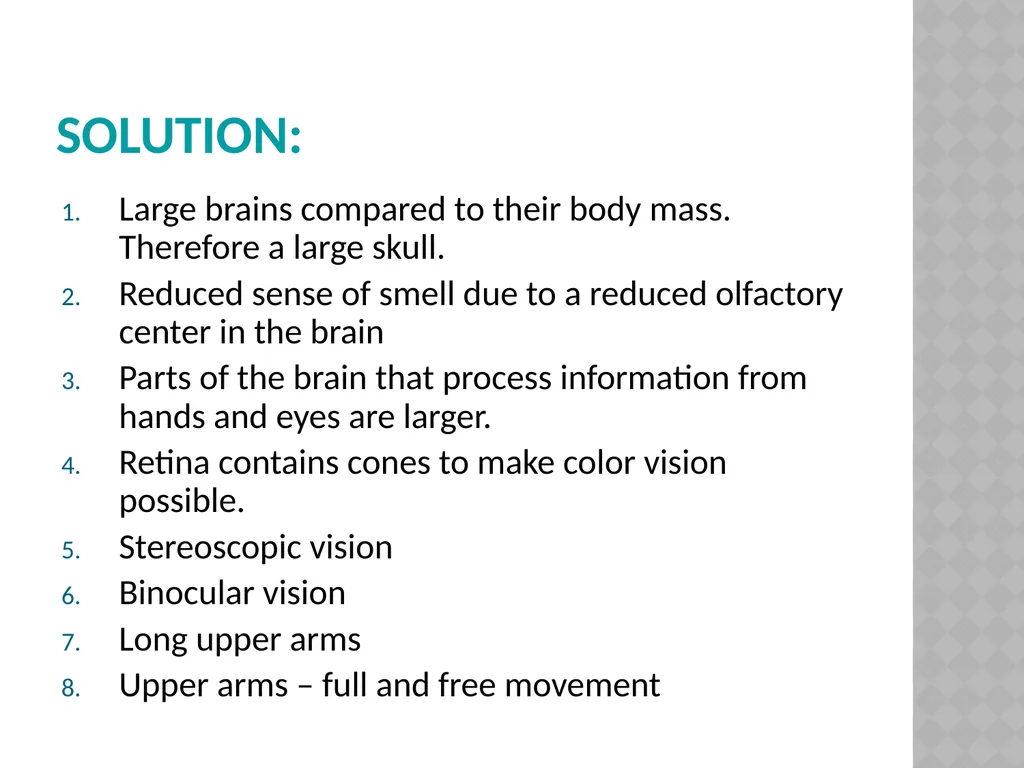
Solution: Large brains compared to their body mass. Therefore a large skull.
Reduced sense of smell due to a reduced olfactory center in the brain
Parts of the brain that process information from hands and eyes are larger.
Retina contains cones to make color vision possible.
Stereoscopic vision
Binocular vision
Long upper arms
Upper arms – full and free movement<br>
Reduced sense of smell due to a reduced olfactory center in the brain
Parts of the brain that process information from hands and eyes are larger.
Retina contains cones to make color vision possible.
Stereoscopic vision
Binocular vision
Long upper arms
Upper arms – full and free movement<br>
37
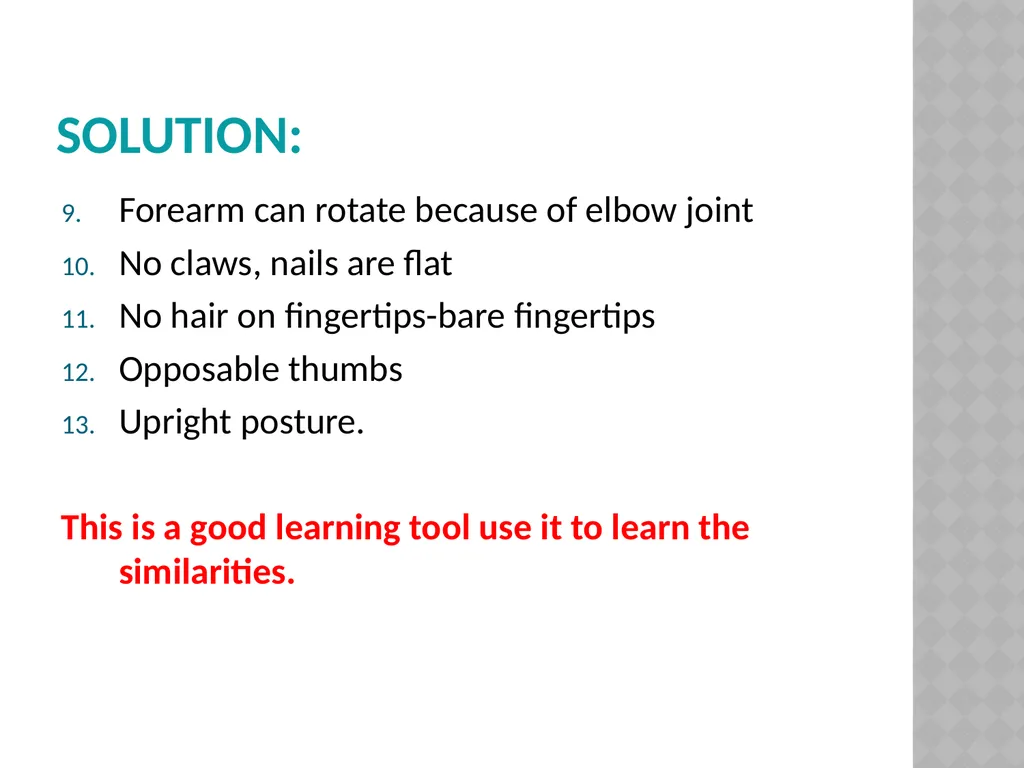
Solution: Forearm can rotate because of elbow joint
No claws, nails are flat
No hair on fingertips-bare fingertips
Opposable thumbs
Upright posture.
This is a good learning tool use it to learn the similarities.<br>
No claws, nails are flat
No hair on fingertips-bare fingertips
Opposable thumbs
Upright posture.
This is a good learning tool use it to learn the similarities.<br>
38
Terminology:<br>
39
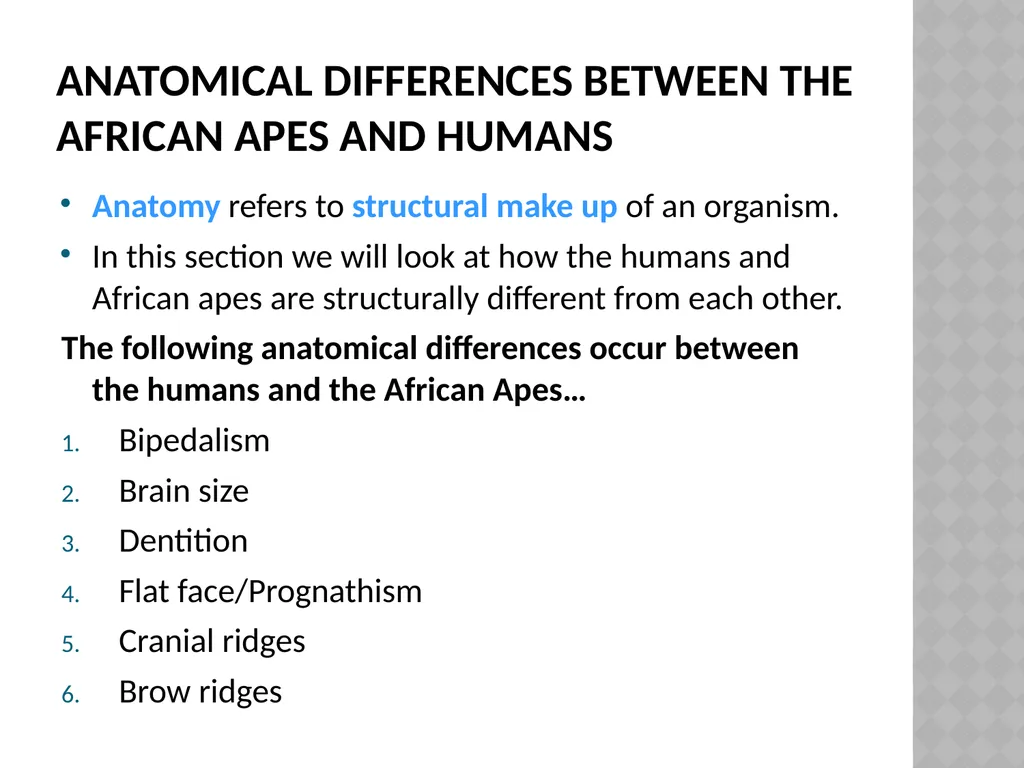
Anatomical Differences between the African Apes and Humans Anatomy refers to structural make up of an organism.
In this section we will look at how the humans and African apes are structurally different from each other.
The following anatomical differences occur between the humans and the African Apes…
Bipedalism
Brain size
Dentition
Flat face/Prognathism
Cranial ridges
Brow ridges<br>
In this section we will look at how the humans and African apes are structurally different from each other.
The following anatomical differences occur between the humans and the African Apes…
Bipedalism
Brain size
Dentition
Flat face/Prognathism
Cranial ridges
Brow ridges<br>
40
Anatomical Differences between the African Apes and Humans There is fossil evidence to support these anatomical differences.
Now lets look at each of these in some detail
Bipedalism:
The African apes sit upright and are able to walk on 2 feet.
However they do this only sometimes, while humans walk on 2 legs all the time.
Animals that show bipedalism have a different arrangement of the vertebral column to the head<br>
Now lets look at each of these in some detail
Bipedalism:
The African apes sit upright and are able to walk on 2 feet.
However they do this only sometimes, while humans walk on 2 legs all the time.
Animals that show bipedalism have a different arrangement of the vertebral column to the head<br>
41
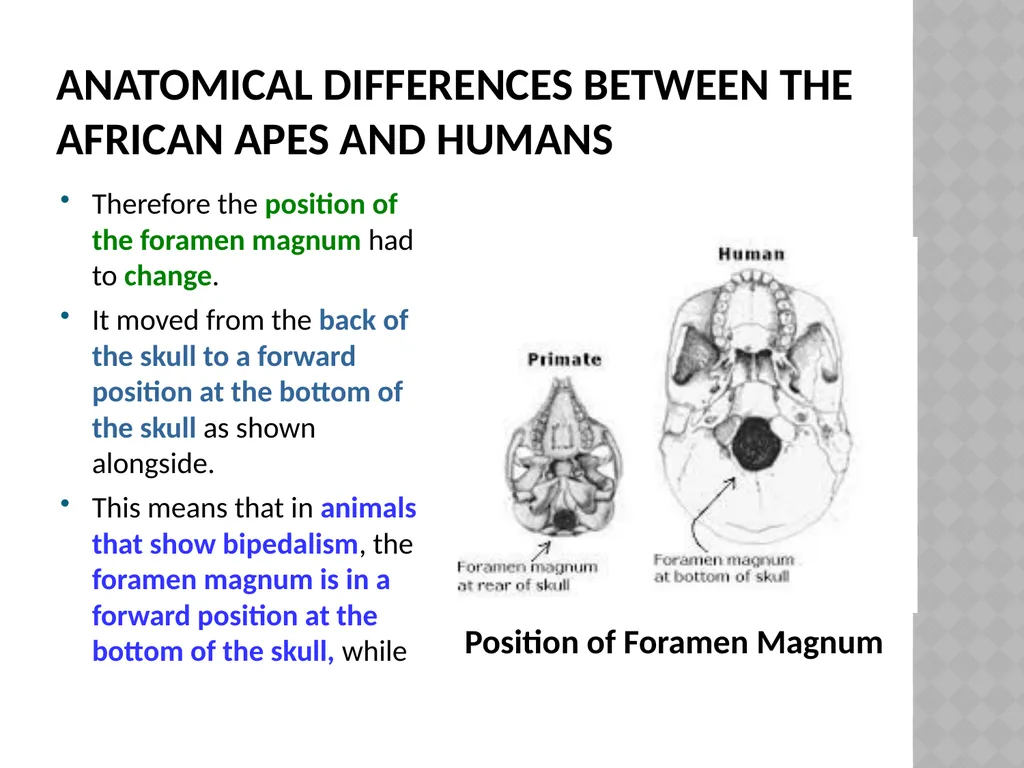
Anatomical Differences between the African Apes and Humans Therefore the position of the foramen magnum had to change.
It moved from the back of the skull to a forward position at the bottom of the skull as shown alongside.
This means that in animals that show bipedalism, the foramen magnum is in a forward position at the bottom of the skull, while Position of Foramen Magnum<br>
It moved from the back of the skull to a forward position at the bottom of the skull as shown alongside.
This means that in animals that show bipedalism, the foramen magnum is in a forward position at the bottom of the skull, while Position of Foramen Magnum<br>
42
Anatomical Differences between the African Apes and Humans The animals that show quadrupedalism have a foramen magnum at the back of the skull.<br>
43
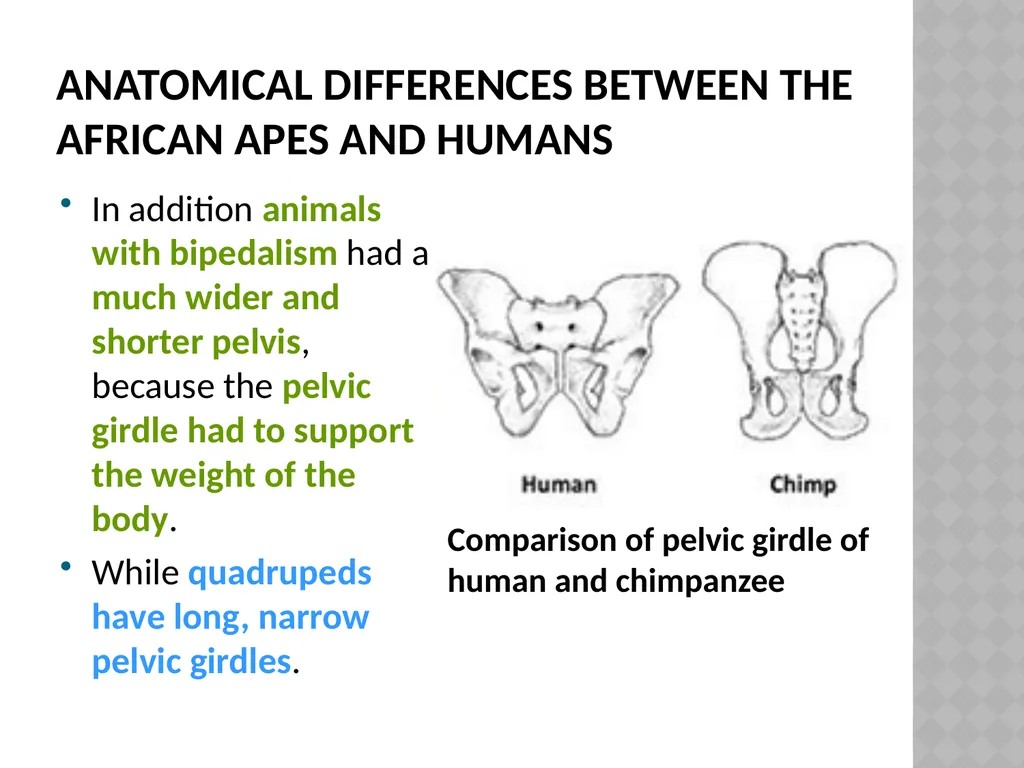
Anatomical Differences between the African Apes and Humans In addition animals with bipedalism had a much wider and shorter pelvis, because the pelvic girdle had to support the weight of the body.
While quadrupeds have long, narrow pelvic girdles. Comparison of pelvic girdle of
human and chimpanzee<br>
While quadrupeds have long, narrow pelvic girdles. Comparison of pelvic girdle of
human and chimpanzee<br>
44
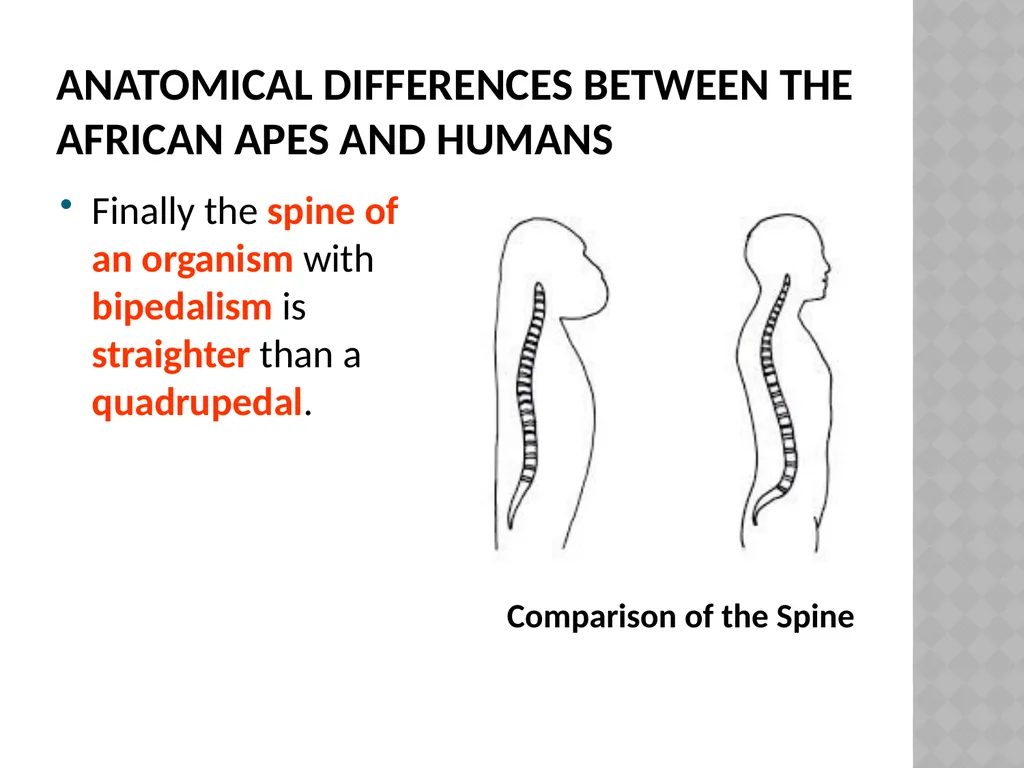
Anatomical Differences between the African Apes and Humans Finally the spine of an organism with bipedalism is straighter than a quadrupedal. Comparison of the Spine<br>
45
Terminology:<br>
46
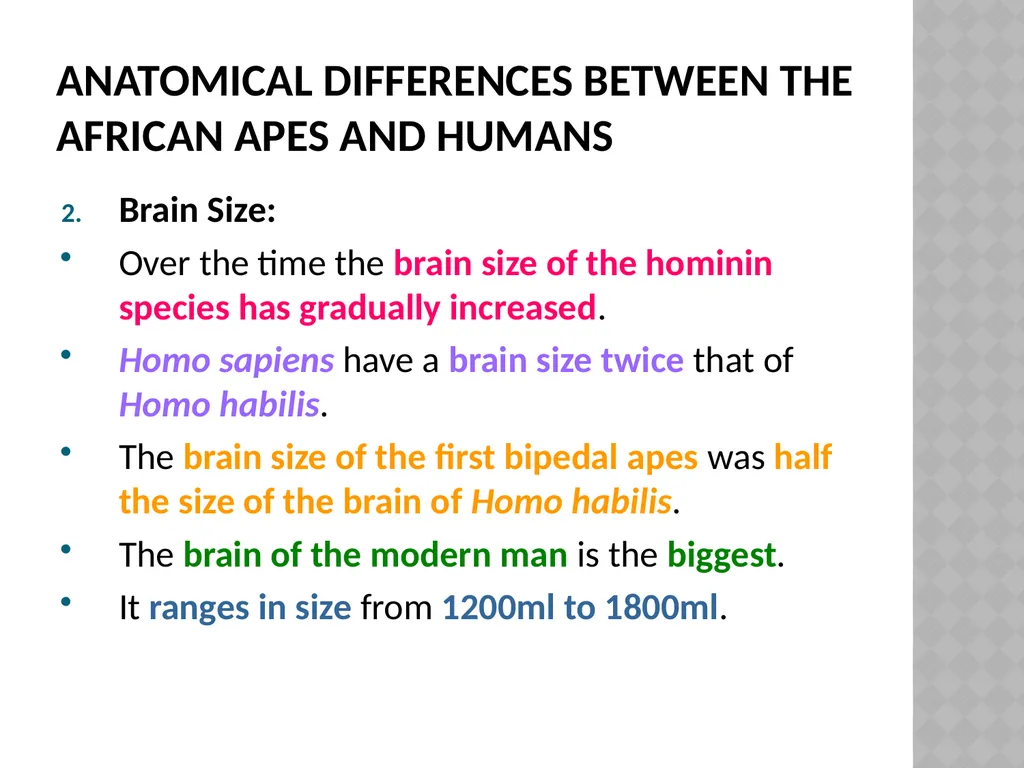
Anatomical Differences between the African Apes and Humans Brain Size:
Over the time the brain size of the hominin species has gradually increased.
Homo sapiens have a brain size twice that of Homo habilis.
The brain size of the first bipedal apes was half the size of the brain of Homo habilis.
The brain of the modern man is the biggest.
It ranges in size from 1200ml to 1800ml.<br>
Over the time the brain size of the hominin species has gradually increased.
Homo sapiens have a brain size twice that of Homo habilis.
The brain size of the first bipedal apes was half the size of the brain of Homo habilis.
The brain of the modern man is the biggest.
It ranges in size from 1200ml to 1800ml.<br>
47
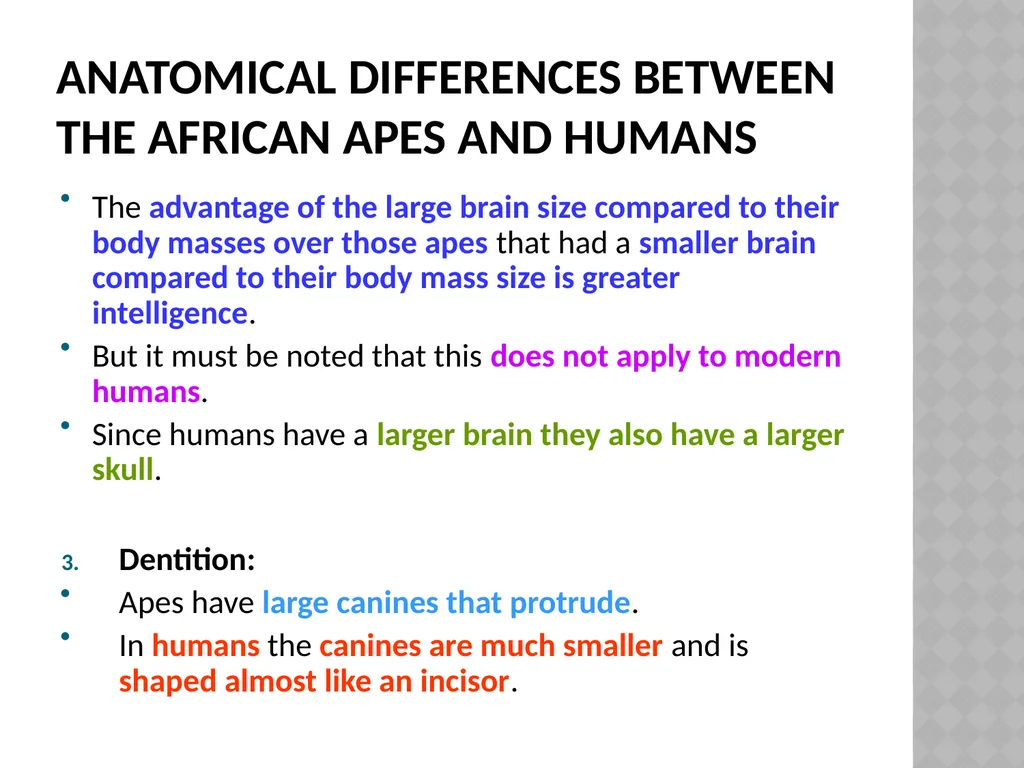
Anatomical Differences between the African Apes and Humans The advantage of the large brain size compared to their body masses over those apes that had a smaller brain compared to their body mass size is greater intelligence.
But it must be noted that this does not apply to modern humans.
Since humans have a larger brain they also have a larger skull.
Dentition:
Apes have large canines that protrude.
In humans the canines are much smaller and is shaped almost like an incisor.<br>
But it must be noted that this does not apply to modern humans.
Since humans have a larger brain they also have a larger skull.
Dentition:
Apes have large canines that protrude.
In humans the canines are much smaller and is shaped almost like an incisor.<br>
48
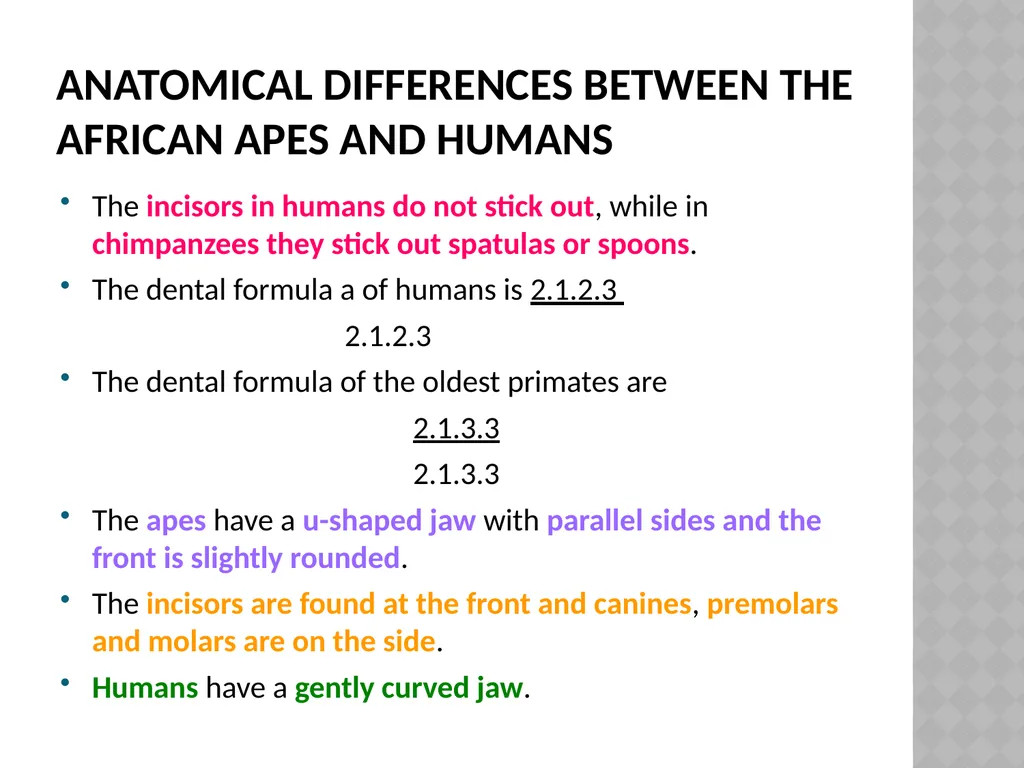
Anatomical Differences between the African Apes and Humans The incisors in humans do not stick out, while in chimpanzees they stick out spatulas or spoons.
The dental formula a of humans is 2.1.2.3
2.1.2.3
The dental formula of the oldest primates are
2.1.3.3
2.1.3.3
The apes have a u-shaped jaw with parallel sides and the front is slightly rounded.
The incisors are found at the front and canines, premolars and molars are on the side.
Humans have a gently curved jaw.<br>
The dental formula a of humans is 2.1.2.3
2.1.2.3
The dental formula of the oldest primates are
2.1.3.3
2.1.3.3
The apes have a u-shaped jaw with parallel sides and the front is slightly rounded.
The incisors are found at the front and canines, premolars and molars are on the side.
Humans have a gently curved jaw.<br>
49
Terminology:<br>
50
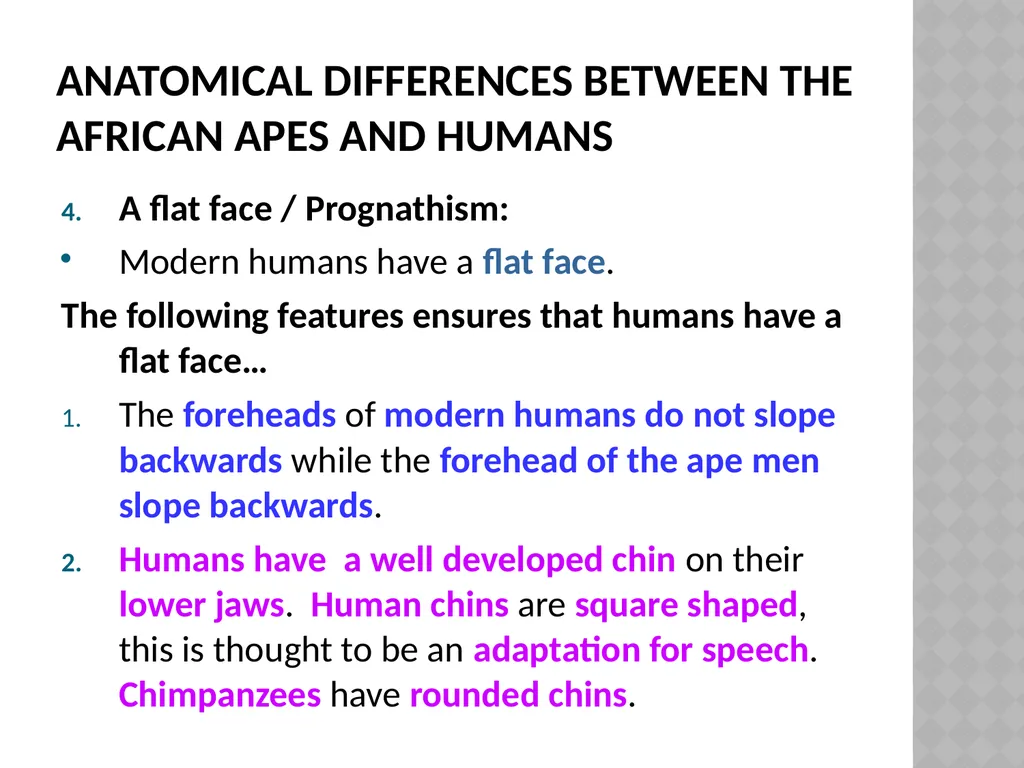
Anatomical Differences between the African Apes and Humans A flat face / Prognathism:
Modern humans have a flat face.
The following features ensures that humans have a flat face…
The foreheads of modern humans do not slope backwards while the forehead of the ape men slope backwards.
Humans have a well developed chin on their lower jaws. Human chins are square shaped, this is thought to be an adaptation for speech. Chimpanzees have rounded chins.<br>
Modern humans have a flat face.
The following features ensures that humans have a flat face…
The foreheads of modern humans do not slope backwards while the forehead of the ape men slope backwards.
Humans have a well developed chin on their lower jaws. Human chins are square shaped, this is thought to be an adaptation for speech. Chimpanzees have rounded chins.<br>
51
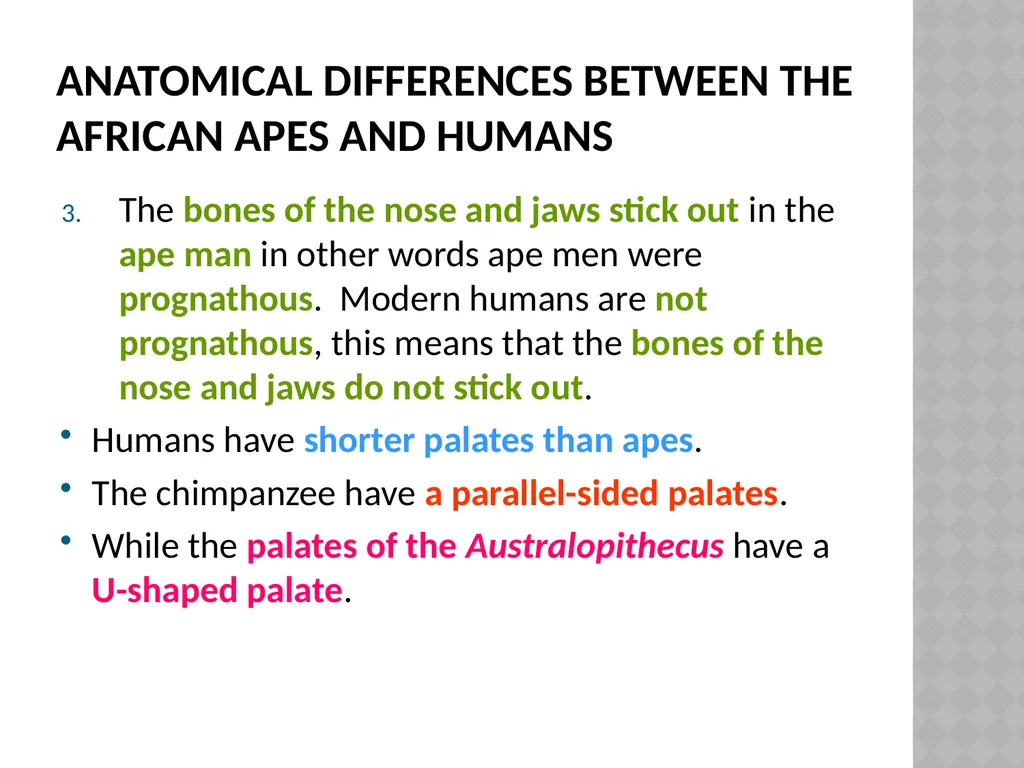
Anatomical Differences between the African Apes and Humans The bones of the nose and jaws stick out in the ape man in other words ape men were prognathous. Modern humans are not prognathous, this means that the bones of the nose and jaws do not stick out.
Humans have shorter palates than apes.
The chimpanzee have a parallel-sided palates.
While the palates of the Australopithecus have a U-shaped palate.<br>
Humans have shorter palates than apes.
The chimpanzee have a parallel-sided palates.
While the palates of the Australopithecus have a U-shaped palate.<br>
52
Terminology:<br>
53
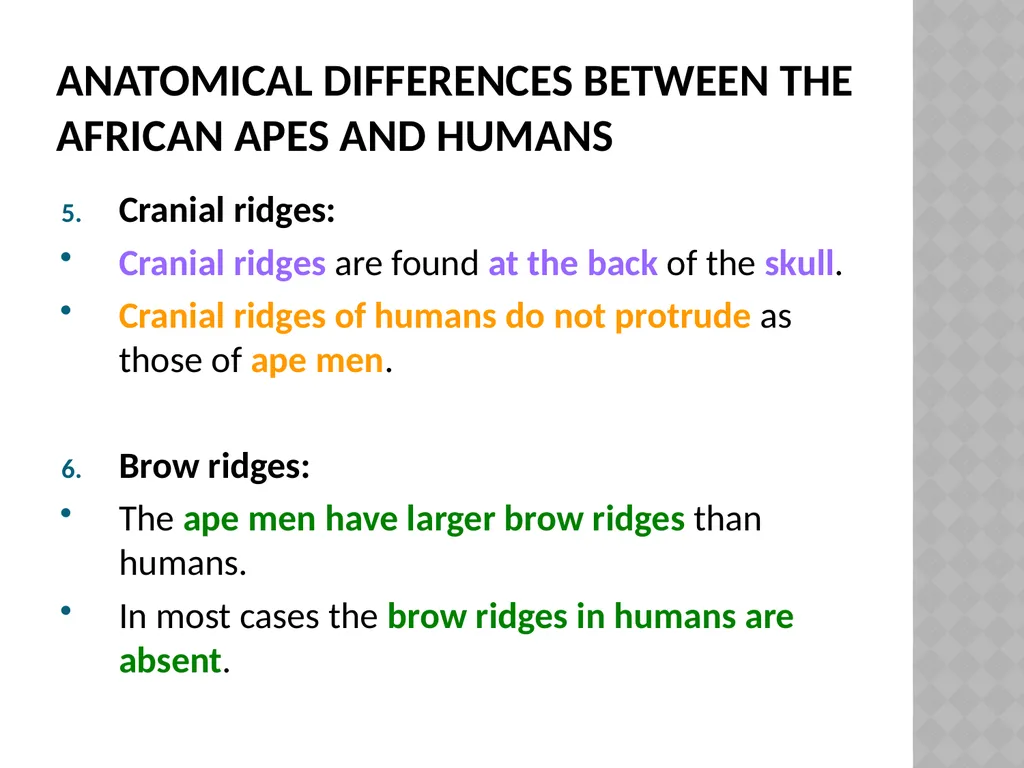
Anatomical Differences between the African Apes and Humans Cranial ridges:
Cranial ridges are found at the back of the skull.
Cranial ridges of humans do not protrude as those of ape men.
Brow ridges:
The ape men have larger brow ridges than humans.
In most cases the brow ridges in humans are absent.<br>
Cranial ridges are found at the back of the skull.
Cranial ridges of humans do not protrude as those of ape men.
Brow ridges:
The ape men have larger brow ridges than humans.
In most cases the brow ridges in humans are absent.<br>
54
Something for you to do:<br>
55
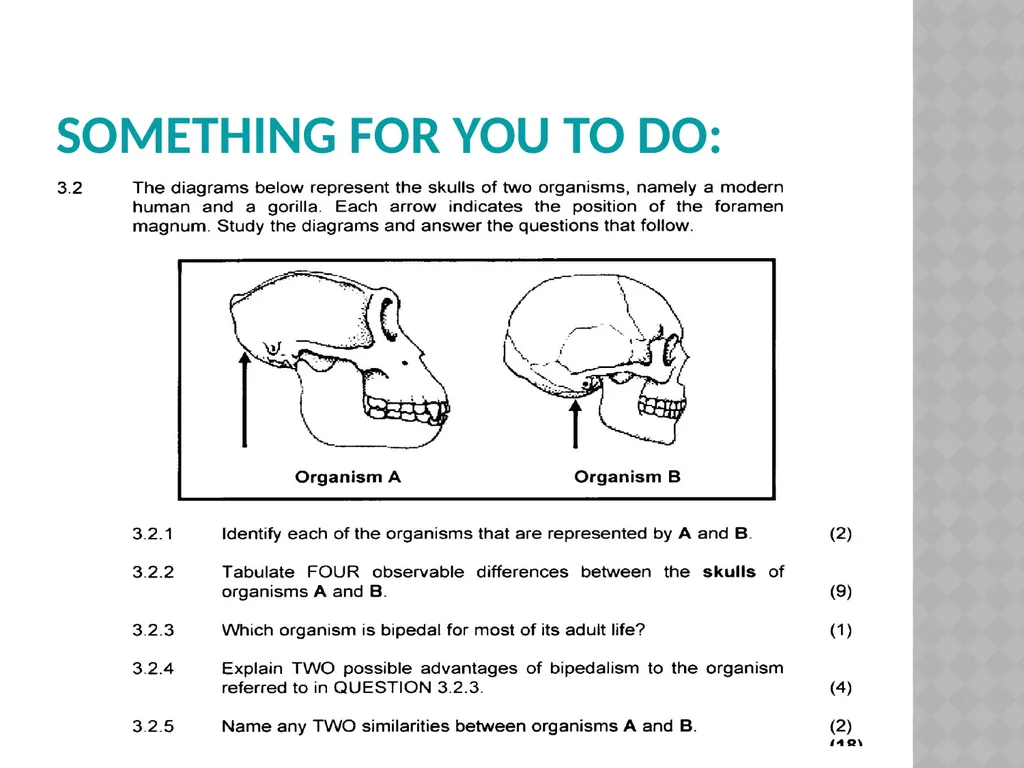
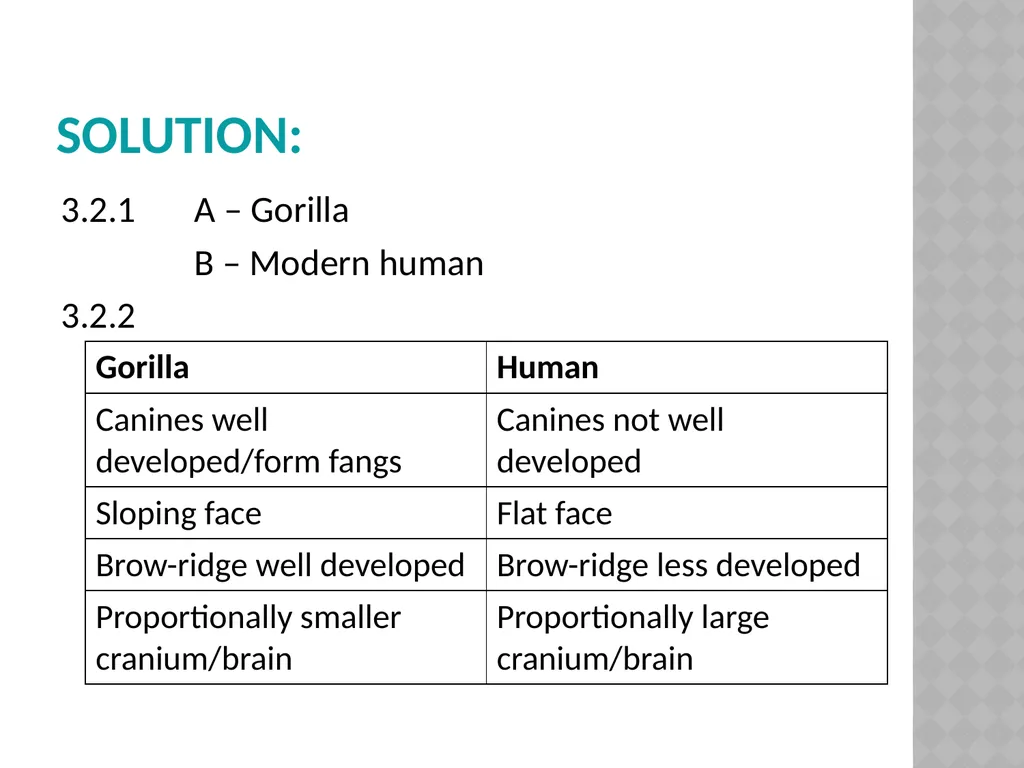
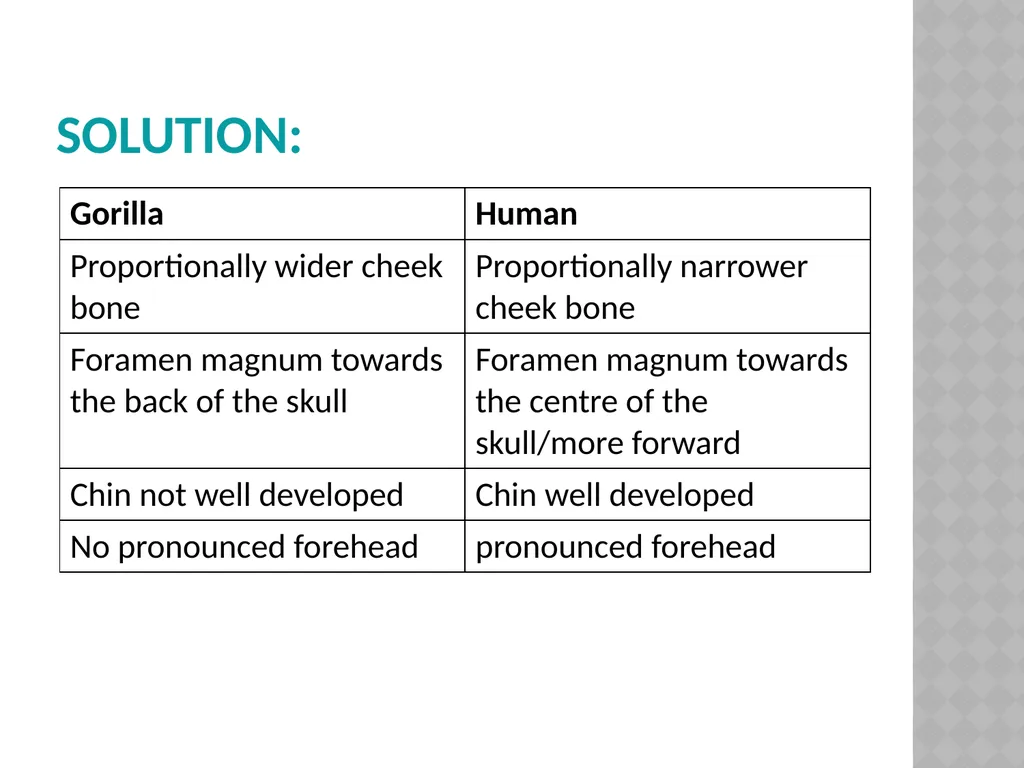
Solution: 3.2.1 A – Gorilla
B – Modern human
3.2.2<br>
B – Modern human
3.2.2<br>
56
Solution:<br>
57
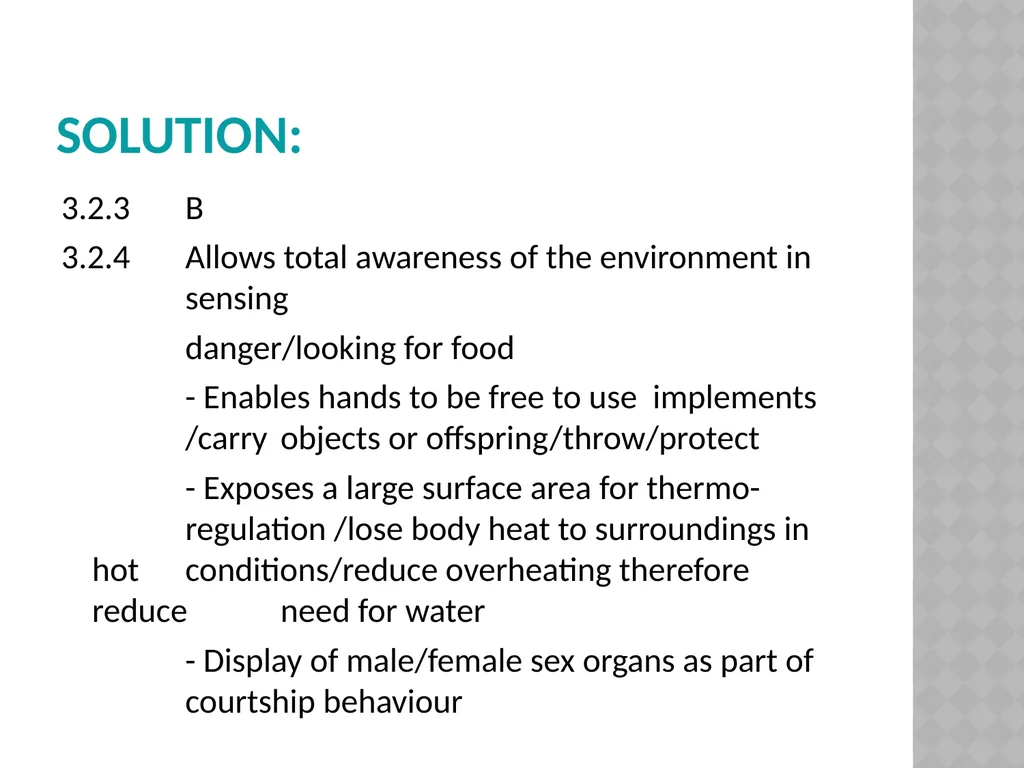
Solution: 3.2.3 B
3.2.4 Allows total awareness of the environment in sensing
danger/looking for food
- Enables hands to be free to use implements /carry objects or offspring/throw/protect
- Exposes a large surface area for thermo- regulation /lose body heat to surroundings in hot conditions/reduce overheating therefore reduce need for water
- Display of male/female sex organs as part of courtship behaviour<br>
3.2.4 Allows total awareness of the environment in sensing
danger/looking for food
- Enables hands to be free to use implements /carry objects or offspring/throw/protect
- Exposes a large surface area for thermo- regulation /lose body heat to surroundings in hot conditions/reduce overheating therefore reduce need for water
- Display of male/female sex organs as part of courtship behaviour<br>
58
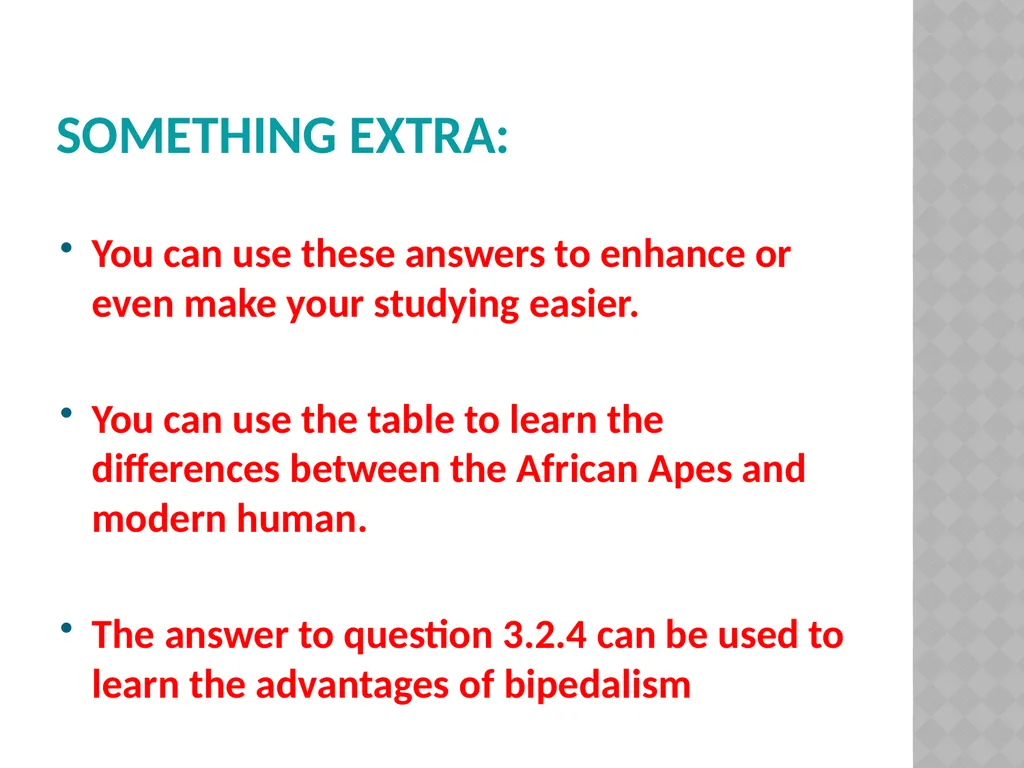
Something extra: You can use these answers to enhance or even make your studying easier.
You can use the table to learn the differences between the African Apes and modern human.
The answer to question 3.2.4 can be used to learn the advantages of bipedalism<br>
You can use the table to learn the differences between the African Apes and modern human.
The answer to question 3.2.4 can be used to learn the advantages of bipedalism<br>
59
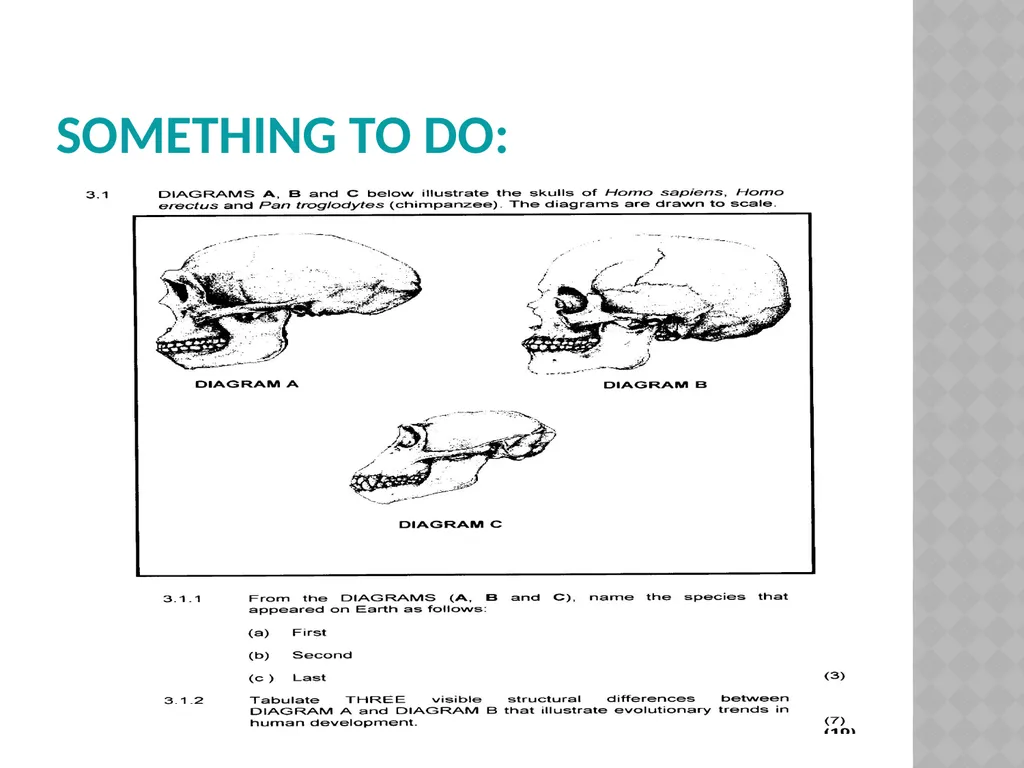
Something to do:<br>
60
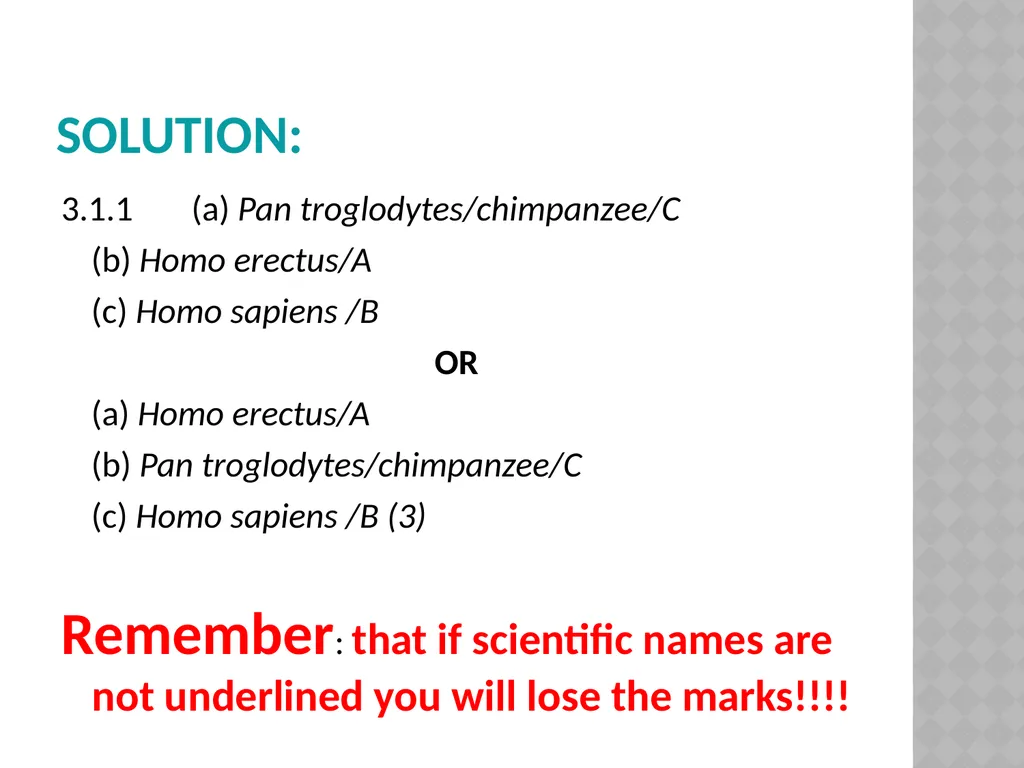
Solution: 3.1.1 (a) Pan troglodytes/chimpanzee/C
(b) Homo erectus/A
(c) Homo sapiens /B
OR
(a) Homo erectus/A
(b) Pan troglodytes/chimpanzee/C
(c) Homo sapiens /B (3)
Remember: that if scientific names are not underlined you will lose the marks!!!!<br>
(b) Homo erectus/A
(c) Homo sapiens /B
OR
(a) Homo erectus/A
(b) Pan troglodytes/chimpanzee/C
(c) Homo sapiens /B (3)
Remember: that if scientific names are not underlined you will lose the marks!!!!<br>
61
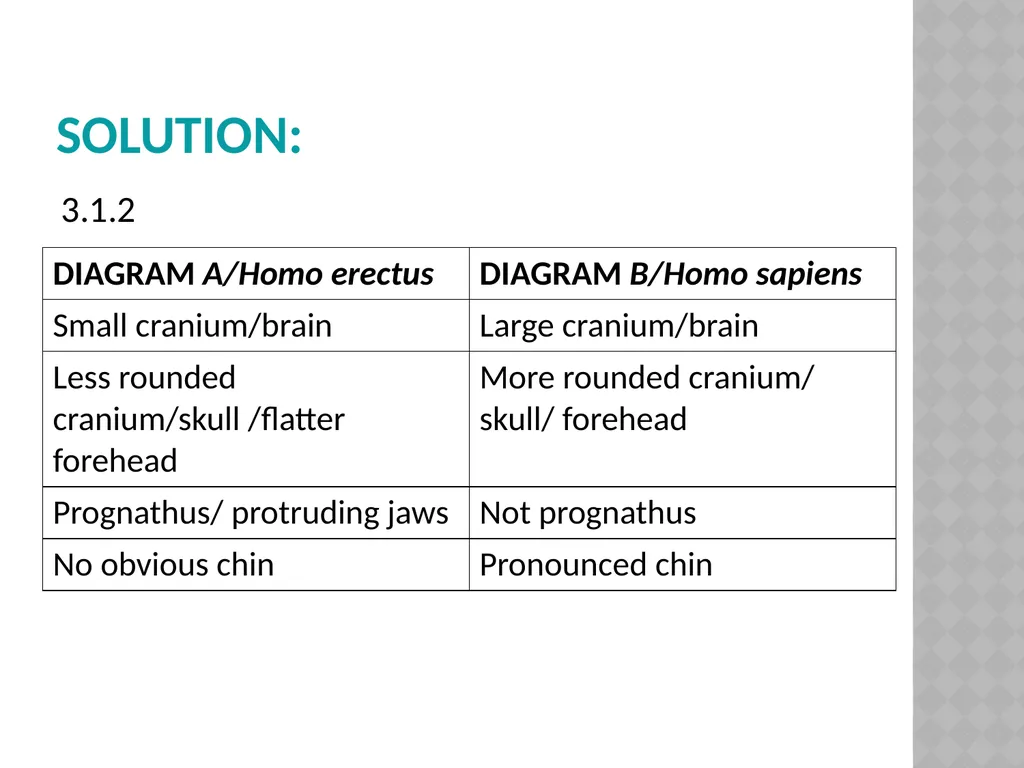
Solution: 3.1.2<br>
62
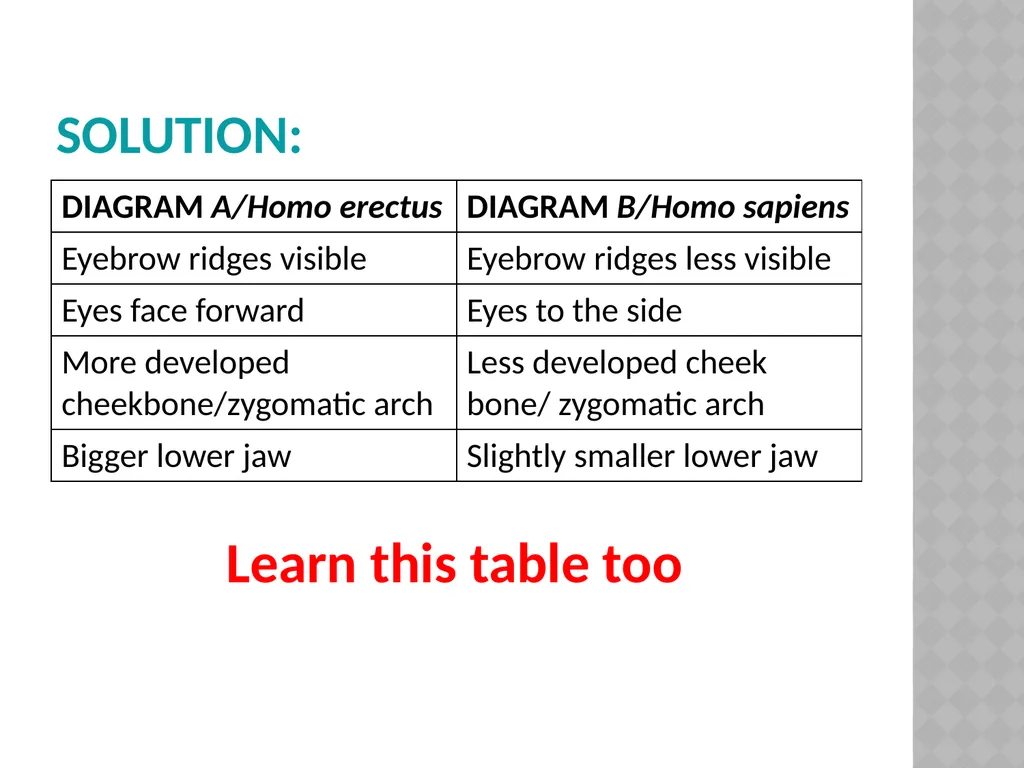
Solution: Learn this table too<br>
63
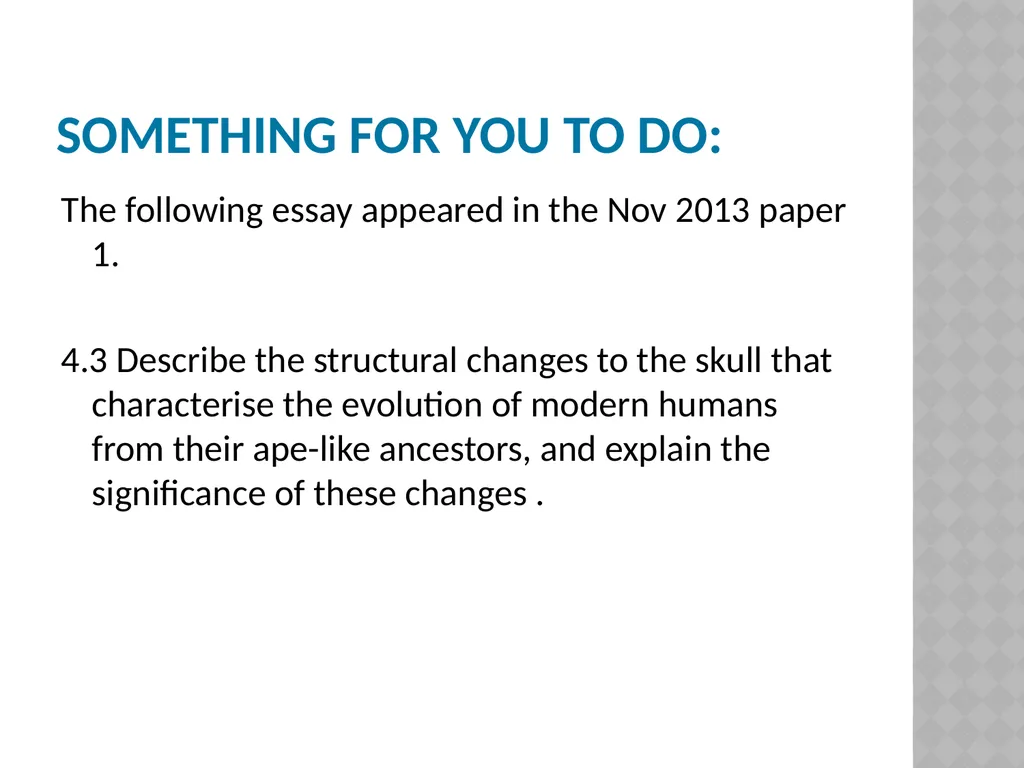
Something for you to do: The following essay appeared in the Nov 2013 paper 1.
4.3 Describe the structural changes to the skull that characterise the evolution of modern humans from their ape-like ancestors, and explain the significance of these changes .<br>
4.3 Describe the structural changes to the skull that characterise the evolution of modern humans from their ape-like ancestors, and explain the significance of these changes .<br>
64
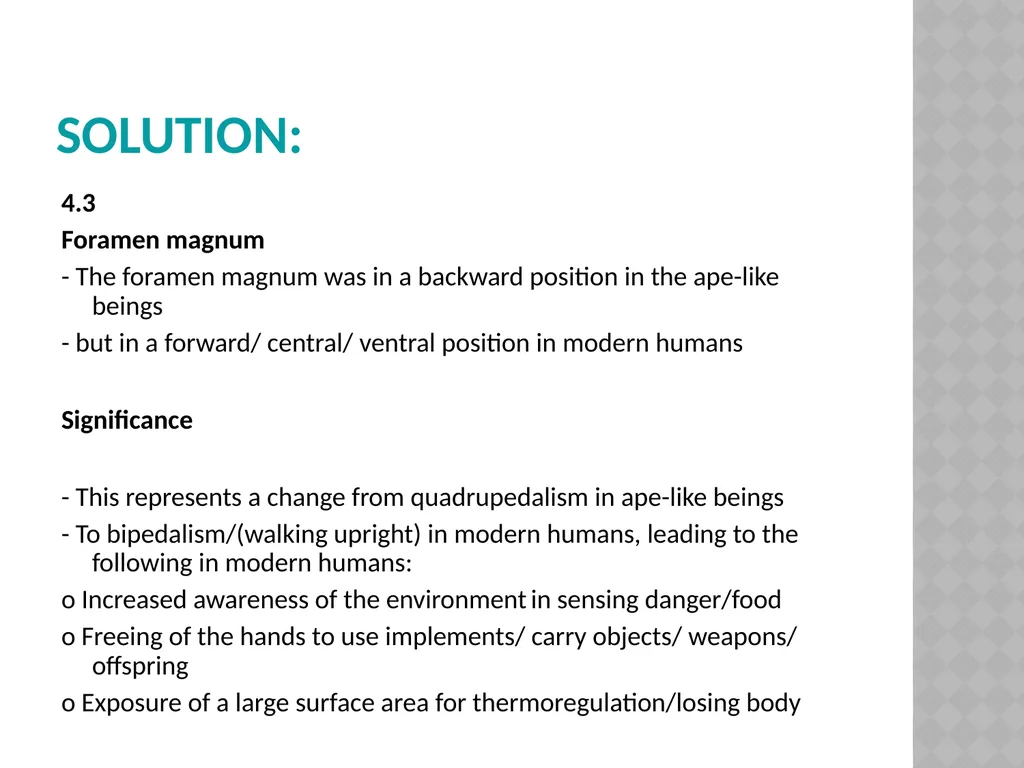
Solution: 4.3
Foramen magnum
- The foramen magnum was in a backward position in the ape-like beings
- but in a forward/ central/ ventral position in modern humans
Significance
- This represents a change from quadrupedalism in ape-like beings
- To bipedalism/(walking upright) in modern humans, leading to the following in modern humans:
o Increased awareness of the environment in sensing danger/food
o Freeing of the hands to use implements/ carry objects/ weapons/ offspring
o Exposure of a large surface area for thermoregulation/losing body<br>
Foramen magnum
- The foramen magnum was in a backward position in the ape-like beings
- but in a forward/ central/ ventral position in modern humans
Significance
- This represents a change from quadrupedalism in ape-like beings
- To bipedalism/(walking upright) in modern humans, leading to the following in modern humans:
o Increased awareness of the environment in sensing danger/food
o Freeing of the hands to use implements/ carry objects/ weapons/ offspring
o Exposure of a large surface area for thermoregulation/losing body<br>
65
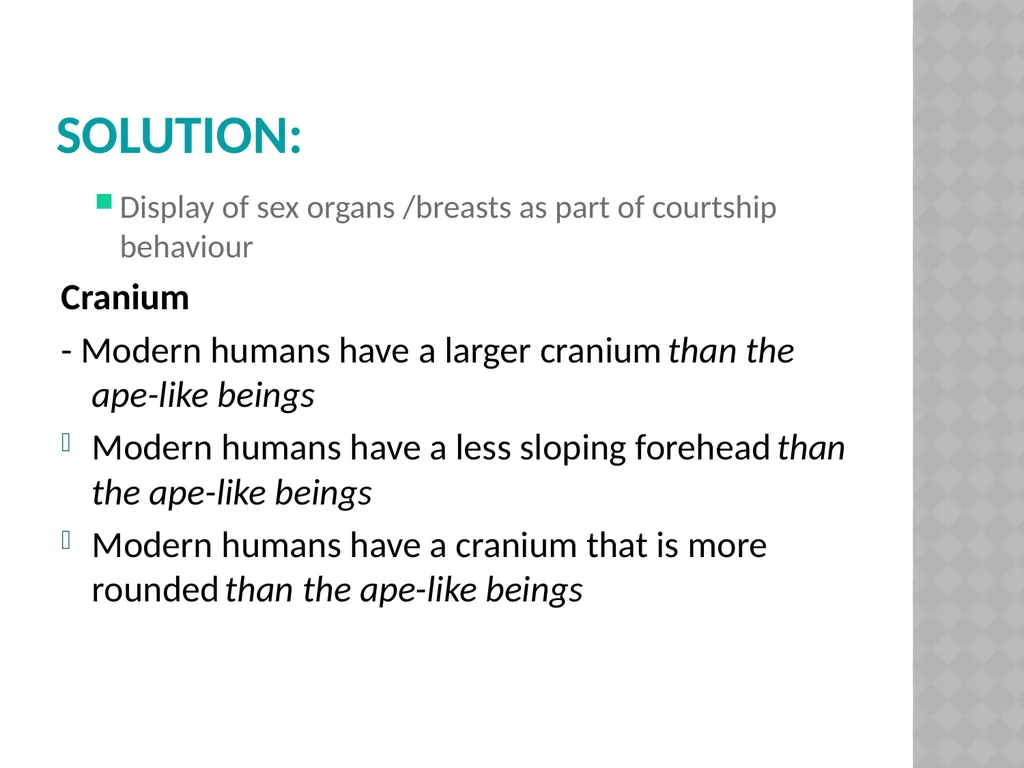
Solution: Display of sex organs /breasts as part of courtship behaviour
Cranium
- Modern humans have a larger cranium than the ape-like beings
Modern humans have a less sloping forehead than the ape-like beings
Modern humans have a cranium that is more rounded than the ape-like beings<br>
Cranium
- Modern humans have a larger cranium than the ape-like beings
Modern humans have a less sloping forehead than the ape-like beings
Modern humans have a cranium that is more rounded than the ape-like beings<br>
66
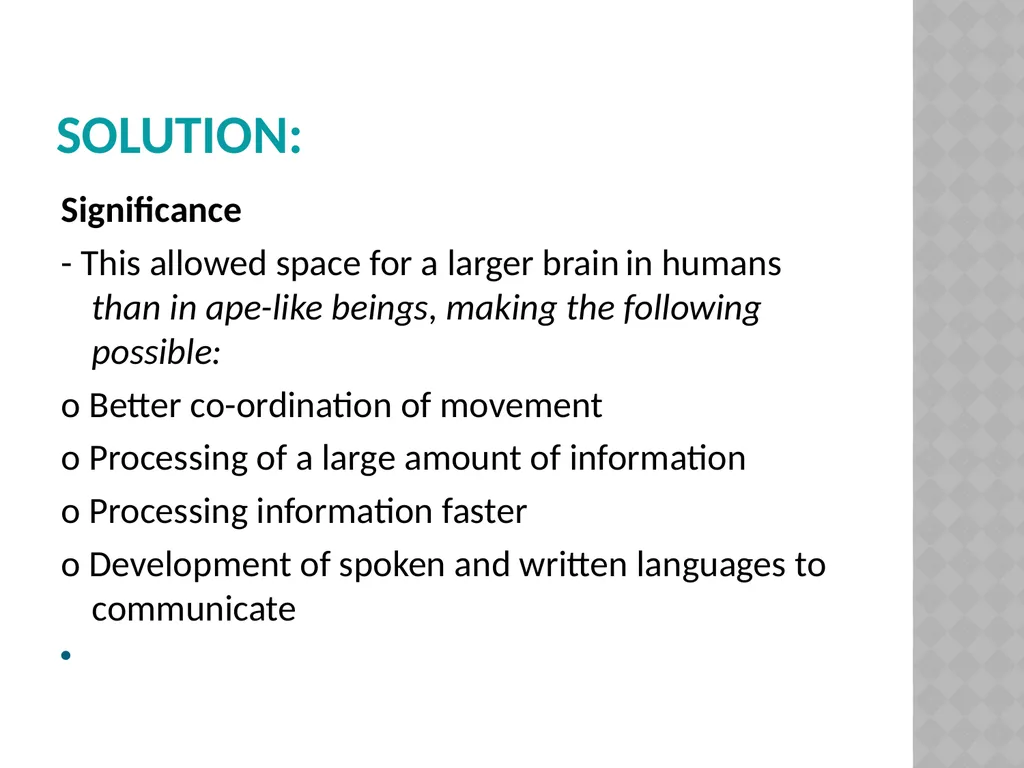
Solution: Significance
- This allowed space for a larger brain in humans than in ape-like beings, making the following possible:
o Better co-ordination of movement
o Processing of a large amount of information
o Processing information faster
o Development of spoken and written languages to communicate<br>
- This allowed space for a larger brain in humans than in ape-like beings, making the following possible:
o Better co-ordination of movement
o Processing of a large amount of information
o Processing information faster
o Development of spoken and written languages to communicate<br>
67
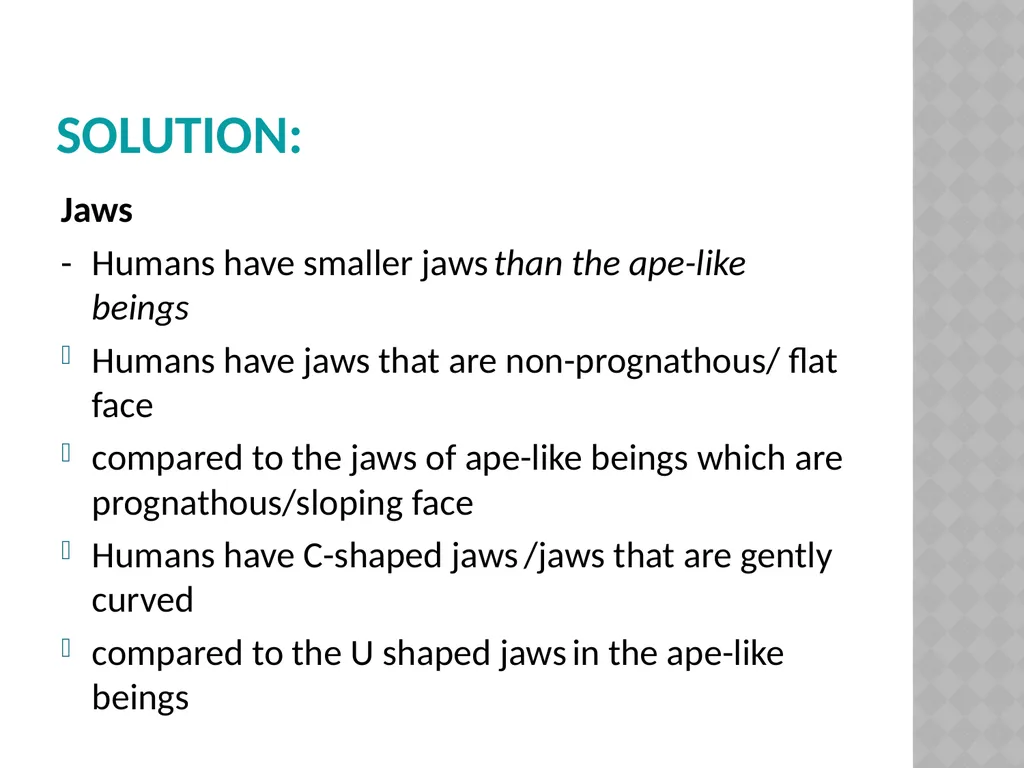
Solution: Jaws
- Humans have smaller jaws than the ape-like beings
Humans have jaws that are non-prognathous/ flat face
compared to the jaws of ape-like beings which are prognathous/sloping face
Humans have C-shaped jaws /jaws that are gently curved
compared to the U shaped jaws in the ape-like beings<br>
- Humans have smaller jaws than the ape-like beings
Humans have jaws that are non-prognathous/ flat face
compared to the jaws of ape-like beings which are prognathous/sloping face
Humans have C-shaped jaws /jaws that are gently curved
compared to the U shaped jaws in the ape-like beings<br>
68
Solution: Significance
This corresponds with a change in diet from hard, raw food in the ape- like beings
To softer, cooked foods in humans
Dentition/Teeth
- In ape-like beings there are gaps/diastema between incisors and canines
- but no gaps between the teeth in humans
- Humans have smaller teeth/incisors and canines than the ape-like beings
- Humans have flatter molars and pre-molars than the ape-like beings<br>
This corresponds with a change in diet from hard, raw food in the ape- like beings
To softer, cooked foods in humans
Dentition/Teeth
- In ape-like beings there are gaps/diastema between incisors and canines
- but no gaps between the teeth in humans
- Humans have smaller teeth/incisors and canines than the ape-like beings
- Humans have flatter molars and pre-molars than the ape-like beings<br>
69
Solution: Significance
- This corresponds with the decreased need to bite and tear
and an increased need to grind and chew in humans in view of the change in diet to soft, cooked food
Eyebrow ridges
- Humans have eyebrow ridges that are smaller than those of the ape-like beings
Significance
- There is a decreased need to strengthen the skull of humans
- due to the smaller size of the jaws<br>
- This corresponds with the decreased need to bite and tear
and an increased need to grind and chew in humans in view of the change in diet to soft, cooked food
Eyebrow ridges
- Humans have eyebrow ridges that are smaller than those of the ape-like beings
Significance
- There is a decreased need to strengthen the skull of humans
- due to the smaller size of the jaws<br>
70
Solution: Chin
- In humans the chin is more developed compared to the ape-like beings
Significance
- Developed chin assists with speech in humans
Zygomatic arch
- In humans the zygomatic arch/cheek bone is less developed than in the ape-like beings
Significance
- This corresponds with the decreased need for attachment of strong muscles
due to the decreased jaw size in humans<br>
- In humans the chin is more developed compared to the ape-like beings
Significance
- Developed chin assists with speech in humans
Zygomatic arch
- In humans the zygomatic arch/cheek bone is less developed than in the ape-like beings
Significance
- This corresponds with the decreased need for attachment of strong muscles
due to the decreased jaw size in humans<br>
71
Terminology: Hominid: refers to the group including modern humans, chimpanzees, gorillas and orangutans.
Hominin: refers to modern humans and all the extinct human species
Transitional fossils: refers to the immediate fossils between a group and their ancestor
Arboreal: refers to living in trees
Stereoscopic vision: refers to see the depth and solidity of objects
Binocular vision: the process of looking at an object with both eyes<br>
Hominin: refers to modern humans and all the extinct human species
Transitional fossils: refers to the immediate fossils between a group and their ancestor
Arboreal: refers to living in trees
Stereoscopic vision: refers to see the depth and solidity of objects
Binocular vision: the process of looking at an object with both eyes<br>
72
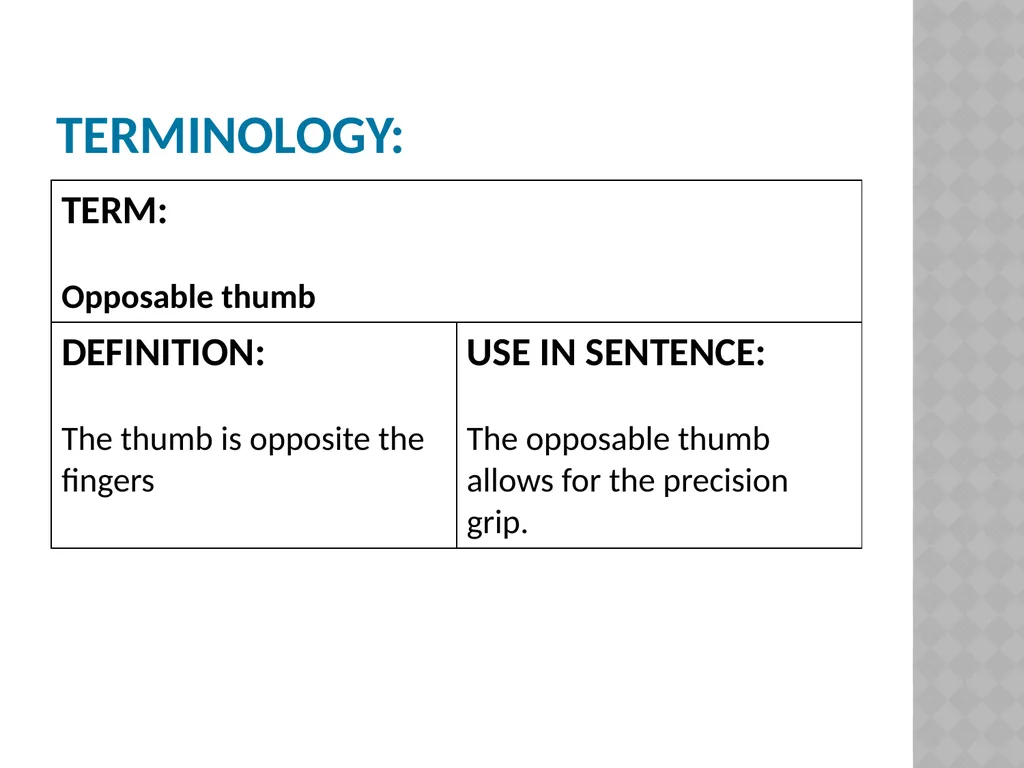
Terminology: Opposable thumb: the thumb is opposite the fingers
Bipedalism: refers to a type of locomotion where the animal moves on 2 hind legs in an upright position
Dentition: refers to the development of teeth and the way they are arranged in the mouth
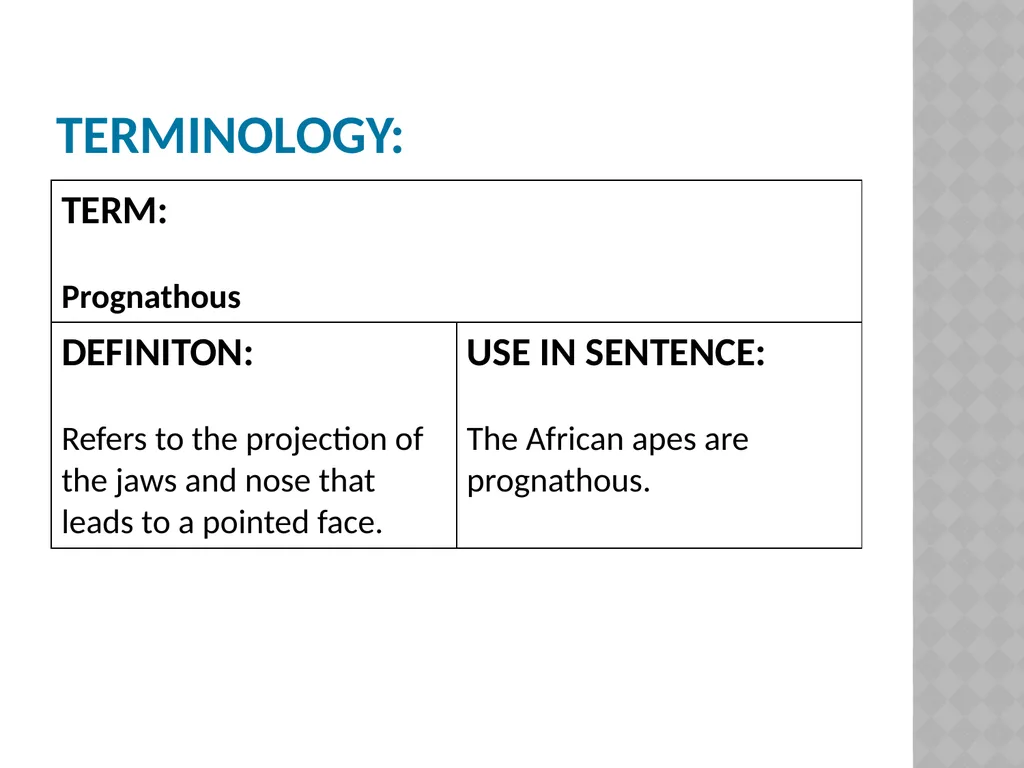
Prognathous: refers to the projection of the jaws and nose that leads to a pointed face.<br>
Bipedalism: refers to a type of locomotion where the animal moves on 2 hind legs in an upright position
Dentition: refers to the development of teeth and the way they are arranged in the mouth
Prognathous: refers to the projection of the jaws and nose that leads to a pointed face.<br>
73
QUESTION 1 Characteristic/s that humans share with other primates…
A. Opposable thumbs
B. Binocular vision
C. Both A and B
D. Neither A nor B<br>
A. Opposable thumbs
B. Binocular vision
C. Both A and B
D. Neither A nor B<br>
74
QUESTION 2 Homo habilis…
A. was called Handyman because he was a toolmaker.
B. had a larger brain capacity than Homo erectus.
C. was the first Homo species without brow ridges.
D. was the first Homo species to leave Africa.<br>
A. was called Handyman because he was a toolmaker.
B. had a larger brain capacity than Homo erectus.
C. was the first Homo species without brow ridges.
D. was the first Homo species to leave Africa.<br>
75
QUESTION 3 An opening on the primate skulls through which the spinal cord passes…
A. Foramen magnum
B. Vertebral column
C. Spine
D. Vertebrae<br>
A. Foramen magnum
B. Vertebral column
C. Spine
D. Vertebrae<br>
76
QUESTION 4 Capable of bipedal locomotion…
A. Homo erectus
B. Australopithecus africanus
C. Both A and B
D. Neither A nor B<br>
A. Homo erectus
B. Australopithecus africanus
C. Both A and B
D. Neither A nor B<br>
77
QUESTION 5 A branched diagram showing the evolutionary relationships between species…
A. Cladogram
B. Phylogenetic tree
C. Both A and B
D. Neither A nor B<br>
A. Cladogram
B. Phylogenetic tree
C. Both A and B
D. Neither A nor B<br>
78
QUESTION 6 The group consisting of modern humans, chimpanzee, gorillas and orangutans and all their ancestors is…
A. Hominid
B. Hominin
C. Both A and B
D. Neither A nor B<br>
A. Hominid
B. Hominin
C. Both A and B
D. Neither A nor B<br>
79
QUESTION 7 Australopithecus, Panantropus and Ardipithecus belong to…
A. Hominid
B. Hominin
C. Both A and B
D. Neither A nor B<br>
A. Hominid
B. Hominin
C. Both A and B
D. Neither A nor B<br>
80
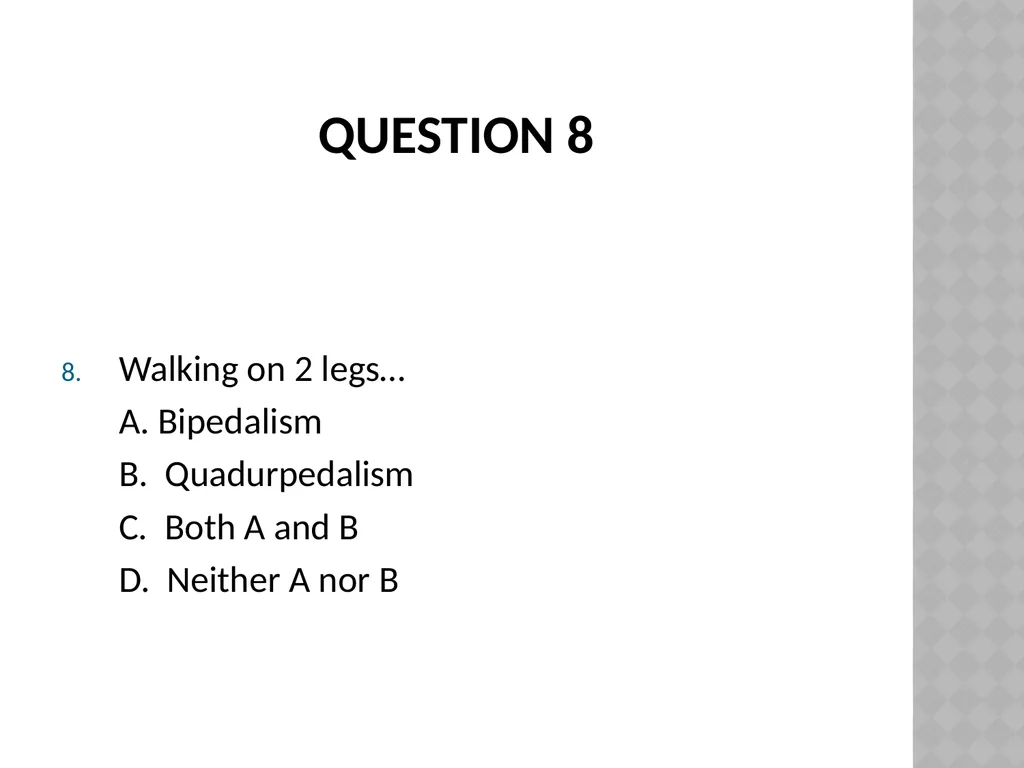
QUESTION 8 Walking on 2 legs…
A. Bipedalism
B. Quadurpedalism
C. Both A and B
D. Neither A nor B<br>
A. Bipedalism
B. Quadurpedalism
C. Both A and B
D. Neither A nor B<br>
81
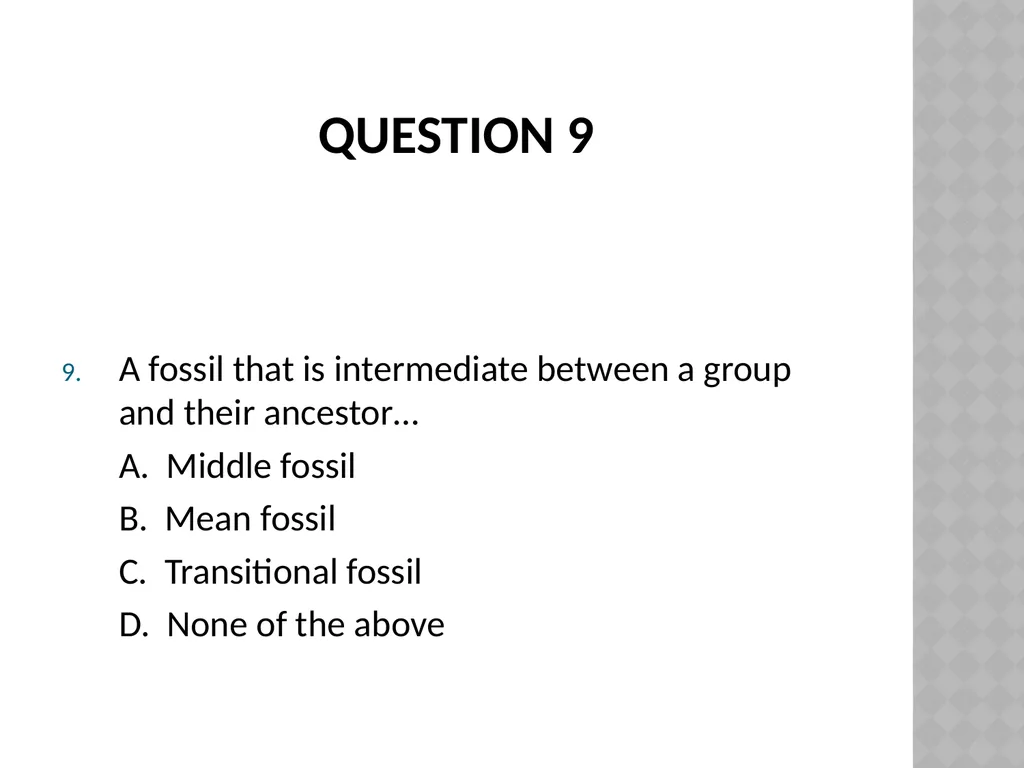
QUESTION 9 A fossil that is intermediate between a group and their ancestor…
A. Middle fossil
B. Mean fossil
C. Transitional fossil
D. None of the above<br>
A. Middle fossil
B. Mean fossil
C. Transitional fossil
D. None of the above<br>
82
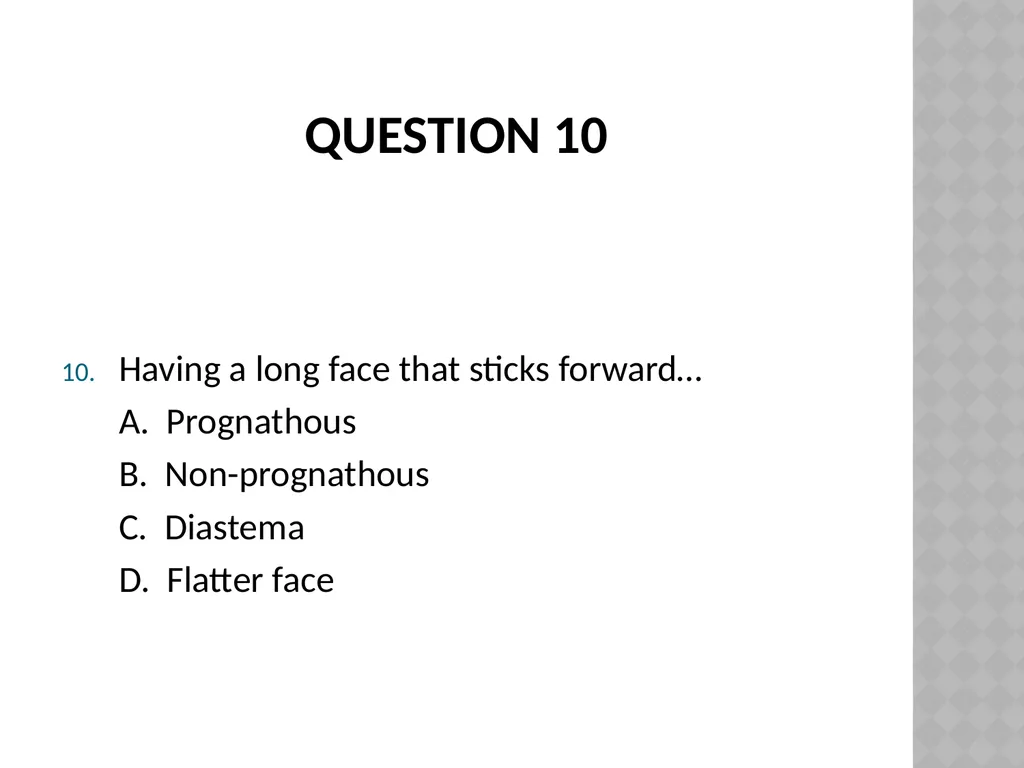
QUESTION 10 Having a long face that sticks forward…
A. Prognathous
B. Non-prognathous
C. Diastema
D. Flatter face<br>
A. Prognathous
B. Non-prognathous
C. Diastema
D. Flatter face<br>
83
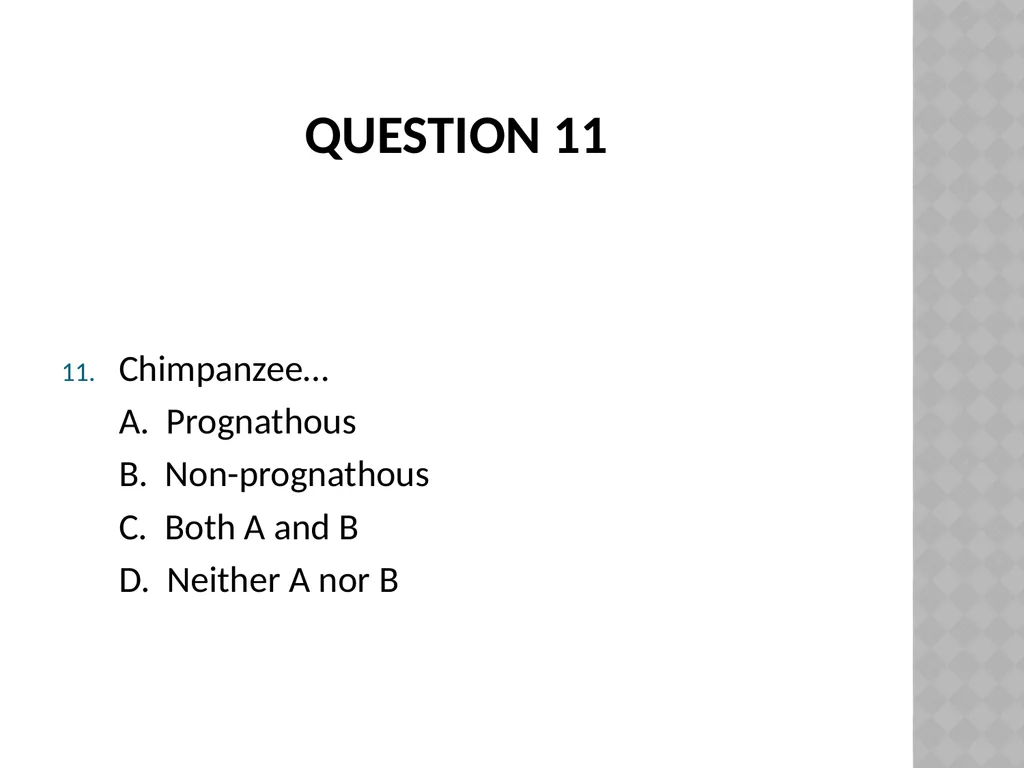
QUESTION 11 Chimpanzee…
A. Prognathous
B. Non-prognathous
C. Both A and B
D. Neither A nor B<br>
A. Prognathous
B. Non-prognathous
C. Both A and B
D. Neither A nor B<br>
84
QUESTION 12 Humans…
A. Prognathous
B. Non-prognathous
C. Both A and B
D. Neither A nor B<br>
A. Prognathous
B. Non-prognathous
C. Both A and B
D. Neither A nor B<br>
85
QUESTION 13 Structure or parts of the body…
A. Ancestor
B. Anatomy
C. Both A and B
D. Neither A nor B<br>
A. Ancestor
B. Anatomy
C. Both A and B
D. Neither A nor B<br>
86
QUESTION 14 U-shaped jaw…
A. Humans
B. Australopithecus
C. Both A and B
D. Neither A nor B<br>
A. Humans
B. Australopithecus
C. Both A and B
D. Neither A nor B<br>
87
QUESTION 15 Prominent brow ridges…
A. Humans
B. Australopithecus
C. Both A and B
D. Neither A nor B<br>
A. Humans
B. Australopithecus
C. Both A and B
D. Neither A nor B<br>
88
QUESTION 16 Absence of cranial ridges…
A. Humans
B. Australopithecus
C. Both A and B
D. Neither A nor B<br>
A. Humans
B. Australopithecus
C. Both A and B
D. Neither A nor B<br>
89
QUESTION 17 Binocular vision…
A. Humans
B. Australopithecus
C. Both A and B
D. Neither A nor B<br>
A. Humans
B. Australopithecus
C. Both A and B
D. Neither A nor B<br>
90
QUESTION 18 Altricial development…
A. Humans
B. Australopithecus
C. Both A and B
D. Neither A nor B<br>
A. Humans
B. Australopithecus
C. Both A and B
D. Neither A nor B<br>
91
QUESTION 19 Forward foramen magnum…
A. Humans
B. Australopithecus
C. Both A and B
D. Neither A nor B<br>
A. Humans
B. Australopithecus
C. Both A and B
D. Neither A nor B<br>
92
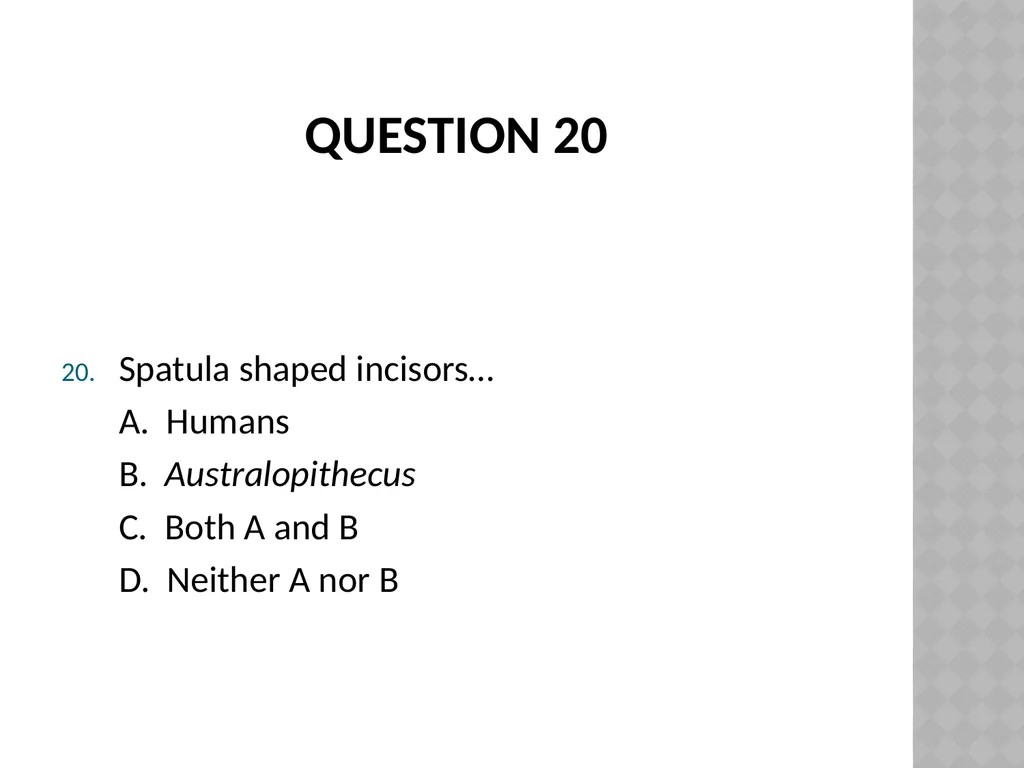
QUESTION 20 Spatula shaped incisors…
A. Humans
B. Australopithecus
C. Both A and B
D. Neither A nor B<br>
A. Humans
B. Australopithecus
C. Both A and B
D. Neither A nor B<br>
93
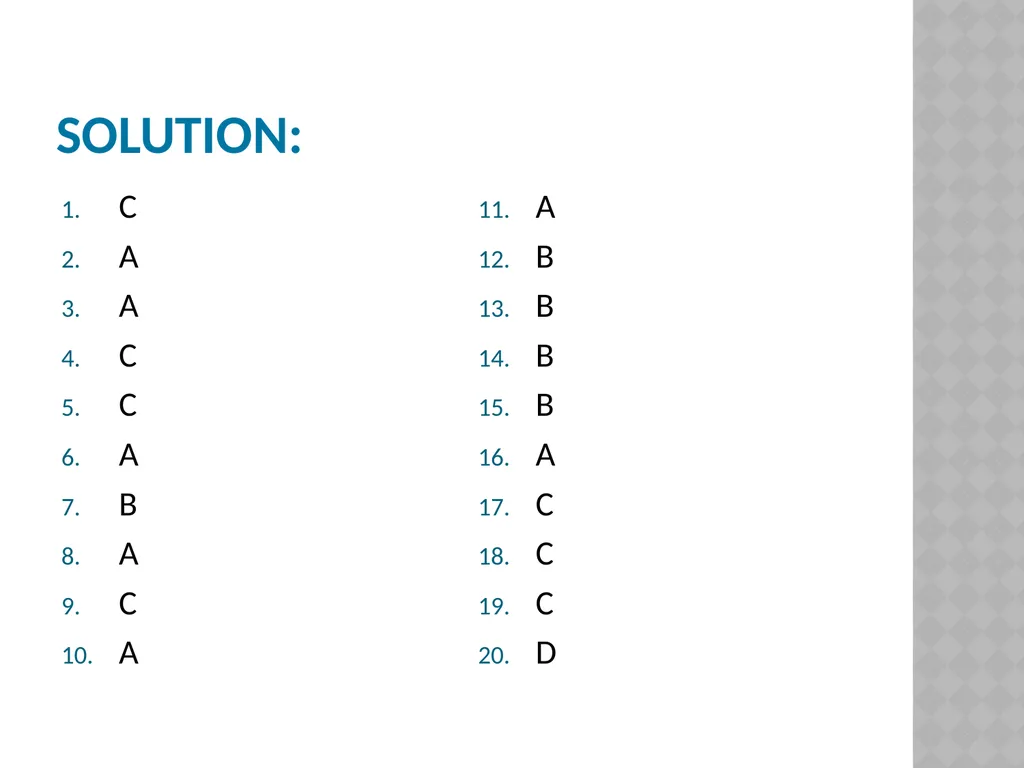
Solution: C
A
A
C
C
A
B
A
C
A A
B
B
B
B
A
C
C
C
D<br>
A
A
C
C
A
B
A
C
A A
B
B
B
B
A
C
C
C
D<br>