
LIFE-SPAN DEVELOPMENT 19e John W. Santrock ©
DP
Published · 47 slides · 0 views

1 / 1


Description
LIFE-SPAN DEVELOPMENT 19e John W. Santrock McGraw Hill LLC. All rights reserved. No reproduction or distribution without the prior written consent of McGraw Hill LLC. Chapter 6 Socioemotional Development in Infancy McGraw Hill LLC. All
Related Topics
Share
Embed code
Download this presentation From Below
"LIFE-SPAN DEVELOPMENT 19e John W. Santrock ©" is the property of its rightful owner. Permission is granted to download and print the materials on this website for personal, non-commercial use only, and to display it on your personal computer provided you do not modify the materials and that you retain all copyright notices contained in the materials. By downloading content from our website, you accept the terms of this agreement.
Presentation Transcript
01
LIFE-SPAN DEVELOPMENT 19e John W. Santrock © McGraw Hill LLC. All rights reserved. No reproduction or distribution without the prior written consent of McGraw Hill LLC.<br>
02
Chapter 6 Socioemotional Development in Infancy © McGraw Hill LLC. All rights reserved. No reproduction or distribution without the prior written consent of McGraw Hill LLC.<br>
03
Chapter Outline Emotional and Personality Development.
Social Orientation/Understanding and Attachment.
Social Contexts. 3<br>
Social Orientation/Understanding and Attachment.
Social Contexts. 3<br>
04
Emotional and Personality Development: Topics Emotional development.
Temperament.
Personality development. 4<br>
Temperament.
Personality development. 4<br>
05
Emotional Development 1 Emotion: the feeling, or affect, that occurs when a person is in a state or interaction that is important to self and well-being.
Characterized by behavior that reflects the pleasantness or unpleasantness of the state a person is in or the transactions being experienced.
Classified as positive or negative.
Plays an important role in:
Communication with others.
Behavioral organization. 5<br>
Characterized by behavior that reflects the pleasantness or unpleasantness of the state a person is in or the transactions being experienced.
Classified as positive or negative.
Plays an important role in:
Communication with others.
Behavioral organization. 5<br>
06
Emotional Development 2 Emotions influence infants’ social responses and adaptive behaviors as they interact with others in their world.
Infants communicate important aspects of their lives through joy, sadness, interest, and fear. 6<br>
Infants communicate important aspects of their lives through joy, sadness, interest, and fear. 6<br>
07
Emotional Development 3 Biological, cognitive, and environmental influences:
Certain brain regions play a role in emotions.
Cognitive processes influence infants’ and children’s emotional development.
Children learn cognitive strategies to control emotions and emotional arousal.
Emotion-linked interchanges provide the foundation for an infant’s developing attachment to the parent.
Relationships and culture provide diversity in emotional experiences. 7<br>
Certain brain regions play a role in emotions.
Cognitive processes influence infants’ and children’s emotional development.
Children learn cognitive strategies to control emotions and emotional arousal.
Emotion-linked interchanges provide the foundation for an infant’s developing attachment to the parent.
Relationships and culture provide diversity in emotional experiences. 7<br>
08
Emotional Development 4 Early emotions:
Primary emotions: those present in humans and other animals, emerging early in life.
Joy, anger, sadness, fear, and disgust.
Self-conscious emotions: require self-awareness, especially consciousness and a sense of “me.”
Jealousy, empathy, and embarrassment. 8<br>
Primary emotions: those present in humans and other animals, emerging early in life.
Joy, anger, sadness, fear, and disgust.
Self-conscious emotions: require self-awareness, especially consciousness and a sense of “me.”
Jealousy, empathy, and embarrassment. 8<br>
09
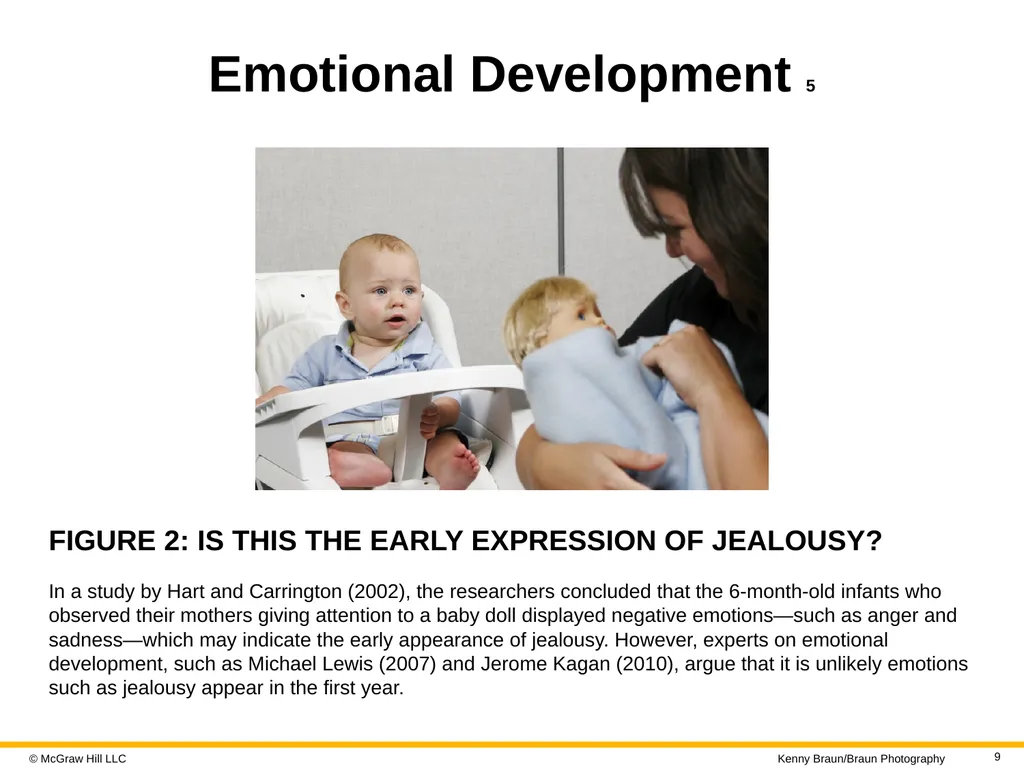
Emotional Development 5 FIGURE 2: IS THIS THE EARLY EXPRESSION OF JEALOUSY? In a study by Hart and Carrington (2002), the researchers concluded that the 6-month-old infants who observed their mothers giving attention to a baby doll displayed negative emotions—such as anger and sadness—which may indicate the early appearance of jealousy. However, experts on emotional development, such as Michael Lewis (2007) and Jerome Kagan (2010), argue that it is unlikely emotions such as jealousy appear in the first year. Kenny Braun/Braun Photography 9<br>
10
Emotional Development 6 Emotional expression and social relationships:
Crying is the most important mechanism newborns have for communicating.
Basic cry: a rhythmic pattern usually consisting of a cry, a briefer silence, a shorter whistle, then a rest before the next cry.
Anger cry: a variation of the basic cry, with more excess air forced through the vocal cords.
Pain cry: a sudden long, loud cry followed by breath holding. 10<br>
Crying is the most important mechanism newborns have for communicating.
Basic cry: a rhythmic pattern usually consisting of a cry, a briefer silence, a shorter whistle, then a rest before the next cry.
Anger cry: a variation of the basic cry, with more excess air forced through the vocal cords.
Pain cry: a sudden long, loud cry followed by breath holding. 10<br>
11
Emotional Development 7 Smiling is a key social signal and important to social interaction.
Reflexive smile: a smile that does not occur in response to external stimuli.
Usually appears in the first month, often during sleep.
Social smile: a smile in response to an external stimulus.
Occurs as early as 2 months of age, typically in response to a face.
The infant’s social smile can have a powerful impact on caregivers. 11<br>
Reflexive smile: a smile that does not occur in response to external stimuli.
Usually appears in the first month, often during sleep.
Social smile: a smile in response to an external stimulus.
Occurs as early as 2 months of age, typically in response to a face.
The infant’s social smile can have a powerful impact on caregivers. 11<br>
12
Emotional Development 8 Fear is one of babies’ earliest emotions.
The most frequent expression of fear is stranger anxiety: an infant’s fear and wariness of strangers.
Appears during the second half of the first year of life.
Separation protest: the distressed crying of an infant when the caregiver leaves. 12<br>
The most frequent expression of fear is stranger anxiety: an infant’s fear and wariness of strangers.
Appears during the second half of the first year of life.
Separation protest: the distressed crying of an infant when the caregiver leaves. 12<br>
13
Emotional Development 9 Emotion regulation and coping:
Infants develop an ability to inhibit, or minimize, the intensity and duration of emotional reactions.
Caregivers’ actions and contexts influence emotion regulation.
Soothing a crying infant helps the infant develop an adaptive emotion regulation, a sense of trust and secure attachment to the caregiver.
Infants with negative temperaments have fewer regulation strategies.
Depressed mothers rock and touch their crying infants less. 13<br>
Infants develop an ability to inhibit, or minimize, the intensity and duration of emotional reactions.
Caregivers’ actions and contexts influence emotion regulation.
Soothing a crying infant helps the infant develop an adaptive emotion regulation, a sense of trust and secure attachment to the caregiver.
Infants with negative temperaments have fewer regulation strategies.
Depressed mothers rock and touch their crying infants less. 13<br>
14
Temperament 1 Temperament: individual differences in behavioral styles, emotions, and characteristic ways of responding.
Researchers have described and classified the temperaments of individuals in several different ways. 14<br>
Researchers have described and classified the temperaments of individuals in several different ways. 14<br>
15
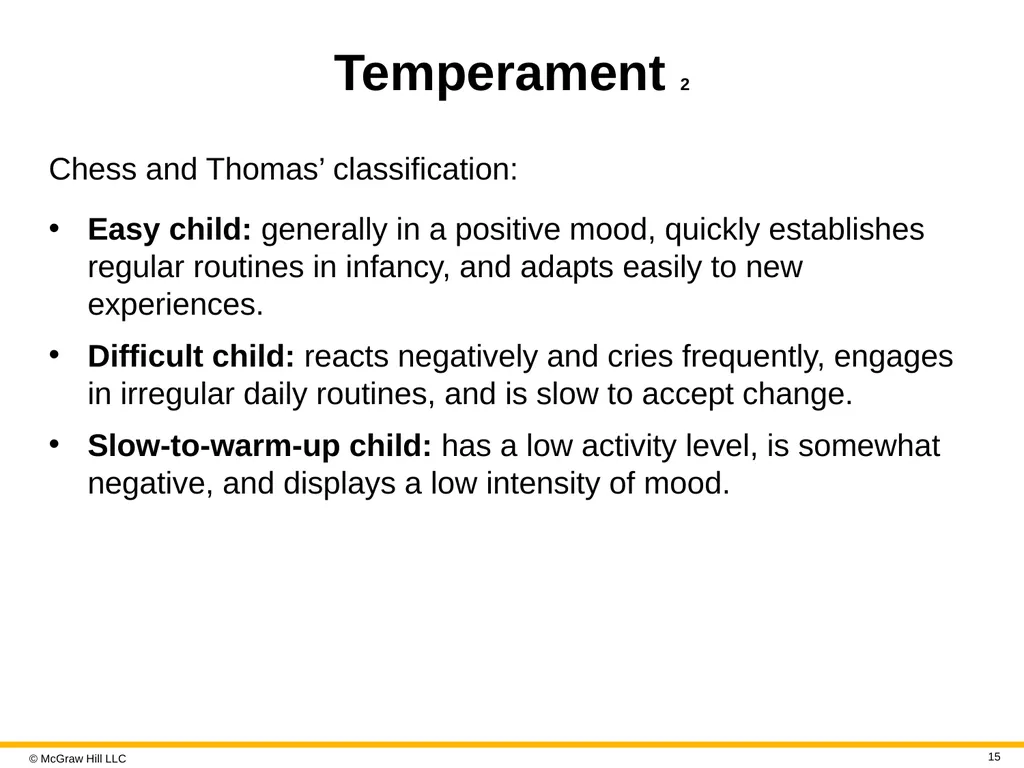
Temperament 2 Chess and Thomas’ classification:
Easy child: generally in a positive mood, quickly establishes regular routines in infancy, and adapts easily to new experiences.
Difficult child: reacts negatively and cries frequently, engages in irregular daily routines, and is slow to accept change.
Slow-to-warm-up child: has a low activity level, is somewhat negative, and displays a low intensity of mood. 15<br>
Easy child: generally in a positive mood, quickly establishes regular routines in infancy, and adapts easily to new experiences.
Difficult child: reacts negatively and cries frequently, engages in irregular daily routines, and is slow to accept change.
Slow-to-warm-up child: has a low activity level, is somewhat negative, and displays a low intensity of mood. 15<br>
16
Temperament 3 Kagan’s behavioral inhibition:
Focuses on differences between a shy, subdued, timid child—an inhibited child—and the sociable, extraverted, bold child.
Inhibited children react to many aspects of unfamiliarity with initial avoidance, distress, or subdued affect. 16<br>
Focuses on differences between a shy, subdued, timid child—an inhibited child—and the sociable, extraverted, bold child.
Inhibited children react to many aspects of unfamiliarity with initial avoidance, distress, or subdued affect. 16<br>
17
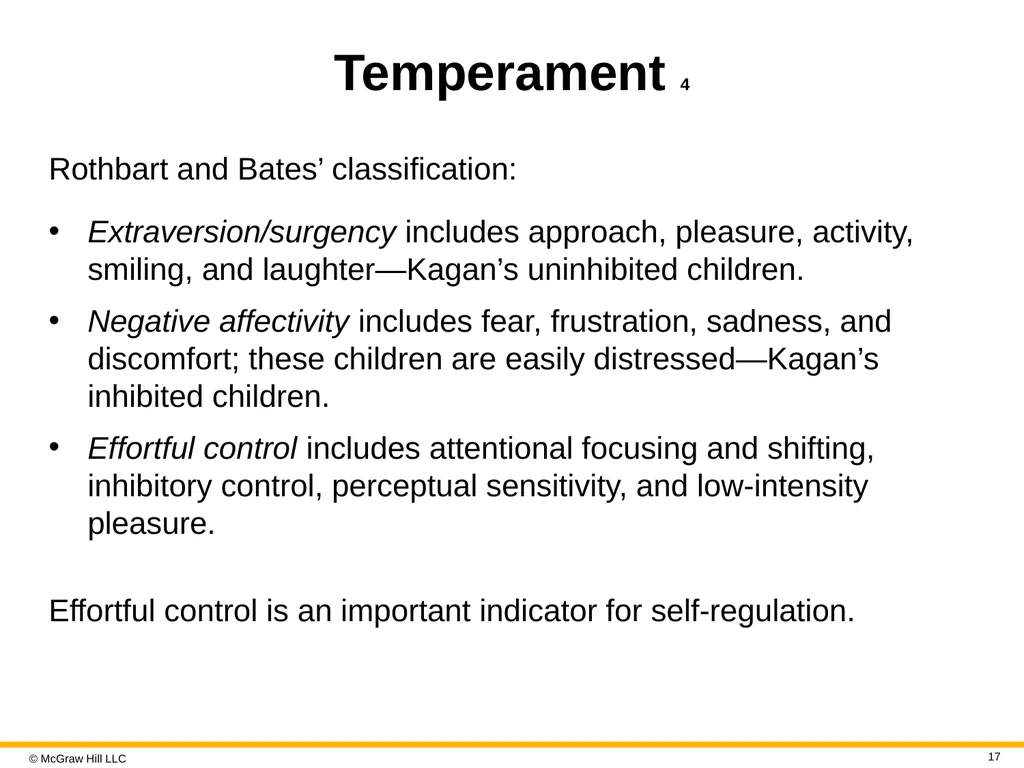
Temperament 4 Rothbart and Bates’ classification:
Extraversion/surgency includes approach, pleasure, activity, smiling, and laughter—Kagan’s uninhibited children.
Negative affectivity includes fear, frustration, sadness, and discomfort; these children are easily distressed—Kagan’s inhibited children.
Effortful control includes attentional focusing and shifting, inhibitory control, perceptual sensitivity, and low-intensity pleasure.
Effortful control is an important indicator for self-regulation. 17<br>
Extraversion/surgency includes approach, pleasure, activity, smiling, and laughter—Kagan’s uninhibited children.
Negative affectivity includes fear, frustration, sadness, and discomfort; these children are easily distressed—Kagan’s inhibited children.
Effortful control includes attentional focusing and shifting, inhibitory control, perceptual sensitivity, and low-intensity pleasure.
Effortful control is an important indicator for self-regulation. 17<br>
18
Temperament 5 Biological foundations and experience:
The contemporary view is that temperament is a biologically based but evolving aspect of behavior.
Gender, culture, and temperament:
Parents may react differently to an infant’s temperament depending on gender.
Caregivers’ reactions may also depend in part on culture—where behavioral inhibition is more valued in China, for example, than in North America. 18<br>
The contemporary view is that temperament is a biologically based but evolving aspect of behavior.
Gender, culture, and temperament:
Parents may react differently to an infant’s temperament depending on gender.
Caregivers’ reactions may also depend in part on culture—where behavioral inhibition is more valued in China, for example, than in North America. 18<br>
19
Temperament 6 Goodness of fit: the match between a child’s temperament and the environmental demands with which the child must cope.
The recent differential susceptibility model and biological sensitivity to context model both reveal:
Certain characteristics make children more vulnerable to setbacks in adverse contexts.
These same characteristics also make them more susceptible to optimal growth in very supportive conditions. 19<br>
The recent differential susceptibility model and biological sensitivity to context model both reveal:
Certain characteristics make children more vulnerable to setbacks in adverse contexts.
These same characteristics also make them more susceptible to optimal growth in very supportive conditions. 19<br>
20
Personality Development 1 Trust and the development of self and independence are often seen as central to personality development in infancy.
According to Erikson, the stage of the first year of life is trust-versus-mistrust—an issue that arises again at each successive stage of development.
Infants begin to develop a self-understanding called self-recognition at about 18 months of age.
Later forms reflect a sense of “me.”
Independence becomes important in the second year, in Erikson’s stage of autonomy versus shame and doubt.
Autonomy builds as mental and motor abilities develop. 20<br>
According to Erikson, the stage of the first year of life is trust-versus-mistrust—an issue that arises again at each successive stage of development.
Infants begin to develop a self-understanding called self-recognition at about 18 months of age.
Later forms reflect a sense of “me.”
Independence becomes important in the second year, in Erikson’s stage of autonomy versus shame and doubt.
Autonomy builds as mental and motor abilities develop. 20<br>
21
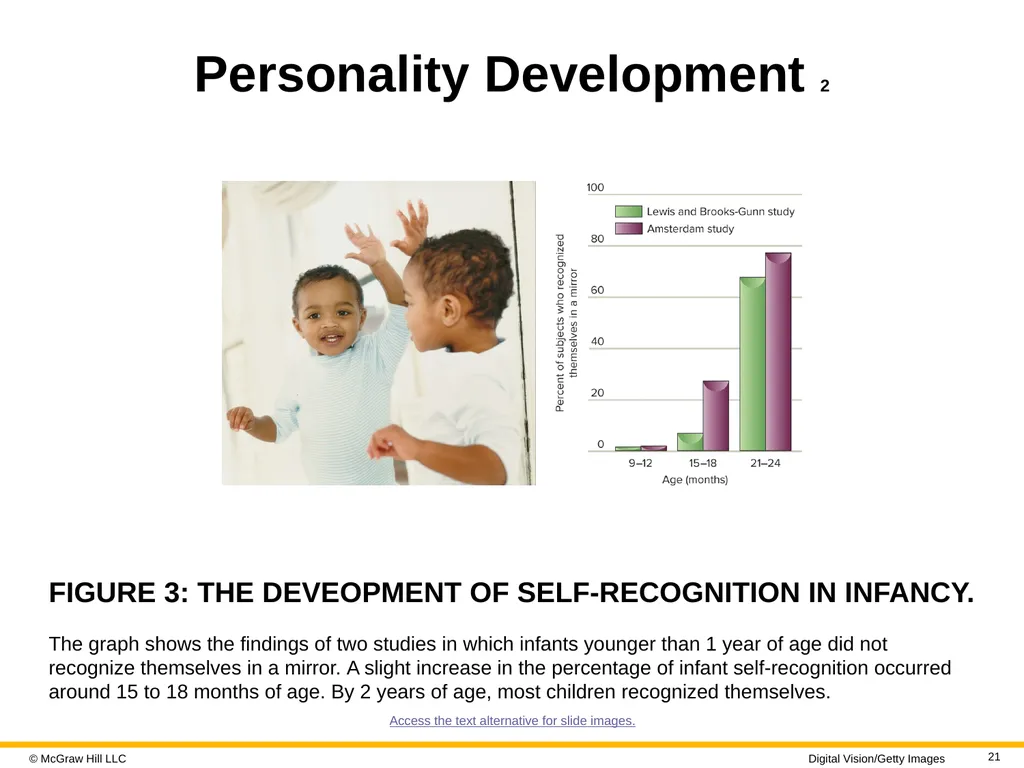
Personality Development 2 FIGURE 3: THE DEVEOPMENT OF SELF-RECOGNITION IN INFANCY. The graph shows the findings of two studies in which infants younger than 1 year of age did not recognize themselves in a mirror. A slight increase in the percentage of infant self-recognition occurred around 15 to 18 months of age. By 2 years of age, most children recognized themselves. Access the text alternative for slide images. Digital Vision/Getty Images 21<br>
22
Social Orientation/Understanding and Attachment: Topics Social orientation/understanding.
Attachment and its development.
Individual differences in attachment.
Caregiving styles and attachment.
Developmental social neuroscience and attachment. 22<br>
Attachment and its development.
Individual differences in attachment.
Caregiving styles and attachment.
Developmental social neuroscience and attachment. 22<br>
23
Social Orientation/Understanding 1 From early in their development, infants are captivated by the social world, especially facial expressions and voices.
Face-to-face play starts at 2 to 3 months of age, with vocalizations, touch, and gestures.
Responses to people and objects are different.
Between 18 and 24 months, with increasing peer interaction, children markedly increase imitative and reciprocal play.
Locomotion skills allow infants to independently initiate social interchanges, increasing independence.
The ability to move in goal-directed pursuits leads to further efforts to explore and develop skills. 23<br>
Face-to-face play starts at 2 to 3 months of age, with vocalizations, touch, and gestures.
Responses to people and objects are different.
Between 18 and 24 months, with increasing peer interaction, children markedly increase imitative and reciprocal play.
Locomotion skills allow infants to independently initiate social interchanges, increasing independence.
The ability to move in goal-directed pursuits leads to further efforts to explore and develop skills. 23<br>
24
Social Orientation/Understanding 2 Infants are more socially sophisticated and insightful at younger ages than was previously envisioned.
Intention, goal-directed behavior, and meaningful interactions with others begin to occur toward the end of the first year.
Joint attention and gaze-following help the infant understand that other people have intentions.
By 11 months old, babies understand others and make appropriate social responses.
Social referencing: “reading” emotional cues in others to help determine how to act in a particular situation. 24<br>
Intention, goal-directed behavior, and meaningful interactions with others begin to occur toward the end of the first year.
Joint attention and gaze-following help the infant understand that other people have intentions.
By 11 months old, babies understand others and make appropriate social responses.
Social referencing: “reading” emotional cues in others to help determine how to act in a particular situation. 24<br>
25
Attachment and Its Development 1 Attachment: a close emotional bond between two people.
Freud: infants become attached to the person who provides oral satisfaction.
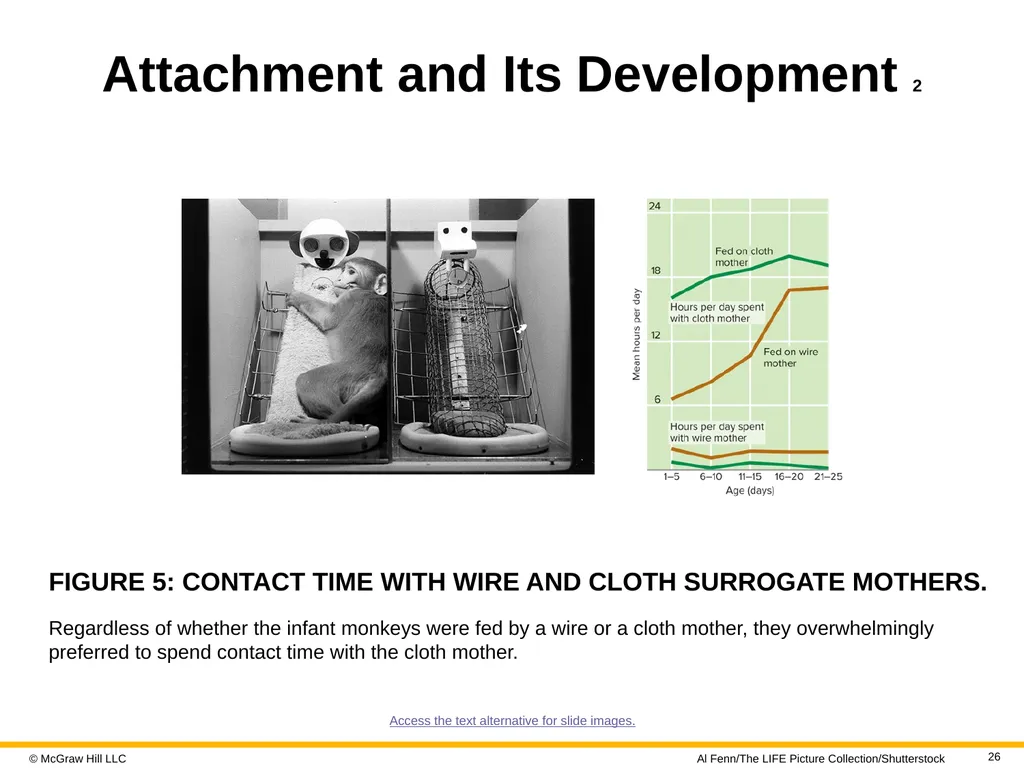
Harlow: contact comfort is preferred over food.
Erikson: trust arises from physical comfort and sensitive care. 25<br>
Freud: infants become attached to the person who provides oral satisfaction.
Harlow: contact comfort is preferred over food.
Erikson: trust arises from physical comfort and sensitive care. 25<br>
26
Attachment and Its Development 2 FIGURE 5: CONTACT TIME WITH WIRE AND CLOTH SURROGATE MOTHERS. Regardless of whether the infant monkeys were fed by a wire or a cloth mother, they overwhelmingly preferred to spend contact time with the cloth mother. Access the text alternative for slide images. Al Fenn/The LIFE Picture Collection/Shutterstock 26<br>
27
Attachment and Its Development 3 Bowlby’s four phases of attachment:
Phase 1: From birth to 2 months: infants direct their attachment to human figures.
Phase 2: From 2 to 7 months: attachment becomes focused on one figure (primary caregiver).
Phase 3: From 7 to 27 months: specific attachments develop. With increased locomotion, babies actively seek contact with regular caregivers.
Phase 4: From 24 months on: children become aware of others’ feelings and goals and account for them in their own actions.
Bowlby argued that infants develop an internal working model of attachment. 27<br>
Phase 1: From birth to 2 months: infants direct their attachment to human figures.
Phase 2: From 2 to 7 months: attachment becomes focused on one figure (primary caregiver).
Phase 3: From 7 to 27 months: specific attachments develop. With increased locomotion, babies actively seek contact with regular caregivers.
Phase 4: From 24 months on: children become aware of others’ feelings and goals and account for them in their own actions.
Bowlby argued that infants develop an internal working model of attachment. 27<br>
28
Individual Differences in Attachment 1 Strange Situation: an observational measure of infant attachment, created by Mary Ainsworth.
The infant moves through a series of introductions, separations, and reunions with the caregiver and an adult stranger in prescribed order.
Based on how babies respond in the Strange Situation, they are described as being securely attached or insecurely attached to the caregiver. 28<br>
The infant moves through a series of introductions, separations, and reunions with the caregiver and an adult stranger in prescribed order.
Based on how babies respond in the Strange Situation, they are described as being securely attached or insecurely attached to the caregiver. 28<br>
29
Individual Differences in Attachment 2 Securely attached babies: use the caregiver as a secure base from which to explore the environment.
Insecure avoidant babies: show insecurity by avoiding the caregiver.
Insecure resistant babies: cling to the caregiver, then resist the caregiver by fighting against the closeness.
Insecure disorganized babies: appear disoriented, showing strong patterns of avoidance and resistance. 29<br>
Insecure avoidant babies: show insecurity by avoiding the caregiver.
Insecure resistant babies: cling to the caregiver, then resist the caregiver by fighting against the closeness.
Insecure disorganized babies: appear disoriented, showing strong patterns of avoidance and resistance. 29<br>
30
Individual Differences in Attachment 3 Evaluating the Strange Situation:
It may be culturally biased.
Example: Compared to U.S. infants, German infants are more likely to show an avoidant attachment pattern, and Japanese infants are less likely to display this pattern.
Regardless of cultural variations, the most frequent classification in every culture studied so far is secure attachment. 30<br>
It may be culturally biased.
Example: Compared to U.S. infants, German infants are more likely to show an avoidant attachment pattern, and Japanese infants are less likely to display this pattern.
Regardless of cultural variations, the most frequent classification in every culture studied so far is secure attachment. 30<br>
31
Individual Differences in Attachment 4 Interpreting differences:
For some children, early attachments seem to foreshadow later functioning.
Research links secure attachment to positive emotional health, social competence with peers, and better resilience.
Insecure attachment to both mother and father (“double-insecure”) may lead to more externalizing problems. 31<br>
For some children, early attachments seem to foreshadow later functioning.
Research links secure attachment to positive emotional health, social competence with peers, and better resilience.
Insecure attachment to both mother and father (“double-insecure”) may lead to more externalizing problems. 31<br>
32
Individual Differences in Attachment 5 Criticisms of attachment theory:
Results of some studies refute the idea that infancy is a critical or sensitive period for the influence of attachment.
Consistently positive caregiving is likely key.
Developmental cascade model: connections across domains over time influence developmental pathways and outcomes.
Some argue secure attachment does not adequately consider certain biological factors, such as genes and temperament.
Another criticism is that the theory ignores the diversity of socializing agents and contexts in infants’ worlds. 32<br>
Results of some studies refute the idea that infancy is a critical or sensitive period for the influence of attachment.
Consistently positive caregiving is likely key.
Developmental cascade model: connections across domains over time influence developmental pathways and outcomes.
Some argue secure attachment does not adequately consider certain biological factors, such as genes and temperament.
Another criticism is that the theory ignores the diversity of socializing agents and contexts in infants’ worlds. 32<br>
33
Caregiving Styles and Attachment Caregivers’ sensitivity is linked to secure attachment.
Consistently available to respond to infants’ needs.
Often let babies have an active part in determining the onset and pacing of interaction in the first year of life.
Caregivers of avoidant babies tend to be unavailable and rejecting.
Caregivers of resistant babies tend to be inconsistent and tend not to be very affectionate.
Caregivers of disorganized babies often neglect or physically abuse them.
In some cases, these individuals are depressed. 33<br>
Consistently available to respond to infants’ needs.
Often let babies have an active part in determining the onset and pacing of interaction in the first year of life.
Caregivers of avoidant babies tend to be unavailable and rejecting.
Caregivers of resistant babies tend to be inconsistent and tend not to be very affectionate.
Caregivers of disorganized babies often neglect or physically abuse them.
In some cases, these individuals are depressed. 33<br>
34
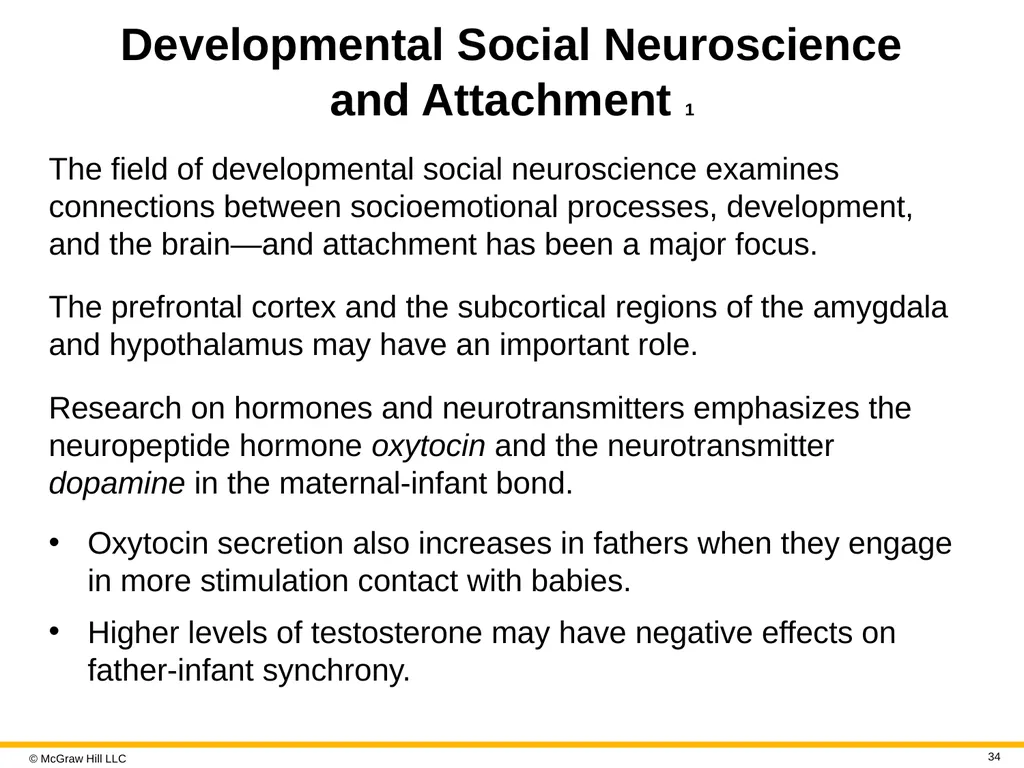
Developmental Social Neuroscience and Attachment 1 The field of developmental social neuroscience examines connections between socioemotional processes, development, and the brain—and attachment has been a major focus.
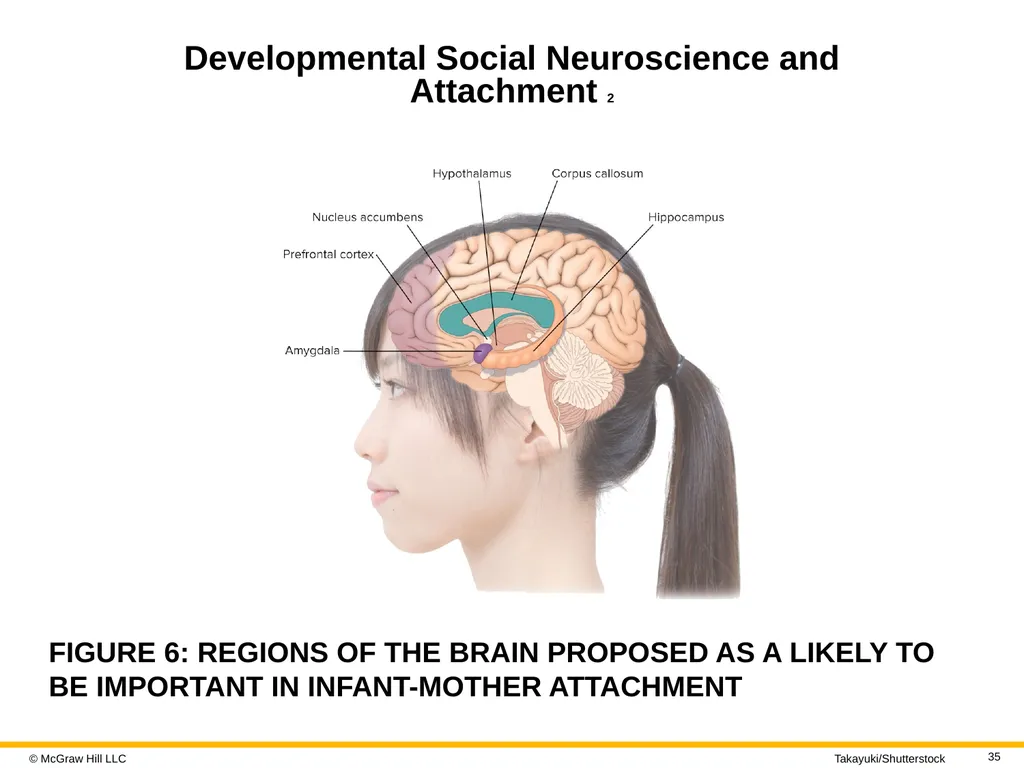
The prefrontal cortex and the subcortical regions of the amygdala and hypothalamus may have an important role.
Research on hormones and neurotransmitters emphasizes the neuropeptide hormone oxytocin and the neurotransmitter dopamine in the maternal-infant bond.
Oxytocin secretion also increases in fathers when they engage in more stimulation contact with babies.
Higher levels of testosterone may have negative effects on father-infant synchrony. 34<br>
The prefrontal cortex and the subcortical regions of the amygdala and hypothalamus may have an important role.
Research on hormones and neurotransmitters emphasizes the neuropeptide hormone oxytocin and the neurotransmitter dopamine in the maternal-infant bond.
Oxytocin secretion also increases in fathers when they engage in more stimulation contact with babies.
Higher levels of testosterone may have negative effects on father-infant synchrony. 34<br>
35
Developmental Social Neuroscience and Attachment 2 FIGURE 6: REGIONS OF THE BRAIN PROPOSED AS A LIKELY TO BE IMPORTANT IN INFANT-MOTHER ATTACHMENT Takayuki/Shutterstock 35<br>
36
Social Contexts: Topics The family.
Child care. 36<br>
Child care. 36<br>
37
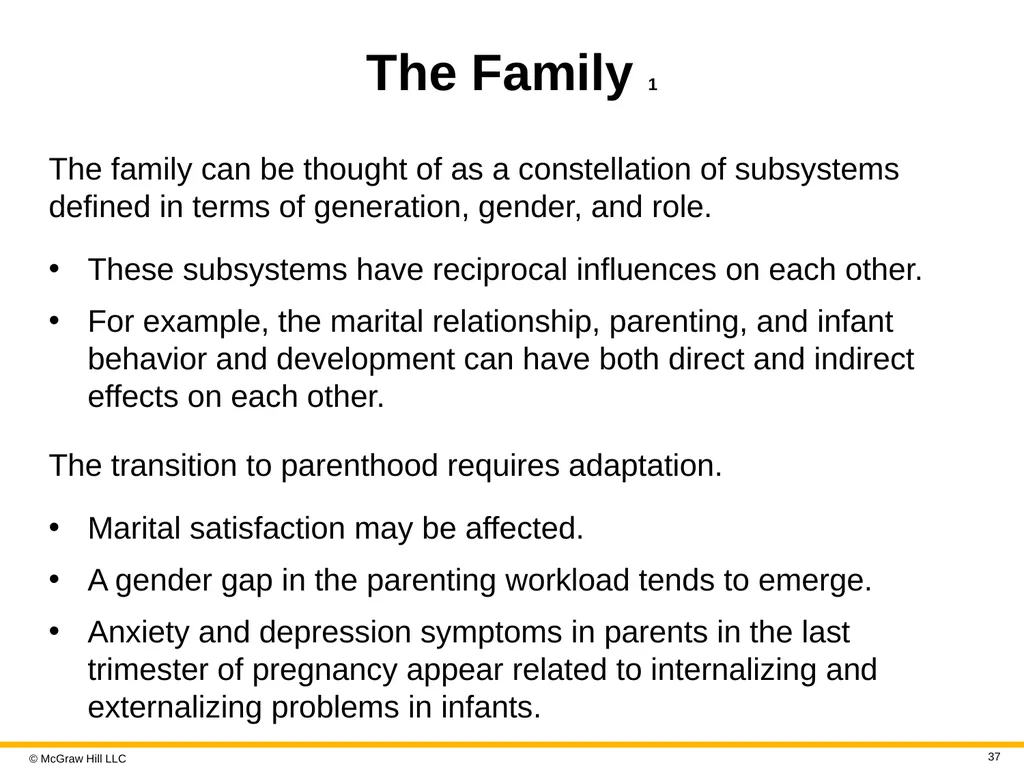
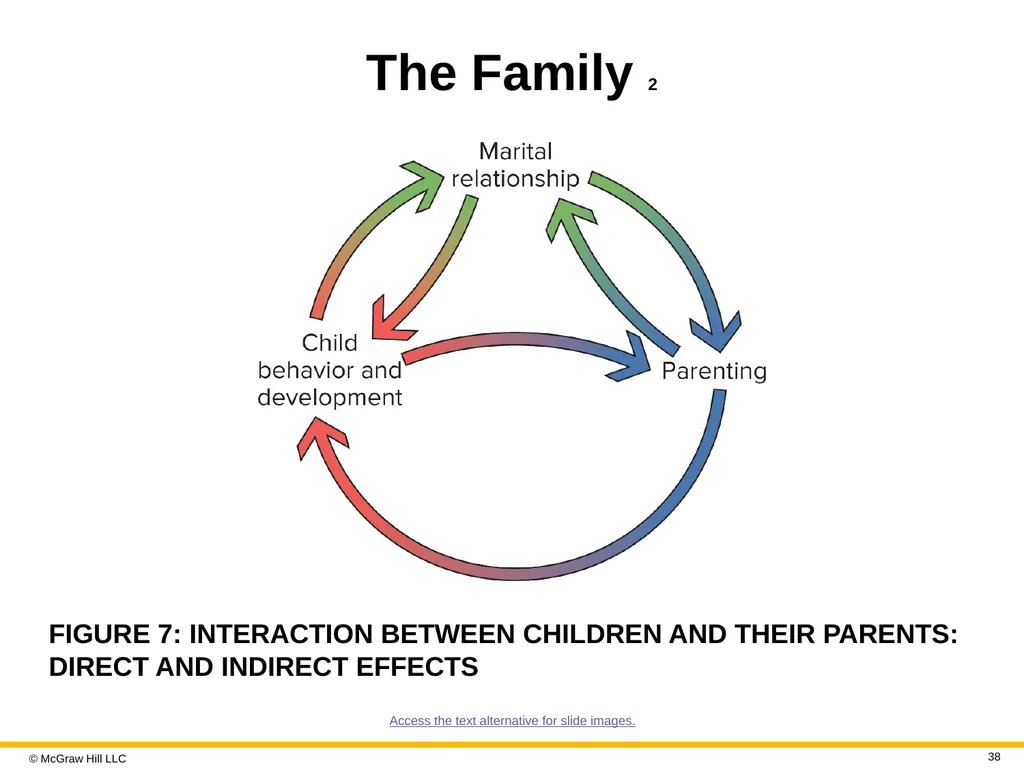
The Family 1 The family can be thought of as a constellation of subsystems defined in terms of generation, gender, and role.
These subsystems have reciprocal influences on each other.
For example, the marital relationship, parenting, and infant behavior and development can have both direct and indirect effects on each other.
The transition to parenthood requires adaptation.
Marital satisfaction may be affected.
A gender gap in the parenting workload tends to emerge.
Anxiety and depression symptoms in parents in the last trimester of pregnancy appear related to internalizing and externalizing problems in infants. 37<br>
These subsystems have reciprocal influences on each other.
For example, the marital relationship, parenting, and infant behavior and development can have both direct and indirect effects on each other.
The transition to parenthood requires adaptation.
Marital satisfaction may be affected.
A gender gap in the parenting workload tends to emerge.
Anxiety and depression symptoms in parents in the last trimester of pregnancy appear related to internalizing and externalizing problems in infants. 37<br>
38
The Family 2 FIGURE 7: INTERACTION BETWEEN CHILDREN AND THEIR PARENTS: DIRECT AND INDIRECT EFFECTS Access the text alternative for slide images. 38<br>
39
The Family 3 Reciprocal socialization is bidirectional.
Children socialize parents, just as parents socialize children.
Scaffolding: parents time interactions so that infants experience turn-taking with parents.
Managing and guiding infants’ behavior includes:
Being proactive and childproofing the environment.
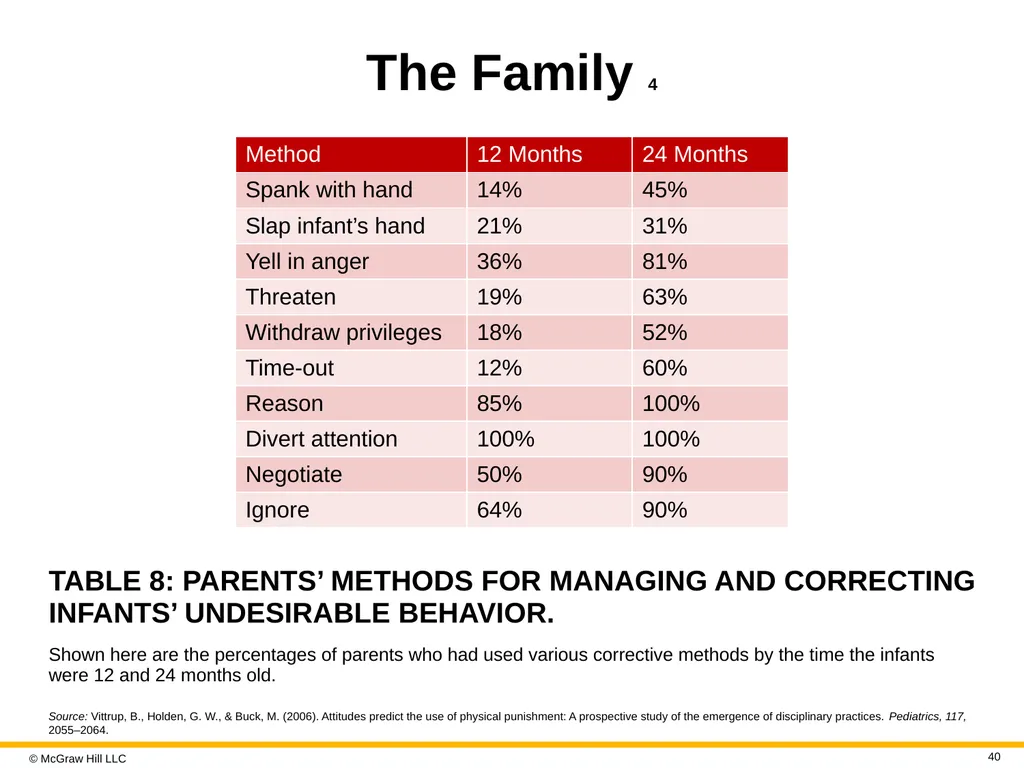
Engaging in corrective methods.
As infants become more capable, parental management often triggers more corrective feedback and discipline.
Some degree of this involves parents’ expectations. 39<br>
Children socialize parents, just as parents socialize children.
Scaffolding: parents time interactions so that infants experience turn-taking with parents.
Managing and guiding infants’ behavior includes:
Being proactive and childproofing the environment.
Engaging in corrective methods.
As infants become more capable, parental management often triggers more corrective feedback and discipline.
Some degree of this involves parents’ expectations. 39<br>
40
The Family 4 TABLE 8: PARENTS’ METHODS FOR MANAGING AND CORRECTING INFANTS’ UNDESIRABLE BEHAVIOR. Shown here are the percentages of parents who had used various corrective methods by the time the infants were 12 and 24 months old. Source: Vittrup, B., Holden, G. W., & Buck, M. (2006). Attitudes predict the use of physical punishment: A prospective study of the emergence of disciplinary practices. Pediatrics, 117, 2055–2064. 40<br>
41
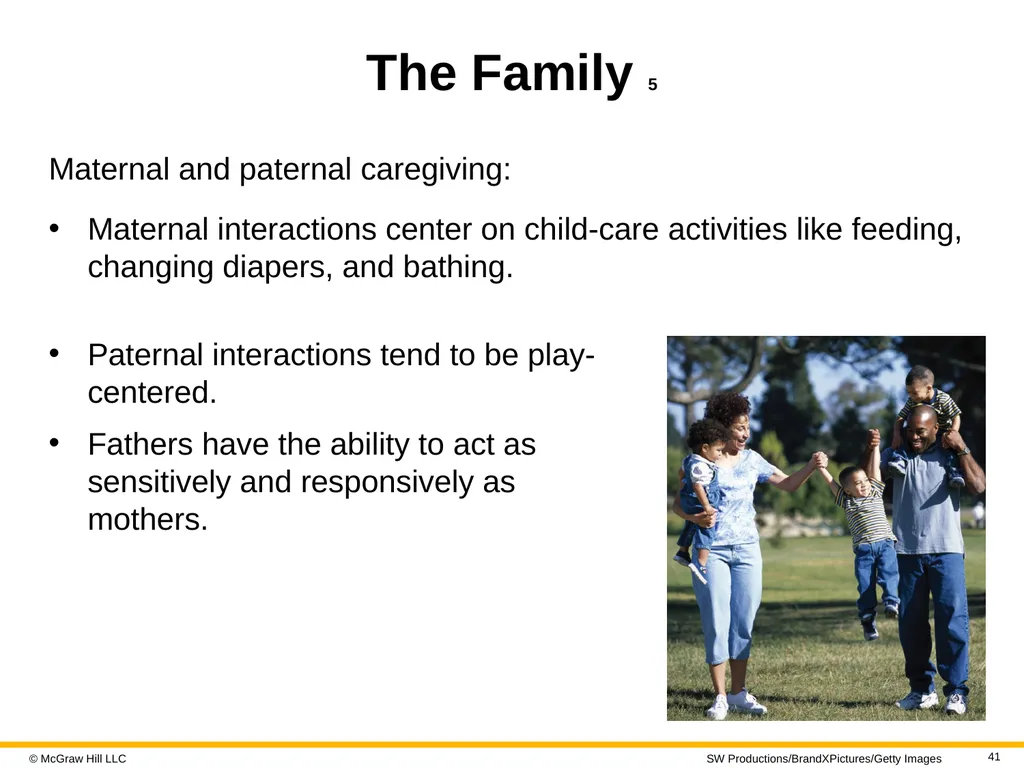
The Family 5 Maternal and paternal caregiving:
Maternal interactions center on child-care activities like feeding, changing diapers, and bathing. Paternal interactions tend to be play-centered.
Fathers have the ability to act as sensitively and responsively as mothers. SW Productions/BrandXPictures/Getty Images 41<br>
Maternal interactions center on child-care activities like feeding, changing diapers, and bathing. Paternal interactions tend to be play-centered.
Fathers have the ability to act as sensitively and responsively as mothers. SW Productions/BrandXPictures/Getty Images 41<br>
42
Child Care 1 Many U.S. children today experience multiple caregivers.
Most do not have a parent staying at home.
About 2 million children in the United States currently receive formal, licensed child care.
Parental leave:
Child-care policies around the world vary.
In much of Europe, paid leave averages about 16 weeks, while the United States currently grants up to 12 weeks of unpaid leave.
In some countries, benefits are not strictly connected to prior employment, and both mothers and fathers are eligible. 42<br>
Most do not have a parent staying at home.
About 2 million children in the United States currently receive formal, licensed child care.
Parental leave:
Child-care policies around the world vary.
In much of Europe, paid leave averages about 16 weeks, while the United States currently grants up to 12 weeks of unpaid leave.
In some countries, benefits are not strictly connected to prior employment, and both mothers and fathers are eligible. 42<br>
43
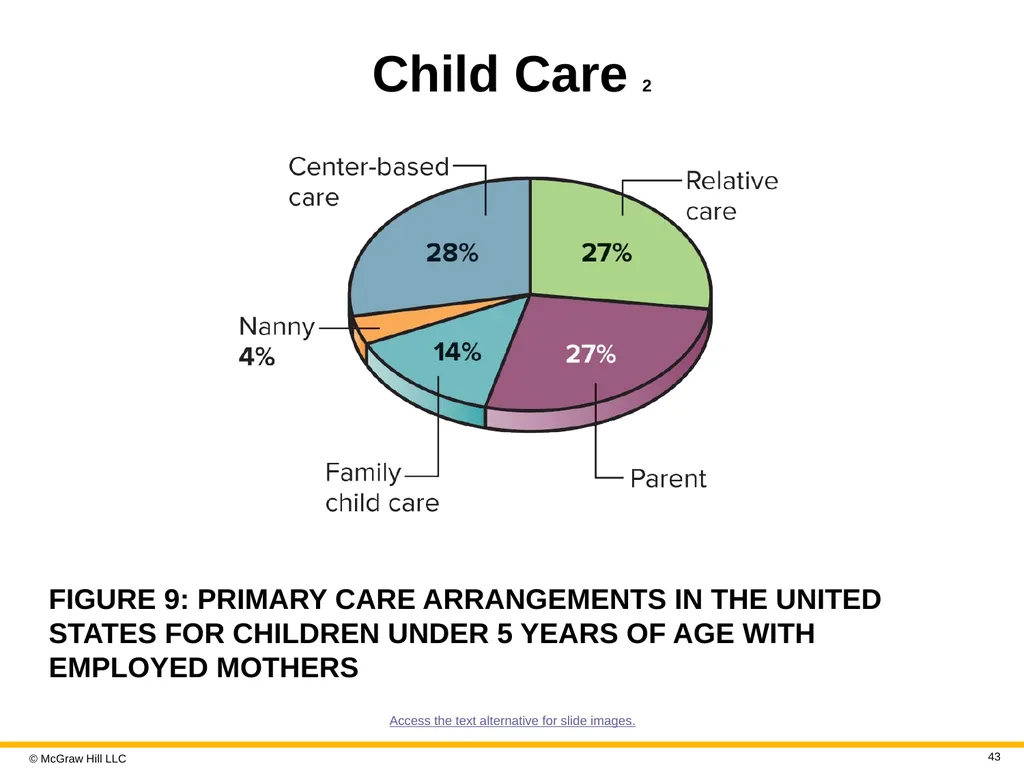
Child Care 2 FIGURE 9: PRIMARY CARE ARRANGEMENTS IN THE UNITED STATES FOR CHILDREN UNDER 5 YEARS OF AGE WITH EMPLOYED MOTHERS Access the text alternative for slide images. 43<br>
44
Child Care 3 Variations in child care:
Child care in the United States is a major concern, with about 15% of children 5 years old and younger attending more than one child-care arrangement.
Factors that influence the effects include the age of the child, the type of child care, and the quality of the program.
The type of child care varies extensively:
Large centers and private homes.
Commercial operations and nonprofit centers.
Professional operations, and mothers earning extra money. 44<br>
Child care in the United States is a major concern, with about 15% of children 5 years old and younger attending more than one child-care arrangement.
Factors that influence the effects include the age of the child, the type of child care, and the quality of the program.
The type of child care varies extensively:
Large centers and private homes.
Commercial operations and nonprofit centers.
Professional operations, and mothers earning extra money. 44<br>
45
Child Care 4 Infants of low-income families receive lower-quality child care.
These children benefit in terms of school readiness and language development if higher-quality care can be secured.
High-quality child care:
provides a safe environment, age-appropriate toys, and age-appropriate activities;
has a low caregiver-to-child ratio; and
is linked to better cognitive and language skills, cooperation, positive play with peers, and fewer behavioral issues 45<br>
These children benefit in terms of school readiness and language development if higher-quality care can be secured.
High-quality child care:
provides a safe environment, age-appropriate toys, and age-appropriate activities;
has a low caregiver-to-child ratio; and
is linked to better cognitive and language skills, cooperation, positive play with peers, and fewer behavioral issues 45<br>
46
Child Care 5 Strategies recommended to parents with respect to child care:
Recognize that the quality of your parenting is a key factor in your child’s development.
Monitor your child’s development.
Take some time to find the best child care.
Not all parents can afford the care they want, but state subsidies and other programs are often available. 46<br>
Recognize that the quality of your parenting is a key factor in your child’s development.
Monitor your child’s development.
Take some time to find the best child care.
Not all parents can afford the care they want, but state subsidies and other programs are often available. 46<br>
47
End of Main Content © McGraw Hill LLC. All rights reserved. No reproduction or distribution without the prior written consent of McGraw Hill LLC.<br>
48
Accessibility Content: Text Alternatives for Images 48<br>
49
Personality Development 2 - Text Alternative Return to parent-slide containing images. The graph compares the results of the following two studies: Lewis and Brooks-Gunn study and Amsterdam study. The horizontal axis shows age in months as 9 through 12, 15 through 18, and 21 through 24. The vertical axis shows the percent of subjects who recognized themselves in a mirror, ranging from 0 through 100, in increments of 20. The data in percent is as follows: 9 through 12: Lewis and Brooks-Gunn study, 2; Amsterdam study, 3; 15 through 18: Lewis and Brooks-Gunn study, 8; Amsterdam study, 28; and 21 through 24: Lewis and Brooks-Gunn study, 68; Amsterdam study, 76. Please note the data is approximate. Return to parent-slide containing images. 49<br>
50
Attachment and Its Development 2 - Text Alternative Return to parent-slide containing images. The horizontal axis shows age of monkey in days ranging from 1 through 25, in increments of 5. The vertical axis shows mean hours per day ranging from 0 through 24, in increments of 6. Four lines depict the difference based on 1. feeding type: either fed on cloth mother, or fed on wire mother; and 2. hours spent with cloth mother and hours spent with wire mother. The data is as follows:
Fed on cloth mother: Initially, the line ranges between 0 through 1 hours per day between 1 through 25 days of age, which increases from 16 through 20 hours per day between 1 through 20 days, decreasing back till hours per day 19 between 21 through 25 days of age.
Fed on wire mother: Initially, the line ranges around 2 hours per day between 1 through 25 days of age, which increases from 7 through 16 between 1 through 20 days, increasing and remaining approximately constant at 17 between 21 through 25 days of age. Please note the data is approximate. Return to parent-slide containing images. 50<br>
Fed on cloth mother: Initially, the line ranges between 0 through 1 hours per day between 1 through 25 days of age, which increases from 16 through 20 hours per day between 1 through 20 days, decreasing back till hours per day 19 between 21 through 25 days of age.
Fed on wire mother: Initially, the line ranges around 2 hours per day between 1 through 25 days of age, which increases from 7 through 16 between 1 through 20 days, increasing and remaining approximately constant at 17 between 21 through 25 days of age. Please note the data is approximate. Return to parent-slide containing images. 50<br>
51
The Family 2 - Text Alternative Return to parent-slide containing images. A cycle displays the interaction inside a family. The marital relationship leads to parenting which leads to child behavior and development. The marital relationship is connected to child behavior and development which leads to parenting and later connects back to marital relationship. Return to parent-slide containing images. 51<br>
52
Child Care 2 - Text Alternative Return to parent-slide containing images. Twenty-eight percent of children are cared for in center-based care, 27 percent are cared for by relatives, 27 percent are cared for by a parent, 14 percent are cared for by someone in their family, and 4 percent are cared for by a nanny. Return to parent-slide containing images. 52<br>