
Life Span Development CHAPTER 10 Introduction






Description: Life Span Development CHAPTER 10 Introduction Humans evolve over their life span. Paramedics must be aware of the changes that humans undergo at each stage of life. Paramedics may need to adjust care based on patients life stage. Infants
Related Topics
Download Presentation
"Life Span Development CHAPTER 10 Introduction" is the property of its rightful owner. Permission is granted to download and print the materials on this website for personal, non-commercial use only, and to display it on your personal computer provided you do not modify the materials and that you retain all copyright notices contained in the materials. By downloading content from our website, you accept the terms of this agreement.
Presentation Transcript
slide1. Life Span Development CHAPTER 10<br>
slide2. Introduction Humans evolve over their life span.
Paramedics must be aware of the changes that humans undergo at each stage of life.
Paramedics may need to adjust care based on patient’s life stage.<br>
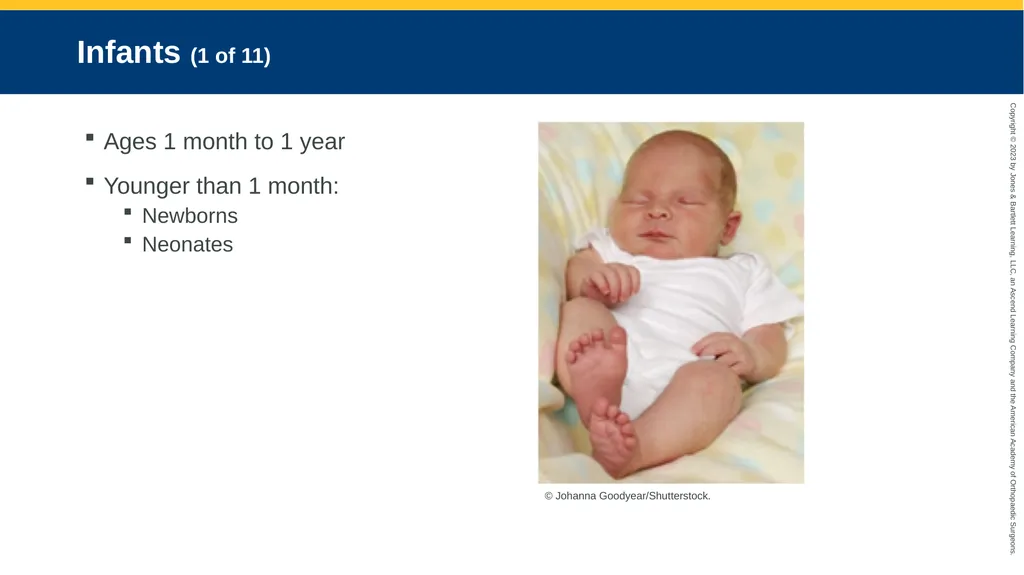
slide3. Infants (1 of 11) Ages 1 month to 1 year
Younger than 1 month:
Newborns
Neonates © Johanna Goodyear/Shutterstock.<br>
slide4. Infants (2 of 11) Weight
Generally around 7.5 pounds at birth
Lose 10% to 12% of birth weight in week 1
Begin weight gain during week 2
Cardiovascular system
Prior to birth, circulation occurs through the placenta
Switch to own vasculature system postbirth<br>
slide5. Infants (3 of 11) Pulmonary system
First breath results from chemical, mechanical, thermal, and sensory triggers
Young infants are nose breathers
Younger than 6 months, prone to nasal congestion<br>
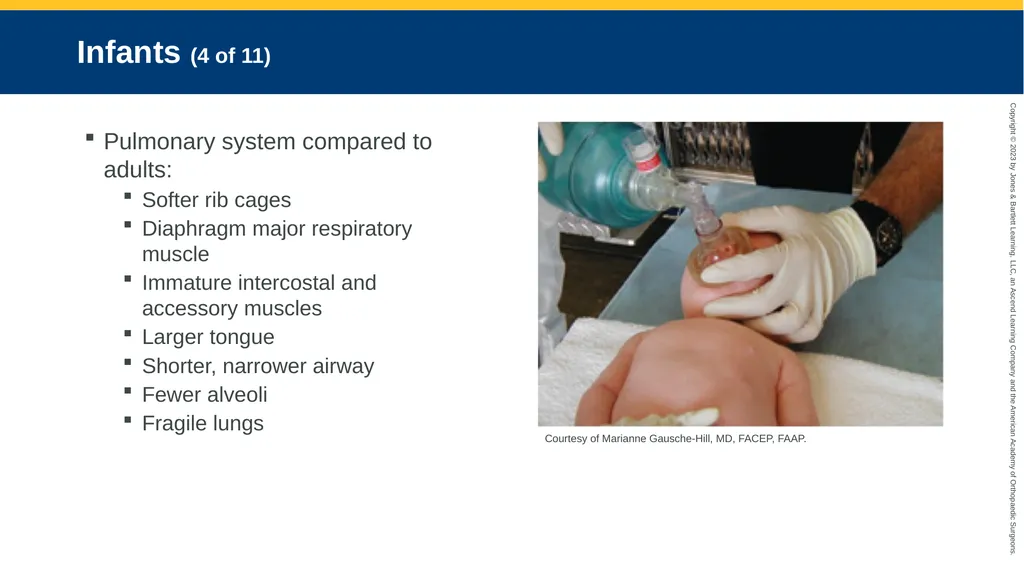
slide6. Infants (4 of 11) Pulmonary system compared to adults:
Softer rib cages
Diaphragm major respiratory muscle
Immature intercostal and accessory muscles
Larger tongue
Shorter, narrower airway
Fewer alveoli
Fragile lungs Courtesy of Marianne Gausche-Hill, MD, FACEP, FAAP.<br>
slide7. Infants (5 of 11) Renal system
Consider:
Dehydration
Electrolyte imbalances
Immune system
Passive immunity helps protect up to 1 year Nervous system
Continues to evolve following birth
Born with:
Moro reflex
Palmar grasp
Rooting reflex
Sucking reflex<br>
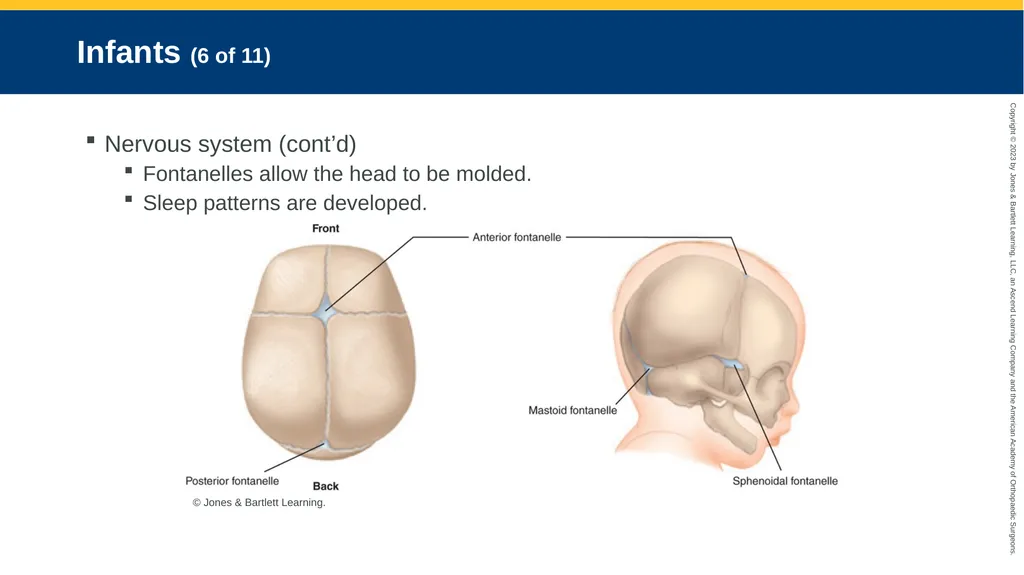
slide8. Infants (6 of 11) Nervous system (cont’d)
Fontanelles allow the head to be molded.
Sleep patterns are developed. © Jones & Bartlett Learning.<br>
slide9. Infants (7 of 11) Musculoskeletal system
Growth plates are where bone growth occurs.
Growth charts track growth of infants and children. Teeth
Teething begins at 4 to 7 months.
Baby teeth are in by age 3 years.
Permanent teeth come in around age 6.<br>
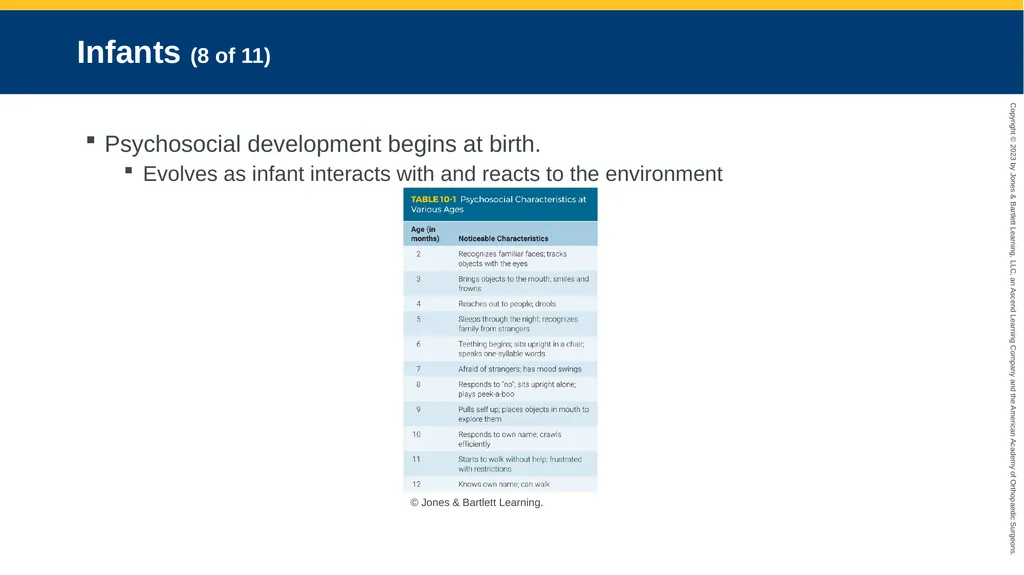
slide10. Infants (8 of 11) Psychosocial development begins at birth.
Evolves as infant interacts with and reacts to the environment © Jones & Bartlett Learning.<br>
slide11. Infants (9 of 11) Infants typically have their own timetable for development.
Bonding based on a secure attachment
Anxious avoidant attachment based on rejection
Most infants use crying as the primary method of communicating distress.<br>
slide12. Infants (10 of 11) For infants, a reaction to a situational crisis follows three phases:
Protest phase
Despair phase
Withdrawal
Infants need a predictable environment to feel secure.<br>
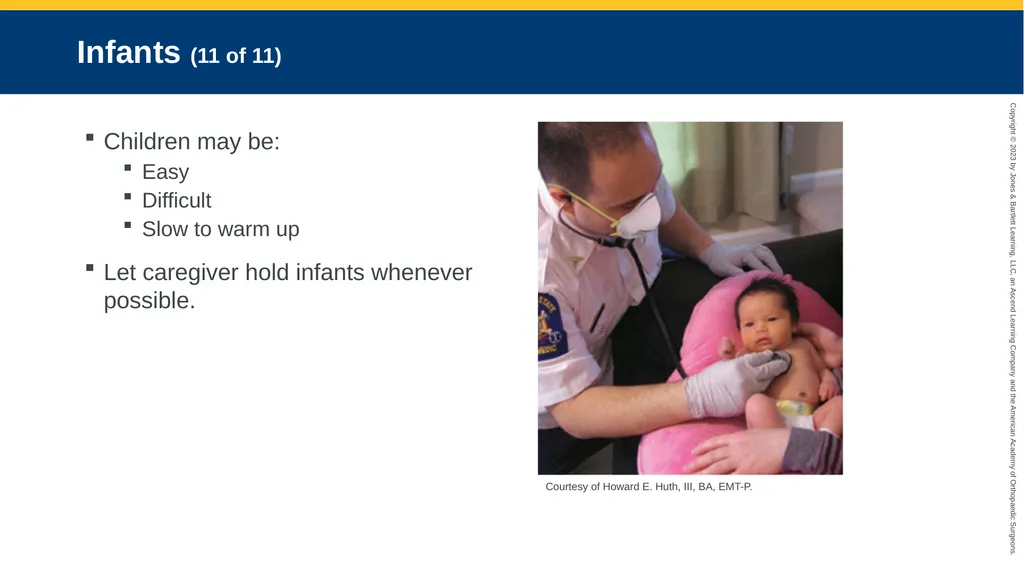
slide13. Infants (11 of 11) Children may be:
Easy
Difficult
Slow to warm up
Let caregiver hold infants whenever possible. Courtesy of Howard E. Huth, III, BA, EMT-P.<br>
slide14. Toddlers and Preschoolers (1 of 7) Toddlers are ages 1 to 2 years.
Preschoolers are ages 3 to 5 years.
Vital signs
Slower pulse and respiratory rates than infants
Higher systolic blood pressure © EML/Shutterstock. © Maxim Bolotnikov/Shutterstock.<br>
slide15. Toddlers and Preschoolers (2 of 7) Cardiovascular system
Similar to an adult’s, but lacks well-developed lung musculature
Immune system
Passive immunity loss leads to acquired immunity.<br>
slide16. Toddlers and Preschoolers (3 of 7) Neuromuscular system
Development of gross and fine motor skills
Brain weighs 90% of final adult weight © onkeybusinessimages/iStock/Getty.<br>
slide17. Toddlers and Preschoolers (4 of 7) Renal system
Develop bladder control and bowel control
Teething process may be painful and include fever.
Sensory development makes tickling fun.<br>
slide18. Toddlers and Preschoolers (5 of 7) Psychosocial changes
Separation anxiety peaks.
Language development occurs.
Peer interactions result in:
Learning control, obedience, competitiveness
Modeling behavior
Recognizing sexual differences<br>
slide19. Toddlers and Preschoolers (6 of 7) Tips for paramedic:
Always include a parent or caregiver!
Position yourself at eye level.
Explain what you are going to do.
Save the worst for last.<br>
slide20. Toddlers and Preschoolers (7 of 7) Development is a reflection of parents
Styles:
Authoritarian: Expects complete obedience
Authoritative: Balances authority with freedom
Permissive: Little imposition of rules
Uninvolved: Few or no rules
Divorce may affect self-esteem and well-being.<br>
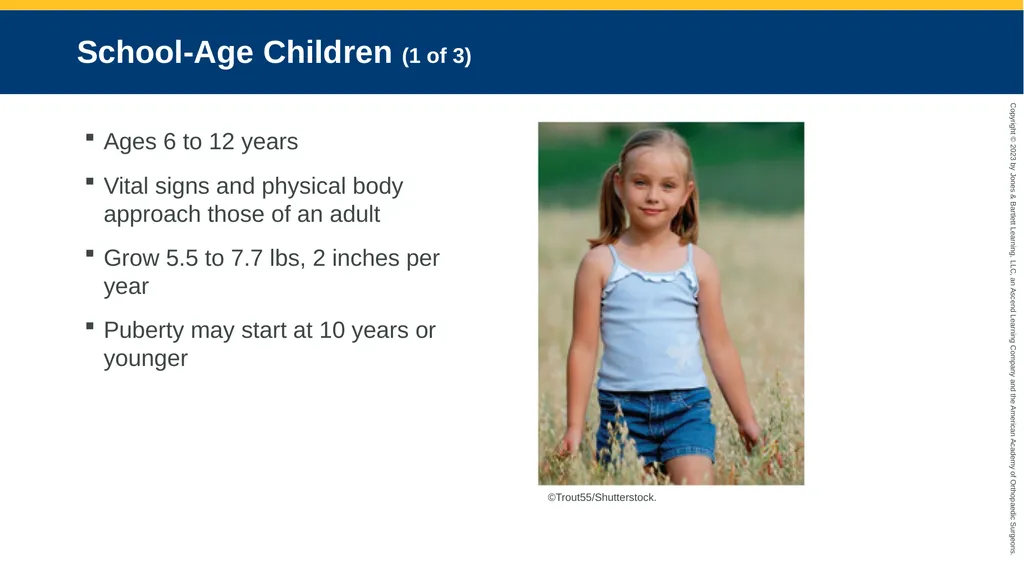
slide21. School-Age Children (1 of 3) Ages 6 to 12 years
Vital signs and physical body approach those of an adult
Grow 5.5 to 7.7 lbs, 2 inches per year
Puberty may start at 10 years or younger ©Trout55/Shutterstock.<br>
slide22. School-Age Children (2 of 3) Psychosocial changes
Three stages of reasoning
Preconventional: Avoid punishment
Conventional: Obtain approval
Postconventional: Conscience
Self-concept develops
Self-esteem develops<br>
slide23. School-Age Children (3 of 3) Tips for paramedics:
Use same techniques as for preschoolers.
Gaining (and losing) trust is a huge issue.
Be direct, assertive, and honest.<br>
slide24. Adolescents (Teenagers) (1 of 4) Ages 13 through 18 years
Vital signs level off to adult ranges.
Growth spurt © Jamie Wilson/Shutterstock.<br>
slide25. Adolescents (Teenagers) (2 of 4) Reproductive changes
Secondary sex characteristics
Menstruation in girls
Hormone secretion<br>
slide26. Adolescents (Teenagers) (3 of 4) Psychosocial changes
Family conflict related to:
Privacy
Self-consciousness
Rebelliousness
Peer pressure
Self-destructive behavior © Monkey Business Images/Shutterstock.<br>
slide27. Adolescents (Teenagers) (4 of 4) Tips for paramedics:
Provide discretion and respect to patients.
Speak with patient separately from caregivers whenever possible. © Jones & Bartlett Learning. Courtesy of MIEMSS.<br>
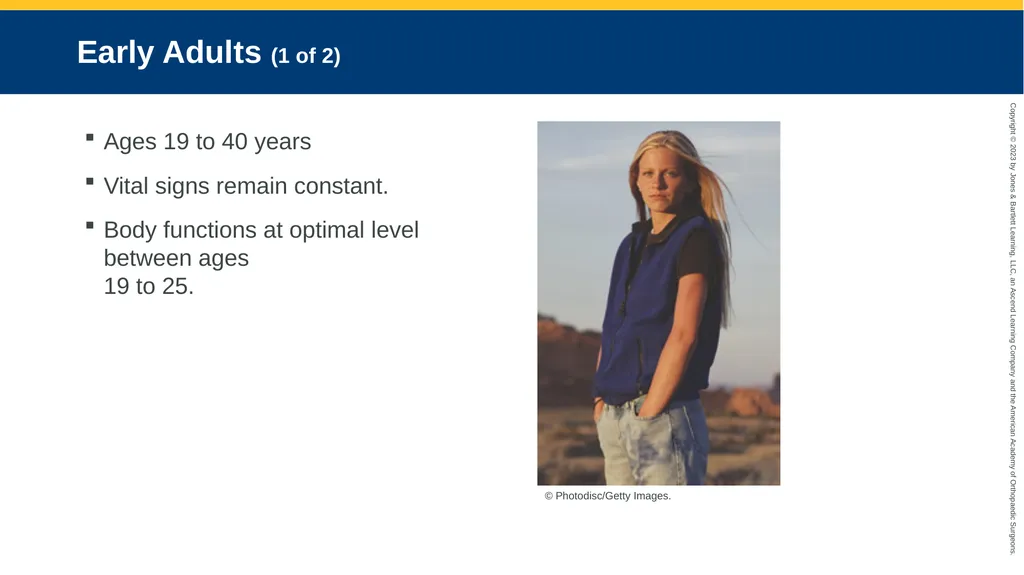
slide28. Early Adults (1 of 2) Ages 19 to 40 years
Vital signs remain constant.
Body functions at optimal level between ages 19 to 25. © Photodisc/Getty Images.<br>
slide29. Early Adults (2 of 2) Psychosocial changes
Work, family, and stress are main focus
Want to “settle down”
Seek and find love
Have children
One of the most stable life periods, with fewer psychological conditions than other stages<br>
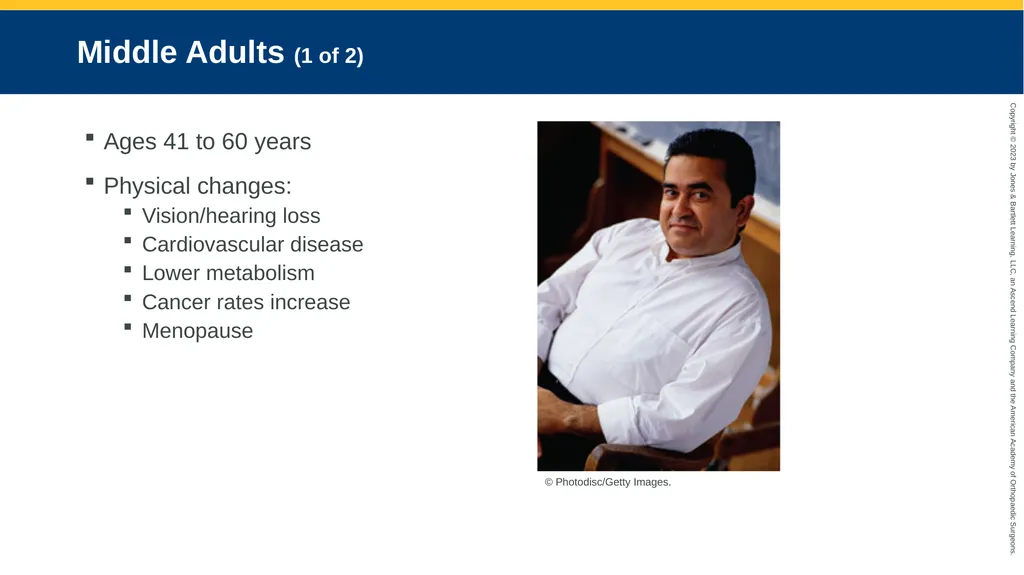
slide30. Middle Adults (1 of 2) Ages 41 to 60 years
Physical changes:
Vision/hearing loss
Cardiovascular disease
Lower metabolism
Cancer rates increase
Menopause © Photodisc/Getty Images.<br>
slide31. Middle Adults (2 of 2) Psychosocial changes
Focus on achieving life goals
Empty nest syndrome
Financial worries related to retirement
May see crisis as a challenge, not a threat<br>
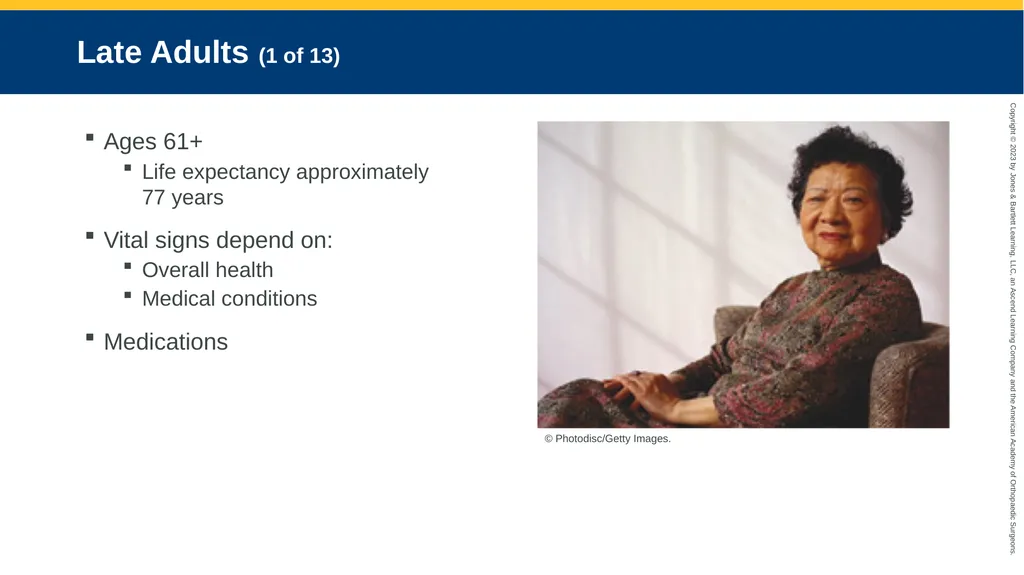
slide32. Late Adults (1 of 13) Ages 61+
Life expectancy approximately 77 years
Vital signs depend on:
Overall health
Medical conditions
Medications © Photodisc/Getty Images.<br>
slide33. Late Adults (2 of 13) Cardiovascular system
Atherosclerosis leads to blood vessel blockage.
Hearts are less able to respond to exercise or disease.
Vascular system becomes stiff<br>
slide34. Late Adults (3 of 13) Respiratory system
Structural changes make breathing more difficult.
Changes in the mouth and nose leave the upper airway less protected.
Weakening of the smooth muscle of the lower airway may lead to collapse.
Vital capacity is significantly decreased, and residual volume increases.<br>
slide35. Late Adults (4 of 13) Endocrine system
Diabetes related to weight gain
Changes in reproductive system<br>
slide36. Late Adults (5 of 13) Renal system
Structural and functional changes occur
Decreased response to hemodynamic stress and fluid and electrolyte imbalances<br>
slide37. Late Adults (6 of 13) Gastrointestinal system
Decreased sense of taste, weaker teeth
Decreased saliva production
Slower gastric motility
Diminishing acid secretion
Decreased ability to extract nutrients
Fecal incontinence<br>
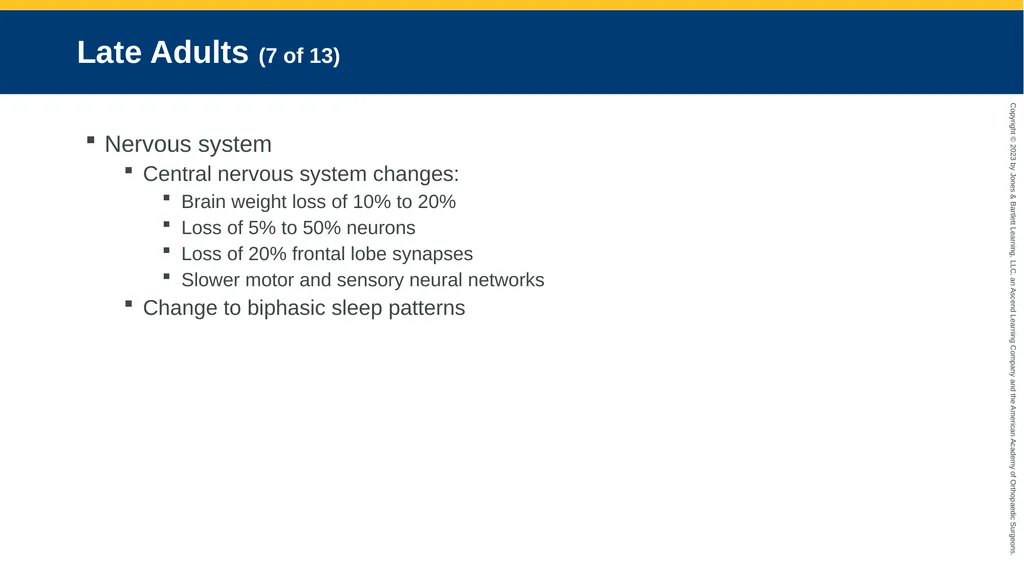
slide38. Late Adults (7 of 13) Nervous system
Central nervous system changes:
Brain weight loss of 10% to 20%
Loss of 5% to 50% neurons
Loss of 20% frontal lobe synapses
Slower motor and sensory neural networks
Change to biphasic sleep patterns<br>
slide39. Late Adults (8 of 13) Nervous system (cont’d)
Brains have increased risk for injury.
Smaller brain may lead to movement.
Bridging veins may tear. © Jones & Bartlett Learning.<br>
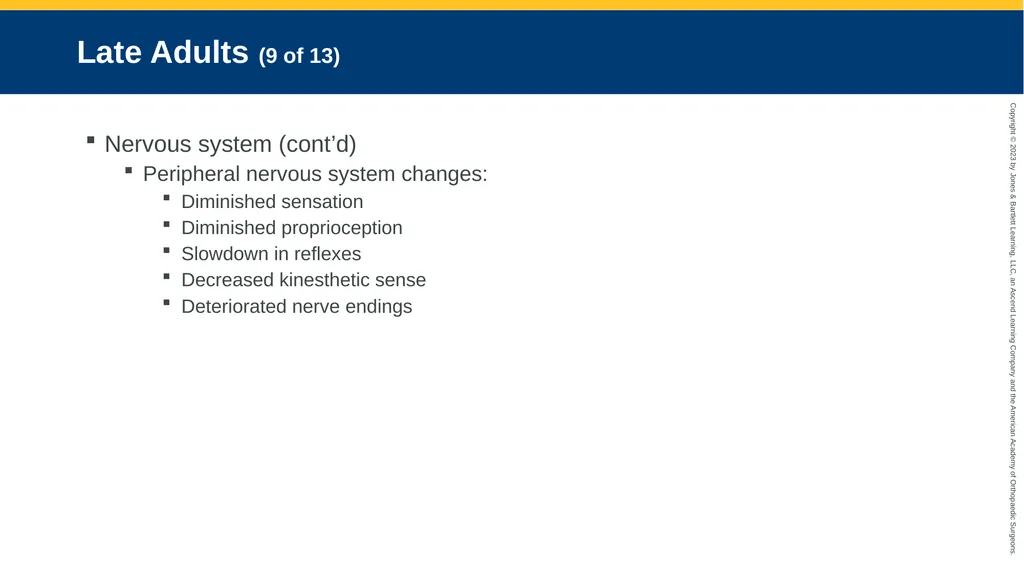
slide40. Late Adults (9 of 13) Nervous system (cont’d)
Peripheral nervous system changes:
Diminished sensation
Diminished proprioception
Slowdown in reflexes
Decreased kinesthetic sense
Deteriorated nerve endings<br>
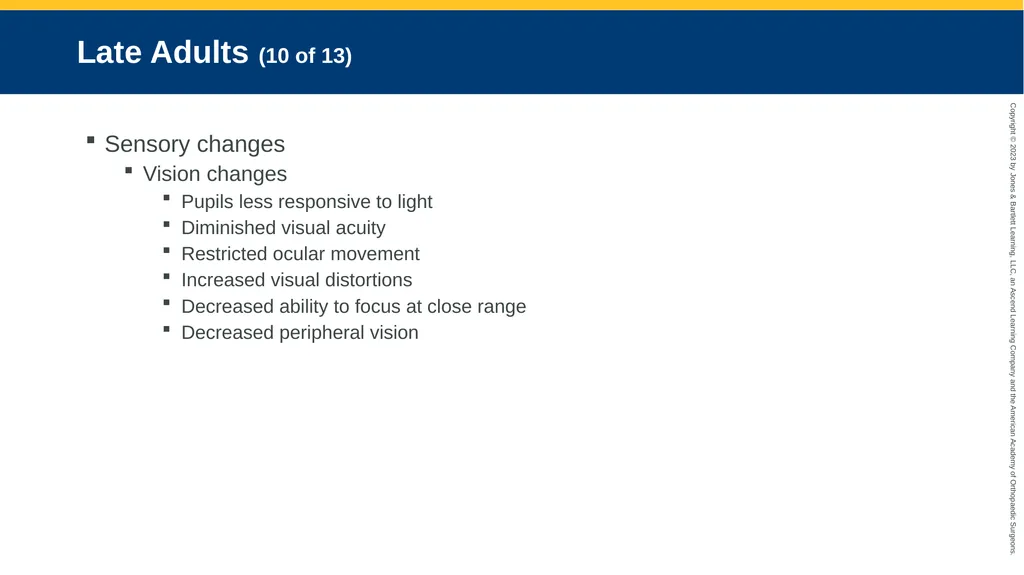
slide41. Late Adults (10 of 13) Sensory changes
Vision changes
Pupils less responsive to light
Diminished visual acuity
Restricted ocular movement
Increased visual distortions
Decreased ability to focus at close range
Decreased peripheral vision<br>
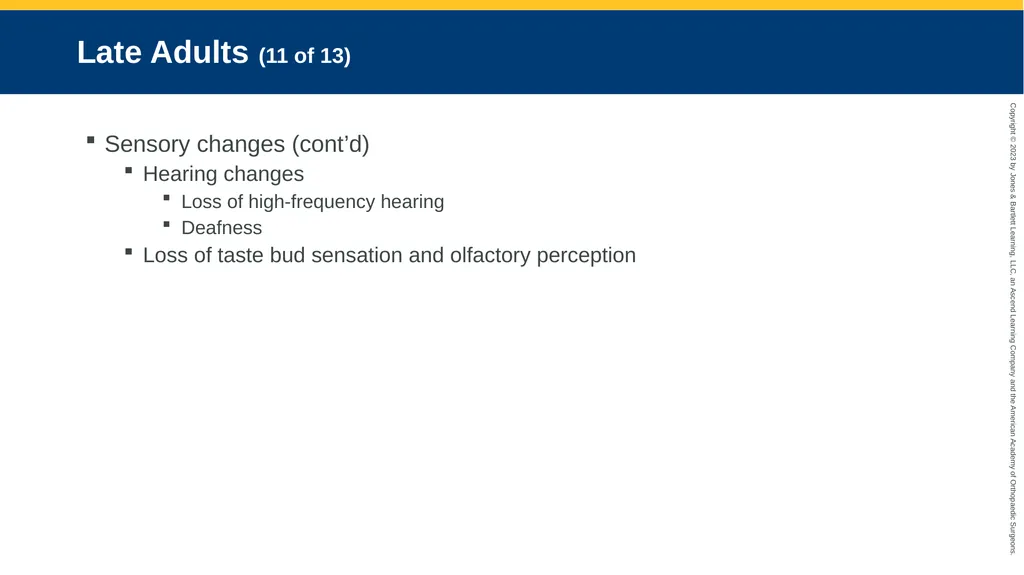
slide42. Late Adults (11 of 13) Sensory changes (cont’d)
Hearing changes
Loss of high-frequency hearing
Deafness
Loss of taste bud sensation and olfactory perception<br>
slide43. Late Adults (12 of 13) Psychosocial changes
Until 5 years preceding death, most late adults retain high-level brain function.
Many live at home.<br>
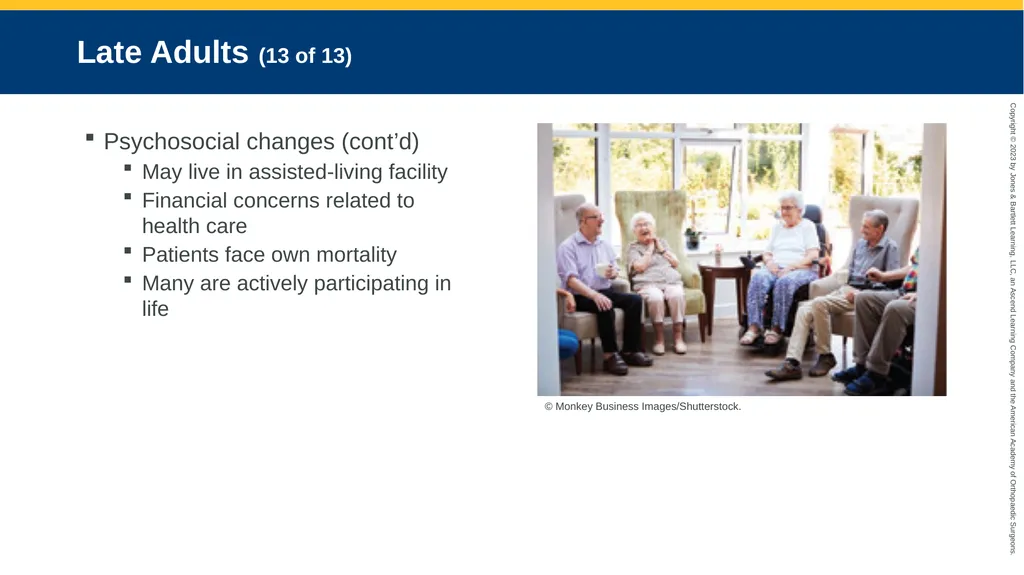
slide44. Late Adults (13 of 13) Psychosocial changes (cont’d)
May live in assisted-living facility
Financial concerns related to health care
Patients face own mortality
Many are actively participating in life © Monkey Business Images/Shutterstock.<br>
slide2. Introduction Humans evolve over their life span.
Paramedics must be aware of the changes that humans undergo at each stage of life.
Paramedics may need to adjust care based on patient’s life stage.<br>
slide3. Infants (1 of 11) Ages 1 month to 1 year
Younger than 1 month:
Newborns
Neonates © Johanna Goodyear/Shutterstock.<br>
slide4. Infants (2 of 11) Weight
Generally around 7.5 pounds at birth
Lose 10% to 12% of birth weight in week 1
Begin weight gain during week 2
Cardiovascular system
Prior to birth, circulation occurs through the placenta
Switch to own vasculature system postbirth<br>
slide5. Infants (3 of 11) Pulmonary system
First breath results from chemical, mechanical, thermal, and sensory triggers
Young infants are nose breathers
Younger than 6 months, prone to nasal congestion<br>
slide6. Infants (4 of 11) Pulmonary system compared to adults:
Softer rib cages
Diaphragm major respiratory muscle
Immature intercostal and accessory muscles
Larger tongue
Shorter, narrower airway
Fewer alveoli
Fragile lungs Courtesy of Marianne Gausche-Hill, MD, FACEP, FAAP.<br>
slide7. Infants (5 of 11) Renal system
Consider:
Dehydration
Electrolyte imbalances
Immune system
Passive immunity helps protect up to 1 year Nervous system
Continues to evolve following birth
Born with:
Moro reflex
Palmar grasp
Rooting reflex
Sucking reflex<br>
slide8. Infants (6 of 11) Nervous system (cont’d)
Fontanelles allow the head to be molded.
Sleep patterns are developed. © Jones & Bartlett Learning.<br>
slide9. Infants (7 of 11) Musculoskeletal system
Growth plates are where bone growth occurs.
Growth charts track growth of infants and children. Teeth
Teething begins at 4 to 7 months.
Baby teeth are in by age 3 years.
Permanent teeth come in around age 6.<br>
slide10. Infants (8 of 11) Psychosocial development begins at birth.
Evolves as infant interacts with and reacts to the environment © Jones & Bartlett Learning.<br>
slide11. Infants (9 of 11) Infants typically have their own timetable for development.
Bonding based on a secure attachment
Anxious avoidant attachment based on rejection
Most infants use crying as the primary method of communicating distress.<br>
slide12. Infants (10 of 11) For infants, a reaction to a situational crisis follows three phases:
Protest phase
Despair phase
Withdrawal
Infants need a predictable environment to feel secure.<br>
slide13. Infants (11 of 11) Children may be:
Easy
Difficult
Slow to warm up
Let caregiver hold infants whenever possible. Courtesy of Howard E. Huth, III, BA, EMT-P.<br>
slide14. Toddlers and Preschoolers (1 of 7) Toddlers are ages 1 to 2 years.
Preschoolers are ages 3 to 5 years.
Vital signs
Slower pulse and respiratory rates than infants
Higher systolic blood pressure © EML/Shutterstock. © Maxim Bolotnikov/Shutterstock.<br>
slide15. Toddlers and Preschoolers (2 of 7) Cardiovascular system
Similar to an adult’s, but lacks well-developed lung musculature
Immune system
Passive immunity loss leads to acquired immunity.<br>
slide16. Toddlers and Preschoolers (3 of 7) Neuromuscular system
Development of gross and fine motor skills
Brain weighs 90% of final adult weight © onkeybusinessimages/iStock/Getty.<br>
slide17. Toddlers and Preschoolers (4 of 7) Renal system
Develop bladder control and bowel control
Teething process may be painful and include fever.
Sensory development makes tickling fun.<br>
slide18. Toddlers and Preschoolers (5 of 7) Psychosocial changes
Separation anxiety peaks.
Language development occurs.
Peer interactions result in:
Learning control, obedience, competitiveness
Modeling behavior
Recognizing sexual differences<br>
slide19. Toddlers and Preschoolers (6 of 7) Tips for paramedic:
Always include a parent or caregiver!
Position yourself at eye level.
Explain what you are going to do.
Save the worst for last.<br>
slide20. Toddlers and Preschoolers (7 of 7) Development is a reflection of parents
Styles:
Authoritarian: Expects complete obedience
Authoritative: Balances authority with freedom
Permissive: Little imposition of rules
Uninvolved: Few or no rules
Divorce may affect self-esteem and well-being.<br>
slide21. School-Age Children (1 of 3) Ages 6 to 12 years
Vital signs and physical body approach those of an adult
Grow 5.5 to 7.7 lbs, 2 inches per year
Puberty may start at 10 years or younger ©Trout55/Shutterstock.<br>
slide22. School-Age Children (2 of 3) Psychosocial changes
Three stages of reasoning
Preconventional: Avoid punishment
Conventional: Obtain approval
Postconventional: Conscience
Self-concept develops
Self-esteem develops<br>
slide23. School-Age Children (3 of 3) Tips for paramedics:
Use same techniques as for preschoolers.
Gaining (and losing) trust is a huge issue.
Be direct, assertive, and honest.<br>
slide24. Adolescents (Teenagers) (1 of 4) Ages 13 through 18 years
Vital signs level off to adult ranges.
Growth spurt © Jamie Wilson/Shutterstock.<br>
slide25. Adolescents (Teenagers) (2 of 4) Reproductive changes
Secondary sex characteristics
Menstruation in girls
Hormone secretion<br>
slide26. Adolescents (Teenagers) (3 of 4) Psychosocial changes
Family conflict related to:
Privacy
Self-consciousness
Rebelliousness
Peer pressure
Self-destructive behavior © Monkey Business Images/Shutterstock.<br>
slide27. Adolescents (Teenagers) (4 of 4) Tips for paramedics:
Provide discretion and respect to patients.
Speak with patient separately from caregivers whenever possible. © Jones & Bartlett Learning. Courtesy of MIEMSS.<br>
slide28. Early Adults (1 of 2) Ages 19 to 40 years
Vital signs remain constant.
Body functions at optimal level between ages 19 to 25. © Photodisc/Getty Images.<br>
slide29. Early Adults (2 of 2) Psychosocial changes
Work, family, and stress are main focus
Want to “settle down”
Seek and find love
Have children
One of the most stable life periods, with fewer psychological conditions than other stages<br>
slide30. Middle Adults (1 of 2) Ages 41 to 60 years
Physical changes:
Vision/hearing loss
Cardiovascular disease
Lower metabolism
Cancer rates increase
Menopause © Photodisc/Getty Images.<br>
slide31. Middle Adults (2 of 2) Psychosocial changes
Focus on achieving life goals
Empty nest syndrome
Financial worries related to retirement
May see crisis as a challenge, not a threat<br>
slide32. Late Adults (1 of 13) Ages 61+
Life expectancy approximately 77 years
Vital signs depend on:
Overall health
Medical conditions
Medications © Photodisc/Getty Images.<br>
slide33. Late Adults (2 of 13) Cardiovascular system
Atherosclerosis leads to blood vessel blockage.
Hearts are less able to respond to exercise or disease.
Vascular system becomes stiff<br>
slide34. Late Adults (3 of 13) Respiratory system
Structural changes make breathing more difficult.
Changes in the mouth and nose leave the upper airway less protected.
Weakening of the smooth muscle of the lower airway may lead to collapse.
Vital capacity is significantly decreased, and residual volume increases.<br>
slide35. Late Adults (4 of 13) Endocrine system
Diabetes related to weight gain
Changes in reproductive system<br>
slide36. Late Adults (5 of 13) Renal system
Structural and functional changes occur
Decreased response to hemodynamic stress and fluid and electrolyte imbalances<br>
slide37. Late Adults (6 of 13) Gastrointestinal system
Decreased sense of taste, weaker teeth
Decreased saliva production
Slower gastric motility
Diminishing acid secretion
Decreased ability to extract nutrients
Fecal incontinence<br>
slide38. Late Adults (7 of 13) Nervous system
Central nervous system changes:
Brain weight loss of 10% to 20%
Loss of 5% to 50% neurons
Loss of 20% frontal lobe synapses
Slower motor and sensory neural networks
Change to biphasic sleep patterns<br>
slide39. Late Adults (8 of 13) Nervous system (cont’d)
Brains have increased risk for injury.
Smaller brain may lead to movement.
Bridging veins may tear. © Jones & Bartlett Learning.<br>
slide40. Late Adults (9 of 13) Nervous system (cont’d)
Peripheral nervous system changes:
Diminished sensation
Diminished proprioception
Slowdown in reflexes
Decreased kinesthetic sense
Deteriorated nerve endings<br>
slide41. Late Adults (10 of 13) Sensory changes
Vision changes
Pupils less responsive to light
Diminished visual acuity
Restricted ocular movement
Increased visual distortions
Decreased ability to focus at close range
Decreased peripheral vision<br>
slide42. Late Adults (11 of 13) Sensory changes (cont’d)
Hearing changes
Loss of high-frequency hearing
Deafness
Loss of taste bud sensation and olfactory perception<br>
slide43. Late Adults (12 of 13) Psychosocial changes
Until 5 years preceding death, most late adults retain high-level brain function.
Many live at home.<br>
slide44. Late Adults (13 of 13) Psychosocial changes (cont’d)
May live in assisted-living facility
Financial concerns related to health care
Patients face own mortality
Many are actively participating in life © Monkey Business Images/Shutterstock.<br>