
Life Span Development CHAPTER 9: Focused Lecture
SN
Published · 45 slides · 0 views
1 / 1





Description
Life Span Development CHAPTER 9: Focused Lecture National EMS Education Standard Competencies Life Span Development Applies fundamental knowledge of life span development to patient assessment and management. Introduction Human beings
Related Topics
Share
Embed code
Download this presentation From Below
"Life Span Development CHAPTER 9: Focused Lecture" is the property of its rightful owner. Permission is granted to download and print the materials on this website for personal, non-commercial use only, and to display it on your personal computer provided you do not modify the materials and that you retain all copyright notices contained in the materials. By downloading content from our website, you accept the terms of this agreement.
Presentation Transcript
01
Life Span Development CHAPTER 9: Focused Lecture<br>
02
National EMS Education Standard Competencies Life Span Development
Applies fundamental knowledge of life span development to patient assessment and management.<br>
Applies fundamental knowledge of life span development to patient assessment and management.<br>
03
Introduction Human beings evolve throughout their life spans.
AEMTs must be aware of the changes a person undergoes at various stages of life.<br>
AEMTs must be aware of the changes a person undergoes at various stages of life.<br>
04
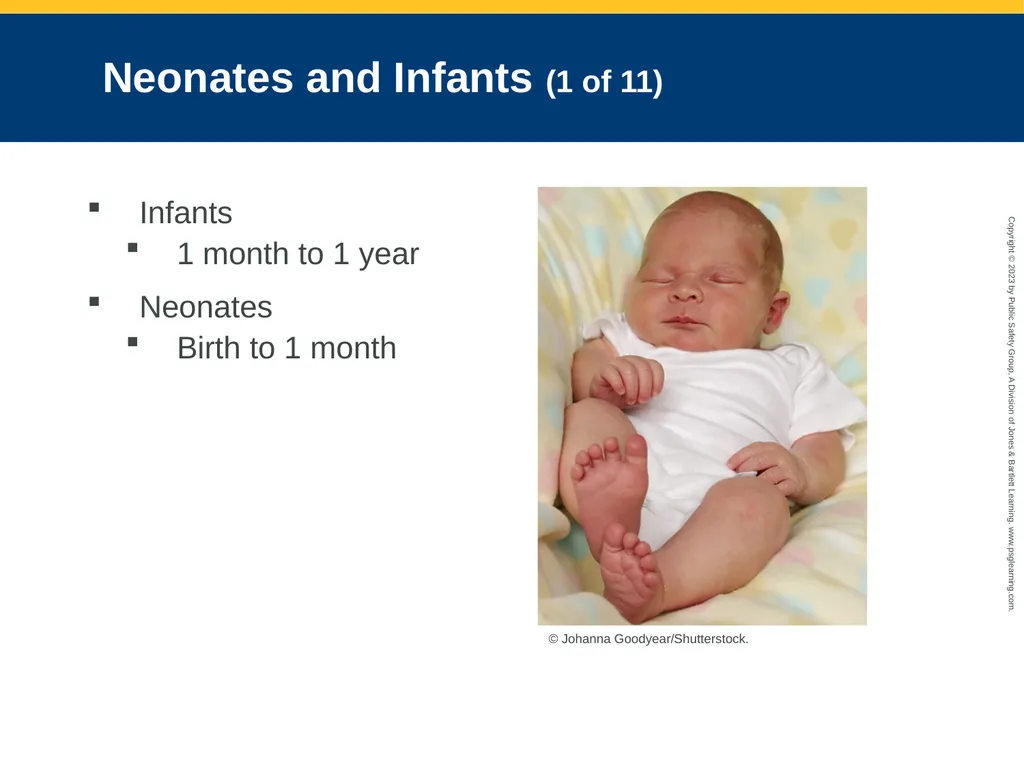
Neonates and Infants (1 of 11) Infants
1 month to 1 year
Neonates
Birth to 1 month © Johanna Goodyear/Shutterstock.<br>
1 month to 1 year
Neonates
Birth to 1 month © Johanna Goodyear/Shutterstock.<br>
05
Neonates and Infants (2 of 11) Vital signs
Pulse rate
At birth: 90 to 205 beats/min
Within first half hour, drops to 120 beats/min
Blood pressure directly corresponds to weight.
Body temperature
Neonate: 98ºF to 100ºF
Infant: 96.8ºF to 99.6ºF<br>
Pulse rate
At birth: 90 to 205 beats/min
Within first half hour, drops to 120 beats/min
Blood pressure directly corresponds to weight.
Body temperature
Neonate: 98ºF to 100ºF
Infant: 96.8ºF to 99.6ºF<br>
06
Neonates and Infants (3 of 11) Weight
Neonate usually weighs 6 to 8 lb.
Doubles by 4–6 months, triples by first year
At birth, neonate makes transition from fetal to independent circulation.<br>
Neonate usually weighs 6 to 8 lb.
Doubles by 4–6 months, triples by first year
At birth, neonate makes transition from fetal to independent circulation.<br>
07
Neonates and Infants (4 of 11) Pulmonary system
Neonates are primarily nose breathers.
Prone to nasal congestion
Rib cage is less rigid and ribs sit horizontally.<br>
Neonates are primarily nose breathers.
Prone to nasal congestion
Rib cage is less rigid and ribs sit horizontally.<br>
08
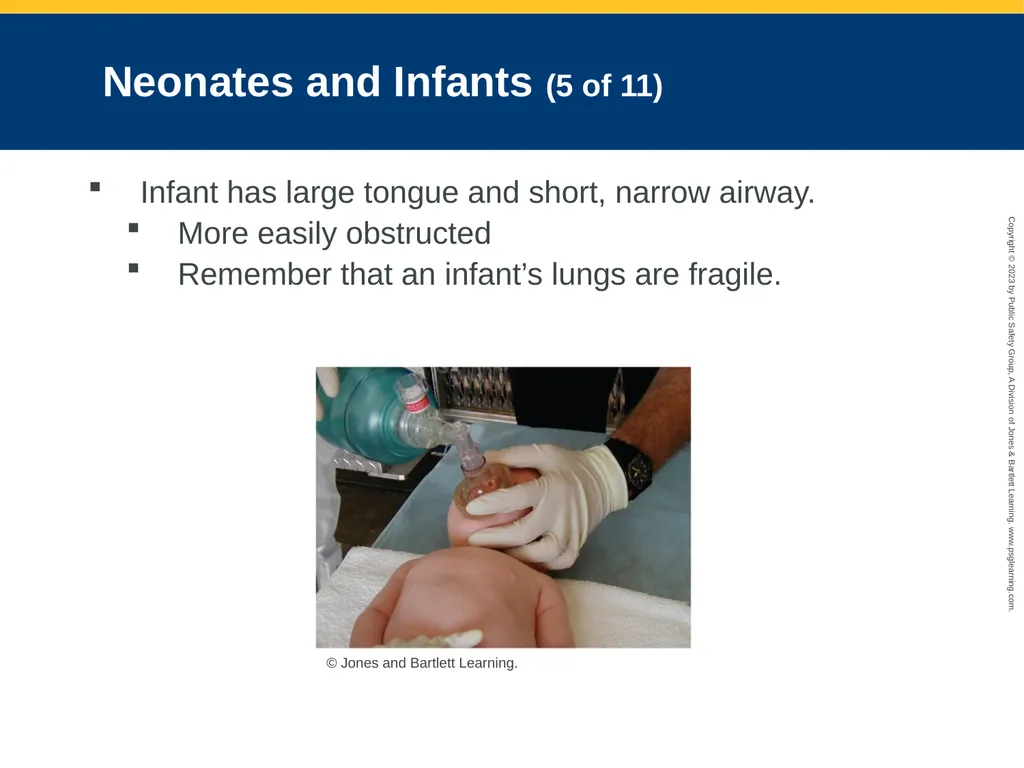
Neonates and Infants (5 of 11) Infant has large tongue and short, narrow airway.
More easily obstructed
Remember that an infant’s lungs are fragile. © Jones and Bartlett Learning.<br>
More easily obstructed
Remember that an infant’s lungs are fragile. © Jones and Bartlett Learning.<br>
09
Neonates and Infants (6 of 11) Nervous system
Continues to evolve after birth
Neonate is born with certain reflexes:
Moro reflex
Palmar grasp
Rooting reflex
Sucking reflex<br>
Continues to evolve after birth
Neonate is born with certain reflexes:
Moro reflex
Palmar grasp
Rooting reflex
Sucking reflex<br>
10
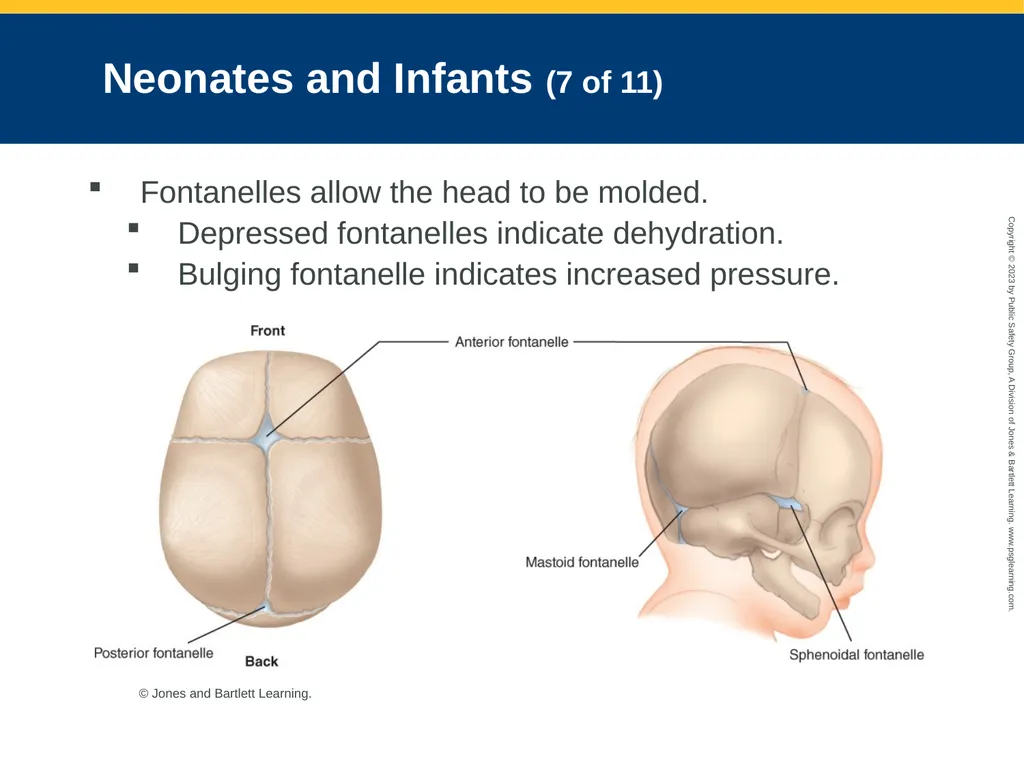
Neonates and Infants (7 of 11) Fontanelles allow the head to be molded.
Depressed fontanelles indicate dehydration.
Bulging fontanelle indicates increased pressure. © Jones and Bartlett Learning.<br>
Depressed fontanelles indicate dehydration.
Bulging fontanelle indicates increased pressure. © Jones and Bartlett Learning.<br>
11
Neonates and Infants (8 of 11) Musculoskeletal system
Growth plates aid in lengthening bones.
Bones grow in thickness by building on themselves.<br>
Growth plates aid in lengthening bones.
Bones grow in thickness by building on themselves.<br>
12
Neonates and Infants (9 of 11) Renal system
Infants can become dehydrated easily.
Kidneys cannot produce concentrated urine.
Infant’s urine consists mainly of water.
Immune system
Passive immunities for the first 6 months
Receive antibodies via breastfeeding<br>
Infants can become dehydrated easily.
Kidneys cannot produce concentrated urine.
Infant’s urine consists mainly of water.
Immune system
Passive immunities for the first 6 months
Receive antibodies via breastfeeding<br>
13
Neonates and Infants (10 of 11) Psychosocial changes
Begin at birth
Evolve as infant interacts with/reacts to environment
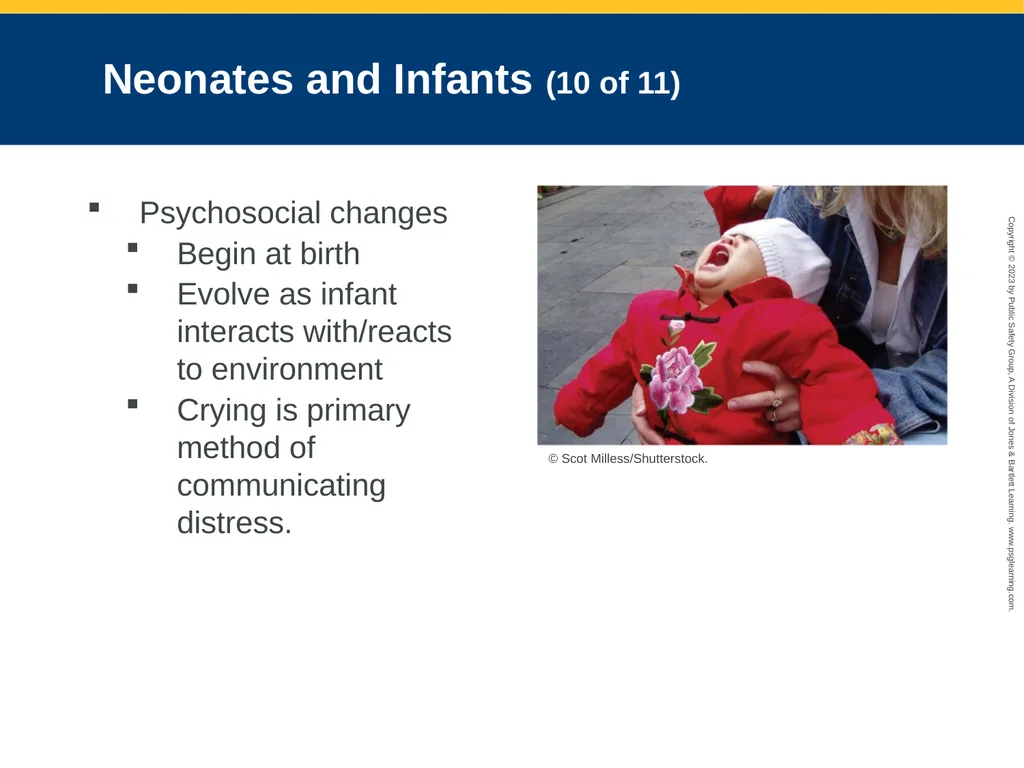
Crying is primary method of communicating distress. © Scot Milless/Shutterstock.<br>
Begin at birth
Evolve as infant interacts with/reacts to environment
Crying is primary method of communicating distress. © Scot Milless/Shutterstock.<br>
14
Neonates and Infants (11 of 11) Psychosocial changes (cont’d)
Infants can develop secure attachments or anxious-avoidant attachments with caregivers.
Separation anxiety is common in older infants.
Infants desire planned, organized routine.
Gain trust in caregivers or develop sense of mistrust<br>
Infants can develop secure attachments or anxious-avoidant attachments with caregivers.
Separation anxiety is common in older infants.
Infants desire planned, organized routine.
Gain trust in caregivers or develop sense of mistrust<br>
15
Toddlers and Preschoolers (1 of 4) Toddlers (1 to 3 years)
Pulse: 80 to 140 beats/min
Respiratory rate: 22 to 37 breaths/min
Systolic blood pressure: 86 to 106 mm Hg
Temperature: 96.8ºF to 99.6ºF © EML/Shutterstock.<br>
Pulse: 80 to 140 beats/min
Respiratory rate: 22 to 37 breaths/min
Systolic blood pressure: 86 to 106 mm Hg
Temperature: 96.8ºF to 99.6ºF © EML/Shutterstock.<br>
16
Toddlers and Preschoolers (2 of 4) Preschoolers (3 to 6 years)
Pulse: 65 to 120 beats/min
Respiratory rate: 20 to 28 breaths/min
Systolic blood pressure: 89 to 112 mm Hg © Maxim Bolotnikov/Shutterstock.<br>
Pulse: 65 to 120 beats/min
Respiratory rate: 20 to 28 breaths/min
Systolic blood pressure: 89 to 112 mm Hg © Maxim Bolotnikov/Shutterstock.<br>
17
Toddlers and Preschoolers (3 of 4) Passive immunity is lost.
Neuromuscular growth
Renal system develops.
Toilet training
Teething occurs. © monkeybusinessimages/iStock/Getty Images.<br>
Neuromuscular growth
Renal system develops.
Toilet training
Teething occurs. © monkeybusinessimages/iStock/Getty Images.<br>
18
Toddlers and Preschoolers (4 of 4) Psychosocial changes
Learn to speak and express themselves
Master basic language
Interact and play games with other children
Begin to understand cause and effect
Learn to recognize sexual differences<br>
Learn to speak and express themselves
Master basic language
Interact and play games with other children
Begin to understand cause and effect
Learn to recognize sexual differences<br>
19
School-Age Children (1 of 3) Age 6 to 12 years
Vital signs
Pulse: 58 to 118 beats/min
Respiratory rate: 18 to 25 breaths/min
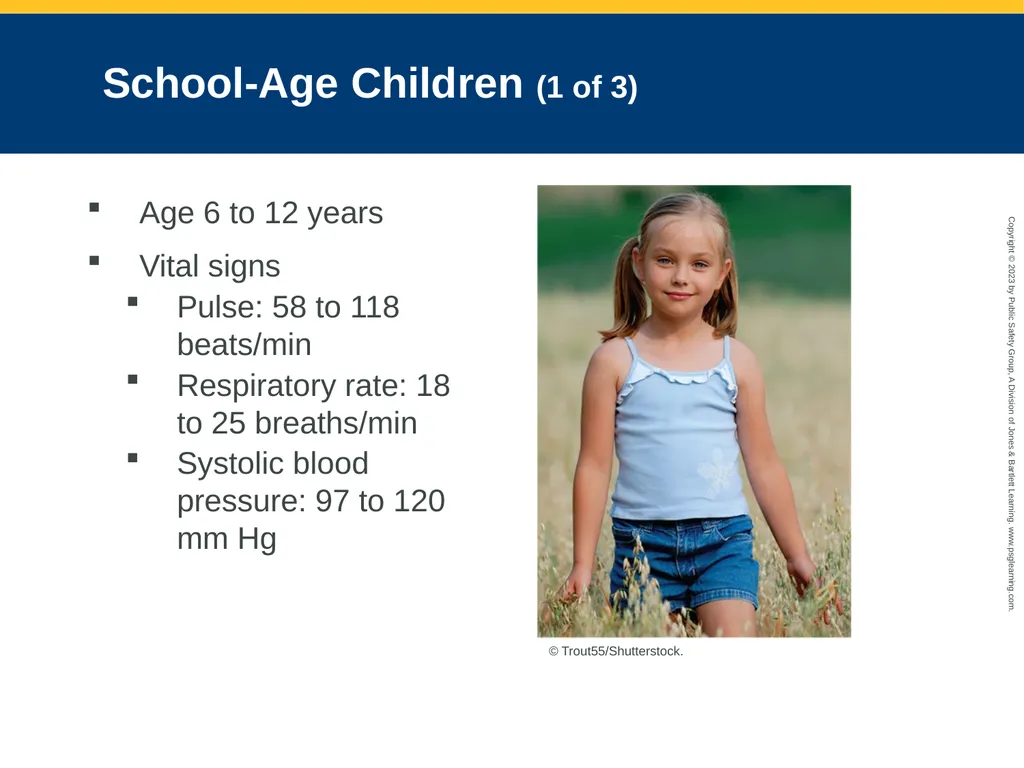
Systolic blood pressure: 97 to 120 mm Hg © Trout55/Shutterstock.<br>
Vital signs
Pulse: 58 to 118 beats/min
Respiratory rate: 18 to 25 breaths/min
Systolic blood pressure: 97 to 120 mm Hg © Trout55/Shutterstock.<br>
20
School-Age Children (2 of 3) Gain about 4 lb (2 kg) and grow 2.5 in (6 cm) each year
Brain function develops further in both hemispheres.
Permanent teeth come in.<br>
Brain function develops further in both hemispheres.
Permanent teeth come in.<br>
21
School-Age Children (3 of 3) Psychosocial changes
Children learn reasoning
Preconventional reasoning
Conventional reasoning
Postconventional reasoning
Begin to develop self-concept and self-esteem<br>
Children learn reasoning
Preconventional reasoning
Conventional reasoning
Postconventional reasoning
Begin to develop self-concept and self-esteem<br>
22
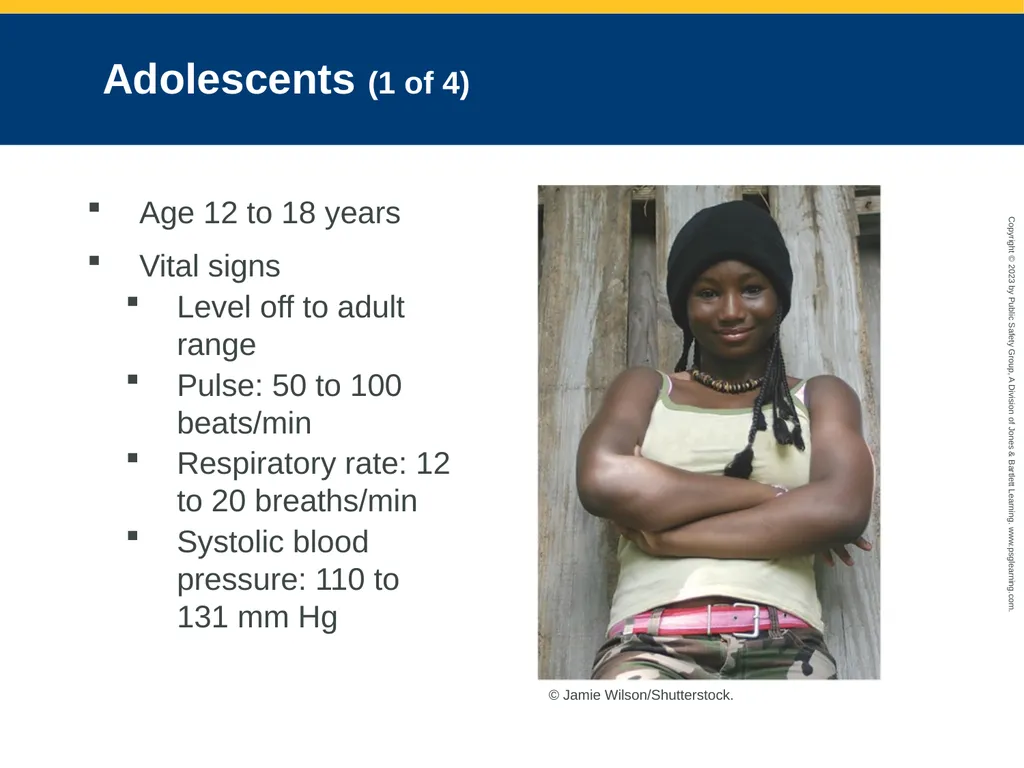
Adolescents (1 of 4) Age 12 to 18 years
Vital signs
Level off to adult range
Pulse: 50 to 100 beats/min
Respiratory rate: 12 to 20 breaths/min
Systolic blood pressure: 110 to 131 mm Hg © Jamie Wilson/Shutterstock.<br>
Vital signs
Level off to adult range
Pulse: 50 to 100 beats/min
Respiratory rate: 12 to 20 breaths/min
Systolic blood pressure: 110 to 131 mm Hg © Jamie Wilson/Shutterstock.<br>
23
Adolescents (2 of 4) Rapid 2- to 3-year growth spurt
Girls finish growing by 16 years.
Boys continue until 18 years.
Reproductive system matures.
Secondary sexual development<br>
Girls finish growing by 16 years.
Boys continue until 18 years.
Reproductive system matures.
Secondary sexual development<br>
24
Adolescents (3 of 4) Psychosocial changes
Try to gain control of their lives
Privacy becomes an issue.
Self-consciousness increases.
May struggle to create their own identity
Peer pressure becomes major factor.<br>
Try to gain control of their lives
Privacy becomes an issue.
Self-consciousness increases.
May struggle to create their own identity
Peer pressure becomes major factor.<br>
25
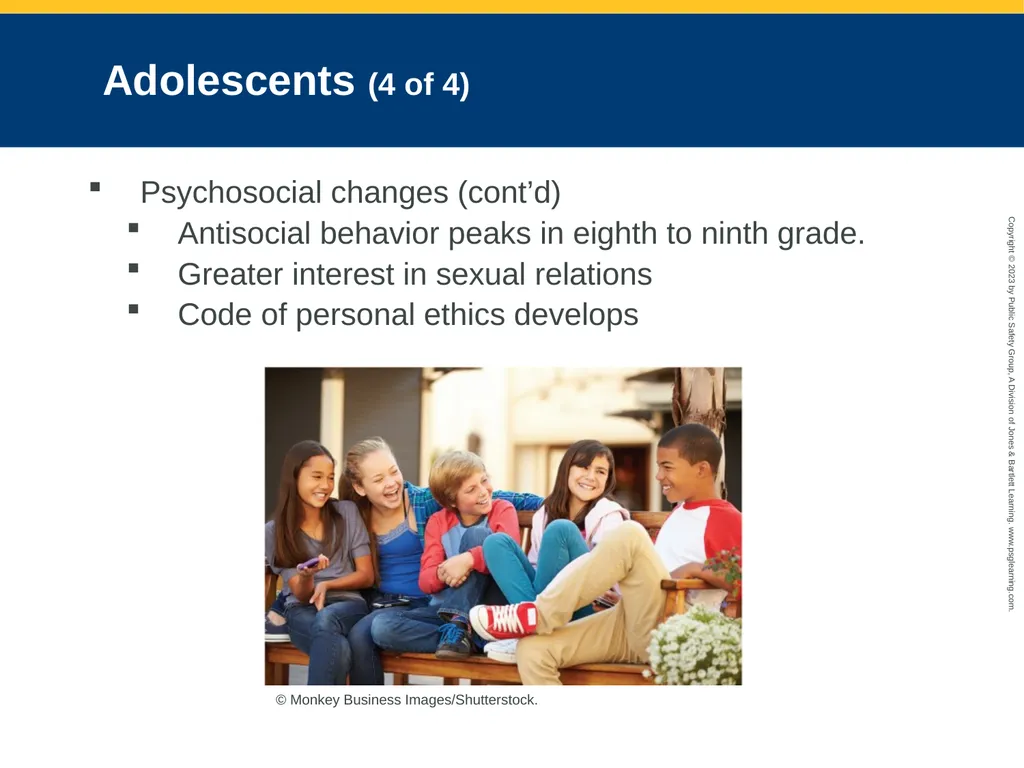
Adolescents (4 of 4) Psychosocial changes (cont’d)
Antisocial behavior peaks in eighth to ninth grade.
Greater interest in sexual relations
Code of personal ethics develops © Monkey Business Images/Shutterstock.<br>
Antisocial behavior peaks in eighth to ninth grade.
Greater interest in sexual relations
Code of personal ethics develops © Monkey Business Images/Shutterstock.<br>
26
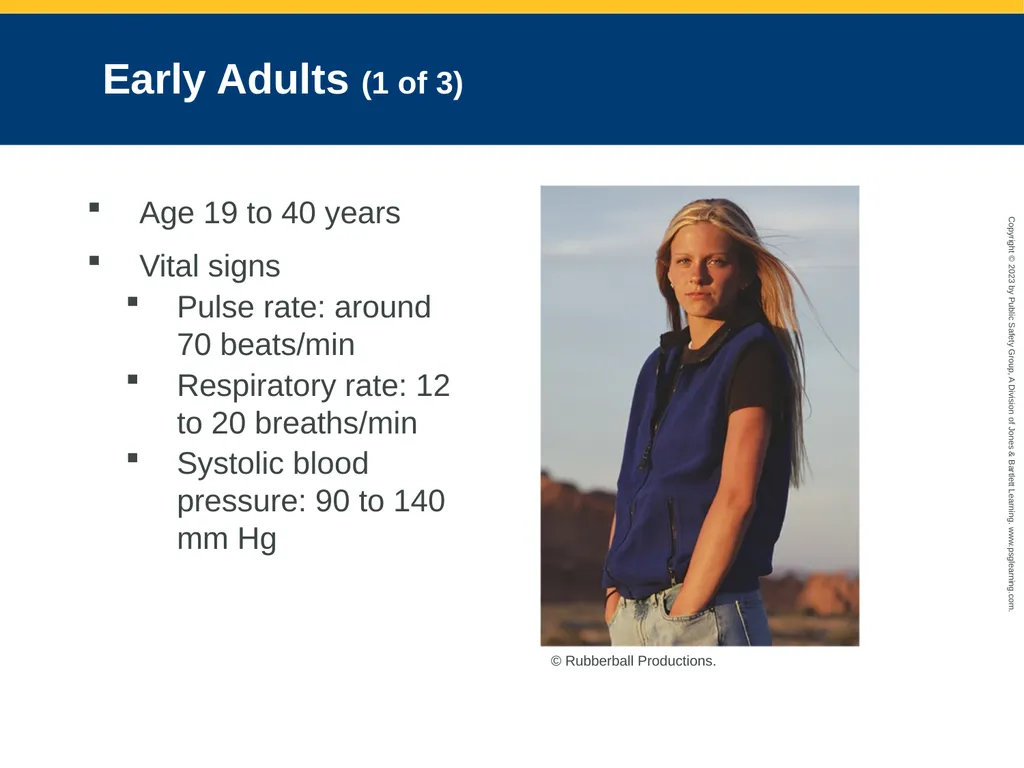
Early Adults (1 of 3) Age 19 to 40 years
Vital signs
Pulse rate: around 70 beats/min
Respiratory rate: 12 to 20 breaths/min
Systolic blood pressure: 90 to 140 mm Hg © Rubberball Productions.<br>
Vital signs
Pulse rate: around 70 beats/min
Respiratory rate: 12 to 20 breaths/min
Systolic blood pressure: 90 to 140 mm Hg © Rubberball Productions.<br>
27
Early Adults (2 of 3) From 19 to 25 years, body should be functioning at its optimal level.
Lifelong habits and routines develop.
Wear and tear on bones and changes in body tissues and muscles begin.<br>
Lifelong habits and routines develop.
Wear and tear on bones and changes in body tissues and muscles begin.<br>
28
Early Adults (3 of 3) Psychosocial changes
Life centers on work, family, and stress.
Strive to create a place for themselves and settle down
Marriage and childbirth are common.<br>
Life centers on work, family, and stress.
Strive to create a place for themselves and settle down
Marriage and childbirth are common.<br>
29
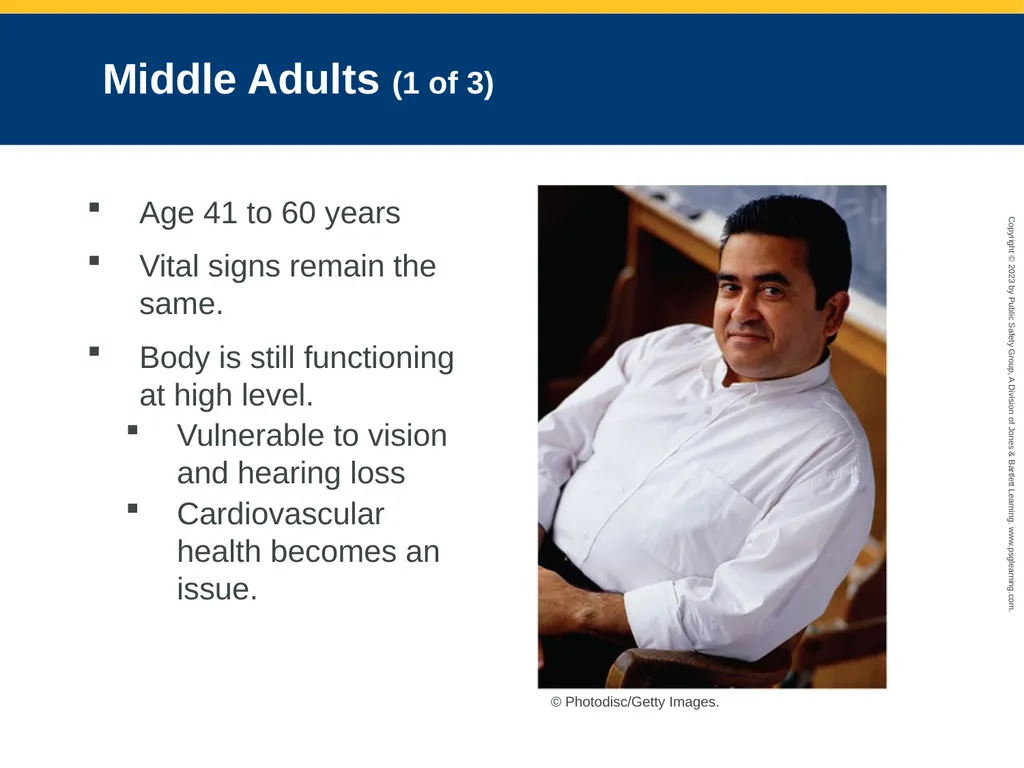
Middle Adults (1 of 3) Age 41 to 60 years
Vital signs remain the same.
Body is still functioning at high level.
Vulnerable to vision and hearing loss
Cardiovascular health becomes an issue. © Photodisc/Getty Images.<br>
Vital signs remain the same.
Body is still functioning at high level.
Vulnerable to vision and hearing loss
Cardiovascular health becomes an issue. © Photodisc/Getty Images.<br>
30
Middle Adults (2 of 3) Cancer incidence increases.
May show symptoms of diabetes, hypertension
Menopause occurs in late 40s, early 50s.
Exercise and healthy diet can diminish effects of aging.<br>
May show symptoms of diabetes, hypertension
Menopause occurs in late 40s, early 50s.
Exercise and healthy diet can diminish effects of aging.<br>
31
Middle Adults (3 of 3) Psychosocial changes
Focus on achieving life goals
Readjust lifestyle as children leave home
Generally have physical, emotional, and spiritual reserves to handle life’s issues
May be caring for children leaving for college and aging parents as well<br>
Focus on achieving life goals
Readjust lifestyle as children leave home
Generally have physical, emotional, and spiritual reserves to handle life’s issues
May be caring for children leaving for college and aging parents as well<br>
32
Leading Causes of Death Unintentional injury
Toddlers and preschoolers
School-age children
Adolescents
Early adults
Ages 41 to 44
Cancer
Ages 45 to 60
Heart disease and cancer
Ages 65 and older<br>
Toddlers and preschoolers
School-age children
Adolescents
Early adults
Ages 41 to 44
Cancer
Ages 45 to 60
Heart disease and cancer
Ages 65 and older<br>
33
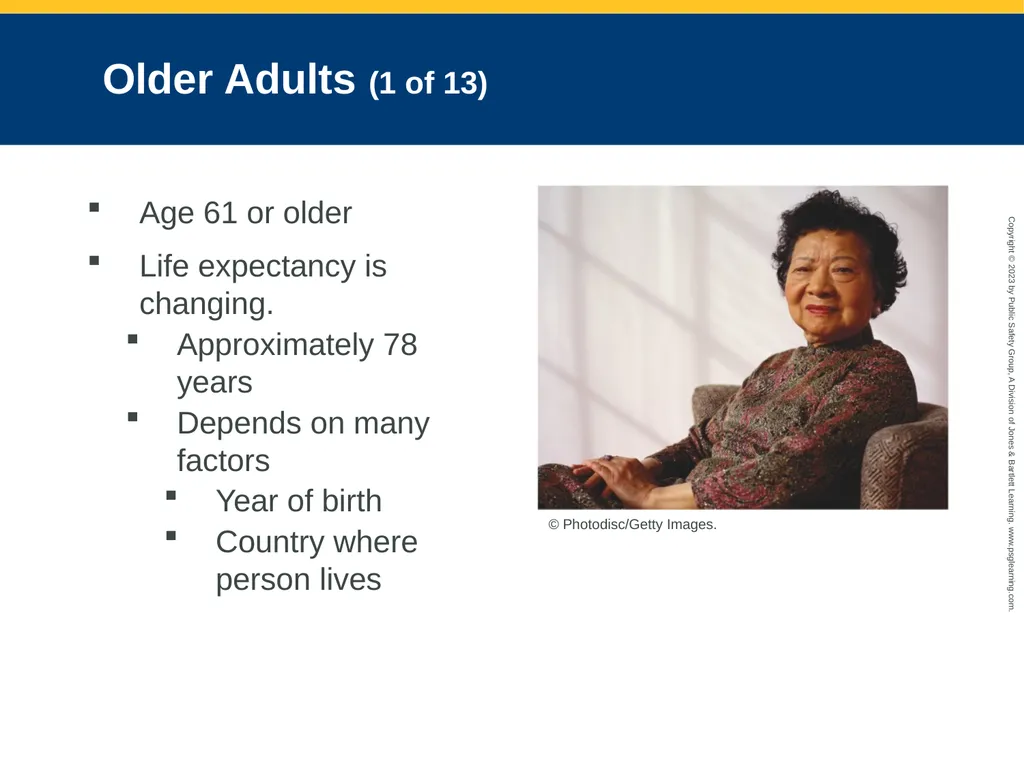
Older Adults (1 of 13) Age 61 or older
Life expectancy is changing.
Approximately 78 years
Depends on many factors
Year of birth
Country where person lives © Photodisc/Getty Images.<br>
Life expectancy is changing.
Approximately 78 years
Depends on many factors
Year of birth
Country where person lives © Photodisc/Getty Images.<br>
34
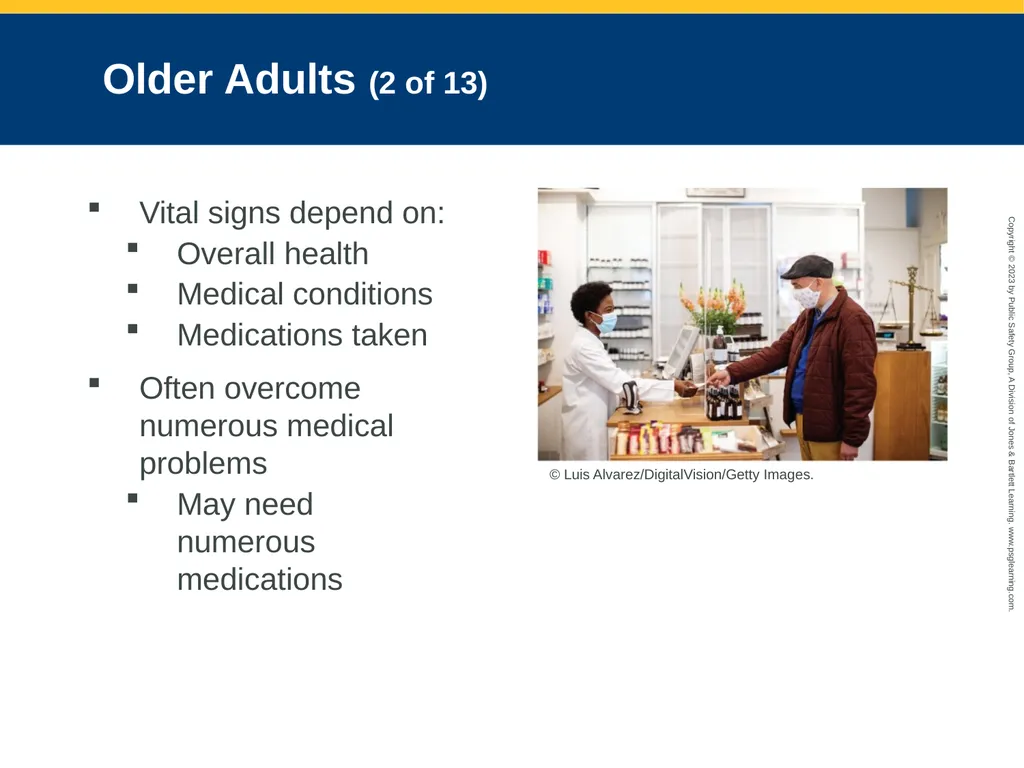
Older Adults (2 of 13) Vital signs depend on:
Overall health
Medical conditions
Medications taken
Often overcome numerous medical problems
May need numerous medications © Luis Alvarez/DigitalVision/Getty Images.<br>
Overall health
Medical conditions
Medications taken
Often overcome numerous medical problems
May need numerous medications © Luis Alvarez/DigitalVision/Getty Images.<br>
35
Older Adults (3 of 13) Cardiovascular system
Declines with age largely due to atherosclerosis
Heart rate and cardiac output decrease.
Vascular system becomes stiff.
Ability to produce replacement blood cells declines, as does blood volume.<br>
Declines with age largely due to atherosclerosis
Heart rate and cardiac output decrease.
Vascular system becomes stiff.
Ability to produce replacement blood cells declines, as does blood volume.<br>
36
Older Adults (4 of 13) Respiratory system
Size of airway increases as smooth muscle weakens and surface area of alveoli decreases
Natural elasticity of lungs decreases.
Changes are often gradual.
Loss of mechanisms that protect upper airway<br>
Size of airway increases as smooth muscle weakens and surface area of alveoli decreases
Natural elasticity of lungs decreases.
Changes are often gradual.
Loss of mechanisms that protect upper airway<br>
37
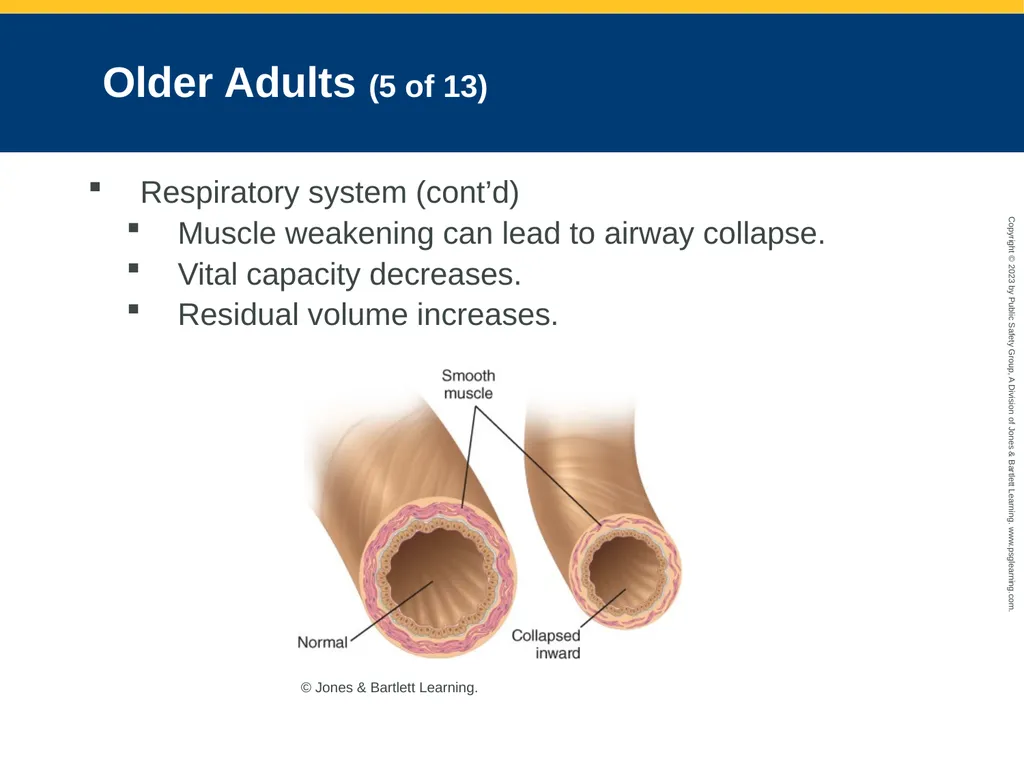
Older Adults (5 of 13) Respiratory system (cont’d)
Muscle weakening can lead to airway collapse.
Vital capacity decreases.
Residual volume increases. © Jones & Bartlett Learning.<br>
Muscle weakening can lead to airway collapse.
Vital capacity decreases.
Residual volume increases. © Jones & Bartlett Learning.<br>
38
Older Adults (6 of 13) Endocrine system
People tend to slow down physical activity but not decrease food intake.
Insulin production drops off.
Metabolism decreases.
Reproductive system changes to some extent.<br>
People tend to slow down physical activity but not decrease food intake.
Insulin production drops off.
Metabolism decreases.
Reproductive system changes to some extent.<br>
39
Older Adults (7 of 13) Renal and gastrointestinal systems
Filtration function declines.
Kidney mass decreases.
Ability to clear wastes from the body and conserve fluids decreases.
Changes in gastrointestinal function may inhibit nutritional intake and utilization.<br>
Filtration function declines.
Kidney mass decreases.
Ability to clear wastes from the body and conserve fluids decreases.
Changes in gastrointestinal function may inhibit nutritional intake and utilization.<br>
40
Older Adults (8 of 13) Renal and gastrointestinal systems (cont’d)
Taste bud sensitivity decreases.
Teeth become weaker.
Saliva secretion decreases.
Gastric motility slows.
Gastric acid secretion diminishes.
Anal sphincter changes reduce elasticity.<br>
Taste bud sensitivity decreases.
Teeth become weaker.
Saliva secretion decreases.
Gastric motility slows.
Gastric acid secretion diminishes.
Anal sphincter changes reduce elasticity.<br>
41
Older Adults (9 of 13) Nervous system
Brain weight decreases.
Motor and sensory neural networks become slower and less responsive.
Diminished number of brain cells
Loss of neurons, but not knowledge or skill
Sleep patterns change.<br>
Brain weight decreases.
Motor and sensory neural networks become slower and less responsive.
Diminished number of brain cells
Loss of neurons, but not knowledge or skill
Sleep patterns change.<br>
42
Older Adults (10 of 13) Nervous system (cont’d)
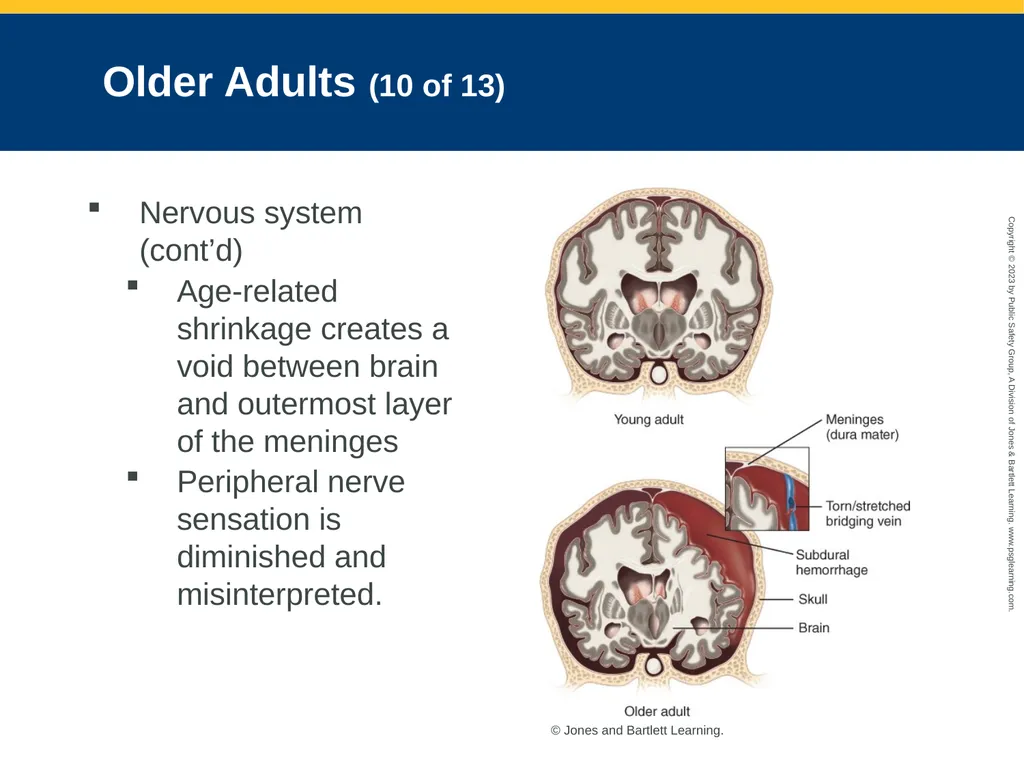
Age-related shrinkage creates a void between brain and outermost layer of the meninges
Peripheral nerve sensation is diminished and misinterpreted. © Jones and Bartlett Learning.<br>
Age-related shrinkage creates a void between brain and outermost layer of the meninges
Peripheral nerve sensation is diminished and misinterpreted. © Jones and Bartlett Learning.<br>
43
Older Adults (11 of 13) Sensory changes
Most older adults can see and hear well.
Pupillary reaction and ocular movement become more restricted.
Hearing loss is four times more common than vision loss.<br>
Most older adults can see and hear well.
Pupillary reaction and ocular movement become more restricted.
Hearing loss is four times more common than vision loss.<br>
44
Older Adults (12 of 13) Psychosocial changes
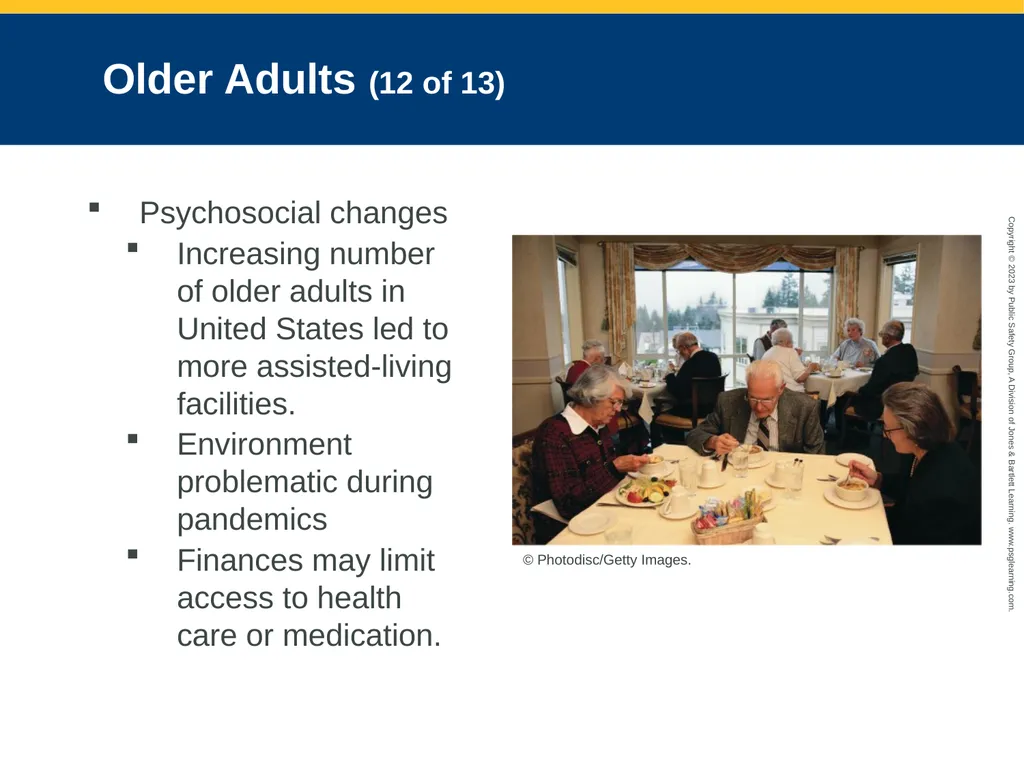
Increasing number of older adults in United States led to more assisted-living facilities.
Environment problematic during pandemics
Finances may limit access to health care or medication. © Photodisc/Getty Images.<br>
Increasing number of older adults in United States led to more assisted-living facilities.
Environment problematic during pandemics
Finances may limit access to health care or medication. © Photodisc/Getty Images.<br>
45
Older Adults (13 of 13) Psychosocial changes (cont’d)
In 5 years preceding death, mental function is presumed to decline.
Older adults face the issue of mortality.
With good resources and support, older adults in their 80s and beyond can enjoy life and feel productive.<br>
In 5 years preceding death, mental function is presumed to decline.
Older adults face the issue of mortality.
With good resources and support, older adults in their 80s and beyond can enjoy life and feel productive.<br>