
Lifespan Development Module 4; Infancy Module
AS
Published · 35 slides · 0 views
1 / 1


Description
Lifespan Development Module 4; Infancy Module Learning Outcomes Describe human development during infancy 4.1 Describe physical growth and development in infants and toddlers 4.2 Explain cognitive development in infants and toddlers 4.3
Related Topics
Share
Embed code
Download this presentation From Below
"Lifespan Development Module 4; Infancy Module" is the property of its rightful owner. Permission is granted to download and print the materials on this website for personal, non-commercial use only, and to display it on your personal computer provided you do not modify the materials and that you retain all copyright notices contained in the materials. By downloading content from our website, you accept the terms of this agreement.
Presentation Transcript
01
Lifespan Development Module 4; Infancy<br>
02
Module Learning Outcomes Describe human development during infancy
4.1 Describe physical growth and development in infants and toddlers
4.2 Explain cognitive development in infants and toddlers
4.3 Explain emotional and social development during infancy<br>
4.1 Describe physical growth and development in infants and toddlers
4.2 Explain cognitive development in infants and toddlers
4.3 Explain emotional and social development during infancy<br>
03
Physical Growth & Development in Infants<br>
04
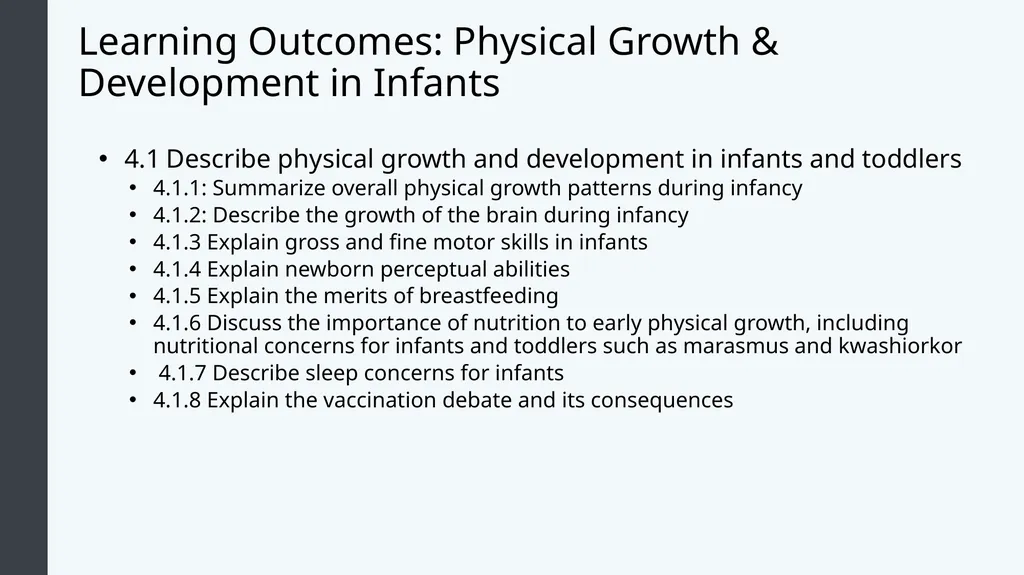
Learning Outcomes: Physical Growth & Development in Infants 4.1 Describe physical growth and development in infants and toddlers
4.1.1: Summarize overall physical growth patterns during infancy
4.1.2: Describe the growth of the brain during infancy
4.1.3 Explain gross and fine motor skills in infants
4.1.4 Explain newborn perceptual abilities
4.1.5 Explain the merits of breastfeeding
4.1.6 Discuss the importance of nutrition to early physical growth, including nutritional concerns for infants and toddlers such as marasmus and kwashiorkor
4.1.7 Describe sleep concerns for infants
4.1.8 Explain the vaccination debate and its consequences<br>
4.1.1: Summarize overall physical growth patterns during infancy
4.1.2: Describe the growth of the brain during infancy
4.1.3 Explain gross and fine motor skills in infants
4.1.4 Explain newborn perceptual abilities
4.1.5 Explain the merits of breastfeeding
4.1.6 Discuss the importance of nutrition to early physical growth, including nutritional concerns for infants and toddlers such as marasmus and kwashiorkor
4.1.7 Describe sleep concerns for infants
4.1.8 Explain the vaccination debate and its consequences<br>
05
Overall Physical Growth Birth weight & length
Normal weight range ~ 5lb 8 oz to 8lb 13oz
Normal length range ~ 19.5 inches
Babies lose approx. 5% of body weight in first few days
Normal adjustment to life outside womb- waste elimination, feeding
Physical proportions
Head-to-body ratio: head comprises 25% of total length at birth
Percentiles: 1-100
Failure to thrive: a child born in normal ranges falls below 20th percentile
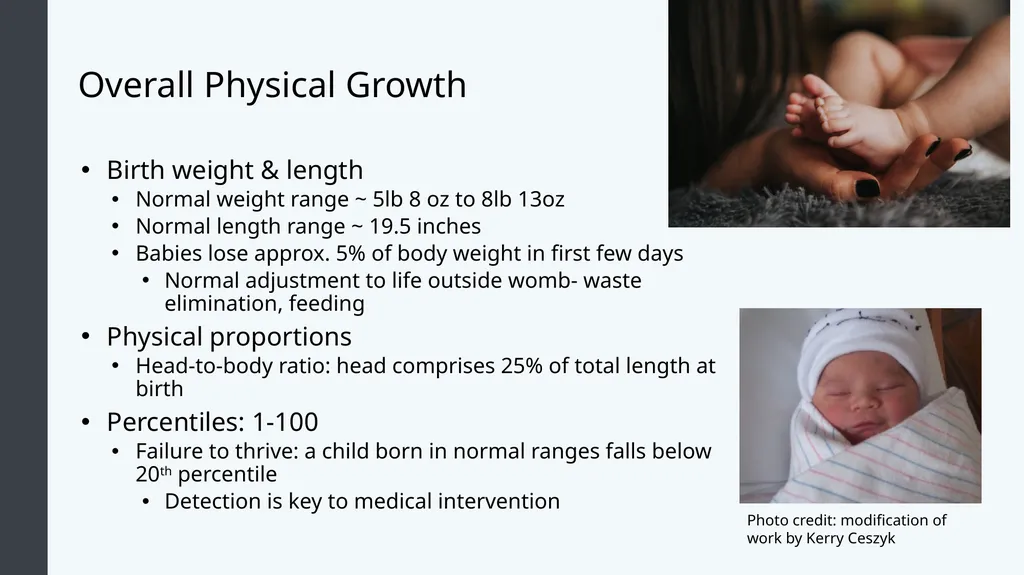
Detection is key to medical intervention Photo credit: modification of work by Kerry Ceszyk<br>
Normal weight range ~ 5lb 8 oz to 8lb 13oz
Normal length range ~ 19.5 inches
Babies lose approx. 5% of body weight in first few days
Normal adjustment to life outside womb- waste elimination, feeding
Physical proportions
Head-to-body ratio: head comprises 25% of total length at birth
Percentiles: 1-100
Failure to thrive: a child born in normal ranges falls below 20th percentile
Detection is key to medical intervention Photo credit: modification of work by Kerry Ceszyk<br>
06
Physical growth, continued Weight:
At 4 months old, weight typically doubles
At one year, weight has tripled
By age 2, weight has quadrupled.
Length:
Average length at 12 months ~28.5-30.5 inches
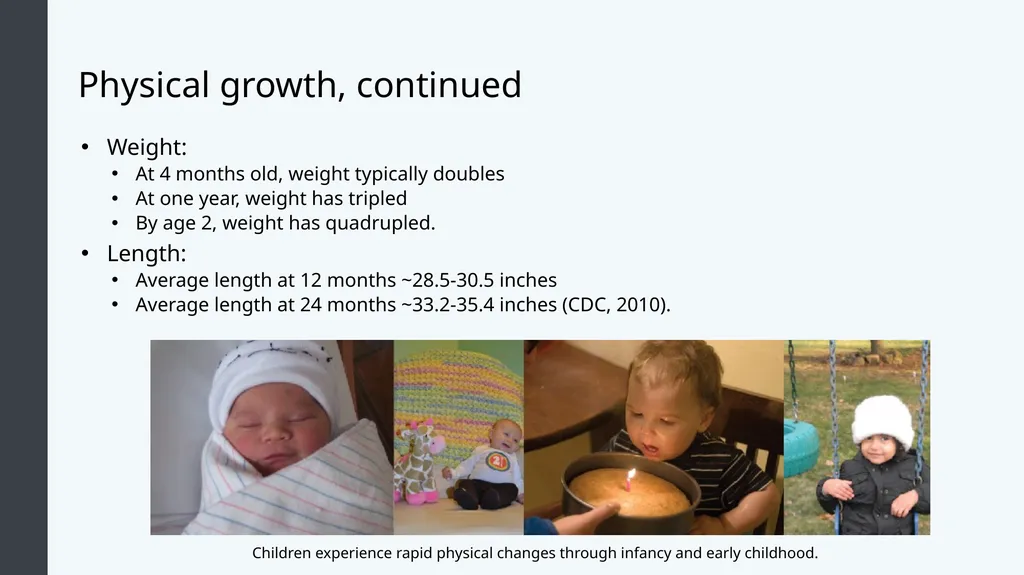
Average length at 24 months ~33.2-35.4 inches (CDC, 2010). Children experience rapid physical changes through infancy and early childhood.<br>
At 4 months old, weight typically doubles
At one year, weight has tripled
By age 2, weight has quadrupled.
Length:
Average length at 12 months ~28.5-30.5 inches
Average length at 24 months ~33.2-35.4 inches (CDC, 2010). Children experience rapid physical changes through infancy and early childhood.<br>
07
Brain Growth- The First Two Years Growth
Physical size of brain increases
At birth, brain is 25% adult weight
At 2-years-old, 75%
Neural development
Most neurons are present at birth, not fully developed
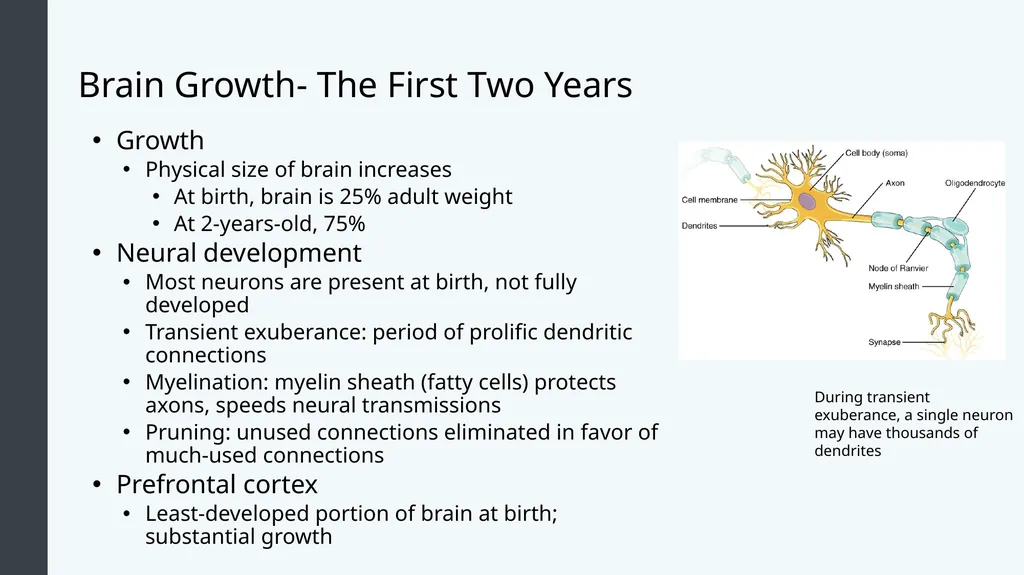
Transient exuberance: period of prolific dendritic connections
Myelination: myelin sheath (fatty cells) protects axons, speeds neural transmissions
Pruning: unused connections eliminated in favor of much-used connections
Prefrontal cortex
Least-developed portion of brain at birth; substantial growth During transient exuberance, a single neuron may have thousands of dendrites<br>
Physical size of brain increases
At birth, brain is 25% adult weight
At 2-years-old, 75%
Neural development
Most neurons are present at birth, not fully developed
Transient exuberance: period of prolific dendritic connections
Myelination: myelin sheath (fatty cells) protects axons, speeds neural transmissions
Pruning: unused connections eliminated in favor of much-used connections
Prefrontal cortex
Least-developed portion of brain at birth; substantial growth During transient exuberance, a single neuron may have thousands of dendrites<br>
08
Motor Development Reflexes are inborn
Some are necessary for survival
Rooting reflex, breathing, sucking reflex
Some signify health, development
Moro reflex, stepping reflex, palmar grasp
Motor development is orderly
Follows cephalocaudal (head-down) proximodistal (center-out) principles
Gross Motor Skills
Large muscle groups
Fine Motor Skills
Small, coordinated muscle movements
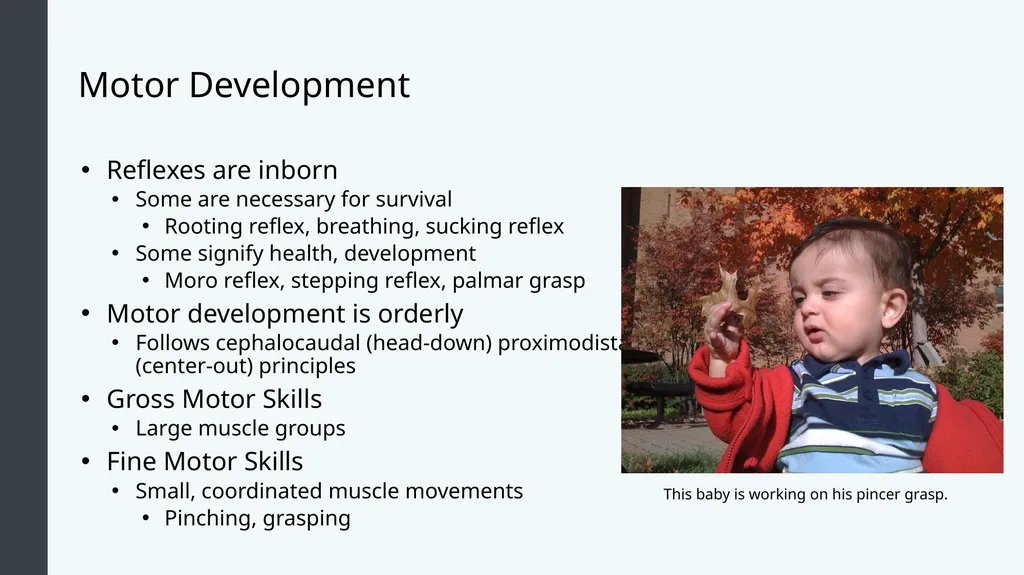
Pinching, grasping This baby is working on his pincer grasp.<br>
Some are necessary for survival
Rooting reflex, breathing, sucking reflex
Some signify health, development
Moro reflex, stepping reflex, palmar grasp
Motor development is orderly
Follows cephalocaudal (head-down) proximodistal (center-out) principles
Gross Motor Skills
Large muscle groups
Fine Motor Skills
Small, coordinated muscle movements
Pinching, grasping This baby is working on his pincer grasp.<br>
09
Motor & Sensory Development Sensation & Perception
Sensation: interaction with sensory receptors
Perception: interpreting information sensed
Sensory Development
Sight- least developed at birth
Newborns see ~8-16 inches in front of them
Preference for faces, unusual, interesting, exciting images
Hearing: most developed at birth
In the womb, babies know the sound of mother’s voice
Touch/pain
Physiological reactions indicate sensation of pain- circumcision
Touch- necessary and comforting
Taste/smell
Ability to distinguish flavors: sweet, salty, sour, bitter (prefer sweet tastes)
Identify mother’s smell easily<br>
Sensation: interaction with sensory receptors
Perception: interpreting information sensed
Sensory Development
Sight- least developed at birth
Newborns see ~8-16 inches in front of them
Preference for faces, unusual, interesting, exciting images
Hearing: most developed at birth
In the womb, babies know the sound of mother’s voice
Touch/pain
Physiological reactions indicate sensation of pain- circumcision
Touch- necessary and comforting
Taste/smell
Ability to distinguish flavors: sweet, salty, sour, bitter (prefer sweet tastes)
Identify mother’s smell easily<br>
10
Nutrition Breastfeeding- “breast is best”
Colostrum: “liquid gold,” nutrient-dense, first days of life
Breastmilk has iron, fats, proteins, for proper development
Alternatives to breastfeeding
Formula feeding may be necessary in various conditions (mother doesn’t produce enough milk, adoptive or two-father family, mother has communicable disease, etc.)
Introducing solid foods
Start simple: one at a time is best, spaced days apart to ID allergies
Malnutrition & clean water access
Kwashiorkor: “displaced child’s disease”- lack of sufficient nutrition
Marasmus: starvation from lack of calories, protein
Milk anemia: Lack of iron from drinking cow’s milk in place of more nutritive foods
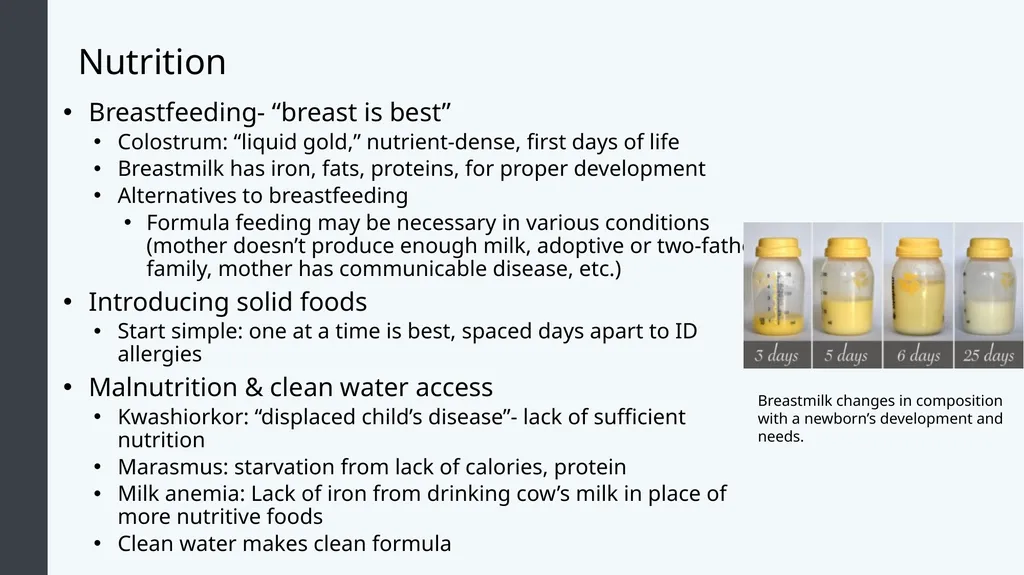
Clean water makes clean formula Breastmilk changes in composition with a newborn’s development and needs.<br>
Colostrum: “liquid gold,” nutrient-dense, first days of life
Breastmilk has iron, fats, proteins, for proper development
Alternatives to breastfeeding
Formula feeding may be necessary in various conditions (mother doesn’t produce enough milk, adoptive or two-father family, mother has communicable disease, etc.)
Introducing solid foods
Start simple: one at a time is best, spaced days apart to ID allergies
Malnutrition & clean water access
Kwashiorkor: “displaced child’s disease”- lack of sufficient nutrition
Marasmus: starvation from lack of calories, protein
Milk anemia: Lack of iron from drinking cow’s milk in place of more nutritive foods
Clean water makes clean formula Breastmilk changes in composition with a newborn’s development and needs.<br>
11
Sleep & Health Infant sleep requirements
From 0-2 years, average 12.8 hrs/day
Newborns sleep 14-17 hrs
SIDS: many risk factors, many unknowns
Sudden Unexpected Infant Deaths (SUID): some identified causes
“Back to Sleep”
Back-sleeping recommended for every sleep
No soft bedding, blankets, potential hazards
Co-sleeping
Benefit of skin-to-skin contact
Risk of child suffocation, increased risk w/ parental drug/alcohol use
Sleep schedules
Nighttime waking is common
Many infants sleep 6 hrs during night by 6 months
Not doing so does not indicate a serious problem, but individual differences<br>
From 0-2 years, average 12.8 hrs/day
Newborns sleep 14-17 hrs
SIDS: many risk factors, many unknowns
Sudden Unexpected Infant Deaths (SUID): some identified causes
“Back to Sleep”
Back-sleeping recommended for every sleep
No soft bedding, blankets, potential hazards
Co-sleeping
Benefit of skin-to-skin contact
Risk of child suffocation, increased risk w/ parental drug/alcohol use
Sleep schedules
Nighttime waking is common
Many infants sleep 6 hrs during night by 6 months
Not doing so does not indicate a serious problem, but individual differences<br>
12
Vaccinations Immunizations: the debate
Personal beliefs, opt-out programs, religious beliefs
Need for community protection, prevent resurgence of diseases
Herd immunity
90%+ of population is vaccinated, population is protected
Approx. 1 in 14 children isn’t vaccinated
Outbreaks
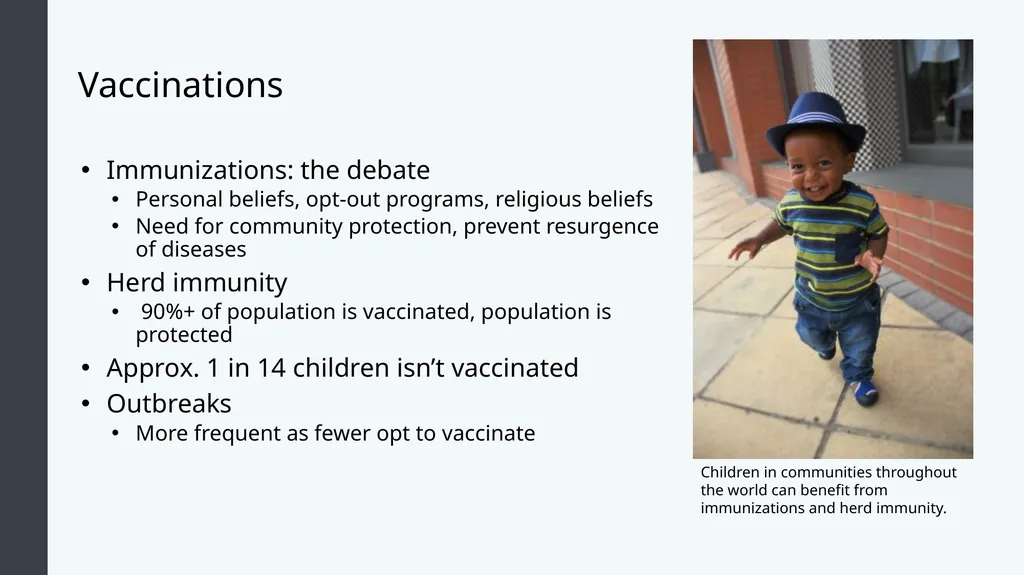
More frequent as fewer opt to vaccinate Children in communities throughout the world can benefit from immunizations and herd immunity.<br>
Personal beliefs, opt-out programs, religious beliefs
Need for community protection, prevent resurgence of diseases
Herd immunity
90%+ of population is vaccinated, population is protected
Approx. 1 in 14 children isn’t vaccinated
Outbreaks
More frequent as fewer opt to vaccinate Children in communities throughout the world can benefit from immunizations and herd immunity.<br>
13
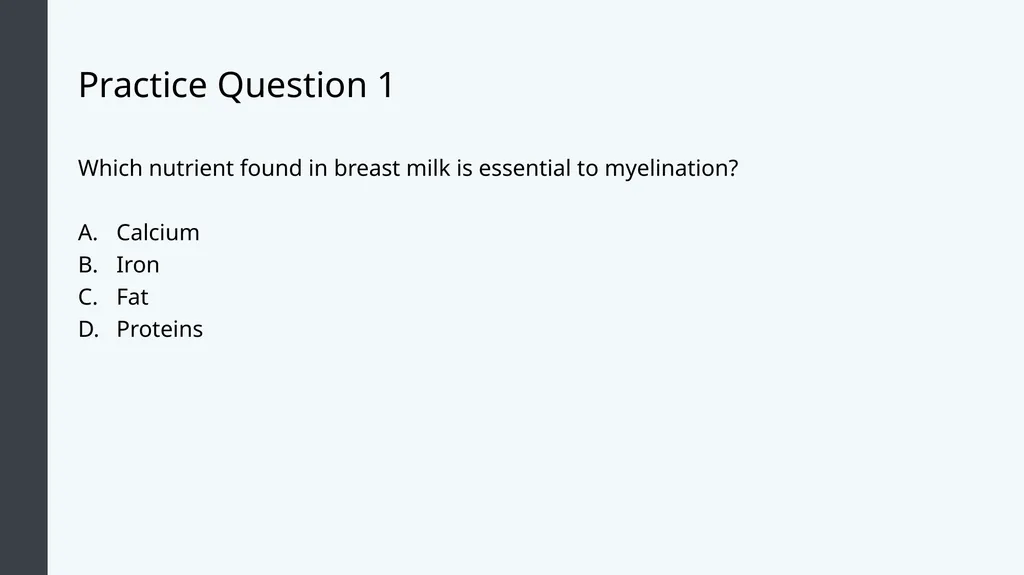
Practice Question 1 Which nutrient found in breast milk is essential to myelination?
Calcium
Iron
Fat
Proteins<br>
Calcium
Iron
Fat
Proteins<br>
14
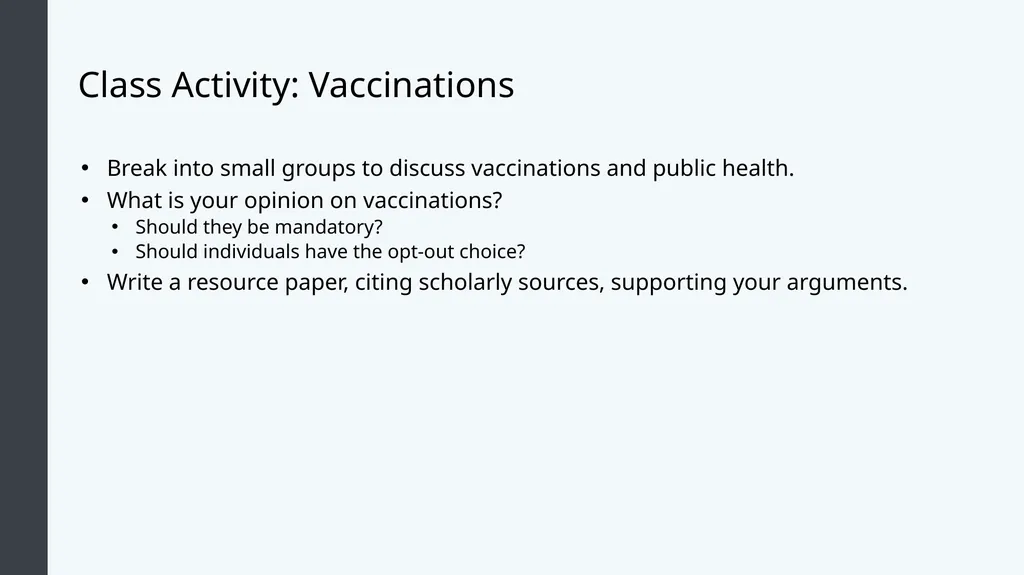
Class Activity: Vaccinations Break into small groups to discuss vaccinations and public health.
What is your opinion on vaccinations?
Should they be mandatory?
Should individuals have the opt-out choice?
Write a resource paper, citing scholarly sources, supporting your arguments.<br>
What is your opinion on vaccinations?
Should they be mandatory?
Should individuals have the opt-out choice?
Write a resource paper, citing scholarly sources, supporting your arguments.<br>
15
Cognitive Development in Infants & Toddlers<br>
16
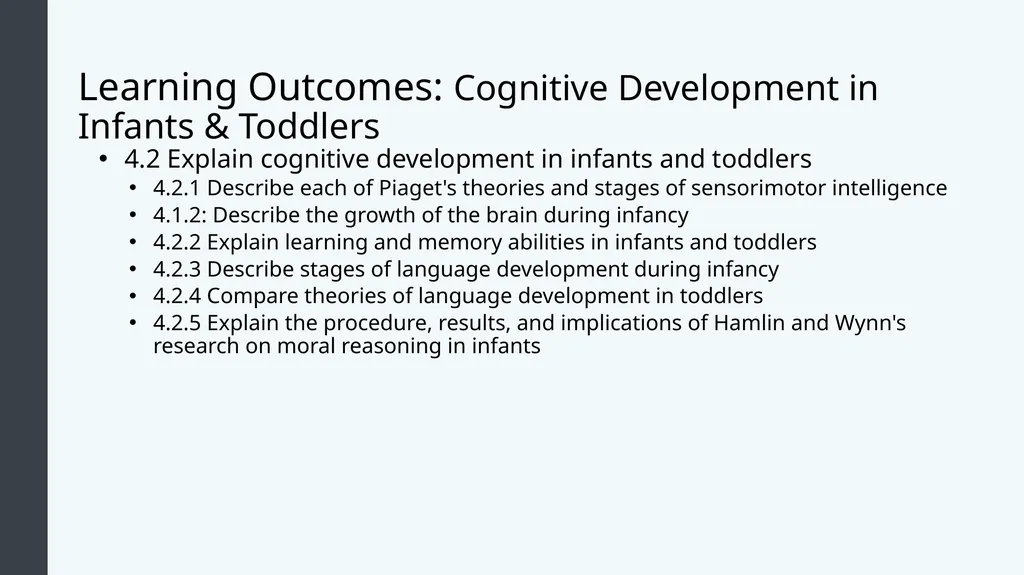
Learning Outcomes: Cognitive Development in Infants & Toddlers 4.2 Explain cognitive development in infants and toddlers
4.2.1 Describe each of Piaget's theories and stages of sensorimotor intelligence
4.1.2: Describe the growth of the brain during infancy
4.2.2 Explain learning and memory abilities in infants and toddlers
4.2.3 Describe stages of language development during infancy
4.2.4 Compare theories of language development in toddlers
4.2.5 Explain the procedure, results, and implications of Hamlin and Wynn's research on moral reasoning in infants<br>
4.2.1 Describe each of Piaget's theories and stages of sensorimotor intelligence
4.1.2: Describe the growth of the brain during infancy
4.2.2 Explain learning and memory abilities in infants and toddlers
4.2.3 Describe stages of language development during infancy
4.2.4 Compare theories of language development in toddlers
4.2.5 Explain the procedure, results, and implications of Hamlin and Wynn's research on moral reasoning in infants<br>
17
Cognitive Development:
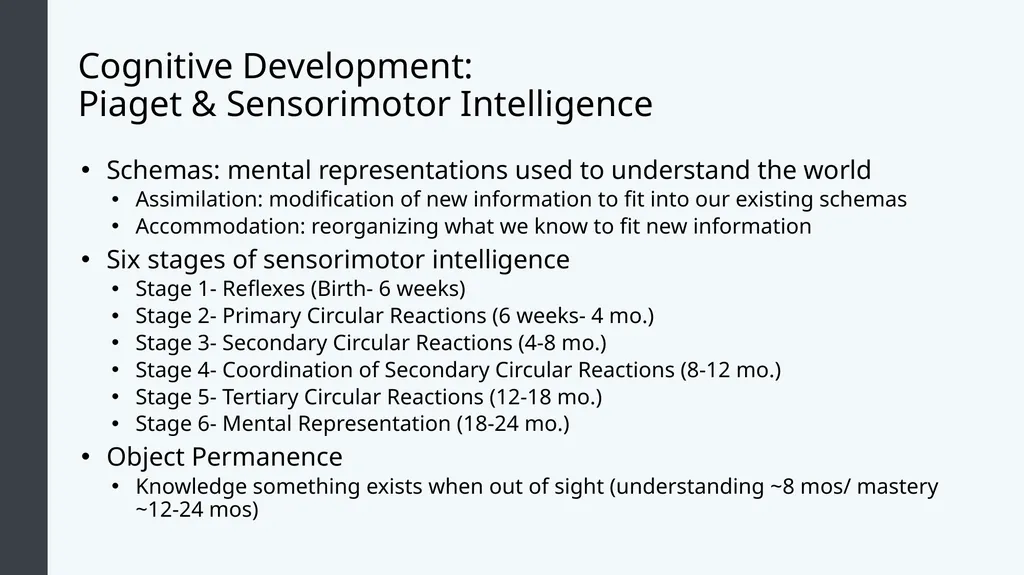
Piaget & Sensorimotor Intelligence Schemas: mental representations used to understand the world
Assimilation: modification of new information to fit into our existing schemas
Accommodation: reorganizing what we know to fit new information
Six stages of sensorimotor intelligence
Stage 1- Reflexes (Birth- 6 weeks)
Stage 2- Primary Circular Reactions (6 weeks- 4 mo.)
Stage 3- Secondary Circular Reactions (4-8 mo.)
Stage 4- Coordination of Secondary Circular Reactions (8-12 mo.)
Stage 5- Tertiary Circular Reactions (12-18 mo.)
Stage 6- Mental Representation (18-24 mo.)
Object Permanence
Knowledge something exists when out of sight (understanding ~8 mos/ mastery ~12-24 mos)<br>
Assimilation: modification of new information to fit into our existing schemas
Accommodation: reorganizing what we know to fit new information
Six stages of sensorimotor intelligence
Stage 1- Reflexes (Birth- 6 weeks)
Stage 2- Primary Circular Reactions (6 weeks- 4 mo.)
Stage 3- Secondary Circular Reactions (4-8 mo.)
Stage 4- Coordination of Secondary Circular Reactions (8-12 mo.)
Stage 5- Tertiary Circular Reactions (12-18 mo.)
Stage 6- Mental Representation (18-24 mo.)
Object Permanence
Knowledge something exists when out of sight (understanding ~8 mos/ mastery ~12-24 mos)<br>
18
Learning & Memory Abilities in Infants Piaget underestimated infant memory ability
Lacking in language to express memory
Experiments: preferential looking
Infantile amnesia
Infants and toddlers form memories, remember them weeks, months later
Lack of memory years later
Encoding/ retrieval failures
Older children, adults use linguistic retrieval methods
Misalignment between encoding and new memory organization<br>
Lacking in language to express memory
Experiments: preferential looking
Infantile amnesia
Infants and toddlers form memories, remember them weeks, months later
Lack of memory years later
Encoding/ retrieval failures
Older children, adults use linguistic retrieval methods
Misalignment between encoding and new memory organization<br>
19
Language Development Phonemes are basic units of speech, which make morphemes, the smallest meaningful units of speech
When a child starts vocalizing, they produce all phonemes
With specialization, only native phonemes are easy to reproduce
Stages of language development:
Stage 1: Reflexive Communication
Stage 2: Reflexive communication; interest in others
Stage 3: Intentional communication
Stage 4: First words
Stage 5: Simple sentences (two words)
Stage 6: Sentences of three or more words
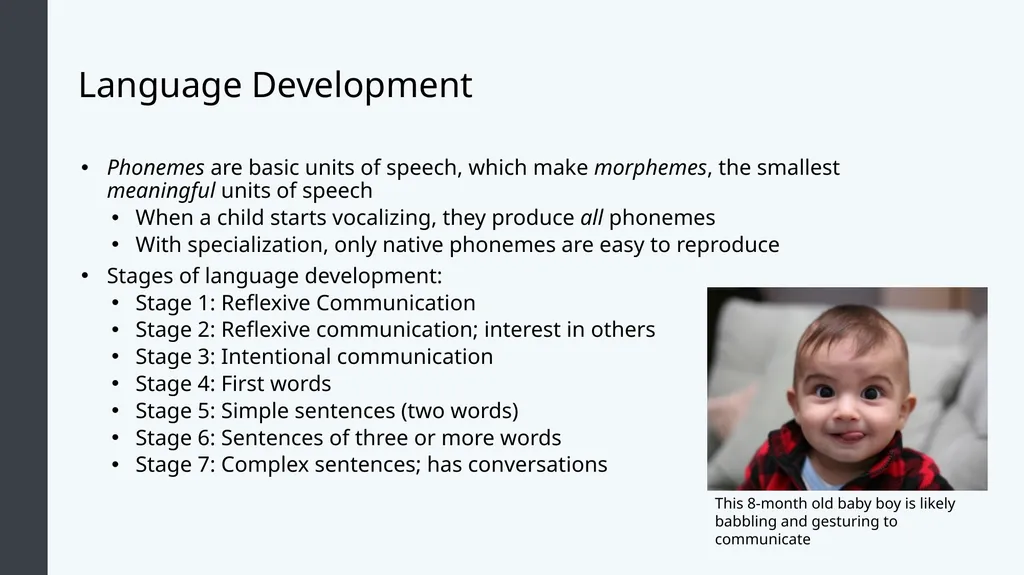
Stage 7: Complex sentences; has conversations This 8-month old baby boy is likely babbling and gesturing to communicate<br>
When a child starts vocalizing, they produce all phonemes
With specialization, only native phonemes are easy to reproduce
Stages of language development:
Stage 1: Reflexive Communication
Stage 2: Reflexive communication; interest in others
Stage 3: Intentional communication
Stage 4: First words
Stage 5: Simple sentences (two words)
Stage 6: Sentences of three or more words
Stage 7: Complex sentences; has conversations This 8-month old baby boy is likely babbling and gesturing to communicate<br>
20
Language Development, cont. Intentional vocalizations: gurgling, cooing, learn conversational cadences
Babbling, gesturing: syllable repetition, gesturing, sign language
Babies understand more language than they can produce
Holophrasic speech: partial words convey thoughts
People close to the child often interpret correctly
Underextension: a word may only be used for one specific think
Example: “Mommy” is my mother, so I shout for her in the grocery store when I am lost
Overextension is more common- generalizing
First words, cultural influences
Nouns, verbs, relationships- parts of speech vary by language & culture
Vocabulary growth spurt/ naming explosion: rapid vocabulary expansion
Many new words are nouns; child can name things around them & in the world
Two-word sentences, telegraphic speech: Lacks complete grammar, yet conveys meaning (like text messages)
Child-directed speech: captures children’s attention, articulates sounds<br>
Babbling, gesturing: syllable repetition, gesturing, sign language
Babies understand more language than they can produce
Holophrasic speech: partial words convey thoughts
People close to the child often interpret correctly
Underextension: a word may only be used for one specific think
Example: “Mommy” is my mother, so I shout for her in the grocery store when I am lost
Overextension is more common- generalizing
First words, cultural influences
Nouns, verbs, relationships- parts of speech vary by language & culture
Vocabulary growth spurt/ naming explosion: rapid vocabulary expansion
Many new words are nouns; child can name things around them & in the world
Two-word sentences, telegraphic speech: Lacks complete grammar, yet conveys meaning (like text messages)
Child-directed speech: captures children’s attention, articulates sounds<br>
21
Theories of Language Development Nativism- Noam Chomsky
Language Acquisition Device- innate ability to learn language, understand conventions and syntax
Children learn language through exposure, can learn any language
Critical periods- during these times learning is most important
Behaviorism- B.F. Skinner
Language is taught through reinforcement
Social Pragmatics- Tomasello & Hermann
Communication develops from need to communicate, join social world
All have components of truth and help explain language learning<br>
Language Acquisition Device- innate ability to learn language, understand conventions and syntax
Children learn language through exposure, can learn any language
Critical periods- during these times learning is most important
Behaviorism- B.F. Skinner
Language is taught through reinforcement
Social Pragmatics- Tomasello & Hermann
Communication develops from need to communicate, join social world
All have components of truth and help explain language learning<br>
22
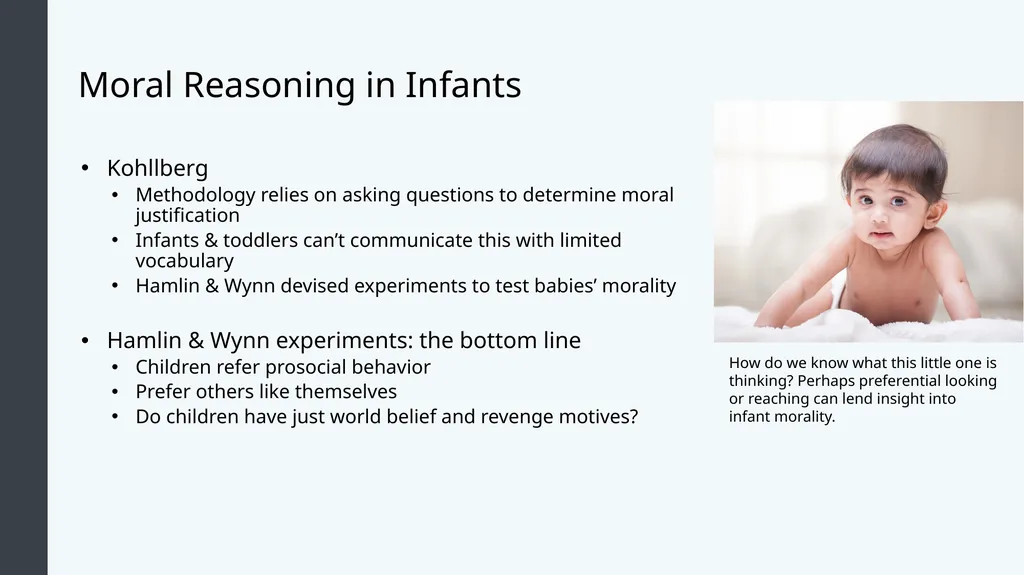
Moral Reasoning in Infants Kohllberg
Methodology relies on asking questions to determine moral justification
Infants & toddlers can’t communicate this with limited vocabulary
Hamlin & Wynn devised experiments to test babies’ morality
Hamlin & Wynn experiments: the bottom line
Children refer prosocial behavior
Prefer others like themselves
Do children have just world belief and revenge motives? How do we know what this little one is thinking? Perhaps preferential looking or reaching can lend insight into infant morality.<br>
Methodology relies on asking questions to determine moral justification
Infants & toddlers can’t communicate this with limited vocabulary
Hamlin & Wynn devised experiments to test babies’ morality
Hamlin & Wynn experiments: the bottom line
Children refer prosocial behavior
Prefer others like themselves
Do children have just world belief and revenge motives? How do we know what this little one is thinking? Perhaps preferential looking or reaching can lend insight into infant morality.<br>
23
Practice Question 2 Why is the stage of rapid vocabulary growth in toddlerhood often called the “naming explosion?”
The child learns mostly people’s names in his/her expanding vocabulary.
Words the child adds to their repertoire are mostly nouns: people, places, and things.
Pronouns are an important part of vocabulary growth, as children learn how to properly refer to other people.
The child usually enters pre-school programs at this age and revels in reciting names of classmates.<br>
The child learns mostly people’s names in his/her expanding vocabulary.
Words the child adds to their repertoire are mostly nouns: people, places, and things.
Pronouns are an important part of vocabulary growth, as children learn how to properly refer to other people.
The child usually enters pre-school programs at this age and revels in reciting names of classmates.<br>
24
Class Activity: Earliest memories Childhood memories are ephemeral, but some have lasting impact. Think of your earliest childhood memory and try to describe it in as much detail as possible.
Note the retrieval cues you used and recall anything you can about your surroundings at the time the memory occurred.
Share your memories in small groups and discuss any commonalities between your earliest memories.<br>
Note the retrieval cues you used and recall anything you can about your surroundings at the time the memory occurred.
Share your memories in small groups and discuss any commonalities between your earliest memories.<br>
25
Emotional & Social Development During Infancy<br>
26
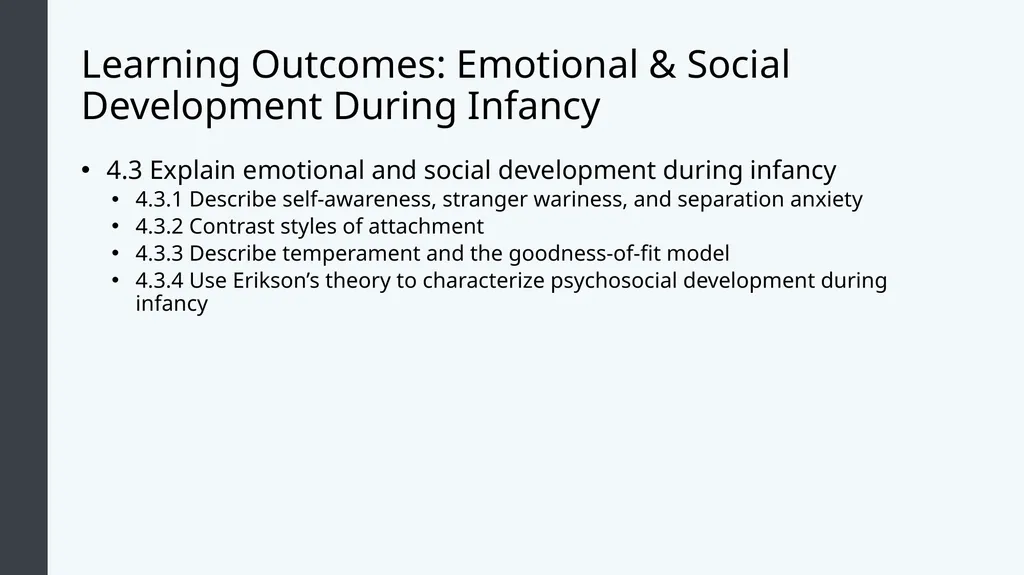
Learning Outcomes: Emotional & Social Development During Infancy 4.3 Explain emotional and social development during infancy
4.3.1 Describe self-awareness, stranger wariness, and separation anxiety
4.3.2 Contrast styles of attachment
4.3.3 Describe temperament and the goodness-of-fit model
4.3.4 Use Erikson’s theory to characterize psychosocial development during infancy<br>
4.3.1 Describe self-awareness, stranger wariness, and separation anxiety
4.3.2 Contrast styles of attachment
4.3.3 Describe temperament and the goodness-of-fit model
4.3.4 Use Erikson’s theory to characterize psychosocial development during infancy<br>
27
Emotional Development Attraction & withdrawal
Social smiling- appears ~2 months, laughter at 3-5 months
Displeasure- frustration is normal, sadness can indicate withdrawal
Stranger wariness- appears ~6-15 months
Indicator of memory- familiar and unfamiliar
Separation anxiety
Shows cognitive development: “where has my caregiver gone?”
Peaks around 8-10 months, declines later w/ healthy attachment
Emotional regulation
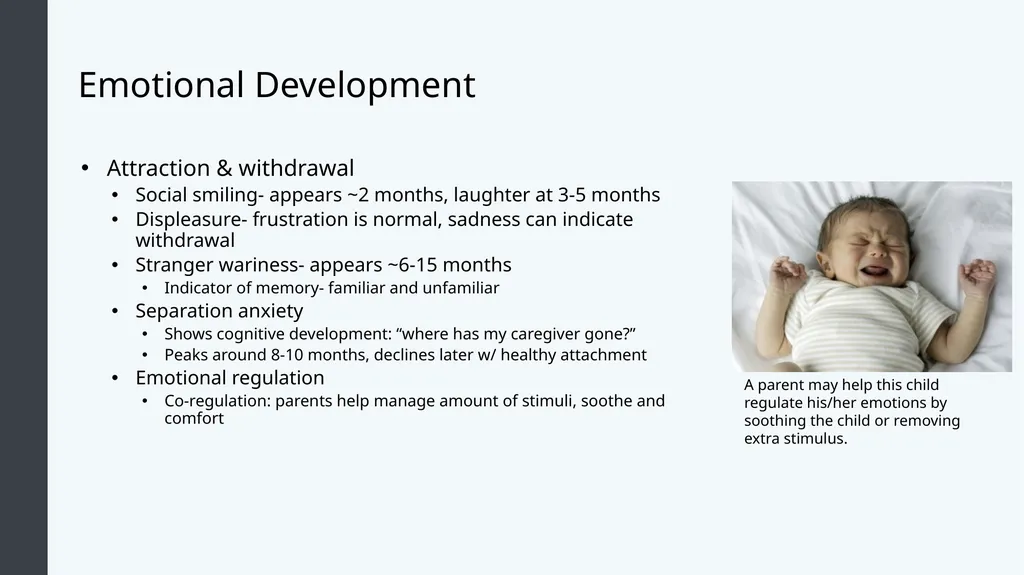
Co-regulation: parents help manage amount of stimuli, soothe and comfort A parent may help this child regulate his/her emotions by soothing the child or removing extra stimulus.<br>
Social smiling- appears ~2 months, laughter at 3-5 months
Displeasure- frustration is normal, sadness can indicate withdrawal
Stranger wariness- appears ~6-15 months
Indicator of memory- familiar and unfamiliar
Separation anxiety
Shows cognitive development: “where has my caregiver gone?”
Peaks around 8-10 months, declines later w/ healthy attachment
Emotional regulation
Co-regulation: parents help manage amount of stimuli, soothe and comfort A parent may help this child regulate his/her emotions by soothing the child or removing extra stimulus.<br>
28
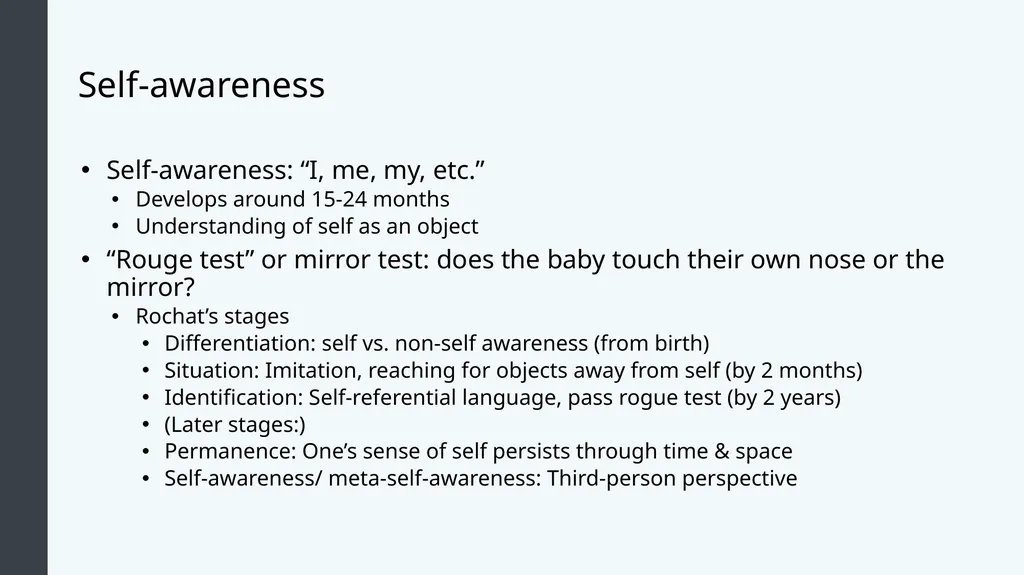
Self-awareness Self-awareness: “I, me, my, etc.”
Develops around 15-24 months
Understanding of self as an object
“Rouge test” or mirror test: does the baby touch their own nose or the mirror?
Rochat’s stages
Differentiation: self vs. non-self awareness (from birth)
Situation: Imitation, reaching for objects away from self (by 2 months)
Identification: Self-referential language, pass rogue test (by 2 years)
(Later stages:)
Permanence: One’s sense of self persists through time & space
Self-awareness/ meta-self-awareness: Third-person perspective<br>
Develops around 15-24 months
Understanding of self as an object
“Rouge test” or mirror test: does the baby touch their own nose or the mirror?
Rochat’s stages
Differentiation: self vs. non-self awareness (from birth)
Situation: Imitation, reaching for objects away from self (by 2 months)
Identification: Self-referential language, pass rogue test (by 2 years)
(Later stages:)
Permanence: One’s sense of self persists through time & space
Self-awareness/ meta-self-awareness: Third-person perspective<br>
29
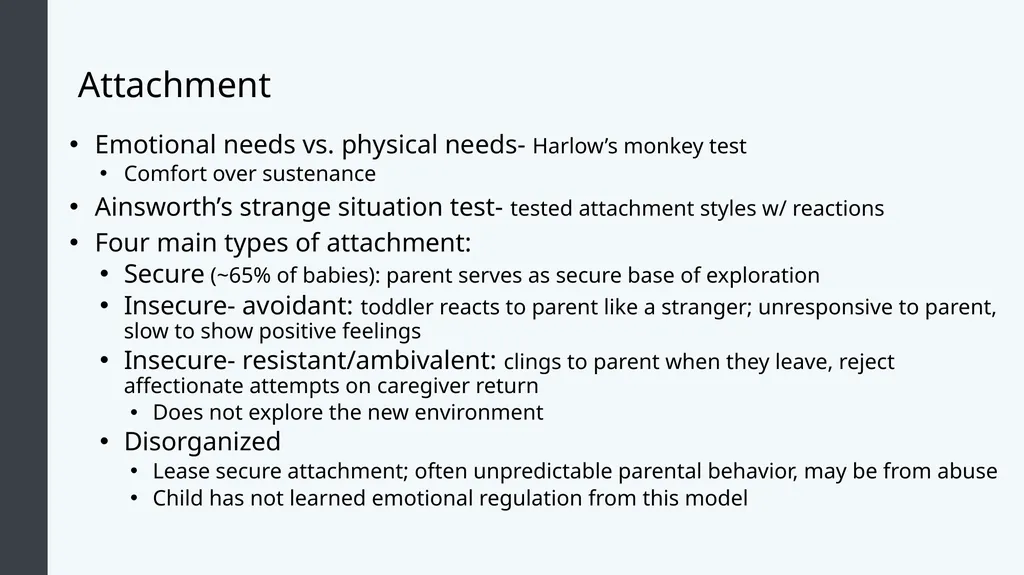
Attachment Emotional needs vs. physical needs- Harlow’s monkey test
Comfort over sustenance
Ainsworth’s strange situation test- tested attachment styles w/ reactions
Four main types of attachment:
Secure (~65% of babies): parent serves as secure base of exploration
Insecure- avoidant: toddler reacts to parent like a stranger; unresponsive to parent, slow to show positive feelings
Insecure- resistant/ambivalent: clings to parent when they leave, reject affectionate attempts on caregiver return
Does not explore the new environment
Disorganized
Lease secure attachment; often unpredictable parental behavior, may be from abuse
Child has not learned emotional regulation from this model<br>
Comfort over sustenance
Ainsworth’s strange situation test- tested attachment styles w/ reactions
Four main types of attachment:
Secure (~65% of babies): parent serves as secure base of exploration
Insecure- avoidant: toddler reacts to parent like a stranger; unresponsive to parent, slow to show positive feelings
Insecure- resistant/ambivalent: clings to parent when they leave, reject affectionate attempts on caregiver return
Does not explore the new environment
Disorganized
Lease secure attachment; often unpredictable parental behavior, may be from abuse
Child has not learned emotional regulation from this model<br>
30
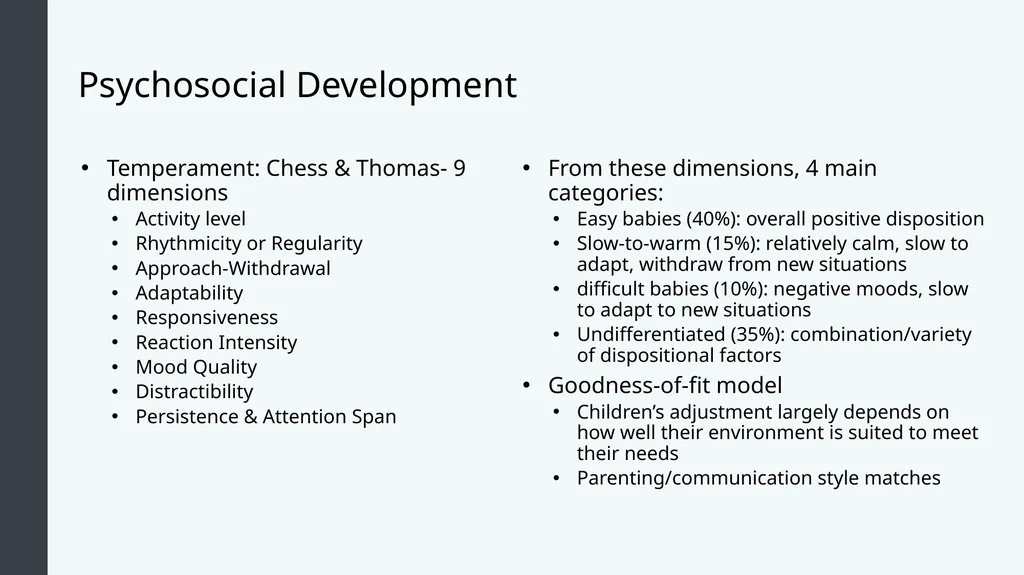
Psychosocial Development Temperament: Chess & Thomas- 9 dimensions
Activity level
Rhythmicity or Regularity
Approach-Withdrawal
Adaptability
Responsiveness
Reaction Intensity
Mood Quality
Distractibility
Persistence & Attention Span From these dimensions, 4 main categories:
Easy babies (40%): overall positive disposition
Slow-to-warm (15%): relatively calm, slow to adapt, withdraw from new situations
difficult babies (10%): negative moods, slow to adapt to new situations
Undifferentiated (35%): combination/variety of dispositional factors
Goodness-of-fit model
Children’s adjustment largely depends on how well their environment is suited to meet their needs
Parenting/communication style matches<br>
Activity level
Rhythmicity or Regularity
Approach-Withdrawal
Adaptability
Responsiveness
Reaction Intensity
Mood Quality
Distractibility
Persistence & Attention Span From these dimensions, 4 main categories:
Easy babies (40%): overall positive disposition
Slow-to-warm (15%): relatively calm, slow to adapt, withdraw from new situations
difficult babies (10%): negative moods, slow to adapt to new situations
Undifferentiated (35%): combination/variety of dispositional factors
Goodness-of-fit model
Children’s adjustment largely depends on how well their environment is suited to meet their needs
Parenting/communication style matches<br>
31
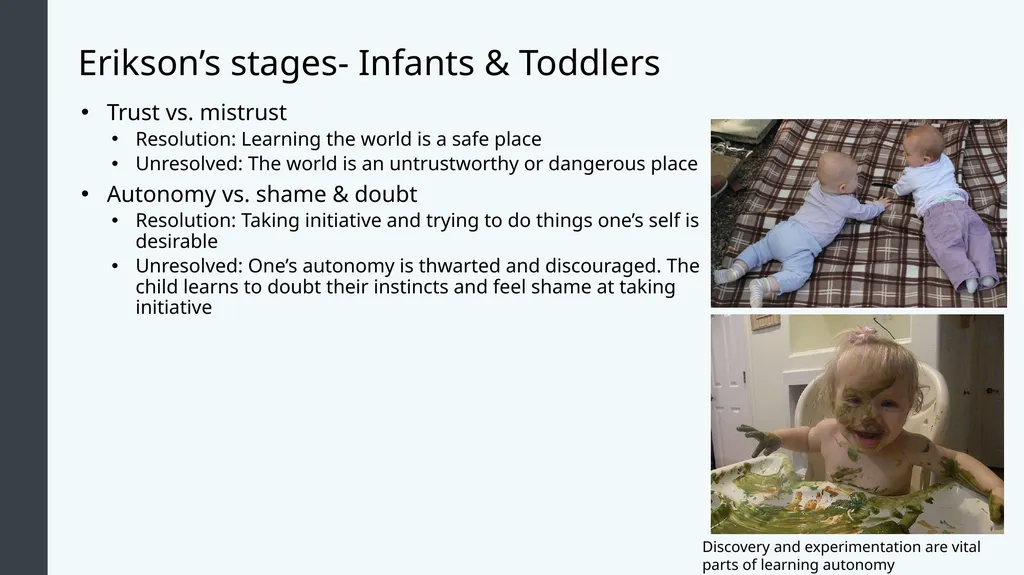
Erikson’s stages- Infants & Toddlers Trust vs. mistrust
Resolution: Learning the world is a safe place
Unresolved: The world is an untrustworthy or dangerous place
Autonomy vs. shame & doubt
Resolution: Taking initiative and trying to do things one’s self is desirable
Unresolved: One’s autonomy is thwarted and discouraged. The child learns to doubt their instincts and feel shame at taking initiative Discovery and experimentation are vital parts of learning autonomy<br>
Resolution: Learning the world is a safe place
Unresolved: The world is an untrustworthy or dangerous place
Autonomy vs. shame & doubt
Resolution: Taking initiative and trying to do things one’s self is desirable
Unresolved: One’s autonomy is thwarted and discouraged. The child learns to doubt their instincts and feel shame at taking initiative Discovery and experimentation are vital parts of learning autonomy<br>
32
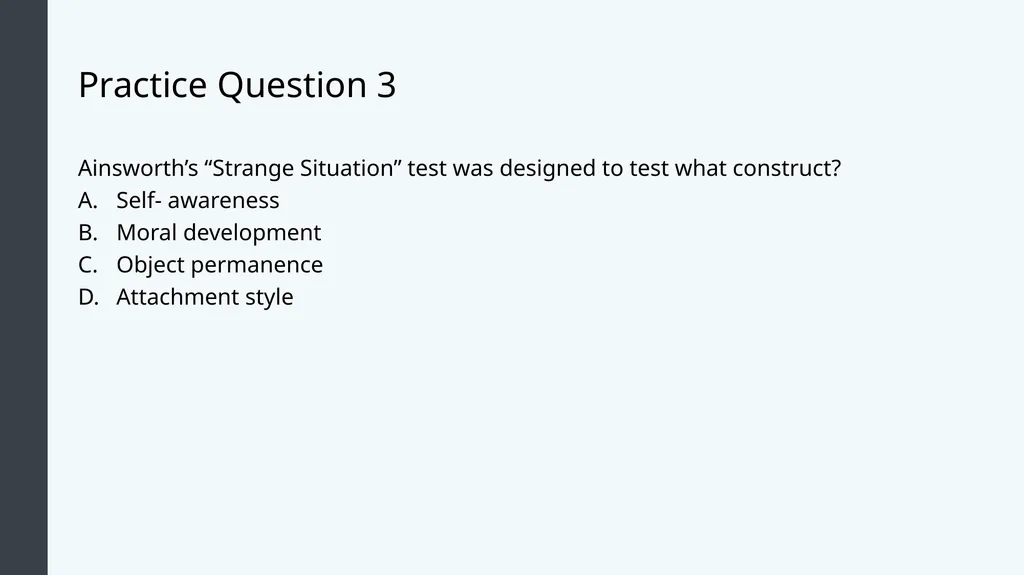
Practice Question 3 Ainsworth’s “Strange Situation” test was designed to test what construct?
Self- awareness
Moral development
Object permanence
Attachment style<br>
Self- awareness
Moral development
Object permanence
Attachment style<br>
33
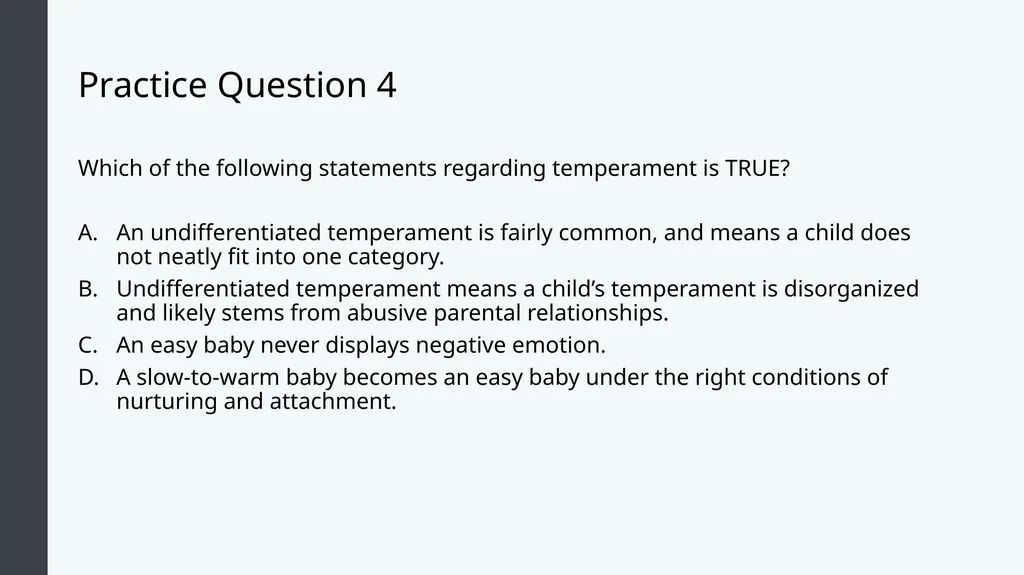
Practice Question 4 Which of the following statements regarding temperament is TRUE?
An undifferentiated temperament is fairly common, and means a child does not neatly fit into one category.
Undifferentiated temperament means a child’s temperament is disorganized and likely stems from abusive parental relationships.
An easy baby never displays negative emotion.
A slow-to-warm baby becomes an easy baby under the right conditions of nurturing and attachment.<br>
An undifferentiated temperament is fairly common, and means a child does not neatly fit into one category.
Undifferentiated temperament means a child’s temperament is disorganized and likely stems from abusive parental relationships.
An easy baby never displays negative emotion.
A slow-to-warm baby becomes an easy baby under the right conditions of nurturing and attachment.<br>
34
Quick Review What are Piaget's theories and stages of sensorimotor intelligence?
How does the brain grow during infancy?
What learning and memory abilities do infants and toddlers display?
How does language develop in stages during infancy?
What are the major theories of language development in toddlers, and how do they compare and contrast?
How did Hamlin and Wynn conduct their research on moral reasoning in infants, what were their results, and what did their research reveal?
What role do self-awareness, stranger wariness, and separation anxiety in infancy?
What styles of attachment did Ainsworth describe and test, and how do they compare?
How do a child’s temperament and the goodness-of-fit model for parenting relate?
How did Erikson characterize psychosocial development during infancy?<br>
How does the brain grow during infancy?
What learning and memory abilities do infants and toddlers display?
How does language develop in stages during infancy?
What are the major theories of language development in toddlers, and how do they compare and contrast?
How did Hamlin and Wynn conduct their research on moral reasoning in infants, what were their results, and what did their research reveal?
What role do self-awareness, stranger wariness, and separation anxiety in infancy?
What styles of attachment did Ainsworth describe and test, and how do they compare?
How do a child’s temperament and the goodness-of-fit model for parenting relate?
How did Erikson characterize psychosocial development during infancy?<br>
35
Quick Review - continued What are Piaget's theories and stages of sensorimotor intelligence?
How does the brain grow during infancy?
What learning and memory abilities do infants and toddlers display?
How does language develop in stages during infancy?
What are the major theories of language development in toddlers, and how do they compare and contrast?
How did Hamlin and Wynn conduct their research on moral reasoning in infants, what were their results, and what did their research reveal?
What role do self-awareness, stranger wariness, and separation anxiety in infancy?
What styles of attachment did Ainsworth describe and test, and how do they compare?
How do a child’s temperament and the goodness-of-fit model for parenting relate?
How did Erikson characterize psychosocial development during infancy?<br>
How does the brain grow during infancy?
What learning and memory abilities do infants and toddlers display?
How does language develop in stages during infancy?
What are the major theories of language development in toddlers, and how do they compare and contrast?
How did Hamlin and Wynn conduct their research on moral reasoning in infants, what were their results, and what did their research reveal?
What role do self-awareness, stranger wariness, and separation anxiety in infancy?
What styles of attachment did Ainsworth describe and test, and how do they compare?
How do a child’s temperament and the goodness-of-fit model for parenting relate?
How did Erikson characterize psychosocial development during infancy?<br>