
Lifespan Development Module 7: Adolescence Module
Description: Lifespan Development Module 7: Adolescence Module Learning Outcomes Describe the physical, cognitive, emotional, and social changes that occur during adolescence 7.1 describe the physical changes that occur during puberty and adolescence
Related Topics
Download Presentation
"Lifespan Development Module 7: Adolescence Module" is the property of its rightful owner. Permission is granted to download and print the materials on this website for personal, non-commercial use only, and to display it on your personal computer provided you do not modify the materials and that you retain all copyright notices contained in the materials. By downloading content from our website, you accept the terms of this agreement.
Presentation Transcript
slide1. Lifespan Development Module 7: Adolescence<br>
slide2. Module Learning Outcomes Describe the physical, cognitive, emotional, and social changes that occur during adolescence
7.1 describe the physical changes that occur during puberty and adolescence
7.2 Describe changes in cognitive development and moral reasoning during adolescence
7.3 describe adolescent identity development and social influences on development<br>
slide3. Physical Changes of Adolescence<br>
slide4. Learning Outcomes: Physical Changes of Adolescence 7.1 Describe the physical changes that occur during puberty and adolescence
7.1.1: Describe pubertal changes in body size, proportions, and sexual maturity
7.1.2: Explain social and emotional attitudes and reactions toward puberty, including sex differences
7.1.3: Describe brain development during adolescence
7.1.4: Describe health concerns during adolescence
7.1.5: Discuss concerns associated with eating disorders<br>
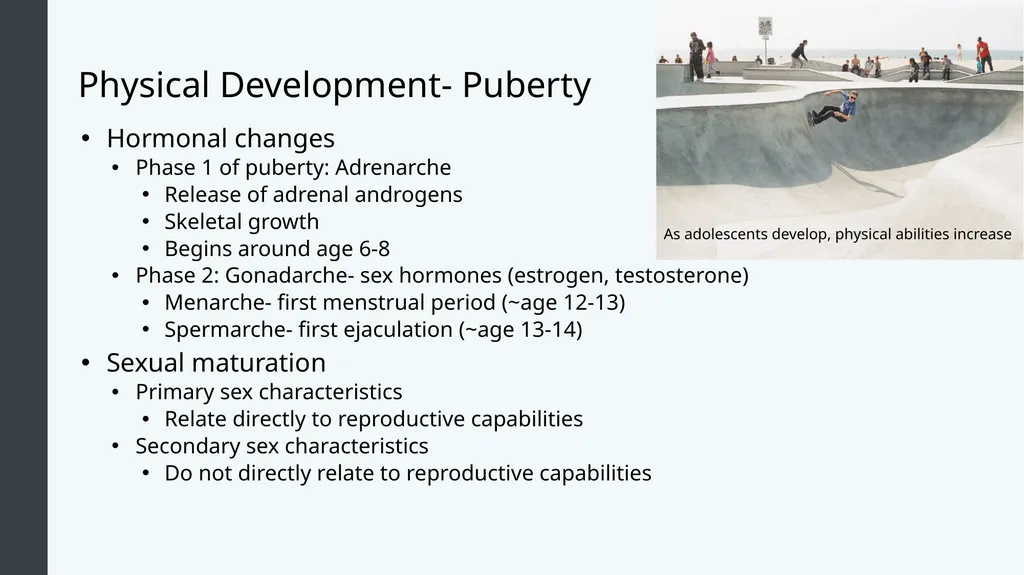
slide5. Physical Development- Puberty As adolescents develop, physical abilities increase Hormonal changes
Phase 1 of puberty: Adrenarche
Release of adrenal androgens
Skeletal growth
Begins around age 6-8
Phase 2: Gonadarche- sex hormones (estrogen, testosterone)
Menarche- first menstrual period (~age 12-13)
Spermarche- first ejaculation (~age 13-14)
Sexual maturation
Primary sex characteristics
Relate directly to reproductive capabilities
Secondary sex characteristics
Do not directly relate to reproductive capabilities<br>
slide6. Physical Growth: The Growth Spurt Growth spurts: Girls (age ~8-13) Boys (age ~10-16)
Increased height weight, reach adult proportions
Early developers & reactions
Girls: often get unwanted attention, teasing
Increased risk for depression, eating disorders, early sexual activity, substance abuse
Boys: risks and benefits
May be more athletic, taller
Increased risk for substance abuse, early sexual activity
Late developers/ “late bloomers”
Boys: risk of bullying, depression, parental conflict
Girls: risk of teasing, bullying
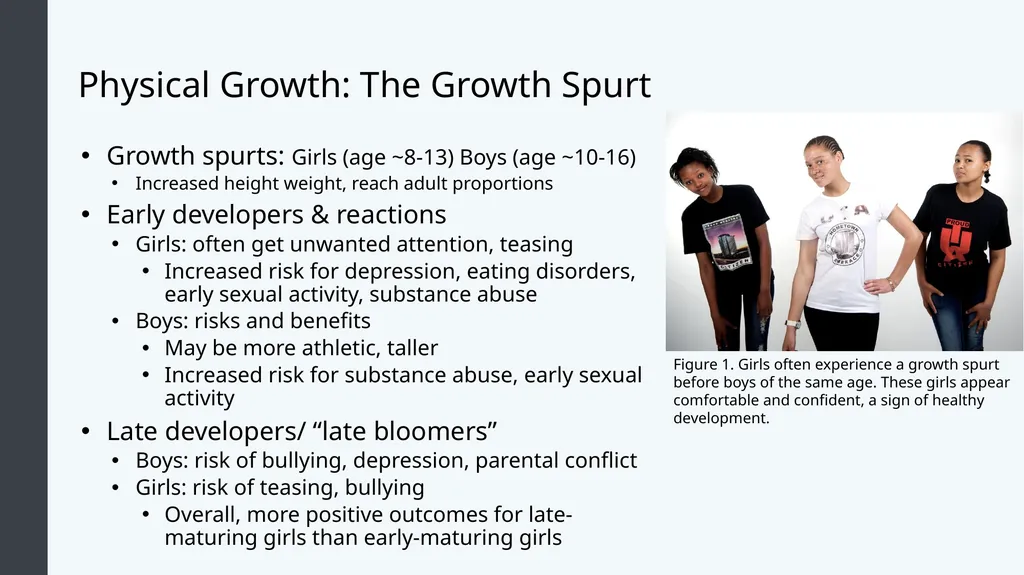
Overall, more positive outcomes for late-maturing girls than early-maturing girls Figure 1. Girls often experience a growth spurt before boys of the same age. These girls appear comfortable and confident, a sign of healthy development.<br>
slide7. Brain Development During Adolescence Prefrontal cortex- decision-making, higher level cognition
Myelination: increases information processing speed
Synaptic pruning: strengthens strongest neural connections
Limbic system- develops before prefrontal cortex
Responsible for emotional processing, rewards & punishments
Pubertal hormones target the amygdala
Dopamine: the “feel good” chemical- production is high
Involved in pleasure-seeking, risk-taking behaviors
Serotonin: calming chemical, balances dopamine, extreme behaviors
Sleep
Melatonin levels increase later in the night making “night owls” vs. “early risers”
Teens need 9-10 hrs of sleep
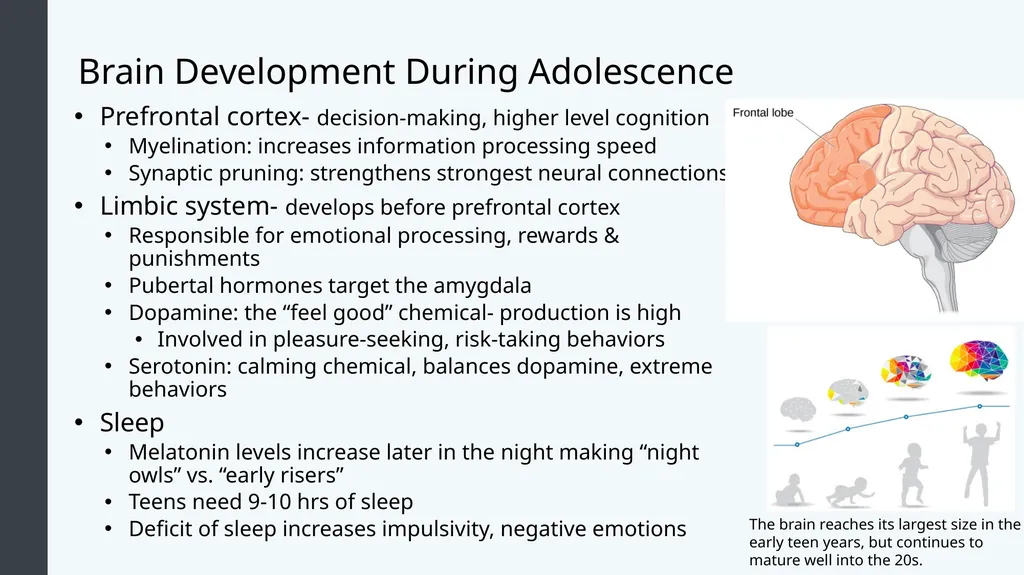
Deficit of sleep increases impulsivity, negative emotions The brain reaches its largest size in the early teen years, but continues to mature well into the 20s.<br>
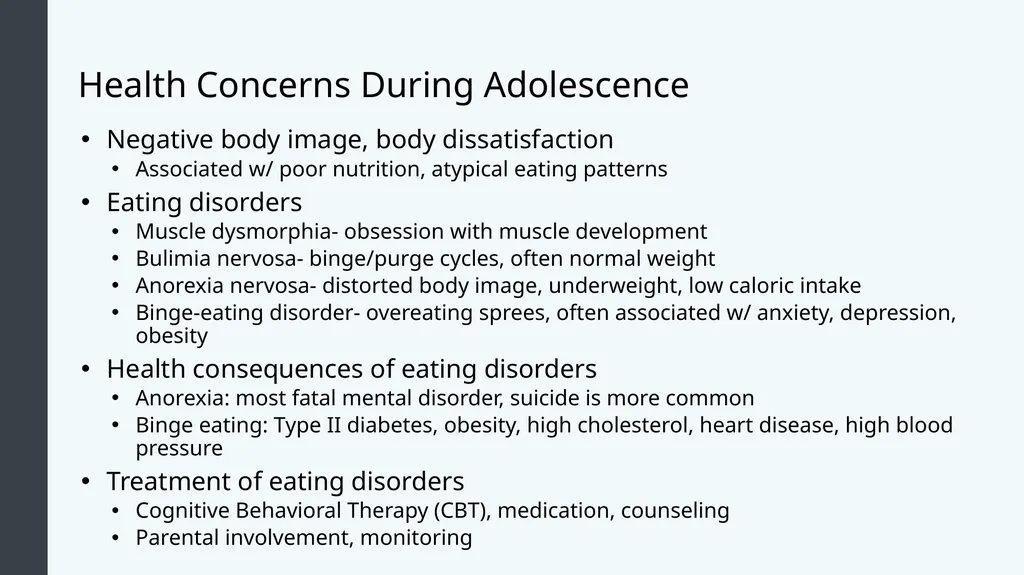
slide8. Health Concerns During Adolescence Negative body image, body dissatisfaction
Associated w/ poor nutrition, atypical eating patterns
Eating disorders
Muscle dysmorphia- obsession with muscle development
Bulimia nervosa- binge/purge cycles, often normal weight
Anorexia nervosa- distorted body image, underweight, low caloric intake
Binge-eating disorder- overeating sprees, often associated w/ anxiety, depression, obesity
Health consequences of eating disorders
Anorexia: most fatal mental disorder, suicide is more common
Binge eating: Type II diabetes, obesity, high cholesterol, heart disease, high blood pressure
Treatment of eating disorders
Cognitive Behavioral Therapy (CBT), medication, counseling
Parental involvement, monitoring<br>
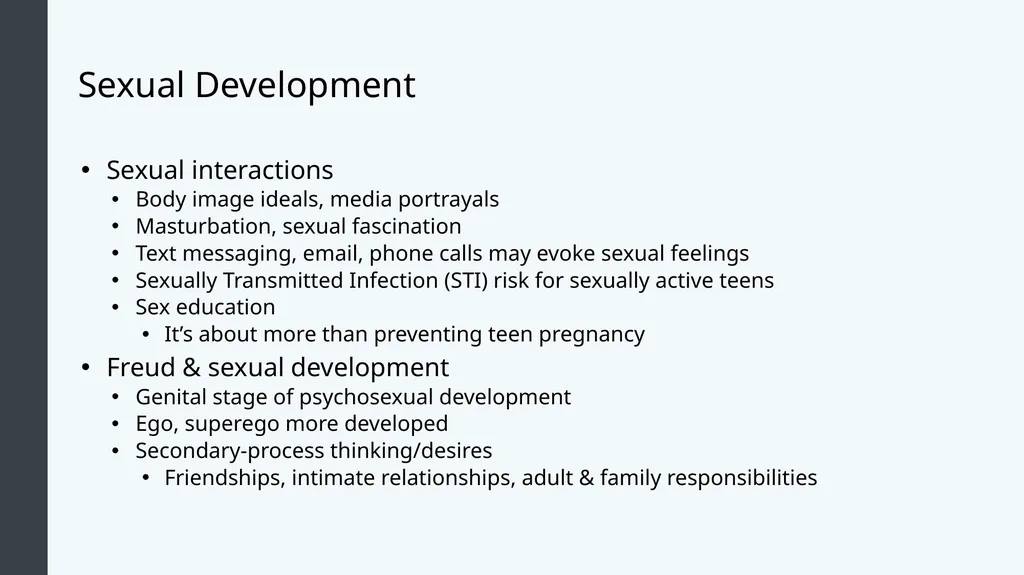
slide9. Sexual Development Sexual interactions
Body image ideals, media portrayals
Masturbation, sexual fascination
Text messaging, email, phone calls may evoke sexual feelings
Sexually Transmitted Infection (STI) risk for sexually active teens
Sex education
It’s about more than preventing teen pregnancy
Freud & sexual development
Genital stage of psychosexual development
Ego, superego more developed
Secondary-process thinking/desires
Friendships, intimate relationships, adult & family responsibilities<br>
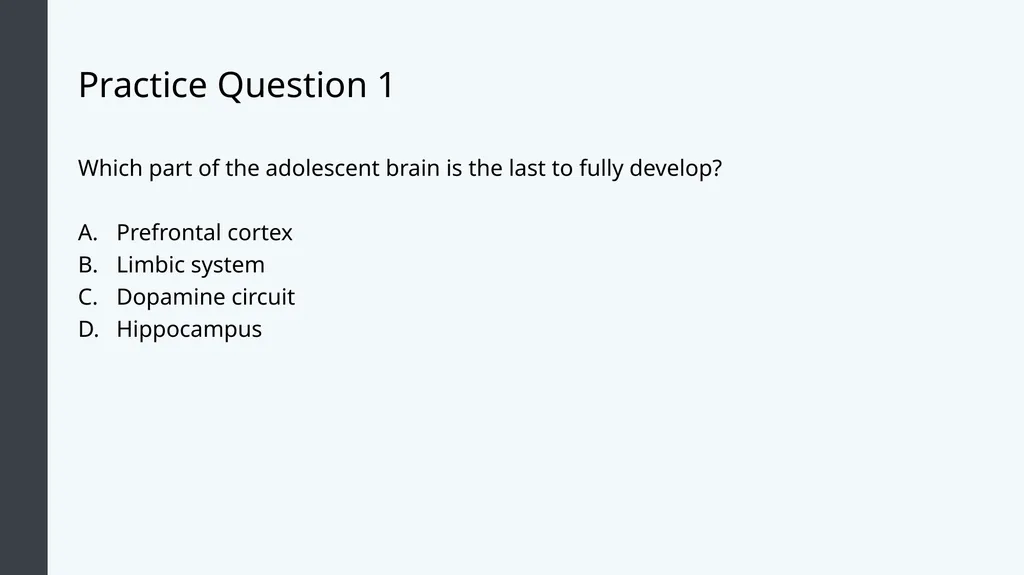
slide10. Practice Question 1 Which part of the adolescent brain is the last to fully develop?
Prefrontal cortex
Limbic system
Dopamine circuit
Hippocampus<br>
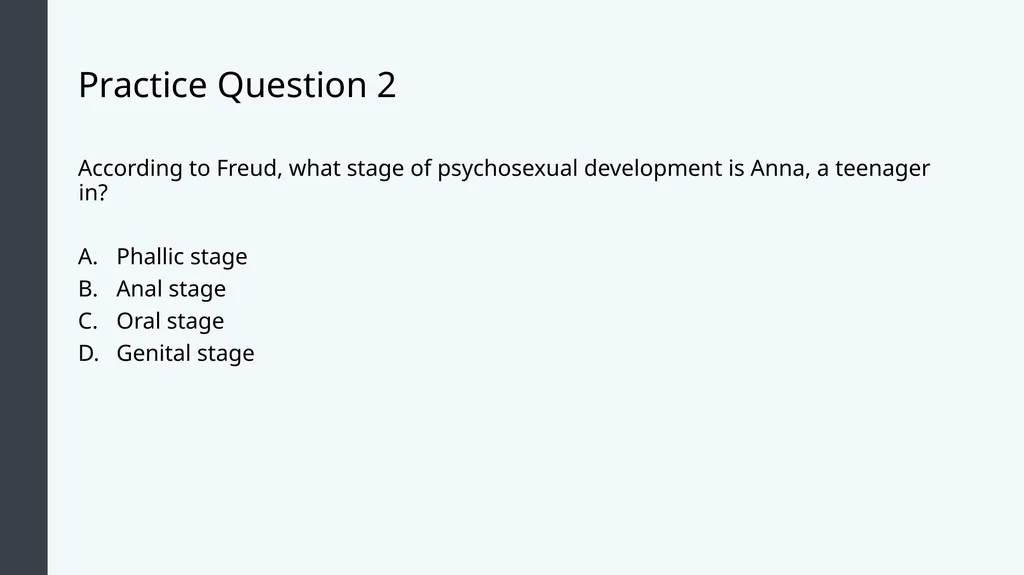
slide11. Practice Question 2 According to Freud, what stage of psychosexual development is Anna, a teenager in?
Phallic stage
Anal stage
Oral stage
Genital stage<br>
slide12. Cognitive Development During Adolescence<br>
slide13. Learning Outcomes: Cognitive Development During Adolescence 7.2 Describe changes in cognitive development and moral reasoning during adolescence
7.2.1 Explain Piaget's theory on formal operational thought
7.2.2 Describe cognitive abilities and changes during adolescence
7.2.3 Describe the role of secondary education in adolescent development
7.2.4 Describe moral development during adolescence<br>
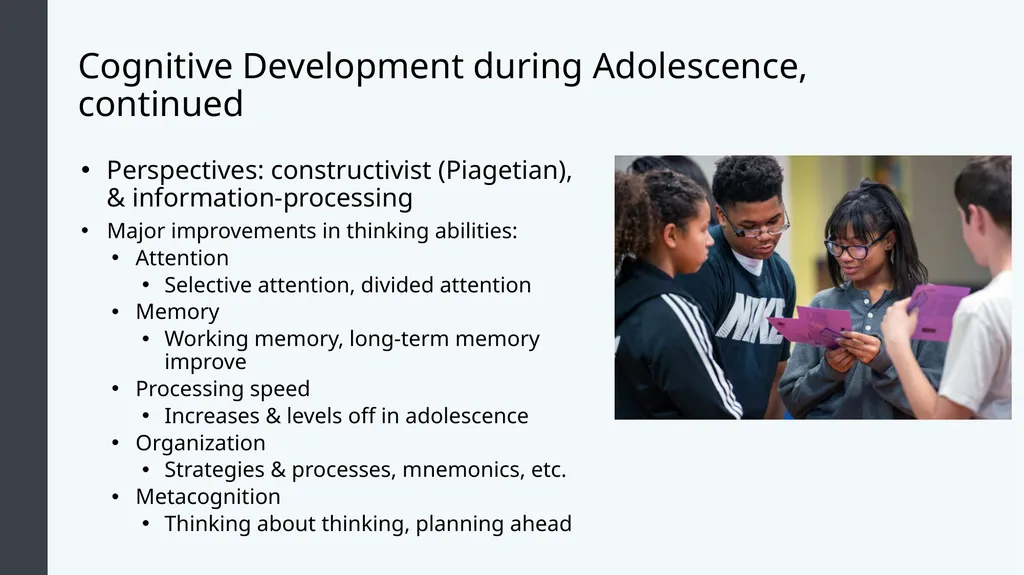
slide14. Cognitive Development during Adolescence, continued Perspectives: constructivist (Piagetian), & information-processing
Major improvements in thinking abilities:
Attention
Selective attention, divided attention
Memory
Working memory, long-term memory improve
Processing speed
Increases & levels off in adolescence
Organization
Strategies & processes, mnemonics, etc.
Metacognition
Thinking about thinking, planning ahead<br>
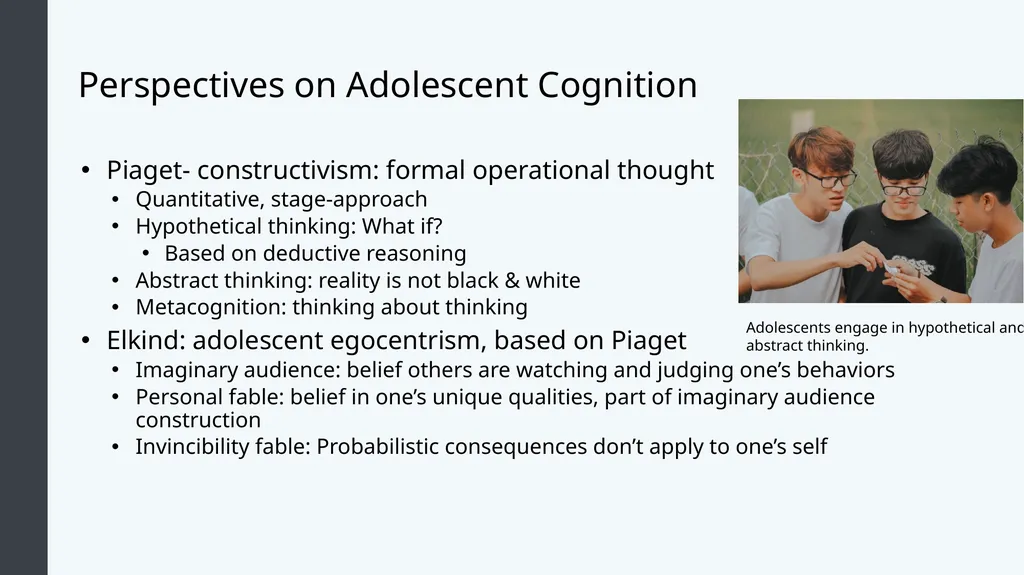
slide15. Perspectives on Adolescent Cognition Adolescents engage in hypothetical and abstract thinking. Piaget- constructivism: formal operational thought
Quantitative, stage-approach
Hypothetical thinking: What if?
Based on deductive reasoning
Abstract thinking: reality is not black & white
Metacognition: thinking about thinking
Elkind: adolescent egocentrism, based on Piaget
Imaginary audience: belief others are watching and judging one’s behaviors
Personal fable: belief in one’s unique qualities, part of imaginary audience construction
Invincibility fable: Probabilistic consequences don’t apply to one’s self<br>
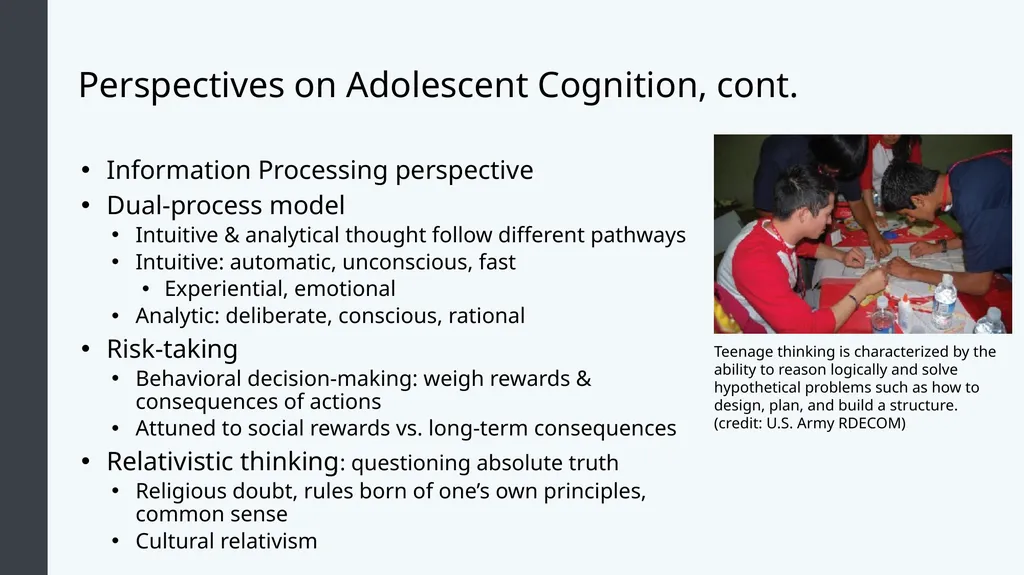
slide16. Perspectives on Adolescent Cognition, cont. Teenage thinking is characterized by the ability to reason logically and solve hypothetical problems such as how to design, plan, and build a structure.
(credit: U.S. Army RDECOM) Information Processing perspective
Dual-process model
Intuitive & analytical thought follow different pathways
Intuitive: automatic, unconscious, fast
Experiential, emotional
Analytic: deliberate, conscious, rational
Risk-taking
Behavioral decision-making: weigh rewards & consequences of actions
Attuned to social rewards vs. long-term consequences
Relativistic thinking: questioning absolute truth
Religious doubt, rules born of one’s own principles, common sense
Cultural relativism<br>
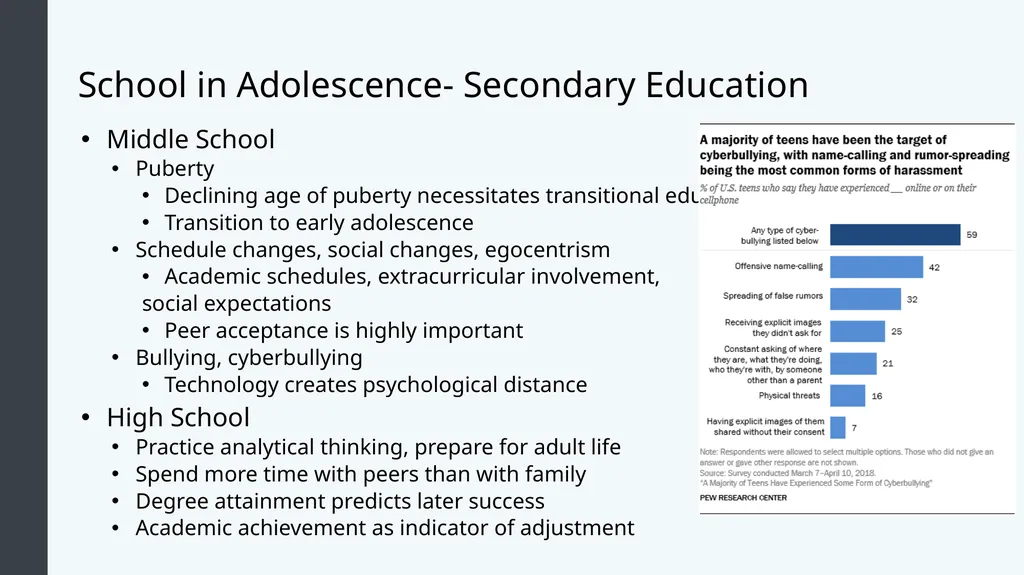
slide17. School in Adolescence- Secondary Education Middle School
Puberty
Declining age of puberty necessitates transitional education
Transition to early adolescence
Schedule changes, social changes, egocentrism
Academic schedules, extracurricular involvement,
social expectations
Peer acceptance is highly important
Bullying, cyberbullying
Technology creates psychological distance
High School
Practice analytical thinking, prepare for adult life
Spend more time with peers than with family
Degree attainment predicts later success
Academic achievement as indicator of adjustment<br>
slide18. Moral Reasoning During Adolescence Independence increases
Kohlberg: postconventional morality
Morals determined by self-chosen ethics, principles
Influences
Home, media, school
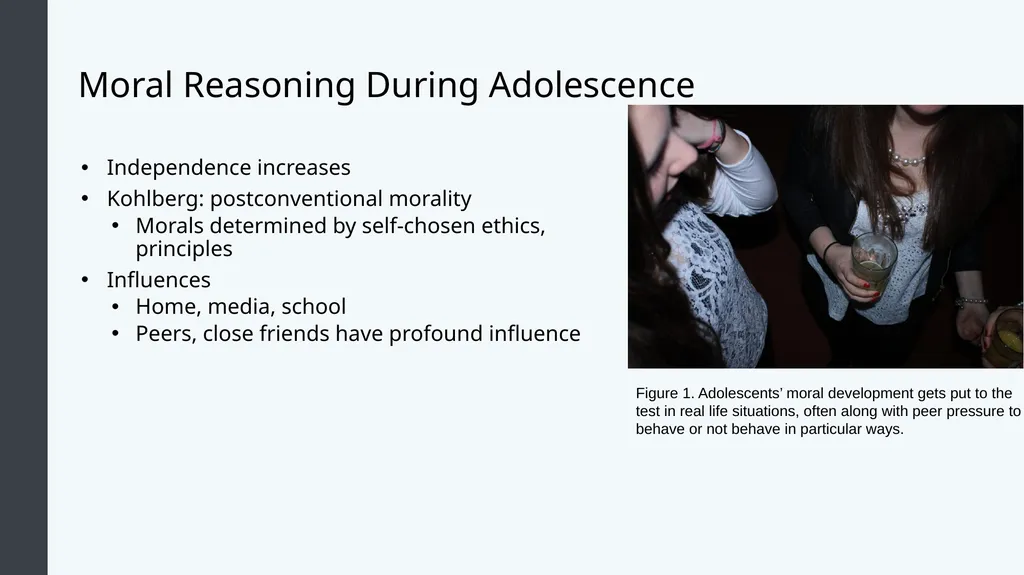
Peers, close friends have profound influence Figure 1. Adolescents’ moral development gets put to the test in real life situations, often along with peer pressure to behave or not behave in particular ways.<br>
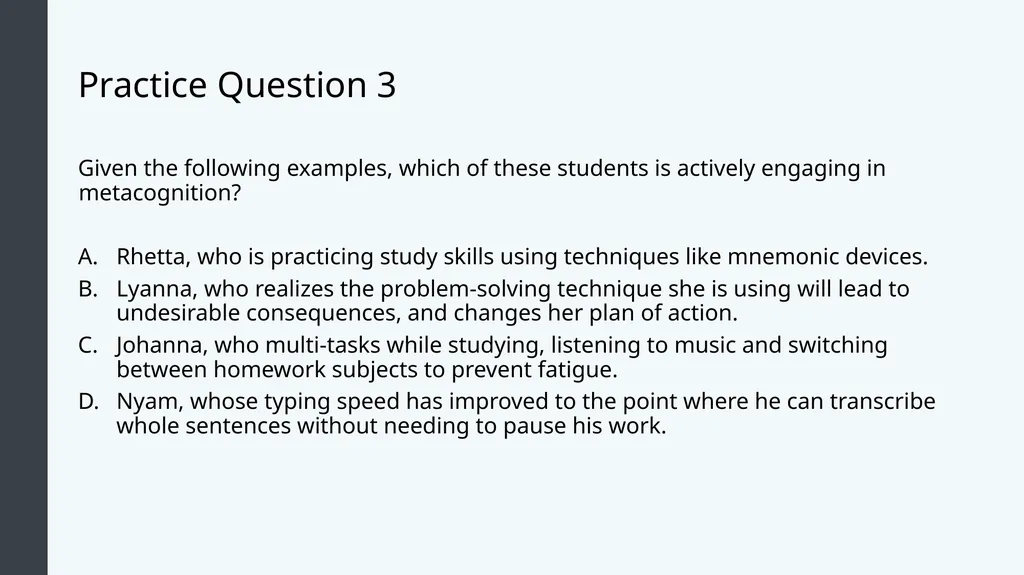
slide19. Practice Question 3 Given the following examples, which of these students is actively engaging in metacognition?
Rhetta, who is practicing study skills using techniques like mnemonic devices.
Lyanna, who realizes the problem-solving technique she is using will lead to undesirable consequences, and changes her plan of action.
Johanna, who multi-tasks while studying, listening to music and switching between homework subjects to prevent fatigue.
Nyam, whose typing speed has improved to the point where he can transcribe whole sentences without needing to pause his work.<br>
slide20. Class Activity: Adolescent egocentrism? Find a diary or journal entry (or any writing assignment) from middle or high school, re-read it. If unable to find your own original work, access an open source document or internet post written by an adolescent.
Identify any examples of the adolescent personal fable, beliefs of invincibility, and the imaginary audience phenomenon.
Describe what cognitive processes were likely taking place at the time the entry was written.
Discuss your findings with classmates.<br>
slide21. Social Development During Adolescence<br>
slide22. Learning Outcomes: Social Development During Adolescence 7.3 describe adolescent identity development and social influences on development
7.3.1 Describe changes in self-concept and identity development during adolescence
7.3.2 Explain Marcia's four identity statuses
7.3.3 Examine changes in family relationships during adolescence
7.3.4 Describe adolescent friendships and dating relationships as they apply to development
7.3.5 Explain the role that aggression, anxiety, and depression play in adolescent development<br>
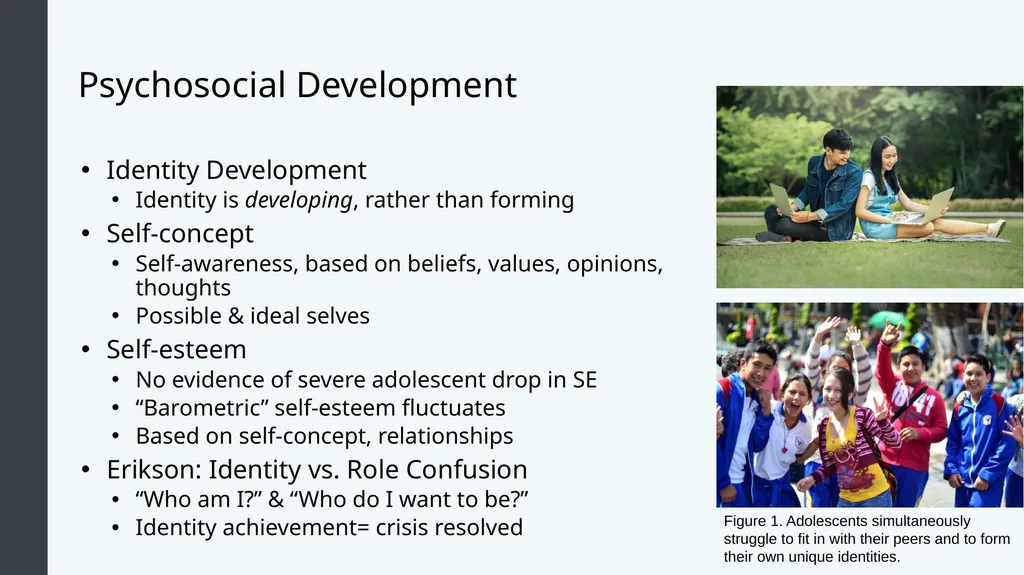
slide23. Psychosocial Development Identity Development
Identity is developing, rather than forming
Self-concept
Self-awareness, based on beliefs, values, opinions, thoughts
Possible & ideal selves
Self-esteem
No evidence of severe adolescent drop in SE
“Barometric” self-esteem fluctuates
Based on self-concept, relationships
Erikson: Identity vs. Role Confusion
“Who am I?” & “Who do I want to be?”
Identity achievement= crisis resolved Figure 1. Adolescents simultaneously struggle to fit in with their peers and to form their own unique identities.<br>
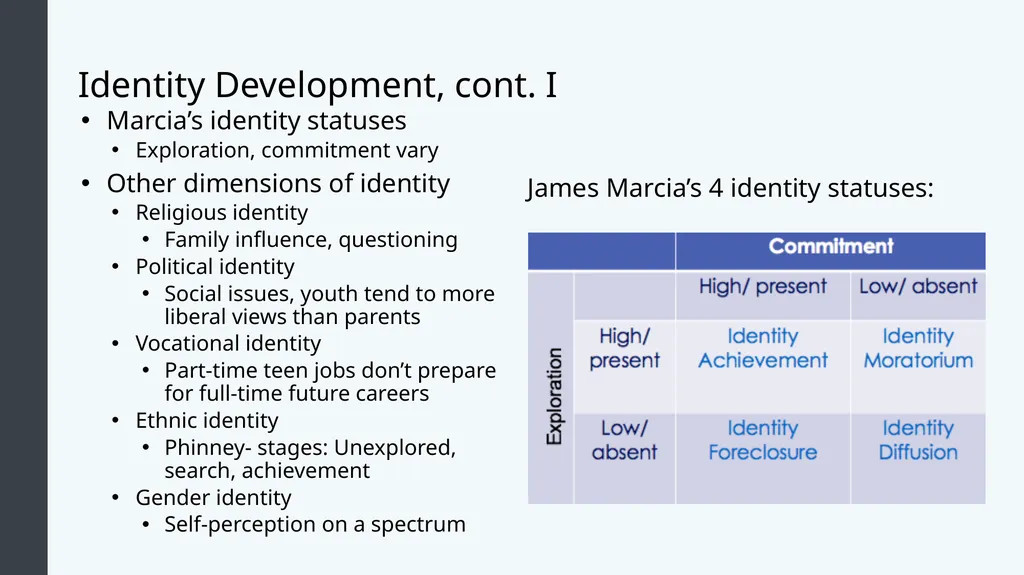
slide24. Identity Development, cont. I Marcia’s identity statuses
Exploration, commitment vary
Other dimensions of identity
Religious identity
Family influence, questioning
Political identity
Social issues, youth tend to more liberal views than parents
Vocational identity
Part-time teen jobs don’t prepare for full-time future careers
Ethnic identity
Phinney- stages: Unexplored, search, achievement
Gender identity
Self-perception on a spectrum James Marcia’s 4 identity statuses:<br>
slide25. Identity development, cont. II Gender identity
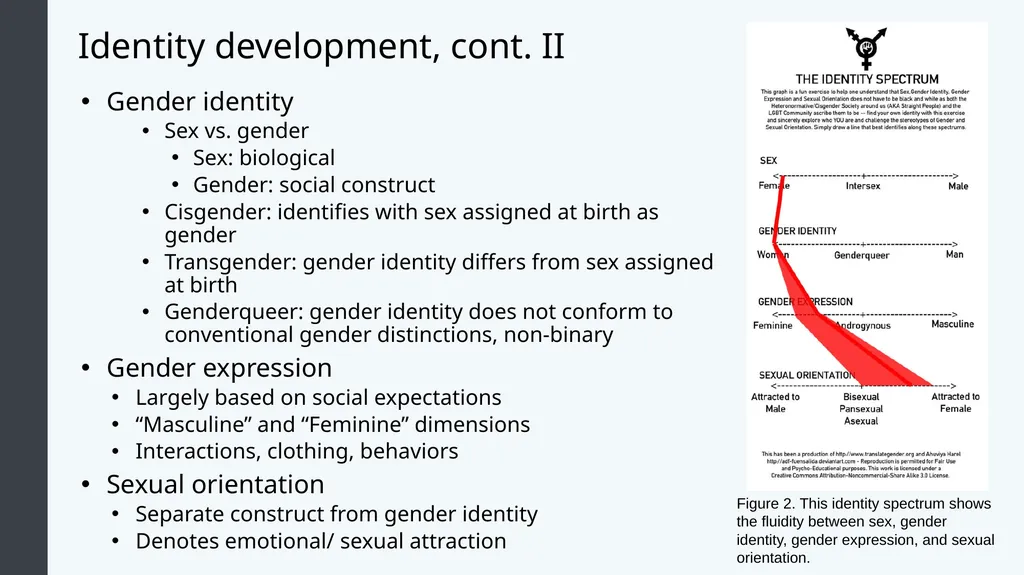
Sex vs. gender
Sex: biological
Gender: social construct
Cisgender: identifies with sex assigned at birth as gender
Transgender: gender identity differs from sex assigned at birth
Genderqueer: gender identity does not conform to conventional gender distinctions, non-binary
Gender expression
Largely based on social expectations
“Masculine” and “Feminine” dimensions
Interactions, clothing, behaviors
Sexual orientation
Separate construct from gender identity
Denotes emotional/ sexual attraction Figure 2. This identity spectrum shows the fluidity between sex, gender identity, gender expression, and sexual orientation.<br>
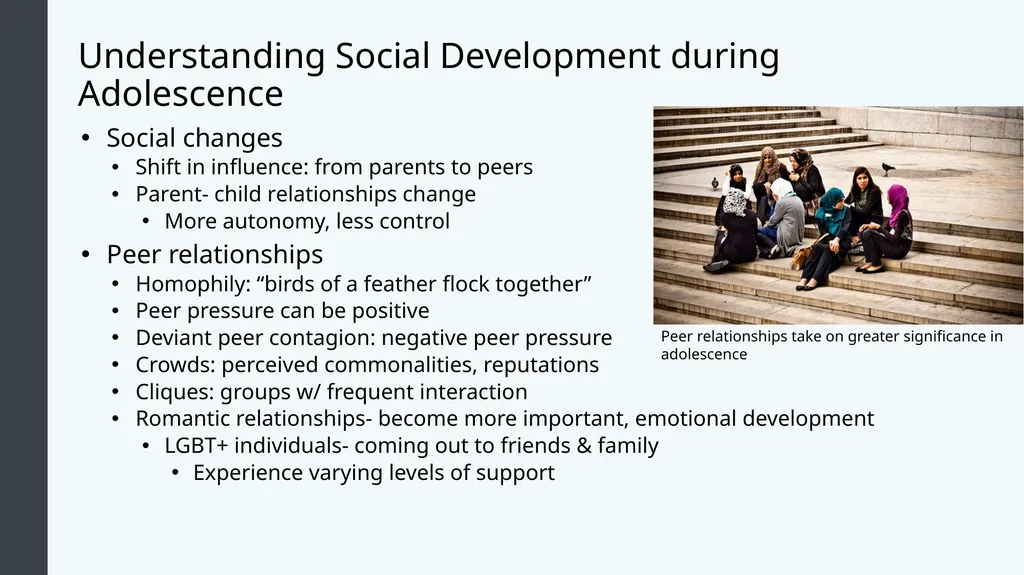
slide26. Understanding Social Development during Adolescence Peer relationships take on greater significance in adolescence Social changes
Shift in influence: from parents to peers
Parent- child relationships change
More autonomy, less control
Peer relationships
Homophily: “birds of a feather flock together”
Peer pressure can be positive
Deviant peer contagion: negative peer pressure
Crowds: perceived commonalities, reputations
Cliques: groups w/ frequent interaction
Romantic relationships- become more important, emotional development
LGBT+ individuals- coming out to friends & family
Experience varying levels of support<br>
slide27. Aggression and antisocial behavior Patterson:
Early starters vs. Late starters
Early starters more likely to persist long-term
May be personal factors
Late starters: limited duration- adolescence only
lack of parental monitoring becomes salient
Deviance ends when more alternative options arise
Moffitt:
Life-course persistent vs. adolescent-limited
Life-course persistent typically start earlier
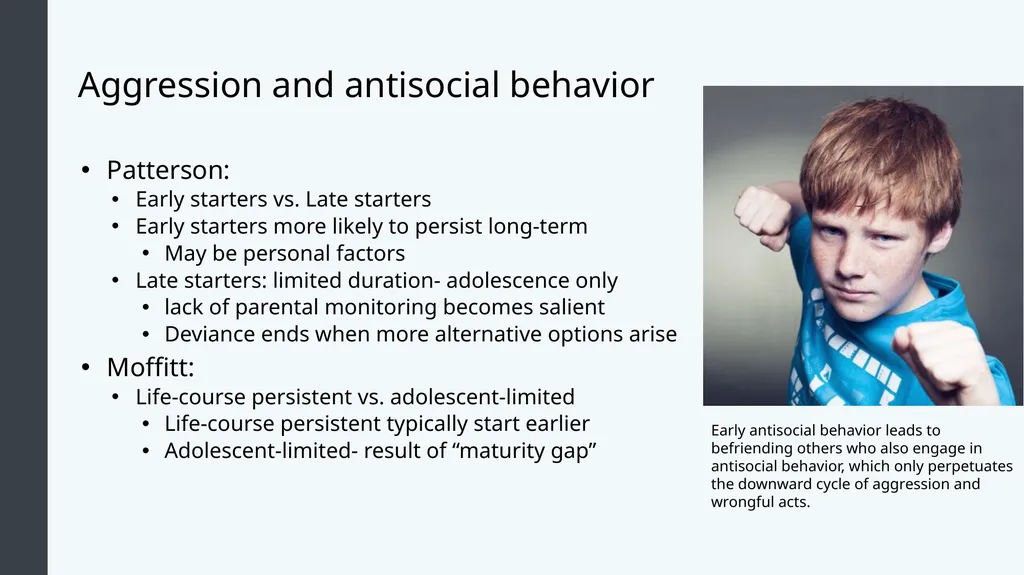
Adolescent-limited- result of “maturity gap” Early antisocial behavior leads to befriending others who also engage in antisocial behavior, which only perpetuates the downward cycle of aggression and wrongful acts.<br>
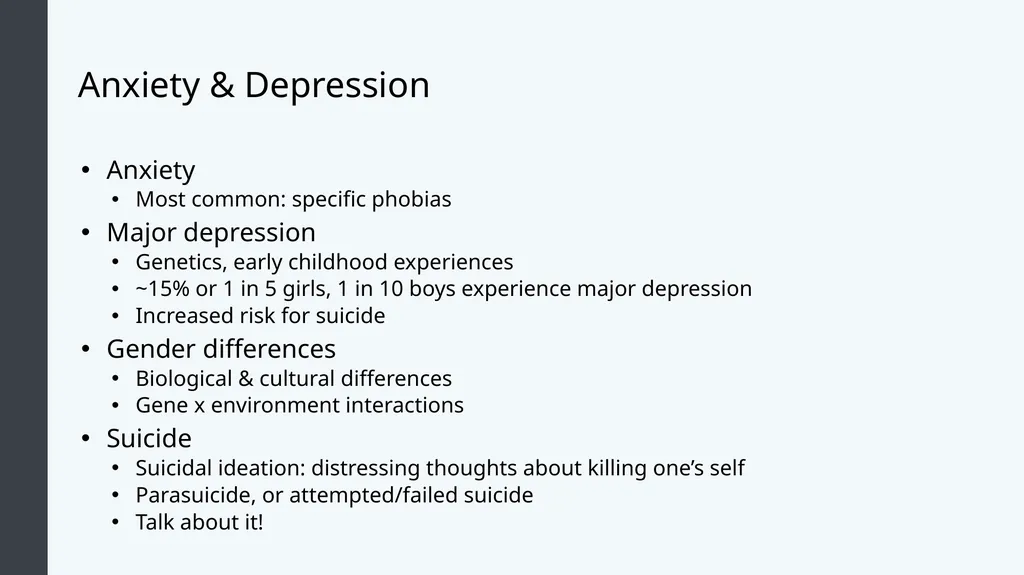
slide28. Anxiety & Depression Anxiety
Most common: specific phobias
Major depression
Genetics, early childhood experiences
~15% or 1 in 5 girls, 1 in 10 boys experience major depression
Increased risk for suicide
Gender differences
Biological & cultural differences
Gene x environment interactions
Suicide
Suicidal ideation: distressing thoughts about killing one’s self
Parasuicide, or attempted/failed suicide
Talk about it!<br>
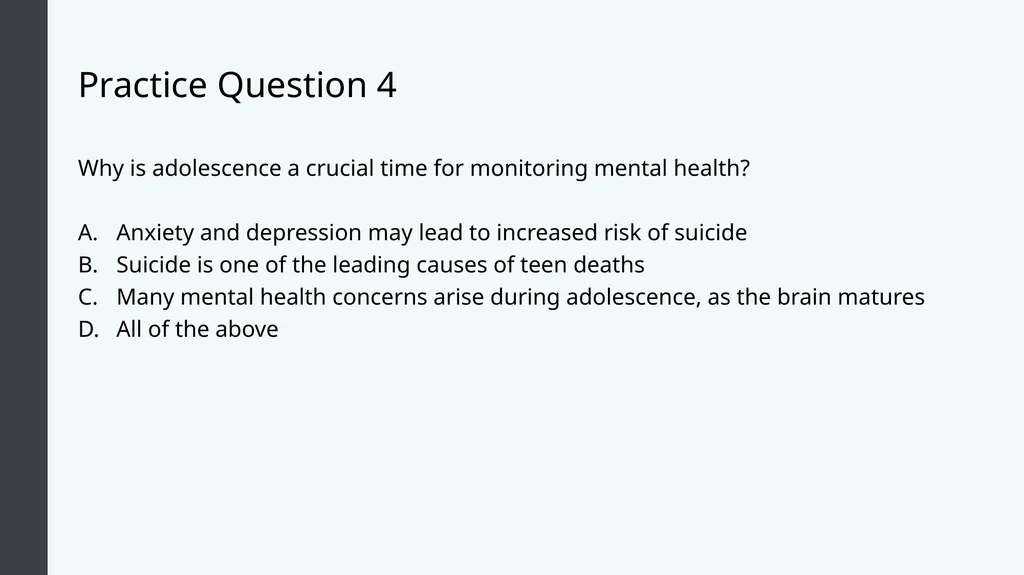
slide29. Practice Question 4 Why is adolescence a crucial time for monitoring mental health?
Anxiety and depression may lead to increased risk of suicide
Suicide is one of the leading causes of teen deaths
Many mental health concerns arise during adolescence, as the brain matures
All of the above<br>
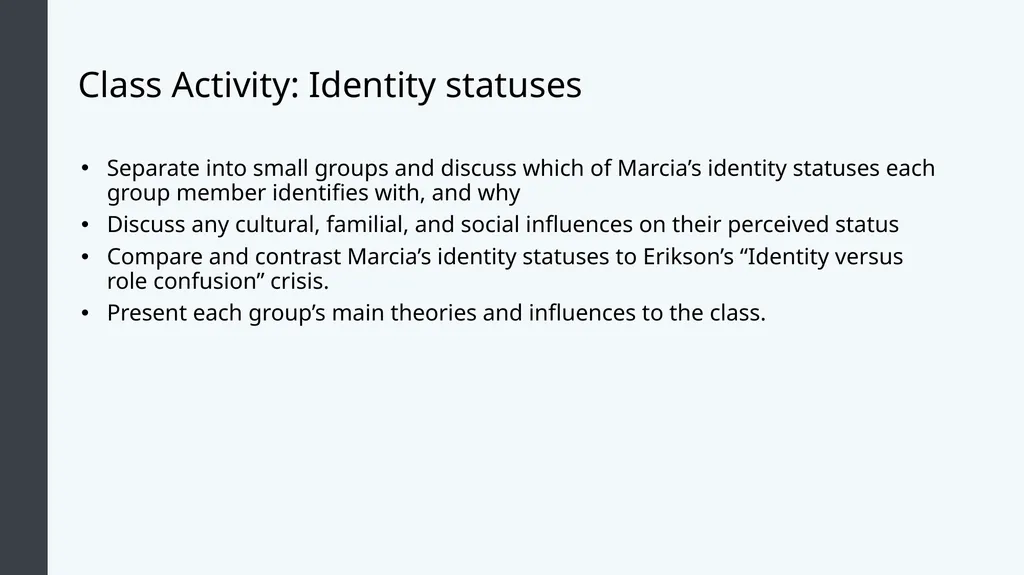
slide30. Class Activity: Identity statuses Separate into small groups and discuss which of Marcia’s identity statuses each group member identifies with, and why
Discuss any cultural, familial, and social influences on their perceived status
Compare and contrast Marcia’s identity statuses to Erikson’s “Identity versus role confusion” crisis.
Present each group’s main theories and influences to the class.<br>
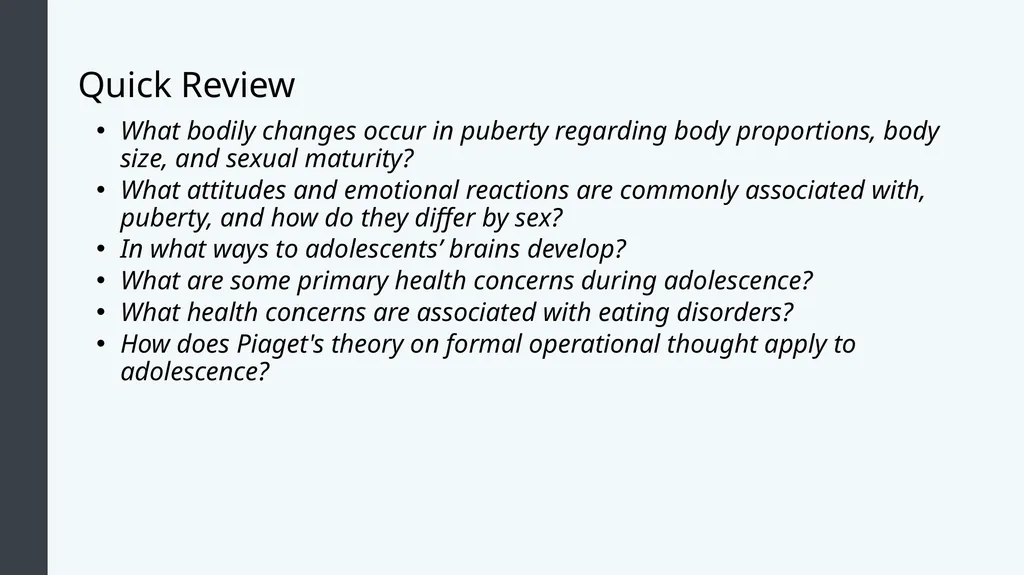
slide31. Quick Review What bodily changes occur in puberty regarding body proportions, body size, and sexual maturity?
What attitudes and emotional reactions are commonly associated with, puberty, and how do they differ by sex?
In what ways to adolescents’ brains develop?
What are some primary health concerns during adolescence?
What health concerns are associated with eating disorders?
How does Piaget's theory on formal operational thought apply to adolescence?<br>
slide32. Quick Review - continued How do cognitive abilities and cognitions change during adolescence?
What role does secondary education play in adolescent development?
How do adolescents develop morally?
How does self-concept change and identity develop during adolescence?
What are Marcia's four identity statuses, and how do they apply to adolescents?
In what ways do family relationships change during adolescence?
How do adolescent friendships and dating relationships apply to development?
What role do aggression, anxiety, and depression play in adolescent development?<br>
slide2. Module Learning Outcomes Describe the physical, cognitive, emotional, and social changes that occur during adolescence
7.1 describe the physical changes that occur during puberty and adolescence
7.2 Describe changes in cognitive development and moral reasoning during adolescence
7.3 describe adolescent identity development and social influences on development<br>
slide3. Physical Changes of Adolescence<br>
slide4. Learning Outcomes: Physical Changes of Adolescence 7.1 Describe the physical changes that occur during puberty and adolescence
7.1.1: Describe pubertal changes in body size, proportions, and sexual maturity
7.1.2: Explain social and emotional attitudes and reactions toward puberty, including sex differences
7.1.3: Describe brain development during adolescence
7.1.4: Describe health concerns during adolescence
7.1.5: Discuss concerns associated with eating disorders<br>
slide5. Physical Development- Puberty As adolescents develop, physical abilities increase Hormonal changes
Phase 1 of puberty: Adrenarche
Release of adrenal androgens
Skeletal growth
Begins around age 6-8
Phase 2: Gonadarche- sex hormones (estrogen, testosterone)
Menarche- first menstrual period (~age 12-13)
Spermarche- first ejaculation (~age 13-14)
Sexual maturation
Primary sex characteristics
Relate directly to reproductive capabilities
Secondary sex characteristics
Do not directly relate to reproductive capabilities<br>
slide6. Physical Growth: The Growth Spurt Growth spurts: Girls (age ~8-13) Boys (age ~10-16)
Increased height weight, reach adult proportions
Early developers & reactions
Girls: often get unwanted attention, teasing
Increased risk for depression, eating disorders, early sexual activity, substance abuse
Boys: risks and benefits
May be more athletic, taller
Increased risk for substance abuse, early sexual activity
Late developers/ “late bloomers”
Boys: risk of bullying, depression, parental conflict
Girls: risk of teasing, bullying
Overall, more positive outcomes for late-maturing girls than early-maturing girls Figure 1. Girls often experience a growth spurt before boys of the same age. These girls appear comfortable and confident, a sign of healthy development.<br>
slide7. Brain Development During Adolescence Prefrontal cortex- decision-making, higher level cognition
Myelination: increases information processing speed
Synaptic pruning: strengthens strongest neural connections
Limbic system- develops before prefrontal cortex
Responsible for emotional processing, rewards & punishments
Pubertal hormones target the amygdala
Dopamine: the “feel good” chemical- production is high
Involved in pleasure-seeking, risk-taking behaviors
Serotonin: calming chemical, balances dopamine, extreme behaviors
Sleep
Melatonin levels increase later in the night making “night owls” vs. “early risers”
Teens need 9-10 hrs of sleep
Deficit of sleep increases impulsivity, negative emotions The brain reaches its largest size in the early teen years, but continues to mature well into the 20s.<br>
slide8. Health Concerns During Adolescence Negative body image, body dissatisfaction
Associated w/ poor nutrition, atypical eating patterns
Eating disorders
Muscle dysmorphia- obsession with muscle development
Bulimia nervosa- binge/purge cycles, often normal weight
Anorexia nervosa- distorted body image, underweight, low caloric intake
Binge-eating disorder- overeating sprees, often associated w/ anxiety, depression, obesity
Health consequences of eating disorders
Anorexia: most fatal mental disorder, suicide is more common
Binge eating: Type II diabetes, obesity, high cholesterol, heart disease, high blood pressure
Treatment of eating disorders
Cognitive Behavioral Therapy (CBT), medication, counseling
Parental involvement, monitoring<br>
slide9. Sexual Development Sexual interactions
Body image ideals, media portrayals
Masturbation, sexual fascination
Text messaging, email, phone calls may evoke sexual feelings
Sexually Transmitted Infection (STI) risk for sexually active teens
Sex education
It’s about more than preventing teen pregnancy
Freud & sexual development
Genital stage of psychosexual development
Ego, superego more developed
Secondary-process thinking/desires
Friendships, intimate relationships, adult & family responsibilities<br>
slide10. Practice Question 1 Which part of the adolescent brain is the last to fully develop?
Prefrontal cortex
Limbic system
Dopamine circuit
Hippocampus<br>
slide11. Practice Question 2 According to Freud, what stage of psychosexual development is Anna, a teenager in?
Phallic stage
Anal stage
Oral stage
Genital stage<br>
slide12. Cognitive Development During Adolescence<br>
slide13. Learning Outcomes: Cognitive Development During Adolescence 7.2 Describe changes in cognitive development and moral reasoning during adolescence
7.2.1 Explain Piaget's theory on formal operational thought
7.2.2 Describe cognitive abilities and changes during adolescence
7.2.3 Describe the role of secondary education in adolescent development
7.2.4 Describe moral development during adolescence<br>
slide14. Cognitive Development during Adolescence, continued Perspectives: constructivist (Piagetian), & information-processing
Major improvements in thinking abilities:
Attention
Selective attention, divided attention
Memory
Working memory, long-term memory improve
Processing speed
Increases & levels off in adolescence
Organization
Strategies & processes, mnemonics, etc.
Metacognition
Thinking about thinking, planning ahead<br>
slide15. Perspectives on Adolescent Cognition Adolescents engage in hypothetical and abstract thinking. Piaget- constructivism: formal operational thought
Quantitative, stage-approach
Hypothetical thinking: What if?
Based on deductive reasoning
Abstract thinking: reality is not black & white
Metacognition: thinking about thinking
Elkind: adolescent egocentrism, based on Piaget
Imaginary audience: belief others are watching and judging one’s behaviors
Personal fable: belief in one’s unique qualities, part of imaginary audience construction
Invincibility fable: Probabilistic consequences don’t apply to one’s self<br>
slide16. Perspectives on Adolescent Cognition, cont. Teenage thinking is characterized by the ability to reason logically and solve hypothetical problems such as how to design, plan, and build a structure.
(credit: U.S. Army RDECOM) Information Processing perspective
Dual-process model
Intuitive & analytical thought follow different pathways
Intuitive: automatic, unconscious, fast
Experiential, emotional
Analytic: deliberate, conscious, rational
Risk-taking
Behavioral decision-making: weigh rewards & consequences of actions
Attuned to social rewards vs. long-term consequences
Relativistic thinking: questioning absolute truth
Religious doubt, rules born of one’s own principles, common sense
Cultural relativism<br>
slide17. School in Adolescence- Secondary Education Middle School
Puberty
Declining age of puberty necessitates transitional education
Transition to early adolescence
Schedule changes, social changes, egocentrism
Academic schedules, extracurricular involvement,
social expectations
Peer acceptance is highly important
Bullying, cyberbullying
Technology creates psychological distance
High School
Practice analytical thinking, prepare for adult life
Spend more time with peers than with family
Degree attainment predicts later success
Academic achievement as indicator of adjustment<br>
slide18. Moral Reasoning During Adolescence Independence increases
Kohlberg: postconventional morality
Morals determined by self-chosen ethics, principles
Influences
Home, media, school
Peers, close friends have profound influence Figure 1. Adolescents’ moral development gets put to the test in real life situations, often along with peer pressure to behave or not behave in particular ways.<br>
slide19. Practice Question 3 Given the following examples, which of these students is actively engaging in metacognition?
Rhetta, who is practicing study skills using techniques like mnemonic devices.
Lyanna, who realizes the problem-solving technique she is using will lead to undesirable consequences, and changes her plan of action.
Johanna, who multi-tasks while studying, listening to music and switching between homework subjects to prevent fatigue.
Nyam, whose typing speed has improved to the point where he can transcribe whole sentences without needing to pause his work.<br>
slide20. Class Activity: Adolescent egocentrism? Find a diary or journal entry (or any writing assignment) from middle or high school, re-read it. If unable to find your own original work, access an open source document or internet post written by an adolescent.
Identify any examples of the adolescent personal fable, beliefs of invincibility, and the imaginary audience phenomenon.
Describe what cognitive processes were likely taking place at the time the entry was written.
Discuss your findings with classmates.<br>
slide21. Social Development During Adolescence<br>
slide22. Learning Outcomes: Social Development During Adolescence 7.3 describe adolescent identity development and social influences on development
7.3.1 Describe changes in self-concept and identity development during adolescence
7.3.2 Explain Marcia's four identity statuses
7.3.3 Examine changes in family relationships during adolescence
7.3.4 Describe adolescent friendships and dating relationships as they apply to development
7.3.5 Explain the role that aggression, anxiety, and depression play in adolescent development<br>
slide23. Psychosocial Development Identity Development
Identity is developing, rather than forming
Self-concept
Self-awareness, based on beliefs, values, opinions, thoughts
Possible & ideal selves
Self-esteem
No evidence of severe adolescent drop in SE
“Barometric” self-esteem fluctuates
Based on self-concept, relationships
Erikson: Identity vs. Role Confusion
“Who am I?” & “Who do I want to be?”
Identity achievement= crisis resolved Figure 1. Adolescents simultaneously struggle to fit in with their peers and to form their own unique identities.<br>
slide24. Identity Development, cont. I Marcia’s identity statuses
Exploration, commitment vary
Other dimensions of identity
Religious identity
Family influence, questioning
Political identity
Social issues, youth tend to more liberal views than parents
Vocational identity
Part-time teen jobs don’t prepare for full-time future careers
Ethnic identity
Phinney- stages: Unexplored, search, achievement
Gender identity
Self-perception on a spectrum James Marcia’s 4 identity statuses:<br>
slide25. Identity development, cont. II Gender identity
Sex vs. gender
Sex: biological
Gender: social construct
Cisgender: identifies with sex assigned at birth as gender
Transgender: gender identity differs from sex assigned at birth
Genderqueer: gender identity does not conform to conventional gender distinctions, non-binary
Gender expression
Largely based on social expectations
“Masculine” and “Feminine” dimensions
Interactions, clothing, behaviors
Sexual orientation
Separate construct from gender identity
Denotes emotional/ sexual attraction Figure 2. This identity spectrum shows the fluidity between sex, gender identity, gender expression, and sexual orientation.<br>
slide26. Understanding Social Development during Adolescence Peer relationships take on greater significance in adolescence Social changes
Shift in influence: from parents to peers
Parent- child relationships change
More autonomy, less control
Peer relationships
Homophily: “birds of a feather flock together”
Peer pressure can be positive
Deviant peer contagion: negative peer pressure
Crowds: perceived commonalities, reputations
Cliques: groups w/ frequent interaction
Romantic relationships- become more important, emotional development
LGBT+ individuals- coming out to friends & family
Experience varying levels of support<br>
slide27. Aggression and antisocial behavior Patterson:
Early starters vs. Late starters
Early starters more likely to persist long-term
May be personal factors
Late starters: limited duration- adolescence only
lack of parental monitoring becomes salient
Deviance ends when more alternative options arise
Moffitt:
Life-course persistent vs. adolescent-limited
Life-course persistent typically start earlier
Adolescent-limited- result of “maturity gap” Early antisocial behavior leads to befriending others who also engage in antisocial behavior, which only perpetuates the downward cycle of aggression and wrongful acts.<br>
slide28. Anxiety & Depression Anxiety
Most common: specific phobias
Major depression
Genetics, early childhood experiences
~15% or 1 in 5 girls, 1 in 10 boys experience major depression
Increased risk for suicide
Gender differences
Biological & cultural differences
Gene x environment interactions
Suicide
Suicidal ideation: distressing thoughts about killing one’s self
Parasuicide, or attempted/failed suicide
Talk about it!<br>
slide29. Practice Question 4 Why is adolescence a crucial time for monitoring mental health?
Anxiety and depression may lead to increased risk of suicide
Suicide is one of the leading causes of teen deaths
Many mental health concerns arise during adolescence, as the brain matures
All of the above<br>
slide30. Class Activity: Identity statuses Separate into small groups and discuss which of Marcia’s identity statuses each group member identifies with, and why
Discuss any cultural, familial, and social influences on their perceived status
Compare and contrast Marcia’s identity statuses to Erikson’s “Identity versus role confusion” crisis.
Present each group’s main theories and influences to the class.<br>
slide31. Quick Review What bodily changes occur in puberty regarding body proportions, body size, and sexual maturity?
What attitudes and emotional reactions are commonly associated with, puberty, and how do they differ by sex?
In what ways to adolescents’ brains develop?
What are some primary health concerns during adolescence?
What health concerns are associated with eating disorders?
How does Piaget's theory on formal operational thought apply to adolescence?<br>
slide32. Quick Review - continued How do cognitive abilities and cognitions change during adolescence?
What role does secondary education play in adolescent development?
How do adolescents develop morally?
How does self-concept change and identity develop during adolescence?
What are Marcia's four identity statuses, and how do they apply to adolescents?
In what ways do family relationships change during adolescence?
How do adolescent friendships and dating relationships apply to development?
What role do aggression, anxiety, and depression play in adolescent development?<br>