
Ligand Design for Selectivity and Complex




Description: Ligand Design for Selectivity and Complex Stability Created by Daniel S. Kissel, Lewis University (kisseldalewisu.edu) and posted on VIPEr on June 30, 2016. Copyright Daniel S. Kissel, 2016. This work is licensed under the Creative Commons
Related Topics
Download Presentation
"Ligand Design for Selectivity and Complex" is the property of its rightful owner. Permission is granted to download and print the materials on this website for personal, non-commercial use only, and to display it on your personal computer provided you do not modify the materials and that you retain all copyright notices contained in the materials. By downloading content from our website, you accept the terms of this agreement.
Presentation Transcript
slide1. Ligand Design for Selectivity and Complex Stability Created by Daniel S. Kissel, Lewis University (kisselda@lewisu.edu) and posted on VIPEr on June 30, 2016. Copyright Daniel S. Kissel, 2016. This work is licensed under the Creative Commons Attribution-NonCommercial-ShareAlike License. To view a copy of this license visit
http://creativecommons.org/licenses/by-nc-sa/4.0/<br>
slide2. What is Ligand Design? “A ligand is more preorganized when it is more constrained to be in a conformation required to complex a metal ion.” –Donald J. Cram
Ligand design is an area of inorganic chemistry that involves the design and synthesis of ligands preorganized to achieve specific functions involving coordination complexes
This area involves the understanding and manipulation of several concepts in chemistry:
HSAB Theory
Chelation and chelate ring size effect
Neutral O-donor effect
Steric Focus
Organic synthesis<br>
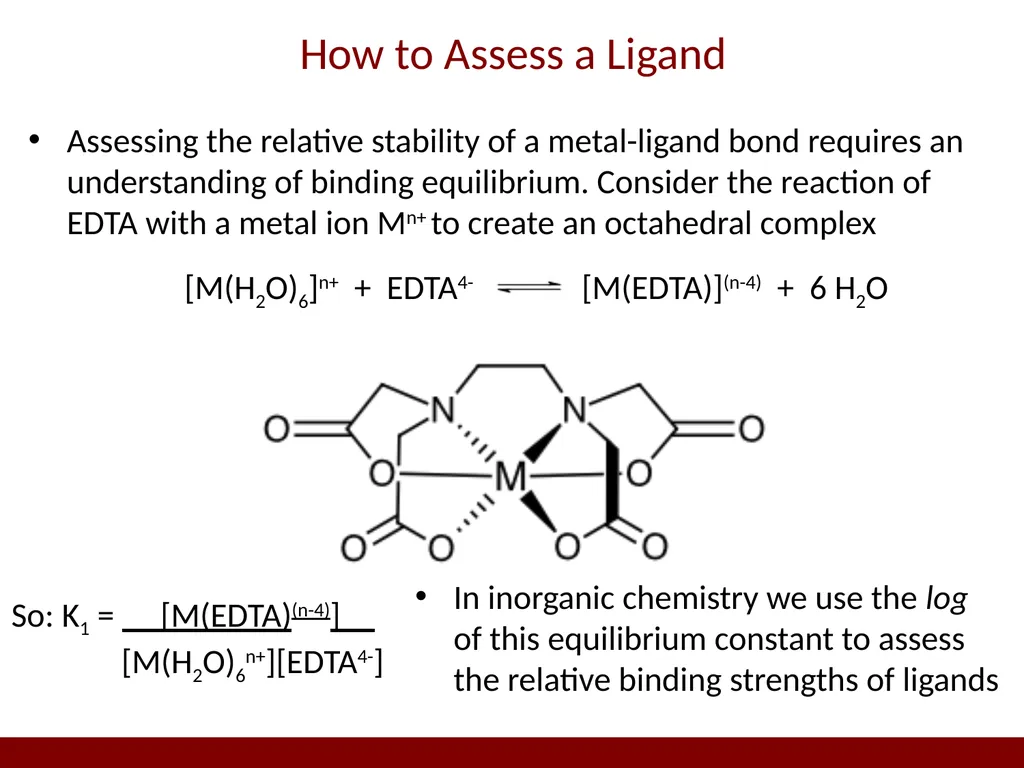
slide3. How to Assess a Ligand Assessing the relative stability of a metal-ligand bond requires an understanding of binding equilibrium. Consider the reaction of EDTA with a metal ion Mn+ to create an octahedral complex So: K1 = [M(EDTA)(n-4)]__
[M(H2O)6n+][EDTA4-] In inorganic chemistry we use the log of this equilibrium constant to assess the relative binding strengths of ligands [M(H2O)6]n+ + EDTA4- [M(EDTA)](n-4) + 6 H2O<br>
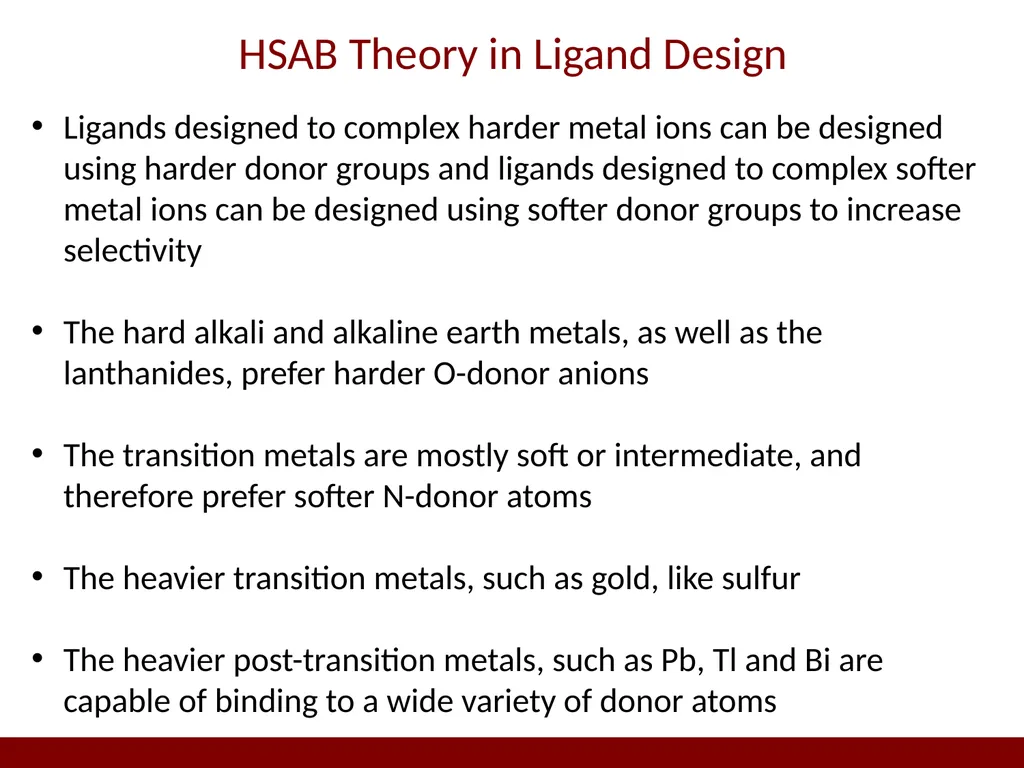
slide4. HSAB Theory in Ligand Design Ligands designed to complex harder metal ions can be designed using harder donor groups and ligands designed to complex softer metal ions can be designed using softer donor groups to increase selectivity
The hard alkali and alkaline earth metals, as well as the lanthanides, prefer harder O-donor anions
The transition metals are mostly soft or intermediate, and therefore prefer softer N-donor atoms
The heavier transition metals, such as gold, like sulfur
The heavier post-transition metals, such as Pb, Tl and Bi are capable of binding to a wide variety of donor atoms<br>
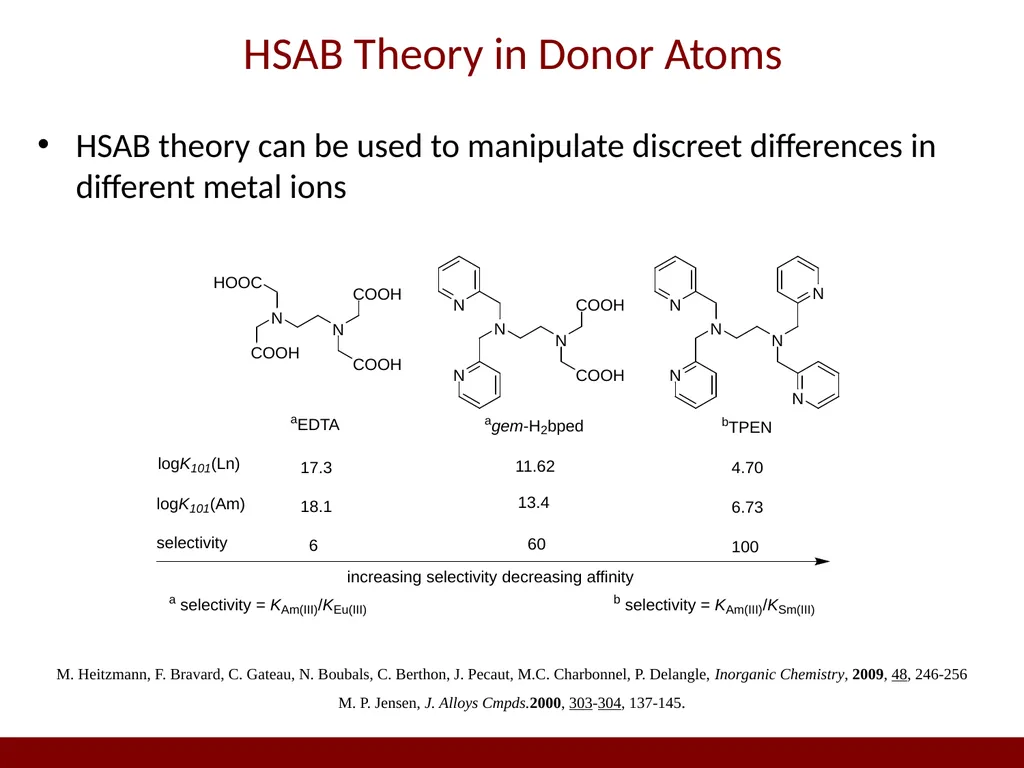
slide5. HSAB Theory in Donor Atoms HSAB theory can be used to manipulate discreet differences in different metal ions M. Heitzmann, F. Bravard, C. Gateau, N. Boubals, C. Berthon, J. Pecaut, M.C. Charbonnel, P. Delangle, Inorganic Chemistry, 2009, 48, 246-256
M. P. Jensen, J. Alloys Cmpds.2000, 303-304, 137-145.<br>
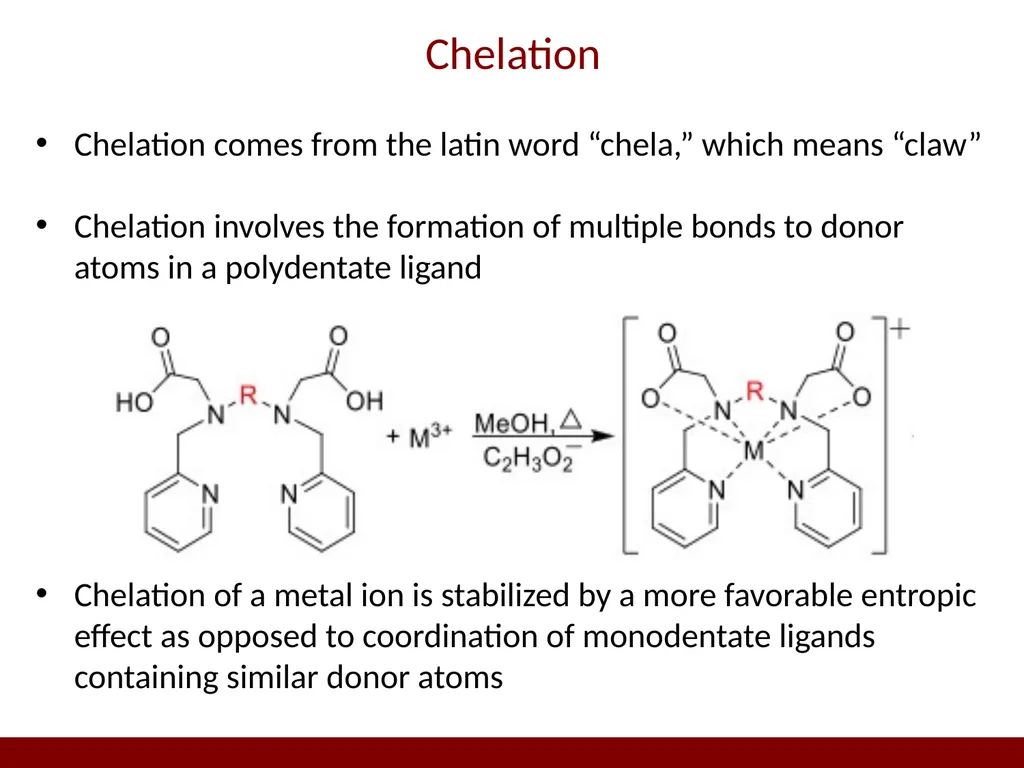
slide6. Chelation Chelation comes from the latin word “chela,” which means “claw”
Chelation involves the formation of multiple bonds to donor atoms in a polydentate ligand
Chelation of a metal ion is stabilized by a more favorable entropic effect as opposed to coordination of monodentate ligands containing similar donor atoms<br>
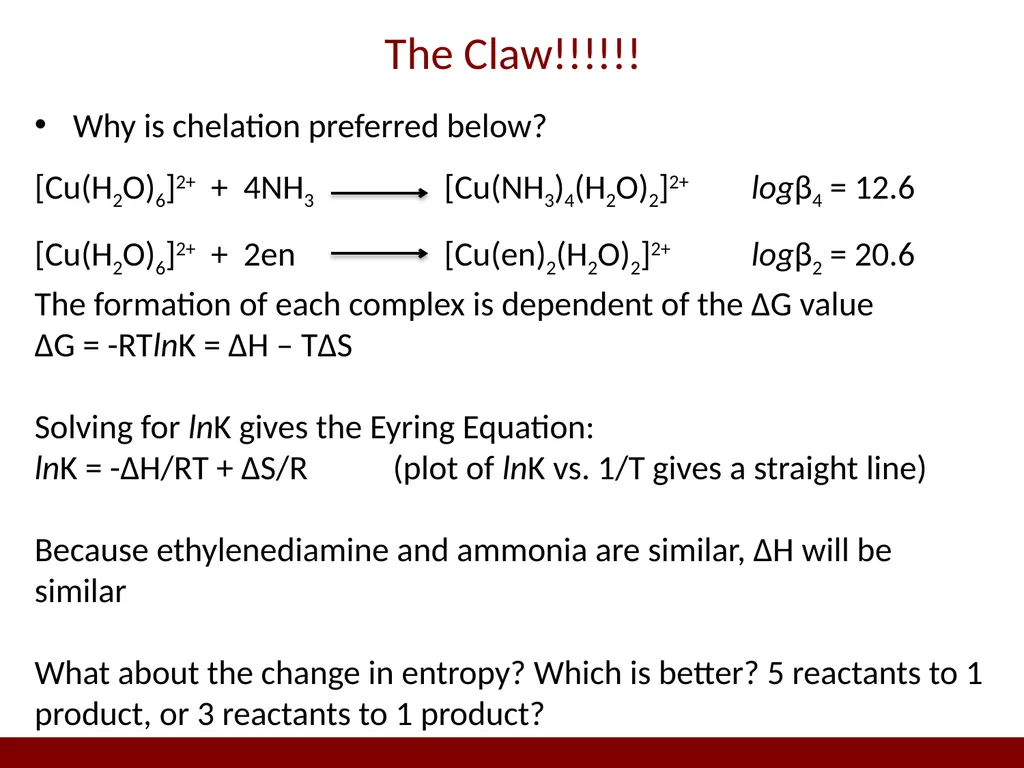
slide7. The Claw!!!!!! Why is chelation preferred below?
[Cu(H2O)6]2+ + 4NH3 [Cu(NH3)4(H2O)2]2+ logβ4 = 12.6
[Cu(H2O)6]2+ + 2en [Cu(en)2(H2O)2]2+ logβ2 = 20.6 The formation of each complex is dependent of the ΔG value
ΔG = -RTlnK = ΔH – TΔS
Solving for lnK gives the Eyring Equation:
lnK = -ΔH/RT + ΔS/R (plot of lnK vs. 1/T gives a straight line)
Because ethylenediamine and ammonia are similar, ΔH will be similar
What about the change in entropy? Which is better? 5 reactants to 1 product, or 3 reactants to 1 product?<br>
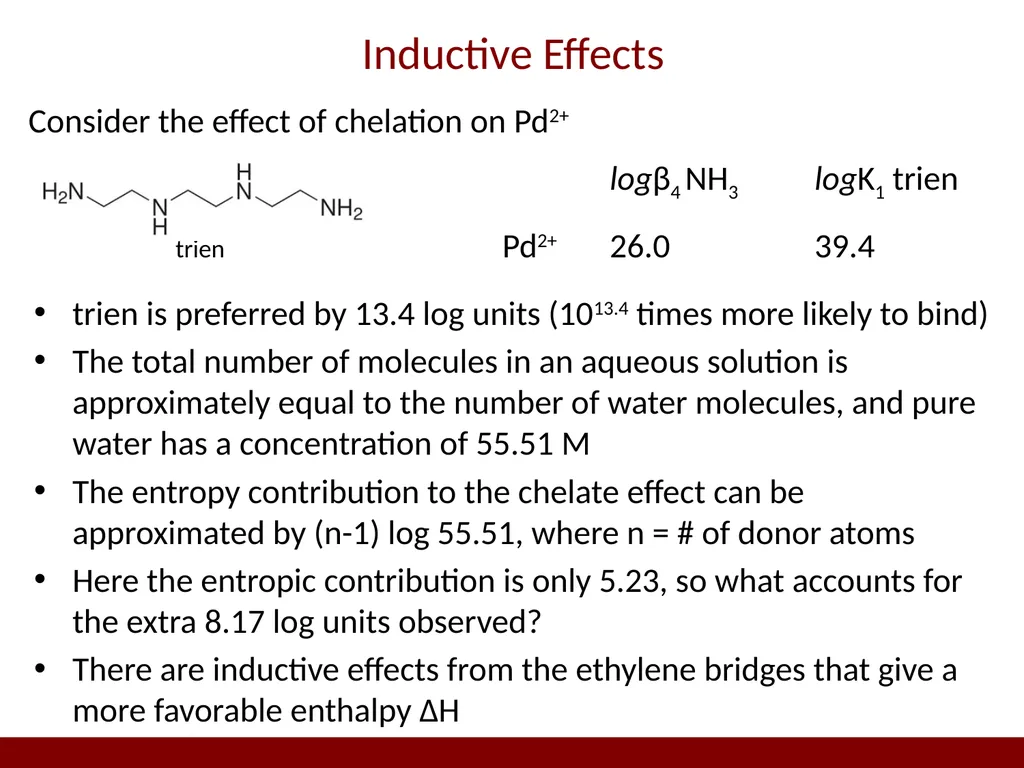
slide8. Inductive Effects Consider the effect of chelation on Pd2+ trien logβ4 NH3 logK1 trien
Pd2+ 26.0 39.4 trien is preferred by 13.4 log units (1013.4 times more likely to bind)
The total number of molecules in an aqueous solution is approximately equal to the number of water molecules, and pure water has a concentration of 55.51 M
The entropy contribution to the chelate effect can be approximated by (n-1) log 55.51, where n = # of donor atoms
Here the entropic contribution is only 5.23, so what accounts for the extra 8.17 log units observed?
There are inductive effects from the ethylene bridges that give a more favorable enthalpy ΔH<br>
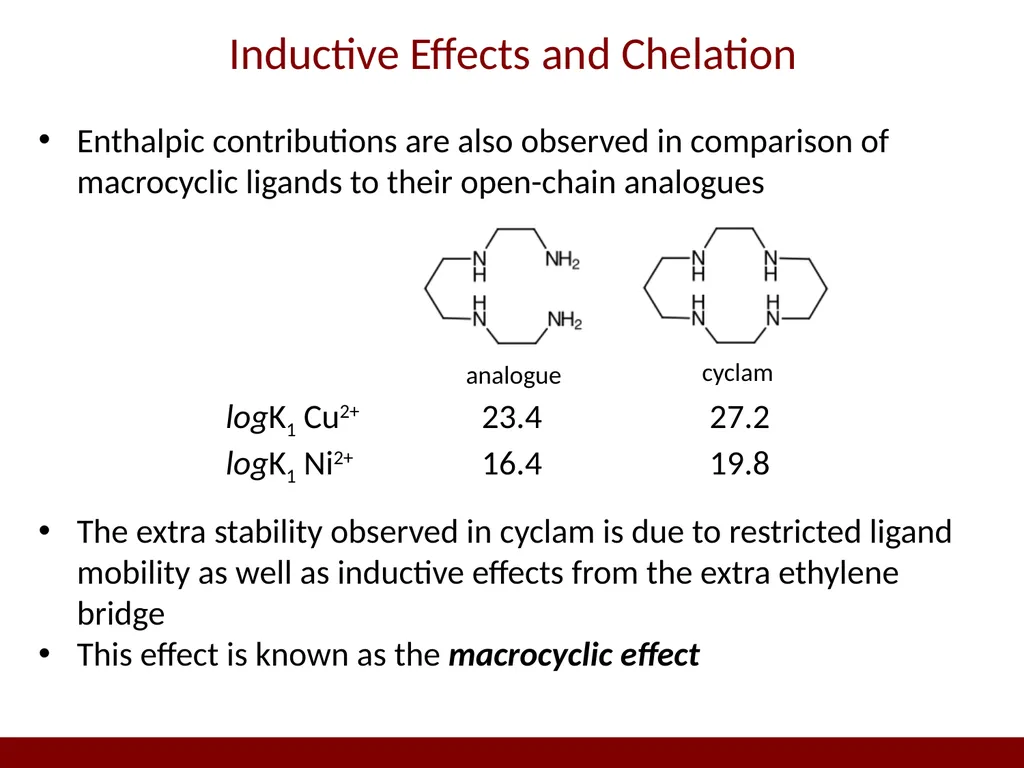
slide9. Inductive Effects and Chelation Enthalpic contributions are also observed in comparison of macrocyclic ligands to their open-chain analogues cyclam analogue logK1 Cu2+ 23.4 27.2
logK1 Ni2+ 16.4 19.8 The extra stability observed in cyclam is due to restricted ligand mobility as well as inductive effects from the extra ethylene bridge
This effect is known as the macrocyclic effect<br>
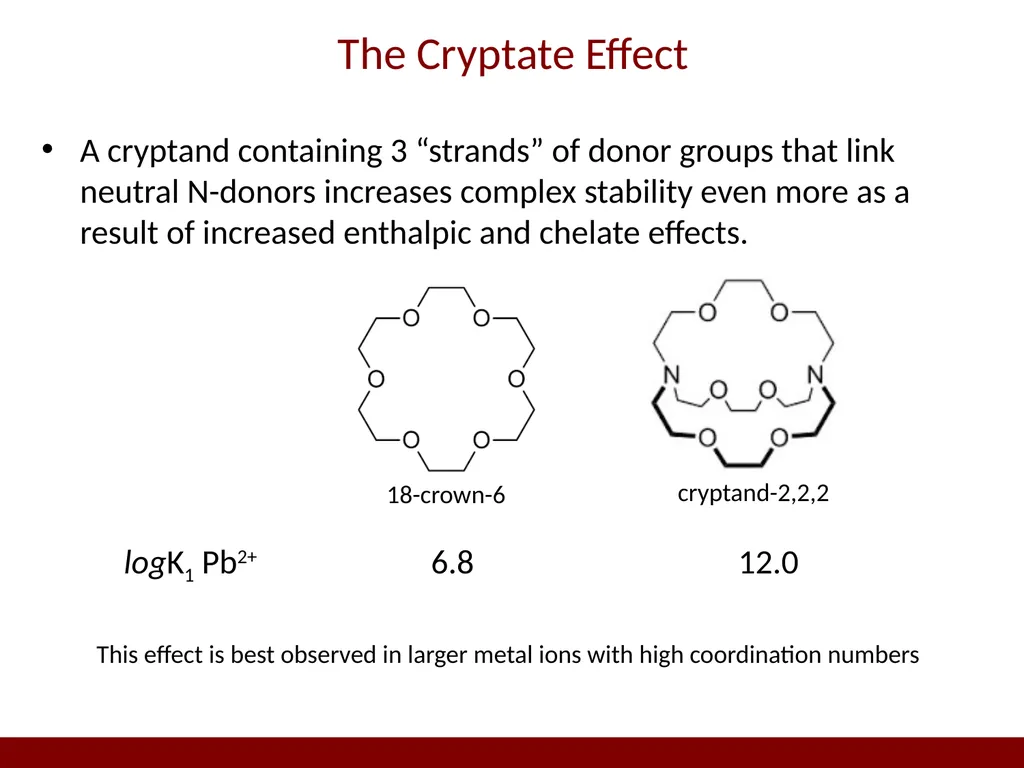
slide10. The Cryptate Effect A cryptand containing 3 “strands” of donor groups that link neutral N-donors increases complex stability even more as a result of increased enthalpic and chelate effects. 18-crown-6 cryptand-2,2,2 logK1 Pb2+ 6.8 12.0 This effect is best observed in larger metal ions with high coordination numbers<br>
slide11. Chelate Ring Size Effect Formation of 4 and 5-membered chelate rings is more favorable for complexes containing larger metal ions
Formation of 6-membered chelate rings is more favorable for complexes containing smaller metal ions
This is a geometric effect Insert image of Figure 3 A, B, and C ONLY from Hancock, R. D. J. Chem. Educ., 1992, 69 (8), pg 617<br>
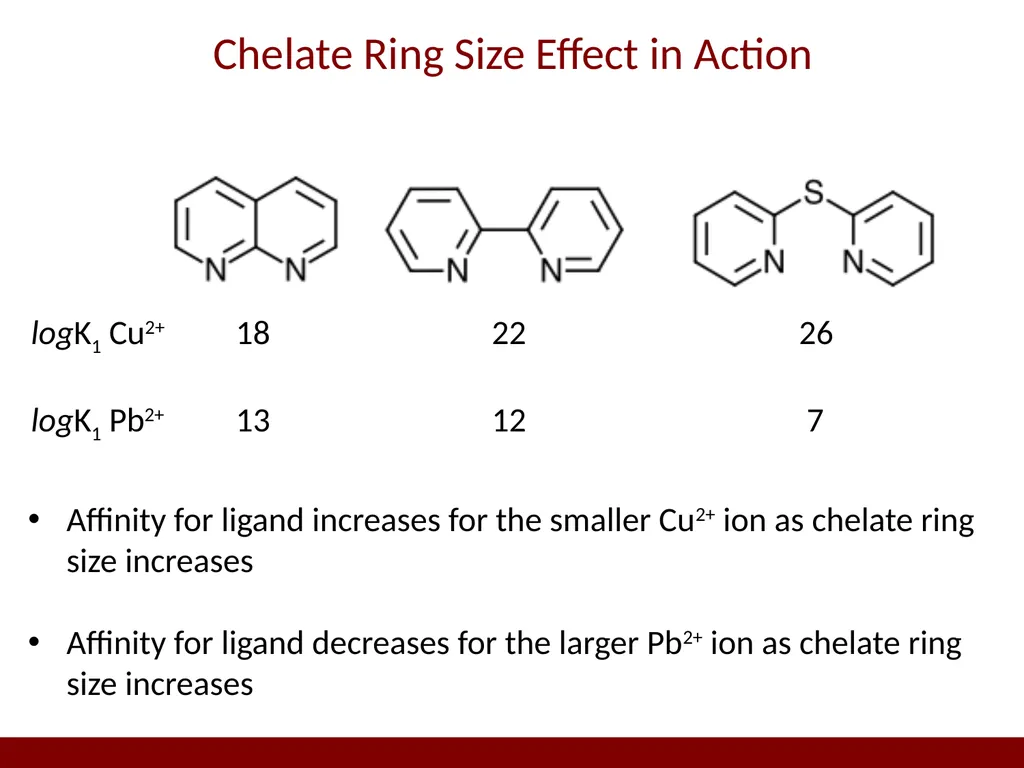
slide12. Chelate Ring Size Effect in Action logK1 Cu2+ 18 22 26
logK1 Pb2+ 13 12 7 Affinity for ligand increases for the smaller Cu2+ ion as chelate ring size increases
Affinity for ligand decreases for the larger Pb2+ ion as chelate ring size increases<br>
slide13. Chelate Rings and O-donors Addition of neutral O-donors to a polydentate ligands stabilizes the complexation of larger metal ions (especially ligands that form 5-membered chelate rings)
Neutral O-donors include: alcohols, ethers, esters, and amides
Addition of anionic O-donors to a polydentate ligands stabilizes the complexation of smaller, highly charged metal ions (harder acids)
Examples of charged O-donors include carboxylates, phenols and catechols (easily deprotonated alcohols) logK1 Ni2+ 7.4 6.6
logK1 Pb2+ 5.0 7.6<br>
slide14. Steric Focus Steric focus can be accomplished by modifying a ligand backbone to restrict mobility and “focus” the ligand in a conformation favorable for metal ion complexation Ogden, M. D.; Meier, G. P.; Nash, K. L. J. Solution Chem. 2012 41, 1–16. Cyclohexyl backbone restricts rotation about the N—N ethylene bridge that reduces the preorientation energy requirement for binding
This “focuses” pendent arms in a conformation favorable for binding<br>
http://creativecommons.org/licenses/by-nc-sa/4.0/<br>
slide2. What is Ligand Design? “A ligand is more preorganized when it is more constrained to be in a conformation required to complex a metal ion.” –Donald J. Cram
Ligand design is an area of inorganic chemistry that involves the design and synthesis of ligands preorganized to achieve specific functions involving coordination complexes
This area involves the understanding and manipulation of several concepts in chemistry:
HSAB Theory
Chelation and chelate ring size effect
Neutral O-donor effect
Steric Focus
Organic synthesis<br>
slide3. How to Assess a Ligand Assessing the relative stability of a metal-ligand bond requires an understanding of binding equilibrium. Consider the reaction of EDTA with a metal ion Mn+ to create an octahedral complex So: K1 = [M(EDTA)(n-4)]__
[M(H2O)6n+][EDTA4-] In inorganic chemistry we use the log of this equilibrium constant to assess the relative binding strengths of ligands [M(H2O)6]n+ + EDTA4- [M(EDTA)](n-4) + 6 H2O<br>
slide4. HSAB Theory in Ligand Design Ligands designed to complex harder metal ions can be designed using harder donor groups and ligands designed to complex softer metal ions can be designed using softer donor groups to increase selectivity
The hard alkali and alkaline earth metals, as well as the lanthanides, prefer harder O-donor anions
The transition metals are mostly soft or intermediate, and therefore prefer softer N-donor atoms
The heavier transition metals, such as gold, like sulfur
The heavier post-transition metals, such as Pb, Tl and Bi are capable of binding to a wide variety of donor atoms<br>
slide5. HSAB Theory in Donor Atoms HSAB theory can be used to manipulate discreet differences in different metal ions M. Heitzmann, F. Bravard, C. Gateau, N. Boubals, C. Berthon, J. Pecaut, M.C. Charbonnel, P. Delangle, Inorganic Chemistry, 2009, 48, 246-256
M. P. Jensen, J. Alloys Cmpds.2000, 303-304, 137-145.<br>
slide6. Chelation Chelation comes from the latin word “chela,” which means “claw”
Chelation involves the formation of multiple bonds to donor atoms in a polydentate ligand
Chelation of a metal ion is stabilized by a more favorable entropic effect as opposed to coordination of monodentate ligands containing similar donor atoms<br>
slide7. The Claw!!!!!! Why is chelation preferred below?
[Cu(H2O)6]2+ + 4NH3 [Cu(NH3)4(H2O)2]2+ logβ4 = 12.6
[Cu(H2O)6]2+ + 2en [Cu(en)2(H2O)2]2+ logβ2 = 20.6 The formation of each complex is dependent of the ΔG value
ΔG = -RTlnK = ΔH – TΔS
Solving for lnK gives the Eyring Equation:
lnK = -ΔH/RT + ΔS/R (plot of lnK vs. 1/T gives a straight line)
Because ethylenediamine and ammonia are similar, ΔH will be similar
What about the change in entropy? Which is better? 5 reactants to 1 product, or 3 reactants to 1 product?<br>
slide8. Inductive Effects Consider the effect of chelation on Pd2+ trien logβ4 NH3 logK1 trien
Pd2+ 26.0 39.4 trien is preferred by 13.4 log units (1013.4 times more likely to bind)
The total number of molecules in an aqueous solution is approximately equal to the number of water molecules, and pure water has a concentration of 55.51 M
The entropy contribution to the chelate effect can be approximated by (n-1) log 55.51, where n = # of donor atoms
Here the entropic contribution is only 5.23, so what accounts for the extra 8.17 log units observed?
There are inductive effects from the ethylene bridges that give a more favorable enthalpy ΔH<br>
slide9. Inductive Effects and Chelation Enthalpic contributions are also observed in comparison of macrocyclic ligands to their open-chain analogues cyclam analogue logK1 Cu2+ 23.4 27.2
logK1 Ni2+ 16.4 19.8 The extra stability observed in cyclam is due to restricted ligand mobility as well as inductive effects from the extra ethylene bridge
This effect is known as the macrocyclic effect<br>
slide10. The Cryptate Effect A cryptand containing 3 “strands” of donor groups that link neutral N-donors increases complex stability even more as a result of increased enthalpic and chelate effects. 18-crown-6 cryptand-2,2,2 logK1 Pb2+ 6.8 12.0 This effect is best observed in larger metal ions with high coordination numbers<br>
slide11. Chelate Ring Size Effect Formation of 4 and 5-membered chelate rings is more favorable for complexes containing larger metal ions
Formation of 6-membered chelate rings is more favorable for complexes containing smaller metal ions
This is a geometric effect Insert image of Figure 3 A, B, and C ONLY from Hancock, R. D. J. Chem. Educ., 1992, 69 (8), pg 617<br>
slide12. Chelate Ring Size Effect in Action logK1 Cu2+ 18 22 26
logK1 Pb2+ 13 12 7 Affinity for ligand increases for the smaller Cu2+ ion as chelate ring size increases
Affinity for ligand decreases for the larger Pb2+ ion as chelate ring size increases<br>
slide13. Chelate Rings and O-donors Addition of neutral O-donors to a polydentate ligands stabilizes the complexation of larger metal ions (especially ligands that form 5-membered chelate rings)
Neutral O-donors include: alcohols, ethers, esters, and amides
Addition of anionic O-donors to a polydentate ligands stabilizes the complexation of smaller, highly charged metal ions (harder acids)
Examples of charged O-donors include carboxylates, phenols and catechols (easily deprotonated alcohols) logK1 Ni2+ 7.4 6.6
logK1 Pb2+ 5.0 7.6<br>
slide14. Steric Focus Steric focus can be accomplished by modifying a ligand backbone to restrict mobility and “focus” the ligand in a conformation favorable for metal ion complexation Ogden, M. D.; Meier, G. P.; Nash, K. L. J. Solution Chem. 2012 41, 1–16. Cyclohexyl backbone restricts rotation about the N—N ethylene bridge that reduces the preorientation energy requirement for binding
This “focuses” pendent arms in a conformation favorable for binding<br>