
Likely this is not centrally recorded, So I will
AS
Published · 48 slides · 0 views

1 / 1





Description
Likely this is not centrally recorded, So I will manually record via Zoom The Cloud Recording Link CS4234 Optimiz(s)ation Algorithms L12 Push-Relabel Max-Flow Algorithm What if we dont fixate our thoughts towards finding even better
Related Topics
Share
Embed code
Download this presentation From Below
"Likely this is not centrally recorded, So I will" is the property of its rightful owner. Permission is granted to download and print the materials on this website for personal, non-commercial use only, and to display it on your personal computer provided you do not modify the materials and that you retain all copyright notices contained in the materials. By downloading content from our website, you accept the terms of this agreement.
Presentation Transcript
01
Likely this is not centrally recorded,
So I will manually record via Zoom The Cloud Recording Link<br>
So I will manually record via Zoom The Cloud Recording Link<br>
02
CS4234
Optimiz(s)ation Algorithms L12 – Push-Relabel
Max-Flow Algorithm What if we don’t fixate our thoughts towards finding even better augmenting paths iteratively… v0.5: Seth Gilbert
v1.7: Steven Halim<br>
v1.7: Steven Halim<br>
03
Push-Relabel Algorithm
Recap about Ford-Fulkerson and its variations…
Introducing Push-Relabel Algorithm
Analysis of Push-Relabel Algorithm: O(n2 m)
Implementation note Roadmap<br>
Recap about Ford-Fulkerson and its variations…
Introducing Push-Relabel Algorithm
Analysis of Push-Relabel Algorithm: O(n2 m)
Implementation note Roadmap<br>
04
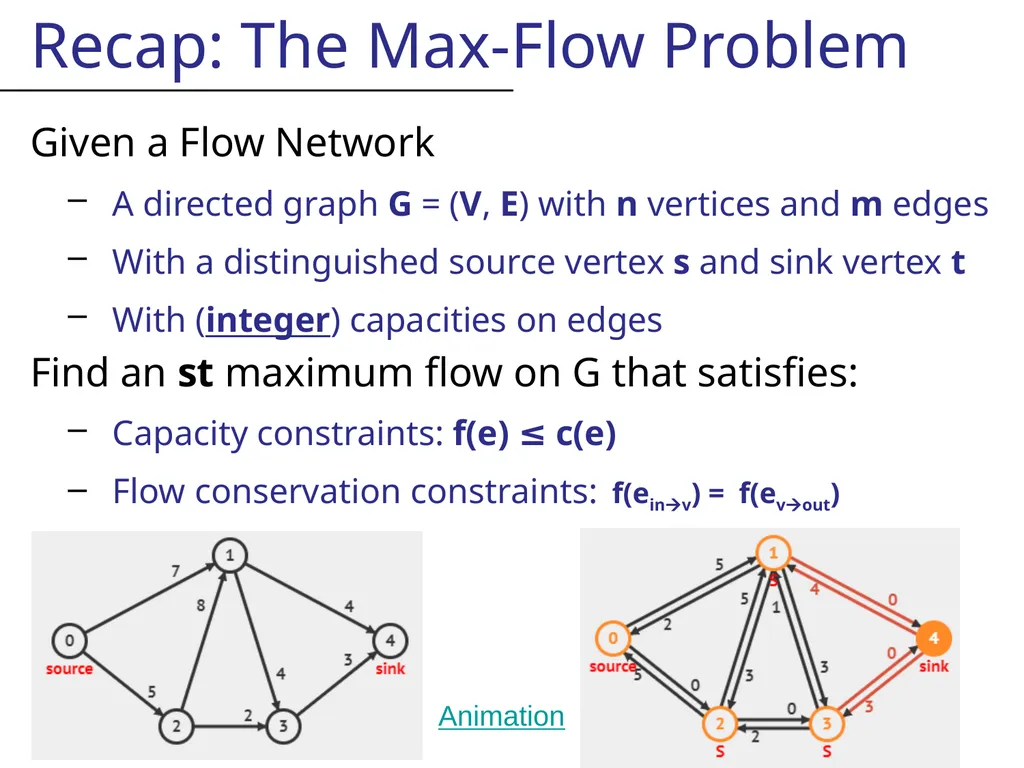
Given a Flow Network
A directed graph G = (V, E) with n vertices and m edges
With a distinguished source vertex s and sink vertex t
With (integer) capacities on edges
Find an st maximum flow on G that satisfies:
Capacity constraints: f(e) ≤ c(e)
Flow conservation constraints: f(einv) = f(evout) Recap: The Max-Flow Problem Animation<br>
A directed graph G = (V, E) with n vertices and m edges
With a distinguished source vertex s and sink vertex t
With (integer) capacities on edges
Find an st maximum flow on G that satisfies:
Capacity constraints: f(e) ≤ c(e)
Flow conservation constraints: f(einv) = f(evout) Recap: The Max-Flow Problem Animation<br>
05
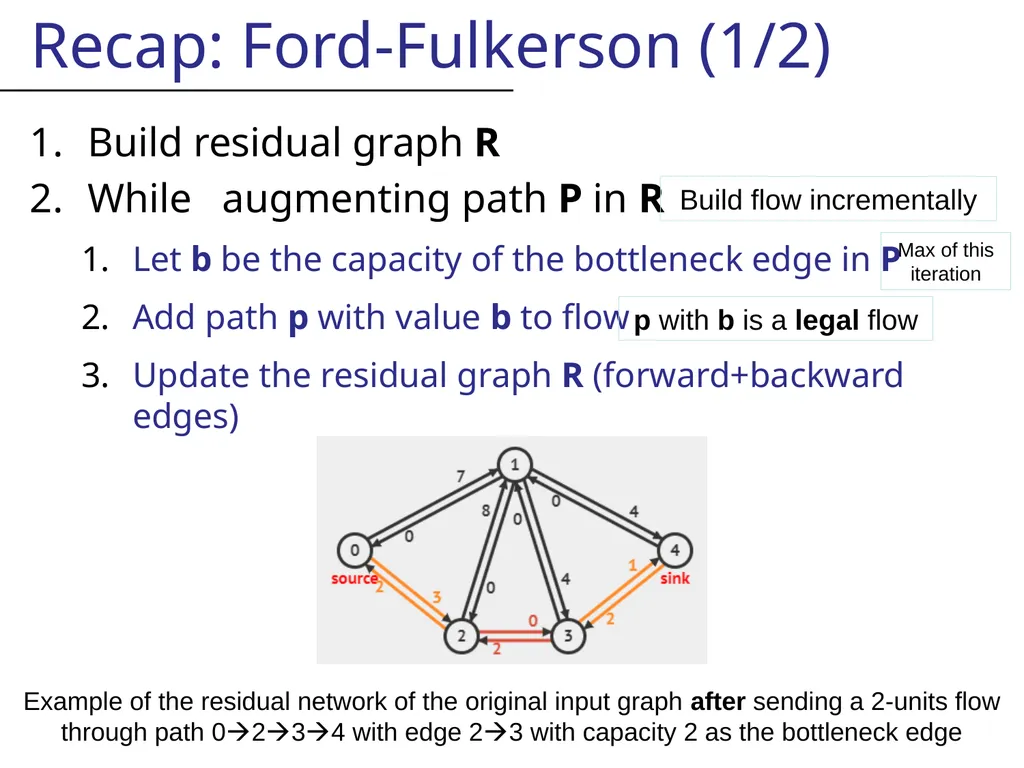
Build residual graph R
While augmenting path P in R
Let b be the capacity of the bottleneck edge in P
Add path p with value b to flow
Update the residual graph R (forward+backward edges) Recap: Ford-Fulkerson (1/2) Example of the residual network of the original input graph after sending a 2-units flow through path 0234 with edge 23 with capacity 2 as the bottleneck edge Build flow incrementally p with b is a legal flow Max of this iteration<br>
While augmenting path P in R
Let b be the capacity of the bottleneck edge in P
Add path p with value b to flow
Update the residual graph R (forward+backward edges) Recap: Ford-Fulkerson (1/2) Example of the residual network of the original input graph after sending a 2-units flow through path 0234 with edge 23 with capacity 2 as the bottleneck edge Build flow incrementally p with b is a legal flow Max of this iteration<br>
06
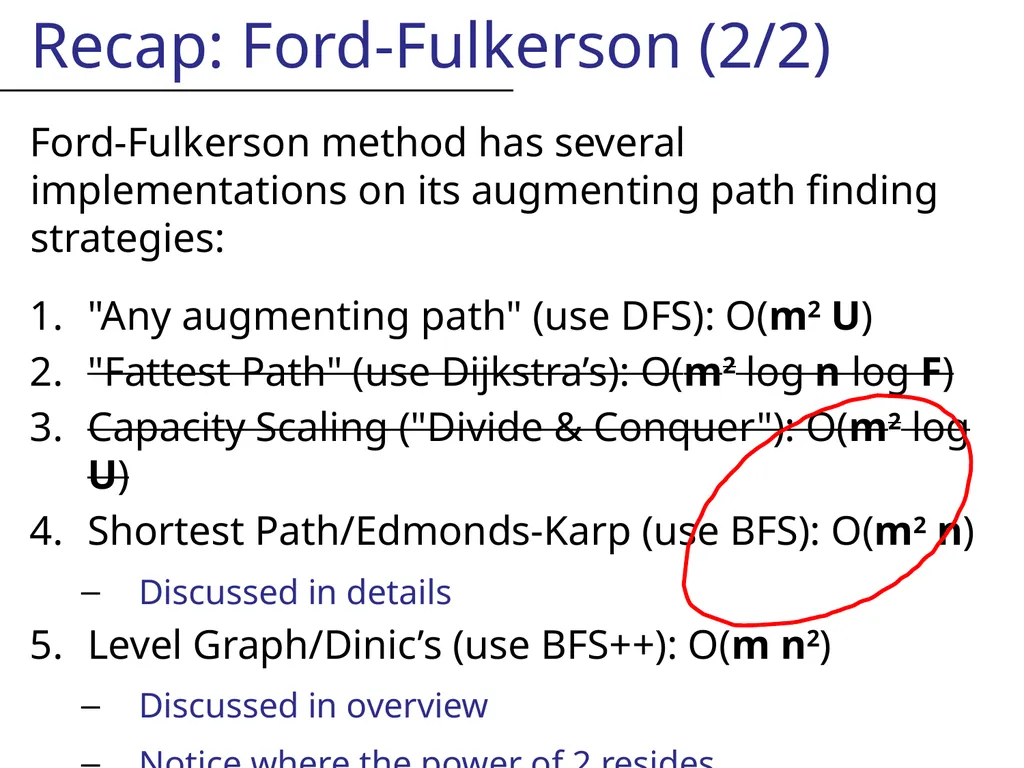
Ford-Fulkerson method has several implementations on its augmenting path finding strategies:
"Any augmenting path" (use DFS): O(m2 U)
"Fattest Path" (use Dijkstra’s): O(m2 log n log F)
Capacity Scaling ("Divide & Conquer"): O(m2 log U)
Shortest Path/Edmonds-Karp (use BFS): O(m2 n)
Discussed in details
Level Graph/Dinic’s (use BFS++): O(m n2)
Discussed in overview
Notice where the power of 2 resides… Recap: Ford-Fulkerson (2/2)<br>
"Any augmenting path" (use DFS): O(m2 U)
"Fattest Path" (use Dijkstra’s): O(m2 log n log F)
Capacity Scaling ("Divide & Conquer"): O(m2 log U)
Shortest Path/Edmonds-Karp (use BFS): O(m2 n)
Discussed in details
Level Graph/Dinic’s (use BFS++): O(m n2)
Discussed in overview
Notice where the power of 2 resides… Recap: Ford-Fulkerson (2/2)<br>
07
Push-Relabel Algorithm
Recap about Ford-Fulkerson and its variations…
Introducing Push-Relabel Algorithm
Analysis of Push-Relabel Algorithm: O(n2 m)
Implementation note Roadmap<br>
Recap about Ford-Fulkerson and its variations…
Introducing Push-Relabel Algorithm
Analysis of Push-Relabel Algorithm: O(n2 m)
Implementation note Roadmap<br>
08
https://en.wikipedia.org/wiki/Maximum_flow_problem#Algorithms
But Push-Relabel was removed from CLRS 3rd4th edition… Research on Max Flow<br>
But Push-Relabel was removed from CLRS 3rd4th edition… Research on Max Flow<br>
09
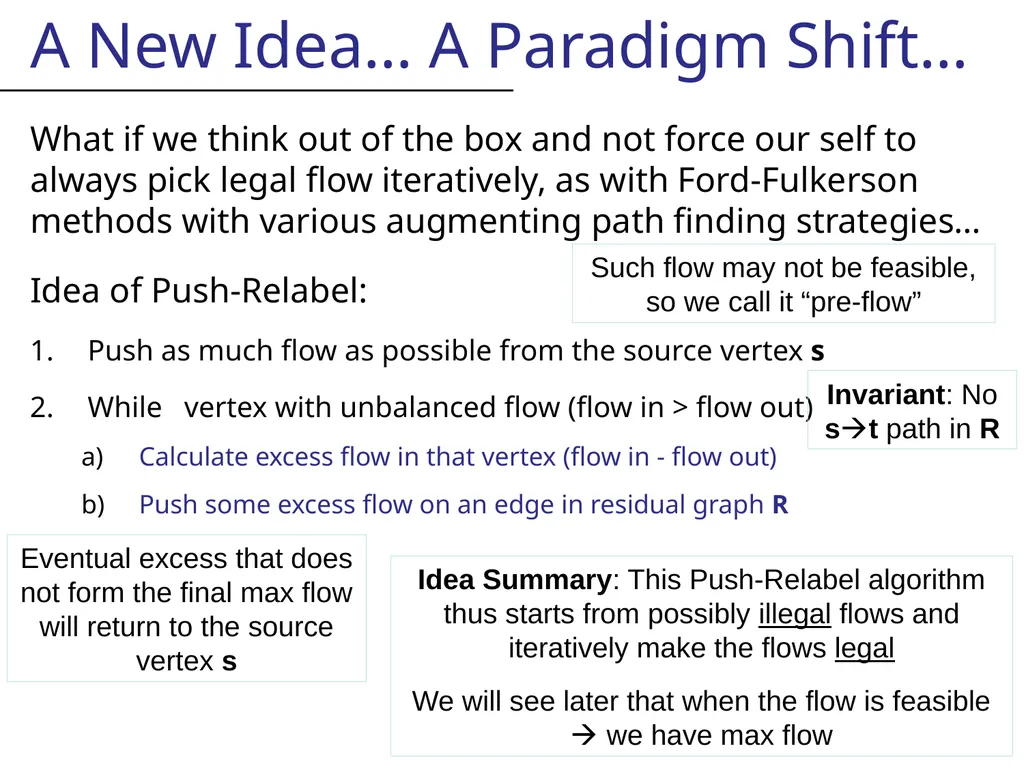
What if we think out of the box and not force our self to always pick legal flow iteratively, as with Ford-Fulkerson methods with various augmenting path finding strategies…
Idea of Push-Relabel:
Push as much flow as possible from the source vertex s
While vertex with unbalanced flow (flow in > flow out)
Calculate excess flow in that vertex (flow in - flow out)
Push some excess flow on an edge in residual graph R A New Idea… A Paradigm Shift… Such flow may not be feasible, so we call it “pre-flow” Idea Summary: This Push-Relabel algorithm thus starts from possibly illegal flows and iteratively make the flows legal
We will see later that when the flow is feasible we have max flow Invariant: No st path in R Eventual excess that does not form the final max flow will return to the source vertex s<br>
Idea of Push-Relabel:
Push as much flow as possible from the source vertex s
While vertex with unbalanced flow (flow in > flow out)
Calculate excess flow in that vertex (flow in - flow out)
Push some excess flow on an edge in residual graph R A New Idea… A Paradigm Shift… Such flow may not be feasible, so we call it “pre-flow” Idea Summary: This Push-Relabel algorithm thus starts from possibly illegal flows and iteratively make the flows legal
We will see later that when the flow is feasible we have max flow Invariant: No st path in R Eventual excess that does not form the final max flow will return to the source vertex s<br>
10
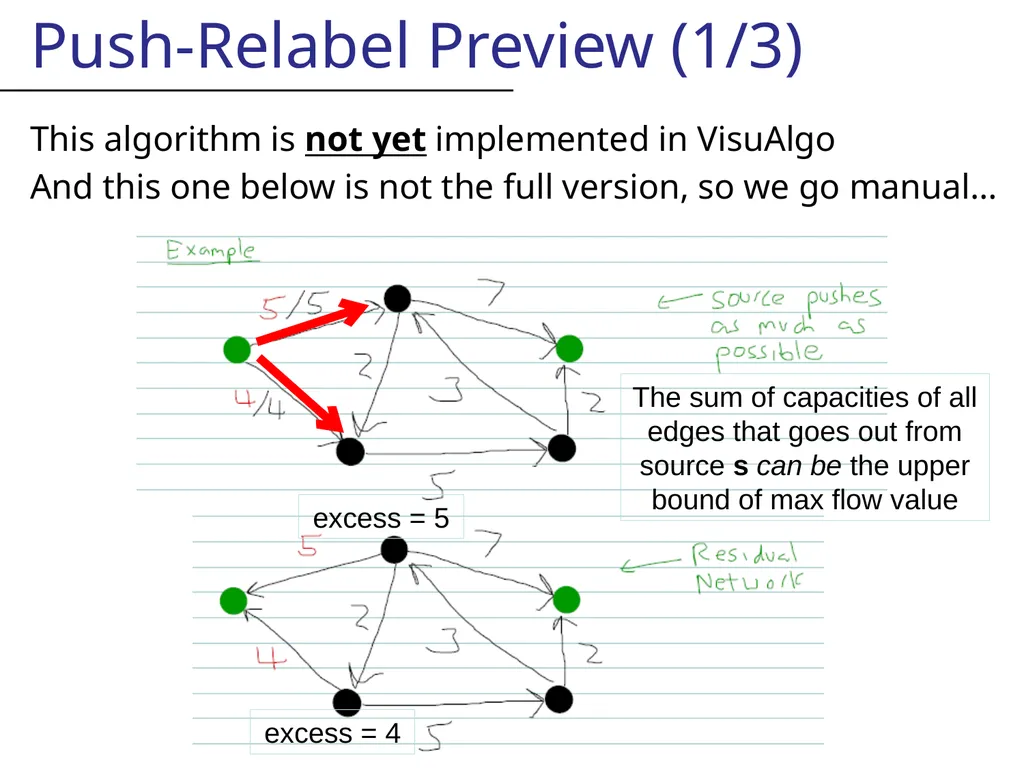
This algorithm is not yet implemented in VisuAlgo
And this one below is not the full version, so we go manual… Push-Relabel Preview (1/3) excess = 5 excess = 4 The sum of capacities of all edges that goes out from source s can be the upper bound of max flow value<br>
And this one below is not the full version, so we go manual… Push-Relabel Preview (1/3) excess = 5 excess = 4 The sum of capacities of all edges that goes out from source s can be the upper bound of max flow value<br>
11
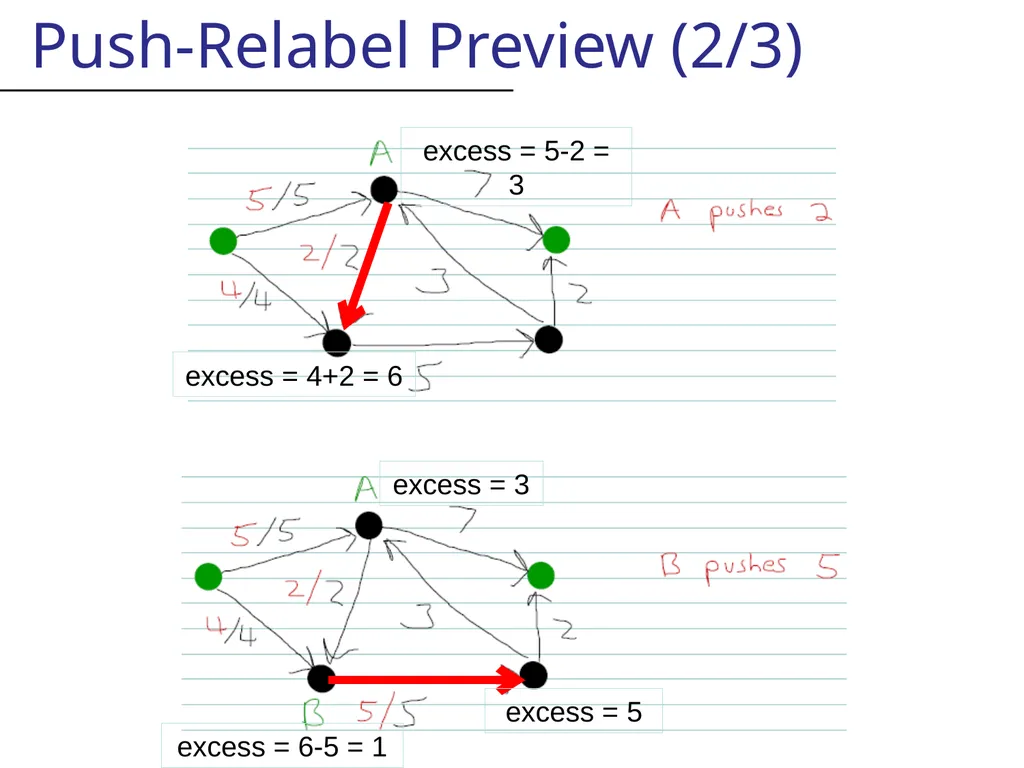
Push-Relabel Preview (2/3) excess = 5-2 = 3 excess = 4+2 = 6 excess = 3 excess = 6-5 = 1 excess = 5<br>
12
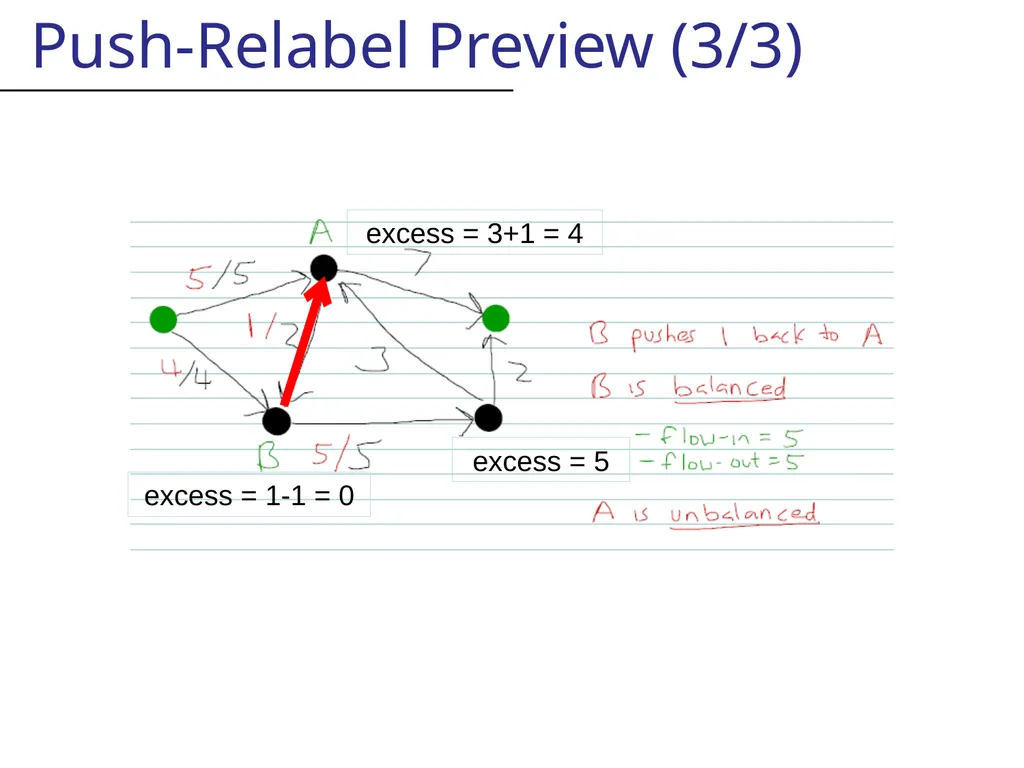
Push-Relabel Preview (3/3) excess = 3+1 = 4 excess = 1-1 = 0 excess = 5<br>
13
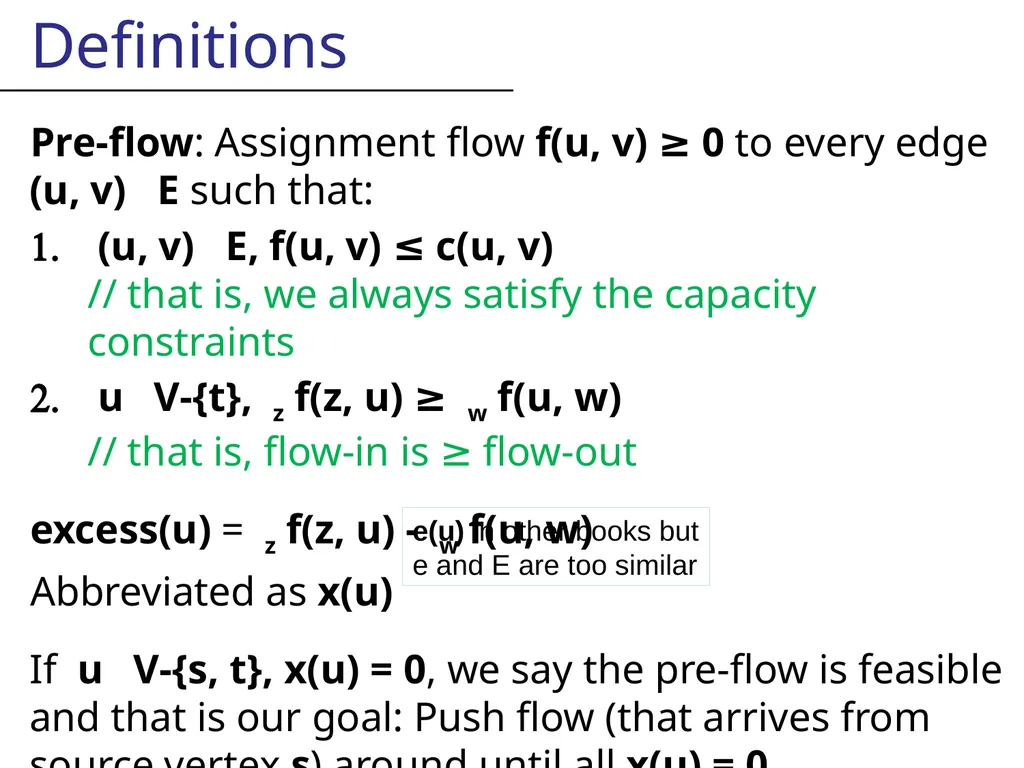
Pre-flow: Assignment flow f(u, v) ≥ 0 to every edge (u, v) E such that:
(u, v) E, f(u, v) ≤ c(u, v) // that is, we always satisfy the capacity constraints
u V-{t}, z f(z, u) ≥ w f(u, w) // that is, flow-in is ≥ flow-out
excess(u) = z f(z, u) - w f(u, w)
Abbreviated as x(u)
If u V-{s, t}, x(u) = 0, we say the pre-flow is feasible and that is our goal: Push flow (that arrives from source vertex s) around until all x(u) = 0 Definitions e(u) in other books but e and E are too similar<br>
(u, v) E, f(u, v) ≤ c(u, v) // that is, we always satisfy the capacity constraints
u V-{t}, z f(z, u) ≥ w f(u, w) // that is, flow-in is ≥ flow-out
excess(u) = z f(z, u) - w f(u, w)
Abbreviated as x(u)
If u V-{s, t}, x(u) = 0, we say the pre-flow is feasible and that is our goal: Push flow (that arrives from source vertex s) around until all x(u) = 0 Definitions e(u) in other books but e and E are too similar<br>
14
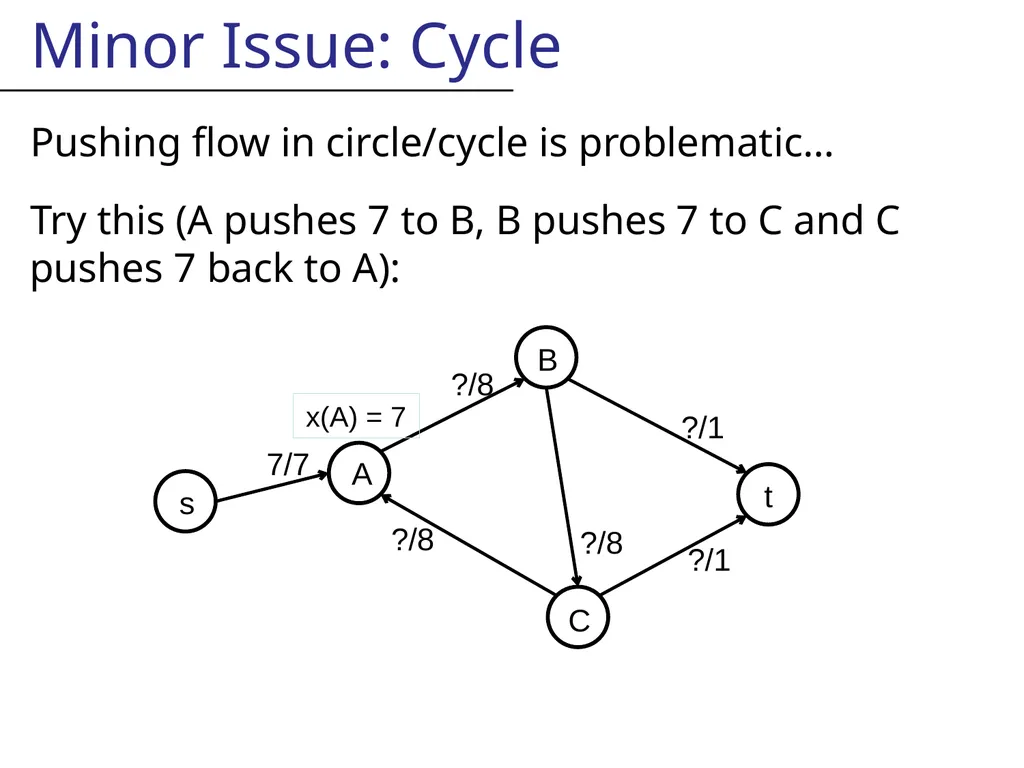
Pushing flow in circle/cycle is problematic…
Try this (A pushes 7 to B, B pushes 7 to C and C pushes 7 back to A): Minor Issue: Cycle 7/7 ?/8 ?/8 ?/8 x(A) = 7 ?/1 ?/1<br>
Try this (A pushes 7 to B, B pushes 7 to C and C pushes 7 back to A): Minor Issue: Cycle 7/7 ?/8 ?/8 ?/8 x(A) = 7 ?/1 ?/1<br>
15
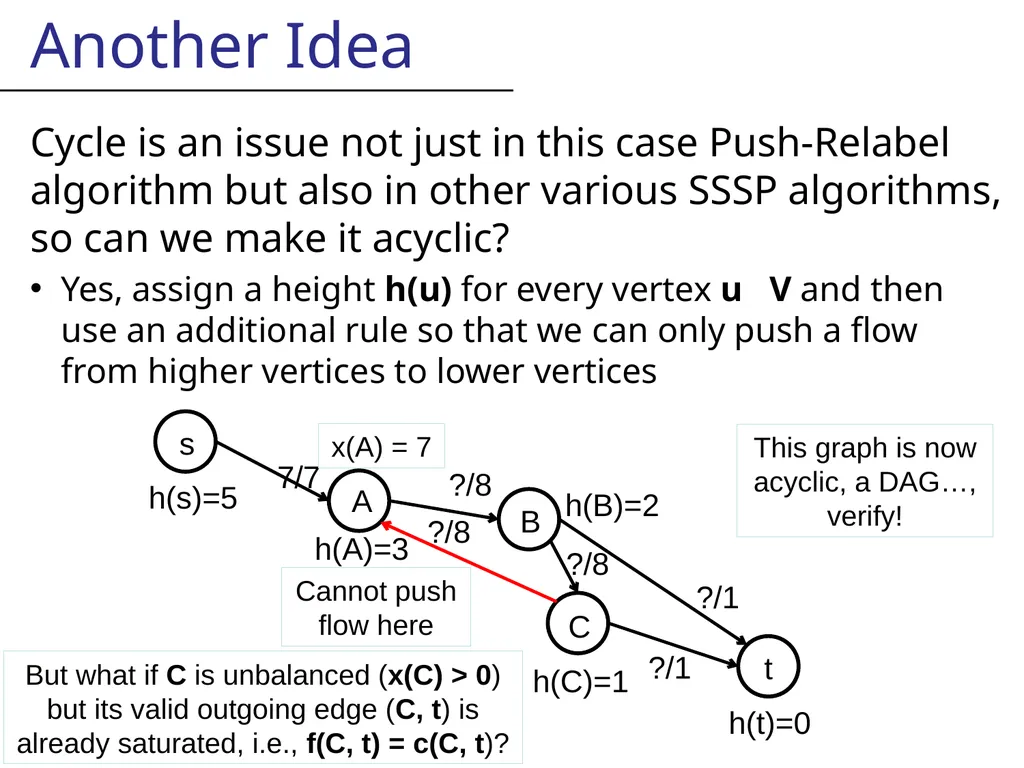
Cycle is an issue not just in this case Push-Relabel algorithm but also in other various SSSP algorithms,
so can we make it acyclic?
Yes, assign a height h(u) for every vertex u V and then use an additional rule so that we can only push a flow from higher vertices to lower vertices Another Idea This graph is now acyclic, a DAG…, verify! But what if C is unbalanced (x(C) > 0) but its valid outgoing edge (C, t) is already saturated, i.e., f(C, t) = c(C, t)? h(B)=2 7/7 h(s)=5 h(t)=0 h(A)=3 h(C)=1 Cannot push flow here ?/1 ?/1 ?/8 ?/8 ?/8 x(A) = 7<br>
Yes, assign a height h(u) for every vertex u V and then use an additional rule so that we can only push a flow from higher vertices to lower vertices Another Idea This graph is now acyclic, a DAG…, verify! But what if C is unbalanced (x(C) > 0) but its valid outgoing edge (C, t) is already saturated, i.e., f(C, t) = c(C, t)? h(B)=2 7/7 h(s)=5 h(t)=0 h(A)=3 h(C)=1 Cannot push flow here ?/1 ?/1 ?/8 ?/8 ?/8 x(A) = 7<br>
16
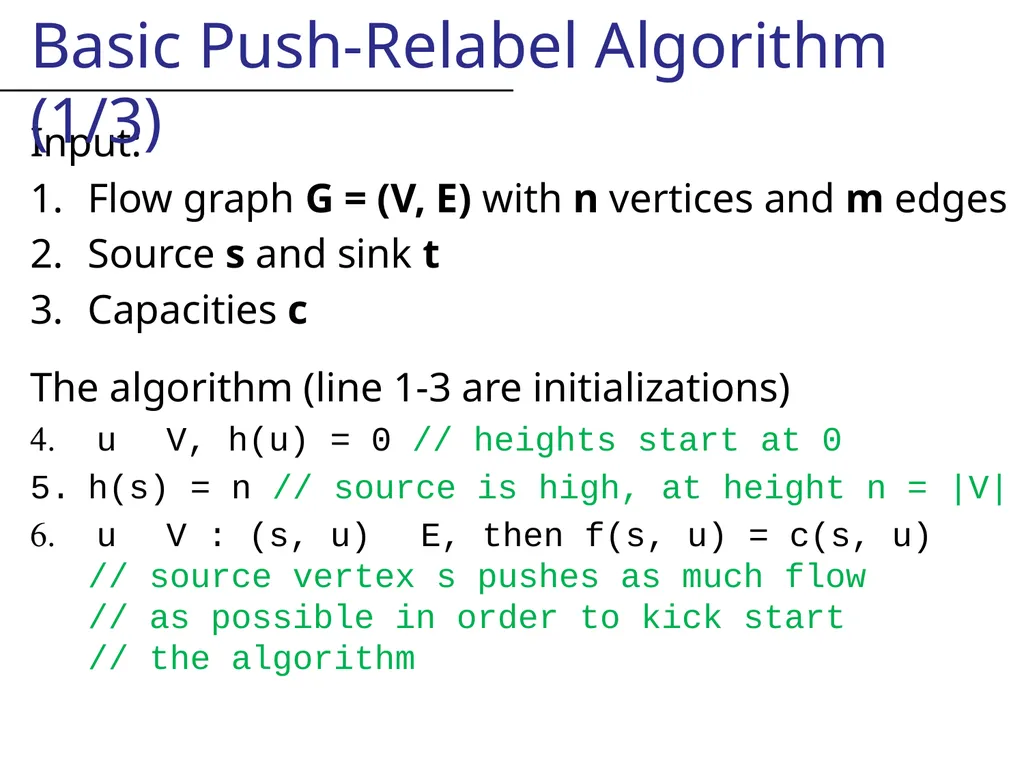
Input:
Flow graph G = (V, E) with n vertices and m edges
Source s and sink t
Capacities c
The algorithm (line 1-3 are initializations)
u V, h(u) = 0 // heights start at 0
h(s) = n // source is high, at height n = |V|
u V : (s, u) E, then f(s, u) = c(s, u) // source vertex s pushes as much flow // as possible in order to kick start // the algorithm Basic Push-Relabel Algorithm (1/3)<br>
Flow graph G = (V, E) with n vertices and m edges
Source s and sink t
Capacities c
The algorithm (line 1-3 are initializations)
u V, h(u) = 0 // heights start at 0
h(s) = n // source is high, at height n = |V|
u V : (s, u) E, then f(s, u) = c(s, u) // source vertex s pushes as much flow // as possible in order to kick start // the algorithm Basic Push-Relabel Algorithm (1/3)<br>
17
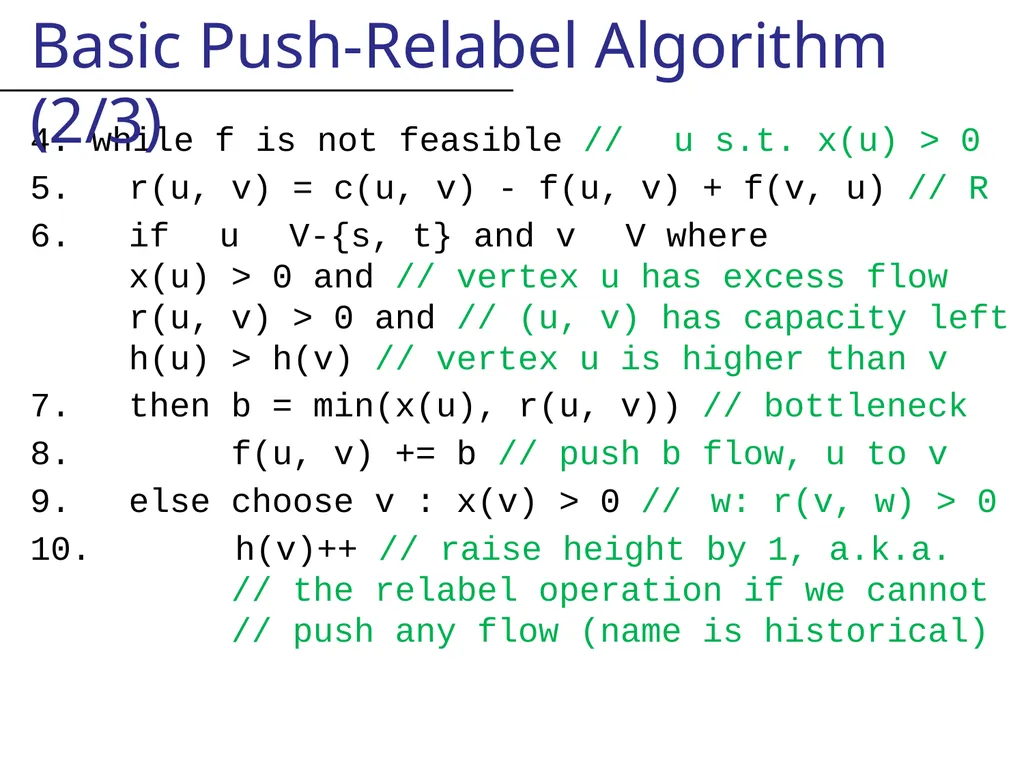
4. while f is not feasible // u s.t. x(u) > 0
r(u, v) = c(u, v) - f(u, v) + f(v, u) // R
if u V-{s, t} and v V where x(u) > 0 and // vertex u has excess flow r(u, v) > 0 and // (u, v) has capacity left h(u) > h(v) // vertex u is higher than v
then b = min(x(u), r(u, v)) // bottleneck
f(u, v) += b // push b flow, u to v
else choose v : x(v) > 0 // w: r(v, w) > 0
h(v)++ // raise height by 1, a.k.a. // the relabel operation if we cannot // push any flow (name is historical) Basic Push-Relabel Algorithm (2/3)<br>
r(u, v) = c(u, v) - f(u, v) + f(v, u) // R
if u V-{s, t} and v V where x(u) > 0 and // vertex u has excess flow r(u, v) > 0 and // (u, v) has capacity left h(u) > h(v) // vertex u is higher than v
then b = min(x(u), r(u, v)) // bottleneck
f(u, v) += b // push b flow, u to v
else choose v : x(v) > 0 // w: r(v, w) > 0
h(v)++ // raise height by 1, a.k.a. // the relabel operation if we cannot // push any flow (name is historical) Basic Push-Relabel Algorithm (2/3)<br>
18
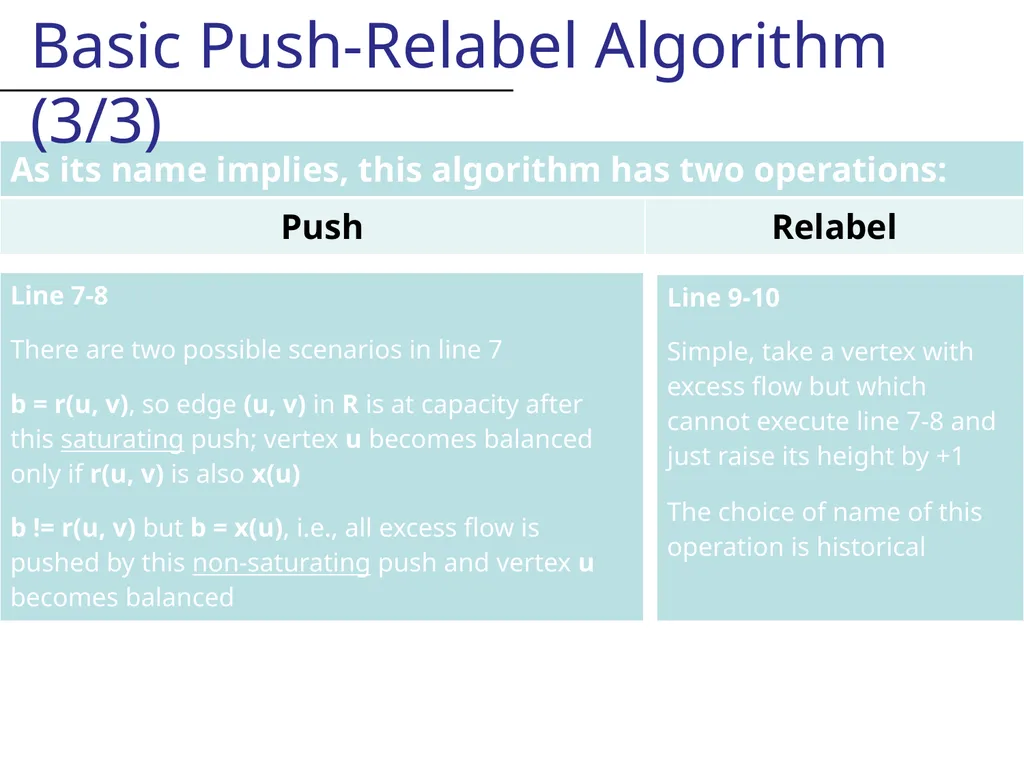
Basic Push-Relabel Algorithm (3/3)<br>
19
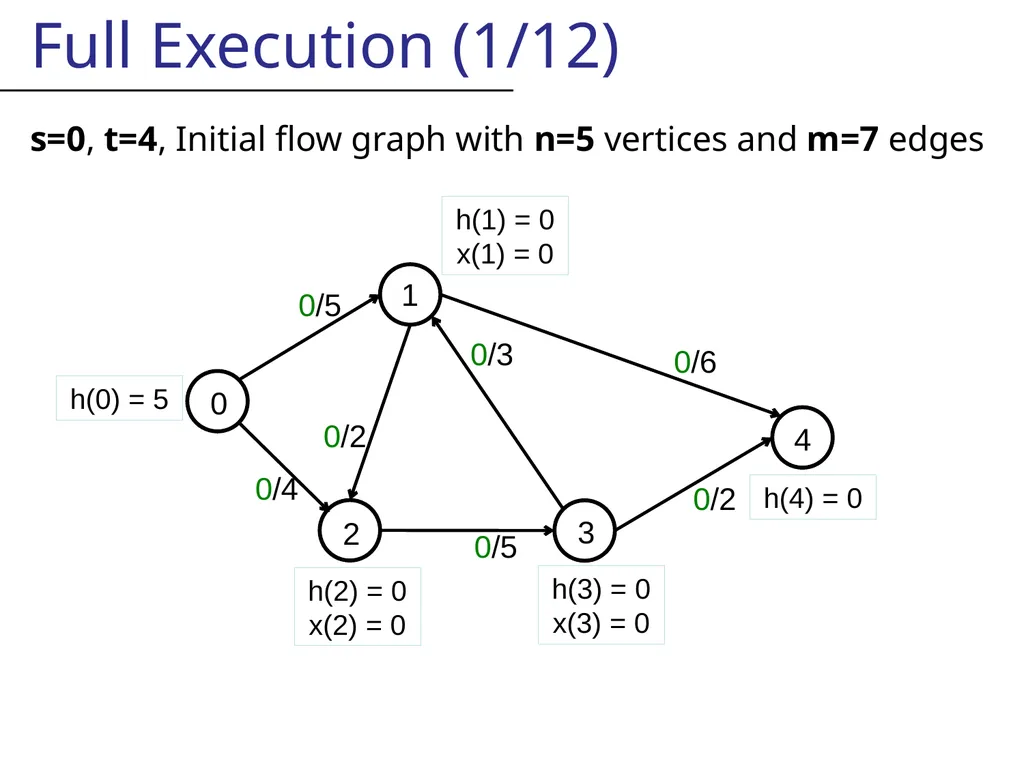
s=0, t=4, Initial flow graph with n=5 vertices and m=7 edges Full Execution (1/12) 0/5 0/6 0/3 0/5 h(3) = 0
x(3) = 0 h(2) = 0 x(2) = 0 0/2 0/2 0/4 h(4) = 0 h(0) = 5 h(1) = 0
x(1) = 0<br>
x(3) = 0 h(2) = 0 x(2) = 0 0/2 0/2 0/4 h(4) = 0 h(0) = 5 h(1) = 0
x(1) = 0<br>
20
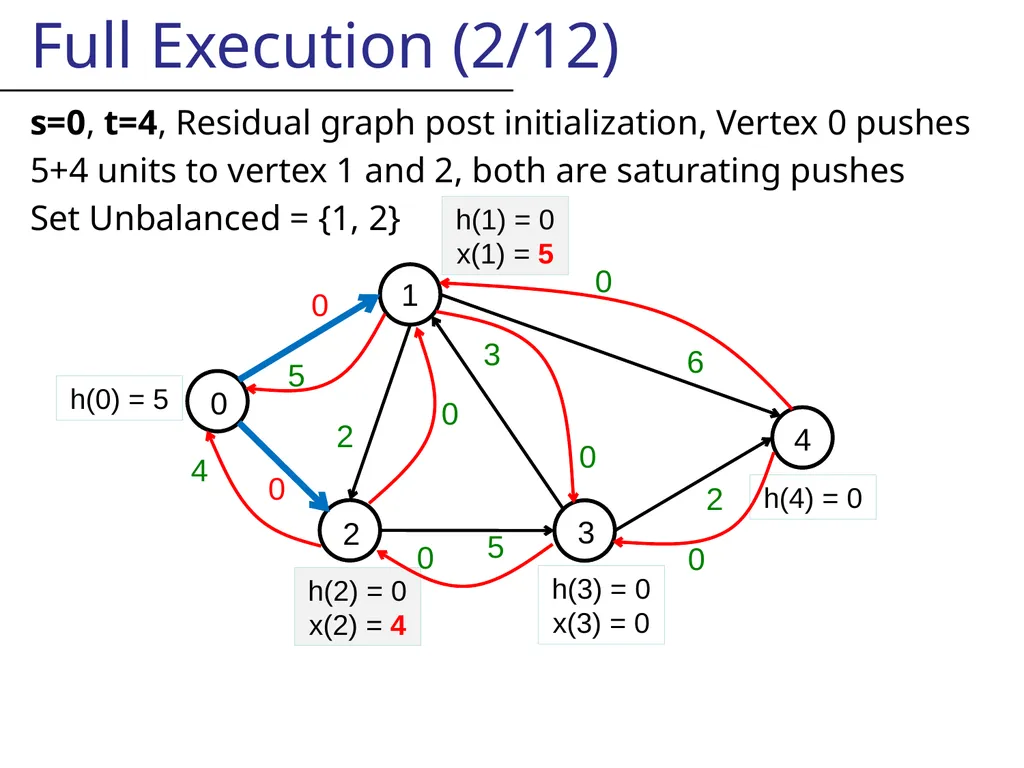
s=0, t=4, Residual graph post initialization, Vertex 0 pushes
5+4 units to vertex 1 and 2, both are saturating pushes
Set Unbalanced = {1, 2} Full Execution (2/12) 0 6 3 5 h(3) = 0
x(3) = 0 h(2) = 0 x(2) = 4 2 2 0 h(4) = 0 h(0) = 5 h(1) = 0
x(1) = 5 5 4 0 0 0 0 0<br>
5+4 units to vertex 1 and 2, both are saturating pushes
Set Unbalanced = {1, 2} Full Execution (2/12) 0 6 3 5 h(3) = 0
x(3) = 0 h(2) = 0 x(2) = 4 2 2 0 h(4) = 0 h(0) = 5 h(1) = 0
x(1) = 5 5 4 0 0 0 0 0<br>
21
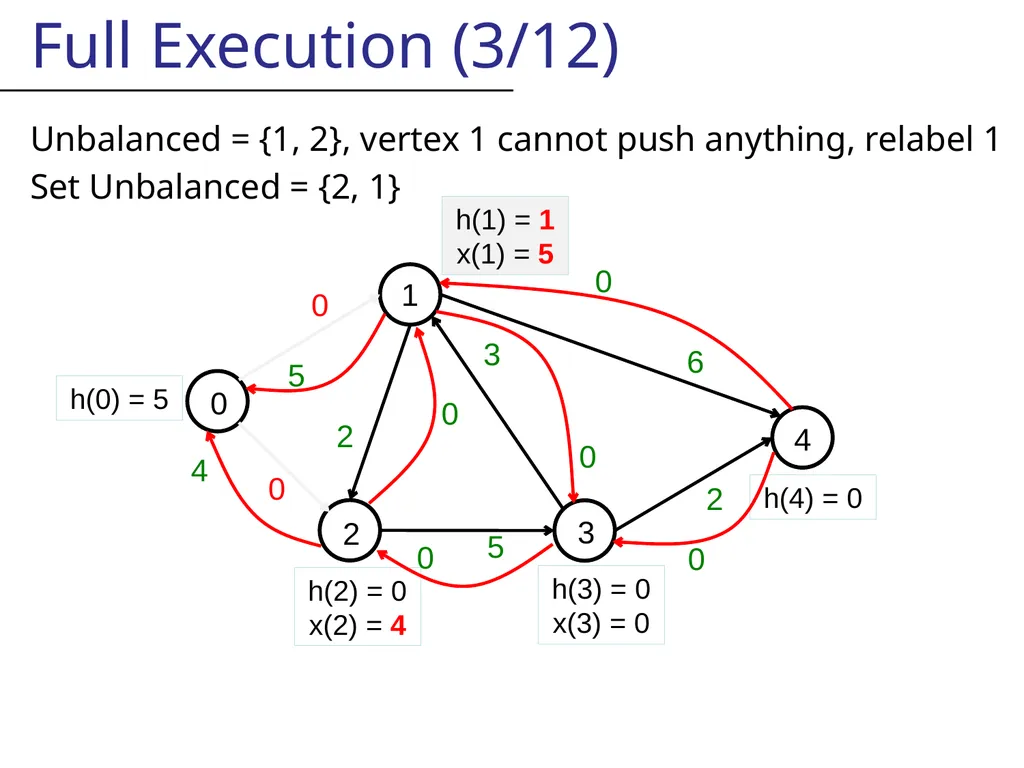
Unbalanced = {1, 2}, vertex 1 cannot push anything, relabel 1
Set Unbalanced = {2, 1} Full Execution (3/12) 0 6 3 5 h(3) = 0
x(3) = 0 h(2) = 0 x(2) = 4 2 2 0 h(4) = 0 h(0) = 5 h(1) = 1
x(1) = 5 5 4 0 0 0 0 0<br>
Set Unbalanced = {2, 1} Full Execution (3/12) 0 6 3 5 h(3) = 0
x(3) = 0 h(2) = 0 x(2) = 4 2 2 0 h(4) = 0 h(0) = 5 h(1) = 1
x(1) = 5 5 4 0 0 0 0 0<br>
22
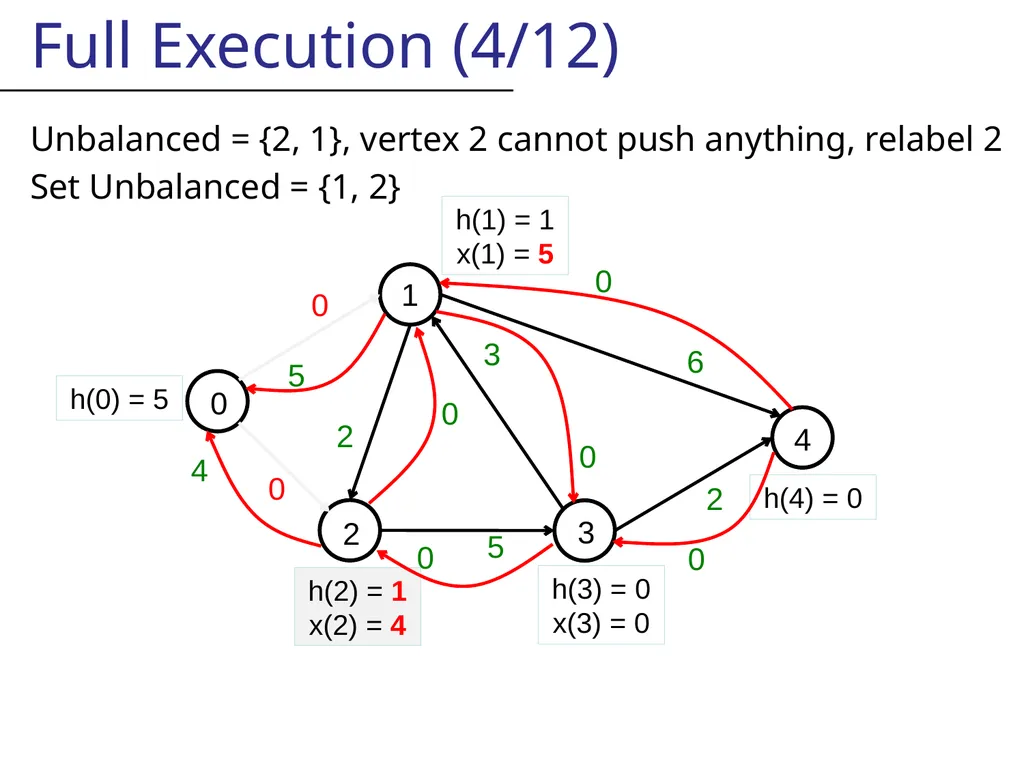
Unbalanced = {2, 1}, vertex 2 cannot push anything, relabel 2
Set Unbalanced = {1, 2} Full Execution (4/12) 0 6 3 5 h(3) = 0
x(3) = 0 h(2) = 1 x(2) = 4 2 2 0 h(4) = 0 h(0) = 5 h(1) = 1
x(1) = 5 5 4 0 0 0 0 0<br>
Set Unbalanced = {1, 2} Full Execution (4/12) 0 6 3 5 h(3) = 0
x(3) = 0 h(2) = 1 x(2) = 4 2 2 0 h(4) = 0 h(0) = 5 h(1) = 1
x(1) = 5 5 4 0 0 0 0 0<br>
23
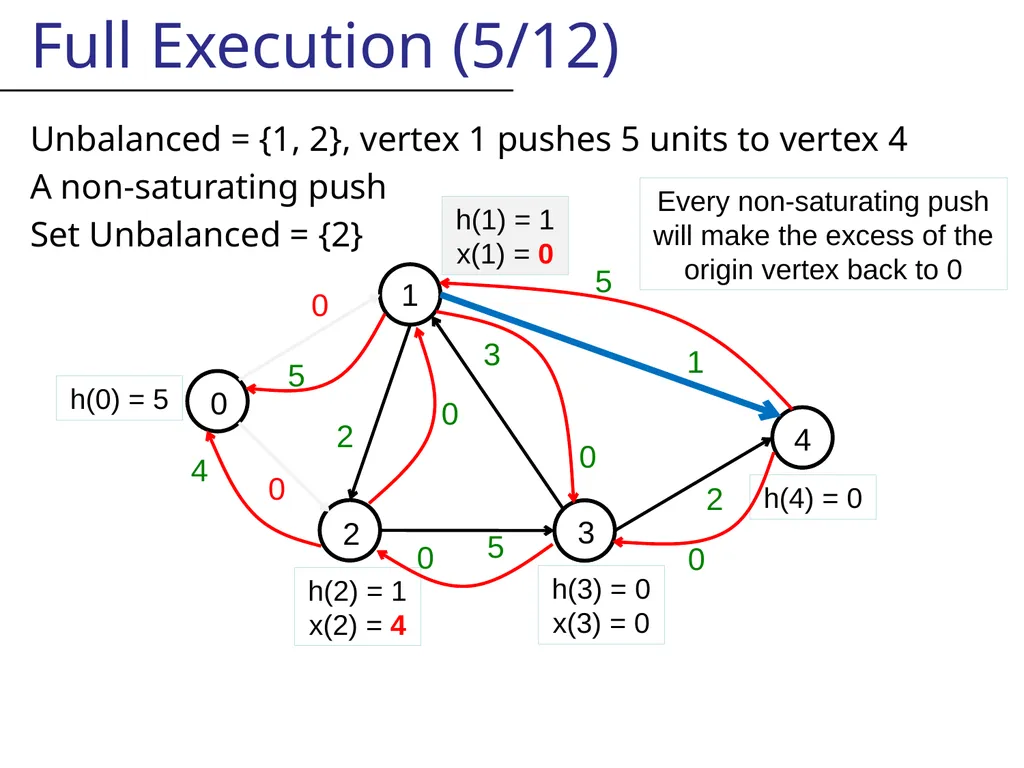
Unbalanced = {1, 2}, vertex 1 pushes 5 units to vertex 4
A non-saturating push
Set Unbalanced = {2} Full Execution (5/12) 0 1 3 5 h(3) = 0
x(3) = 0 h(2) = 1 x(2) = 4 2 2 0 h(4) = 0 h(0) = 5 h(1) = 1
x(1) = 0 5 4 5 0 0 0 0 Every non-saturating push will make the excess of the origin vertex back to 0<br>
A non-saturating push
Set Unbalanced = {2} Full Execution (5/12) 0 1 3 5 h(3) = 0
x(3) = 0 h(2) = 1 x(2) = 4 2 2 0 h(4) = 0 h(0) = 5 h(1) = 1
x(1) = 0 5 4 5 0 0 0 0 Every non-saturating push will make the excess of the origin vertex back to 0<br>
24
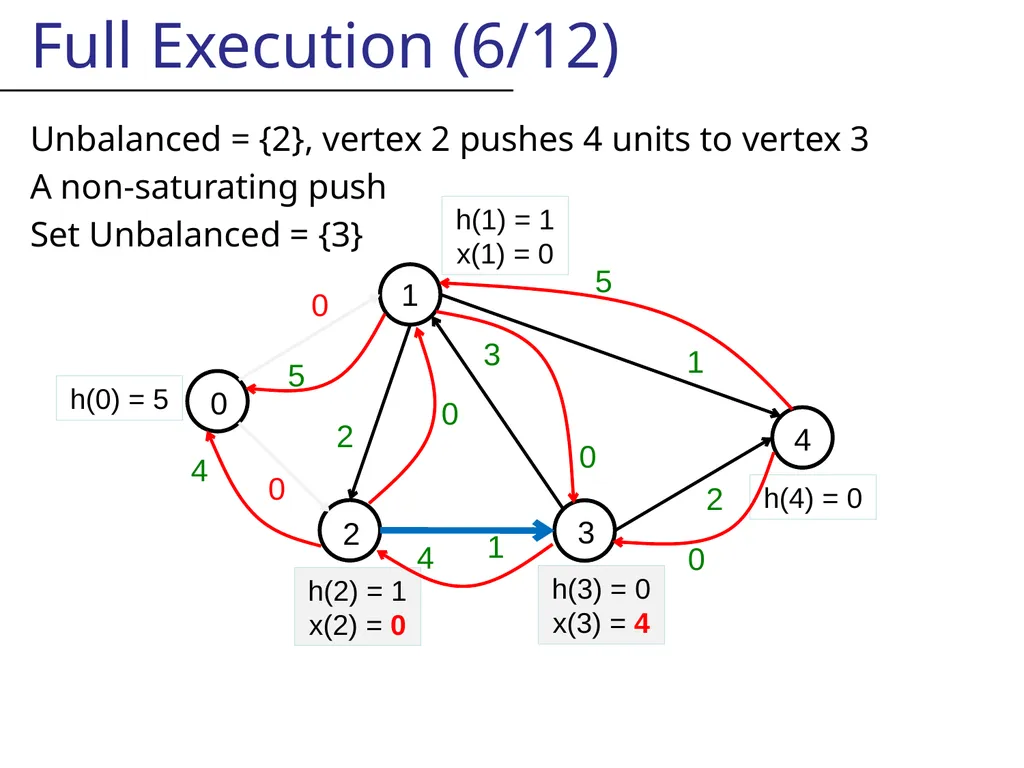
Unbalanced = {2}, vertex 2 pushes 4 units to vertex 3
A non-saturating push
Set Unbalanced = {3} Full Execution (6/12) 0 1 3 1 h(3) = 0
x(3) = 4 h(2) = 1 x(2) = 0 2 2 0 h(4) = 0 h(0) = 5 h(1) = 1
x(1) = 0 5 4 5 0 0 4 0<br>
A non-saturating push
Set Unbalanced = {3} Full Execution (6/12) 0 1 3 1 h(3) = 0
x(3) = 4 h(2) = 1 x(2) = 0 2 2 0 h(4) = 0 h(0) = 5 h(1) = 1
x(1) = 0 5 4 5 0 0 4 0<br>
25
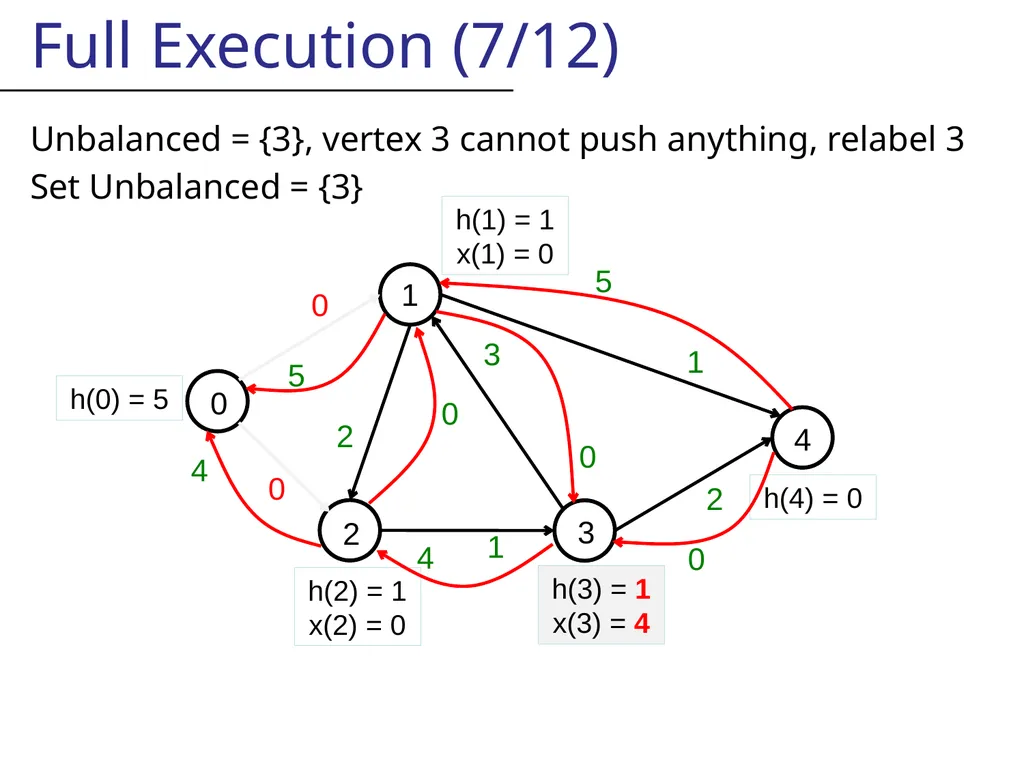
Unbalanced = {3}, vertex 3 cannot push anything, relabel 3
Set Unbalanced = {3} Full Execution (7/12) 0 1 3 1 h(3) = 1
x(3) = 4 h(2) = 1 x(2) = 0 2 2 0 h(4) = 0 h(0) = 5 h(1) = 1
x(1) = 0 5 4 5 0 0 4 0<br>
Set Unbalanced = {3} Full Execution (7/12) 0 1 3 1 h(3) = 1
x(3) = 4 h(2) = 1 x(2) = 0 2 2 0 h(4) = 0 h(0) = 5 h(1) = 1
x(1) = 0 5 4 5 0 0 4 0<br>
26
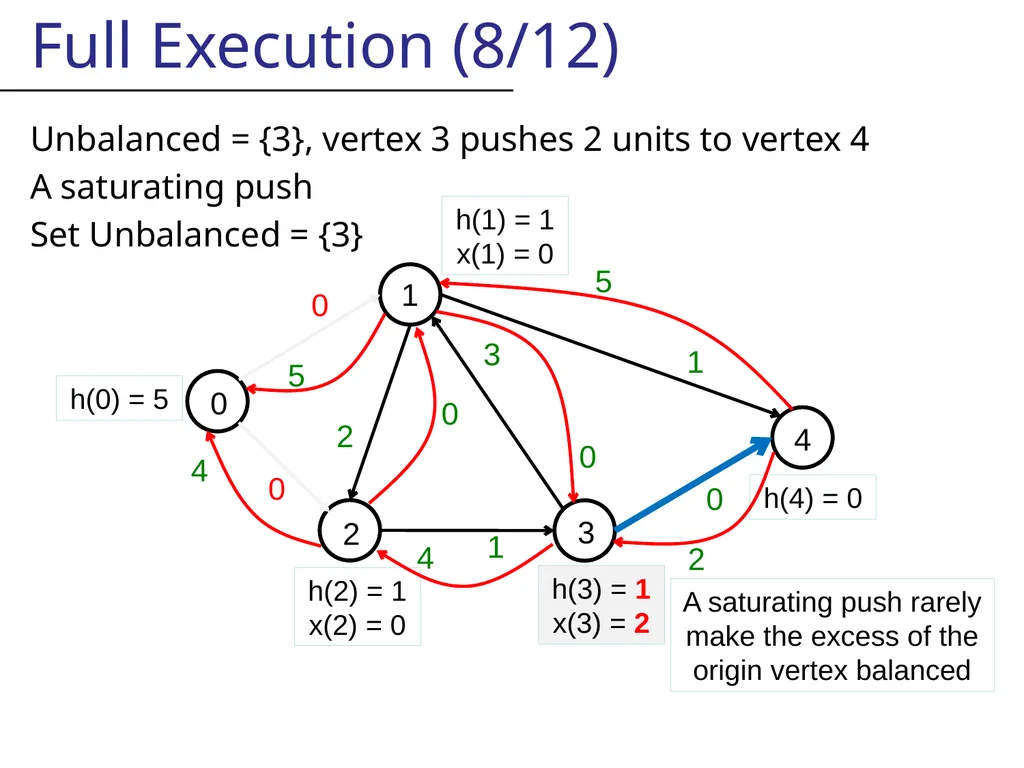
Unbalanced = {3}, vertex 3 pushes 2 units to vertex 4
A saturating push
Set Unbalanced = {3} Full Execution (8/12) 0 1 3 1 h(3) = 1
x(3) = 2 h(2) = 1 x(2) = 0 2 0 0 h(4) = 0 h(0) = 5 h(1) = 1
x(1) = 0 5 4 5 0 2 4 0 A saturating push rarely make the excess of the origin vertex balanced<br>
A saturating push
Set Unbalanced = {3} Full Execution (8/12) 0 1 3 1 h(3) = 1
x(3) = 2 h(2) = 1 x(2) = 0 2 0 0 h(4) = 0 h(0) = 5 h(1) = 1
x(1) = 0 5 4 5 0 2 4 0 A saturating push rarely make the excess of the origin vertex balanced<br>
27
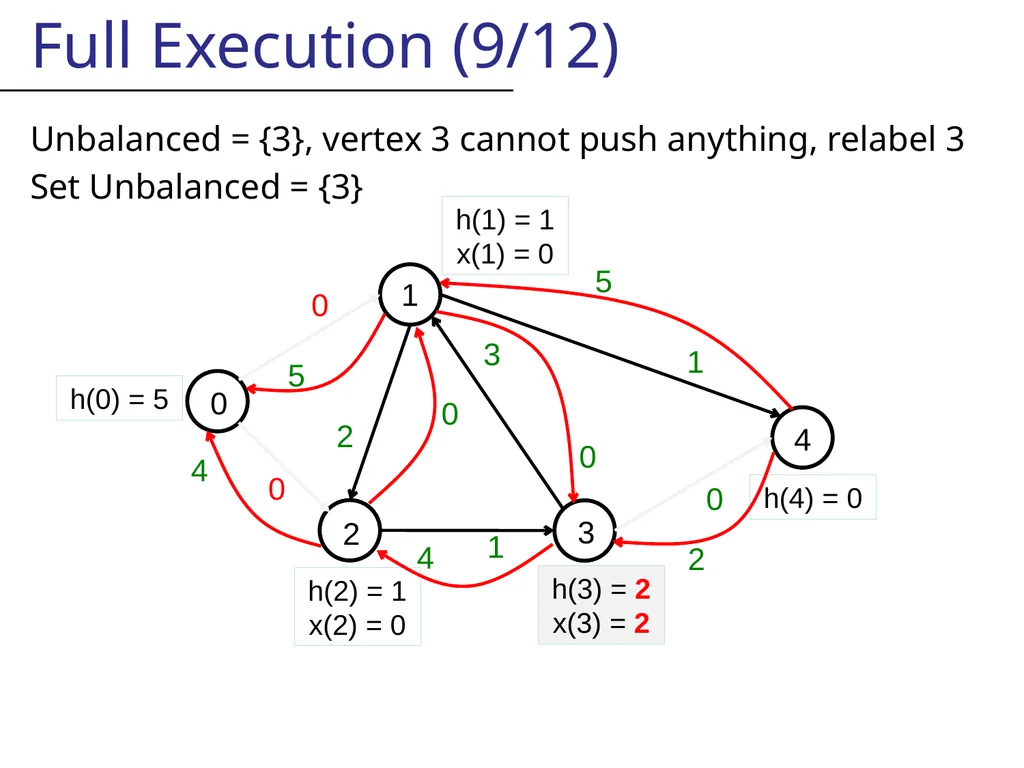
Unbalanced = {3}, vertex 3 cannot push anything, relabel 3
Set Unbalanced = {3} Full Execution (9/12) 0 1 3 1 h(3) = 2
x(3) = 2 h(2) = 1 x(2) = 0 2 0 0 h(4) = 0 h(0) = 5 h(1) = 1
x(1) = 0 5 4 5 0 2 4 0<br>
Set Unbalanced = {3} Full Execution (9/12) 0 1 3 1 h(3) = 2
x(3) = 2 h(2) = 1 x(2) = 0 2 0 0 h(4) = 0 h(0) = 5 h(1) = 1
x(1) = 0 5 4 5 0 2 4 0<br>
28
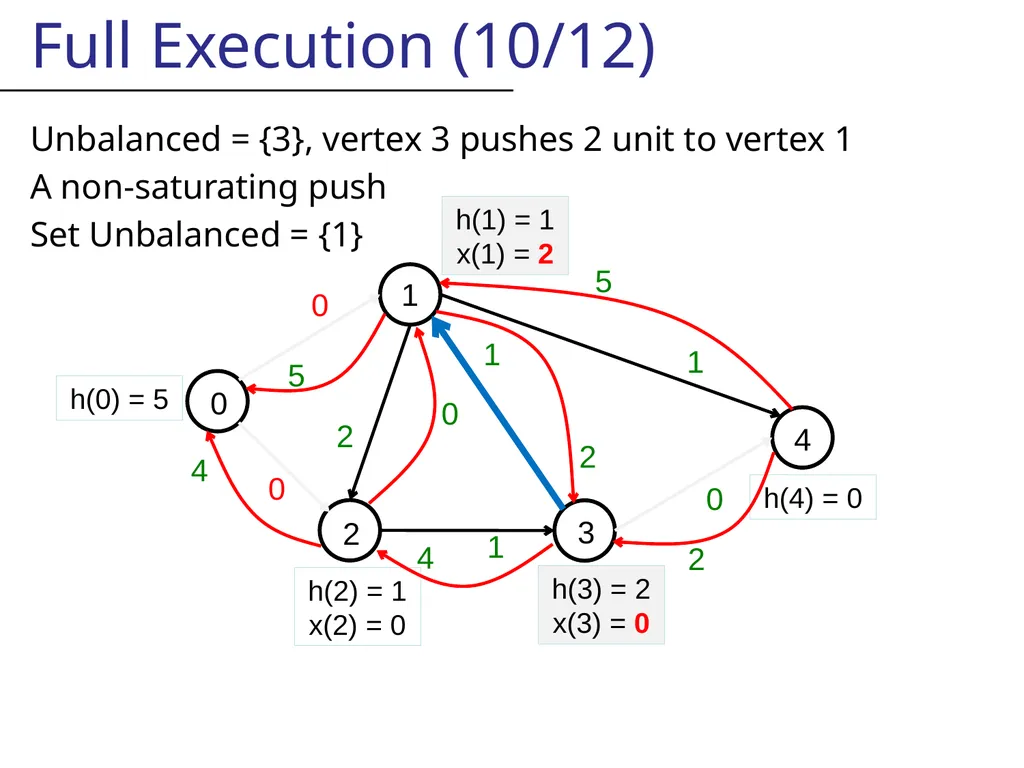
Unbalanced = {3}, vertex 3 pushes 2 unit to vertex 1
A non-saturating push
Set Unbalanced = {1} Full Execution (10/12) 0 1 1 1 h(3) = 2
x(3) = 0 h(2) = 1 x(2) = 0 2 0 0 h(4) = 0 h(0) = 5 h(1) = 1
x(1) = 2 5 4 5 0 2 4 2<br>
A non-saturating push
Set Unbalanced = {1} Full Execution (10/12) 0 1 1 1 h(3) = 2
x(3) = 0 h(2) = 1 x(2) = 0 2 0 0 h(4) = 0 h(0) = 5 h(1) = 1
x(1) = 2 5 4 5 0 2 4 2<br>
29
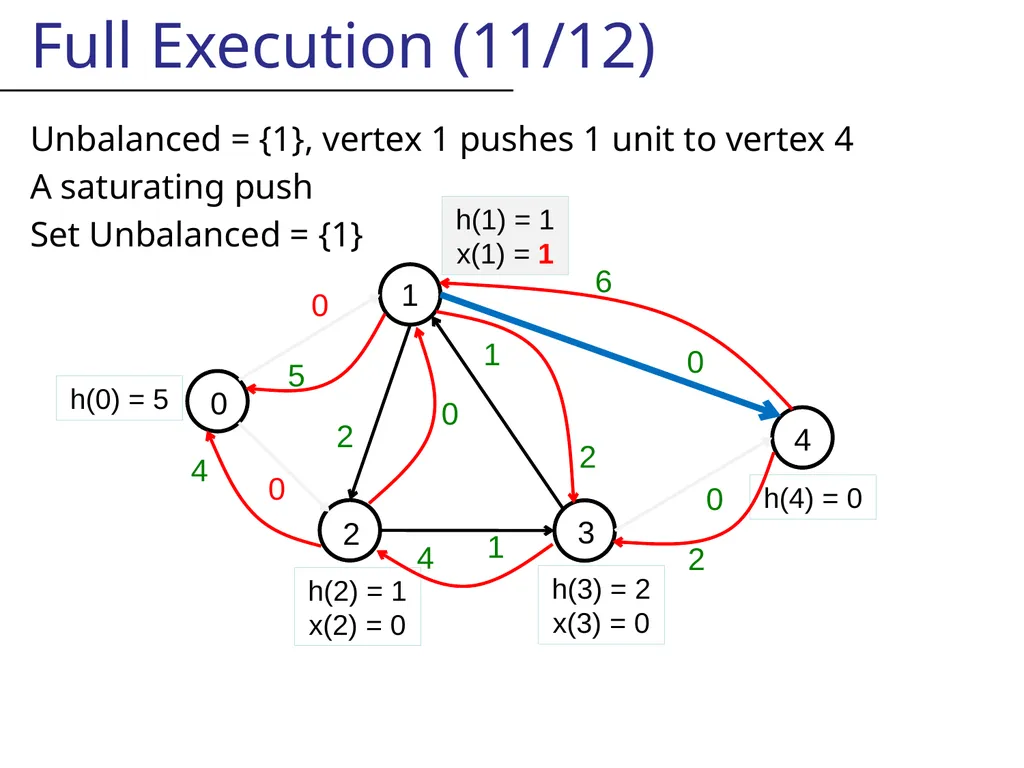
Unbalanced = {1}, vertex 1 pushes 1 unit to vertex 4
A saturating push
Set Unbalanced = {1} Full Execution (11/12) 0 0 1 1 h(3) = 2
x(3) = 0 h(2) = 1 x(2) = 0 2 0 0 h(4) = 0 h(0) = 5 h(1) = 1
x(1) = 1 5 4 6 0 2 4 2<br>
A saturating push
Set Unbalanced = {1} Full Execution (11/12) 0 0 1 1 h(3) = 2
x(3) = 0 h(2) = 1 x(2) = 0 2 0 0 h(4) = 0 h(0) = 5 h(1) = 1
x(1) = 1 5 4 6 0 2 4 2<br>
30
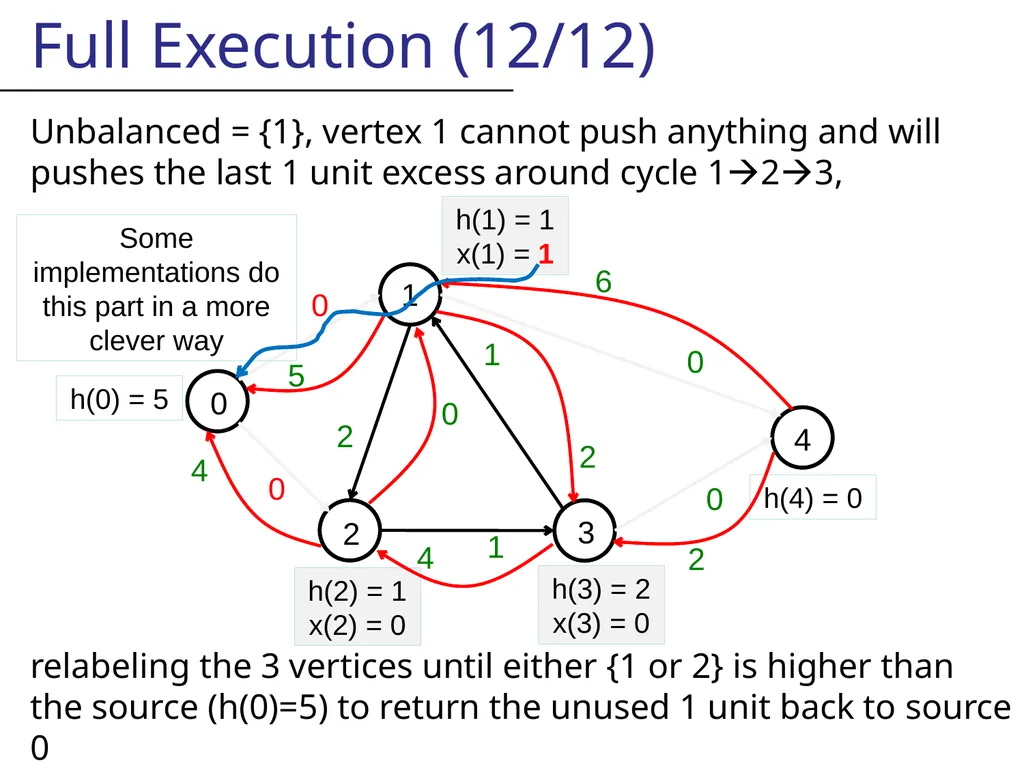
Unbalanced = {1}, vertex 1 cannot push anything and will pushes the last 1 unit excess around cycle 123,
relabeling the 3 vertices until either {1 or 2} is higher than the source (h(0)=5) to return the unused 1 unit back to source 0 Full Execution (12/12) 0 0 1 1 h(3) = 2
x(3) = 0 h(2) = 1 x(2) = 0 2 0 0 h(4) = 0 h(0) = 5 h(1) = 1
x(1) = 1 5 4 6 0 2 4 2 Some implementations do this part in a more clever way<br>
relabeling the 3 vertices until either {1 or 2} is higher than the source (h(0)=5) to return the unused 1 unit back to source 0 Full Execution (12/12) 0 0 1 1 h(3) = 2
x(3) = 0 h(2) = 1 x(2) = 0 2 0 0 h(4) = 0 h(0) = 5 h(1) = 1
x(1) = 1 5 4 6 0 2 4 2 Some implementations do this part in a more clever way<br>
31
Push-Relabel Algorithm
Recap about Ford-Fulkerson and its variations…
Introducing Push-Relabel Algorithm
Analysis of Push-Relabel Algorithm: O(n2 m)
Implementation note Roadmap<br>
Recap about Ford-Fulkerson and its variations…
Introducing Push-Relabel Algorithm
Analysis of Push-Relabel Algorithm: O(n2 m)
Implementation note Roadmap<br>
32
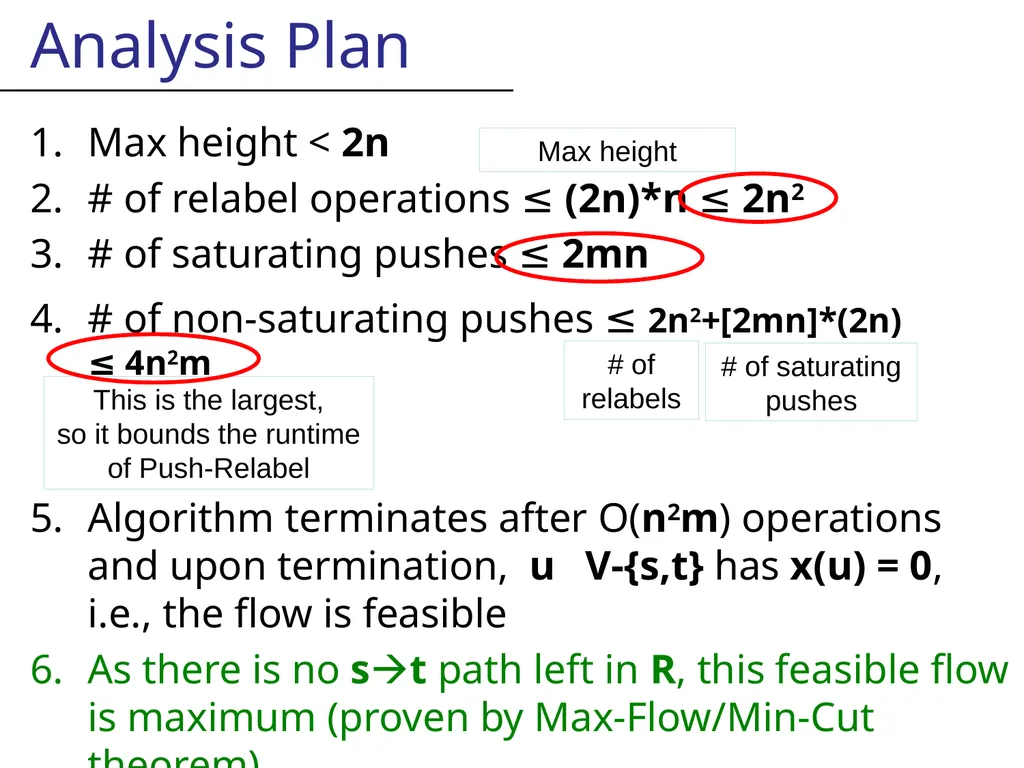
Max height < 2n
# of relabel operations ≤ (2n)*n ≤ 2n2
# of saturating pushes ≤ 2mn
# of non-saturating pushes ≤ 2n2+[2mn]*(2n) ≤ 4n2m
Algorithm terminates after O(n2m) operations and upon termination, u V-{s,t} has x(u) = 0, i.e., the flow is feasible
As there is no st path left in R, this feasible flow is maximum (proven by Max-Flow/Min-Cut theorem) Analysis Plan Max height # of relabels # of saturating pushes This is the largest, so it bounds the runtime of Push-Relabel<br>
# of relabel operations ≤ (2n)*n ≤ 2n2
# of saturating pushes ≤ 2mn
# of non-saturating pushes ≤ 2n2+[2mn]*(2n) ≤ 4n2m
Algorithm terminates after O(n2m) operations and upon termination, u V-{s,t} has x(u) = 0, i.e., the flow is feasible
As there is no st path left in R, this feasible flow is maximum (proven by Max-Flow/Min-Cut theorem) Analysis Plan Max height # of relabels # of saturating pushes This is the largest, so it bounds the runtime of Push-Relabel<br>
33
Lemma: If vertex i has excess flow, then there is a path from i to source s in residual network R
This is clearly logical: How else can vertex i get excess flow except from s? But let’s prove it…
Let set A be the set of vertices that can reach back the source vertex s on R
We will show that vertex i that has excess A
That is, as i is an arbitrary vertex in R, the proof will show that all vertices with excess flow are in set A A1: Max height < 2n<br>
This is clearly logical: How else can vertex i get excess flow except from s? But let’s prove it…
Let set A be the set of vertices that can reach back the source vertex s on R
We will show that vertex i that has excess A
That is, as i is an arbitrary vertex in R, the proof will show that all vertices with excess flow are in set A A1: Max height < 2n<br>
34
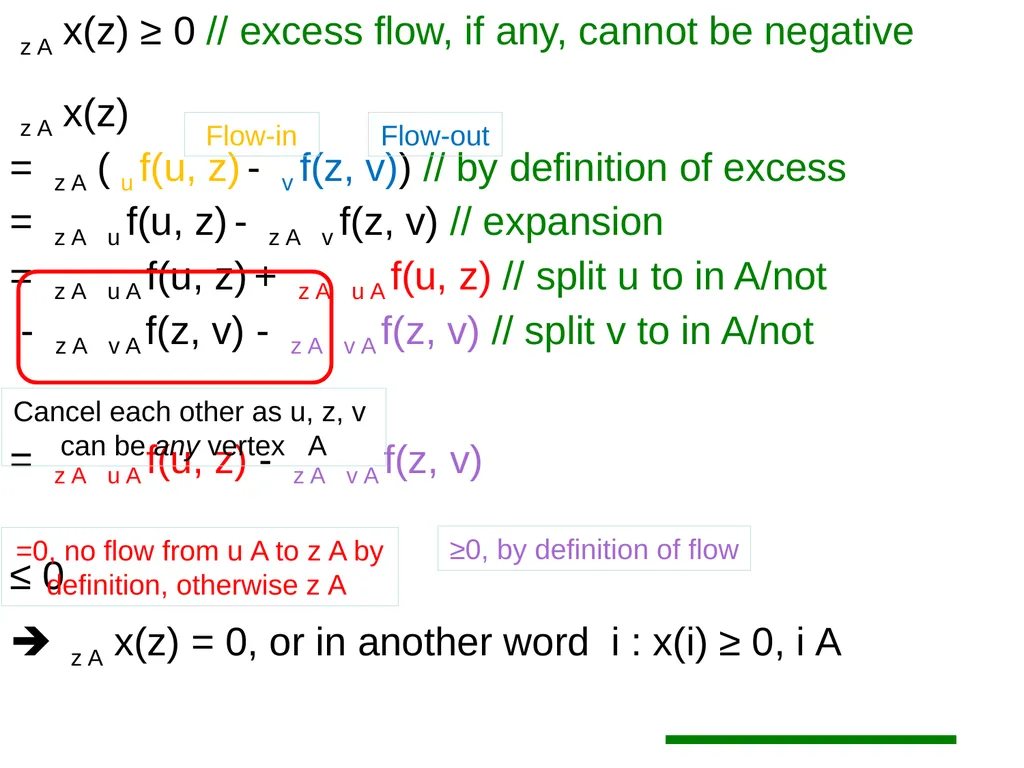
zA x(z) ≥ 0 // excess flow, if any, cannot be negative
zA x(z)
= zA (u f(u, z) - v f(z, v)) // by definition of excess
= zA u f(u, z) - zA v f(z, v) // expansion
= zA uA f(u, z) + zA uA f(u, z) // split u to in A/not
- zA vA f(z, v) - zA vA f(z, v) // split v to in A/not
= zA uA f(u, z) - zA vA f(z, v)
≤ 0
zA x(z) = 0, or in another word i : x(i) ≥ 0, iA Flow-in Flow-out Cancel each other as u, z, v can be any vertex A =0, no flow from uA to zA by definition, otherwise zA ≥0, by definition of flow<br>
zA x(z)
= zA (u f(u, z) - v f(z, v)) // by definition of excess
= zA u f(u, z) - zA v f(z, v) // expansion
= zA uA f(u, z) + zA uA f(u, z) // split u to in A/not
- zA vA f(z, v) - zA vA f(z, v) // split v to in A/not
= zA uA f(u, z) - zA vA f(z, v)
≤ 0
zA x(z) = 0, or in another word i : x(i) ≥ 0, iA Flow-in Flow-out Cancel each other as u, z, v can be any vertex A =0, no flow from uA to zA by definition, otherwise zA ≥0, by definition of flow<br>
35
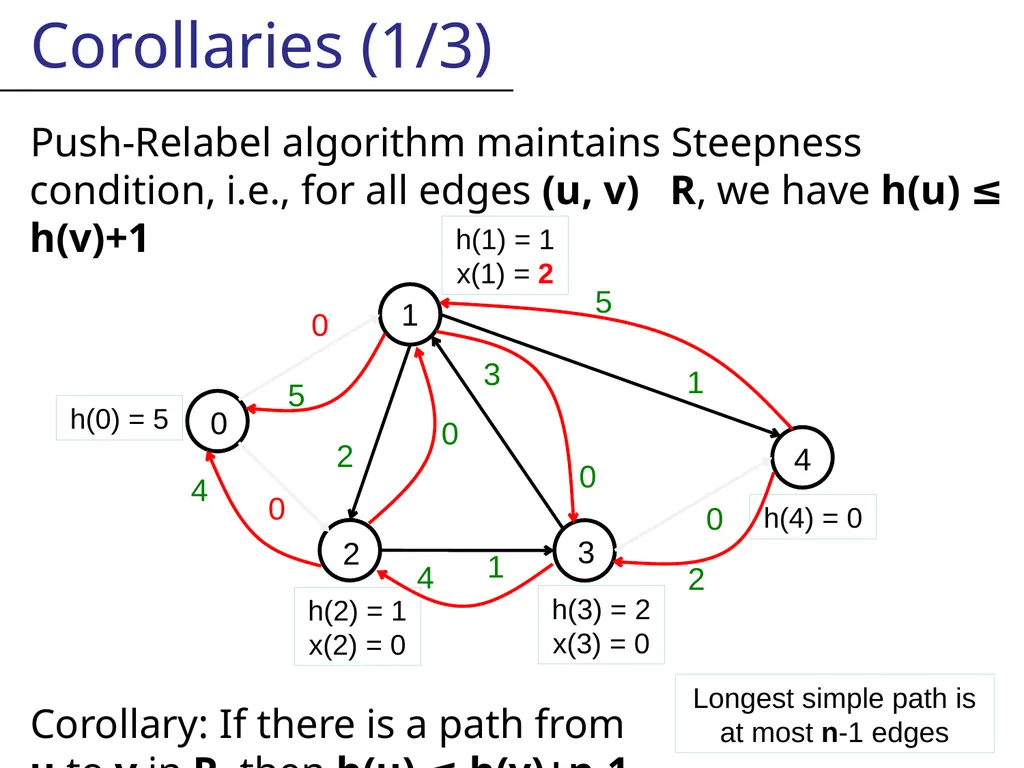
Push-Relabel algorithm maintains Steepness condition, i.e., for all edges (u, v) R, we have h(u) ≤ h(v)+1
Corollary: If there is a path from u to v in R, then h(u) ≤ h(v)+n-1 Corollaries (1/3) Longest simple path is at most n-1 edges 0 1 3 1 h(3) = 2
x(3) = 0 h(2) = 1 x(2) = 0 2 0 0 h(4) = 0 h(0) = 5 h(1) = 1
x(1) = 2 5 4 5 0 2 4 0<br>
Corollary: If there is a path from u to v in R, then h(u) ≤ h(v)+n-1 Corollaries (1/3) Longest simple path is at most n-1 edges 0 1 3 1 h(3) = 2
x(3) = 0 h(2) = 1 x(2) = 0 2 0 0 h(4) = 0 h(0) = 5 h(1) = 1
x(1) = 2 5 4 5 0 2 4 0<br>
36
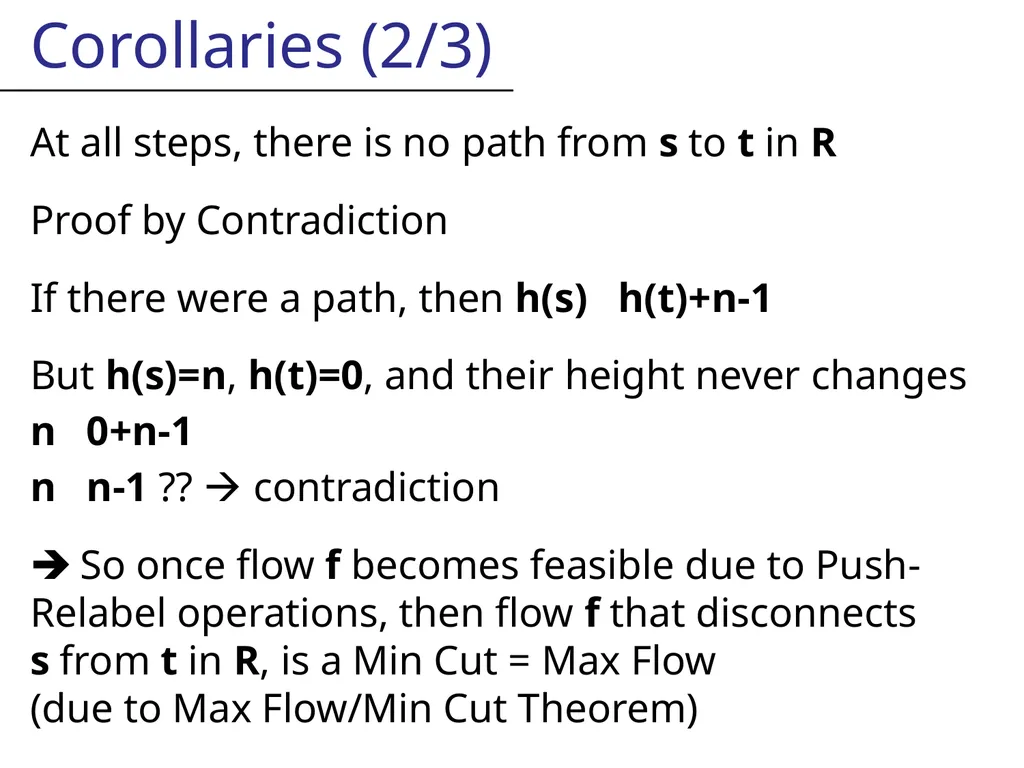
At all steps, there is no path from s to t in R
Proof by Contradiction
If there were a path, then h(s) h(t)+n-1
But h(s)=n, h(t)=0, and their height never changes
n 0+n-1
n n-1 ?? contradiction
So once flow f becomes feasible due to Push-Relabel operations, then flow f that disconnects s from t in R, is a Min Cut = Max Flow (due to Max Flow/Min Cut Theorem) Corollaries (2/3)<br>
Proof by Contradiction
If there were a path, then h(s) h(t)+n-1
But h(s)=n, h(t)=0, and their height never changes
n 0+n-1
n n-1 ?? contradiction
So once flow f becomes feasible due to Push-Relabel operations, then flow f that disconnects s from t in R, is a Min Cut = Max Flow (due to Max Flow/Min Cut Theorem) Corollaries (2/3)<br>
37
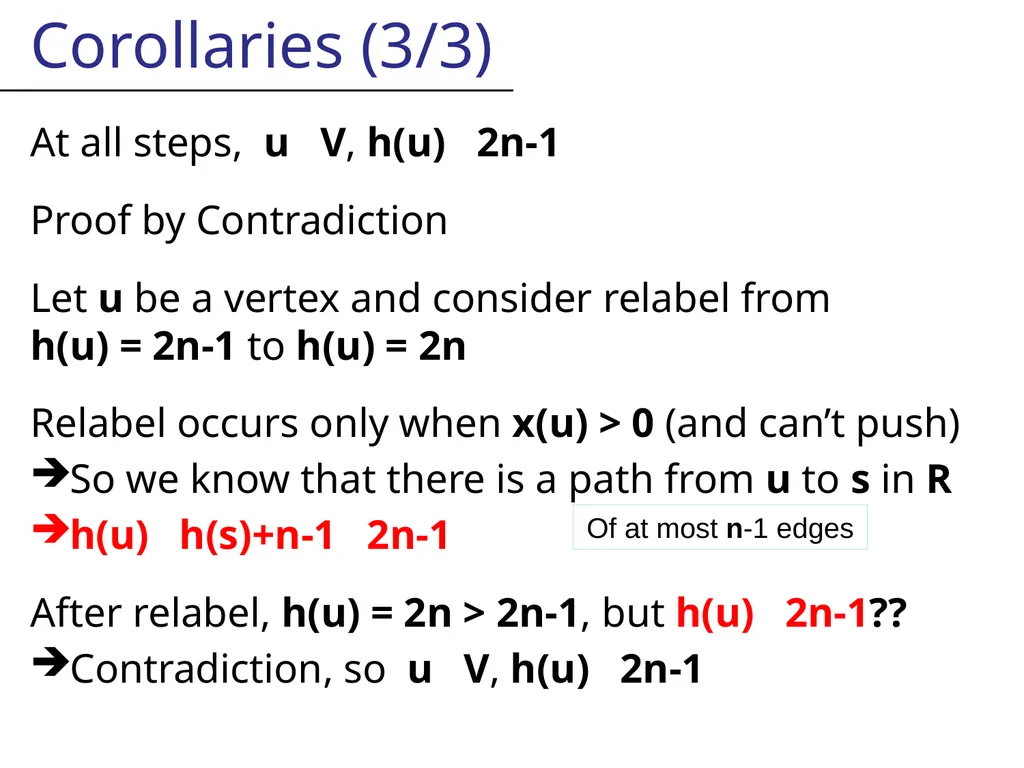
At all steps, u V, h(u) 2n-1
Proof by Contradiction
Let u be a vertex and consider relabel from h(u) = 2n-1 to h(u) = 2n
Relabel occurs only when x(u) > 0 (and can’t push)
So we know that there is a path from u to s in R
h(u) h(s)+n-1 2n-1
After relabel, h(u) = 2n > 2n-1, but h(u) 2n-1??
Contradiction, so u V, h(u) 2n-1 Corollaries (3/3) Of at most n-1 edges<br>
Proof by Contradiction
Let u be a vertex and consider relabel from h(u) = 2n-1 to h(u) = 2n
Relabel occurs only when x(u) > 0 (and can’t push)
So we know that there is a path from u to s in R
h(u) h(s)+n-1 2n-1
After relabel, h(u) = 2n > 2n-1, but h(u) 2n-1??
Contradiction, so u V, h(u) 2n-1 Corollaries (3/3) Of at most n-1 edges<br>
38
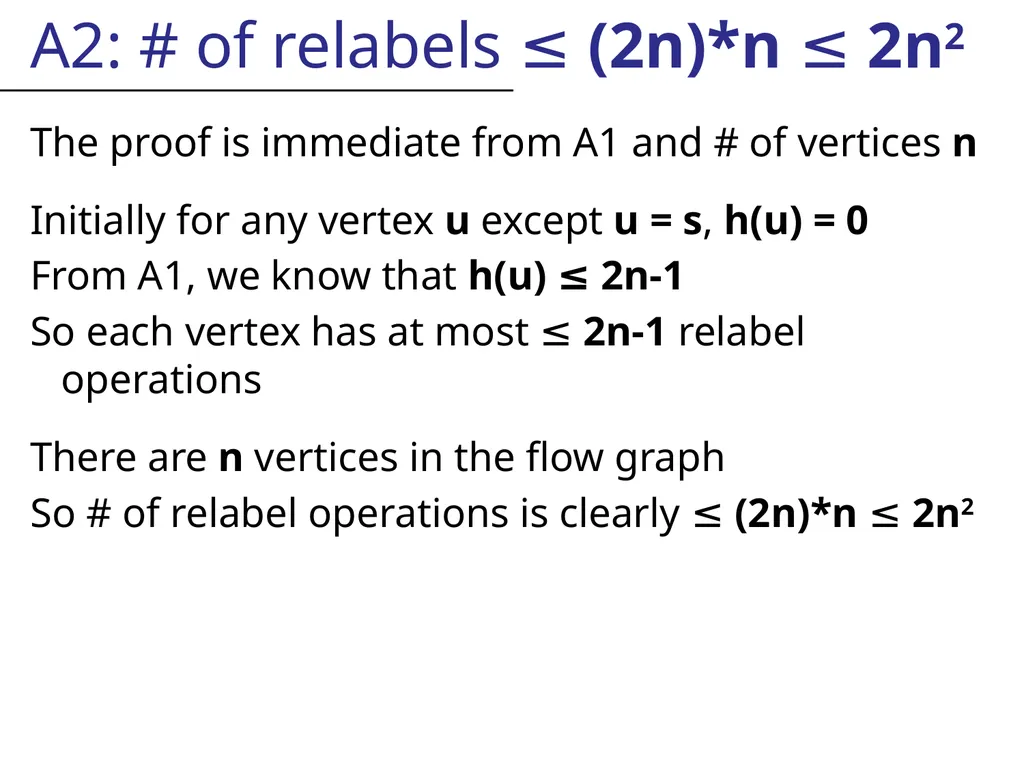
The proof is immediate from A1 and # of vertices n
Initially for any vertex u except u = s, h(u) = 0
From A1, we know that h(u) ≤ 2n-1
So each vertex has at most ≤ 2n-1 relabel operations
There are n vertices in the flow graph
So # of relabel operations is clearly ≤ (2n)*n ≤ 2n2 A2: # of relabels ≤ (2n)*n ≤ 2n2<br>
Initially for any vertex u except u = s, h(u) = 0
From A1, we know that h(u) ≤ 2n-1
So each vertex has at most ≤ 2n-1 relabel operations
There are n vertices in the flow graph
So # of relabel operations is clearly ≤ (2n)*n ≤ 2n2 A2: # of relabels ≤ (2n)*n ≤ 2n2<br>
39
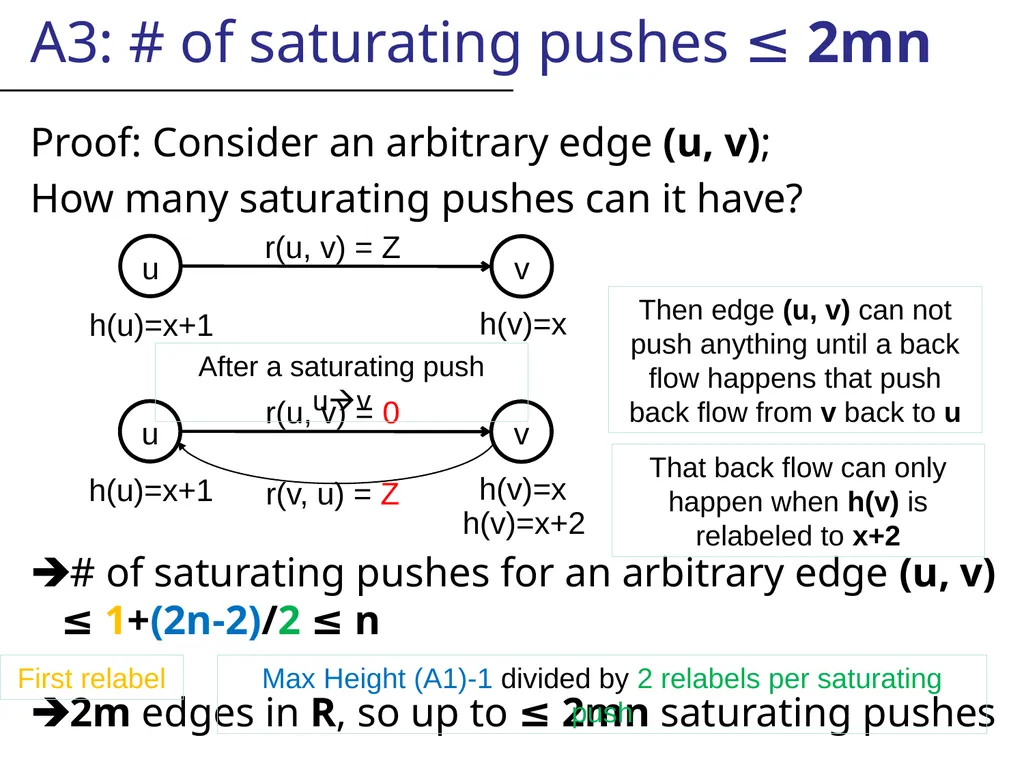
Proof: Consider an arbitrary edge (u, v);
How many saturating pushes can it have?
# of saturating pushes for an arbitrary edge (u, v) ≤ 1+(2n-2)/2 ≤ n
2m edges in R, so up to ≤ 2mn saturating pushes A3: # of saturating pushes ≤ 2mn h(v)=x h(u)=x+1 r(u, v) = Z h(v)=x h(u)=x+1 r(u, v) = 0 After a saturating push uv Then edge (u, v) can not push anything until a back flow happens that push back flow from v back to u r(v, u) = Z That back flow can only happen when h(v) is relabeled to x+2 h(v)=x+2 First relabel Max Height (A1)-1 divided by 2 relabels per saturating push<br>
How many saturating pushes can it have?
# of saturating pushes for an arbitrary edge (u, v) ≤ 1+(2n-2)/2 ≤ n
2m edges in R, so up to ≤ 2mn saturating pushes A3: # of saturating pushes ≤ 2mn h(v)=x h(u)=x+1 r(u, v) = Z h(v)=x h(u)=x+1 r(u, v) = 0 After a saturating push uv Then edge (u, v) can not push anything until a back flow happens that push back flow from v back to u r(v, u) = Z That back flow can only happen when h(v) is relabeled to x+2 h(v)=x+2 First relabel Max Height (A1)-1 divided by 2 relabels per saturating push<br>
40
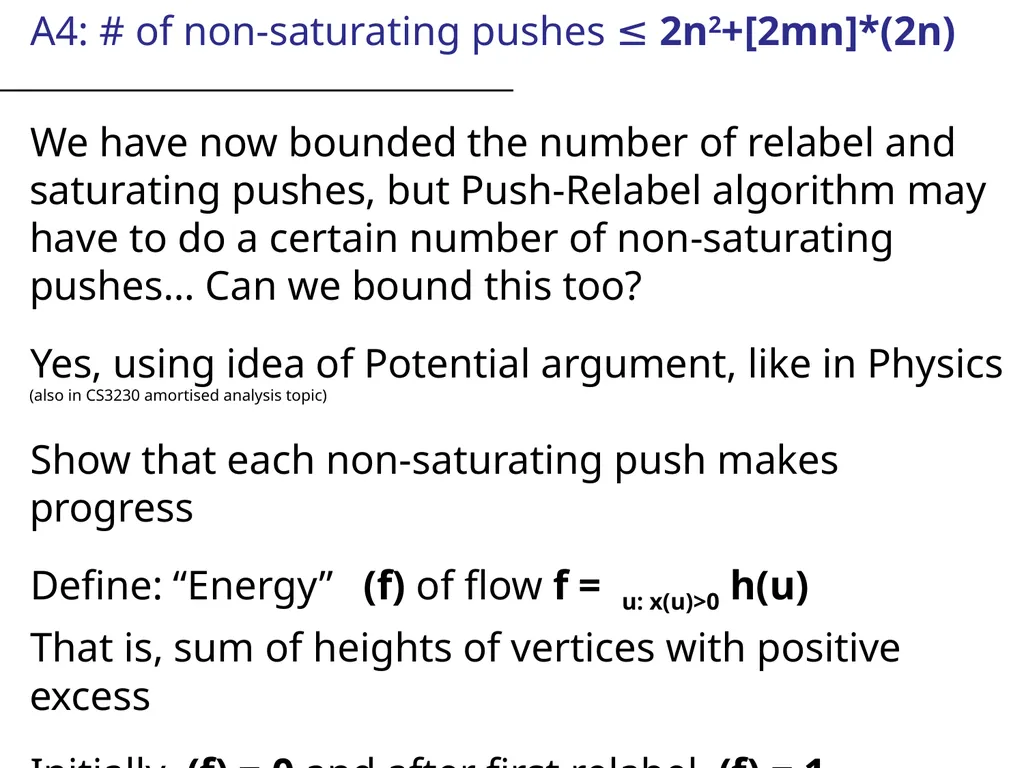
We have now bounded the number of relabel and saturating pushes, but Push-Relabel algorithm may have to do a certain number of non-saturating pushes… Can we bound this too?
Yes, using idea of Potential argument, like in Physics (also in CS3230 amortised analysis topic)
Show that each non-saturating push makes progress
Define: “Energy” (f) of flow f = u: x(u)>0 h(u)
That is, sum of heights of vertices with positive excess
Initially (f) = 0 and after first relabel (f) = 1
But at all times (f) ≥ 0 A4: # of non-saturating pushes ≤ 2n2+[2mn]*(2n)<br>
Yes, using idea of Potential argument, like in Physics (also in CS3230 amortised analysis topic)
Show that each non-saturating push makes progress
Define: “Energy” (f) of flow f = u: x(u)>0 h(u)
That is, sum of heights of vertices with positive excess
Initially (f) = 0 and after first relabel (f) = 1
But at all times (f) ≥ 0 A4: # of non-saturating pushes ≤ 2n2+[2mn]*(2n)<br>
41
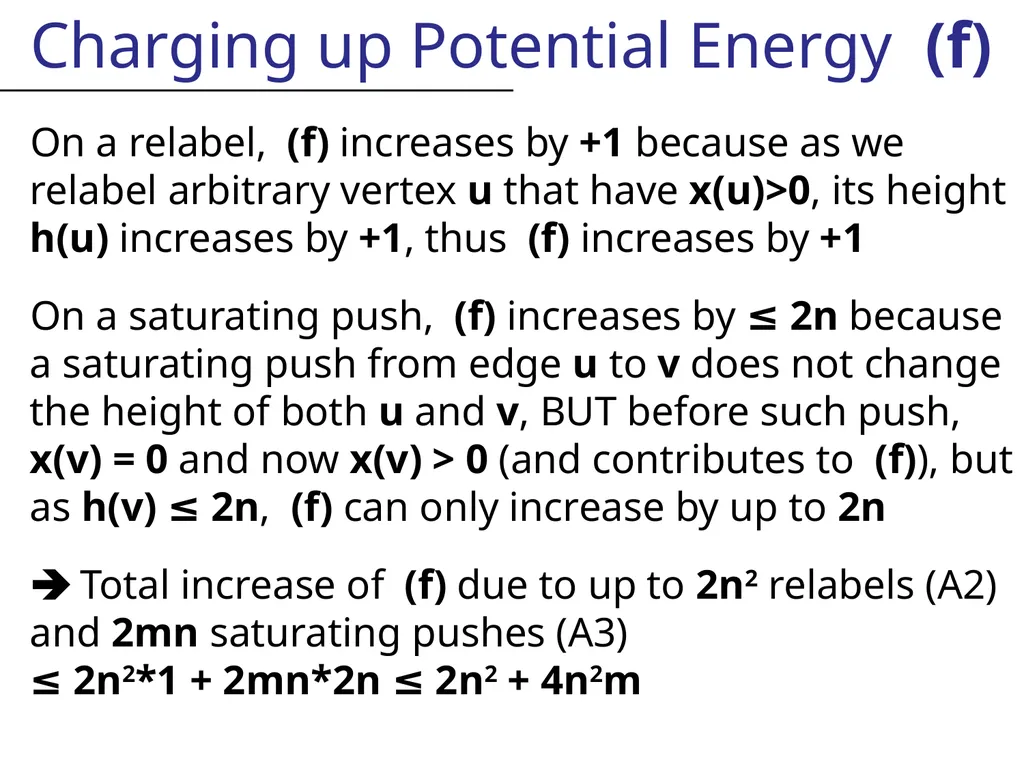
On a relabel, (f) increases by +1 because as we relabel arbitrary vertex u that have x(u)>0, its height h(u) increases by +1, thus (f) increases by +1
On a saturating push, (f) increases by ≤ 2n because a saturating push from edge u to v does not change the height of both u and v, BUT before such push, x(v) = 0 and now x(v) > 0 (and contributes to (f)), but as h(v) ≤ 2n, (f) can only increase by up to 2n
Total increase of (f) due to up to 2n2 relabels (A2) and 2mn saturating pushes (A3) ≤ 2n2*1 + 2mn*2n ≤ 2n2 + 4n2m Charging up Potential Energy (f)<br>
On a saturating push, (f) increases by ≤ 2n because a saturating push from edge u to v does not change the height of both u and v, BUT before such push, x(v) = 0 and now x(v) > 0 (and contributes to (f)), but as h(v) ≤ 2n, (f) can only increase by up to 2n
Total increase of (f) due to up to 2n2 relabels (A2) and 2mn saturating pushes (A3) ≤ 2n2*1 + 2mn*2n ≤ 2n2 + 4n2m Charging up Potential Energy (f)<br>
42
On non-saturating push from u to v, we have:
Before:
x(u) > 0 // thus we need to push
x(u) < r(u, v) // as it is non-saturating
h(u) > h(v) // that’s why we can push
After:
x(u) = 0 // vertex u is 'relieved'…
x(v) > 0 // vertex v gets the excess
r(u, v) > 0 // remember, this is non-saturating
h(u) > h(v) // nothing changes here Discharging Potential Energy (f)<br>
Before:
x(u) > 0 // thus we need to push
x(u) < r(u, v) // as it is non-saturating
h(u) > h(v) // that’s why we can push
After:
x(u) = 0 // vertex u is 'relieved'…
x(v) > 0 // vertex v gets the excess
r(u, v) > 0 // remember, this is non-saturating
h(u) > h(v) // nothing changes here Discharging Potential Energy (f)<br>
43
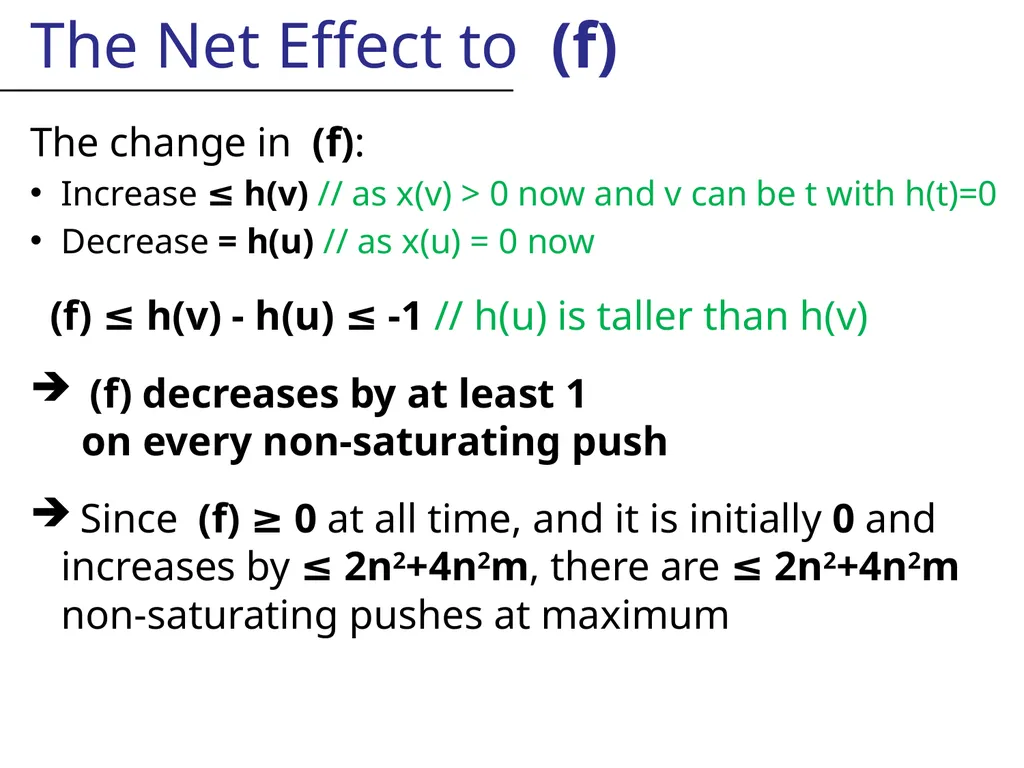
The change in (f):
Increase ≤ h(v) // as x(v) > 0 now and v can be t with h(t)=0
Decrease = h(u) // as x(u) = 0 now
(f) ≤ h(v) - h(u) ≤ -1 // h(u) is taller than h(v)
(f) decreases by at least 1 on every non-saturating push
Since (f) ≥ 0 at all time, and it is initially 0 and increases by ≤ 2n2+4n2m, there are ≤ 2n2+4n2m non-saturating pushes at maximum The Net Effect to (f)<br>
Increase ≤ h(v) // as x(v) > 0 now and v can be t with h(t)=0
Decrease = h(u) // as x(u) = 0 now
(f) ≤ h(v) - h(u) ≤ -1 // h(u) is taller than h(v)
(f) decreases by at least 1 on every non-saturating push
Since (f) ≥ 0 at all time, and it is initially 0 and increases by ≤ 2n2+4n2m, there are ≤ 2n2+4n2m non-saturating pushes at maximum The Net Effect to (f)<br>
44
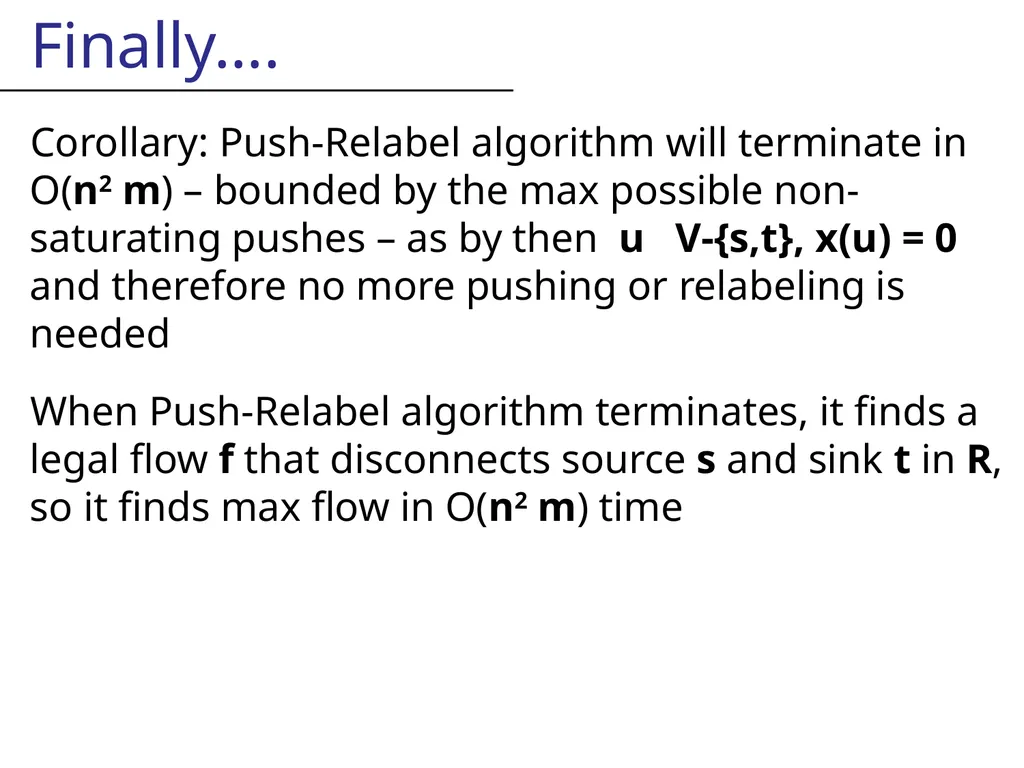
Corollary: Push-Relabel algorithm will terminate in
O(n2 m) – bounded by the max possible non-saturating pushes – as by then u V-{s,t}, x(u) = 0 and therefore no more pushing or relabeling is needed
When Push-Relabel algorithm terminates, it finds a legal flow f that disconnects source s and sink t in R, so it finds max flow in O(n2 m) time Finally….<br>
When Push-Relabel algorithm terminates, it finds a legal flow f that disconnects source s and sink t in R, so it finds max flow in O(n2 m) time Finally….<br>
45
Push-Relabel Algorithm
Recap about Ford-Fulkerson and its variations…
Introducing Push-Relabel Algorithm
Analysis of Push-Relabel Algorithm: O(n2 m)
Implementation note Roadmap<br>
Recap about Ford-Fulkerson and its variations…
Introducing Push-Relabel Algorithm
Analysis of Push-Relabel Algorithm: O(n2 m)
Implementation note Roadmap<br>
46
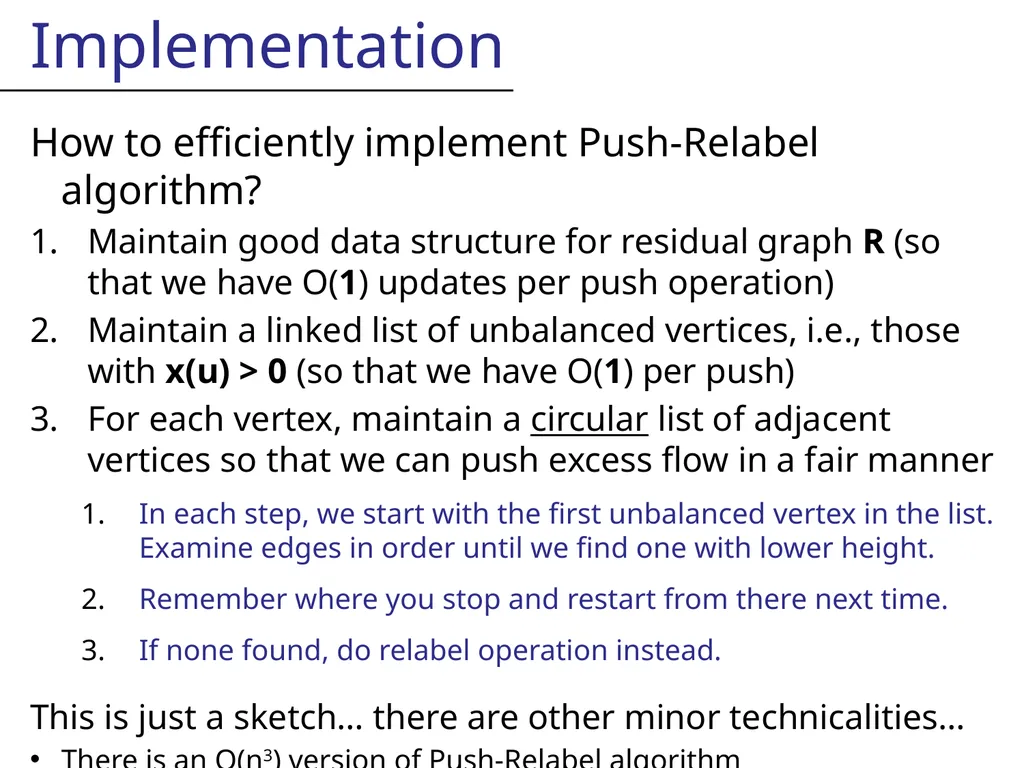
How to efficiently implement Push-Relabel algorithm?
Maintain good data structure for residual graph R (so that we have O(1) updates per push operation)
Maintain a linked list of unbalanced vertices, i.e., those with x(u) > 0 (so that we have O(1) per push)
For each vertex, maintain a circular list of adjacent vertices so that we can push excess flow in a fair manner
In each step, we start with the first unbalanced vertex in the list. Examine edges in order until we find one with lower height.
Remember where you stop and restart from there next time.
If none found, do relabel operation instead.
This is just a sketch… there are other minor technicalities…
There is an O(n3) version of Push-Relabel algorithm
https://en.wikipedia.org/wiki/Push%E2%80%93relabel_maximum_flow_algorithm#Active_node_selection_rules Implementation<br>
Maintain good data structure for residual graph R (so that we have O(1) updates per push operation)
Maintain a linked list of unbalanced vertices, i.e., those with x(u) > 0 (so that we have O(1) per push)
For each vertex, maintain a circular list of adjacent vertices so that we can push excess flow in a fair manner
In each step, we start with the first unbalanced vertex in the list. Examine edges in order until we find one with lower height.
Remember where you stop and restart from there next time.
If none found, do relabel operation instead.
This is just a sketch… there are other minor technicalities…
There is an O(n3) version of Push-Relabel algorithm
https://en.wikipedia.org/wiki/Push%E2%80%93relabel_maximum_flow_algorithm#Active_node_selection_rules Implementation<br>
47
See available sources in the Internet
e.g., refer to Stanford’s ICPC team for O(n3) Push-Relabel implementation
https://github.com/jaehyunp/stanfordacm/blob/master/code/PushRelabel.cc Sample Implementation<br>
e.g., refer to Stanford’s ICPC team for O(n3) Push-Relabel implementation
https://github.com/jaehyunp/stanfordacm/blob/master/code/PushRelabel.cc Sample Implementation<br>
48
Push-Relabel Algorithm
Recap about Ford-Fulkerson and its variations…
Introducing Push-Relabel Algorithm
Analysis of Push-Relabel Algorithm: O(n2 m)
Implementation note Roadmap/Summary All the best for your Final
PS: there will be some “simple” Push-Relabel questions as MCQs in the final<br>
Recap about Ford-Fulkerson and its variations…
Introducing Push-Relabel Algorithm
Analysis of Push-Relabel Algorithm: O(n2 m)
Implementation note Roadmap/Summary All the best for your Final
PS: there will be some “simple” Push-Relabel questions as MCQs in the final<br>