
LIVING BY CHEMISTRY SECOND EDITION Unit 1: ALCHEMY

Published  . 0 views
↓ Download
LIVING BY CHEMISTRY SECOND EDITION Unit 1: ALCHEMY
1 / 1
LIVING BY CHEMISTRY SECOND EDITION Unit 1: ALCHEMY - slide 1 of 10 LIVING BY CHEMISTRY SECOND EDITION Unit 1: ALCHEMY - slide 2 of 10 LIVING BY CHEMISTRY SECOND EDITION Unit 1: ALCHEMY - slide 3 of 10 LIVING BY CHEMISTRY SECOND EDITION Unit 1: ALCHEMY - slide 4 of 10 LIVING BY CHEMISTRY SECOND EDITION Unit 1: ALCHEMY - slide 5 of 10 LIVING BY CHEMISTRY SECOND EDITION Unit 1: ALCHEMY - slide 6 of 10 LIVING BY CHEMISTRY SECOND EDITION Unit 1: ALCHEMY - slide 7 of 10 LIVING BY CHEMISTRY SECOND EDITION Unit 1: ALCHEMY - slide 8 of 10 LIVING BY CHEMISTRY SECOND EDITION Unit 1: ALCHEMY - slide 9 of 10 LIVING BY CHEMISTRY SECOND EDITION Unit 1: ALCHEMY - slide 10 of 10
Description: LIVING BY CHEMISTRY SECOND EDITION Unit 1: ALCHEMY Matter, Atomic Structure, and Bonding Lesson 2: A Penny for Your Thoughts Introduction to Chemistry ChemCatalyst Long ago, early scientists tried to turn ordinary things into gold. This

Related Topics

Download Presentation

"LIVING BY CHEMISTRY SECOND EDITION Unit 1: ALCHEMY" is the property of its rightful owner. Permission is granted to download and print the materials on this website for personal, non-commercial use only, and to display it on your personal computer provided you do not modify the materials and that you retain all copyright notices contained in the materials. By downloading content from our website, you accept the terms of this agreement.

Presentation Transcript

slide1. LIVING BY CHEMISTRY SECOND EDITION Unit 1: ALCHEMY
Matter, Atomic Structure, and Bonding<br>
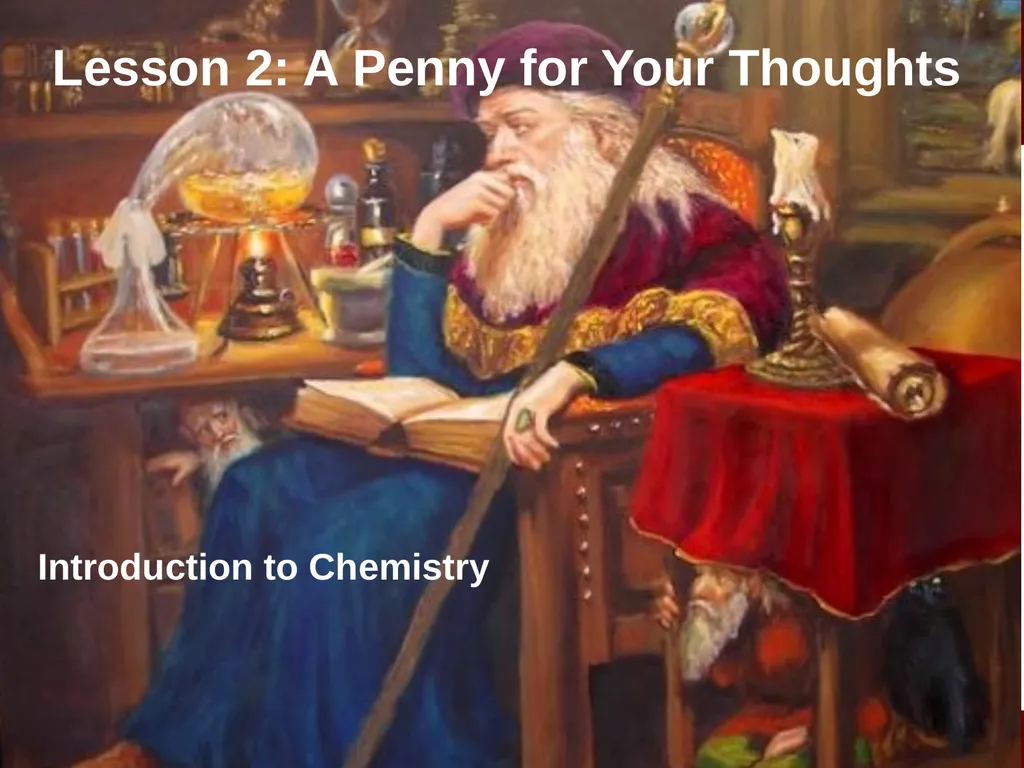
slide2. Lesson 2: A Penny for Your Thoughts Introduction to Chemistry<br>
slide3. ChemCatalyst Long ago, early scientists tried to turn ordinary things into gold. This pursuit was called alchemy, and the people who engaged in alchemy were called alchemists.
Do you think these early scientists were successful in turning things into gold? Explain your thinking.<br>
slide4. Key Question What is chemistry?<br>
slide5. You will be able to: observe a procedure and write observations.
define and formulate a hypothesis to explain observed phenomena.
define chemistry and begin to describe what chemists study.<br>
slide6. Prepare for the Demonstration In this demo, you will observe a chemical transformation firsthand.<br>
slide7. Discussion Notes (1 of 3) To determine whether the new penny is gold, you need to study its properties.
Property: A characteristic of a substance.
Physical Properties: color, hardness, size, weight
Chemical Properties: how a substance reacts<br>
slide8. Discussion Notes (2 of 3) Chemistry: The study of substances, their properties, and how they can be transformed. The study of matter and how matter can be changed.<br>
slide9. Discussion Notes (3 of 3) Scientists use a systematic approach to solve problems in science.
Hypothesis: A testable explanation for an observation.<br>
slide10. Wrap Up What is chemistry?
Chemistry is the study of what substances are made of, how they behave, and how they can be transformed. It is the study of matter and how matter can be changed.
A hypothesis is a testable explanation for an observation.
Scientists use a systematic approach to solving problems in science.<br>