Living Well Evaluation Greater Manchester Community Mental Health Board July 2022 Overview of the Living Well Evaluation January 2019 to May 2022. Three Living Well systems: Edinburgh Thrive and Welcome Teams, Salford Living Well, and
"Living Well Evaluation Greater Manchester" is the property of its rightful owner. Permission is granted to
download and print the materials on this website for personal, non-commercial use only, and to display it
on your personal computer provided you do not modify the materials and that you retain all copyright
notices contained in the materials. By downloading content from our website, you accept the terms of this
agreement.
Presentation Transcript
01
Living Well Evaluation Greater Manchester Community Mental Health Board July 2022<br>
02
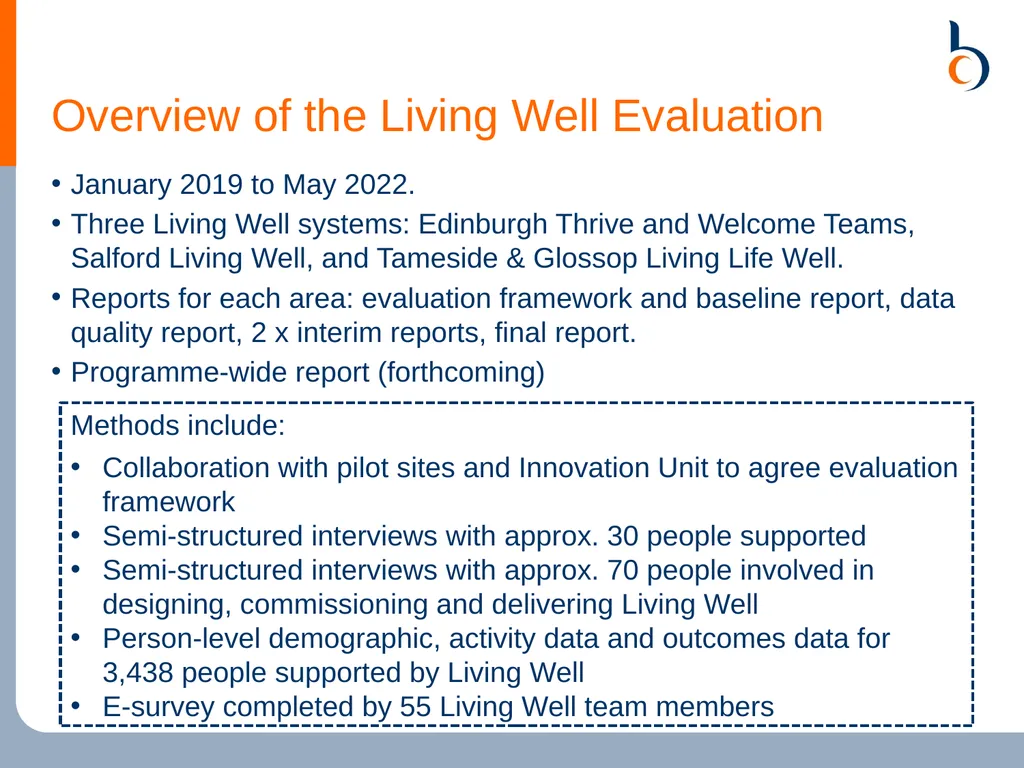
Overview of the Living Well Evaluation January 2019 to May 2022.
Three Living Well systems: Edinburgh Thrive and Welcome Teams, Salford Living Well, and Tameside & Glossop Living Life Well.
Reports for each area: evaluation framework and baseline report, data quality report, 2 x interim reports, final report.
Programme-wide report (forthcoming) Methods include:
Collaboration with pilot sites and Innovation Unit to agree evaluation framework
Semi-structured interviews with approx. 30 people supported
Semi-structured interviews with approx. 70 people involved in designing, commissioning and delivering Living Well
Person-level demographic, activity data and outcomes data for 3,438 people supported by Living Well
E-survey completed by 55 Living Well team members<br>
03
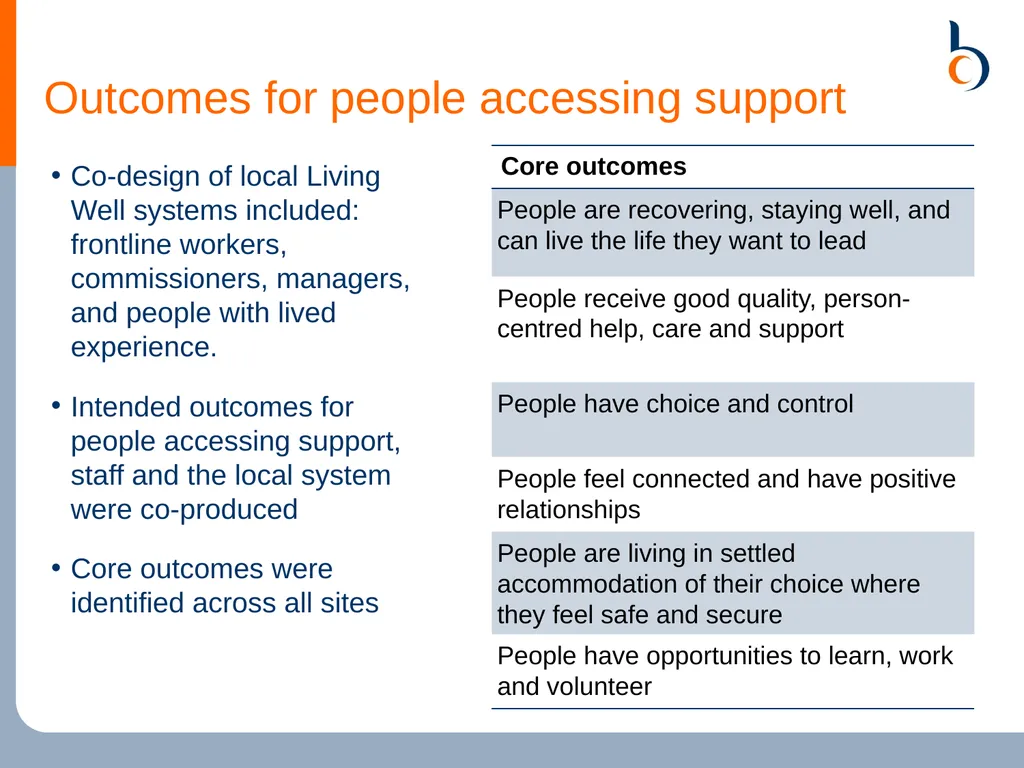
Outcomes for people accessing support Co-design of local Living Well systems included: frontline workers, commissioners, managers, and people with lived experience.
Intended outcomes for people accessing support, staff and the local system were co-produced
Core outcomes were identified across all sites<br>
04
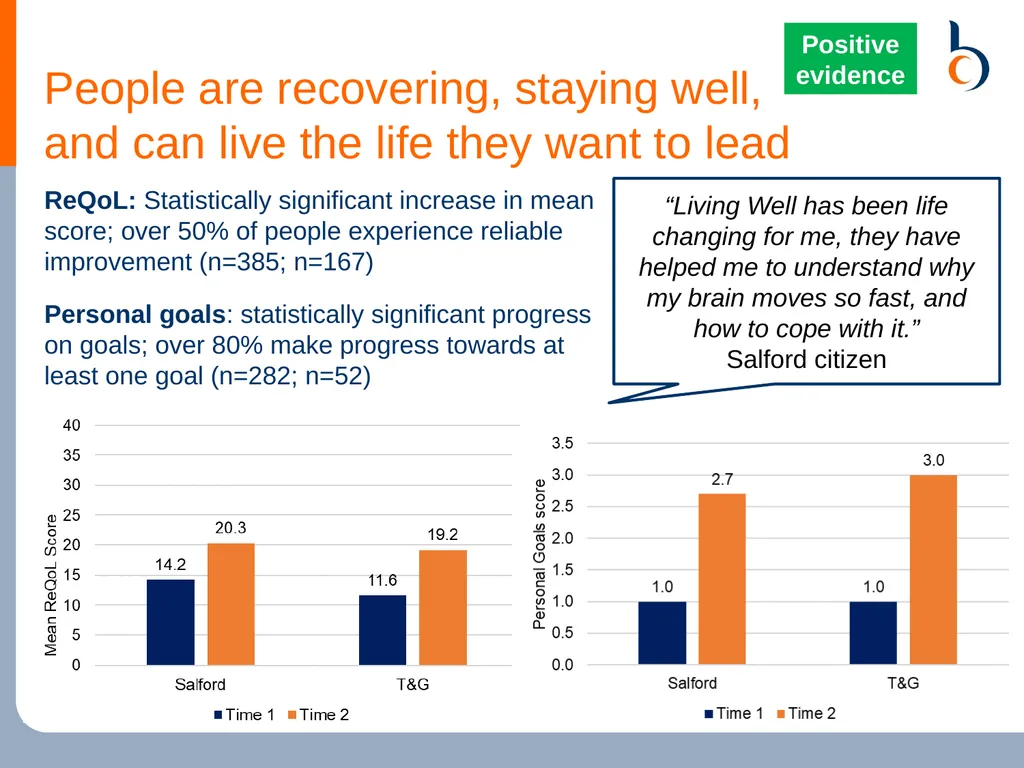
People are recovering, staying well, and can live the life they want to lead ReQoL: Statistically significant increase in mean score; over 50% of people experience reliable improvement (n=385; n=167)
Personal goals: statistically significant progress on goals; over 80% make progress towards at least one goal (n=282; n=52) “Living Well has been life changing for me, they have helped me to understand why my brain moves so fast, and how to cope with it.”
Salford citizen Positive evidence<br>
05
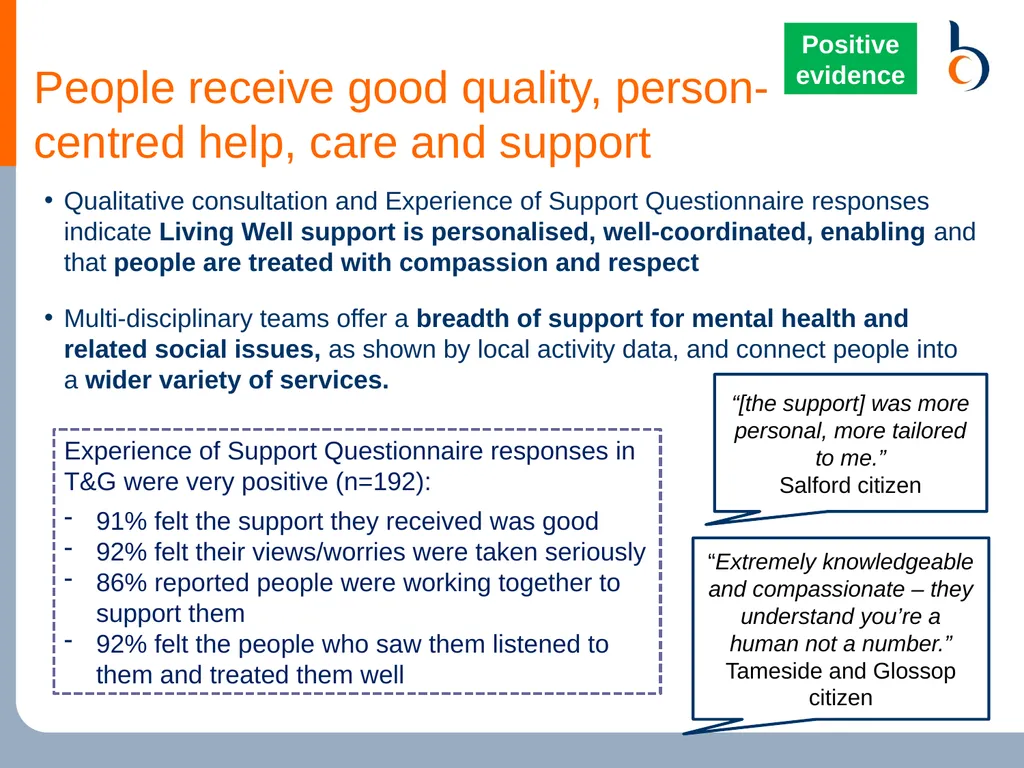
People receive good quality, person-centred help, care and support Qualitative consultation and Experience of Support Questionnaire responses indicate Living Well support is personalised, well-coordinated, enabling and that people are treated with compassion and respect
Multi-disciplinary teams offer a breadth of support for mental health and related social issues, as shown by local activity data, and connect people into a wider variety of services. “[the support] was more personal, more tailored to me.”
Salford citizen Experience of Support Questionnaire responses in T&G were very positive (n=192):
91% felt the support they received was good
92% felt their views/worries were taken seriously
86% reported people were working together to support them
92% felt the people who saw them listened to them and treated them well Positive evidence “Extremely knowledgeable and compassionate – they understand you’re a human not a number.” Tameside and Glossop citizen<br>
06
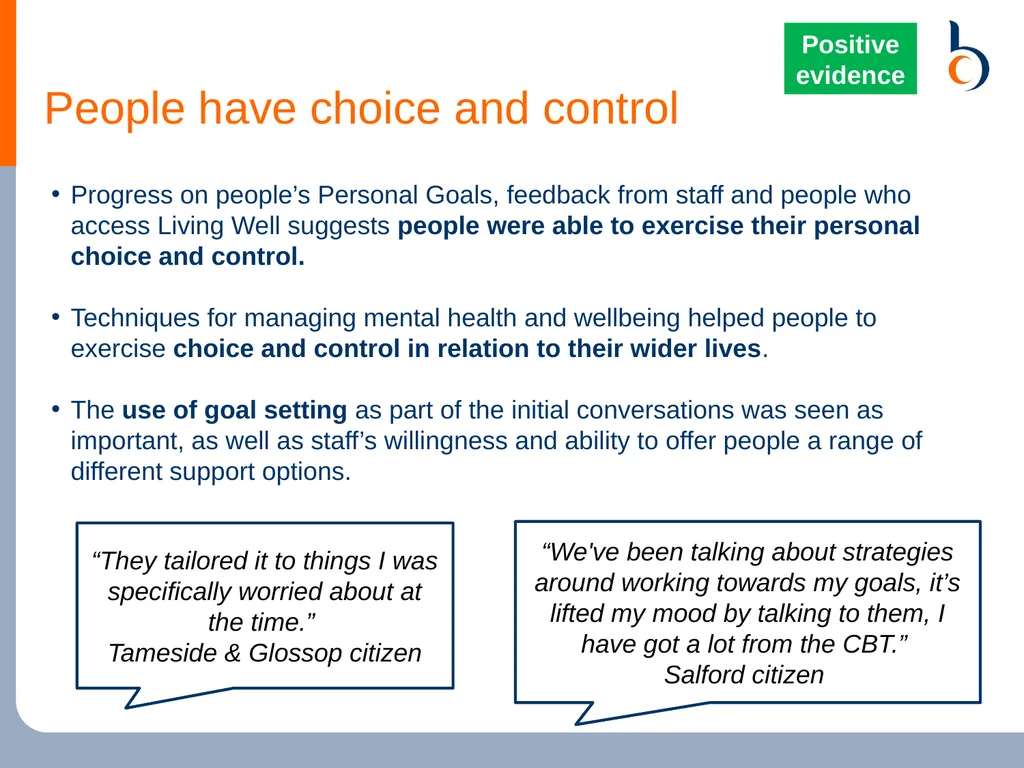
People have choice and control Progress on people’s Personal Goals, feedback from staff and people who access Living Well suggests people were able to exercise their personal choice and control.
Techniques for managing mental health and wellbeing helped people to exercise choice and control in relation to their wider lives.
The use of goal setting as part of the initial conversations was seen as important, as well as staff’s willingness and ability to offer people a range of different support options. “They tailored it to things I was specifically worried about at the time.”
Tameside & Glossop citizen “We've been talking about strategies around working towards my goals, it’s lifted my mood by talking to them, I have got a lot from the CBT.”
Salford citizen Positive evidence<br>
07
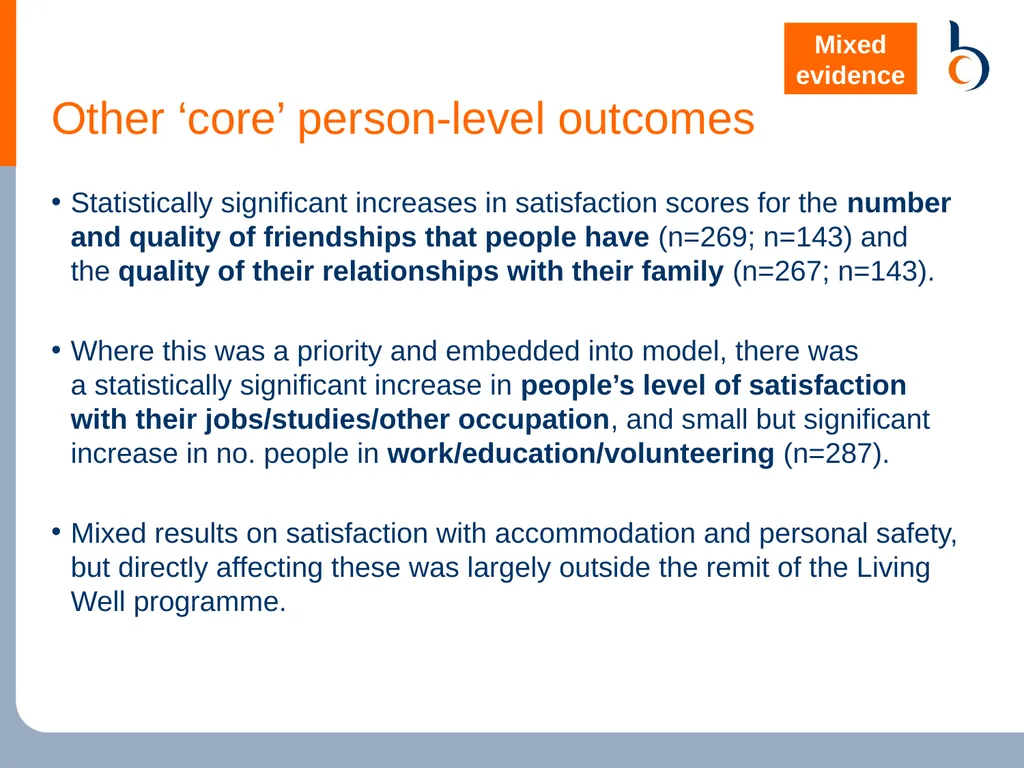
Other ‘core’ person-level outcomes Mixed evidence Statistically significant increases in satisfaction scores for the number and quality of friendships that people have (n=269; n=143) and the quality of their relationships with their family (n=267; n=143).
Where this was a priority and embedded into model, there was a statistically significant increase in people’s level of satisfaction with their jobs/studies/other occupation, and small but significant increase in no. people in work/education/volunteering (n=287).
Mixed results on satisfaction with accommodation and personal safety, but directly affecting these was largely outside the remit of the Living Well programme.<br>
08
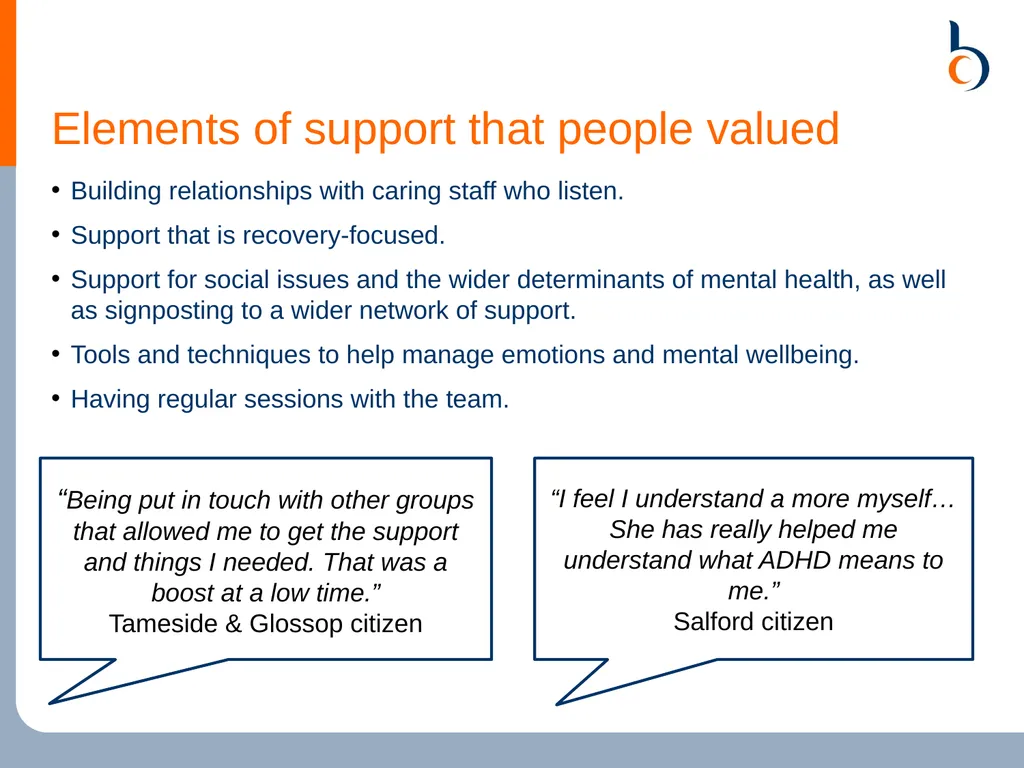
Elements of support that people valued Building relationships with caring staff who listen.
Support that is recovery-focused.
Support for social issues and the wider determinants of mental health, as well as signposting to a wider network of support.
Tools and techniques to help manage emotions and mental wellbeing.
Having regular sessions with the team. “Being put in touch with other groups that allowed me to get the support and things I needed. That was a boost at a low time.”
Tameside & Glossop citizen “I feel I understand a more myself… She has really helped me understand what ADHD means to me.”
Salford citizen<br>
09
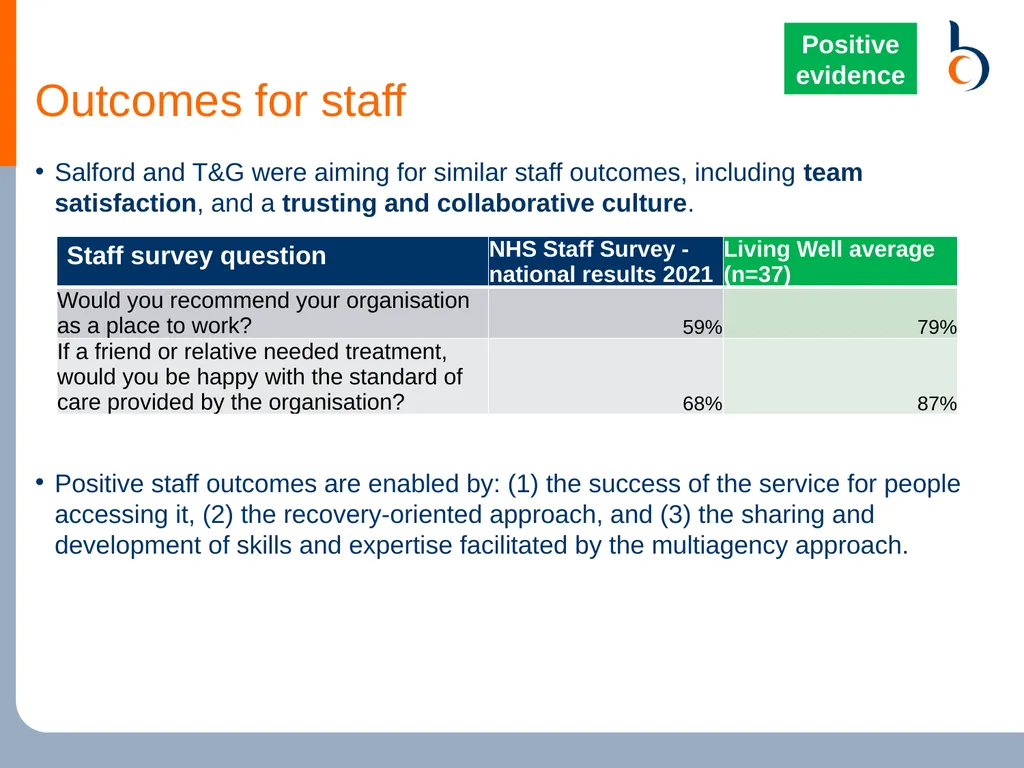
Outcomes for staff Salford and T&G were aiming for similar staff outcomes, including team satisfaction, and a trusting and collaborative culture.
Positive staff outcomes are enabled by: (1) the success of the service for people accessing it, (2) the recovery-oriented approach, and (3) the sharing and development of skills and expertise facilitated by the multiagency approach. Positive evidence<br>
10
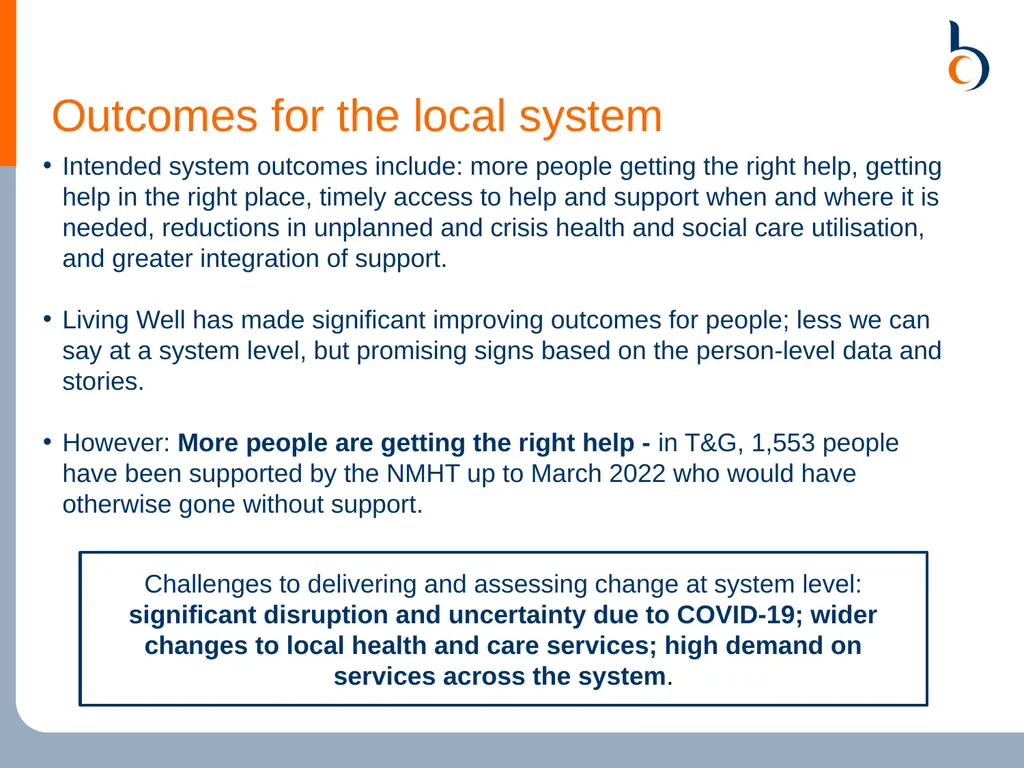
Outcomes for the local system Intended system outcomes include: more people getting the right help, getting help in the right place, timely access to help and support when and where it is needed, reductions in unplanned and crisis health and social care utilisation, and greater integration of support.
Living Well has made significant improving outcomes for people; less we can say at a system level, but promising signs based on the person-level data and stories.
However: More people are getting the right help - in T&G, 1,553 people have been supported by the NMHT up to March 2022 who would have otherwise gone without support. Challenges to delivering and assessing change at system level: significant disruption and uncertainty due to COVID-19; wider changes to local health and care services; high demand on services across the system.<br>
11
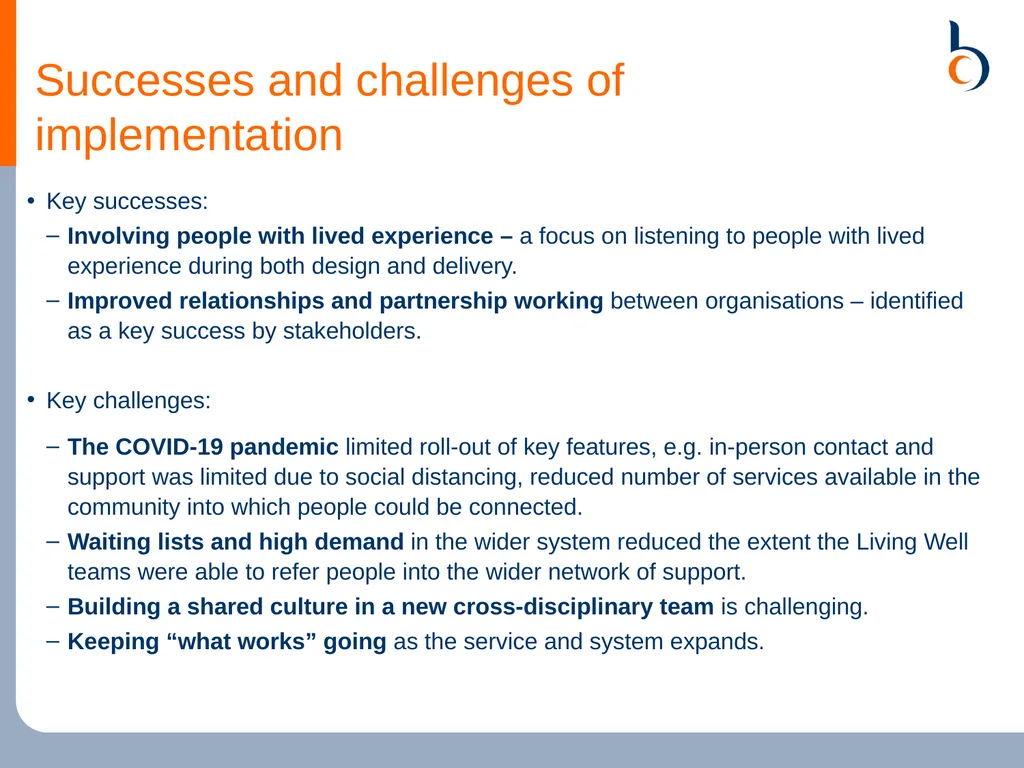
Successes and challenges of implementation Key successes:
Involving people with lived experience – a focus on listening to people with lived experience during both design and delivery.
Improved relationships and partnership working between organisations – identified as a key success by stakeholders.
Key challenges:
The COVID-19 pandemic limited roll-out of key features, e.g. in-person contact and support was limited due to social distancing, reduced number of services available in the community into which people could be connected.
Waiting lists and high demand in the wider system reduced the extent the Living Well teams were able to refer people into the wider network of support.
Building a shared culture in a new cross-disciplinary team is challenging.
Keeping “what works” going as the service and system expands.<br>
12
Current and future work in T&G and Salford Over to T&G and Salford colleagues<br>
13
Next steps in the evaluation Over to Innovation Unit colleagues<br>