
LOAD RECOVERY & ADAPTATION – A SCIENTIFIC APPROACH
PC
Published · 24 slides · 0 views

1 / 1


Description
LOAD RECOVERY ADAPTATION A SCIENTIFIC APPROACH Presented by Poulami ghosh Assistant Professor, Department of Physical Education, Union Christian Training College, Berhampore, Murshidabad, W.B. Load Training load feature tells us how
Related Topics
Share
Embed code
Download this presentation From Below
"LOAD RECOVERY & ADAPTATION – A SCIENTIFIC APPROACH" is the property of its rightful owner. Permission is granted to download and print the materials on this website for personal, non-commercial use only, and to display it on your personal computer provided you do not modify the materials and that you retain all copyright notices contained in the materials. By downloading content from our website, you accept the terms of this agreement.
Presentation Transcript
01
LOAD RECOVERY & ADAPTATION – A SCIENTIFIC APPROACH Presented by
Poulami ghosh Assistant Professor, Department of Physical Education,
Union Christian Training College,
Berhampore, Murshidabad, W.B.<br>
Poulami ghosh Assistant Professor, Department of Physical Education,
Union Christian Training College,
Berhampore, Murshidabad, W.B.<br>
02
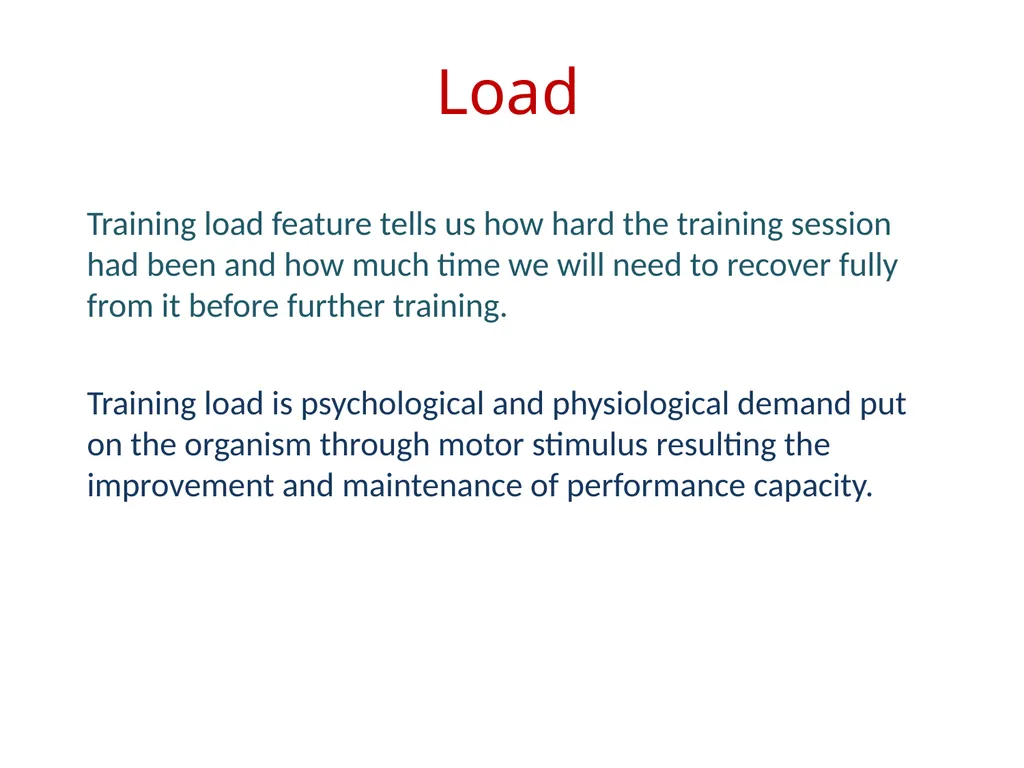
Load Training load feature tells us how hard the training session had been and how much time we will need to recover fully from it before further training. Training load is psychological and physiological demand put on the organism through motor stimulus resulting the improvement and maintenance of performance capacity.<br>
03
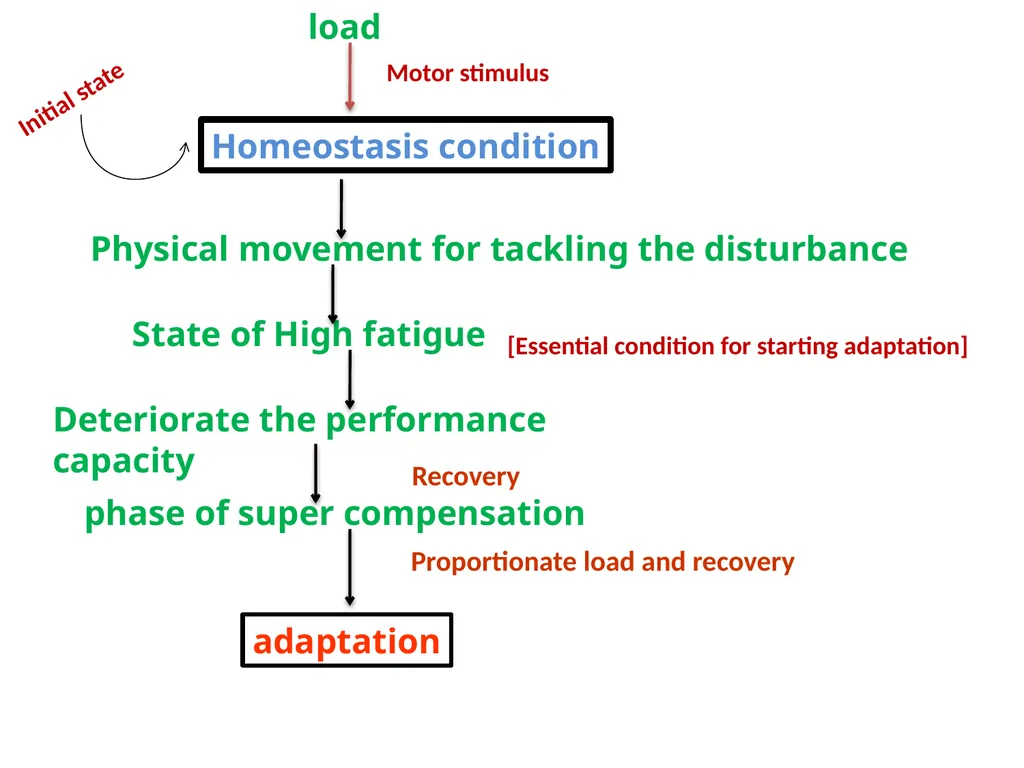
load Homeostasis condition Motor stimulus Physical movement for tackling the disturbance State of High fatigue [Essential condition for starting adaptation] Deteriorate the performance capacity Initial state Recovery phase of super compensation adaptation Proportionate load and recovery<br>
04
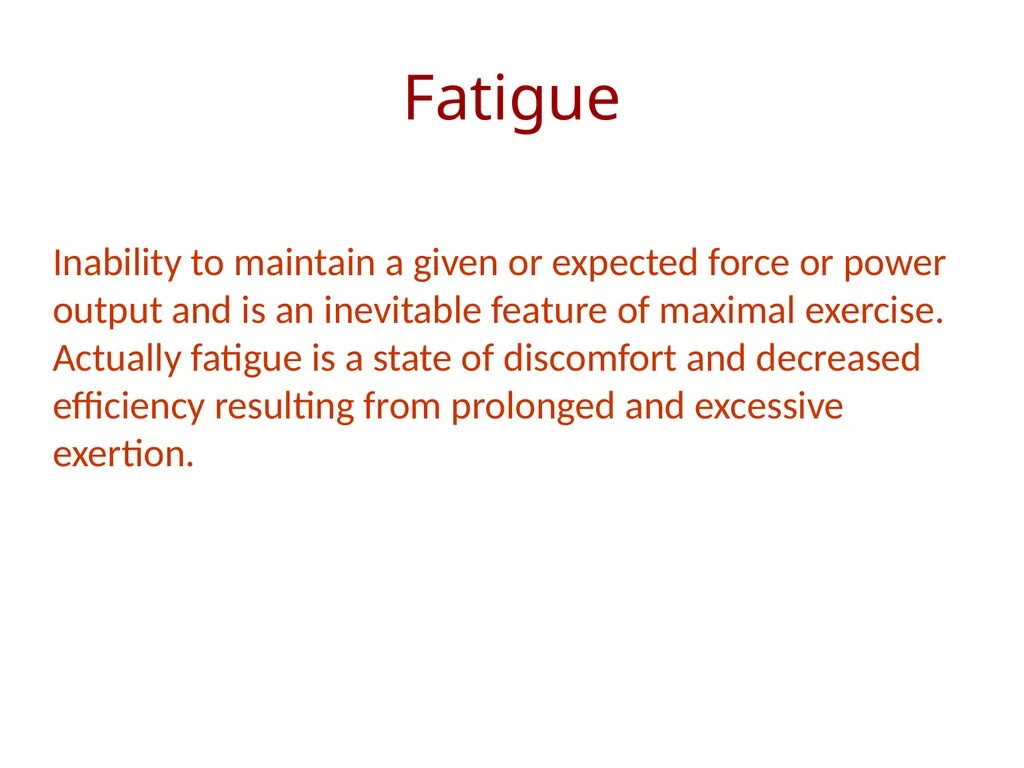
Fatigue Inability to maintain a given or expected force or power output and is an inevitable feature of maximal exercise.
Actually fatigue is a state of discomfort and decreased efficiency resulting from prolonged and excessive exertion.<br>
05
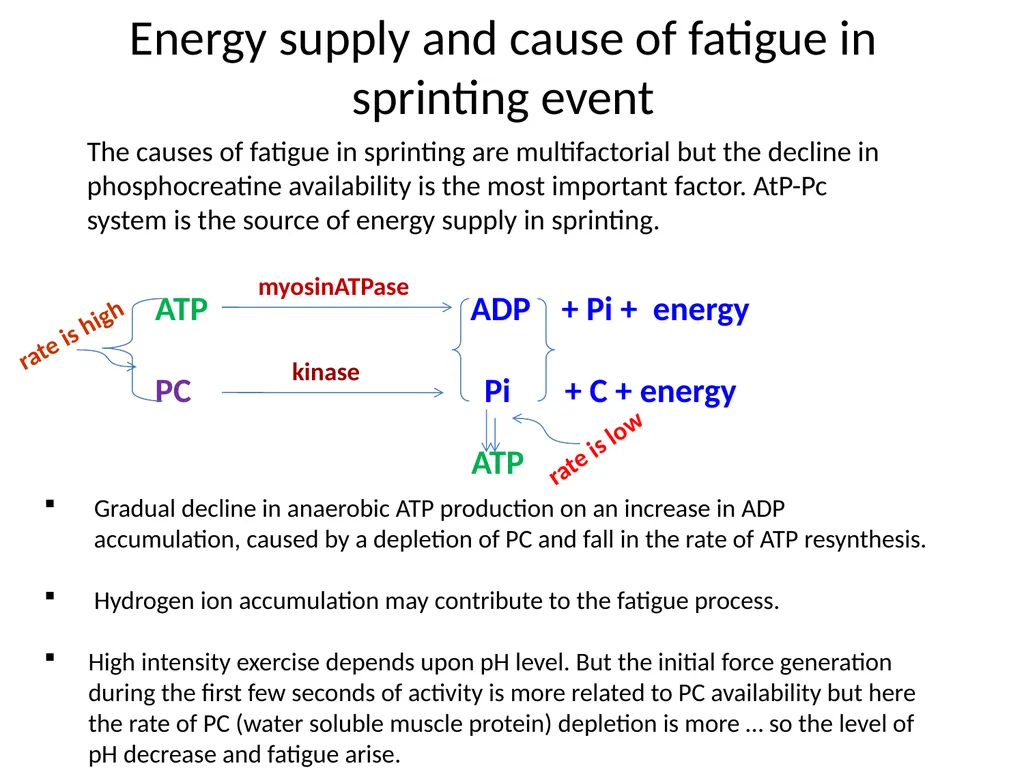
Energy supply and cause of fatigue in sprinting event The causes of fatigue in sprinting are multifactorial but the decline in phosphocreatine availability is the most important factor. AtP-Pc system is the source of energy supply in sprinting. ATP ADP + Pi + energy
PC Pi + C + energy myosinATPase kinase ATP rate is low rate is high Gradual decline in anaerobic ATP production on an increase in ADP accumulation, caused by a depletion of PC and fall in the rate of ATP resynthesis.
Hydrogen ion accumulation may contribute to the fatigue process.
High intensity exercise depends upon pH level. But the initial force generation during the first few seconds of activity is more related to PC availability but here the rate of PC (water soluble muscle protein) depletion is more … so the level of pH decrease and fatigue arise.<br>
PC Pi + C + energy myosinATPase kinase ATP rate is low rate is high Gradual decline in anaerobic ATP production on an increase in ADP accumulation, caused by a depletion of PC and fall in the rate of ATP resynthesis.
Hydrogen ion accumulation may contribute to the fatigue process.
High intensity exercise depends upon pH level. But the initial force generation during the first few seconds of activity is more related to PC availability but here the rate of PC (water soluble muscle protein) depletion is more … so the level of pH decrease and fatigue arise.<br>
06
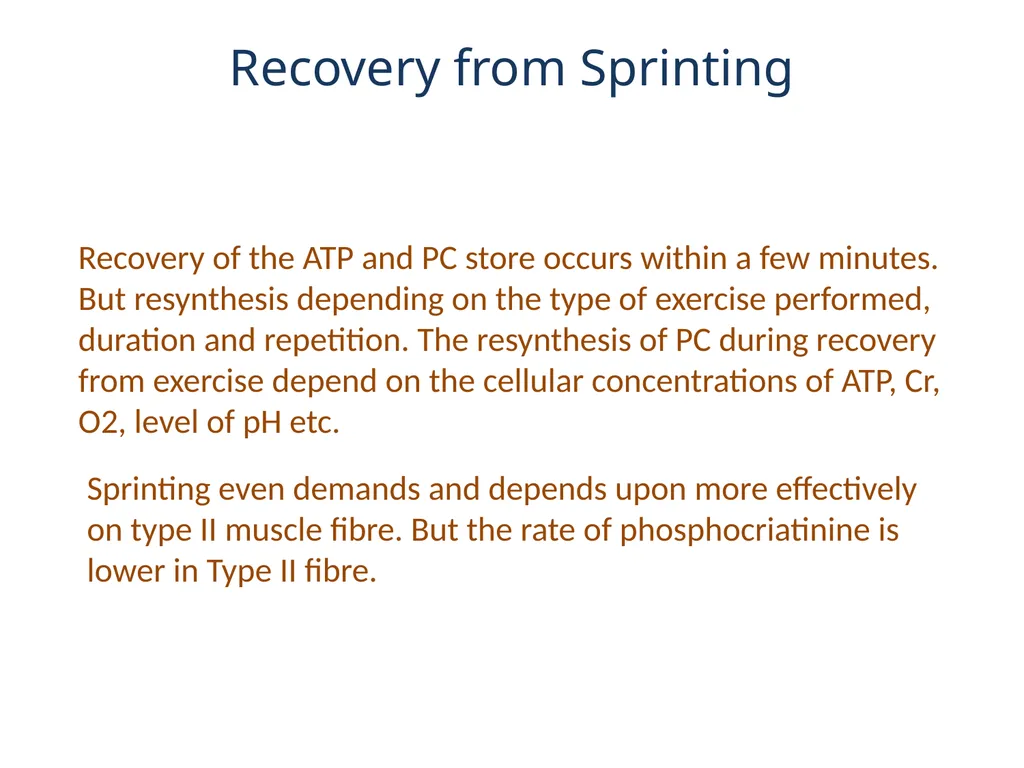
Recovery from Sprinting Recovery of the ATP and PC store occurs within a few minutes. But resynthesis depending on the type of exercise performed, duration and repetition. The resynthesis of PC during recovery from exercise depend on the cellular concentrations of ATP, Cr, O2, level of pH etc. Sprinting even demands and depends upon more effectively on type II muscle fibre. But the rate of phosphocriatinine is lower in Type II fibre.<br>
07
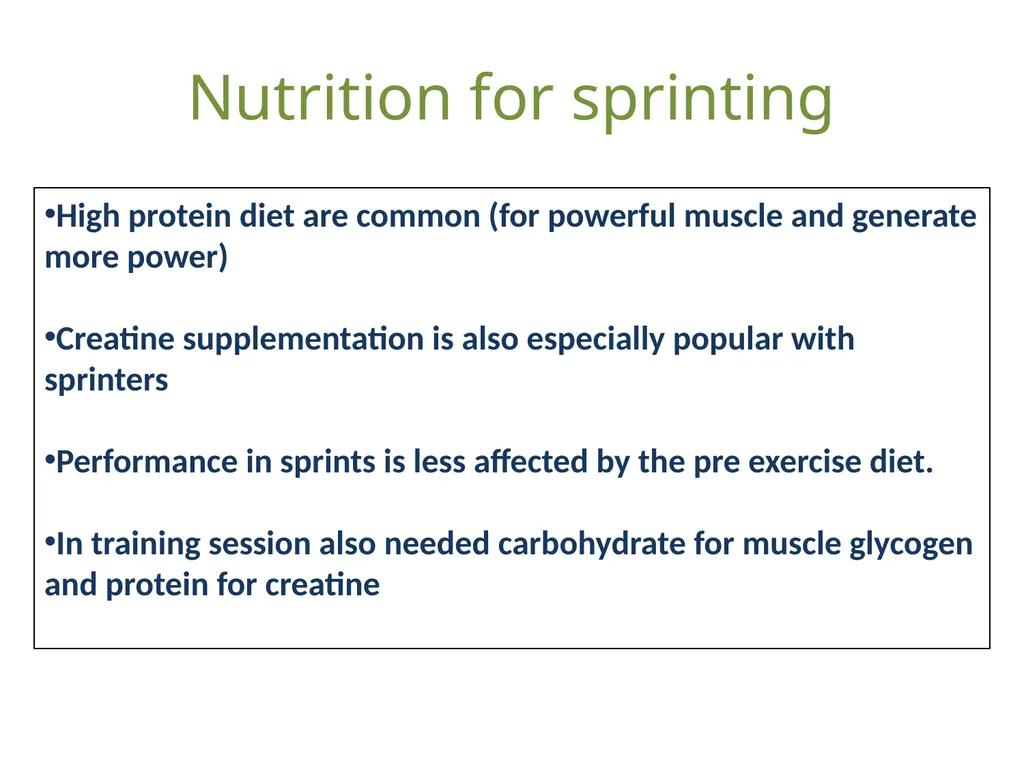
Nutrition for sprinting High protein diet are common (for powerful muscle and generate more power)
Creatine supplementation is also especially popular with sprinters
Performance in sprints is less affected by the pre exercise diet.
In training session also needed carbohydrate for muscle glycogen and protein for creatine<br>
Creatine supplementation is also especially popular with sprinters
Performance in sprints is less affected by the pre exercise diet.
In training session also needed carbohydrate for muscle glycogen and protein for creatine<br>
08
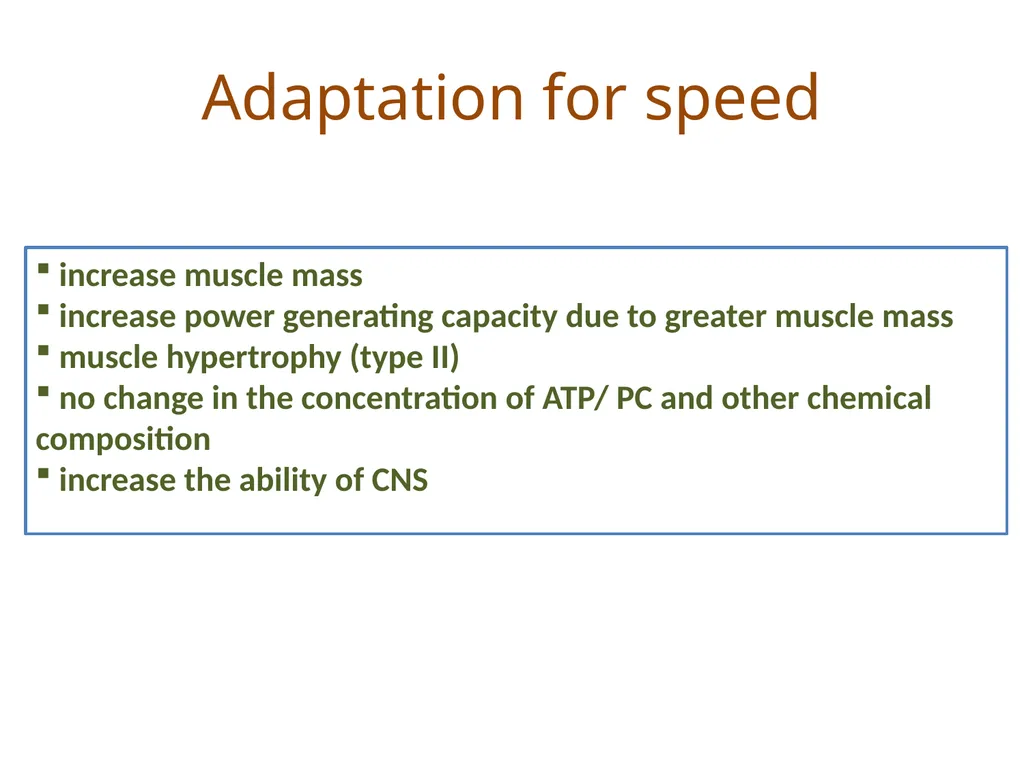
Adaptation for speed increase muscle mass
increase power generating capacity due to greater muscle mass
muscle hypertrophy (type II)
no change in the concentration of ATP/ PC and other chemical composition
increase the ability of CNS<br>
increase power generating capacity due to greater muscle mass
muscle hypertrophy (type II)
no change in the concentration of ATP/ PC and other chemical composition
increase the ability of CNS<br>
09
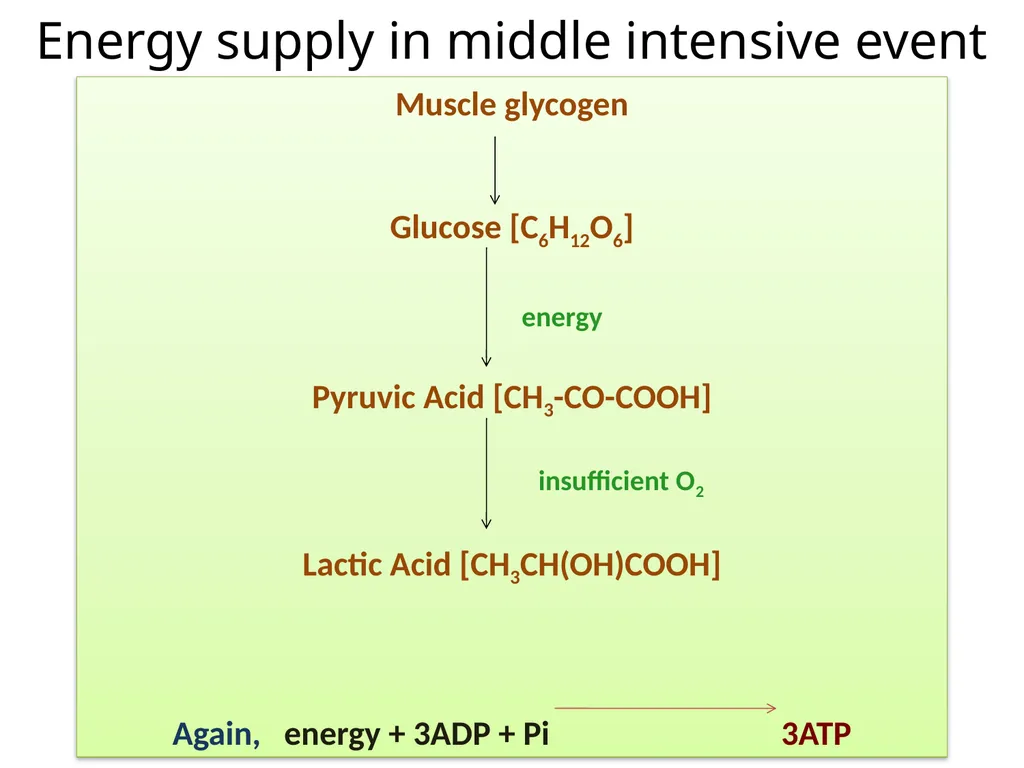
Muscle glycogen
Glucose [C6H12O6] energy Pyruvic Acid [CH3-CO-COOH] insufficient O2
Lactic Acid [CH3CH(OH)COOH]
Again, energy + 3ADP + Pi 3ATP Energy supply in middle intensive event<br>
Glucose [C6H12O6] energy Pyruvic Acid [CH3-CO-COOH] insufficient O2
Lactic Acid [CH3CH(OH)COOH]
Again, energy + 3ADP + Pi 3ATP Energy supply in middle intensive event<br>
10
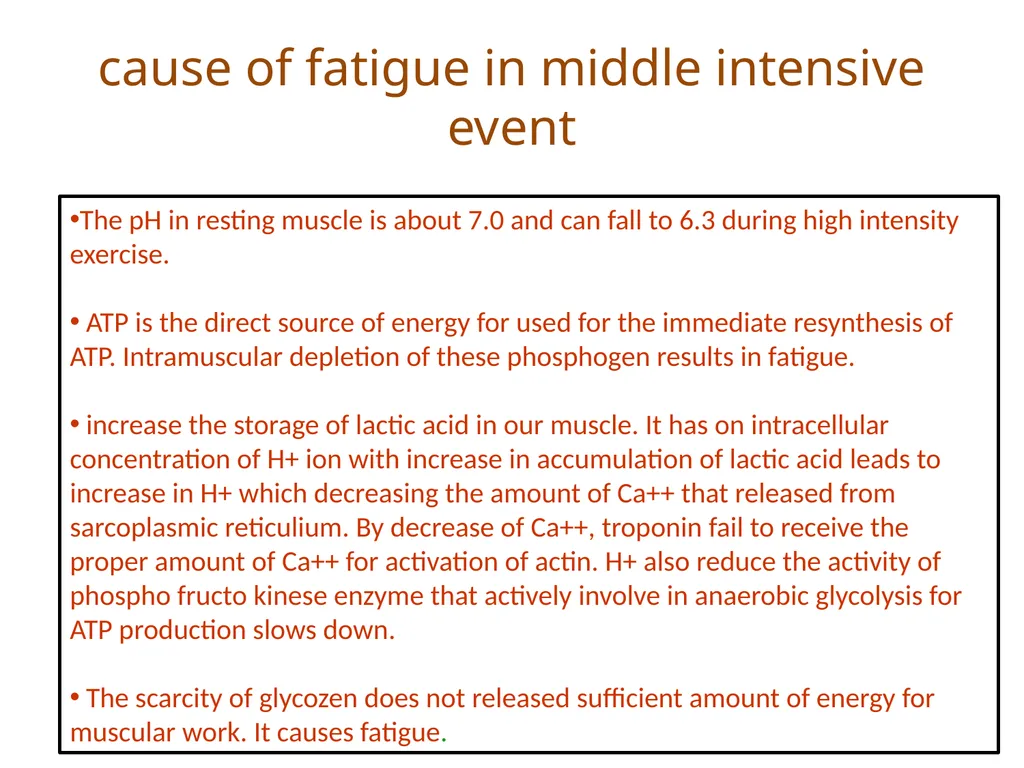
cause of fatigue in middle intensive event The pH in resting muscle is about 7.0 and can fall to 6.3 during high intensity exercise.
ATP is the direct source of energy for used for the immediate resynthesis of ATP. Intramuscular depletion of these phosphogen results in fatigue.
increase the storage of lactic acid in our muscle. It has on intracellular concentration of H+ ion with increase in accumulation of lactic acid leads to increase in H+ which decreasing the amount of Ca++ that released from sarcoplasmic reticulium. By decrease of Ca++, troponin fail to receive the proper amount of Ca++ for activation of actin. H+ also reduce the activity of phospho fructo kinese enzyme that actively involve in anaerobic glycolysis for ATP production slows down.
The scarcity of glycozen does not released sufficient amount of energy for muscular work. It causes fatigue.<br>
ATP is the direct source of energy for used for the immediate resynthesis of ATP. Intramuscular depletion of these phosphogen results in fatigue.
increase the storage of lactic acid in our muscle. It has on intracellular concentration of H+ ion with increase in accumulation of lactic acid leads to increase in H+ which decreasing the amount of Ca++ that released from sarcoplasmic reticulium. By decrease of Ca++, troponin fail to receive the proper amount of Ca++ for activation of actin. H+ also reduce the activity of phospho fructo kinese enzyme that actively involve in anaerobic glycolysis for ATP production slows down.
The scarcity of glycozen does not released sufficient amount of energy for muscular work. It causes fatigue.<br>
11
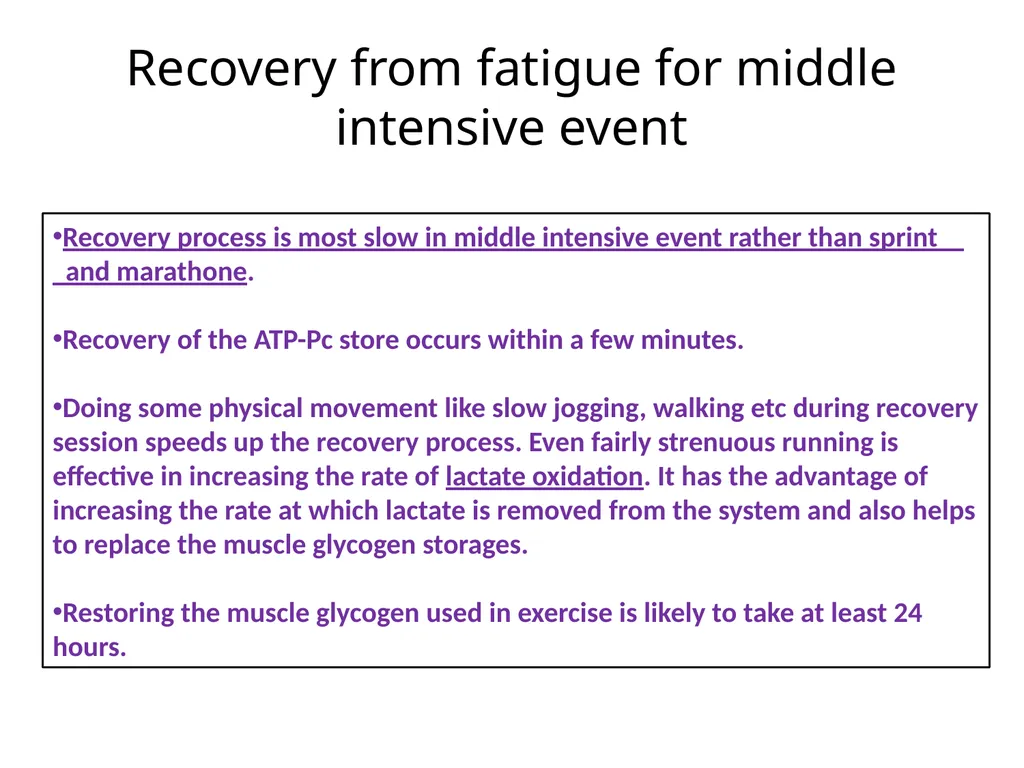
Recovery from fatigue for middle intensive event Recovery process is most slow in middle intensive event rather than sprint
and marathone.
Recovery of the ATP-Pc store occurs within a few minutes.
Doing some physical movement like slow jogging, walking etc during recovery session speeds up the recovery process. Even fairly strenuous running is effective in increasing the rate of lactate oxidation. It has the advantage of increasing the rate at which lactate is removed from the system and also helps to replace the muscle glycogen storages.
Restoring the muscle glycogen used in exercise is likely to take at least 24 hours.<br>
Recovery of the ATP-Pc store occurs within a few minutes.
Doing some physical movement like slow jogging, walking etc during recovery session speeds up the recovery process. Even fairly strenuous running is effective in increasing the rate of lactate oxidation. It has the advantage of increasing the rate at which lactate is removed from the system and also helps to replace the muscle glycogen storages.
Restoring the muscle glycogen used in exercise is likely to take at least 24 hours.<br>
12
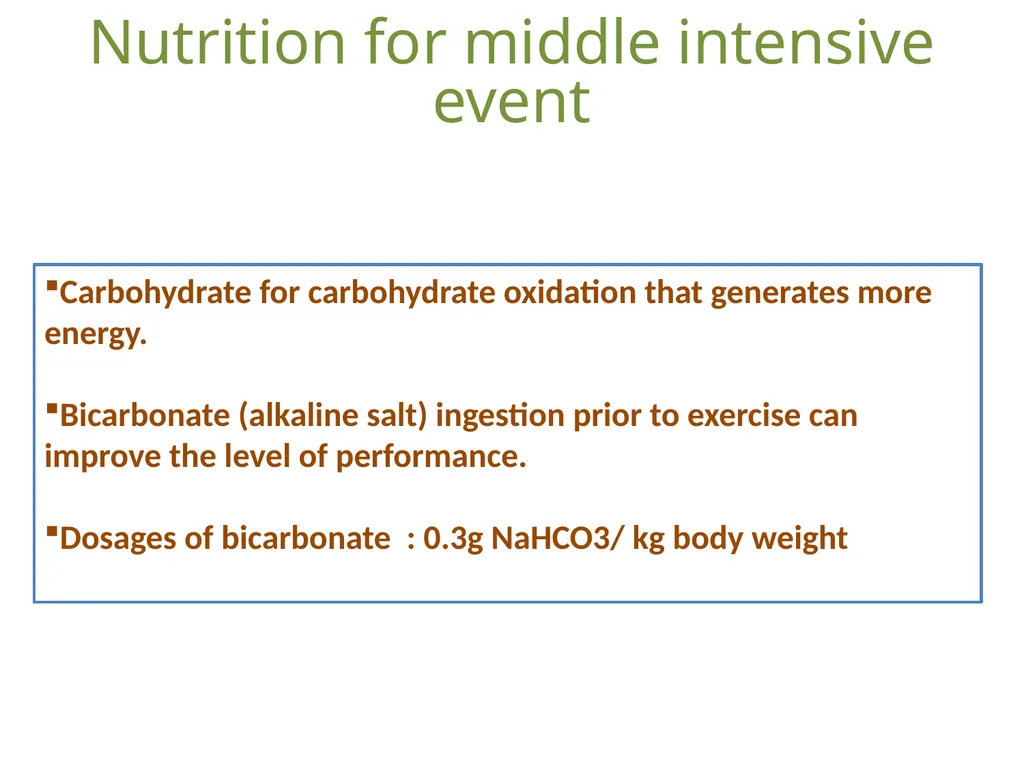
Nutrition for middle intensive event Carbohydrate for carbohydrate oxidation that generates more energy.
Bicarbonate (alkaline salt) ingestion prior to exercise can improve the level of performance.
Dosages of bicarbonate : 0.3g NaHCO3/ kg body weight<br>
Bicarbonate (alkaline salt) ingestion prior to exercise can improve the level of performance.
Dosages of bicarbonate : 0.3g NaHCO3/ kg body weight<br>
13
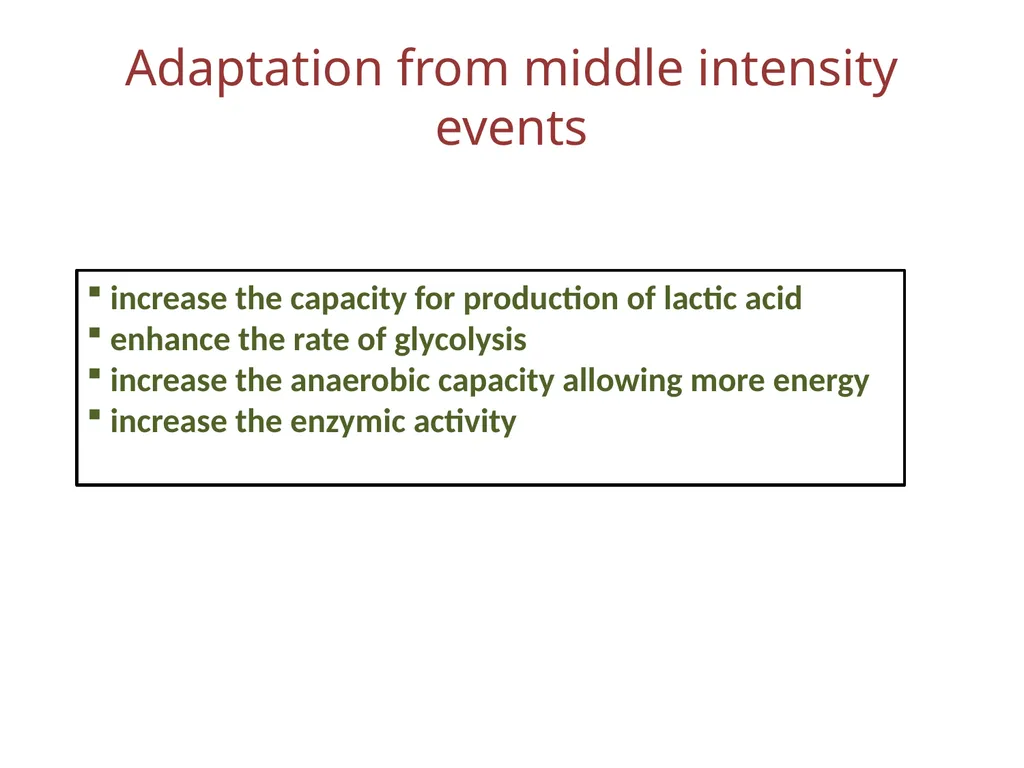
Adaptation from middle intensity events increase the capacity for production of lactic acid
enhance the rate of glycolysis
increase the anaerobic capacity allowing more energy
increase the enzymic activity<br>
enhance the rate of glycolysis
increase the anaerobic capacity allowing more energy
increase the enzymic activity<br>
14
Energy supply in endurance event Muscle glycogen
Glucose [C6H12O6] energy Pyruvic Acid [CH3-CO-COOH]
Acytile CoA After that it enters into the kreb’s cycle or TCA cycle<br>
Glucose [C6H12O6] energy Pyruvic Acid [CH3-CO-COOH]
Acytile CoA After that it enters into the kreb’s cycle or TCA cycle<br>
15
Energy metabolism in endurance event Fat
1 mole of triglyceride (found in adipose tissue)
by lypolisis
3 mole free fatty acid (FFA) + 1 mole glycerol The rate of lypolisis and the rate of adipose tissue blood flow determine the rate of entry of FFA into circulation.<br>
1 mole of triglyceride (found in adipose tissue)
by lypolisis
3 mole free fatty acid (FFA) + 1 mole glycerol The rate of lypolisis and the rate of adipose tissue blood flow determine the rate of entry of FFA into circulation.<br>
16
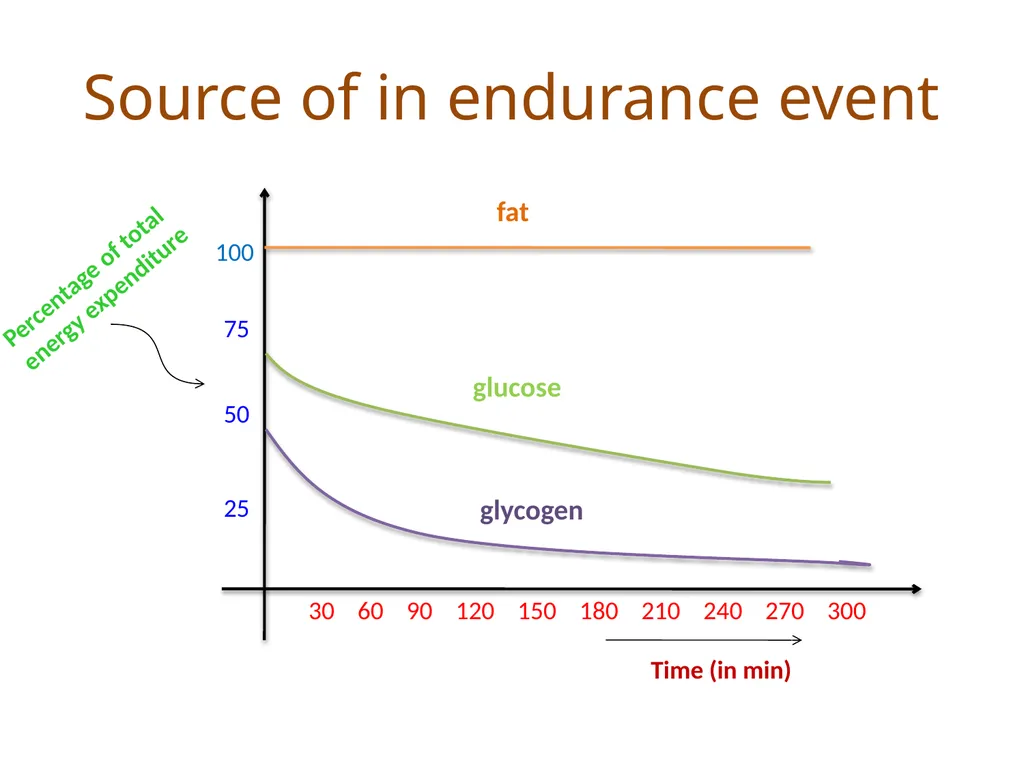
Source of in endurance event 25 75 50 100 fat glucose glycogen Percentage of total energy expenditure Time (in min) 30 60 90 120 150 180 210 240 270 300<br>
17
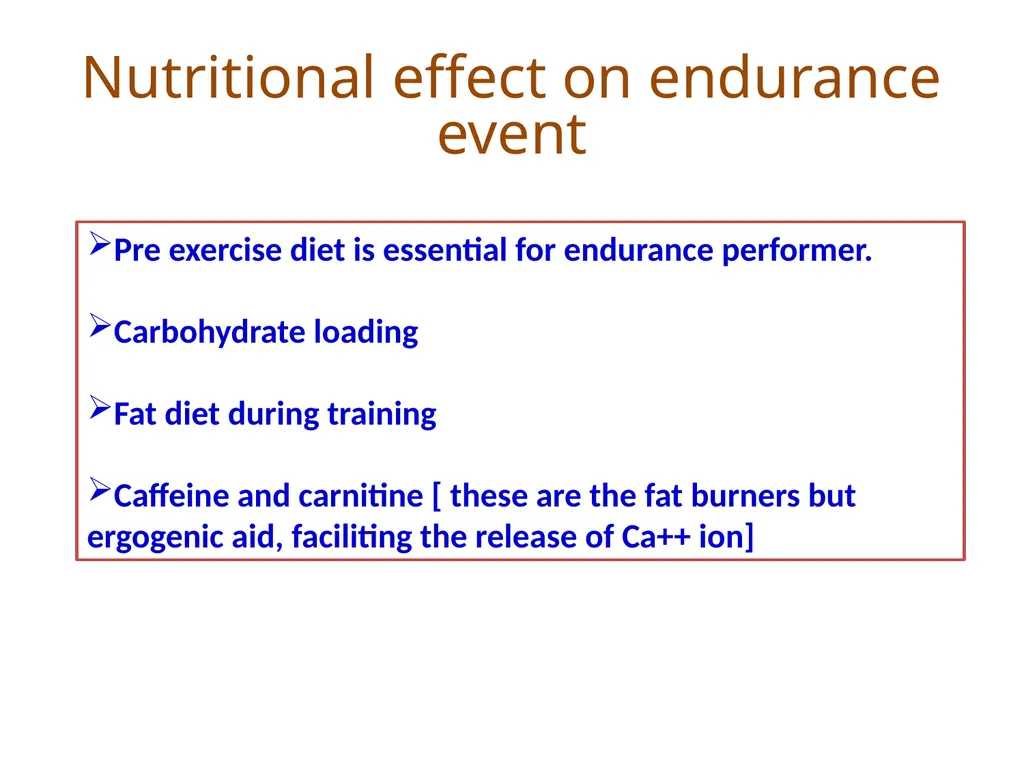
Nutritional effect on endurance event Pre exercise diet is essential for endurance performer.
Carbohydrate loading
Fat diet during training
Caffeine and carnitine [ these are the fat burners but ergogenic aid, faciliting the release of Ca++ ion]<br>
Carbohydrate loading
Fat diet during training
Caffeine and carnitine [ these are the fat burners but ergogenic aid, faciliting the release of Ca++ ion]<br>
18
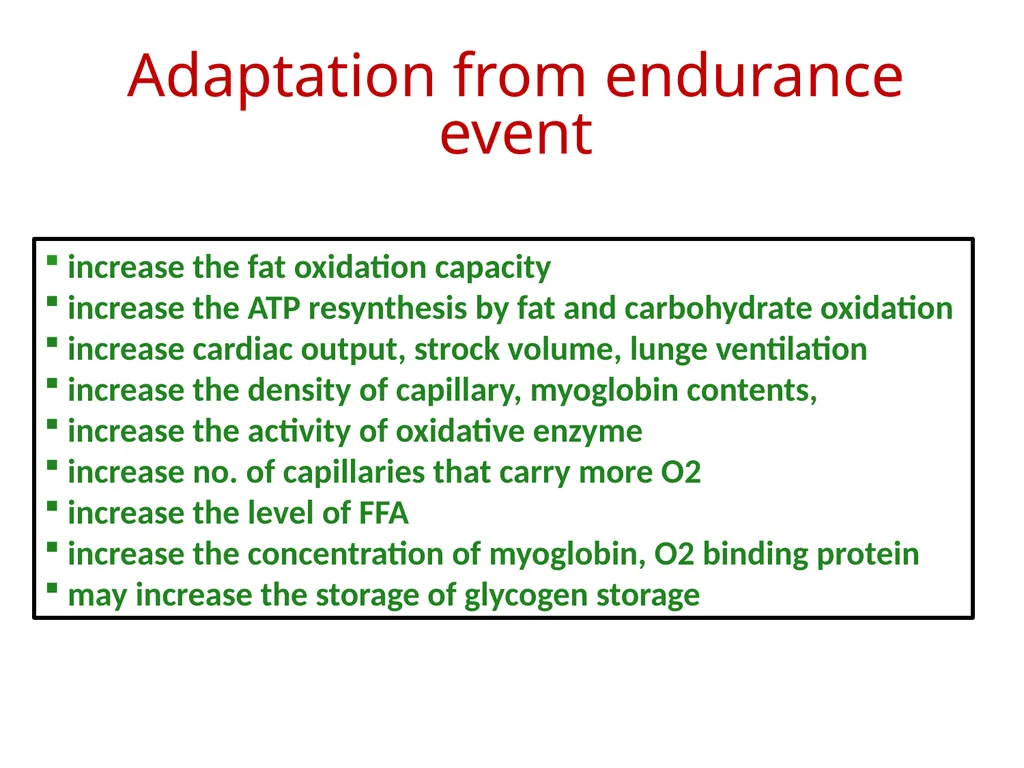
Adaptation from endurance event increase the fat oxidation capacity
increase the ATP resynthesis by fat and carbohydrate oxidation
increase cardiac output, strock volume, lunge ventilation
increase the density of capillary, myoglobin contents,
increase the activity of oxidative enzyme
increase no. of capillaries that carry more O2
increase the level of FFA
increase the concentration of myoglobin, O2 binding protein
may increase the storage of glycogen storage<br>
increase the ATP resynthesis by fat and carbohydrate oxidation
increase cardiac output, strock volume, lunge ventilation
increase the density of capillary, myoglobin contents,
increase the activity of oxidative enzyme
increase no. of capillaries that carry more O2
increase the level of FFA
increase the concentration of myoglobin, O2 binding protein
may increase the storage of glycogen storage<br>
19
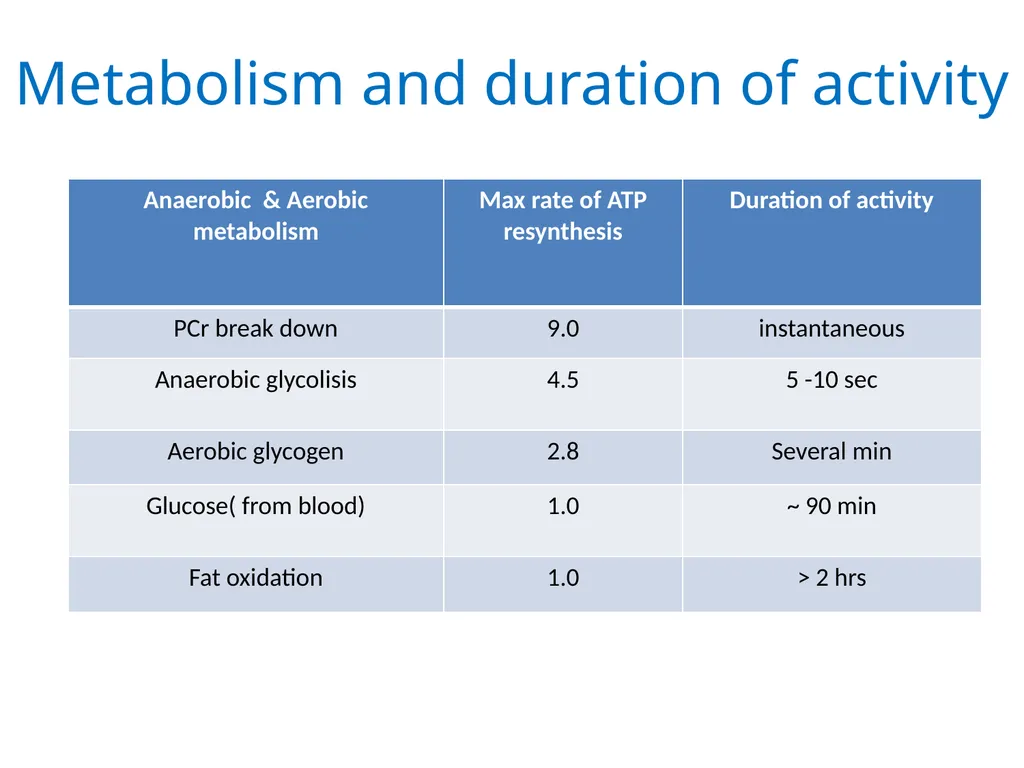
Metabolism and duration of activity<br>
20
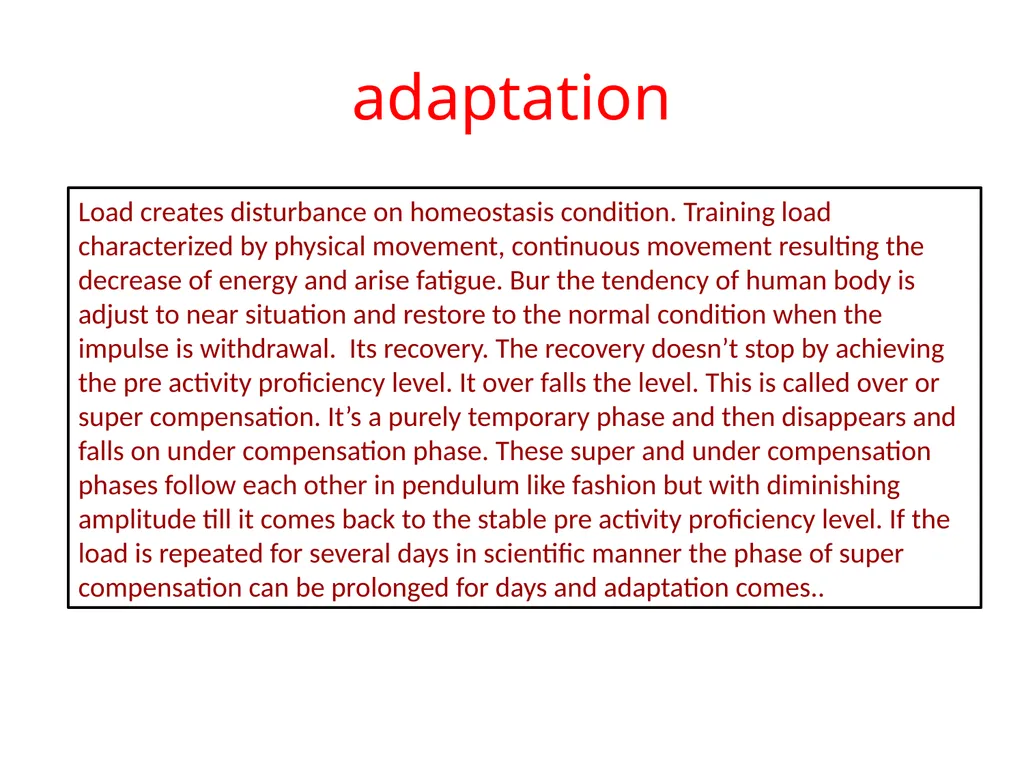
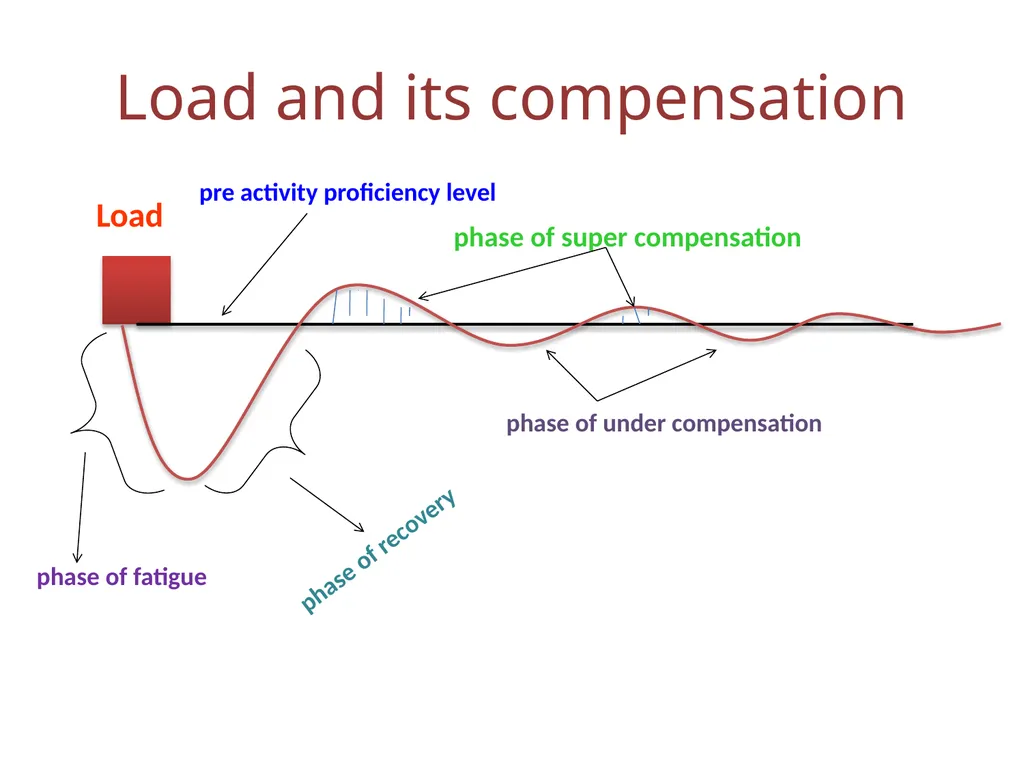
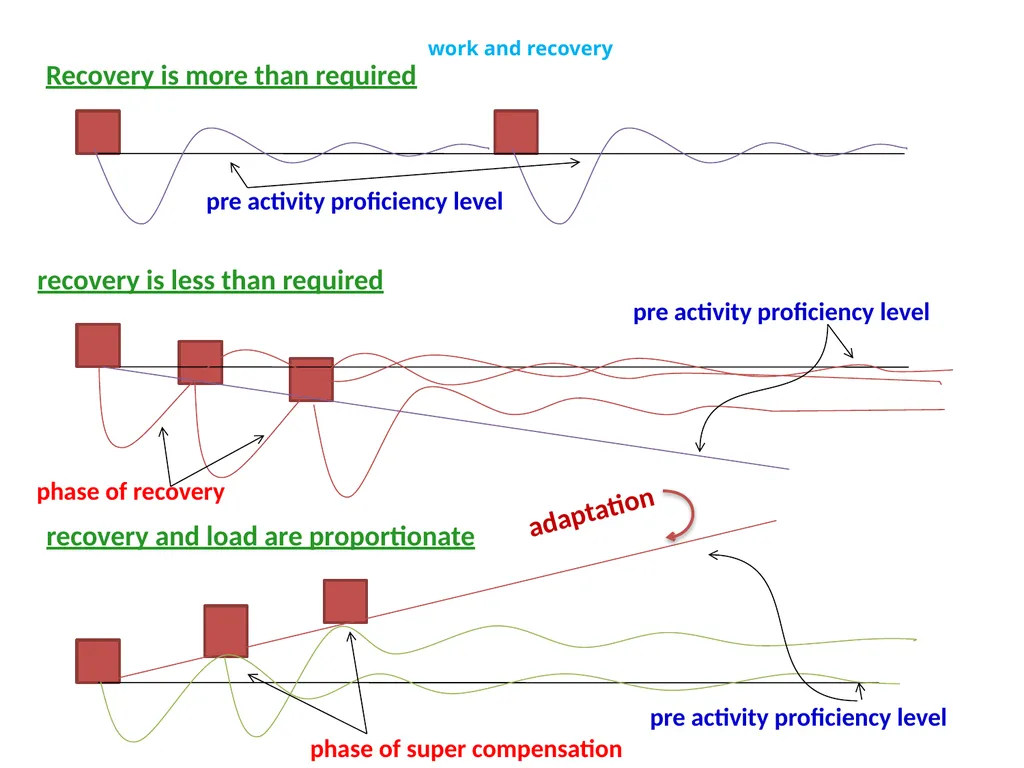
adaptation Load creates disturbance on homeostasis condition. Training load characterized by physical movement, continuous movement resulting the decrease of energy and arise fatigue. Bur the tendency of human body is adjust to near situation and restore to the normal condition when the impulse is withdrawal. Its recovery. The recovery doesn’t stop by achieving the pre activity proficiency level. It over falls the level. This is called over or super compensation. It’s a purely temporary phase and then disappears and falls on under compensation phase. These super and under compensation phases follow each other in pendulum like fashion but with diminishing amplitude till it comes back to the stable pre activity proficiency level. If the load is repeated for several days in scientific manner the phase of super compensation can be prolonged for days and adaptation comes..<br>
21
Load and its compensation Load pre activity proficiency level phase of fatigue phase of recovery phase of super compensation phase of under compensation<br>
22
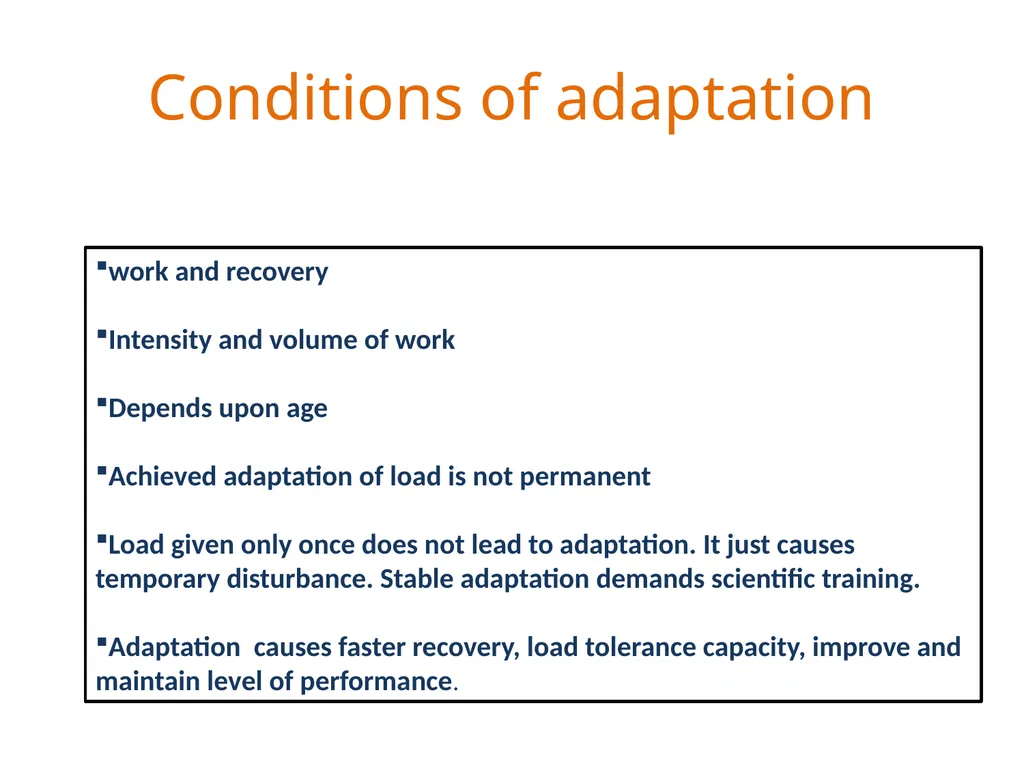
Conditions of adaptation work and recovery
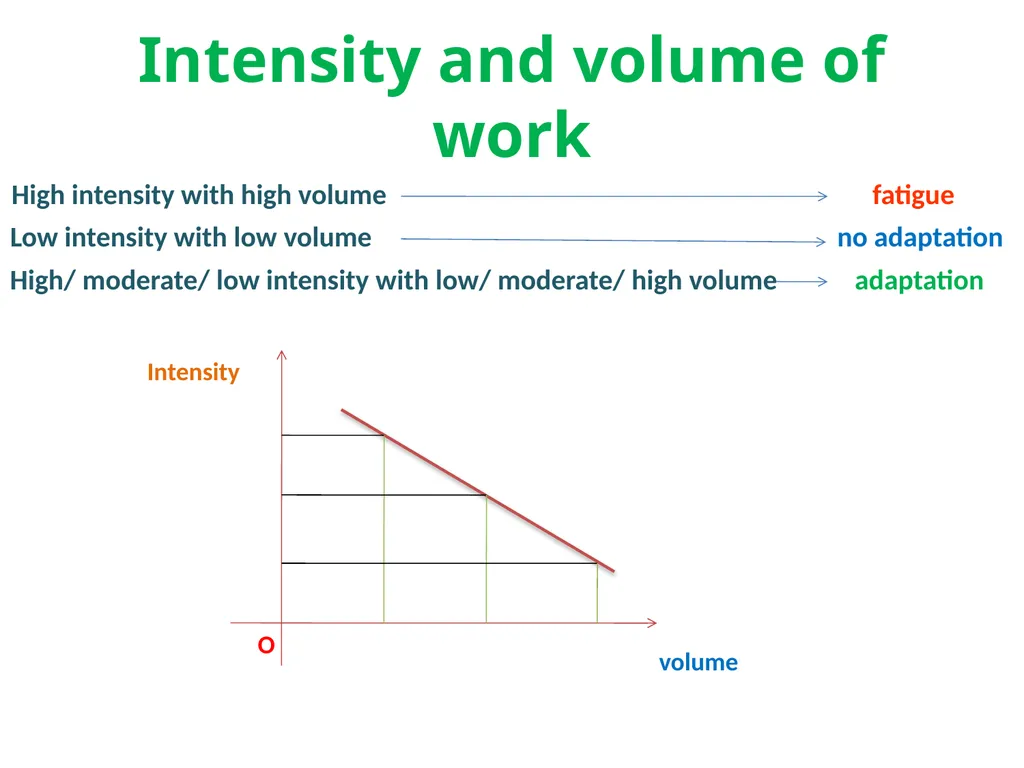
Intensity and volume of work
Depends upon age
Achieved adaptation of load is not permanent
Load given only once does not lead to adaptation. It just causes temporary disturbance. Stable adaptation demands scientific training.
Adaptation causes faster recovery, load tolerance capacity, improve and maintain level of performance.<br>
Intensity and volume of work
Depends upon age
Achieved adaptation of load is not permanent
Load given only once does not lead to adaptation. It just causes temporary disturbance. Stable adaptation demands scientific training.
Adaptation causes faster recovery, load tolerance capacity, improve and maintain level of performance.<br>
23
work and recovery Recovery is more than required recovery is less than required recovery and load are proportionate phase of recovery phase of super compensation pre activity proficiency level pre activity proficiency level pre activity proficiency level adaptation<br>
24
Intensity and volume of work High intensity with high volume Low intensity with low volume High/ moderate/ low intensity with low/ moderate/ high volume adaptation no adaptation fatigue Intensity volume O<br>