
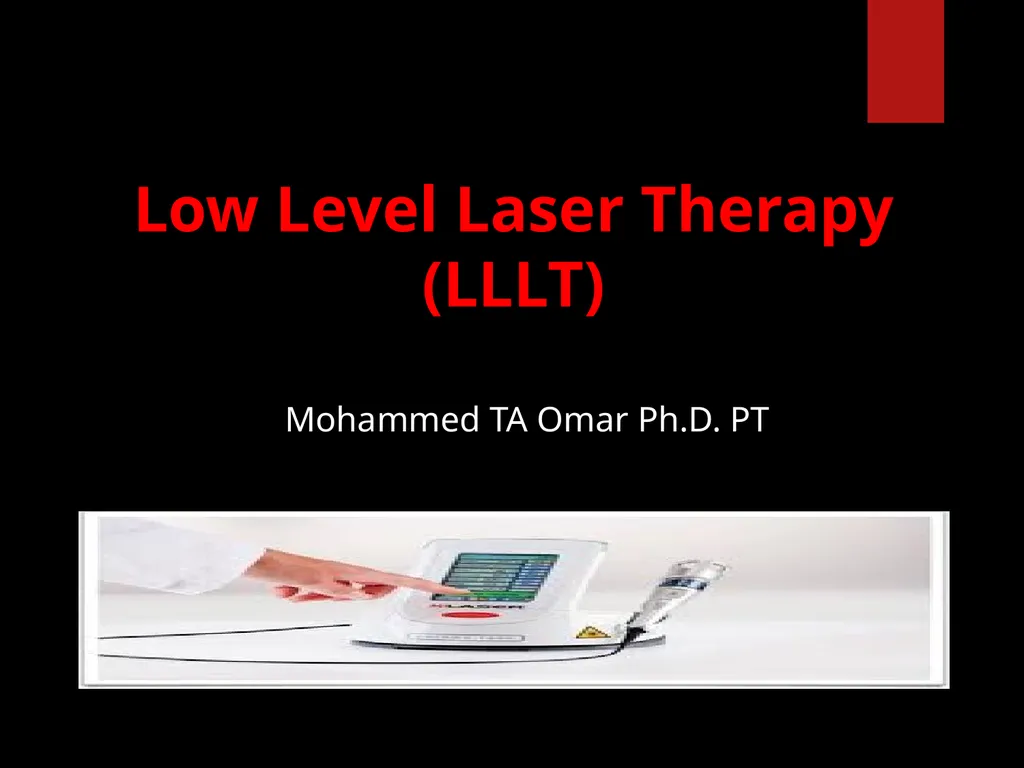
Low Level Laser Therapy (LLLT) Mohammed TA Omar
PT
Published · 39 slides · 0 views
1 / 1

Description
Low Level Laser Therapy (LLLT) Mohammed TA Omar Ph.D. PT Objectives of lecture Define laser and explain its physical principle of laser. Explain the physical characteristics of laser. Describe the classifications of laser. Contrast the
Related Topics
Share
Embed code
Download this presentation From Below
"Low Level Laser Therapy (LLLT) Mohammed TA Omar" is the property of its rightful owner. Permission is granted to download and print the materials on this website for personal, non-commercial use only, and to display it on your personal computer provided you do not modify the materials and that you retain all copyright notices contained in the materials. By downloading content from our website, you accept the terms of this agreement.
Presentation Transcript
01
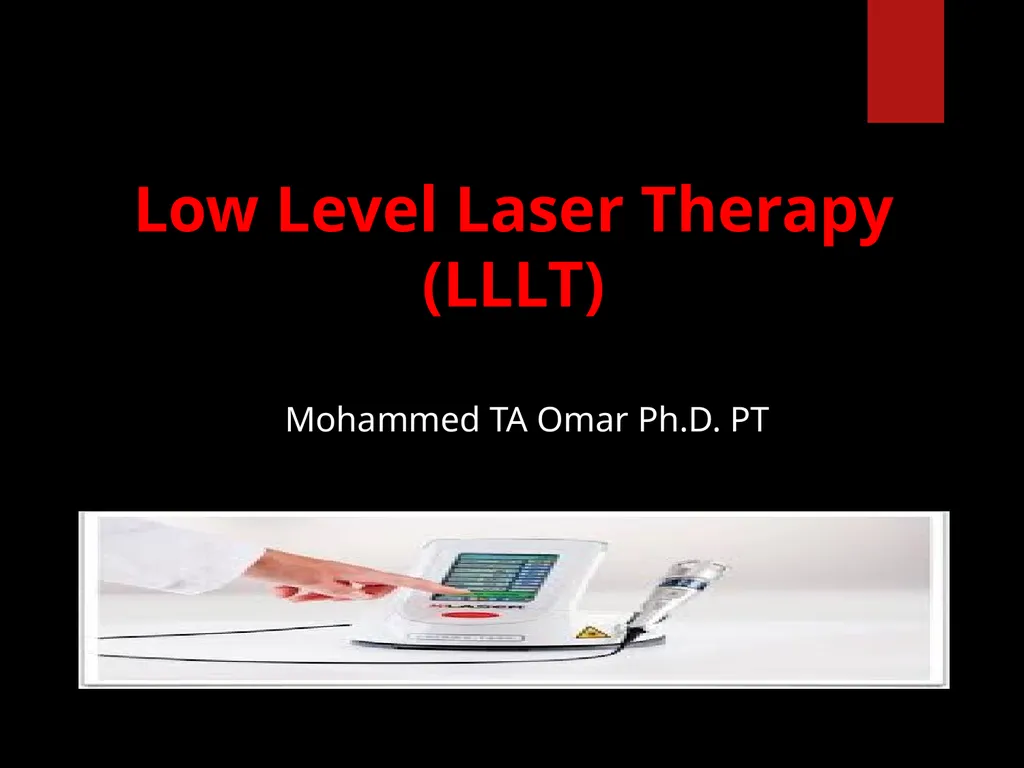
Low Level Laser Therapy
(LLLT) Mohammed TA Omar Ph.D. PT<br>
02
Objectives of lecture Define laser and explain its physical principle of laser.
Explain the physical characteristics of laser.
Describe the classifications of laser.
Contrast the characteristics of helium neon and gallium arsenide low power laser.
Analysis the therapeutic application of laser in different conditions.
Demonstrate the application techniques of low power laser.
Describe the precautions and contraindications for low power laser.<br>
Explain the physical characteristics of laser.
Describe the classifications of laser.
Contrast the characteristics of helium neon and gallium arsenide low power laser.
Analysis the therapeutic application of laser in different conditions.
Demonstrate the application techniques of low power laser.
Describe the precautions and contraindications for low power laser.<br>
03
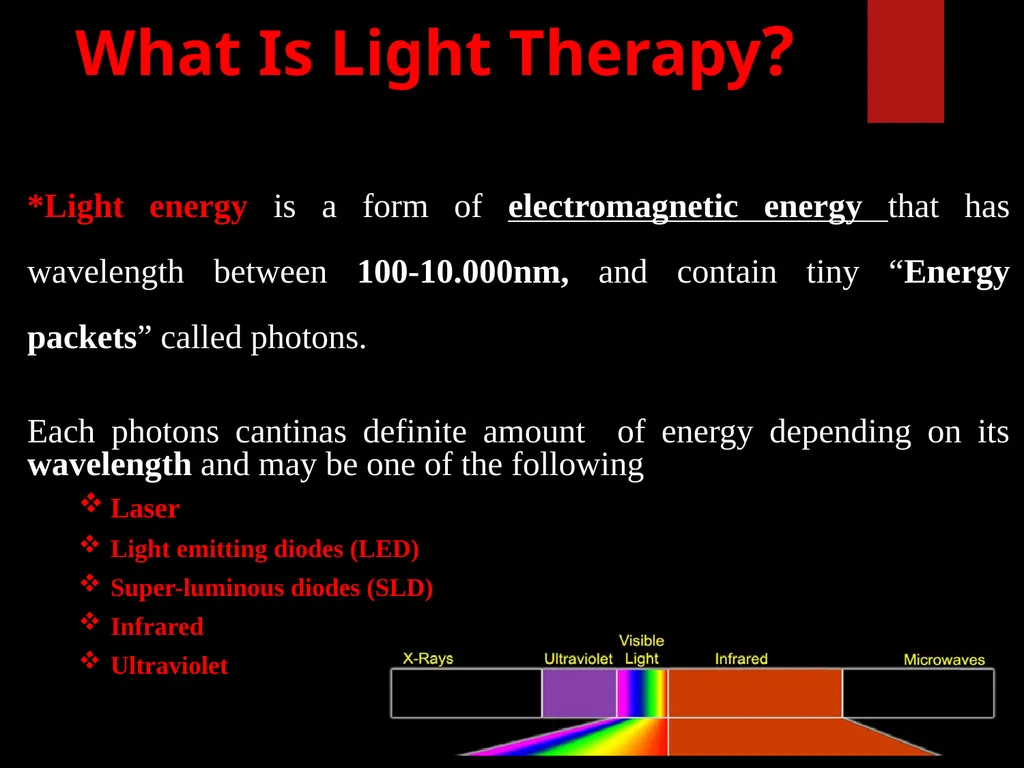
What Is Light Therapy? *Light energy is a form of electromagnetic energy that has wavelength between 100-10.000nm, and contain tiny “Energy packets” called photons.
Each photons cantinas definite amount of energy depending on its wavelength and may be one of the following
Laser
Light emitting diodes (LED)
Super-luminous diodes (SLD)
Infrared
Ultraviolet<br>
Each photons cantinas definite amount of energy depending on its wavelength and may be one of the following
Laser
Light emitting diodes (LED)
Super-luminous diodes (SLD)
Infrared
Ultraviolet<br>
04
What Is Laser Therapy? LASER is acronym of
Light : an electromagnetic
Amplification by
Stimulated
Emission of
Radiation<br>
Light : an electromagnetic
Amplification by
Stimulated
Emission of
Radiation<br>
05
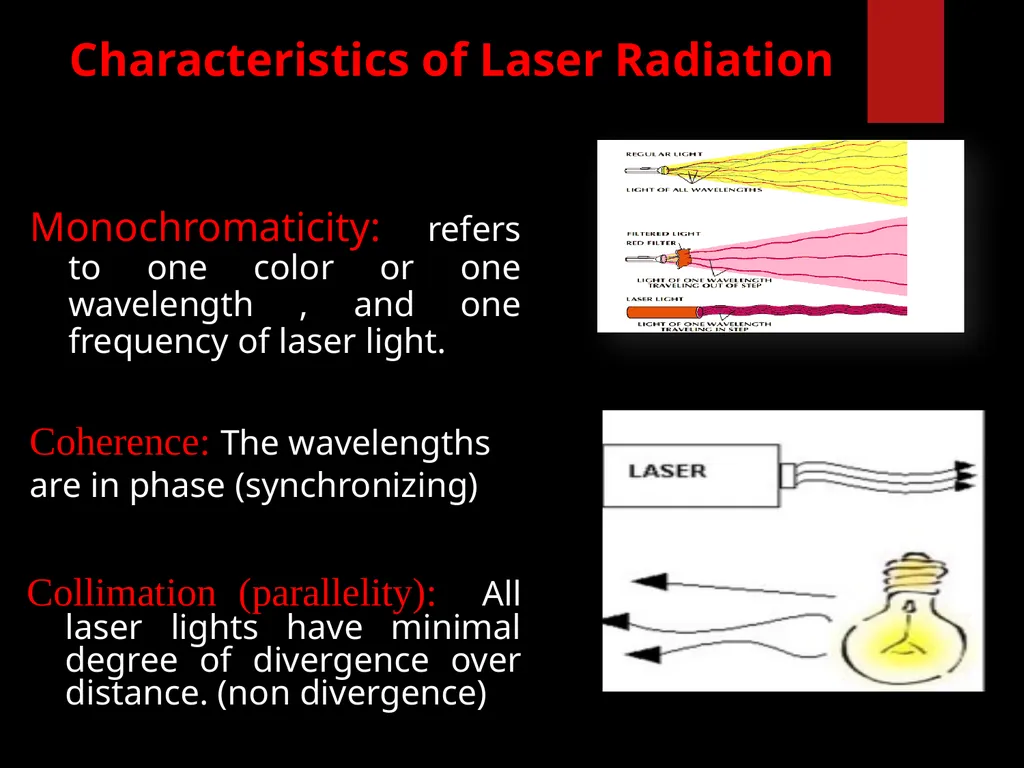
Characteristics of Laser Radiation Monochromaticity: refers to one color or one wavelength , and one frequency of laser light. Coherence: The wavelengths are in phase (synchronizing) Collimation (parallelity): All laser lights have minimal degree of divergence over distance. (non divergence)<br>
06
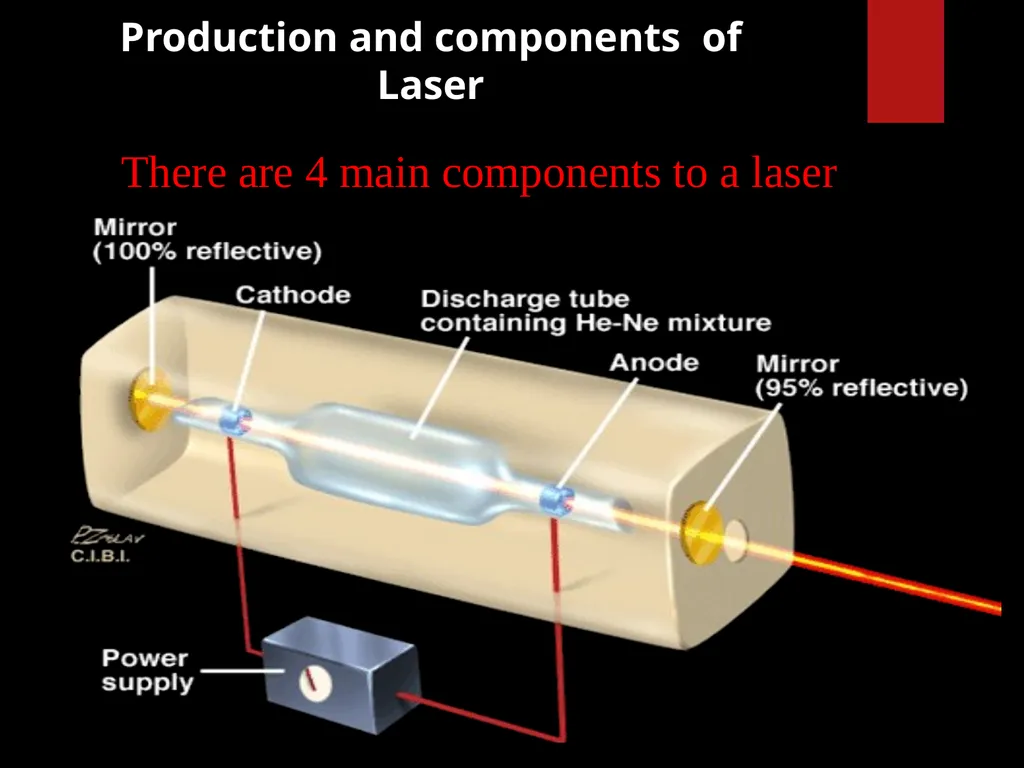
Production and components of Laser There are 4 main components to a laser<br>
07
Optical resonant cavity:
Contains lasing medium which is surrounded by two parallel mirrors at either end. One mirror has 100% reflectance while the other has slightly less reflectance.(stimulation and amplification) Lasing medium:
Material that excited to generates laser light
(gas, solid, semiconductors & liquid) Production and components of Laser Power supply: 10,000 volts & 100’s amps.
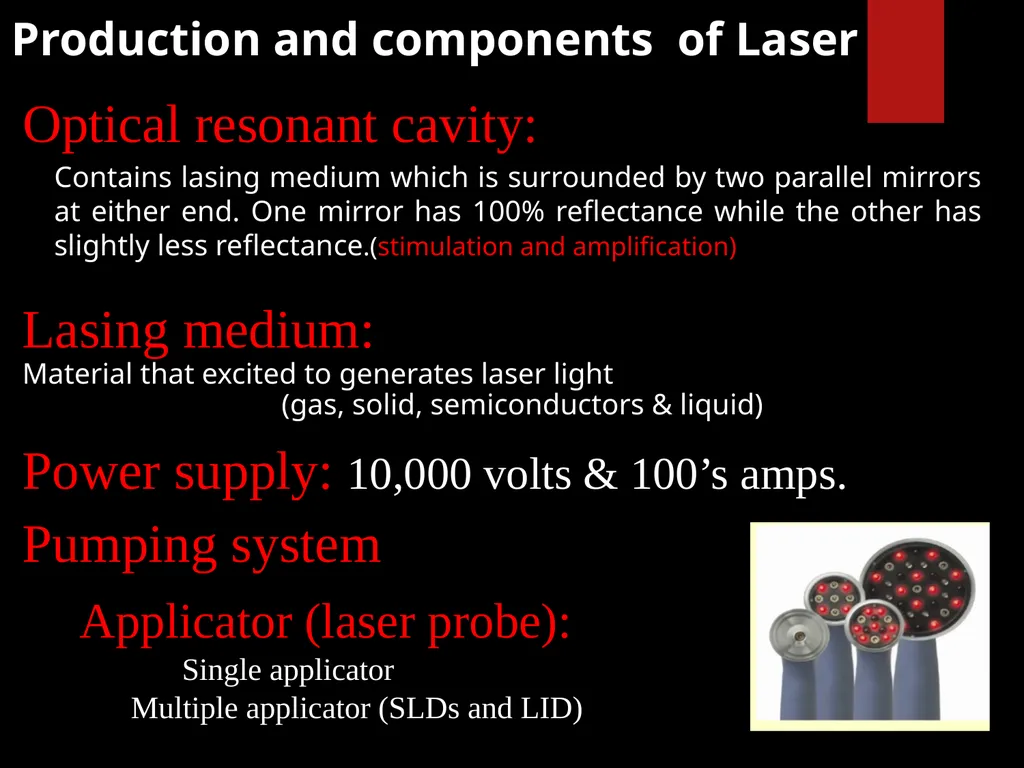
Pumping system Applicator (laser probe):
Single applicator
Multiple applicator (SLDs and LID)<br>
Contains lasing medium which is surrounded by two parallel mirrors at either end. One mirror has 100% reflectance while the other has slightly less reflectance.(stimulation and amplification) Lasing medium:
Material that excited to generates laser light
(gas, solid, semiconductors & liquid) Production and components of Laser Power supply: 10,000 volts & 100’s amps.
Pumping system Applicator (laser probe):
Single applicator
Multiple applicator (SLDs and LID)<br>
08
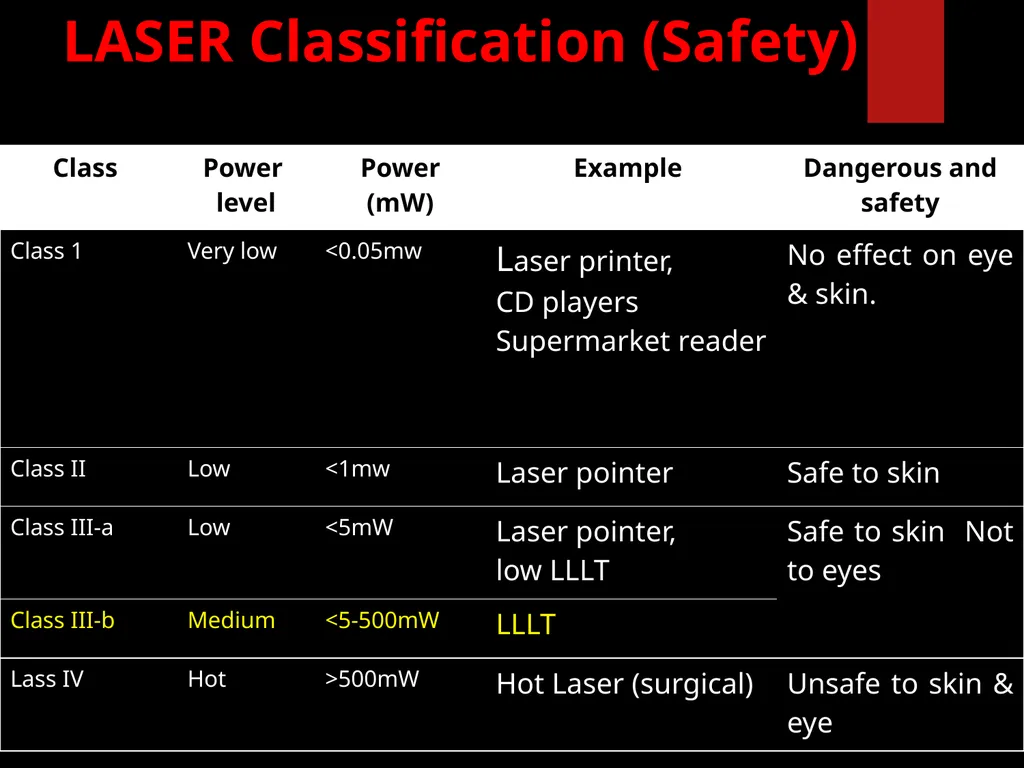
LASER Classification (Safety)<br>
09
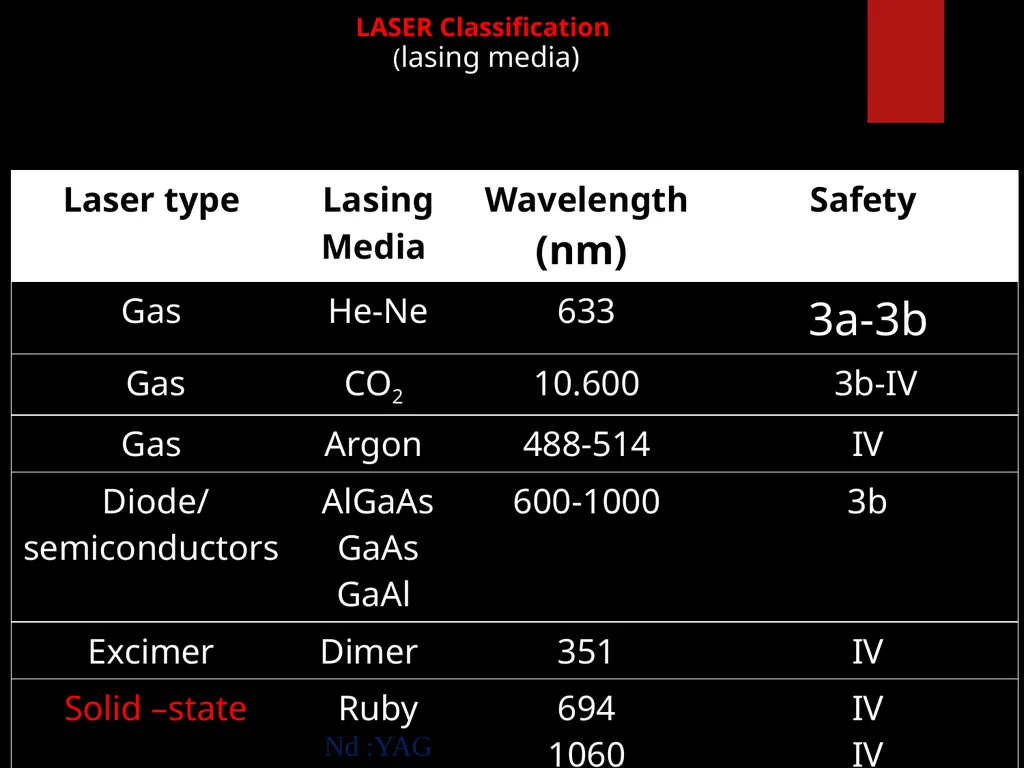
LASER Classification
(lasing media)<br>
10
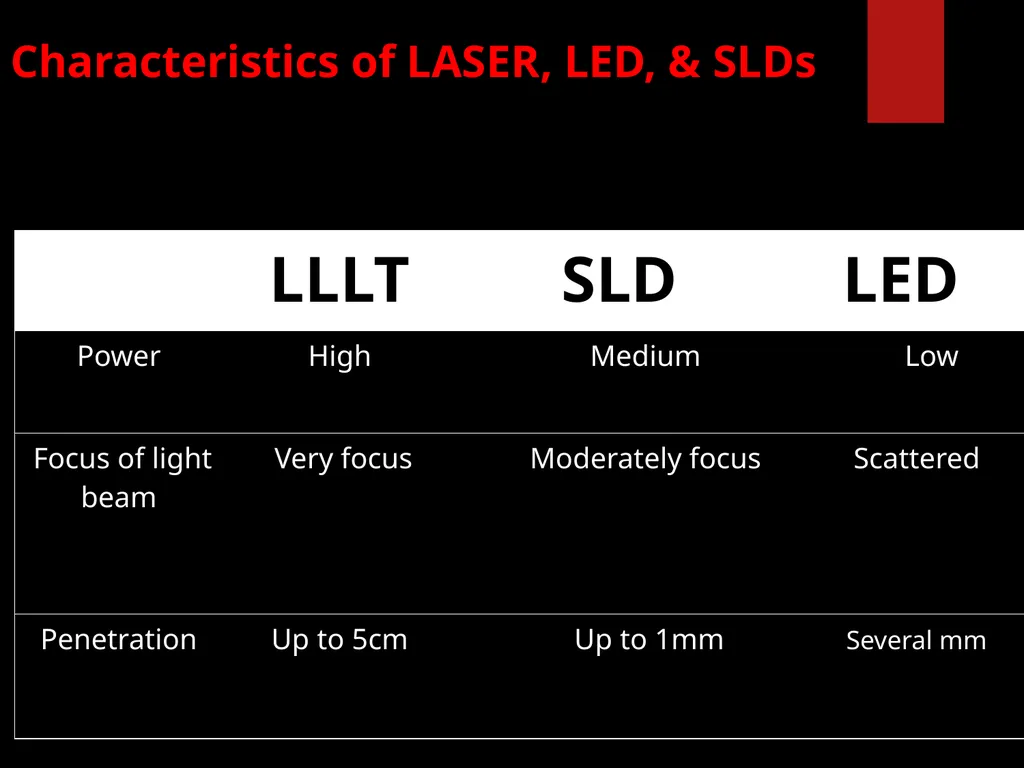
Characteristics of LASER, LED, & SLDs<br>
11
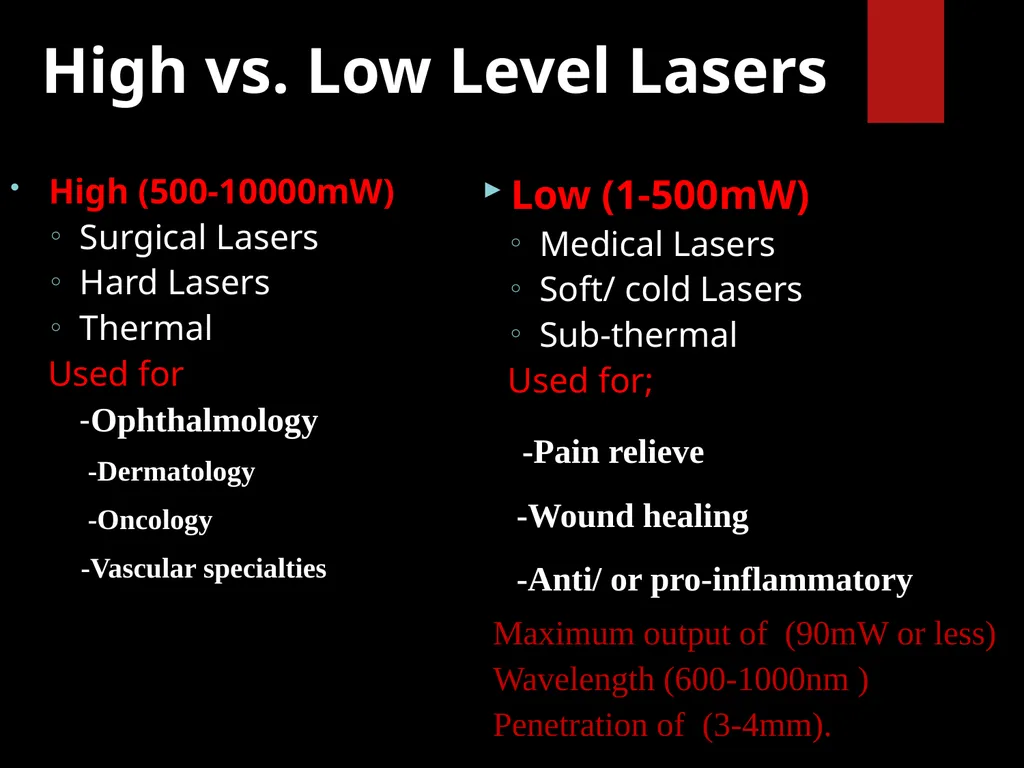
High vs. Low Level Lasers High (500-10000mW)
Surgical Lasers
Hard Lasers
Thermal
Used for
-Ophthalmology
-Dermatology
-Oncology
-Vascular specialties Low (1-500mW)
Medical Lasers
Soft/ cold Lasers
Sub-thermal
Used for;
-Pain relieve
-Wound healing
-Anti/ or pro-inflammatory Maximum output of (90mW or less)
Wavelength (600-1000nm )
Penetration of (3-4mm).<br>
Surgical Lasers
Hard Lasers
Thermal
Used for
-Ophthalmology
-Dermatology
-Oncology
-Vascular specialties Low (1-500mW)
Medical Lasers
Soft/ cold Lasers
Sub-thermal
Used for;
-Pain relieve
-Wound healing
-Anti/ or pro-inflammatory Maximum output of (90mW or less)
Wavelength (600-1000nm )
Penetration of (3-4mm).<br>
12
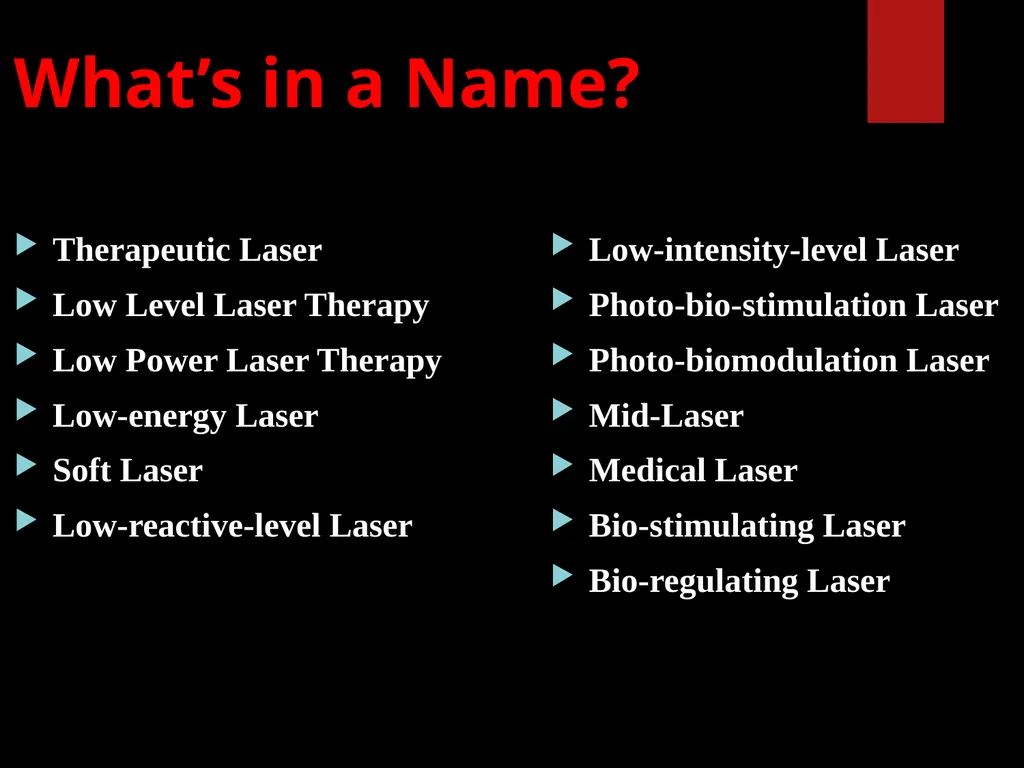
What’s in a Name? Therapeutic Laser
Low Level Laser Therapy
Low Power Laser Therapy
Low-energy Laser
Soft Laser
Low-reactive-level Laser Low-intensity-level Laser
Photo-bio-stimulation Laser
Photo-biomodulation Laser
Mid-Laser
Medical Laser
Bio-stimulating Laser
Bio-regulating Laser<br>
Low Level Laser Therapy
Low Power Laser Therapy
Low-energy Laser
Soft Laser
Low-reactive-level Laser Low-intensity-level Laser
Photo-bio-stimulation Laser
Photo-biomodulation Laser
Mid-Laser
Medical Laser
Bio-stimulating Laser
Bio-regulating Laser<br>
13
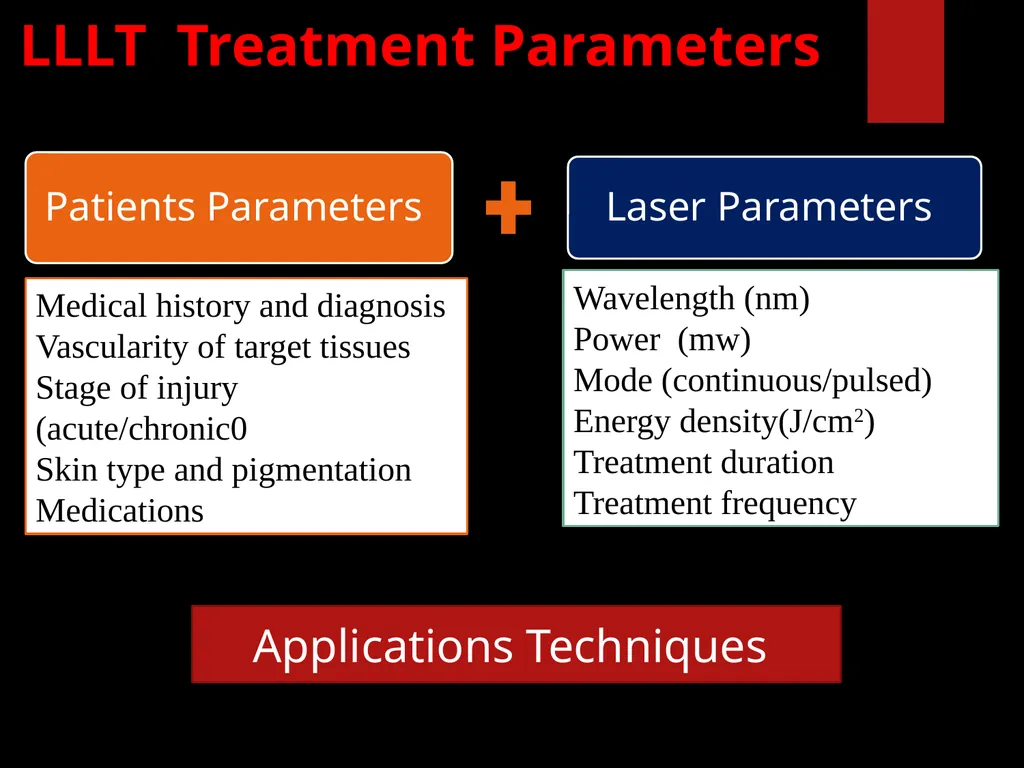
LLLT Treatment Parameters Wavelength (nm)
Power (mw)
Mode (continuous/pulsed)
Energy density(J/cm2)
Treatment duration
Treatment frequency Medical history and diagnosis
Vascularity of target tissues
Stage of injury (acute/chronic0
Skin type and pigmentation
Medications Applications Techniques<br>
Power (mw)
Mode (continuous/pulsed)
Energy density(J/cm2)
Treatment duration
Treatment frequency Medical history and diagnosis
Vascularity of target tissues
Stage of injury (acute/chronic0
Skin type and pigmentation
Medications Applications Techniques<br>
14
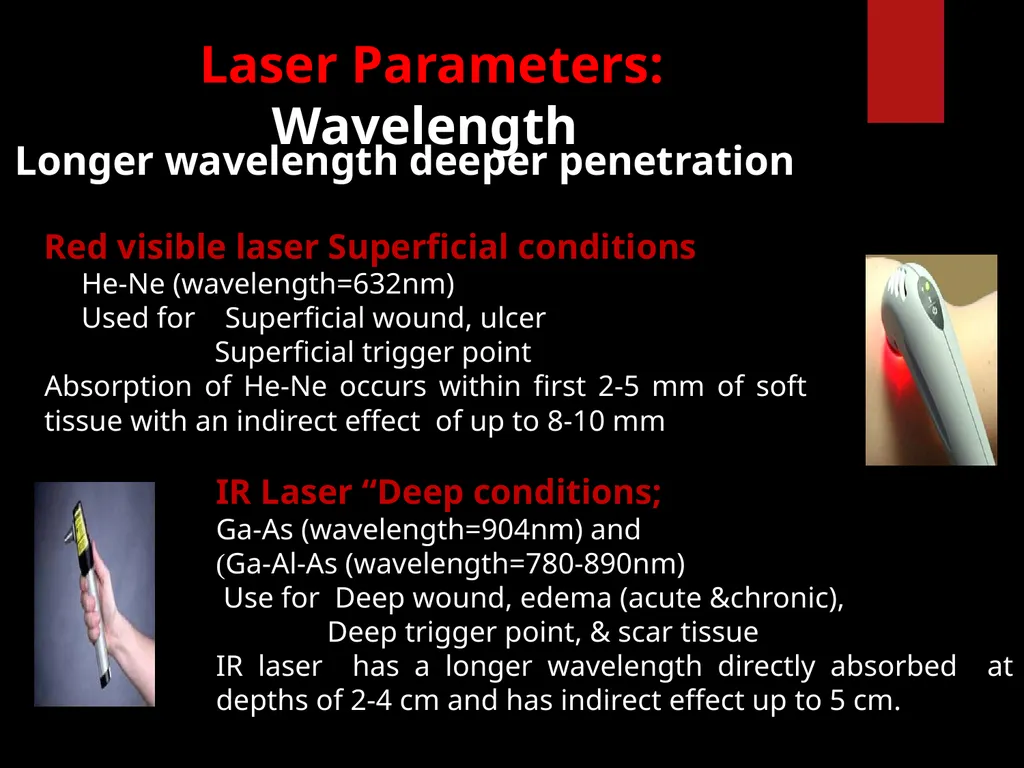
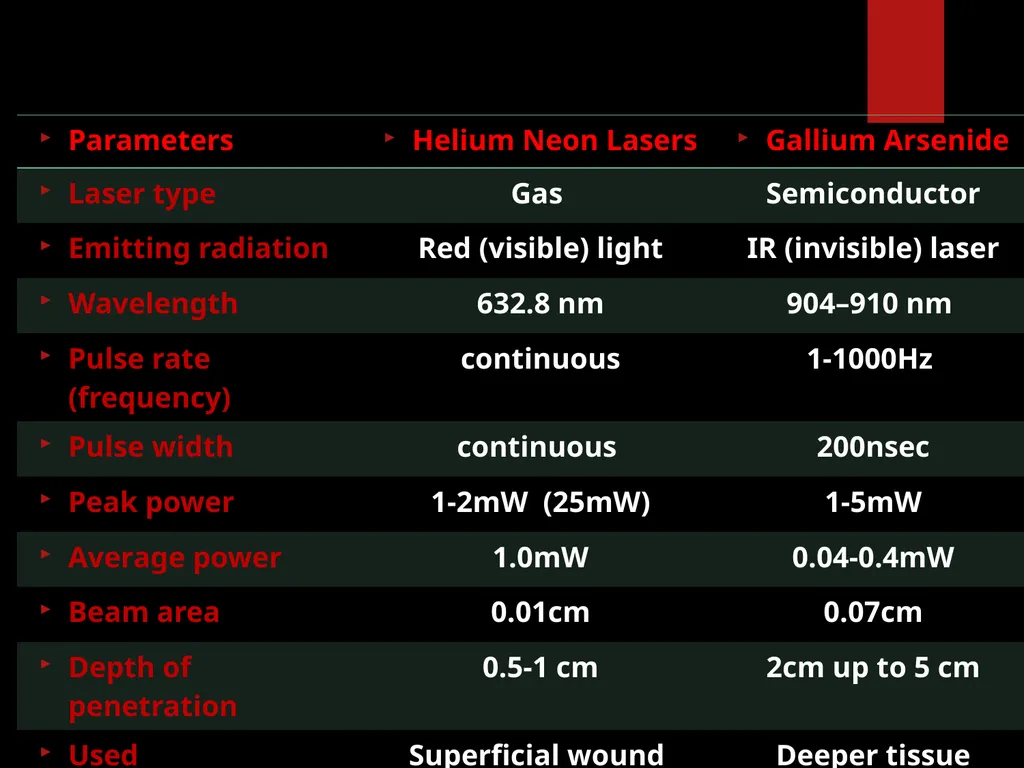
Laser Parameters: Wavelength Longer wavelength deeper penetration Red visible laser Superficial conditions
He-Ne (wavelength=632nm)
Used for Superficial wound, ulcer
Superficial trigger point
Absorption of He-Ne occurs within first 2-5 mm of soft tissue with an indirect effect of up to 8-10 mm IR Laser “Deep conditions;
Ga-As (wavelength=904nm) and
(Ga-Al-As (wavelength=780-890nm)
Use for Deep wound, edema (acute &chronic),
Deep trigger point, & scar tissue
IR laser has a longer wavelength directly absorbed at depths of 2-4 cm and has indirect effect up to 5 cm.<br>
He-Ne (wavelength=632nm)
Used for Superficial wound, ulcer
Superficial trigger point
Absorption of He-Ne occurs within first 2-5 mm of soft tissue with an indirect effect of up to 8-10 mm IR Laser “Deep conditions;
Ga-As (wavelength=904nm) and
(Ga-Al-As (wavelength=780-890nm)
Use for Deep wound, edema (acute &chronic),
Deep trigger point, & scar tissue
IR laser has a longer wavelength directly absorbed at depths of 2-4 cm and has indirect effect up to 5 cm.<br>
15
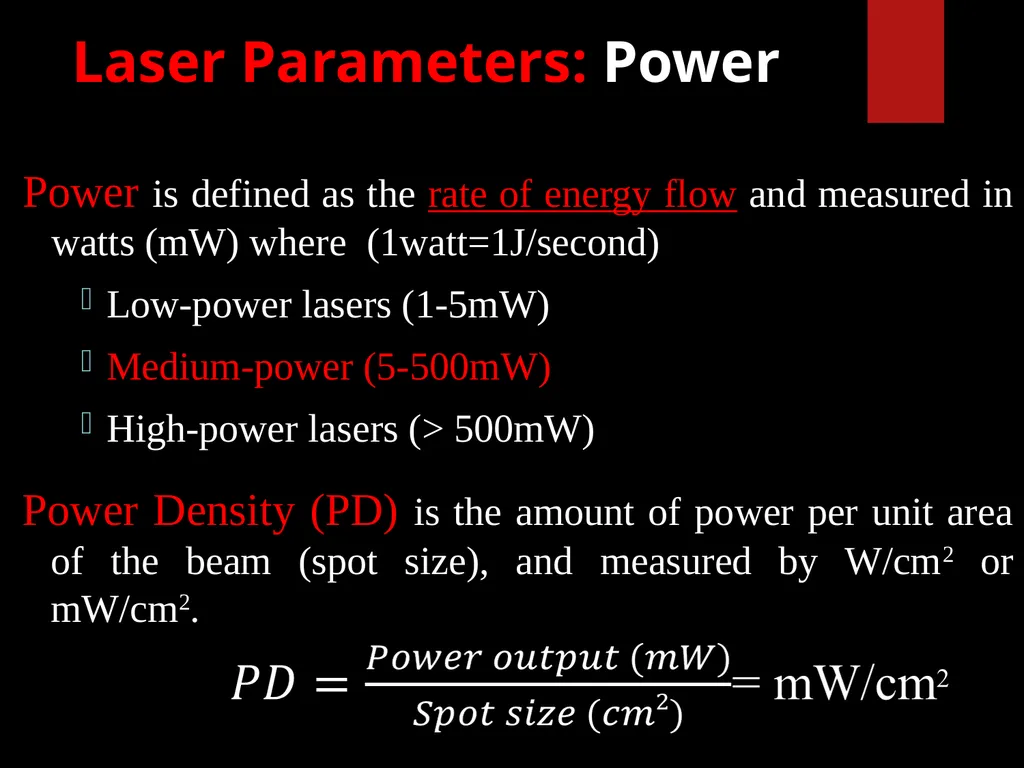
Laser Parameters: Power Power is defined as the rate of energy flow and measured in watts (mW) where (1watt=1J/second)
Low-power lasers (1-5mW)
Medium-power (5-500mW)
High-power lasers (> 500mW) Power Density (PD) is the amount of power per unit area of the beam (spot size), and measured by W/cm2 or mW/cm2.<br>
Low-power lasers (1-5mW)
Medium-power (5-500mW)
High-power lasers (> 500mW) Power Density (PD) is the amount of power per unit area of the beam (spot size), and measured by W/cm2 or mW/cm2.<br>
16
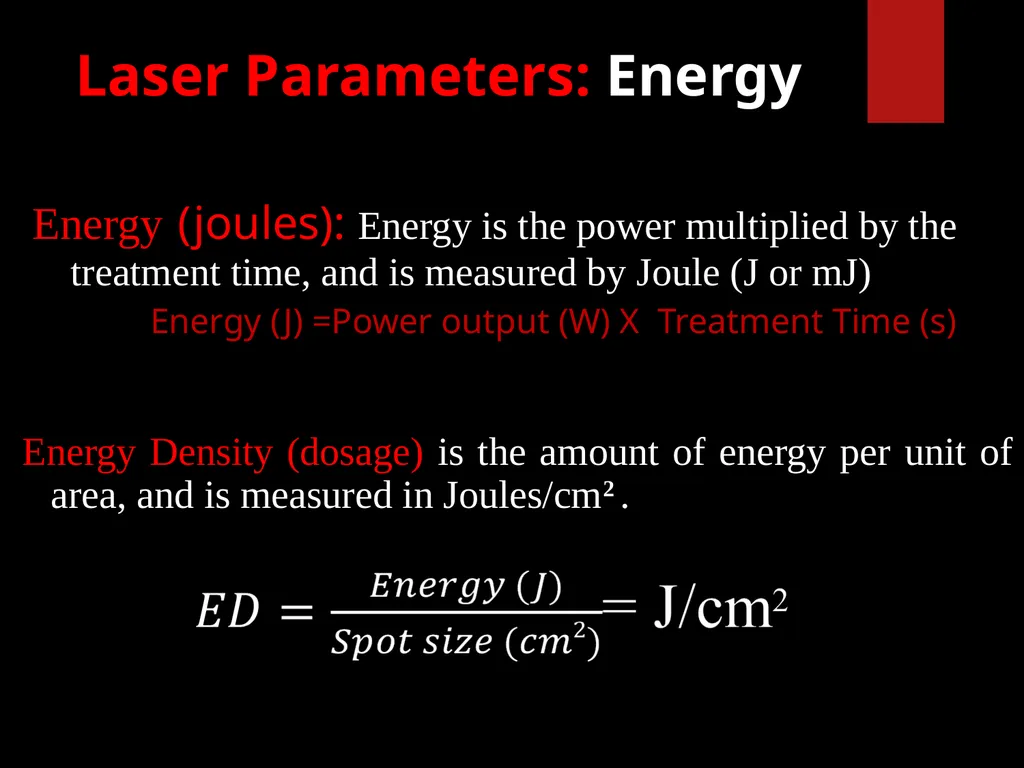
Energy (joules): Energy is the power multiplied by the treatment time, and is measured by Joule (J or mJ)
Energy (J) =Power output (W) X Treatment Time (s) Laser Parameters: Energy Energy Density (dosage) is the amount of energy per unit of area, and is measured in Joules/cm2 .<br>
Energy (J) =Power output (W) X Treatment Time (s) Laser Parameters: Energy Energy Density (dosage) is the amount of energy per unit of area, and is measured in Joules/cm2 .<br>
17
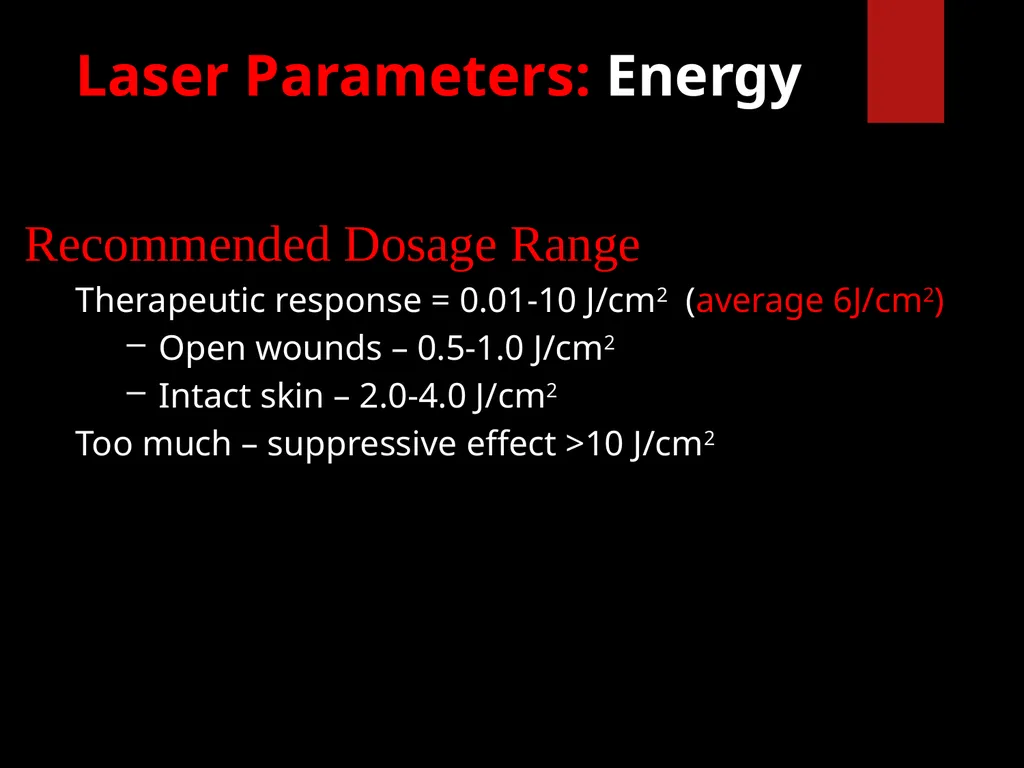
Recommended Dosage Range
Therapeutic response = 0.01-10 J/cm2 (average 6J/cm2)
Open wounds – 0.5-1.0 J/cm2
Intact skin – 2.0-4.0 J/cm2
Too much – suppressive effect >10 J/cm2 Laser Parameters: Energy<br>
Therapeutic response = 0.01-10 J/cm2 (average 6J/cm2)
Open wounds – 0.5-1.0 J/cm2
Intact skin – 2.0-4.0 J/cm2
Too much – suppressive effect >10 J/cm2 Laser Parameters: Energy<br>
18
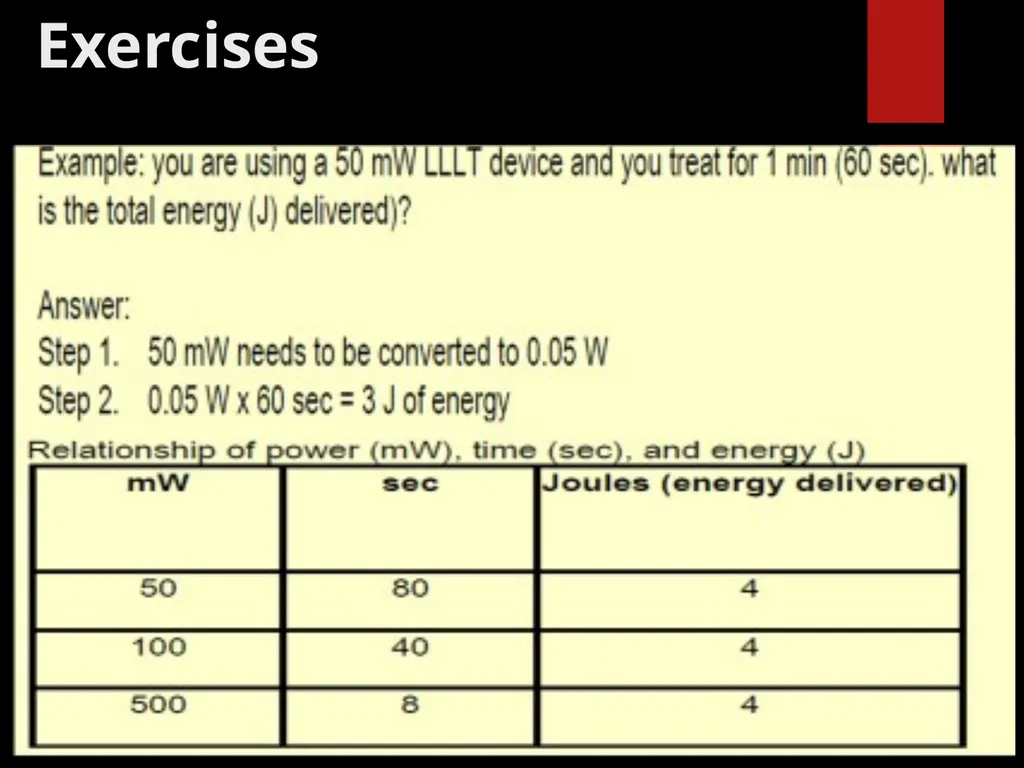
Exercises<br>
19
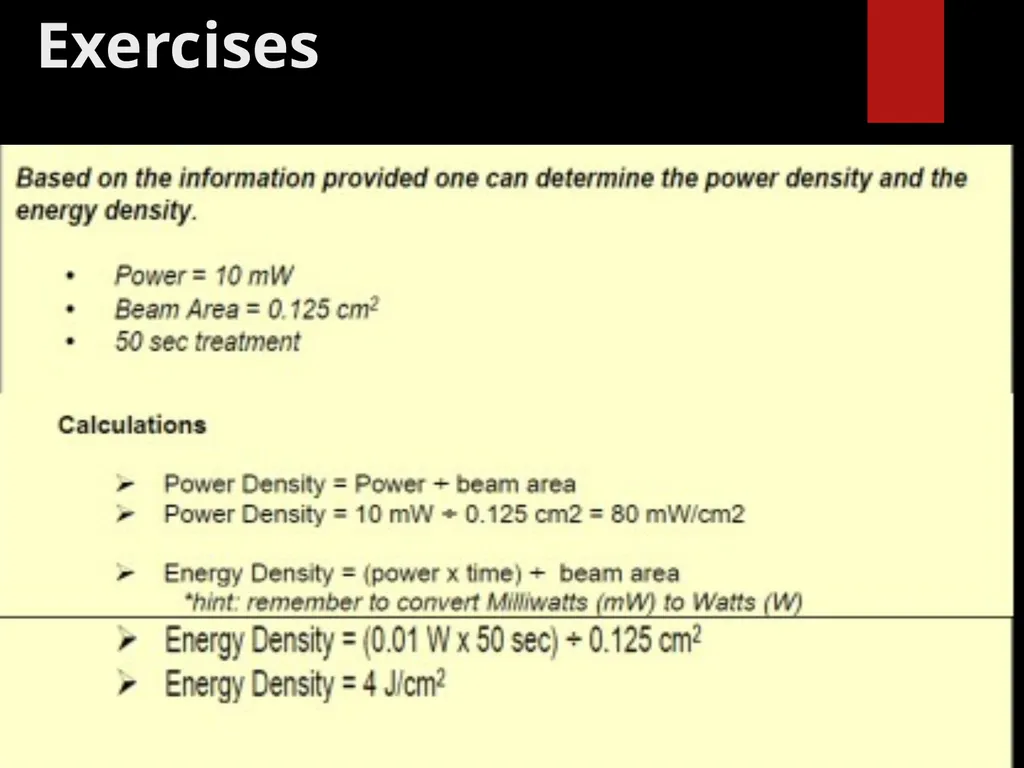
Exercises<br>
20
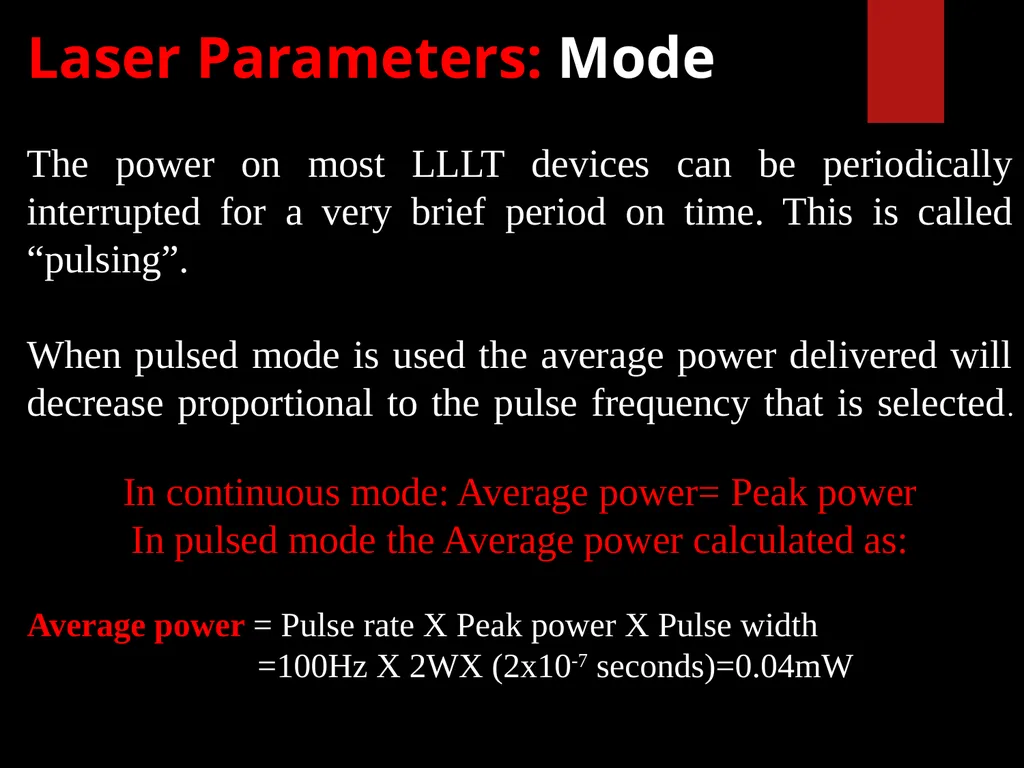
Laser Parameters: Mode The power on most LLLT devices can be periodically interrupted for a very brief period on time. This is called “pulsing”.
When pulsed mode is used the average power delivered will decrease proportional to the pulse frequency that is selected. In continuous mode: Average power= Peak power
In pulsed mode the Average power calculated as:
Average power = Pulse rate X Peak power X Pulse width
=100Hz X 2WX (2x10-7 seconds)=0.04mW<br>
When pulsed mode is used the average power delivered will decrease proportional to the pulse frequency that is selected. In continuous mode: Average power= Peak power
In pulsed mode the Average power calculated as:
Average power = Pulse rate X Peak power X Pulse width
=100Hz X 2WX (2x10-7 seconds)=0.04mW<br>
21
Laser Parameters
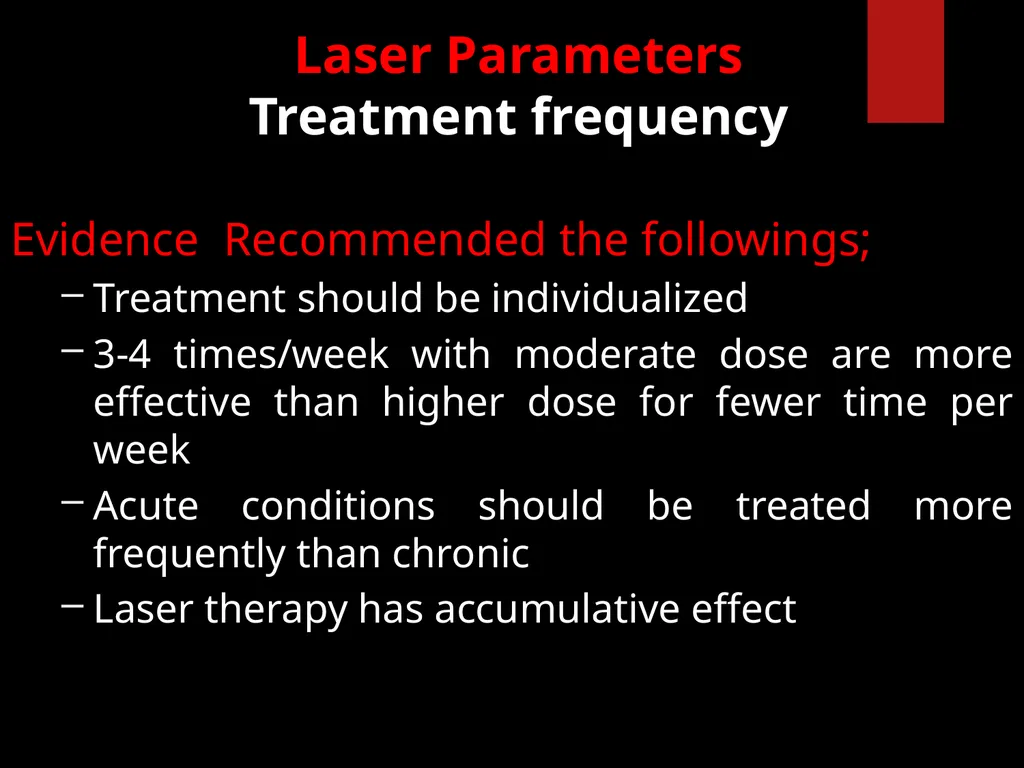
Treatment frequency Evidence Recommended the followings;
Treatment should be individualized
3-4 times/week with moderate dose are more effective than higher dose for fewer time per week
Acute conditions should be treated more frequently than chronic
Laser therapy has accumulative effect<br>
Treatment should be individualized
3-4 times/week with moderate dose are more effective than higher dose for fewer time per week
Acute conditions should be treated more frequently than chronic
Laser therapy has accumulative effect<br>
22
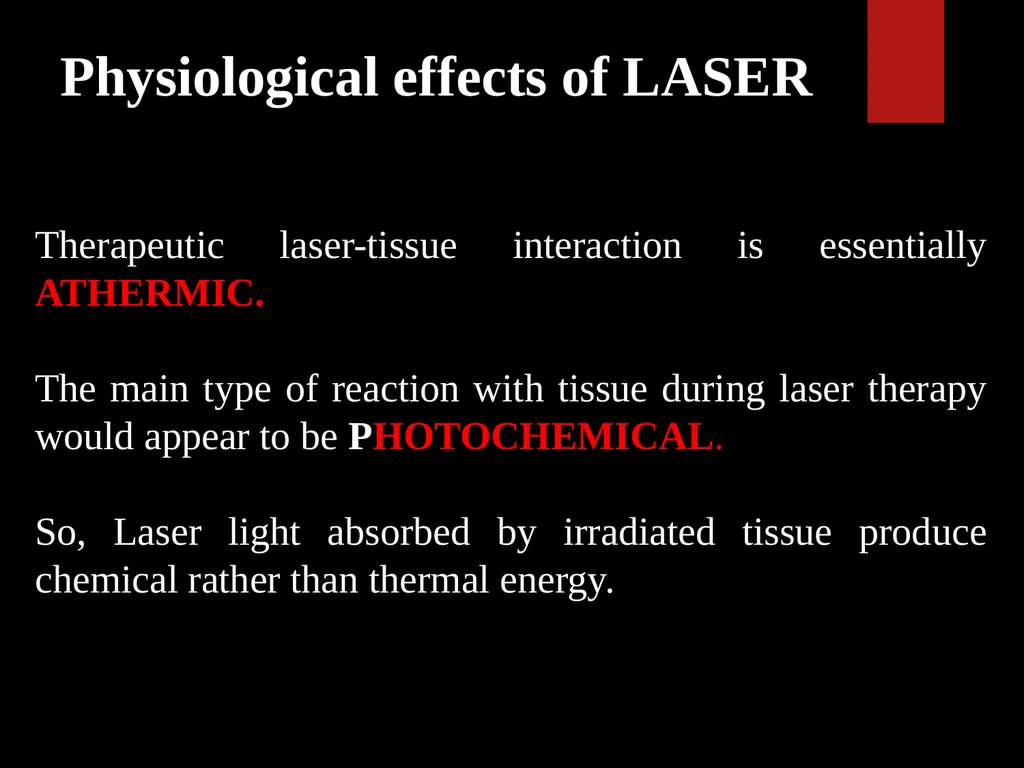
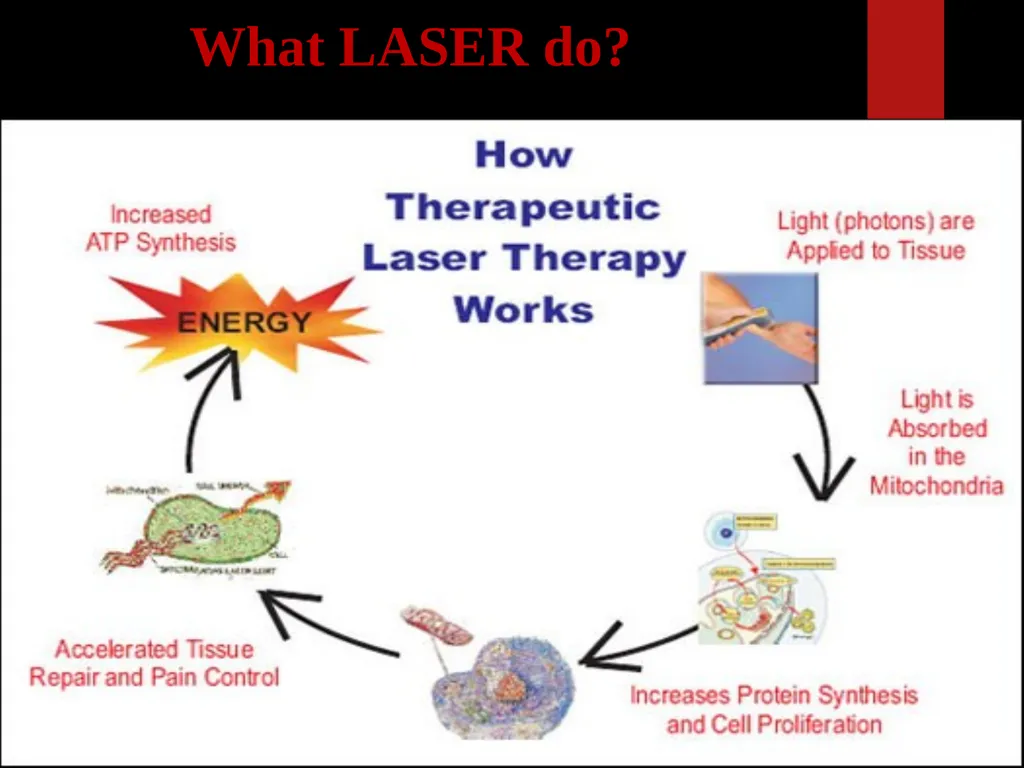
Physiological effects of LASER Therapeutic laser-tissue interaction is essentially ATHERMIC.
The main type of reaction with tissue during laser therapy would appear to be PHOTOCHEMICAL.
So, Laser light absorbed by irradiated tissue produce chemical rather than thermal energy.<br>
The main type of reaction with tissue during laser therapy would appear to be PHOTOCHEMICAL.
So, Laser light absorbed by irradiated tissue produce chemical rather than thermal energy.<br>
23
What LASER do?<br>
24
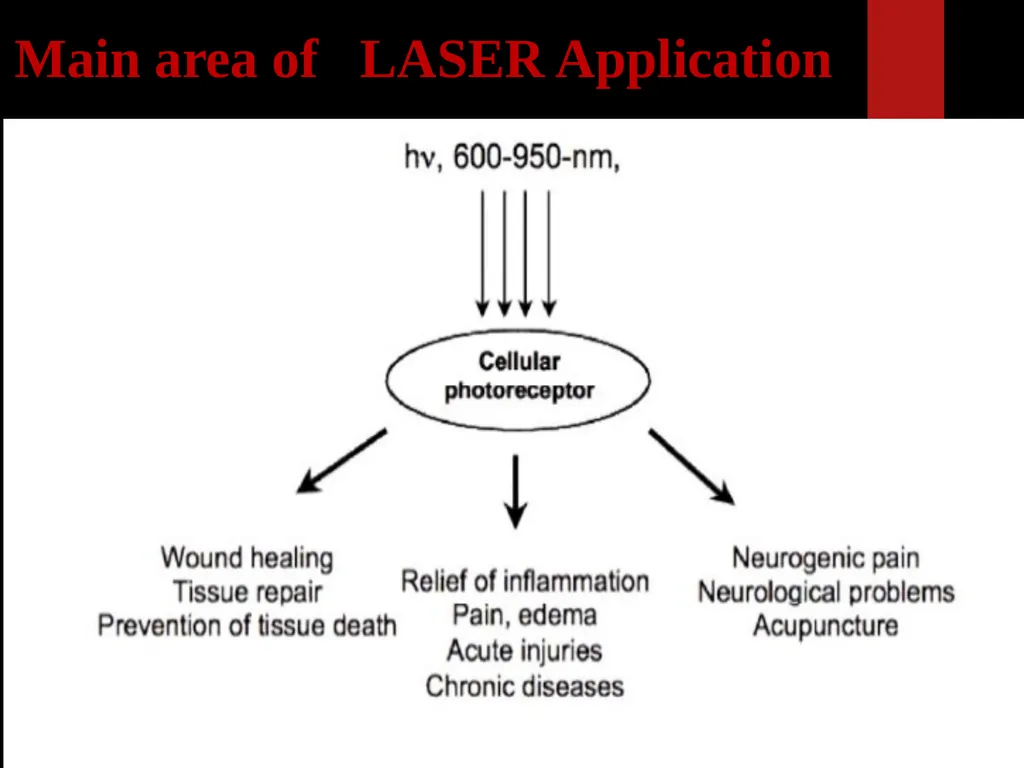
Main area of LASER Application<br>
25
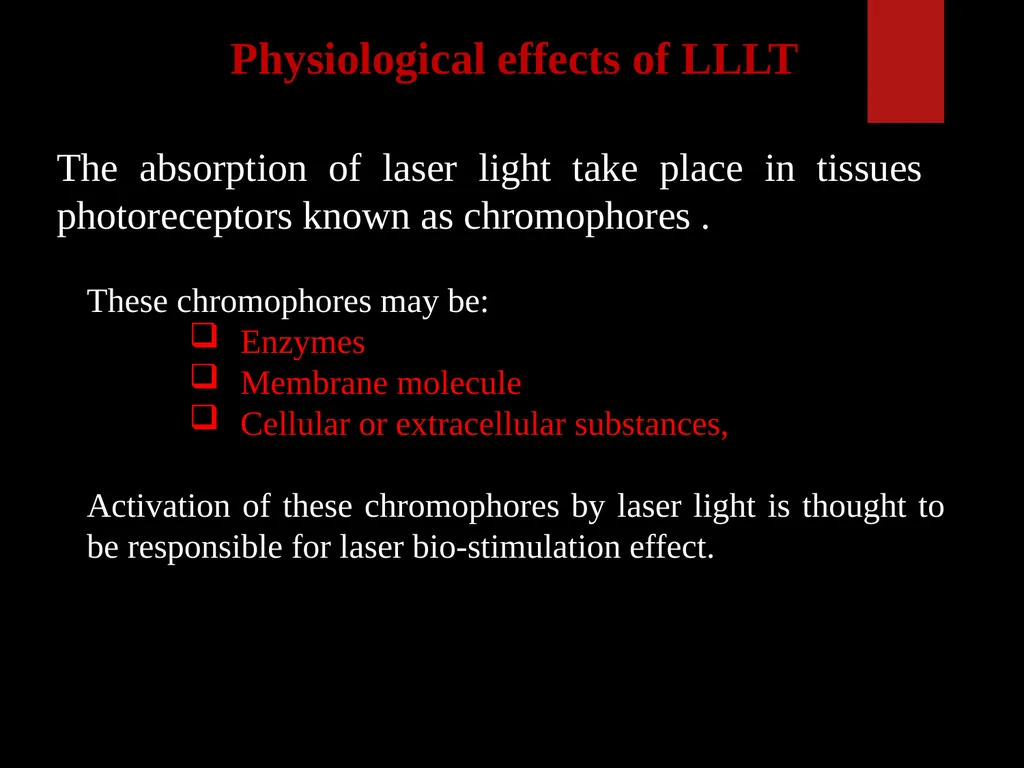
Physiological effects of LLLT These chromophores may be:
Enzymes
Membrane molecule
Cellular or extracellular substances,
Activation of these chromophores by laser light is thought to be responsible for laser bio-stimulation effect. The absorption of laser light take place in tissues photoreceptors known as chromophores .<br>
Enzymes
Membrane molecule
Cellular or extracellular substances,
Activation of these chromophores by laser light is thought to be responsible for laser bio-stimulation effect. The absorption of laser light take place in tissues photoreceptors known as chromophores .<br>
26
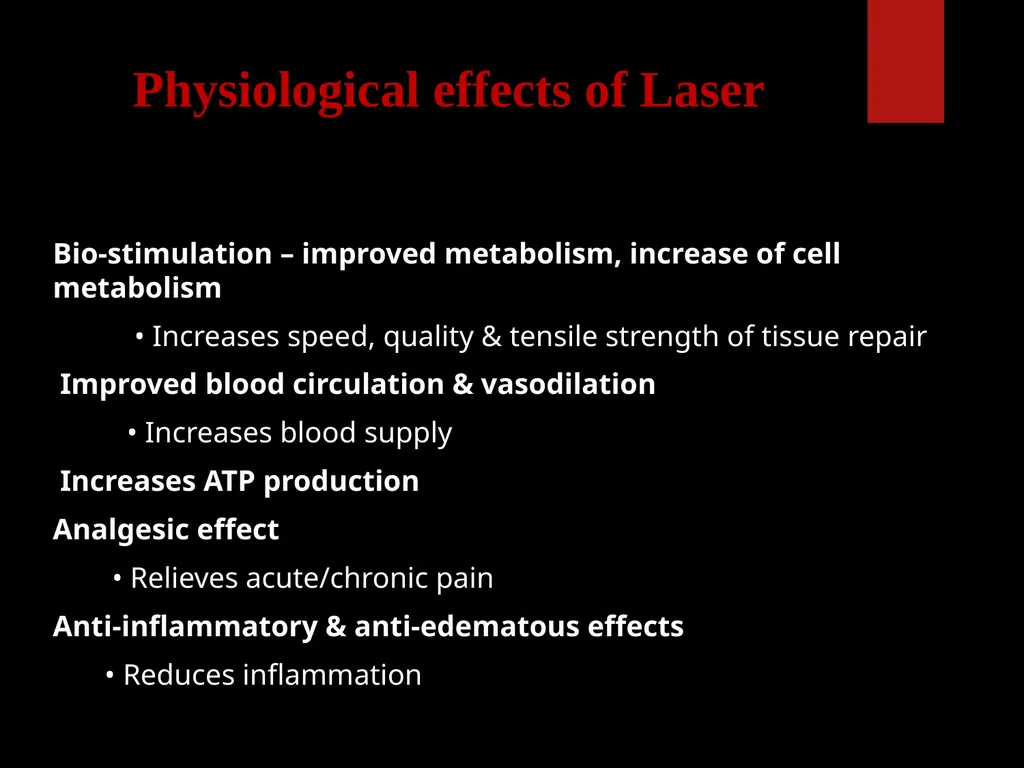
Bio-stimulation – improved metabolism, increase of cell metabolism
• Increases speed, quality & tensile strength of tissue repair
Improved blood circulation & vasodilation
• Increases blood supply
Increases ATP production
Analgesic effect
• Relieves acute/chronic pain
Anti-inflammatory & anti-edematous effects
• Reduces inflammation Physiological effects of Laser<br>
• Increases speed, quality & tensile strength of tissue repair
Improved blood circulation & vasodilation
• Increases blood supply
Increases ATP production
Analgesic effect
• Relieves acute/chronic pain
Anti-inflammatory & anti-edematous effects
• Reduces inflammation Physiological effects of Laser<br>
27
Stimulation of wound healing
• Promotes faster wound healing/clot formation
• Helps generate new & healthy cells & tissue
Increase collagen production
• Develops collagen & muscle tissue
Increase macrophage activity
• Stimulates immune system
Alter nerve conduction velocity
• Stimulates nerve function Physiological effects of Laser<br>
• Promotes faster wound healing/clot formation
• Helps generate new & healthy cells & tissue
Increase collagen production
• Develops collagen & muscle tissue
Increase macrophage activity
• Stimulates immune system
Alter nerve conduction velocity
• Stimulates nerve function Physiological effects of Laser<br>
28
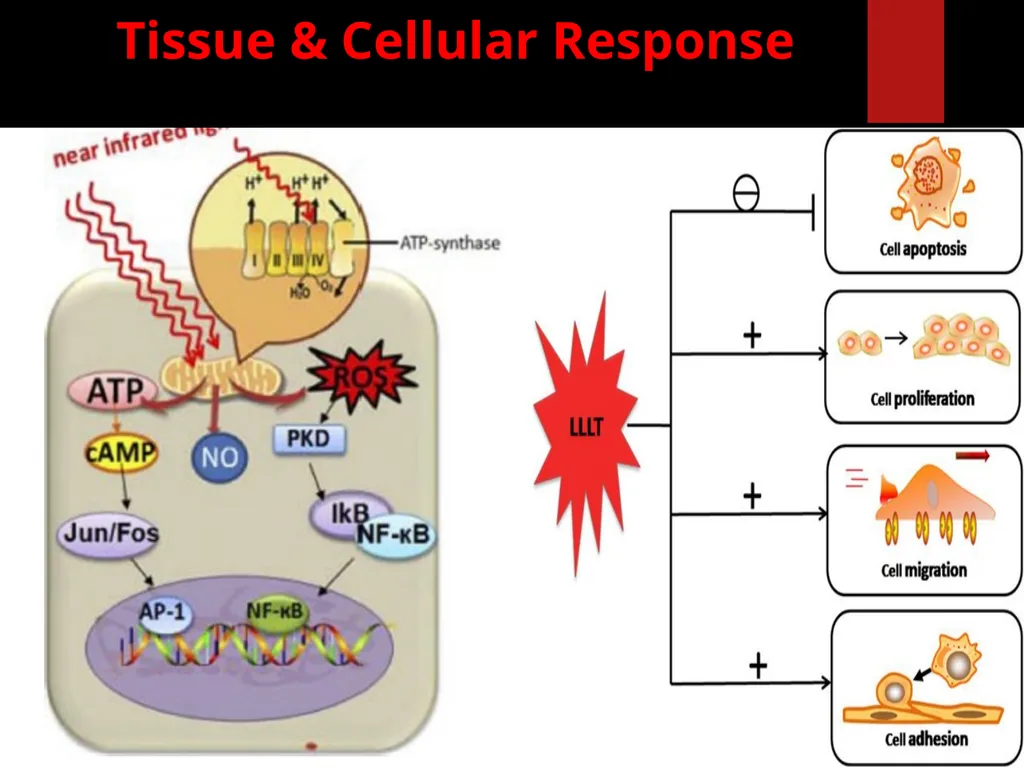
Tissue & Cellular Response<br>
29
Tissue & Cellular Response Magnitude of tissue’s reaction are based on physical
characteristics of:
Output wavelength/frequency
Density of power
Duration of treatment
Vascularity of target tissues
• Direct effect - occurs from absorption of photons
• Indirect effect – produced by chemical events caused by
interaction of photons emitted from laser & the tissues<br>
characteristics of:
Output wavelength/frequency
Density of power
Duration of treatment
Vascularity of target tissues
• Direct effect - occurs from absorption of photons
• Indirect effect – produced by chemical events caused by
interaction of photons emitted from laser & the tissues<br>
30
Indications Pain control ; (acute & chronic)
Pain secondary to soft tissue injuries ( sprain. Strain, bursitis)
Osteoarthritis, Rheumatoid Arthritis, & low back pain
Neurogenic Pain (trigeminal , post-herpetic, neuralgia)
Acupuncture & trigger point pain application. Soft tissue healing in following conditions;
Pressure Ulcers, Diabetic foot
Burn wound
Postoperative wound care.
Fracture healing ? Inflammatory conditions
Post traumatic peripheral nerve injury.
Edema reduction
Scar tissue remodeling .<br>
Pain secondary to soft tissue injuries ( sprain. Strain, bursitis)
Osteoarthritis, Rheumatoid Arthritis, & low back pain
Neurogenic Pain (trigeminal , post-herpetic, neuralgia)
Acupuncture & trigger point pain application. Soft tissue healing in following conditions;
Pressure Ulcers, Diabetic foot
Burn wound
Postoperative wound care.
Fracture healing ? Inflammatory conditions
Post traumatic peripheral nerve injury.
Edema reduction
Scar tissue remodeling .<br>
31
Contraindications & Precautions Application over eyes
Over or around Cancer
Over pregnant uterus
Over & around thyroid gland & endocrine glands
Patients who pre-treated with photosensitizers drugs
Over area or radiotherapy Over cardiac region
Vogues nerve
Growth plates in children
Fever
Infected tissue
Epilepsy
Confused/disoriented patients<br>
Over or around Cancer
Over pregnant uterus
Over & around thyroid gland & endocrine glands
Patients who pre-treated with photosensitizers drugs
Over area or radiotherapy Over cardiac region
Vogues nerve
Growth plates in children
Fever
Infected tissue
Epilepsy
Confused/disoriented patients<br>
32
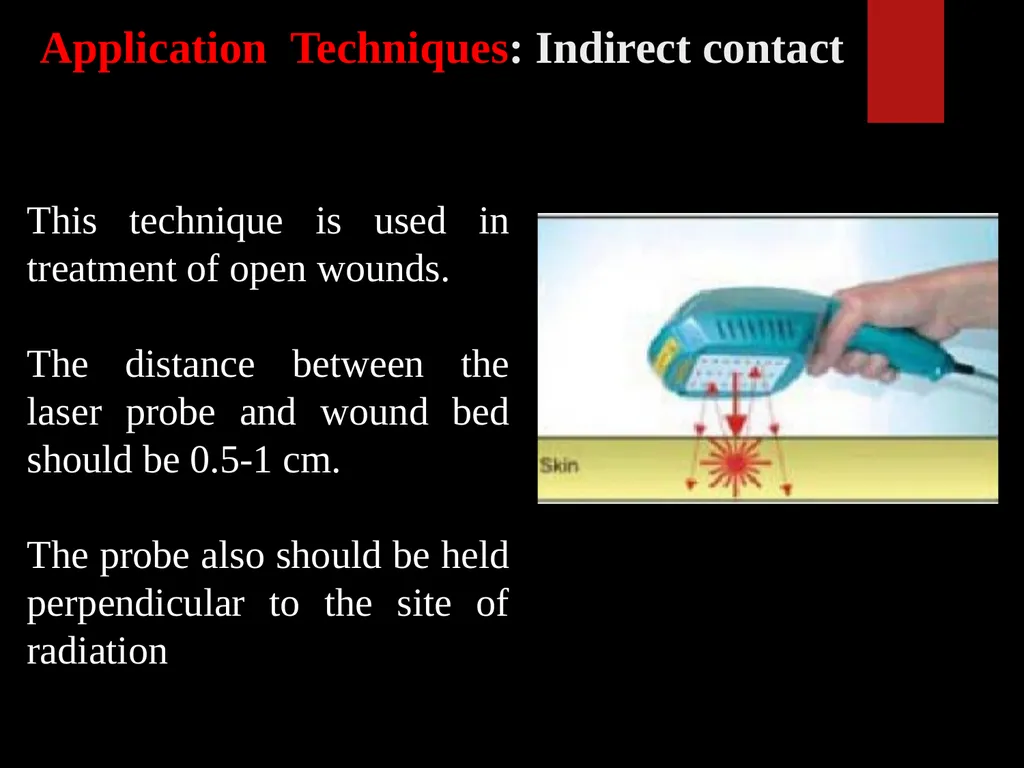
This technique is used in treatment of open wounds.
The distance between the laser probe and wound bed should be 0.5-1 cm.
The probe also should be held perpendicular to the site of radiation Application Techniques: Indirect contact<br>
The distance between the laser probe and wound bed should be 0.5-1 cm.
The probe also should be held perpendicular to the site of radiation Application Techniques: Indirect contact<br>
33
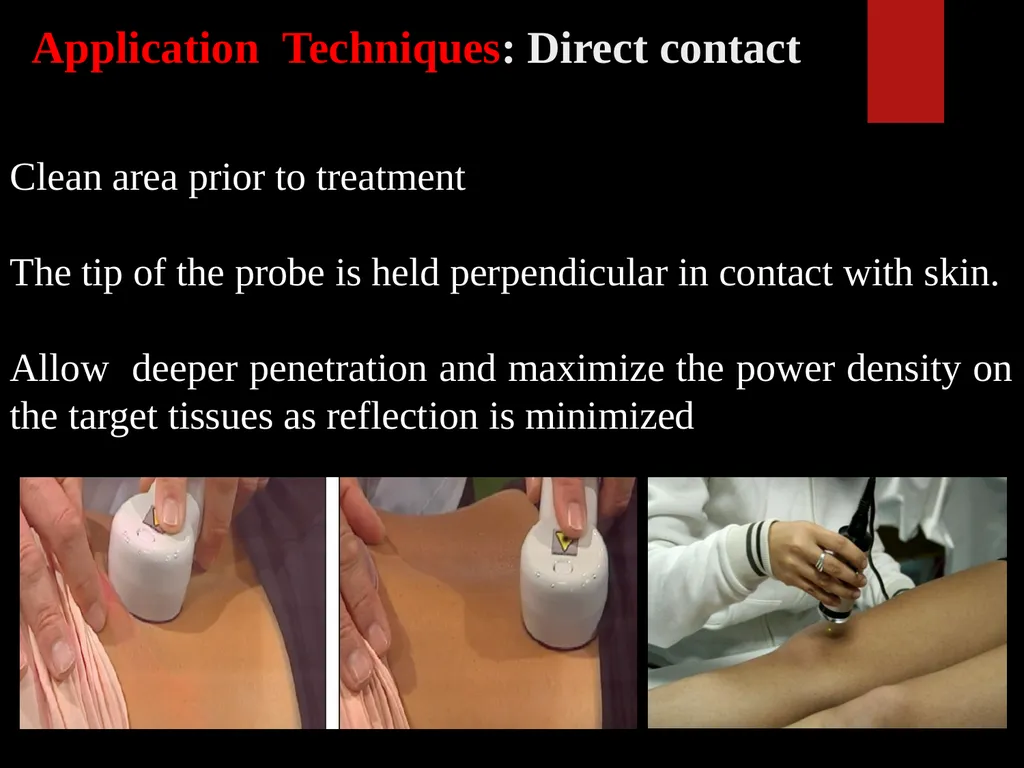
Clean area prior to treatment
The tip of the probe is held perpendicular in contact with skin.
Allow deeper penetration and maximize the power density on the target tissues as reflection is minimized Application Techniques: Direct contact<br>
The tip of the probe is held perpendicular in contact with skin.
Allow deeper penetration and maximize the power density on the target tissues as reflection is minimized Application Techniques: Direct contact<br>
34
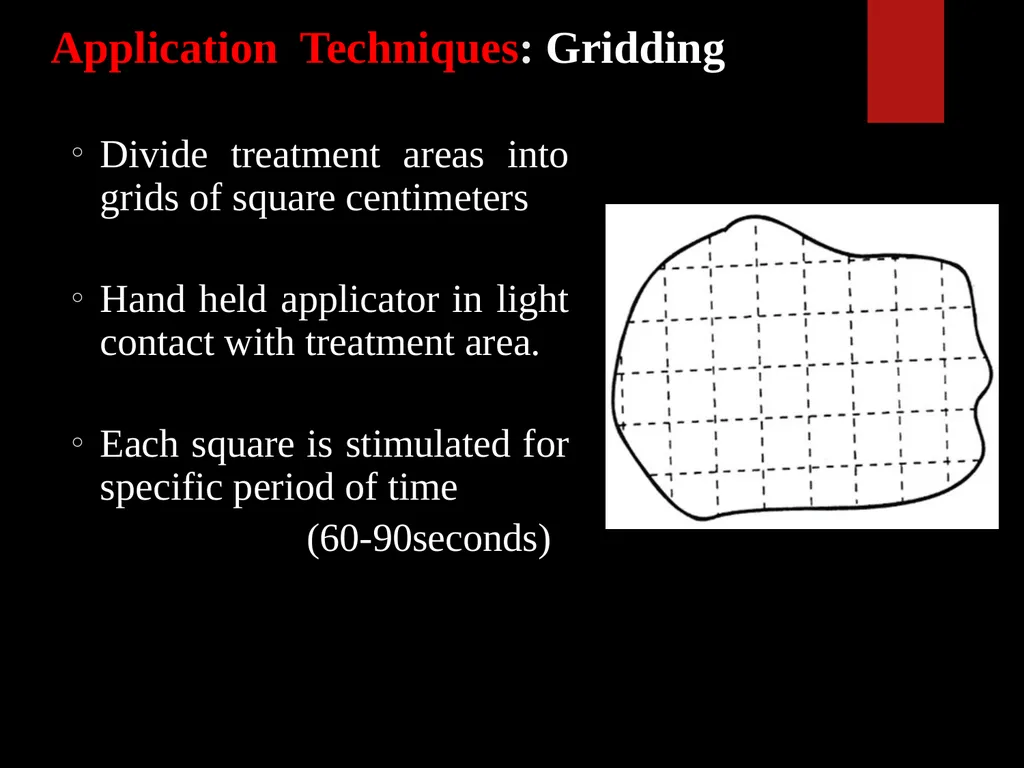
Application Techniques: Gridding Divide treatment areas into grids of square centimeters
Hand held applicator in light contact with treatment area.
Each square is stimulated for specific period of time
(60-90seconds)<br>
Hand held applicator in light contact with treatment area.
Each square is stimulated for specific period of time
(60-90seconds)<br>
35
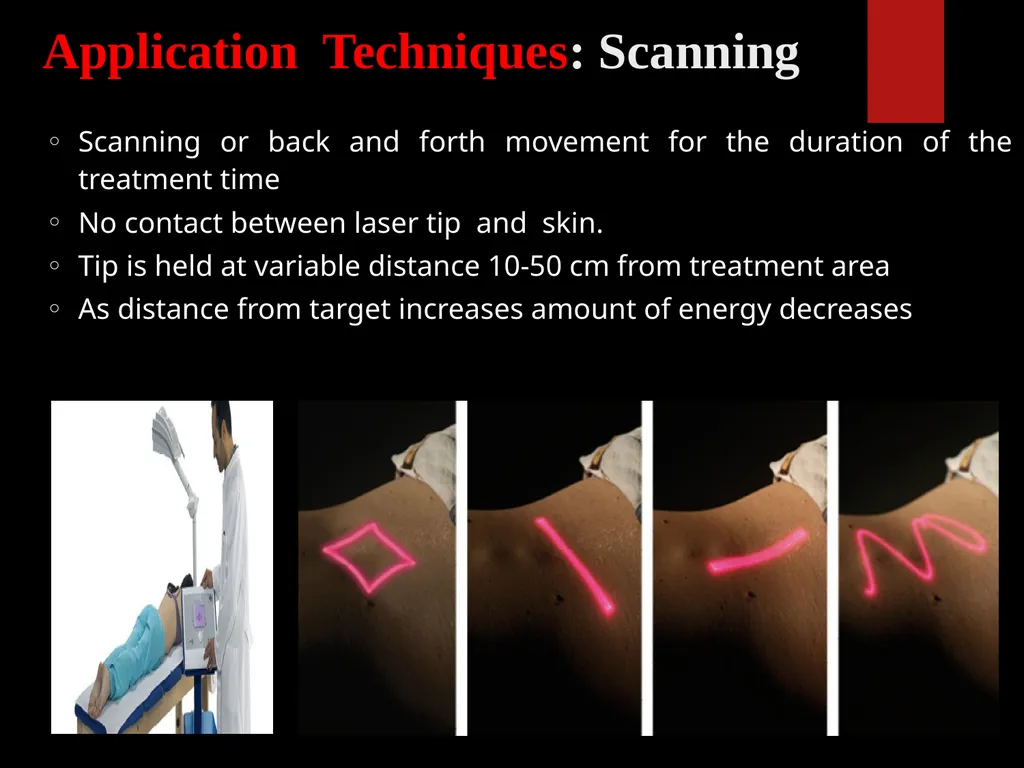
Application Techniques: Scanning Scanning or back and forth movement for the duration of the treatment time
No contact between laser tip and skin.
Tip is held at variable distance 10-50 cm from treatment area
As distance from target increases amount of energy decreases<br>
No contact between laser tip and skin.
Tip is held at variable distance 10-50 cm from treatment area
As distance from target increases amount of energy decreases<br>
36
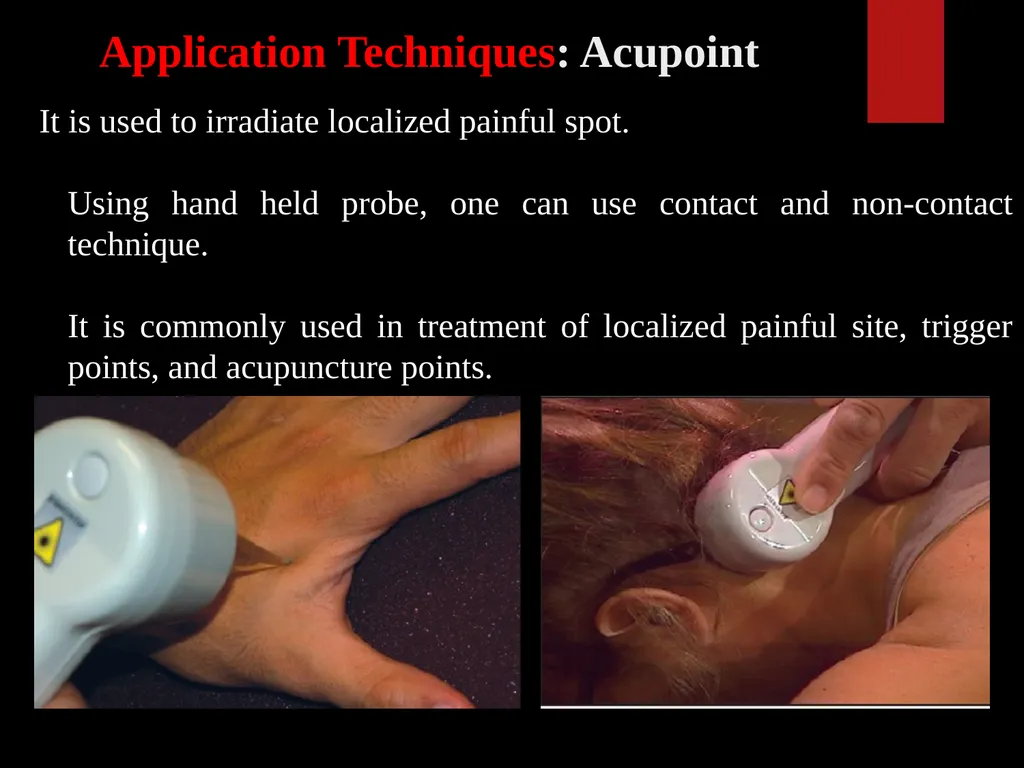
Application Techniques: Acupoint It is used to irradiate localized painful spot.
Using hand held probe, one can use contact and non-contact technique.
It is commonly used in treatment of localized painful site, trigger points, and acupuncture points.<br>
Using hand held probe, one can use contact and non-contact technique.
It is commonly used in treatment of localized painful site, trigger points, and acupuncture points.<br>
37
Better to underexpose than to overexpose
Begin treatment with minimal and gradually increase
Avoid direct exposure into eyes (If lasing for extended periods of time, safety glasses are recommended)
If icing – use BEFORE phototherapy • Enhances light penetration
If heating – use AFTER phototherapy • Decreases light penetration
Not recommended to combined US and LASER in the same sessions
Medication should be considered e.g. photosensitizers Treatment consideration<br>
Begin treatment with minimal and gradually increase
Avoid direct exposure into eyes (If lasing for extended periods of time, safety glasses are recommended)
If icing – use BEFORE phototherapy • Enhances light penetration
If heating – use AFTER phototherapy • Decreases light penetration
Not recommended to combined US and LASER in the same sessions
Medication should be considered e.g. photosensitizers Treatment consideration<br>
38
Patients Parameters of laser therapy Need medical history & proper diagnosis
Diabetes – may alter clinical efficacy
Medications
Photosensitivity (antibiotics)
Pigmentation
Dark skin absorbs light energy better
Clean skin surface
Wearing goggles<br>
Diabetes – may alter clinical efficacy
Medications
Photosensitivity (antibiotics)
Pigmentation
Dark skin absorbs light energy better
Clean skin surface
Wearing goggles<br>