LP-based Approximation Algorithms for Multi-Vehicle Minimum Latency Problems Chaitanya Swamy University of Waterloo Joint work with Ian Post University of Waterloo Minimum-latency problem (MLP) nodeclient starting rootdepot Find a path P
"LP-based Approximation Algorithms for" is the property of its rightful owner. Permission is granted to
download and print the materials on this website for personal, non-commercial use only, and to display it
on your personal computer provided you do not modify the materials and that you retain all copyright
notices contained in the materials. By downloading content from our website, you accept the terms of this
agreement.
Presentation Transcript
01
LP-based Approximation Algorithms for Multi-Vehicle Minimum Latency Problems Chaitanya Swamy
University of Waterloo
Joint work with Ian Post
University of Waterloo<br>
02
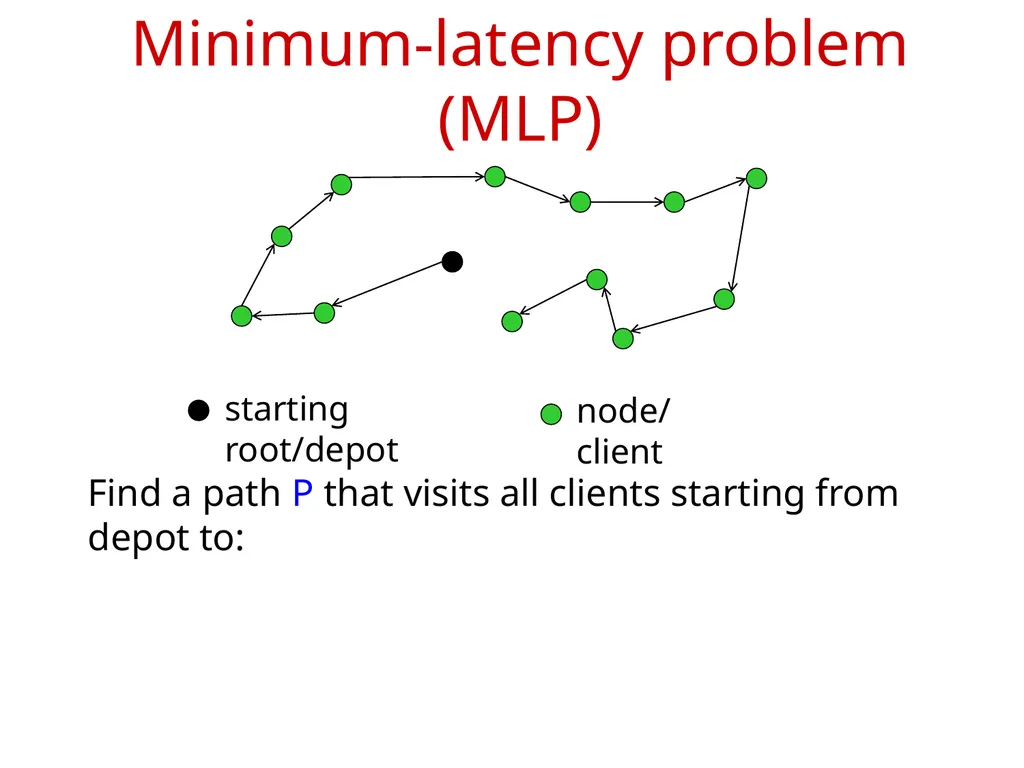
Minimum-latency problem (MLP) node/client starting root/depot Find a path P that visits all clients starting from depot to:<br>
03
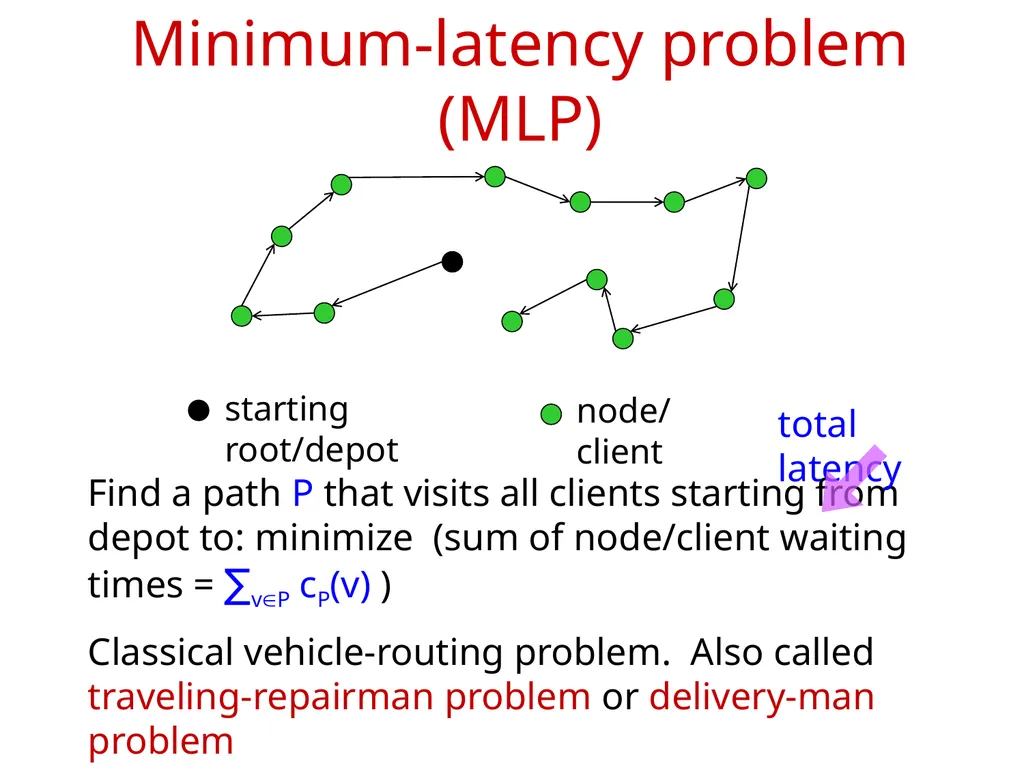
Minimum-latency problem (MLP) node/client starting root/depot Find a path P that visits all clients starting from depot to: minimize (sum of node/client waiting times = ∑vP cP(v) )
Classical vehicle-routing problem. Also called
traveling-repairman problem or delivery-man problem
Problem is hard to approximate better than some constant total latency<br>
04
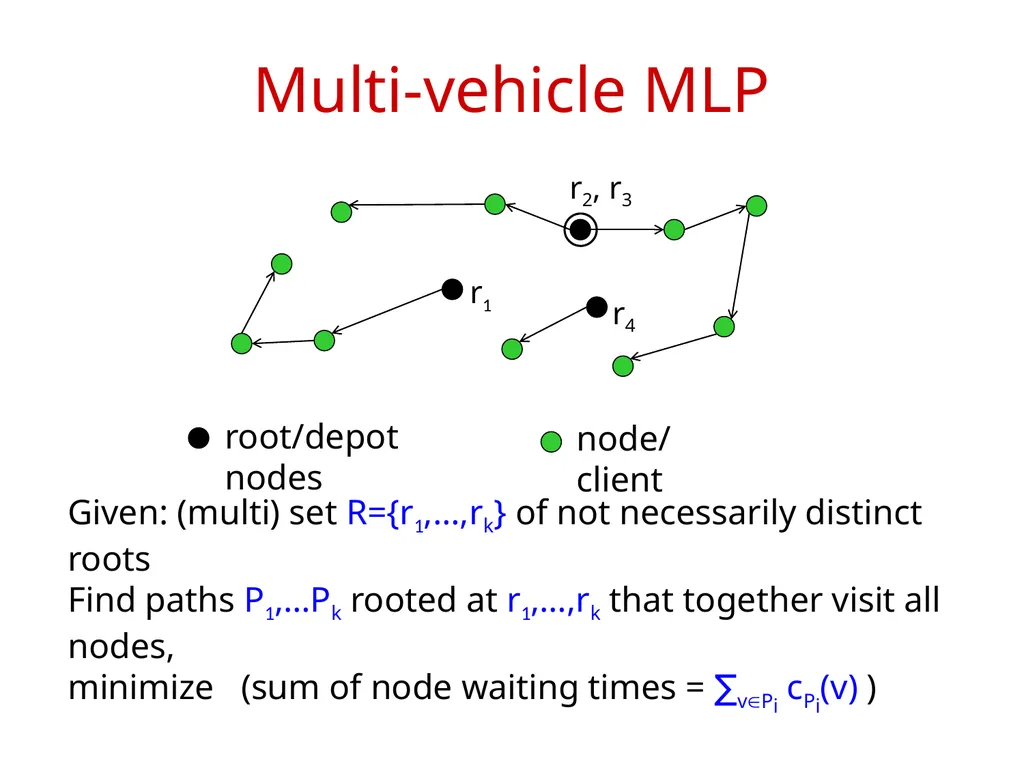
Multi-vehicle MLP node/client root/depot nodes Given: (multi) set R={r1,…,rk} of not necessarily distinct roots
Find paths P1,…Pk rooted at r1,…,rk that together visit all nodes,
minimize (sum of node waiting times = ∑vPi cPi(v) ) r1 r2, r3 r4<br>
05
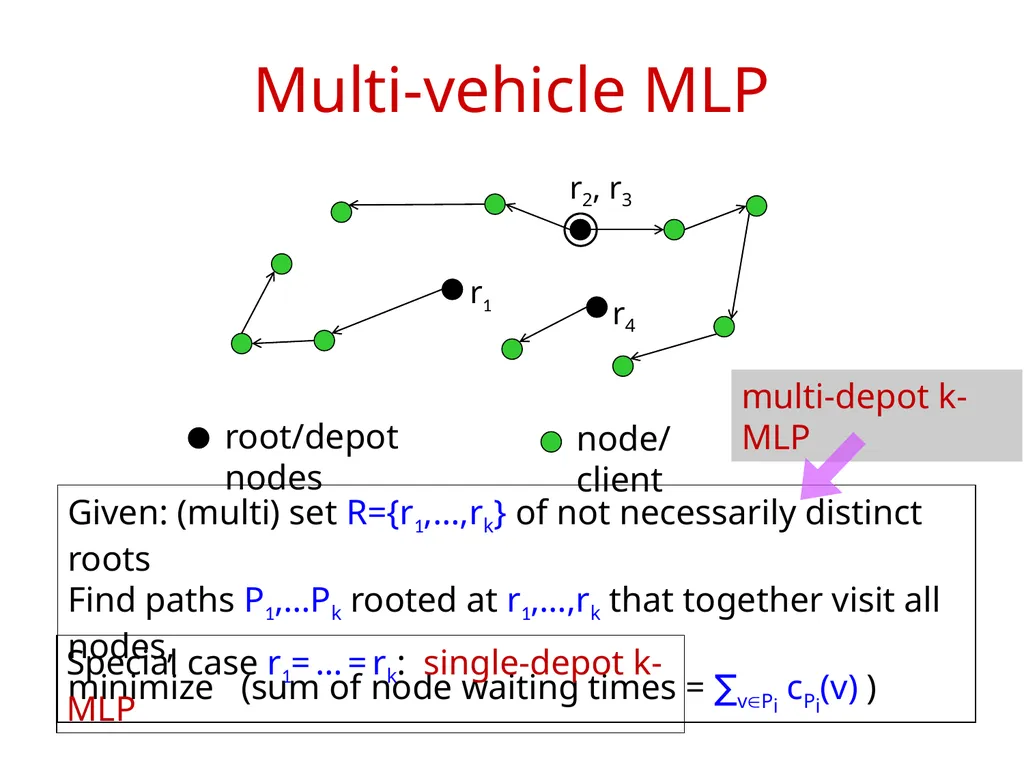
Multi-vehicle MLP root/depot nodes Given: (multi) set R={r1,…,rk} of not necessarily distinct roots
Find paths P1,…Pk rooted at r1,…,rk that together visit all nodes,
minimize (sum of node waiting times = ∑vPi cPi(v) ) r1 r2, r3 r4 multi-depot k-MLP Special case r1= … = rk: single-depot k-MLP node/client<br>
06
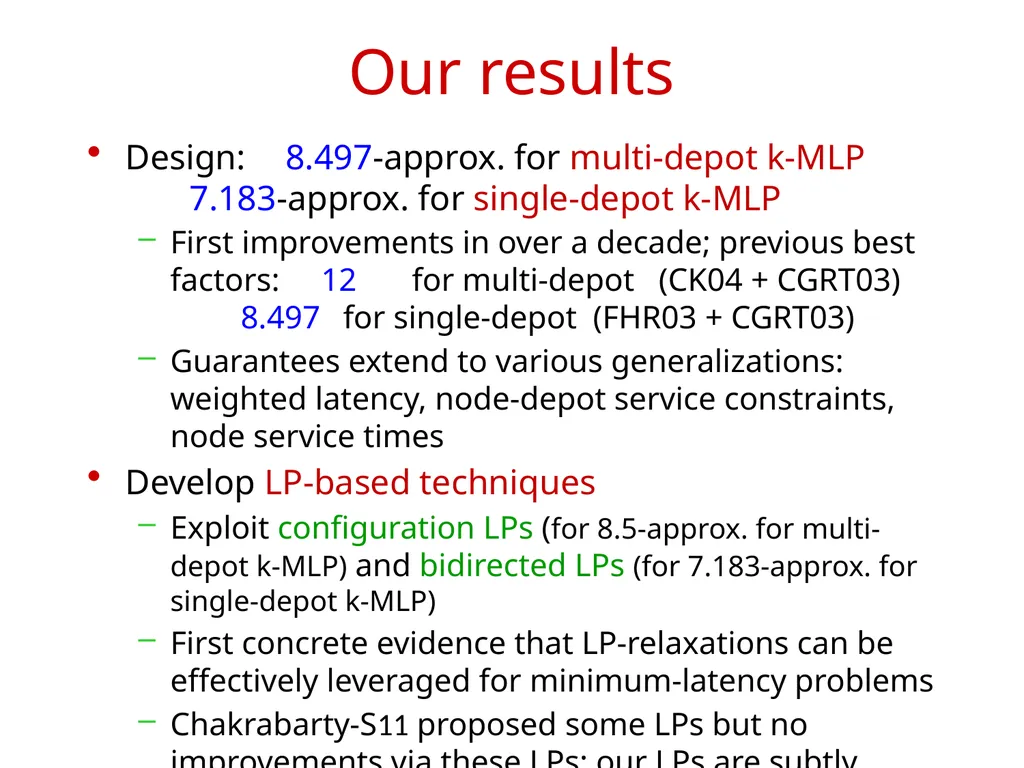
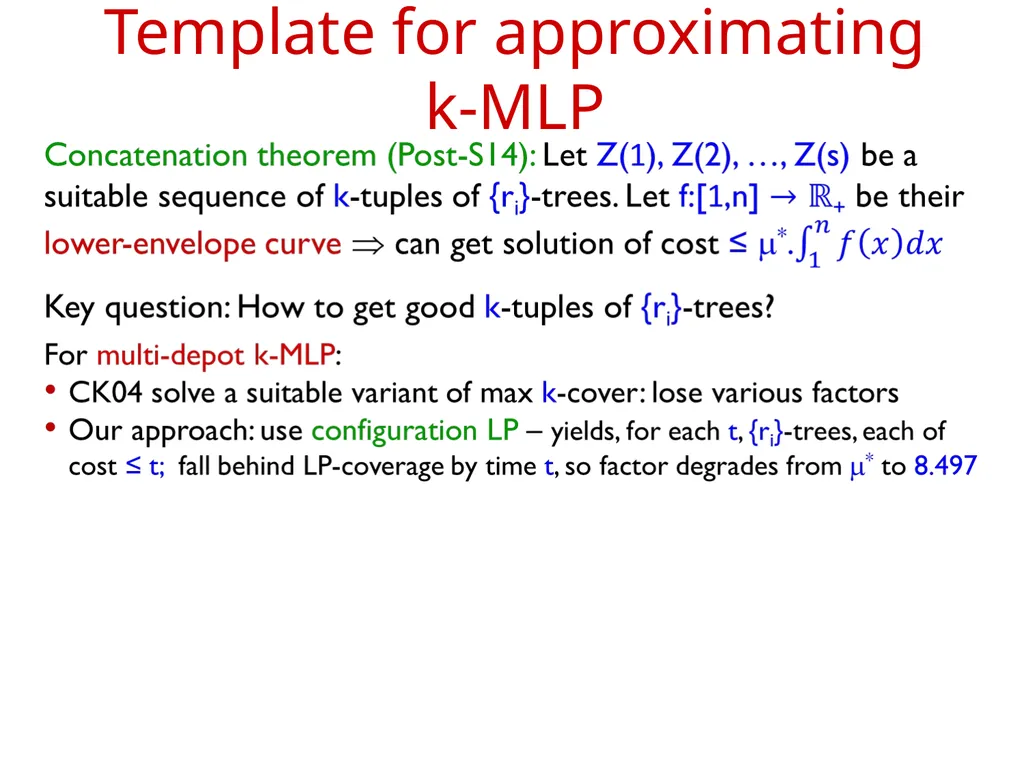
Our results Design: 8.497-approx. for multi-depot k-MLP
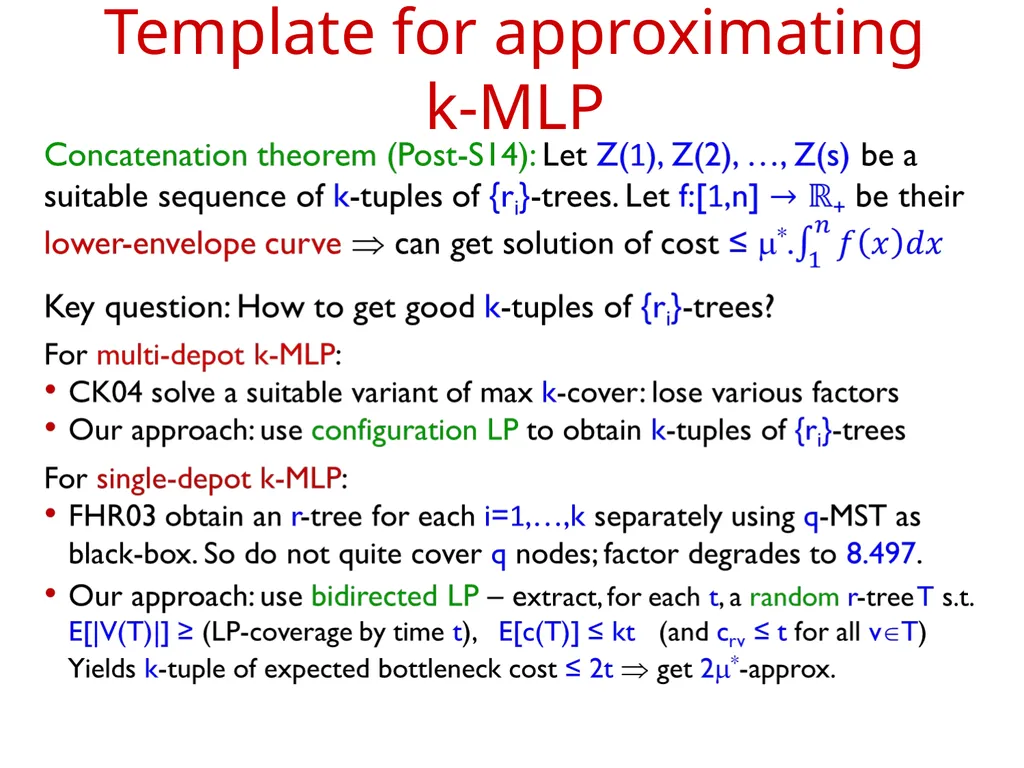
7.183-approx. for single-depot k-MLP
First improvements in over a decade; previous best factors: 12 for multi-depot (CK04 + CGRT03)
8.497 for single-depot (FHR03 + CGRT03)
Guarantees extend to various generalizations: weighted latency, node-depot service constraints, node service times
Develop LP-based techniques
Exploit configuration LPs (for 8.5-approx. for multi-depot k-MLP) and bidirected LPs (for 7.183-approx. for single-depot k-MLP)
First concrete evidence that LP-relaxations can be effectively leveraged for minimum-latency problems
Chakrabarty-S11 proposed some LPs but no improvements via these LPs; our LPs are subtly different, except when k=1<br>
07
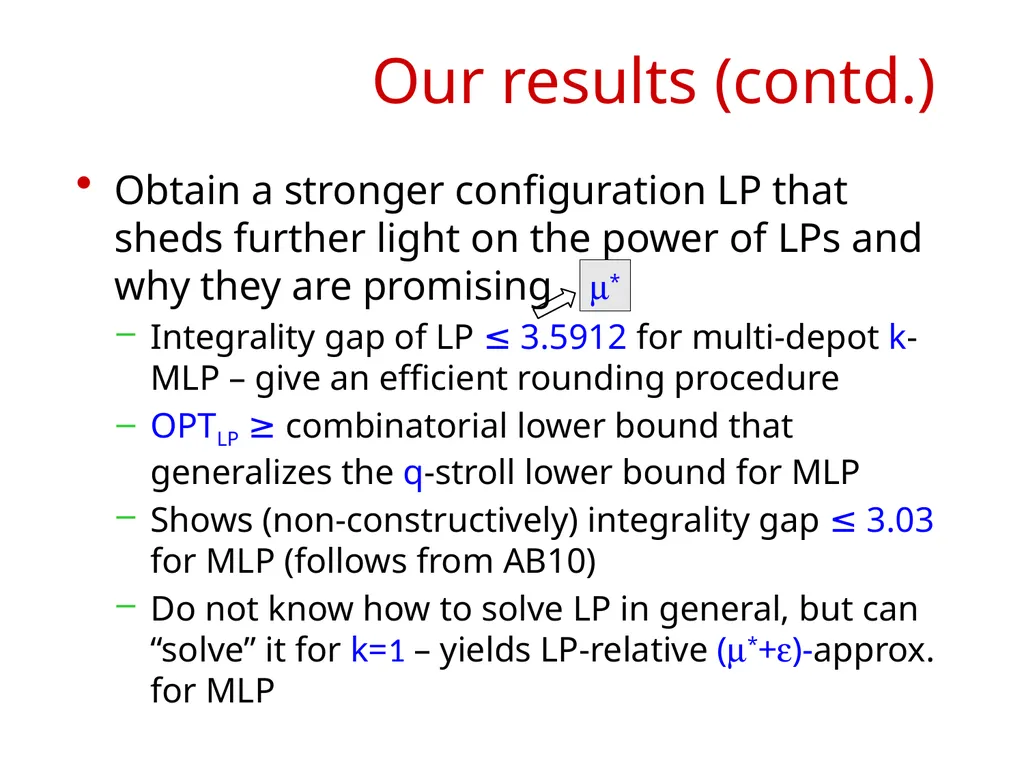
Our results (contd.) Obtain a stronger configuration LP that sheds further light on the power of LPs and why they are promising
Integrality gap of LP ≤ 3.5912 for multi-depot k-MLP – give an efficient rounding procedure
OPTLP ≥ combinatorial lower bound that generalizes the q-stroll lower bound for MLP
Shows (non-constructively) integrality gap ≤ 3.03 for MLP (follows from AB10)
Do not know how to solve LP in general, but can “solve” it for k=1 – yields LP-relative (m*+e)-approx. for MLP m*<br>
08
Our results (contd.) Use bidirected LP to obtain following prize-collecting result of independent interest:<br>
09
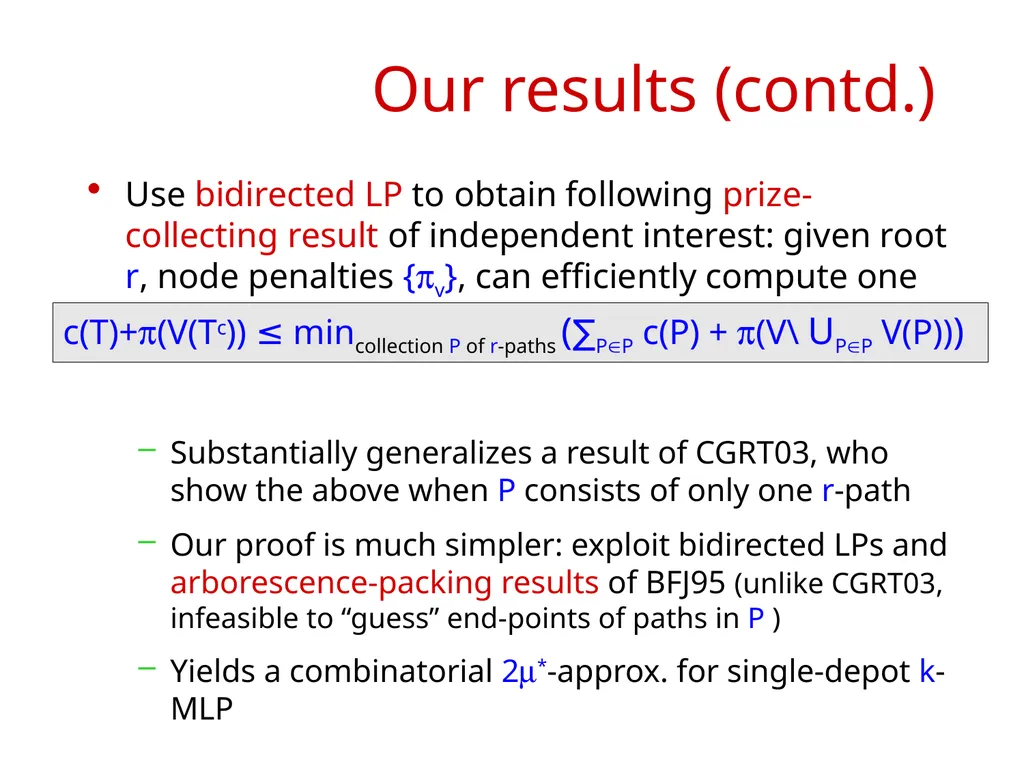
Our results (contd.) Use bidirected LP to obtain following prize-collecting result of independent interest: given root r, node penalties {pv}, can efficiently compute one r-tree T s.t.
Substantially generalizes a result of CGRT03, who show the above when P consists of only one r-path
Our proof is much simpler: exploit bidirected LPs and arborescence-packing results of BFJ95 (unlike CGRT03, infeasible to “guess” end-points of paths in P )
Yields a combinatorial 2m*-approx. for single-depot k-MLP c(T)+p(V(Tc)) ≤ mincollection P of r-paths (∑PP c(P) + p(V\ UPP V(P)))<br>
10
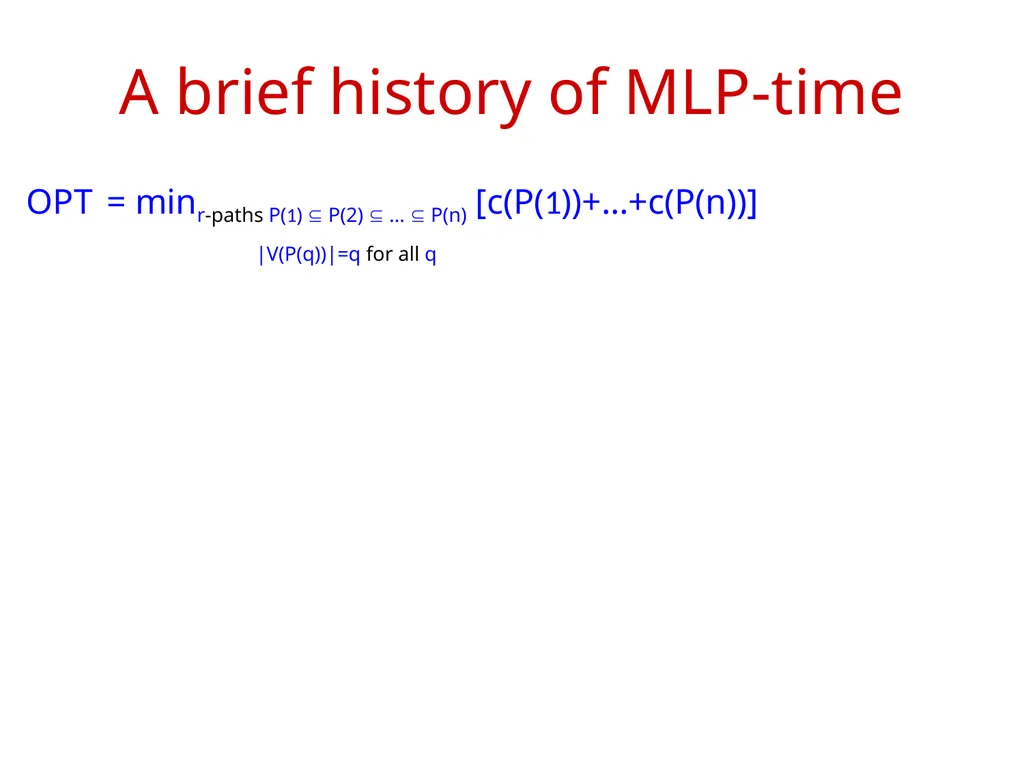
A brief history of MLP-time OPT = minr-paths P(1) P(2) … P(n) [c(P(1))+…+c(P(n))] |V(P(q))|=q for all q<br>
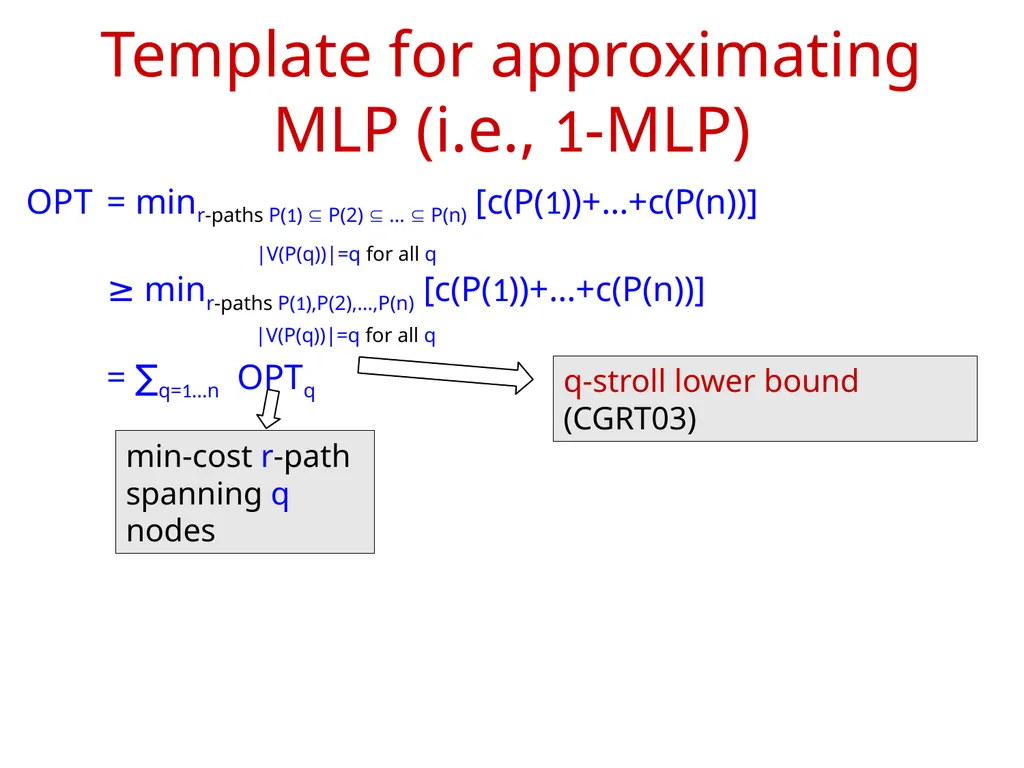
= ∑q=1…n OPTq |V(P(q))|=q for all q q-stroll lower bound (CGRT03) |V(P(q))|=q for all q min-cost r-path spanning q nodes<br>
12
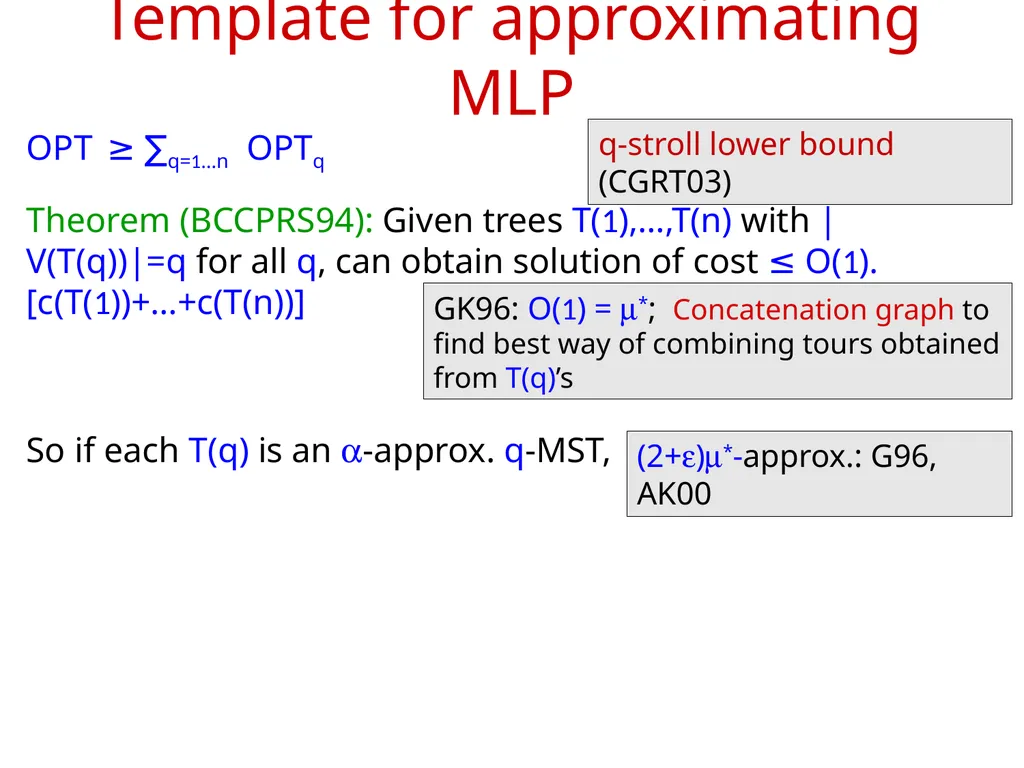
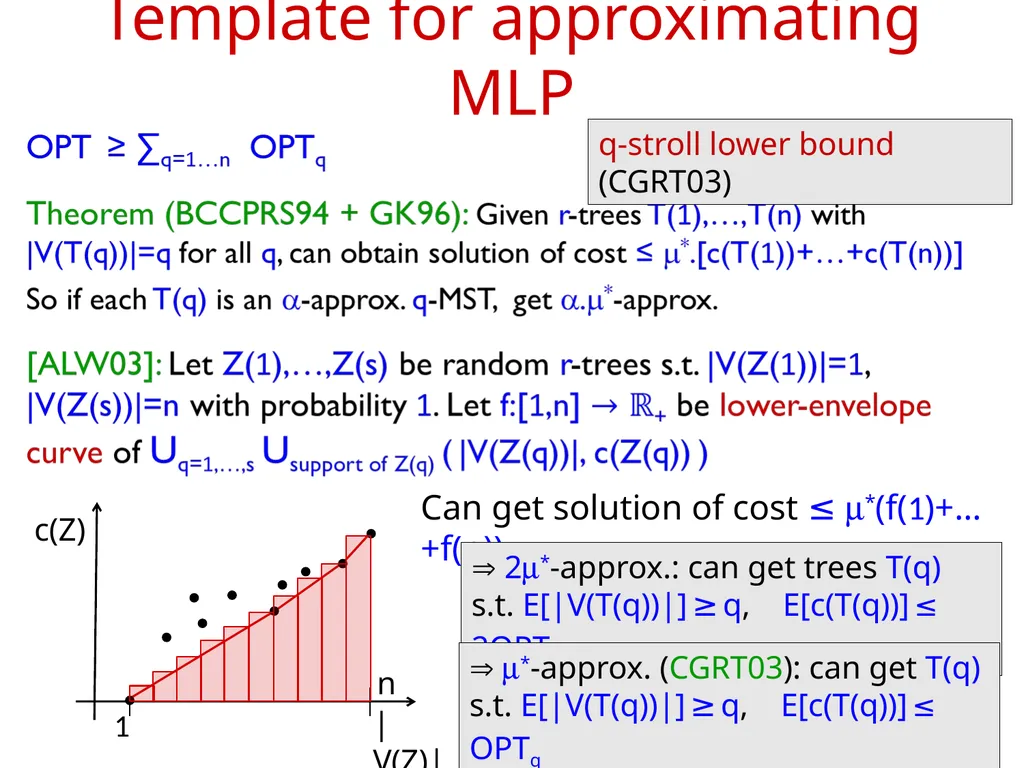
Template for approximating MLP OPT ≥ ∑q=1…n OPTq
Theorem (BCCPRS94): Given trees T(1),…,T(n) with |V(T(q))|=q for all q, can obtain solution of cost ≤ O(1).[c(T(1))+…+c(T(n))]
So if each T(q) is an a-approx. q-MST, get a.m*-approx. GK96: O(1) = m*; Concatenation graph to find best way of combining tours obtained from T(q)’s (2+e)m*-approx.: G96, AK00 q-stroll lower bound (CGRT03)<br>
13
Template for approximating MLP q-stroll lower bound (CGRT03) Can get solution of cost ≤ m*(f(1)+…+f(n)) 2m*-approx.: can get trees T(q) s.t. E[|V(T(q))|] ≥ q, E[c(T(q))] ≤ 2OPTq-MST m*-approx. (CGRT03): can get T(q) s.t. E[|V(T(q))|] ≥ q, E[c(T(q))] ≤ OPTq<br>
14
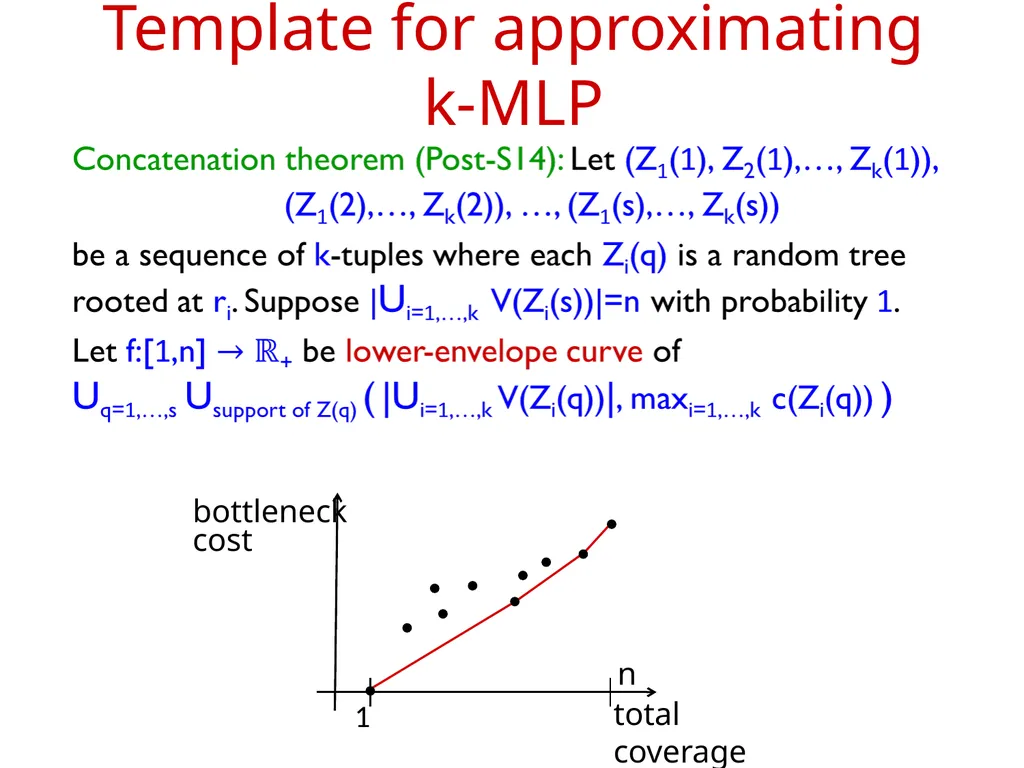
Template for approximating k-MLP<br>
15
Template for approximating k-MLP<br>
16
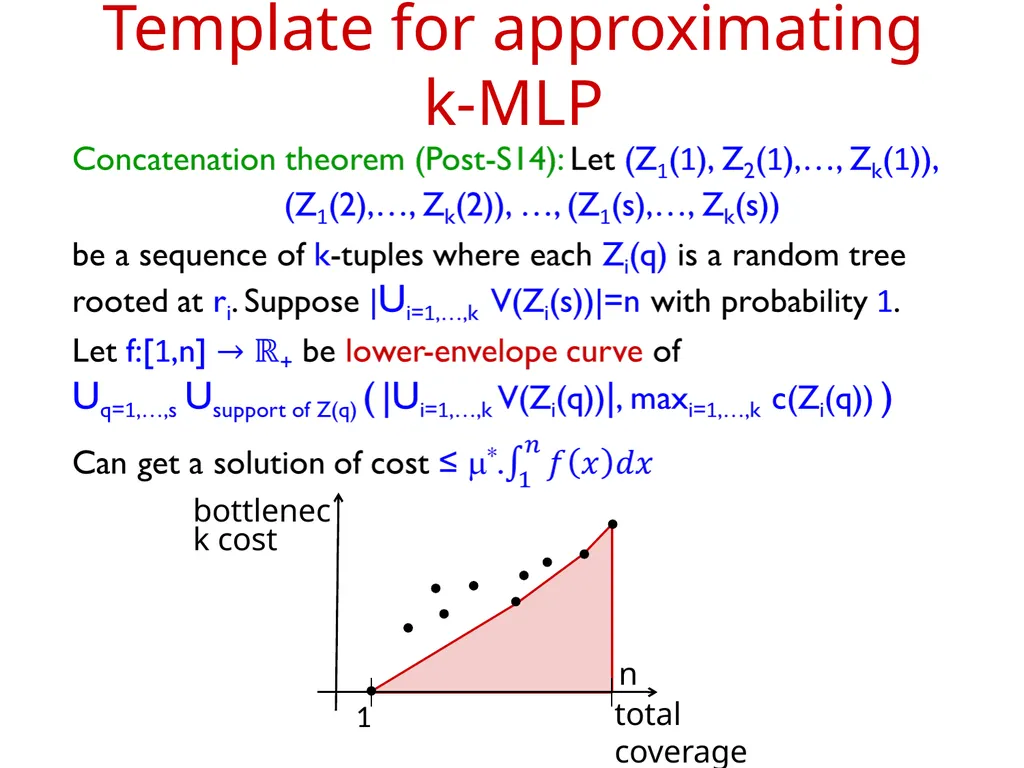
Template for approximating k-MLP<br>
17
Template for approximating k-MLP<br>
18
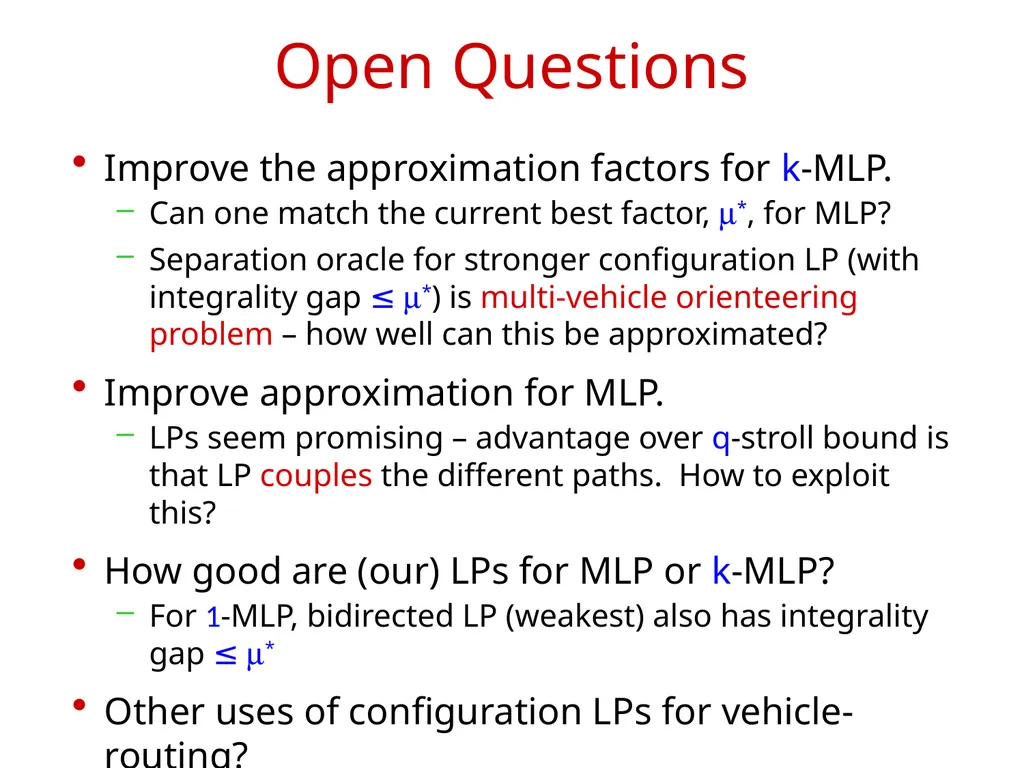
Open Questions Improve the approximation factors for k-MLP.
Can one match the current best factor, m*, for MLP?
Separation oracle for stronger configuration LP (with integrality gap ≤ m*) is multi-vehicle orienteering problem – how well can this be approximated?
Improve approximation for MLP.
LPs seem promising – advantage over q-stroll bound is that LP couples the different paths. How to exploit this?
How good are (our) LPs for MLP or k-MLP?
For 1-MLP, bidirected LP (weakest) also has integrality gap ≤ m*
Other uses of configuration LPs for vehicle-routing?
Only aware of Friggstad-S14 as another application.<br>