LPM (Unit-2) Fodder Production and Conservation (Importance of Grassland and Fodder in livestock production) BY- Dr. SANJAY KUMAR ASST.PROF., DEPT. OF LPM BVC, PATNA Bihar Animal Sciences University Fodder Fodder also called provender, is
"LPM (Unit-2) Fodder Production and Conservation" is the property of its rightful owner. Permission is granted to
download and print the materials on this website for personal, non-commercial use only, and to display it
on your personal computer provided you do not modify the materials and that you retain all copyright
notices contained in the materials. By downloading content from our website, you accept the terms of this
agreement.
Presentation Transcript
01
LPM (Unit-2) Fodder Production and Conservation (Importance of Grassland and Fodder in livestock production) BY-
Dr. SANJAY KUMAR
ASST.PROF., DEPT. OF LPM
BVC, PATNA
Bihar Animal Sciences University<br>
02
Fodder Fodder also called provender, is any agricultural foodstuff used specifically to feed domesticated livestock, such as cattle, rabbits, sheep, horses, chickens and pigs.
"Fodder" refers particularly to food given to the animals .
Fodder includes hay, straw, silage, compressed and pelleted feeds, oils and mixed rations, and sprouted grains and legumes (such as bean sprouts, fresh malt, or spent malt).
Most animal feed is from plants, but some manufacturers add ingredients to processed feeds that are of animal origin.<br>
03
Types of fodder Conserved forage plants: hay and silage.
Crop residues: straw, chaff, sugar beet waste.
Freshly cut grass and other forage plants.
Grass/lawn clipping waste.<br>
04
IMPORTANCE OF GREEN FODDER PRODUCTION Green forages have cooling effect on the animal body,
It is more palatable and contain easily digestible nutrients,
It provide fresh effectively utilizable nutrients in natural form.
and slightly laxative ,hence prevents constipation.
Green fodder is the primary only source of vit A for lactation vit ‘A’ is present in the form of precursor.
Feed should be available to cows at least 20 hours / day.
Feed at least 60 % of ration during night in the hot weather (Summer)
Cows reduce feed intake by about 3.3% for every 2.2degree rise in temperature over 24 degree Celcius
.<br>
05
The use of concentrates no doubt will give the greatest animal production per unit feed intake, but this may not be economical in countries like India where grains and concentrates are costly and/or in short supply.
On the other hand animals yielding as high as 8 litres of milk can easily be maintained solely on green fodder without any concentrate.
But unfortunately only 6.9 million ha or 4.4% of the countries area is under fodder cultivation and hardly any scope for further expansion because of pressure on agriculture land for food and cash crops.
The current feed and fodder resources in India can meet only less than 50% of the requirement of its livestock population of 450 million.
The grazing intensity is very high viz., 2.6 cattle unit per hactere as against 0.8 cattle unit per hactere in developed countries.<br>
06
IMPORTANCE OF GREEN FODDER IN MILK PRODUCTION . Green fodder is an economic source of nutrients for the dairy animals.
It is highly palatable and digestible.
Micro-organisms present in green fodder help in improving digestibility of crop residues under mixed feeding system.
It also helps in maintaining good health and improving breeding efficiency of animals.
Increased use of green fodder in the ration of animals may reduce cost of milk production.
To reduce the gap between demand and availability of green fodder, there is a need to improve green fodder yield through enhanced use of improved fodder seeds.<br>
07
For ensuring year round green fodder production, farmers need to adopt following agricultural practices:
Always use certified / truthfully labeled seed / planting material of improved high yielding varieties of fodder crops.
Follow recommended package of practices for fodder cultivation such as land preparation, timely sowing, fertilizer application, irrigation, weed and pest control and harvesting schedule.
Growing short duration varieties of fodder crops such as maize, sunflower, chinese cabbage, turnip, cowpea etc. between two main seasonal crops.<br>
08
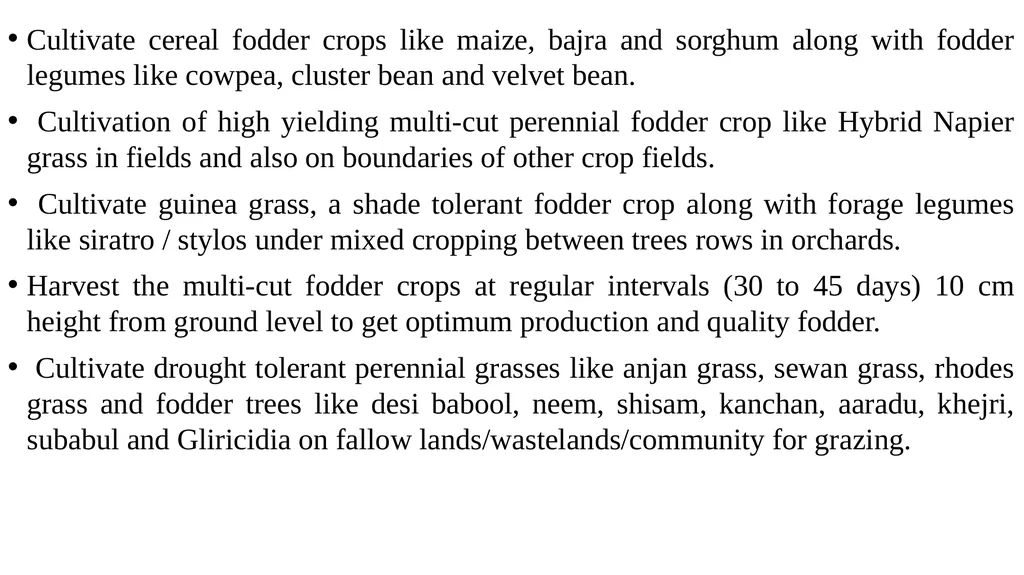
Cultivate cereal fodder crops like maize, bajra and sorghum along with fodder legumes like cowpea, cluster bean and velvet bean.
Cultivation of high yielding multi-cut perennial fodder crop like Hybrid Napier grass in fields and also on boundaries of other crop fields.
Cultivate guinea grass, a shade tolerant fodder crop along with forage legumes like siratro / stylos under mixed cropping between trees rows in orchards.
Harvest the multi-cut fodder crops at regular intervals (30 to 45 days) 10 cm height from ground level to get optimum production and quality fodder.
Cultivate drought tolerant perennial grasses like anjan grass, sewan grass, rhodes grass and fodder trees like desi babool, neem, shisam, kanchan, aaradu, khejri, subabul and Gliricidia on fallow lands/wastelands/community for grazing.<br>
09
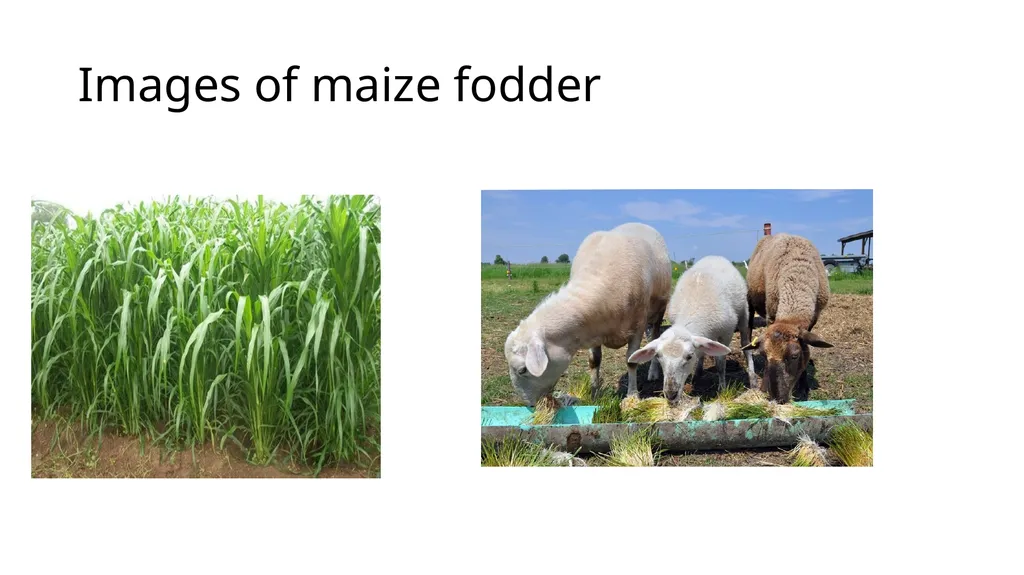
Images of maize fodder<br>
10
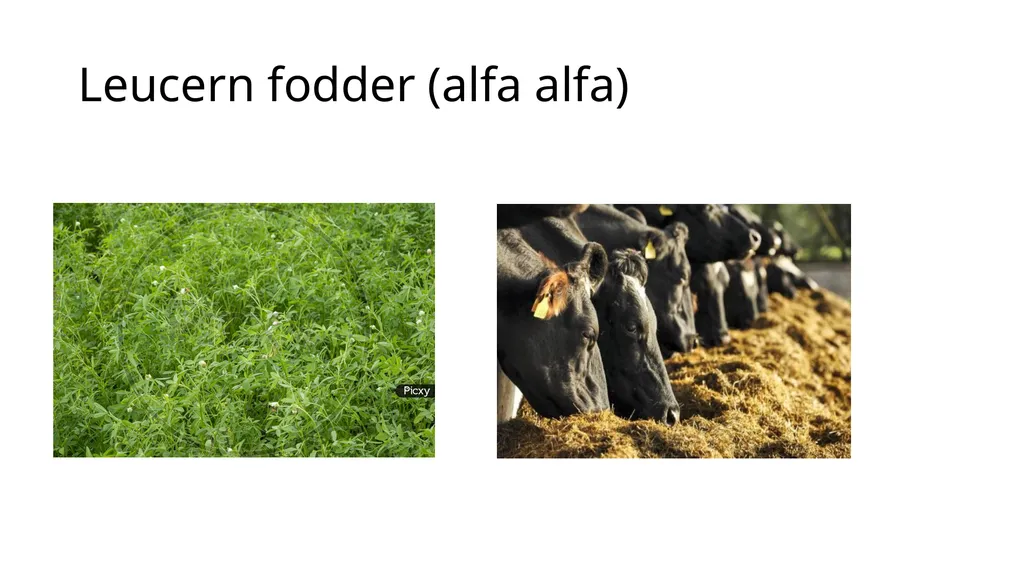
Leucern fodder (alfa alfa)<br>
11
Books for reference- Fodder Production & Grassland Management Books
1.K. Sarjan Rao - Price : Rs. 200/- - Ist Edition 2004