
Lurbinectedin + atezolizumab as first-line
MS
Published · 28 slides · 0 views

1 / 1


Description
Lurbinectedin atezolizumab as first-line maintenance treatment in patients with extensive-stage small cell lung cancer: Primary results of the Phase 3 IMforte trial Luis Paz-Ares,1 Hossein Borghaei,2 Stephen V. Liu,3 Solange Peters,4 Roy
Related Topics
Share
Embed code
Download this presentation From Below
"Lurbinectedin + atezolizumab as first-line" is the property of its rightful owner. Permission is granted to download and print the materials on this website for personal, non-commercial use only, and to display it on your personal computer provided you do not modify the materials and that you retain all copyright notices contained in the materials. By downloading content from our website, you accept the terms of this agreement.
Presentation Transcript
01
Lurbinectedin + atezolizumab as first-line maintenance treatment in patients with
extensive-stage small cell lung cancer:
Primary results of the Phase 3 IMforte trial Luis Paz-Ares,1 Hossein Borghaei,2 Stephen V. Liu,3 Solange Peters,4 Roy S. Herbst,5 Katarzyna Stencel,6
Margarita Majem,7 Grzegorz Czyżewicz,8 Reyes Bernabé Caro,9 Ki Hyeong Lee,10 Melissa L. Johnson,11 Nuri Karadurmuş,12 Christian Grohé,13 Vaikunth Cuchelkar,14 Vilma Graupner,15 Monika Kaul,14 Ya-Chen Lin,14 Debasis Chakrabarti,16
Kamalnayan Bhatt,16 Martin Reck17 1Hospital Universitario 12 de Octubre, H12O-CNIO Lung Cancer Unit, Universidad Complutense and Ciberonc, Madrid, Spain; 2Fox Chase Cancer Center, Philadelphia, PA, USA; 3Lombardi Comprehensive Cancer Center, Georgetown University, Washington, DC, USA; 4University Hospital CHUV, Lausanne, Switzerland; 5Yale School of Medicine, New Haven,
CT, USA; 6Wielkopolska Center of Pulmonology and Thoracic Surgery of Eugenia and Janusz Zeyland, Poznan, Poland; 7Hospital de la Santa Creu i Sant Pau, Barcelona, Spain;
8The John Paul II Specialist Hospital, Kraków, Poland; 9Hospital Universitario Virgen del Rocío, Seville, Spain; 10Chungbuk National University Hospital, Cheongju, South Korea; 11Tennessee Oncology, Sarah Cannon Research Institute, Nashville, TN, USA; 12University of Health Sciences, Gülhane Training and Research Hospital, Ankara, Türkiye;
13Klinik für Pneumologie, Evangelische Lungenklinik Berlin, Berlin, Germany; 14Genentech Inc, South San Francisco, CA, USA; 15F. Hoffmann-La Roche Ltd, Basel, Switzerland;
16Jazz Pharmaceuticals plc, Dublin, Ireland; 17Lung Clinic Grosshansdorf, Airway Research Center North, German Center of Lung Research, Grosshansdorf, Germany Luis Paz-Ares, MD, PhD IMforte ASCO 2025 Abstract 8006<br>
02
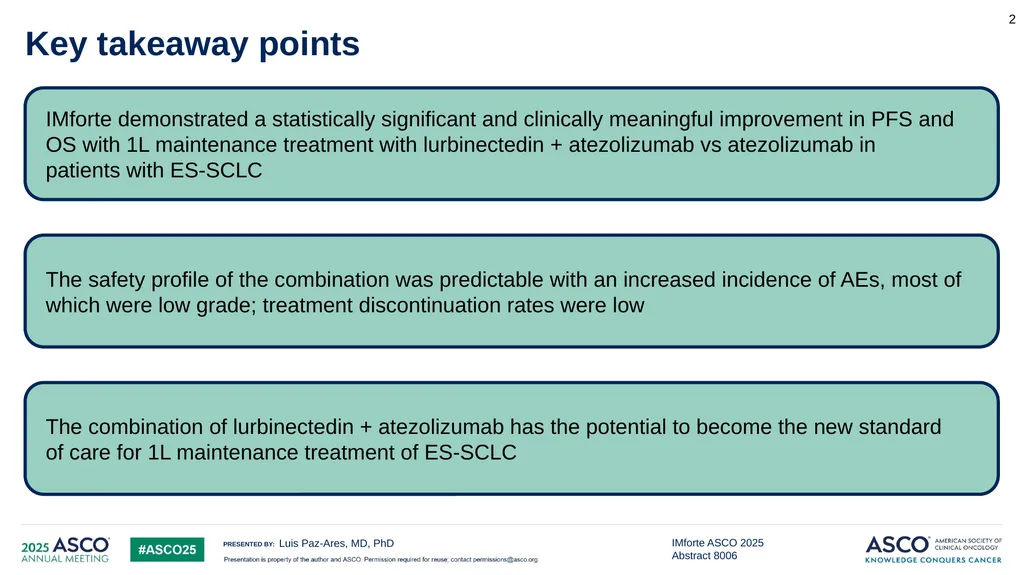
Key takeaway points Luis Paz-Ares, MD, PhD IMforte ASCO 2025 Abstract 8006 The combination of lurbinectedin + atezolizumab has the potential to become the new standard
of care for 1L maintenance treatment of ES-SCLC IMforte demonstrated a statistically significant and clinically meaningful improvement in PFS and OS with 1L maintenance treatment with lurbinectedin + atezolizumab vs atezolizumab in
patients with ES-SCLC The safety profile of the combination was predictable with an increased incidence of AEs, most of which were low grade; treatment discontinuation rates were low 2<br>
03
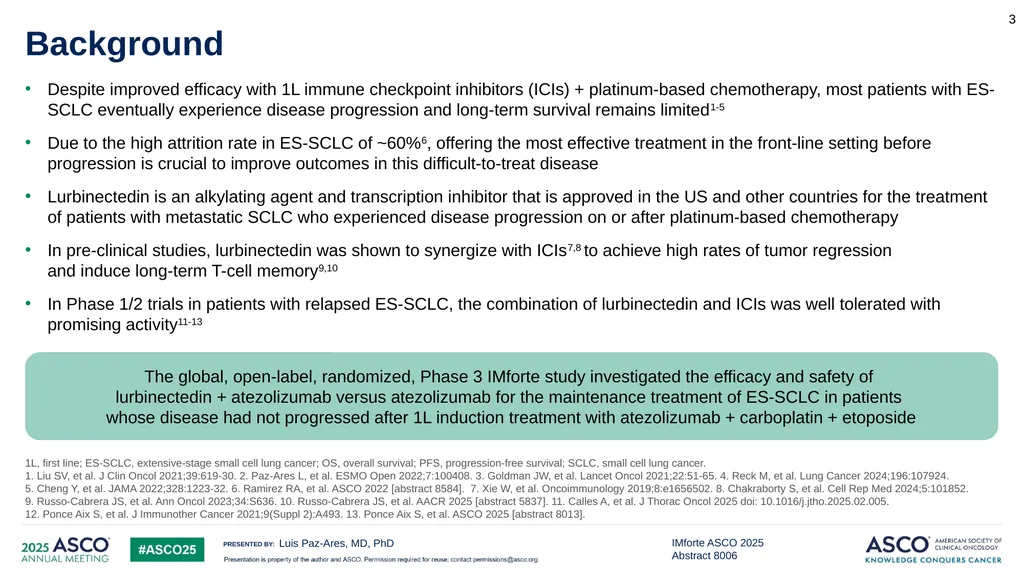
Background Despite improved efficacy with 1L immune checkpoint inhibitors (ICIs) + platinum-based chemotherapy, most patients with ES-SCLC eventually experience disease progression and long-term survival remains limited1-5
Due to the high attrition rate in ES-SCLC of ~60%6, offering the most effective treatment in the front-line setting before progression is crucial to improve outcomes in this difficult-to-treat disease
Lurbinectedin is an alkylating agent and transcription inhibitor that is approved in the US and other countries for the treatment of patients with metastatic SCLC who experienced disease progression on or after platinum-based chemotherapy
In pre-clinical studies, lurbinectedin was shown to synergize with ICIs7,8 to achieve high rates of tumor regression and induce long-term T-cell memory9,10
In Phase 1/2 trials in patients with relapsed ES-SCLC, the combination of lurbinectedin and ICIs was well tolerated with promising activity11-13 Luis Paz-Ares, MD, PhD 1L, first line; ES-SCLC, extensive-stage small cell lung cancer; OS, overall survival; PFS, progression-free survival; SCLC, small cell lung cancer. 1. Liu SV, et al. J Clin Oncol 2021;39:619-30. 2. Paz-Ares L, et al. ESMO Open 2022;7:100408. 3. Goldman JW, et al. Lancet Oncol 2021;22:51-65. 4. Reck M, et al. Lung Cancer 2024;196:107924. 5. Cheng Y, et al. JAMA 2022;328:1223-32. 6. Ramirez RA, et al. ASCO 2022 [abstract 8584]. 7. Xie W, et al. Oncoimmunology 2019;8:e1656502. 8. Chakraborty S, et al. Cell Rep Med 2024;5:101852. 9. Russo-Cabrera JS, et al. Ann Oncol 2023;34:S636. 10. Russo-Cabrera JS, et al. AACR 2025 [abstract 5837]. 11. Calles A, et al. J Thorac Oncol 2025 doi: 10.1016/j.jtho.2025.02.005. 12. Ponce Aix S, et al. J Immunother Cancer 2021;9(Suppl 2):A493. 13. Ponce Aix S, et al. ASCO 2025 [abstract 8013]. 3 The global, open-label, randomized, Phase 3 IMforte study investigated the efficacy and safety of lurbinectedin + atezolizumab versus atezolizumab for the maintenance treatment of ES-SCLC in patients whose disease had not progressed after 1L induction treatment with atezolizumab + carboplatin + etoposide IMforte ASCO 2025 Abstract 8006<br>
Due to the high attrition rate in ES-SCLC of ~60%6, offering the most effective treatment in the front-line setting before progression is crucial to improve outcomes in this difficult-to-treat disease
Lurbinectedin is an alkylating agent and transcription inhibitor that is approved in the US and other countries for the treatment of patients with metastatic SCLC who experienced disease progression on or after platinum-based chemotherapy
In pre-clinical studies, lurbinectedin was shown to synergize with ICIs7,8 to achieve high rates of tumor regression and induce long-term T-cell memory9,10
In Phase 1/2 trials in patients with relapsed ES-SCLC, the combination of lurbinectedin and ICIs was well tolerated with promising activity11-13 Luis Paz-Ares, MD, PhD 1L, first line; ES-SCLC, extensive-stage small cell lung cancer; OS, overall survival; PFS, progression-free survival; SCLC, small cell lung cancer. 1. Liu SV, et al. J Clin Oncol 2021;39:619-30. 2. Paz-Ares L, et al. ESMO Open 2022;7:100408. 3. Goldman JW, et al. Lancet Oncol 2021;22:51-65. 4. Reck M, et al. Lung Cancer 2024;196:107924. 5. Cheng Y, et al. JAMA 2022;328:1223-32. 6. Ramirez RA, et al. ASCO 2022 [abstract 8584]. 7. Xie W, et al. Oncoimmunology 2019;8:e1656502. 8. Chakraborty S, et al. Cell Rep Med 2024;5:101852. 9. Russo-Cabrera JS, et al. Ann Oncol 2023;34:S636. 10. Russo-Cabrera JS, et al. AACR 2025 [abstract 5837]. 11. Calles A, et al. J Thorac Oncol 2025 doi: 10.1016/j.jtho.2025.02.005. 12. Ponce Aix S, et al. J Immunother Cancer 2021;9(Suppl 2):A493. 13. Ponce Aix S, et al. ASCO 2025 [abstract 8013]. 3 The global, open-label, randomized, Phase 3 IMforte study investigated the efficacy and safety of lurbinectedin + atezolizumab versus atezolizumab for the maintenance treatment of ES-SCLC in patients whose disease had not progressed after 1L induction treatment with atezolizumab + carboplatin + etoposide IMforte ASCO 2025 Abstract 8006<br>
04
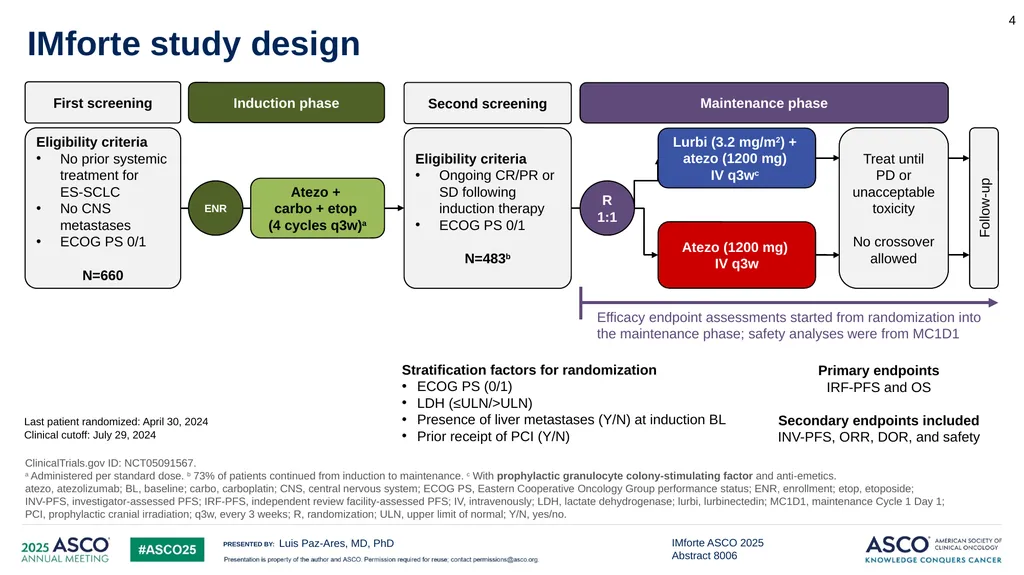
IMforte study design ClinicalTrials.gov ID: NCT05091567.
a Administered per standard dose. b 73% of patients continued from induction to maintenance. c With prophylactic granulocyte colony-stimulating factor and anti-emetics.
atezo, atezolizumab; BL, baseline; carbo, carboplatin; CNS, central nervous system; ECOG PS, Eastern Cooperative Oncology Group performance status; ENR, enrollment; etop, etoposide;
INV-PFS, investigator-assessed PFS; IRF-PFS, independent review facility-assessed PFS; IV, intravenously; LDH, lactate dehydrogenase; lurbi, lurbinectedin; MC1D1, maintenance Cycle 1 Day 1;
PCI, prophylactic cranial irradiation; q3w, every 3 weeks; R, randomization; ULN, upper limit of normal; Y/N, yes/no. 4 Luis Paz-Ares, MD, PhD IMforte ASCO 2025 Abstract 8006 4 Stratification factors for randomization
ECOG PS (0/1)
LDH (≤ULN/>ULN)
Presence of liver metastases (Y/N) at induction BL
Prior receipt of PCI (Y/N) Primary endpoints
IRF-PFS and OS
Secondary endpoints included
INV-PFS, ORR, DOR, and safety Last patient randomized: April 30, 2024 Clinical cutoff: July 29, 2024<br>
ECOG PS (0/1)
LDH (≤ULN/>ULN)
Presence of liver metastases (Y/N) at induction BL
Prior receipt of PCI (Y/N) Primary endpoints
IRF-PFS and OS
Secondary endpoints included
INV-PFS, ORR, DOR, and safety Last patient randomized: April 30, 2024 Clinical cutoff: July 29, 2024<br>
05
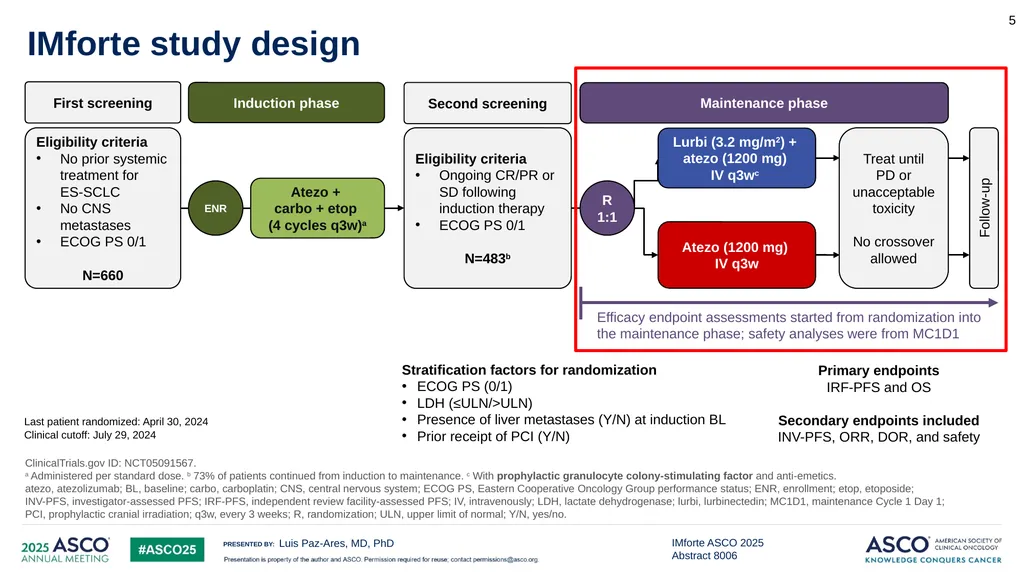
IMforte study design ClinicalTrials.gov ID: NCT05091567.
a Administered per standard dose. b 73% of patients continued from induction to maintenance. c With prophylactic granulocyte colony-stimulating factor and anti-emetics.
atezo, atezolizumab; BL, baseline; carbo, carboplatin; CNS, central nervous system; ECOG PS, Eastern Cooperative Oncology Group performance status; ENR, enrollment; etop, etoposide;
INV-PFS, investigator-assessed PFS; IRF-PFS, independent review facility-assessed PFS; IV, intravenously; LDH, lactate dehydrogenase; lurbi, lurbinectedin; MC1D1, maintenance Cycle 1 Day 1;
PCI, prophylactic cranial irradiation; q3w, every 3 weeks; R, randomization; ULN, upper limit of normal; Y/N, yes/no. 5 Luis Paz-Ares, MD, PhD IMforte ASCO 2025 Abstract 8006 5 Stratification factors for randomization
ECOG PS (0/1)
LDH (≤ULN/>ULN)
Presence of liver metastases (Y/N) at induction BL
Prior receipt of PCI (Y/N) Primary endpoints
IRF-PFS and OS
Secondary endpoints included
INV-PFS, ORR, DOR, and safety Last patient randomized: April 30, 2024 Clinical cutoff: July 29, 2024<br>
ECOG PS (0/1)
LDH (≤ULN/>ULN)
Presence of liver metastases (Y/N) at induction BL
Prior receipt of PCI (Y/N) Primary endpoints
IRF-PFS and OS
Secondary endpoints included
INV-PFS, ORR, DOR, and safety Last patient randomized: April 30, 2024 Clinical cutoff: July 29, 2024<br>
06
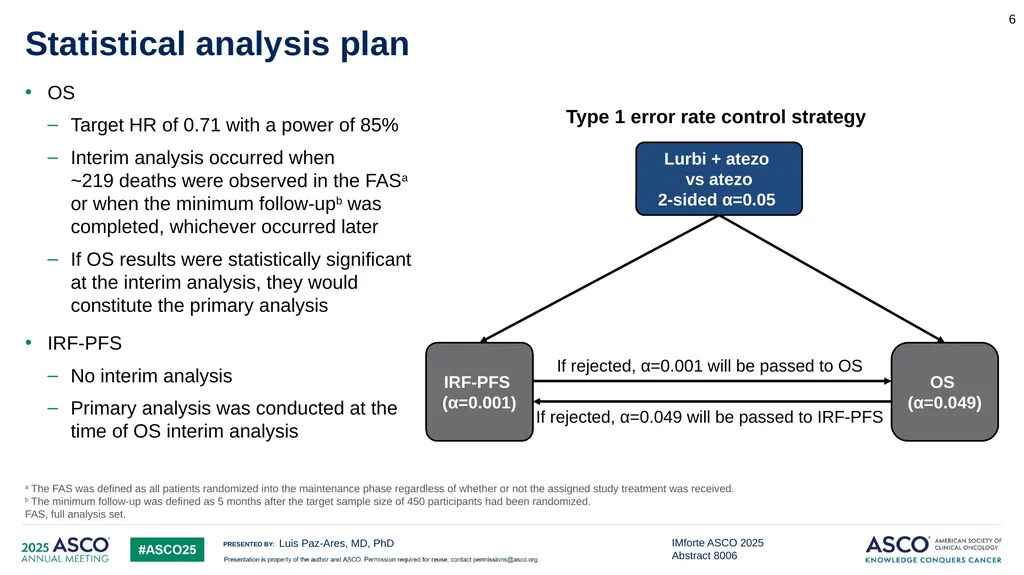
Statistical analysis plan OS
Target HR of 0.71 with a power of 85%
Interim analysis occurred when ~219 deaths were observed in the FASa or when the minimum follow-upb was completed, whichever occurred later
If OS results were statistically significant at the interim analysis, they would constitute the primary analysis
IRF-PFS
No interim analysis
Primary analysis was conducted at the time of OS interim analysis a The FAS was defined as all patients randomized into the maintenance phase regardless of whether or not the assigned study treatment was received. b The minimum follow-up was defined as 5 months after the target sample size of 450 participants had been randomized.
FAS, full analysis set. 6 Type 1 error rate control strategy Luis Paz-Ares, MD, PhD IMforte ASCO 2025 Abstract 8006<br>
Target HR of 0.71 with a power of 85%
Interim analysis occurred when ~219 deaths were observed in the FASa or when the minimum follow-upb was completed, whichever occurred later
If OS results were statistically significant at the interim analysis, they would constitute the primary analysis
IRF-PFS
No interim analysis
Primary analysis was conducted at the time of OS interim analysis a The FAS was defined as all patients randomized into the maintenance phase regardless of whether or not the assigned study treatment was received. b The minimum follow-up was defined as 5 months after the target sample size of 450 participants had been randomized.
FAS, full analysis set. 6 Type 1 error rate control strategy Luis Paz-Ares, MD, PhD IMforte ASCO 2025 Abstract 8006<br>
07
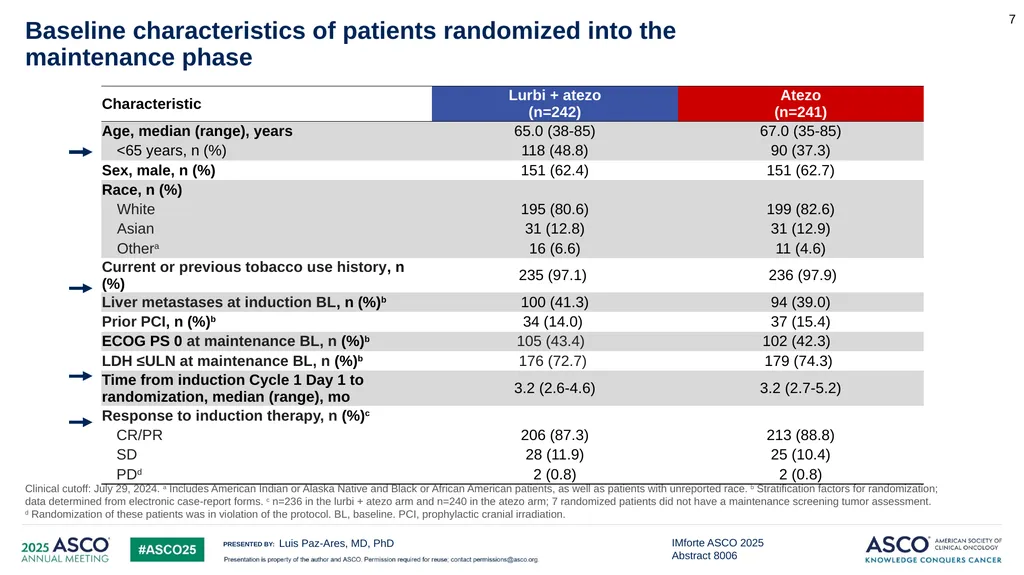
Baseline characteristics of patients randomized into the
maintenance phase Clinical cutoff: July 29, 2024. a Includes American Indian or Alaska Native and Black or African American patients, as well as patients with unreported race. b Stratification factors for randomization;
data determined from electronic case-report forms. c n=236 in the lurbi + atezo arm and n=240 in the atezo arm; 7 randomized patients did not have a maintenance screening tumor assessment.
d Randomization of these patients was in violation of the protocol. BL, baseline. PCI, prophylactic cranial irradiation. 7 Luis Paz-Ares, MD, PhD IMforte ASCO 2025 Abstract 8006<br>
08
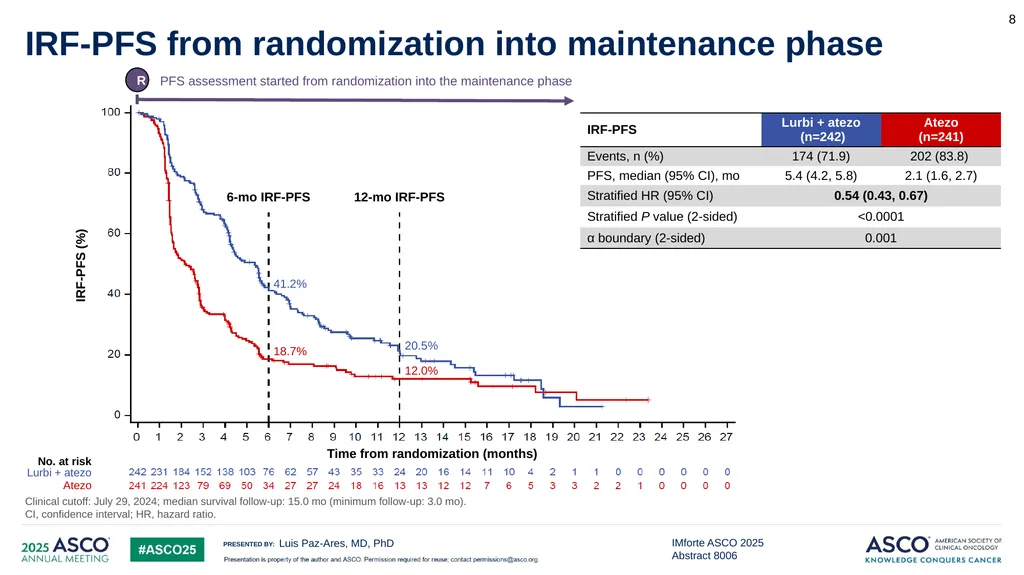
IRF-PFS from randomization into maintenance phase Clinical cutoff: July 29, 2024; median survival follow-up: 15.0 mo (minimum follow-up: 3.0 mo).
CI, confidence interval; HR, hazard ratio. 8 Luis Paz-Ares, MD, PhD IMforte ASCO 2025 Abstract 8006<br>
09
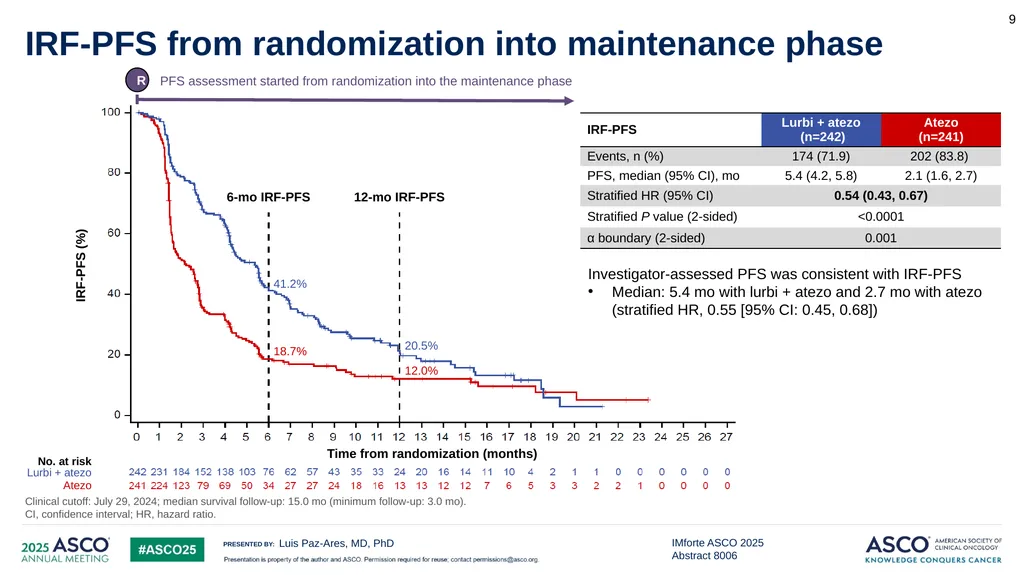
IRF-PFS from randomization into maintenance phase Clinical cutoff: July 29, 2024; median survival follow-up: 15.0 mo (minimum follow-up: 3.0 mo).
CI, confidence interval; HR, hazard ratio. 9 Luis Paz-Ares, MD, PhD IMforte ASCO 2025 Abstract 8006 Investigator-assessed PFS was consistent with IRF-PFS
Median: 5.4 mo with lurbi + atezo and 2.7 mo with atezo (stratified HR, 0.55 [95% CI: 0.45, 0.68])<br>
Median: 5.4 mo with lurbi + atezo and 2.7 mo with atezo (stratified HR, 0.55 [95% CI: 0.45, 0.68])<br>
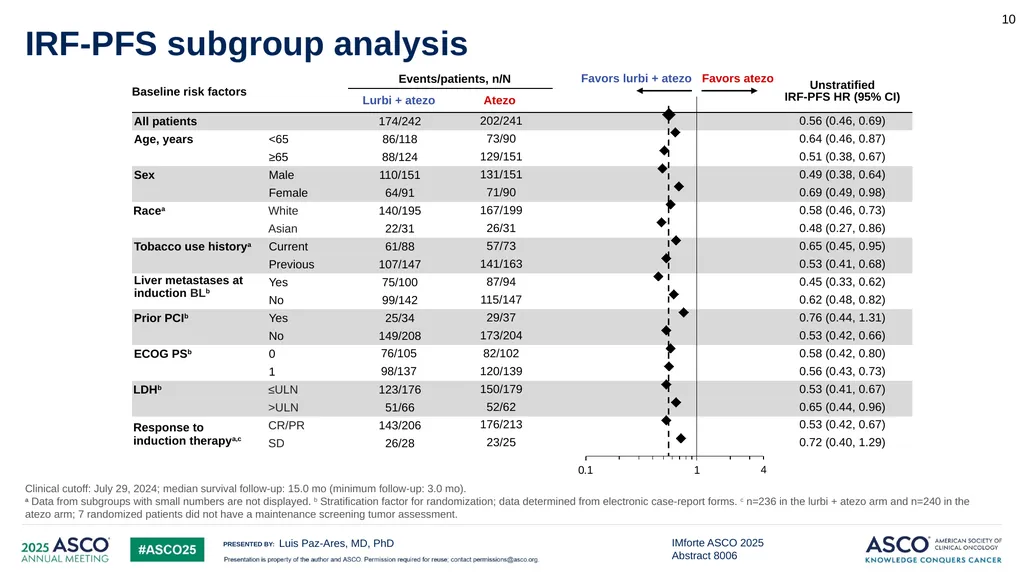
10
IRF-PFS subgroup analysis Clinical cutoff: July 29, 2024; median survival follow-up: 15.0 mo (minimum follow-up: 3.0 mo).
a Data from subgroups with small numbers are not displayed. b Stratification factor for randomization; data determined from electronic case-report forms. c n=236 in the lurbi + atezo arm and n=240 in the atezo arm; 7 randomized patients did not have a maintenance screening tumor assessment. 10 Luis Paz-Ares, MD, PhD IMforte ASCO 2025 Abstract 8006<br>
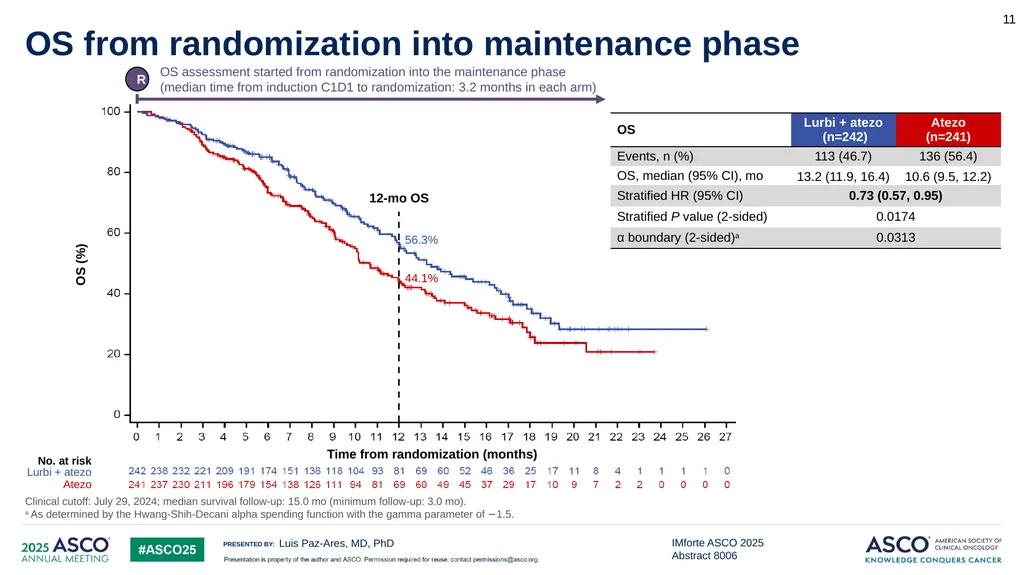
11
OS from randomization into maintenance phase Clinical cutoff: July 29, 2024; median survival follow-up: 15.0 mo (minimum follow-up: 3.0 mo).
a As determined by the Hwang-Shih-Decani alpha spending function with the gamma parameter of −1.5. 11 Luis Paz-Ares, MD, PhD IMforte ASCO 2025 Abstract 8006<br>
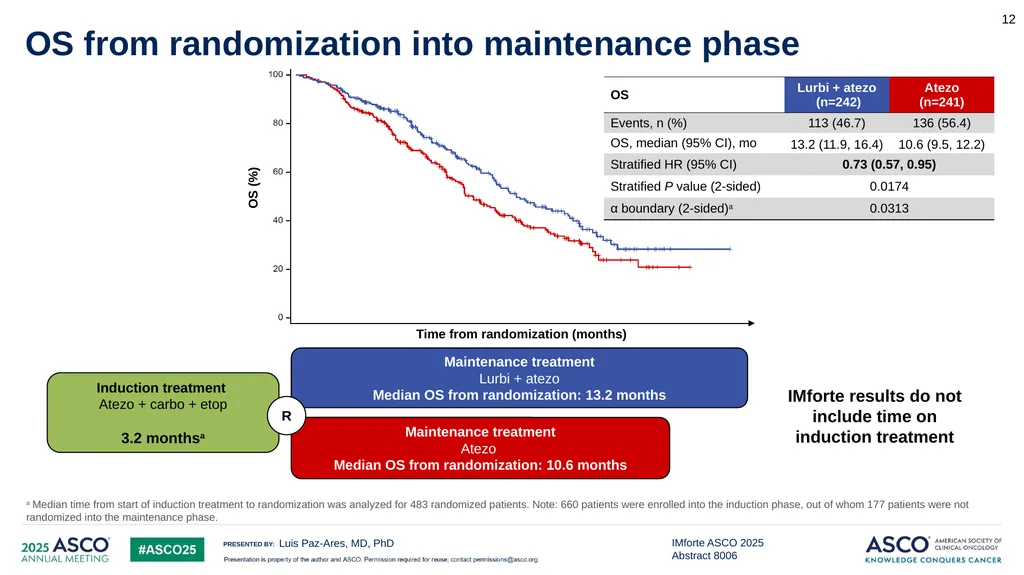
12
a Median time from start of induction treatment to randomization was analyzed for 483 randomized patients. Note: 660 patients were enrolled into the induction phase, out of whom 177 patients were not randomized into the maintenance phase. 12 Luis Paz-Ares, MD, PhD IMforte ASCO 2025 Abstract 8006 IMforte results do not include time on induction treatment OS from randomization into maintenance phase<br>
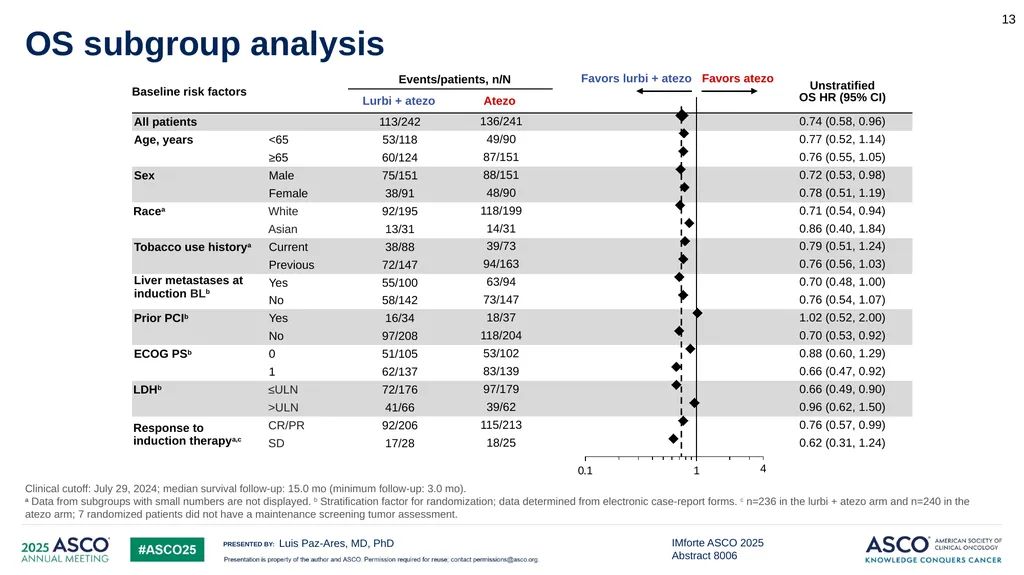
13
OS subgroup analysis Clinical cutoff: July 29, 2024; median survival follow-up: 15.0 mo (minimum follow-up: 3.0 mo).
a Data from subgroups with small numbers are not displayed. b Stratification factor for randomization; data determined from electronic case-report forms. c n=236 in the lurbi + atezo arm and n=240 in the atezo arm; 7 randomized patients did not have a maintenance screening tumor assessment. 13 Luis Paz-Ares, MD, PhD IMforte ASCO 2025 Abstract 8006<br>
14
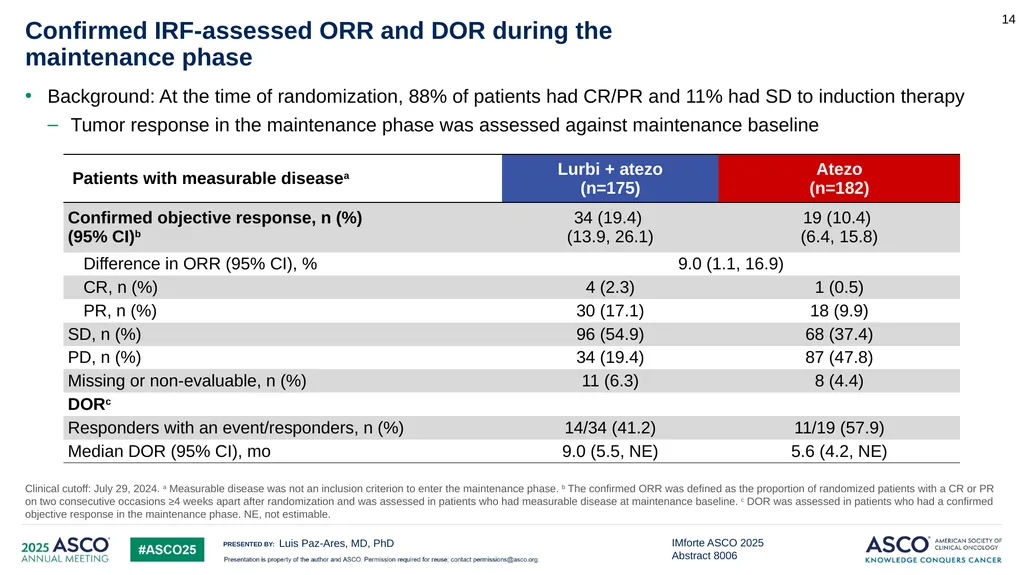
Confirmed IRF-assessed ORR and DOR during the
maintenance phase Background: At the time of randomization, 88% of patients had CR/PR and 11% had SD to induction therapy
Tumor response in the maintenance phase was assessed against maintenance baseline Clinical cutoff: July 29, 2024. a Measurable disease was not an inclusion criterion to enter the maintenance phase. b The confirmed ORR was defined as the proportion of randomized patients with a CR or PR on two consecutive occasions ≥4 weeks apart after randomization and was assessed in patients who had measurable disease at maintenance baseline. c DOR was assessed in patients who had a confirmed objective response in the maintenance phase. NE, not estimable. 14 Luis Paz-Ares, MD, PhD IMforte ASCO 2025 Abstract 8006<br>
Tumor response in the maintenance phase was assessed against maintenance baseline Clinical cutoff: July 29, 2024. a Measurable disease was not an inclusion criterion to enter the maintenance phase. b The confirmed ORR was defined as the proportion of randomized patients with a CR or PR on two consecutive occasions ≥4 weeks apart after randomization and was assessed in patients who had measurable disease at maintenance baseline. c DOR was assessed in patients who had a confirmed objective response in the maintenance phase. NE, not estimable. 14 Luis Paz-Ares, MD, PhD IMforte ASCO 2025 Abstract 8006<br>
15
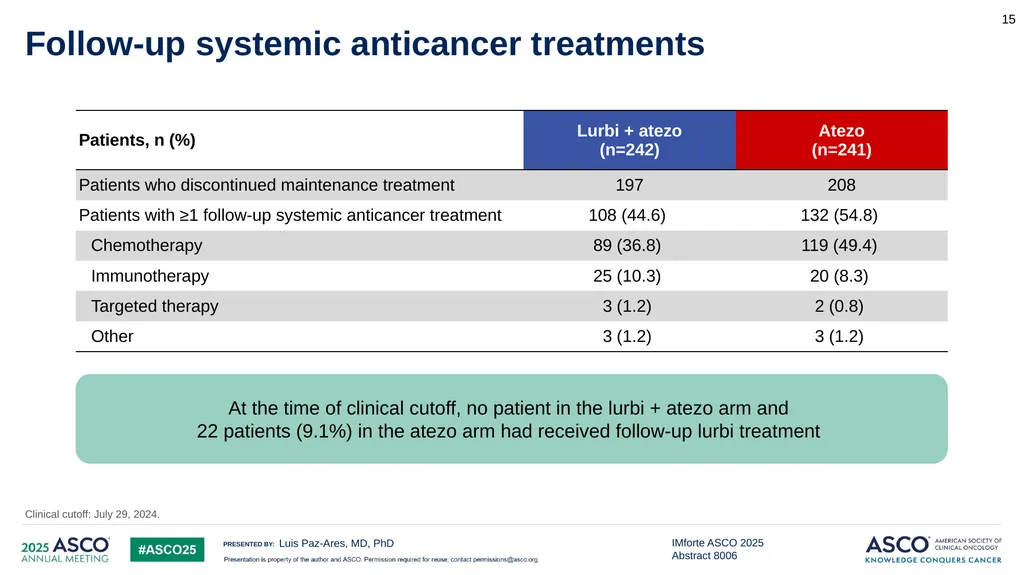
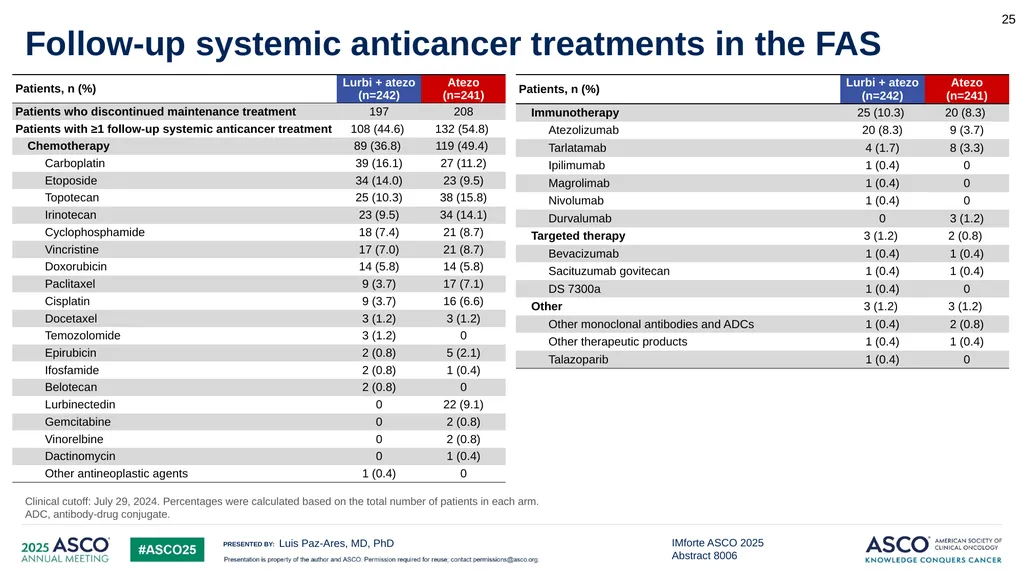
Follow-up systemic anticancer treatments Clinical cutoff: July 29, 2024. 15 At the time of clinical cutoff, no patient in the lurbi + atezo arm and
22 patients (9.1%) in the atezo arm had received follow-up lurbi treatment Luis Paz-Ares, MD, PhD IMforte ASCO 2025 Abstract 8006<br>
16
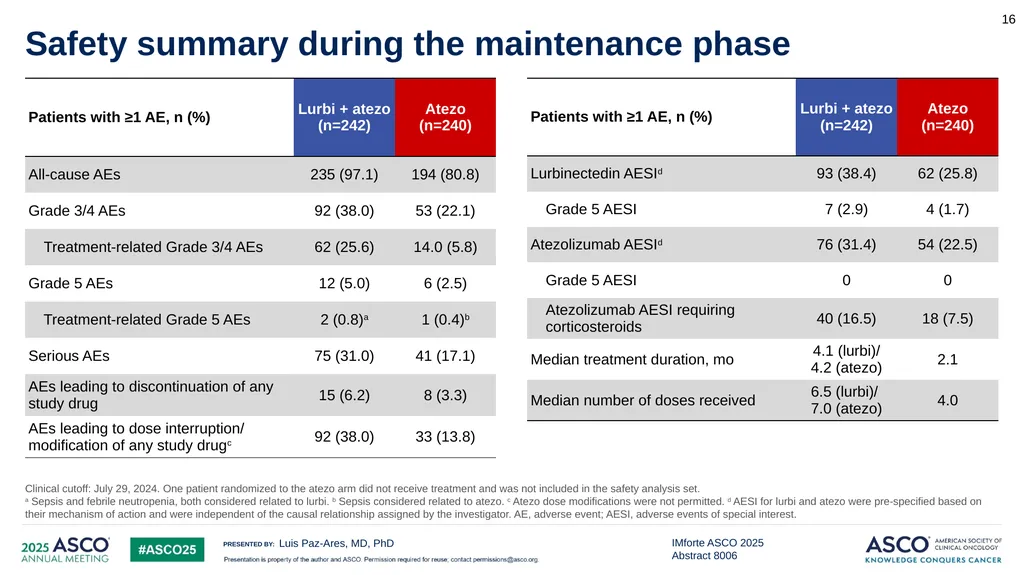
Safety summary during the maintenance phase Clinical cutoff: July 29, 2024. One patient randomized to the atezo arm did not receive treatment and was not included in the safety analysis set.
a Sepsis and febrile neutropenia, both considered related to lurbi. b Sepsis considered related to atezo. c Atezo dose modifications were not permitted. d AESI for lurbi and atezo were pre-specified based on their mechanism of action and were independent of the causal relationship assigned by the investigator. AE, adverse event; AESI, adverse events of special interest. 16 Luis Paz-Ares, MD, PhD IMforte ASCO 2025 Abstract 8006<br>
17
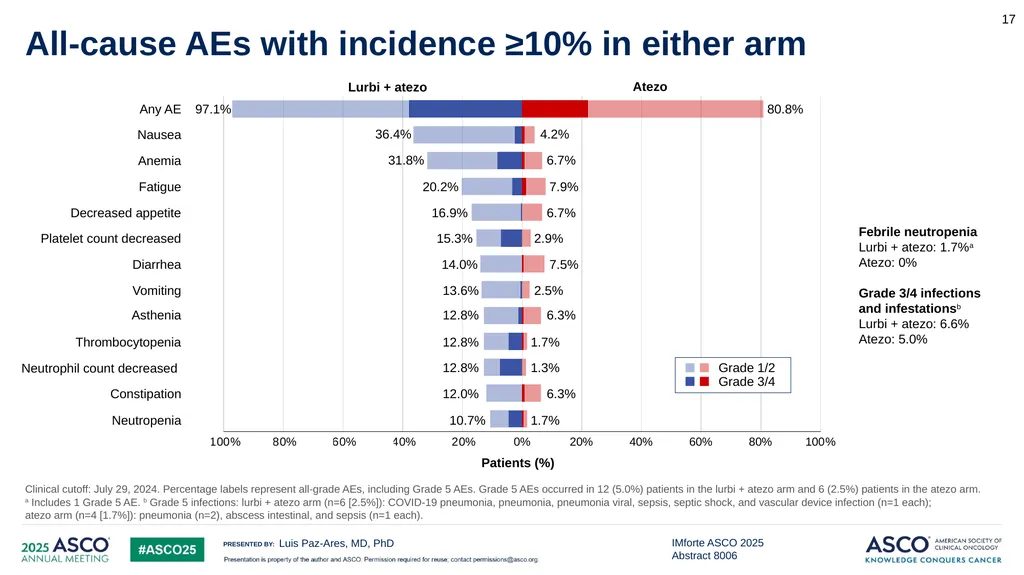
All-cause AEs with incidence ≥10% in either arm Clinical cutoff: July 29, 2024. Percentage labels represent all-grade AEs, including Grade 5 AEs. Grade 5 AEs occurred in 12 (5.0%) patients in the lurbi + atezo arm and 6 (2.5%) patients in the atezo arm.
a Includes 1 Grade 5 AE. b Grade 5 infections: lurbi + atezo arm (n=6 [2.5%]): COVID-19 pneumonia, pneumonia, pneumonia viral, sepsis, septic shock, and vascular device infection (n=1 each); atezo arm (n=4 [1.7%]): pneumonia (n=2), abscess intestinal, and sepsis (n=1 each). 17 Luis Paz-Ares, MD, PhD IMforte ASCO 2025 Abstract 8006 Febrile neutropenia
Lurbi + atezo: 1.7%a
Atezo: 0%
Grade 3/4 infections and infestationsb
Lurbi + atezo: 6.6%
Atezo: 5.0%<br>
a Includes 1 Grade 5 AE. b Grade 5 infections: lurbi + atezo arm (n=6 [2.5%]): COVID-19 pneumonia, pneumonia, pneumonia viral, sepsis, septic shock, and vascular device infection (n=1 each); atezo arm (n=4 [1.7%]): pneumonia (n=2), abscess intestinal, and sepsis (n=1 each). 17 Luis Paz-Ares, MD, PhD IMforte ASCO 2025 Abstract 8006 Febrile neutropenia
Lurbi + atezo: 1.7%a
Atezo: 0%
Grade 3/4 infections and infestationsb
Lurbi + atezo: 6.6%
Atezo: 5.0%<br>
18
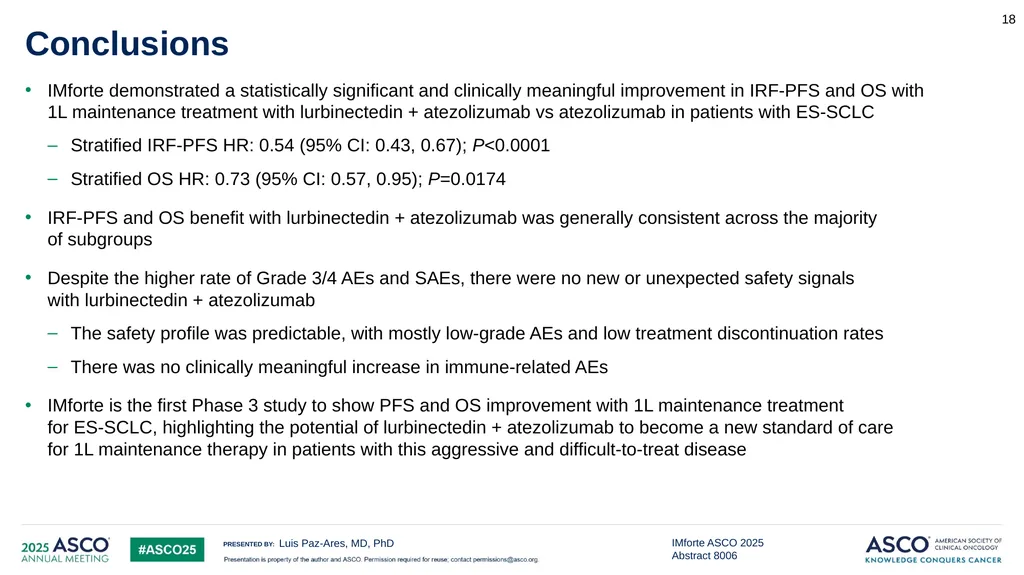
Conclusions IMforte demonstrated a statistically significant and clinically meaningful improvement in IRF-PFS and OS with
1L maintenance treatment with lurbinectedin + atezolizumab vs atezolizumab in patients with ES-SCLC
Stratified IRF-PFS HR: 0.54 (95% CI: 0.43, 0.67); P<0.0001
Stratified OS HR: 0.73 (95% CI: 0.57, 0.95); P=0.0174
IRF-PFS and OS benefit with lurbinectedin + atezolizumab was generally consistent across the majority of subgroups
Despite the higher rate of Grade 3/4 AEs and SAEs, there were no new or unexpected safety signals with lurbinectedin + atezolizumab
The safety profile was predictable, with mostly low-grade AEs and low treatment discontinuation rates
There was no clinically meaningful increase in immune-related AEs
IMforte is the first Phase 3 study to show PFS and OS improvement with 1L maintenance treatment for ES-SCLC, highlighting the potential of lurbinectedin + atezolizumab to become a new standard of care for 1L maintenance therapy in patients with this aggressive and difficult-to-treat disease Luis Paz-Ares, MD, PhD 18 IMforte ASCO 2025 Abstract 8006<br>
Stratified IRF-PFS HR: 0.54 (95% CI: 0.43, 0.67); P<0.0001
Stratified OS HR: 0.73 (95% CI: 0.57, 0.95); P=0.0174
IRF-PFS and OS benefit with lurbinectedin + atezolizumab was generally consistent across the majority of subgroups
Despite the higher rate of Grade 3/4 AEs and SAEs, there were no new or unexpected safety signals with lurbinectedin + atezolizumab
The safety profile was predictable, with mostly low-grade AEs and low treatment discontinuation rates
There was no clinically meaningful increase in immune-related AEs
IMforte is the first Phase 3 study to show PFS and OS improvement with 1L maintenance treatment for ES-SCLC, highlighting the potential of lurbinectedin + atezolizumab to become a new standard of care for 1L maintenance therapy in patients with this aggressive and difficult-to-treat disease Luis Paz-Ares, MD, PhD 18 IMforte ASCO 2025 Abstract 8006<br>
19
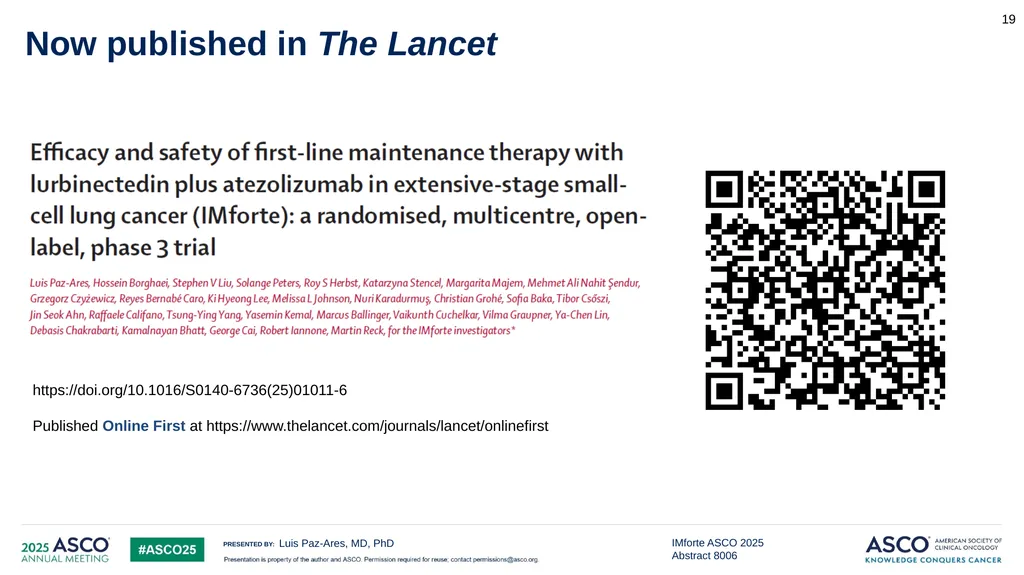
Now published in The Lancet Luis Paz-Ares, MD, PhD IMforte ASCO 2025 Abstract 8006 https://doi.org/10.1016/S0140-6736(25)01011-6
Published Online First at https://www.thelancet.com/journals/lancet/onlinefirst 19<br>
Published Online First at https://www.thelancet.com/journals/lancet/onlinefirst 19<br>
20
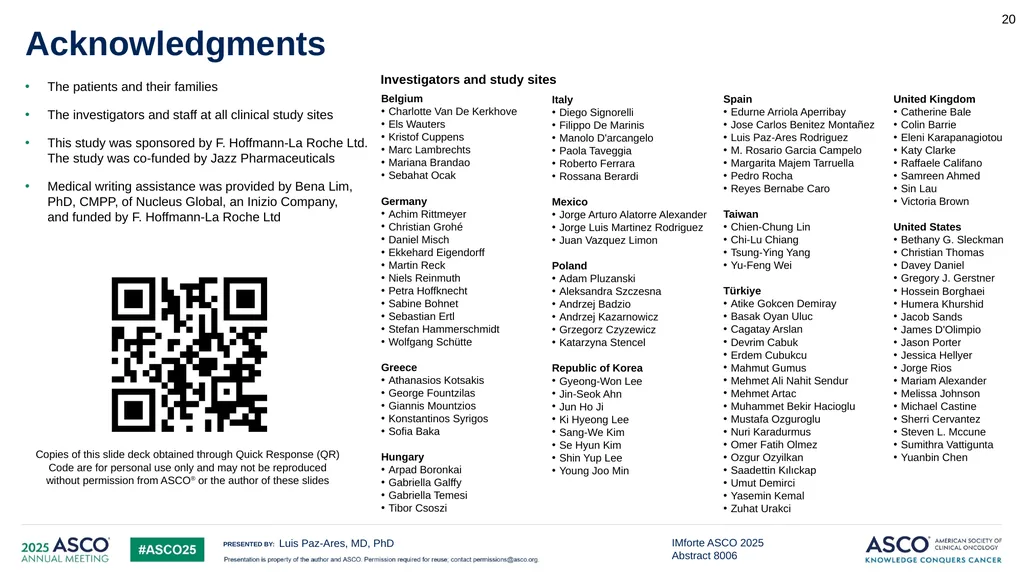
Acknowledgments The patients and their families
The investigators and staff at all clinical study sites
This study was sponsored by F. Hoffmann-La Roche Ltd. The study was co-funded by Jazz Pharmaceuticals
Medical writing assistance was provided by Bena Lim, PhD, CMPP, of Nucleus Global, an Inizio Company, and funded by F. Hoffmann-La Roche Ltd Luis Paz-Ares, MD, PhD 20 Copies of this slide deck obtained through Quick Response (QR) Code are for personal use only and may not be reproduced without permission from ASCO® or the author of these slides Investigators and study sites IMforte ASCO 2025 Abstract 8006<br>
The investigators and staff at all clinical study sites
This study was sponsored by F. Hoffmann-La Roche Ltd. The study was co-funded by Jazz Pharmaceuticals
Medical writing assistance was provided by Bena Lim, PhD, CMPP, of Nucleus Global, an Inizio Company, and funded by F. Hoffmann-La Roche Ltd Luis Paz-Ares, MD, PhD 20 Copies of this slide deck obtained through Quick Response (QR) Code are for personal use only and may not be reproduced without permission from ASCO® or the author of these slides Investigators and study sites IMforte ASCO 2025 Abstract 8006<br>
21
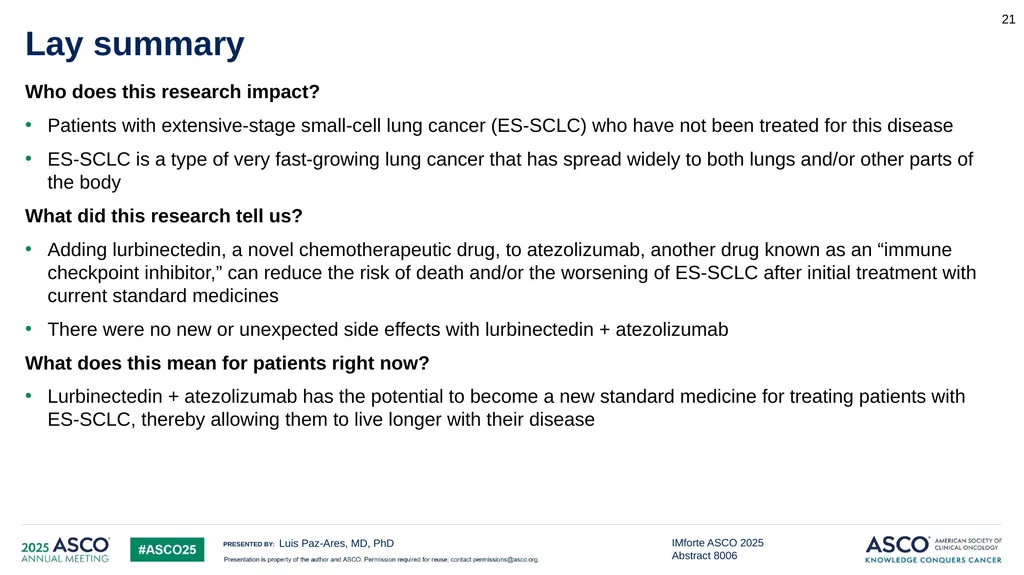
Lay summary Who does this research impact?
Patients with extensive-stage small-cell lung cancer (ES-SCLC) who have not been treated for this disease
ES-SCLC is a type of very fast-growing lung cancer that has spread widely to both lungs and/or other parts of the body
What did this research tell us?
Adding lurbinectedin, a novel chemotherapeutic drug, to atezolizumab, another drug known as an “immune checkpoint inhibitor,” can reduce the risk of death and/or the worsening of ES-SCLC after initial treatment with current standard medicines
There were no new or unexpected side effects with lurbinectedin + atezolizumab
What does this mean for patients right now?
Lurbinectedin + atezolizumab has the potential to become a new standard medicine for treating patients with ES-SCLC, thereby allowing them to live longer with their disease Luis Paz-Ares, MD, PhD IMforte ASCO 2025 Abstract 8006 21<br>
Patients with extensive-stage small-cell lung cancer (ES-SCLC) who have not been treated for this disease
ES-SCLC is a type of very fast-growing lung cancer that has spread widely to both lungs and/or other parts of the body
What did this research tell us?
Adding lurbinectedin, a novel chemotherapeutic drug, to atezolizumab, another drug known as an “immune checkpoint inhibitor,” can reduce the risk of death and/or the worsening of ES-SCLC after initial treatment with current standard medicines
There were no new or unexpected side effects with lurbinectedin + atezolizumab
What does this mean for patients right now?
Lurbinectedin + atezolizumab has the potential to become a new standard medicine for treating patients with ES-SCLC, thereby allowing them to live longer with their disease Luis Paz-Ares, MD, PhD IMforte ASCO 2025 Abstract 8006 21<br>
22
Supplementary information Luis Paz-Ares, MD, PhD IMforte ASCO 2025 Abstract 8006 22<br>
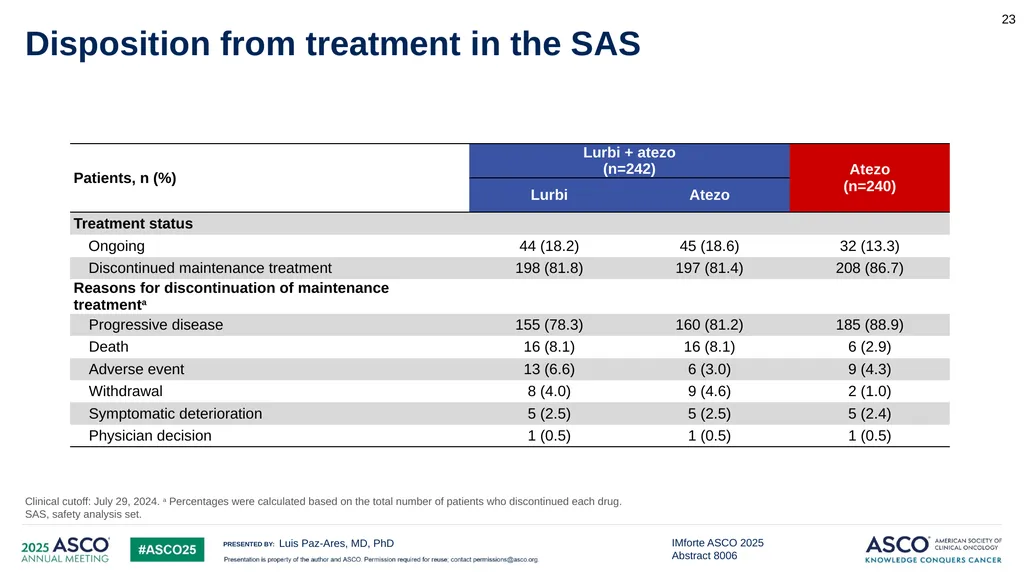
23
Disposition from treatment in the SAS Luis Paz-Ares, MD, PhD Clinical cutoff: July 29, 2024. a Percentages were calculated based on the total number of patients who discontinued each drug.
SAS, safety analysis set. IMforte ASCO 2025 Abstract 8006 23<br>
SAS, safety analysis set. IMforte ASCO 2025 Abstract 8006 23<br>
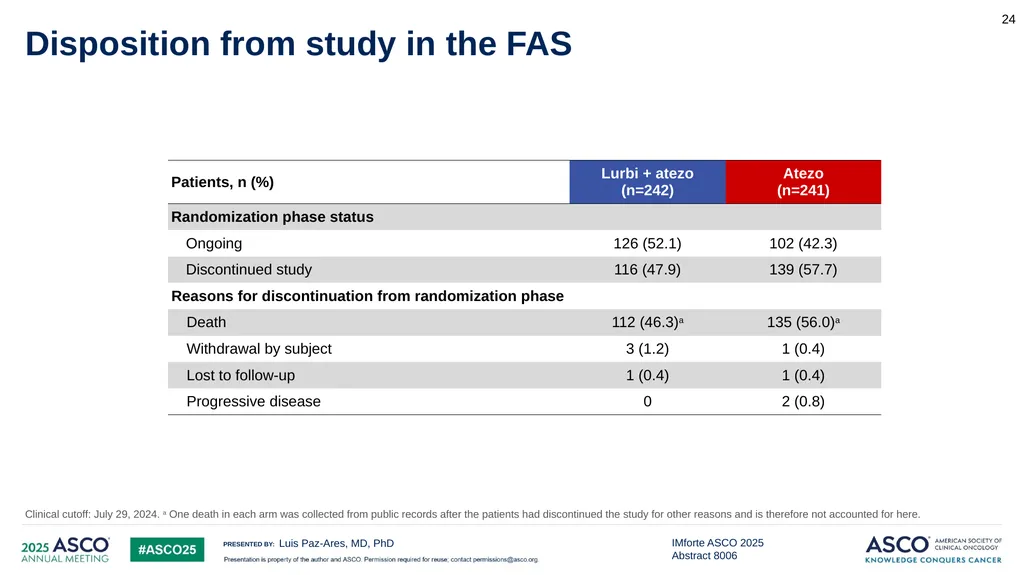
24
Disposition from study in the FAS Luis Paz-Ares, MD, PhD Clinical cutoff: July 29, 2024. a One death in each arm was collected from public records after the patients had discontinued the study for other reasons and is therefore not accounted for here. IMforte ASCO 2025 Abstract 8006 24<br>
25
Follow-up systemic anticancer treatments in the FAS Luis Paz-Ares, MD, PhD Clinical cutoff: July 29, 2024. Percentages were calculated based on the total number of patients in each arm.
ADC, antibody-drug conjugate. IMforte ASCO 2025 Abstract 8006 25<br>
26
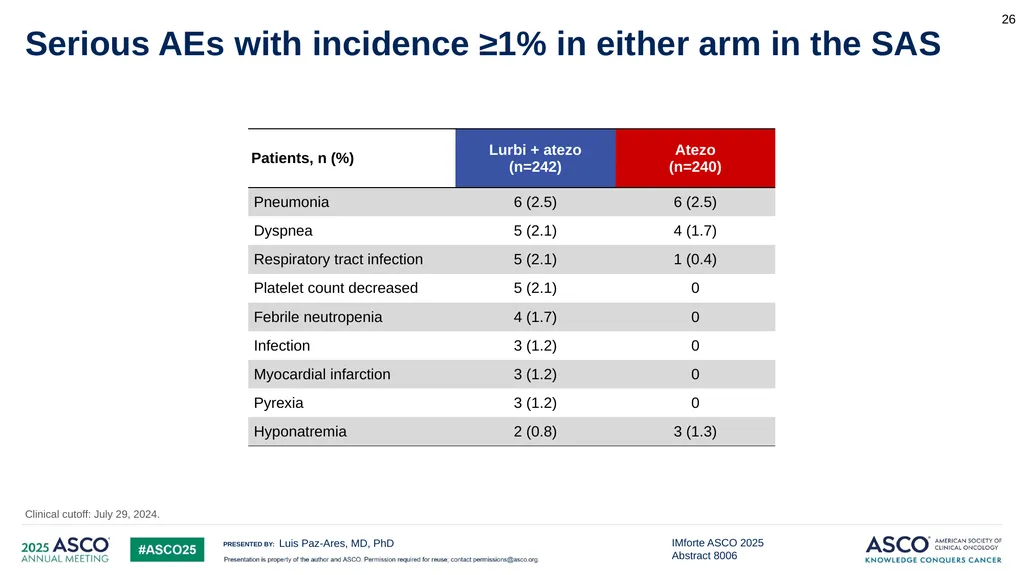
Serious AEs with incidence ≥1% in either arm in the SAS Luis Paz-Ares, MD, PhD Clinical cutoff: July 29, 2024. IMforte ASCO 2025 Abstract 8006 26<br>
27
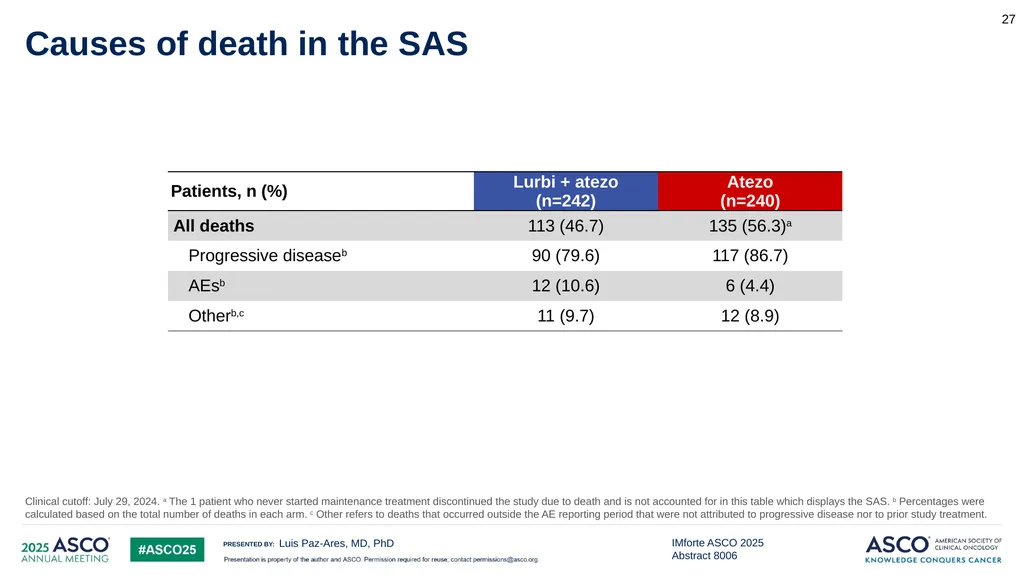
Causes of death in the SAS Luis Paz-Ares, MD, PhD Clinical cutoff: July 29, 2024. a The 1 patient who never started maintenance treatment discontinued the study due to death and is not accounted for in this table which displays the SAS. b Percentages were calculated based on the total number of deaths in each arm. c Other refers to deaths that occurred outside the AE reporting period that were not attributed to progressive disease nor to prior study treatment. IMforte ASCO 2025 Abstract 8006 27<br>
28
Grade 5 AEs by SOC and PT in the SAS Luis Paz-Ares, MD, PhD Clinical cutoff: July 29, 2024. a AE related to lurbi. b AE related to atezo.
PT, preferred term; SOC, system organ class. IMforte ASCO 2025 Abstract 8006 28<br>
PT, preferred term; SOC, system organ class. IMforte ASCO 2025 Abstract 8006 28<br>