
M.PAPPATHI M.COM.,M.PHIL., ASSISTANT PROFESSOR,
KB
Published · 18 slides · 0 views
1 / 1


Description
M.PAPPATHI M.COM.,M.PHIL., ASSISTANT PROFESSOR, III B.COM.,(CA) PPT ENTREPRENEURIAL DEVELOPMENT P.G DEPARTMENT OF COMMERCE(CA) ENTREPRENEURIAL DEVELOPMENT EVOLUTION OF ENTREPRENEURSHIP FUNCTIONS OF ENTREPRENEUR CHARACTERISTICS OF
Related Topics
Share
Embed code
Download this presentation From Below
"M.PAPPATHI M.COM.,M.PHIL., ASSISTANT PROFESSOR," is the property of its rightful owner. Permission is granted to download and print the materials on this website for personal, non-commercial use only, and to display it on your personal computer provided you do not modify the materials and that you retain all copyright notices contained in the materials. By downloading content from our website, you accept the terms of this agreement.
Presentation Transcript
01
M.PAPPATHI M.COM.,M.PHIL.,
ASSISTANT PROFESSOR,
III B.COM.,(CA) – PPT
ENTREPRENEURIAL DEVELOPMENT
P.G DEPARTMENT OF COMMERCE(CA)<br>
ASSISTANT PROFESSOR,
III B.COM.,(CA) – PPT
ENTREPRENEURIAL DEVELOPMENT
P.G DEPARTMENT OF COMMERCE(CA)<br>
02
ENTREPRENEURIAL
DEVELOPMENT<br>
03
EVOLUTION OF ENTREPRENEURSHIP
FUNCTIONS OF ENTREPRENEUR
CHARACTERISTICS OF ENTREPRENEUR<br>
FUNCTIONS OF ENTREPRENEUR
CHARACTERISTICS OF ENTREPRENEUR<br>
04
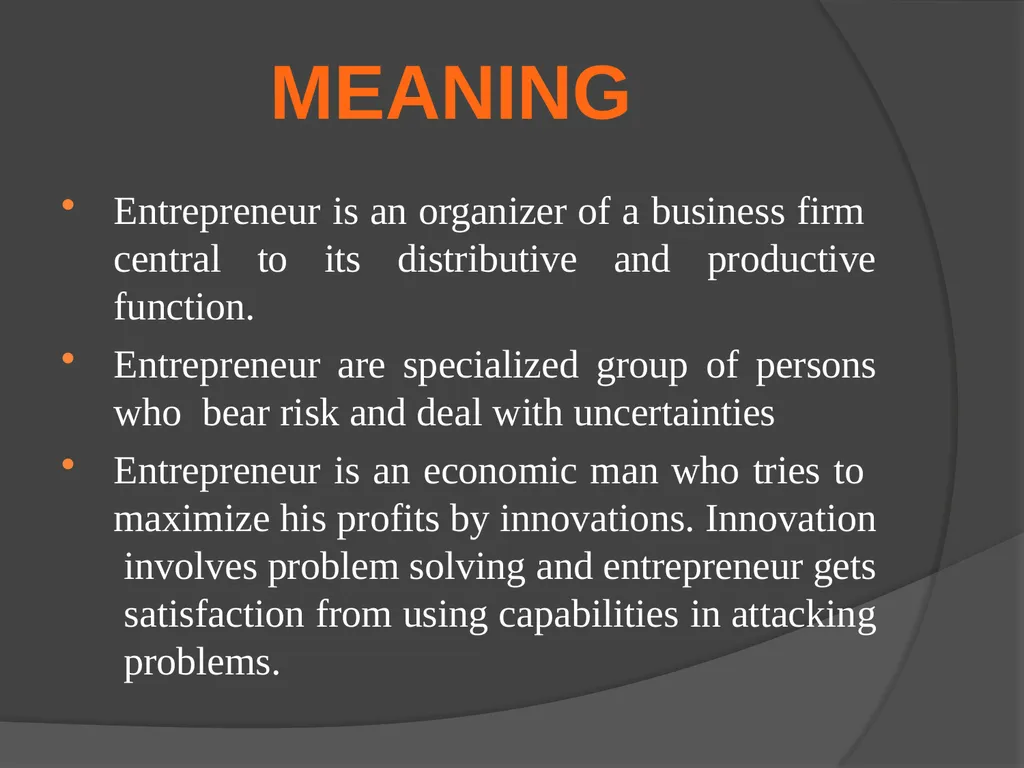
Entrepreneur is an organizer of a business firm central to its distributive and productive function.
Entrepreneur are specialized group of persons who bear risk and deal with uncertainties
Entrepreneur is an economic man who tries to maximize his profits by innovations. Innovation involves problem solving and entrepreneur gets satisfaction from using capabilities in attacking problems. MEANING<br>
Entrepreneur are specialized group of persons who bear risk and deal with uncertainties
Entrepreneur is an economic man who tries to maximize his profits by innovations. Innovation involves problem solving and entrepreneur gets satisfaction from using capabilities in attacking problems. MEANING<br>
05
Evolution Of Entrepreneurship in India The evolution of entrepreneurship in India starts in the era of Indus Valley Civilization.
During the Early Harappa period (about 3200–2600 BCE)
This age is also called as copper age, the Indus Valley Civilization area showed ceramic similarities with southern Turkmenistan and northern Iran which suggested considerable mobility and trade.
Apart from agriculture and hunting, the Indus people supported themselves by trading goods like exchange of Potteries, ornaments, exchanges of animals etc…<br>
06
Indus valley civilization: organized enterprise at a time when the world just belonged to clothe itself.
The early years (1000 B.C-500 B.C): Indian trader introduced re-exporting bought silk from Chinese and sold to central Asia. Bought horses from west Asians and sold to the Chinese.
The Maurya Era: In modern times the Maurya Empire is remembered as one of the golden ages of Indian history, a time when the country was united and independent.
Vast territory, better trade. Widespread use of metallic money, Missions to Sri Lanka and Southeast Asia increase trade.
The people were divided into seven endogamous groups--philosophers, peasants, herdsmen, traders, soldiers, government officials, and councilors.<br>
07
The Gupta Era: (400 A.D – 600 A.D) - Traders from associations to protect interests Codification of transnational business.
The Middle ages-(700 A.D-1300 A.D): Paper, Printing invented. Dams, roads ease trade, south –East Asia & Indonesia.
The Mughal age (1500 A.D-1600 A.D): Dominated world commerce, large quantities of gold and silver flow into the country.
The Mughal Era II (1600 A.D-1700 A.D): British arrive in this era. The person named Surat merchant virji Vora among first entrepreneurs.
The colonial era I (1700 A.D-1850 A.D): Europe was then the hotbed of technological innovation. The traders brought with them plenty of new ways of doing business. Seizing the opportunities that emerged, many Indians became entrepreneurs.
Dwarkanath Tagore, who formed India‘s first Joint Venture with a foreigner, Carr Tagore Nanabhai Davar, who put up the country first textile mill in 1854.But could not able to run that.<br>
08
The colonial ERA II (1850 A.D-1900A.D): Railways set up (1853). cowasjee Nanabhai Davar first cotton mill in Bombay. Sir J.N Tata founded Jamshedpur steelworks. Foundations of jute mills, pharmaceutical industry were laid.
Major players of the era were Ghanshyam das, Birla, Goenkas, khaitans, jamsetjee jejeebhoy, Mafaltal Gagalbhai, Laxmanrao kirlsokar, walchand Hirachand,Nusserwanjee wadia, pirojsha Godrej, K.Gopalakrishnan, L.K.singhania, Gujar- lal modi and Lala shriram
The colonial era III (1900 A.D-1947A.D): New crop arises in this Period. Change makers like JRD Tata, MS Oberai, jamnalal Bajaj lead the way for Indian entrepreneurs.
After Independence: scale industrialization entrepreneurs like Dirubai Ambani emerge.Globalisation arrives, and with it the premjis, the Narayana murthys, the Rajesh Jains etc.,Over the last 68 years, India has seen the entrepreneur evolves in different role.
The modern entrepreneurs are wealth creators, communicators, change agents, entertainers etc.<br>
09
Entrepreneurship-Present Era: C. K. Prahlad, - Fortune at the bottom of the pyramid‖ states that the need for innovation in entrepreneurship.
Nation urges Entrepreneurs to Explore domestic opportunities
To succeed, one need to continuous innovation & to have continuous innovation, one need to tap thinking of every one in enterprise. Innovation plays a key factor in an entrepreneurial quality.<br>
Nation urges Entrepreneurs to Explore domestic opportunities
To succeed, one need to continuous innovation & to have continuous innovation, one need to tap thinking of every one in enterprise. Innovation plays a key factor in an entrepreneurial quality.<br>
10
Functions of Entrepreneur<br>
11
FUNCTIONS OF ENTREPRENEUR Risk measurement and risk taking : Risk taking and risk measurement is the primary function of entrepreneur. Risk are not only related to success or failure of business but also involve personal and professional career forgone for the sake of opportunity.
Innovate/ create/ discover : Entrepreneurship is innovativeness of individual and does not involve ownership. Principal function of the entrepreneur is to carry out new combinations of means of production.
Analyze opportunities : Entrepreneur has to have opportunity seeking style where he has to evaluate credibility of various alternatives and choose suitable alternative which will prove to be profitable in future.
Strategies for venture : Entrepreneur has to strategize long term plan for starting venture. He has to analyze the market and devise effective strategies to face present and future competition.<br>
12
Develop business plan : Business plan is written document containing details about every aspect of proposed business venture. It provides roadmap to employees working in company to attain objectives and is capable of convincing potential customers they are share holders and investors of company.
Acquire resources : Entrepreneur has to acquire various types of resources such as men, money, material, machinery to start venture. Entrepreneur has to have suitable skills to line up required resources for the company.
Organize and start venture : Entrepreneur should be a good organizer, he should deploy suitable resources at right place in right time required to for the company to ensure effective working of organization.
Develop and grow venture : It is not only important to start a venture but also company should be able to respond to changes happening in the business market which is crucial factor deciding existence of company<br>
13
Delegate, direct and lead the plan : During the growth stage of the company entrepreneur should provide required resources for the company and during later stage entrepreneur should come up with effective strategies to face competition and guide employees in company performing role of leader.
Supervise and control : For success of business it is important to have suitable mechanism in place so that entrepreneur can track overall success of the company.<br>
Supervise and control : For success of business it is important to have suitable mechanism in place so that entrepreneur can track overall success of the company.<br>
14
CHARACTERISTICS OF ENTREPRENEUR<br>
15
Vision: Entrepreneur works hard to fulfill his dream in process to achieve his objective, he visualizes market scenario, socio economic, and technological environment based on these information he predicts future situation and accordingly plans his vision and ways to achieve desired objective.
Knowledge: As entrepreneur is soul of organization he is required to have knowledge about all the operations carried in organization so that he can direct and regulate activities of his employees from time to time.
Desire to succeed: Entrepreneur are recognized in society because of their varied mindset and high dreams which motivates them to bring in invention and innovation in are of their business.<br>
16
Independence : Entrepreneur needs independence in his work area as they are not know to follow their rule of thumb.
Optimistic: Entrepreneurs are optimistic about achieving their objective as they intend to take risk to any extent to accomplish desired goals.
Value addition: Entrepreneurs are known for bringing new things in market. They create, innovate, add value to existing products in market.<br>
Optimistic: Entrepreneurs are optimistic about achieving their objective as they intend to take risk to any extent to accomplish desired goals.
Value addition: Entrepreneurs are known for bringing new things in market. They create, innovate, add value to existing products in market.<br>
17
Hardworking: Entrepreneur are know to be workaholic. They put in continuous efforts to achieve success and know that their is no substitute for hard work.
Risk taking: Ability is one of the major trait of successful entrepreneur .
Leadership: Entrepreneur exhibits qualities of good leader. They are good planners, organizers, decision makers and are empathetic towards employees at workplace.<br>
Risk taking: Ability is one of the major trait of successful entrepreneur .
Leadership: Entrepreneur exhibits qualities of good leader. They are good planners, organizers, decision makers and are empathetic towards employees at workplace.<br>
18
Thank You<br>