
Madhu Sudan Sharma Senior Project Coordinator
KB
Published · 20 slides · 0 views

1 / 1

Description
Madhu Sudan Sharma Senior Project Coordinator Consumer Unity Trust Society (CUTS International) Rajasthan Public Procurement Observatory CUTS Experiences and Learning on Public Procurement Date: February 22, 2017 Colombo, Sri Lanka CUTS
Related Topics
Share
Embed code
Download this presentation From Below
"Madhu Sudan Sharma Senior Project Coordinator" is the property of its rightful owner. Permission is granted to download and print the materials on this website for personal, non-commercial use only, and to display it on your personal computer provided you do not modify the materials and that you retain all copyright notices contained in the materials. By downloading content from our website, you accept the terms of this agreement.
Presentation Transcript
01
Madhu Sudan Sharma
Senior Project Coordinator
Consumer Unity & Trust Society (CUTS International) ‘Rajasthan Public Procurement Observatory’
CUTS Experiences and Learning on Public Procurement
Date: February 22, 2017
Colombo, Sri Lanka<br>
Senior Project Coordinator
Consumer Unity & Trust Society (CUTS International) ‘Rajasthan Public Procurement Observatory’
CUTS Experiences and Learning on Public Procurement
Date: February 22, 2017
Colombo, Sri Lanka<br>
02
CUTS is a leading Indian origin, international consumer organisation, established in 1983 and headquartered in Jaipur.
CUTS’ Vision: Consumer sovereignty in the framework of social justice and economic equality, within and across borders.
CUTS is working on Consumer Issues, Trade, Investment, Competition, Regulation and Governance issues for last 34 years.
CUTS is working on Public Procurement for last 15 Years. It works on it from various angles of Trades, Governance and academics (Offers PDPP).
CIRC, New Delhi is maintaining National Observatory on Pub. Procurement.
CUTS CART: Brief Introduction: Consumer Protection & Good Governance are two key programmatic area. Work for promoting transparency & accountability using various tools/Laws including RTPP Act and Rules.
CUTS CART has worked intensively in almost all the districts of Rajasthan. And also in various states of India and Asian Countries.
Approach: RAN (Research, advocacy and Networking)
Works in close collaboration with Central, State and Local Govt.
Details can be seen at: www.cuts-international.org/cart About CUTS<br>
CUTS’ Vision: Consumer sovereignty in the framework of social justice and economic equality, within and across borders.
CUTS is working on Consumer Issues, Trade, Investment, Competition, Regulation and Governance issues for last 34 years.
CUTS is working on Public Procurement for last 15 Years. It works on it from various angles of Trades, Governance and academics (Offers PDPP).
CIRC, New Delhi is maintaining National Observatory on Pub. Procurement.
CUTS CART: Brief Introduction: Consumer Protection & Good Governance are two key programmatic area. Work for promoting transparency & accountability using various tools/Laws including RTPP Act and Rules.
CUTS CART has worked intensively in almost all the districts of Rajasthan. And also in various states of India and Asian Countries.
Approach: RAN (Research, advocacy and Networking)
Works in close collaboration with Central, State and Local Govt.
Details can be seen at: www.cuts-international.org/cart About CUTS<br>
03
Rajasthan is known as land of Kings,Palaces/Forts and Desert.
Geographically It’s largest state of India.
Population of state of 7.48 Crores (2016) and Live stocks population is 5.77 Crore (2012). (RTPP is applicable on Animals and Trees’ Procurement).
Range: Procurement happens at state, district, sub-division and Village Council/Urban Local Bodies level.
It has 33 Districts, 295 Sub-Divisions, 9894 Village Councils and 187 Municipalities (Total 10376 PRIs).
In State, 180 Departments, 400 HoDs, 671 procuring Entities, 22,580 procuring officials but could be much more.
Most of the interactions of observatory are with Finance Department, SPFC officials, selected Procuring officials, vendors and common consumers. About Rajasthan<br>
Geographically It’s largest state of India.
Population of state of 7.48 Crores (2016) and Live stocks population is 5.77 Crore (2012). (RTPP is applicable on Animals and Trees’ Procurement).
Range: Procurement happens at state, district, sub-division and Village Council/Urban Local Bodies level.
It has 33 Districts, 295 Sub-Divisions, 9894 Village Councils and 187 Municipalities (Total 10376 PRIs).
In State, 180 Departments, 400 HoDs, 671 procuring Entities, 22,580 procuring officials but could be much more.
Most of the interactions of observatory are with Finance Department, SPFC officials, selected Procuring officials, vendors and common consumers. About Rajasthan<br>
04
Rajasthan Transparency in Public Procurement (RTPP) Act, 2012
Rajasthan Transparency in Public Procurement (RTPP) Rules, 2013.
RTPP Act & Rules came in to force from January 26, 2013.
Public Private Partnership Guidelines, 2012.
Rajasthan P.P.P. Policy, 2008.
E-Procurement Portal: https://eproc.rajasthan.gov.in/nicgep/app
Swish Challenge Method, 2015.
Nodal Department to implement the Act/Rules: Finance Department is the nodal department and State Public Procurement Facilitation (SPFC) is the dedicated cell with 10 dedicated officials. (Sec. 50)
Centralised web platform: ‘State Public Procurement Portal for disclosure of procurement information of the state. (Sec. 17).
Details can be seen at: http://sppp.rajasthan.gov.in/bidsearch.php
Recently launched ‘Government E-market place (GeM)’ Portal, 2016.
Conclusion: The legal and institutional framework is very strong now. Legal & Institutional Pub. Proc. Framework in Rajasthan<br>
Rajasthan Transparency in Public Procurement (RTPP) Rules, 2013.
RTPP Act & Rules came in to force from January 26, 2013.
Public Private Partnership Guidelines, 2012.
Rajasthan P.P.P. Policy, 2008.
E-Procurement Portal: https://eproc.rajasthan.gov.in/nicgep/app
Swish Challenge Method, 2015.
Nodal Department to implement the Act/Rules: Finance Department is the nodal department and State Public Procurement Facilitation (SPFC) is the dedicated cell with 10 dedicated officials. (Sec. 50)
Centralised web platform: ‘State Public Procurement Portal for disclosure of procurement information of the state. (Sec. 17).
Details can be seen at: http://sppp.rajasthan.gov.in/bidsearch.php
Recently launched ‘Government E-market place (GeM)’ Portal, 2016.
Conclusion: The legal and institutional framework is very strong now. Legal & Institutional Pub. Proc. Framework in Rajasthan<br>
05
Project Name: ‘Setting up a Public Procurement Observatory in Rajasthan (ProOb)’.
Support: The World Bank, ADB, New Delhi
Duration: Nov. 2014 to Nov. 2015 & June, 2016 to June 2017
Purpose of the Observatory:
Monitor the legal framework, implementation of Act/policies/rules and procurement practices in Rajasthan.
Collection and analyses of public procurement related quantitative/quantitative data.
Share the findings of the mentioned analyses and its outcome with State Govt./Departments/PEs through seminars/website/Publications. Documenting best practices.
Facilitate public access to information/current happenings/practices, in order to ensure transparency.
Enable learnings from past experiences and good practices and provide guidance for future reforms and innovations.
Consequently, making procurement process cost effective by advocating better practices for process improvement.
Producing knowledge products. Project Overview<br>
Support: The World Bank, ADB, New Delhi
Duration: Nov. 2014 to Nov. 2015 & June, 2016 to June 2017
Purpose of the Observatory:
Monitor the legal framework, implementation of Act/policies/rules and procurement practices in Rajasthan.
Collection and analyses of public procurement related quantitative/quantitative data.
Share the findings of the mentioned analyses and its outcome with State Govt./Departments/PEs through seminars/website/Publications. Documenting best practices.
Facilitate public access to information/current happenings/practices, in order to ensure transparency.
Enable learnings from past experiences and good practices and provide guidance for future reforms and innovations.
Consequently, making procurement process cost effective by advocating better practices for process improvement.
Producing knowledge products. Project Overview<br>
06
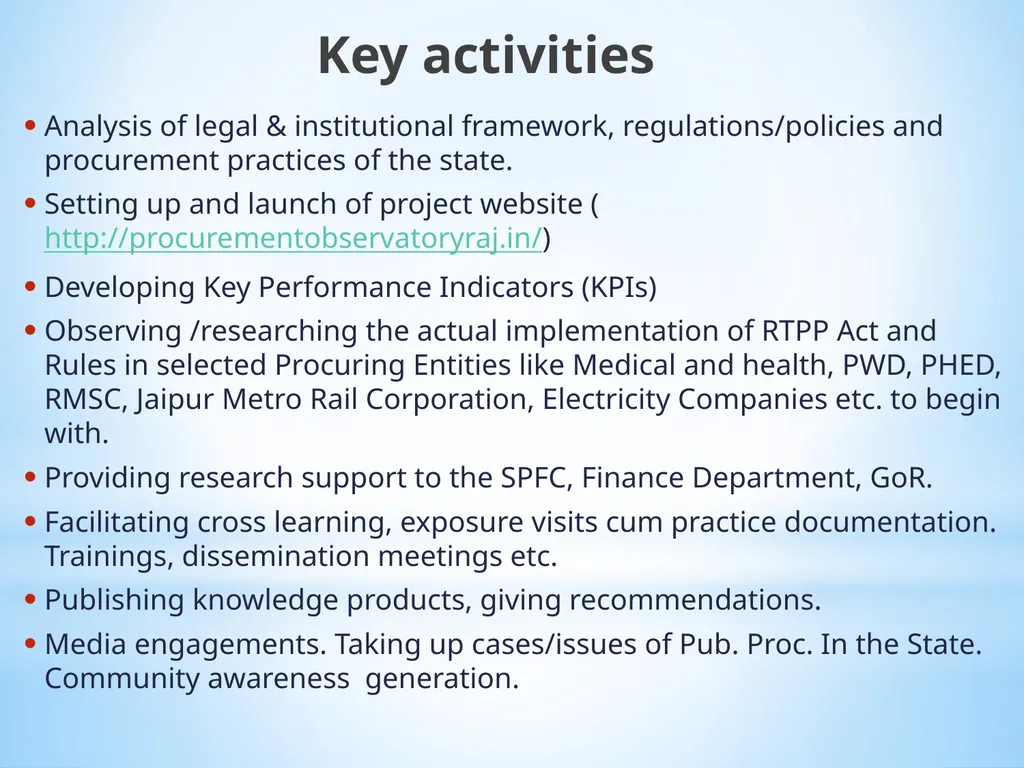
Key activities Analysis of legal & institutional framework, regulations/policies and procurement practices of the state.
Setting up and launch of project website (http://procurementobservatoryraj.in/)
Developing Key Performance Indicators (KPIs)
Observing /researching the actual implementation of RTPP Act and Rules in selected Procuring Entities like Medical and health, PWD, PHED, RMSC, Jaipur Metro Rail Corporation, Electricity Companies etc. to begin with.
Providing research support to the SPFC, Finance Department, GoR.
Facilitating cross learning, exposure visits cum practice documentation. Trainings, dissemination meetings etc.
Publishing knowledge products, giving recommendations.
Media engagements. Taking up cases/issues of Pub. Proc. In the State. Community awareness generation.<br>
Setting up and launch of project website (http://procurementobservatoryraj.in/)
Developing Key Performance Indicators (KPIs)
Observing /researching the actual implementation of RTPP Act and Rules in selected Procuring Entities like Medical and health, PWD, PHED, RMSC, Jaipur Metro Rail Corporation, Electricity Companies etc. to begin with.
Providing research support to the SPFC, Finance Department, GoR.
Facilitating cross learning, exposure visits cum practice documentation. Trainings, dissemination meetings etc.
Publishing knowledge products, giving recommendations.
Media engagements. Taking up cases/issues of Pub. Proc. In the State. Community awareness generation.<br>
07
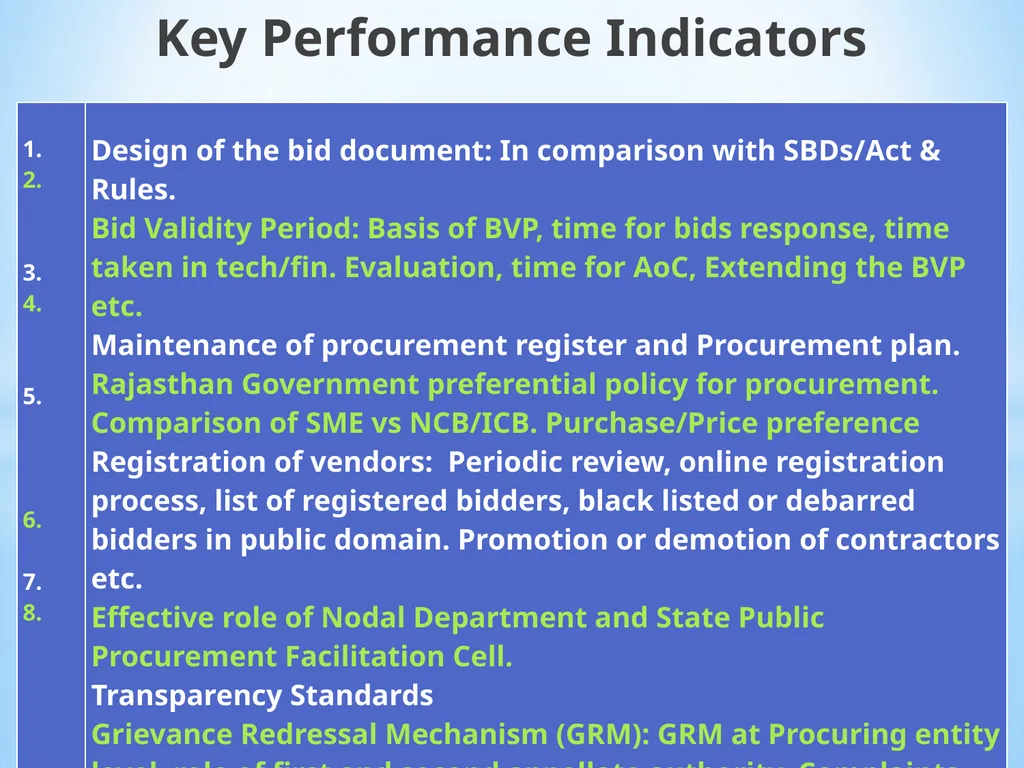
Key Performance Indicators<br>
08
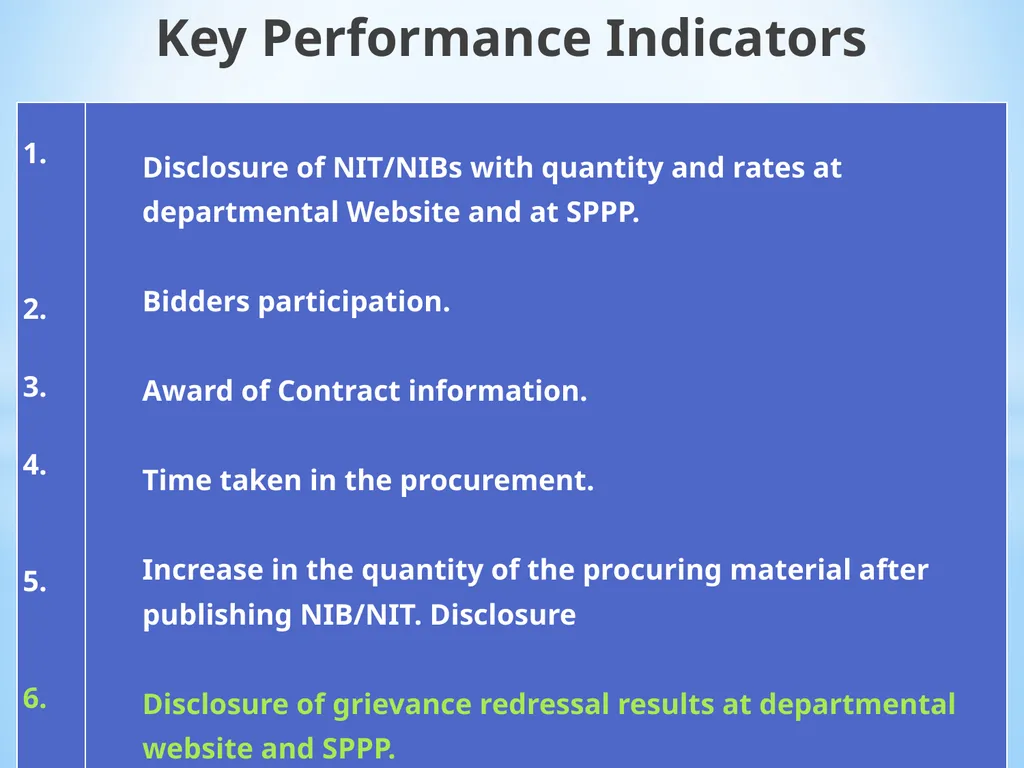
Key Performance Indicators<br>
09
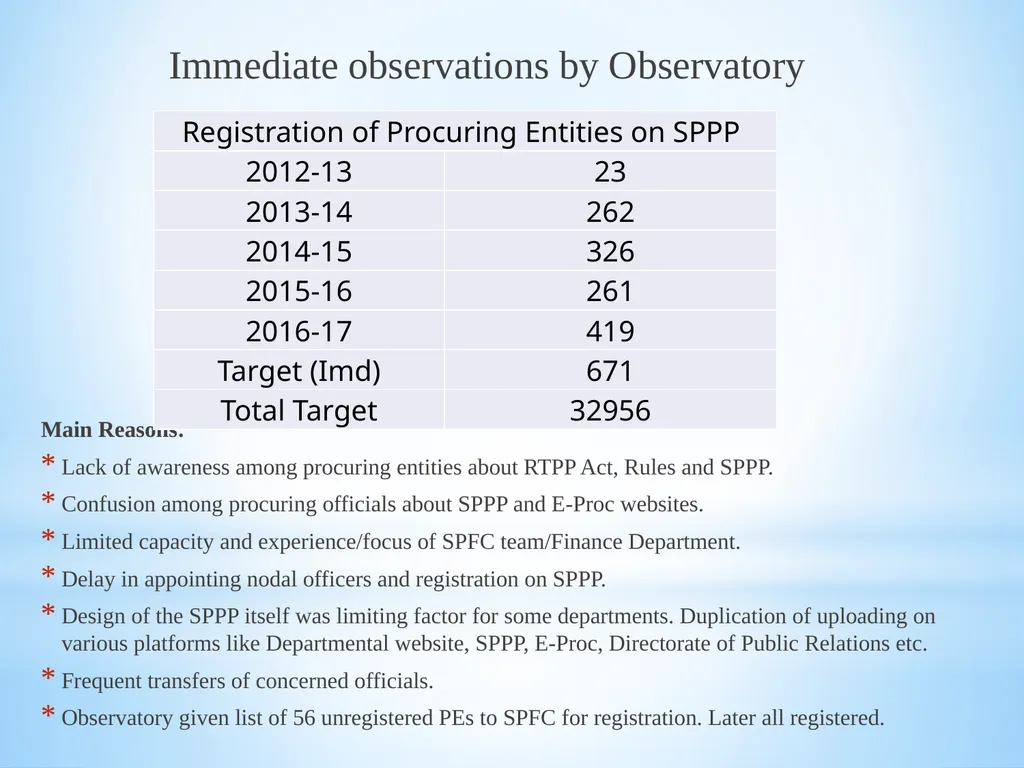
Main Reasons:
Lack of awareness among procuring entities about RTPP Act, Rules and SPPP.
Confusion among procuring officials about SPPP and E-Proc websites.
Limited capacity and experience/focus of SPFC team/Finance Department.
Delay in appointing nodal officers and registration on SPPP.
Design of the SPPP itself was limiting factor for some departments. Duplication of uploading on various platforms like Departmental website, SPPP, E-Proc, Directorate of Public Relations etc.
Frequent transfers of concerned officials.
Observatory given list of 56 unregistered PEs to SPFC for registration. Later all registered. Immediate observations by Observatory<br>
Lack of awareness among procuring entities about RTPP Act, Rules and SPPP.
Confusion among procuring officials about SPPP and E-Proc websites.
Limited capacity and experience/focus of SPFC team/Finance Department.
Delay in appointing nodal officers and registration on SPPP.
Design of the SPPP itself was limiting factor for some departments. Duplication of uploading on various platforms like Departmental website, SPPP, E-Proc, Directorate of Public Relations etc.
Frequent transfers of concerned officials.
Observatory given list of 56 unregistered PEs to SPFC for registration. Later all registered. Immediate observations by Observatory<br>
10
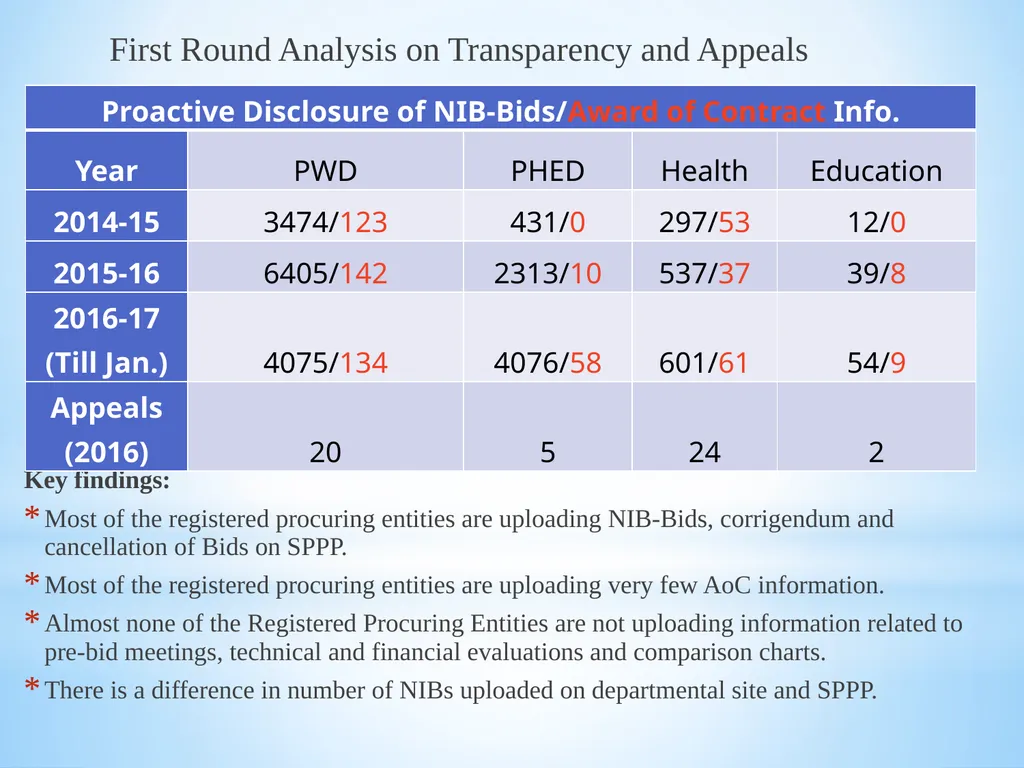
Key findings:
Most of the registered procuring entities are uploading NIB-Bids, corrigendum and cancellation of Bids on SPPP.
Most of the registered procuring entities are uploading very few AoC information.
Almost none of the Registered Procuring Entities are not uploading information related to pre-bid meetings, technical and financial evaluations and comparison charts.
There is a difference in number of NIBs uploaded on departmental site and SPPP. First Round Analysis on Transparency and Appeals<br>
Most of the registered procuring entities are uploading NIB-Bids, corrigendum and cancellation of Bids on SPPP.
Most of the registered procuring entities are uploading very few AoC information.
Almost none of the Registered Procuring Entities are not uploading information related to pre-bid meetings, technical and financial evaluations and comparison charts.
There is a difference in number of NIBs uploaded on departmental site and SPPP. First Round Analysis on Transparency and Appeals<br>
11
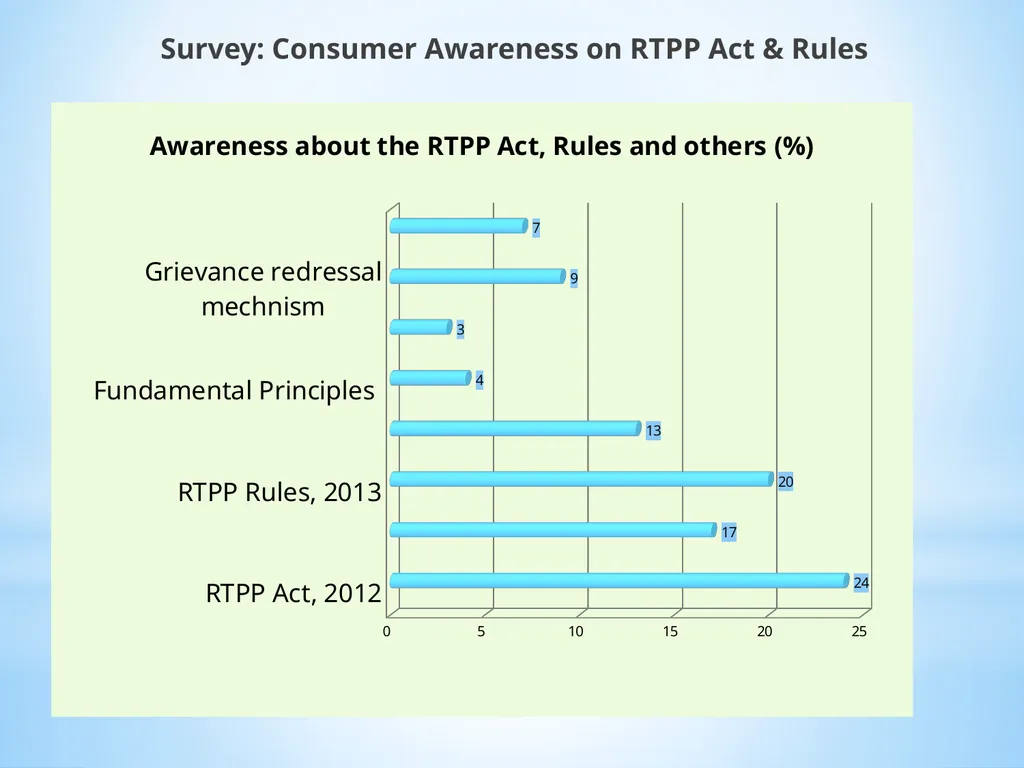
Survey: Consumer Awareness on RTPP Act & Rules<br>
12
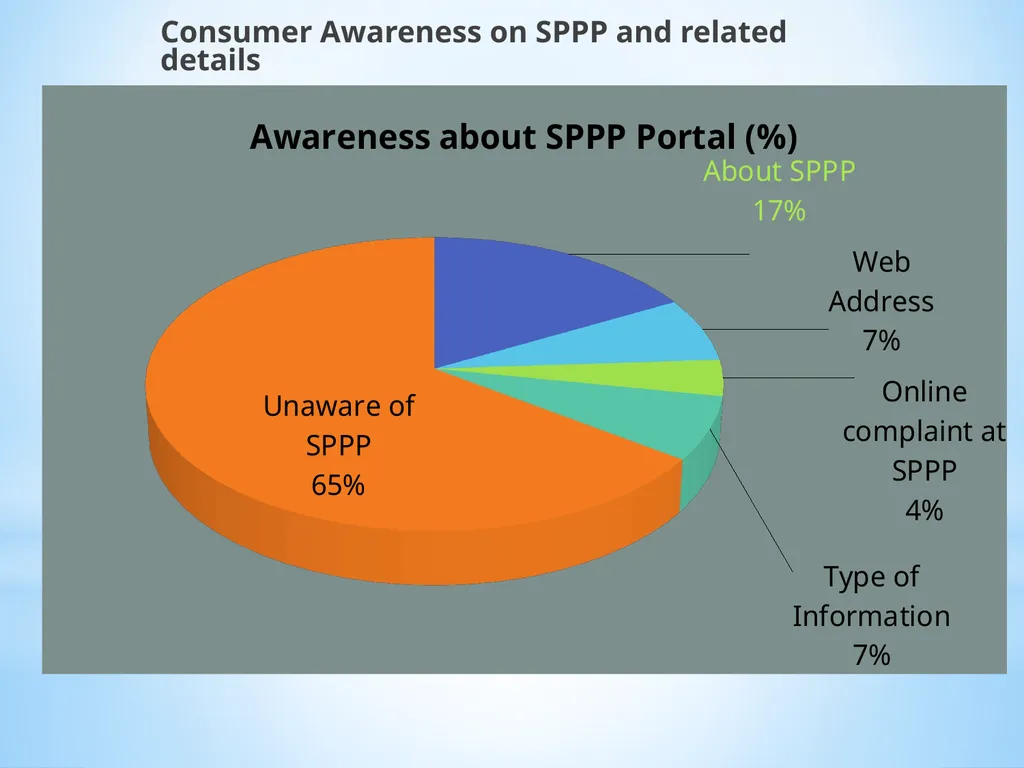
Consumer Awareness on SPPP and related details<br>
13
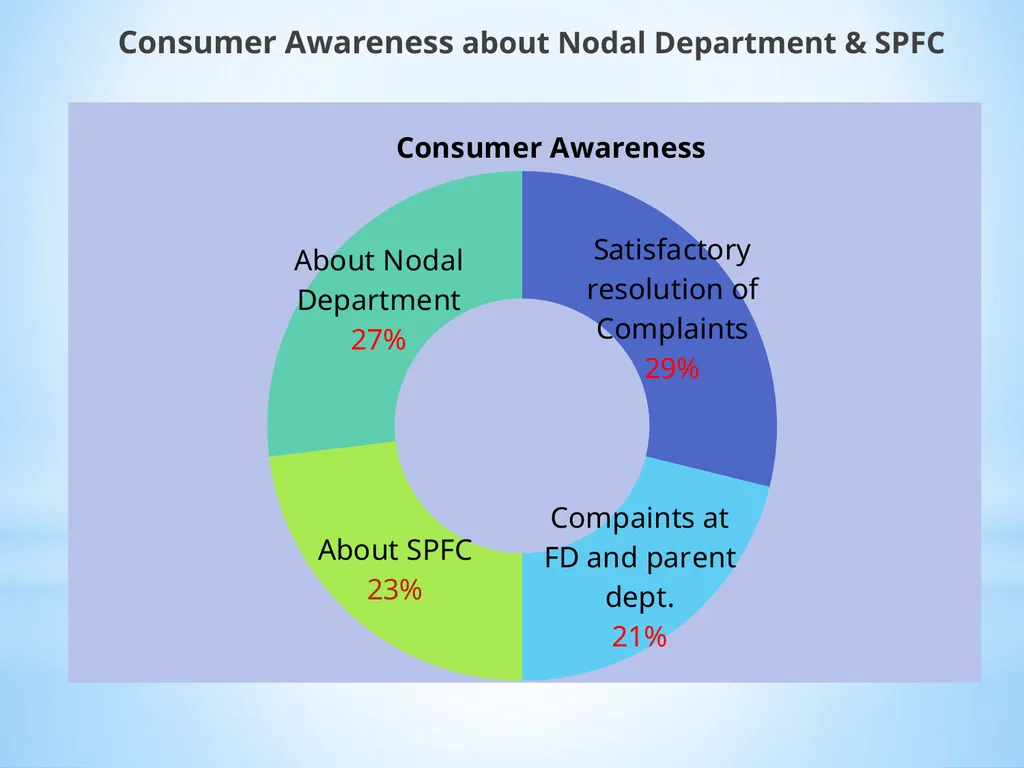
Consumer Awareness about Nodal Department & SPFC<br>
14
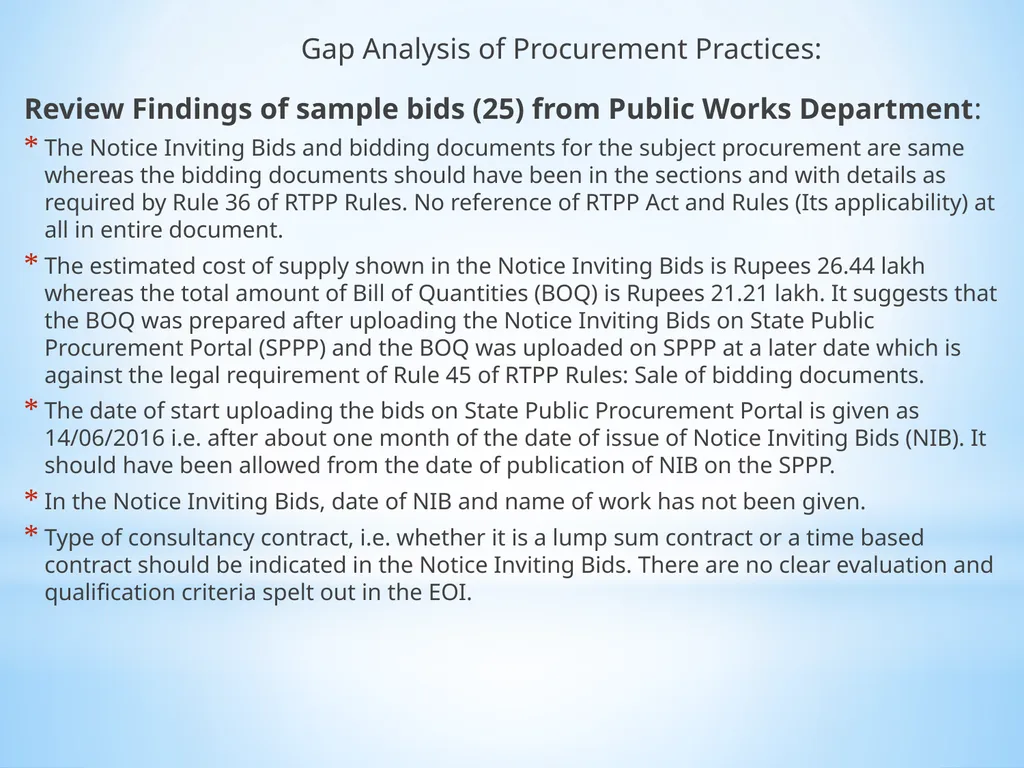
Review Findings of sample bids (25) from Public Works Department:
The Notice Inviting Bids and bidding documents for the subject procurement are same whereas the bidding documents should have been in the sections and with details as required by Rule 36 of RTPP Rules. No reference of RTPP Act and Rules (Its applicability) at all in entire document.
The estimated cost of supply shown in the Notice Inviting Bids is Rupees 26.44 lakh whereas the total amount of Bill of Quantities (BOQ) is Rupees 21.21 lakh. It suggests that the BOQ was prepared after uploading the Notice Inviting Bids on State Public Procurement Portal (SPPP) and the BOQ was uploaded on SPPP at a later date which is against the legal requirement of Rule 45 of RTPP Rules: Sale of bidding documents.
The date of start uploading the bids on State Public Procurement Portal is given as 14/06/2016 i.e. after about one month of the date of issue of Notice Inviting Bids (NIB). It should have been allowed from the date of publication of NIB on the SPPP.
In the Notice Inviting Bids, date of NIB and name of work has not been given.
Type of consultancy contract, i.e. whether it is a lump sum contract or a time based contract should be indicated in the Notice Inviting Bids. There are no clear evaluation and qualification criteria spelt out in the EOI. Gap Analysis of Procurement Practices:<br>
The Notice Inviting Bids and bidding documents for the subject procurement are same whereas the bidding documents should have been in the sections and with details as required by Rule 36 of RTPP Rules. No reference of RTPP Act and Rules (Its applicability) at all in entire document.
The estimated cost of supply shown in the Notice Inviting Bids is Rupees 26.44 lakh whereas the total amount of Bill of Quantities (BOQ) is Rupees 21.21 lakh. It suggests that the BOQ was prepared after uploading the Notice Inviting Bids on State Public Procurement Portal (SPPP) and the BOQ was uploaded on SPPP at a later date which is against the legal requirement of Rule 45 of RTPP Rules: Sale of bidding documents.
The date of start uploading the bids on State Public Procurement Portal is given as 14/06/2016 i.e. after about one month of the date of issue of Notice Inviting Bids (NIB). It should have been allowed from the date of publication of NIB on the SPPP.
In the Notice Inviting Bids, date of NIB and name of work has not been given.
Type of consultancy contract, i.e. whether it is a lump sum contract or a time based contract should be indicated in the Notice Inviting Bids. There are no clear evaluation and qualification criteria spelt out in the EOI. Gap Analysis of Procurement Practices:<br>
15
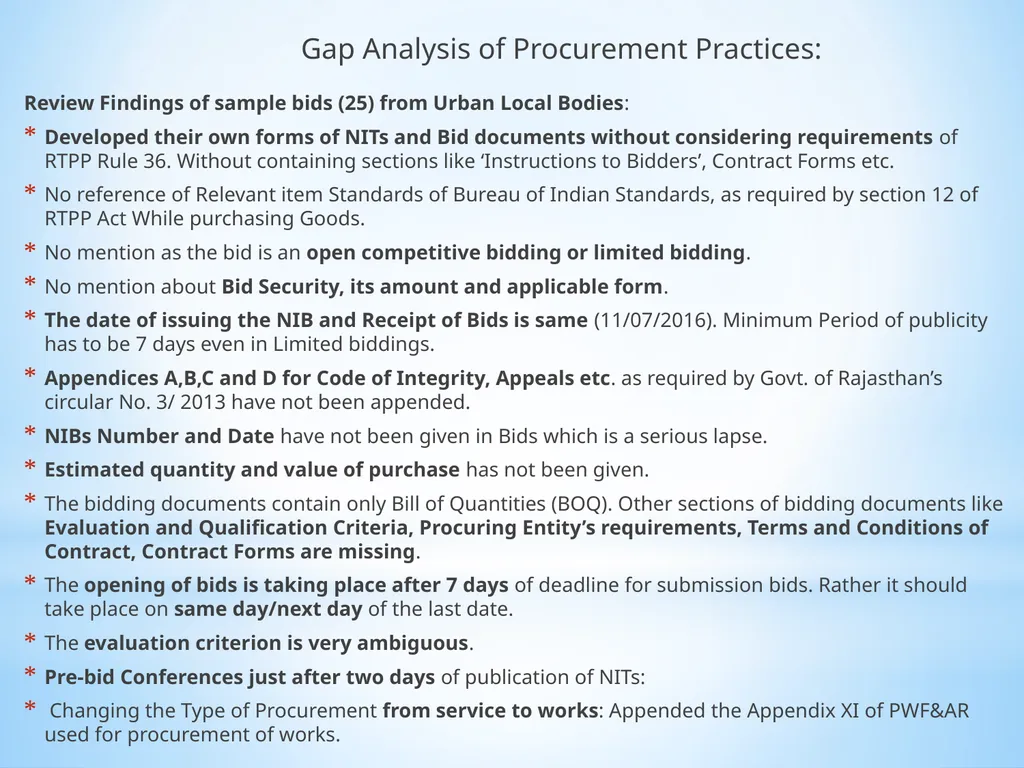
Review Findings of sample bids (25) from Urban Local Bodies:
Developed their own forms of NITs and Bid documents without considering requirements of RTPP Rule 36. Without containing sections like ‘Instructions to Bidders’, Contract Forms etc.
No reference of Relevant item Standards of Bureau of Indian Standards, as required by section 12 of RTPP Act While purchasing Goods.
No mention as the bid is an open competitive bidding or limited bidding.
No mention about Bid Security, its amount and applicable form.
The date of issuing the NIB and Receipt of Bids is same (11/07/2016). Minimum Period of publicity has to be 7 days even in Limited biddings.
Appendices A,B,C and D for Code of Integrity, Appeals etc. as required by Govt. of Rajasthan’s circular No. 3/ 2013 have not been appended.
NIBs Number and Date have not been given in Bids which is a serious lapse.
Estimated quantity and value of purchase has not been given.
The bidding documents contain only Bill of Quantities (BOQ). Other sections of bidding documents like Evaluation and Qualification Criteria, Procuring Entity’s requirements, Terms and Conditions of Contract, Contract Forms are missing.
The opening of bids is taking place after 7 days of deadline for submission bids. Rather it should take place on same day/next day of the last date.
The evaluation criterion is very ambiguous.
Pre-bid Conferences just after two days of publication of NITs:
Changing the Type of Procurement from service to works: Appended the Appendix XI of PWF&AR used for procurement of works. Gap Analysis of Procurement Practices:<br>
Developed their own forms of NITs and Bid documents without considering requirements of RTPP Rule 36. Without containing sections like ‘Instructions to Bidders’, Contract Forms etc.
No reference of Relevant item Standards of Bureau of Indian Standards, as required by section 12 of RTPP Act While purchasing Goods.
No mention as the bid is an open competitive bidding or limited bidding.
No mention about Bid Security, its amount and applicable form.
The date of issuing the NIB and Receipt of Bids is same (11/07/2016). Minimum Period of publicity has to be 7 days even in Limited biddings.
Appendices A,B,C and D for Code of Integrity, Appeals etc. as required by Govt. of Rajasthan’s circular No. 3/ 2013 have not been appended.
NIBs Number and Date have not been given in Bids which is a serious lapse.
Estimated quantity and value of purchase has not been given.
The bidding documents contain only Bill of Quantities (BOQ). Other sections of bidding documents like Evaluation and Qualification Criteria, Procuring Entity’s requirements, Terms and Conditions of Contract, Contract Forms are missing.
The opening of bids is taking place after 7 days of deadline for submission bids. Rather it should take place on same day/next day of the last date.
The evaluation criterion is very ambiguous.
Pre-bid Conferences just after two days of publication of NITs:
Changing the Type of Procurement from service to works: Appended the Appendix XI of PWF&AR used for procurement of works. Gap Analysis of Procurement Practices:<br>
16
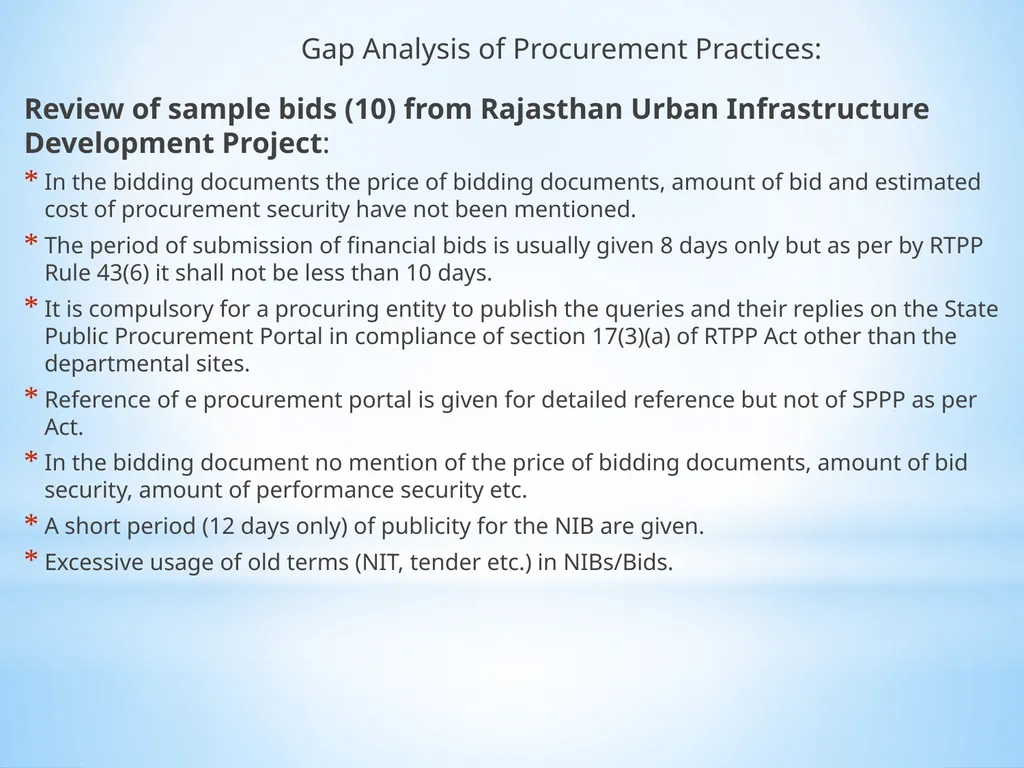
Review of sample bids (10) from Rajasthan Urban Infrastructure Development Project:
In the bidding documents the price of bidding documents, amount of bid and estimated cost of procurement security have not been mentioned.
The period of submission of financial bids is usually given 8 days only but as per by RTPP Rule 43(6) it shall not be less than 10 days.
It is compulsory for a procuring entity to publish the queries and their replies on the State Public Procurement Portal in compliance of section 17(3)(a) of RTPP Act other than the departmental sites.
Reference of e procurement portal is given for detailed reference but not of SPPP as per Act.
In the bidding document no mention of the price of bidding documents, amount of bid security, amount of performance security etc.
A short period (12 days only) of publicity for the NIB are given.
Excessive usage of old terms (NIT, tender etc.) in NIBs/Bids. Gap Analysis of Procurement Practices:<br>
In the bidding documents the price of bidding documents, amount of bid and estimated cost of procurement security have not been mentioned.
The period of submission of financial bids is usually given 8 days only but as per by RTPP Rule 43(6) it shall not be less than 10 days.
It is compulsory for a procuring entity to publish the queries and their replies on the State Public Procurement Portal in compliance of section 17(3)(a) of RTPP Act other than the departmental sites.
Reference of e procurement portal is given for detailed reference but not of SPPP as per Act.
In the bidding document no mention of the price of bidding documents, amount of bid security, amount of performance security etc.
A short period (12 days only) of publicity for the NIB are given.
Excessive usage of old terms (NIT, tender etc.) in NIBs/Bids. Gap Analysis of Procurement Practices:<br>
17
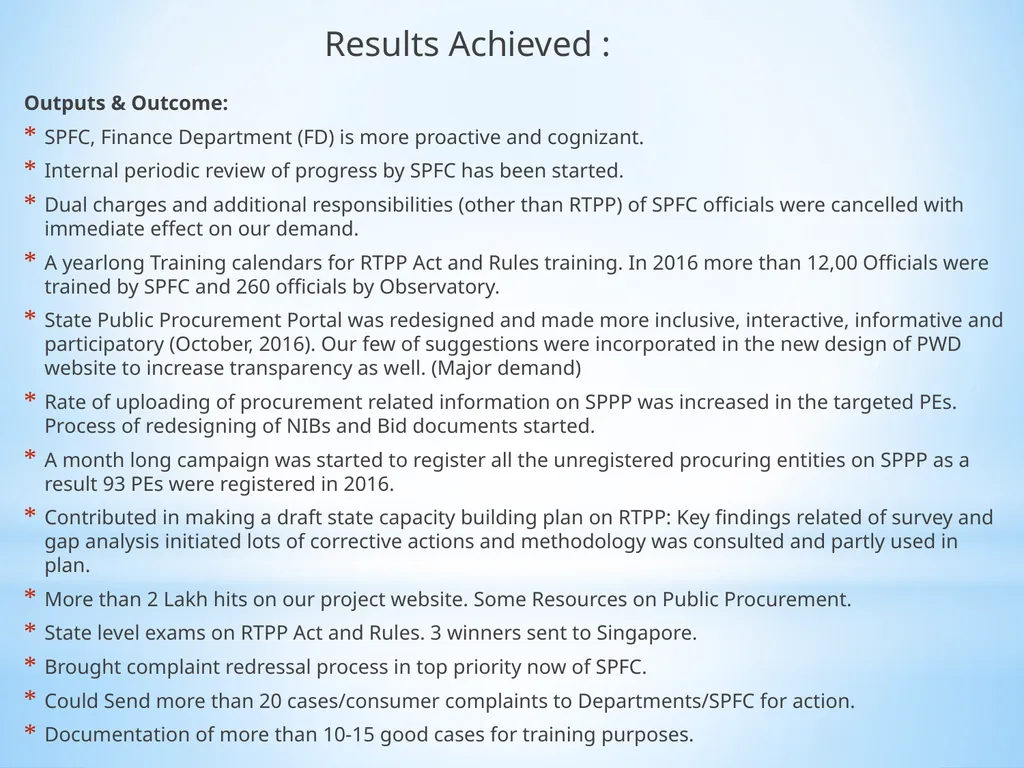
Outputs & Outcome:
SPFC, Finance Department (FD) is more proactive and cognizant.
Internal periodic review of progress by SPFC has been started.
Dual charges and additional responsibilities (other than RTPP) of SPFC officials were cancelled with immediate effect on our demand.
A yearlong Training calendars for RTPP Act and Rules training. In 2016 more than 12,00 Officials were trained by SPFC and 260 officials by Observatory.
State Public Procurement Portal was redesigned and made more inclusive, interactive, informative and participatory (October, 2016). Our few of suggestions were incorporated in the new design of PWD website to increase transparency as well. (Major demand)
Rate of uploading of procurement related information on SPPP was increased in the targeted PEs. Process of redesigning of NIBs and Bid documents started.
A month long campaign was started to register all the unregistered procuring entities on SPPP as a result 93 PEs were registered in 2016.
Contributed in making a draft state capacity building plan on RTPP: Key findings related of survey and gap analysis initiated lots of corrective actions and methodology was consulted and partly used in plan.
More than 2 Lakh hits on our project website. Some Resources on Public Procurement.
State level exams on RTPP Act and Rules. 3 winners sent to Singapore.
Brought complaint redressal process in top priority now of SPFC.
Could Send more than 20 cases/consumer complaints to Departments/SPFC for action.
Documentation of more than 10-15 good cases for training purposes. Results Achieved :<br>
SPFC, Finance Department (FD) is more proactive and cognizant.
Internal periodic review of progress by SPFC has been started.
Dual charges and additional responsibilities (other than RTPP) of SPFC officials were cancelled with immediate effect on our demand.
A yearlong Training calendars for RTPP Act and Rules training. In 2016 more than 12,00 Officials were trained by SPFC and 260 officials by Observatory.
State Public Procurement Portal was redesigned and made more inclusive, interactive, informative and participatory (October, 2016). Our few of suggestions were incorporated in the new design of PWD website to increase transparency as well. (Major demand)
Rate of uploading of procurement related information on SPPP was increased in the targeted PEs. Process of redesigning of NIBs and Bid documents started.
A month long campaign was started to register all the unregistered procuring entities on SPPP as a result 93 PEs were registered in 2016.
Contributed in making a draft state capacity building plan on RTPP: Key findings related of survey and gap analysis initiated lots of corrective actions and methodology was consulted and partly used in plan.
More than 2 Lakh hits on our project website. Some Resources on Public Procurement.
State level exams on RTPP Act and Rules. 3 winners sent to Singapore.
Brought complaint redressal process in top priority now of SPFC.
Could Send more than 20 cases/consumer complaints to Departments/SPFC for action.
Documentation of more than 10-15 good cases for training purposes. Results Achieved :<br>
18
Some of the lessons learnt from the intervention are as follows.
Critical Success factors for us: Timing of the Observatory in Rajasthan (1.5 Yrs after Rules came in force). Then Finance Secretary’s personal interest and CUTS experiences in the area. Continued support by ADB.
Only the information which is available online can be gathered otherwise getting any information from departments is very difficult and tedious process. Using Right to Information as a tool creates suspicion.
The Approach of collaborating with the Staff Welfare Associations proved to be good.
Only one or two CSOs and four or Five good consultants are working in the areas of Public Procurement in Rajasthan.
Lack of civic watch on Public Procurement of State due to lack of General awareness among the common consumers.
Due to lack of human resource at SPFC level strict monitoring of entire Rajasthan state is almost impossible (Far-flung districts). More and more trainings on RTPP Act and Rules, need to be done to remove confusions and old practices. Lessons Learnt:<br>
Critical Success factors for us: Timing of the Observatory in Rajasthan (1.5 Yrs after Rules came in force). Then Finance Secretary’s personal interest and CUTS experiences in the area. Continued support by ADB.
Only the information which is available online can be gathered otherwise getting any information from departments is very difficult and tedious process. Using Right to Information as a tool creates suspicion.
The Approach of collaborating with the Staff Welfare Associations proved to be good.
Only one or two CSOs and four or Five good consultants are working in the areas of Public Procurement in Rajasthan.
Lack of civic watch on Public Procurement of State due to lack of General awareness among the common consumers.
Due to lack of human resource at SPFC level strict monitoring of entire Rajasthan state is almost impossible (Far-flung districts). More and more trainings on RTPP Act and Rules, need to be done to remove confusions and old practices. Lessons Learnt:<br>
19
Key Challenges in front of Observatory:
It is very difficult to get the desired information on procurement processes from the Procuring entities.
Not Entertaining the complaints send by Observatory and saying that only bidders can make any complaint or appeal in any of the procurement activity undertaken.
Because of the Human resource constraint in the SPFC, Finance Department, they are reluctant to take up more suggestions for effective monitoring and capacity building on RTPP act and rules.
Lack of collective voice and community pressure from demand side on Service providers to bring the desired change.
Sustainability of the Observatory work. Challenges:<br>
It is very difficult to get the desired information on procurement processes from the Procuring entities.
Not Entertaining the complaints send by Observatory and saying that only bidders can make any complaint or appeal in any of the procurement activity undertaken.
Because of the Human resource constraint in the SPFC, Finance Department, they are reluctant to take up more suggestions for effective monitoring and capacity building on RTPP act and rules.
Lack of collective voice and community pressure from demand side on Service providers to bring the desired change.
Sustainability of the Observatory work. Challenges:<br>
20
Thanks CUTS Centre for Consumer Action, Research and Training (CUTS CART)
D-218, Bhaskar Marg, Bani Park Jaipur 302 016, Rajasthan, India Ph: 91.141.5133269 Fax: 91.141.4015395 Email: cart@cuts.org; mss@cuts.org;
Web: http://cuts-international.org/cart/<br>
D-218, Bhaskar Marg, Bani Park Jaipur 302 016, Rajasthan, India Ph: 91.141.5133269 Fax: 91.141.4015395 Email: cart@cuts.org; mss@cuts.org;
Web: http://cuts-international.org/cart/<br>