Making an Effective Curriculum Vitae Gail P. Taylor, PhD RISE Research Training Program What is a CV? the course of my life A presentation of your: Education Experience Accomplishments Scholarly Pedigree Its appearance also tells about
"Making an Effective Curriculum Vitae Gail P." is the property of its rightful owner. Permission is granted to
download and print the materials on this website for personal, non-commercial use only, and to display it
on your personal computer provided you do not modify the materials and that you retain all copyright
notices contained in the materials. By downloading content from our website, you accept the terms of this
agreement.
Presentation Transcript
01
Making an Effective Curriculum Vitae Gail P. Taylor, PhD
RISE Research Training Program<br>
02
What is a CV? “the course of my life”
A presentation of your:
Education
Experience
Accomplishments
Scholarly Pedigree
Its appearance also tells about your:
Attention to detail
Thoroughness<br>
03
Why do I need a CV? New job positions
Awards, fellowships
Grant proposals
Publishing, introductions for presentations
Consulting
Tenure or advancement in University
Usually accompanied by
Statement of Purpose
Or
Cover and small research proposal<br>
04
CV v. Résumé CV
Overall summary:
Education
Experience
Pubs, Presentations
Teaching, Grants
Used for applying for:
Grants
Fellowships
Academic Teaching
Academic Administration
Dozens of pages, eventually Résumé
Snapshot
Tailored information
Education
Relevant skills set
Information generally incomplete
Used when applying for
Specific job
Public or private sector
1 to 2 pages<br>
05
Key Elements Name, address, telephone number, & e-mail
Education
Recent or expected degree at top
List degrees, majors, institutions, and dates of completion (or expected date) in reverse chronological order.
Positions Held
Location, Position, dates
Dissertations or theses, including the date it was (will be) finished.
Provide titles<br>
06
Key Elements 2 Key Elements Progress (if you are a Ph.D. student)
Completed coursework, June 2000
Passed qualifying exam, March 2000
Research Interests
Research Experience:
Brief description, conclusions, advisors, committees
Postdoctoral
Graduate
Undergraduate
Honors and Awards (e.g., National Science Foundation Fellowship, IBM Dissertation Fellowship)<br>
07
Key Elements 3 Key Elements Experience:
Include your job title
Name of the employer or institution
Dates
Your responsibilities
Your accomplishments
Use “active” verbs to highlight:
Delivered eight class lectures on composite materials
Developed five supporting problem sets and a midterm examination<br>
08
Key Elements 4 Key Elements Patents
Publications
Put these last if more than four or five entries.
Classify by type
Refereed Papers
Abstracts
List items in standard bibliographic form
Beware of "in preparation”
Current and past grants
Poster and Oral Presentations
List title, meeting/school, city, state, dates<br>
09
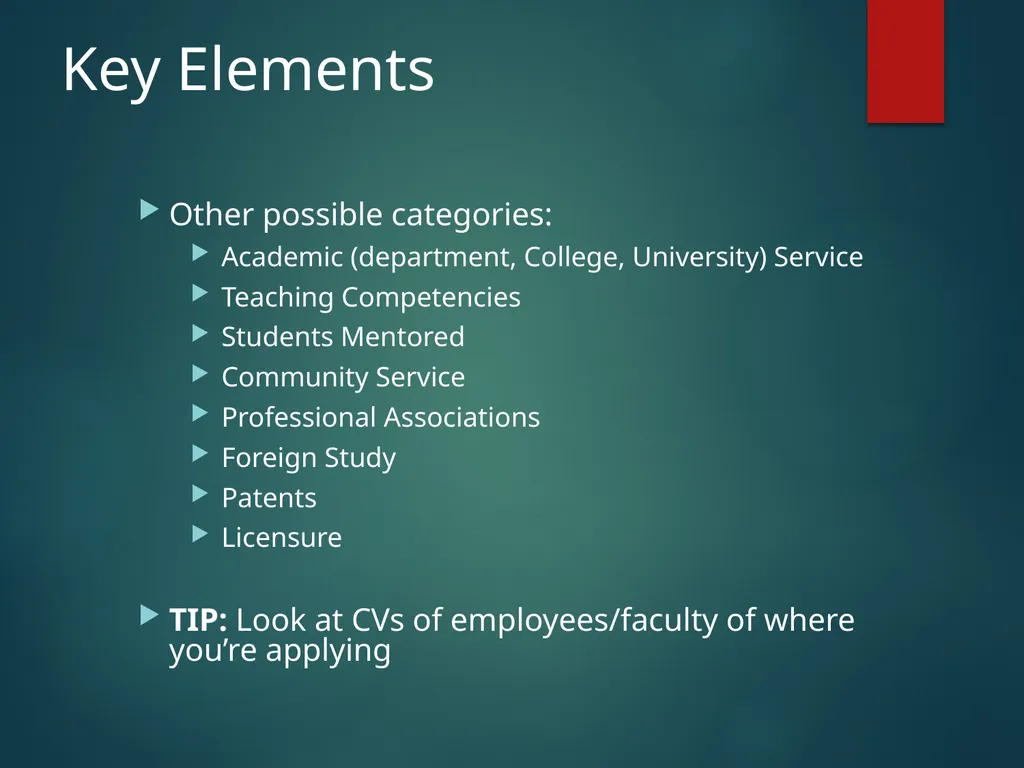
Key Elements 5 Key Elements Other possible categories:
Academic (department, College, University) Service
Teaching Competencies
Students Mentored
Community Service
Professional Associations
Foreign Study
Patents
Licensure
TIP: Look at CVs of employees/faculty of where you’re applying<br>
10
Focusing a CV For Research:
Sample Research CV
For Teaching
Sample Teaching CV
Difference? Order of information<br>
11
Additional Elements for Students Show what you’ve done
Conferences
Jobs that show you’ve handled responsibility<br>
12
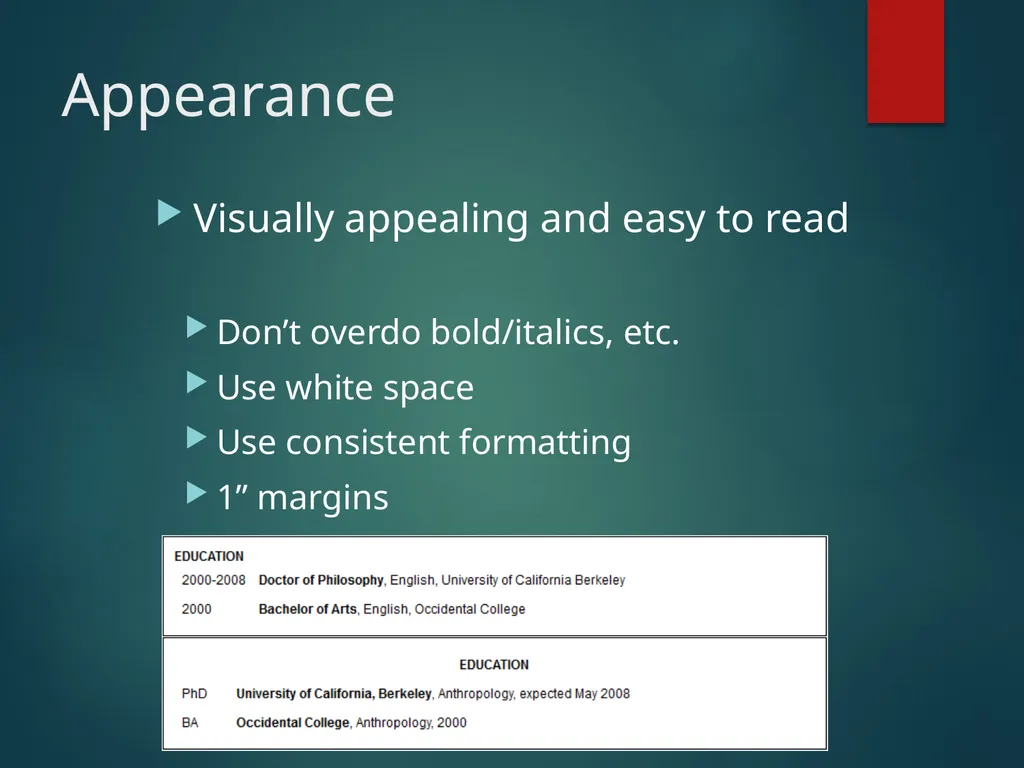
Appearance Visually appealing and easy to read
Don’t overdo bold/italics, etc.
Use white space
Use consistent formatting
1” margins<br>
13
Questions to Ask Yourself Appropriate use of bold and italic text?
Are categories clearly labeled?
Is it easy to find sections of interest for admissions committee members?
Has your advisor and at least one other person reviewed and critiqued it?
Avoided using acronyms?
Proofread to eliminate typographical errors?<br>
14
What NOT to do: Don't include:
Birthday
SS#
Ethnic identity
Political affiliation
Religious preference
Hobbies
Marital status
Sexual orientation
Place of birth
Photographs
Physical: Height; Weight; and Health.<br>
15
Useful websites The Chronicle of Higher Education:
The Basics of Science CVs
From CV to Résumé