
Making Notes on each Chapter Key Notes Reminders
MJ
Published · 39 slides · 0 views
1 / 1

Description
Making Notes on each Chapter Key Notes Reminders Questions Main Lesson Notes Summary of learning ManorAnimal Farm Chapter 1 As we read think carefully about: Staging of the characters Who we meet? What impressions we have of these
Related Topics
Share
Embed code
Download this presentation From Below
"Making Notes on each Chapter Key Notes Reminders" is the property of its rightful owner. Permission is granted to download and print the materials on this website for personal, non-commercial use only, and to display it on your personal computer provided you do not modify the materials and that you retain all copyright notices contained in the materials. By downloading content from our website, you accept the terms of this agreement.
Presentation Transcript
01
Making Notes on each Chapter Key Notes
Reminders
Questions Main Lesson Notes Summary of learning<br>
Reminders
Questions Main Lesson Notes Summary of learning<br>
02
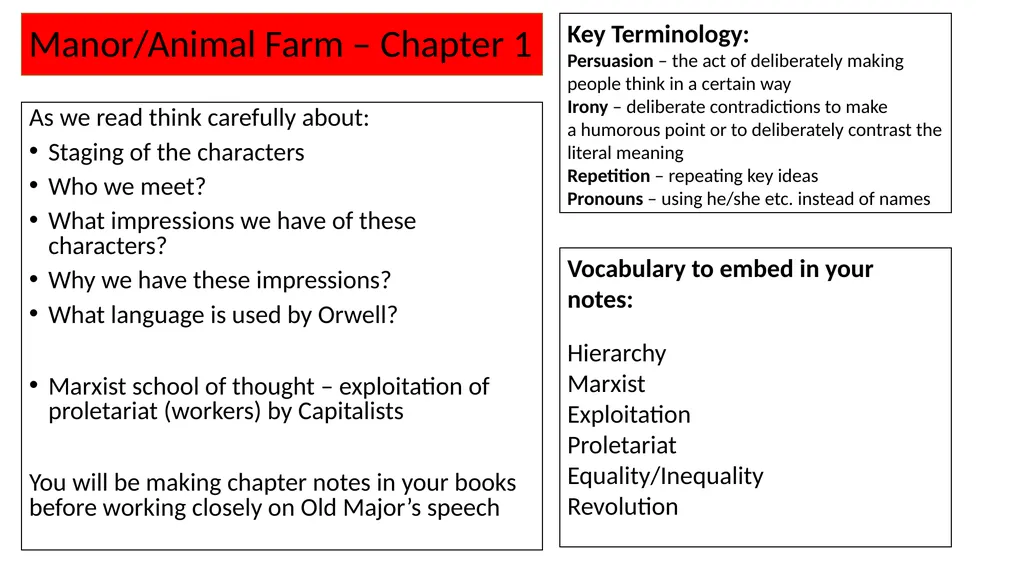
Manor/Animal Farm – Chapter 1 As we read think carefully about:
Staging of the characters
Who we meet?
What impressions we have of these characters?
Why we have these impressions?
What language is used by Orwell?
Marxist school of thought – exploitation of proletariat (workers) by Capitalists
You will be making chapter notes in your books before working closely on Old Major’s speech Key Terminology:
Persuasion – the act of deliberately making people think in a certain way
Irony – deliberate contradictions to make
a humorous point or to deliberately contrast the literal meaning
Repetition – repeating key ideas
Pronouns – using he/she etc. instead of names Vocabulary to embed in your notes:
Hierarchy
Marxist
Exploitation
Proletariat
Equality/Inequality
Revolution<br>
Staging of the characters
Who we meet?
What impressions we have of these characters?
Why we have these impressions?
What language is used by Orwell?
Marxist school of thought – exploitation of proletariat (workers) by Capitalists
You will be making chapter notes in your books before working closely on Old Major’s speech Key Terminology:
Persuasion – the act of deliberately making people think in a certain way
Irony – deliberate contradictions to make
a humorous point or to deliberately contrast the literal meaning
Repetition – repeating key ideas
Pronouns – using he/she etc. instead of names Vocabulary to embed in your notes:
Hierarchy
Marxist
Exploitation
Proletariat
Equality/Inequality
Revolution<br>
03
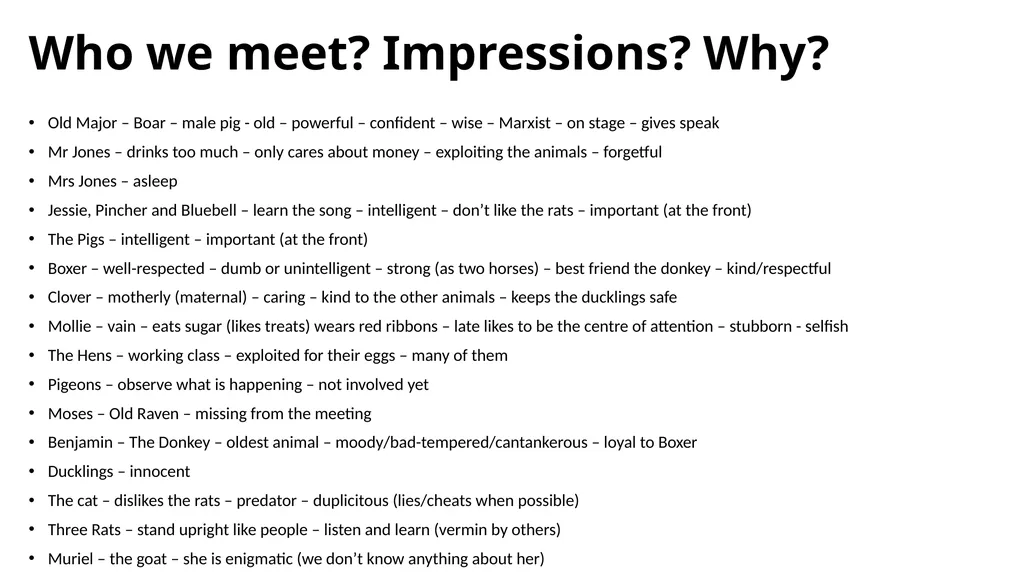
Who we meet? Impressions? Why? Old Major – Boar – male pig - old – powerful – confident – wise – Marxist – on stage – gives speak
Mr Jones – drinks too much – only cares about money – exploiting the animals – forgetful
Mrs Jones – asleep
Jessie, Pincher and Bluebell – learn the song – intelligent – don’t like the rats – important (at the front)
The Pigs – intelligent – important (at the front)
Boxer – well-respected – dumb or unintelligent – strong (as two horses) – best friend the donkey – kind/respectful
Clover – motherly (maternal) – caring – kind to the other animals – keeps the ducklings safe
Mollie – vain – eats sugar (likes treats) wears red ribbons – late likes to be the centre of attention – stubborn - selfish
The Hens – working class – exploited for their eggs – many of them
Pigeons – observe what is happening – not involved yet
Moses – Old Raven – missing from the meeting
Benjamin – The Donkey – oldest animal – moody/bad-tempered/cantankerous – loyal to Boxer
Ducklings – innocent
The cat – dislikes the rats – predator – duplicitous (lies/cheats when possible)
Three Rats – stand upright like people – listen and learn (vermin by others)
Muriel – the goat – she is enigmatic (we don’t know anything about her)<br>
Mr Jones – drinks too much – only cares about money – exploiting the animals – forgetful
Mrs Jones – asleep
Jessie, Pincher and Bluebell – learn the song – intelligent – don’t like the rats – important (at the front)
The Pigs – intelligent – important (at the front)
Boxer – well-respected – dumb or unintelligent – strong (as two horses) – best friend the donkey – kind/respectful
Clover – motherly (maternal) – caring – kind to the other animals – keeps the ducklings safe
Mollie – vain – eats sugar (likes treats) wears red ribbons – late likes to be the centre of attention – stubborn - selfish
The Hens – working class – exploited for their eggs – many of them
Pigeons – observe what is happening – not involved yet
Moses – Old Raven – missing from the meeting
Benjamin – The Donkey – oldest animal – moody/bad-tempered/cantankerous – loyal to Boxer
Ducklings – innocent
The cat – dislikes the rats – predator – duplicitous (lies/cheats when possible)
Three Rats – stand upright like people – listen and learn (vermin by others)
Muriel – the goat – she is enigmatic (we don’t know anything about her)<br>
04
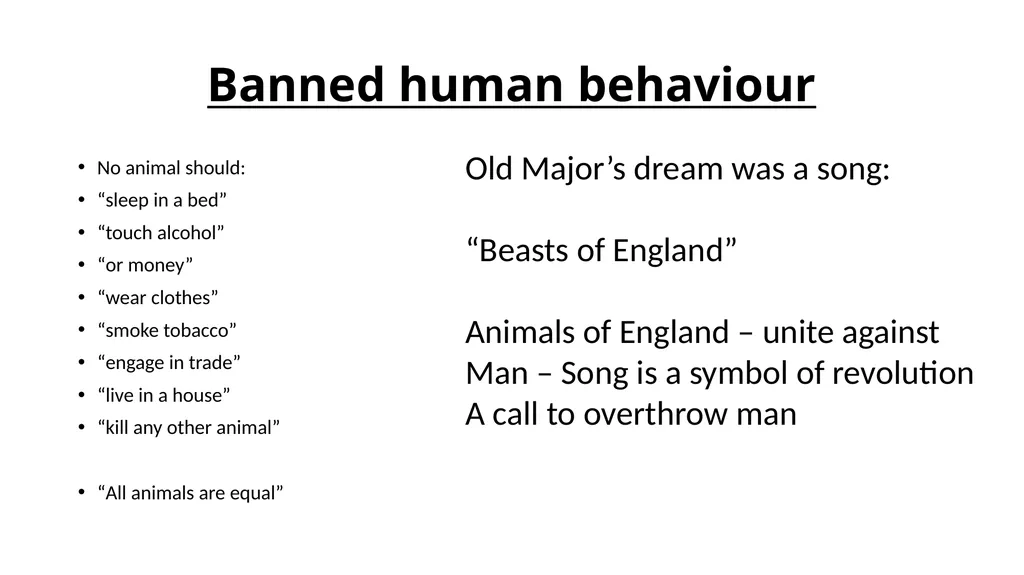
Banned human behaviour No animal should:
“sleep in a bed”
“touch alcohol”
“or money”
“wear clothes”
“smoke tobacco”
“engage in trade”
“live in a house”
“kill any other animal”
“All animals are equal” Old Major’s dream was a song:
“Beasts of England”
Animals of England – unite against
Man – Song is a symbol of revolution
A call to overthrow man<br>
“sleep in a bed”
“touch alcohol”
“or money”
“wear clothes”
“smoke tobacco”
“engage in trade”
“live in a house”
“kill any other animal”
“All animals are equal” Old Major’s dream was a song:
“Beasts of England”
Animals of England – unite against
Man – Song is a symbol of revolution
A call to overthrow man<br>
05
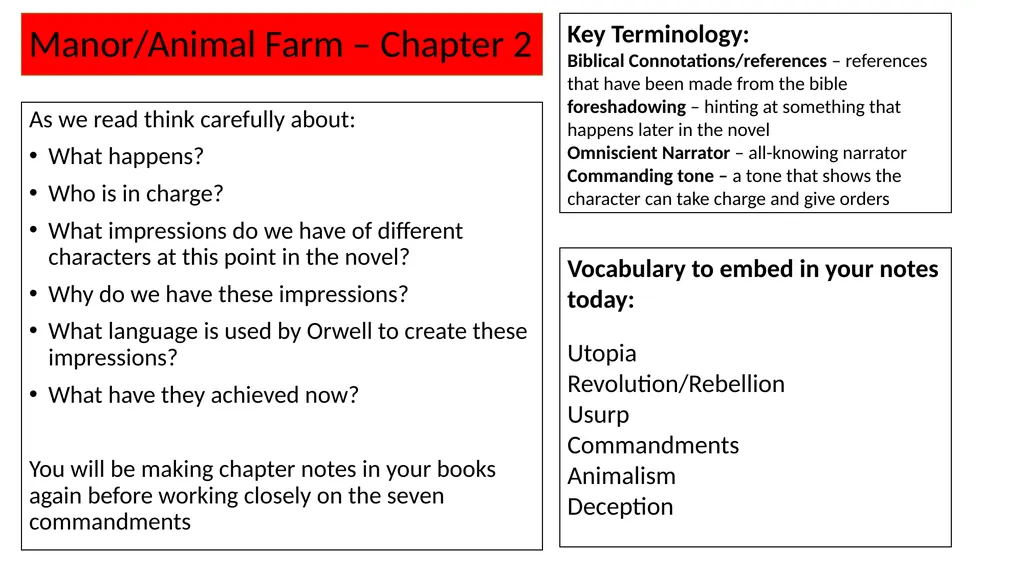
Manor/Animal Farm – Chapter 2 Key Terminology:
Biblical Connotations/references – references that have been made from the bible
foreshadowing – hinting at something that happens later in the novel
Omniscient Narrator – all-knowing narrator
Commanding tone – a tone that shows the character can take charge and give orders Vocabulary to embed in your notes today:
Utopia
Revolution/Rebellion
Usurp
Commandments
Animalism
Deception As we read think carefully about:
What happens?
Who is in charge?
What impressions do we have of different characters at this point in the novel?
Why do we have these impressions?
What language is used by Orwell to create these impressions?
What have they achieved now?
You will be making chapter notes in your books again before working closely on the seven commandments<br>
Biblical Connotations/references – references that have been made from the bible
foreshadowing – hinting at something that happens later in the novel
Omniscient Narrator – all-knowing narrator
Commanding tone – a tone that shows the character can take charge and give orders Vocabulary to embed in your notes today:
Utopia
Revolution/Rebellion
Usurp
Commandments
Animalism
Deception As we read think carefully about:
What happens?
Who is in charge?
What impressions do we have of different characters at this point in the novel?
Why do we have these impressions?
What language is used by Orwell to create these impressions?
What have they achieved now?
You will be making chapter notes in your books again before working closely on the seven commandments<br>
06
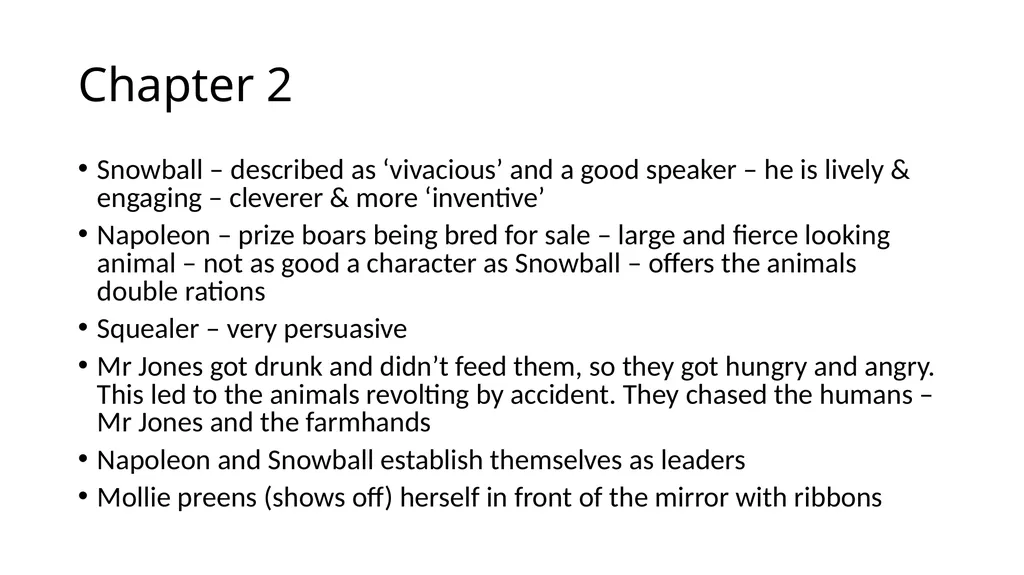
Chapter 2 Snowball – described as ‘vivacious’ and a good speaker – he is lively & engaging – cleverer & more ‘inventive’
Napoleon – prize boars being bred for sale – large and fierce looking animal – not as good a character as Snowball – offers the animals double rations
Squealer – very persuasive
Mr Jones got drunk and didn’t feed them, so they got hungry and angry. This led to the animals revolting by accident. They chased the humans – Mr Jones and the farmhands
Napoleon and Snowball establish themselves as leaders
Mollie preens (shows off) herself in front of the mirror with ribbons<br>
Napoleon – prize boars being bred for sale – large and fierce looking animal – not as good a character as Snowball – offers the animals double rations
Squealer – very persuasive
Mr Jones got drunk and didn’t feed them, so they got hungry and angry. This led to the animals revolting by accident. They chased the humans – Mr Jones and the farmhands
Napoleon and Snowball establish themselves as leaders
Mollie preens (shows off) herself in front of the mirror with ribbons<br>
07
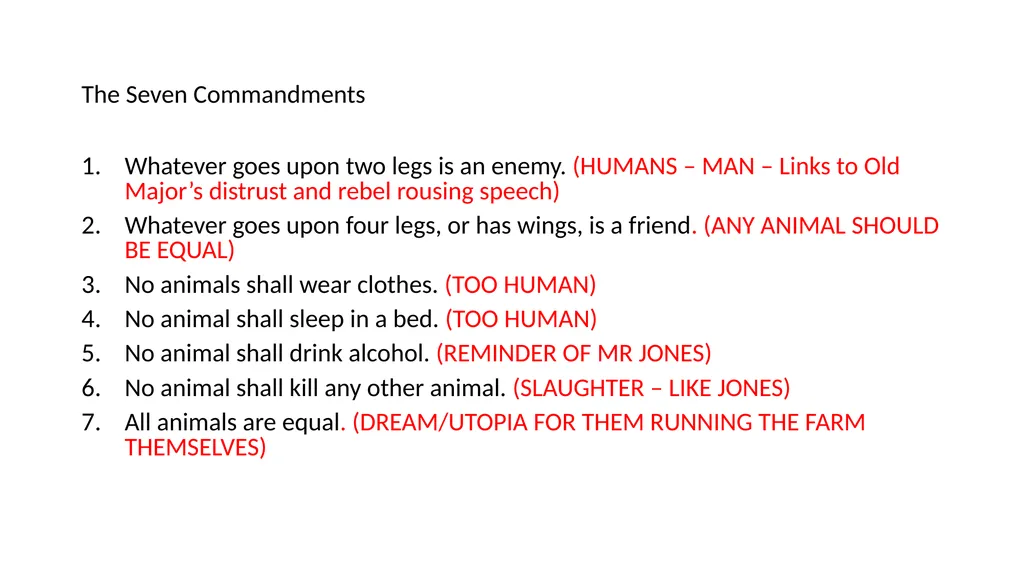
The Seven Commandments
Whatever goes upon two legs is an enemy. (HUMANS – MAN – Links to Old Major’s distrust and rebel rousing speech)
Whatever goes upon four legs, or has wings, is a friend. (ANY ANIMAL SHOULD BE EQUAL)
No animals shall wear clothes. (TOO HUMAN)
No animal shall sleep in a bed. (TOO HUMAN)
No animal shall drink alcohol. (REMINDER OF MR JONES)
No animal shall kill any other animal. (SLAUGHTER – LIKE JONES)
All animals are equal. (DREAM/UTOPIA FOR THEM RUNNING THE FARM THEMSELVES)<br>
Whatever goes upon two legs is an enemy. (HUMANS – MAN – Links to Old Major’s distrust and rebel rousing speech)
Whatever goes upon four legs, or has wings, is a friend. (ANY ANIMAL SHOULD BE EQUAL)
No animals shall wear clothes. (TOO HUMAN)
No animal shall sleep in a bed. (TOO HUMAN)
No animal shall drink alcohol. (REMINDER OF MR JONES)
No animal shall kill any other animal. (SLAUGHTER – LIKE JONES)
All animals are equal. (DREAM/UTOPIA FOR THEM RUNNING THE FARM THEMSELVES)<br>
08
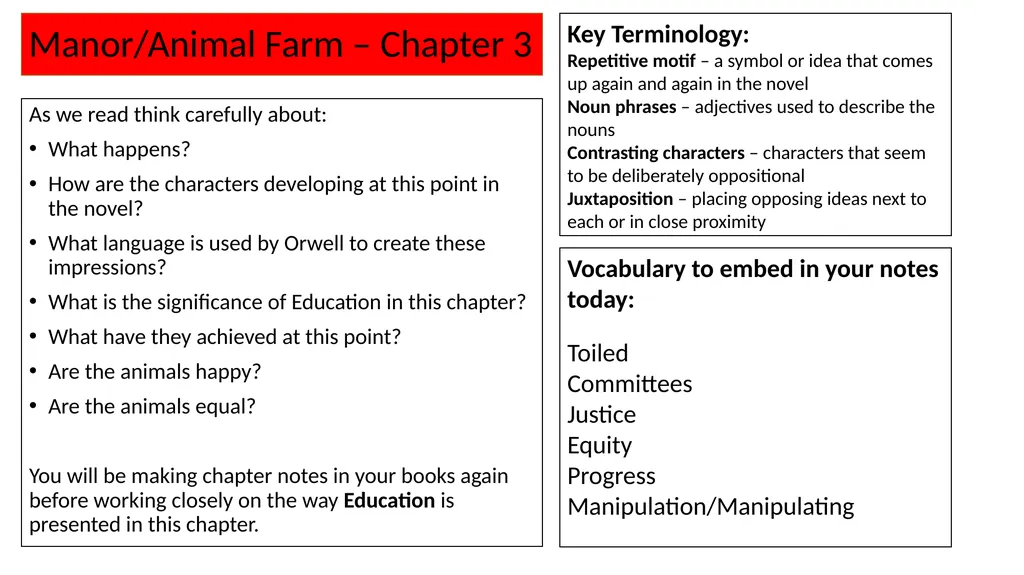
Manor/Animal Farm – Chapter 3 Key Terminology:
Repetitive motif – a symbol or idea that comes up again and again in the novel
Noun phrases – adjectives used to describe the nouns
Contrasting characters – characters that seem to be deliberately oppositional
Juxtaposition – placing opposing ideas next to each or in close proximity Vocabulary to embed in your notes today:
Toiled
Committees
Justice
Equity
Progress
Manipulation/Manipulating As we read think carefully about:
What happens?
How are the characters developing at this point in the novel?
What language is used by Orwell to create these impressions?
What is the significance of Education in this chapter?
What have they achieved at this point?
Are the animals happy?
Are the animals equal?
You will be making chapter notes in your books again before working closely on the way Education is presented in this chapter.<br>
Repetitive motif – a symbol or idea that comes up again and again in the novel
Noun phrases – adjectives used to describe the nouns
Contrasting characters – characters that seem to be deliberately oppositional
Juxtaposition – placing opposing ideas next to each or in close proximity Vocabulary to embed in your notes today:
Toiled
Committees
Justice
Equity
Progress
Manipulation/Manipulating As we read think carefully about:
What happens?
How are the characters developing at this point in the novel?
What language is used by Orwell to create these impressions?
What is the significance of Education in this chapter?
What have they achieved at this point?
Are the animals happy?
Are the animals equal?
You will be making chapter notes in your books again before working closely on the way Education is presented in this chapter.<br>
09
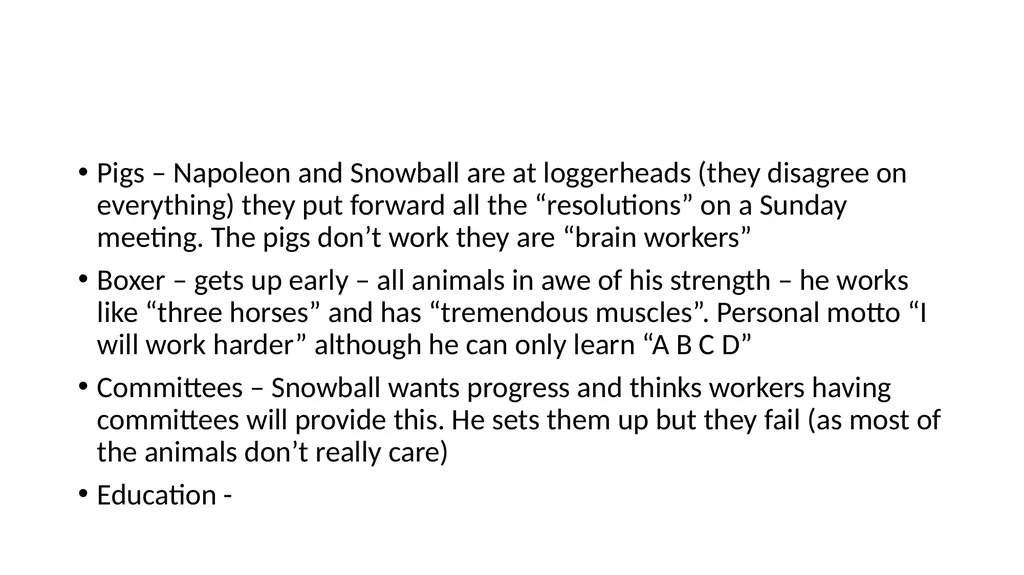
Pigs – Napoleon and Snowball are at loggerheads (they disagree on everything) they put forward all the “resolutions” on a Sunday meeting. The pigs don’t work they are “brain workers”
Boxer – gets up early – all animals in awe of his strength – he works like “three horses” and has “tremendous muscles”. Personal motto “I will work harder” although he can only learn “A B C D”
Committees – Snowball wants progress and thinks workers having committees will provide this. He sets them up but they fail (as most of the animals don’t really care)
Education -<br>
Boxer – gets up early – all animals in awe of his strength – he works like “three horses” and has “tremendous muscles”. Personal motto “I will work harder” although he can only learn “A B C D”
Committees – Snowball wants progress and thinks workers having committees will provide this. He sets them up but they fail (as most of the animals don’t really care)
Education -<br>
10
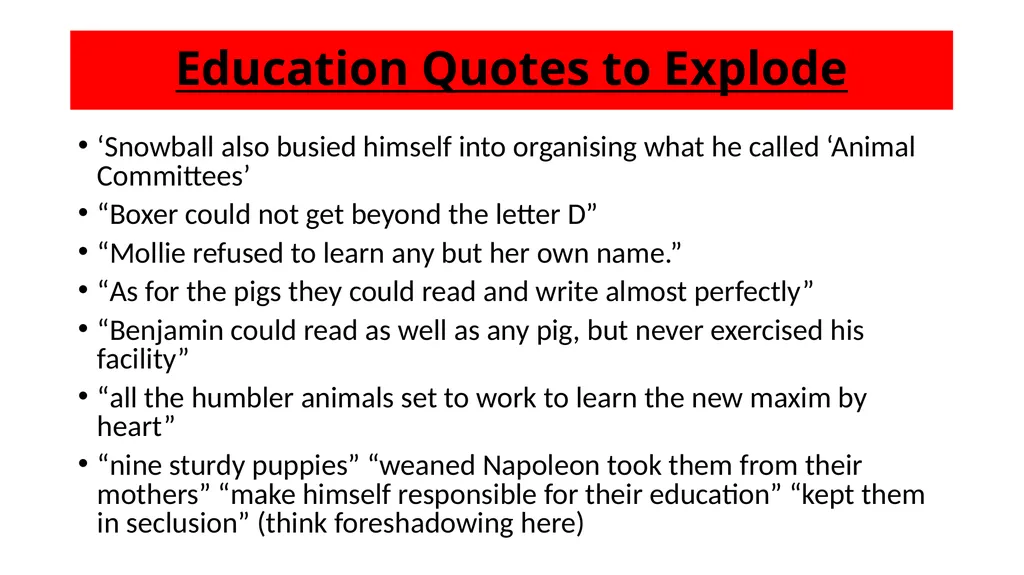
Education Quotes to Explode ‘Snowball also busied himself into organising what he called ‘Animal Committees’
“Boxer could not get beyond the letter D”
“Mollie refused to learn any but her own name.”
“As for the pigs they could read and write almost perfectly”
“Benjamin could read as well as any pig, but never exercised his facility”
“all the humbler animals set to work to learn the new maxim by heart”
“nine sturdy puppies” “weaned Napoleon took them from their mothers” “make himself responsible for their education” “kept them in seclusion” (think foreshadowing here)<br>
“Boxer could not get beyond the letter D”
“Mollie refused to learn any but her own name.”
“As for the pigs they could read and write almost perfectly”
“Benjamin could read as well as any pig, but never exercised his facility”
“all the humbler animals set to work to learn the new maxim by heart”
“nine sturdy puppies” “weaned Napoleon took them from their mothers” “make himself responsible for their education” “kept them in seclusion” (think foreshadowing here)<br>
11
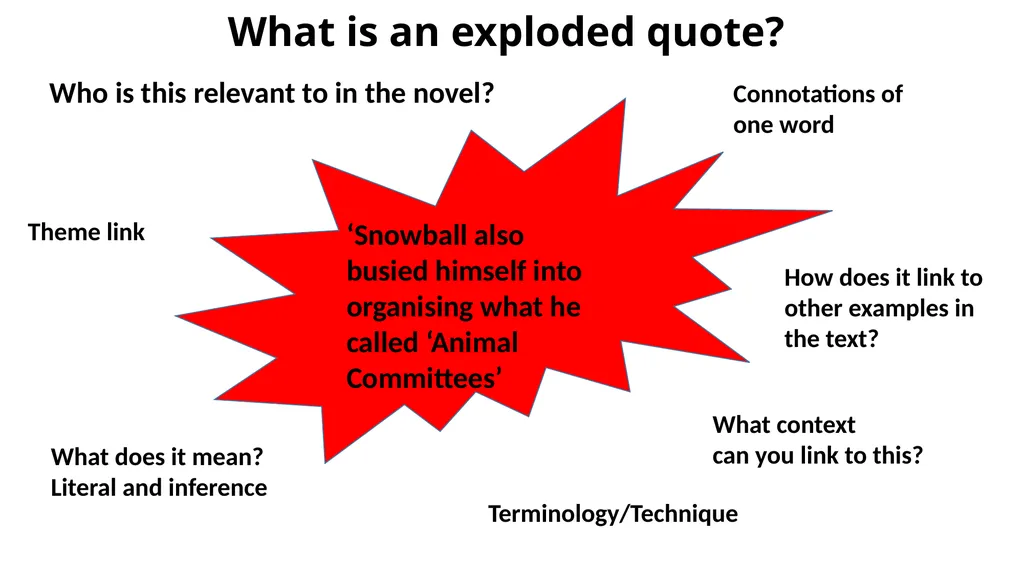
What is an exploded quote? ‘Snowball also busied himself into organising what he called ‘Animal Committees’ Who is this relevant to in the novel? Theme link What does it mean?
Literal and inference Terminology/Technique Connotations of
one word How does it link to
other examples in
the text? What context
can you link to this?<br>
Literal and inference Terminology/Technique Connotations of
one word How does it link to
other examples in
the text? What context
can you link to this?<br>
12
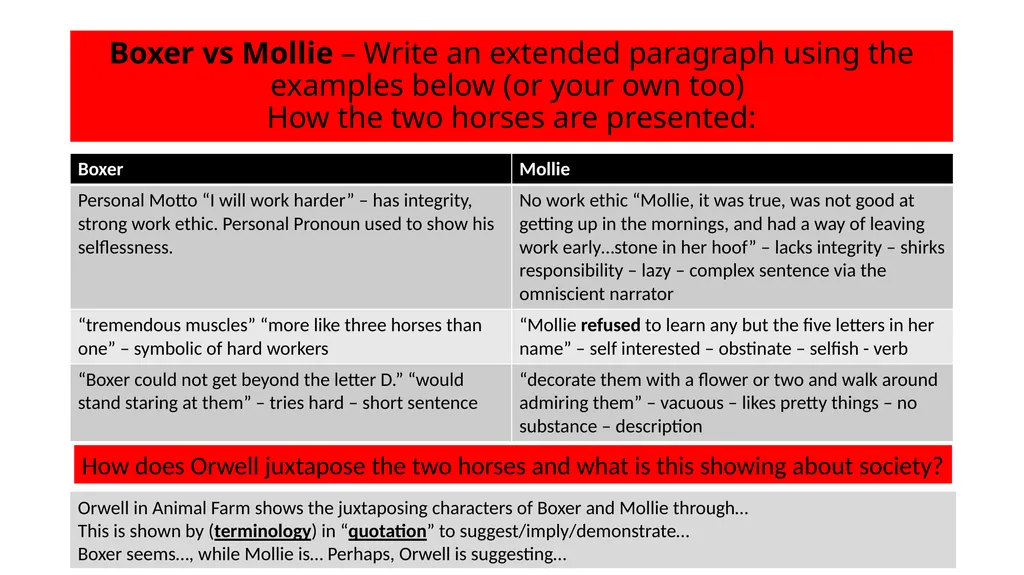
Boxer vs Mollie – Write an extended paragraph using the examples below (or your own too)
How the two horses are presented: How does Orwell juxtapose the two horses and what is this showing about society? Orwell in Animal Farm shows the juxtaposing characters of Boxer and Mollie through…
This is shown by (terminology) in “quotation” to suggest/imply/demonstrate…
Boxer seems…, while Mollie is… Perhaps, Orwell is suggesting…<br>
This is shown by (terminology) in “quotation” to suggest/imply/demonstrate…
Boxer seems…, while Mollie is… Perhaps, Orwell is suggesting…<br>
13
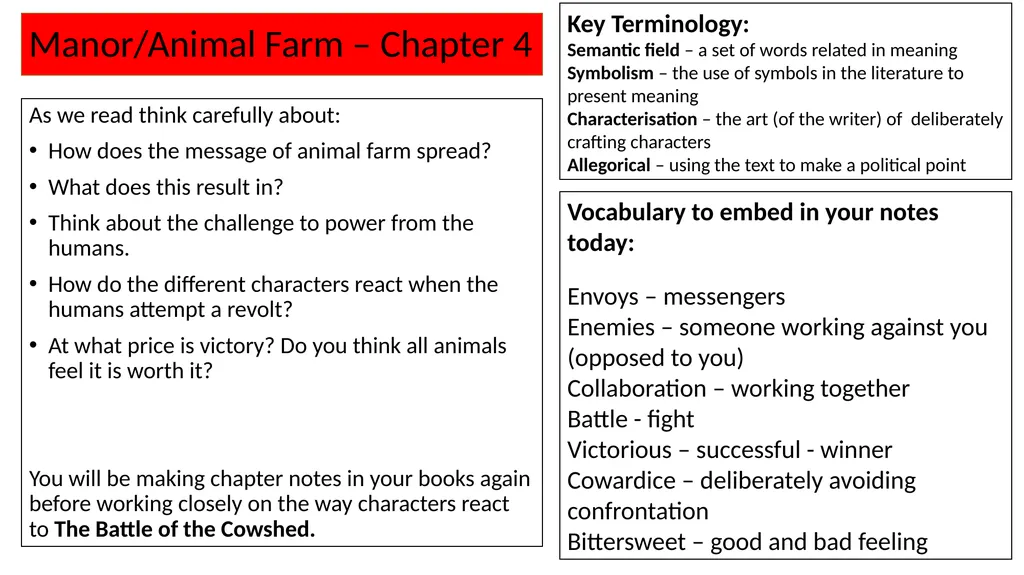
Manor/Animal Farm – Chapter 4 Key Terminology:
Semantic field – a set of words related in meaning
Symbolism – the use of symbols in the literature to present meaning
Characterisation – the art (of the writer) of deliberately crafting characters
Allegorical – using the text to make a political point Vocabulary to embed in your notes today:
Envoys – messengers
Enemies – someone working against you (opposed to you)
Collaboration – working together
Battle - fight
Victorious – successful - winner
Cowardice – deliberately avoiding confrontation
Bittersweet – good and bad feeling As we read think carefully about:
How does the message of animal farm spread?
What does this result in?
Think about the challenge to power from the humans.
How do the different characters react when the humans attempt a revolt?
At what price is victory? Do you think all animals feel it is worth it?
You will be making chapter notes in your books again before working closely on the way characters react to The Battle of the Cowshed.<br>
Semantic field – a set of words related in meaning
Symbolism – the use of symbols in the literature to present meaning
Characterisation – the art (of the writer) of deliberately crafting characters
Allegorical – using the text to make a political point Vocabulary to embed in your notes today:
Envoys – messengers
Enemies – someone working against you (opposed to you)
Collaboration – working together
Battle - fight
Victorious – successful - winner
Cowardice – deliberately avoiding confrontation
Bittersweet – good and bad feeling As we read think carefully about:
How does the message of animal farm spread?
What does this result in?
Think about the challenge to power from the humans.
How do the different characters react when the humans attempt a revolt?
At what price is victory? Do you think all animals feel it is worth it?
You will be making chapter notes in your books again before working closely on the way characters react to The Battle of the Cowshed.<br>
14
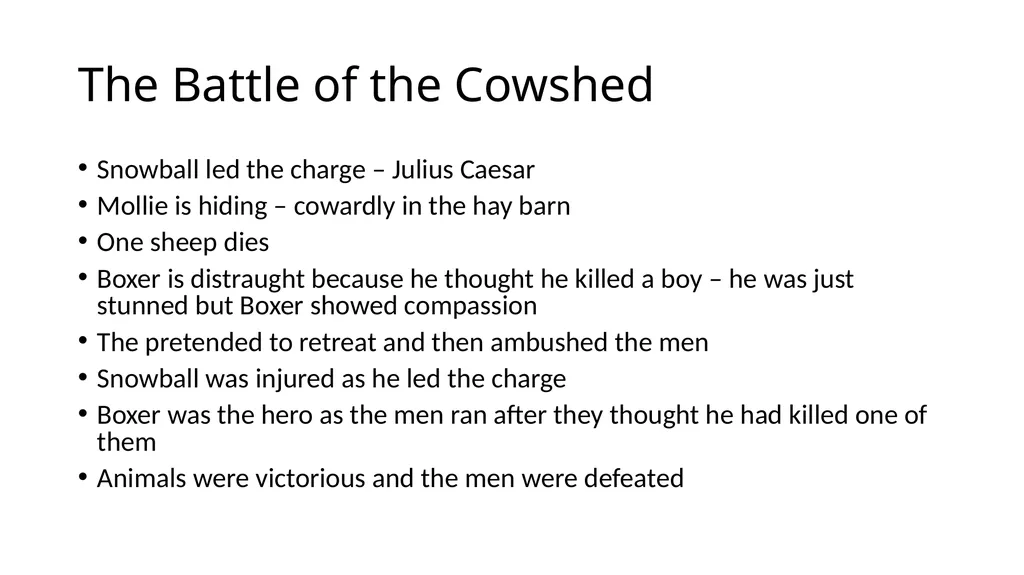
The Battle of the Cowshed Snowball led the charge – Julius Caesar
Mollie is hiding – cowardly in the hay barn
One sheep dies
Boxer is distraught because he thought he killed a boy – he was just stunned but Boxer showed compassion
The pretended to retreat and then ambushed the men
Snowball was injured as he led the charge
Boxer was the hero as the men ran after they thought he had killed one of them
Animals were victorious and the men were defeated<br>
Mollie is hiding – cowardly in the hay barn
One sheep dies
Boxer is distraught because he thought he killed a boy – he was just stunned but Boxer showed compassion
The pretended to retreat and then ambushed the men
Snowball was injured as he led the charge
Boxer was the hero as the men ran after they thought he had killed one of them
Animals were victorious and the men were defeated<br>
15
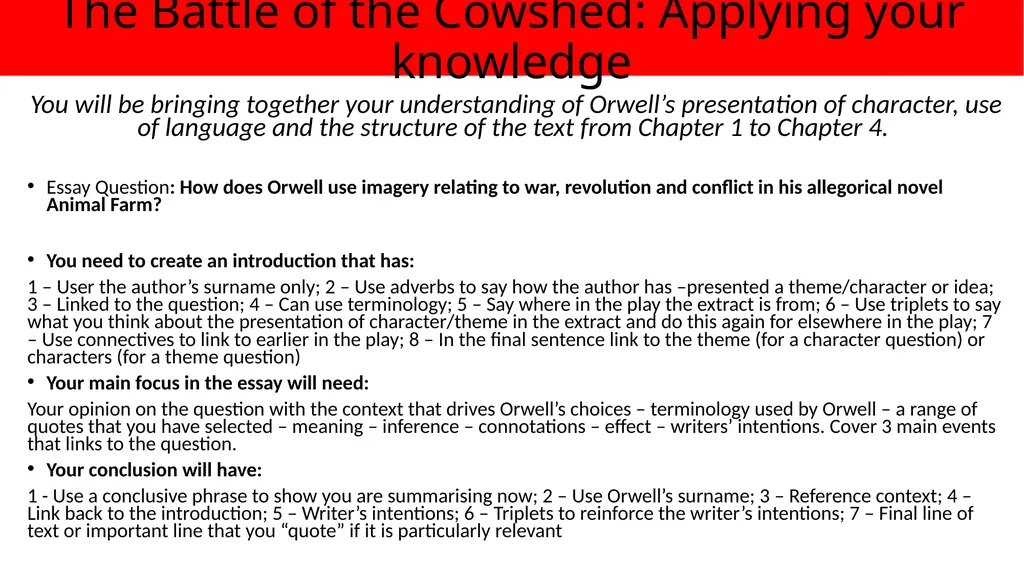
The Battle of the Cowshed: Applying your knowledge You will be bringing together your understanding of Orwell’s presentation of character, use of language and the structure of the text from Chapter 1 to Chapter 4.
Essay Question: How does Orwell use imagery relating to war, revolution and conflict in his allegorical novel Animal Farm?
You need to create an introduction that has:
1 – User the author’s surname only; 2 – Use adverbs to say how the author has –presented a theme/character or idea; 3 – Linked to the question; 4 – Can use terminology; 5 – Say where in the play the extract is from; 6 – Use triplets to say what you think about the presentation of character/theme in the extract and do this again for elsewhere in the play; 7 – Use connectives to link to earlier in the play; 8 – In the final sentence link to the theme (for a character question) or characters (for a theme question)
Your main focus in the essay will need:
Your opinion on the question with the context that drives Orwell’s choices – terminology used by Orwell – a range of quotes that you have selected – meaning – inference – connotations – effect – writers’ intentions. Cover 3 main events that links to the question.
Your conclusion will have:
1 - Use a conclusive phrase to show you are summarising now; 2 – Use Orwell’s surname; 3 – Reference context; 4 – Link back to the introduction; 5 – Writer’s intentions; 6 – Triplets to reinforce the writer’s intentions; 7 – Final line of text or important line that you “quote” if it is particularly relevant<br>
Essay Question: How does Orwell use imagery relating to war, revolution and conflict in his allegorical novel Animal Farm?
You need to create an introduction that has:
1 – User the author’s surname only; 2 – Use adverbs to say how the author has –presented a theme/character or idea; 3 – Linked to the question; 4 – Can use terminology; 5 – Say where in the play the extract is from; 6 – Use triplets to say what you think about the presentation of character/theme in the extract and do this again for elsewhere in the play; 7 – Use connectives to link to earlier in the play; 8 – In the final sentence link to the theme (for a character question) or characters (for a theme question)
Your main focus in the essay will need:
Your opinion on the question with the context that drives Orwell’s choices – terminology used by Orwell – a range of quotes that you have selected – meaning – inference – connotations – effect – writers’ intentions. Cover 3 main events that links to the question.
Your conclusion will have:
1 - Use a conclusive phrase to show you are summarising now; 2 – Use Orwell’s surname; 3 – Reference context; 4 – Link back to the introduction; 5 – Writer’s intentions; 6 – Triplets to reinforce the writer’s intentions; 7 – Final line of text or important line that you “quote” if it is particularly relevant<br>
16
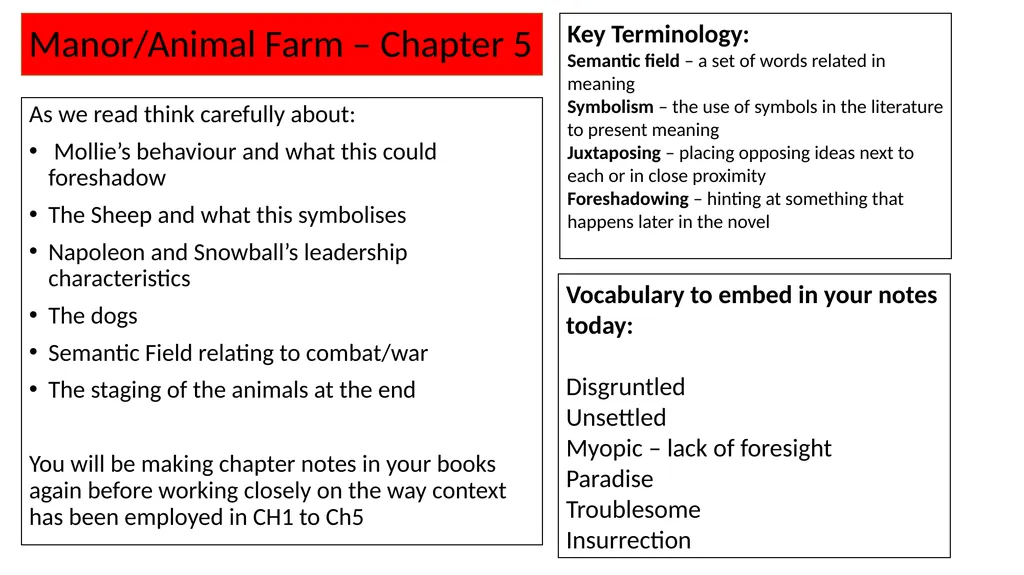
Manor/Animal Farm – Chapter 5 Key Terminology:
Semantic field – a set of words related in meaning
Symbolism – the use of symbols in the literature to present meaning
Juxtaposing – placing opposing ideas next to each or in close proximity
Foreshadowing – hinting at something that happens later in the novel Vocabulary to embed in your notes today:
Disgruntled
Unsettled
Myopic – lack of foresight
Paradise
Troublesome
Insurrection As we read think carefully about:
Mollie’s behaviour and what this could foreshadow
The Sheep and what this symbolises
Napoleon and Snowball’s leadership characteristics
The dogs
Semantic Field relating to combat/war
The staging of the animals at the end
You will be making chapter notes in your books again before working closely on the way context has been employed in CH1 to Ch5<br>
Semantic field – a set of words related in meaning
Symbolism – the use of symbols in the literature to present meaning
Juxtaposing – placing opposing ideas next to each or in close proximity
Foreshadowing – hinting at something that happens later in the novel Vocabulary to embed in your notes today:
Disgruntled
Unsettled
Myopic – lack of foresight
Paradise
Troublesome
Insurrection As we read think carefully about:
Mollie’s behaviour and what this could foreshadow
The Sheep and what this symbolises
Napoleon and Snowball’s leadership characteristics
The dogs
Semantic Field relating to combat/war
The staging of the animals at the end
You will be making chapter notes in your books again before working closely on the way context has been employed in CH1 to Ch5<br>
17
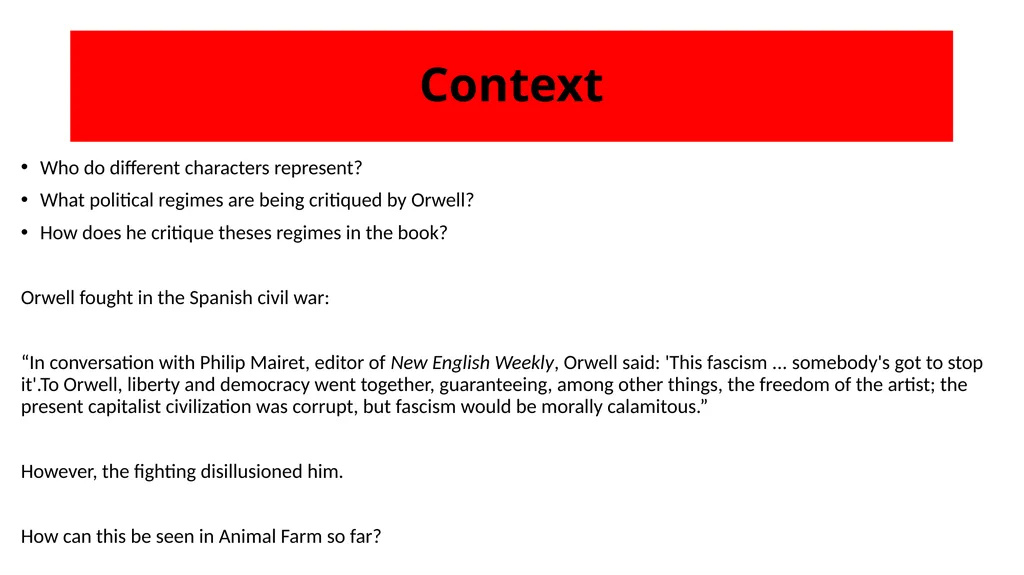
Context Who do different characters represent?
What political regimes are being critiqued by Orwell?
How does he critique theses regimes in the book?
Orwell fought in the Spanish civil war:
“In conversation with Philip Mairet, editor of New English Weekly, Orwell said: 'This fascism ... somebody's got to stop it'.To Orwell, liberty and democracy went together, guaranteeing, among other things, the freedom of the artist; the present capitalist civilization was corrupt, but fascism would be morally calamitous.”
However, the fighting disillusioned him.
How can this be seen in Animal Farm so far?<br>
What political regimes are being critiqued by Orwell?
How does he critique theses regimes in the book?
Orwell fought in the Spanish civil war:
“In conversation with Philip Mairet, editor of New English Weekly, Orwell said: 'This fascism ... somebody's got to stop it'.To Orwell, liberty and democracy went together, guaranteeing, among other things, the freedom of the artist; the present capitalist civilization was corrupt, but fascism would be morally calamitous.”
However, the fighting disillusioned him.
How can this be seen in Animal Farm so far?<br>
18
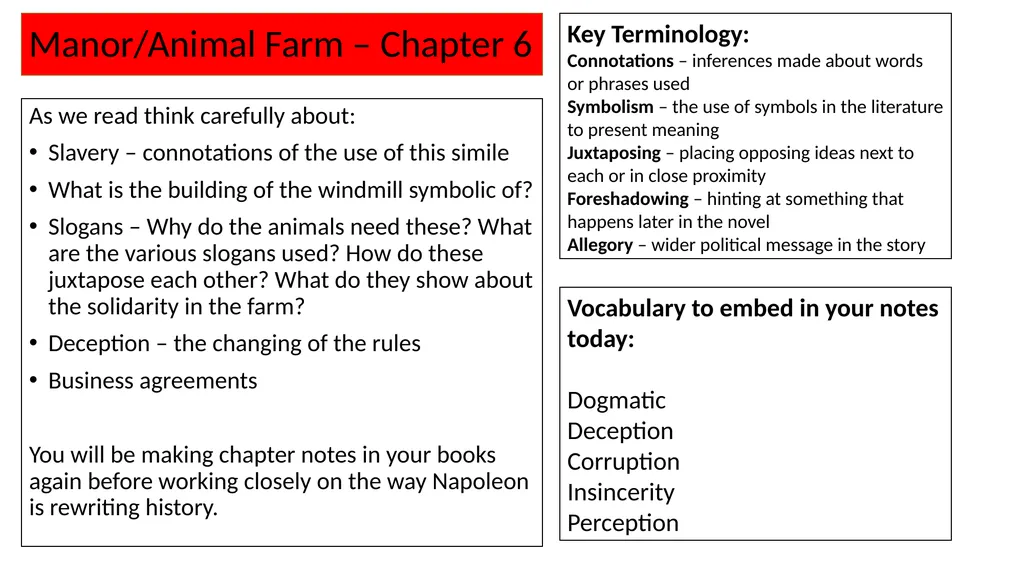
Manor/Animal Farm – Chapter 6 Key Terminology:
Connotations – inferences made about words or phrases used
Symbolism – the use of symbols in the literature to present meaning
Juxtaposing – placing opposing ideas next to each or in close proximity
Foreshadowing – hinting at something that happens later in the novel
Allegory – wider political message in the story Vocabulary to embed in your notes today:
Dogmatic
Deception
Corruption
Insincerity
Perception As we read think carefully about:
Slavery – connotations of the use of this simile
What is the building of the windmill symbolic of?
Slogans – Why do the animals need these? What are the various slogans used? How do these juxtapose each other? What do they show about the solidarity in the farm?
Deception – the changing of the rules
Business agreements
You will be making chapter notes in your books again before working closely on the way Napoleon is rewriting history.<br>
Connotations – inferences made about words or phrases used
Symbolism – the use of symbols in the literature to present meaning
Juxtaposing – placing opposing ideas next to each or in close proximity
Foreshadowing – hinting at something that happens later in the novel
Allegory – wider political message in the story Vocabulary to embed in your notes today:
Dogmatic
Deception
Corruption
Insincerity
Perception As we read think carefully about:
Slavery – connotations of the use of this simile
What is the building of the windmill symbolic of?
Slogans – Why do the animals need these? What are the various slogans used? How do these juxtapose each other? What do they show about the solidarity in the farm?
Deception – the changing of the rules
Business agreements
You will be making chapter notes in your books again before working closely on the way Napoleon is rewriting history.<br>
19
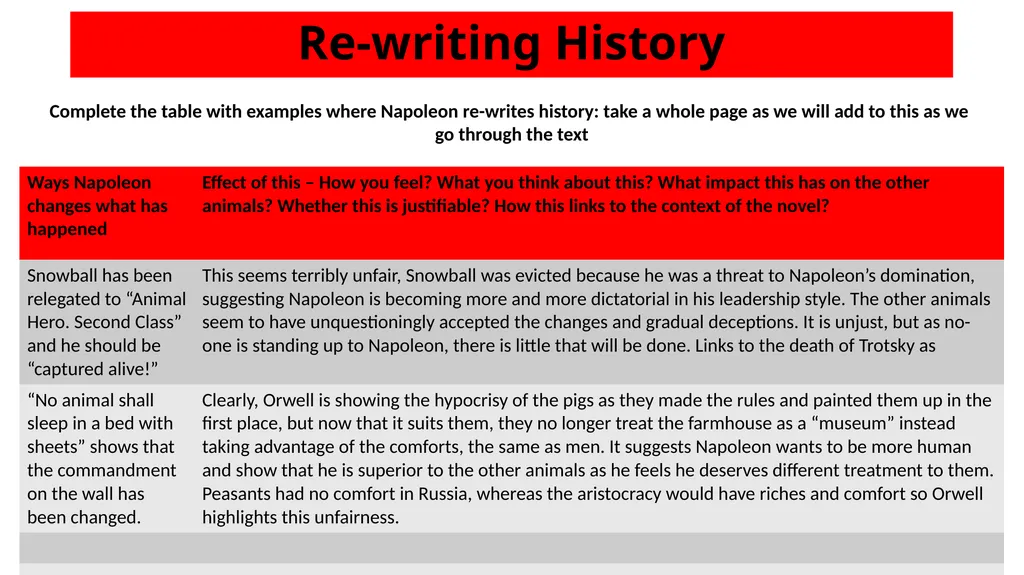
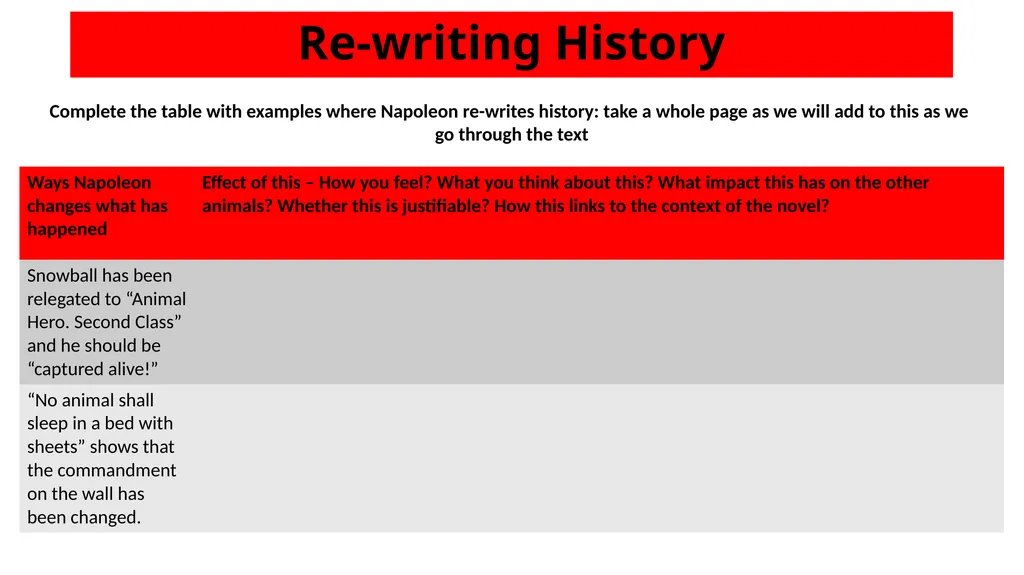
Re-writing History Complete the table with examples where Napoleon re-writes history: take a whole page as we will add to this as we
go through the text<br>
go through the text<br>
20
Re-writing History Complete the table with examples where Napoleon re-writes history: take a whole page as we will add to this as we
go through the text<br>
go through the text<br>
21
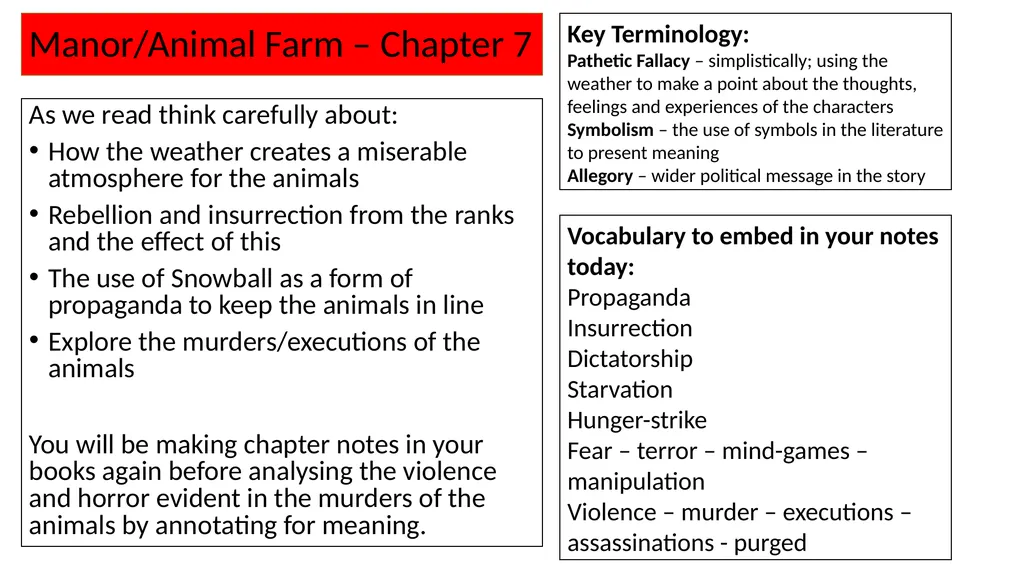
Manor/Animal Farm – Chapter 7 Key Terminology:
Pathetic Fallacy – simplistically; using the weather to make a point about the thoughts, feelings and experiences of the characters
Symbolism – the use of symbols in the literature to present meaning
Allegory – wider political message in the story Vocabulary to embed in your notes today:
Propaganda
Insurrection
Dictatorship
Starvation
Hunger-strike
Fear – terror – mind-games – manipulation
Violence – murder – executions – assassinations - purged As we read think carefully about:
How the weather creates a miserable atmosphere for the animals
Rebellion and insurrection from the ranks and the effect of this
The use of Snowball as a form of propaganda to keep the animals in line
Explore the murders/executions of the animals
You will be making chapter notes in your books again before analysing the violence and horror evident in the murders of the animals by annotating for meaning.<br>
Pathetic Fallacy – simplistically; using the weather to make a point about the thoughts, feelings and experiences of the characters
Symbolism – the use of symbols in the literature to present meaning
Allegory – wider political message in the story Vocabulary to embed in your notes today:
Propaganda
Insurrection
Dictatorship
Starvation
Hunger-strike
Fear – terror – mind-games – manipulation
Violence – murder – executions – assassinations - purged As we read think carefully about:
How the weather creates a miserable atmosphere for the animals
Rebellion and insurrection from the ranks and the effect of this
The use of Snowball as a form of propaganda to keep the animals in line
Explore the murders/executions of the animals
You will be making chapter notes in your books again before analysing the violence and horror evident in the murders of the animals by annotating for meaning.<br>
22
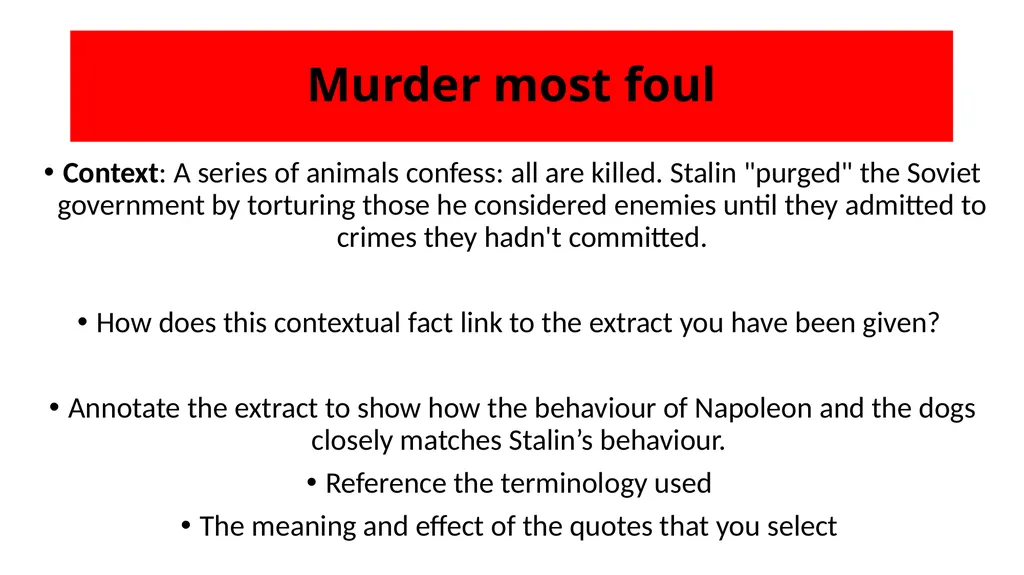
Murder most foul Context: A series of animals confess: all are killed. Stalin "purged" the Soviet government by torturing those he considered enemies until they admitted to crimes they hadn't committed.
How does this contextual fact link to the extract you have been given?
Annotate the extract to show how the behaviour of Napoleon and the dogs closely matches Stalin’s behaviour.
Reference the terminology used
The meaning and effect of the quotes that you select<br>
How does this contextual fact link to the extract you have been given?
Annotate the extract to show how the behaviour of Napoleon and the dogs closely matches Stalin’s behaviour.
Reference the terminology used
The meaning and effect of the quotes that you select<br>
23
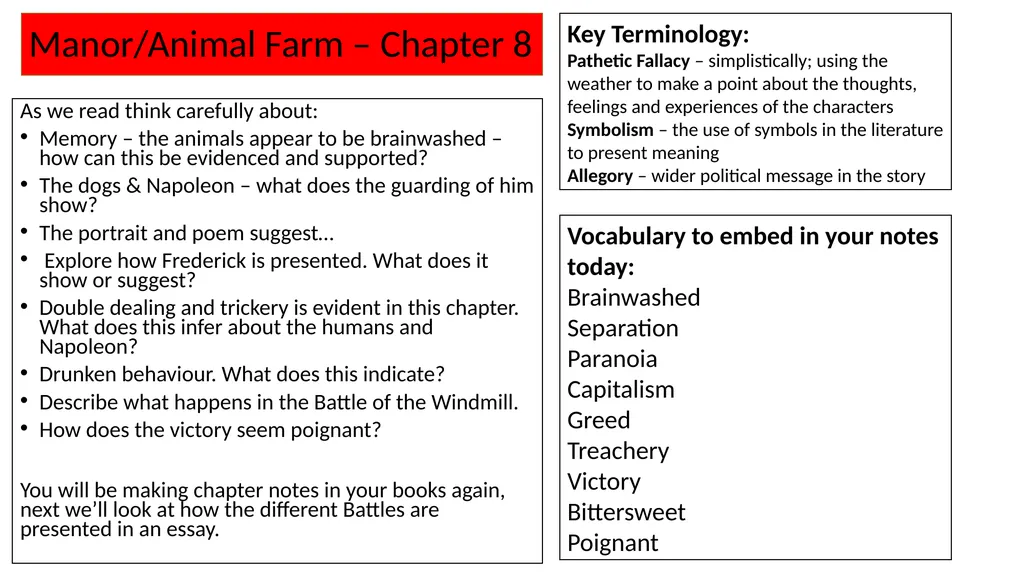
Manor/Animal Farm – Chapter 8 Key Terminology:
Pathetic Fallacy – simplistically; using the weather to make a point about the thoughts, feelings and experiences of the characters
Symbolism – the use of symbols in the literature to present meaning
Allegory – wider political message in the story Vocabulary to embed in your notes today:
Brainwashed
Separation
Paranoia
Capitalism
Greed
Treachery
Victory
Bittersweet
Poignant As we read think carefully about:
Memory – the animals appear to be brainwashed – how can this be evidenced and supported?
The dogs & Napoleon – what does the guarding of him show?
The portrait and poem suggest…
Explore how Frederick is presented. What does it show or suggest?
Double dealing and trickery is evident in this chapter. What does this infer about the humans and Napoleon?
Drunken behaviour. What does this indicate?
Describe what happens in the Battle of the Windmill.
How does the victory seem poignant?
You will be making chapter notes in your books again, next we’ll look at how the different Battles are presented in an essay.<br>
Pathetic Fallacy – simplistically; using the weather to make a point about the thoughts, feelings and experiences of the characters
Symbolism – the use of symbols in the literature to present meaning
Allegory – wider political message in the story Vocabulary to embed in your notes today:
Brainwashed
Separation
Paranoia
Capitalism
Greed
Treachery
Victory
Bittersweet
Poignant As we read think carefully about:
Memory – the animals appear to be brainwashed – how can this be evidenced and supported?
The dogs & Napoleon – what does the guarding of him show?
The portrait and poem suggest…
Explore how Frederick is presented. What does it show or suggest?
Double dealing and trickery is evident in this chapter. What does this infer about the humans and Napoleon?
Drunken behaviour. What does this indicate?
Describe what happens in the Battle of the Windmill.
How does the victory seem poignant?
You will be making chapter notes in your books again, next we’ll look at how the different Battles are presented in an essay.<br>
24
Characterisation: Applying your knowledge You will be bringing together your understanding of Orwell’s presentation of character, use of language and the structure of the text from Chapter 1 to Chapter 8.
Essay Question: How does Orwell’s characterisation show the complex emotions felt by different animals across the allegorical novel Animal Farm?
You need to create an introduction that has:
1 – User the author’s surname only; 2 – Use adverbs to say how the author has –presented a theme/character or idea; 3 – Linked to the question; 4 – Can use terminology; 5 – Say where in the play the extract is from; 6 – Use triplets to say what you think about the presentation of character/theme in the extract and do this again for elsewhere in the play; 7 – Use connectives to link to earlier in the play; 8 – In the final sentence link to the theme (for a character question) or characters (for a theme question)
Your main focus in the essay will need:
Your opinion on the question with the context that drives Orwell’s choices – terminology used by Orwell – a range of quotes that you have selected – meaning – inference – connotations – effect – writers’ intentions. Cover 3 main events that links to the question.
Your conclusion will have:
1 - Use a conclusive phrase to show you are summarising now; 2 – Use Orwell’s surname; 3 – Reference context; 4 – Link back to the introduction; 5 – Writer’s intentions; 6 – Triplets to reinforce the writer’s intentions; 7 – Final line of text or important line that you “quote” if it is particularly relevant<br>
Essay Question: How does Orwell’s characterisation show the complex emotions felt by different animals across the allegorical novel Animal Farm?
You need to create an introduction that has:
1 – User the author’s surname only; 2 – Use adverbs to say how the author has –presented a theme/character or idea; 3 – Linked to the question; 4 – Can use terminology; 5 – Say where in the play the extract is from; 6 – Use triplets to say what you think about the presentation of character/theme in the extract and do this again for elsewhere in the play; 7 – Use connectives to link to earlier in the play; 8 – In the final sentence link to the theme (for a character question) or characters (for a theme question)
Your main focus in the essay will need:
Your opinion on the question with the context that drives Orwell’s choices – terminology used by Orwell – a range of quotes that you have selected – meaning – inference – connotations – effect – writers’ intentions. Cover 3 main events that links to the question.
Your conclusion will have:
1 - Use a conclusive phrase to show you are summarising now; 2 – Use Orwell’s surname; 3 – Reference context; 4 – Link back to the introduction; 5 – Writer’s intentions; 6 – Triplets to reinforce the writer’s intentions; 7 – Final line of text or important line that you “quote” if it is particularly relevant<br>
25
Characterisation: Applying your knowledge You will be bringing together your understanding of Orwell’s presentation of character, use of language and the structure of the text from Chapter 1 to Chapter 8.
Essay Question: How does Orwell’s characterisation show the complex emotions felt by different animals across the allegorical novel Animal Farm?
Planning:
Either create a detailed mind map or a bullet point list of information to include in your essay.
Choose 3 – 4 moments/events across the novel that shows how the animals feel at different points in the novel. Select quotes from these moments that will show how the animal feels. Show progression/changes in the way the characters are presented.
Remember you can’t cover everything, so you need to select examples/moments carefully.<br>
Essay Question: How does Orwell’s characterisation show the complex emotions felt by different animals across the allegorical novel Animal Farm?
Planning:
Either create a detailed mind map or a bullet point list of information to include in your essay.
Choose 3 – 4 moments/events across the novel that shows how the animals feel at different points in the novel. Select quotes from these moments that will show how the animal feels. Show progression/changes in the way the characters are presented.
Remember you can’t cover everything, so you need to select examples/moments carefully.<br>
26
Manor/Animal Farm – Chapter 9 Key Terminology:
Irony – conveying an opposite meaning to the literal meaning Vocabulary to embed in your notes today:
Futility
False representation
Retirement
Utopia
Betrayal As we read think carefully about:
Health
Old Age
Deception of Boxer and the implication of living in a society that will take everything from you but not look after you in old age
The ultimate betrayal by the pigs with the whisky – why is this a real true betrayal of Boxer and all he symbolised?
You will be making chapter notes in your books again, next we’ll explore the symbolic representation of the different characters.<br>
Irony – conveying an opposite meaning to the literal meaning Vocabulary to embed in your notes today:
Futility
False representation
Retirement
Utopia
Betrayal As we read think carefully about:
Health
Old Age
Deception of Boxer and the implication of living in a society that will take everything from you but not look after you in old age
The ultimate betrayal by the pigs with the whisky – why is this a real true betrayal of Boxer and all he symbolised?
You will be making chapter notes in your books again, next we’ll explore the symbolic representation of the different characters.<br>
27
Characters and how they are symbolic representations Explore the following characters and create mind maps to show how they are presented across the text and what they may symbolically represent:
Napoleon
Boxer
Clover
Squealer
The Dogs
Old Benjamin
Moses
The Sheep<br>
Napoleon
Boxer
Clover
Squealer
The Dogs
Old Benjamin
Moses
The Sheep<br>
28
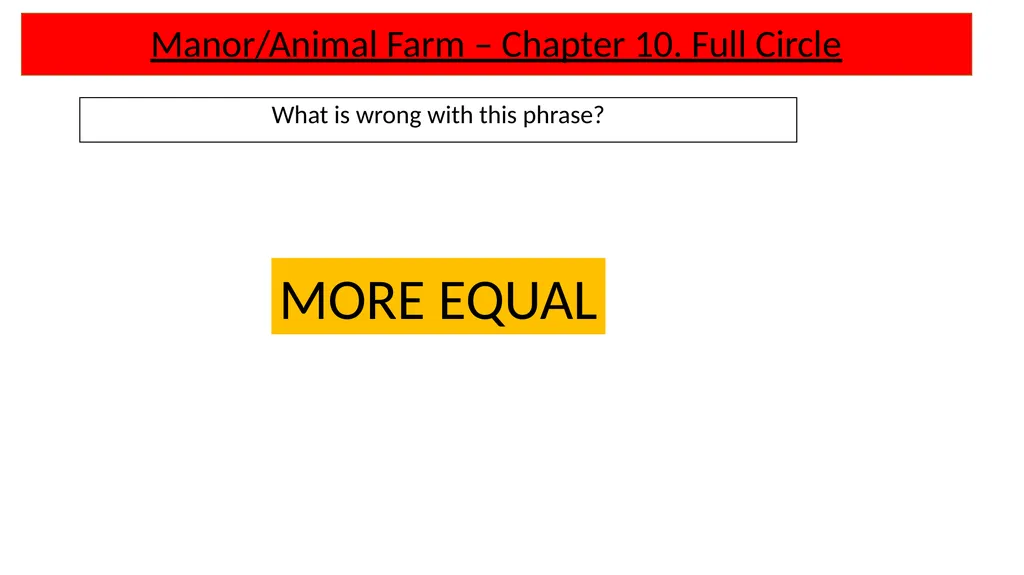
Manor/Animal Farm – Chapter 10. Full Circle What is wrong with this phrase? MORE EQUAL<br>
29
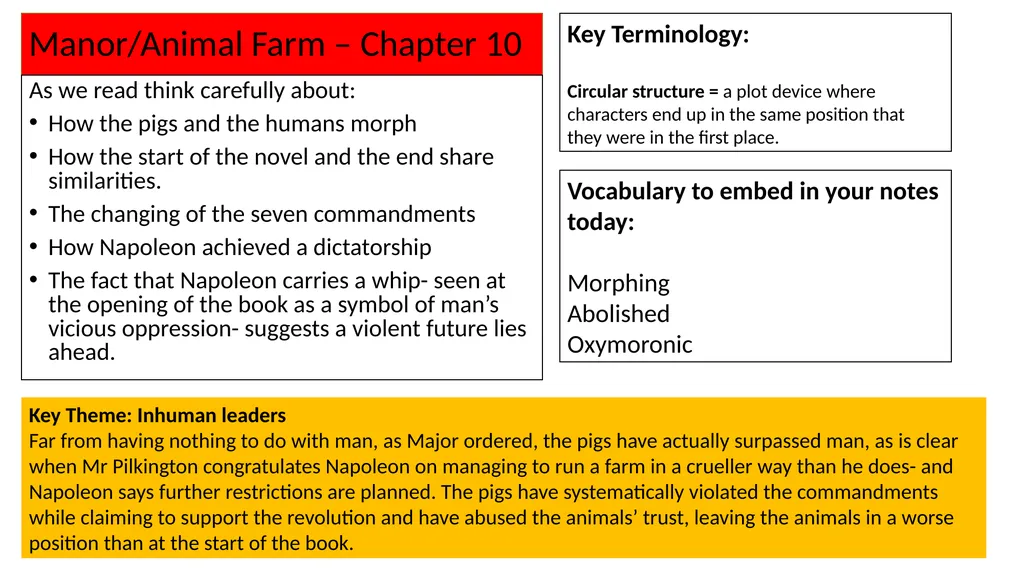
Manor/Animal Farm – Chapter 10 Key Terminology:
Circular structure = a plot device where characters end up in the same position that they were in the first place. Vocabulary to embed in your notes today:
Morphing
Abolished
Oxymoronic As we read think carefully about:
How the pigs and the humans morph
How the start of the novel and the end share similarities.
The changing of the seven commandments
How Napoleon achieved a dictatorship
The fact that Napoleon carries a whip- seen at the opening of the book as a symbol of man’s vicious oppression- suggests a violent future lies ahead. Key Theme: Inhuman leaders
Far from having nothing to do with man, as Major ordered, the pigs have actually surpassed man, as is clear when Mr Pilkington congratulates Napoleon on managing to run a farm in a crueller way than he does- and Napoleon says further restrictions are planned. The pigs have systematically violated the commandments while claiming to support the revolution and have abused the animals’ trust, leaving the animals in a worse position than at the start of the book.<br>
Circular structure = a plot device where characters end up in the same position that they were in the first place. Vocabulary to embed in your notes today:
Morphing
Abolished
Oxymoronic As we read think carefully about:
How the pigs and the humans morph
How the start of the novel and the end share similarities.
The changing of the seven commandments
How Napoleon achieved a dictatorship
The fact that Napoleon carries a whip- seen at the opening of the book as a symbol of man’s vicious oppression- suggests a violent future lies ahead. Key Theme: Inhuman leaders
Far from having nothing to do with man, as Major ordered, the pigs have actually surpassed man, as is clear when Mr Pilkington congratulates Napoleon on managing to run a farm in a crueller way than he does- and Napoleon says further restrictions are planned. The pigs have systematically violated the commandments while claiming to support the revolution and have abused the animals’ trust, leaving the animals in a worse position than at the start of the book.<br>
30
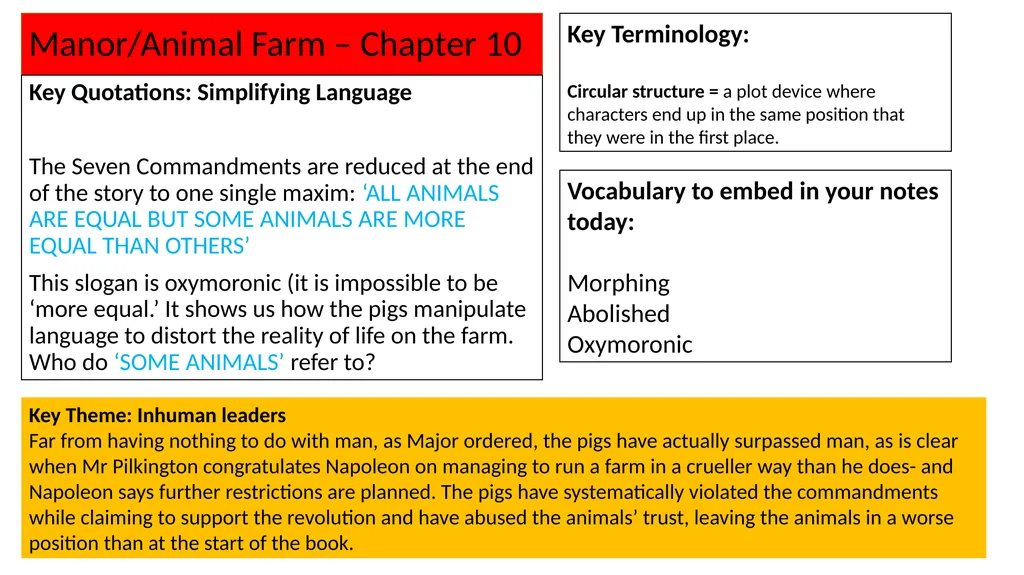
Manor/Animal Farm – Chapter 10 Key Terminology:
Circular structure = a plot device where characters end up in the same position that they were in the first place. Vocabulary to embed in your notes today:
Morphing
Abolished
Oxymoronic Key Quotations: Simplifying Language
The Seven Commandments are reduced at the end of the story to one single maxim: ‘ALL ANIMALS ARE EQUAL BUT SOME ANIMALS ARE MORE EQUAL THAN OTHERS’
This slogan is oxymoronic (it is impossible to be ‘more equal.’ It shows us how the pigs manipulate language to distort the reality of life on the farm. Who do ‘SOME ANIMALS’ refer to? Key Theme: Inhuman leaders
Far from having nothing to do with man, as Major ordered, the pigs have actually surpassed man, as is clear when Mr Pilkington congratulates Napoleon on managing to run a farm in a crueller way than he does- and Napoleon says further restrictions are planned. The pigs have systematically violated the commandments while claiming to support the revolution and have abused the animals’ trust, leaving the animals in a worse position than at the start of the book.<br>
Circular structure = a plot device where characters end up in the same position that they were in the first place. Vocabulary to embed in your notes today:
Morphing
Abolished
Oxymoronic Key Quotations: Simplifying Language
The Seven Commandments are reduced at the end of the story to one single maxim: ‘ALL ANIMALS ARE EQUAL BUT SOME ANIMALS ARE MORE EQUAL THAN OTHERS’
This slogan is oxymoronic (it is impossible to be ‘more equal.’ It shows us how the pigs manipulate language to distort the reality of life on the farm. Who do ‘SOME ANIMALS’ refer to? Key Theme: Inhuman leaders
Far from having nothing to do with man, as Major ordered, the pigs have actually surpassed man, as is clear when Mr Pilkington congratulates Napoleon on managing to run a farm in a crueller way than he does- and Napoleon says further restrictions are planned. The pigs have systematically violated the commandments while claiming to support the revolution and have abused the animals’ trust, leaving the animals in a worse position than at the start of the book.<br>
31
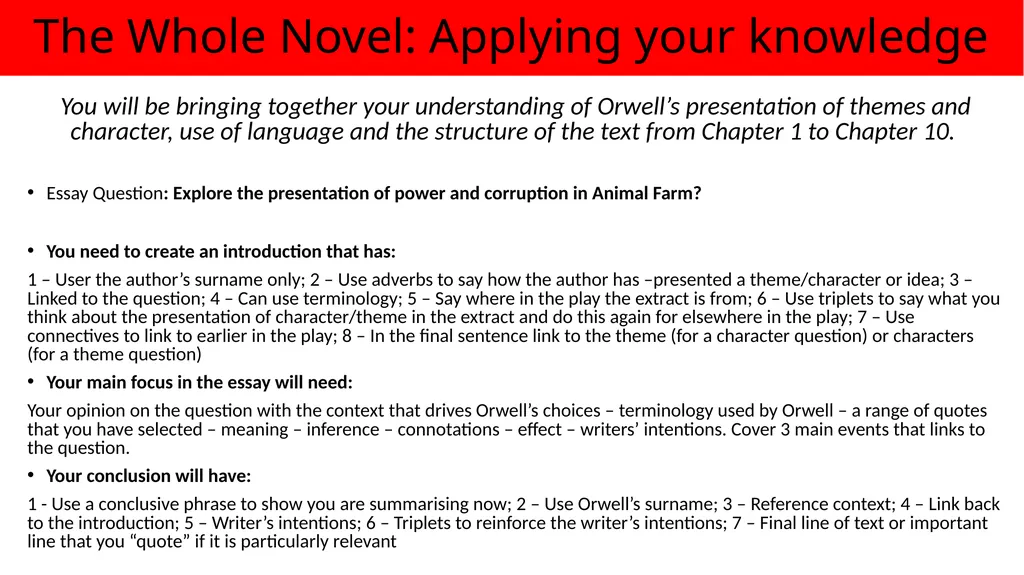
The Whole Novel: Applying your knowledge You will be bringing together your understanding of Orwell’s presentation of themes and character, use of language and the structure of the text from Chapter 1 to Chapter 10.
Essay Question: Explore the presentation of power and corruption in Animal Farm?
You need to create an introduction that has:
1 – User the author’s surname only; 2 – Use adverbs to say how the author has –presented a theme/character or idea; 3 – Linked to the question; 4 – Can use terminology; 5 – Say where in the play the extract is from; 6 – Use triplets to say what you think about the presentation of character/theme in the extract and do this again for elsewhere in the play; 7 – Use connectives to link to earlier in the play; 8 – In the final sentence link to the theme (for a character question) or characters (for a theme question)
Your main focus in the essay will need:
Your opinion on the question with the context that drives Orwell’s choices – terminology used by Orwell – a range of quotes that you have selected – meaning – inference – connotations – effect – writers’ intentions. Cover 3 main events that links to the question.
Your conclusion will have:
1 - Use a conclusive phrase to show you are summarising now; 2 – Use Orwell’s surname; 3 – Reference context; 4 – Link back to the introduction; 5 – Writer’s intentions; 6 – Triplets to reinforce the writer’s intentions; 7 – Final line of text or important line that you “quote” if it is particularly relevant<br>
Essay Question: Explore the presentation of power and corruption in Animal Farm?
You need to create an introduction that has:
1 – User the author’s surname only; 2 – Use adverbs to say how the author has –presented a theme/character or idea; 3 – Linked to the question; 4 – Can use terminology; 5 – Say where in the play the extract is from; 6 – Use triplets to say what you think about the presentation of character/theme in the extract and do this again for elsewhere in the play; 7 – Use connectives to link to earlier in the play; 8 – In the final sentence link to the theme (for a character question) or characters (for a theme question)
Your main focus in the essay will need:
Your opinion on the question with the context that drives Orwell’s choices – terminology used by Orwell – a range of quotes that you have selected – meaning – inference – connotations – effect – writers’ intentions. Cover 3 main events that links to the question.
Your conclusion will have:
1 - Use a conclusive phrase to show you are summarising now; 2 – Use Orwell’s surname; 3 – Reference context; 4 – Link back to the introduction; 5 – Writer’s intentions; 6 – Triplets to reinforce the writer’s intentions; 7 – Final line of text or important line that you “quote” if it is particularly relevant<br>
32
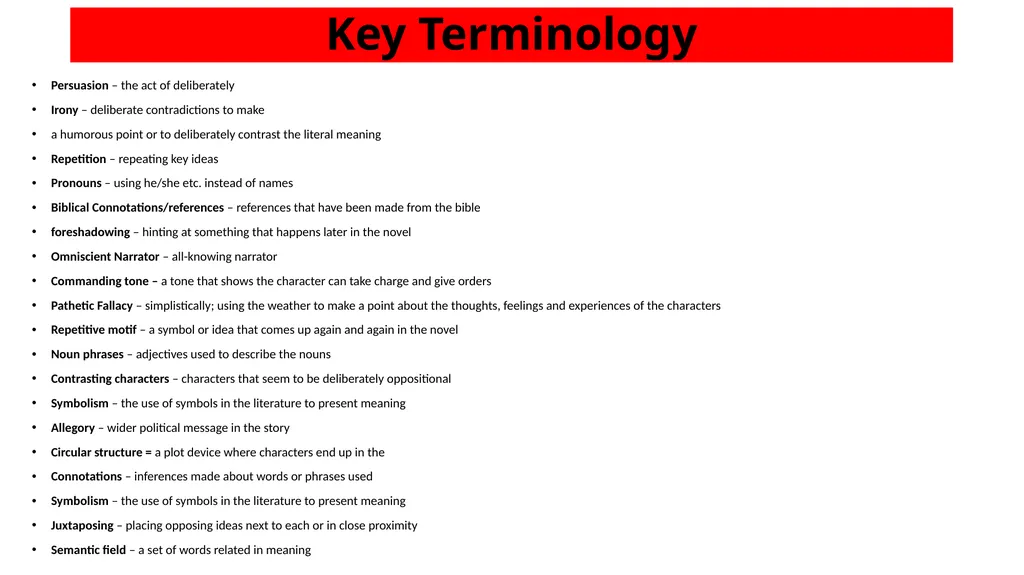
Key Terminology Persuasion – the act of deliberately
Irony – deliberate contradictions to make
a humorous point or to deliberately contrast the literal meaning
Repetition – repeating key ideas
Pronouns – using he/she etc. instead of names
Biblical Connotations/references – references that have been made from the bible
foreshadowing – hinting at something that happens later in the novel
Omniscient Narrator – all-knowing narrator
Commanding tone – a tone that shows the character can take charge and give orders
Pathetic Fallacy – simplistically; using the weather to make a point about the thoughts, feelings and experiences of the characters
Repetitive motif – a symbol or idea that comes up again and again in the novel
Noun phrases – adjectives used to describe the nouns
Contrasting characters – characters that seem to be deliberately oppositional
Symbolism – the use of symbols in the literature to present meaning
Allegory – wider political message in the story
Circular structure = a plot device where characters end up in the
Connotations – inferences made about words or phrases used
Symbolism – the use of symbols in the literature to present meaning
Juxtaposing – placing opposing ideas next to each or in close proximity
Semantic field – a set of words related in meaning<br>
Irony – deliberate contradictions to make
a humorous point or to deliberately contrast the literal meaning
Repetition – repeating key ideas
Pronouns – using he/she etc. instead of names
Biblical Connotations/references – references that have been made from the bible
foreshadowing – hinting at something that happens later in the novel
Omniscient Narrator – all-knowing narrator
Commanding tone – a tone that shows the character can take charge and give orders
Pathetic Fallacy – simplistically; using the weather to make a point about the thoughts, feelings and experiences of the characters
Repetitive motif – a symbol or idea that comes up again and again in the novel
Noun phrases – adjectives used to describe the nouns
Contrasting characters – characters that seem to be deliberately oppositional
Symbolism – the use of symbols in the literature to present meaning
Allegory – wider political message in the story
Circular structure = a plot device where characters end up in the
Connotations – inferences made about words or phrases used
Symbolism – the use of symbols in the literature to present meaning
Juxtaposing – placing opposing ideas next to each or in close proximity
Semantic field – a set of words related in meaning<br>
33
Animal Farm: Betrayal
L/O: to identify and explore a range of examples of betrayal in Animal Farm Key Questions:
You will use these throughout the lesson when working
What is betrayal?
Who betrays the animals most?
Why? Key Vocabulary:
Use the chapter notes in your books if you need the definition of the following words:
Exploitation
Dictatorship
Manipulative
Propaganda
Utopia
Morphed
Rewriting history Key Terminology:
Use the chapter notes in your books if you need the definition of the following terms:
Circular structure
Metaphor
Allegory
Foreshadowing
Symbolism
Dialogue
Description
Tone<br>
You will use these throughout the lesson when working
What is betrayal?
Who betrays the animals most?
Why? Key Vocabulary:
Use the chapter notes in your books if you need the definition of the following words:
Exploitation
Dictatorship
Manipulative
Propaganda
Utopia
Morphed
Rewriting history Key Terminology:
Use the chapter notes in your books if you need the definition of the following terms:
Circular structure
Metaphor
Allegory
Foreshadowing
Symbolism
Dialogue
Description
Tone<br>
34
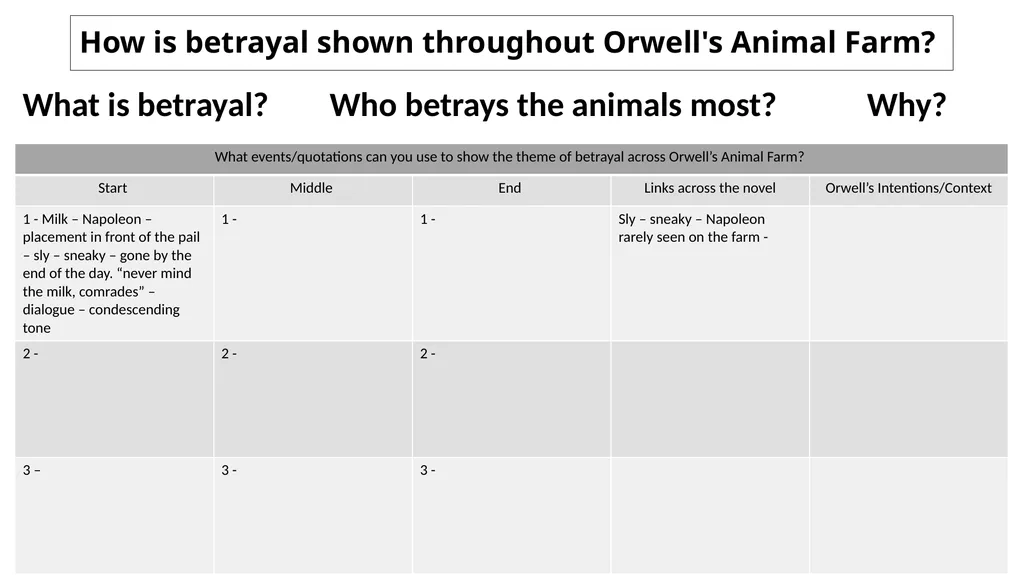
How is betrayal shown throughout Orwell's Animal Farm? What is betrayal? Who betrays the animals most? Why?<br>
35
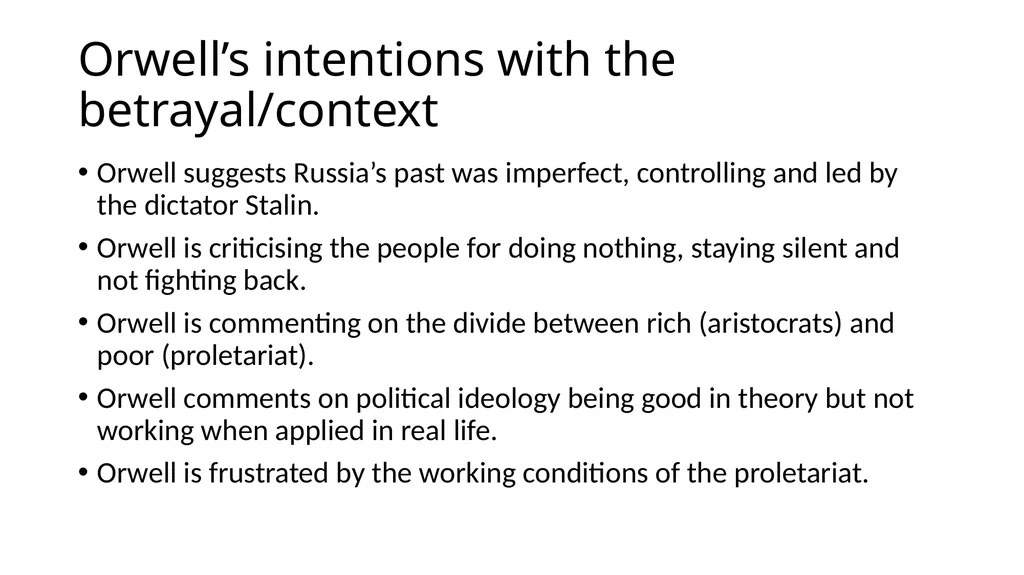
Orwell’s intentions with the betrayal/context Orwell suggests Russia’s past was imperfect, controlling and led by the dictator Stalin.
Orwell is criticising the people for doing nothing, staying silent and not fighting back.
Orwell is commenting on the divide between rich (aristocrats) and poor (proletariat).
Orwell comments on political ideology being good in theory but not working when applied in real life.
Orwell is frustrated by the working conditions of the proletariat.<br>
Orwell is criticising the people for doing nothing, staying silent and not fighting back.
Orwell is commenting on the divide between rich (aristocrats) and poor (proletariat).
Orwell comments on political ideology being good in theory but not working when applied in real life.
Orwell is frustrated by the working conditions of the proletariat.<br>
36
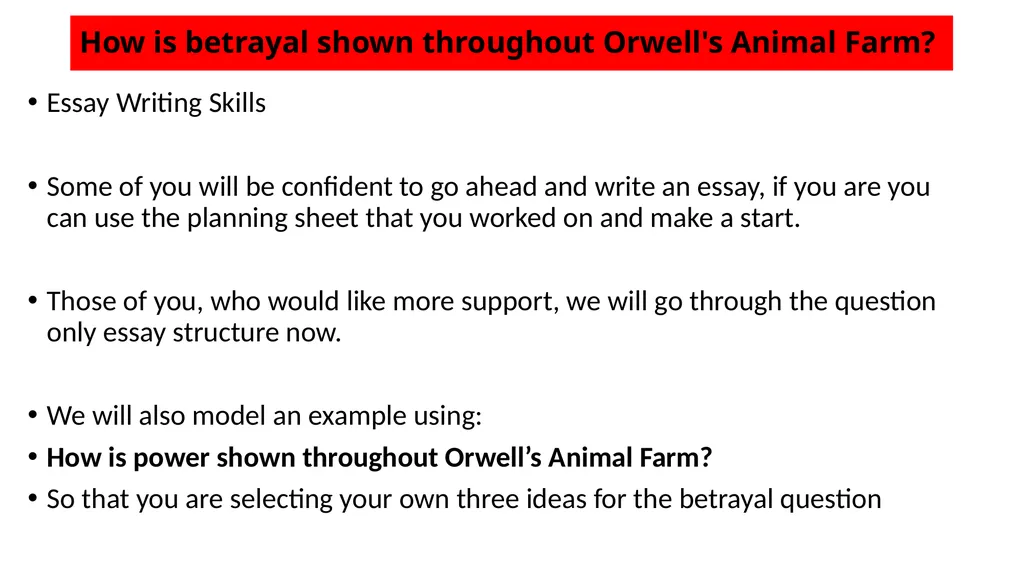
How is betrayal shown throughout Orwell's Animal Farm? Essay Writing Skills
Some of you will be confident to go ahead and write an essay, if you are you can use the planning sheet that you worked on and make a start.
Those of you, who would like more support, we will go through the question only essay structure now.
We will also model an example using:
How is power shown throughout Orwell’s Animal Farm?
So that you are selecting your own three ideas for the betrayal question<br>
Some of you will be confident to go ahead and write an essay, if you are you can use the planning sheet that you worked on and make a start.
Those of you, who would like more support, we will go through the question only essay structure now.
We will also model an example using:
How is power shown throughout Orwell’s Animal Farm?
So that you are selecting your own three ideas for the betrayal question<br>
37
I do - Live Model introduction: We will annotate this after doing it You do - How is betrayal shown throughout Orwell's Animal Farm?<br>
38
Live Model main paragraph: We will annotate this after doing it You do - How is betrayal shown throughout Orwell's Animal Farm?<br>
39
How confident are you with the plot?
How confident are you with the themes?
How confident are with Orwell’s intentions?
How confident are you with context?
How confident are you with essay writing skills? Animal Farm Reflection <br>
How confident are you with the themes?
How confident are with Orwell’s intentions?
How confident are you with context?
How confident are you with essay writing skills? Animal Farm Reflection <br>