Making Your Swim Program Stronger Mike Adams –
Description: Making Your Swim Program Stronger Mike Adams Head Boys Coach Naperville Central High School 78th Annual NISCA Convention and Clinic Minneapolis, MN March 25 - 26, 2011 What we do in the Weight Room The body is a racecar We fine-tune
Related Topics
Download Presentation
"Making Your Swim Program Stronger Mike Adams –" is the property of its rightful owner. Permission is granted to download and print the materials on this website for personal, non-commercial use only, and to display it on your personal computer provided you do not modify the materials and that you retain all copyright notices contained in the materials. By downloading content from our website, you accept the terms of this agreement.
Presentation Transcript
slide1. Making Your Swim Program Stronger Mike Adams – Head Boy’s Coach
Naperville Central High School
78th Annual NISCA Convention and Clinic – Minneapolis, MN
March 25 - 26, 2011<br>
slide2. What we do in the Weight Room The body is a racecar
We fine-tune the engine in the water
We build hydrodynamics and shaping in the weight room
We lift 3 times per week regardless of practice or meet schedules<br>
slide3. The days we lift Helps to make phenomenal progress in the water
Greg Troy, Coach of Ryan Lochte
We lift Monday, Wednesday and Thursday
Never target the same group of muscles back to back
Put effort into your dryland program<br>
slide4. Consistently in motion We currently have 45 swimmers – all lift after practice
We have adequate coaching coverage in the weight room
Little to no rest or off-task in the weight room
We have shifted from a traditional approach to a program that focuses on producing more power<br>
slide5. Free Weights, Angles, Planes We do very little machine / Nautilus based strength training.
We lift at many different planes and angles
When you are in the water, you are never n a static or constant position.<br>
slide6. Free Weights, Angles, Planes We are more of a free-weight program
We are looking for the proper form, then intensity
We have had very few, if any injuries in the weight room<br>
slide7. 14-Week Strength Plan Week 1-2: Base Foundation
Week 3-4: PHA
Week 5-6: Christmas
Work Central Nervous System
Recovery
Range of Motion
Flexibility<br>
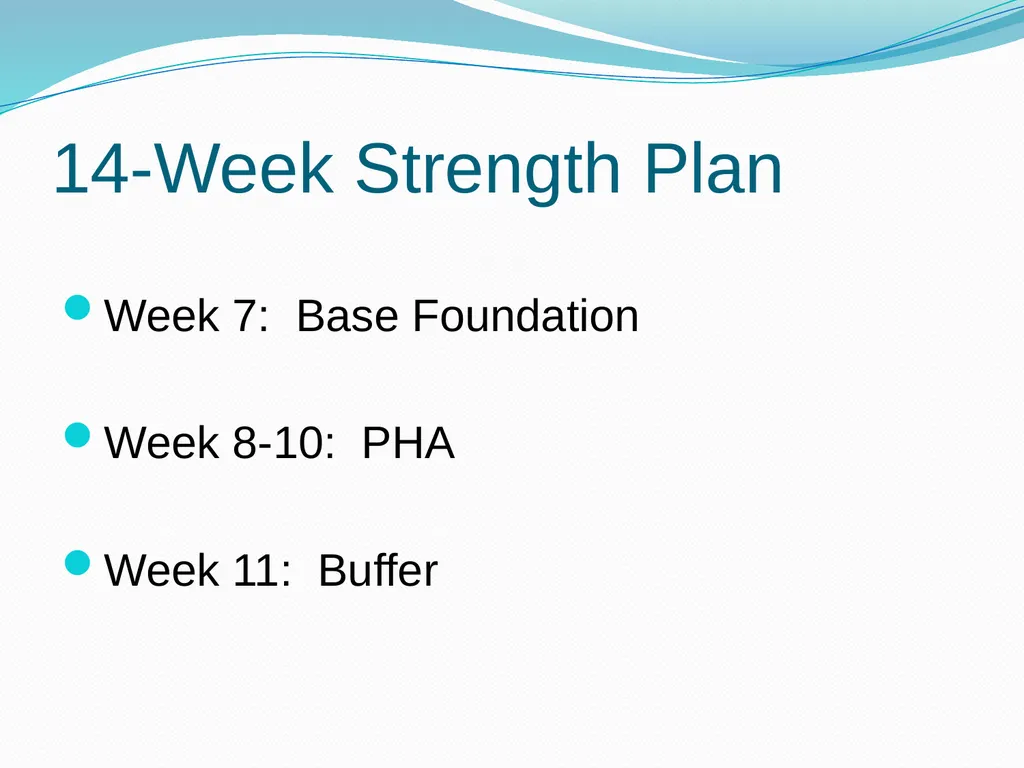
slide8. 14-Week Strength Plan Week 7: Base Foundation
Week 8-10: PHA
Week 11: Buffer<br>
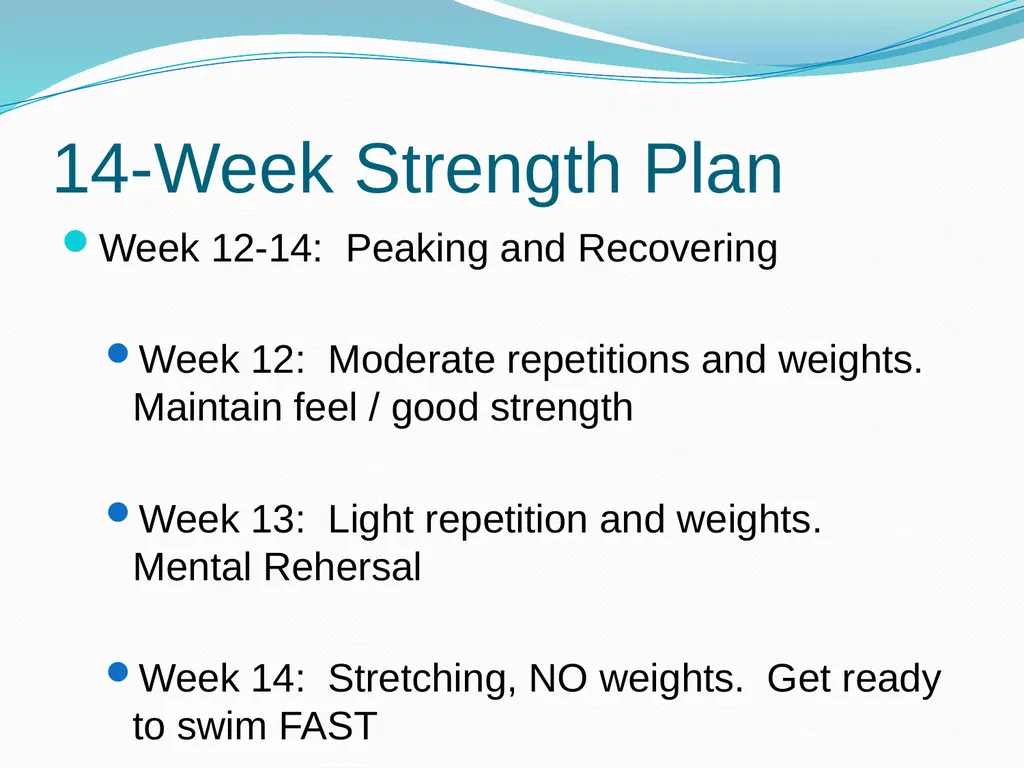
slide9. 14-Week Strength Plan Week 12-14: Peaking and Recovering
Week 12: Moderate repetitions and weights. Maintain feel / good strength
Week 13: Light repetition and weights. Mental Rehersal
Week 14: Stretching, NO weights. Get ready to swim FAST<br>
slide10. 14-Week Strength Plan This formula changes for those on an 11-week season
This is a template, not an absolute<br>
slide11. Main Exercises Squats
Dead Lifts
Horizontal Press
Bench Press
Push Ups
Dips<br>
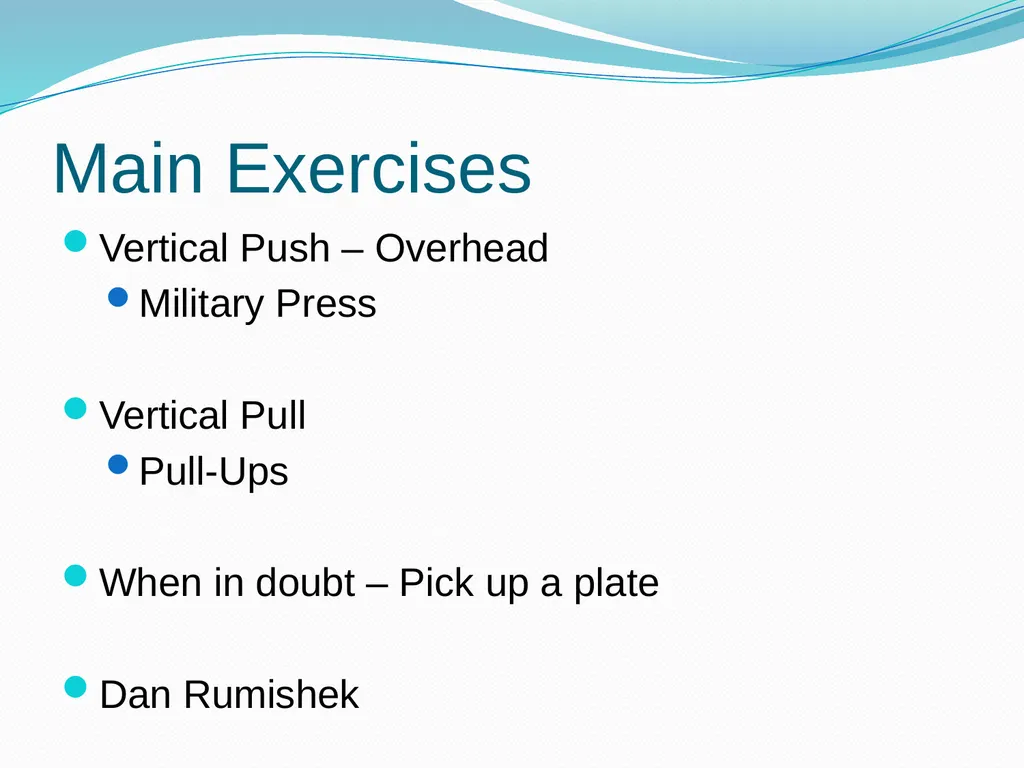
slide12. Main Exercises Vertical Push – Overhead
Military Press
Vertical Pull
Pull-Ups
When in doubt – Pick up a plate
Dan Rumishek<br>
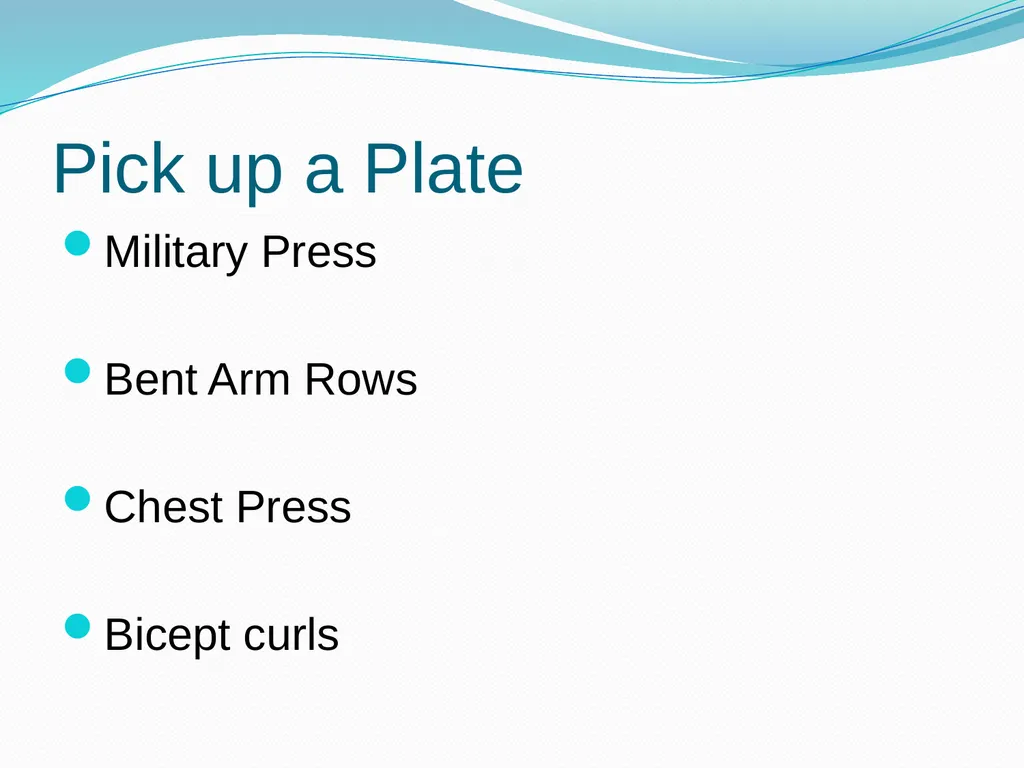
slide13. Pick up a Plate Military Press
Bent Arm Rows
Chest Press
Bicept curls<br>
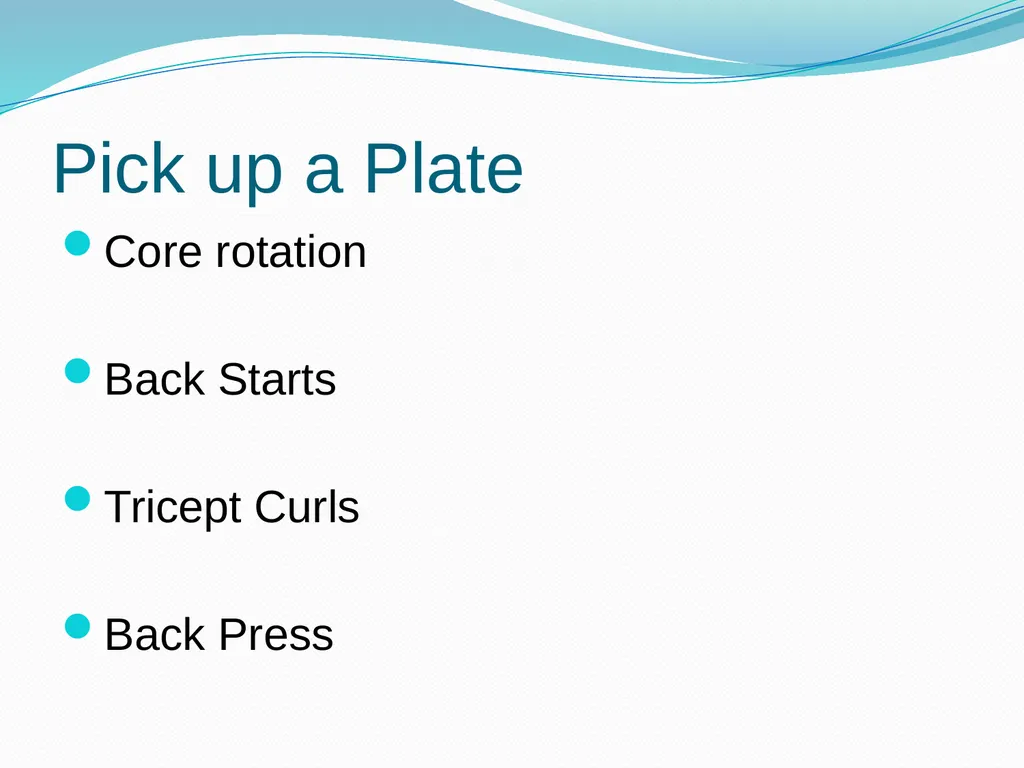
slide14. Pick up a Plate Core rotation
Back Starts
Tricept Curls
Back Press<br>
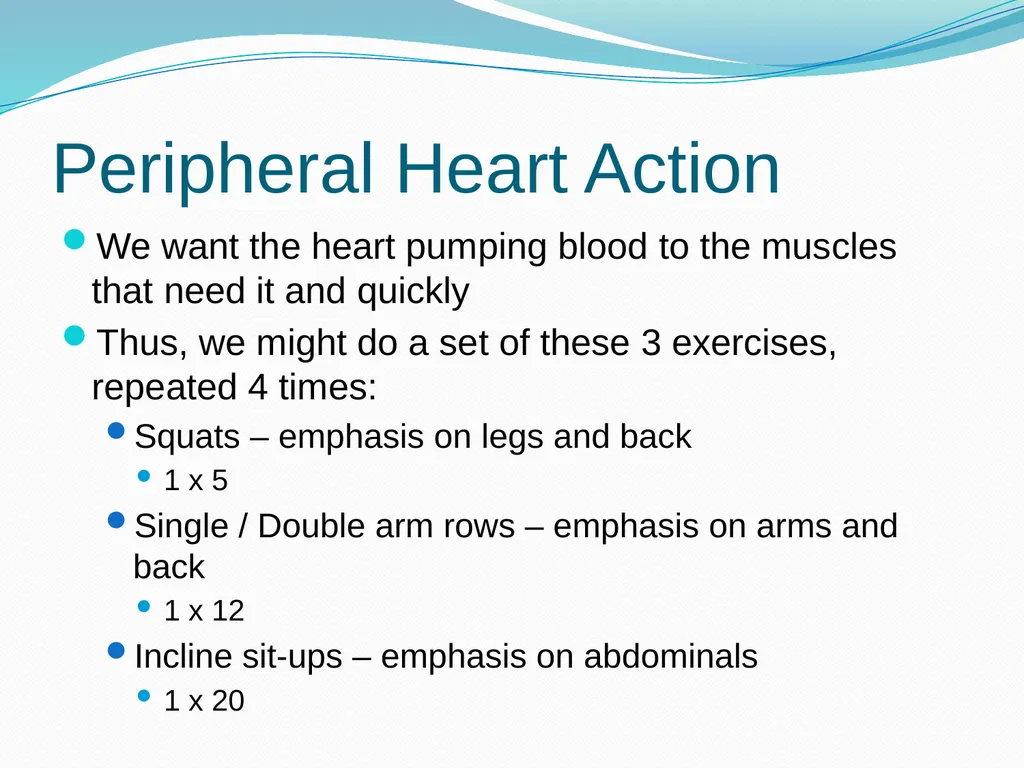
slide15. Peripheral Heart Action We want the heart pumping blood to the muscles that need it and quickly
Thus, we might do a set of these 3 exercises, repeated 4 times:
Squats – emphasis on legs and back
1 x 5
Single / Double arm rows – emphasis on arms and back
1 x 12
Incline sit-ups – emphasis on abdominals
1 x 20<br>
slide16. Constant Variety in the Weight Room Arms
Tricepts Press
Dumbell Kickbacks
Medicine Ball Chest Passes
Barbell Bicepts / Tricepts curl
Dumbbell bicepts curl
Close grip push-ups
Close grip bench press<br>
slide17. Constant Variety in the Weight Room Shoulders
Forward dumbbell deltoid raises
Lateral dumbbell deltoid raises
Bent over reverse dumbbell flies
Arata Swings
Johnsons
Crab Walks
Internal rotation with tubing or cables
External rotation with tubing or cables<br>
slide18. Constant Variety in the Weight Room Chest
Push-ups
Feet elevated push-ups
Bench Press
Dumbbell Physioball bench press
Barbell incline bench press
Wheelbarrows
Standing double-arm medicine bal throw-downs
Reverse pull-up<br>
slide19. Constant Variety in the Weight Room Abdominals
Planks
Side Planks
V-Ups
Flutter Kicks
Physioball crunches
Russian twists with medicine ball
Medicine balls with kneeling chop<br>
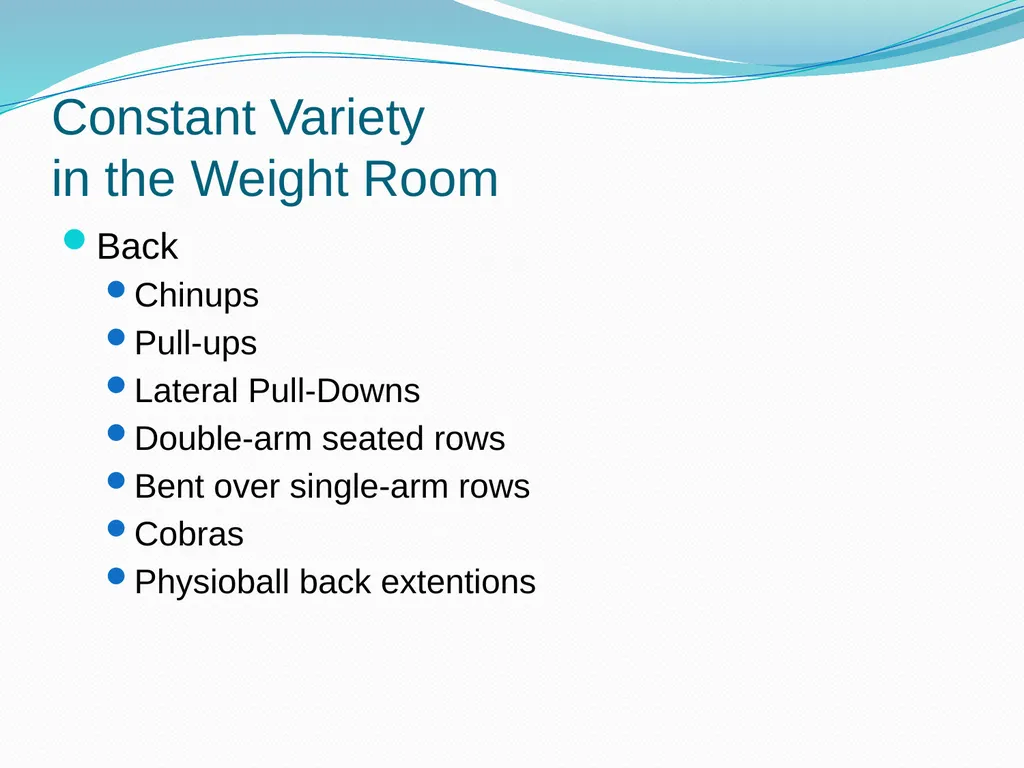
slide20. Constant Variety in the Weight Room Back
Chinups
Pull-ups
Lateral Pull-Downs
Double-arm seated rows
Bent over single-arm rows
Cobras
Physioball back extentions<br>
slide21. Constant Variety in the Weight Room Legs
Squats
Dead lifts
Jump blocks
Dumbbell step ups onto jump blocks
Lunges with barbells
Leg curls
Leg extentions<br>
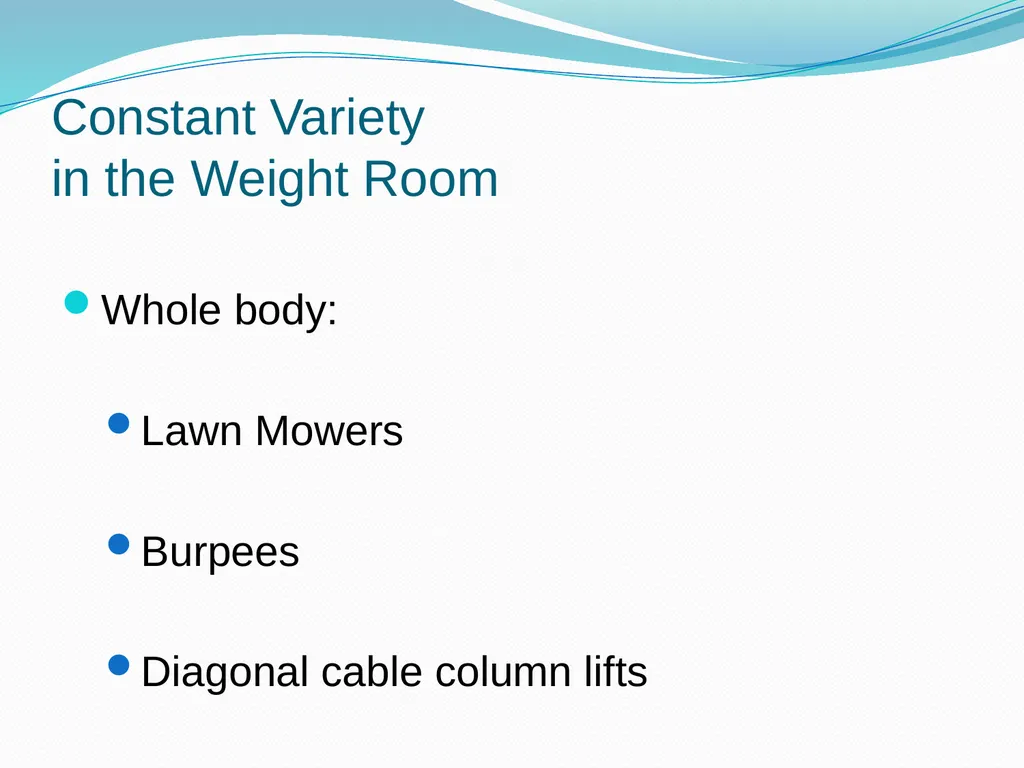
slide22. Constant Variety in the Weight Room Whole body:
Lawn Mowers
Burpees
Diagonal cable column lifts<br>
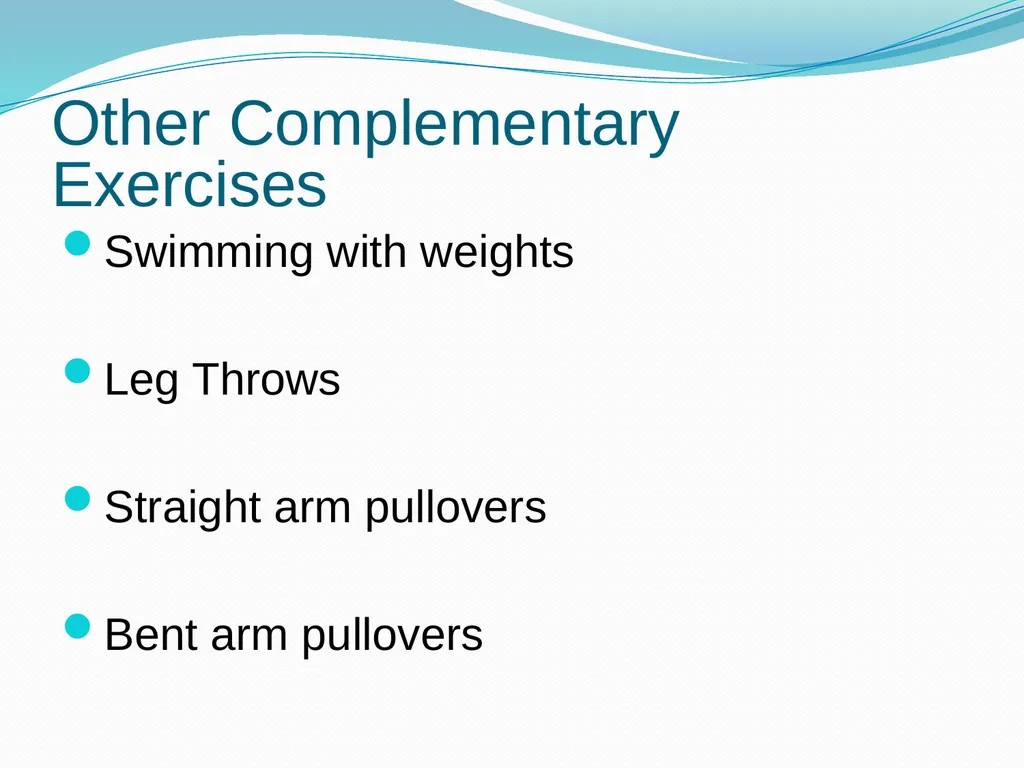
slide23. Other Complementary Exercises Swimming with weights
Leg Throws
Straight arm pullovers
Bent arm pullovers<br>
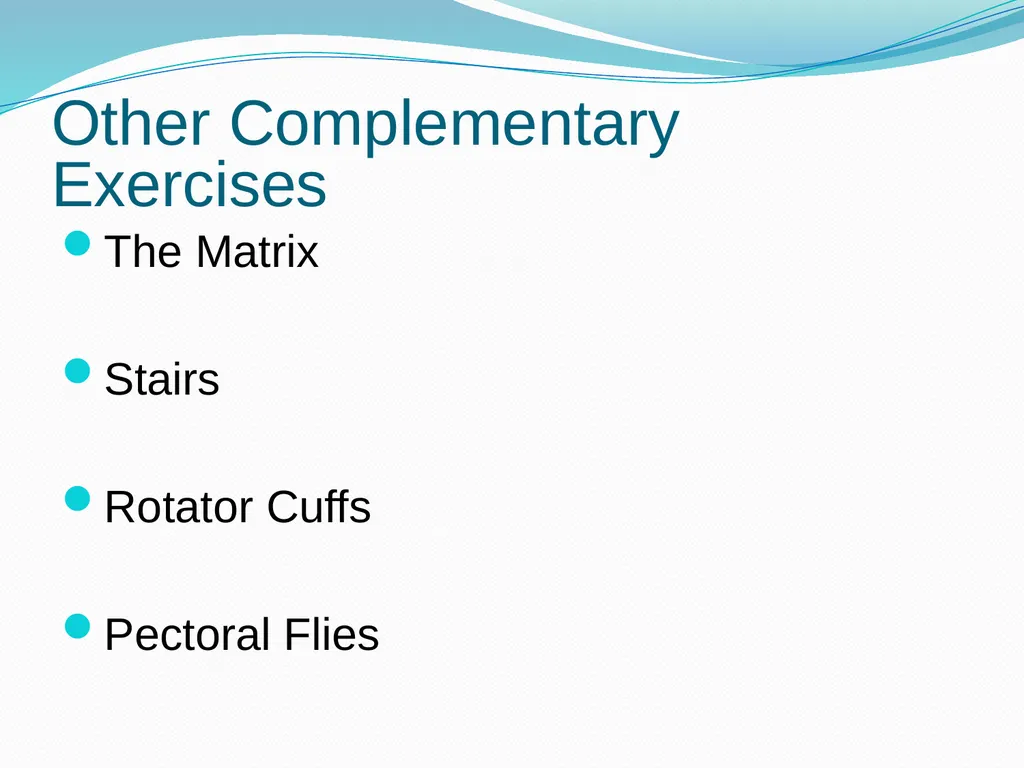
slide24. Other Complementary Exercises The Matrix
Stairs
Rotator Cuffs
Pectoral Flies<br>
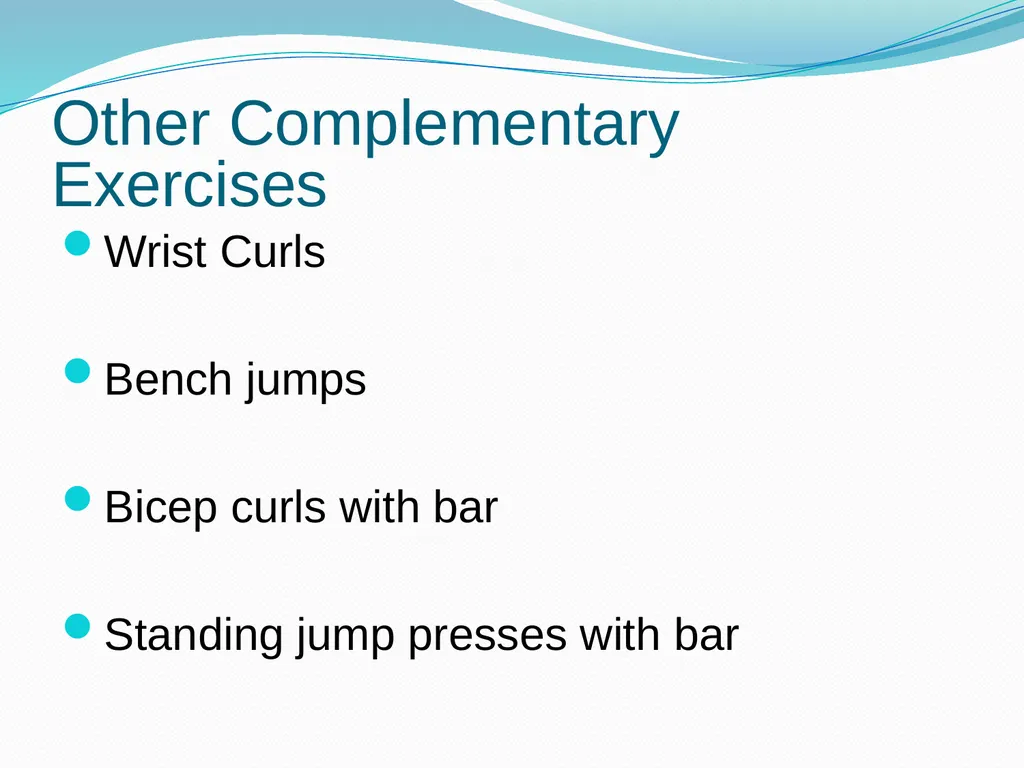
slide25. Other Complementary Exercises Wrist Curls
Bench jumps
Bicep curls with bar
Standing jump presses with bar<br>
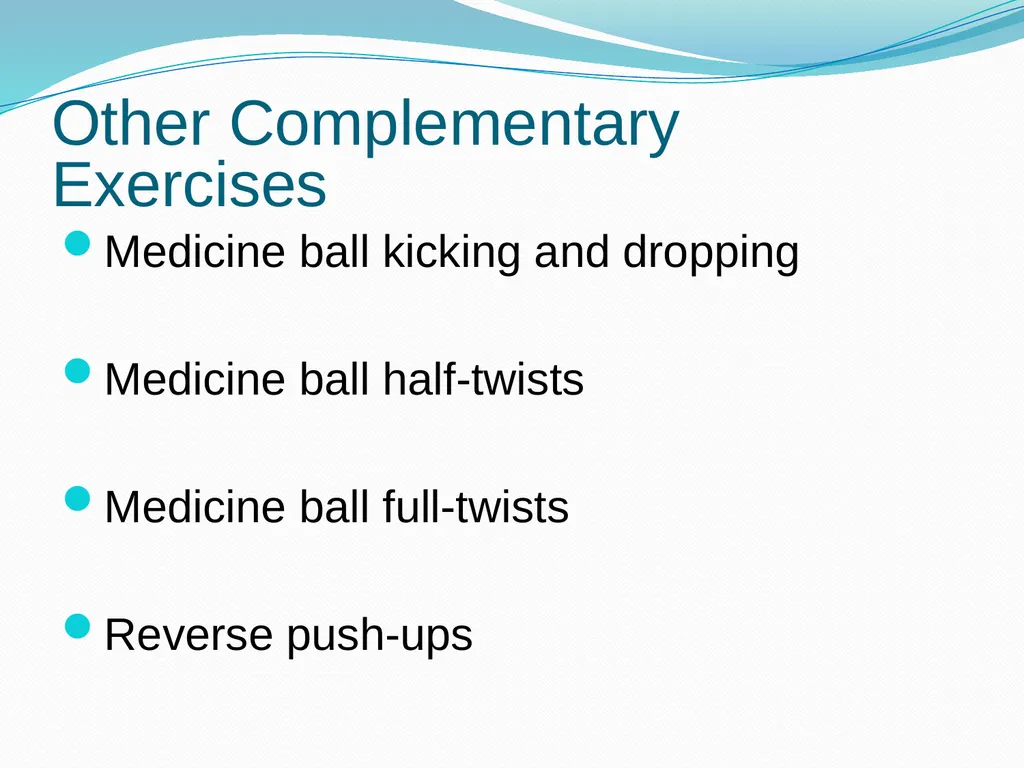
slide26. Other Complementary Exercises Medicine ball kicking and dropping
Medicine ball half-twists
Medicine ball full-twists
Reverse push-ups<br>
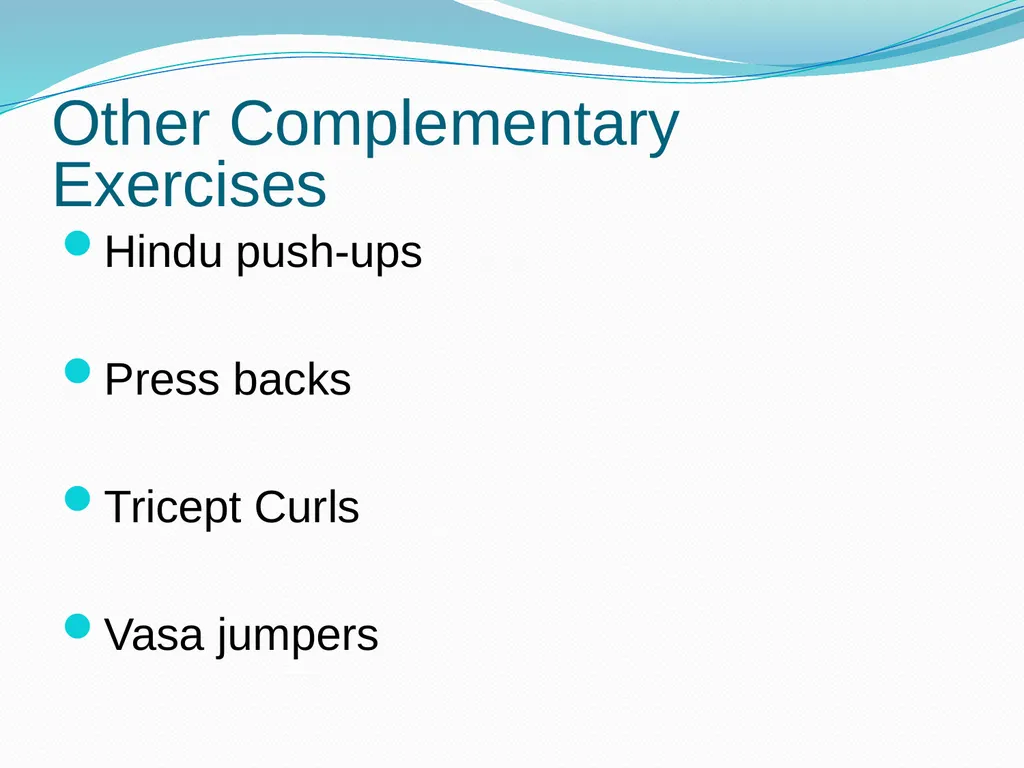
slide27. Other Complementary Exercises Hindu push-ups
Press backs
Tricept Curls
Vasa jumpers<br>
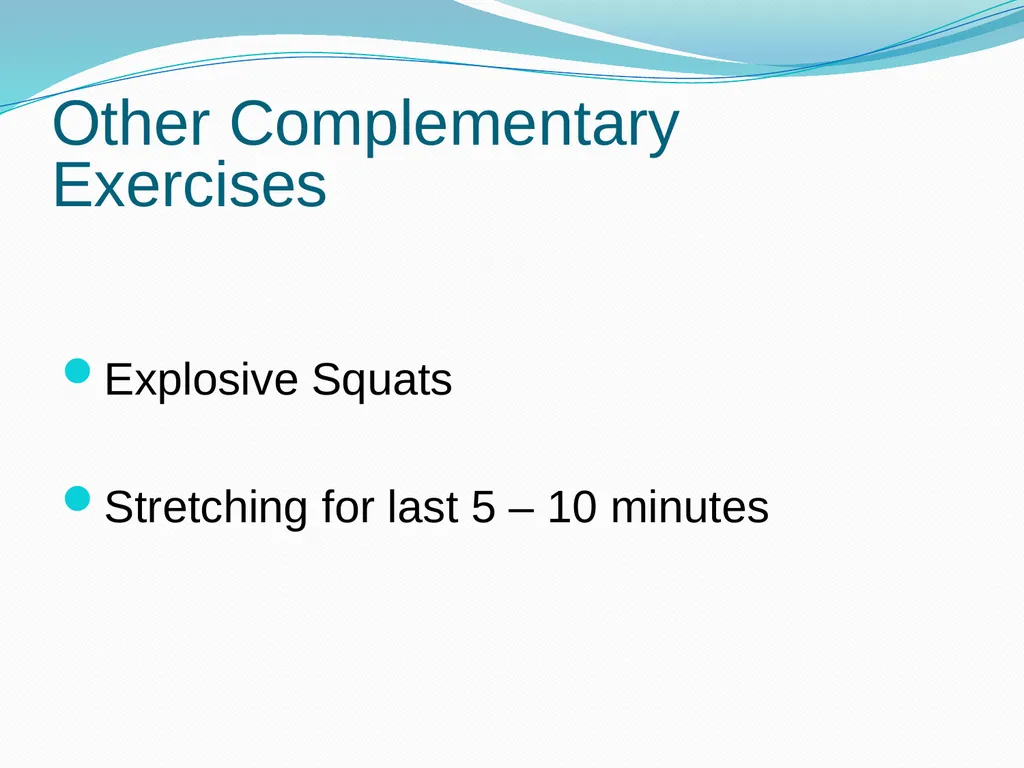
slide28. Other Complementary Exercises Explosive Squats
Stretching for last 5 – 10 minutes<br>
slide29. Underwaters – Typical Week Sets of varying distances with pole in the middle of pool
Streamline to the green line
Texas kick
Widths<br>
slide30. Underwaters – Typical Week Monofin – 1,000 – 1,500 yards per week
Under / Over 50’s with fins
Underwater 25’s
Rockets
Fins in deep end – pushing off bottom<br>
slide31. Power Rack Three Racks
Three Swimmers – 20 Reps
One Swimmer every 20 Seconds
30 minute duration<br>
slide32. Power Rack Only for athletes who double
Times recorded for each session parent volunteers
Free, Specialty, Underwater<br>
slide33. Taper for the Individual Generally a 3-week process
Go through a set warm-up
If your program has a minimal weight-room:
Use a 2-week taper<br>
slide34. Taper for the Individual Depends upon the athlete needs and how hard one has worked during the season
In and out of the weight room
In and out of the water
Some athletes need more rest than others<br>
slide35. Window of Opportunity v. Specific time and place Look at the taper as a window of opportunity
Generally, the first week consists of 75% normal yardage
Week 2 generally is 50% of normal yardage
Week 3 consists mostly of warming up<br>
slide36. Window of Opportunity v. Specific time and place Try to maintain aerobic conditioning
Continually work on speed and pace
Be careful with dives and odd distances<br>
slide37. When in doubt, rest Some athletes look and feel great – others not so.
Be calm and get the swimmers ready
Swimmers MUST rest outside of pool
When in doubt, rest<br>
slide38. When in doubt, rest Broken Swims
Everything is individualized
Go with your gut
Maintain confidence regardless of how swimmers look<br>
slide39. Proper Diet and Nutrition No “dirty diesel”
Barry Sears – The Zone Diet
Try to be careful that the State Team is not too fast at Sectionals<br>
slide40. References Functional Training for Sports: Michael Boyle
High Intensity Training: John Philbin
Strength Training Anatomy: Frederic Delavier
Swimming Anatomy: Ian McLeod
Theory and Methodology of Training: Tudor Bompa
Swim Strength: Paul Collins
How to Develop Olympic Level Swimmers: Dr. John Cramer<br>
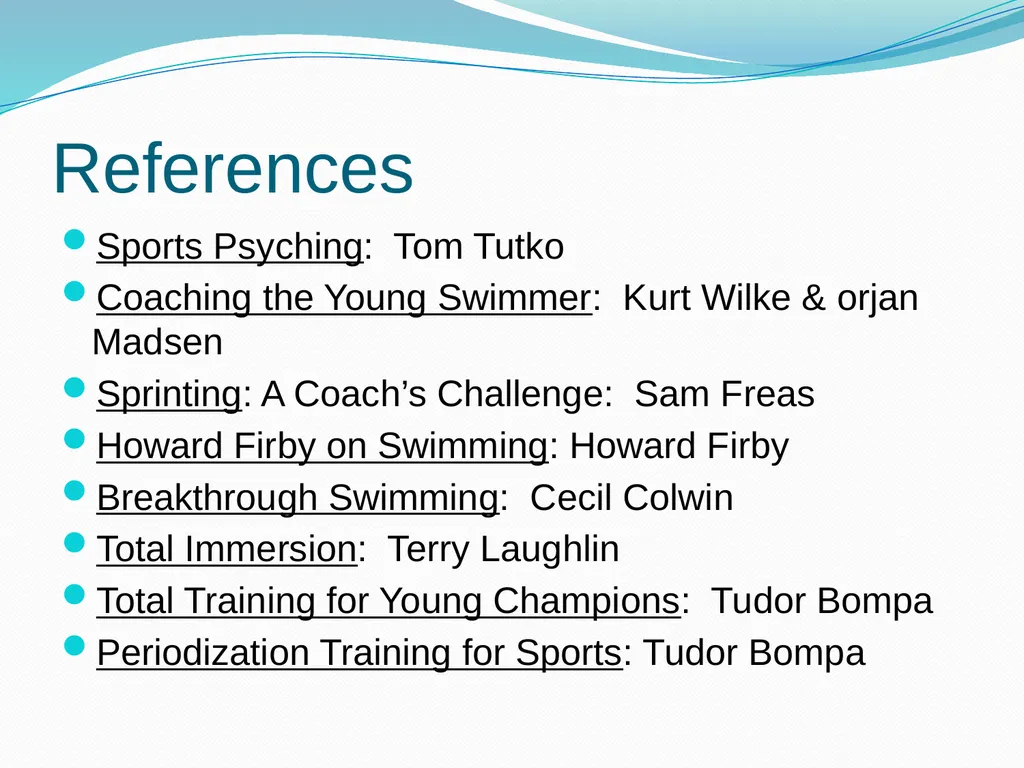
slide41. References Sports Psyching: Tom Tutko
Coaching the Young Swimmer: Kurt Wilke & orjan Madsen
Sprinting: A Coach’s Challenge: Sam Freas
Howard Firby on Swimming: Howard Firby
Breakthrough Swimming: Cecil Colwin
Total Immersion: Terry Laughlin
Total Training for Young Champions: Tudor Bompa
Periodization Training for Sports: Tudor Bompa<br>
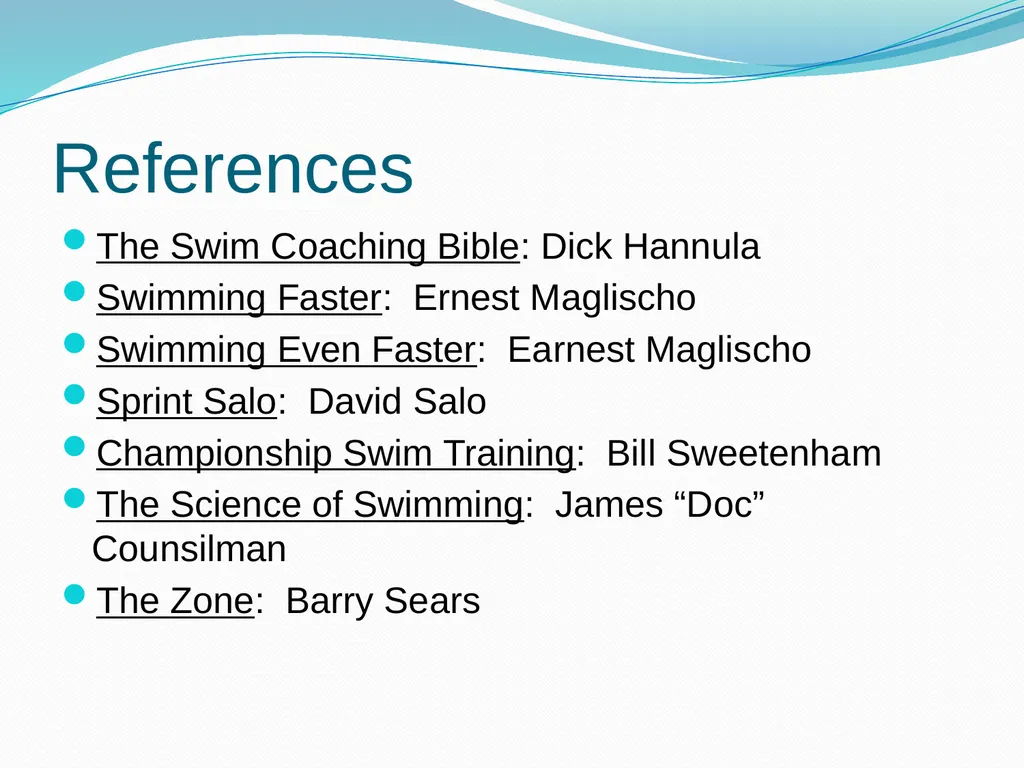
slide42. References The Swim Coaching Bible: Dick Hannula
Swimming Faster: Ernest Maglischo
Swimming Even Faster: Earnest Maglischo
Sprint Salo: David Salo
Championship Swim Training: Bill Sweetenham
The Science of Swimming: James “Doc” Counsilman
The Zone: Barry Sears<br>
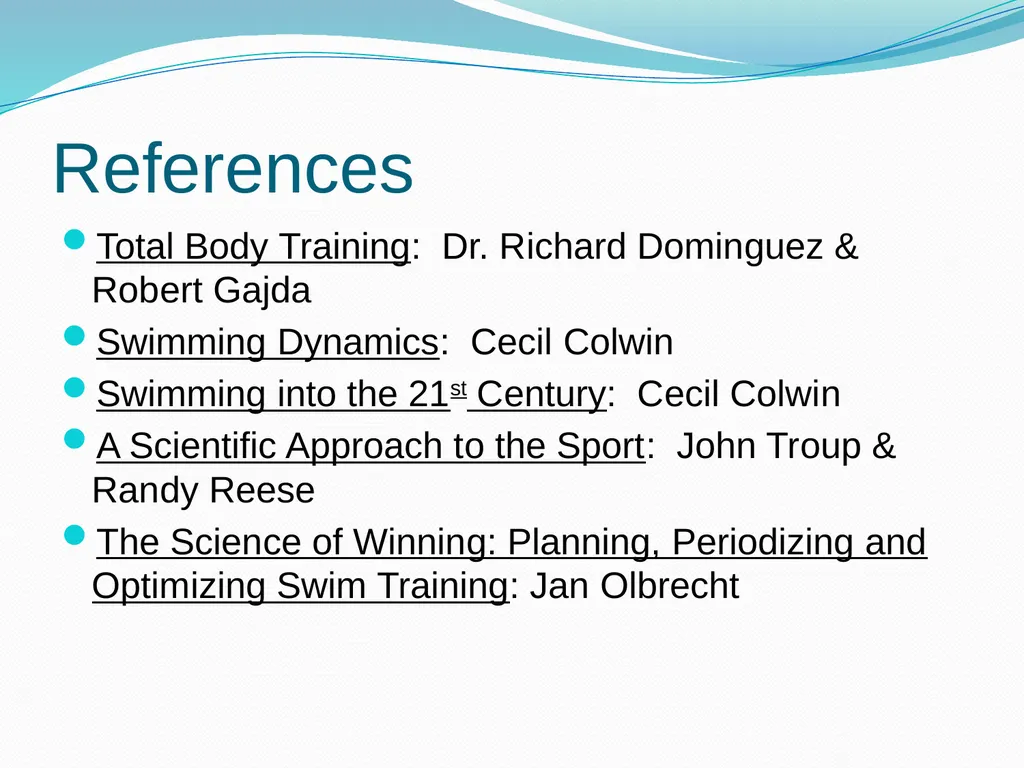
slide43. References Total Body Training: Dr. Richard Dominguez & Robert Gajda
Swimming Dynamics: Cecil Colwin
Swimming into the 21st Century: Cecil Colwin
A Scientific Approach to the Sport: John Troup & Randy Reese
The Science of Winning: Planning, Periodizing and Optimizing Swim Training: Jan Olbrecht<br>
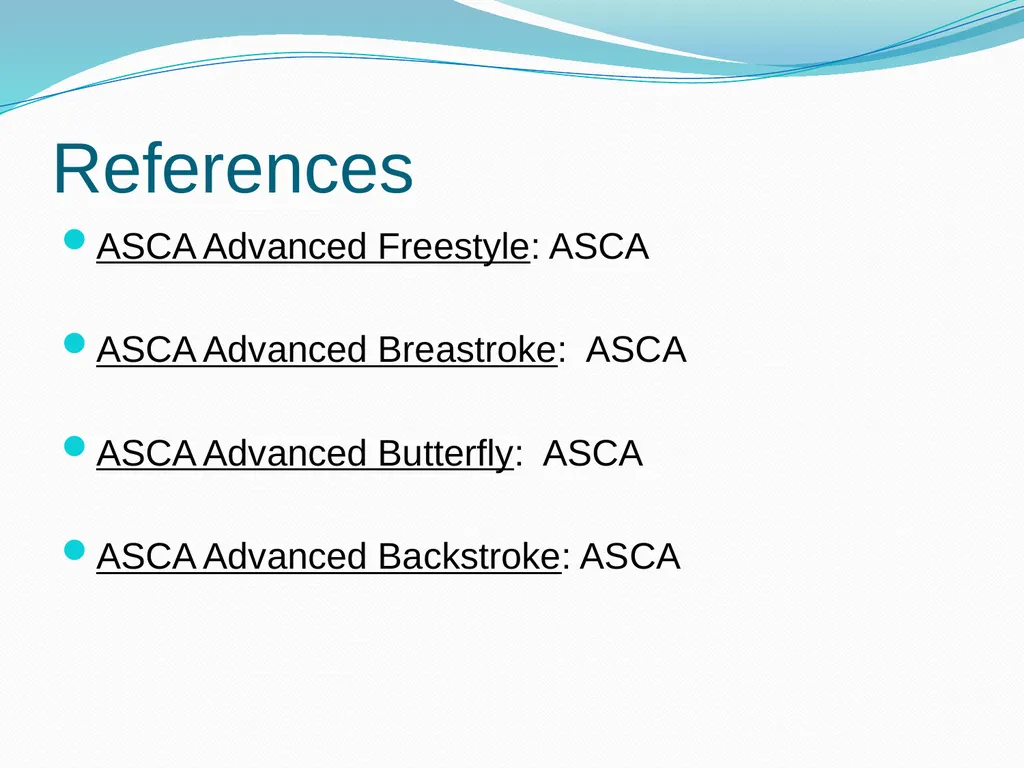
slide44. References ASCA Advanced Freestyle: ASCA
ASCA Advanced Breastroke: ASCA
ASCA Advanced Butterfly: ASCA
ASCA Advanced Backstroke: ASCA<br>

Naperville Central High School
78th Annual NISCA Convention and Clinic – Minneapolis, MN
March 25 - 26, 2011<br>
slide2. What we do in the Weight Room The body is a racecar
We fine-tune the engine in the water
We build hydrodynamics and shaping in the weight room
We lift 3 times per week regardless of practice or meet schedules<br>

slide3. The days we lift Helps to make phenomenal progress in the water
Greg Troy, Coach of Ryan Lochte
We lift Monday, Wednesday and Thursday
Never target the same group of muscles back to back
Put effort into your dryland program<br>
slide4. Consistently in motion We currently have 45 swimmers – all lift after practice
We have adequate coaching coverage in the weight room
Little to no rest or off-task in the weight room
We have shifted from a traditional approach to a program that focuses on producing more power<br>
slide5. Free Weights, Angles, Planes We do very little machine / Nautilus based strength training.
We lift at many different planes and angles
When you are in the water, you are never n a static or constant position.<br>
slide6. Free Weights, Angles, Planes We are more of a free-weight program
We are looking for the proper form, then intensity
We have had very few, if any injuries in the weight room<br>
slide7. 14-Week Strength Plan Week 1-2: Base Foundation
Week 3-4: PHA
Week 5-6: Christmas
Work Central Nervous System
Recovery
Range of Motion
Flexibility<br>
slide8. 14-Week Strength Plan Week 7: Base Foundation
Week 8-10: PHA
Week 11: Buffer<br>
slide9. 14-Week Strength Plan Week 12-14: Peaking and Recovering
Week 12: Moderate repetitions and weights. Maintain feel / good strength
Week 13: Light repetition and weights. Mental Rehersal
Week 14: Stretching, NO weights. Get ready to swim FAST<br>
slide10. 14-Week Strength Plan This formula changes for those on an 11-week season
This is a template, not an absolute<br>
slide11. Main Exercises Squats
Dead Lifts
Horizontal Press
Bench Press
Push Ups
Dips<br>
slide12. Main Exercises Vertical Push – Overhead
Military Press
Vertical Pull
Pull-Ups
When in doubt – Pick up a plate
Dan Rumishek<br>
slide13. Pick up a Plate Military Press
Bent Arm Rows
Chest Press
Bicept curls<br>
slide14. Pick up a Plate Core rotation
Back Starts
Tricept Curls
Back Press<br>
slide15. Peripheral Heart Action We want the heart pumping blood to the muscles that need it and quickly
Thus, we might do a set of these 3 exercises, repeated 4 times:
Squats – emphasis on legs and back
1 x 5
Single / Double arm rows – emphasis on arms and back
1 x 12
Incline sit-ups – emphasis on abdominals
1 x 20<br>
slide16. Constant Variety in the Weight Room Arms
Tricepts Press
Dumbell Kickbacks
Medicine Ball Chest Passes
Barbell Bicepts / Tricepts curl
Dumbbell bicepts curl
Close grip push-ups
Close grip bench press<br>
slide17. Constant Variety in the Weight Room Shoulders
Forward dumbbell deltoid raises
Lateral dumbbell deltoid raises
Bent over reverse dumbbell flies
Arata Swings
Johnsons
Crab Walks
Internal rotation with tubing or cables
External rotation with tubing or cables<br>
slide18. Constant Variety in the Weight Room Chest
Push-ups
Feet elevated push-ups
Bench Press
Dumbbell Physioball bench press
Barbell incline bench press
Wheelbarrows
Standing double-arm medicine bal throw-downs
Reverse pull-up<br>
slide19. Constant Variety in the Weight Room Abdominals
Planks
Side Planks
V-Ups
Flutter Kicks
Physioball crunches
Russian twists with medicine ball
Medicine balls with kneeling chop<br>
slide20. Constant Variety in the Weight Room Back
Chinups
Pull-ups
Lateral Pull-Downs
Double-arm seated rows
Bent over single-arm rows
Cobras
Physioball back extentions<br>
slide21. Constant Variety in the Weight Room Legs
Squats
Dead lifts
Jump blocks
Dumbbell step ups onto jump blocks
Lunges with barbells
Leg curls
Leg extentions<br>
slide22. Constant Variety in the Weight Room Whole body:
Lawn Mowers
Burpees
Diagonal cable column lifts<br>
slide23. Other Complementary Exercises Swimming with weights
Leg Throws
Straight arm pullovers
Bent arm pullovers<br>
slide24. Other Complementary Exercises The Matrix
Stairs
Rotator Cuffs
Pectoral Flies<br>
slide25. Other Complementary Exercises Wrist Curls
Bench jumps
Bicep curls with bar
Standing jump presses with bar<br>
slide26. Other Complementary Exercises Medicine ball kicking and dropping
Medicine ball half-twists
Medicine ball full-twists
Reverse push-ups<br>
slide27. Other Complementary Exercises Hindu push-ups
Press backs
Tricept Curls
Vasa jumpers<br>
slide28. Other Complementary Exercises Explosive Squats
Stretching for last 5 – 10 minutes<br>
slide29. Underwaters – Typical Week Sets of varying distances with pole in the middle of pool
Streamline to the green line
Texas kick
Widths<br>
slide30. Underwaters – Typical Week Monofin – 1,000 – 1,500 yards per week
Under / Over 50’s with fins
Underwater 25’s
Rockets
Fins in deep end – pushing off bottom<br>
slide31. Power Rack Three Racks
Three Swimmers – 20 Reps
One Swimmer every 20 Seconds
30 minute duration<br>
slide32. Power Rack Only for athletes who double
Times recorded for each session parent volunteers
Free, Specialty, Underwater<br>
slide33. Taper for the Individual Generally a 3-week process
Go through a set warm-up
If your program has a minimal weight-room:
Use a 2-week taper<br>
slide34. Taper for the Individual Depends upon the athlete needs and how hard one has worked during the season
In and out of the weight room
In and out of the water
Some athletes need more rest than others<br>
slide35. Window of Opportunity v. Specific time and place Look at the taper as a window of opportunity
Generally, the first week consists of 75% normal yardage
Week 2 generally is 50% of normal yardage
Week 3 consists mostly of warming up<br>
slide36. Window of Opportunity v. Specific time and place Try to maintain aerobic conditioning
Continually work on speed and pace
Be careful with dives and odd distances<br>
slide37. When in doubt, rest Some athletes look and feel great – others not so.
Be calm and get the swimmers ready
Swimmers MUST rest outside of pool
When in doubt, rest<br>
slide38. When in doubt, rest Broken Swims
Everything is individualized
Go with your gut
Maintain confidence regardless of how swimmers look<br>
slide39. Proper Diet and Nutrition No “dirty diesel”
Barry Sears – The Zone Diet
Try to be careful that the State Team is not too fast at Sectionals<br>
slide40. References Functional Training for Sports: Michael Boyle
High Intensity Training: John Philbin
Strength Training Anatomy: Frederic Delavier
Swimming Anatomy: Ian McLeod
Theory and Methodology of Training: Tudor Bompa
Swim Strength: Paul Collins
How to Develop Olympic Level Swimmers: Dr. John Cramer<br>
slide41. References Sports Psyching: Tom Tutko
Coaching the Young Swimmer: Kurt Wilke & orjan Madsen
Sprinting: A Coach’s Challenge: Sam Freas
Howard Firby on Swimming: Howard Firby
Breakthrough Swimming: Cecil Colwin
Total Immersion: Terry Laughlin
Total Training for Young Champions: Tudor Bompa
Periodization Training for Sports: Tudor Bompa<br>
slide42. References The Swim Coaching Bible: Dick Hannula
Swimming Faster: Ernest Maglischo
Swimming Even Faster: Earnest Maglischo
Sprint Salo: David Salo
Championship Swim Training: Bill Sweetenham
The Science of Swimming: James “Doc” Counsilman
The Zone: Barry Sears<br>
slide43. References Total Body Training: Dr. Richard Dominguez & Robert Gajda
Swimming Dynamics: Cecil Colwin
Swimming into the 21st Century: Cecil Colwin
A Scientific Approach to the Sport: John Troup & Randy Reese
The Science of Winning: Planning, Periodizing and Optimizing Swim Training: Jan Olbrecht<br>
slide44. References ASCA Advanced Freestyle: ASCA
ASCA Advanced Breastroke: ASCA
ASCA Advanced Butterfly: ASCA
ASCA Advanced Backstroke: ASCA<br>