
Mamba: Linear-Time Sequence Modeling with
TF
Published · 44 slides · 0 views
1 / 1

Description
Mamba: Linear-Time Sequence Modeling with Selective State Spaces Albert Gu and Tri Dao Presenter: Jiatong Li The background and motivation of the problem. Existing work Key ideas and design in the paper. Evaluation methodology and
Related Topics
Share
Embed code
Download this presentation From Below
"Mamba: Linear-Time Sequence Modeling with" is the property of its rightful owner. Permission is granted to download and print the materials on this website for personal, non-commercial use only, and to display it on your personal computer provided you do not modify the materials and that you retain all copyright notices contained in the materials. By downloading content from our website, you accept the terms of this agreement.
Presentation Transcript
01
Mamba: Linear-Time Sequence Modeling with Selective State Spaces Albert Gu and Tri Dao Presenter: Jiatong Li<br>
02
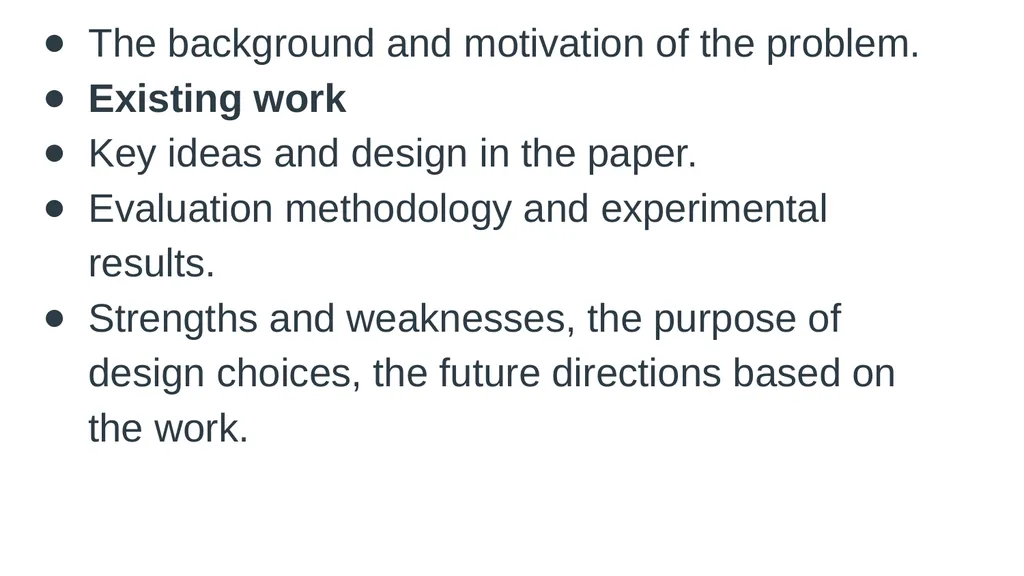
The background and motivation of the problem.
Existing work
Key ideas and design in the paper.
Evaluation methodology and experimental results.
Strengths and weaknesses, the purpose of design choices, the future directions based on the work.<br>
Existing work
Key ideas and design in the paper.
Evaluation methodology and experimental results.
Strengths and weaknesses, the purpose of design choices, the future directions based on the work.<br>
03
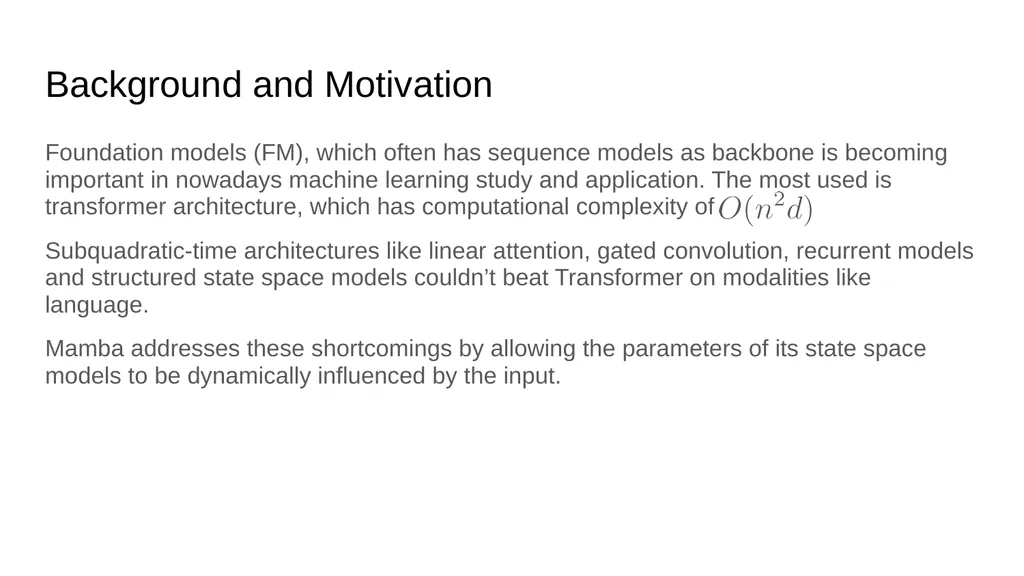
Background and Motivation Foundation models (FM), which often has sequence models as backbone is becoming important in nowadays machine learning study and application. The most used is transformer architecture, which has computational complexity of
Subquadratic-time architectures like linear attention, gated convolution, recurrent models and structured state space models couldn’t beat Transformer on modalities like language.
Mamba addresses these shortcomings by allowing the parameters of its state space models to be dynamically influenced by the input.<br>
Subquadratic-time architectures like linear attention, gated convolution, recurrent models and structured state space models couldn’t beat Transformer on modalities like language.
Mamba addresses these shortcomings by allowing the parameters of its state space models to be dynamically influenced by the input.<br>
04
The background and motivation of the problem.
Existing work
Key ideas and design in the paper.
Evaluation methodology and experimental results.
Strengths and weaknesses, the purpose of design choices, the future directions based on the work.<br>
Existing work
Key ideas and design in the paper.
Evaluation methodology and experimental results.
Strengths and weaknesses, the purpose of design choices, the future directions based on the work.<br>
05
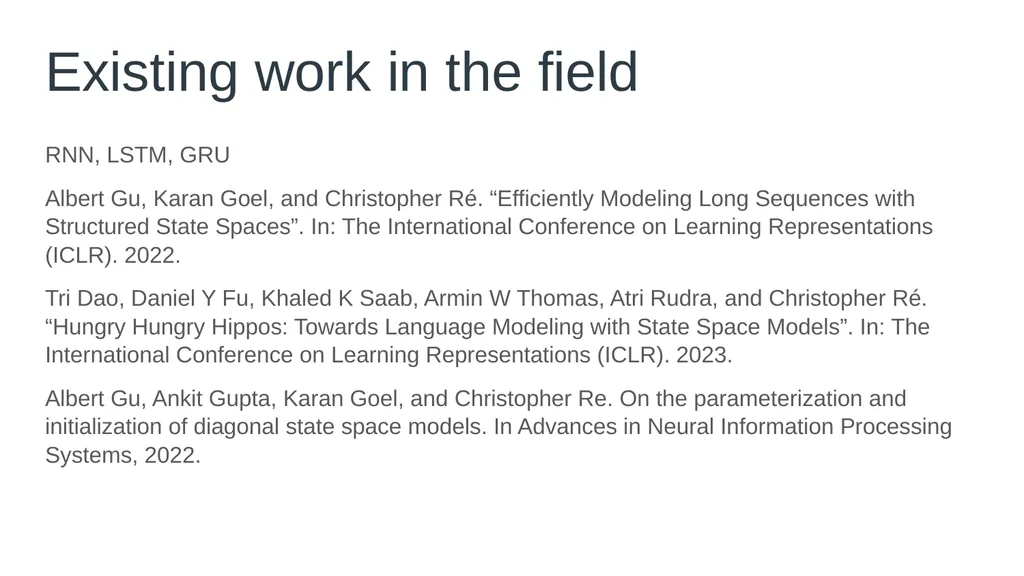
Existing work in the field RNN, LSTM, GRU
Albert Gu, Karan Goel, and Christopher Ré. “Efficiently Modeling Long Sequences with Structured State Spaces”. In: The International Conference on Learning Representations (ICLR). 2022.
Tri Dao, Daniel Y Fu, Khaled K Saab, Armin W Thomas, Atri Rudra, and Christopher Ré. “Hungry Hungry Hippos: Towards Language Modeling with State Space Models”. In: The International Conference on Learning Representations (ICLR). 2023.
Albert Gu, Ankit Gupta, Karan Goel, and Christopher Re. On the parameterization and initialization of diagonal state space models. In Advances in Neural Information Processing Systems, 2022.<br>
Albert Gu, Karan Goel, and Christopher Ré. “Efficiently Modeling Long Sequences with Structured State Spaces”. In: The International Conference on Learning Representations (ICLR). 2022.
Tri Dao, Daniel Y Fu, Khaled K Saab, Armin W Thomas, Atri Rudra, and Christopher Ré. “Hungry Hungry Hippos: Towards Language Modeling with State Space Models”. In: The International Conference on Learning Representations (ICLR). 2023.
Albert Gu, Ankit Gupta, Karan Goel, and Christopher Re. On the parameterization and initialization of diagonal state space models. In Advances in Neural Information Processing Systems, 2022.<br>
06
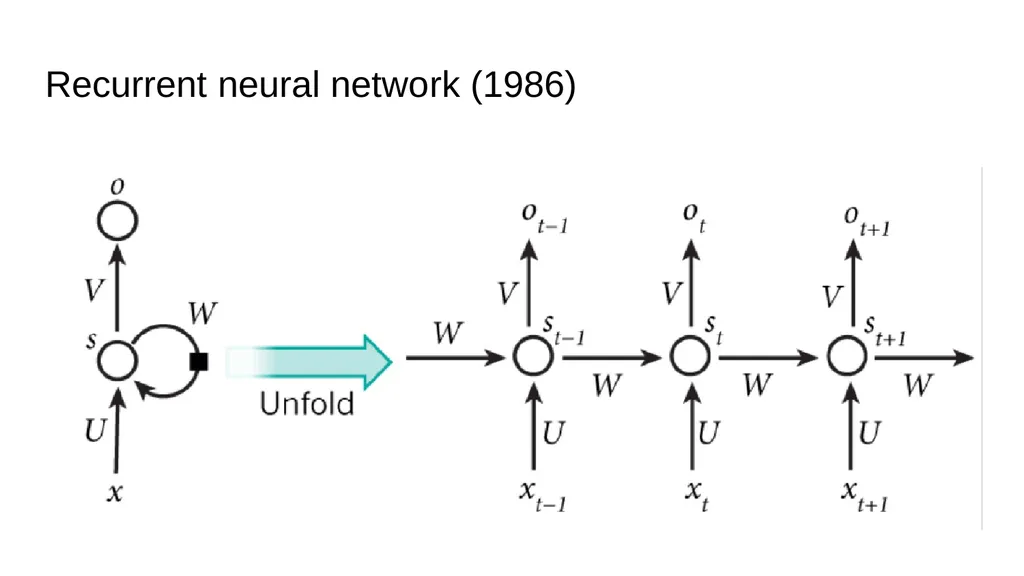
Recurrent neural network (1986)<br>
07
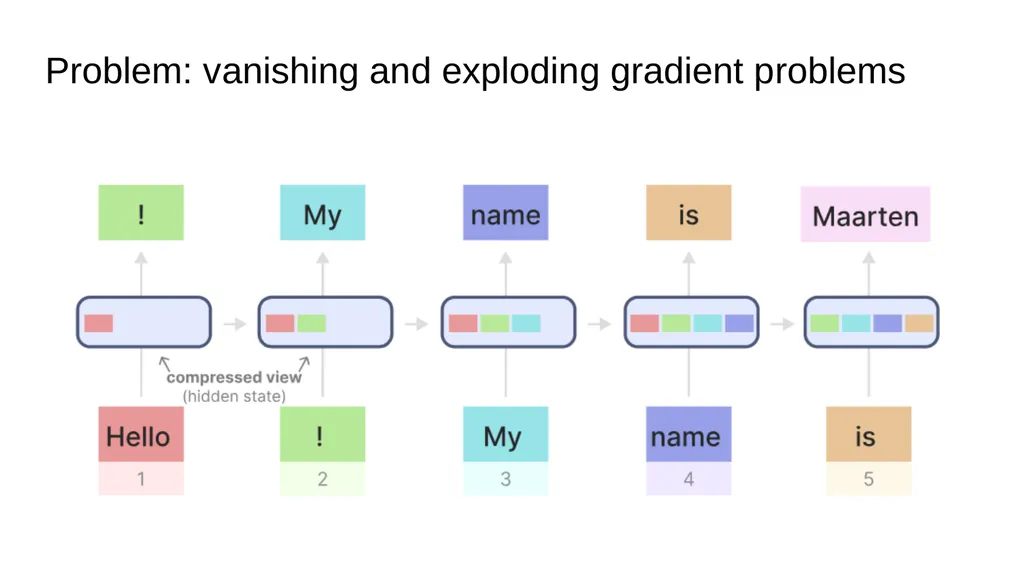
Problem: vanishing and exploding gradient problems<br>
08
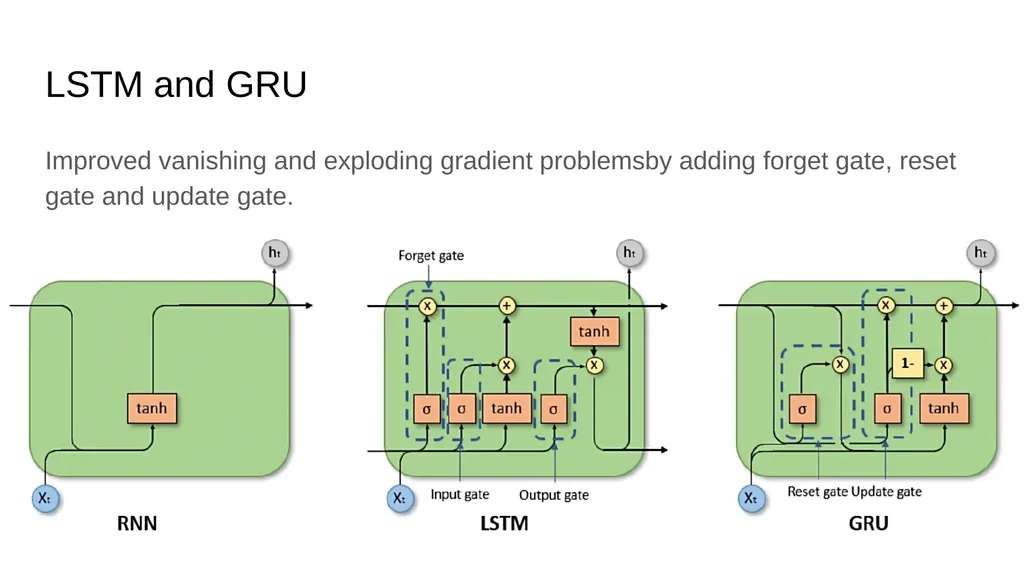
LSTM and GRU Improved vanishing and exploding gradient problemsby adding forget gate, reset gate and update gate.<br>
09
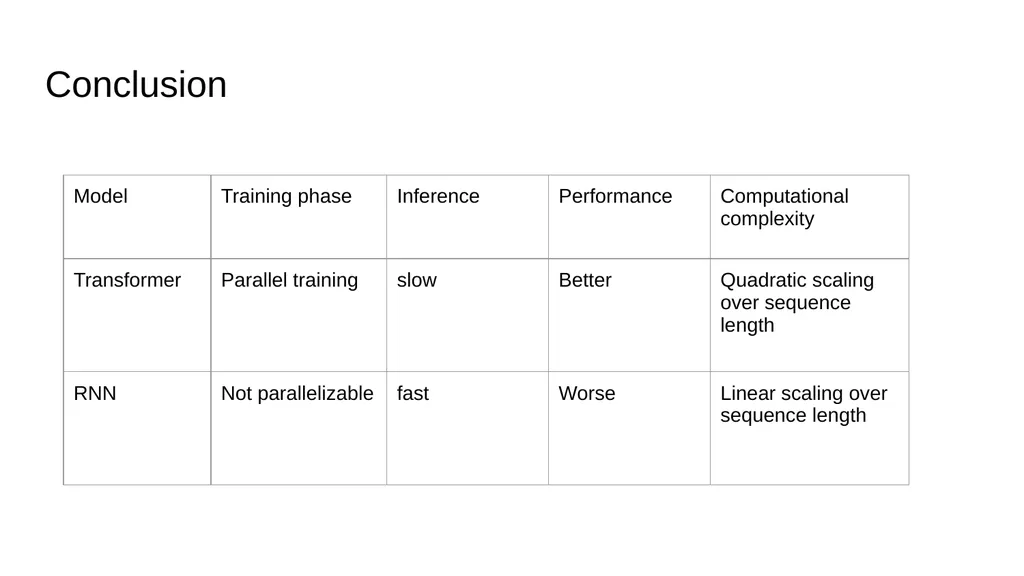
Conclusion<br>
10
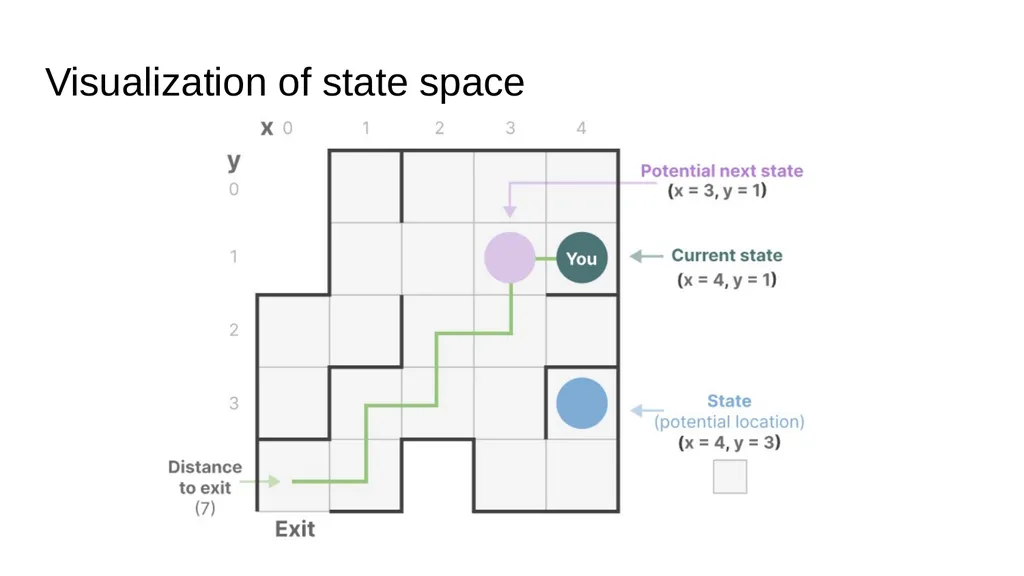
Visualization of state space<br>
11
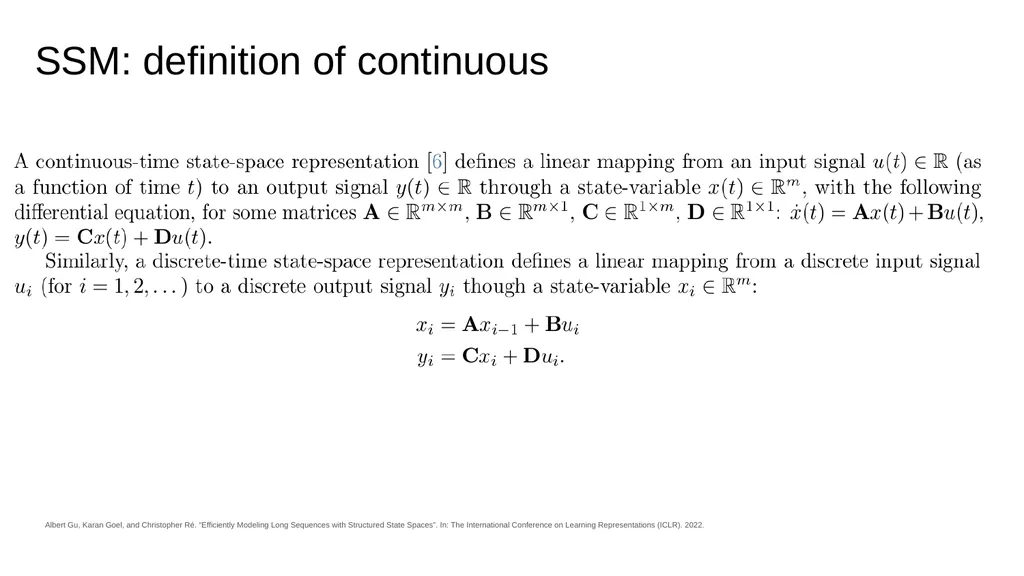
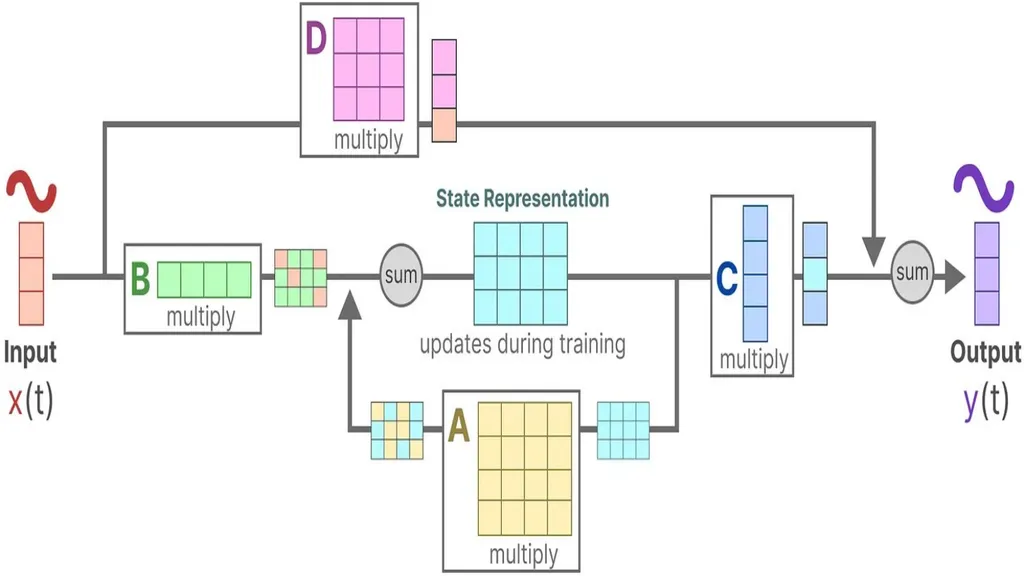
SSM: definition of continuous Albert Gu, Karan Goel, and Christopher Ré. “Efficiently Modeling Long Sequences with Structured State Spaces”. In: The International Conference on Learning Representations (ICLR). 2022.<br>
12
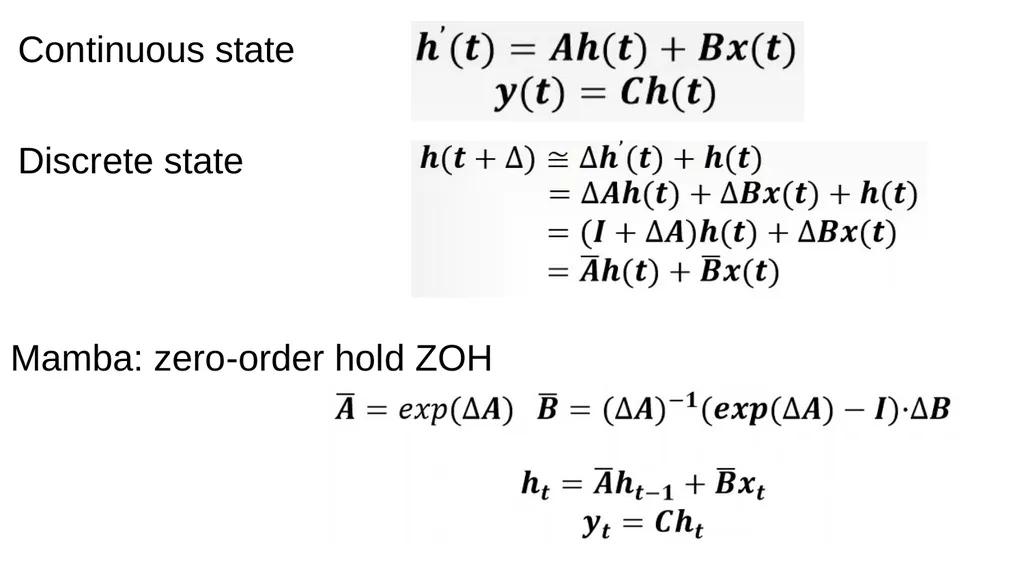
Continuous state Discrete state Mamba: zero-order hold ZOH<br>
13
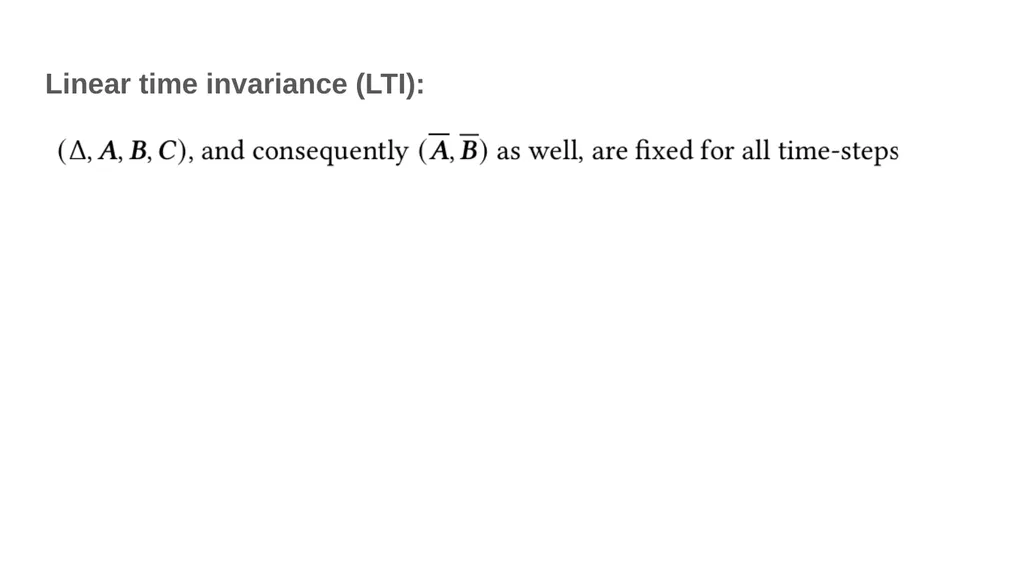
Linear time invariance (LTI):<br>
14
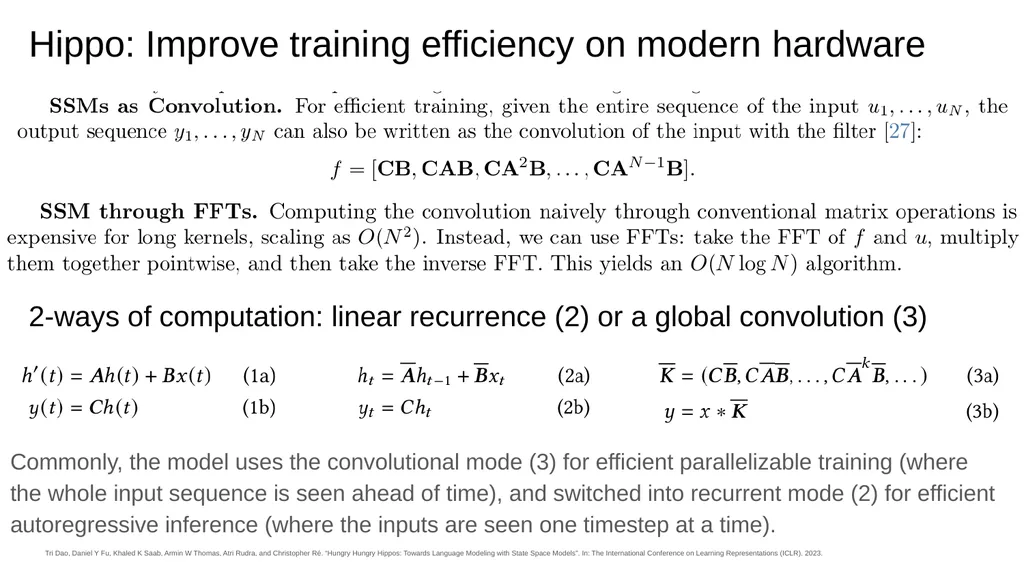
Hippo: Improve training efficiency on modern hardware Tri Dao, Daniel Y Fu, Khaled K Saab, Armin W Thomas, Atri Rudra, and Christopher Ré. “Hungry Hungry Hippos: Towards Language Modeling with State Space Models”. In: The International Conference on Learning Representations (ICLR). 2023. 2-ways of computation: linear recurrence (2) or a global convolution (3) Commonly, the model uses the convolutional mode (3) for efficient parallelizable training (where the whole input sequence is seen ahead of time), and switched into recurrent mode (2) for efficient autoregressive inference (where the inputs are seen one timestep at a time).<br>
15
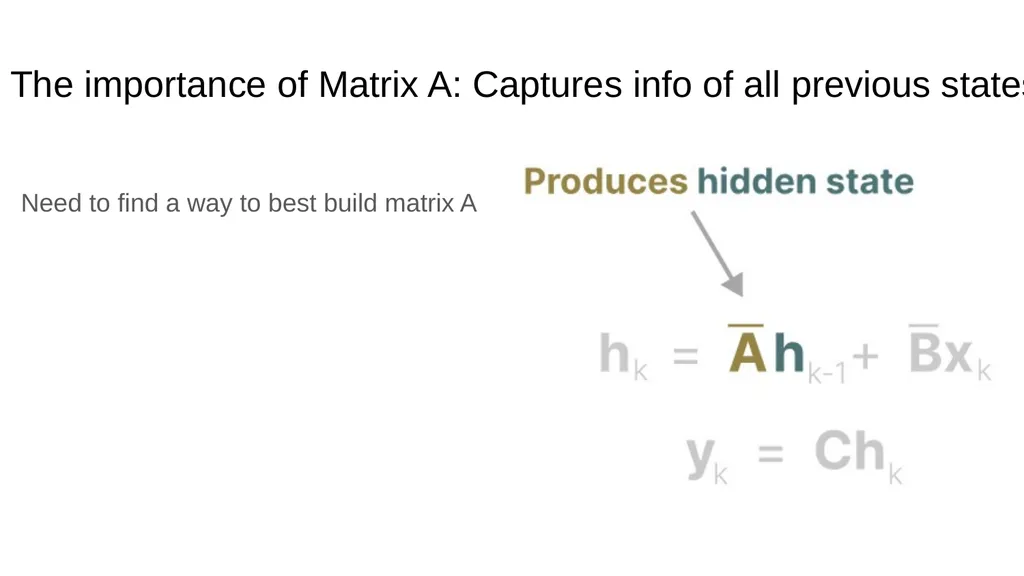
The importance of Matrix A: Captures info of all previous states Need to find a way to best build matrix A<br>
16
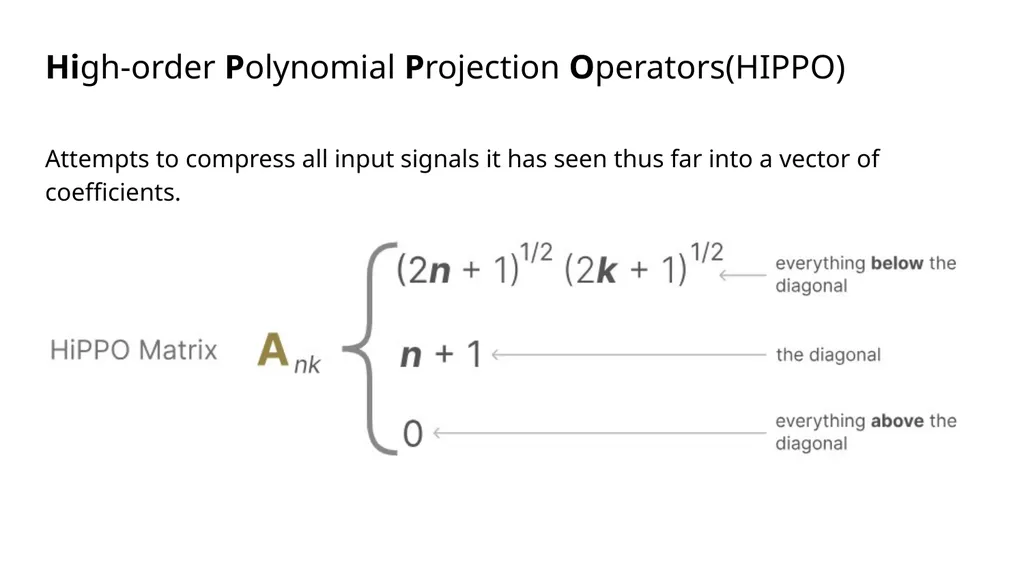
High-order Polynomial Projection Operators(HIPPO) Attempts to compress all input signals it has seen thus far into a vector of coefficients.<br>
17
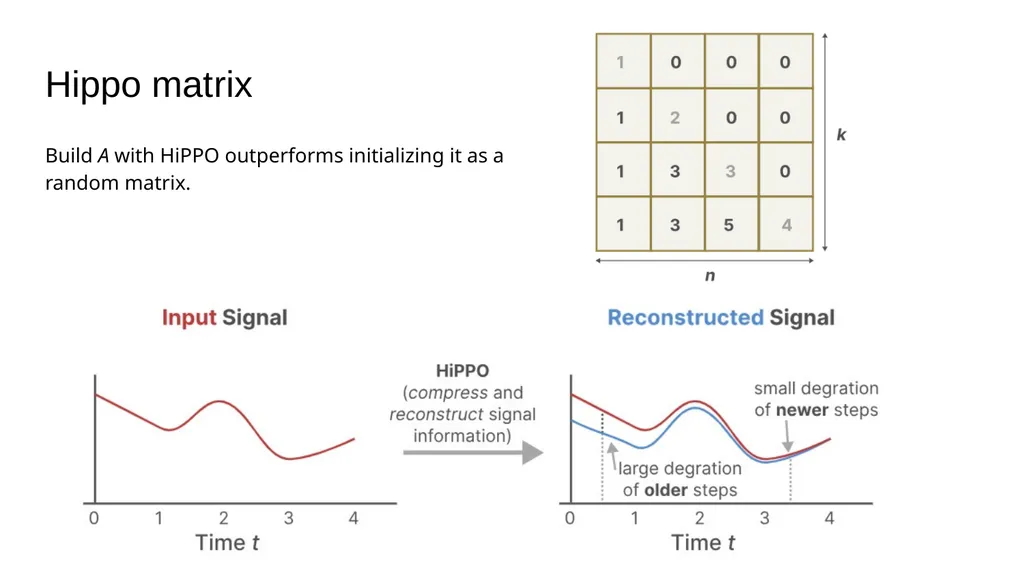
Hippo matrix Build A with HiPPO outperforms initializing it as a random matrix.<br>
18
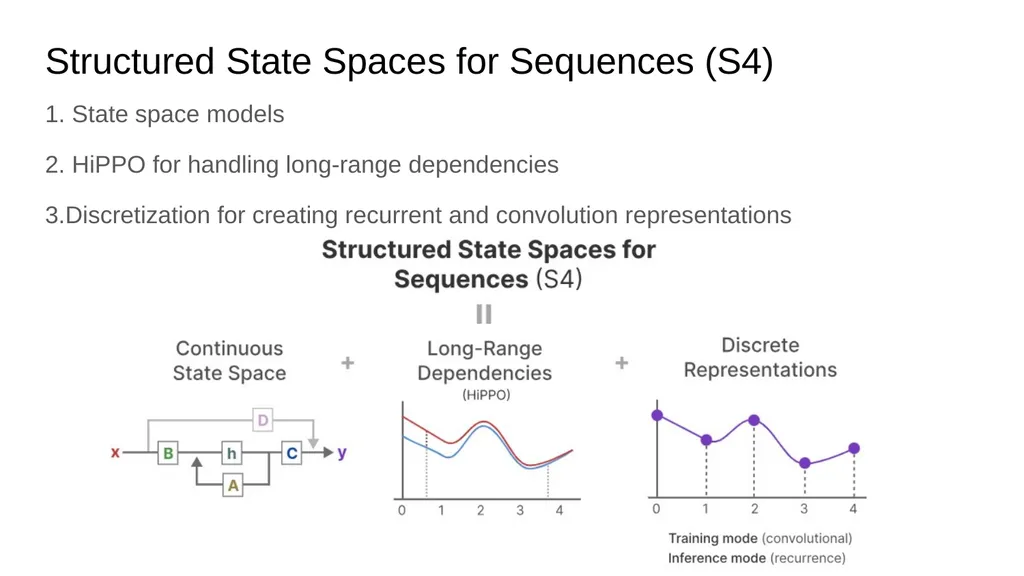
Structured State Spaces for Sequences (S4) 1. State space models
2. HiPPO for handling long-range dependencies
3.Discretization for creating recurrent and convolution representations<br>
2. HiPPO for handling long-range dependencies
3.Discretization for creating recurrent and convolution representations<br>
19
The background and motivation of the problem.
Existing work
Key ideas and design in the paper.
Evaluation methodology and experimental results.
Strengths and weaknesses, the purpose of design choices, the future directions based on the work.<br>
Existing work
Key ideas and design in the paper.
Evaluation methodology and experimental results.
Strengths and weaknesses, the purpose of design choices, the future directions based on the work.<br>
20
Mamba: A selective state space model Two key ideas:
Selective scan algorithm:
Allows model filter out non-trivial information
Hardware aware algorithm:
Allows efficient intermediate result storage.<br>
Allows model filter out non-trivial information
Hardware aware algorithm:
Allows efficient intermediate result storage.<br>
21
Problem of Structured state space model: Can’t focus or ignore certain tokens, thus perform badly on some task like selective copying and induction heads.
Induction heads: reproduce patterns found in the input.
Selective copying: copy certain parts of the input, and output them in order.<br>
Induction heads: reproduce patterns found in the input.
Selective copying: copy certain parts of the input, and output them in order.<br>
22
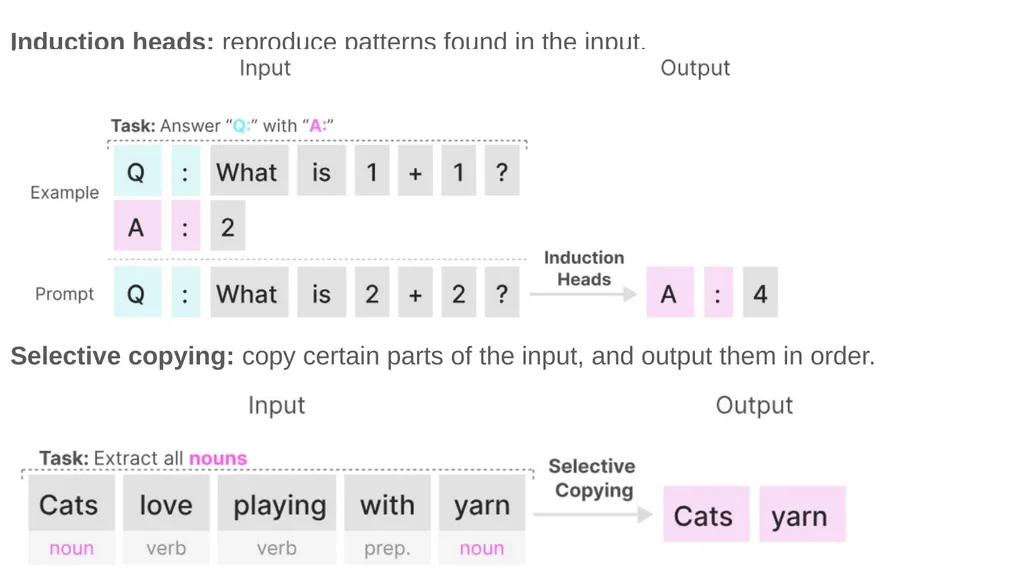
Induction heads: reproduce patterns found in the input.
Selective copying: copy certain parts of the input, and output them in order.<br>
Selective copying: copy certain parts of the input, and output them in order.<br>
23
Why? For selective copying, because the State space model is linear time invariant, which means it has the same A,B,C matrix for every token, so it treats each token equally.
For induction heads, SSMs are time(position) invariant, so it wouldn’t know which seen token to recall.<br>
For induction heads, SSMs are time(position) invariant, so it wouldn’t know which seen token to recall.<br>
24
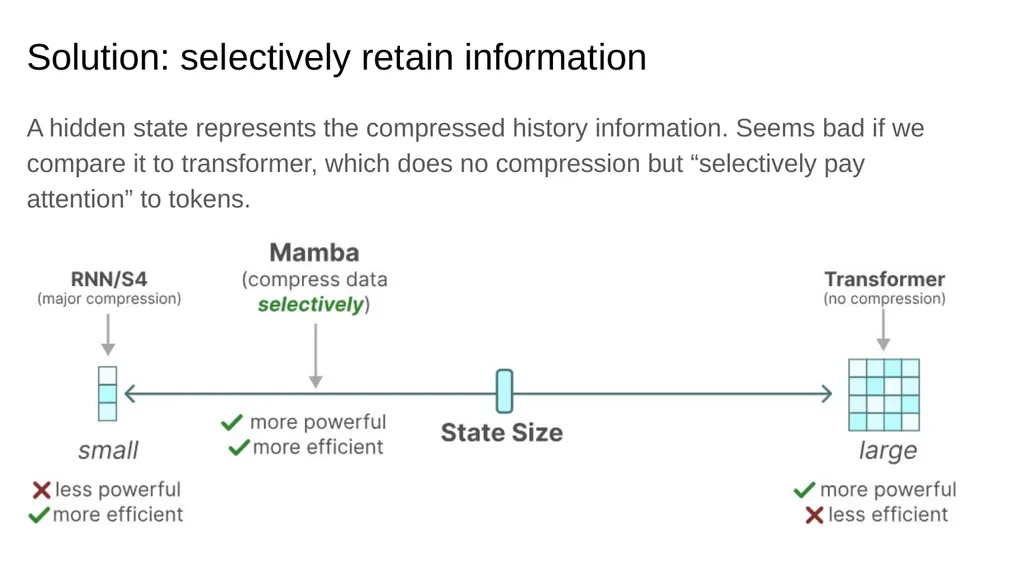
Solution: selectively retain information A hidden state represents the compressed history information. Seems bad if we compare it to transformer, which does no compression but “selectively pay attention” to tokens.<br>
25
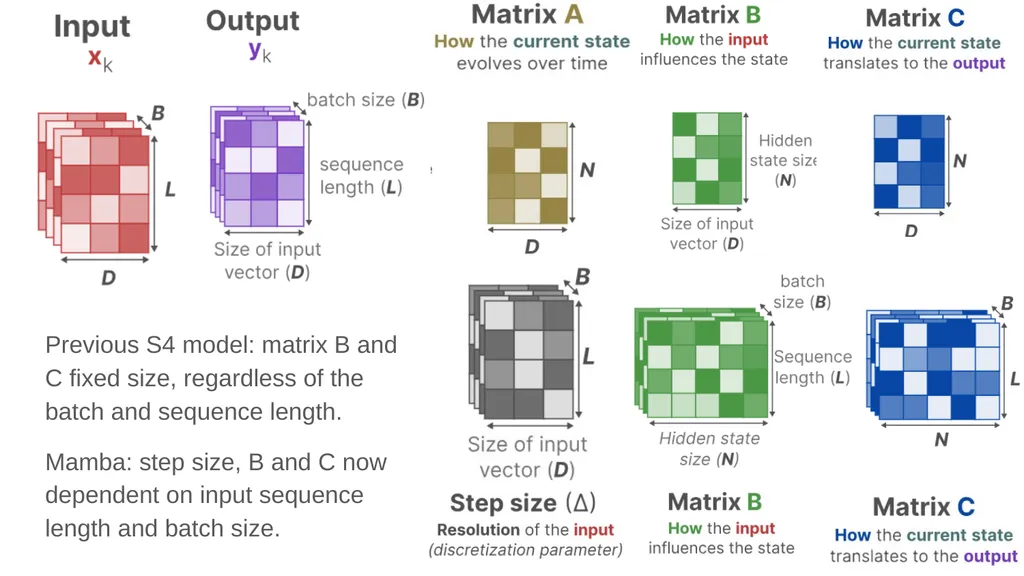
Previous S4 model: matrix B and C fixed size, regardless of the batch and sequence length.
Mamba: step size, B and C now dependent on input sequence length and batch size.<br>
Mamba: step size, B and C now dependent on input sequence length and batch size.<br>
26
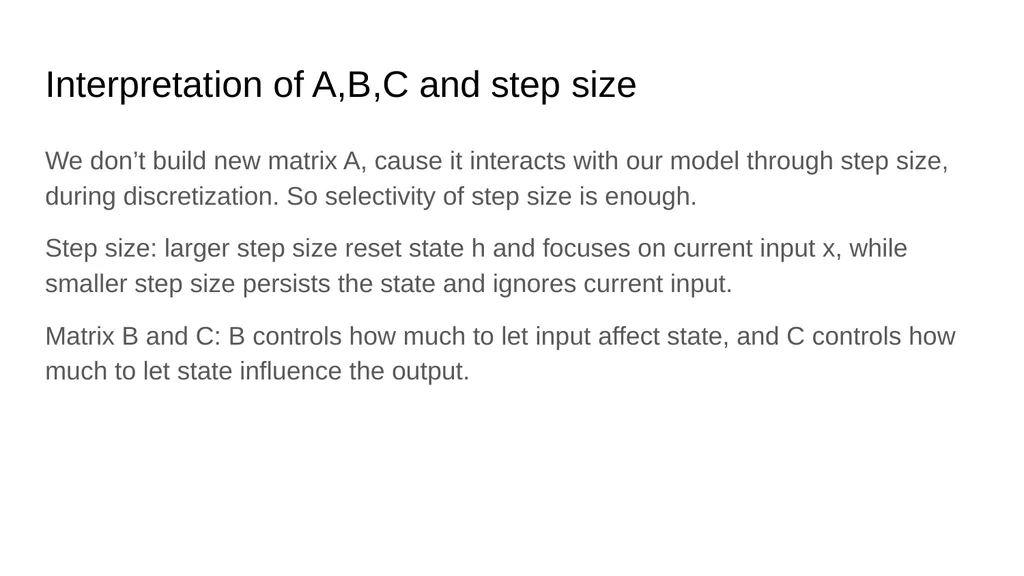
Interpretation of A,B,C and step size We don’t build new matrix A, cause it interacts with our model through step size, during discretization. So selectivity of step size is enough.
Step size: larger step size reset state h and focuses on current input x, while smaller step size persists the state and ignores current input.
Matrix B and C: B controls how much to let input affect state, and C controls how much to let state influence the output.<br>
Step size: larger step size reset state h and focuses on current input x, while smaller step size persists the state and ignores current input.
Matrix B and C: B controls how much to let input affect state, and C controls how much to let state influence the output.<br>
27
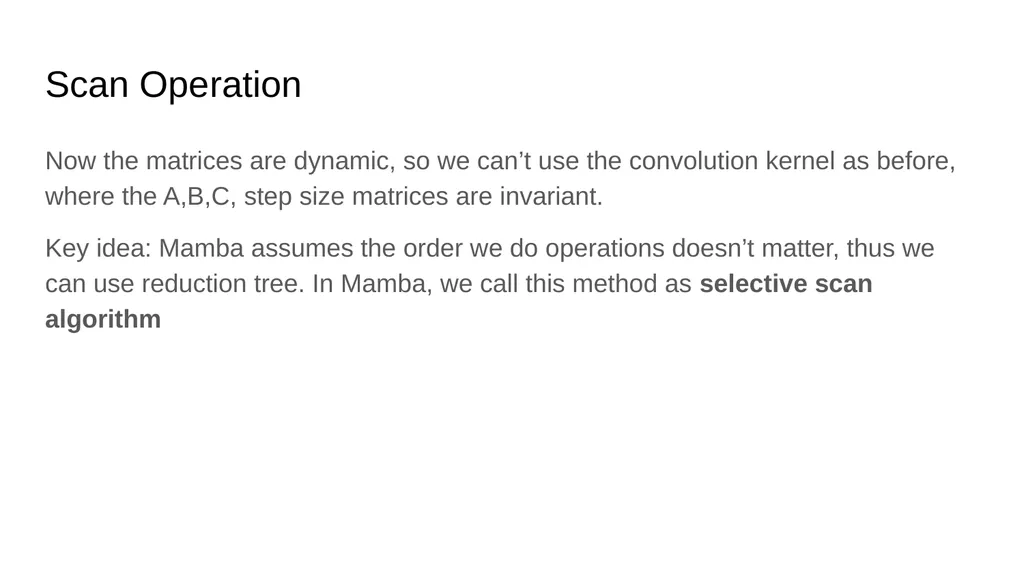
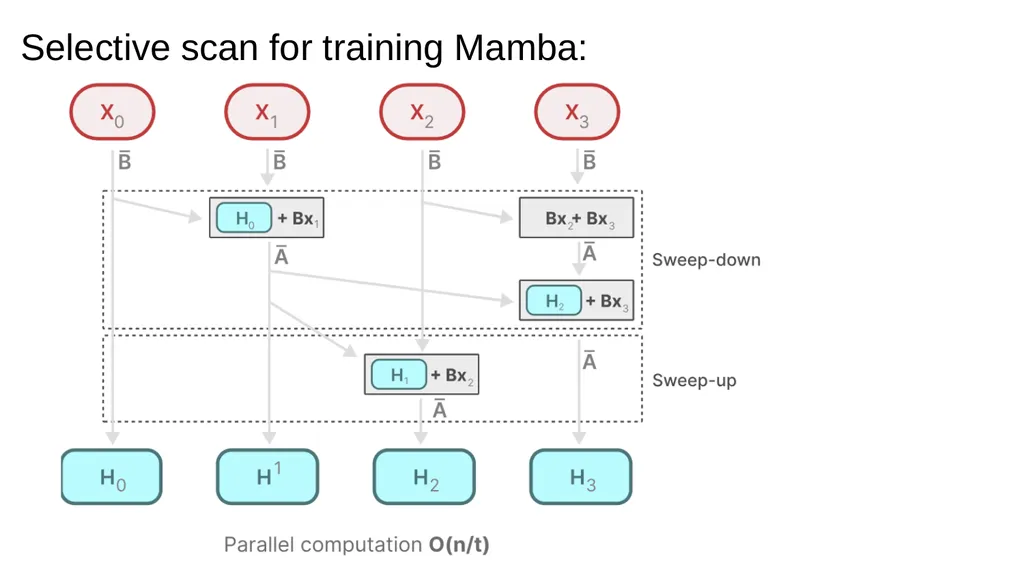
Scan Operation Now the matrices are dynamic, so we can’t use the convolution kernel as before, where the A,B,C, step size matrices are invariant.
Key idea: Mamba assumes the order we do operations doesn’t matter, thus we can use reduction tree. In Mamba, we call this method as selective scan algorithm<br>
Key idea: Mamba assumes the order we do operations doesn’t matter, thus we can use reduction tree. In Mamba, we call this method as selective scan algorithm<br>
28
Selective scan for training Mamba:<br>
29
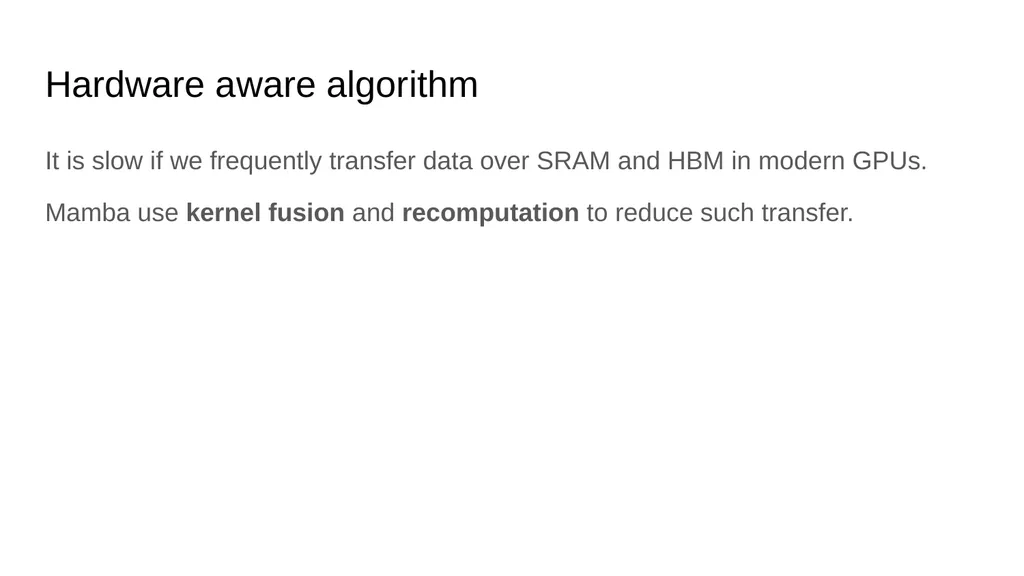
Hardware aware algorithm It is slow if we frequently transfer data over SRAM and HBM in modern GPUs.
Mamba use kernel fusion and recomputation to reduce such transfer.<br>
Mamba use kernel fusion and recomputation to reduce such transfer.<br>
30
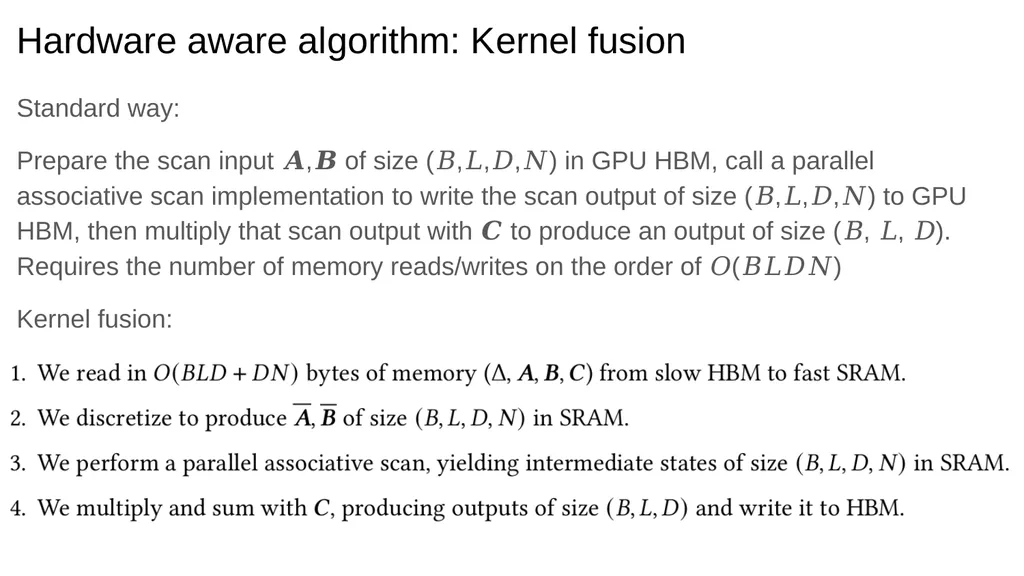
Hardware aware algorithm: Kernel fusion Standard way:
Prepare the scan input 𝑨,𝑩 of size (𝐵,𝐿,𝐷,𝑁) in GPU HBM, call a parallel associative scan implementation to write the scan output of size (𝐵,𝐿,𝐷,𝑁) to GPU HBM, then multiply that scan output with 𝑪 to produce an output of size (𝐵, 𝐿, 𝐷). Requires the number of memory reads/writes on the order of 𝑂(𝐵𝐿𝐷𝑁)
Kernel fusion:<br>
Prepare the scan input 𝑨,𝑩 of size (𝐵,𝐿,𝐷,𝑁) in GPU HBM, call a parallel associative scan implementation to write the scan output of size (𝐵,𝐿,𝐷,𝑁) to GPU HBM, then multiply that scan output with 𝑪 to produce an output of size (𝐵, 𝐿, 𝐷). Requires the number of memory reads/writes on the order of 𝑂(𝐵𝐿𝐷𝑁)
Kernel fusion:<br>
31
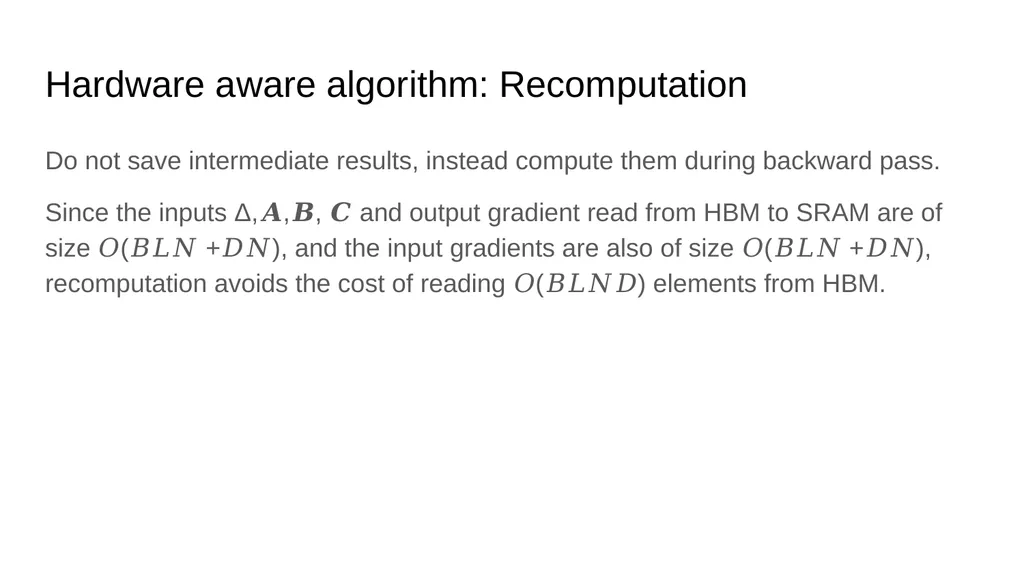
Hardware aware algorithm: Recomputation Do not save intermediate results, instead compute them during backward pass.
Since the inputs Δ,𝑨,𝑩, 𝑪 and output gradient read from HBM to SRAM are of size 𝑂(𝐵𝐿𝑁 +𝐷𝑁), and the input gradients are also of size 𝑂(𝐵𝐿𝑁 +𝐷𝑁), recomputation avoids the cost of reading 𝑂(𝐵𝐿𝑁𝐷) elements from HBM.<br>
Since the inputs Δ,𝑨,𝑩, 𝑪 and output gradient read from HBM to SRAM are of size 𝑂(𝐵𝐿𝑁 +𝐷𝑁), and the input gradients are also of size 𝑂(𝐵𝐿𝑁 +𝐷𝑁), recomputation avoids the cost of reading 𝑂(𝐵𝐿𝑁𝐷) elements from HBM.<br>
32
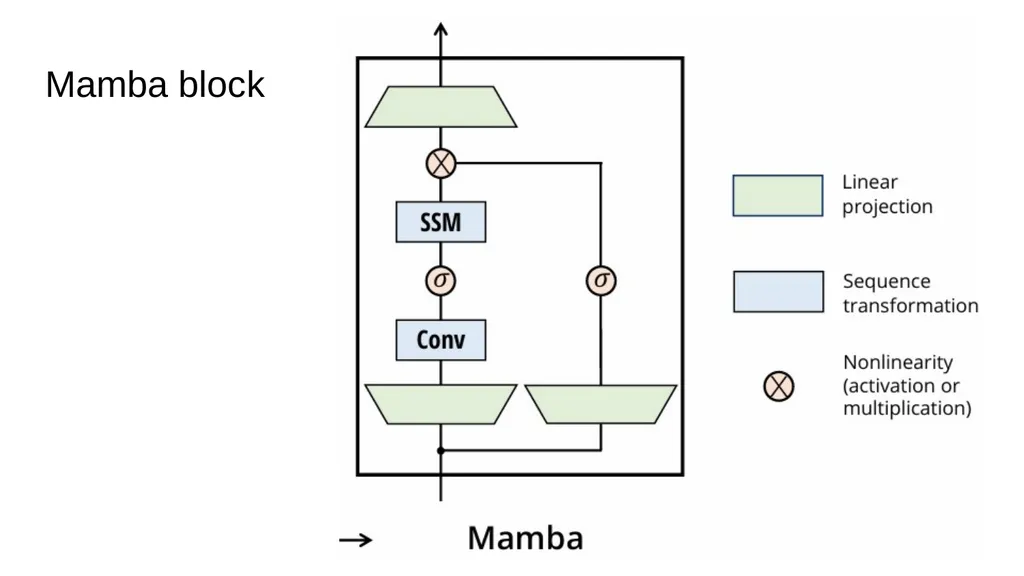
Mamba block<br>
33
The background and motivation of the problem.
Existing work
Key ideas and design in the paper.
Evaluation methodology and experimental results.
Strengths and weaknesses, the purpose of design choices, the future directions based on the work.<br>
Existing work
Key ideas and design in the paper.
Evaluation methodology and experimental results.
Strengths and weaknesses, the purpose of design choices, the future directions based on the work.<br>
34
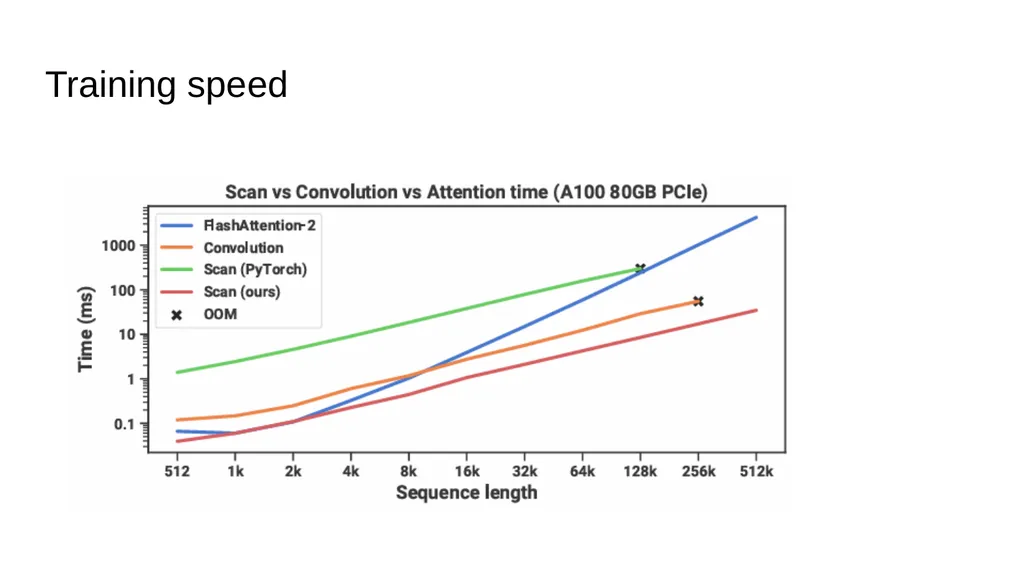
Training speed<br>
35
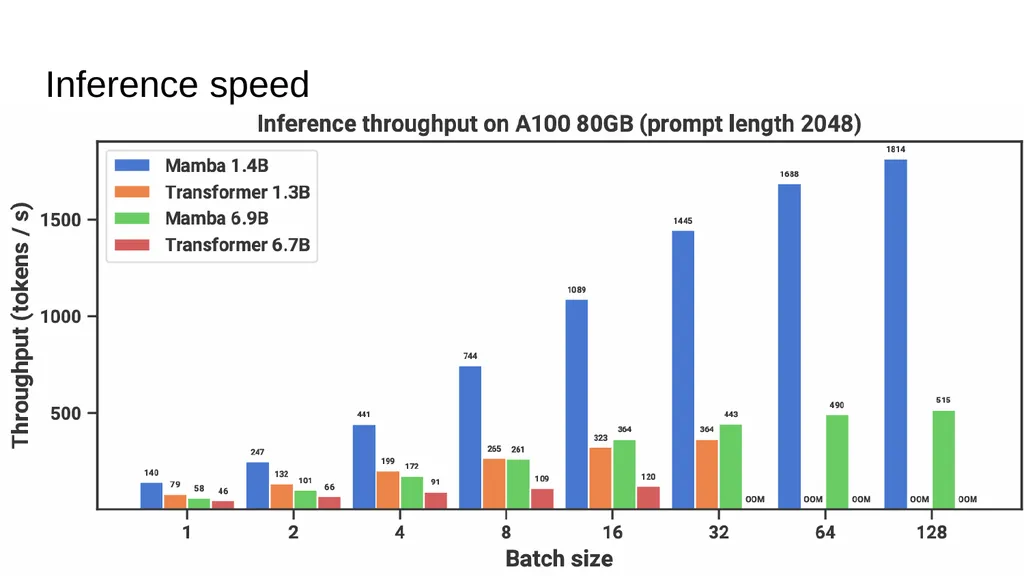
Inference speed<br>
36
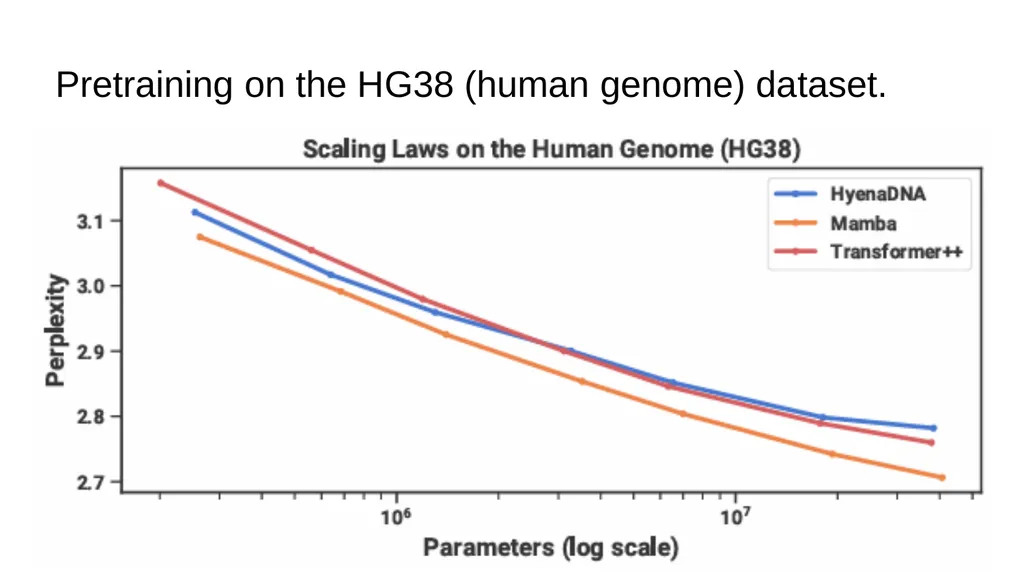
Pretraining on the HG38 (human genome) dataset.<br>
37
Comparison with other models on some downstream zero-shot evaluation tasks<br>
38
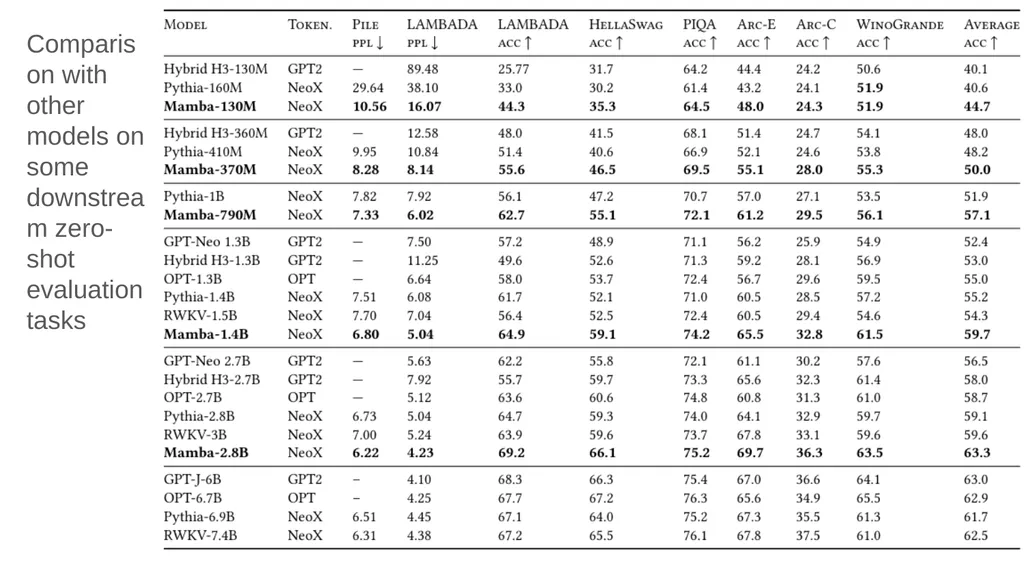
Comparison with other models on some downstream zero-shot evaluation tasks<br>
39
The background and motivation of the problem.
Existing work
Key ideas and design in the paper.
Evaluation methodology and experimental results.
Strengths and weaknesses, the purpose of design choices, the future directions based on the work.<br>
Existing work
Key ideas and design in the paper.
Evaluation methodology and experimental results.
Strengths and weaknesses, the purpose of design choices, the future directions based on the work.<br>
40
Advantages of Mamba over Transformer
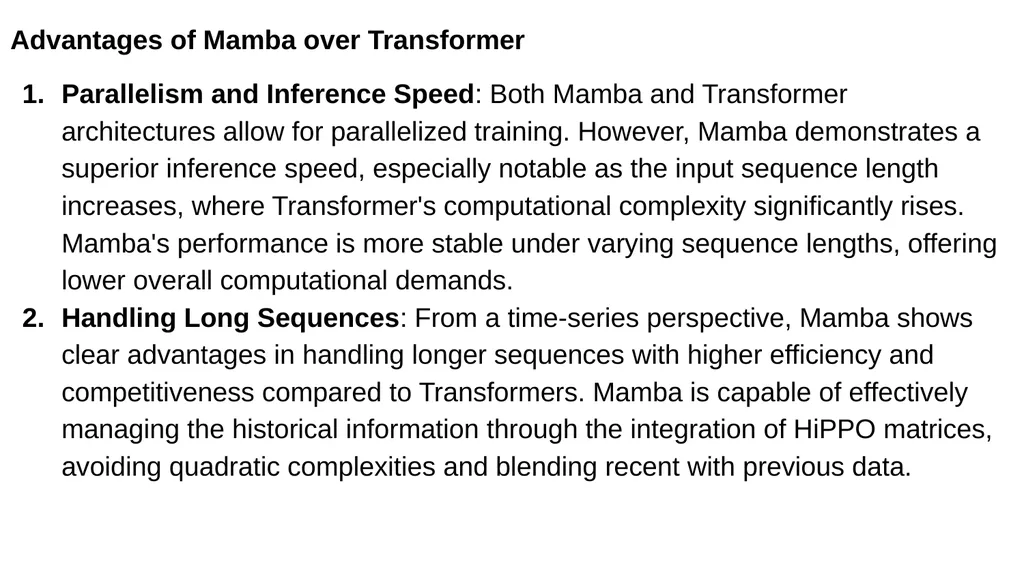
Parallelism and Inference Speed: Both Mamba and Transformer architectures allow for parallelized training. However, Mamba demonstrates a superior inference speed, especially notable as the input sequence length increases, where Transformer's computational complexity significantly rises. Mamba's performance is more stable under varying sequence lengths, offering lower overall computational demands.
Handling Long Sequences: From a time-series perspective, Mamba shows clear advantages in handling longer sequences with higher efficiency and competitiveness compared to Transformers. Mamba is capable of effectively managing the historical information through the integration of HiPPO matrices, avoiding quadratic complexities and blending recent with previous data.<br>
Parallelism and Inference Speed: Both Mamba and Transformer architectures allow for parallelized training. However, Mamba demonstrates a superior inference speed, especially notable as the input sequence length increases, where Transformer's computational complexity significantly rises. Mamba's performance is more stable under varying sequence lengths, offering lower overall computational demands.
Handling Long Sequences: From a time-series perspective, Mamba shows clear advantages in handling longer sequences with higher efficiency and competitiveness compared to Transformers. Mamba is capable of effectively managing the historical information through the integration of HiPPO matrices, avoiding quadratic complexities and blending recent with previous data.<br>
41
Advantages of Mamba over Transformer
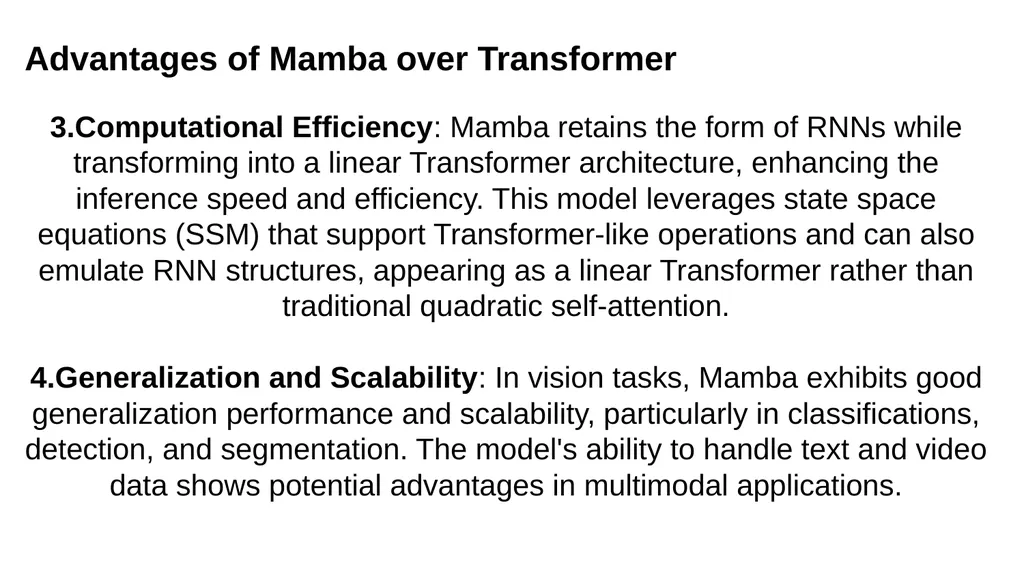
3.Computational Efficiency: Mamba retains the form of RNNs while transforming into a linear Transformer architecture, enhancing the inference speed and efficiency. This model leverages state space equations (SSM) that support Transformer-like operations and can also emulate RNN structures, appearing as a linear Transformer rather than traditional quadratic self-attention.
4.Generalization and Scalability: In vision tasks, Mamba exhibits good generalization performance and scalability, particularly in classifications, detection, and segmentation. The model's ability to handle text and video data shows potential advantages in multimodal applications.<br>
3.Computational Efficiency: Mamba retains the form of RNNs while transforming into a linear Transformer architecture, enhancing the inference speed and efficiency. This model leverages state space equations (SSM) that support Transformer-like operations and can also emulate RNN structures, appearing as a linear Transformer rather than traditional quadratic self-attention.
4.Generalization and Scalability: In vision tasks, Mamba exhibits good generalization performance and scalability, particularly in classifications, detection, and segmentation. The model's ability to handle text and video data shows potential advantages in multimodal applications.<br>
42
imitations of Mamba Compared to Transformer
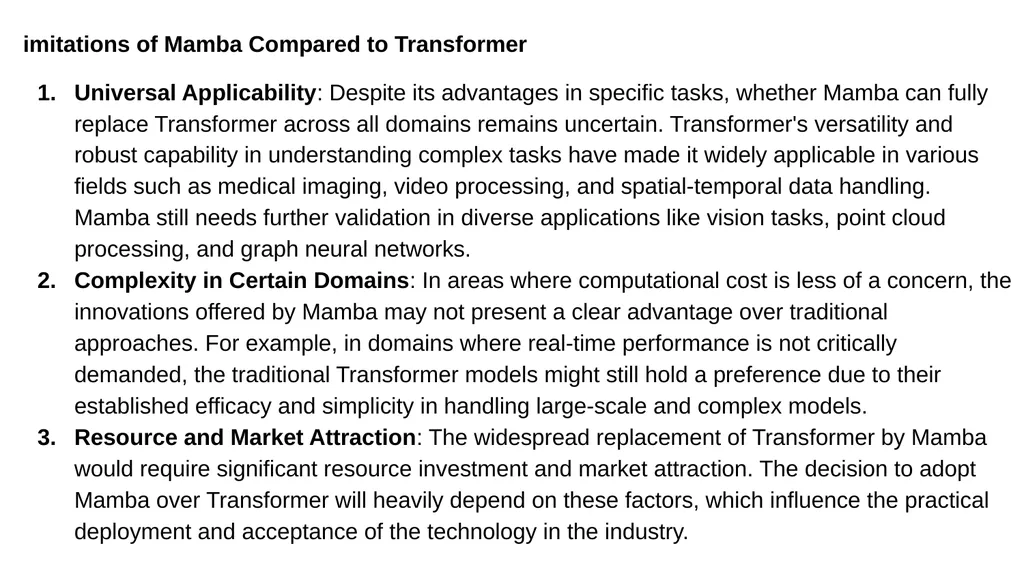
Universal Applicability: Despite its advantages in specific tasks, whether Mamba can fully replace Transformer across all domains remains uncertain. Transformer's versatility and robust capability in understanding complex tasks have made it widely applicable in various fields such as medical imaging, video processing, and spatial-temporal data handling. Mamba still needs further validation in diverse applications like vision tasks, point cloud processing, and graph neural networks.
Complexity in Certain Domains: In areas where computational cost is less of a concern, the innovations offered by Mamba may not present a clear advantage over traditional approaches. For example, in domains where real-time performance is not critically demanded, the traditional Transformer models might still hold a preference due to their established efficacy and simplicity in handling large-scale and complex models.
Resource and Market Attraction: The widespread replacement of Transformer by Mamba would require significant resource investment and market attraction. The decision to adopt Mamba over Transformer will heavily depend on these factors, which influence the practical deployment and acceptance of the technology in the industry.<br>
Universal Applicability: Despite its advantages in specific tasks, whether Mamba can fully replace Transformer across all domains remains uncertain. Transformer's versatility and robust capability in understanding complex tasks have made it widely applicable in various fields such as medical imaging, video processing, and spatial-temporal data handling. Mamba still needs further validation in diverse applications like vision tasks, point cloud processing, and graph neural networks.
Complexity in Certain Domains: In areas where computational cost is less of a concern, the innovations offered by Mamba may not present a clear advantage over traditional approaches. For example, in domains where real-time performance is not critically demanded, the traditional Transformer models might still hold a preference due to their established efficacy and simplicity in handling large-scale and complex models.
Resource and Market Attraction: The widespread replacement of Transformer by Mamba would require significant resource investment and market attraction. The decision to adopt Mamba over Transformer will heavily depend on these factors, which influence the practical deployment and acceptance of the technology in the industry.<br>
43
Future directions: Test mamba on larger dataset, with larger parameters.
Optimize its computation from math and program aspect.<br>
Optimize its computation from math and program aspect.<br>