
Management Practices in Responsible Organisations
LV
Published · 26 slides · 0 views
1 / 1

Description
Management Practices in Responsible Organisations Topic 11 tutorial workshop While you are waiting for us to start: To think about while you wait: Do you think there is an international dimension to how your organisation will solve your
Related Topics
Share
Embed code
Download this presentation From Below
"Management Practices in Responsible Organisations" is the property of its rightful owner. Permission is granted to download and print the materials on this website for personal, non-commercial use only, and to display it on your personal computer provided you do not modify the materials and that you retain all copyright notices contained in the materials. By downloading content from our website, you accept the terms of this agreement.
Presentation Transcript
01
Management Practices in Responsible Organisations
Topic 11 tutorial workshop While you are waiting for us to start:
To think about while you wait: Do you think there is an international dimension to how your organisation will solve your issue?
Make sure you have:
Your answers to the Week 11 tasks
Some kind of note taking tool
Some kind of timekeeping device.<br>
To think about while you wait: Do you think there is an international dimension to how your organisation will solve your issue?
Make sure you have:
Your answers to the Week 11 tasks
Some kind of note taking tool
Some kind of timekeeping device.<br>
02
Learning Outcomes At the end of this topic you will be able to:
Analyze the glocal (global and local) environments for responsible business.
Manage responsibly in an intercultural context.
Understand the complex systemic nature of supply and demand networks.
Take some notes on what these mean to you and reflect on your thoughts as we work through this session<br>
Analyze the glocal (global and local) environments for responsible business.
Manage responsibly in an intercultural context.
Understand the complex systemic nature of supply and demand networks.
Take some notes on what these mean to you and reflect on your thoughts as we work through this session<br>
03
Agenda and timing for today Welcome and overview (10 mins)
Create the space for learning and connection (10 mins)
Overview of Topic 11 (30 mins)
Small group discussion around a Week 11 issue #1(15 mins)
Large group review of key questions and insights (10 mins)
Small group discussion around Week 11 issue #2 (15 mins)
Large group review of key questions and insights (10 mins)
Taking learning forward to the exam and check out (10 mins)<br>
Create the space for learning and connection (10 mins)
Overview of Topic 11 (30 mins)
Small group discussion around a Week 11 issue #1(15 mins)
Large group review of key questions and insights (10 mins)
Small group discussion around Week 11 issue #2 (15 mins)
Large group review of key questions and insights (10 mins)
Taking learning forward to the exam and check out (10 mins)<br>
04
Rules of engagement You will get the most out of session through stretch / contribution /taking on challenges = invitation
Trust the process - stay curious to see what emerges
Encourage, listen to and respect diverse voices = real humans
You need to make the connection back to your practice (potential or actual)
Safe space for learning for all, not performing
When it’s over, it’s over - every minute counts
Put yourself in best position to give your full attention<br>
Trust the process - stay curious to see what emerges
Encourage, listen to and respect diverse voices = real humans
You need to make the connection back to your practice (potential or actual)
Safe space for learning for all, not performing
When it’s over, it’s over - every minute counts
Put yourself in best position to give your full attention<br>
05
Setting the space for learning You will be in groups of 4 working together (unless we have uneven numbers).
Make a note of the breakout room you are in for today in case you drop out of the connection for some reason!
Thinking circle #1 (choose a timekeeper)
Choose who will go first and set a timer (1.5 mins)
Introduce yourself with your name and your issue. What would be an international dimension to how your organisation will solve your issue?
Return to the main group (you will be returned automatically when the time runs out)<br>
Make a note of the breakout room you are in for today in case you drop out of the connection for some reason!
Thinking circle #1 (choose a timekeeper)
Choose who will go first and set a timer (1.5 mins)
Introduce yourself with your name and your issue. What would be an international dimension to how your organisation will solve your issue?
Return to the main group (you will be returned automatically when the time runs out)<br>
06
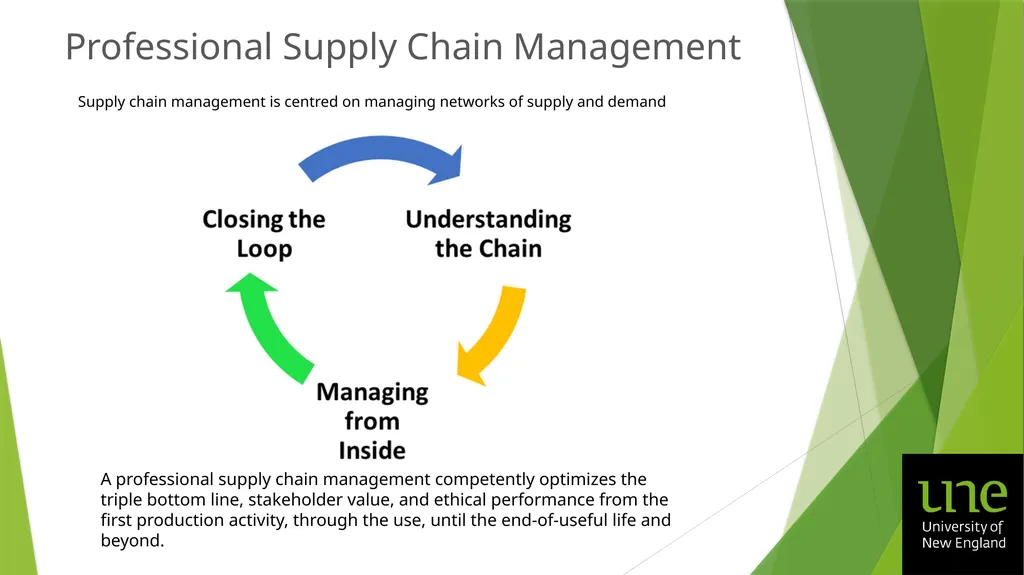
Professional Supply Chain Management A professional supply chain management competently optimizes the triple bottom line, stakeholder value, and ethical performance from the first production activity, through the use, until the end-of-useful life and beyond. Supply chain management is centred on managing networks of supply and demand<br>
07
3 Tasks of professional supply chain management Ethics: minimize the number of ethical issues and misconduct throughout supply network.
Responsibility: create value for and with supply chain partners and stakeholders.
Sustainability: optimizes triple bottom line across suppliers, clients, and users.<br>
Responsibility: create value for and with supply chain partners and stakeholders.
Sustainability: optimizes triple bottom line across suppliers, clients, and users.<br>
08
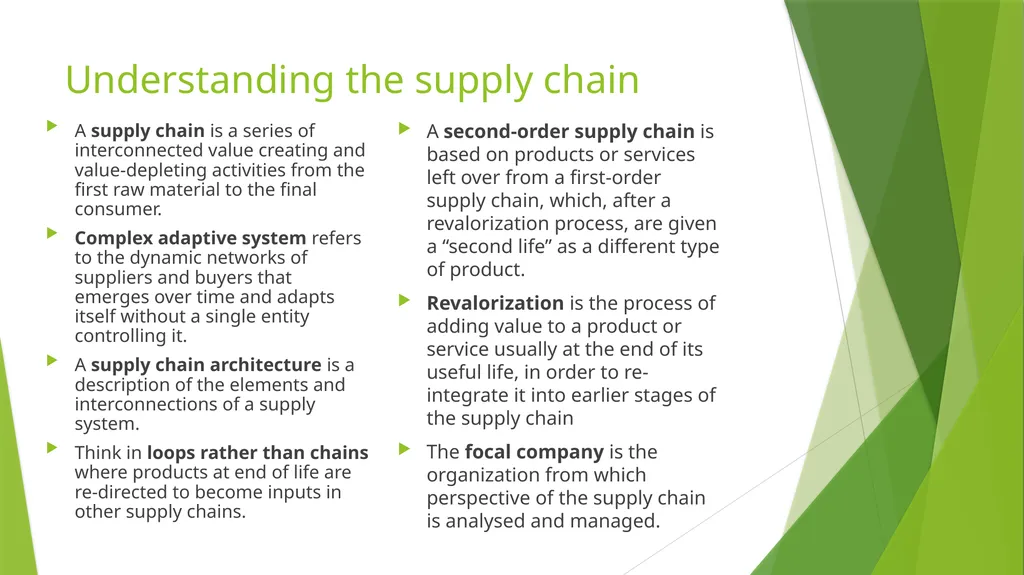
Understanding the supply chain A supply chain is a series of interconnected value creating and value-depleting activities from the first raw material to the final consumer.
Complex adaptive system refers to the dynamic networks of suppliers and buyers that emerges over time and adapts itself without a single entity controlling it.
A supply chain architecture is a description of the elements and interconnections of a supply system.
Think in loops rather than chains where products at end of life are re-directed to become inputs in other supply chains. A second-order supply chain is based on products or services left over from a first-order supply chain, which, after a revalorization process, are given a “second life” as a different type of product.
Revalorization is the process of adding value to a product or service usually at the end of its useful life, in order to re-integrate it into earlier stages of the supply chain
The focal company is the organization from which perspective of the supply chain is analysed and managed.<br>
Complex adaptive system refers to the dynamic networks of suppliers and buyers that emerges over time and adapts itself without a single entity controlling it.
A supply chain architecture is a description of the elements and interconnections of a supply system.
Think in loops rather than chains where products at end of life are re-directed to become inputs in other supply chains. A second-order supply chain is based on products or services left over from a first-order supply chain, which, after a revalorization process, are given a “second life” as a different type of product.
Revalorization is the process of adding value to a product or service usually at the end of its useful life, in order to re-integrate it into earlier stages of the supply chain
The focal company is the organization from which perspective of the supply chain is analysed and managed.<br>
09
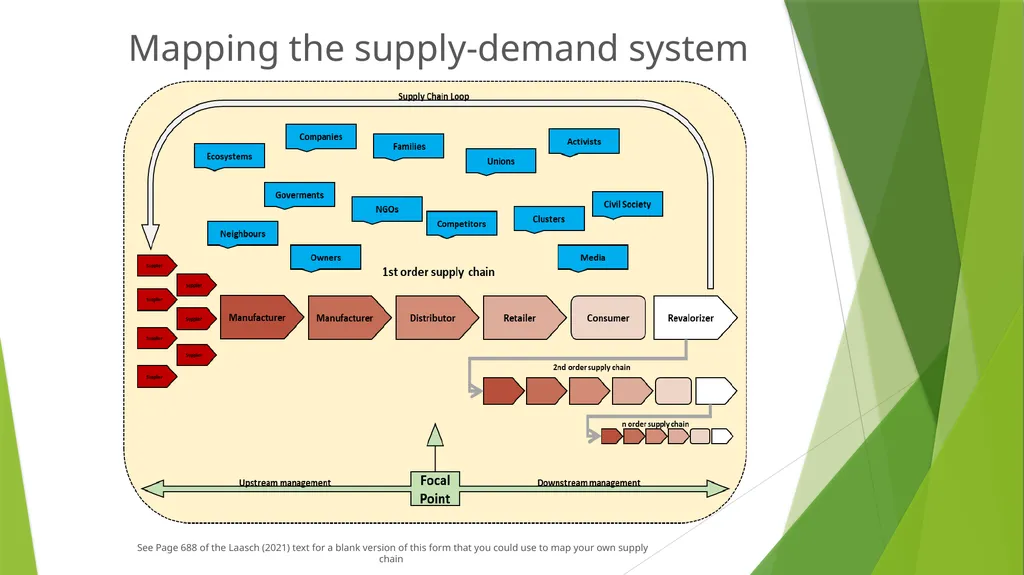
Mapping the supply-demand system See Page 688 of the Laasch (2021) text for a blank version of this form that you could use to map your own supply chain<br>
10
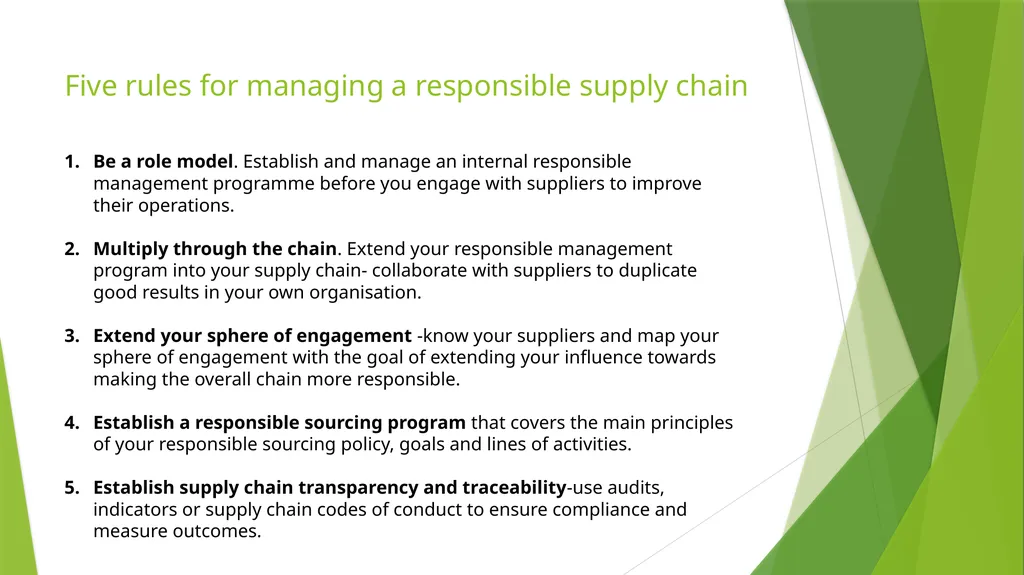
Five rules for managing a responsible supply chain Be a role model. Establish and manage an internal responsible management programme before you engage with suppliers to improve their operations.
Multiply through the chain. Extend your responsible management program into your supply chain- collaborate with suppliers to duplicate good results in your own organisation.
Extend your sphere of engagement -know your suppliers and map your sphere of engagement with the goal of extending your influence towards making the overall chain more responsible.
Establish a responsible sourcing program that covers the main principles of your responsible sourcing policy, goals and lines of activities.
Establish supply chain transparency and traceability-use audits, indicators or supply chain codes of conduct to ensure compliance and measure outcomes.<br>
Multiply through the chain. Extend your responsible management program into your supply chain- collaborate with suppliers to duplicate good results in your own organisation.
Extend your sphere of engagement -know your suppliers and map your sphere of engagement with the goal of extending your influence towards making the overall chain more responsible.
Establish a responsible sourcing program that covers the main principles of your responsible sourcing policy, goals and lines of activities.
Establish supply chain transparency and traceability-use audits, indicators or supply chain codes of conduct to ensure compliance and measure outcomes.<br>
11
Glocalising Glocalising is a mode of management that integrates global and local issues and solutions.<br>
12
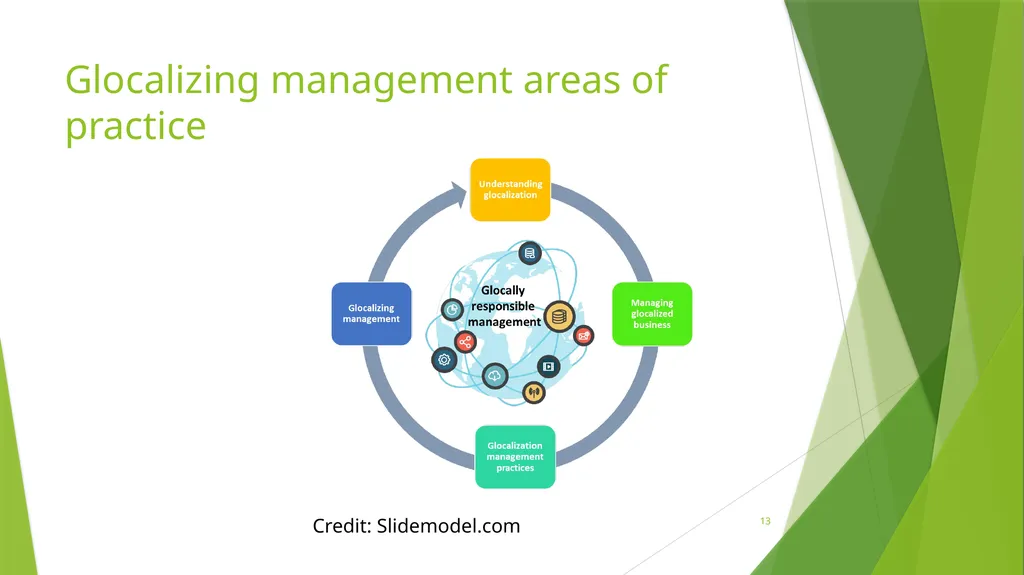
Glocalizing management areas of practice 13 Credit: Slidemodel.com<br>
13
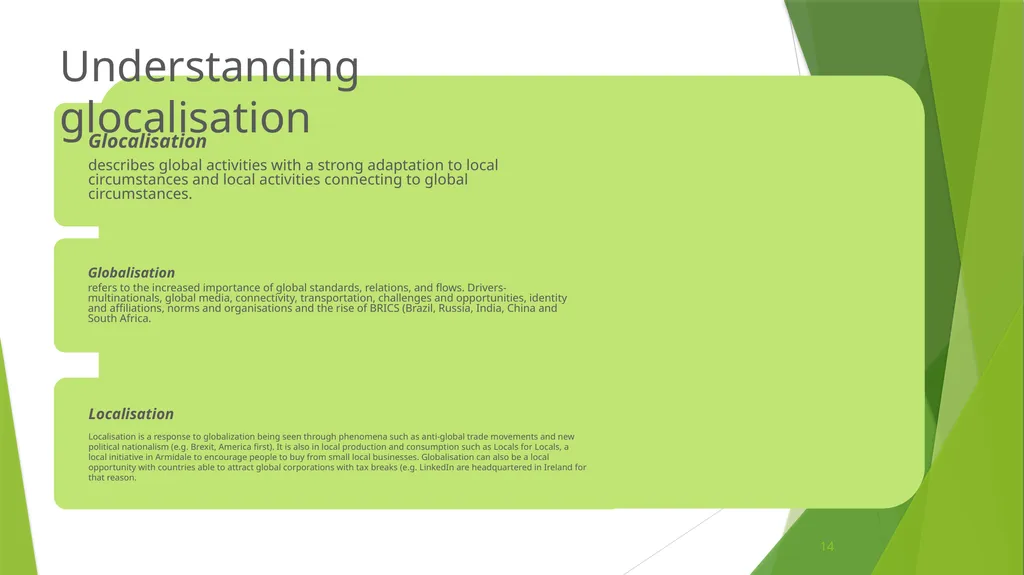
Glocalisation
describes global activities with a strong adaptation to local circumstances and local activities connecting to global circumstances. 14 Globalisation
refers to the increased importance of global standards, relations, and flows. Drivers- multinationals, global media, connectivity, transportation, challenges and opportunities, identity and affiliations, norms and organisations and the rise of BRICS (Brazil, Russia, India, China and South Africa. Understanding glocalisation Localisation
Localisation is a response to globalization being seen through phenomena such as anti-global trade movements and new political nationalism (e.g. Brexit, America first). It is also in local production and consumption such as Locals for Locals, a local initiative in Armidale to encourage people to buy from small local businesses. Globalisation can also be a local opportunity with countries able to attract global corporations with tax breaks (e.g. LinkedIn are headquartered in Ireland for that reason.<br>
describes global activities with a strong adaptation to local circumstances and local activities connecting to global circumstances. 14 Globalisation
refers to the increased importance of global standards, relations, and flows. Drivers- multinationals, global media, connectivity, transportation, challenges and opportunities, identity and affiliations, norms and organisations and the rise of BRICS (Brazil, Russia, India, China and South Africa. Understanding glocalisation Localisation
Localisation is a response to globalization being seen through phenomena such as anti-global trade movements and new political nationalism (e.g. Brexit, America first). It is also in local production and consumption such as Locals for Locals, a local initiative in Armidale to encourage people to buy from small local businesses. Globalisation can also be a local opportunity with countries able to attract global corporations with tax breaks (e.g. LinkedIn are headquartered in Ireland for that reason.<br>
14
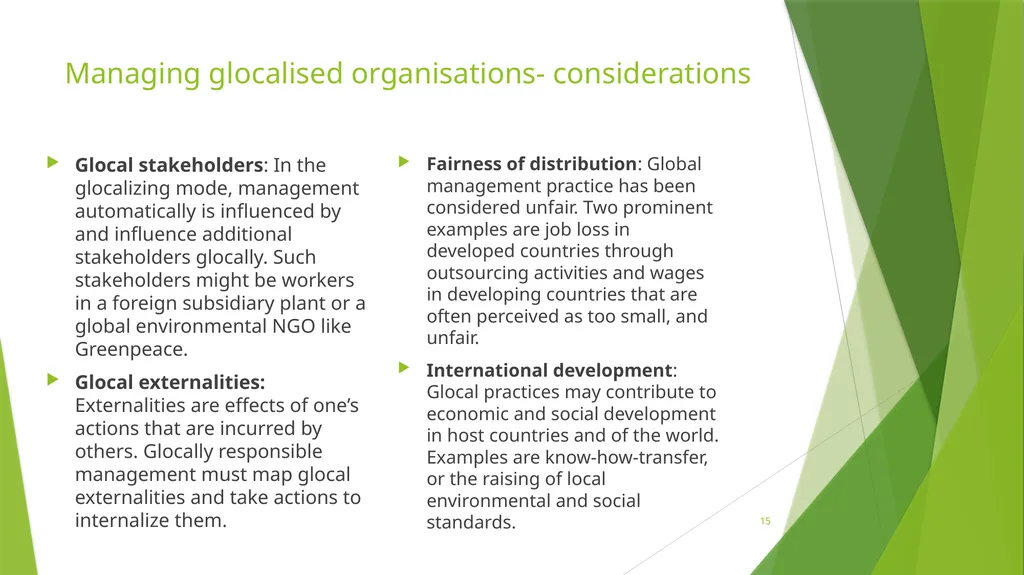
Managing glocalised organisations- considerations Glocal stakeholders: In the glocalizing mode, management automatically is influenced by and influence additional stakeholders glocally. Such stakeholders might be workers in a foreign subsidiary plant or a global environmental NGO like Greenpeace.
Glocal externalities: Externalities are effects of one’s actions that are incurred by others. Glocally responsible management must map glocal externalities and take actions to internalize them. 15 Fairness of distribution: Global management practice has been considered unfair. Two prominent examples are job loss in developed countries through outsourcing activities and wages in developing countries that are often perceived as too small, and unfair.
International development: Glocal practices may contribute to economic and social development in host countries and of the world. Examples are know-how-transfer, or the raising of local environmental and social standards.<br>
Glocal externalities: Externalities are effects of one’s actions that are incurred by others. Glocally responsible management must map glocal externalities and take actions to internalize them. 15 Fairness of distribution: Global management practice has been considered unfair. Two prominent examples are job loss in developed countries through outsourcing activities and wages in developing countries that are often perceived as too small, and unfair.
International development: Glocal practices may contribute to economic and social development in host countries and of the world. Examples are know-how-transfer, or the raising of local environmental and social standards.<br>
15
Localising responsible business Strictly speaking, there is no such thing as a “global business”.
All businesses operating outside the domestic borders operate in foreign countries, not on a superior “global” level.
Business strategies for responsible business are crafted from the perspective of a global business interacting with many countries at the same time.
However, the operations of such global business are locally “on the ground” in many different locations throughout different regions, countries, and locations.
A glocally responsible business must be able to adopt responsible business and management to local conditions, including culture, systems, standards and resulting local issues, challenges and opportunities.<br>
All businesses operating outside the domestic borders operate in foreign countries, not on a superior “global” level.
Business strategies for responsible business are crafted from the perspective of a global business interacting with many countries at the same time.
However, the operations of such global business are locally “on the ground” in many different locations throughout different regions, countries, and locations.
A glocally responsible business must be able to adopt responsible business and management to local conditions, including culture, systems, standards and resulting local issues, challenges and opportunities.<br>
16
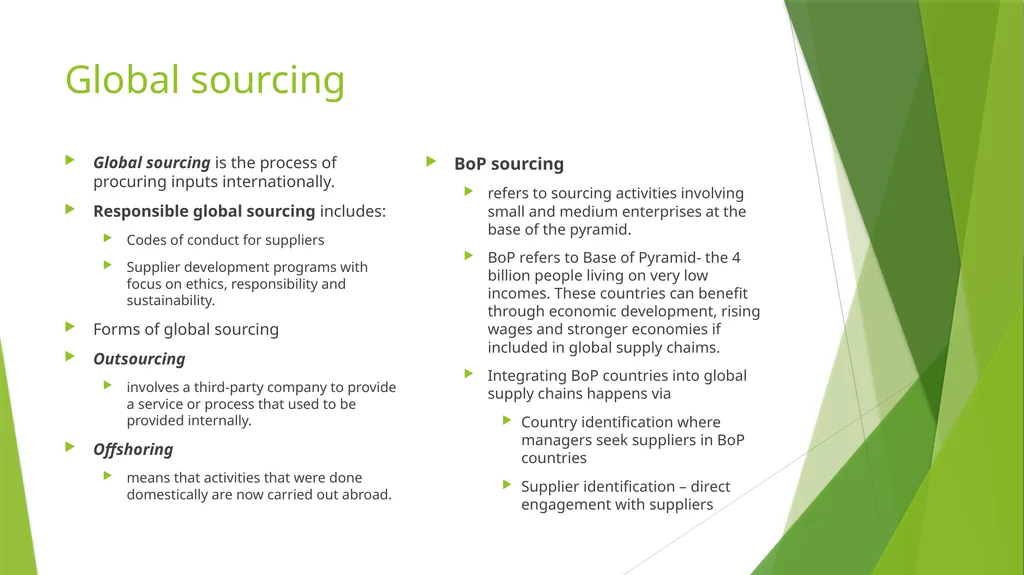
Global sourcing Global sourcing is the process of procuring inputs internationally.
Responsible global sourcing includes:
Codes of conduct for suppliers
Supplier development programs with focus on ethics, responsibility and sustainability.
Forms of global sourcing
Outsourcing
involves a third-party company to provide a service or process that used to be provided internally.
Offshoring
means that activities that were done domestically are now carried out abroad. BoP sourcing
refers to sourcing activities involving small and medium enterprises at the base of the pyramid.
BoP refers to Base of Pyramid- the 4 billion people living on very low incomes. These countries can benefit through economic development, rising wages and stronger economies if included in global supply chaims.
Integrating BoP countries into global supply chains happens via
Country identification where managers seek suppliers in BoP countries
Supplier identification – direct engagement with suppliers<br>
Responsible global sourcing includes:
Codes of conduct for suppliers
Supplier development programs with focus on ethics, responsibility and sustainability.
Forms of global sourcing
Outsourcing
involves a third-party company to provide a service or process that used to be provided internally.
Offshoring
means that activities that were done domestically are now carried out abroad. BoP sourcing
refers to sourcing activities involving small and medium enterprises at the base of the pyramid.
BoP refers to Base of Pyramid- the 4 billion people living on very low incomes. These countries can benefit through economic development, rising wages and stronger economies if included in global supply chaims.
Integrating BoP countries into global supply chains happens via
Country identification where managers seek suppliers in BoP countries
Supplier identification – direct engagement with suppliers<br>
17
Small group reflection (10 mins) You will be in groups of 4 working together (unless we have uneven numbers).
Thinking circle #2
Choose a time keeper, investigators, a scribe and reporter
Examine the intersection of glocalising and supply chain management View https://www.unilever.com/sustainable-living/reducing-environmental-impact/sustainable-sourcing and the relevant section given by your facilitator.
Provide a summary of the key targets, initiatives and progress towards meeting them for your sub-area. Choose someone to report the key findings to the main group.<br>
Thinking circle #2
Choose a time keeper, investigators, a scribe and reporter
Examine the intersection of glocalising and supply chain management View https://www.unilever.com/sustainable-living/reducing-environmental-impact/sustainable-sourcing and the relevant section given by your facilitator.
Provide a summary of the key targets, initiatives and progress towards meeting them for your sub-area. Choose someone to report the key findings to the main group.<br>
18
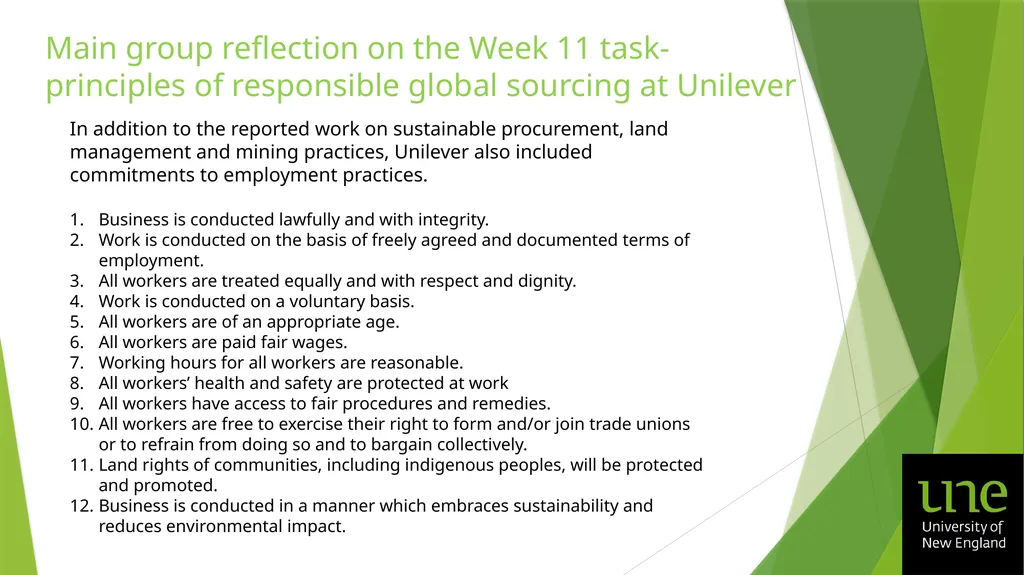
Main group reflection on the Week 11 task- principles of responsible global sourcing at Unilever In addition to the reported work on sustainable procurement, land management and mining practices, Unilever also included commitments to employment practices.
Business is conducted lawfully and with integrity.
Work is conducted on the basis of freely agreed and documented terms of employment.
All workers are treated equally and with respect and dignity.
Work is conducted on a voluntary basis.
All workers are of an appropriate age.
All workers are paid fair wages.
Working hours for all workers are reasonable.
All workers’ health and safety are protected at work
All workers have access to fair procedures and remedies.
All workers are free to exercise their right to form and/or join trade unions or to refrain from doing so and to bargain collectively.
Land rights of communities, including indigenous peoples, will be protected and promoted.
Business is conducted in a manner which embraces sustainability and reduces environmental impact.<br>
Business is conducted lawfully and with integrity.
Work is conducted on the basis of freely agreed and documented terms of employment.
All workers are treated equally and with respect and dignity.
Work is conducted on a voluntary basis.
All workers are of an appropriate age.
All workers are paid fair wages.
Working hours for all workers are reasonable.
All workers’ health and safety are protected at work
All workers have access to fair procedures and remedies.
All workers are free to exercise their right to form and/or join trade unions or to refrain from doing so and to bargain collectively.
Land rights of communities, including indigenous peoples, will be protected and promoted.
Business is conducted in a manner which embraces sustainability and reduces environmental impact.<br>
19
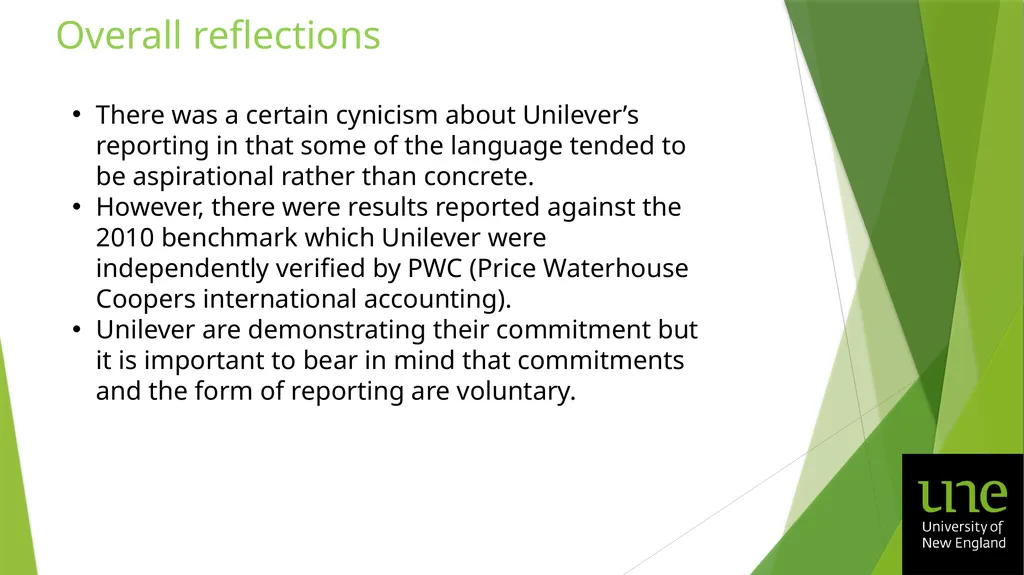
Overall reflections There was a certain cynicism about Unilever’s reporting in that some of the language tended to be aspirational rather than concrete.
However, there were results reported against the 2010 benchmark which Unilever were independently verified by PWC (Price Waterhouse Coopers international accounting).
Unilever are demonstrating their commitment but it is important to bear in mind that commitments and the form of reporting are voluntary.<br>
However, there were results reported against the 2010 benchmark which Unilever were independently verified by PWC (Price Waterhouse Coopers international accounting).
Unilever are demonstrating their commitment but it is important to bear in mind that commitments and the form of reporting are voluntary.<br>
20
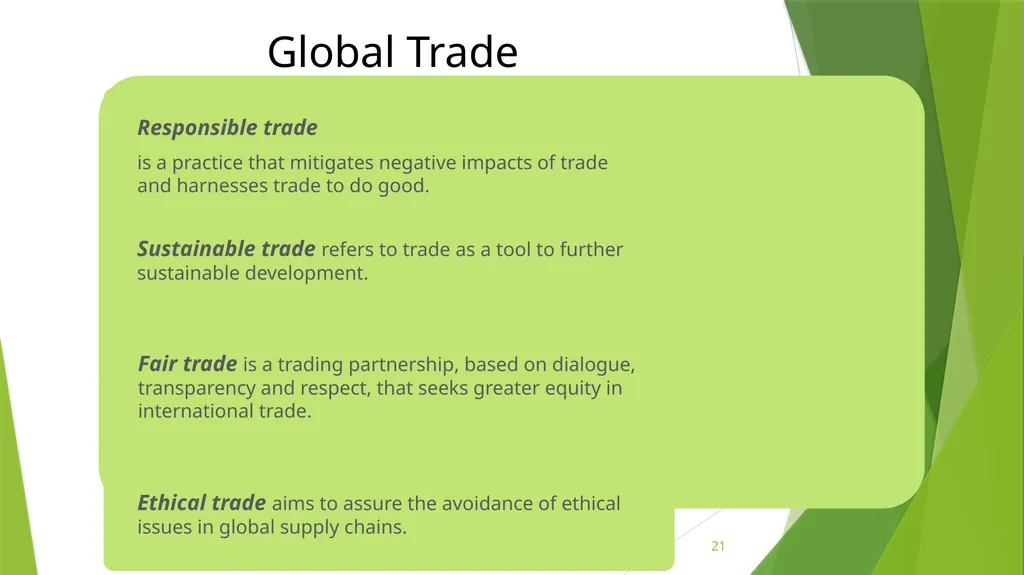
Responsible trade
is a practice that mitigates negative impacts of trade and harnesses trade to do good. 21 Sustainable trade refers to trade as a tool to further sustainable development. Global Trade Fair trade is a trading partnership, based on dialogue, transparency and respect, that seeks greater equity in international trade. Ethical trade aims to assure the avoidance of ethical issues in global supply chains.<br>
is a practice that mitigates negative impacts of trade and harnesses trade to do good. 21 Sustainable trade refers to trade as a tool to further sustainable development. Global Trade Fair trade is a trading partnership, based on dialogue, transparency and respect, that seeks greater equity in international trade. Ethical trade aims to assure the avoidance of ethical issues in global supply chains.<br>
21
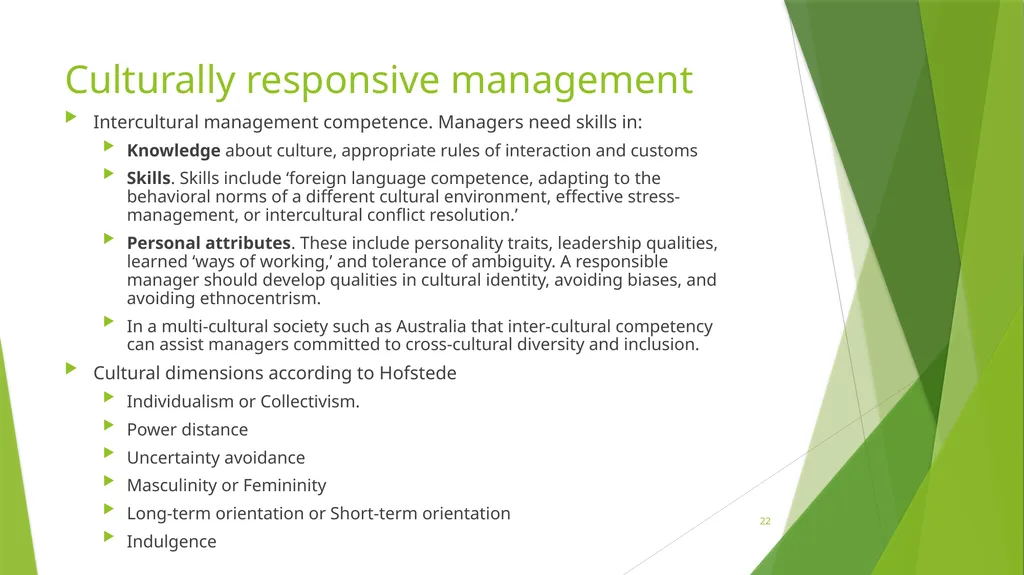
Culturally responsive management Intercultural management competence. Managers need skills in:
Knowledge about culture, appropriate rules of interaction and customs
Skills. Skills include ‘foreign language competence, adapting to the behavioral norms of a different cultural environment, effective stress-management, or intercultural conflict resolution.’
Personal attributes. These include personality traits, leadership qualities, learned ‘ways of working,’ and tolerance of ambiguity. A responsible manager should develop qualities in cultural identity, avoiding biases, and avoiding ethnocentrism.
In a multi-cultural society such as Australia that inter-cultural competency can assist managers committed to cross-cultural diversity and inclusion.
Cultural dimensions according to Hofstede
Individualism or Collectivism.
Power distance
Uncertainty avoidance
Masculinity or Femininity
Long-term orientation or Short-term orientation
Indulgence 22<br>
Knowledge about culture, appropriate rules of interaction and customs
Skills. Skills include ‘foreign language competence, adapting to the behavioral norms of a different cultural environment, effective stress-management, or intercultural conflict resolution.’
Personal attributes. These include personality traits, leadership qualities, learned ‘ways of working,’ and tolerance of ambiguity. A responsible manager should develop qualities in cultural identity, avoiding biases, and avoiding ethnocentrism.
In a multi-cultural society such as Australia that inter-cultural competency can assist managers committed to cross-cultural diversity and inclusion.
Cultural dimensions according to Hofstede
Individualism or Collectivism.
Power distance
Uncertainty avoidance
Masculinity or Femininity
Long-term orientation or Short-term orientation
Indulgence 22<br>
22
Small group reflection(15 mins) You will be in groups of 4 working together (unless we have uneven numbers).
Thinking circle #3
Choose a note taker and speaker
Consider how can you improve your own intercultural management competencies and improve your knowledge, skills, and personal attributes in cultural competence.
Look up country cultural values on Geert Hofstede’s site at https://www.hofstede-insights.com/product/compare-countries/ .
Compare Australia with a country of interest and make some notes about what you might need to do in order to improve your competencies.
You can also view https://geerthofstede.com for further details about his work.
Take some notes of your insights and nominate a speaker to report the findings back to the main group.<br>
Thinking circle #3
Choose a note taker and speaker
Consider how can you improve your own intercultural management competencies and improve your knowledge, skills, and personal attributes in cultural competence.
Look up country cultural values on Geert Hofstede’s site at https://www.hofstede-insights.com/product/compare-countries/ .
Compare Australia with a country of interest and make some notes about what you might need to do in order to improve your competencies.
You can also view https://geerthofstede.com for further details about his work.
Take some notes of your insights and nominate a speaker to report the findings back to the main group.<br>
23
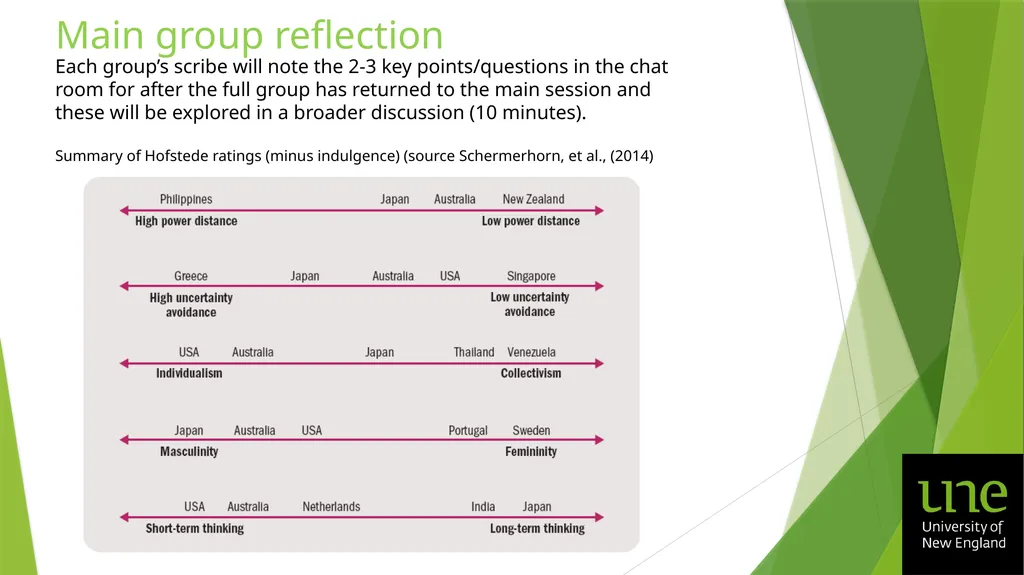
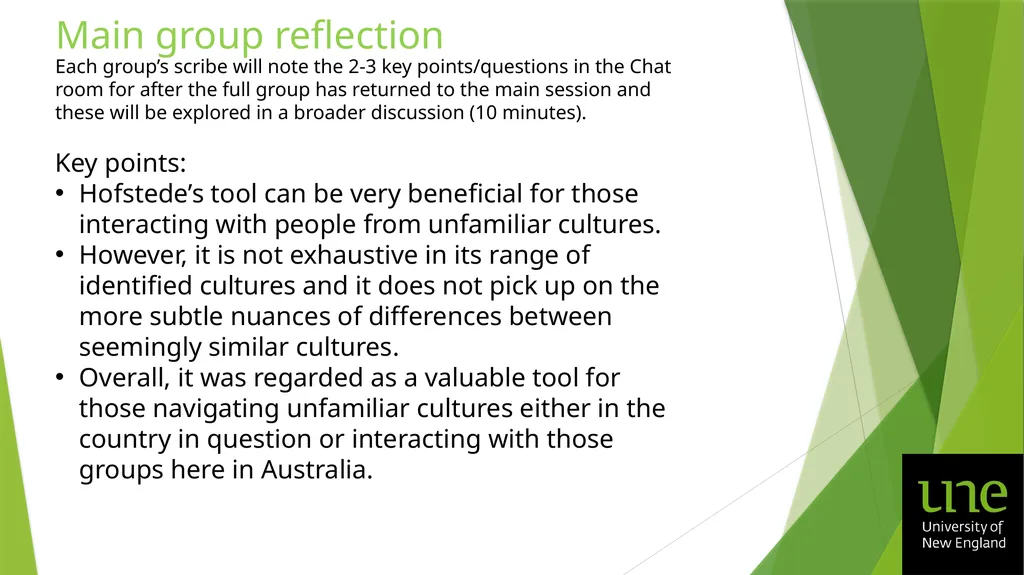
Main group reflection Each group’s scribe will note the 2-3 key points/questions in the chat room for after the full group has returned to the main session and these will be explored in a broader discussion (10 minutes).
Summary of Hofstede ratings (minus indulgence) (source Schermerhorn, et al., (2014)<br>
Summary of Hofstede ratings (minus indulgence) (source Schermerhorn, et al., (2014)<br>
24
Main group reflection Each group’s scribe will note the 2-3 key points/questions in the Chat room for after the full group has returned to the main session and these will be explored in a broader discussion (10 minutes).
Key points:
Hofstede’s tool can be very beneficial for those interacting with people from unfamiliar cultures.
However, it is not exhaustive in its range of identified cultures and it does not pick up on the more subtle nuances of differences between seemingly similar cultures.
Overall, it was regarded as a valuable tool for those navigating unfamiliar cultures either in the country in question or interacting with those groups here in Australia.<br>
Key points:
Hofstede’s tool can be very beneficial for those interacting with people from unfamiliar cultures.
However, it is not exhaustive in its range of identified cultures and it does not pick up on the more subtle nuances of differences between seemingly similar cultures.
Overall, it was regarded as a valuable tool for those navigating unfamiliar cultures either in the country in question or interacting with those groups here in Australia.<br>
25
Main group looking forward to the exam We have explored Topic 11 themes in this session looking at supply chain management and glocalisation and we have wrapped up the unit.
Next is the exam – remember if you have worked through Module 3, review the slides from the Zooms for key focus areas to revise and undertaken the tasks, you will be in good shape for the exam. Questions will be related to those areas.
I will post a separate set of slides focussing on the exam.
Thanks, good luck and best wishes for whatever is next!<br>
Next is the exam – remember if you have worked through Module 3, review the slides from the Zooms for key focus areas to revise and undertaken the tasks, you will be in good shape for the exam. Questions will be related to those areas.
I will post a separate set of slides focussing on the exam.
Thanks, good luck and best wishes for whatever is next!<br>