Managing a Holistic Marketing Organization for the Long Run Advertisement Trends in Marketing Practices Reengineering Outsourcing Benchmarking Supplier partnering Customer partnering Merging Globalizing Flattening Focusing Accelerating
"Managing a Holistic Marketing Organization for the" is the property of its rightful owner. Permission is granted to
download and print the materials on this website for personal, non-commercial use only, and to display it
on your personal computer provided you do not modify the materials and that you retain all copyright
notices contained in the materials. By downloading content from our website, you accept the terms of this
agreement.
Presentation Transcript
01
Managing a Holistic Marketing Organization for the Long Run<br>
Trends in Marketing Practices Reengineering refers to appointing teams to manage customer-value-building processes and break down walls between departments.
Outsourcing refers to the buying more goods and services from outside domestic or foreign vendors.
Benchmarking is the studying of “best practice companies” to improve performance.
Supplier partnering refers to partnering with fewer but better value-adding suppliers.<br>
05
Trends in Marketing Practices Customer partnering refers to the trend of working more closely with customers to add value to their operations.
Merging is the acquiring or merging with firms in the same or complementary industries to gain economies of scale and scope.
Globalizing refers to the increasing efforts to “think global” and “act local”.
Flattening is the reduction in the number of organizational levels to get closer to the customer.<br>
06
Trends in Marketing Practices Focusing is determining the most profitable businesses and customers and focusing on them.
Justifying means becoming more accountable by measuring, analyzing, and documenting the effects of marketing actions.
Accelerating means designing the organization and setting up processes to respond more quickly to changes in the environment.<br>
07
Trends in Marketing Practices Empowering is encouraging and empowering personnel to produce more ideas and take more initiative.
Broadening is factoring the interests of customers, employees, shareholders, and other stakeholders into the activities of the enterprise.
Monitoring is tracking what is said online and elsewhere and studying customers, competitors, and others to improve business practices.<br>
08
Internal Marketing R&D
Purchasing
Manufacturing
Marketing
Sales Logistics
Accounting
Finance
Public Relations
Other Customer-Contact Personnel<br>
09
Organizing the Marketing Department Functional Organization
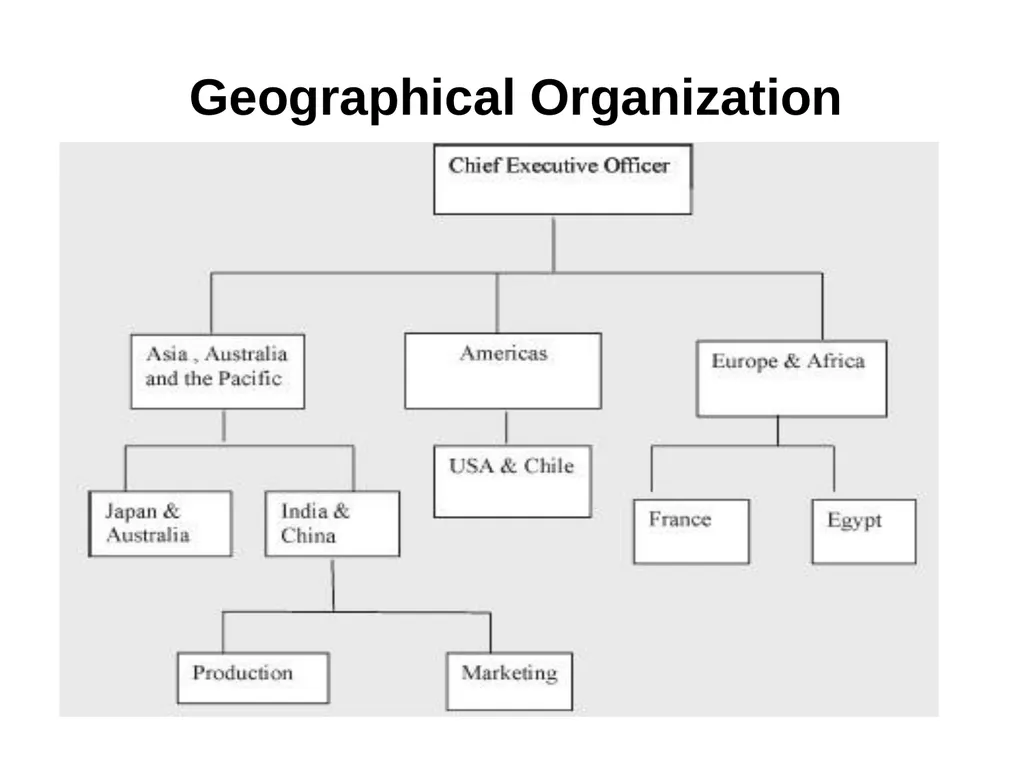
Geographic Organization
Product- or Brand-Management Organization
Market-Management Organization
Matrix-Management Organization<br>
10
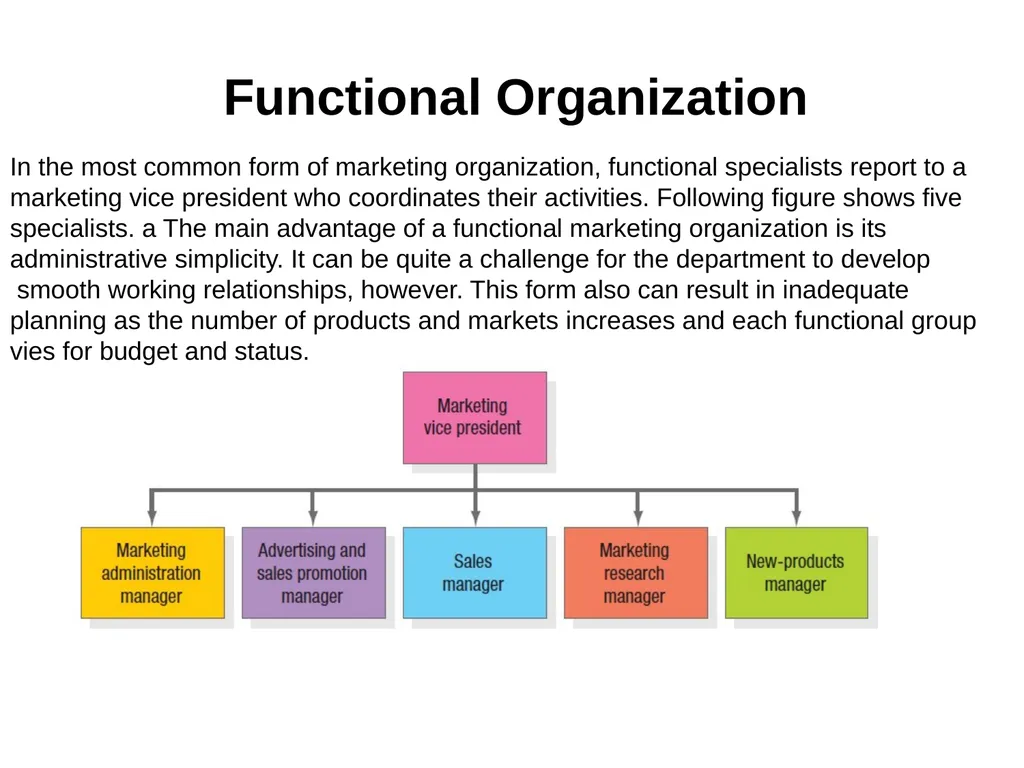
Functional Organization In the most common form of marketing organization, functional specialists report to a
marketing vice president who coordinates their activities. Following figure shows five
specialists. a The main advantage of a functional marketing organization is its
administrative simplicity. It can be quite a challenge for the department to develop
smooth working relationships, however. This form also can result in inadequate
planning as the number of products and markets increases and each functional group
vies for budget and status.<br>
11
Geographical Organization<br>
12
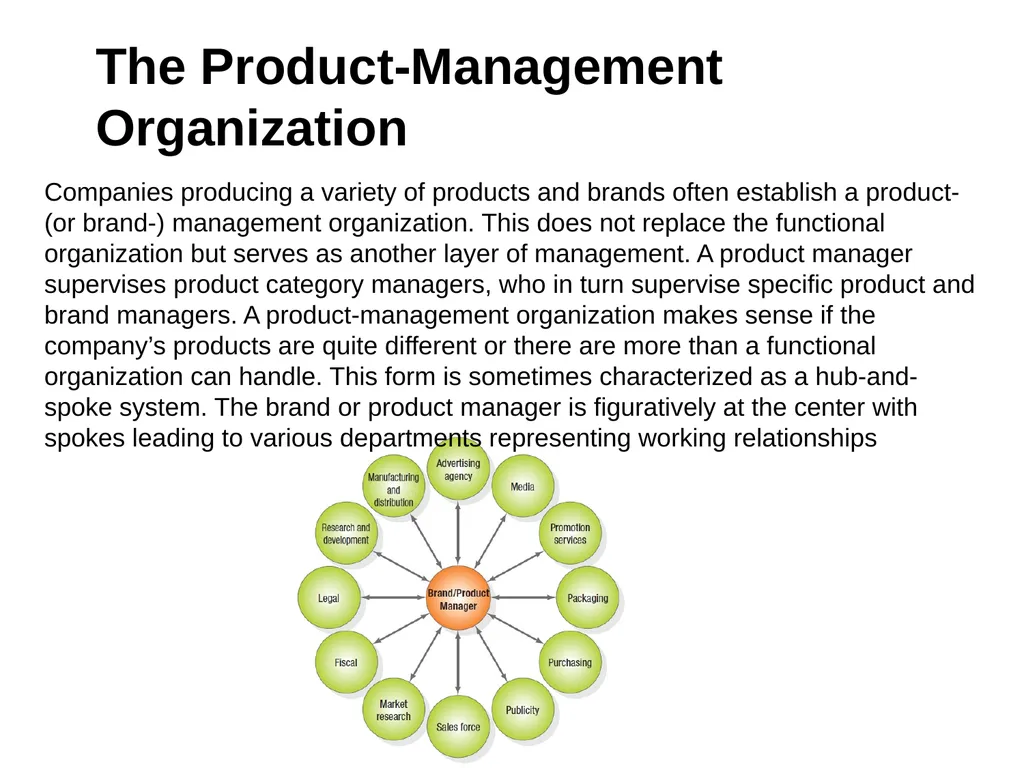
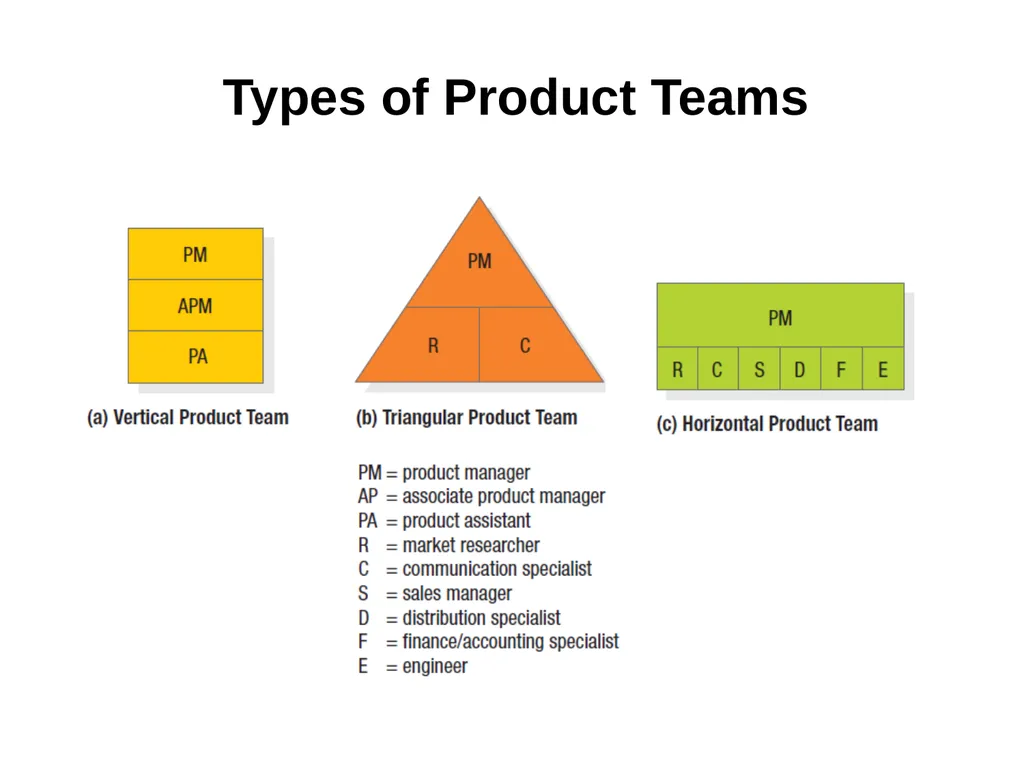
The Product-Management Organization Companies producing a variety of products and brands often establish a product- (or brand-) management organization. This does not replace the functional organization but serves as another layer of management. A product manager supervises product category managers, who in turn supervise specific product and brand managers. A product-management organization makes sense if the company’s products are quite different or there are more than a functional organization can handle. This form is sometimes characterized as a hub-and-spoke system. The brand or product manager is figuratively at the center with spokes leading to various departments representing working relationships<br>
13
Tasks Performed by Brand Managers Develop long-range and competitive strategy for each product
Prepare annual marketing plan and sales forecast
Work with advertising and merchandising agencies to develop campaigns
Increase support of the product among channel members
Gather continuous intelligence on product performance, customer attitudes
Initiate product improvements<br>
14
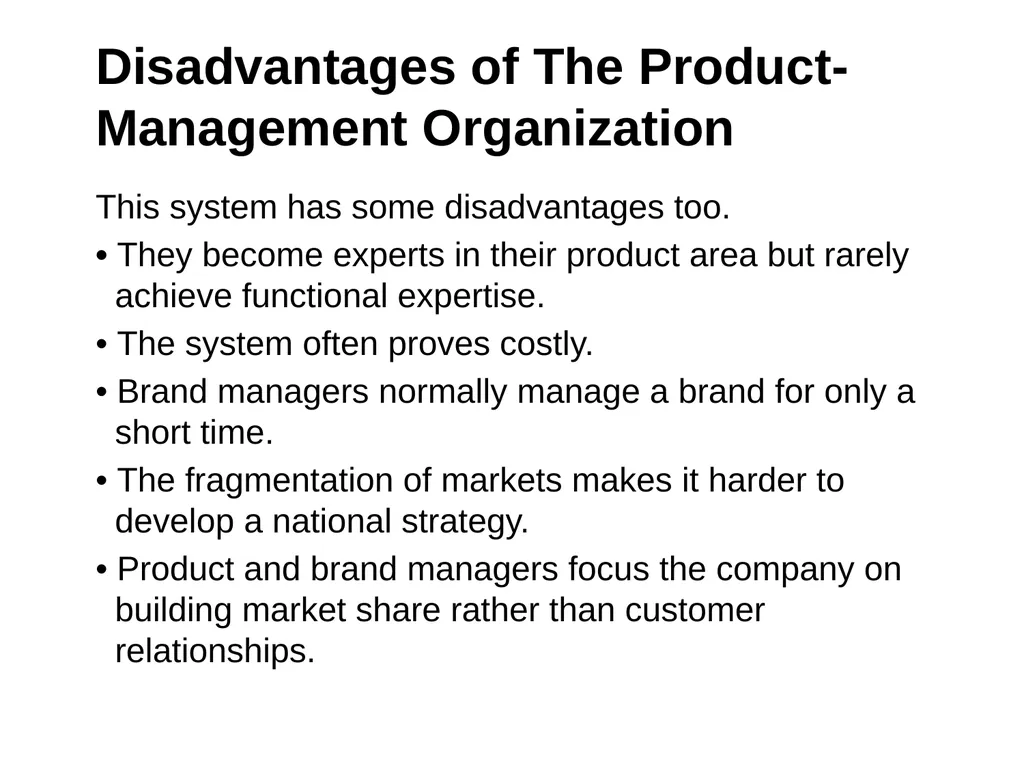
Disadvantages of The Product-Management Organization This system has some disadvantages too.
• They become experts in their product area but rarely achieve functional expertise.
• The system often proves costly.
• Brand managers normally manage a brand for only a short time.
• The fragmentation of markets makes it harder to develop a national strategy.
• Product and brand managers focus the company on building market share rather than customer relationships.<br>
15
Types of Product Teams<br>
16
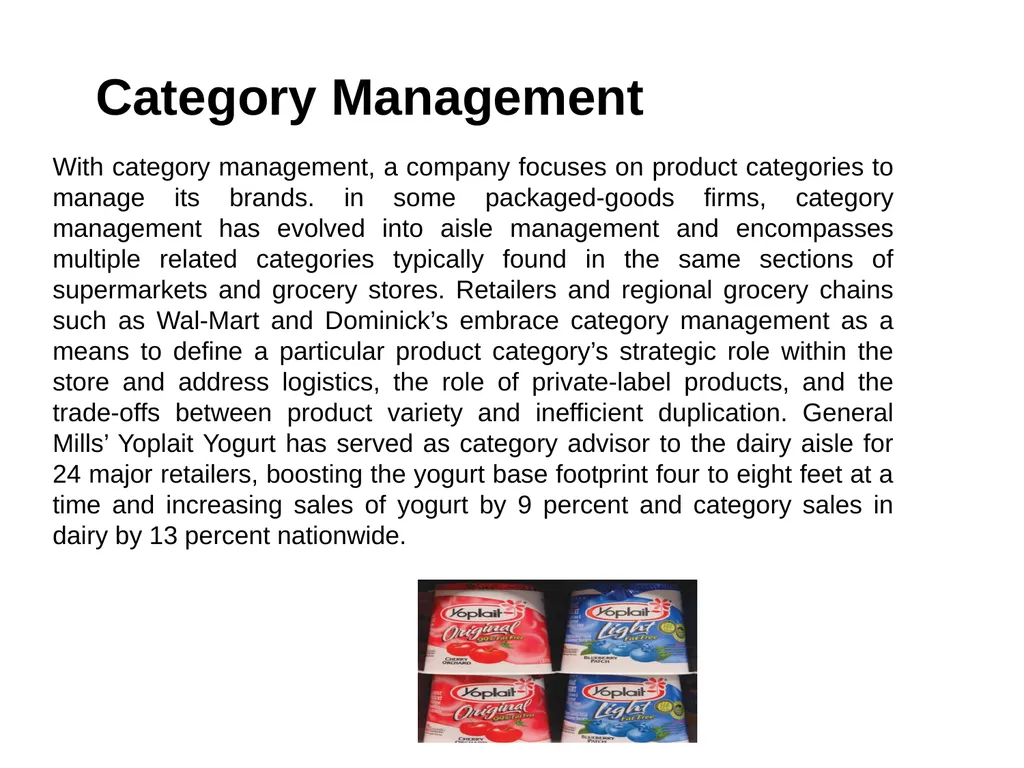
Category Management With category management, a company focuses on product categories to manage its brands. in some packaged-goods firms, category management has evolved into aisle management and encompasses multiple related categories typically found in the same sections of supermarkets and grocery stores. Retailers and regional grocery chains such as Wal-Mart and Dominick’s embrace category management as a means to define a particular product category’s strategic role within the store and address logistics, the role of private-label products, and the trade-offs between product variety and inefficient duplication. General Mills’ Yoplait Yogurt has served as category advisor to the dairy aisle for 24 major retailers, boosting the yogurt base footprint four to eight feet at a time and increasing sales of yogurt by 9 percent and category sales in dairy by 13 percent nationwide.<br>
17
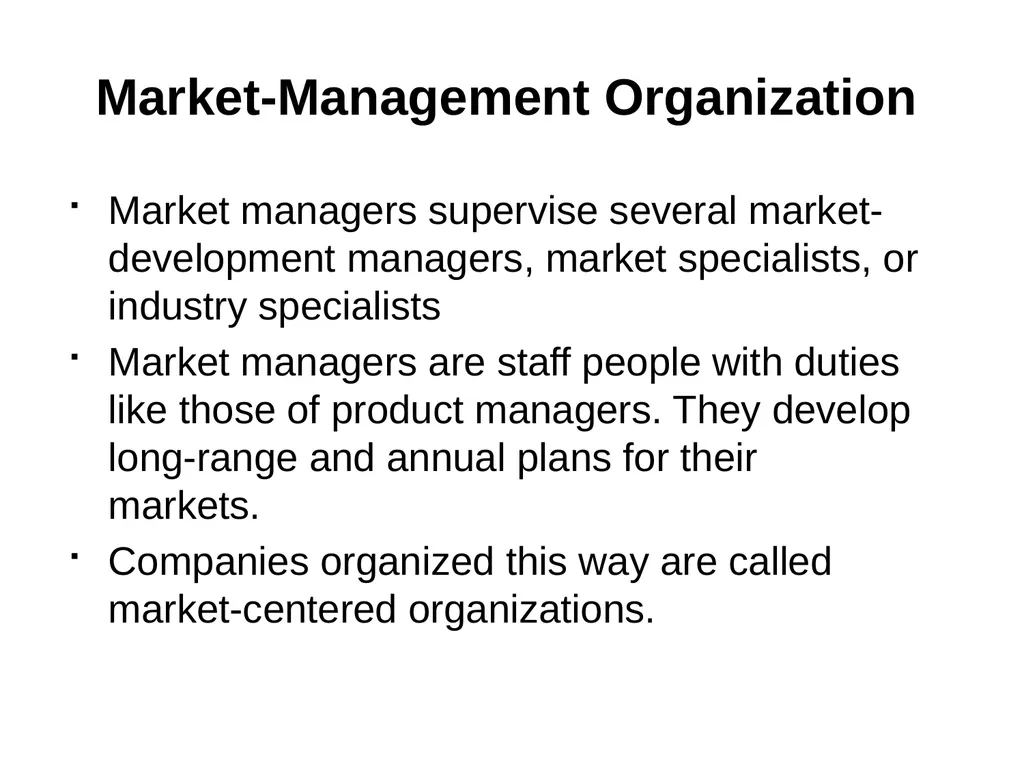
Market-Management Organization Market managers supervise several market-development managers, market specialists, or industry specialists
Market managers are staff people with duties like those of product managers. They develop long-range and annual plans for their markets.
Companies organized this way are called market-centered organizations.<br>
18
Building a Creative Marketing Organization Developing a company-wide passion for customers
Organizing around customer segments instead of products
Understanding customers through qualitative and quantitative research<br>
19
How Can CEOs Create a Marketing-Focused Company? Convince senior management of the need to become customer focused
Appoint a senior marketing officer and marketing task force
Get outside guidance
Change the company’s reward measurement and system
Hire strong marketing talent<br>
20
How Can CEOs Create a Marketing-Focused Company? Develop strong in-house marketing training programs
Install a modern marketing planning system
Establish an annual marketing excellence recognition program
Shift from a department focus to a process-outcome focus
Empower the employees<br>