
Managing Change, Sustaining Accessibility Antonio
Description: Managing Change, Sustaining Accessibility Antonio Haileselassie The National Institutes of Health May 21, 2026 Section 508 in a minute If everyone is enabled, then no one is disabled Required Section 508 requires federal agencies to make
Related Topics
Download Presentation
"Managing Change, Sustaining Accessibility Antonio" is the property of its rightful owner. Permission is granted to download and print the materials on this website for personal, non-commercial use only, and to display it on your personal computer provided you do not modify the materials and that you retain all copyright notices contained in the materials. By downloading content from our website, you accept the terms of this agreement.
Presentation Transcript
slide1. Managing Change, Sustaining Accessibility Antonio Haileselassie
The National Institutes of Health
May 21, 2026<br>
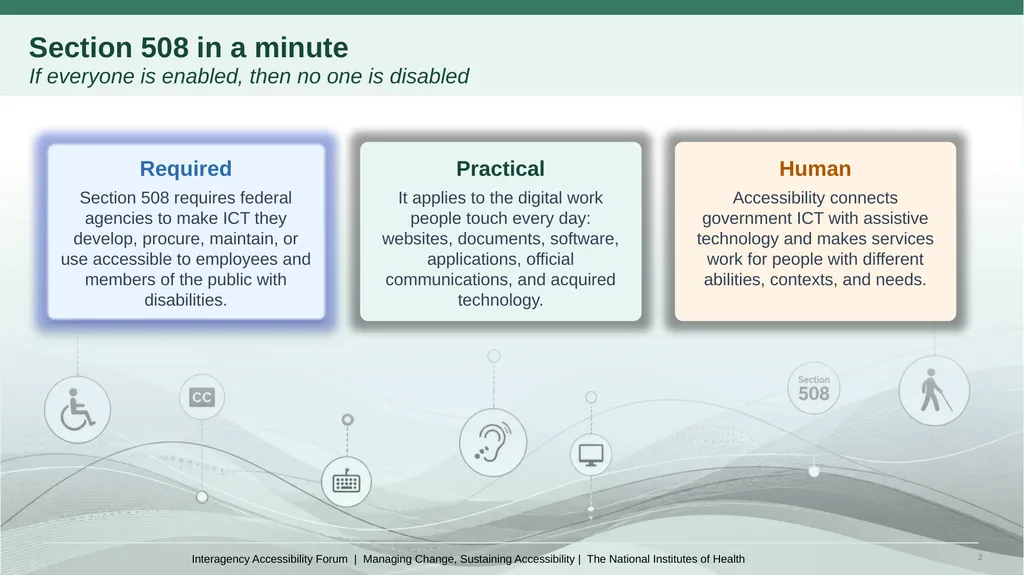
slide2. Section 508 in a minute If everyone is enabled, then no one is disabled Required Section 508 requires federal agencies to make ICT they develop, procure, maintain, or use accessible to employees and members of the public with disabilities. Practical It applies to the digital work people touch every day: websites, documents, software, applications, official communications, and acquired technology. Human Accessibility connects government ICT with assistive technology and makes services work for people with different abilities, contexts, and needs. Interagency Accessibility Forum | Managing Change, Sustaining Accessibility | The National Institutes of Health 2<br>
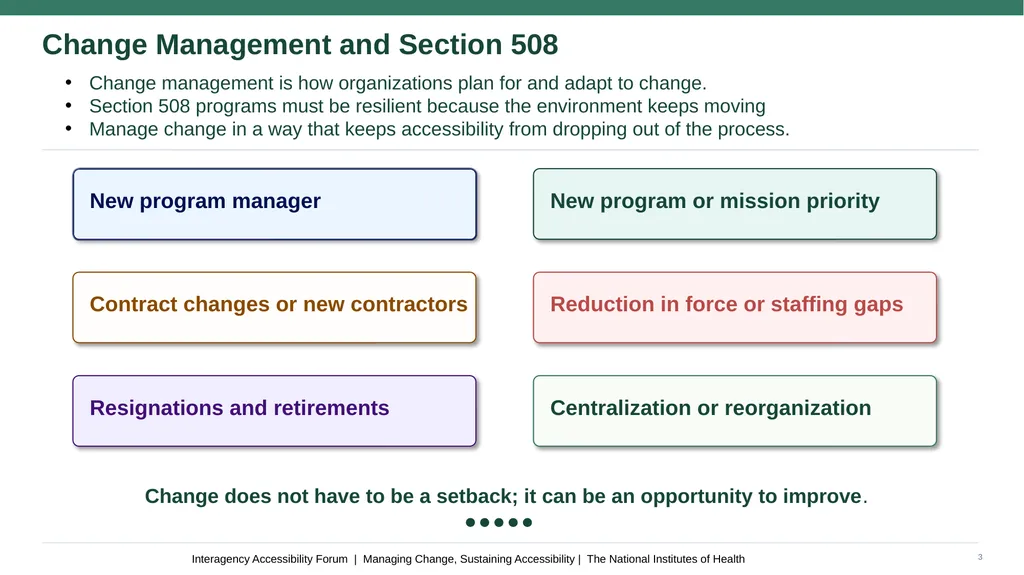
slide3. Change Management and Section 508 Change management is how organizations plan for and adapt to change.
Section 508 programs must be resilient because the environment keeps moving
Manage change in a way that keeps accessibility from dropping out of the process. New program manager New program or mission priority Contract changes or new contractors Reduction in force or staffing gaps Resignations and retirements Centralization or reorganization Change does not have to be a setback; it can be an opportunity to improve. Interagency Accessibility Forum | Managing Change, Sustaining Accessibility | The National Institutes of Health 3<br>
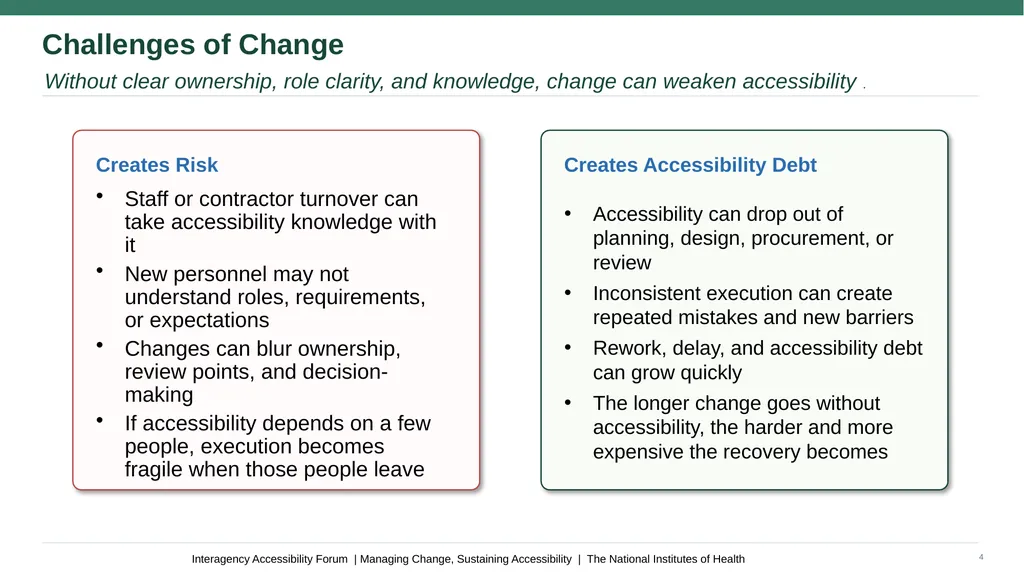
slide4. Challenges of Change Without clear ownership, role clarity, and knowledge, change can weaken accessibility . Creates Risk Staff or contractor turnover can take accessibility knowledge with it
New personnel may not understand roles, requirements, or expectations
Changes can blur ownership, review points, and decision-making
If accessibility depends on a few people, execution becomes fragile when those people leave Creates Accessibility Debt Accessibility can drop out of planning, design, procurement, or review
Inconsistent execution can create repeated mistakes and new barriers
Rework, delay, and accessibility debt can grow quickly
The longer change goes without accessibility, the harder and more expensive the recovery becomes Interagency Accessibility Forum | Managing Change, Sustaining Accessibility | The National Institutes of Health 4<br>
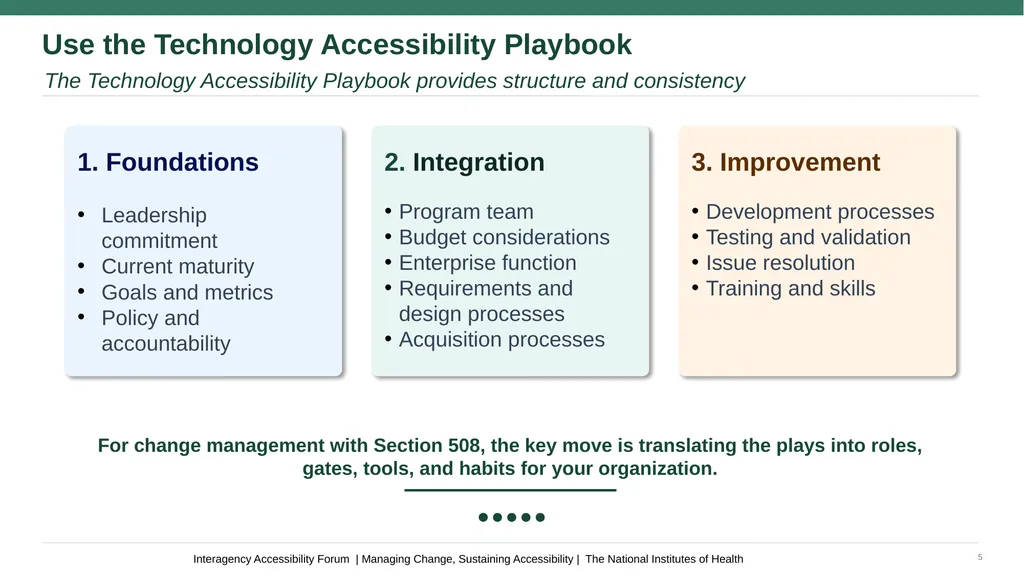
slide5. Use the Technology Accessibility Playbook The Technology Accessibility Playbook provides structure and consistency 1. Foundations Leadership commitment
Current maturity
Goals and metrics
Policy and accountability 2. Integration Program team
Budget considerations
Enterprise function
Requirements and design processes
Acquisition processes 3. Improvement Development processes
Testing and validation
Issue resolution
Training and skills For change management with Section 508, the key move is translating the plays into roles, gates, tools, and habits for your organization. Interagency Accessibility Forum | Managing Change, Sustaining Accessibility | The National Institutes of Health 5<br>
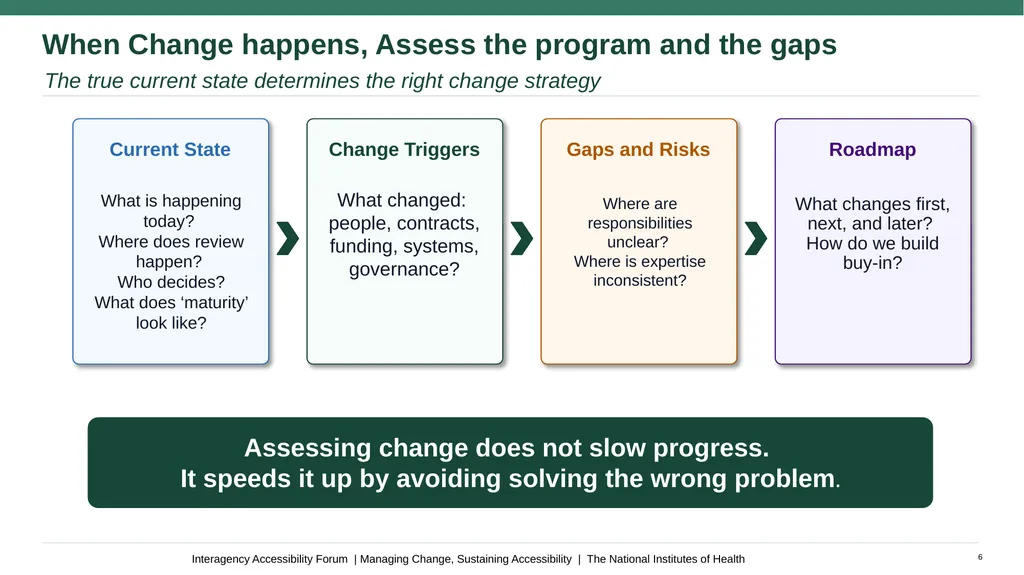
slide6. When Change happens, Assess the program and the gaps The true current state determines the right change strategy Current State What is happening today?
Where does review happen?
Who decides?
What does ‘maturity’ look like? Change Triggers What changed:
people, contracts, funding, systems, governance? Gaps and Risks Where are responsibilities unclear?
Where is expertise inconsistent? Roadmap What changes first, next, and later?
How do we build buy-in? Assessing change does not slow progress.
It speeds it up by avoiding solving the wrong problem. Interagency Accessibility Forum | Managing Change, Sustaining Accessibility | The National Institutes of Health 6<br>
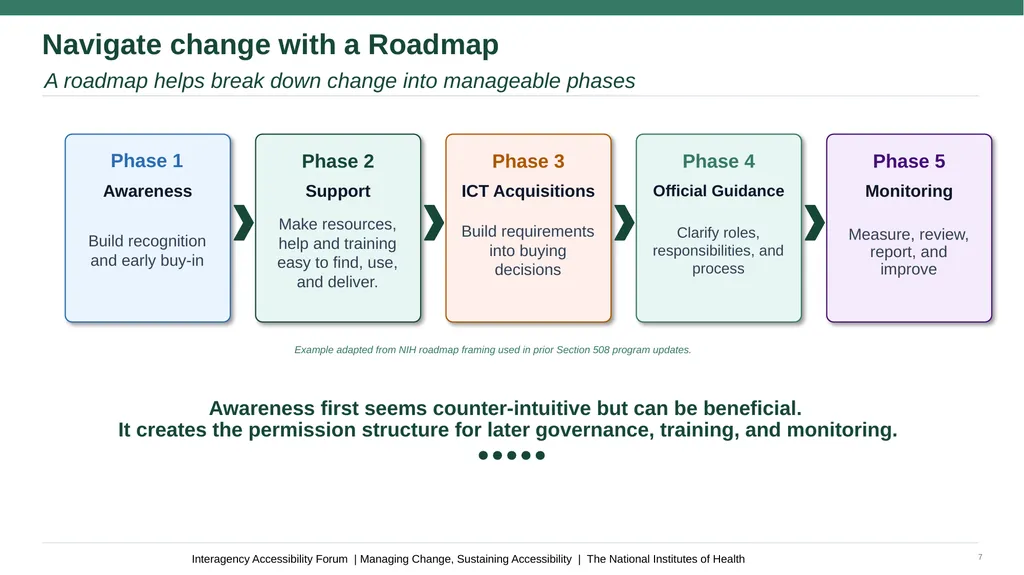
slide7. Navigate change with a Roadmap A roadmap helps break down change into manageable phases Phase 1 Awareness Build recognition and early buy-in Phase 2 Support Make resources, help and training easy to find, use, and deliver. Phase 3 ICT Acquisitions Build requirements into buying decisions Phase 4 Official Guidance Clarify roles, responsibilities, and process Phase 5 Monitoring Measure, review, report, and improve Example adapted from NIH roadmap framing used in prior Section 508 program updates. Awareness first seems counter-intuitive but can be beneficial.
It creates the permission structure for later governance, training, and monitoring. Interagency Accessibility Forum | Managing Change, Sustaining Accessibility | The National Institutes of Health 7<br>
slide8. Everyone is Responsible The program enables the work, but owners and creators must build it in Fragile Model 508 team as last stop/gate
Contractor self-review or no review
Late testing and emergency remediation
Knowledge held by a few people Resilient Model Content creators and IT owners understand their role
508 support embedded in planning and design
Testing validates, not discovers, the basics
Program knowledge is documented and repeatable Interagency Accessibility Forum | Managing Change, Sustaining Accessibility | The National Institutes of Health 8<br>
slide9. The Old Way: Accessibility at the End Late review turns a preventable issue into a change-management problem Idea Requirement Phase Design Build Launch Review Remediate When accessibility shows up late,
the work changes shape: Costly rework
Delayed delivery
Overly complex applications
Avoidable compliance exposure
Barriers for employees, patients, research communities, and the public Move away from
“Remediation” mentality. Interagency Accessibility Forum | Managing Change, Sustaining Accessibility | The National Institutes of Health 9<br>
slide10. The Better Way: Accessibility at the Start Invest efforts in the beginning and save time and effort. Idea Requirements w/
508 in Mind Design w/
508 Review Build w/
508 Testing Launch Review Less
Remediation When accessibility shows up early,
the level of effort is reduced: More efficient use of time and resources
Stronger delivery outcomes
Better-designed digital products and services
Greater confidence in compliance
More equitable access for all users Move toward “Accessibility from the Start” Culture Interagency Accessibility Forum | Managing Change, Sustaining Accessibility | The National Institutes of Health 10<br>
slide11. From a Checkpoint to a Culture Building a Culture of Accessibility From the Start Change efforts succeed when accessibility is part of how we work, every day and in every decision. Shared Responsibility
Accessibility is everyone's job. Think Early
Consider accessibility at the start of every project and change. Lead by Example
Use “Champions of Accessibility“ and model the behavior. Measure What Matters
Track progress, drive continuous improvement, avoid “gotchas”. People First
Design for real people and real needs. Interagency Accessibility Forum | Managing Change, Sustaining Accessibility | The National Institutes of Health 11<br>
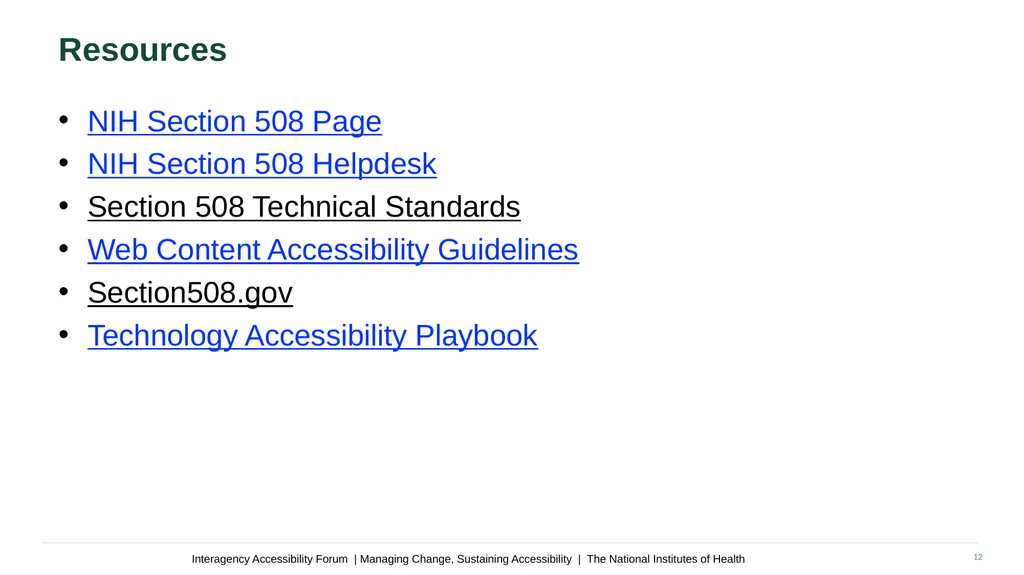
slide12. Resources NIH Section 508 Page
NIH Section 508 Helpdesk
Section 508 Technical Standards
Web Content Accessibility Guidelines
Section508.gov
Technology Accessibility Playbook Interagency Accessibility Forum | Managing Change, Sustaining Accessibility | The National Institutes of Health 12 12<br>
The National Institutes of Health
May 21, 2026<br>
slide2. Section 508 in a minute If everyone is enabled, then no one is disabled Required Section 508 requires federal agencies to make ICT they develop, procure, maintain, or use accessible to employees and members of the public with disabilities. Practical It applies to the digital work people touch every day: websites, documents, software, applications, official communications, and acquired technology. Human Accessibility connects government ICT with assistive technology and makes services work for people with different abilities, contexts, and needs. Interagency Accessibility Forum | Managing Change, Sustaining Accessibility | The National Institutes of Health 2<br>
slide3. Change Management and Section 508 Change management is how organizations plan for and adapt to change.
Section 508 programs must be resilient because the environment keeps moving
Manage change in a way that keeps accessibility from dropping out of the process. New program manager New program or mission priority Contract changes or new contractors Reduction in force or staffing gaps Resignations and retirements Centralization or reorganization Change does not have to be a setback; it can be an opportunity to improve. Interagency Accessibility Forum | Managing Change, Sustaining Accessibility | The National Institutes of Health 3<br>
slide4. Challenges of Change Without clear ownership, role clarity, and knowledge, change can weaken accessibility . Creates Risk Staff or contractor turnover can take accessibility knowledge with it
New personnel may not understand roles, requirements, or expectations
Changes can blur ownership, review points, and decision-making
If accessibility depends on a few people, execution becomes fragile when those people leave Creates Accessibility Debt Accessibility can drop out of planning, design, procurement, or review
Inconsistent execution can create repeated mistakes and new barriers
Rework, delay, and accessibility debt can grow quickly
The longer change goes without accessibility, the harder and more expensive the recovery becomes Interagency Accessibility Forum | Managing Change, Sustaining Accessibility | The National Institutes of Health 4<br>
slide5. Use the Technology Accessibility Playbook The Technology Accessibility Playbook provides structure and consistency 1. Foundations Leadership commitment
Current maturity
Goals and metrics
Policy and accountability 2. Integration Program team
Budget considerations
Enterprise function
Requirements and design processes
Acquisition processes 3. Improvement Development processes
Testing and validation
Issue resolution
Training and skills For change management with Section 508, the key move is translating the plays into roles, gates, tools, and habits for your organization. Interagency Accessibility Forum | Managing Change, Sustaining Accessibility | The National Institutes of Health 5<br>
slide6. When Change happens, Assess the program and the gaps The true current state determines the right change strategy Current State What is happening today?
Where does review happen?
Who decides?
What does ‘maturity’ look like? Change Triggers What changed:
people, contracts, funding, systems, governance? Gaps and Risks Where are responsibilities unclear?
Where is expertise inconsistent? Roadmap What changes first, next, and later?
How do we build buy-in? Assessing change does not slow progress.
It speeds it up by avoiding solving the wrong problem. Interagency Accessibility Forum | Managing Change, Sustaining Accessibility | The National Institutes of Health 6<br>
slide7. Navigate change with a Roadmap A roadmap helps break down change into manageable phases Phase 1 Awareness Build recognition and early buy-in Phase 2 Support Make resources, help and training easy to find, use, and deliver. Phase 3 ICT Acquisitions Build requirements into buying decisions Phase 4 Official Guidance Clarify roles, responsibilities, and process Phase 5 Monitoring Measure, review, report, and improve Example adapted from NIH roadmap framing used in prior Section 508 program updates. Awareness first seems counter-intuitive but can be beneficial.
It creates the permission structure for later governance, training, and monitoring. Interagency Accessibility Forum | Managing Change, Sustaining Accessibility | The National Institutes of Health 7<br>
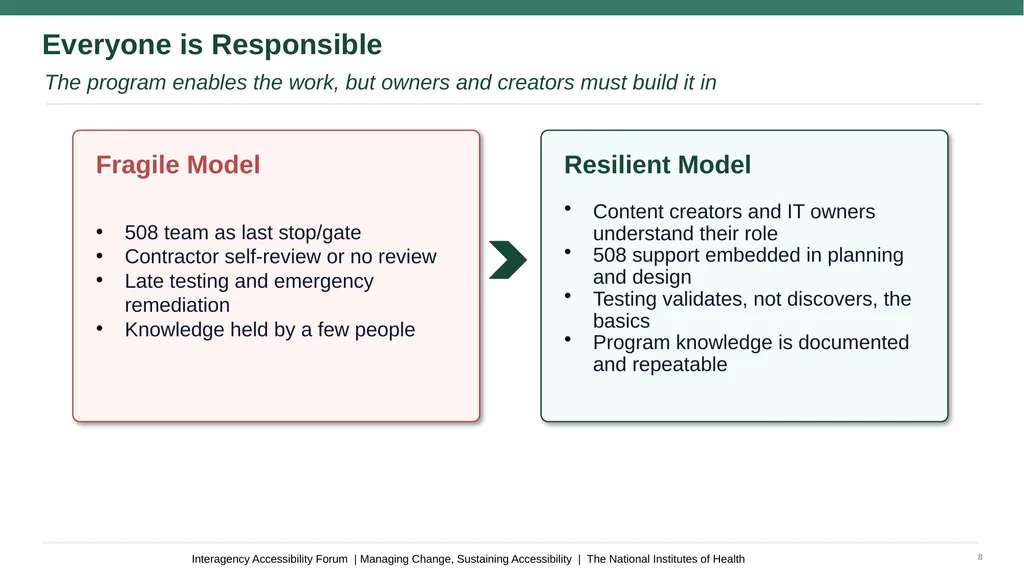
slide8. Everyone is Responsible The program enables the work, but owners and creators must build it in Fragile Model 508 team as last stop/gate
Contractor self-review or no review
Late testing and emergency remediation
Knowledge held by a few people Resilient Model Content creators and IT owners understand their role
508 support embedded in planning and design
Testing validates, not discovers, the basics
Program knowledge is documented and repeatable Interagency Accessibility Forum | Managing Change, Sustaining Accessibility | The National Institutes of Health 8<br>
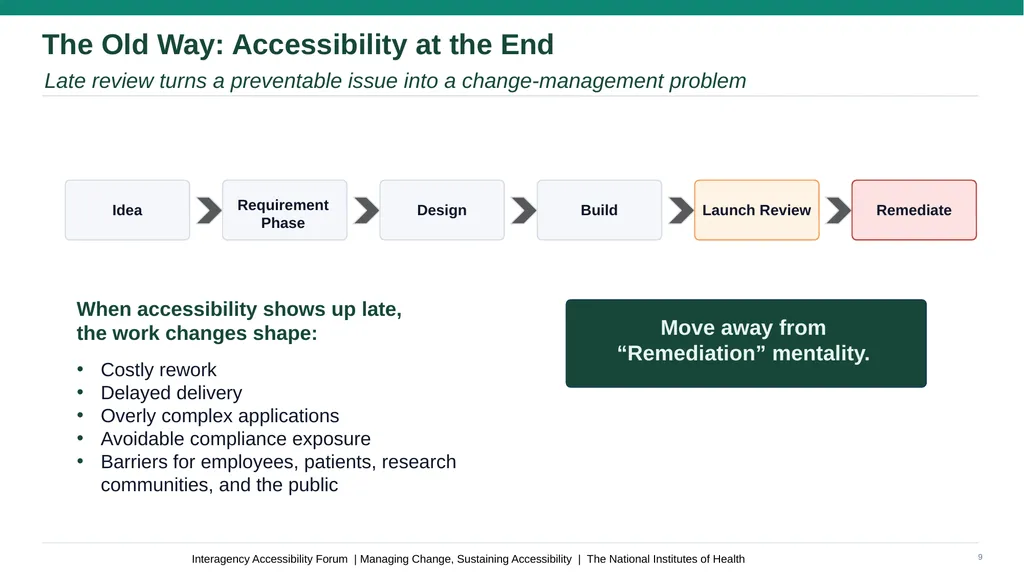
slide9. The Old Way: Accessibility at the End Late review turns a preventable issue into a change-management problem Idea Requirement Phase Design Build Launch Review Remediate When accessibility shows up late,
the work changes shape: Costly rework
Delayed delivery
Overly complex applications
Avoidable compliance exposure
Barriers for employees, patients, research communities, and the public Move away from
“Remediation” mentality. Interagency Accessibility Forum | Managing Change, Sustaining Accessibility | The National Institutes of Health 9<br>
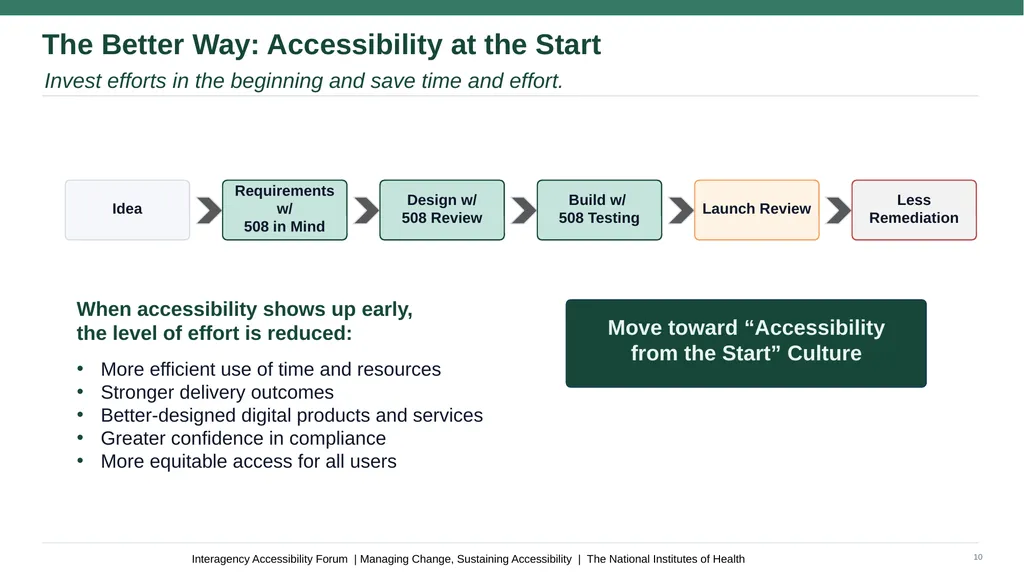
slide10. The Better Way: Accessibility at the Start Invest efforts in the beginning and save time and effort. Idea Requirements w/
508 in Mind Design w/
508 Review Build w/
508 Testing Launch Review Less
Remediation When accessibility shows up early,
the level of effort is reduced: More efficient use of time and resources
Stronger delivery outcomes
Better-designed digital products and services
Greater confidence in compliance
More equitable access for all users Move toward “Accessibility from the Start” Culture Interagency Accessibility Forum | Managing Change, Sustaining Accessibility | The National Institutes of Health 10<br>
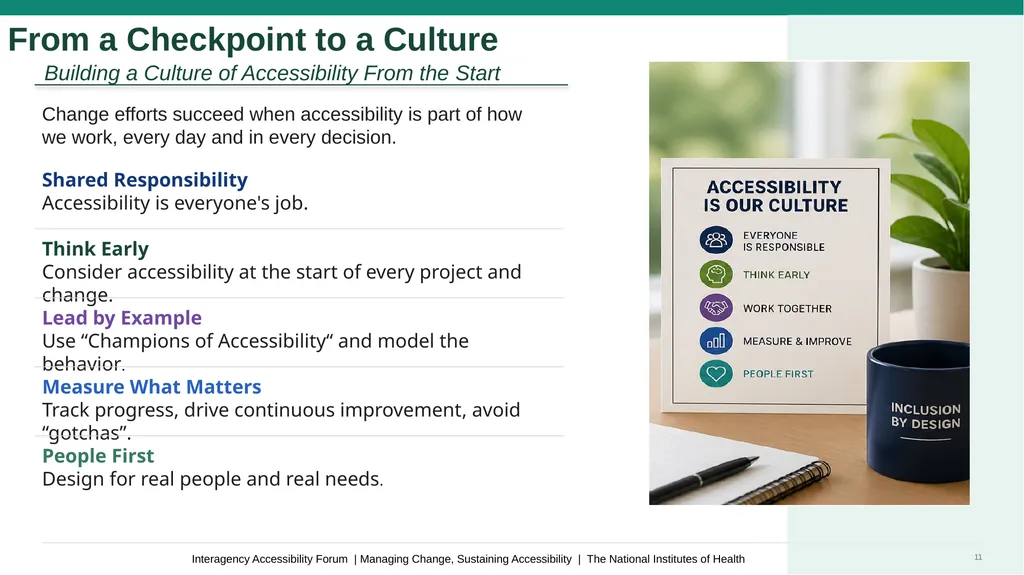
slide11. From a Checkpoint to a Culture Building a Culture of Accessibility From the Start Change efforts succeed when accessibility is part of how we work, every day and in every decision. Shared Responsibility
Accessibility is everyone's job. Think Early
Consider accessibility at the start of every project and change. Lead by Example
Use “Champions of Accessibility“ and model the behavior. Measure What Matters
Track progress, drive continuous improvement, avoid “gotchas”. People First
Design for real people and real needs. Interagency Accessibility Forum | Managing Change, Sustaining Accessibility | The National Institutes of Health 11<br>
slide12. Resources NIH Section 508 Page
NIH Section 508 Helpdesk
Section 508 Technical Standards
Web Content Accessibility Guidelines
Section508.gov
Technology Accessibility Playbook Interagency Accessibility Forum | Managing Change, Sustaining Accessibility | The National Institutes of Health 12 12<br>