
Managing pain during vaccine administration 1 A
MJ
Published · 40 slides · 0 views

1 / 1





Description
Managing pain during vaccine administration 1 A training module for health workers May 2017 How to use this training module? The content in this training module is intended to be practical and adaptable for almost any setting. Prior to the
Related Topics
Share
Embed code
Download this presentation From Below
"Managing pain during vaccine administration 1 A" is the property of its rightful owner. Permission is granted to download and print the materials on this website for personal, non-commercial use only, and to display it on your personal computer provided you do not modify the materials and that you retain all copyright notices contained in the materials. By downloading content from our website, you accept the terms of this agreement.
Presentation Transcript
01
Managing pain during vaccine administration 1 A training module
for health workers May 2017<br>
02
How to use this training module? The content in this training module is intended to be practical and adaptable for almost any setting.
Prior to the training, we recommend that the programme manager/trainer adjust the content to allow for any local considerations. 2<br>
Prior to the training, we recommend that the programme manager/trainer adjust the content to allow for any local considerations. 2<br>
03
Learning objectives At the end of the module, the participant will:
Understand the impact of pain at the time of immunization and why it is important to be managed well
Outline the role of health workers in managing pain during vaccination
Describe what health workers can say, do and act to help manage pain
Identify important considerations (caregiver involvement, breastfeeding during vaccination and multiple injections) in pain management
Duration: 2 hours approximately 3<br>
Understand the impact of pain at the time of immunization and why it is important to be managed well
Outline the role of health workers in managing pain during vaccination
Describe what health workers can say, do and act to help manage pain
Identify important considerations (caregiver involvement, breastfeeding during vaccination and multiple injections) in pain management
Duration: 2 hours approximately 3<br>
04
Decrease distress among infants, children, adults, and health care workers
Decrease anxiety about vaccination
Decrease risk of acquiring a fear of needles (i.e. needle phobia) that can prevent people from coming forward for healthcare because of a fear of procedures Pain at the time of vaccination is common.
Addressing pain is important to… 4 Not adequately managing these factors can make individuals less likely to accept vaccination<br>
Decrease anxiety about vaccination
Decrease risk of acquiring a fear of needles (i.e. needle phobia) that can prevent people from coming forward for healthcare because of a fear of procedures Pain at the time of vaccination is common.
Addressing pain is important to… 4 Not adequately managing these factors can make individuals less likely to accept vaccination<br>
05
Pain at the time of vaccination Unpleasant physical sensation caused by the needle penetrating skin and muscles, and the chemical properties of the vaccine
May be described as a poke or a sting, and some pushing
Perception of pain is very variable among individuals
Children often perceive needles to be more painful than adults and describe any procedure related to needles to be one of the most frightening health related events
Anticipation of pain can cause fear Pain during vaccination is expected and normal,
but it can be modified. Health workers have an ethical obligation to minimize pain caused during vaccination. 5<br>
May be described as a poke or a sting, and some pushing
Perception of pain is very variable among individuals
Children often perceive needles to be more painful than adults and describe any procedure related to needles to be one of the most frightening health related events
Anticipation of pain can cause fear Pain during vaccination is expected and normal,
but it can be modified. Health workers have an ethical obligation to minimize pain caused during vaccination. 5<br>
06
Pain during vaccination is different from pain that develops after vaccination Pain that develops AFTER immunization may present with redness, tenderness and/or swelling at the injection site:
Usually mild and not serious
May be associated with other common, mild adverse events following immunization (AEFI) such as:
Fatigue
Headache
Nausea
Dizziness or fainting (most common in adolescents) 6<br>
Usually mild and not serious
May be associated with other common, mild adverse events following immunization (AEFI) such as:
Fatigue
Headache
Nausea
Dizziness or fainting (most common in adolescents) 6<br>
07
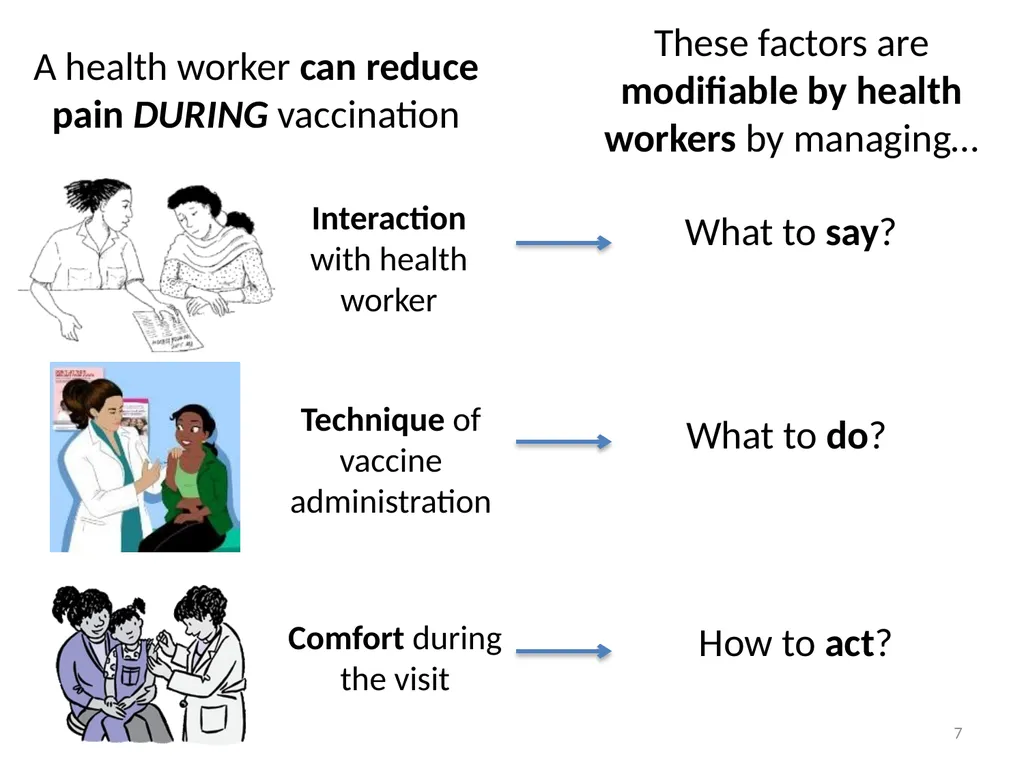
These factors are modifiable by health workers by managing… Interaction with health worker Technique of vaccine administration Comfort during the visit What to say? What to do? How to act? A health worker can reduce pain DURING vaccination 7<br>
08
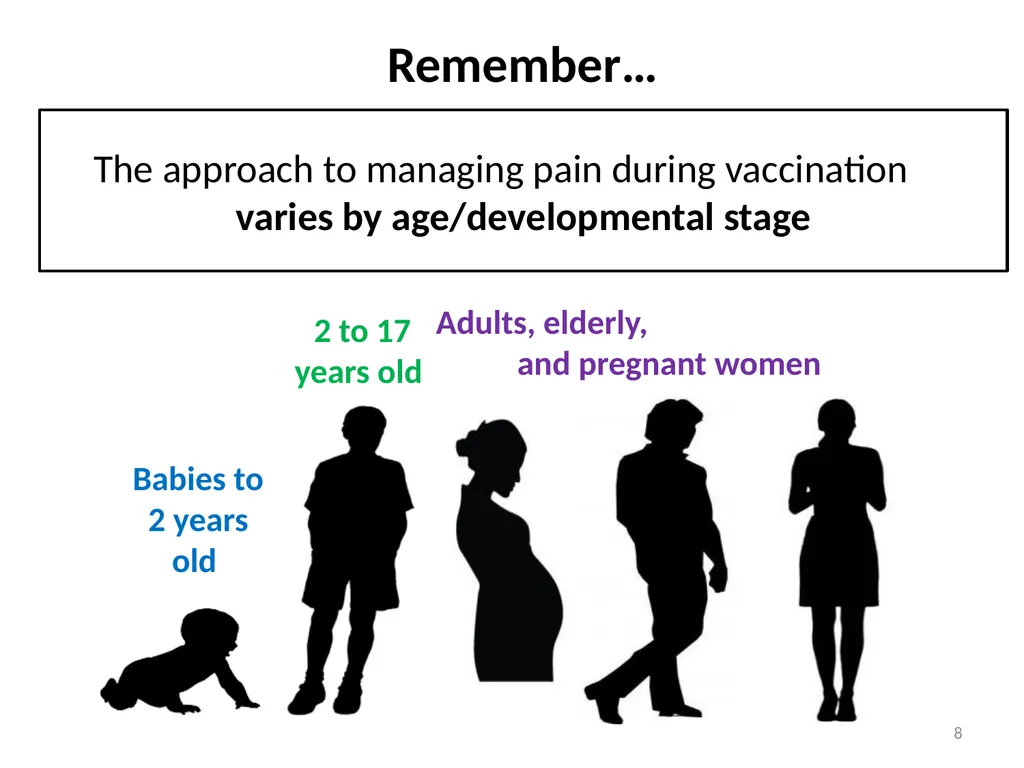
Babies to 2 years old 2 to 17 years old Adults, elderly, and pregnant women Remember… The approach to managing pain during vaccination varies by age/developmental stage 8<br>
09
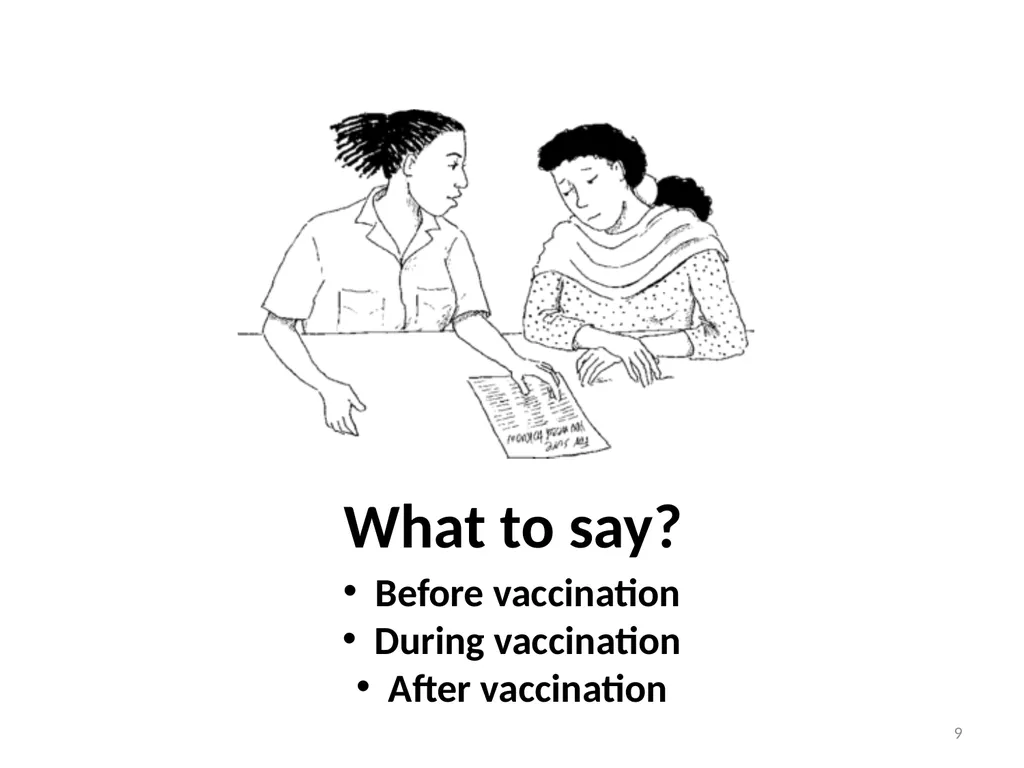
What to say? Before vaccination
During vaccination
After vaccination 9<br>
During vaccination
After vaccination 9<br>
10
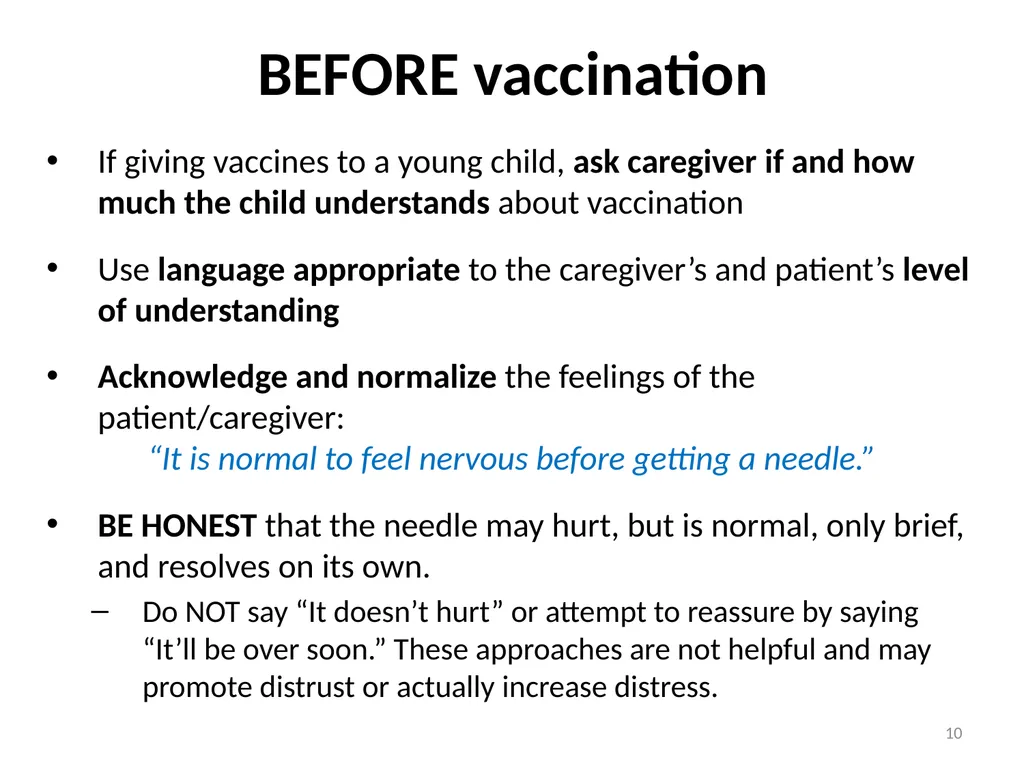
BEFORE vaccination If giving vaccines to a young child, ask caregiver if and how much the child understands about vaccination
Use language appropriate to the caregiver’s and patient’s level of understanding
Acknowledge and normalize the feelings of the patient/caregiver:
“It is normal to feel nervous before getting a needle.”
BE HONEST that the needle may hurt, but is normal, only brief, and resolves on its own.
Do NOT say “It doesn’t hurt” or attempt to reassure by saying “It’ll be over soon.” These approaches are not helpful and may promote distrust or actually increase distress. 10<br>
Use language appropriate to the caregiver’s and patient’s level of understanding
Acknowledge and normalize the feelings of the patient/caregiver:
“It is normal to feel nervous before getting a needle.”
BE HONEST that the needle may hurt, but is normal, only brief, and resolves on its own.
Do NOT say “It doesn’t hurt” or attempt to reassure by saying “It’ll be over soon.” These approaches are not helpful and may promote distrust or actually increase distress. 10<br>
11
Prepare the patient/caregiver by briefly explaining to them what to expect in terms of:
What the vaccine or vaccines prevent against: “Remember that these vaccines provide important protection against…”
How you will carry out the vaccination and take steps to minimize discomfort: e.g. “I will inject the vaccine as carefully and quickly as possible”
Describe how the vaccination will feel without inferring that they may or may not happen: “You may feel a poke or pinch and some pushing for a few seconds.”
If aiming to provide distraction, offer limited but realistic choices and let the child/ patient choose:
“Would you like to sing a song or look at this book while I give you the vaccine?” 11 BEFORE vaccination (cont.)<br>
What the vaccine or vaccines prevent against: “Remember that these vaccines provide important protection against…”
How you will carry out the vaccination and take steps to minimize discomfort: e.g. “I will inject the vaccine as carefully and quickly as possible”
Describe how the vaccination will feel without inferring that they may or may not happen: “You may feel a poke or pinch and some pushing for a few seconds.”
If aiming to provide distraction, offer limited but realistic choices and let the child/ patient choose:
“Would you like to sing a song or look at this book while I give you the vaccine?” 11 BEFORE vaccination (cont.)<br>
12
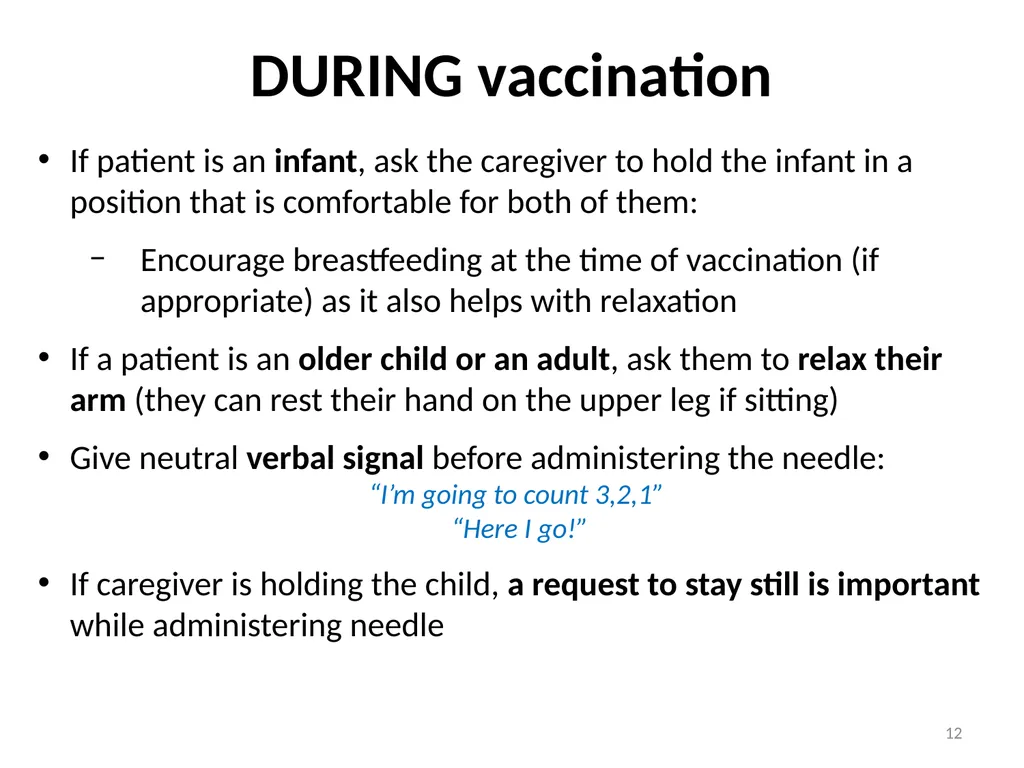
DURING vaccination If patient is an infant, ask the caregiver to hold the infant in a position that is comfortable for both of them:
Encourage breastfeeding at the time of vaccination (if appropriate) as it also helps with relaxation
If a patient is an older child or an adult, ask them to relax their arm (they can rest their hand on the upper leg if sitting)
Give neutral verbal signal before administering the needle:
“I’m going to count 3,2,1”
“Here I go!”
If caregiver is holding the child, a request to stay still is important while administering needle 12<br>
Encourage breastfeeding at the time of vaccination (if appropriate) as it also helps with relaxation
If a patient is an older child or an adult, ask them to relax their arm (they can rest their hand on the upper leg if sitting)
Give neutral verbal signal before administering the needle:
“I’m going to count 3,2,1”
“Here I go!”
If caregiver is holding the child, a request to stay still is important while administering needle 12<br>
13
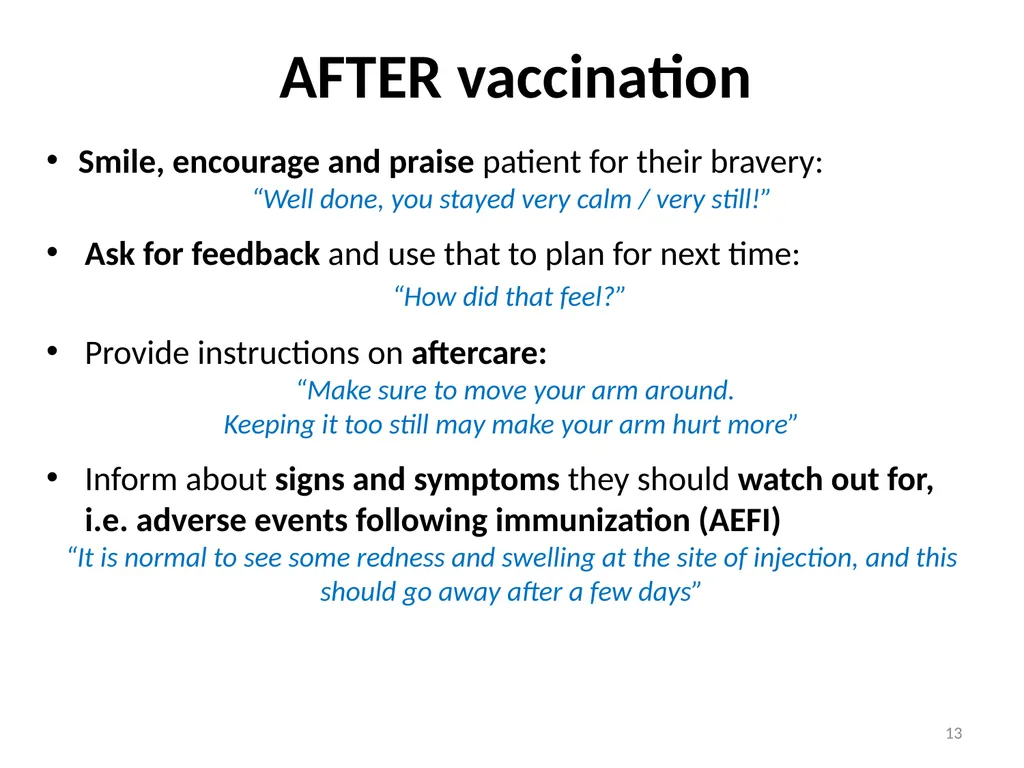
AFTER vaccination Smile, encourage and praise patient for their bravery:
“Well done, you stayed very calm / very still!”
Ask for feedback and use that to plan for next time:
“How did that feel?”
Provide instructions on aftercare:
“Make sure to move your arm around.
Keeping it too still may make your arm hurt more”
Inform about signs and symptoms they should watch out for, i.e. adverse events following immunization (AEFI)
“It is normal to see some redness and swelling at the site of injection, and this should go away after a few days” 13<br>
“Well done, you stayed very calm / very still!”
Ask for feedback and use that to plan for next time:
“How did that feel?”
Provide instructions on aftercare:
“Make sure to move your arm around.
Keeping it too still may make your arm hurt more”
Inform about signs and symptoms they should watch out for, i.e. adverse events following immunization (AEFI)
“It is normal to see some redness and swelling at the site of injection, and this should go away after a few days” 13<br>
14
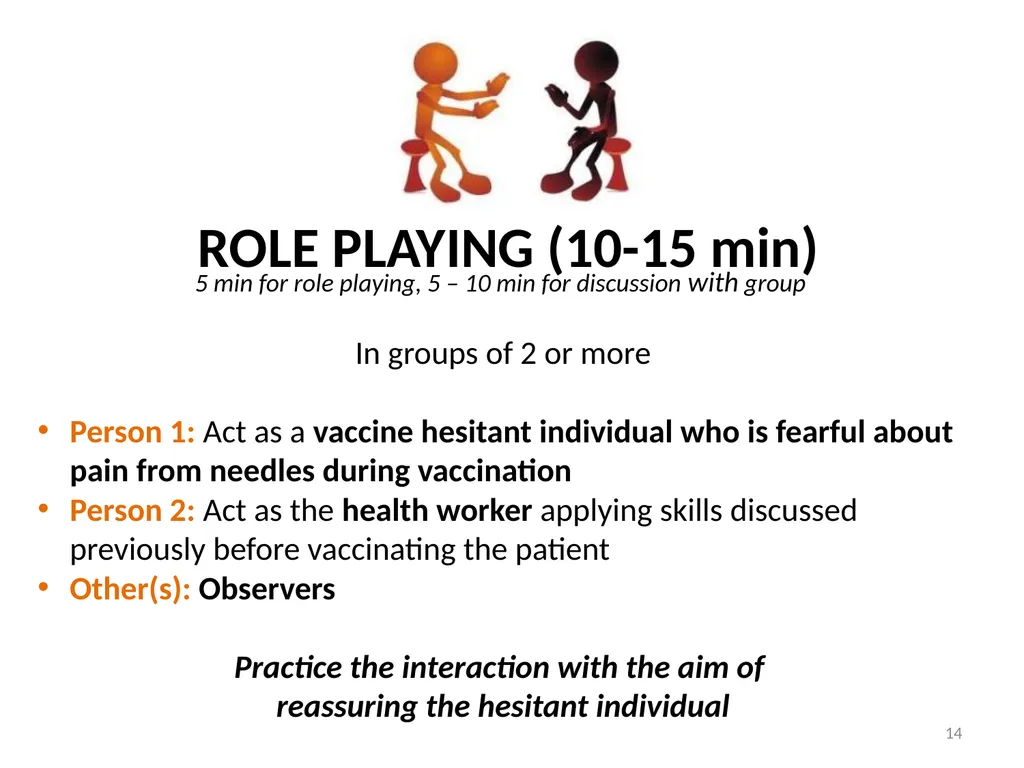
14 ROLE PLAYING (10-15 min) 5 min for role playing, 5 – 10 min for discussion with group In groups of 2 or more
Person 1: Act as a vaccine hesitant individual who is fearful about pain from needles during vaccination
Person 2: Act as the health worker applying skills discussed previously before vaccinating the patient
Other(s): Observers
Practice the interaction with the aim of
reassuring the hesitant individual<br>
Person 1: Act as a vaccine hesitant individual who is fearful about pain from needles during vaccination
Person 2: Act as the health worker applying skills discussed previously before vaccinating the patient
Other(s): Observers
Practice the interaction with the aim of
reassuring the hesitant individual<br>
15
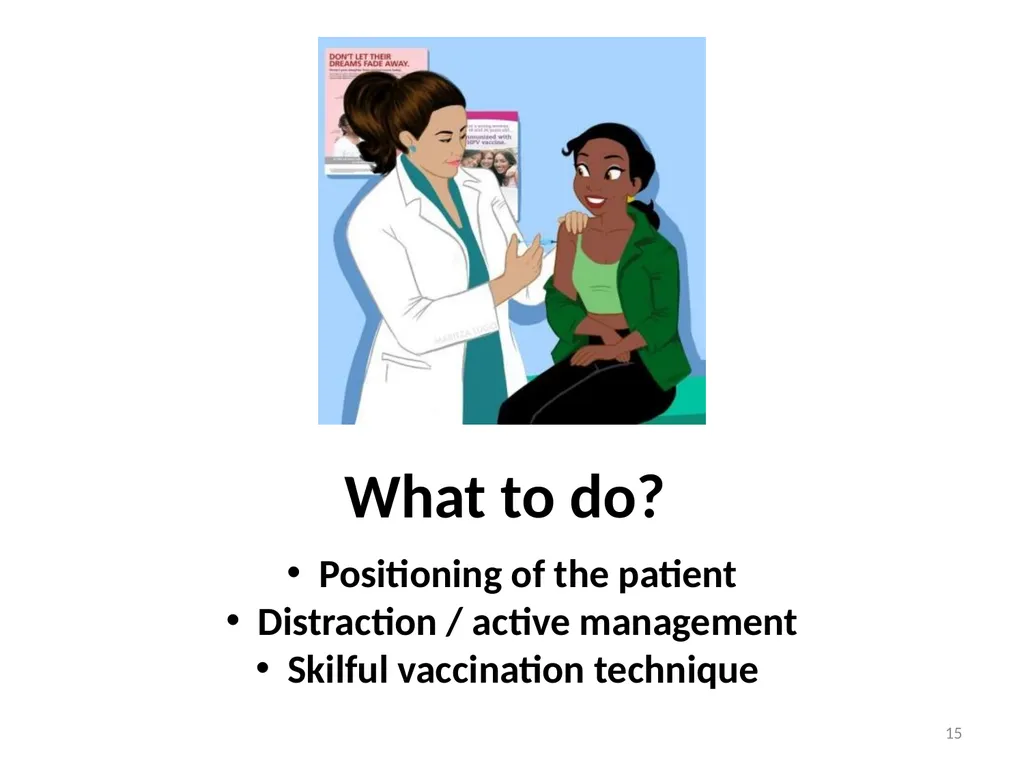
What to do? Positioning of the patient
Distraction / active management
Skilful vaccination technique 15<br>
Distraction / active management
Skilful vaccination technique 15<br>
16
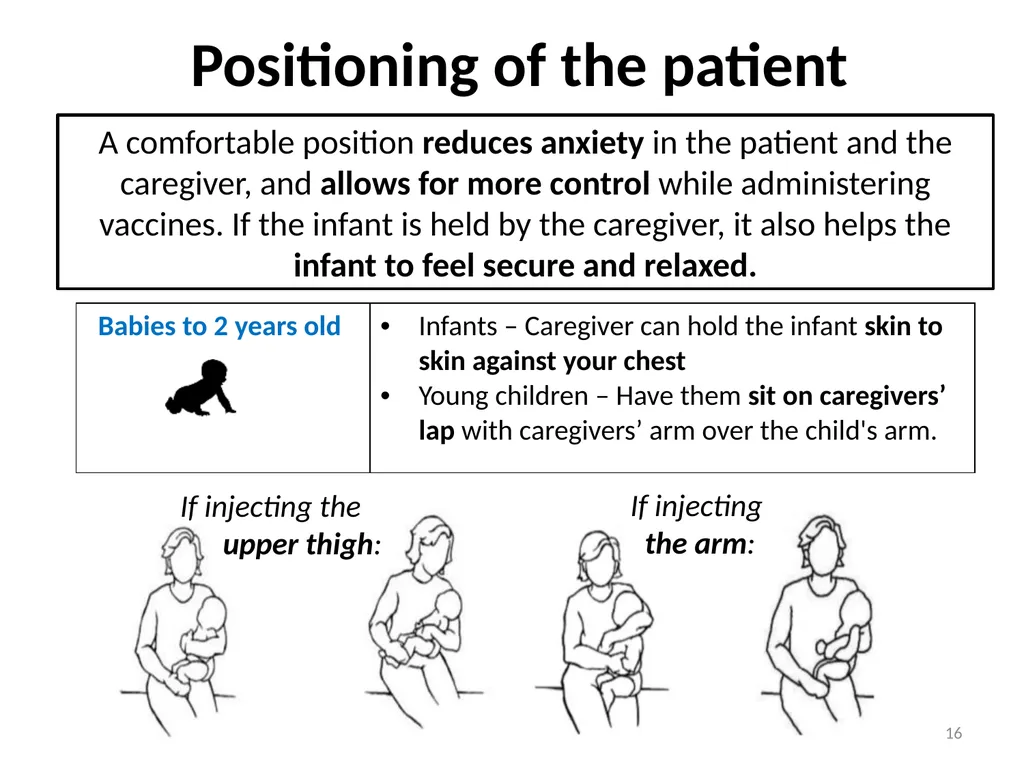
Positioning of the patient A comfortable position reduces anxiety in the patient and the caregiver, and allows for more control while administering vaccines. If the infant is held by the caregiver, it also helps the infant to feel secure and relaxed. If injecting
the arm: If injecting the upper thigh: 16<br>
the arm: If injecting the upper thigh: 16<br>
17
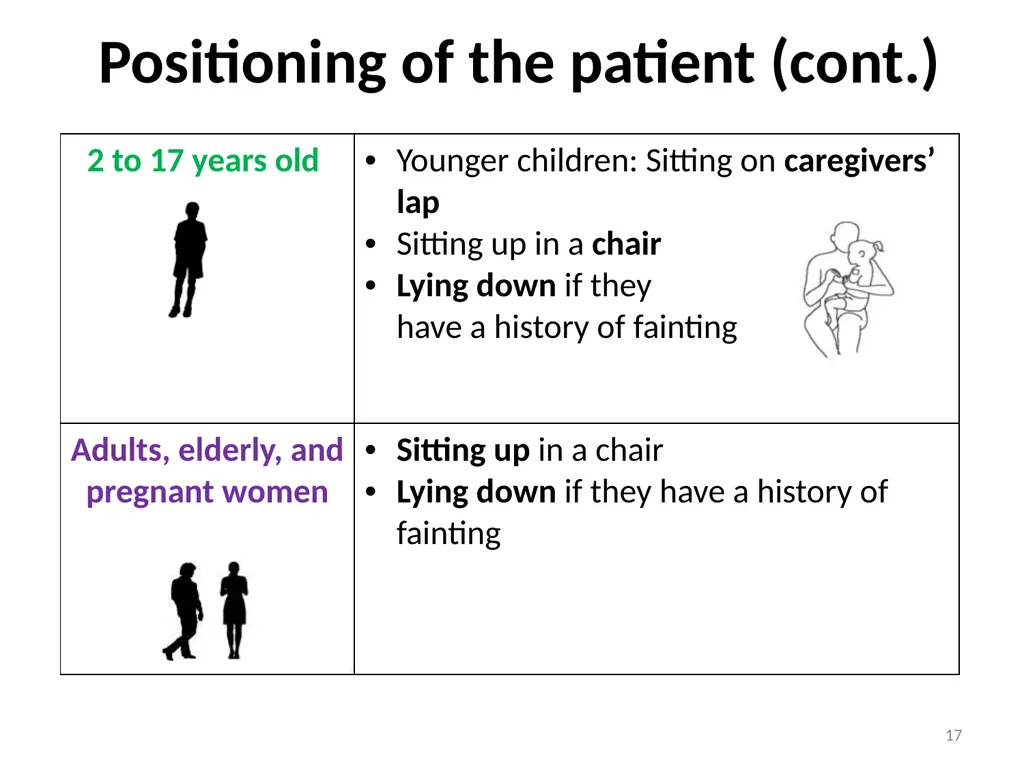
17 Positioning of the patient (cont.)<br>
18
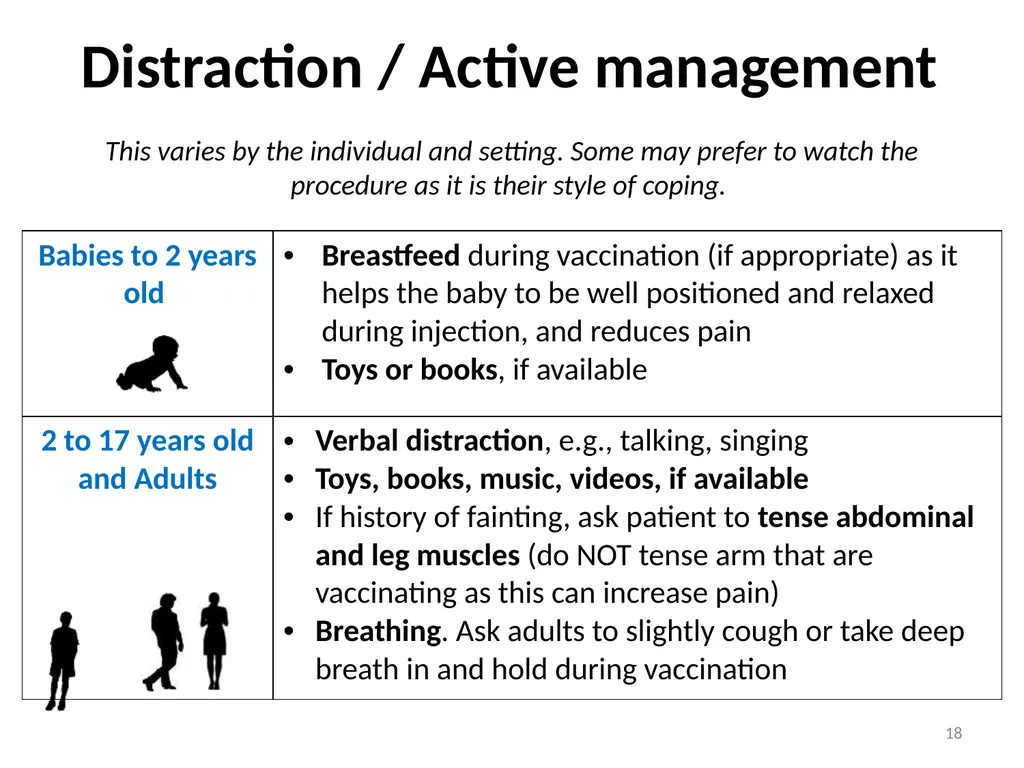
Distraction / Active management This varies by the individual and setting. Some may prefer to watch the procedure as it is their style of coping. 18<br>
19
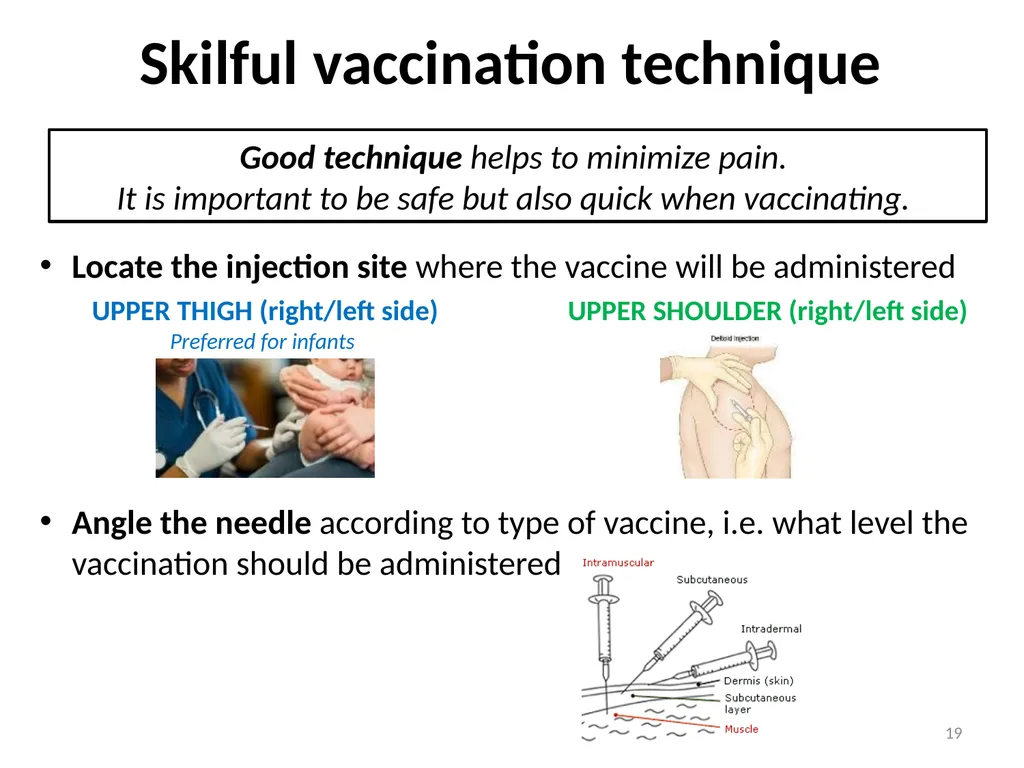
Skilful vaccination technique Good technique helps to minimize pain.
It is important to be safe but also quick when vaccinating. Locate the injection site where the vaccine will be administered
Angle the needle according to type of vaccine, i.e. what level the vaccination should be administered 19<br>
It is important to be safe but also quick when vaccinating. Locate the injection site where the vaccine will be administered
Angle the needle according to type of vaccine, i.e. what level the vaccination should be administered 19<br>
20
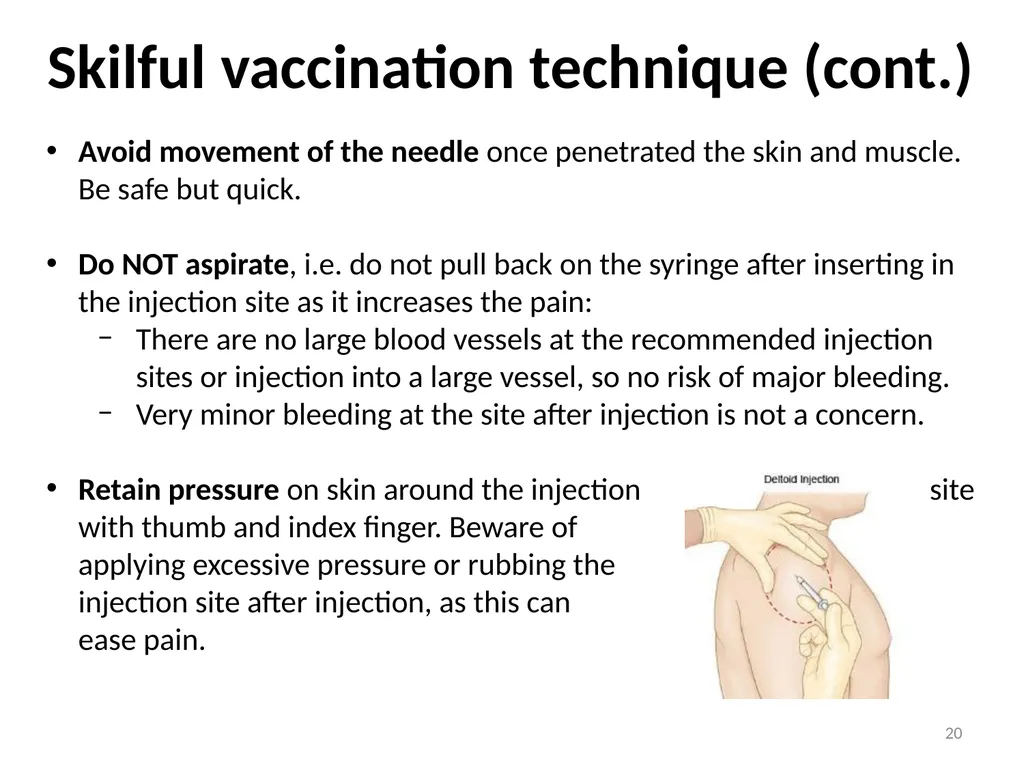
Avoid movement of the needle once penetrated the skin and muscle. Be safe but quick.
Do NOT aspirate, i.e. do not pull back on the syringe after inserting in the injection site as it increases the pain:
There are no large blood vessels at the recommended injection sites or injection into a large vessel, so no risk of major bleeding.
Very minor bleeding at the site after injection is not a concern.
Retain pressure on skin around the injection site with thumb and index finger. Beware of applying excessive pressure or rubbing the injection site after injection, as this can incr ease pain. 20 Skilful vaccination technique (cont.)<br>
Do NOT aspirate, i.e. do not pull back on the syringe after inserting in the injection site as it increases the pain:
There are no large blood vessels at the recommended injection sites or injection into a large vessel, so no risk of major bleeding.
Very minor bleeding at the site after injection is not a concern.
Retain pressure on skin around the injection site with thumb and index finger. Beware of applying excessive pressure or rubbing the injection site after injection, as this can incr ease pain. 20 Skilful vaccination technique (cont.)<br>
21
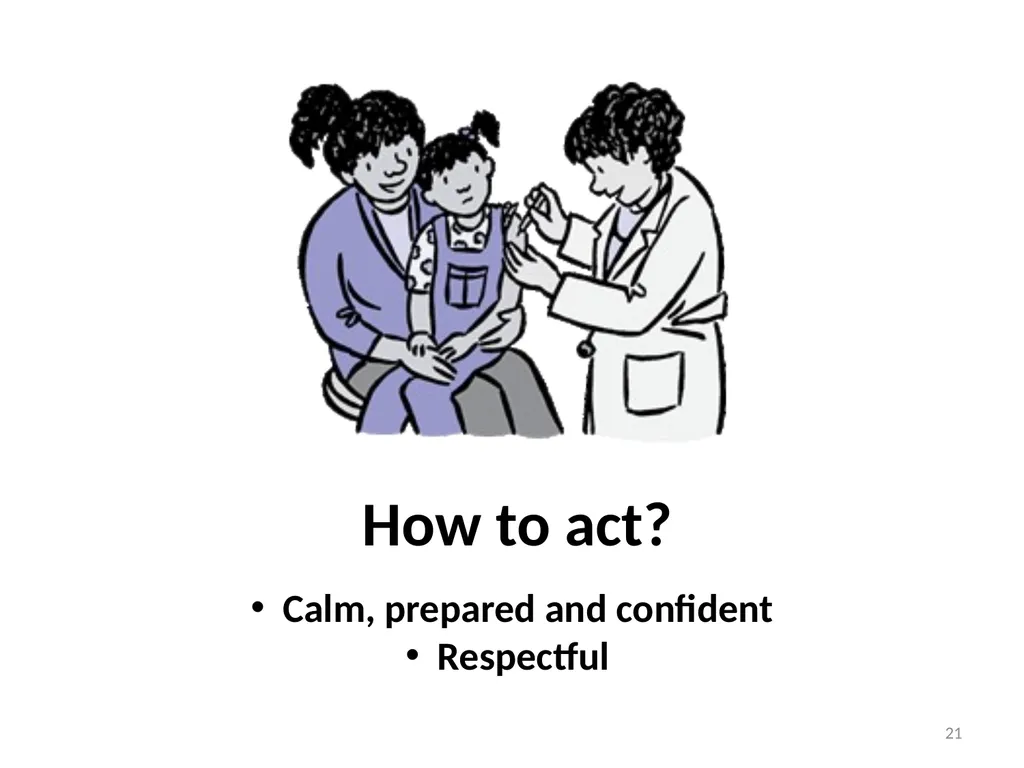
How to act? Calm, prepared and confident
Respectful 21<br>
Respectful 21<br>
22
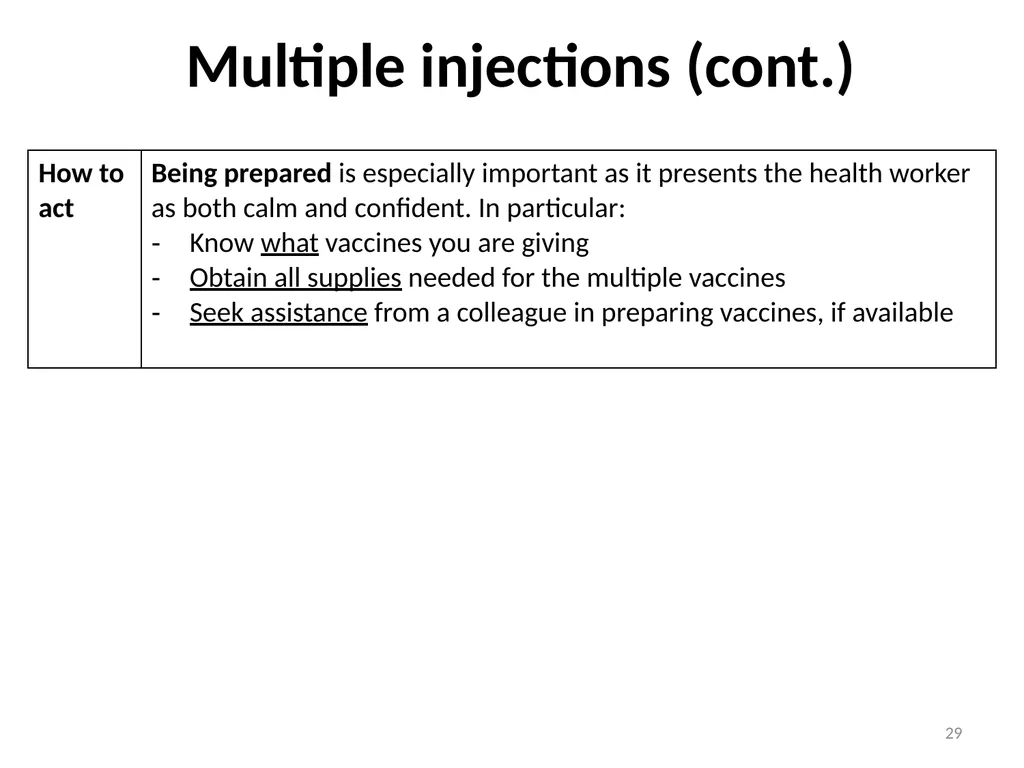
Be calm, prepared, and confident Do NOT preload syringes beforehand as it increases the risk of contamination and immunization programme error.
Keep supplies nearby (e.g. syringes, vaccines, tray, cotton ball or gauze etc.), so doses can be prepared quickly.
These strategies combined with skilful injection techniques will allow you to feel and demonstrate confidence to caregivers and patients. Being calm, prepared and confident puts the patient/caregiver at ease 22<br>
Keep supplies nearby (e.g. syringes, vaccines, tray, cotton ball or gauze etc.), so doses can be prepared quickly.
These strategies combined with skilful injection techniques will allow you to feel and demonstrate confidence to caregivers and patients. Being calm, prepared and confident puts the patient/caregiver at ease 22<br>
23
23 Prior to vaccination, prepare by knowing what vaccines you will administer, and administer them in a manner that reduces pain. Use the following proven strategies:
Administer the least painful vaccine first (most painful last)
If a patient is to receive oral rotavirus vaccine in addition to injectable vaccines, give the oral rotavirus vaccine first as it contains sucrose which can decrease pain from the injectable vaccines that follow Be calm, prepared, and confident (cont.)<br>
Administer the least painful vaccine first (most painful last)
If a patient is to receive oral rotavirus vaccine in addition to injectable vaccines, give the oral rotavirus vaccine first as it contains sucrose which can decrease pain from the injectable vaccines that follow Be calm, prepared, and confident (cont.)<br>
24
Be respectful Patients and caregivers perceive health workers as a trusted source of information
Respectful interactions include:
Allowing the patient/caregiver to express their concerns
Patiently listening
Trying to understand and acknowledging concerns
Offering options and working together to address concerns
Honouring their decision A respectful and professional demeanour can demonstrate a health care provider is positive, caring and approachable. 24<br>
Respectful interactions include:
Allowing the patient/caregiver to express their concerns
Patiently listening
Trying to understand and acknowledging concerns
Offering options and working together to address concerns
Honouring their decision A respectful and professional demeanour can demonstrate a health care provider is positive, caring and approachable. 24<br>
25
Important considerations Involving caregivers
Breastfeeding during vaccination
Multiple injections 25<br>
Breastfeeding during vaccination
Multiple injections 25<br>
26
Involving caregivers When vaccinating children, caregivers should be involved as this respects the preferences of children and parents can assist in efforts to minimize child distress.
Engage them in positioning and distracting the infant or child.
If appropriate and feasible, mothers can breastfeed infants during vaccination as this facilitates positioning and decreases pain. 26<br>
Engage them in positioning and distracting the infant or child.
If appropriate and feasible, mothers can breastfeed infants during vaccination as this facilitates positioning and decreases pain. 26<br>
27
Breastfeeding during vaccination If appropriate and feasible, encourage the breastfeeding mother to breastfeed before and during immunization
Try to ensure there is a good latch before proceeding with immunization for optimal effects
Vaccinating during breastfeeding does NOT increase the risk of aspiration 27<br>
Try to ensure there is a good latch before proceeding with immunization for optimal effects
Vaccinating during breastfeeding does NOT increase the risk of aspiration 27<br>
28
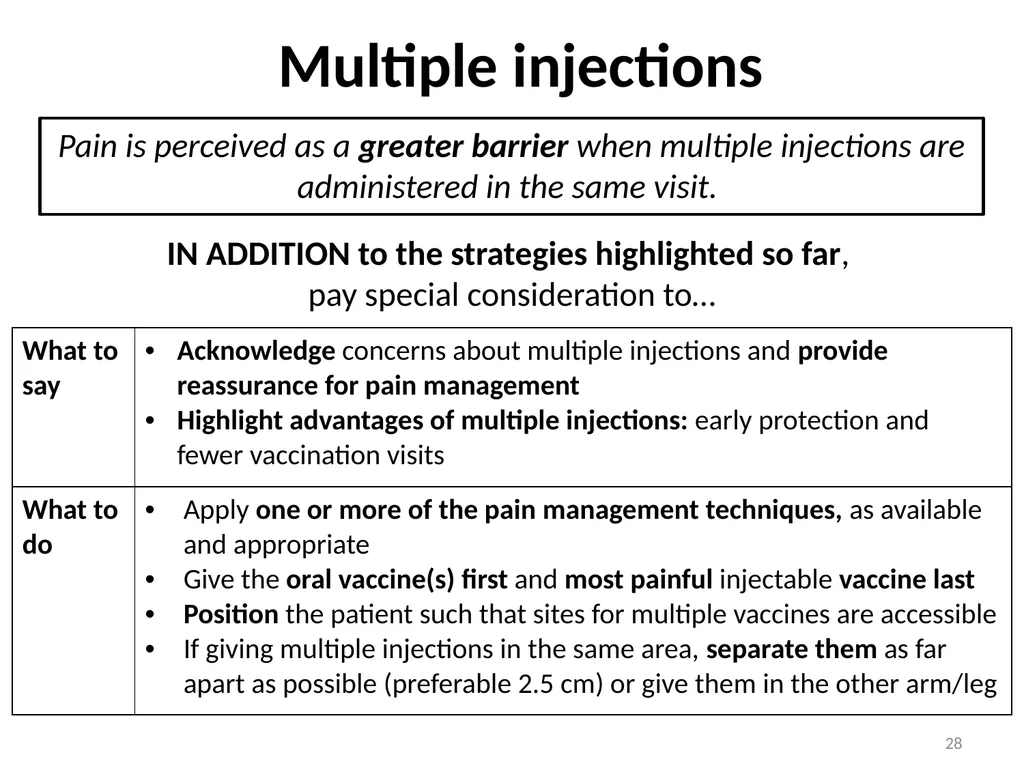
Multiple injections Pain is perceived as a greater barrier when multiple injections are administered in the same visit. IN ADDITION to the strategies highlighted so far,
pay special consideration to… 28<br>
pay special consideration to… 28<br>
29
29 Multiple injections (cont.)<br>
30
Commonly asked questions on
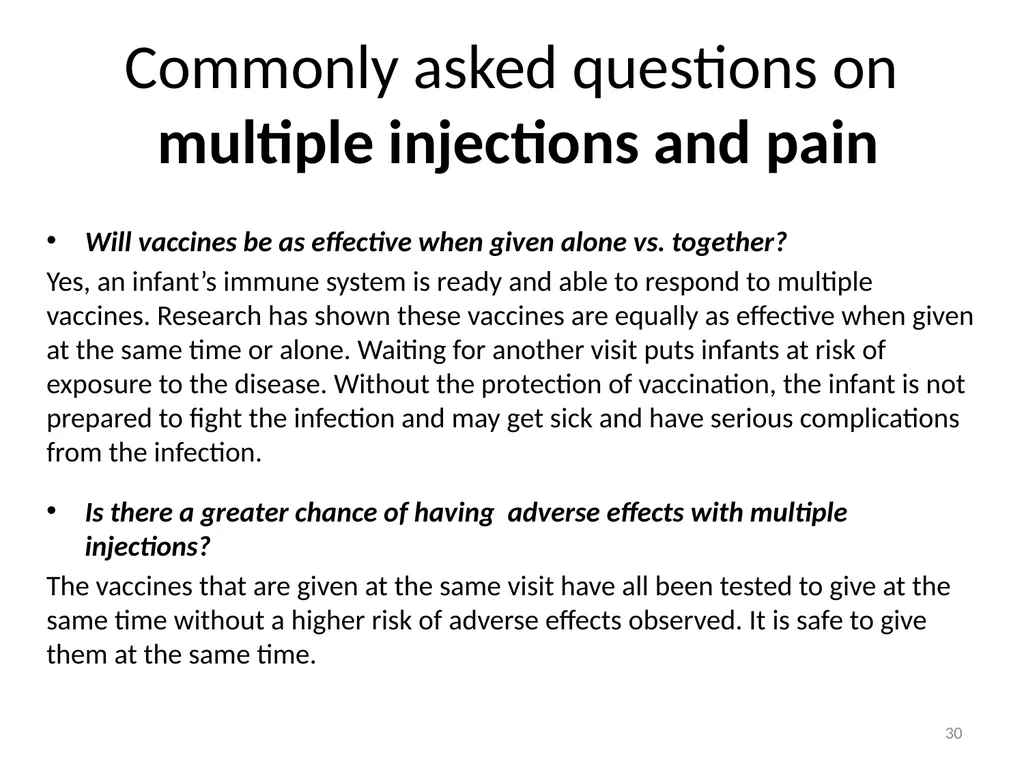
multiple injections and pain Will vaccines be as effective when given alone vs. together?
Yes, an infant’s immune system is ready and able to respond to multiple vaccines. Research has shown these vaccines are equally as effective when given at the same time or alone. Waiting for another visit puts infants at risk of exposure to the disease. Without the protection of vaccination, the infant is not prepared to fight the infection and may get sick and have serious complications from the infection.
Is there a greater chance of having adverse effects with multiple injections?
The vaccines that are given at the same visit have all been tested to give at the same time without a higher risk of adverse effects observed. It is safe to give them at the same time. 30<br>
Yes, an infant’s immune system is ready and able to respond to multiple vaccines. Research has shown these vaccines are equally as effective when given at the same time or alone. Waiting for another visit puts infants at risk of exposure to the disease. Without the protection of vaccination, the infant is not prepared to fight the infection and may get sick and have serious complications from the infection.
Is there a greater chance of having adverse effects with multiple injections?
The vaccines that are given at the same visit have all been tested to give at the same time without a higher risk of adverse effects observed. It is safe to give them at the same time. 30<br>
31
Can I come tomorrow for the next vaccine?
We recommend that you/your child get all vaccines in this visit, if possible. Sometimes, things happen and people are not able to return and then children are not protected from the disease. Also, I wouldn’t want you to experience the inconvenience of having to come back for one more vaccine that we can give now.
What if blood comes out of injection site?
Noticing a small amount of blood coming out after an intermuscular injection is normal. It is not a sign of a problem. You can apply gentle pressure if you wish. 31 Commonly asked questions on multiple injections and pain (cont.)<br>
We recommend that you/your child get all vaccines in this visit, if possible. Sometimes, things happen and people are not able to return and then children are not protected from the disease. Also, I wouldn’t want you to experience the inconvenience of having to come back for one more vaccine that we can give now.
What if blood comes out of injection site?
Noticing a small amount of blood coming out after an intermuscular injection is normal. It is not a sign of a problem. You can apply gentle pressure if you wish. 31 Commonly asked questions on multiple injections and pain (cont.)<br>
32
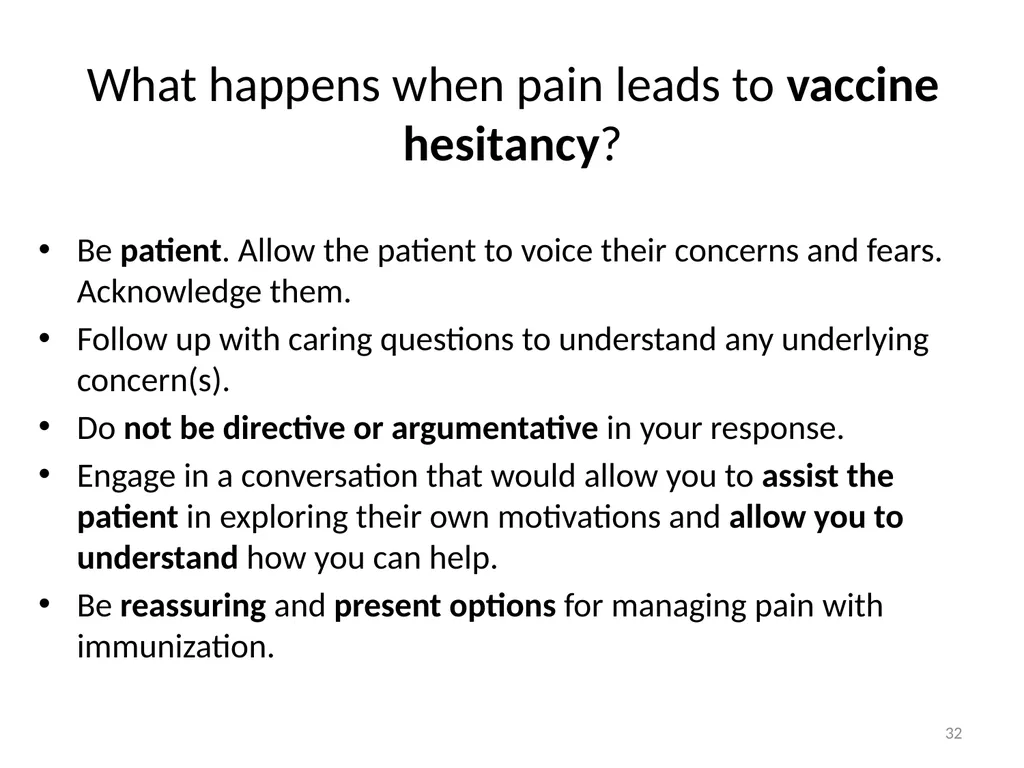
What happens when pain leads to vaccine hesitancy? Be patient. Allow the patient to voice their concerns and fears. Acknowledge them.
Follow up with caring questions to understand any underlying concern(s).
Do not be directive or argumentative in your response.
Engage in a conversation that would allow you to assist the patient in exploring their own motivations and allow you to understand how you can help.
Be reassuring and present options for managing pain with immunization. 32<br>
Follow up with caring questions to understand any underlying concern(s).
Do not be directive or argumentative in your response.
Engage in a conversation that would allow you to assist the patient in exploring their own motivations and allow you to understand how you can help.
Be reassuring and present options for managing pain with immunization. 32<br>
33
What happens when pain leads to refusal of vaccines? 33 If there is refusal of vaccination because of concerns around pain:
Inform the patient that there are options to manage pain and you are able to plan a way to minimize pain so the vaccination can go ahead.
Book a future visit for more conversation and hopefully immunization. If patient has serious needle phobia, you may need expert advice.<br>
Inform the patient that there are options to manage pain and you are able to plan a way to minimize pain so the vaccination can go ahead.
Book a future visit for more conversation and hopefully immunization. If patient has serious needle phobia, you may need expert advice.<br>
34
When applying this guidance to your setting… ADAPT the suggestions depending on availability of resources, time and specific setting 34<br>
35
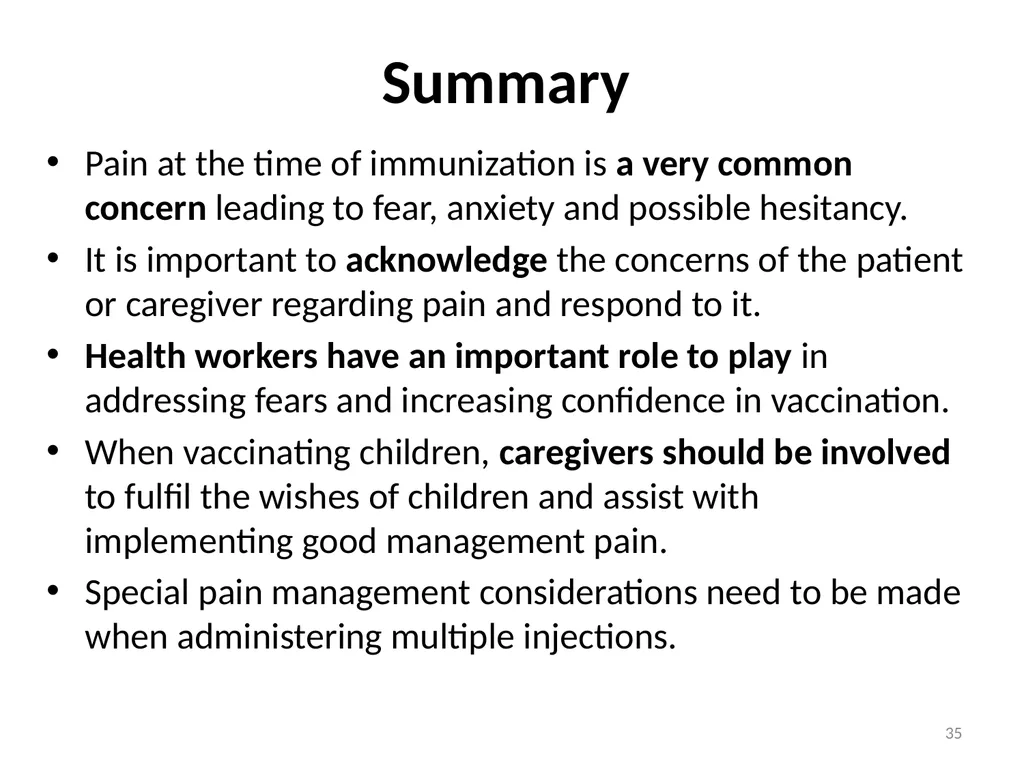
Summary Pain at the time of immunization is a very common concern leading to fear, anxiety and possible hesitancy.
It is important to acknowledge the concerns of the patient or caregiver regarding pain and respond to it.
Health workers have an important role to play in addressing fears and increasing confidence in vaccination.
When vaccinating children, caregivers should be involved to fulfil the wishes of children and assist with implementing good management pain.
Special pain management considerations need to be made when administering multiple injections. 35<br>
It is important to acknowledge the concerns of the patient or caregiver regarding pain and respond to it.
Health workers have an important role to play in addressing fears and increasing confidence in vaccination.
When vaccinating children, caregivers should be involved to fulfil the wishes of children and assist with implementing good management pain.
Special pain management considerations need to be made when administering multiple injections. 35<br>
36
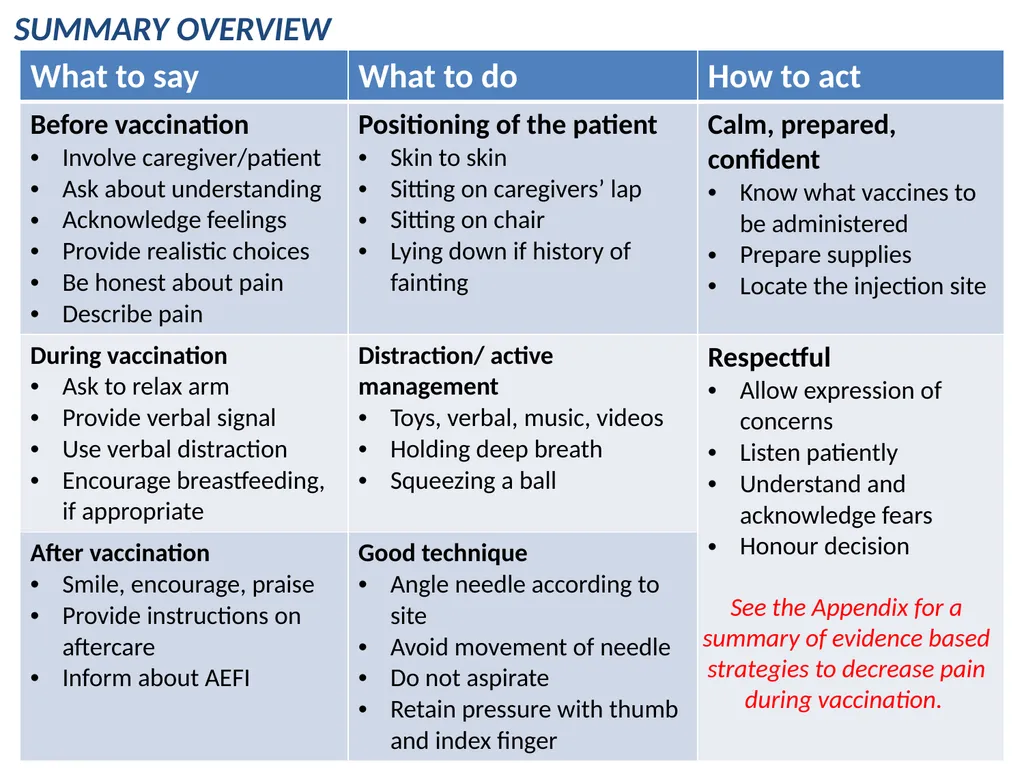
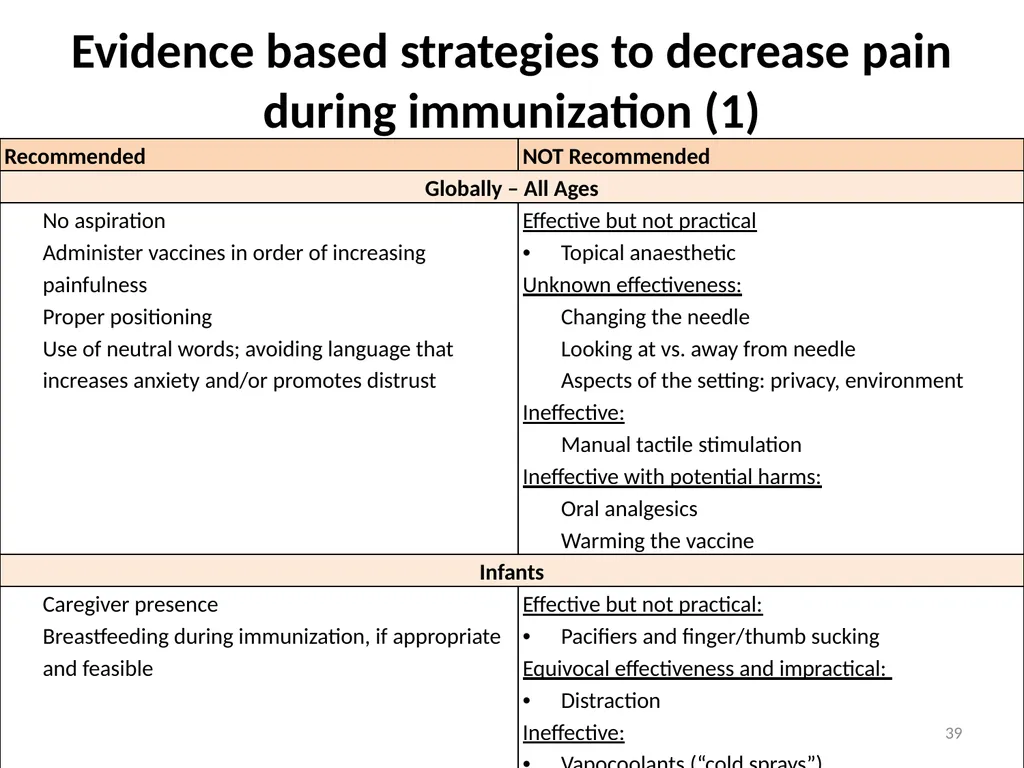
See the Appendix for a summary of evidence based strategies to decrease pain during vaccination. 36 SUMMARY OVERVIEW<br>
37
Thank you for your attention! 37<br>
38
Appendix Summary of evidence-based strategies to decrease pain during vaccination 38<br>
39
39 Evidence based strategies to decrease pain during immunization (1)<br>
40
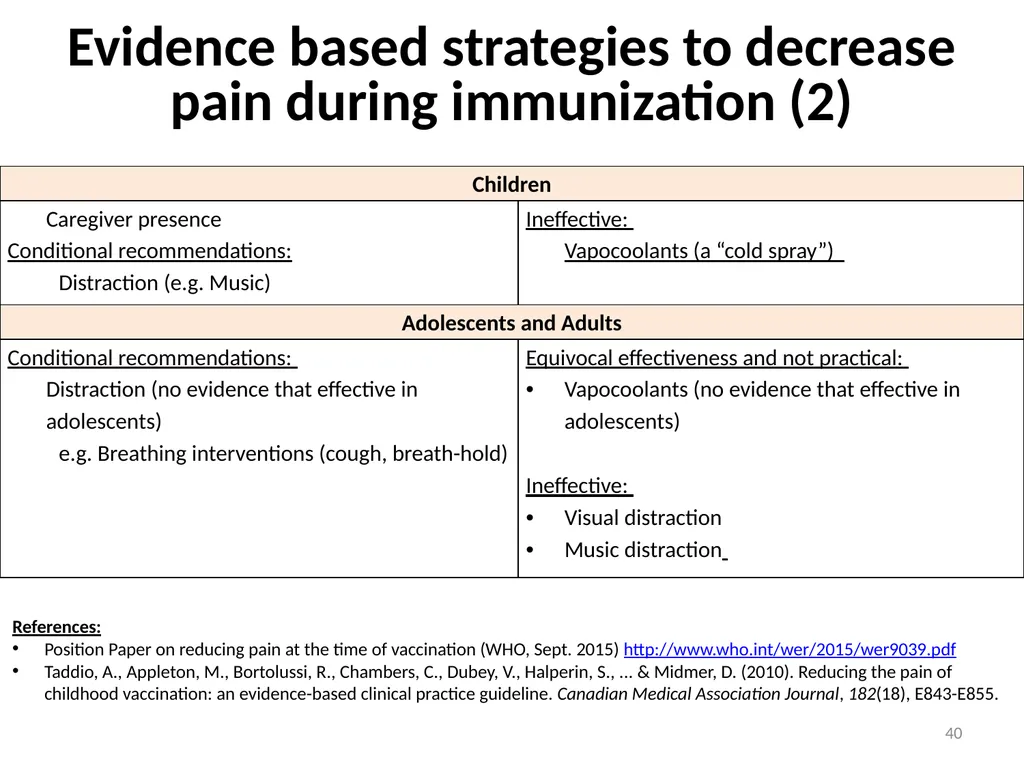
Evidence based strategies to decrease pain during immunization (2) References:
Position Paper on reducing pain at the time of vaccination (WHO, Sept. 2015) http://www.who.int/wer/2015/wer9039.pdf
Taddio, A., Appleton, M., Bortolussi, R., Chambers, C., Dubey, V., Halperin, S., ... & Midmer, D. (2010). Reducing the pain of childhood vaccination: an evidence-based clinical practice guideline. Canadian Medical Association Journal, 182(18), E843-E855. 40<br>
Position Paper on reducing pain at the time of vaccination (WHO, Sept. 2015) http://www.who.int/wer/2015/wer9039.pdf
Taddio, A., Appleton, M., Bortolussi, R., Chambers, C., Dubey, V., Halperin, S., ... & Midmer, D. (2010). Reducing the pain of childhood vaccination: an evidence-based clinical practice guideline. Canadian Medical Association Journal, 182(18), E843-E855. 40<br>