
Mandatory Reporter Training for Camp Staff Working
TA
Published · 41 slides · 0 views

1 / 1


Description
Mandatory Reporter Training for Camp Staff Working with Youth at the University of Georgia Purpose of this Training This is designed to help Georgia mandated reporters recognize the signs of child abuse and neglect, their legal obligations
Related Topics
Share
Embed code
Download this presentation From Below
"Mandatory Reporter Training for Camp Staff Working" is the property of its rightful owner. Permission is granted to download and print the materials on this website for personal, non-commercial use only, and to display it on your personal computer provided you do not modify the materials and that you retain all copyright notices contained in the materials. By downloading content from our website, you accept the terms of this agreement.
Presentation Transcript
01
Mandatory Reporter Training for Camp Staff Working with Youth at the University of Georgia<br>
02
Purpose of this Training This is designed to help Georgia mandated reporters recognize the signs of child abuse and neglect, their legal obligations related to reporting suspected abuse and neglect and how to make the report.<br>
03
Who should I contact? If you need to report suspected child abuse or neglect call:
1-855-GA-CHILD (1-855-422-4453)<br>
1-855-GA-CHILD (1-855-422-4453)<br>
04
Effects of Child Abuse Victims of abuse are more likely to experience:
Developmental delays
Poor physical health
Poor emotional and mental health
Social difficulties
Poor school performance
Behavior problems
Involvement in criminal activity
Chronic health conditions into adulthood<br>
Developmental delays
Poor physical health
Poor emotional and mental health
Social difficulties
Poor school performance
Behavior problems
Involvement in criminal activity
Chronic health conditions into adulthood<br>
05
What is a Mandated Reporter? Certain individuals are called mandated reporters because they are legally required to report suspected child abuse and neglect to the Georgia Division of Family and Children Services (DFCS) as required by the state's laws.<br>
06
Who are mandated reporters? Mandated reporters are individuals who work or volunteer in agencies or organizations that serve children and families. This is a broad category to include those who have the most frequent contact with children in their professional or volunteer lives. They are often the first adults to notice signs of child abuse and neglect. They protect children who cannot protect themselves by reporting suspected child abuse or neglect to the proper authorities.<br>
07
Who are mandated reporters? Anyone employed by or volunteering at an agency or organization providing services to children like those listed below, is a mandated reporter, even if his or her position does not involve direct contact with children.
Care
Treatment
Education
Training
Supervision
Coaching
Counseling
Recreational programs
Shelter<br>
Care
Treatment
Education
Training
Supervision
Coaching
Counseling
Recreational programs
Shelter<br>
08
Who are mandated reporters? Mandated reporters include almost everyone who comes in contact with children – including volunteers at most youth programs and organizations.
Per the UGA Minors on Campus Policy, all camp workers are required to complete training in this area.<br>
Per the UGA Minors on Campus Policy, all camp workers are required to complete training in this area.<br>
09
What is the Role of the Mandated Reporter? Georgia code O.C.G.A.§ 19-7-5 requires mandated reporters to contact the Division of Family and Children Services (DFCS) if they have reasonable cause to believe that a child known to them is suspected of being abused or neglected. Calls should be made to 1-855-422-4453.
In the event of an emergency, call 911.<br>
10
The Mandated Reporter's Role - continued Be clear about what your role is and is not.
If you are a mandated reporter, it is your legal obligation to report your suspicions to your local county DFCS office or to your organization or agency's designated reporter. Familiarize yourself with state law on agency designated reporters (19-7-5) and your agency's policy on reporting suspected abuse or neglect. If you do not have a policy, advocate for one to be implemented.
It is not your role to investigate injuries or anything the child has told you.<br>
11
The Role of DFCS DFCS has an obligation to ensure safety of children under the age of 18 who are not emancipated minors and to be available 24-7 to receive reports. DFCS, based on state law and policy, will determine if a DFCS intervention is needed. The type of intervention will vary depending on the severity of the allegation when the report is screened. DFCS may possibly provide support to the family which includes referral to community resources and/or reconnecting the family to non-professional persons that can provide support and help build the ability of the caregivers to strengthen their own families.<br>
12
Recognizing Types of Abuse and Neglect The first step in fulfilling your role as a mandated reporter is to recognize the main categories of abuse and neglect legally acknowledged by the Georgia Division of Family and Children Services (DFCS). These include:
Physical abuse
Neglect
Emotional abuse*
Sexual abuse
Sexual exploitation
For each type, we will look at both the physical indicators, or what you may see on the child's body, and the behavioral indicators, or how you may observe the child acting.<br>
Physical abuse
Neglect
Emotional abuse*
Sexual abuse
Sexual exploitation
For each type, we will look at both the physical indicators, or what you may see on the child's body, and the behavioral indicators, or how you may observe the child acting.<br>
13
Physical Abuse Georgia Code O.C.G.A.§ 19-7-5 defines physical abuse as "injury or death inflicted upon a child by a parent or caretaker other than by accidental means." Injuries as a result of physical abuse may include severe beatings, burns, bites, fractures, bruises, welts or other physical problems.
Corporal punishment* is legal in Georgia. However, intentionally injuring a child is not. Spanking and any other consequences for a child's behavior should focus on disciplining rather than punishing a child. Leaving a mark or in any way harming a child is not considered discipline.<br>
14
Physical Abuse: Physical Indicators The physical indicators of physical abuse may include:
Unexplained bruises and welts on face, lips, mouth, torso, back, buttocks or thighs
Bruises and welts may be in various stages of healing, clustered, or form patterns
Bite marks
Unexplained fractures or dislocations
Unexplained burns or burns in the shape of an object
Bald patches on the scalp
High or frequent incidence of "accidents"<br>
Unexplained bruises and welts on face, lips, mouth, torso, back, buttocks or thighs
Bruises and welts may be in various stages of healing, clustered, or form patterns
Bite marks
Unexplained fractures or dislocations
Unexplained burns or burns in the shape of an object
Bald patches on the scalp
High or frequent incidence of "accidents"<br>
15
Physical Abuse: Behavioral Indicators The behavioral indicators of physical abuse may include:
Extreme vigilance or watchfulness
Frightened of parents or caregivers
Afraid to go home
Poor social interactions
Bullying smaller children
Acts out inappropriately with dolls or stuffed animals
Poor self-concept<br>
Extreme vigilance or watchfulness
Frightened of parents or caregivers
Afraid to go home
Poor social interactions
Bullying smaller children
Acts out inappropriately with dolls or stuffed animals
Poor self-concept<br>
16
Signs of Parental Drug Abuse Every mandated reporter should be aware of common signs of parental drug abuse and make a report if there is suspected child abuse. Some common signs include:
Sudden change in behavior or odd or irrational behavior
Impaired thinking, confusion and nervousness
Withdrawal from family and friends
Lack of personal grooming or poor hygiene
Red or glassy eyes
Extreme weight loss<br>
Sudden change in behavior or odd or irrational behavior
Impaired thinking, confusion and nervousness
Withdrawal from family and friends
Lack of personal grooming or poor hygiene
Red or glassy eyes
Extreme weight loss<br>
17
Neglect Neglect occurs when a parent or caretaker allows a child to experience avoidable suffering or fails to provide basic essentials for physical, social, and emotional development.<br>
18
Neglect: Physical Indicators The physical indicators of neglect may include:
Underweight, poor growth patterns, failure to thrive
Poor hygiene
Inappropriate dress
Consistent hunger
Evidence of no or poor supervision
Unattended physical problems or medical or dental needs<br>
Underweight, poor growth patterns, failure to thrive
Poor hygiene
Inappropriate dress
Consistent hunger
Evidence of no or poor supervision
Unattended physical problems or medical or dental needs<br>
19
Neglect: Behavioral Indicators The behavioral indicators of neglect may include:
Begging, stealing, or hoarding food in pockets or cubbies
Extended stays at school
Constant fatigue, listlessness or falling asleep in class
Inappropriate seeking of attention
Assuming adult responsibilities or concerns
Reports that there is no caretaker<br>
Begging, stealing, or hoarding food in pockets or cubbies
Extended stays at school
Constant fatigue, listlessness or falling asleep in class
Inappropriate seeking of attention
Assuming adult responsibilities or concerns
Reports that there is no caretaker<br>
20
Emotional Abuse Emotional abuse occurs when a parent or caregiver creates a negative emotional atmosphere for the child. It includes a pattern of behavior that attacks a child's emotional development and sense of self-worth. Emotional abuse includes excessive, aggressive or unreasonable demands that place expectations on a child beyond his or her capacity. Constant criticizing, belittling, insulting, rejecting and teasing are some forms of abusive verbal attacks.
Emotional abuse is often an indication of physical and/or sexual abuse and neglect.<br>
21
Emotional Abuse: Physical Indicators The physical indicators of emotional maltreatment may include:
Speech disorders
Lags in physical development
Failure to thrive
Hyperactive or disruptive behavior<br>
Speech disorders
Lags in physical development
Failure to thrive
Hyperactive or disruptive behavior<br>
22
Emotional Abuse: Behavioral Indicators The behavioral indicators of emotional maltreatment may include:
Habit disorders such as rocking, sucking, biting self
Conduct and learning disorders
Obsessive compulsive disorders such as excessive hand washing
Developmental delays
Lack of self-help skills
Negative statements about self
Cruelty toward others<br>
Habit disorders such as rocking, sucking, biting self
Conduct and learning disorders
Obsessive compulsive disorders such as excessive hand washing
Developmental delays
Lack of self-help skills
Negative statements about self
Cruelty toward others<br>
23
Sexual Abuse Sexual abuse is defined in the Georgia Code (O.C.G.A.§ 19-7-5) as occurring when any adult or older or more powerful child employs, uses, persuades, induces, entices or coerces any minor to engage in any act which involves:
ANY form of sexual intercourse
Physical contact in an act of apparent sexual stimulation with any person's clothed or unclothed genitals, pubic area, or buttocks or with a female's clothed or unclothed breasts
Bestiality (sexual acts with animals)
Masturbation
Lewd exhibition of the breasts, genitals or pubic area
Condition of being fettered, bound, or otherwise physically restrained on the part of a person who is nude
Physical contact in an act of apparent sexual stimulation or gratification with any person's clothed or unclothed genitals, pubic area, or buttocks or with a female's clothed or unclothed breasts
Defecation or urination for the purpose of sexual stimulation
Penetration of the vagina or rectum by any object except when done as part of a recognized medical procedure
In Georgia, sexual abuse does not include consensual sex acts between minors or between a minor and an adult who is not more than 5 years older than the minor (O.C.G.A. § 19-7-5(b)(10)).<br>
ANY form of sexual intercourse
Physical contact in an act of apparent sexual stimulation with any person's clothed or unclothed genitals, pubic area, or buttocks or with a female's clothed or unclothed breasts
Bestiality (sexual acts with animals)
Masturbation
Lewd exhibition of the breasts, genitals or pubic area
Condition of being fettered, bound, or otherwise physically restrained on the part of a person who is nude
Physical contact in an act of apparent sexual stimulation or gratification with any person's clothed or unclothed genitals, pubic area, or buttocks or with a female's clothed or unclothed breasts
Defecation or urination for the purpose of sexual stimulation
Penetration of the vagina or rectum by any object except when done as part of a recognized medical procedure
In Georgia, sexual abuse does not include consensual sex acts between minors or between a minor and an adult who is not more than 5 years older than the minor (O.C.G.A. § 19-7-5(b)(10)).<br>
24
Sexual Abuse: Physical Indicators The physical indicators of sexual abuse may include:
Difficulty in walking or sitting
Torn, stained or bloody underclothing
Pain, swelling or itching in genital area
Pain upon urination
Bruises, bleeding or lacerations in external genitalia
Sexually transmitted disease
Pregnancy in pre-adolescent girls (10-12 years old)<br>
Difficulty in walking or sitting
Torn, stained or bloody underclothing
Pain, swelling or itching in genital area
Pain upon urination
Bruises, bleeding or lacerations in external genitalia
Sexually transmitted disease
Pregnancy in pre-adolescent girls (10-12 years old)<br>
25
Sexual Abuse: Behavioral Indicators The behavioral indicators of sexual abuse may include:
Obsessive genital contact
Sexual knowledge beyond what is age appropriate
Aggressive acting out
Sleeping and eating disorders
Wetting the bed
Poor peer relationships
Unexplained aggression or fear<br>
Obsessive genital contact
Sexual knowledge beyond what is age appropriate
Aggressive acting out
Sleeping and eating disorders
Wetting the bed
Poor peer relationships
Unexplained aggression or fear<br>
26
Commercial Sexual Exploitation of Children Commercial sexual exploitation of children (also known as domestic minor sex trafficking) is sexual abuse/prostitution of a child by an adult involving payment in cash, food, shelter, or other forms of value to the child or third person. Sexual exploitation involves treatment of the child as a sexual and commercial object for activities such as prostitution, adult entertainment, pornography and other forms of transactional sex where a child engages in sexual activities.
Mandated reporters must report if they suspect anyone, not just the parent or caregiver, is exploiting a child.<br>
27
Sexual Exploitation: Physical Indicators The physical indicators of sexual exploitation may include:
Inappropriate clothing/dressing "older"
Little to no eye contact
Weight loss
Unexplained bruises or other injuries
Scars from past injuries
Tattoos of names, nicknames or gang affiliations<br>
Inappropriate clothing/dressing "older"
Little to no eye contact
Weight loss
Unexplained bruises or other injuries
Scars from past injuries
Tattoos of names, nicknames or gang affiliations<br>
28
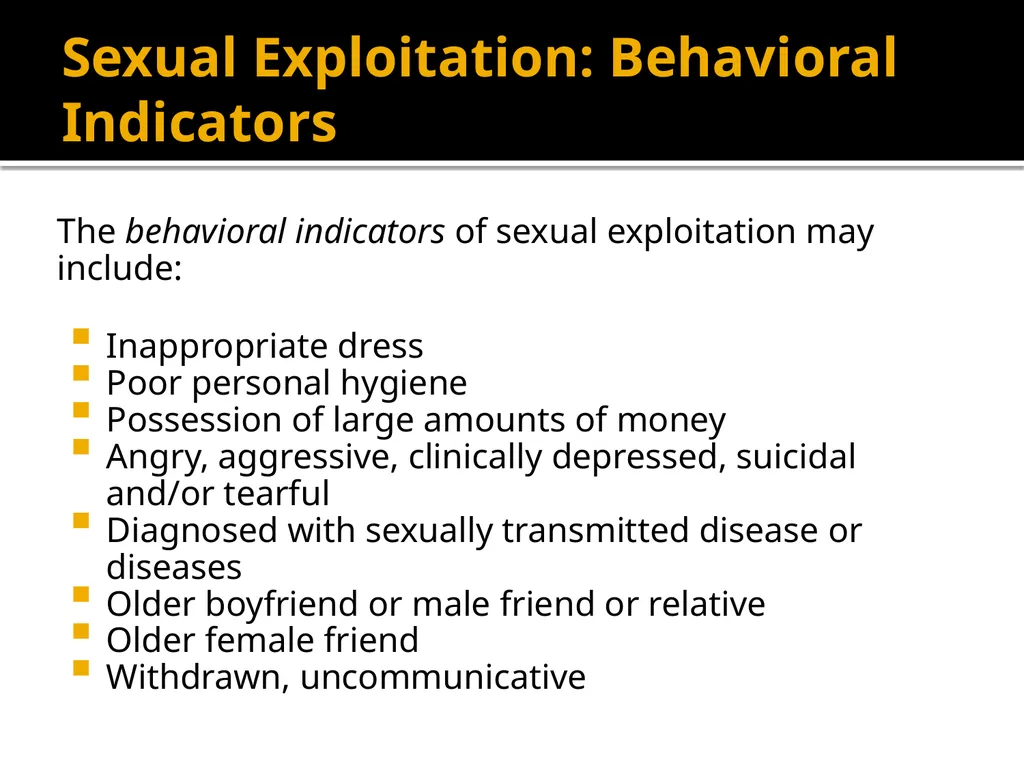
Sexual Exploitation: Behavioral Indicators The behavioral indicators of sexual exploitation may include:
Inappropriate dress
Poor personal hygiene
Possession of large amounts of money
Angry, aggressive, clinically depressed, suicidal and/or tearful
Diagnosed with sexually transmitted disease or diseases
Older boyfriend or male friend or relative
Older female friend
Withdrawn, uncommunicative<br>
Inappropriate dress
Poor personal hygiene
Possession of large amounts of money
Angry, aggressive, clinically depressed, suicidal and/or tearful
Diagnosed with sexually transmitted disease or diseases
Older boyfriend or male friend or relative
Older female friend
Withdrawn, uncommunicative<br>
29
Recognizing Abuse It is important to note that children who are abused or neglected will typically exhibit a variety of indicators, as one type of abuse or neglect rarely occurs alone. For instance, it would be rare for a child to be physically abused and not be emotionally abused as well. So the child may exhibit physical and behavioral indicators of both physical and emotional abuse.<br>
30
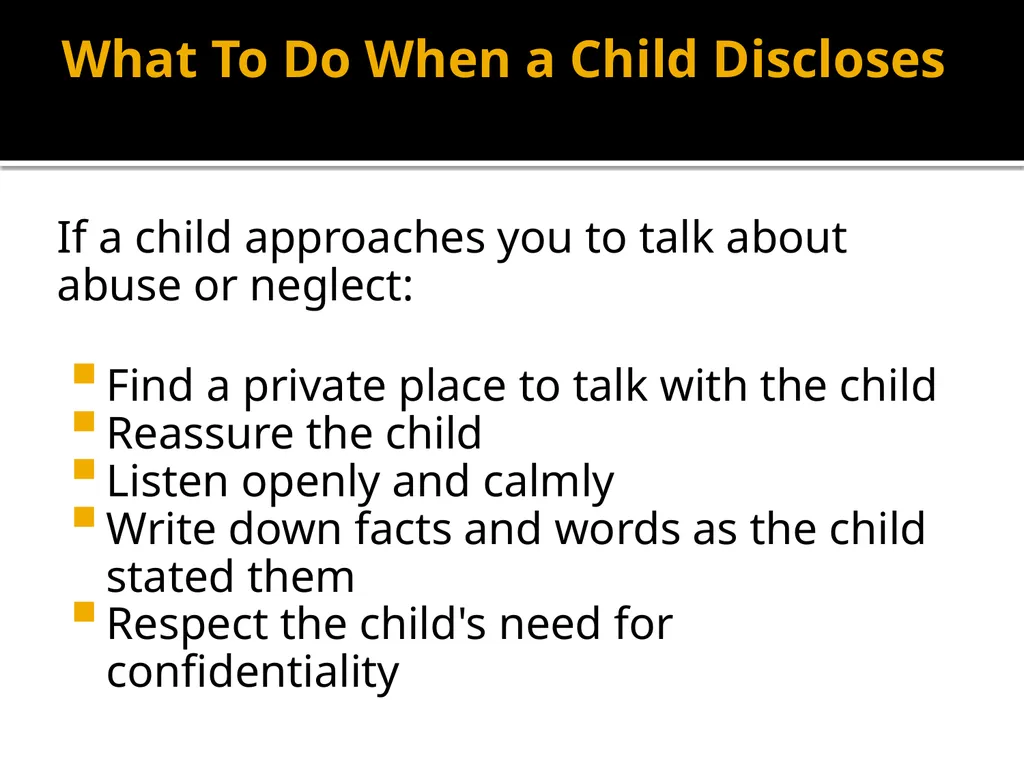
What To Do When a Child Discloses If a child approaches you to talk about abuse or neglect:
Find a private place to talk with the child
Reassure the child
Listen openly and calmly
Write down facts and words as the child stated them
Respect the child's need for confidentiality<br>
Find a private place to talk with the child
Reassure the child
Listen openly and calmly
Write down facts and words as the child stated them
Respect the child's need for confidentiality<br>
31
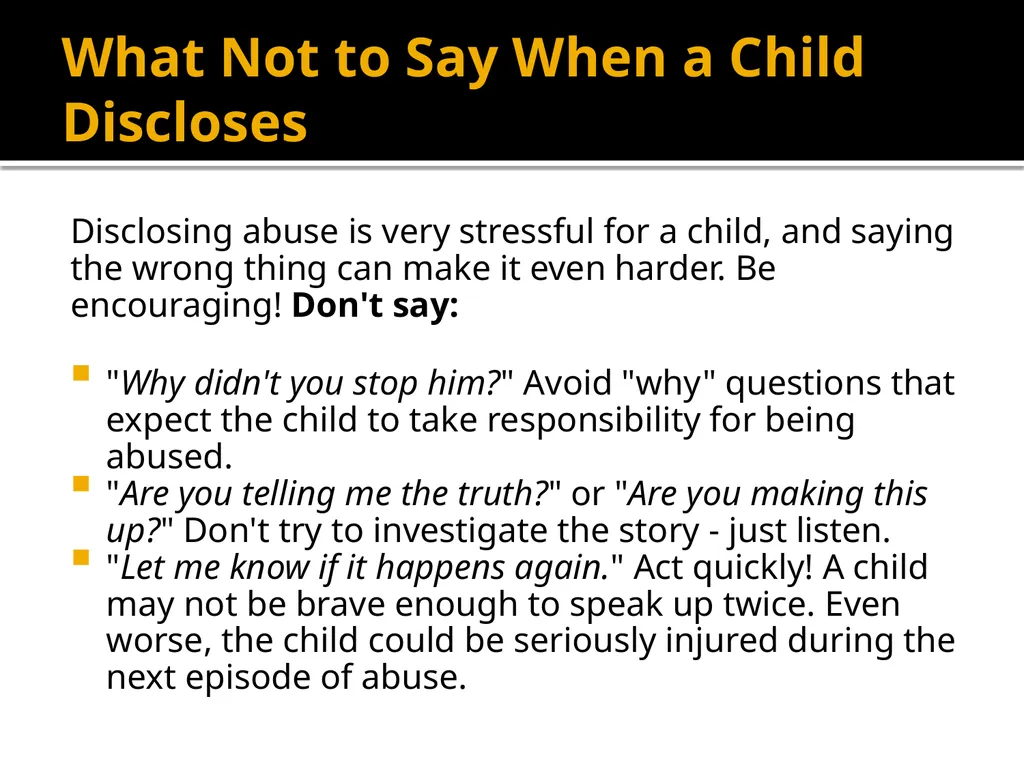
What Not to Say When a Child Discloses Disclosing abuse is very stressful for a child, and saying the wrong thing can make it even harder. Be encouraging! Don't say:
"Why didn't you stop him?" Avoid "why" questions that expect the child to take responsibility for being abused.
"Are you telling me the truth?" or "Are you making this up?" Don't try to investigate the story - just listen.
"Let me know if it happens again." Act quickly! A child may not be brave enough to speak up twice. Even worse, the child could be seriously injured during the next episode of abuse.<br>
"Why didn't you stop him?" Avoid "why" questions that expect the child to take responsibility for being abused.
"Are you telling me the truth?" or "Are you making this up?" Don't try to investigate the story - just listen.
"Let me know if it happens again." Act quickly! A child may not be brave enough to speak up twice. Even worse, the child could be seriously injured during the next episode of abuse.<br>
32
Tips for Talking to Children Be mindful of your body language - Come down to the child's level when you are talking to him or her. Respect the child's space. Do not lean in too close to the child when he or she is speaking. With a teenager, you may find that they avoid eye contact. Respect that and let the story come at its own pace.
Facial expressions - When listening to a child, be aware of your facial expressions. Although you may feel shocked or surprised by the disclosure, try to maintain a calm expression.<br>
33
Tips for Talking to Children - continued Never put words in a child's mouth - Asking leading questions can harm the child and damage the investigation. For instance, if a child says, "My dad hurt me," don't ask, "Did he touch you in a private place?" Ask, for example, "How did he hurt you?" Mirror back the words they use and do not correct their grammar or language.
Minimize your questioning - It is important to limit the number of times a child is questioned or interviewed about an abuse or neglect incident. Multiple interviews can traumatize the child and should be avoided at all costs. Leave the interview process to the trained professional investigator.
Remember, all you need is reasonable cause to believe that abuse or neglect occurred in order to report it to DFCS or your organization's designated reporter.<br>
34
Reporting Suspected Abuse or Neglect Georgia law requires anyone who works or volunteers at a child serving agency to report suspected child abuse or neglect within 24 hours (O.C.G.A. § 19-7-5).
Frequently, hospitals, schools and other facilities have an internal child abuse report protocol. You should be aware of this protocol and follow it.
For instance, there may be a designated reporter like the child care center director who is charged with making reports to DFCS. Each organization will handle this in their own way to assure that accurate reports are made in a timely fashion. If a mandated reporter informs the agency's designated reporter of suspected abuse or neglect, the mandated reporter is considered to have fulfilled their obligation under the law.<br>
35
To whom do you report? To make a report, call:
1-855-GA-CHILD (1-855-422-4453)
If you feel the child is in immediate danger, call 911.<br>
36
Report By Email or Phone You can make a report of suspected abuse by email or fax. The Georgia Mandated Reporter Form is to be used by mandated reporters who wish to report electronically - either by email (cpsintake@dhr.state.ga.us) or by fax (229-317-9663)<br>
37
What are the penalties for not reporting? Any person or official required by Georgia law to report suspected cases of child abuse and who knowingly and willfully fails to do so shall be guilty of a misdemeanor. A misdemeanor is a crime that is less serious than a felony but can still be punishable by fine or incarceration in a county jail.<br>
38
Rights of the Mandated Reporter Mandated reporters who report in good faith are protected by the law, even if the report is not substantiated.
All reports are confidential and the reporter may remain anonymous, if they choose to do so. However, in some instances, the mandated reporter does not wish to remain anonymous and would like to be interviewed and/or serve as a resource for the child/family. DFCS is required to keep the reporter's name confidential!<br>
39
What information should you be prepared to report? Make the report even if you do not have all the information. Remember, you are not an investigator.
Name, age, home address and current location of the child
Name and address of the child's parents or caregivers, if known
Name and address of suspected maltreater
Locations where abuse took place, if known
The nature and extent of injuries
Any other information the reporter believes might be helpful in establishing the cause of the injuries and the identity of the perpetrator
Any information about other household members
If you have this information written down, it will help save time when you call. The intake worker will ask you for additional information. You do not need to know the specific answers in order to report child abuse.<br>
Name, age, home address and current location of the child
Name and address of the child's parents or caregivers, if known
Name and address of suspected maltreater
Locations where abuse took place, if known
The nature and extent of injuries
Any other information the reporter believes might be helpful in establishing the cause of the injuries and the identity of the perpetrator
Any information about other household members
If you have this information written down, it will help save time when you call. The intake worker will ask you for additional information. You do not need to know the specific answers in order to report child abuse.<br>
40
What happens when you make a report? Your job as a mandated reporter is to assure that DFCS is contacted whenever you have reason to believe that a child has been abused or neglected.
It is the job of DFCS to thoroughly screen, assess and determine if services are needed to protect the child. If you provided contact information, you will receive a written acknowledgement of your report from DFCS. It should indicate the outcome of the referral.<br>
41
Thank you! The Mandated Reporter Training is now complete. Please confirm you have completed this training on the Camp Training Website.<br>