
Manicure & Pedicure Introduction Manicure &
OM
Published · 40 slides · 0 views

1 / 1



Description
Manicure Pedicure Introduction Manicure Pedicure is the foundation for any nail technician. During your course we will cover enhanced knowledge into anatomy and physiology of the hands and feet to gain informed knowledge of the
Related Topics
Share
Embed code
Download this presentation From Below
"Manicure & Pedicure Introduction Manicure &" is the property of its rightful owner. Permission is granted to download and print the materials on this website for personal, non-commercial use only, and to display it on your personal computer provided you do not modify the materials and that you retain all copyright notices contained in the materials. By downloading content from our website, you accept the terms of this agreement.
Presentation Transcript
01
Manicure & Pedicure<br>
02
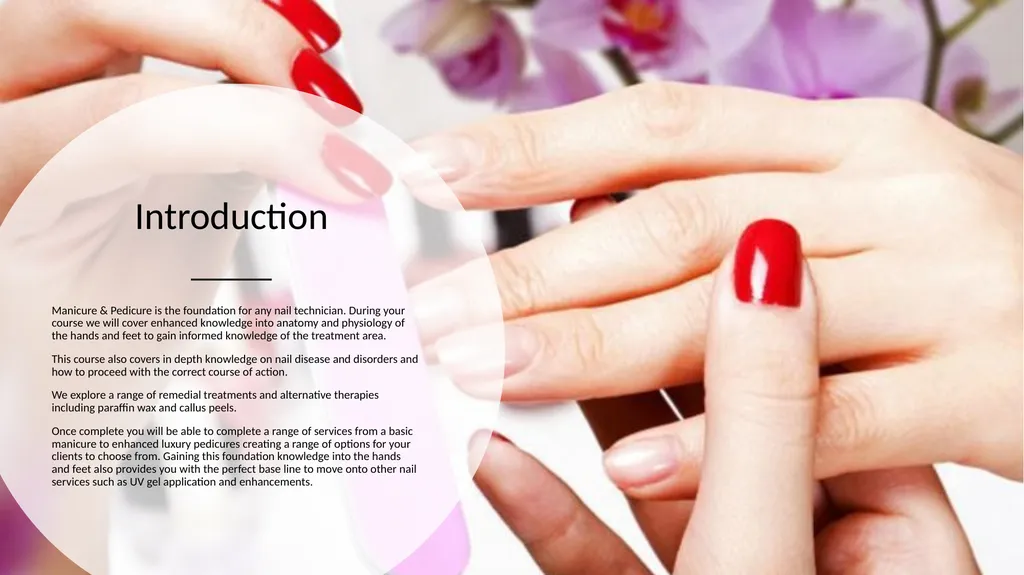
Introduction Manicure & Pedicure is the foundation for any nail technician. During your course we will cover enhanced knowledge into anatomy and physiology of the hands and feet to gain informed knowledge of the treatment area.
This course also covers in depth knowledge on nail disease and disorders and how to proceed with the correct course of action.
We explore a range of remedial treatments and alternative therapies including paraffin wax and callus peels.
Once complete you will be able to complete a range of services from a basic manicure to enhanced luxury pedicures creating a range of options for your clients to choose from. Gaining this foundation knowledge into the hands and feet also provides you with the perfect base line to move onto other nail services such as UV gel application and enhancements.<br>
This course also covers in depth knowledge on nail disease and disorders and how to proceed with the correct course of action.
We explore a range of remedial treatments and alternative therapies including paraffin wax and callus peels.
Once complete you will be able to complete a range of services from a basic manicure to enhanced luxury pedicures creating a range of options for your clients to choose from. Gaining this foundation knowledge into the hands and feet also provides you with the perfect base line to move onto other nail services such as UV gel application and enhancements.<br>
03
Client Satisfaction In an ever changing and competitive industry, to be a successful nail technician offering manicure and pedicure services, having a good reputation and providing excellent customer care is a must. A service can only be truly personal when the needs of an individual client are understood, and the treatment they receive match those of their needs. Clients will visit you for many reasons, these will include:
To complete their look for a special event.
To keep their hands and feet in good condition.
To help improve and control the appearance of certain conditions and disorders.
To make your clients hand look and feel younger.
As a treat to spoil themselves for a special occasion.
As a relaxion and enjoyable experience, something different to everyday life stresses.
To help boost self-confidence.
General improvement of a person’s feelings and wellbeing.
It is important that you listen to their desires and can meet the clients expectations within reason. Clear price structure, description of the service they are receiving and time frame requiried will help ensure that satisfaction is guaranteed.<br>
To complete their look for a special event.
To keep their hands and feet in good condition.
To help improve and control the appearance of certain conditions and disorders.
To make your clients hand look and feel younger.
As a treat to spoil themselves for a special occasion.
As a relaxion and enjoyable experience, something different to everyday life stresses.
To help boost self-confidence.
General improvement of a person’s feelings and wellbeing.
It is important that you listen to their desires and can meet the clients expectations within reason. Clear price structure, description of the service they are receiving and time frame requiried will help ensure that satisfaction is guaranteed.<br>
04
Client Consultation Keeping informed records of your client’s treatments, basic information and outcomes is an important part of any nail treatment.
The things to consider within your records will be:
Name of procedure, signed to agree the procedure has been explained, correctly priced, suitable and not contraindicated in any way, expectations discussed, possible side effects, possible allergies, general medical questionnaire, age and before and after photos.
Age of completing the service will be set by your insurance provider, it will usually be set at a range of 14-16. We recommend for professional standards that you do not provide this service on anyone under the age of sixteen years without parental consent.
Failure to complete client record cards will void your insurance.
All record keeping should comply with GPDR data protection.
Client consultation template available with this training.<br>
The things to consider within your records will be:
Name of procedure, signed to agree the procedure has been explained, correctly priced, suitable and not contraindicated in any way, expectations discussed, possible side effects, possible allergies, general medical questionnaire, age and before and after photos.
Age of completing the service will be set by your insurance provider, it will usually be set at a range of 14-16. We recommend for professional standards that you do not provide this service on anyone under the age of sixteen years without parental consent.
Failure to complete client record cards will void your insurance.
All record keeping should comply with GPDR data protection.
Client consultation template available with this training.<br>
05
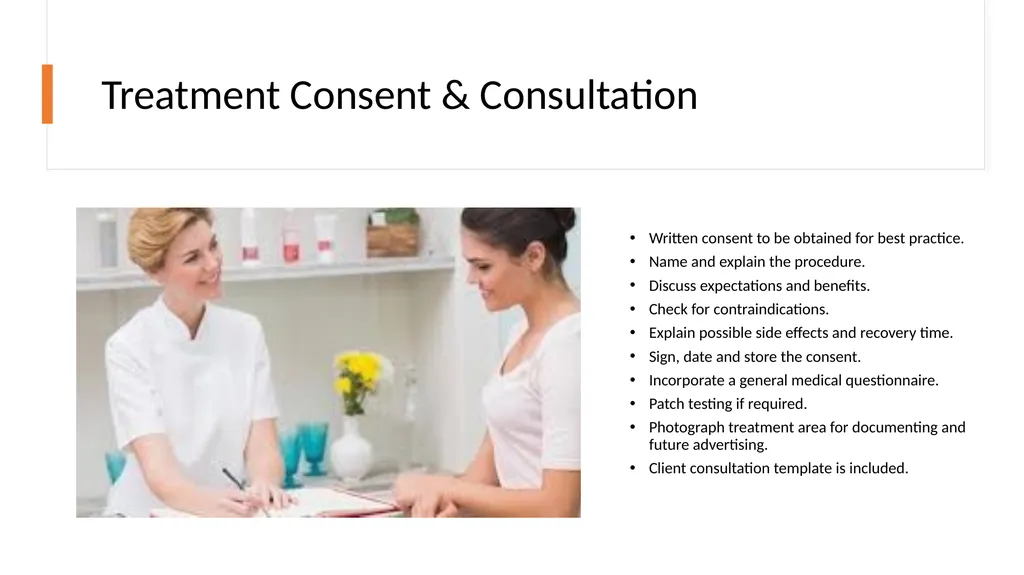
Treatment Consent & Consultation Written consent to be obtained for best practice.
Name and explain the procedure.
Discuss expectations and benefits.
Check for contraindications.
Explain possible side effects and recovery time.
Sign, date and store the consent.
Incorporate a general medical questionnaire.
Patch testing if required.
Photograph treatment area for documenting and future advertising.
Client consultation template is included.<br>
Name and explain the procedure.
Discuss expectations and benefits.
Check for contraindications.
Explain possible side effects and recovery time.
Sign, date and store the consent.
Incorporate a general medical questionnaire.
Patch testing if required.
Photograph treatment area for documenting and future advertising.
Client consultation template is included.<br>
06
Health & Safety Creating a safe working environment for both you and your client are equally important. Working in a safe and hygienic setting allows both you and the client to enjoy the experience and reduce any risks that may occur.
Washing hands before and after each client will reduce the risk of cross contamination. This should involve a thorough cleanse taking approximately 30 seconds using an antibacterial soap and warm running water. Once thoroughly cleaned dry with disposable paper towels.
Sanitising gels are an effective use of keeping the hands clean and again should be used before each treatment. They will prevent the growth of microorganisms and should be used on the hands of both you and the client if relevant.
Salon hygiene should always be considered in the form of a clean working environment. Fresh towels and couch roll for each treatment, do not eat or drink in your working space. Keep working surfaces sanitised with no loose cables or wires exposed causing potential hazards.
Disinfectant is used for the destruction of most living organisms and is suitable for the cleansing of walls, floors, work surfaces, doors and non metal work tools. Disinfectant should be made up fresh prior to use. They usually require watering down, always follow the manufacturers guidelines to ensure safe use.
General waste should be disposed of in a container and not to be mixed with any form of clinical or home waste.
Clothing should be work appropriate such as a tunic or uniform. Washed daily and changed if contaminated with foreign matter.
Keep long hair tied back, nails short and tidy and consider your personal hygiene and smoking habits.<br>
Washing hands before and after each client will reduce the risk of cross contamination. This should involve a thorough cleanse taking approximately 30 seconds using an antibacterial soap and warm running water. Once thoroughly cleaned dry with disposable paper towels.
Sanitising gels are an effective use of keeping the hands clean and again should be used before each treatment. They will prevent the growth of microorganisms and should be used on the hands of both you and the client if relevant.
Salon hygiene should always be considered in the form of a clean working environment. Fresh towels and couch roll for each treatment, do not eat or drink in your working space. Keep working surfaces sanitised with no loose cables or wires exposed causing potential hazards.
Disinfectant is used for the destruction of most living organisms and is suitable for the cleansing of walls, floors, work surfaces, doors and non metal work tools. Disinfectant should be made up fresh prior to use. They usually require watering down, always follow the manufacturers guidelines to ensure safe use.
General waste should be disposed of in a container and not to be mixed with any form of clinical or home waste.
Clothing should be work appropriate such as a tunic or uniform. Washed daily and changed if contaminated with foreign matter.
Keep long hair tied back, nails short and tidy and consider your personal hygiene and smoking habits.<br>
07
Sanitation During a nail service both you and the client’s welfare must be considered at each appointment. Correct treatment set up will reduce the risk of potential complications. The use of good quality products will keep a high professional standard within your salon.
In the Beauty Industry we are working in a close body contact situation where the risk of cross infection exists between the client and the therapist, as well as between the clients. Clients have a right to expect that in all such personal treatments there will be a high standard of hygiene and cleanliness of surfaces and instruments, and the washing of hands prior to treatment should become second nature.
Basic cleaning principles:
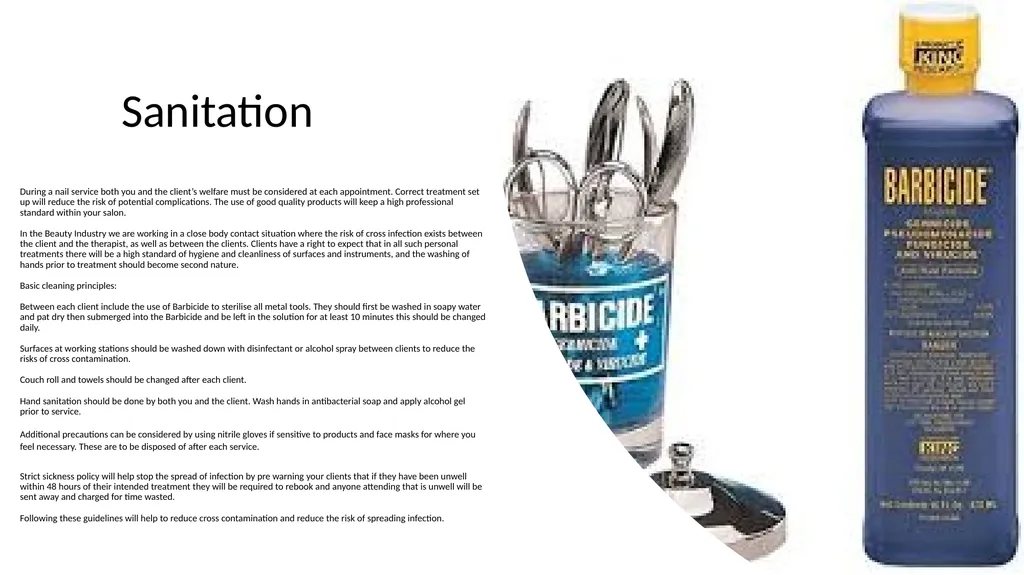
Between each client include the use of Barbicide to sterilise all metal tools. They should first be washed in soapy water and pat dry then submerged into the Barbicide and be left in the solution for at least 10 minutes this should be changed daily.
Surfaces at working stations should be washed down with disinfectant or alcohol spray between clients to reduce the risks of cross contamination.
Couch roll and towels should be changed after each client.
Hand sanitation should be done by both you and the client. Wash hands in antibacterial soap and apply alcohol gel prior to service.
Additional precautions can be considered by using nitrile gloves if sensitive to products and face masks for where you feel necessary. These are to be disposed of after each service.
Strict sickness policy will help stop the spread of infection by pre warning your clients that if they have been unwell within 48 hours of their intended treatment they will be required to rebook and anyone attending that is unwell will be sent away and charged for time wasted.
Following these guidelines will help to reduce cross contamination and reduce the risk of spreading infection.<br>
In the Beauty Industry we are working in a close body contact situation where the risk of cross infection exists between the client and the therapist, as well as between the clients. Clients have a right to expect that in all such personal treatments there will be a high standard of hygiene and cleanliness of surfaces and instruments, and the washing of hands prior to treatment should become second nature.
Basic cleaning principles:
Between each client include the use of Barbicide to sterilise all metal tools. They should first be washed in soapy water and pat dry then submerged into the Barbicide and be left in the solution for at least 10 minutes this should be changed daily.
Surfaces at working stations should be washed down with disinfectant or alcohol spray between clients to reduce the risks of cross contamination.
Couch roll and towels should be changed after each client.
Hand sanitation should be done by both you and the client. Wash hands in antibacterial soap and apply alcohol gel prior to service.
Additional precautions can be considered by using nitrile gloves if sensitive to products and face masks for where you feel necessary. These are to be disposed of after each service.
Strict sickness policy will help stop the spread of infection by pre warning your clients that if they have been unwell within 48 hours of their intended treatment they will be required to rebook and anyone attending that is unwell will be sent away and charged for time wasted.
Following these guidelines will help to reduce cross contamination and reduce the risk of spreading infection.<br>
08
NHS Guidelines To Handwashing Especially with the impact of Coronavirus in 2020, it has never been more important and a basic need to be keeping our hands clean.
We advise your clients wash their hands upon arrival and when leaving your premises to reduce the risk of cross contamination.
It is important that you wash your hands frequently including before and after a service and between each client.
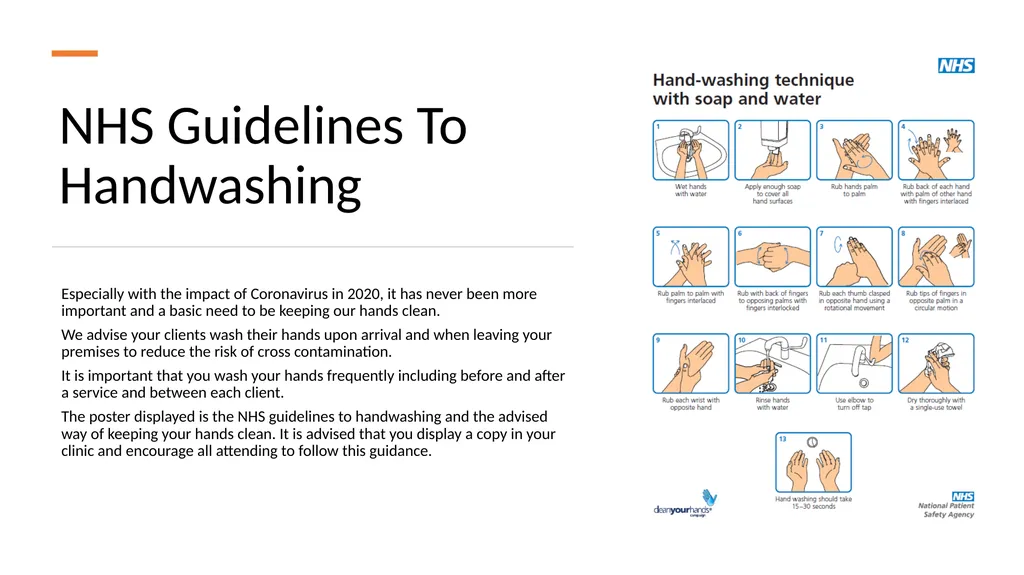
The poster displayed is the NHS guidelines to handwashing and the advised way of keeping your hands clean. It is advised that you display a copy in your clinic and encourage all attending to follow this guidance.<br>
We advise your clients wash their hands upon arrival and when leaving your premises to reduce the risk of cross contamination.
It is important that you wash your hands frequently including before and after a service and between each client.
The poster displayed is the NHS guidelines to handwashing and the advised way of keeping your hands clean. It is advised that you display a copy in your clinic and encourage all attending to follow this guidance.<br>
09
Insurance As a professional therapist setting high industry standards is key. Keeping your records up to date following guidelines set out by your insurance provider and keeping your insurance up to date are absolute basics all should follow.
There are many industry specific brokers and insurance firms in the UK that you can obtain a suitable public and professional liability insurance policy from. Several basic level beauty policies starting at less than £100 a year. This should be in place before working on the public and charging for your services.
Insurance providers can be found in the notes section at the end of your training.
Age of suitability of service is set out by your insurance provider always check their guidelines before offering services, from our professional opinion we advise service is not carried out on anyone under the age of 14 years.<br>
There are many industry specific brokers and insurance firms in the UK that you can obtain a suitable public and professional liability insurance policy from. Several basic level beauty policies starting at less than £100 a year. This should be in place before working on the public and charging for your services.
Insurance providers can be found in the notes section at the end of your training.
Age of suitability of service is set out by your insurance provider always check their guidelines before offering services, from our professional opinion we advise service is not carried out on anyone under the age of 14 years.<br>
10
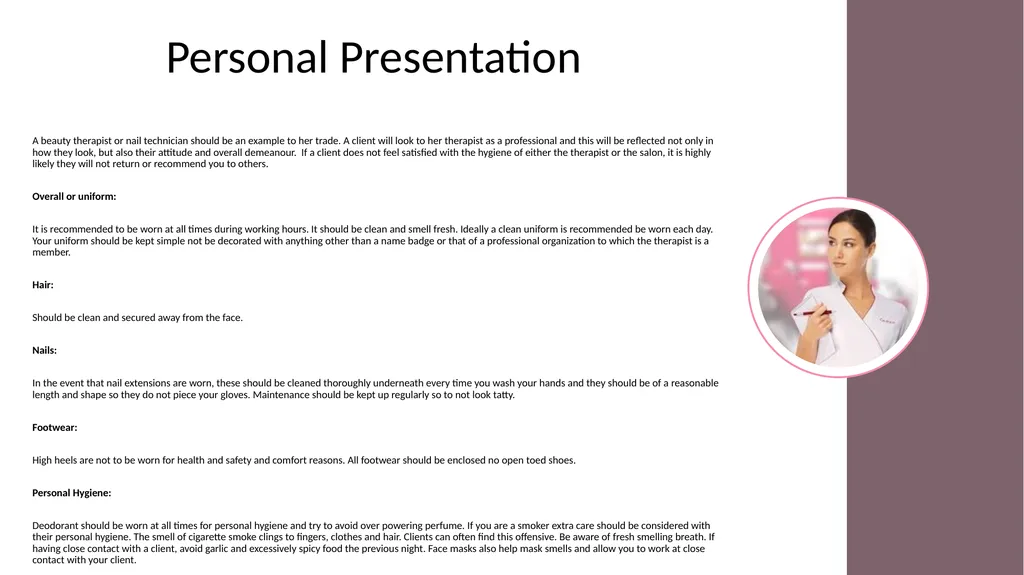
Personal Presentation A beauty therapist or nail technician should be an example to her trade. A client will look to her therapist as a professional and this will be reflected not only in how they look, but also their attitude and overall demeanour. If a client does not feel satisfied with the hygiene of either the therapist or the salon, it is highly likely they will not return or recommend you to others.
Overall or uniform:
It is recommended to be worn at all times during working hours. It should be clean and smell fresh. Ideally a clean uniform is recommended be worn each day. Your uniform should be kept simple not be decorated with anything other than a name badge or that of a professional organization to which the therapist is a member.
Hair:
Should be clean and secured away from the face.
Nails:
In the event that nail extensions are worn, these should be cleaned thoroughly underneath every time you wash your hands and they should be of a reasonable length and shape so they do not piece your gloves. Maintenance should be kept up regularly so to not look tatty.
Footwear:
High heels are not to be worn for health and safety and comfort reasons. All footwear should be enclosed no open toed shoes.
Personal Hygiene:
Deodorant should be worn at all times for personal hygiene and try to avoid over powering perfume. If you are a smoker extra care should be considered with their personal hygiene. The smell of cigarette smoke clings to fingers, clothes and hair. Clients can often find this offensive. Be aware of fresh smelling breath. If having close contact with a client, avoid garlic and excessively spicy food the previous night. Face masks also help mask smells and allow you to work at close contact with your client.<br>
Overall or uniform:
It is recommended to be worn at all times during working hours. It should be clean and smell fresh. Ideally a clean uniform is recommended be worn each day. Your uniform should be kept simple not be decorated with anything other than a name badge or that of a professional organization to which the therapist is a member.
Hair:
Should be clean and secured away from the face.
Nails:
In the event that nail extensions are worn, these should be cleaned thoroughly underneath every time you wash your hands and they should be of a reasonable length and shape so they do not piece your gloves. Maintenance should be kept up regularly so to not look tatty.
Footwear:
High heels are not to be worn for health and safety and comfort reasons. All footwear should be enclosed no open toed shoes.
Personal Hygiene:
Deodorant should be worn at all times for personal hygiene and try to avoid over powering perfume. If you are a smoker extra care should be considered with their personal hygiene. The smell of cigarette smoke clings to fingers, clothes and hair. Clients can often find this offensive. Be aware of fresh smelling breath. If having close contact with a client, avoid garlic and excessively spicy food the previous night. Face masks also help mask smells and allow you to work at close contact with your client.<br>
11
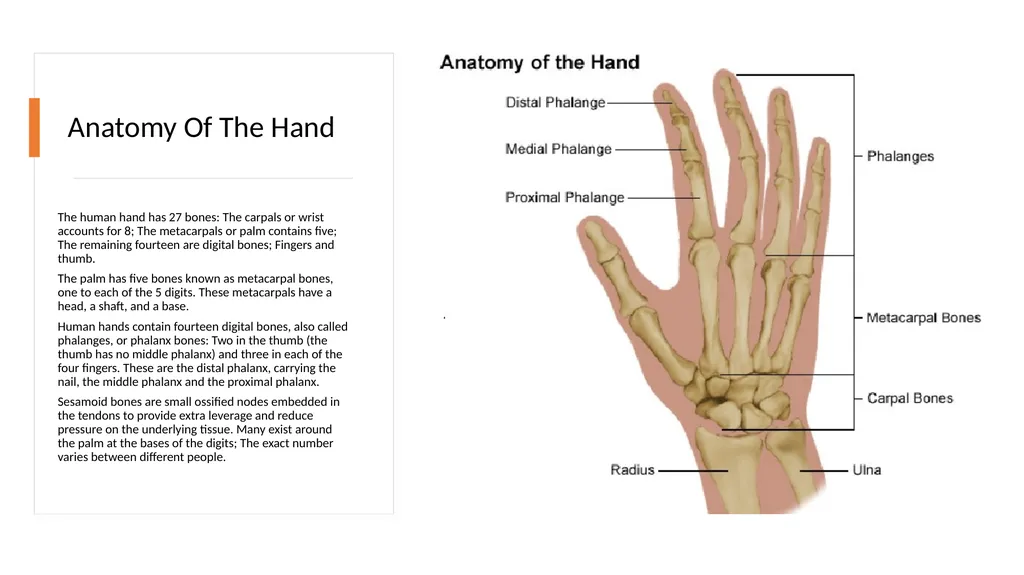
Anatomy Of The Hand The human hand has 27 bones: The carpals or wrist accounts for 8; The metacarpals or palm contains five; The remaining fourteen are digital bones; Fingers and thumb.
The palm has five bones known as metacarpal bones, one to each of the 5 digits. These metacarpals have a head, a shaft, and a base.
Human hands contain fourteen digital bones, also called phalanges, or phalanx bones: Two in the thumb (the thumb has no middle phalanx) and three in each of the four fingers. These are the distal phalanx, carrying the nail, the middle phalanx and the proximal phalanx.
Sesamoid bones are small ossified nodes embedded in the tendons to provide extra leverage and reduce pressure on the underlying tissue. Many exist around the palm at the bases of the digits; The exact number varies between different people.<br>
The palm has five bones known as metacarpal bones, one to each of the 5 digits. These metacarpals have a head, a shaft, and a base.
Human hands contain fourteen digital bones, also called phalanges, or phalanx bones: Two in the thumb (the thumb has no middle phalanx) and three in each of the four fingers. These are the distal phalanx, carrying the nail, the middle phalanx and the proximal phalanx.
Sesamoid bones are small ossified nodes embedded in the tendons to provide extra leverage and reduce pressure on the underlying tissue. Many exist around the palm at the bases of the digits; The exact number varies between different people.<br>
12
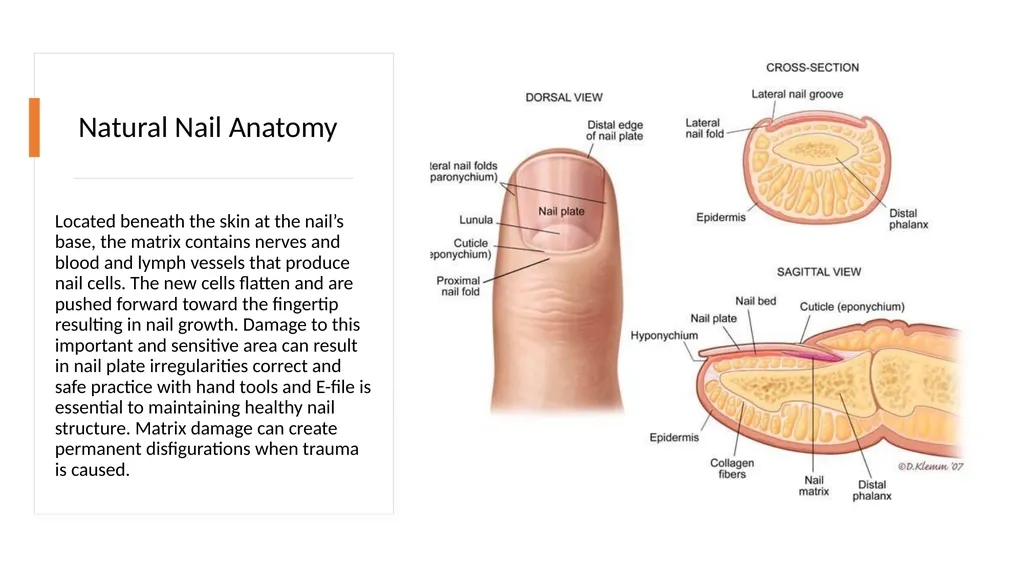
Natural Nail Anatomy Located beneath the skin at the nail’s base, the matrix contains nerves and blood and lymph vessels that produce nail cells. The new cells flatten and are pushed forward toward the fingertip resulting in nail growth. Damage to this important and sensitive area can result in nail plate irregularities correct and safe practice with hand tools and E-file is essential to maintaining healthy nail structure. Matrix damage can create permanent disfigurations when trauma is caused.<br>
13
The lunula, or the whitish “small moon” at the base of the nail, gets its colour from the nuclei of living nail cells transitioning from the matrix. As the nail grows, those cells lose viability and the nuclei disintegrate, making the nail transparent. A common myth is that an obvious lunula signals a healthy nail. But, in fact a client’s genetics is mostly responsible for the lunula’s appearance.
The word proximal means situated near the point of origin or attachment - Which in nail anatomy is the matrix. To that end, the proximal nail fold is a fold of skin that forms a protective barrier to keep bacteria and infection from reaching the matrix.
The eponychium is the visible “lip” of the proximal nail fold. It forms a seal with the nail plate, protecting the matrix from harmful bacteria. Many people mistakenly refer to the eponychium as the cuticle, which is why the adage, ‘Never cut the cuticle!’ is common, although technically incorrect. Indeed, the eponychium is living skin and should never be cut. Instead, moisturize, then very gently push the eponychium back for an even, symmetrical appearance and encourage clients to keep the skin surrounding the nail consistently hydrated between appointments.
The cuticle is the layer of translucent skin that is shed from the underside of the proximal nail fold as the nail grows. This skin emerges from beneath the eponychium attached to the nail plate. Since this tissue is dead, most of it can be safely cut or filed off - And, in fact, you should! Doing so will improve adhesion of polish and enhancements.
The nail bed is the skin underneath the nail plate. It contains blood vessels that supply nutrients to the fingertip. Sometimes, people confuse the nail bed with the nail plate, as in, “Oh, you have such pretty nail beds,” but the compliment is likely meant for the nail plate, rather than the skin it rests on.
The nail plate is the hard, keratin coating on the fingertip. For techs, this is where the magic happens - Be it lacquer, gel polish or a set of sculpted tips. Removing the shine from the nail plate is a common step in many nail services, but it is important to stop there! The nail plate can become thin, weak and sensitive when layers are removed by filing or improper enhancement removal.
The lateral nail fold is the continuation of the proximal nail fold along each side of the nail. It serves to protect the sides of the nail plate.
The perionychium is the skin surrounding the nail and it’s frequently a problem area. “It’s prone to hangnails and it is where most clients will pick or bite which can lead to infection,” says Los Angeles-based celebrity nail tech Michelle Saunders. She encourages clients to always keep the area moisturized because dehydration can lead to further hangnails and painful splintering.
The hyponychium is the skin that forms the seal between the nail plate and the nail bed where the free edge begins. This area is very vascular and sensitive, so avoid aggressively cleaning under the free edge with implements. Not only is this painful and will bleed a lot if the skin is cut, but damaging the hyponychium can cause onycholysis, or the lifting of the nail plate from the nail bed, leaving the area susceptible to infections and fungus, says McCormick.
Sometimes called the distal edge because its situated furthest from the nail’s origin, the free edge is the growth of the nail beyond the fingertip. Anatomy Continued<br>
The word proximal means situated near the point of origin or attachment - Which in nail anatomy is the matrix. To that end, the proximal nail fold is a fold of skin that forms a protective barrier to keep bacteria and infection from reaching the matrix.
The eponychium is the visible “lip” of the proximal nail fold. It forms a seal with the nail plate, protecting the matrix from harmful bacteria. Many people mistakenly refer to the eponychium as the cuticle, which is why the adage, ‘Never cut the cuticle!’ is common, although technically incorrect. Indeed, the eponychium is living skin and should never be cut. Instead, moisturize, then very gently push the eponychium back for an even, symmetrical appearance and encourage clients to keep the skin surrounding the nail consistently hydrated between appointments.
The cuticle is the layer of translucent skin that is shed from the underside of the proximal nail fold as the nail grows. This skin emerges from beneath the eponychium attached to the nail plate. Since this tissue is dead, most of it can be safely cut or filed off - And, in fact, you should! Doing so will improve adhesion of polish and enhancements.
The nail bed is the skin underneath the nail plate. It contains blood vessels that supply nutrients to the fingertip. Sometimes, people confuse the nail bed with the nail plate, as in, “Oh, you have such pretty nail beds,” but the compliment is likely meant for the nail plate, rather than the skin it rests on.
The nail plate is the hard, keratin coating on the fingertip. For techs, this is where the magic happens - Be it lacquer, gel polish or a set of sculpted tips. Removing the shine from the nail plate is a common step in many nail services, but it is important to stop there! The nail plate can become thin, weak and sensitive when layers are removed by filing or improper enhancement removal.
The lateral nail fold is the continuation of the proximal nail fold along each side of the nail. It serves to protect the sides of the nail plate.
The perionychium is the skin surrounding the nail and it’s frequently a problem area. “It’s prone to hangnails and it is where most clients will pick or bite which can lead to infection,” says Los Angeles-based celebrity nail tech Michelle Saunders. She encourages clients to always keep the area moisturized because dehydration can lead to further hangnails and painful splintering.
The hyponychium is the skin that forms the seal between the nail plate and the nail bed where the free edge begins. This area is very vascular and sensitive, so avoid aggressively cleaning under the free edge with implements. Not only is this painful and will bleed a lot if the skin is cut, but damaging the hyponychium can cause onycholysis, or the lifting of the nail plate from the nail bed, leaving the area susceptible to infections and fungus, says McCormick.
Sometimes called the distal edge because its situated furthest from the nail’s origin, the free edge is the growth of the nail beyond the fingertip. Anatomy Continued<br>
14
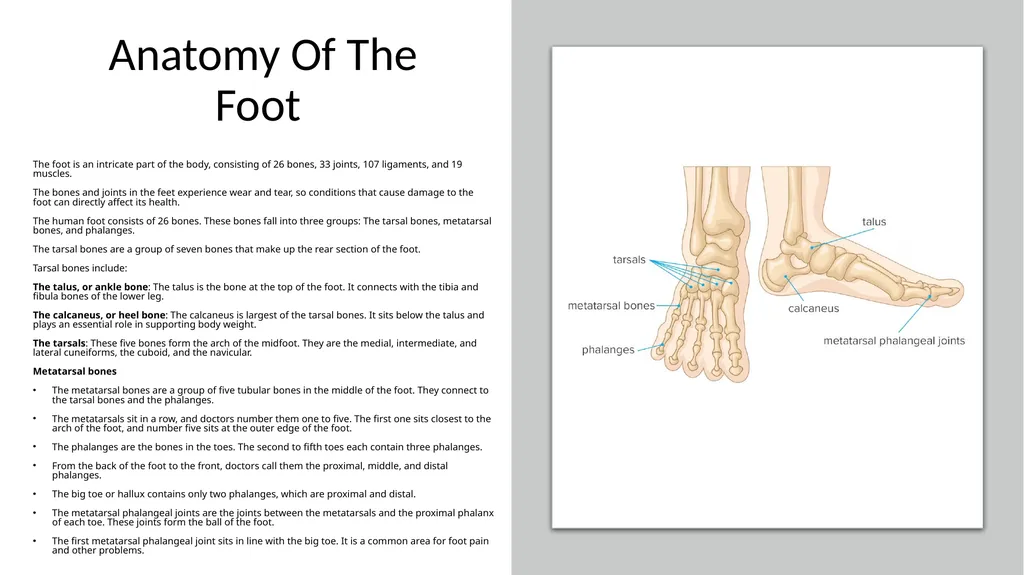
Anatomy Of The Foot The foot is an intricate part of the body, consisting of 26 bones, 33 joints, 107 ligaments, and 19 muscles.
The bones and joints in the feet experience wear and tear, so conditions that cause damage to the foot can directly affect its health.
The human foot consists of 26 bones. These bones fall into three groups: The tarsal bones, metatarsal bones, and phalanges.
The tarsal bones are a group of seven bones that make up the rear section of the foot.
Tarsal bones include:
The talus, or ankle bone: The talus is the bone at the top of the foot. It connects with the tibia and fibula bones of the lower leg.
The calcaneus, or heel bone: The calcaneus is largest of the tarsal bones. It sits below the talus and plays an essential role in supporting body weight.
The tarsals: These five bones form the arch of the midfoot. They are the medial, intermediate, and lateral cuneiforms, the cuboid, and the navicular.
Metatarsal bones
The metatarsal bones are a group of five tubular bones in the middle of the foot. They connect to the tarsal bones and the phalanges.
The metatarsals sit in a row, and doctors number them one to five. The first one sits closest to the arch of the foot, and number five sits at the outer edge of the foot.
The phalanges are the bones in the toes. The second to fifth toes each contain three phalanges.
From the back of the foot to the front, doctors call them the proximal, middle, and distal phalanges.
The big toe or hallux contains only two phalanges, which are proximal and distal.
The metatarsal phalangeal joints are the joints between the metatarsals and the proximal phalanx of each toe. These joints form the ball of the foot.
The first metatarsal phalangeal joint sits in line with the big toe. It is a common area for foot pain and other problems.<br>
The bones and joints in the feet experience wear and tear, so conditions that cause damage to the foot can directly affect its health.
The human foot consists of 26 bones. These bones fall into three groups: The tarsal bones, metatarsal bones, and phalanges.
The tarsal bones are a group of seven bones that make up the rear section of the foot.
Tarsal bones include:
The talus, or ankle bone: The talus is the bone at the top of the foot. It connects with the tibia and fibula bones of the lower leg.
The calcaneus, or heel bone: The calcaneus is largest of the tarsal bones. It sits below the talus and plays an essential role in supporting body weight.
The tarsals: These five bones form the arch of the midfoot. They are the medial, intermediate, and lateral cuneiforms, the cuboid, and the navicular.
Metatarsal bones
The metatarsal bones are a group of five tubular bones in the middle of the foot. They connect to the tarsal bones and the phalanges.
The metatarsals sit in a row, and doctors number them one to five. The first one sits closest to the arch of the foot, and number five sits at the outer edge of the foot.
The phalanges are the bones in the toes. The second to fifth toes each contain three phalanges.
From the back of the foot to the front, doctors call them the proximal, middle, and distal phalanges.
The big toe or hallux contains only two phalanges, which are proximal and distal.
The metatarsal phalangeal joints are the joints between the metatarsals and the proximal phalanx of each toe. These joints form the ball of the foot.
The first metatarsal phalangeal joint sits in line with the big toe. It is a common area for foot pain and other problems.<br>
15
Foot Related Conditions Big toe arthritis
Arthritis can affect many different bones within the feet, but most commonly causes problems with the joints at the base of the big toe.
This type of arthritis is known as big toe arthritis. Doctors may refer to it as hallux limitus or hallux rigidus.
Big toe arthritis occurs when cartilage in the joint of the big toe begins to wear away. This can happen as a result of many years of repetitive upward movement of the joint.
Certain activities, such as prolonged running and walking, can increase a person’s risk of developing arthritis in this area.
A bunion is a prominent bump on the inside of the foot, near the base of the big toe.
Bunions develop when the bone at the base of the toe - The first metatarsal - Begins to separate from the bone at the base of the second toe - The second metatarsal.
Gout
Gout is a type of inflammatory arthritis. Although it can affect almost any joint in the body, it most commonly affects the joint at the base of the big toe.
Gout usually occurs due to a high concentration of uric acid in the blood.
Hammer toes
A hammer toe is a condition that usually affects toes other than the big toe. Instead of pointing straight out in front, these toes point downward, forming a claw shape.
In most cases, the condition develops with age. It is usually the result of a muscle imbalance when the long muscles of the lower leg overpower the smaller muscles of the foot. This imbalance causes the toes to bend inward.
Heel spurs and plantar fasciitis
Heel spurs are bony growths that develop on the heel bone, or calcaneus. Although they may cause some discomfort, they are rarely painful.
Sesamoiditis
Sesamoiditis is inflammation of one or both sesamoid bones at the base of the big toe. The condition can cause significant pain in this area.
Stress fracture
Stress fractures happen when an area of bone endures excessive and repetitive force.
Certain repetitive activities, such as walking and running, can cause microscopic cracks, or microfractures, to develop in the bone. Ordinarily, the body can repair these microfractures.<br>
Arthritis can affect many different bones within the feet, but most commonly causes problems with the joints at the base of the big toe.
This type of arthritis is known as big toe arthritis. Doctors may refer to it as hallux limitus or hallux rigidus.
Big toe arthritis occurs when cartilage in the joint of the big toe begins to wear away. This can happen as a result of many years of repetitive upward movement of the joint.
Certain activities, such as prolonged running and walking, can increase a person’s risk of developing arthritis in this area.
A bunion is a prominent bump on the inside of the foot, near the base of the big toe.
Bunions develop when the bone at the base of the toe - The first metatarsal - Begins to separate from the bone at the base of the second toe - The second metatarsal.
Gout
Gout is a type of inflammatory arthritis. Although it can affect almost any joint in the body, it most commonly affects the joint at the base of the big toe.
Gout usually occurs due to a high concentration of uric acid in the blood.
Hammer toes
A hammer toe is a condition that usually affects toes other than the big toe. Instead of pointing straight out in front, these toes point downward, forming a claw shape.
In most cases, the condition develops with age. It is usually the result of a muscle imbalance when the long muscles of the lower leg overpower the smaller muscles of the foot. This imbalance causes the toes to bend inward.
Heel spurs and plantar fasciitis
Heel spurs are bony growths that develop on the heel bone, or calcaneus. Although they may cause some discomfort, they are rarely painful.
Sesamoiditis
Sesamoiditis is inflammation of one or both sesamoid bones at the base of the big toe. The condition can cause significant pain in this area.
Stress fracture
Stress fractures happen when an area of bone endures excessive and repetitive force.
Certain repetitive activities, such as walking and running, can cause microscopic cracks, or microfractures, to develop in the bone. Ordinarily, the body can repair these microfractures.<br>
16
Contraindications All beauty services have a list of associated contraindications. This could be something that needs to be considered at the beginning of a service to assess for suitability of the service. We put these into three categories for nail services.
Total avoidance - Example bacteria or fungal infection.
Aware of issue and to be monitored - Example mild eczema to the surrounding area.
Make amendments to service to accommodate - Example nail biting.
Next you will find a range of commonly found nail related issues and conditions and if they are appropriate to have a service.<br>
Total avoidance - Example bacteria or fungal infection.
Aware of issue and to be monitored - Example mild eczema to the surrounding area.
Make amendments to service to accommodate - Example nail biting.
Next you will find a range of commonly found nail related issues and conditions and if they are appropriate to have a service.<br>
17
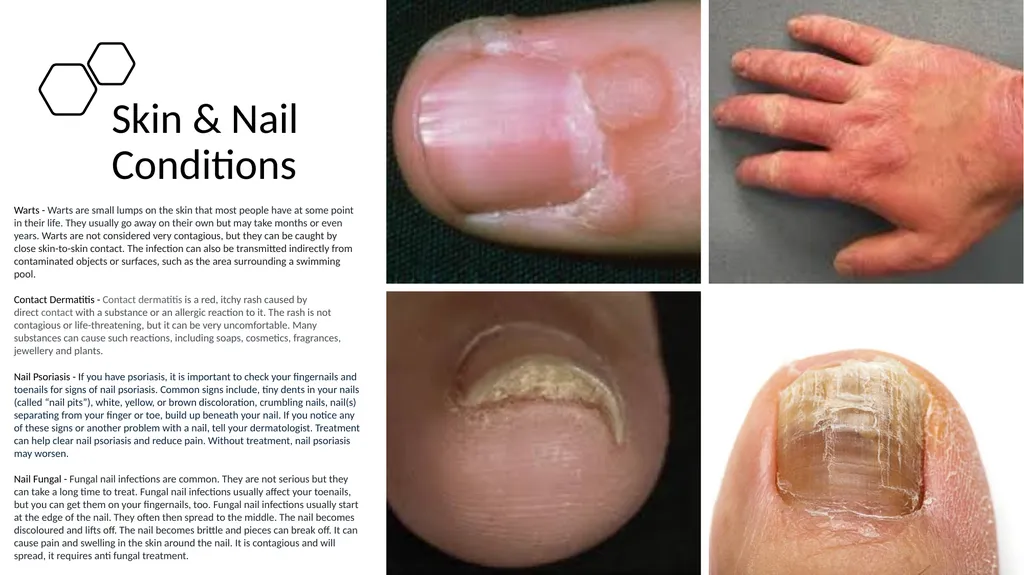
Skin & Nail Conditions Warts - Warts are small lumps on the skin that most people have at some point in their life. They usually go away on their own but may take months or even years. Warts are not considered very contagious, but they can be caught by close skin-to-skin contact. The infection can also be transmitted indirectly from contaminated objects or surfaces, such as the area surrounding a swimming pool.
Contact Dermatitis - Contact dermatitis is a red, itchy rash caused by direct contact with a substance or an allergic reaction to it. The rash is not contagious or life-threatening, but it can be very uncomfortable. Many substances can cause such reactions, including soaps, cosmetics, fragrances, jewellery and plants.
Nail Psoriasis - If you have psoriasis, it is important to check your fingernails and toenails for signs of nail psoriasis. Common signs include, tiny dents in your nails (called “nail pits”), white, yellow, or brown discoloration, crumbling nails, nail(s) separating from your finger or toe, build up beneath your nail. If you notice any of these signs or another problem with a nail, tell your dermatologist. Treatment can help clear nail psoriasis and reduce pain. Without treatment, nail psoriasis may worsen.
Nail Fungal - Fungal nail infections are common. They are not serious but they can take a long time to treat. Fungal nail infections usually affect your toenails, but you can get them on your fingernails, too. Fungal nail infections usually start at the edge of the nail. They often then spread to the middle. The nail becomes discoloured and lifts off. The nail becomes brittle and pieces can break off. It can cause pain and swelling in the skin around the nail. It is contagious and will spread, it requires anti fungal treatment.<br>
Contact Dermatitis - Contact dermatitis is a red, itchy rash caused by direct contact with a substance or an allergic reaction to it. The rash is not contagious or life-threatening, but it can be very uncomfortable. Many substances can cause such reactions, including soaps, cosmetics, fragrances, jewellery and plants.
Nail Psoriasis - If you have psoriasis, it is important to check your fingernails and toenails for signs of nail psoriasis. Common signs include, tiny dents in your nails (called “nail pits”), white, yellow, or brown discoloration, crumbling nails, nail(s) separating from your finger or toe, build up beneath your nail. If you notice any of these signs or another problem with a nail, tell your dermatologist. Treatment can help clear nail psoriasis and reduce pain. Without treatment, nail psoriasis may worsen.
Nail Fungal - Fungal nail infections are common. They are not serious but they can take a long time to treat. Fungal nail infections usually affect your toenails, but you can get them on your fingernails, too. Fungal nail infections usually start at the edge of the nail. They often then spread to the middle. The nail becomes discoloured and lifts off. The nail becomes brittle and pieces can break off. It can cause pain and swelling in the skin around the nail. It is contagious and will spread, it requires anti fungal treatment.<br>
18
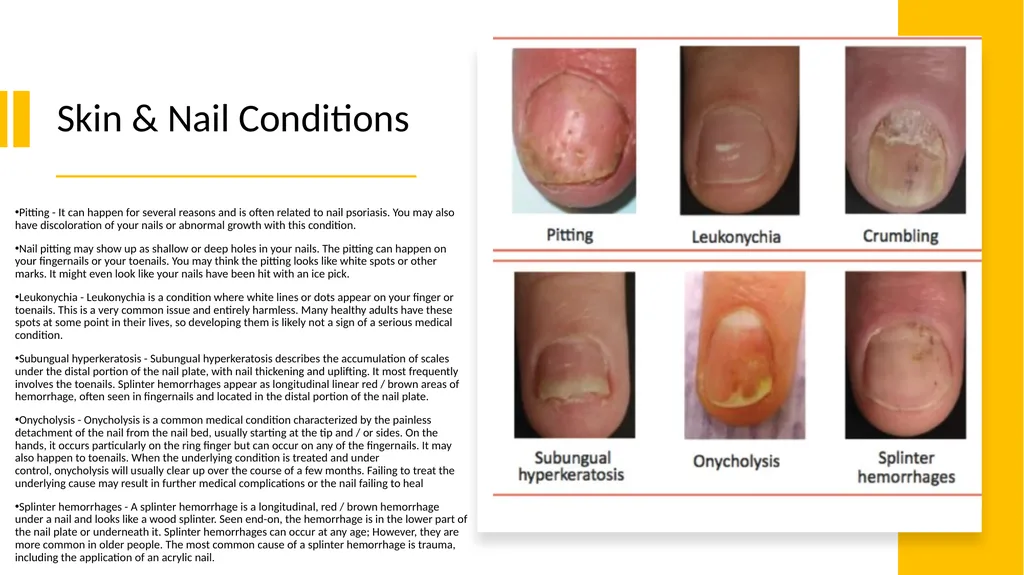
Skin & Nail Conditions Pitting - It can happen for several reasons and is often related to nail psoriasis. You may also have discoloration of your nails or abnormal growth with this condition.
Nail pitting may show up as shallow or deep holes in your nails. The pitting can happen on your fingernails or your toenails. You may think the pitting looks like white spots or other marks. It might even look like your nails have been hit with an ice pick.
Leukonychia - Leukonychia is a condition where white lines or dots appear on your finger or toenails. This is a very common issue and entirely harmless. Many healthy adults have these spots at some point in their lives, so developing them is likely not a sign of a serious medical condition.
Subungual hyperkeratosis - Subungual hyperkeratosis describes the accumulation of scales under the distal portion of the nail plate, with nail thickening and uplifting. It most frequently involves the toenails. Splinter hemorrhages appear as longitudinal linear red / brown areas of hemorrhage, often seen in fingernails and located in the distal portion of the nail plate.
Onycholysis - Onycholysis is a common medical condition characterized by the painless detachment of the nail from the nail bed, usually starting at the tip and / or sides. On the hands, it occurs particularly on the ring finger but can occur on any of the fingernails. It may also happen to toenails. When the underlying condition is treated and under control, onycholysis will usually clear up over the course of a few months. Failing to treat the underlying cause may result in further medical complications or the nail failing to heal
Splinter hemorrhages - A splinter hemorrhage is a longitudinal, red / brown hemorrhage under a nail and looks like a wood splinter. Seen end-on, the hemorrhage is in the lower part of the nail plate or underneath it. Splinter hemorrhages can occur at any age; However, they are more common in older people. The most common cause of a splinter hemorrhage is trauma, including the application of an acrylic nail.<br>
Nail pitting may show up as shallow or deep holes in your nails. The pitting can happen on your fingernails or your toenails. You may think the pitting looks like white spots or other marks. It might even look like your nails have been hit with an ice pick.
Leukonychia - Leukonychia is a condition where white lines or dots appear on your finger or toenails. This is a very common issue and entirely harmless. Many healthy adults have these spots at some point in their lives, so developing them is likely not a sign of a serious medical condition.
Subungual hyperkeratosis - Subungual hyperkeratosis describes the accumulation of scales under the distal portion of the nail plate, with nail thickening and uplifting. It most frequently involves the toenails. Splinter hemorrhages appear as longitudinal linear red / brown areas of hemorrhage, often seen in fingernails and located in the distal portion of the nail plate.
Onycholysis - Onycholysis is a common medical condition characterized by the painless detachment of the nail from the nail bed, usually starting at the tip and / or sides. On the hands, it occurs particularly on the ring finger but can occur on any of the fingernails. It may also happen to toenails. When the underlying condition is treated and under control, onycholysis will usually clear up over the course of a few months. Failing to treat the underlying cause may result in further medical complications or the nail failing to heal
Splinter hemorrhages - A splinter hemorrhage is a longitudinal, red / brown hemorrhage under a nail and looks like a wood splinter. Seen end-on, the hemorrhage is in the lower part of the nail plate or underneath it. Splinter hemorrhages can occur at any age; However, they are more common in older people. The most common cause of a splinter hemorrhage is trauma, including the application of an acrylic nail.<br>
19
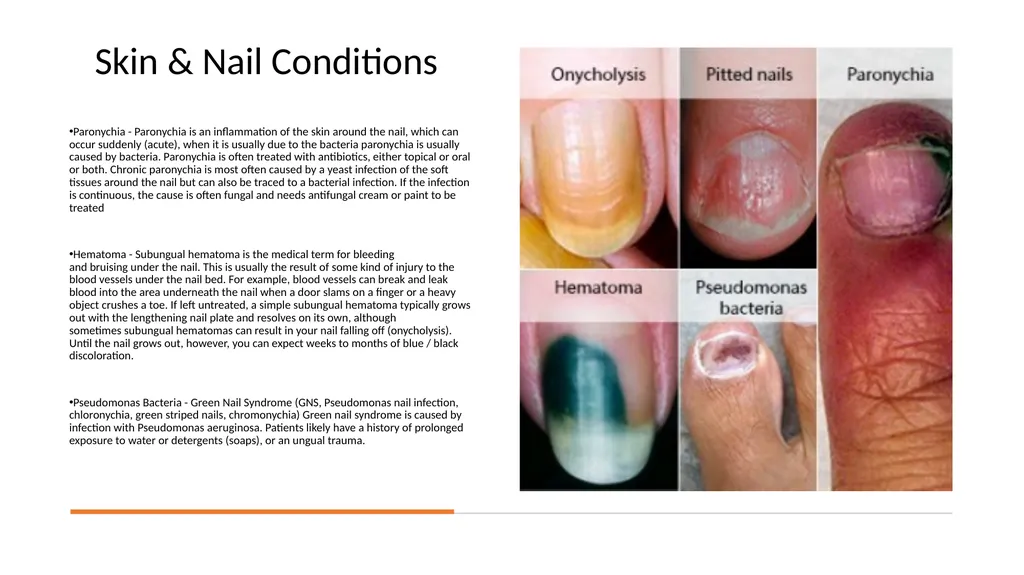
Skin & Nail Conditions Paronychia - Paronychia is an inflammation of the skin around the nail, which can occur suddenly (acute), when it is usually due to the bacteria paronychia is usually caused by bacteria. Paronychia is often treated with antibiotics, either topical or oral or both. Chronic paronychia is most often caused by a yeast infection of the soft tissues around the nail but can also be traced to a bacterial infection. If the infection is continuous, the cause is often fungal and needs antifungal cream or paint to be treated
Hematoma - Subungual hematoma is the medical term for bleeding and bruising under the nail. This is usually the result of some kind of injury to the blood vessels under the nail bed. For example, blood vessels can break and leak blood into the area underneath the nail when a door slams on a finger or a heavy object crushes a toe. If left untreated, a simple subungual hematoma typically grows out with the lengthening nail plate and resolves on its own, although sometimes subungual hematomas can result in your nail falling off (onycholysis). Until the nail grows out, however, you can expect weeks to months of blue / black discoloration.
Pseudomonas Bacteria - Green Nail Syndrome (GNS, Pseudomonas nail infection, chloronychia, green striped nails, chromonychia) Green nail syndrome is caused by infection with Pseudomonas aeruginosa. Patients likely have a history of prolonged exposure to water or detergents (soaps), or an ungual trauma.<br>
Hematoma - Subungual hematoma is the medical term for bleeding and bruising under the nail. This is usually the result of some kind of injury to the blood vessels under the nail bed. For example, blood vessels can break and leak blood into the area underneath the nail when a door slams on a finger or a heavy object crushes a toe. If left untreated, a simple subungual hematoma typically grows out with the lengthening nail plate and resolves on its own, although sometimes subungual hematomas can result in your nail falling off (onycholysis). Until the nail grows out, however, you can expect weeks to months of blue / black discoloration.
Pseudomonas Bacteria - Green Nail Syndrome (GNS, Pseudomonas nail infection, chloronychia, green striped nails, chromonychia) Green nail syndrome is caused by infection with Pseudomonas aeruginosa. Patients likely have a history of prolonged exposure to water or detergents (soaps), or an ungual trauma.<br>
20
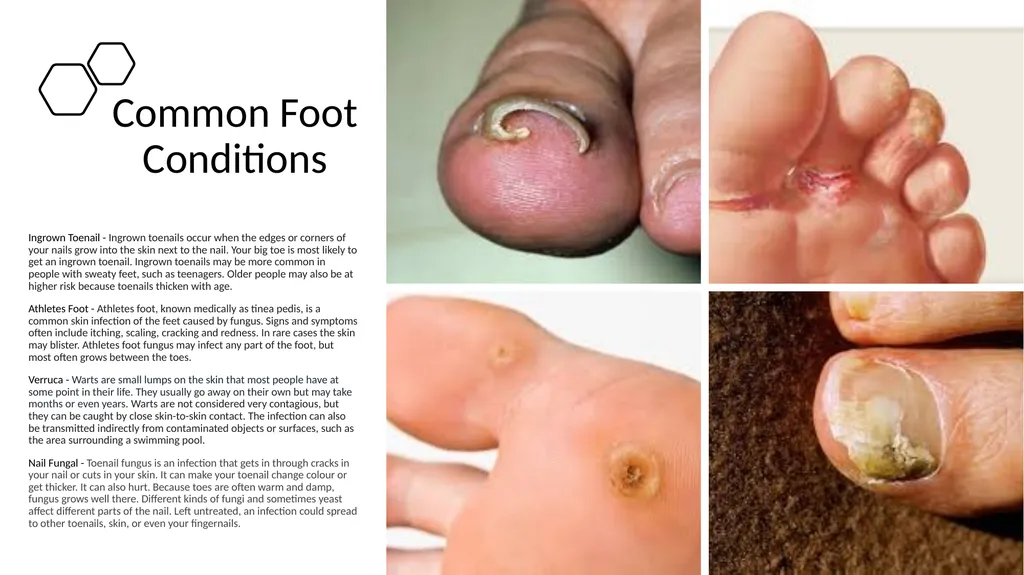
Common Foot Conditions Ingrown Toenail - Ingrown toenails occur when the edges or corners of your nails grow into the skin next to the nail. Your big toe is most likely to get an ingrown toenail. Ingrown toenails may be more common in people with sweaty feet, such as teenagers. Older people may also be at higher risk because toenails thicken with age.
Athletes Foot - Athletes foot, known medically as tinea pedis, is a common skin infection of the feet caused by fungus. Signs and symptoms often include itching, scaling, cracking and redness. In rare cases the skin may blister. Athletes foot fungus may infect any part of the foot, but most often grows between the toes.
Verruca - Warts are small lumps on the skin that most people have at some point in their life. They usually go away on their own but may take months or even years. Warts are not considered very contagious, but they can be caught by close skin-to-skin contact. The infection can also be transmitted indirectly from contaminated objects or surfaces, such as the area surrounding a swimming pool.
Nail Fungal - Toenail fungus is an infection that gets in through cracks in your nail or cuts in your skin. It can make your toenail change colour or get thicker. It can also hurt. Because toes are often warm and damp, fungus grows well there. Different kinds of fungi and sometimes yeast affect different parts of the nail. Left untreated, an infection could spread to other toenails, skin, or even your fingernails.<br>
Athletes Foot - Athletes foot, known medically as tinea pedis, is a common skin infection of the feet caused by fungus. Signs and symptoms often include itching, scaling, cracking and redness. In rare cases the skin may blister. Athletes foot fungus may infect any part of the foot, but most often grows between the toes.
Verruca - Warts are small lumps on the skin that most people have at some point in their life. They usually go away on their own but may take months or even years. Warts are not considered very contagious, but they can be caught by close skin-to-skin contact. The infection can also be transmitted indirectly from contaminated objects or surfaces, such as the area surrounding a swimming pool.
Nail Fungal - Toenail fungus is an infection that gets in through cracks in your nail or cuts in your skin. It can make your toenail change colour or get thicker. It can also hurt. Because toes are often warm and damp, fungus grows well there. Different kinds of fungi and sometimes yeast affect different parts of the nail. Left untreated, an infection could spread to other toenails, skin, or even your fingernails.<br>
21
Products When selecting your products to use during your manicure and pedicure services the options are varied in both price and quality.
Always insure which ever product line you choose to work with that you purchase from a professional range and buy from a recognized supply chain.
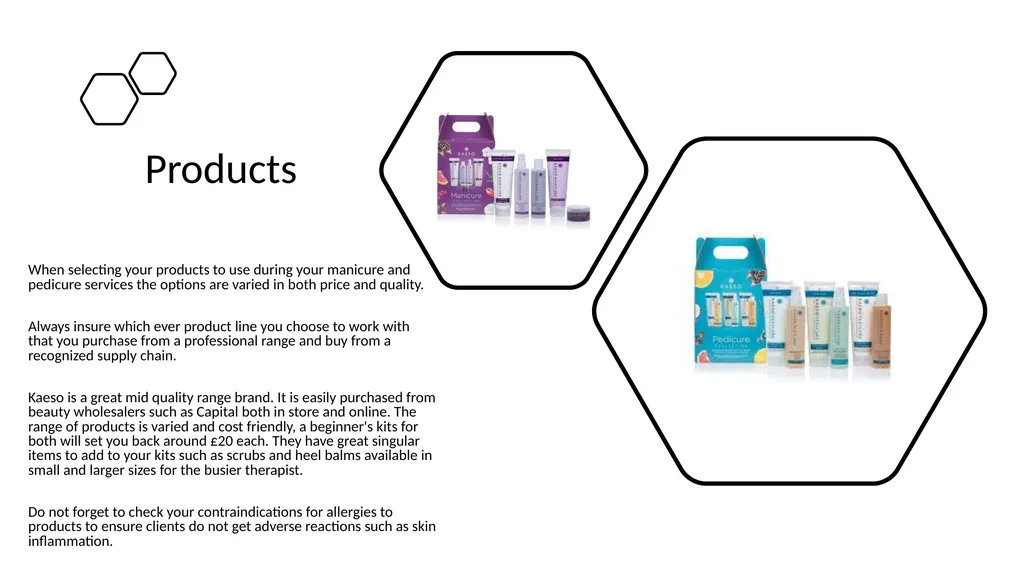
Kaeso is a great mid quality range brand. It is easily purchased from beauty wholesalers such as Capital both in store and online. The range of products is varied and cost friendly, a beginner's kits for both will set you back around £20 each. They have great singular items to add to your kits such as scrubs and heel balms available in small and larger sizes for the busier therapist.
Do not forget to check your contraindications for allergies to products to ensure clients do not get adverse reactions such as skin inflammation.<br>
Always insure which ever product line you choose to work with that you purchase from a professional range and buy from a recognized supply chain.
Kaeso is a great mid quality range brand. It is easily purchased from beauty wholesalers such as Capital both in store and online. The range of products is varied and cost friendly, a beginner's kits for both will set you back around £20 each. They have great singular items to add to your kits such as scrubs and heel balms available in small and larger sizes for the busier therapist.
Do not forget to check your contraindications for allergies to products to ensure clients do not get adverse reactions such as skin inflammation.<br>
22
The Working Environment Nail services have the flexibility to be completed in a range of settings. These commonly include home and mobile services, Spa and wellness centres, nail salons, beauty salons and clinics.
Things to consider which will change to your working environment will include:
Appropriate insurance cover - Check your insured to work in the environment setting that you choose or you may find your policy is invalid in the case of a claim made against you.
Access to water - Some of your services may require this, hot water access will be required and correct disposal of products.
Suitable working station - You need to ensure you have the correct nail station to work on to avoid straining the back and neck. Also mobile services look to use a pop up nail desk as your clients will not appreciate a stain from product on their dinner table.
Electric supply - Some services may require access to electric, consider this in your set up, if you are a mobile therapist think about purchasing an extension lead and this will give you the ability to work better in a range of environments.<br>
Things to consider which will change to your working environment will include:
Appropriate insurance cover - Check your insured to work in the environment setting that you choose or you may find your policy is invalid in the case of a claim made against you.
Access to water - Some of your services may require this, hot water access will be required and correct disposal of products.
Suitable working station - You need to ensure you have the correct nail station to work on to avoid straining the back and neck. Also mobile services look to use a pop up nail desk as your clients will not appreciate a stain from product on their dinner table.
Electric supply - Some services may require access to electric, consider this in your set up, if you are a mobile therapist think about purchasing an extension lead and this will give you the ability to work better in a range of environments.<br>
23
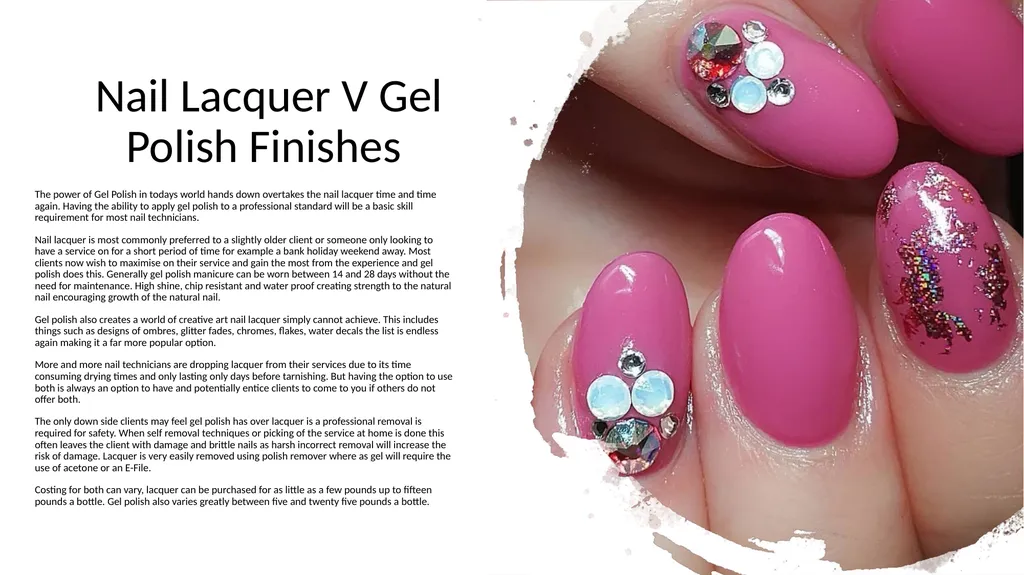
Nail Lacquer V Gel Polish Finishes The power of Gel Polish in todays world hands down overtakes the nail lacquer time and time again. Having the ability to apply gel polish to a professional standard will be a basic skill requirement for most nail technicians.
Nail lacquer is most commonly preferred to a slightly older client or someone only looking to have a service on for a short period of time for example a bank holiday weekend away. Most clients now wish to maximise on their service and gain the most from the experience and gel polish does this. Generally gel polish manicure can be worn between 14 and 28 days without the need for maintenance. High shine, chip resistant and water proof creating strength to the natural nail encouraging growth of the natural nail.
Gel polish also creates a world of creative art nail lacquer simply cannot achieve. This includes things such as designs of ombres, glitter fades, chromes, flakes, water decals the list is endless again making it a far more popular option.
More and more nail technicians are dropping lacquer from their services due to its time consuming drying times and only lasting only days before tarnishing. But having the option to use both is always an option to have and potentially entice clients to come to you if others do not offer both.
The only down side clients may feel gel polish has over lacquer is a professional removal is required for safety. When self removal techniques or picking of the service at home is done this often leaves the client with damage and brittle nails as harsh incorrect removal will increase the risk of damage. Lacquer is very easily removed using polish remover where as gel will require the use of acetone or an E-File.
Costing for both can vary, lacquer can be purchased for as little as a few pounds up to fifteen pounds a bottle. Gel polish also varies greatly between five and twenty five pounds a bottle.<br>
Nail lacquer is most commonly preferred to a slightly older client or someone only looking to have a service on for a short period of time for example a bank holiday weekend away. Most clients now wish to maximise on their service and gain the most from the experience and gel polish does this. Generally gel polish manicure can be worn between 14 and 28 days without the need for maintenance. High shine, chip resistant and water proof creating strength to the natural nail encouraging growth of the natural nail.
Gel polish also creates a world of creative art nail lacquer simply cannot achieve. This includes things such as designs of ombres, glitter fades, chromes, flakes, water decals the list is endless again making it a far more popular option.
More and more nail technicians are dropping lacquer from their services due to its time consuming drying times and only lasting only days before tarnishing. But having the option to use both is always an option to have and potentially entice clients to come to you if others do not offer both.
The only down side clients may feel gel polish has over lacquer is a professional removal is required for safety. When self removal techniques or picking of the service at home is done this often leaves the client with damage and brittle nails as harsh incorrect removal will increase the risk of damage. Lacquer is very easily removed using polish remover where as gel will require the use of acetone or an E-File.
Costing for both can vary, lacquer can be purchased for as little as a few pounds up to fifteen pounds a bottle. Gel polish also varies greatly between five and twenty five pounds a bottle.<br>
24
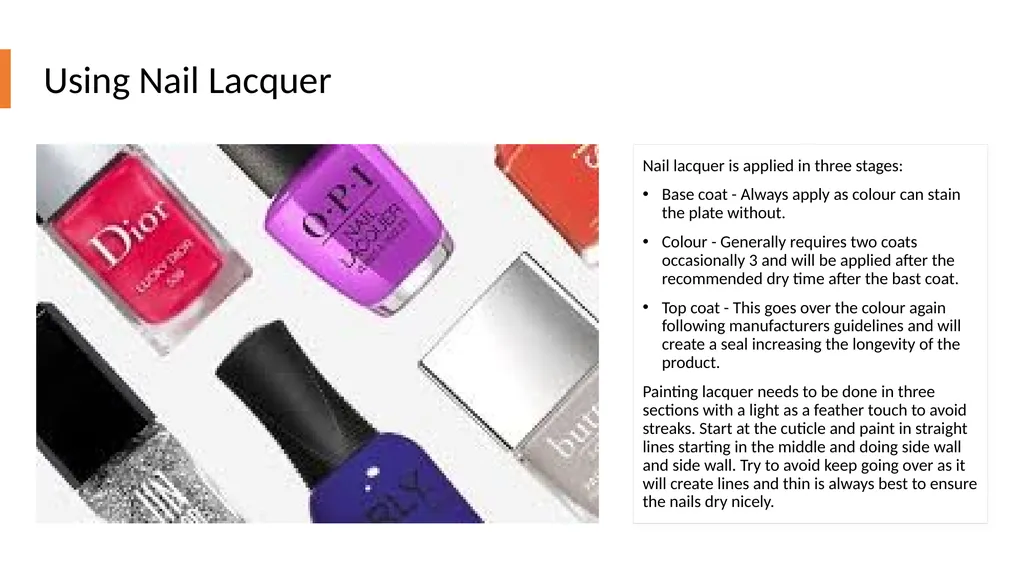
Using Nail Lacquer Nail lacquer is applied in three stages:
Base coat - Always apply as colour can stain the plate without.
Colour - Generally requires two coats occasionally 3 and will be applied after the recommended dry time after the bast coat.
Top coat - This goes over the colour again following manufacturers guidelines and will create a seal increasing the longevity of the product.
Painting lacquer needs to be done in three sections with a light as a feather touch to avoid streaks. Start at the cuticle and paint in straight lines starting in the middle and doing side wall and side wall. Try to avoid keep going over as it will create lines and thin is always best to ensure the nails dry nicely.<br>
Base coat - Always apply as colour can stain the plate without.
Colour - Generally requires two coats occasionally 3 and will be applied after the recommended dry time after the bast coat.
Top coat - This goes over the colour again following manufacturers guidelines and will create a seal increasing the longevity of the product.
Painting lacquer needs to be done in three sections with a light as a feather touch to avoid streaks. Start at the cuticle and paint in straight lines starting in the middle and doing side wall and side wall. Try to avoid keep going over as it will create lines and thin is always best to ensure the nails dry nicely.<br>
25
Filing The Natural Nail Clients often see beautiful shapes created with nail enhancements and believe this is a possibility for their natural nails also, sadly this is not the truth.
When filing the natural nail we advise using a 180 grit file or natural nail emery board and encourage you to file the nail in one direction where possible but a back and forward motion will not create nail damage.
Natural nails should be left to grow and filed to shape in as natural finish as possible, therefore a classic square or rounded finish is the healthiest option. Those who file to encourage the nail to grow tapered at the sides to a coffin or almond are taking too much of the sides of the natural nail away increasing risk of breakage due to breaking down the natural structure of the nail.
To remove any debris such as dead cuticle from the nail plate we use a 240 grit buffing block, this will create no damage to the plate and thoroughly cleanse it for the preparation of polish or extensions.<br>
When filing the natural nail we advise using a 180 grit file or natural nail emery board and encourage you to file the nail in one direction where possible but a back and forward motion will not create nail damage.
Natural nails should be left to grow and filed to shape in as natural finish as possible, therefore a classic square or rounded finish is the healthiest option. Those who file to encourage the nail to grow tapered at the sides to a coffin or almond are taking too much of the sides of the natural nail away increasing risk of breakage due to breaking down the natural structure of the nail.
To remove any debris such as dead cuticle from the nail plate we use a 240 grit buffing block, this will create no damage to the plate and thoroughly cleanse it for the preparation of polish or extensions.<br>
26
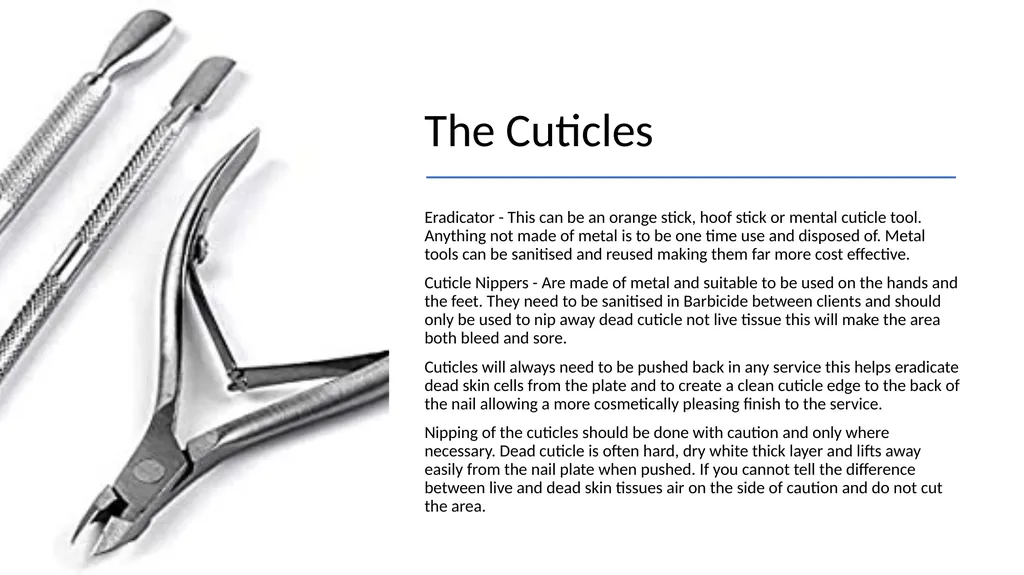
The Cuticles Eradicator - This can be an orange stick, hoof stick or mental cuticle tool. Anything not made of metal is to be one time use and disposed of. Metal tools can be sanitised and reused making them far more cost effective.
Cuticle Nippers - Are made of metal and suitable to be used on the hands and the feet. They need to be sanitised in Barbicide between clients and should only be used to nip away dead cuticle not live tissue this will make the area both bleed and sore.
Cuticles will always need to be pushed back in any service this helps eradicate dead skin cells from the plate and to create a clean cuticle edge to the back of the nail allowing a more cosmetically pleasing finish to the service.
Nipping of the cuticles should be done with caution and only where necessary. Dead cuticle is often hard, dry white thick layer and lifts away easily from the nail plate when pushed. If you cannot tell the difference between live and dead skin tissues air on the side of caution and do not cut the area.<br>
Cuticle Nippers - Are made of metal and suitable to be used on the hands and the feet. They need to be sanitised in Barbicide between clients and should only be used to nip away dead cuticle not live tissue this will make the area both bleed and sore.
Cuticles will always need to be pushed back in any service this helps eradicate dead skin cells from the plate and to create a clean cuticle edge to the back of the nail allowing a more cosmetically pleasing finish to the service.
Nipping of the cuticles should be done with caution and only where necessary. Dead cuticle is often hard, dry white thick layer and lifts away easily from the nail plate when pushed. If you cannot tell the difference between live and dead skin tissues air on the side of caution and do not cut the area.<br>
27
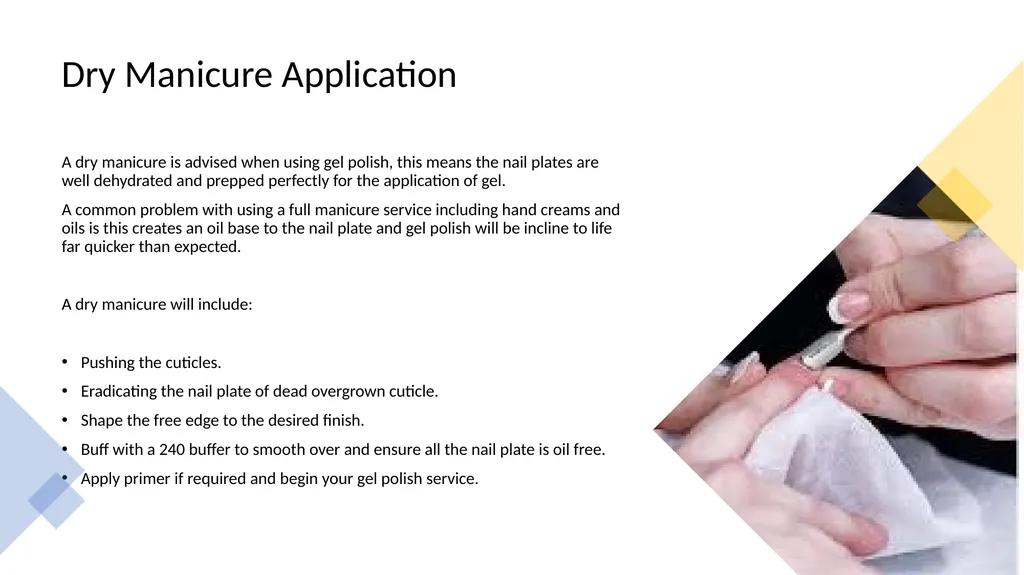
Dry Manicure Application A dry manicure is advised when using gel polish, this means the nail plates are well dehydrated and prepped perfectly for the application of gel.
A common problem with using a full manicure service including hand creams and oils is this creates an oil base to the nail plate and gel polish will be incline to life far quicker than expected.
A dry manicure will include:
Pushing the cuticles.
Eradicating the nail plate of dead overgrown cuticle.
Shape the free edge to the desired finish.
Buff with a 240 buffer to smooth over and ensure all the nail plate is oil free.
Apply primer if required and begin your gel polish service.<br>
A common problem with using a full manicure service including hand creams and oils is this creates an oil base to the nail plate and gel polish will be incline to life far quicker than expected.
A dry manicure will include:
Pushing the cuticles.
Eradicating the nail plate of dead overgrown cuticle.
Shape the free edge to the desired finish.
Buff with a 240 buffer to smooth over and ensure all the nail plate is oil free.
Apply primer if required and begin your gel polish service.<br>
28
Full Manicure Pre-arrange desk with tools and equipment.
Wash both yours and your client’s hands.
Have your client sit comfortably and ask them to remove jewellery and store appropriately.
Remove any nail varnish with non-acetone nail varnish remover leaving the nails clean of product.
Inspect hands for contraindications and check details on the record card.
Clarify with the client the length and shape your client requires before starting to file.
Start working on one hand starting with thumb and working to the little finger, using the fine side of your emery board file in fine sweeping movements towards the centre. Do not file across the nail and do not file into a point as this will weaken the nail and cause it to break. Do not use the course side of a file this can cause the natural nail to split or break off layers.
Apply a small amount of cuticle cream using an orange stick to the cuticle area. Massage in, covering the nail plate using small, firm, circular movements with your thumb pads. Working the thumb and little finger, ring finger and first finger thumb and little finger.
Place the hand into warm water with manicure soak. The water in the manicure bowl should be enough to cover the fingers to the first joint and avoid spilling over, we use warm water to soften the skin and make the treatment enjoyable for the client.
Repeat stages 7 to 9 on the other hand.
Remove the first hand from the water and dry with a clean towel, gently easy cuticle area back as you dry.
Cover an orange stick with cotton wall and place cuticle remover onto it and rub into the cuticle and side walls of the nail and under the free edge.
Using the eradicator scrap away any cuticle skin adhering to the nail plate. Wipe away excess onto a cotton pad with each movement.
Using your eradicator gently push the cuticles back and lift away from the nail plate, use gentle up and down motions working form the centre of the cuticle area to the side walls.
Inspect cuticles if there are any ragged cuticle clip away with cuticle nippers. DO NOT cut live tissues this will leave your client open to risk of infection and cause your client to bleed. Always keep your nippers sharp as blunt nippers tend to tear or rip skin instead of clean cut.
Repeat steps 11 to 15 on the other hand.
Remove all excess off nail and buff over nail using a white buffing block.
Apply cuticle oil and massage around cuticles.
Ask client to wash hands to remove excess oils.
Using hand lotion massage into clients first hand and arm then repeat to clients second hand and arm.
Wipe away excess cream using lint free pad and wipe away from nail plate. The nail should squeak this shows it is clear and smooth. If product is left behind this will cause the polish to go streaky and peel.
Put client’s jewellery back on.
Apply polish: 1 coat of base, 2 of colour and 1 top coat. Allow time to dry.
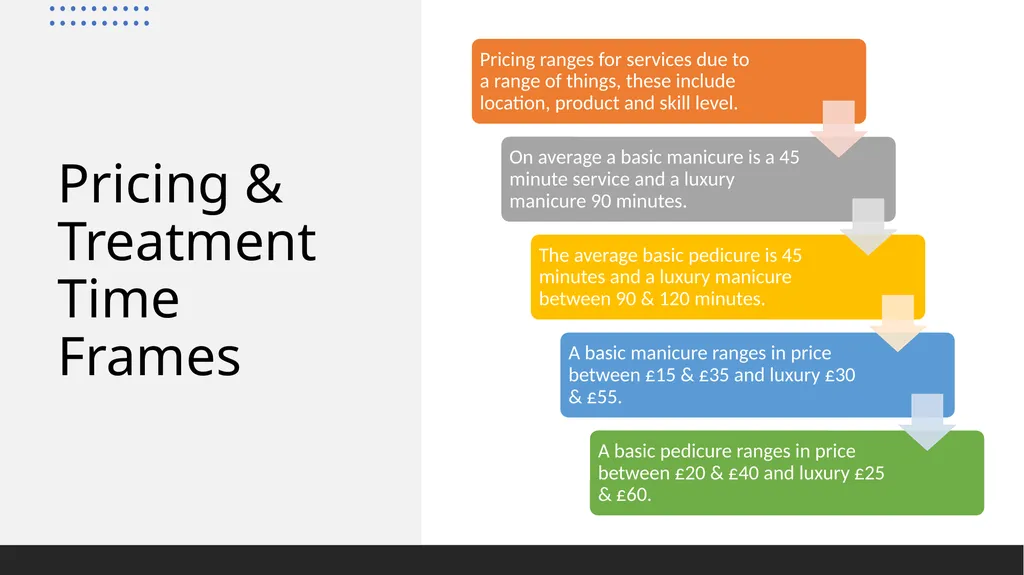
30 minutes should be an adequate time to complete a manicure and 45 minutes when including an arm and hand massage.<br>
Wash both yours and your client’s hands.
Have your client sit comfortably and ask them to remove jewellery and store appropriately.
Remove any nail varnish with non-acetone nail varnish remover leaving the nails clean of product.
Inspect hands for contraindications and check details on the record card.
Clarify with the client the length and shape your client requires before starting to file.
Start working on one hand starting with thumb and working to the little finger, using the fine side of your emery board file in fine sweeping movements towards the centre. Do not file across the nail and do not file into a point as this will weaken the nail and cause it to break. Do not use the course side of a file this can cause the natural nail to split or break off layers.
Apply a small amount of cuticle cream using an orange stick to the cuticle area. Massage in, covering the nail plate using small, firm, circular movements with your thumb pads. Working the thumb and little finger, ring finger and first finger thumb and little finger.
Place the hand into warm water with manicure soak. The water in the manicure bowl should be enough to cover the fingers to the first joint and avoid spilling over, we use warm water to soften the skin and make the treatment enjoyable for the client.
Repeat stages 7 to 9 on the other hand.
Remove the first hand from the water and dry with a clean towel, gently easy cuticle area back as you dry.
Cover an orange stick with cotton wall and place cuticle remover onto it and rub into the cuticle and side walls of the nail and under the free edge.
Using the eradicator scrap away any cuticle skin adhering to the nail plate. Wipe away excess onto a cotton pad with each movement.
Using your eradicator gently push the cuticles back and lift away from the nail plate, use gentle up and down motions working form the centre of the cuticle area to the side walls.
Inspect cuticles if there are any ragged cuticle clip away with cuticle nippers. DO NOT cut live tissues this will leave your client open to risk of infection and cause your client to bleed. Always keep your nippers sharp as blunt nippers tend to tear or rip skin instead of clean cut.
Repeat steps 11 to 15 on the other hand.
Remove all excess off nail and buff over nail using a white buffing block.
Apply cuticle oil and massage around cuticles.
Ask client to wash hands to remove excess oils.
Using hand lotion massage into clients first hand and arm then repeat to clients second hand and arm.
Wipe away excess cream using lint free pad and wipe away from nail plate. The nail should squeak this shows it is clear and smooth. If product is left behind this will cause the polish to go streaky and peel.
Put client’s jewellery back on.
Apply polish: 1 coat of base, 2 of colour and 1 top coat. Allow time to dry.
30 minutes should be an adequate time to complete a manicure and 45 minutes when including an arm and hand massage.<br>
29
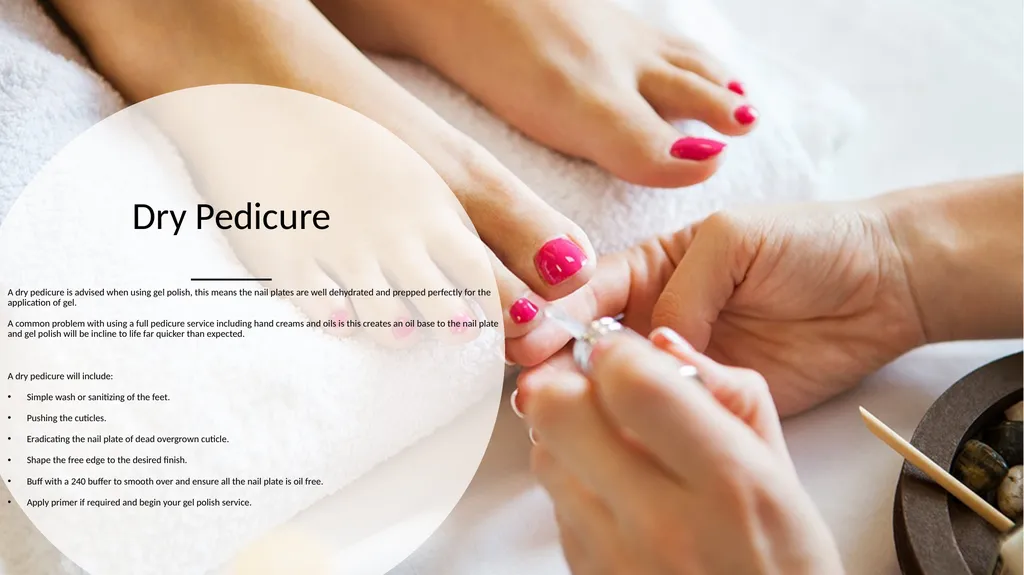
Dry Pedicure A dry pedicure is advised when using gel polish, this means the nail plates are well dehydrated and prepped perfectly for the application of gel.
A common problem with using a full pedicure service including hand creams and oils is this creates an oil base to the nail plate and gel polish will be incline to life far quicker than expected.
A dry pedicure will include:
Simple wash or sanitizing of the feet.
Pushing the cuticles.
Eradicating the nail plate of dead overgrown cuticle.
Shape the free edge to the desired finish.
Buff with a 240 buffer to smooth over and ensure all the nail plate is oil free.
Apply primer if required and begin your gel polish service.<br>
A common problem with using a full pedicure service including hand creams and oils is this creates an oil base to the nail plate and gel polish will be incline to life far quicker than expected.
A dry pedicure will include:
Simple wash or sanitizing of the feet.
Pushing the cuticles.
Eradicating the nail plate of dead overgrown cuticle.
Shape the free edge to the desired finish.
Buff with a 240 buffer to smooth over and ensure all the nail plate is oil free.
Apply primer if required and begin your gel polish service.<br>
30
Full Pedicure Sanitize hands.
Advise client to remove footwear, tights or socks.
Sit client on chair and sit opposite on a low stool.
Inspect feet for contraindications.
Remove toenail polish if client is wearing any.
Place towel down and place foot spa between you and the client fill the spa with soaps and oils and half fill with warm water.
Submerge feet in water and leave to soak for 15 minutes.
Get your client to choose a colour whilst soaking.
Remove first foot pad dry and using foot rasp scrub all hard skin areas heel sides and sole of the foot, apply foot scrub cream rub into the areas then rinse foot off in the water and pat dry.
Repeat on the other foot.
Place first foot up push back cuticle trim if required, clip nails also if required and with the rough side of the emery board in a sweeping motion file nail down and into shape keeping the tops straight and slight curved edges.
Place foot down take second foot out of the water and remove bowl.
Repeat on second foot.
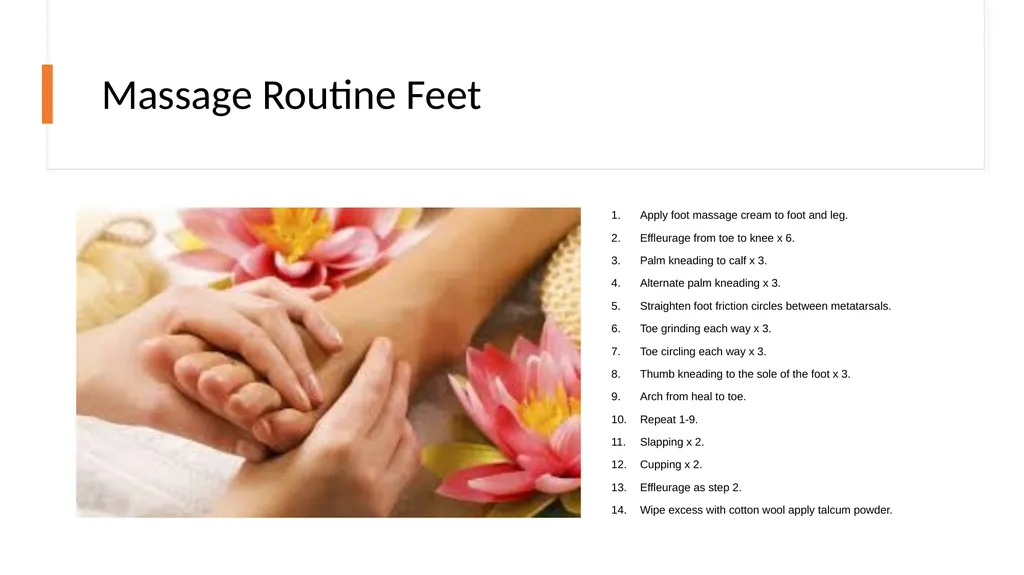
Foot and leg massage one foot at a time.
Cleanse nail plate ready for applying polish and put on toes separators.
Apply polish: 1 coat of base, 2 coats of colour, 1 top coat, allow time to dry.
Allow client to put on footwear.
Wash your hands.
Dispose of all paper towels and water from the foot spa. Towel to go into wash and sterilize all equipment.<br>
Advise client to remove footwear, tights or socks.
Sit client on chair and sit opposite on a low stool.
Inspect feet for contraindications.
Remove toenail polish if client is wearing any.
Place towel down and place foot spa between you and the client fill the spa with soaps and oils and half fill with warm water.
Submerge feet in water and leave to soak for 15 minutes.
Get your client to choose a colour whilst soaking.
Remove first foot pad dry and using foot rasp scrub all hard skin areas heel sides and sole of the foot, apply foot scrub cream rub into the areas then rinse foot off in the water and pat dry.
Repeat on the other foot.
Place first foot up push back cuticle trim if required, clip nails also if required and with the rough side of the emery board in a sweeping motion file nail down and into shape keeping the tops straight and slight curved edges.
Place foot down take second foot out of the water and remove bowl.
Repeat on second foot.
Foot and leg massage one foot at a time.
Cleanse nail plate ready for applying polish and put on toes separators.
Apply polish: 1 coat of base, 2 coats of colour, 1 top coat, allow time to dry.
Allow client to put on footwear.
Wash your hands.
Dispose of all paper towels and water from the foot spa. Towel to go into wash and sterilize all equipment.<br>
31
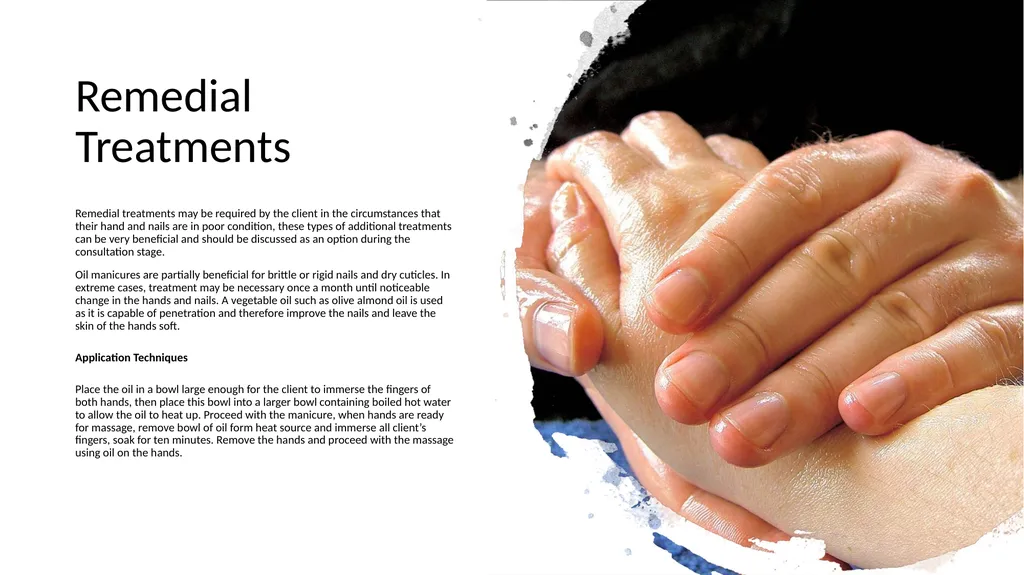
Remedial Treatments Remedial treatments may be required by the client in the circumstances that their hand and nails are in poor condition, these types of additional treatments can be very beneficial and should be discussed as an option during the consultation stage.
Oil manicures are partially beneficial for brittle or rigid nails and dry cuticles. In extreme cases, treatment may be necessary once a month until noticeable change in the hands and nails. A vegetable oil such as olive almond oil is used as it is capable of penetration and therefore improve the nails and leave the skin of the hands soft.
Application Techniques
Place the oil in a bowl large enough for the client to immerse the fingers of both hands, then place this bowl into a larger bowl containing boiled hot water to allow the oil to heat up. Proceed with the manicure, when hands are ready for massage, remove bowl of oil form heat source and immerse all client’s fingers, soak for ten minutes. Remove the hands and proceed with the massage using oil on the hands.<br>
Oil manicures are partially beneficial for brittle or rigid nails and dry cuticles. In extreme cases, treatment may be necessary once a month until noticeable change in the hands and nails. A vegetable oil such as olive almond oil is used as it is capable of penetration and therefore improve the nails and leave the skin of the hands soft.
Application Techniques
Place the oil in a bowl large enough for the client to immerse the fingers of both hands, then place this bowl into a larger bowl containing boiled hot water to allow the oil to heat up. Proceed with the manicure, when hands are ready for massage, remove bowl of oil form heat source and immerse all client’s fingers, soak for ten minutes. Remove the hands and proceed with the massage using oil on the hands.<br>
32
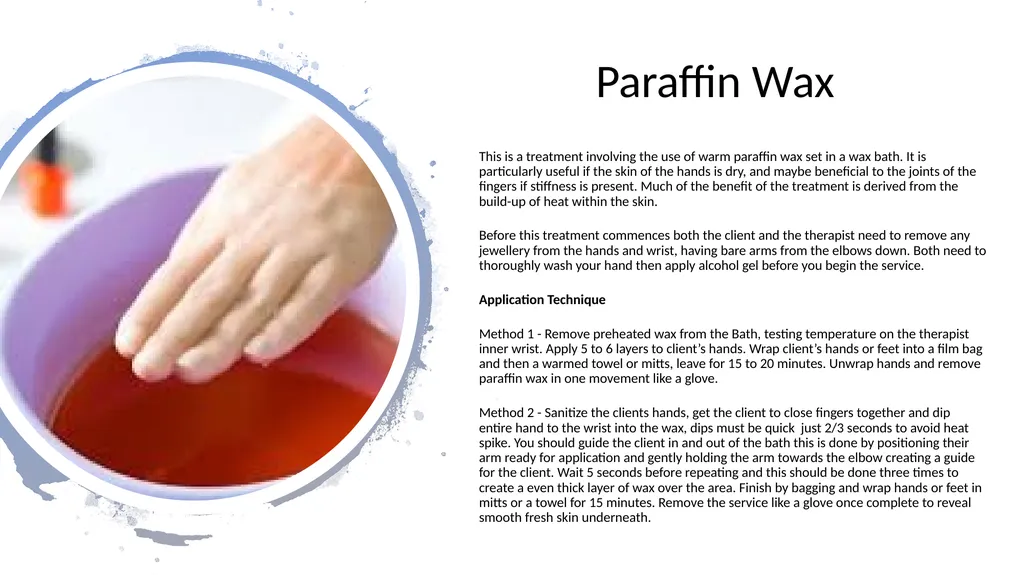
Paraffin Wax This is a treatment involving the use of warm paraffin wax set in a wax bath. It is particularly useful if the skin of the hands is dry, and maybe beneficial to the joints of the fingers if stiffness is present. Much of the benefit of the treatment is derived from the build-up of heat within the skin.
Before this treatment commences both the client and the therapist need to remove any jewellery from the hands and wrist, having bare arms from the elbows down. Both need to thoroughly wash your hand then apply alcohol gel before you begin the service.
Application Technique
Method 1 - Remove preheated wax from the Bath, testing temperature on the therapist inner wrist. Apply 5 to 6 layers to client’s hands. Wrap client’s hands or feet into a film bag and then a warmed towel or mitts, leave for 15 to 20 minutes. Unwrap hands and remove paraffin wax in one movement like a glove.
Method 2 - Sanitize the clients hands, get the client to close fingers together and dip entire hand to the wrist into the wax, dips must be quick just 2/3 seconds to avoid heat spike. You should guide the client in and out of the bath this is done by positioning their arm ready for application and gently holding the arm towards the elbow creating a guide for the client. Wait 5 seconds before repeating and this should be done three times to create a even thick layer of wax over the area. Finish by bagging and wrap hands or feet in mitts or a towel for 15 minutes. Remove the service like a glove once complete to reveal smooth fresh skin underneath.<br>
Before this treatment commences both the client and the therapist need to remove any jewellery from the hands and wrist, having bare arms from the elbows down. Both need to thoroughly wash your hand then apply alcohol gel before you begin the service.
Application Technique
Method 1 - Remove preheated wax from the Bath, testing temperature on the therapist inner wrist. Apply 5 to 6 layers to client’s hands. Wrap client’s hands or feet into a film bag and then a warmed towel or mitts, leave for 15 to 20 minutes. Unwrap hands and remove paraffin wax in one movement like a glove.
Method 2 - Sanitize the clients hands, get the client to close fingers together and dip entire hand to the wrist into the wax, dips must be quick just 2/3 seconds to avoid heat spike. You should guide the client in and out of the bath this is done by positioning their arm ready for application and gently holding the arm towards the elbow creating a guide for the client. Wait 5 seconds before repeating and this should be done three times to create a even thick layer of wax over the area. Finish by bagging and wrap hands or feet in mitts or a towel for 15 minutes. Remove the service like a glove once complete to reveal smooth fresh skin underneath.<br>
33
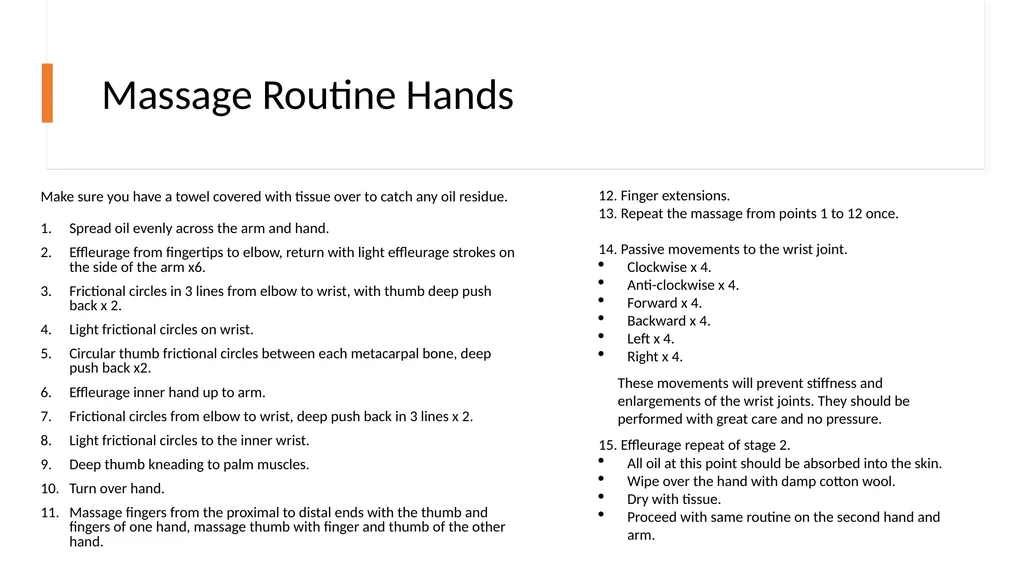
Benefits Of A Hand Massage The purpose of a hand and arm massage is to improve the skin texture and appearance through increased blood circulation. The arm should be well supported throughout the process this will prevent any muscle tension and for the client to feel fully relaxed.
Massage has many positives to the body including:
Relaxation - Relieves fatigue so it good for tense clients.
Aids desquamation (skin shedding).
Firms muscles.
Can help break down fat.
Warms the skin.
Increases blood and lymph flow so aiding the removal of waste materials and encouraging cell regeneration.<br>
Massage has many positives to the body including:
Relaxation - Relieves fatigue so it good for tense clients.
Aids desquamation (skin shedding).
Firms muscles.
Can help break down fat.
Warms the skin.
Increases blood and lymph flow so aiding the removal of waste materials and encouraging cell regeneration.<br>
34
Massage Movements Explained Effleurage
Is a light smooth stroking movement in any direction on the surface of the skin. It is performed with the palm surface of both hands and fingers and a rate of 7” per second.
It will relax the client and can also relieve fatigue. It warms the skin to prepare it for deeper massage. It increases blood and lymph circulation.
Kneading
It is a deep movement performed with palm surface of hands and fingers. The picking up of a muscle or group of muscles, then releasing. Blood and lymph circulation are greatly improved.
Friction Circles
A deep movement performed with palm surface of fingertips or thumb. Pressure must always be towards the heat. It greatly improves blood and lymph circulation, and is often performed around joints, i.e. Wrists to improve mobility.
Joint Manipulation
These movements are called passive movements because the therapist moves the joints and effort is required by the client. In a manicure the wrist joint is moved in a circular motion to the left then right, forwards, backwards and from side to side. There must be no force used by the therapist. This movement is slow and gentle and will improve joint mobility and prevent joint swelling.<br>
Is a light smooth stroking movement in any direction on the surface of the skin. It is performed with the palm surface of both hands and fingers and a rate of 7” per second.
It will relax the client and can also relieve fatigue. It warms the skin to prepare it for deeper massage. It increases blood and lymph circulation.
Kneading
It is a deep movement performed with palm surface of hands and fingers. The picking up of a muscle or group of muscles, then releasing. Blood and lymph circulation are greatly improved.
Friction Circles
A deep movement performed with palm surface of fingertips or thumb. Pressure must always be towards the heat. It greatly improves blood and lymph circulation, and is often performed around joints, i.e. Wrists to improve mobility.
Joint Manipulation
These movements are called passive movements because the therapist moves the joints and effort is required by the client. In a manicure the wrist joint is moved in a circular motion to the left then right, forwards, backwards and from side to side. There must be no force used by the therapist. This movement is slow and gentle and will improve joint mobility and prevent joint swelling.<br>
35
Massage Routine Hands Make sure you have a towel covered with tissue over to catch any oil residue.
Spread oil evenly across the arm and hand.
Effleurage from fingertips to elbow, return with light effleurage strokes on the side of the arm x6.
Frictional circles in 3 lines from elbow to wrist, with thumb deep push back x 2.
Light frictional circles on wrist.
Circular thumb frictional circles between each metacarpal bone, deep push back x2.
Effleurage inner hand up to arm.
Frictional circles from elbow to wrist, deep push back in 3 lines x 2.
Light frictional circles to the inner wrist.
Deep thumb kneading to palm muscles.
Turn over hand.
Massage fingers from the proximal to distal ends with the thumb and fingers of one hand, massage thumb with finger and thumb of the other hand. 12. Finger extensions.
13. Repeat the massage from points 1 to 12 once.
14. Passive movements to the wrist joint.
Clockwise x 4.
Anti-clockwise x 4.
Forward x 4.
Backward x 4.
Left x 4.
Right x 4.
These movements will prevent stiffness and enlargements of the wrist joints. They should be performed with great care and no pressure.
15. Effleurage repeat of stage 2.
All oil at this point should be absorbed into the skin.
Wipe over the hand with damp cotton wool.
Dry with tissue.
Proceed with same routine on the second hand and arm.<br>
Spread oil evenly across the arm and hand.
Effleurage from fingertips to elbow, return with light effleurage strokes on the side of the arm x6.
Frictional circles in 3 lines from elbow to wrist, with thumb deep push back x 2.
Light frictional circles on wrist.
Circular thumb frictional circles between each metacarpal bone, deep push back x2.
Effleurage inner hand up to arm.
Frictional circles from elbow to wrist, deep push back in 3 lines x 2.
Light frictional circles to the inner wrist.
Deep thumb kneading to palm muscles.
Turn over hand.
Massage fingers from the proximal to distal ends with the thumb and fingers of one hand, massage thumb with finger and thumb of the other hand. 12. Finger extensions.
13. Repeat the massage from points 1 to 12 once.
14. Passive movements to the wrist joint.
Clockwise x 4.
Anti-clockwise x 4.
Forward x 4.
Backward x 4.
Left x 4.
Right x 4.
These movements will prevent stiffness and enlargements of the wrist joints. They should be performed with great care and no pressure.
15. Effleurage repeat of stage 2.
All oil at this point should be absorbed into the skin.
Wipe over the hand with damp cotton wool.
Dry with tissue.
Proceed with same routine on the second hand and arm.<br>
36
Massage Routine Feet Apply foot massage cream to foot and leg.
Effleurage from toe to knee x 6.
Palm kneading to calf x 3.
Alternate palm kneading x 3.
Straighten foot friction circles between metatarsals.
Toe grinding each way x 3.
Toe circling each way x 3.
Thumb kneading to the sole of the foot x 3.
Arch from heal to toe.
Repeat 1-9.
Slapping x 2.
Cupping x 2.
Effleurage as step 2.
Wipe excess with cotton wool apply talcum powder.<br>
Effleurage from toe to knee x 6.
Palm kneading to calf x 3.
Alternate palm kneading x 3.
Straighten foot friction circles between metatarsals.
Toe grinding each way x 3.
Toe circling each way x 3.
Thumb kneading to the sole of the foot x 3.
Arch from heal to toe.
Repeat 1-9.
Slapping x 2.
Cupping x 2.
Effleurage as step 2.
Wipe excess with cotton wool apply talcum powder.<br>
37
Aftercare Advice Hands Giving correct aftercare will ensure that your clients look after the service they have received and increase the longevity of the polish. Basic information to give will include:
Wear gloves when washing up, cleaning, gardening or in products.
Do not pick the product on the nails.
Do not file your nails in between services.
Avoid biting the nails and surrounding skin.
Apply cuticle oil and hydrating hand cream daily.
Book your next appointment and keep maintenance regular.<br>
Wear gloves when washing up, cleaning, gardening or in products.
Do not pick the product on the nails.
Do not file your nails in between services.
Avoid biting the nails and surrounding skin.
Apply cuticle oil and hydrating hand cream daily.
Book your next appointment and keep maintenance regular.<br>
38
Pricing & Treatment Time Frames<br>
39
Social Media In todays world social media can play a huge part in the growth and exposure of any business regardless of size. Using multiple networks including Facebook, Instagram, Twitter and Pintrest are just a handful of the most popular platforms to put your business on.
Keeping your posts varied, artistic, quirky and informative is the key to engagement on your posts. Show this seasons must haves, ask questions, see what the customer wants to see next, change the photo angles up so nothing seems too repetitive. Post daily and keep your story active this will also help gain new followings.
Post like and shares special offers, giveaways and seasonal specials continual steady traffic cleaver adverts and making the customer always feel excited or getting a great deal helps to keep that social media going!!<br>
Keeping your posts varied, artistic, quirky and informative is the key to engagement on your posts. Show this seasons must haves, ask questions, see what the customer wants to see next, change the photo angles up so nothing seems too repetitive. Post daily and keep your story active this will also help gain new followings.
Post like and shares special offers, giveaways and seasonal specials continual steady traffic cleaver adverts and making the customer always feel excited or getting a great deal helps to keep that social media going!!<br>
40
Next Steps So now you have a fair understanding of the services you will be completing in your training course its time to complete the next steps before attending your practical day.
We have provided a range of video footage for you to watch to get an a first look into the services you will be providing. They can be found in the practical demonstration section of your course.
Taking the quiz! Test yourself and the knowledge you have already absorbed to see how well you think you know the services you will be providing.
Book your practical day if you haven’t already done so. Courses are available Monday to Friday. For all course dates bookings and enquiries please email us at courses@creativetouch.training<br>
We have provided a range of video footage for you to watch to get an a first look into the services you will be providing. They can be found in the practical demonstration section of your course.
Taking the quiz! Test yourself and the knowledge you have already absorbed to see how well you think you know the services you will be providing.
Book your practical day if you haven’t already done so. Courses are available Monday to Friday. For all course dates bookings and enquiries please email us at courses@creativetouch.training<br>