
Manufacturing Industries What is Manufacturing.
KL
Published · 97 slides · 0 views

1 / 1
















Description
Manufacturing Industries What is Manufacturing. Importance of Manufacturing. Contribution of Industry to National Economy. Factors of Locating Industries. Classification of Industries. Agro based Industries. Mineral Based Industries.
Related Topics
Share
Embed code
Download this presentation From Below
"Manufacturing Industries What is Manufacturing." is the property of its rightful owner. Permission is granted to download and print the materials on this website for personal, non-commercial use only, and to display it on your personal computer provided you do not modify the materials and that you retain all copyright notices contained in the materials. By downloading content from our website, you accept the terms of this agreement.
Presentation Transcript
01
Manufacturing Industries<br>
02
What is Manufacturing.
Importance of Manufacturing.
Contribution of Industry to National Economy.
Factors of Locating Industries.
Classification of Industries.
Agro based Industries.
Mineral Based Industries. Objective of The Chapter<br>
Importance of Manufacturing.
Contribution of Industry to National Economy.
Factors of Locating Industries.
Classification of Industries.
Agro based Industries.
Mineral Based Industries. Objective of The Chapter<br>
03
Automobile Industry.
Information technology and Electronic Industry.
Industrial Pollution and Environmental Degradation.<br>
Information technology and Electronic Industry.
Industrial Pollution and Environmental Degradation.<br>
04
On the occasion of Diwali, Harish went to a market with his parents. They purchased shoes and clothes for him. His mother purchased utensils, sugar, tea and diyas (earthen lamps). Harish observed that the shops in the market were flooded with items for sale. He wondered how so many items could be made in such large quantities. His father explained that shoes, clothes, sugar etc. are manufactured by machines in large industries, some utensils are manufactured in small industries, while items like diyas are made by individual artisans in household industry.<br>
05
What is Manufacturing:-
Production of goods in large quantities after processing from raw materials to more valuable products is called manufacturing.
People employed in the secondary activities manufacture the primary materials into finished goods. The workers employed in steel factories, car, breweries, textile industries, bakeries etc. fall into this category. Some people are employed in providing services. In this chapter, we are mainly concerned with manufacturing industries which fall in the secondary sector. The economic strength of a country is measured by the development of manufacturing industries.<br>
Production of goods in large quantities after processing from raw materials to more valuable products is called manufacturing.
People employed in the secondary activities manufacture the primary materials into finished goods. The workers employed in steel factories, car, breweries, textile industries, bakeries etc. fall into this category. Some people are employed in providing services. In this chapter, we are mainly concerned with manufacturing industries which fall in the secondary sector. The economic strength of a country is measured by the development of manufacturing industries.<br>
06
IMPORTANCE OF MANUFACTURING:-
Manufacturing sector is considered the backbone of development in general and economic development in particular mainly because–
• Manufacturing industries not only help in modernizing agriculture, which forms the backbone of our economy, they also reduce the heavy dependence of people on agricultural income by providing them jobs in secondary and tertiary sectors.
• Industrial development is a precondition for eradication of unemployment and poverty from our country. This was the main philosophy behind public sector industries and joint sector ventures in India. It was also aimed at bringing down regional disparities by establishing industries in tribal and backward areas.
• Export of manufactured goods expands trade and commerce, and brings in much needed foreign exchange.
• Countries that transform their raw materials into a wide variety of finished goods of higher value are prosperous. India’s prosperity lies in increasing and diversifying its manufacturing industries as quickly as possible.<br>
Manufacturing sector is considered the backbone of development in general and economic development in particular mainly because–
• Manufacturing industries not only help in modernizing agriculture, which forms the backbone of our economy, they also reduce the heavy dependence of people on agricultural income by providing them jobs in secondary and tertiary sectors.
• Industrial development is a precondition for eradication of unemployment and poverty from our country. This was the main philosophy behind public sector industries and joint sector ventures in India. It was also aimed at bringing down regional disparities by establishing industries in tribal and backward areas.
• Export of manufactured goods expands trade and commerce, and brings in much needed foreign exchange.
• Countries that transform their raw materials into a wide variety of finished goods of higher value are prosperous. India’s prosperity lies in increasing and diversifying its manufacturing industries as quickly as possible.<br>
07
Agriculture and industry are not exclusive of each other. They move hand in hand. For instance, the agro-industries in India have given a major boost to agriculture by raising its productivity. They depend on the latter for raw materials and sell their products such as irrigation pumps, fertilisers, insecticides, pesticides, plastic and PVC pipes, machines and tools, etc. to the farmers. Thus, development and competitiveness of manufacturing industry has not only assisted agriculturists in increasing their production but also made the production processes very efficient<br>
08
'Agriculture and industry are complimentary to each other.’ Justify the statement.
A close relationship exists between agriculture and manufacturing industries. Each of them compliment each other. Each of them serves as market for goods produced by the other and in the process raises demand for each other's goods. For example, the agro-based industries, like textiles, sugar, etc., depend upon agriculture for raw materials. These industries have given a major boost to agriculture by raising their demand and hence, productivity. Manufacturing industries sell the products such as irrigation pumps, fertilisers, insecticides, pesticides, plastic and PVC pipes, agricultural machineries and tools, etc., to the farmers. Agriculture serves as their market and effects their development. These inputs from industries assists agriculturists in increasing productivity as well as have made the production processes very efficient.<br>
A close relationship exists between agriculture and manufacturing industries. Each of them compliment each other. Each of them serves as market for goods produced by the other and in the process raises demand for each other's goods. For example, the agro-based industries, like textiles, sugar, etc., depend upon agriculture for raw materials. These industries have given a major boost to agriculture by raising their demand and hence, productivity. Manufacturing industries sell the products such as irrigation pumps, fertilisers, insecticides, pesticides, plastic and PVC pipes, agricultural machineries and tools, etc., to the farmers. Agriculture serves as their market and effects their development. These inputs from industries assists agriculturists in increasing productivity as well as have made the production processes very efficient.<br>
09
Contribution of Industry to National Economy:
Over the last two decades, the share of manufacturing sector has stagnated at 17 percent of GDP.
The trend of growth rate in manufacturing over the last decade has been around 7 percent.
Since 2003,manufacturing is once again growing at the rate of 9 to 10 percent per annum.
The desired growth rate for industry is 12 percent in the coming decade. The National Manufacturing Competitiveness Council (NMCC) has been set up with this objective. Government Policy interventions and renewed efforts by the industry for productivity will help manufacturing achieve its desired growth rate.<br>
Over the last two decades, the share of manufacturing sector has stagnated at 17 percent of GDP.
The trend of growth rate in manufacturing over the last decade has been around 7 percent.
Since 2003,manufacturing is once again growing at the rate of 9 to 10 percent per annum.
The desired growth rate for industry is 12 percent in the coming decade. The National Manufacturing Competitiveness Council (NMCC) has been set up with this objective. Government Policy interventions and renewed efforts by the industry for productivity will help manufacturing achieve its desired growth rate.<br>
10
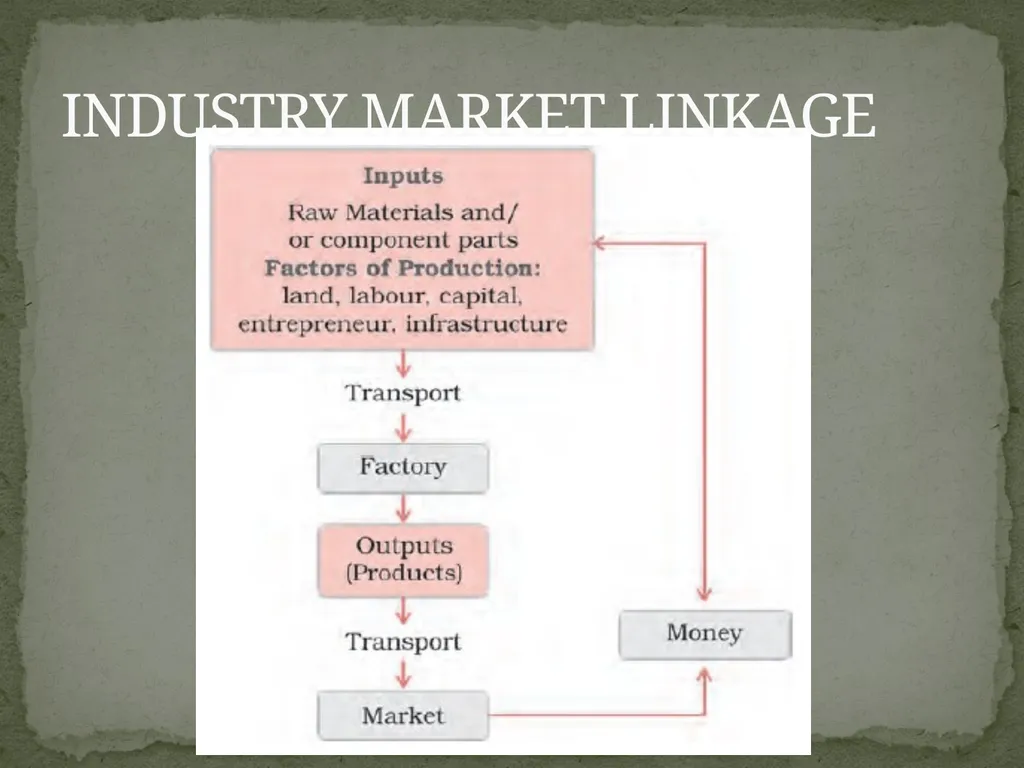
INDUSTRY MARKET LINKAGE<br>
11
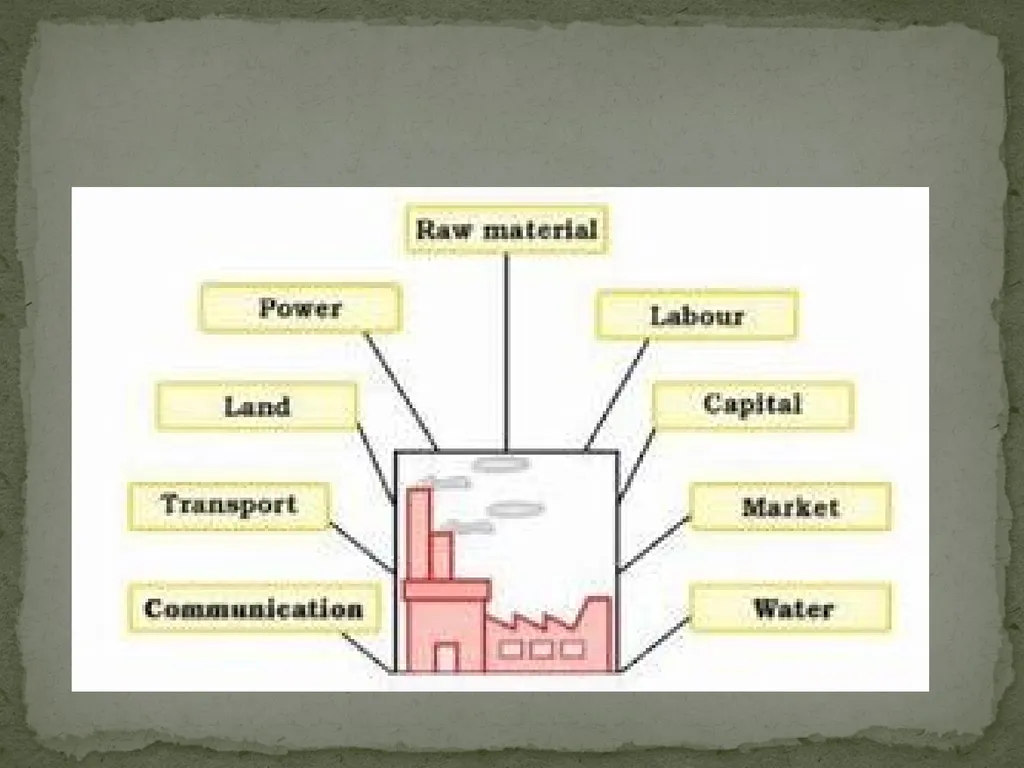
Industrial locations are complex in nature. These are influenced by availability of raw material, labour, capital, power and market, etc. It is rarely possible to find all these factors available at one place. Consequently, manufacturing activity tends to locate at the most appropriate place where all the factors of industrial location are either available or can be arranged at lower cost. A fter an industrial activity starts, urbanisation follows. Sometimes, industries Industrial Location<br>
12
are located in or near the cities. Thus, industrialisation and urbanisation go hand in hand. Cities provide markets and also provide services such as banking, insurance, transport, labour, consultants and financial advice, etc. to the industry. Many industries tend to come together to make use of the advantages offered by the urban centres known as agglomeration economies. Gradually, a large industrial agglomeration takes place.<br>
13
Industrial Location:-
Industrial locations are influenced by the availability of:
Raw material
Labour
Capital
Power
Market
Government policies<br>
Industrial locations are influenced by the availability of:
Raw material
Labour
Capital
Power
Market
Government policies<br>
14
The key to decision of the factory location is the least cost. Government policies and specialized labour also influence the location of industry.<br>
15
On the basis of source of raw materials
used:
• Agro based: cotton, woollen, jute, silk
textile, rubber and sugar, tea, coffee,
edible oil.
• Mineral based: iron and steel, cement,
aluminium, machine tools,
petrochemicals. Classification of Industries:-<br>
used:
• Agro based: cotton, woollen, jute, silk
textile, rubber and sugar, tea, coffee,
edible oil.
• Mineral based: iron and steel, cement,
aluminium, machine tools,
petrochemicals. Classification of Industries:-<br>
16
According to their main role:
Basic or key industries :-are those which
supply their products as raw materials to
manufacture other goods e.g. iron and
steel and copper smelting, aluminum
smelting.
Consumer industries that produce goods:-
for direct use by consumers – sugar,
toothpaste, paper, sewing machines,
fans etc.<br>
Basic or key industries :-are those which
supply their products as raw materials to
manufacture other goods e.g. iron and
steel and copper smelting, aluminum
smelting.
Consumer industries that produce goods:-
for direct use by consumers – sugar,
toothpaste, paper, sewing machines,
fans etc.<br>
17
On the basis of capital investment:-
• A small scale industry is defined with
reference to the maximum inv allowed on the assets of a unit. This limit has changed over a period of time. At present the maximum investment allowedis rupees one crore.<br>
• A small scale industry is defined with
reference to the maximum inv allowed on the assets of a unit. This limit has changed over a period of time. At present the maximum investment allowedis rupees one crore.<br>
18
On the basis of ownership:
• Public sector :-owned and operated by government agencies – BHEL, SAIL etc. •
Private sector industries owned and operated by individuals or a group of
individuals –TISCO, Bajaj Auto Ltd.,Dabur Industries.
Joint sector :-industries which are jointly run by the state and individuals or a group of individuals. Oil India Ltd. (OIL) is jointly owned by public and private sector.
• Cooperative sector industries are owned and operated by the producers or suppliers of raw materials, workers or both. They pool in the resources and share the profits or losses proportionately. Such examples are the sugar industry in Maharashtra, the coir industry in Kerala.<br>
• Public sector :-owned and operated by government agencies – BHEL, SAIL etc. •
Private sector industries owned and operated by individuals or a group of
individuals –TISCO, Bajaj Auto Ltd.,Dabur Industries.
Joint sector :-industries which are jointly run by the state and individuals or a group of individuals. Oil India Ltd. (OIL) is jointly owned by public and private sector.
• Cooperative sector industries are owned and operated by the producers or suppliers of raw materials, workers or both. They pool in the resources and share the profits or losses proportionately. Such examples are the sugar industry in Maharashtra, the coir industry in Kerala.<br>
19
Based on the bulk and weight of raw material
and finished goods:
Heavy industries such as iron and steel
Light industries that use light raw materials and produce light goods such as electrical goods industries.<br>
and finished goods:
Heavy industries such as iron and steel
Light industries that use light raw materials and produce light goods such as electrical goods industries.<br>
20
Cotton, jute, silk, woollen textiles, sugar and
edible oil, etc. industries are based on
agricultural raw materials. Agro-based Industries<br>
edible oil, etc. industries are based on
agricultural raw materials. Agro-based Industries<br>
21
Textile Industries:-
Contribution to National Economy:-
It contribution significantly to Industrial Production near about 14 percentage.
Helps in employment Generation, near about 35 million person are getting their livelihood directly or indirectly from this sector.
It is a good mode of foreign exchange earning near about 24.6 percent.
Contribute near about 4 percent to GDP.<br>
Contribution to National Economy:-
It contribution significantly to Industrial Production near about 14 percentage.
Helps in employment Generation, near about 35 million person are getting their livelihood directly or indirectly from this sector.
It is a good mode of foreign exchange earning near about 24.6 percent.
Contribute near about 4 percent to GDP.<br>
22
First Cotton Mill of India
The first Successful textile mill was established in Mumbai in 1854. Cotton Textile Industry<br>
The first Successful textile mill was established in Mumbai in 1854. Cotton Textile Industry<br>
23
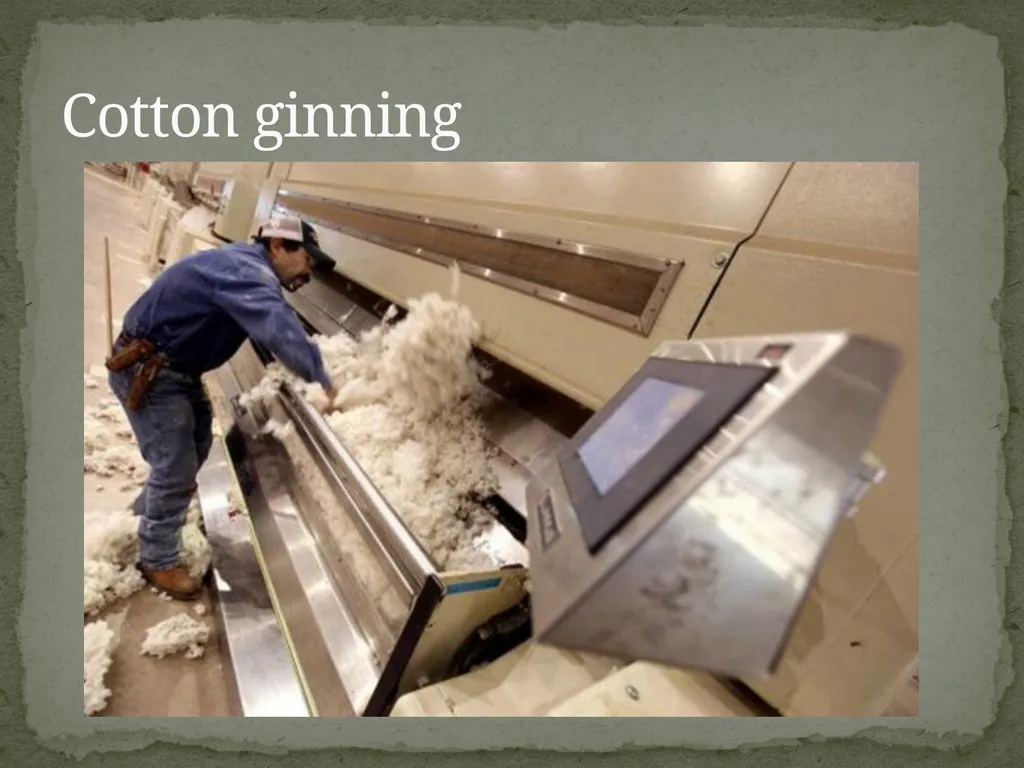
Cotton ginning<br>
24
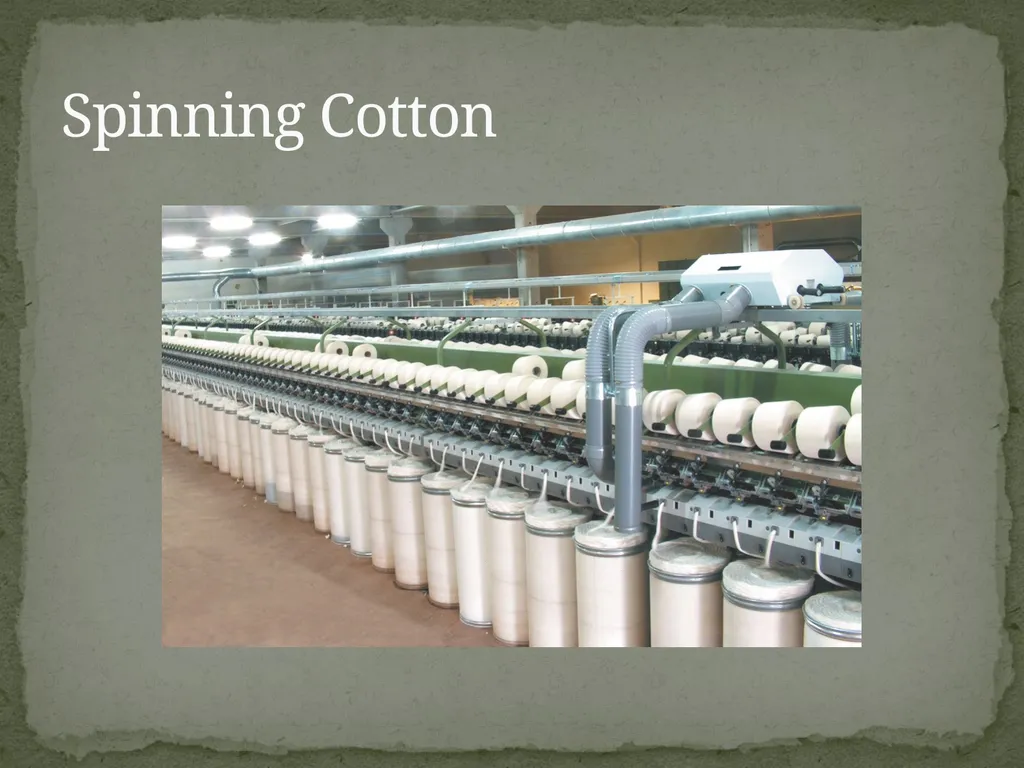
Spinning Cotton<br>
25
Cotton Textiles: In ancient India, cotton
textiles were produced with hand spinning
and handloom weaving techniques. After
the 18th century, power-looms came into
use. Our traditional industries suffered
a setback during the colonial period
because they could not compete with the
mill-made cloth from England.<br>
textiles were produced with hand spinning
and handloom weaving techniques. After
the 18th century, power-looms came into
use. Our traditional industries suffered
a setback during the colonial period
because they could not compete with the
mill-made cloth from England.<br>
26
Most of the Cotton textile Industries are Concentrated in Mumbai and Gujrat. Why?
Availability of raw cotton,
Market facilities
Modern transport facilities.
accessible port facilities,
Availability of Cheap labour.
Best cotton growing climate.<br>
Availability of raw cotton,
Market facilities
Modern transport facilities.
accessible port facilities,
Availability of Cheap labour.
Best cotton growing climate.<br>
27
While spinning continues to be centralised in Maharashtra, Gujarat and Tamil Nadu,weaving is highly decentralized to provide scope for incorporating traditional skills and designs of weaving in cotton, silk, zari,embroidery, etc. India has world class production in spinning, but weaving supplies low quality of fabric as it cannot use much of the high quality yarn produced in the country.Weaving is done by handloom, powerloom and in mills.<br>
28
Zari (or Jari) is an even thread traditionally made of fine gold or silver used in traditional Indian, Bangladeshi and Pakistani garments, especially as brocade in saris etc.<br>
29
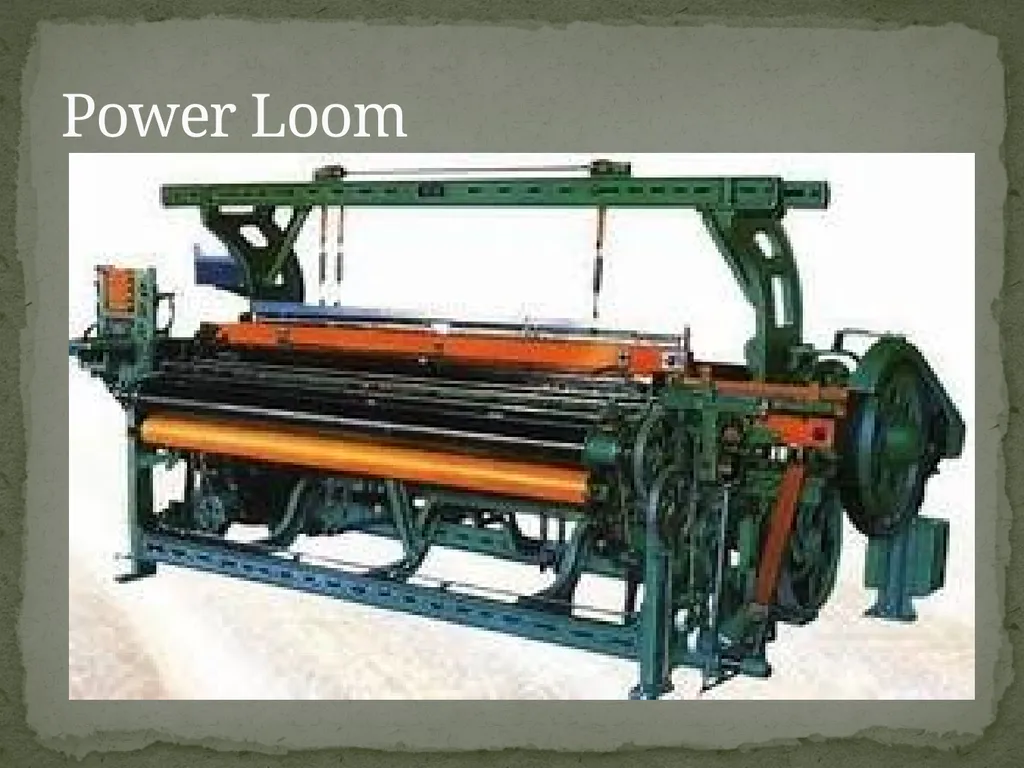
Power Loom<br>
30
Handloom<br>
31
Why did Mahatma Gandhi lay emphasis on
spinning yarn and weaving khadi?
https://www.youtube.com/watch?v=uslx0Mxn-E8<br>
spinning yarn and weaving khadi?
https://www.youtube.com/watch?v=uslx0Mxn-E8<br>
32
1. First of all, he believed in the doctrine of Swadeshi, which means using everything made in his own nation.
2. He promoted the idea of a boycott. The ideology behind boycott was to protest against the foreign made products. Therefore, to serve the need of people he promoted the production of India made textile.
3. The handspun khaadi gave huge employment to Indians. Because Khaadi is a cottage industry, which can easily be set up in homes and through this woman who cannot go outside their homes can easily work. Answer<br>
2. He promoted the idea of a boycott. The ideology behind boycott was to protest against the foreign made products. Therefore, to serve the need of people he promoted the production of India made textile.
3. The handspun khaadi gave huge employment to Indians. Because Khaadi is a cottage industry, which can easily be set up in homes and through this woman who cannot go outside their homes can easily work. Answer<br>
33
India exports yarn to Japan. Other importers of cotton goods from India are U.S.A., U.K., Russia, France, East
European countries, Nepal, Singapore, Sri Lanka, and African countries.We have a large share in the world trade of cotton yarn. Our spinning mills are competitive at the global level and capable of using all the fibres we produce. The weaving,knitting and processing units cannot use much of the high quality yarn that is
produced in the country. There are some large
and modern factories in these segments, but<br>
European countries, Nepal, Singapore, Sri Lanka, and African countries.We have a large share in the world trade of cotton yarn. Our spinning mills are competitive at the global level and capable of using all the fibres we produce. The weaving,knitting and processing units cannot use much of the high quality yarn that is
produced in the country. There are some large
and modern factories in these segments, but<br>
34
most of the production is in fragmented small
units, which cater to the local market. This
mismatch is a major drawback for the
industry. As a result, many of our spinners
export cotton yarn while apparel/garment
manufactures have to import fabric.<br>
units, which cater to the local market. This
mismatch is a major drawback for the
industry. As a result, many of our spinners
export cotton yarn while apparel/garment
manufactures have to import fabric.<br>
35
Drawback of Cotton Textile Industry:-
A. Power supply is erratic.
B. machinery needs to be upgraded in the
weaving and processing sectors in
particular.
C. Less Out Put
D. competition with the synthetic fibre industry.
E.Most of the production is in fragmented small
units, which cater to the local market. This
mismatch is a major drawback for the
industry.<br>
A. Power supply is erratic.
B. machinery needs to be upgraded in the
weaving and processing sectors in
particular.
C. Less Out Put
D. competition with the synthetic fibre industry.
E.Most of the production is in fragmented small
units, which cater to the local market. This
mismatch is a major drawback for the
industry.<br>
36
https://www.youtube.com/watch?v=OWNKojY0ehY<br>
37
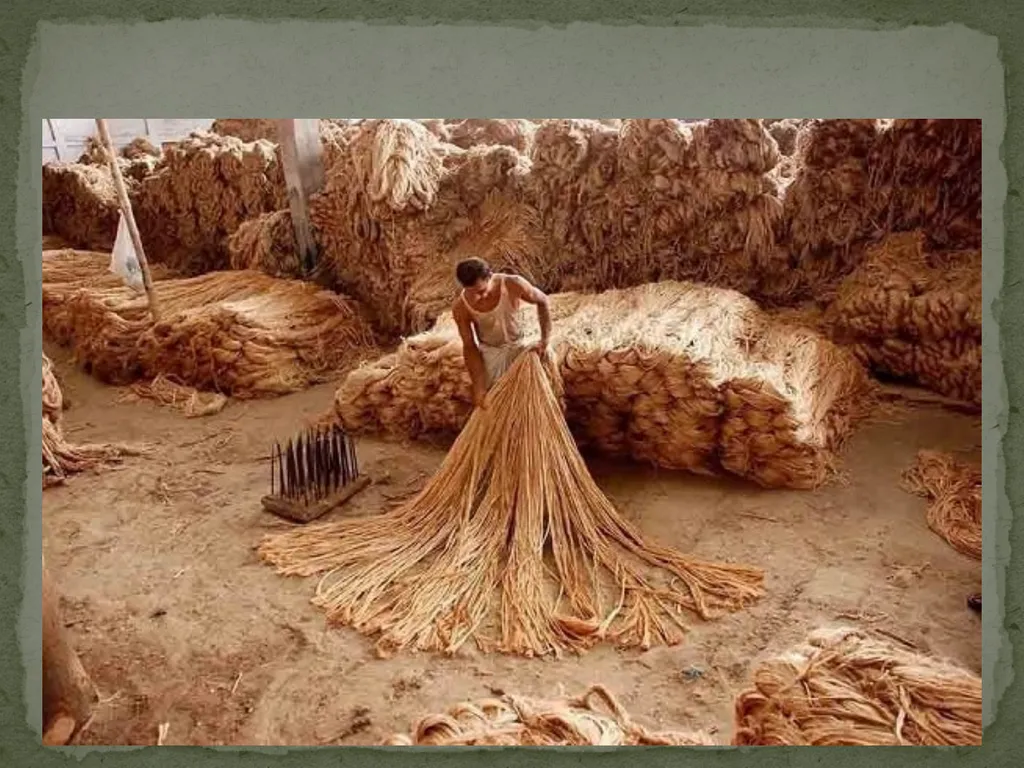
Jute Textiles:-
India is the largest producer of raw jute and
jute goods and stands at second place as an
exporter after Bangladesh. Most of the mills
are located in West Bengal, mainly along the
banks of the Hugli river, in a narrow belt.<br>
India is the largest producer of raw jute and
jute goods and stands at second place as an
exporter after Bangladesh. Most of the mills
are located in West Bengal, mainly along the
banks of the Hugli river, in a narrow belt.<br>
38
The first jute mill was set up near Kolkata in
1855 at Rishra. After Partition in 1947, the
jute mills remained in India but three-fourth
of the jute producing area went to
Bangladesh (erstwhile East Pakistan).<br>
1855 at Rishra. After Partition in 1947, the
jute mills remained in India but three-fourth
of the jute producing area went to
Bangladesh (erstwhile East Pakistan).<br>
39
West Bengal:-
There are many locations in this states which manufacture jute and they are exported to different regions. West Bengal is the largest producer of jute .Areas like Barddhaman, Malda, Murshidabad, 24 Parganas, Medinipur are the regions where jute production is at its maximum.
There is one thing which is also need to be understand that India do not export raw jute to other countries. They import raw jute from Bangladesh and manufacture products of jute in their mills. Based on this, they sell jute products to other countries. Jute Producing State in India<br>
There are many locations in this states which manufacture jute and they are exported to different regions. West Bengal is the largest producer of jute .Areas like Barddhaman, Malda, Murshidabad, 24 Parganas, Medinipur are the regions where jute production is at its maximum.
There is one thing which is also need to be understand that India do not export raw jute to other countries. They import raw jute from Bangladesh and manufacture products of jute in their mills. Based on this, they sell jute products to other countries. Jute Producing State in India<br>
40
Bihar:-
With the districts like Purnea, Darbhanga, Saharsa, and Katihar Bihar is the second largest jute producer in India. It offers a production of 1690 bales on 139.1 hectares of total land.<br>
With the districts like Purnea, Darbhanga, Saharsa, and Katihar Bihar is the second largest jute producer in India. It offers a production of 1690 bales on 139.1 hectares of total land.<br>
41
Assam:-
There are many cities in the state like Nowgong, Sibsagar, Tezpur, Darrang and Goalpara which are producing jute in Assam. Many countries are getting jute through this way. The total land area Assam has is 70 hectares and they produce 823 bales of jute on this.<br>
There are many cities in the state like Nowgong, Sibsagar, Tezpur, Darrang and Goalpara which are producing jute in Assam. Many countries are getting jute through this way. The total land area Assam has is 70 hectares and they produce 823 bales of jute on this.<br>
42
Factors responsible for their location in the Hugli basin are: proximity of the jute producing areas, inexpensive water transport, supported by a good network of railways, roadways and waterways to facilitate movement of raw material to the mills, abundant water for processing raw jute, cheap labour from West Bengal and adjoining states of Bihar, Odisha and Uttar Pradesh. Kolkata as a large urban centre provides banking, insurance and port facilities for export of jute goods. Factors responsible for Location of Industries:-<br>
43
Challenges faced by the industry include stiff competition in the international market from synthetic substitutes and from other competitors like Bangladesh, Brazil,Philippines, Egypt and Thailand. However,the internal demand has been on the increase due to the Government policy of mandatory use of jute packaging. To stimulate demand, the products need to be diversified. The main markets are U.S.A.,Canada, Ghana, Saudi Arabia, U.K. and
Australia. The growing global concern for environment friendly, biodegradable materials, has once again opened the opportunity for jute products.<br>
Australia. The growing global concern for environment friendly, biodegradable materials, has once again opened the opportunity for jute products.<br>
44
Increasing productivity
Improving Quality.
Ensuring good price To the Farmers.
Enhancing yield per hectare. National Jute Policy 2005<br>
Improving Quality.
Ensuring good price To the Farmers.
Enhancing yield per hectare. National Jute Policy 2005<br>
45
Sugar Industry:-
India stands second as a world producer of sugar but occupies the first place in the production of gur and khandsari. The raw material used in this industry is bulky, and in haulage its sucrose content reduces. The mills are located in Uttar Pradesh, Bihar, Maharashtra, Karnataka, Tamil Nadu,Andhra Pradesh, Gujarat, Punjab, Haryana and Madhya Pradesh. Sixty per cent mills are in Uttar Pradesh and Bihar. This industry is seasonal in nature so, it is ideally suited to the cooperative sector.<br>
India stands second as a world producer of sugar but occupies the first place in the production of gur and khandsari. The raw material used in this industry is bulky, and in haulage its sucrose content reduces. The mills are located in Uttar Pradesh, Bihar, Maharashtra, Karnataka, Tamil Nadu,Andhra Pradesh, Gujarat, Punjab, Haryana and Madhya Pradesh. Sixty per cent mills are in Uttar Pradesh and Bihar. This industry is seasonal in nature so, it is ideally suited to the cooperative sector.<br>
46
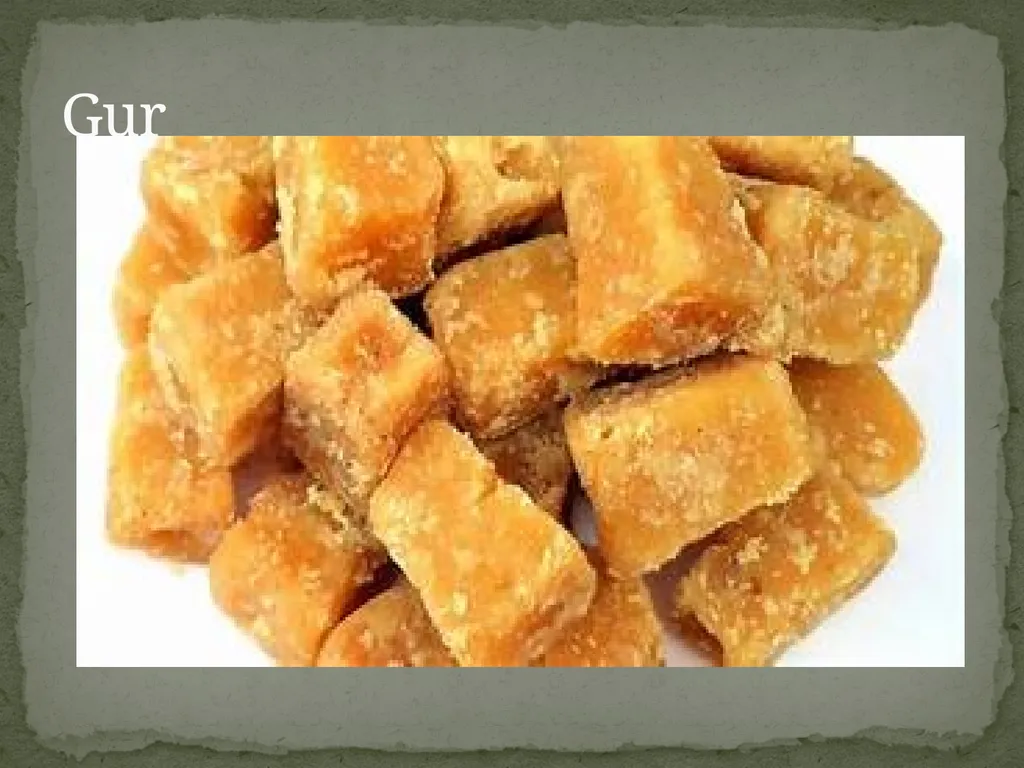
Gur<br>
47
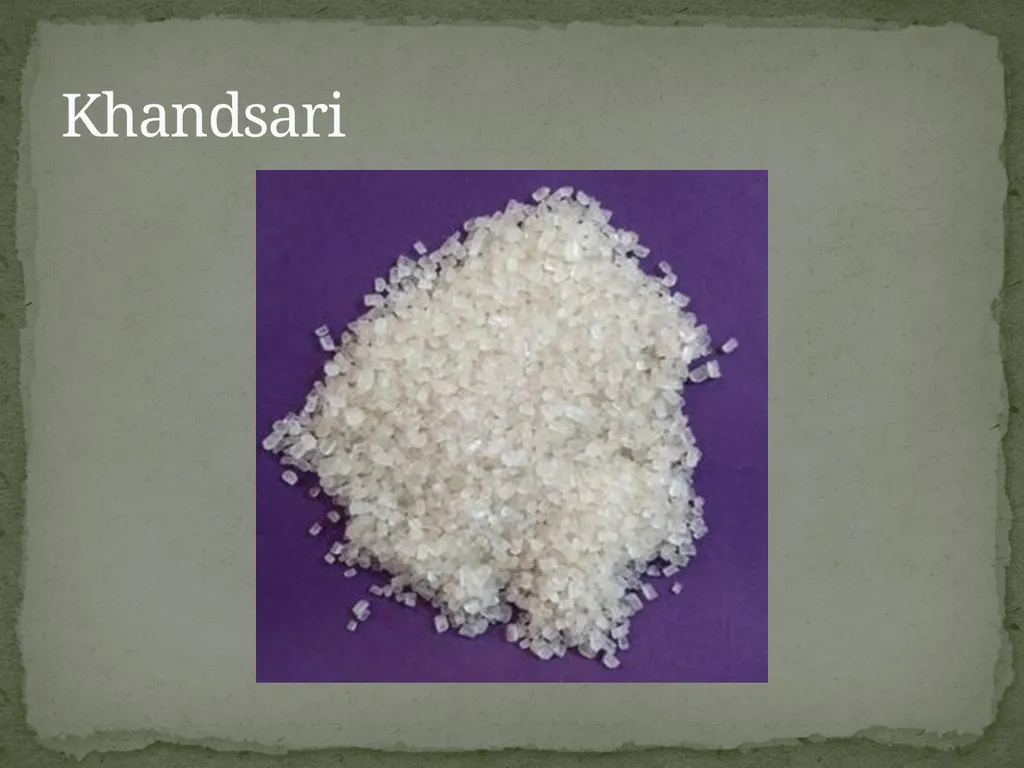
Khandsari<br>
48
In recent years, there is a tendency for
the mills to shift and concentrate in the
southern and western states, especially in
Maharashtra, This is because the cane
produced here has a higher sucrose content.
The cooler climate also ensures a longer
crushing season. Moreover, the cooperatives
are more successful in these states.<br>
the mills to shift and concentrate in the
southern and western states, especially in
Maharashtra, This is because the cane
produced here has a higher sucrose content.
The cooler climate also ensures a longer
crushing season. Moreover, the cooperatives
are more successful in these states.<br>
49
Major challenges include the seasonal
nature of the industry, old and inefficient
methods of production, transport delay in
reaching cane to factories and the need to
maximise the use of baggase.<br>
nature of the industry, old and inefficient
methods of production, transport delay in
reaching cane to factories and the need to
maximise the use of baggase.<br>
50
The economic strength of the country is measured by the development of manufacturing industries”. Support the statement with arguments. Important questions<br>
51
Industries create a variety of goods and thus reduce the dependence of people on agriculture and contributes to modernisation of agriculture.
Industrial development helps to reduce unemployment and poverty levels by initiating income and high standard of living.
Export of manufactured goods add value to the economy. It expands trade and commerce and brings to foreign exchange.
Industries utilise primary materials and convert them into articles of utility, thus adding value to the raw materials.
Countries that transform their raw material into a wide variety of furnished goods of higher value are prosperous. India’s prosperity lies in diversifying its manufacturing industries<br>
Industrial development helps to reduce unemployment and poverty levels by initiating income and high standard of living.
Export of manufactured goods add value to the economy. It expands trade and commerce and brings to foreign exchange.
Industries utilise primary materials and convert them into articles of utility, thus adding value to the raw materials.
Countries that transform their raw material into a wide variety of furnished goods of higher value are prosperous. India’s prosperity lies in diversifying its manufacturing industries<br>
52
Why is the ‘least cost’ known as decision making factor for ideal location of an industry?<br>
53
Least cost is the key factor that determines the location of an industry because industry tends to be located at a place where factors of production are either available or can be arranged at low cost.<br>
54
Why has the ‘National Manufacturing Competitiveness Council’ been set up?<br>
55
National Manufacturing Competitiveness Council (NMCC) has been set up with the objective of appropriate policy intervention, by the Government and renewed efforts, by the industry to improve productivity and achieve its target over the next decade.<br>
56
Explain with examples, how do industries give boost to the agriculture sector?<br>
57
The economic strength of the country depends upon the development of manufacturing industries. Manufacturing industries give major boost to agriculture in the following ways.
Manufacturing industries not only help in modernising agriculture, but also reduces the dependence of people on agricultural income by providing jobs in secondary and tertiary sectors.
Agro industries boost agriculture by increasing its productivity. They depend on raw materials from agricultural sector.
The industries sell their products like irrigation pumps, fertilisers, insecticides, pesticides, machines and tools to the farmers. The manufacturing industries thus make production process efficient.
Industries boost agriculture by transporting the goods produced to various markets.<br>
Manufacturing industries not only help in modernising agriculture, but also reduces the dependence of people on agricultural income by providing jobs in secondary and tertiary sectors.
Agro industries boost agriculture by increasing its productivity. They depend on raw materials from agricultural sector.
The industries sell their products like irrigation pumps, fertilisers, insecticides, pesticides, machines and tools to the farmers. The manufacturing industries thus make production process efficient.
Industries boost agriculture by transporting the goods produced to various markets.<br>
58
Explain any five factors affecting the location of an industry.<br>
59
Availability of raw materials: Close proximity to raw material, regular supply at cheap cost are of utmost significance, e.g., concentration of heavy industries in Chattisgarh.
Labour: Modern industry requires both skilled and unskilled labour at low cost. It also determines the location of industry, e.g., cotton textile industry in Maharashtra.
Capital: Industries are capital intensive. Banks and other financial institutions, insurance etc. play an important role in setting up production units.
Power: All production units depend on one or other sources of power like coal, oil, gas etc. Regular and cheap supply of power is required to keep industries operational, e.g., iron and steel industries near Raniganj and Jharia coal fields.
Market: Goods manufactured need to be sold in the market to maintain the demand and supply.<br>
Labour: Modern industry requires both skilled and unskilled labour at low cost. It also determines the location of industry, e.g., cotton textile industry in Maharashtra.
Capital: Industries are capital intensive. Banks and other financial institutions, insurance etc. play an important role in setting up production units.
Power: All production units depend on one or other sources of power like coal, oil, gas etc. Regular and cheap supply of power is required to keep industries operational, e.g., iron and steel industries near Raniganj and Jharia coal fields.
Market: Goods manufactured need to be sold in the market to maintain the demand and supply.<br>
60
Describe any five factors responsible for the concentration of jute mills along
the banks of the Hugli river.<br>
61
The five factors responsible for the location of jute mills along the Hugli basin are:
Proximity or nearness to the jute producing areas.
Inexpensive water transport.
Good network of roadways, railways and waterways which helps in the movement of raw material to the mills.
Availability of abundant water for processing of raw jute.
Cheap labour from West Bengal, Bihar, Odisha and Uttar Pradesh.
Kolkata being a large urban centre provides banking, insurance and port facilities for export of jute goods.<br>
Proximity or nearness to the jute producing areas.
Inexpensive water transport.
Good network of roadways, railways and waterways which helps in the movement of raw material to the mills.
Availability of abundant water for processing of raw jute.
Cheap labour from West Bengal, Bihar, Odisha and Uttar Pradesh.
Kolkata being a large urban centre provides banking, insurance and port facilities for export of jute goods.<br>
62
. Analyse any three major challenges faced by the sugar industry in India.<br>
63
Answer:
The sugar.industries are concentrated in the sugar producing areas because the raw materials (sugarcane) used by this industry is bulky. To reduce the cost of transporting sugarcane to sugar industries, they are concentrated in sugarcane producing areas.
The three problems faced by the sugar industry in India are:
Old and inefficient methods of production
Delay in transporting sugarcane to the factories
The need to make maximum use of baggase.
Above all seasonal nature of the industry is also a major issue<br>
Old and inefficient methods of production
Delay in transporting sugarcane to the factories
The need to make maximum use of baggase.
Above all seasonal nature of the industry is also a major issue<br>
64
Agriculture and industry move hand in hand’. Analyse the statement with three
examples.<br>
65
Answer:
Agriculture and manufacturing industries have a close relationship. Each of them
compliment each other in the following ways:
Each of them serves as market for goods produced by the other and in the process raises demand for each other’s goods. For example, the agro- based industries, like textiles, sugar, etc., depend upon agriculture for raw materials.
These industries have given a major boost to agriculture by raising their demand and hence, productivity. Manufacturing industries sell the products such as irrigation pumps, fertilisers, insecticides, pesticides, plastic and PVC pipes, agricultural machineries and tools, etc., to the farmers.
(c) Agriculture serves as their market and effects their development. These inputs from industries assists agriculturists in increasing productivity as well as have made the production processes very efficient.
Manufacturing industries not only help in mordenising agriculture, they also reduce the dependency of people on agricultural sector, by providing them jobs in secondary and tertiary sector.
Agro-based industires in India have given boost to agriculture by raising its productivity.<br>
Each of them serves as market for goods produced by the other and in the process raises demand for each other’s goods. For example, the agro- based industries, like textiles, sugar, etc., depend upon agriculture for raw materials.
These industries have given a major boost to agriculture by raising their demand and hence, productivity. Manufacturing industries sell the products such as irrigation pumps, fertilisers, insecticides, pesticides, plastic and PVC pipes, agricultural machineries and tools, etc., to the farmers.
(c) Agriculture serves as their market and effects their development. These inputs from industries assists agriculturists in increasing productivity as well as have made the production processes very efficient.
Manufacturing industries not only help in mordenising agriculture, they also reduce the dependency of people on agricultural sector, by providing them jobs in secondary and tertiary sector.
Agro-based industires in India have given boost to agriculture by raising its productivity.<br>
66
Explain any three objectives of the ‘National Jute Policy 2005’.<br>
67
Answer:
In 2005, the National Jute Policy was adopted with the aim of:
Increasing productivity
Growing better quality of jute
Higher yield per hectare and better price for jute goods<br>
Increasing productivity
Growing better quality of jute
Higher yield per hectare and better price for jute goods<br>
68
Mineral-based Industries:-
Industries that use minerals and metals as
raw materials are called mineral-based
industries.<br>
Industries that use minerals and metals as
raw materials are called mineral-based
industries.<br>
69
https://www.youtube.com/watch?v=6dhAtWDyamY<br>
70
Iron and Steel Industry:-
The iron and steel industry is the basic
industry since all the other industries — heavy,
medium and light, depend on it for their
machinery. Steel is needed to manufacture a
variety of engineering goods, construction
material, defence, medical, telephonic,
scientific equipment and a variety of consumer
goods.<br>
The iron and steel industry is the basic
industry since all the other industries — heavy,
medium and light, depend on it for their
machinery. Steel is needed to manufacture a
variety of engineering goods, construction
material, defence, medical, telephonic,
scientific equipment and a variety of consumer
goods.<br>
71
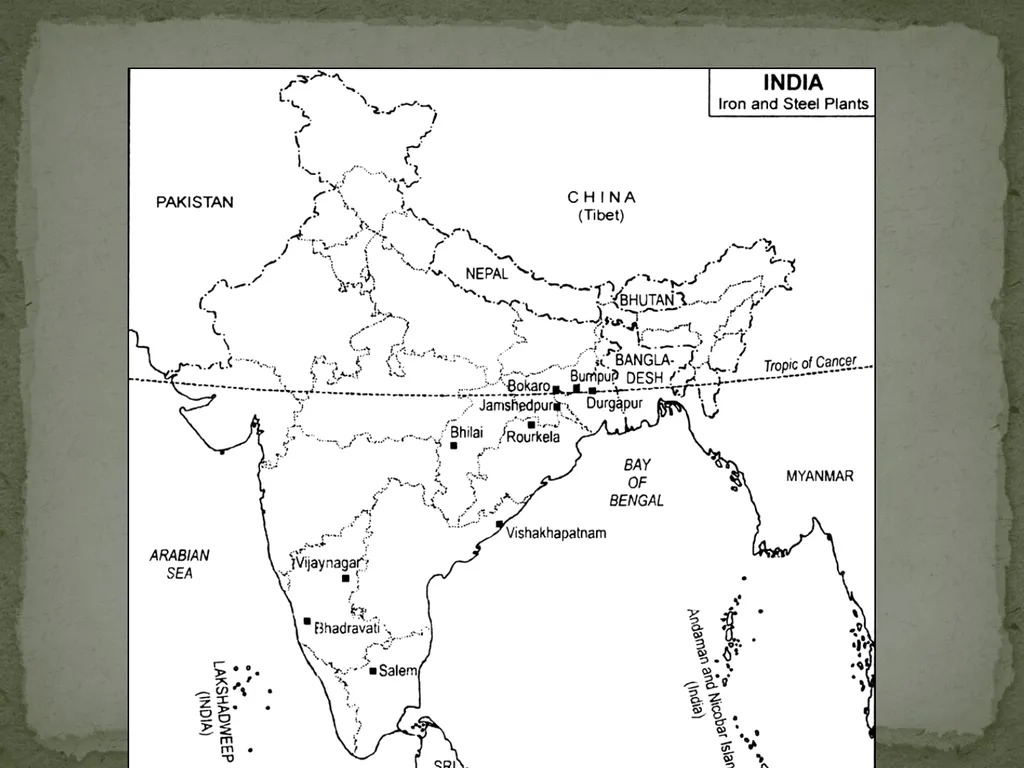
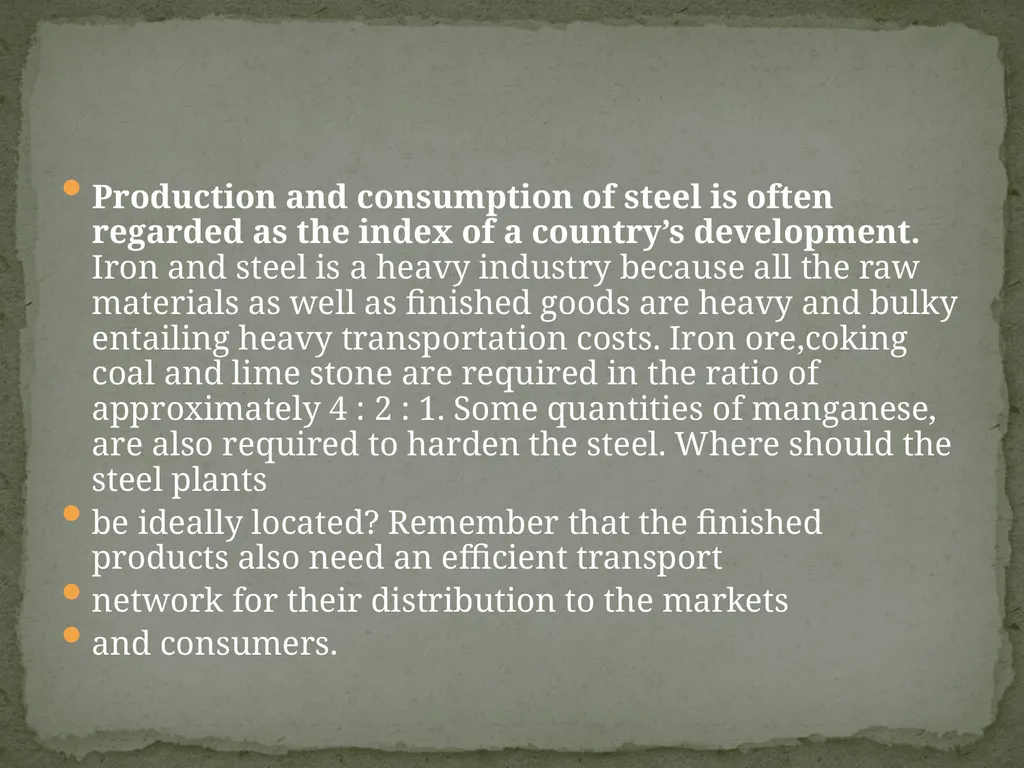
Production and consumption of steel is often regarded as the index of a country’s development. Iron and steel is a heavy industry because all the raw materials as well as finished goods are heavy and bulky entailing heavy transportation costs. Iron ore,coking coal and lime stone are required in the ratio of approximately 4 : 2 : 1. Some quantities of manganese, are also required to harden the steel. Where should the steel plants
be ideally located? Remember that the finished products also need an efficient transport
network for their distribution to the markets
and consumers.<br>
be ideally located? Remember that the finished products also need an efficient transport
network for their distribution to the markets
and consumers.<br>
72
In 2016 with 95.6 million tonnes of crude
steel production, India ranked 3rd among the
world crude steel producers. It is the largest
producer of sponge iron. In 2016 per capita
consumption of steel in the country was only
around 63 kg per annum against the world
average of 208 kg.<br>
steel production, India ranked 3rd among the
world crude steel producers. It is the largest
producer of sponge iron. In 2016 per capita
consumption of steel in the country was only
around 63 kg per annum against the world
average of 208 kg.<br>
73
Most of the public sector undertakings market their steel through Steel Authority of
India Ltd. (SAIL).
In the 1950s China and India produced
almost the same quantity of steel. Today, China
is the largest producer of steel. China is also
the world’s largest consumer of steel.<br>
India Ltd. (SAIL).
In the 1950s China and India produced
almost the same quantity of steel. Today, China
is the largest producer of steel. China is also
the world’s largest consumer of steel.<br>
74
Chhotanagpur plateau region has the maximum concentration of iron and steel industries. ?????
It is largely, because of the relative advantages this region has for the development of this industry. These include, low cost of iron ore, high grade raw materials in proximity,cheap labour and vast growth potential in the home market.<br>
It is largely, because of the relative advantages this region has for the development of this industry. These include, low cost of iron ore, high grade raw materials in proximity,cheap labour and vast growth potential in the home market.<br>
75
Though, India is an important iron and steel producing country in the world yet, we are not able to perform to our full potential largely due to:
(a) High costs and limited availability of coking coal
(b) Lower productivity of labour
(c) Irregular supply of energy and
(d) Poor infrastructure.<br>
(a) High costs and limited availability of coking coal
(b) Lower productivity of labour
(c) Irregular supply of energy and
(d) Poor infrastructure.<br>
76
Why is the per capita consumption of steel so
low in India?
The per capita values of almost all the indicators will be low for India simply because of the reason that our population is so huge. Per capita value of any indicator is the total production by the country divided by the population of that country. So even though India is one of the top most producers of steel in the world, the per capita consumption will show a low value because we have to divide it by 1.3 billion<br>
low in India?
The per capita values of almost all the indicators will be low for India simply because of the reason that our population is so huge. Per capita value of any indicator is the total production by the country divided by the population of that country. So even though India is one of the top most producers of steel in the world, the per capita consumption will show a low value because we have to divide it by 1.3 billion<br>
77
1 Answer. (i) An Integrated steel plant is larger than Mini Steel Plant. (ii) Mini steel plant use steel scrap and sponge iron while Integrated steel plant use basic raw materials ie iron ore for making steel. (iii) Mini steel plant produces mild and alloy steel while integrated steel plant produces only steel.<br>
78
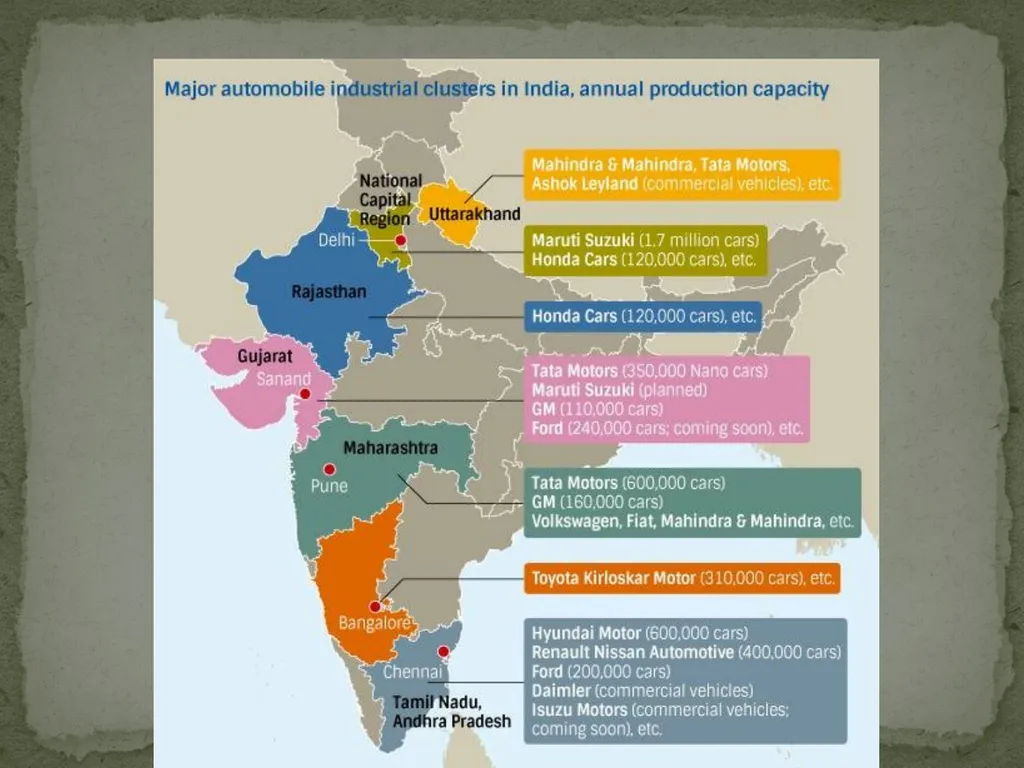
Automobiles provide vehicle for quick transport of good services and passengers.Trucks, buses, cars, motor cycles, scooters,three-wheelers and multi-utility vehicles are manufactured in India at various centres.
After the liberalisation, the coming in of new and contemporary models stimulated the demand for vehicles in the market,which led to the healthy growth of the
industry including passenger cars, two and three-wheelers. The industry is located around Delhi, Gurugram, Mumbai, Pune,
Chennai, Kolkata, Lucknow, Indore, Hyderabad, Jamshedpur and Bengaluru. Automobile Industry<br>
After the liberalisation, the coming in of new and contemporary models stimulated the demand for vehicles in the market,which led to the healthy growth of the
industry including passenger cars, two and three-wheelers. The industry is located around Delhi, Gurugram, Mumbai, Pune,
Chennai, Kolkata, Lucknow, Indore, Hyderabad, Jamshedpur and Bengaluru. Automobile Industry<br>
79
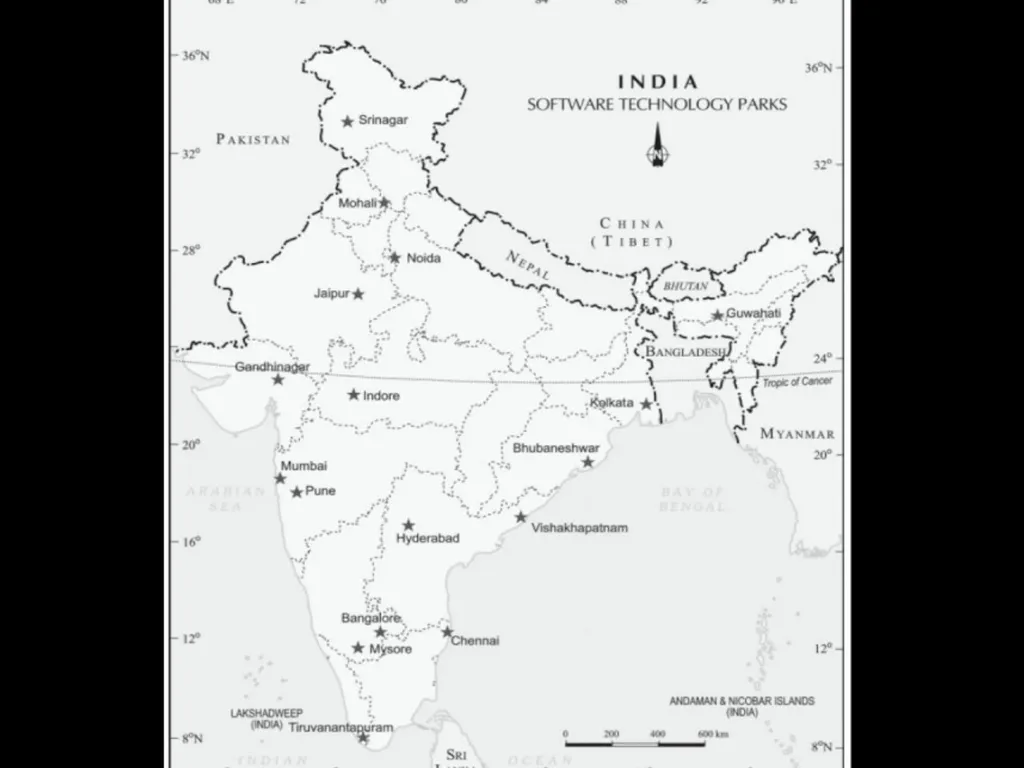
The electronics industry covers a wide range of products from transistor to telivision,telephone, cellular telecom, telephone exchange, radars, computers and many other equipments required by the telecommunication industry. Bengaluru has emerged as the electronic capital of India.Other important centres for electronic goods are Mumbai, Delhi, Hyderabad, Pune,Chennai, Kolkata, Lucknow and Coimbatore. The major industry concentration is at Bengaluru, Noida, Mumbai, Chennai, Hyderabad and Pune. A major impact of this industry has been on employment generation. The continuing growth in the hardware and software is the key to the success of IT industry in India. Information Technology and Electronic Industry<br>
80
By 2010-11(STPI) software Technology Parks of India have come up across 46 locations at different centres in India.However the major industry concentration is in Bengaluru,Noida,Mubai,Chennai,Hyderabad and Pune.A major Impact of this Industry has been on employmenyt Generation.It is encouraging to know that 30 percent of the people employed in this sector are women.<br>
81
This Industry has been a major foreign exchange earner in the last three years because of its fast growing Buisness Processing Outsourcing BPO sector. The continuing growth in the hardware and software is the key to the success of IT industry in India.<br>
82
1. TCS
TCS has become the first Indian IT company to have a market capitalization of 100 billion dollars. The largest IT giant of India was established in 1968 and it is a wholly owned subsidiary of TATA group, and JRD Tata was the first chairman of the company.<br>
TCS has become the first Indian IT company to have a market capitalization of 100 billion dollars. The largest IT giant of India was established in 1968 and it is a wholly owned subsidiary of TATA group, and JRD Tata was the first chairman of the company.<br>
83
Infosys
Infosys is a household name of Information Technology space with workforce of over 200,000 people in different countries.
The company has around 50 offices worldwide and large number of delivery centres at various strategic locations across the world
Founder Mr. Murthy founded Infosys in 1981.<br>
Infosys is a household name of Information Technology space with workforce of over 200,000 people in different countries.
The company has around 50 offices worldwide and large number of delivery centres at various strategic locations across the world
Founder Mr. Murthy founded Infosys in 1981.<br>
84
Tech Mahindra
Tech Mahindra is a part of Mahindra group, which is one of the most reputed organizations in India.
C P Gurnani, the current CEO of Tech Mahindra, has various digital initiatives to position the company in the digital domain.<br>
Tech Mahindra is a part of Mahindra group, which is one of the most reputed organizations in India.
C P Gurnani, the current CEO of Tech Mahindra, has various digital initiatives to position the company in the digital domain.<br>
85
Wipro
Wipro was initially setup as Western India Vegetable Products Limited at 1945 by Mr. Azim Premji.
Mr. Abidali Z. Neemuchwala is the current CEO of Wipro.<br>
Wipro was initially setup as Western India Vegetable Products Limited at 1945 by Mr. Azim Premji.
Mr. Abidali Z. Neemuchwala is the current CEO of Wipro.<br>
86
HCL Technologies
HCL Technologies is part of the HCL group which was founded in 1976 by Mr. Shiv Nadar.
The company has a strong workforce of 117,000+ employees and is headquartered in Noida and has offices in more than 30 nations including USA, France, Germany and United Kingdom<br>
HCL Technologies is part of the HCL group which was founded in 1976 by Mr. Shiv Nadar.
The company has a strong workforce of 117,000+ employees and is headquartered in Noida and has offices in more than 30 nations including USA, France, Germany and United Kingdom<br>
87
Software Technology Parks of India was set up in 1991 as an autonomous society under the Ministry of Electronics and Information Technology (MeitY). STPI’s main objective has been the promotion of software exports from the country.
At present, a total of 60 STPI centres/sub-centres are operational across the country.
Dr. Omkar Rai -Director GeneralSoftware Technology Parks of India<br>
At present, a total of 60 STPI centres/sub-centres are operational across the country.
Dr. Omkar Rai -Director GeneralSoftware Technology Parks of India<br>
88
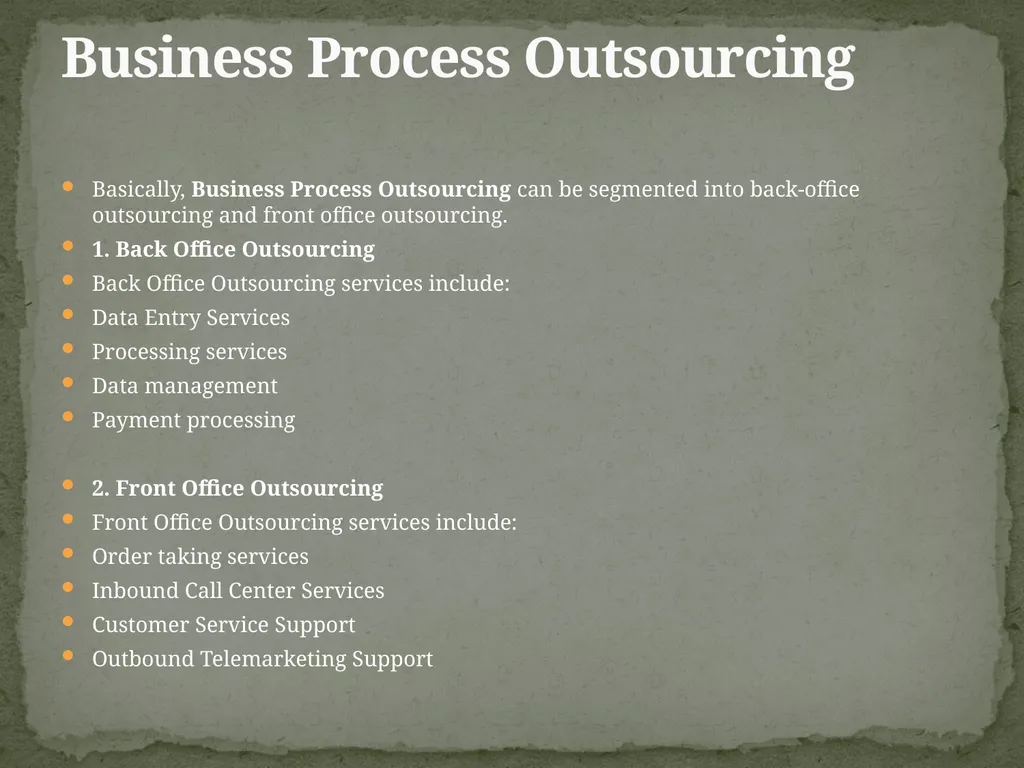
Basically, Business Process Outsourcing can be segmented into back-office outsourcing and front office outsourcing.
1. Back Office Outsourcing
Back Office Outsourcing services include:
Data Entry Services
Processing services
Data management
Payment processing
2. Front Office Outsourcing
Front Office Outsourcing services include:
Order taking services
Inbound Call Center Services
Customer Service Support
Outbound Telemarketing Support Business Process Outsourcing<br>
1. Back Office Outsourcing
Back Office Outsourcing services include:
Data Entry Services
Processing services
Data management
Payment processing
2. Front Office Outsourcing
Front Office Outsourcing services include:
Order taking services
Inbound Call Center Services
Customer Service Support
Outbound Telemarketing Support Business Process Outsourcing<br>
89
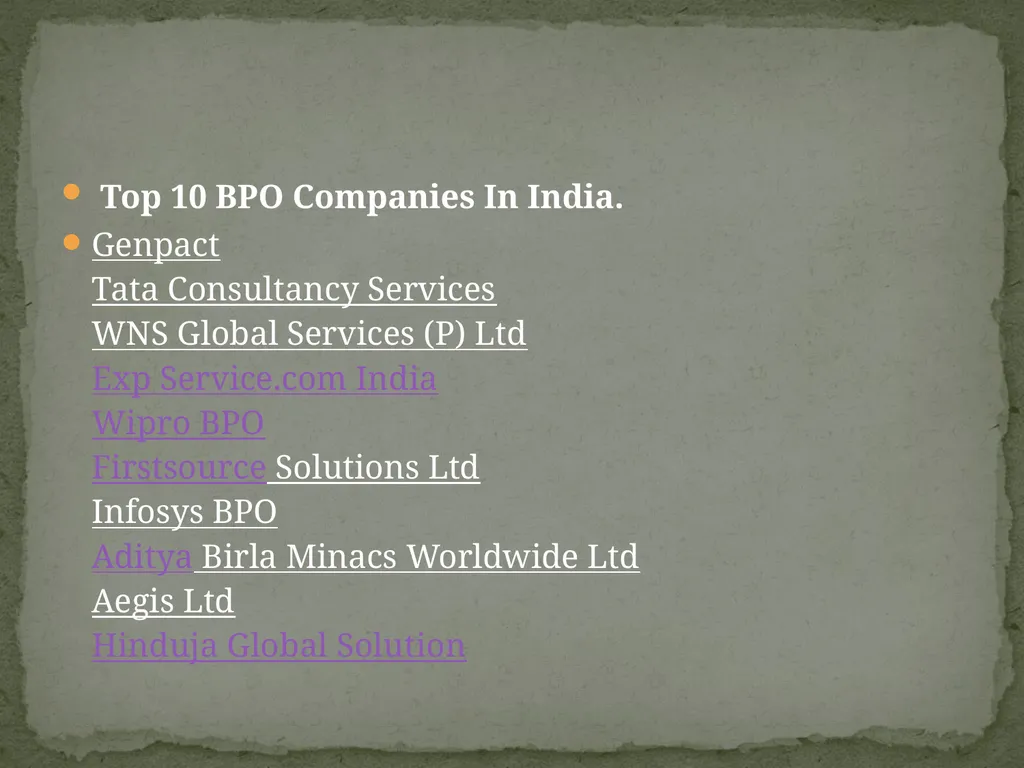
Top 10 BPO Companies In India.
Genpact Tata Consultancy Services WNS Global Services (P) Ltd Exp Service.com India Wipro BPO Firstsource Solutions Ltd Infosys BPO Aditya Birla Minacs Worldwide Ltd Aegis Ltd Hinduja Global Solution<br>
Genpact Tata Consultancy Services WNS Global Services (P) Ltd Exp Service.com India Wipro BPO Firstsource Solutions Ltd Infosys BPO Aditya Birla Minacs Worldwide Ltd Aegis Ltd Hinduja Global Solution<br>
90
https://www.youtube.com/watch?v=hG3S-8cIue4<br>
91
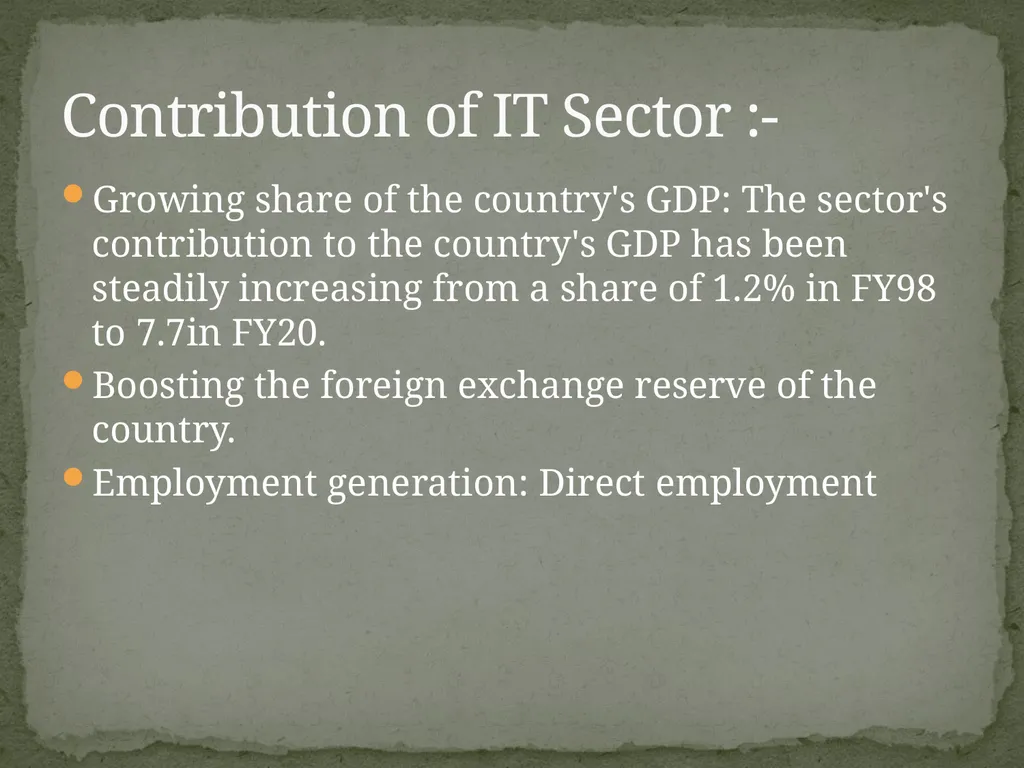
Growing share of the country's GDP: The sector's contribution to the country's GDP has been steadily increasing from a share of 1.2% in FY98 to 7.7in FY20.
Boosting the foreign exchange reserve of the country.
Employment generation: Direct employment Contribution of IT Sector :-<br>
Boosting the foreign exchange reserve of the country.
Employment generation: Direct employment Contribution of IT Sector :-<br>
92
Foreign direct investment brought in new technology and aligned the industry with global developments.
Now you have any latest automobile vehicle launched in any part of the world, simultaneously it is launched in India also.
After liberalization, the coming in of new and contemporary models stimulated the demand for vehicles in the market, which led to the healthy growth of the industry including passenger cars, two and three wheeler.
Production Increased.
Production Plant Increased. Impact of Liberalization on Automobile Industry<br>
Now you have any latest automobile vehicle launched in any part of the world, simultaneously it is launched in India also.
After liberalization, the coming in of new and contemporary models stimulated the demand for vehicles in the market, which led to the healthy growth of the industry including passenger cars, two and three wheeler.
Production Increased.
Production Plant Increased. Impact of Liberalization on Automobile Industry<br>