Manufacturing processes 1.1 What is Manufacturing? The word manufacture is derived from two Latin words, manus (hand) and factus (make); the combination means made by hand. The English word manufacture is several Centuries old, and made
"Manufacturing processes 1.1 What is Manufacturing?" is the property of its rightful owner. Permission is granted to
download and print the materials on this website for personal, non-commercial use only, and to display it
on your personal computer provided you do not modify the materials and that you retain all copyright
notices contained in the materials. By downloading content from our website, you accept the terms of this
agreement.
Presentation Transcript
01
Manufacturing processes 1.1 What is Manufacturing?
The word manufacture is derived from two Latin words, manus (hand) and factus (make); the combination means made by hand. The English word manufacture is several Centuries old, and ‘‘made by hand’’ accurately described the manual methods.
1.2 Manufacturing Defined
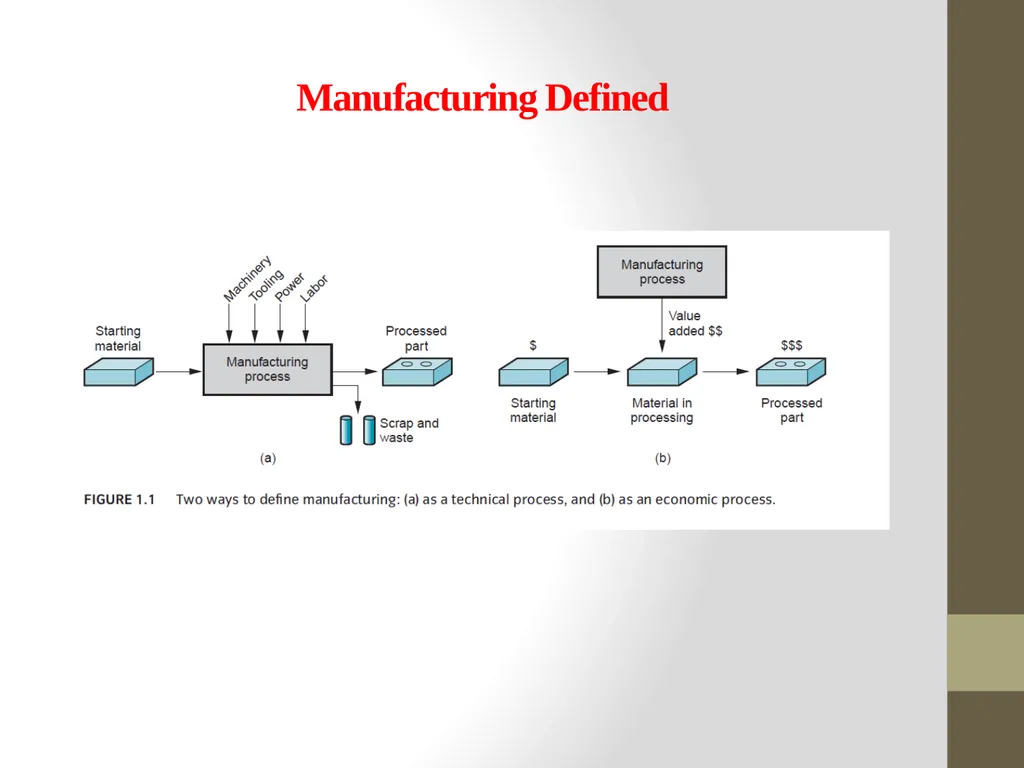
As a field of study in the modern context, manufacturing can be defined two ways, one technologic and the other economic. Technologically, manufacturing is the application of physical and chemical processes to alter the geometry, properties, and/or appearance of a given starting material to make parts or products; manufacturing also includes assembly of multiple parts to make products. The processes to accomplish manufacturing involve a combination of machinery, tools, power, and labor, as depicted in Figure 1.1.
Manufacturing is almost always carried out as a sequence of operations. Each operation brings the material closer to the desired final state.<br>
02
Manufacturing Defined<br>
03
Economically, manufacturing is the transformation of materials into items of greater value by means of one or more processing and/or assembly operations. The key point is that manufacturing adds value to the material by changing its Shape or properties, or by combining it with other materials that have been similarly. The material has been made more valuable through the manufacturing operations performed on it. When iron ore is converted into steel, value is added. When sand is transformed into glass, value is added. When petroleum is refined into plastic, value is added. And when plastic is molded into the complex geometry of a patio chair, it is made even more valuable. The words manufacturing and production are often used interchangeably. The author’s view is that production has a broader meaning than manufacturing. To illustrate, one might speak of ‘‘crude oil production,’’ but the phrase ‘‘crude oil manufacturing’’ seems out of place. Yet when used in the context of products such as metal parts or automobiles, either word seems okay.<br>
04
Importance of Manufacturing Processes Manufacturing may produce discrete products, meaning individual parts or pieces of parts or it may produce continuous products. Nails, gears, steel balls, beverage cans and engine blocks are example of discrete products. Metal or plastic sheet, wire, hose and pipe are continuous products that may be cut into individual pieces and thereby become discrete products. Because a manufactured item has undergone a number of changes during which raw material has become a useful product, it has added value, defined as monetary worth in terms of price. For example, clay has a certain value when mined. When the clay is used to make a ceramic dinner plate, cutting tool, or electrical insulator, value is added to the clay; similarly, a wire coat hanger or a nail has added value over and above the cost of a piece of wire.<br>
05
Classifications of Manufacturing Processes Most of the metals used in industry are obtained as ores. These ores are subjected to a suitable reducing process which gives the metal in a molten form. This molten metal is poured into moulds to give commercial casting, called ingots. These ingots are further subjected to one or more processes to obtain usable metal products of different shapes and sizes. All the further processes used for changing the ingots into usable products can be classified as follows:<br>
06
Primary Shaping Processes These processes are of two types. Some of these finish product to its usable form whereas others do not, and require further working to finish the component to the desired shape and size. Casting needs remelting of ingots in cupola or some other foundry furnace and then pouring of this molten metal into metal or sand moulds to obtain the castings. The products obtained through this process may or may not be required to undergo further operation; depending upon the function they have to perform. Same in the case with forging than casting. Many operations like cold rolling die casting, metal spinning and wire drawing etc., lead to the production of directly useful articles. The common operations are:
(1) Casting (2) Forging
(3) Rolling (4) Bending (5) Drawing
(6) Shearing (7) Spinning<br>
07
1.4.2 Machining Processes A fairly large number of components are not finished to their usable shapes and sizes through the primary processes. These components are further subjected to one or more of the machining operation called SECONDARY PROCESSES, to obtain the desired shape and dimensional accuracy. Thus, the components undergoing these secondary operations are basically the roughly finished products through primary operation. The secondary operation are mainly necessary when a very close dimensional accuracy is required or some such shape is desired to be produced which is not possible through primary operations. These operations require the use of one or more machine tools, various types of cutting tools and cutters, marking and measuring instruments, testing devices and gauges etc. of which a combined application leads to the desired dimensional control. The common machining performed for this purpose are the following:
(1) Turning (2) Threading
(3) Drilling (4) Sawing (5) Grinding<br>
08
Joining Processes
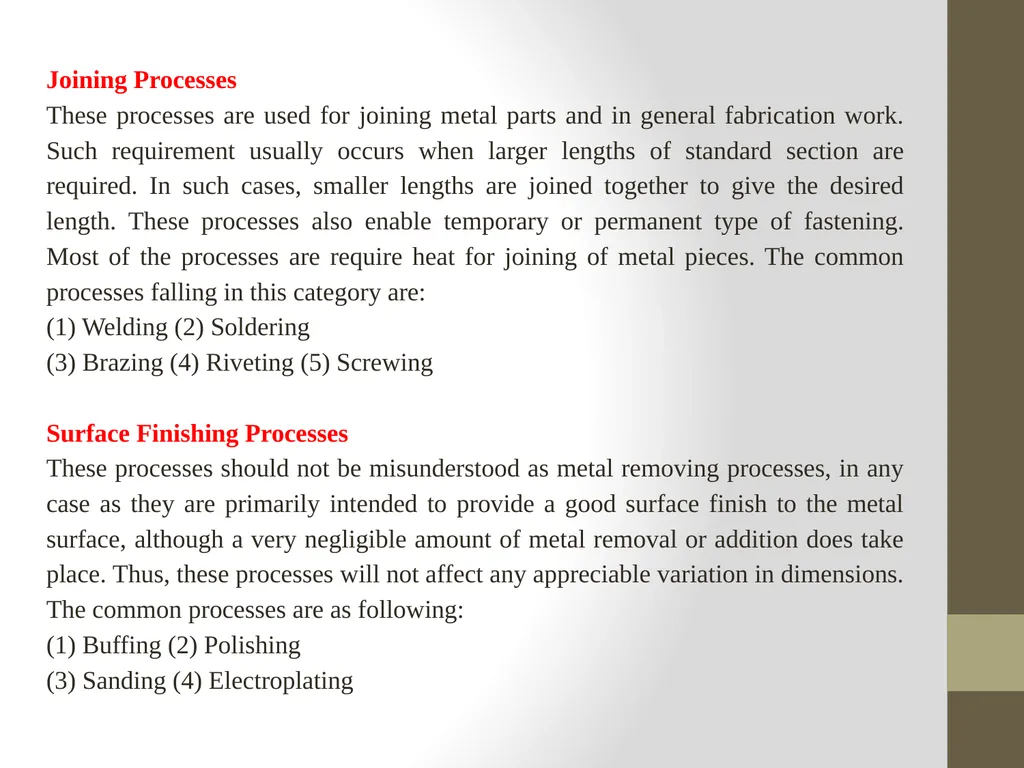
These processes are used for joining metal parts and in general fabrication work. Such requirement usually occurs when larger lengths of standard section are required. In such cases, smaller lengths are joined together to give the desired length. These processes also enable temporary or permanent type of fastening. Most of the processes are require heat for joining of metal pieces. The common processes falling in this category are:
(1) Welding (2) Soldering
(3) Brazing (4) Riveting (5) Screwing
Surface Finishing Processes
These processes should not be misunderstood as metal removing processes, in any case as they are primarily intended to provide a good surface finish to the metal surface, although a very negligible amount of metal removal or addition does take place. Thus, these processes will not affect any appreciable variation in dimensions. The common processes are as following:
(1) Buffing (2) Polishing
(3) Sanding (4) Electroplating<br>
09
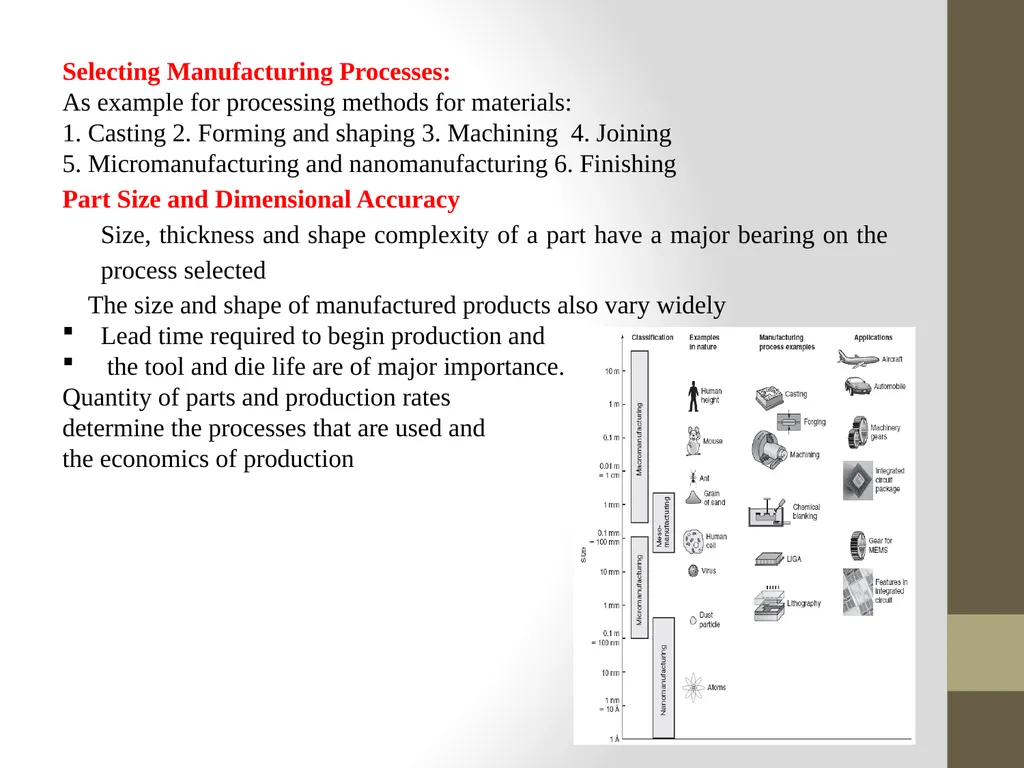
Selecting Manufacturing Processes:
As example for processing methods for materials:
1. Casting 2. Forming and shaping 3. Machining 4. Joining
5. Micromanufacturing and nanomanufacturing 6. Finishing
Part Size and Dimensional Accuracy
Size, thickness and shape complexity of a part have a major bearing on the process selected
The size and shape of manufactured products also vary widely
Lead time required to begin production and
the tool and die life are of major importance.
Quantity of parts and production rates
determine the processes that are used and
the economics of production<br>
10
Net-Shape Manufacturing
Additional finishing operations might be needed for finished parts or products to desired specifications.
The main responsibilities of the manufacturing engineers:
Plane the manufacturing of the product and the processes to be utilized, this function requires a through knowledge of product, its expected performance and specification.
Identify machines, requirement, and tools to carry out the plan.
Interact with design and materials engineers to optimize productivity and minimize product costs.
Cooperate with industrial engineers for machine arrangements, material-handling, new technologies….etc<br>