
Map-Reduce and the New Software Stack Mining of
CM
Published · 48 slides · 0 views
1 / 1


Description
Map-Reduce and the New Software Stack Mining of Massive Datasets Jure Leskovec, Anand Rajaraman, Jeff Ullman Stanford University http:www.mmds.org Note to other teachers and users of these slides: We would be delighted if you found this
Related Topics
Share
Embed code
Download this presentation From Below
"Map-Reduce and the New Software Stack Mining of" is the property of its rightful owner. Permission is granted to download and print the materials on this website for personal, non-commercial use only, and to display it on your personal computer provided you do not modify the materials and that you retain all copyright notices contained in the materials. By downloading content from our website, you accept the terms of this agreement.
Presentation Transcript
01
Map-Reduce and
the New Software Stack Mining of Massive Datasets
Jure Leskovec, Anand Rajaraman, Jeff Ullman Stanford University
http://www.mmds.org Note to other teachers and users of these slides: We would be delighted if you found this our material useful in giving your own lectures. Feel free to use these slides verbatim, or to modify them to fit your own needs. If you make use of a significant portion of these slides in your own lecture, please include this message, or a link to our web site: http://www.mmds.org<br>
Jure Leskovec, Anand Rajaraman, Jeff Ullman Stanford University
http://www.mmds.org Note to other teachers and users of these slides: We would be delighted if you found this our material useful in giving your own lectures. Feel free to use these slides verbatim, or to modify them to fit your own needs. If you make use of a significant portion of these slides in your own lecture, please include this message, or a link to our web site: http://www.mmds.org<br>
02
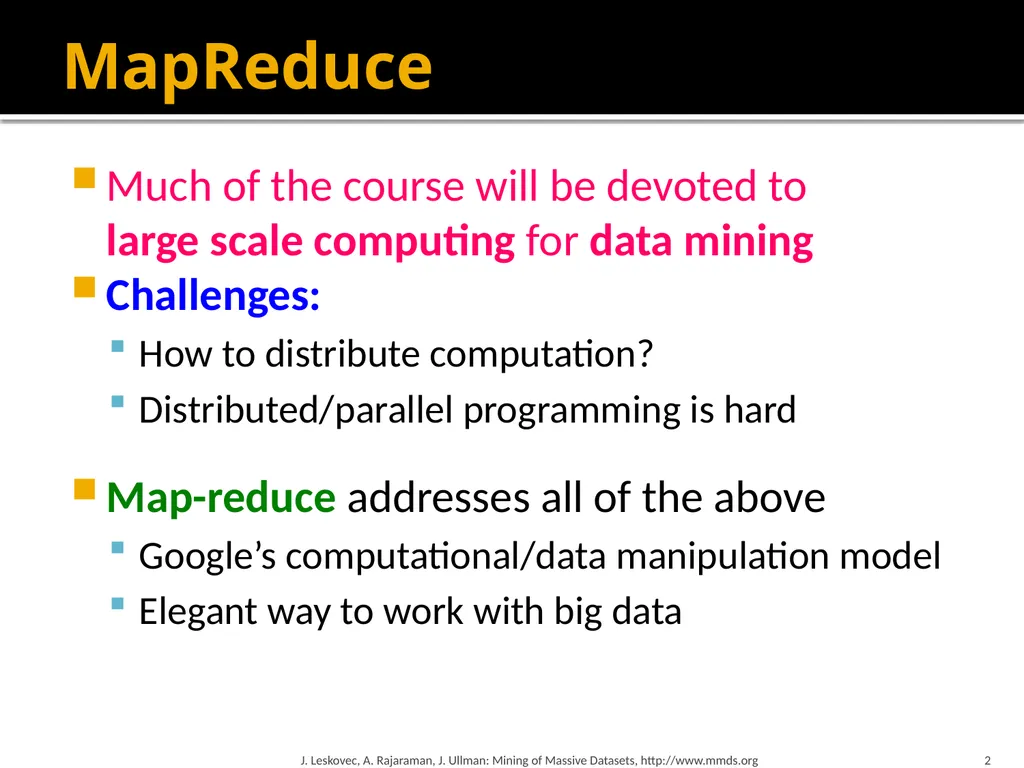
MapReduce Much of the course will be devoted to
large scale computing for data mining
Challenges:
How to distribute computation?
Distributed/parallel programming is hard
Map-reduce addresses all of the above
Google’s computational/data manipulation model
Elegant way to work with big data J. Leskovec, A. Rajaraman, J. Ullman: Mining of Massive Datasets, http://www.mmds.org 2<br>
Challenges:
How to distribute computation?
Distributed/parallel programming is hard
Map-reduce addresses all of the above
Google’s computational/data manipulation model
Elegant way to work with big data J. Leskovec, A. Rajaraman, J. Ullman: Mining of Massive Datasets, http://www.mmds.org 2<br>
03
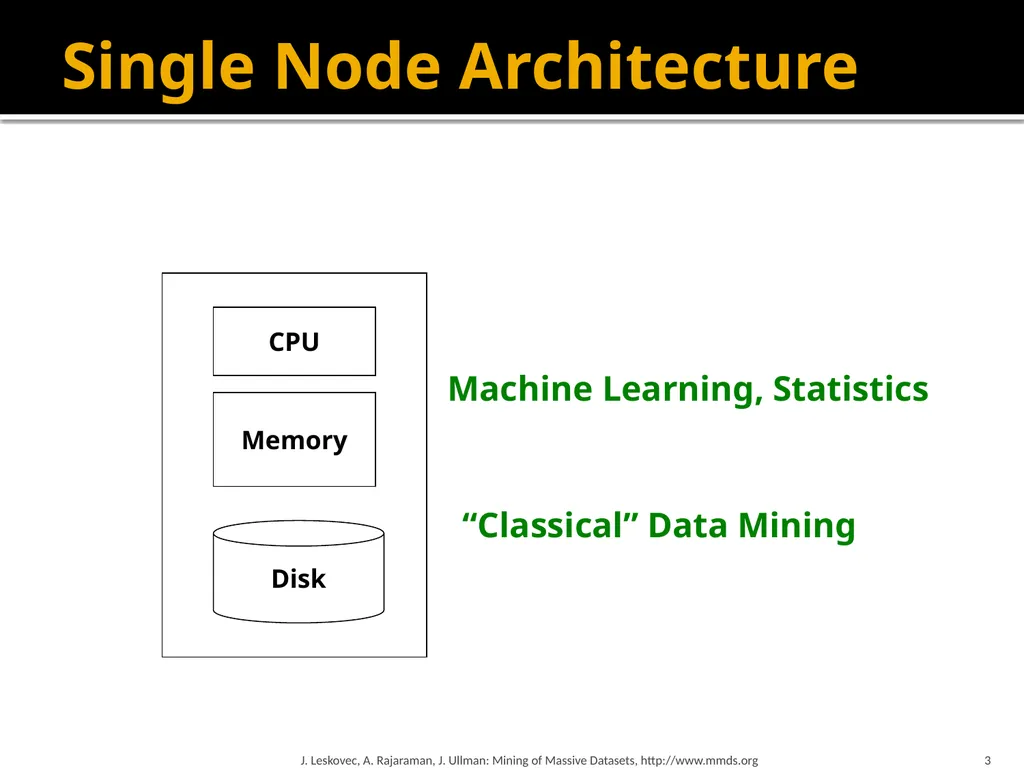
Single Node Architecture Memory Disk CPU Machine Learning, Statistics “Classical” Data Mining J. Leskovec, A. Rajaraman, J. Ullman: Mining of Massive Datasets, http://www.mmds.org 3<br>
04
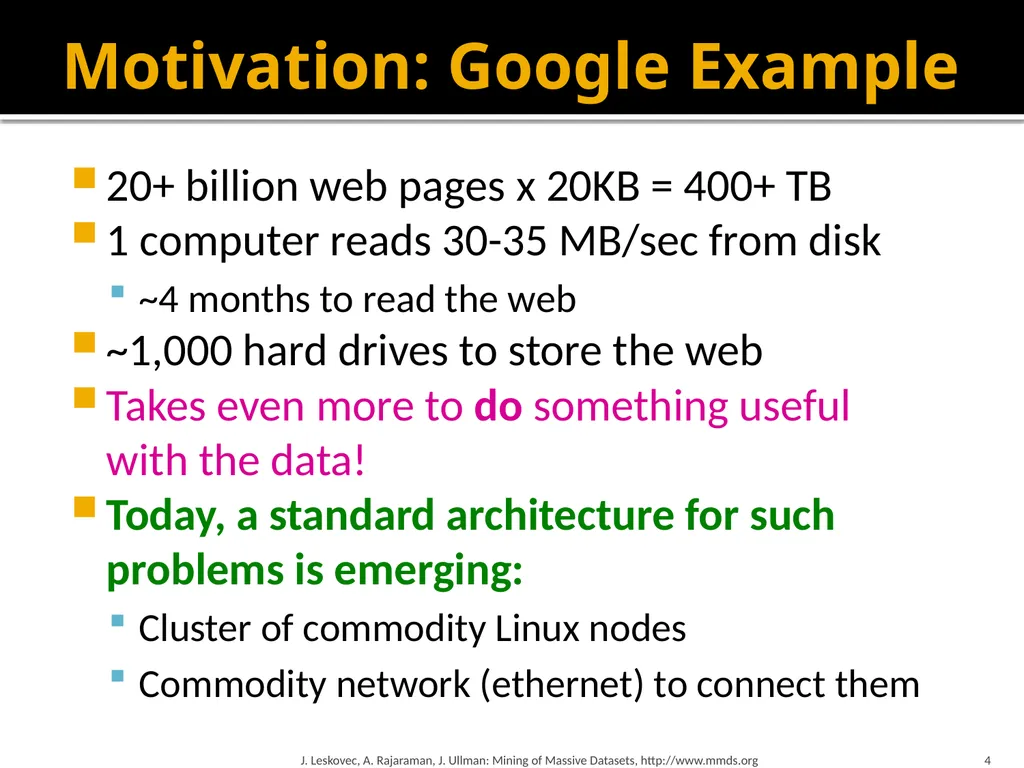
Motivation: Google Example 20+ billion web pages x 20KB = 400+ TB
1 computer reads 30-35 MB/sec from disk
~4 months to read the web
~1,000 hard drives to store the web
Takes even more to do something useful with the data!
Today, a standard architecture for such problems is emerging:
Cluster of commodity Linux nodes
Commodity network (ethernet) to connect them J. Leskovec, A. Rajaraman, J. Ullman: Mining of Massive Datasets, http://www.mmds.org 4<br>
1 computer reads 30-35 MB/sec from disk
~4 months to read the web
~1,000 hard drives to store the web
Takes even more to do something useful with the data!
Today, a standard architecture for such problems is emerging:
Cluster of commodity Linux nodes
Commodity network (ethernet) to connect them J. Leskovec, A. Rajaraman, J. Ullman: Mining of Massive Datasets, http://www.mmds.org 4<br>
05
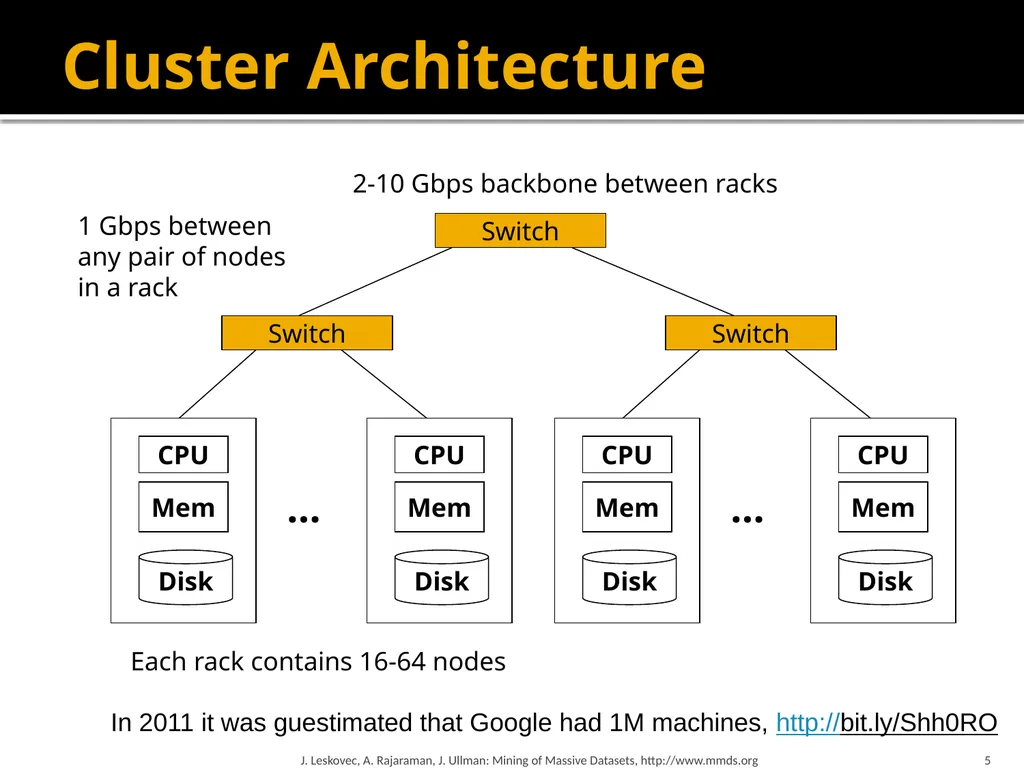
Cluster Architecture … Switch Each rack contains 16-64 nodes … Switch Switch 1 Gbps between
any pair of nodes
in a rack 2-10 Gbps backbone between racks In 2011 it was guestimated that Google had 1M machines, http://bit.ly/Shh0RO J. Leskovec, A. Rajaraman, J. Ullman: Mining of Massive Datasets, http://www.mmds.org 5<br>
any pair of nodes
in a rack 2-10 Gbps backbone between racks In 2011 it was guestimated that Google had 1M machines, http://bit.ly/Shh0RO J. Leskovec, A. Rajaraman, J. Ullman: Mining of Massive Datasets, http://www.mmds.org 5<br>
06
J. Leskovec, A. Rajaraman, J. Ullman: Mining of Massive Datasets, http://www.mmds.org 6<br>
07
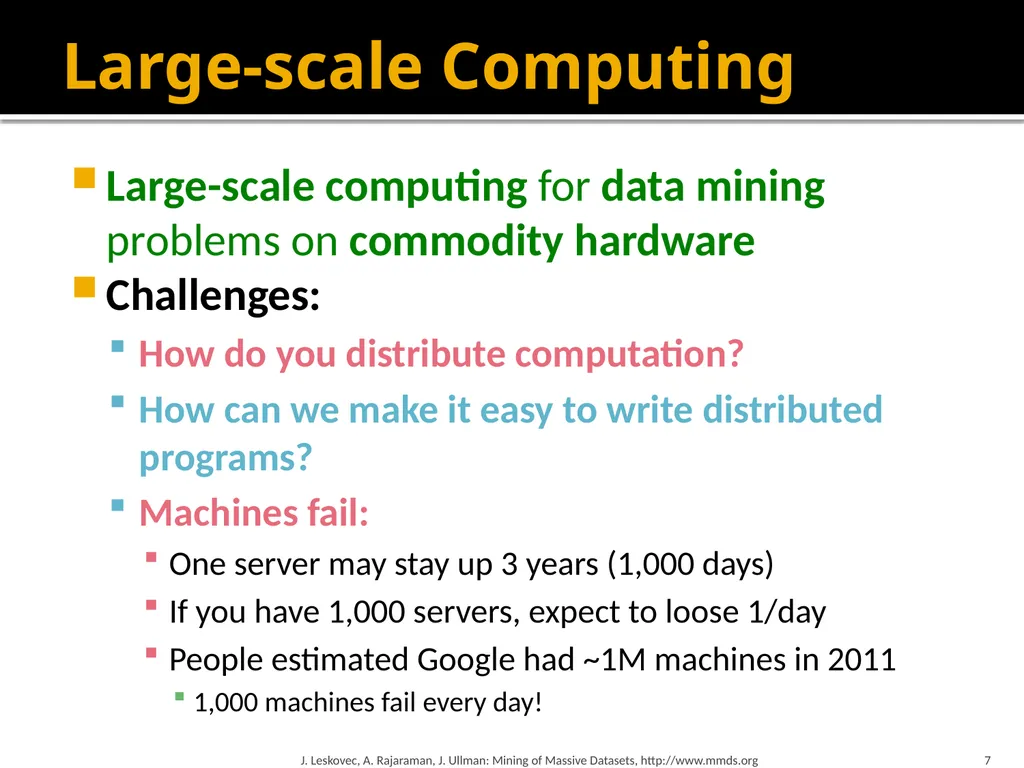
Large-scale Computing Large-scale computing for data mining
problems on commodity hardware
Challenges:
How do you distribute computation?
How can we make it easy to write distributed programs?
Machines fail:
One server may stay up 3 years (1,000 days)
If you have 1,000 servers, expect to loose 1/day
People estimated Google had ~1M machines in 2011
1,000 machines fail every day! J. Leskovec, A. Rajaraman, J. Ullman: Mining of Massive Datasets, http://www.mmds.org 7<br>
Challenges:
How do you distribute computation?
How can we make it easy to write distributed programs?
Machines fail:
One server may stay up 3 years (1,000 days)
If you have 1,000 servers, expect to loose 1/day
People estimated Google had ~1M machines in 2011
1,000 machines fail every day! J. Leskovec, A. Rajaraman, J. Ullman: Mining of Massive Datasets, http://www.mmds.org 7<br>
08
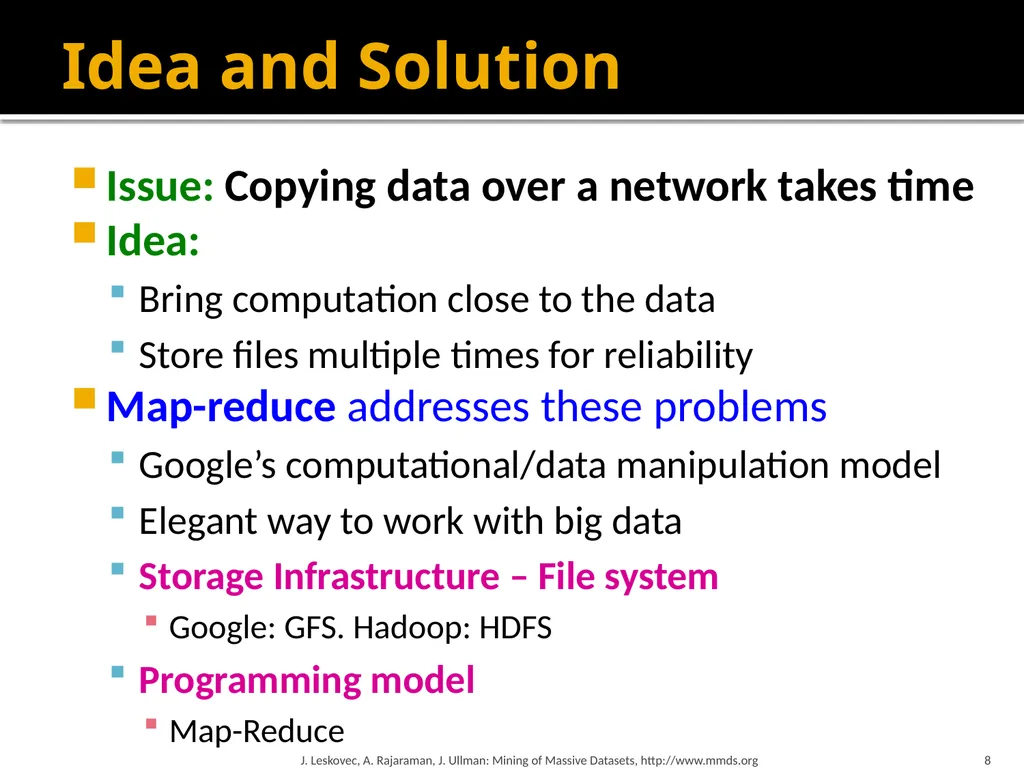
Idea and Solution Issue: Copying data over a network takes time
Idea:
Bring computation close to the data
Store files multiple times for reliability
Map-reduce addresses these problems
Google’s computational/data manipulation model
Elegant way to work with big data
Storage Infrastructure – File system
Google: GFS. Hadoop: HDFS
Programming model
Map-Reduce J. Leskovec, A. Rajaraman, J. Ullman: Mining of Massive Datasets, http://www.mmds.org 8<br>
Idea:
Bring computation close to the data
Store files multiple times for reliability
Map-reduce addresses these problems
Google’s computational/data manipulation model
Elegant way to work with big data
Storage Infrastructure – File system
Google: GFS. Hadoop: HDFS
Programming model
Map-Reduce J. Leskovec, A. Rajaraman, J. Ullman: Mining of Massive Datasets, http://www.mmds.org 8<br>
09
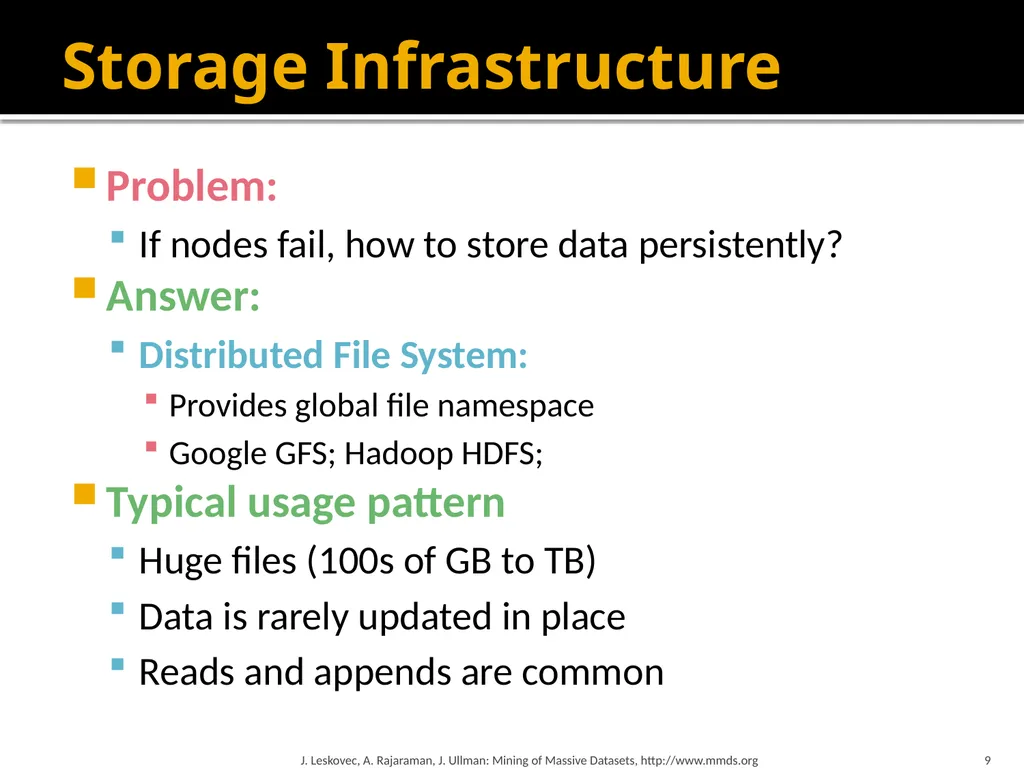
Storage Infrastructure Problem:
If nodes fail, how to store data persistently?
Answer:
Distributed File System:
Provides global file namespace
Google GFS; Hadoop HDFS;
Typical usage pattern
Huge files (100s of GB to TB)
Data is rarely updated in place
Reads and appends are common J. Leskovec, A. Rajaraman, J. Ullman: Mining of Massive Datasets, http://www.mmds.org 9<br>
If nodes fail, how to store data persistently?
Answer:
Distributed File System:
Provides global file namespace
Google GFS; Hadoop HDFS;
Typical usage pattern
Huge files (100s of GB to TB)
Data is rarely updated in place
Reads and appends are common J. Leskovec, A. Rajaraman, J. Ullman: Mining of Massive Datasets, http://www.mmds.org 9<br>
10
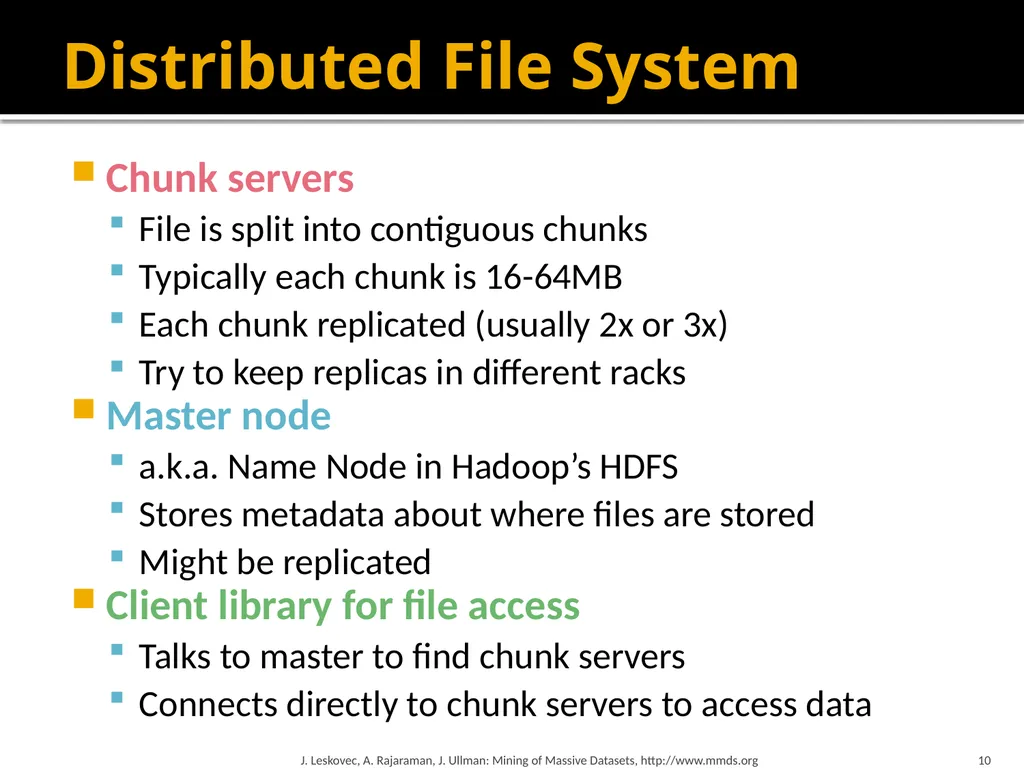
Distributed File System Chunk servers
File is split into contiguous chunks
Typically each chunk is 16-64MB
Each chunk replicated (usually 2x or 3x)
Try to keep replicas in different racks
Master node
a.k.a. Name Node in Hadoop’s HDFS
Stores metadata about where files are stored
Might be replicated
Client library for file access
Talks to master to find chunk servers
Connects directly to chunk servers to access data J. Leskovec, A. Rajaraman, J. Ullman: Mining of Massive Datasets, http://www.mmds.org 10<br>
File is split into contiguous chunks
Typically each chunk is 16-64MB
Each chunk replicated (usually 2x or 3x)
Try to keep replicas in different racks
Master node
a.k.a. Name Node in Hadoop’s HDFS
Stores metadata about where files are stored
Might be replicated
Client library for file access
Talks to master to find chunk servers
Connects directly to chunk servers to access data J. Leskovec, A. Rajaraman, J. Ullman: Mining of Massive Datasets, http://www.mmds.org 10<br>
11
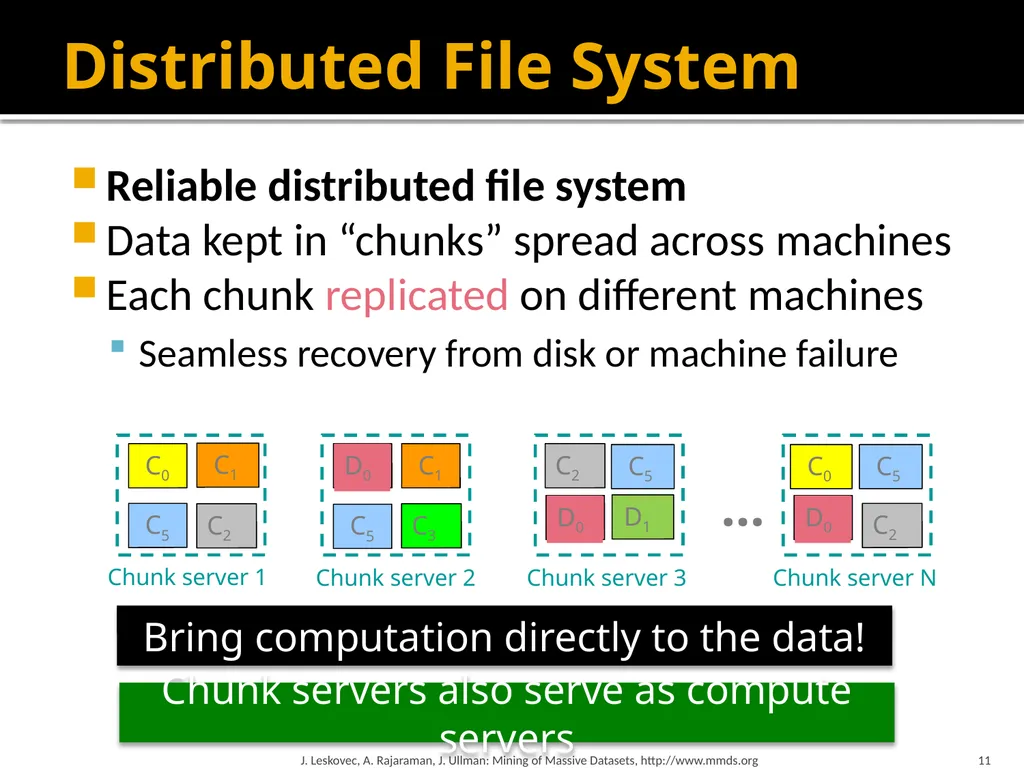
Distributed File System Reliable distributed file system
Data kept in “chunks” spread across machines
Each chunk replicated on different machines
Seamless recovery from disk or machine failure Chunk server 1 Chunk server 3 Chunk server 2 … Bring computation directly to the data! Chunk server N J. Leskovec, A. Rajaraman, J. Ullman: Mining of Massive Datasets, http://www.mmds.org 11 Chunk servers also serve as compute servers<br>
Data kept in “chunks” spread across machines
Each chunk replicated on different machines
Seamless recovery from disk or machine failure Chunk server 1 Chunk server 3 Chunk server 2 … Bring computation directly to the data! Chunk server N J. Leskovec, A. Rajaraman, J. Ullman: Mining of Massive Datasets, http://www.mmds.org 11 Chunk servers also serve as compute servers<br>
12
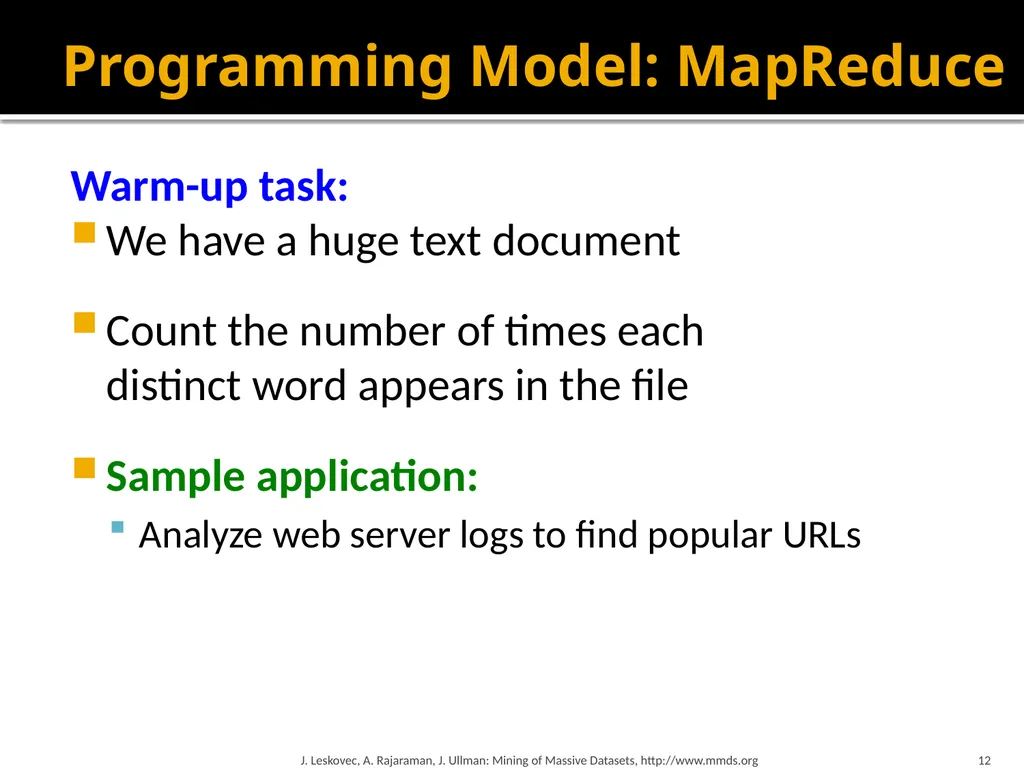
Programming Model: MapReduce Warm-up task:
We have a huge text document
Count the number of times each distinct word appears in the file
Sample application:
Analyze web server logs to find popular URLs J. Leskovec, A. Rajaraman, J. Ullman: Mining of Massive Datasets, http://www.mmds.org 12<br>
We have a huge text document
Count the number of times each distinct word appears in the file
Sample application:
Analyze web server logs to find popular URLs J. Leskovec, A. Rajaraman, J. Ullman: Mining of Massive Datasets, http://www.mmds.org 12<br>
13
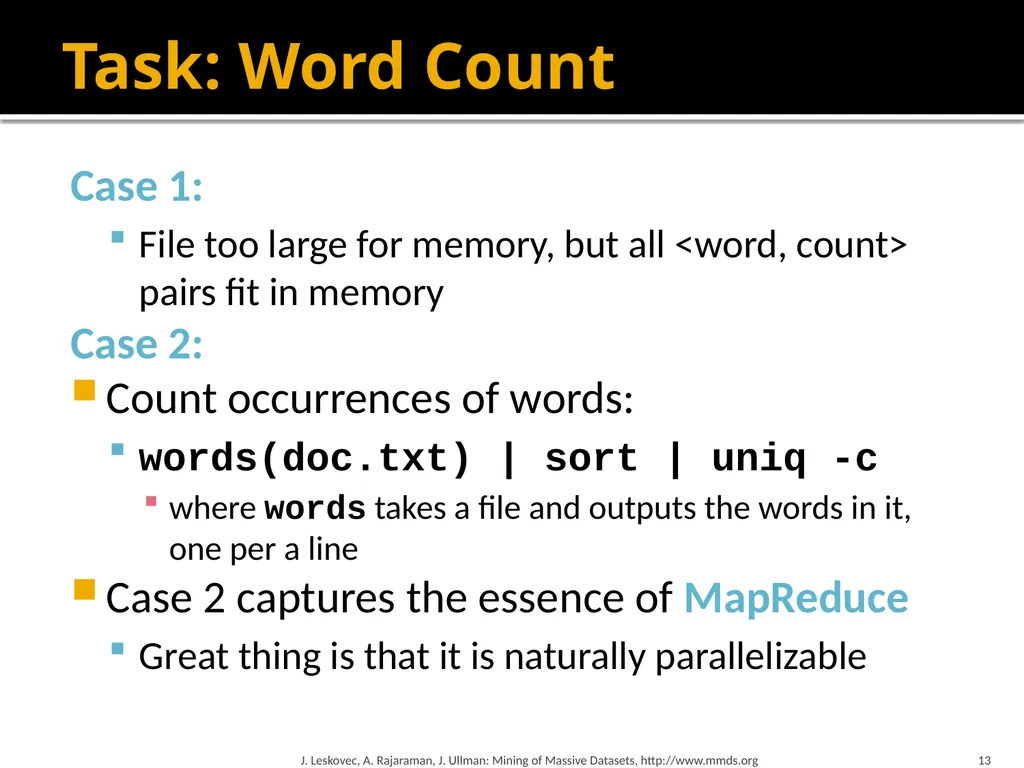
Task: Word Count Case 1:
File too large for memory, but all <word, count> pairs fit in memory
Case 2:
Count occurrences of words:
words(doc.txt) | sort | uniq -c
where words takes a file and outputs the words in it, one per a line
Case 2 captures the essence of MapReduce
Great thing is that it is naturally parallelizable J. Leskovec, A. Rajaraman, J. Ullman: Mining of Massive Datasets, http://www.mmds.org 13<br>
File too large for memory, but all <word, count> pairs fit in memory
Case 2:
Count occurrences of words:
words(doc.txt) | sort | uniq -c
where words takes a file and outputs the words in it, one per a line
Case 2 captures the essence of MapReduce
Great thing is that it is naturally parallelizable J. Leskovec, A. Rajaraman, J. Ullman: Mining of Massive Datasets, http://www.mmds.org 13<br>
14
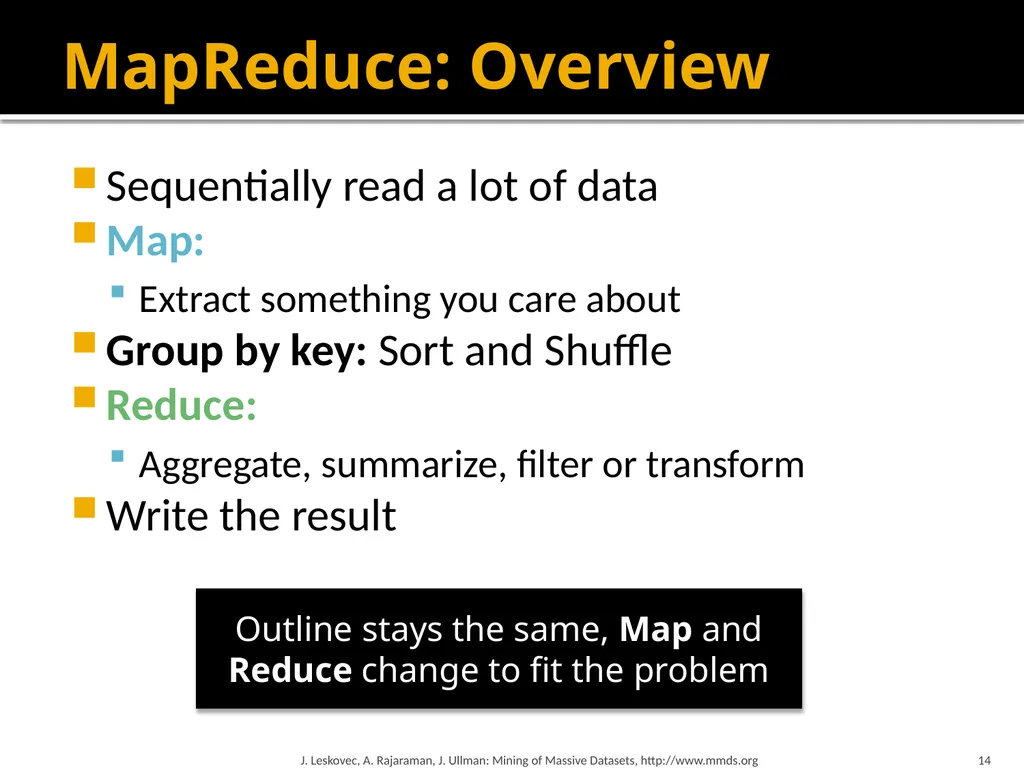
MapReduce: Overview Sequentially read a lot of data
Map:
Extract something you care about
Group by key: Sort and Shuffle
Reduce:
Aggregate, summarize, filter or transform
Write the result Outline stays the same, Map and Reduce change to fit the problem J. Leskovec, A. Rajaraman, J. Ullman: Mining of Massive Datasets, http://www.mmds.org 14<br>
Map:
Extract something you care about
Group by key: Sort and Shuffle
Reduce:
Aggregate, summarize, filter or transform
Write the result Outline stays the same, Map and Reduce change to fit the problem J. Leskovec, A. Rajaraman, J. Ullman: Mining of Massive Datasets, http://www.mmds.org 14<br>
15
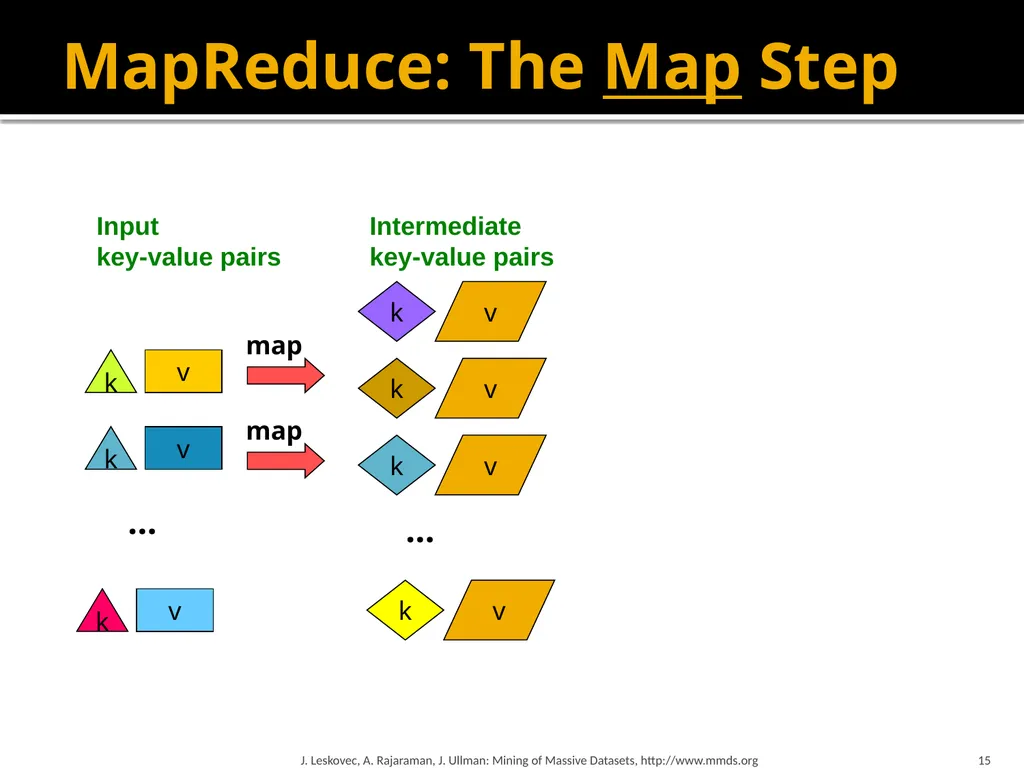
MapReduce: The Map Step … Input
key-value pairs Intermediate
key-value pairs … k v J. Leskovec, A. Rajaraman, J. Ullman: Mining of Massive Datasets, http://www.mmds.org 15<br>
key-value pairs Intermediate
key-value pairs … k v J. Leskovec, A. Rajaraman, J. Ullman: Mining of Massive Datasets, http://www.mmds.org 15<br>
16
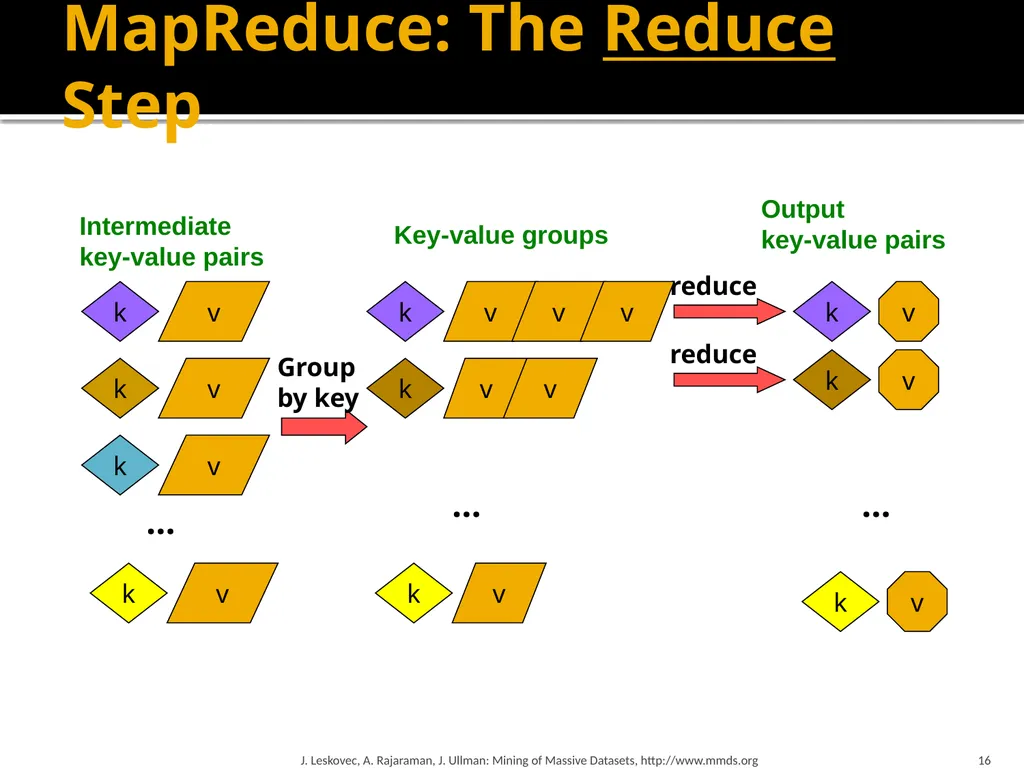
MapReduce: The Reduce Step … Output
key-value pairs J. Leskovec, A. Rajaraman, J. Ullman: Mining of Massive Datasets, http://www.mmds.org 16<br>
key-value pairs J. Leskovec, A. Rajaraman, J. Ullman: Mining of Massive Datasets, http://www.mmds.org 16<br>
17
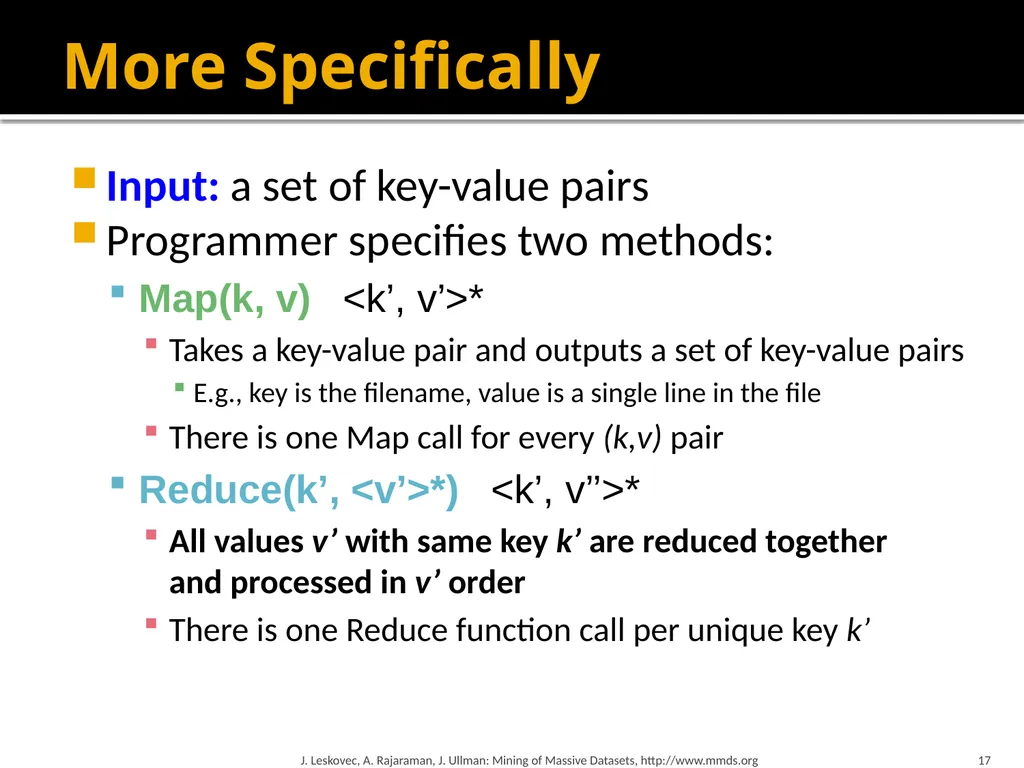
More Specifically Input: a set of key-value pairs
Programmer specifies two methods:
Map(k, v) <k’, v’>*
Takes a key-value pair and outputs a set of key-value pairs
E.g., key is the filename, value is a single line in the file
There is one Map call for every (k,v) pair
Reduce(k’, <v’>*) <k’, v’’>*
All values v’ with same key k’ are reduced together and processed in v’ order
There is one Reduce function call per unique key k’ J. Leskovec, A. Rajaraman, J. Ullman: Mining of Massive Datasets, http://www.mmds.org 17<br>
Programmer specifies two methods:
Map(k, v) <k’, v’>*
Takes a key-value pair and outputs a set of key-value pairs
E.g., key is the filename, value is a single line in the file
There is one Map call for every (k,v) pair
Reduce(k’, <v’>*) <k’, v’’>*
All values v’ with same key k’ are reduced together and processed in v’ order
There is one Reduce function call per unique key k’ J. Leskovec, A. Rajaraman, J. Ullman: Mining of Massive Datasets, http://www.mmds.org 17<br>
18
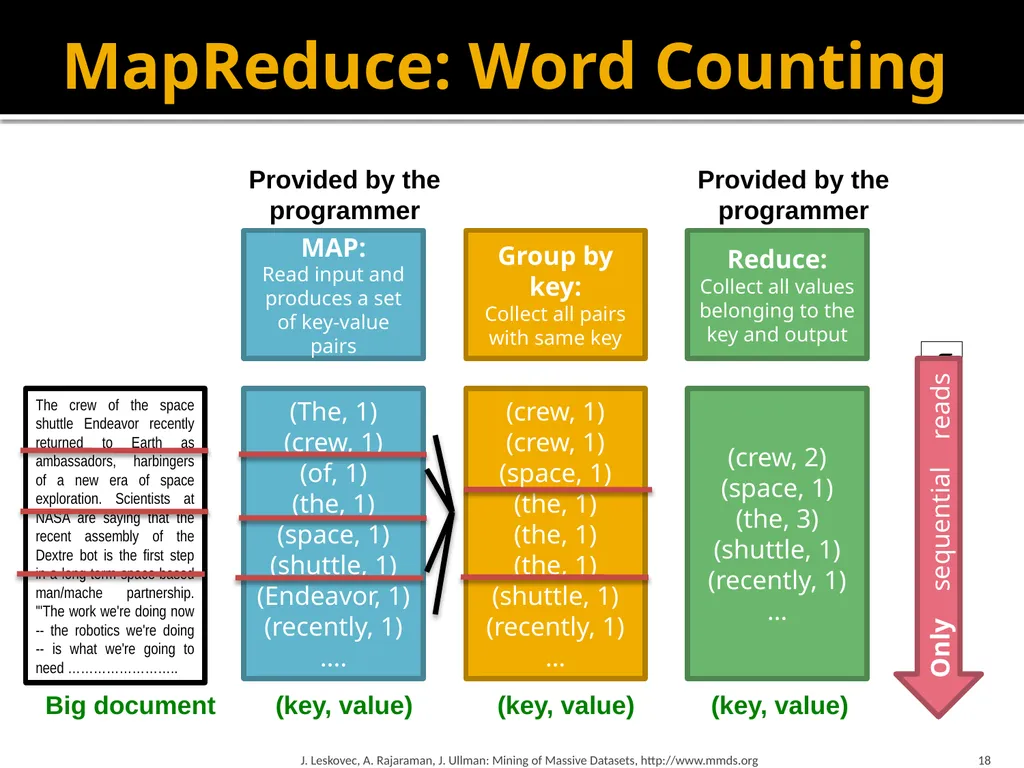
MapReduce: Word Counting The crew of the space shuttle Endeavor recently returned to Earth as ambassadors, harbingers of a new era of space exploration. Scientists at NASA are saying that the recent assembly of the Dextre bot is the first step in a long-term space-based man/mache partnership. '"The work we're doing now -- the robotics we're doing -- is what we're going to need …………………….. Big document (The, 1)
(crew, 1)
(of, 1)
(the, 1)
(space, 1)
(shuttle, 1)
(Endeavor, 1)
(recently, 1)
…. (crew, 1)
(crew, 1)
(space, 1)
(the, 1)
(the, 1)
(the, 1)
(shuttle, 1)
(recently, 1)
… (crew, 2)
(space, 1)
(the, 3)
(shuttle, 1)
(recently, 1)
… MAP:
Read input and produces a set of key-value pairs Group by key:
Collect all pairs with same key Reduce:
Collect all values belonging to the key and output (key, value) Provided by the programmer Provided by the programmer (key, value) (key, value) J. Leskovec, A. Rajaraman, J. Ullman: Mining of Massive Datasets, http://www.mmds.org 18<br>
(crew, 1)
(of, 1)
(the, 1)
(space, 1)
(shuttle, 1)
(Endeavor, 1)
(recently, 1)
…. (crew, 1)
(crew, 1)
(space, 1)
(the, 1)
(the, 1)
(the, 1)
(shuttle, 1)
(recently, 1)
… (crew, 2)
(space, 1)
(the, 3)
(shuttle, 1)
(recently, 1)
… MAP:
Read input and produces a set of key-value pairs Group by key:
Collect all pairs with same key Reduce:
Collect all values belonging to the key and output (key, value) Provided by the programmer Provided by the programmer (key, value) (key, value) J. Leskovec, A. Rajaraman, J. Ullman: Mining of Massive Datasets, http://www.mmds.org 18<br>
19
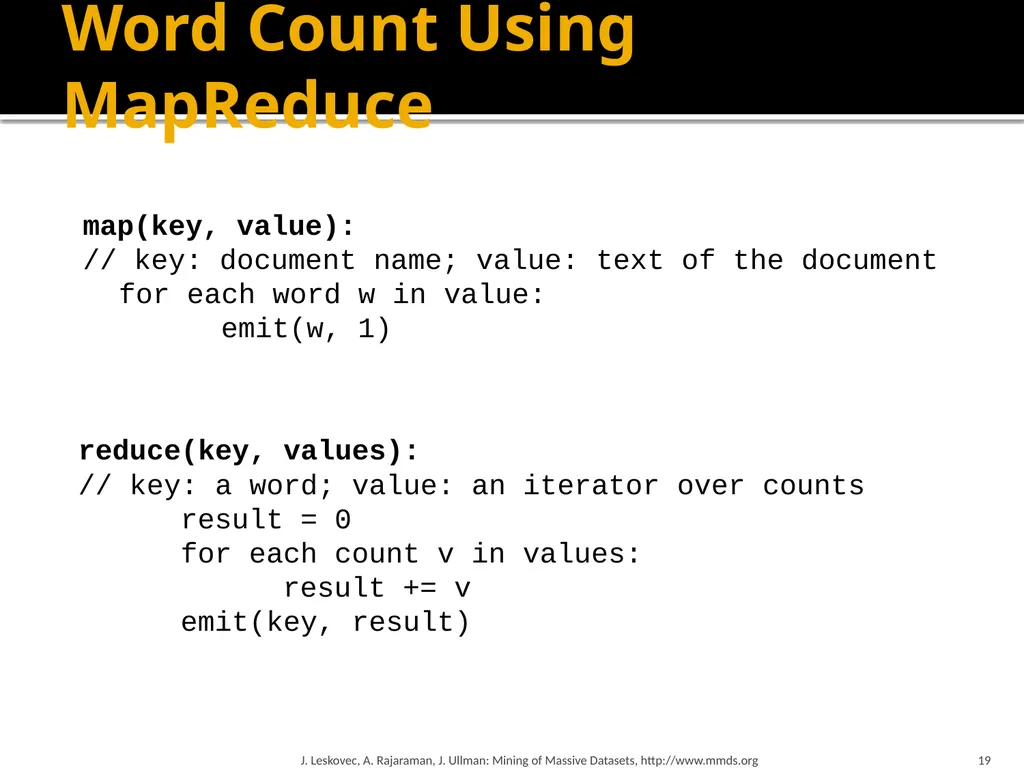
Word Count Using MapReduce map(key, value):
// key: document name; value: text of the document
for each word w in value:
emit(w, 1) reduce(key, values):
// key: a word; value: an iterator over counts
result = 0
for each count v in values:
result += v
emit(key, result) J. Leskovec, A. Rajaraman, J. Ullman: Mining of Massive Datasets, http://www.mmds.org 19<br>
// key: document name; value: text of the document
for each word w in value:
emit(w, 1) reduce(key, values):
// key: a word; value: an iterator over counts
result = 0
for each count v in values:
result += v
emit(key, result) J. Leskovec, A. Rajaraman, J. Ullman: Mining of Massive Datasets, http://www.mmds.org 19<br>
20
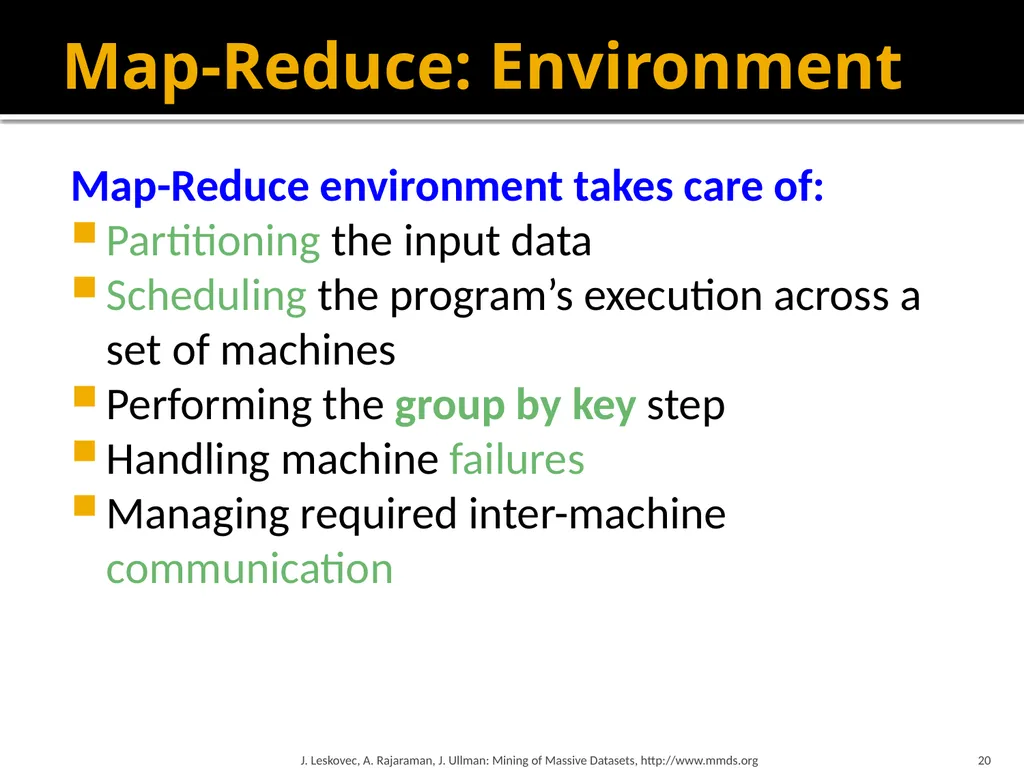
Map-Reduce: Environment Map-Reduce environment takes care of:
Partitioning the input data
Scheduling the program’s execution across a set of machines
Performing the group by key step
Handling machine failures
Managing required inter-machine communication J. Leskovec, A. Rajaraman, J. Ullman: Mining of Massive Datasets, http://www.mmds.org 20<br>
Partitioning the input data
Scheduling the program’s execution across a set of machines
Performing the group by key step
Handling machine failures
Managing required inter-machine communication J. Leskovec, A. Rajaraman, J. Ullman: Mining of Massive Datasets, http://www.mmds.org 20<br>
21
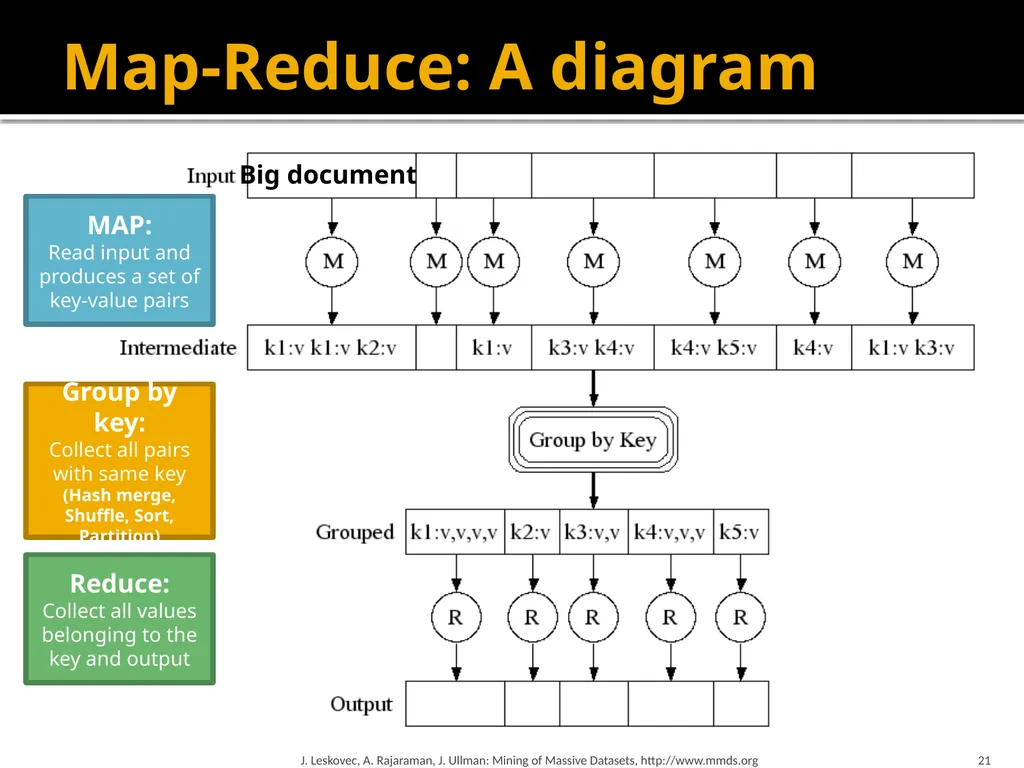
Map-Reduce: A diagram J. Leskovec, A. Rajaraman, J. Ullman: Mining of Massive Datasets, http://www.mmds.org 21 Big document MAP:
Read input and produces a set of key-value pairs Group by key:
Collect all pairs with same key
(Hash merge, Shuffle, Sort, Partition) Reduce:
Collect all values belonging to the key and output<br>
Read input and produces a set of key-value pairs Group by key:
Collect all pairs with same key
(Hash merge, Shuffle, Sort, Partition) Reduce:
Collect all values belonging to the key and output<br>
22
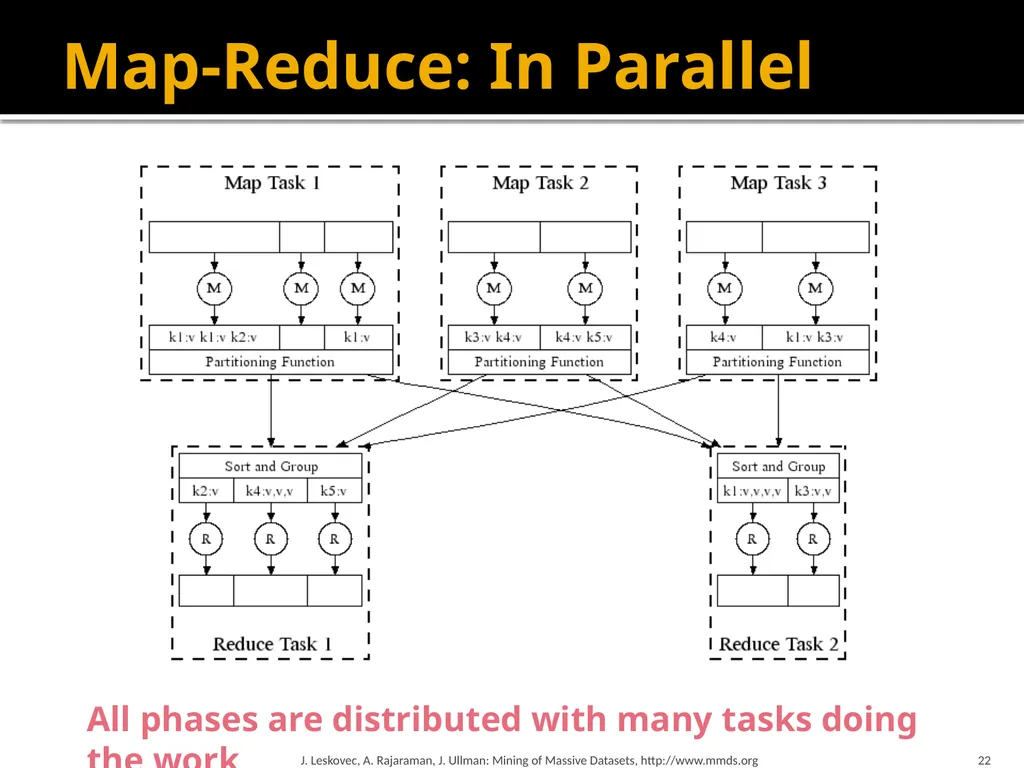
Map-Reduce: In Parallel J. Leskovec, A. Rajaraman, J. Ullman: Mining of Massive Datasets, http://www.mmds.org 22 All phases are distributed with many tasks doing the work<br>
23
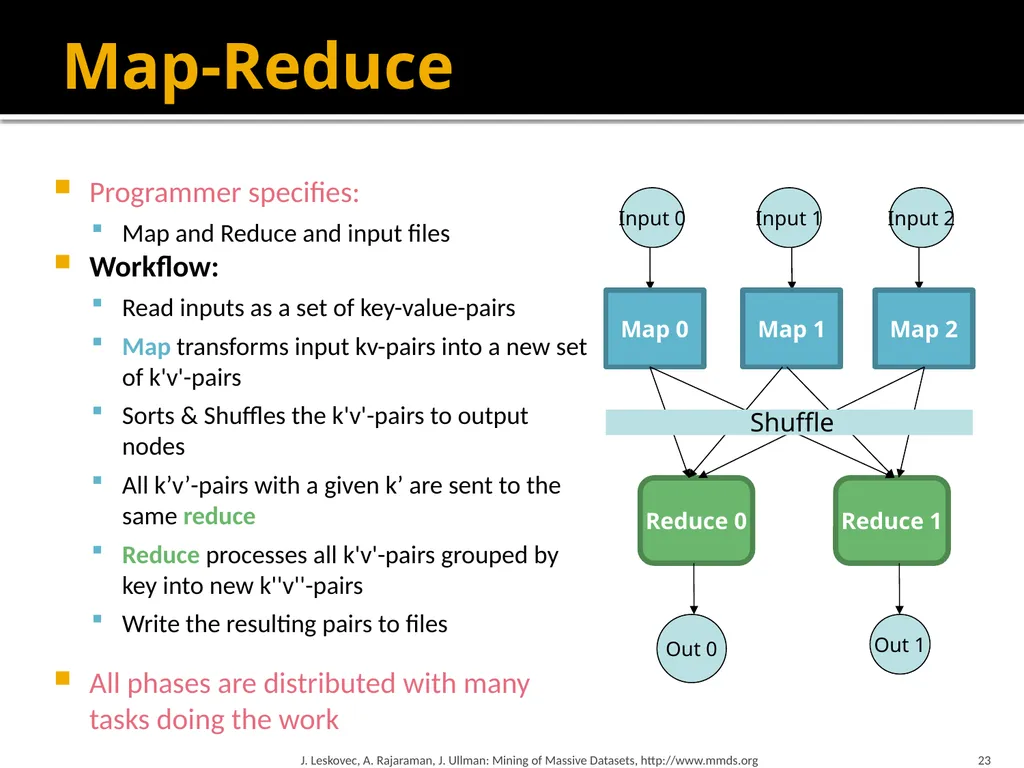
Map-Reduce Programmer specifies:
Map and Reduce and input files
Workflow:
Read inputs as a set of key-value-pairs
Map transforms input kv-pairs into a new set of k'v'-pairs
Sorts & Shuffles the k'v'-pairs to output nodes
All k’v’-pairs with a given k’ are sent to the same reduce
Reduce processes all k'v'-pairs grouped by key into new k''v''-pairs
Write the resulting pairs to files
All phases are distributed with many tasks doing the work Input 0 Map 0 Input 1 Map 1 Input 2 Map 2 Reduce 0 Reduce 1 Out 0 Out 1 Shuffle 23 J. Leskovec, A. Rajaraman, J. Ullman: Mining of Massive Datasets, http://www.mmds.org<br>
Map and Reduce and input files
Workflow:
Read inputs as a set of key-value-pairs
Map transforms input kv-pairs into a new set of k'v'-pairs
Sorts & Shuffles the k'v'-pairs to output nodes
All k’v’-pairs with a given k’ are sent to the same reduce
Reduce processes all k'v'-pairs grouped by key into new k''v''-pairs
Write the resulting pairs to files
All phases are distributed with many tasks doing the work Input 0 Map 0 Input 1 Map 1 Input 2 Map 2 Reduce 0 Reduce 1 Out 0 Out 1 Shuffle 23 J. Leskovec, A. Rajaraman, J. Ullman: Mining of Massive Datasets, http://www.mmds.org<br>
24
Data Flow Input and final output are stored on a distributed file system (FS):
Scheduler tries to schedule map tasks “close” to physical storage location of input data
Intermediate results are stored on local FS of Map and Reduce workers
Output is often input to another MapReduce task J. Leskovec, A. Rajaraman, J. Ullman: Mining of Massive Datasets, http://www.mmds.org 24<br>
Scheduler tries to schedule map tasks “close” to physical storage location of input data
Intermediate results are stored on local FS of Map and Reduce workers
Output is often input to another MapReduce task J. Leskovec, A. Rajaraman, J. Ullman: Mining of Massive Datasets, http://www.mmds.org 24<br>
25
Coordination: Master Master node takes care of coordination:
Task status: (idle, in-progress, completed)
Idle tasks get scheduled as workers become available
When a map task completes, it sends the master the location and sizes of its R intermediate files, one for each reducer
Master pushes this info to reducers
Master pings workers periodically to detect failures J. Leskovec, A. Rajaraman, J. Ullman: Mining of Massive Datasets, http://www.mmds.org 25<br>
Task status: (idle, in-progress, completed)
Idle tasks get scheduled as workers become available
When a map task completes, it sends the master the location and sizes of its R intermediate files, one for each reducer
Master pushes this info to reducers
Master pings workers periodically to detect failures J. Leskovec, A. Rajaraman, J. Ullman: Mining of Massive Datasets, http://www.mmds.org 25<br>
26
Dealing with Failures Map worker failure
Map tasks completed or in-progress at worker are reset to idle
Reduce workers are notified when task is rescheduled on another worker
Reduce worker failure
Only in-progress tasks are reset to idle
Reduce task is restarted
Master failure
MapReduce task is aborted and client is notified J. Leskovec, A. Rajaraman, J. Ullman: Mining of Massive Datasets, http://www.mmds.org 26<br>
Map tasks completed or in-progress at worker are reset to idle
Reduce workers are notified when task is rescheduled on another worker
Reduce worker failure
Only in-progress tasks are reset to idle
Reduce task is restarted
Master failure
MapReduce task is aborted and client is notified J. Leskovec, A. Rajaraman, J. Ullman: Mining of Massive Datasets, http://www.mmds.org 26<br>
27
How many Map and Reduce jobs? M map tasks, R reduce tasks
Rule of a thumb:
Make M much larger than the number of nodes in the cluster
One DFS chunk per map is common
Improves dynamic load balancing and speeds up recovery from worker failures
Usually R is smaller than M
Because output is spread across R files J. Leskovec, A. Rajaraman, J. Ullman: Mining of Massive Datasets, http://www.mmds.org 27<br>
Rule of a thumb:
Make M much larger than the number of nodes in the cluster
One DFS chunk per map is common
Improves dynamic load balancing and speeds up recovery from worker failures
Usually R is smaller than M
Because output is spread across R files J. Leskovec, A. Rajaraman, J. Ullman: Mining of Massive Datasets, http://www.mmds.org 27<br>
28
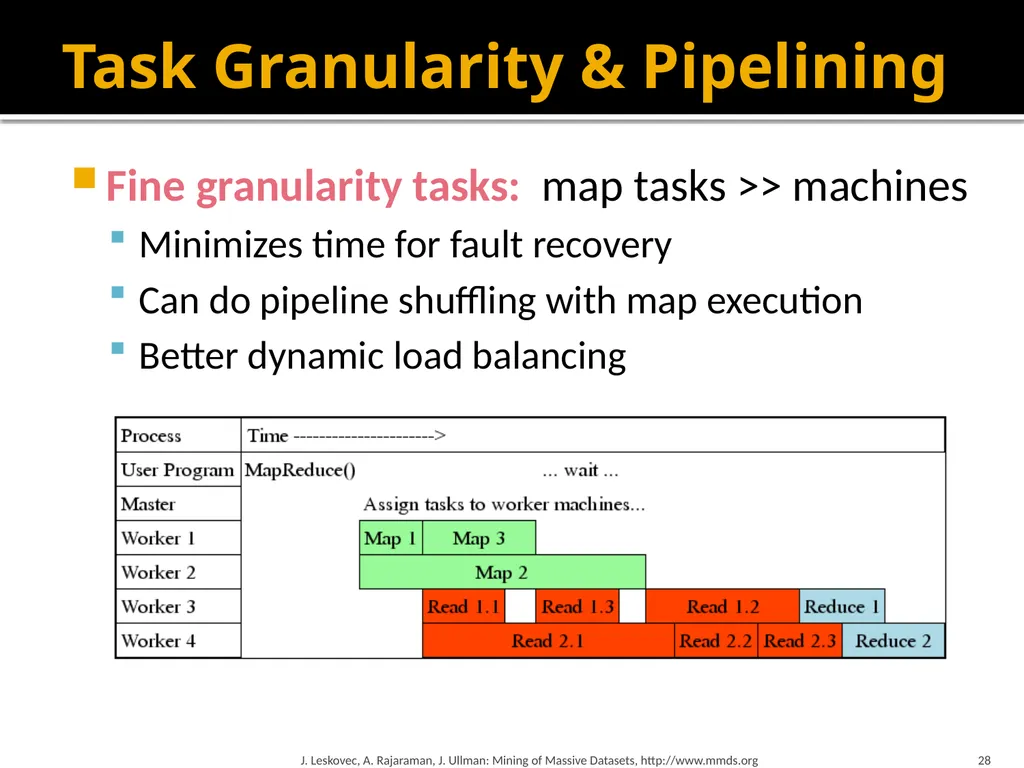
Task Granularity & Pipelining Fine granularity tasks: map tasks >> machines
Minimizes time for fault recovery
Can do pipeline shuffling with map execution
Better dynamic load balancing J. Leskovec, A. Rajaraman, J. Ullman: Mining of Massive Datasets, http://www.mmds.org 28<br>
Minimizes time for fault recovery
Can do pipeline shuffling with map execution
Better dynamic load balancing J. Leskovec, A. Rajaraman, J. Ullman: Mining of Massive Datasets, http://www.mmds.org 28<br>
29
Refinements: Backup Tasks Problem
Slow workers significantly lengthen the job completion time:
Other jobs on the machine
Bad disks
Weird things
Solution
Near end of phase, spawn backup copies of tasks
Whichever one finishes first “wins”
Effect
Dramatically shortens job completion time J. Leskovec, A. Rajaraman, J. Ullman: Mining of Massive Datasets, http://www.mmds.org 29<br>
Slow workers significantly lengthen the job completion time:
Other jobs on the machine
Bad disks
Weird things
Solution
Near end of phase, spawn backup copies of tasks
Whichever one finishes first “wins”
Effect
Dramatically shortens job completion time J. Leskovec, A. Rajaraman, J. Ullman: Mining of Massive Datasets, http://www.mmds.org 29<br>
30
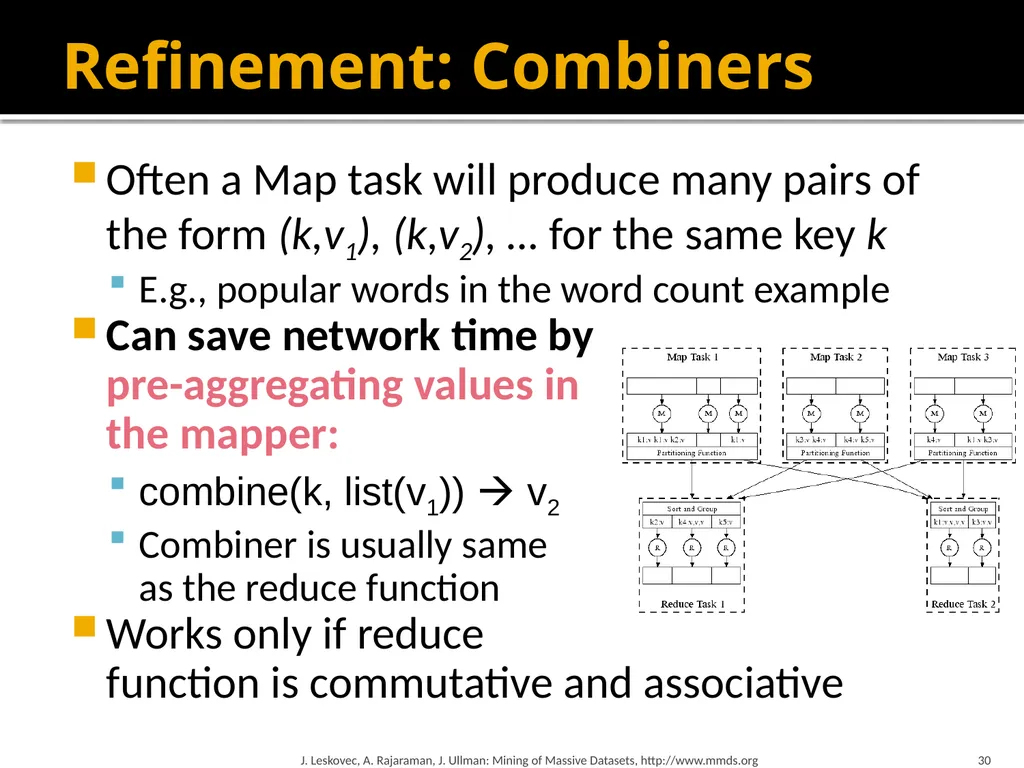
Refinement: Combiners Often a Map task will produce many pairs of the form (k,v1), (k,v2), … for the same key k
E.g., popular words in the word count example
Can save network time by pre-aggregating values in the mapper:
combine(k, list(v1)) v2
Combiner is usually same as the reduce function
Works only if reduce function is commutative and associative J. Leskovec, A. Rajaraman, J. Ullman: Mining of Massive Datasets, http://www.mmds.org 30<br>
E.g., popular words in the word count example
Can save network time by pre-aggregating values in the mapper:
combine(k, list(v1)) v2
Combiner is usually same as the reduce function
Works only if reduce function is commutative and associative J. Leskovec, A. Rajaraman, J. Ullman: Mining of Massive Datasets, http://www.mmds.org 30<br>
31
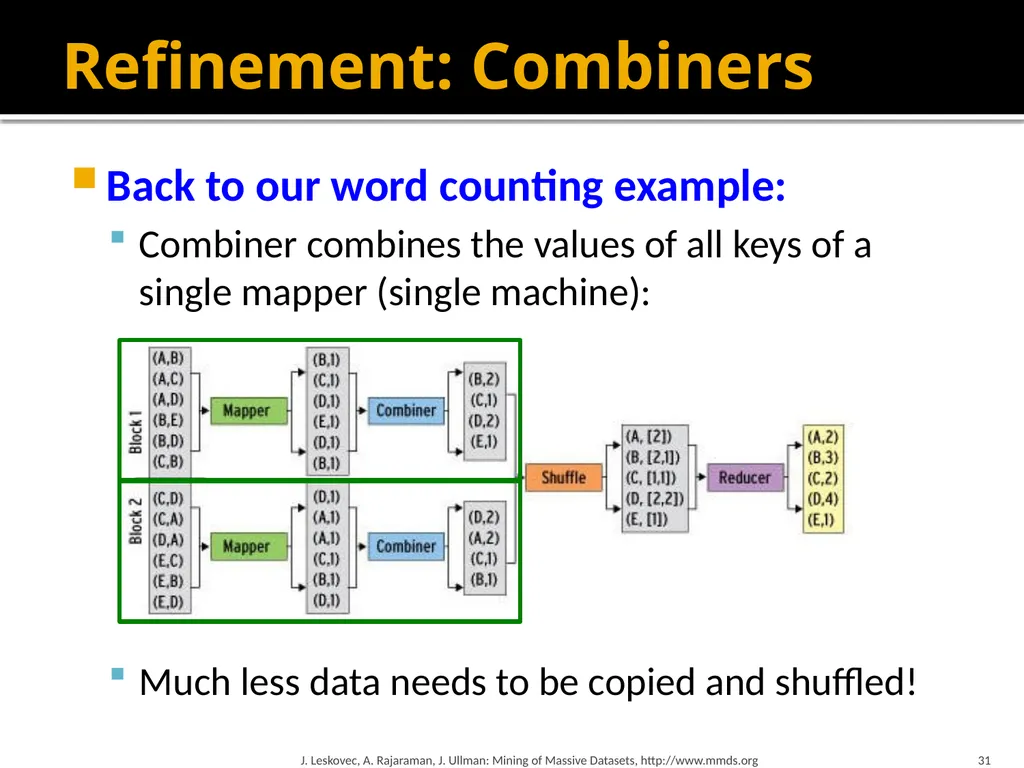
Refinement: Combiners Back to our word counting example:
Combiner combines the values of all keys of a single mapper (single machine):
Much less data needs to be copied and shuffled! J. Leskovec, A. Rajaraman, J. Ullman: Mining of Massive Datasets, http://www.mmds.org 31<br>
Combiner combines the values of all keys of a single mapper (single machine):
Much less data needs to be copied and shuffled! J. Leskovec, A. Rajaraman, J. Ullman: Mining of Massive Datasets, http://www.mmds.org 31<br>
32
Refinement: Partition Function Want to control how keys get partitioned
Inputs to map tasks are created by contiguous splits of input file
Reduce needs to ensure that records with the same intermediate key end up at the same worker
System uses a default partition function:
hash(key) mod R
Sometimes useful to override the hash function:
E.g., hash(hostname(URL)) mod R ensures URLs from a host end up in the same output file J. Leskovec, A. Rajaraman, J. Ullman: Mining of Massive Datasets, http://www.mmds.org 32<br>
Inputs to map tasks are created by contiguous splits of input file
Reduce needs to ensure that records with the same intermediate key end up at the same worker
System uses a default partition function:
hash(key) mod R
Sometimes useful to override the hash function:
E.g., hash(hostname(URL)) mod R ensures URLs from a host end up in the same output file J. Leskovec, A. Rajaraman, J. Ullman: Mining of Massive Datasets, http://www.mmds.org 32<br>
33
Problems Suited for
Map-Reduce<br>
34
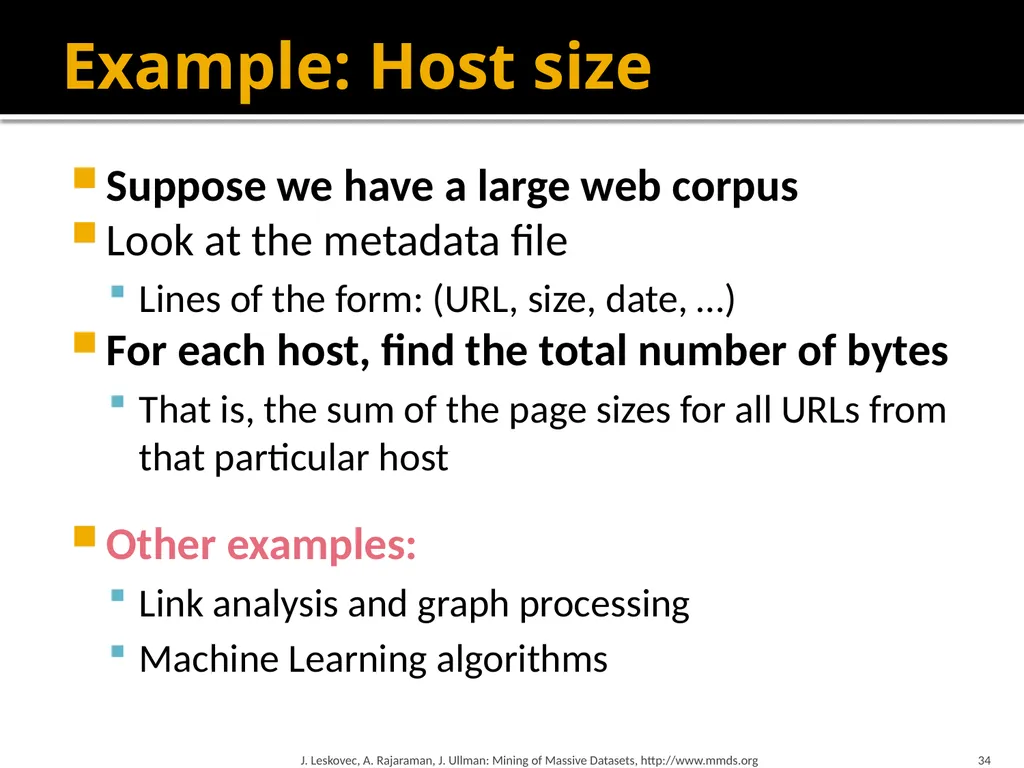
Example: Host size Suppose we have a large web corpus
Look at the metadata file
Lines of the form: (URL, size, date, …)
For each host, find the total number of bytes
That is, the sum of the page sizes for all URLs from that particular host
Other examples:
Link analysis and graph processing
Machine Learning algorithms J. Leskovec, A. Rajaraman, J. Ullman: Mining of Massive Datasets, http://www.mmds.org 34<br>
Look at the metadata file
Lines of the form: (URL, size, date, …)
For each host, find the total number of bytes
That is, the sum of the page sizes for all URLs from that particular host
Other examples:
Link analysis and graph processing
Machine Learning algorithms J. Leskovec, A. Rajaraman, J. Ullman: Mining of Massive Datasets, http://www.mmds.org 34<br>
35
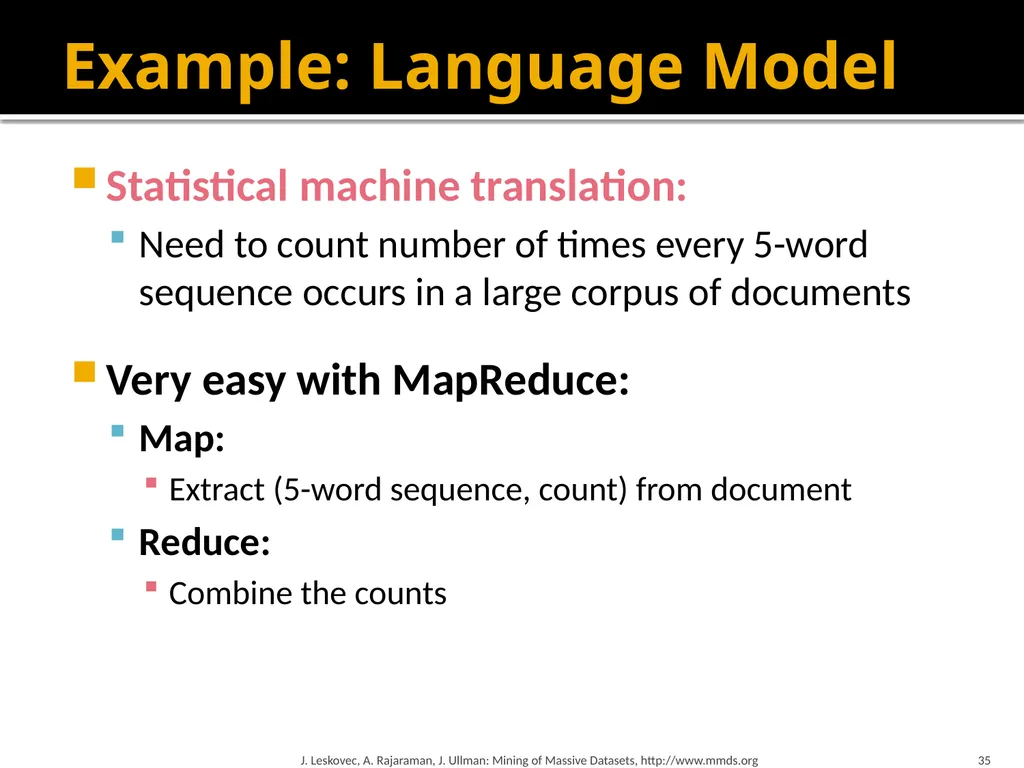
Example: Language Model Statistical machine translation:
Need to count number of times every 5-word sequence occurs in a large corpus of documents
Very easy with MapReduce:
Map:
Extract (5-word sequence, count) from document
Reduce:
Combine the counts J. Leskovec, A. Rajaraman, J. Ullman: Mining of Massive Datasets, http://www.mmds.org 35<br>
Need to count number of times every 5-word sequence occurs in a large corpus of documents
Very easy with MapReduce:
Map:
Extract (5-word sequence, count) from document
Reduce:
Combine the counts J. Leskovec, A. Rajaraman, J. Ullman: Mining of Massive Datasets, http://www.mmds.org 35<br>
36
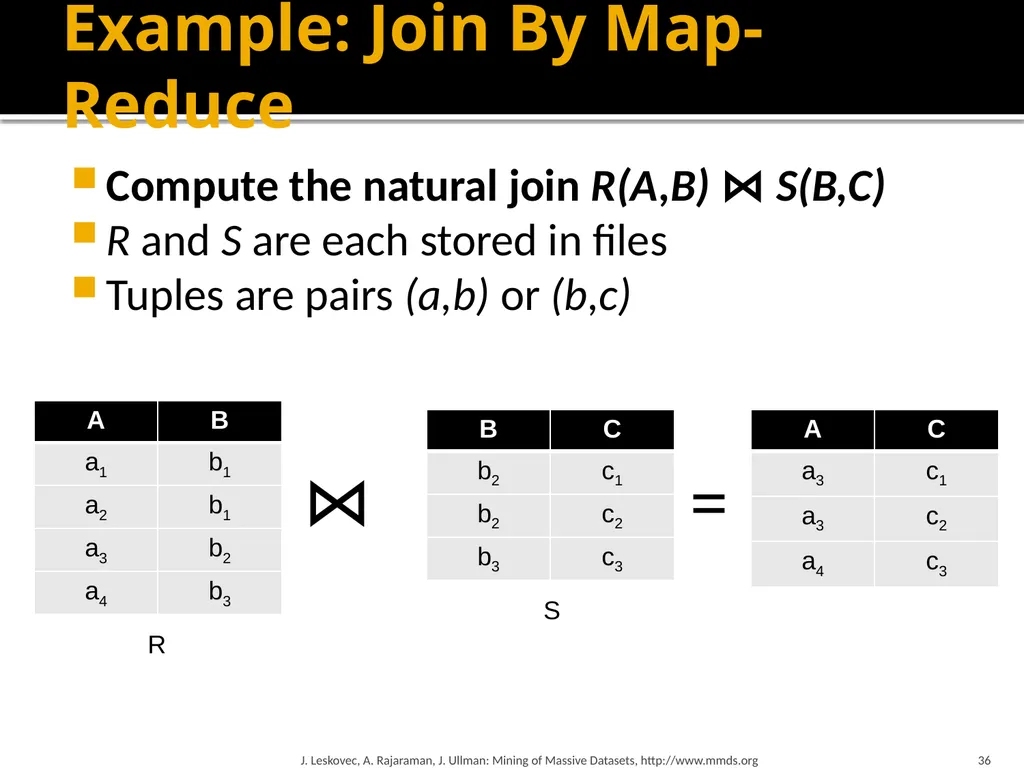
Example: Join By Map-Reduce Compute the natural join R(A,B) ⋈ S(B,C)
R and S are each stored in files
Tuples are pairs (a,b) or (b,c) J. Leskovec, A. Rajaraman, J. Ullman: Mining of Massive Datasets, http://www.mmds.org 36 ⋈ = R S<br>
R and S are each stored in files
Tuples are pairs (a,b) or (b,c) J. Leskovec, A. Rajaraman, J. Ullman: Mining of Massive Datasets, http://www.mmds.org 36 ⋈ = R S<br>
37
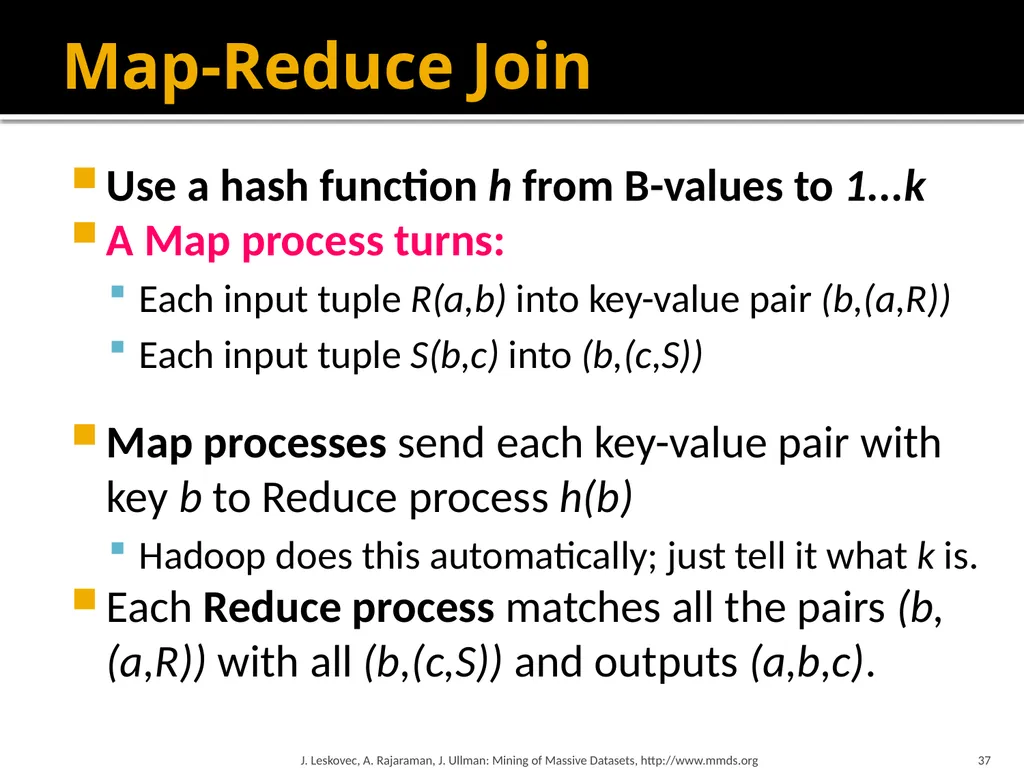
Map-Reduce Join Use a hash function h from B-values to 1...k
A Map process turns:
Each input tuple R(a,b) into key-value pair (b,(a,R))
Each input tuple S(b,c) into (b,(c,S))
Map processes send each key-value pair with key b to Reduce process h(b)
Hadoop does this automatically; just tell it what k is.
Each Reduce process matches all the pairs (b,(a,R)) with all (b,(c,S)) and outputs (a,b,c). J. Leskovec, A. Rajaraman, J. Ullman: Mining of Massive Datasets, http://www.mmds.org 37<br>
A Map process turns:
Each input tuple R(a,b) into key-value pair (b,(a,R))
Each input tuple S(b,c) into (b,(c,S))
Map processes send each key-value pair with key b to Reduce process h(b)
Hadoop does this automatically; just tell it what k is.
Each Reduce process matches all the pairs (b,(a,R)) with all (b,(c,S)) and outputs (a,b,c). J. Leskovec, A. Rajaraman, J. Ullman: Mining of Massive Datasets, http://www.mmds.org 37<br>
38
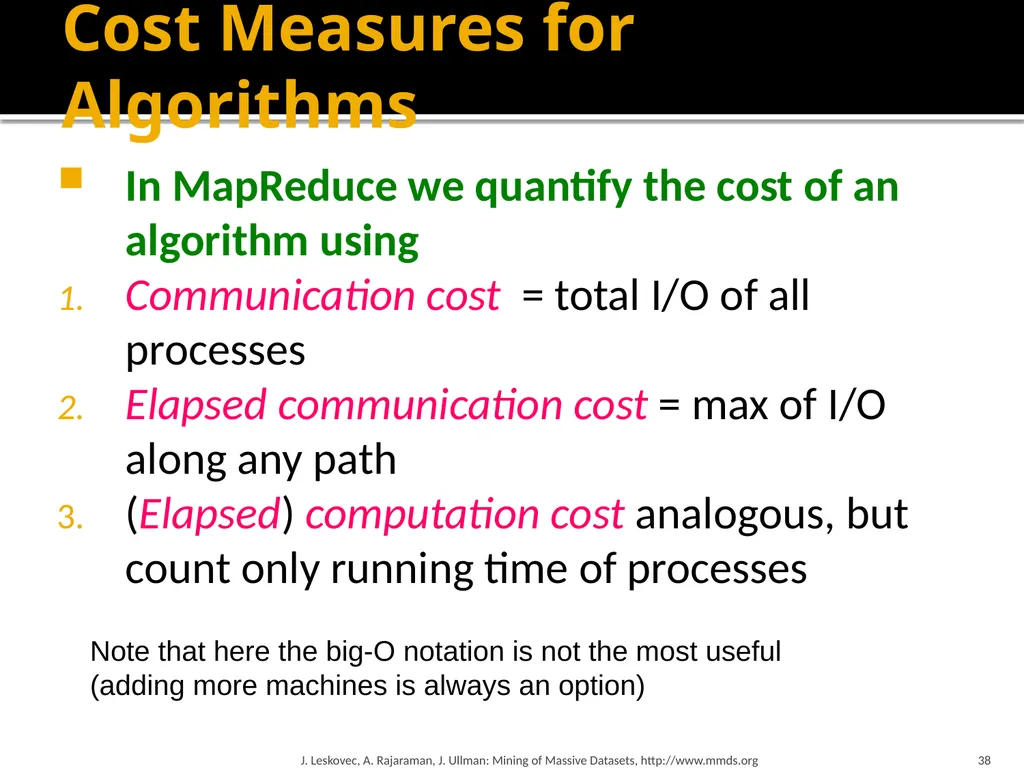
Cost Measures for Algorithms In MapReduce we quantify the cost of an algorithm using
Communication cost = total I/O of all processes
Elapsed communication cost = max of I/O along any path
(Elapsed) computation cost analogous, but count only running time of processes
Note that here the big-O notation is not the most useful (adding more machines is always an option) J. Leskovec, A. Rajaraman, J. Ullman: Mining of Massive Datasets, http://www.mmds.org 38<br>
Communication cost = total I/O of all processes
Elapsed communication cost = max of I/O along any path
(Elapsed) computation cost analogous, but count only running time of processes
Note that here the big-O notation is not the most useful (adding more machines is always an option) J. Leskovec, A. Rajaraman, J. Ullman: Mining of Massive Datasets, http://www.mmds.org 38<br>
39
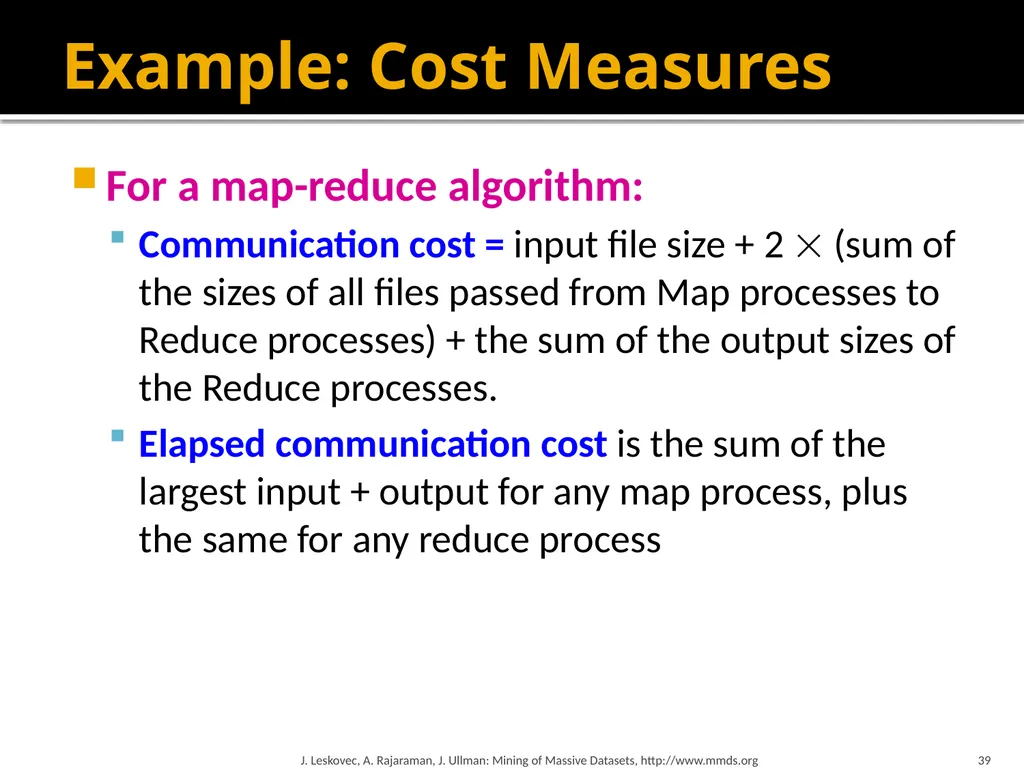
Example: Cost Measures For a map-reduce algorithm:
Communication cost = input file size + 2 (sum of the sizes of all files passed from Map processes to Reduce processes) + the sum of the output sizes of the Reduce processes.
Elapsed communication cost is the sum of the largest input + output for any map process, plus the same for any reduce process J. Leskovec, A. Rajaraman, J. Ullman: Mining of Massive Datasets, http://www.mmds.org 39<br>
Communication cost = input file size + 2 (sum of the sizes of all files passed from Map processes to Reduce processes) + the sum of the output sizes of the Reduce processes.
Elapsed communication cost is the sum of the largest input + output for any map process, plus the same for any reduce process J. Leskovec, A. Rajaraman, J. Ullman: Mining of Massive Datasets, http://www.mmds.org 39<br>
40
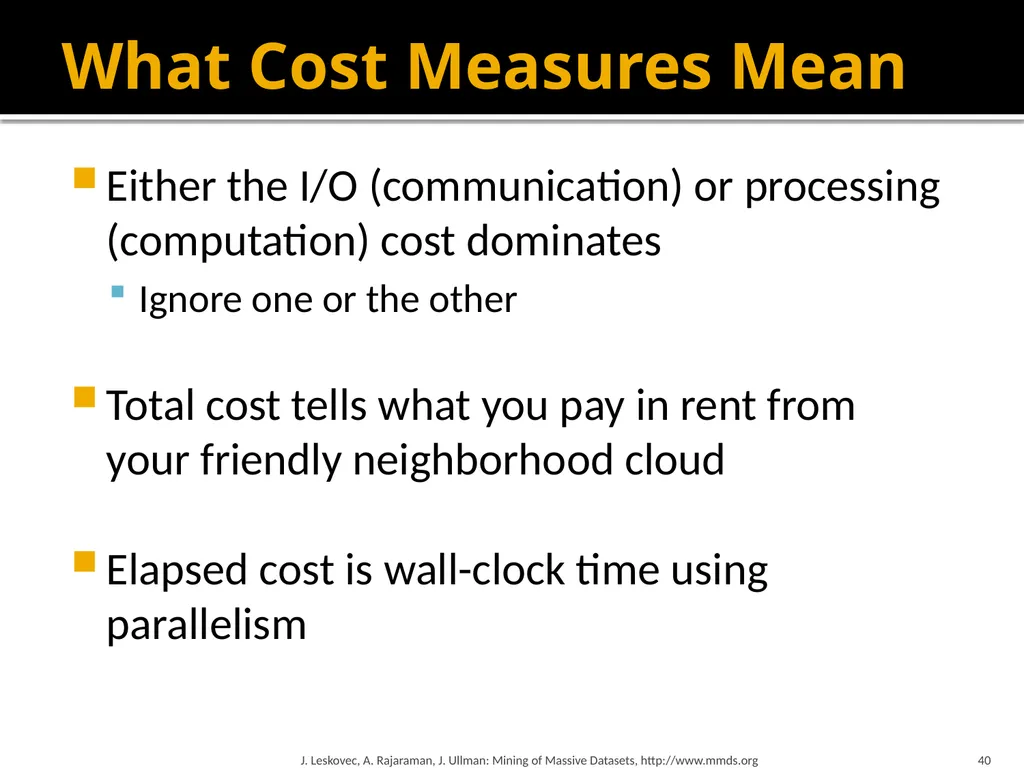
What Cost Measures Mean Either the I/O (communication) or processing (computation) cost dominates
Ignore one or the other
Total cost tells what you pay in rent from your friendly neighborhood cloud
Elapsed cost is wall-clock time using parallelism J. Leskovec, A. Rajaraman, J. Ullman: Mining of Massive Datasets, http://www.mmds.org 40<br>
Ignore one or the other
Total cost tells what you pay in rent from your friendly neighborhood cloud
Elapsed cost is wall-clock time using parallelism J. Leskovec, A. Rajaraman, J. Ullman: Mining of Massive Datasets, http://www.mmds.org 40<br>
41
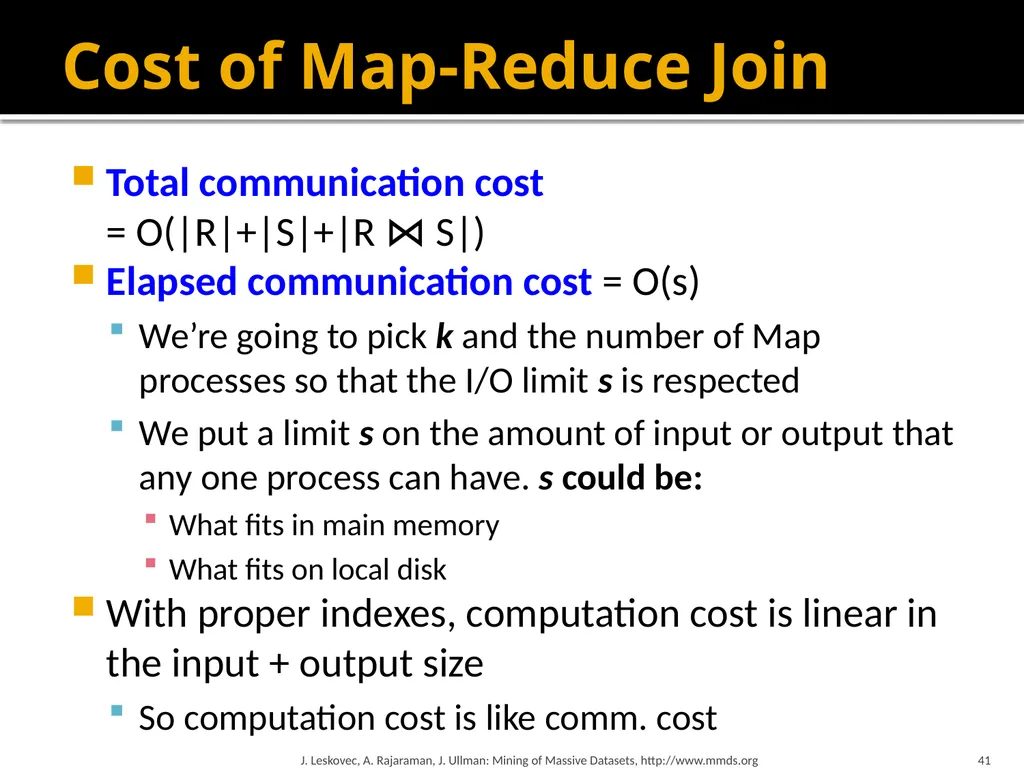
Cost of Map-Reduce Join Total communication cost
= O(|R|+|S|+|R ⋈ S|)
Elapsed communication cost = O(s)
We’re going to pick k and the number of Map processes so that the I/O limit s is respected
We put a limit s on the amount of input or output that any one process can have. s could be:
What fits in main memory
What fits on local disk
With proper indexes, computation cost is linear in the input + output size
So computation cost is like comm. cost J. Leskovec, A. Rajaraman, J. Ullman: Mining of Massive Datasets, http://www.mmds.org 41<br>
Elapsed communication cost = O(s)
We’re going to pick k and the number of Map processes so that the I/O limit s is respected
We put a limit s on the amount of input or output that any one process can have. s could be:
What fits in main memory
What fits on local disk
With proper indexes, computation cost is linear in the input + output size
So computation cost is like comm. cost J. Leskovec, A. Rajaraman, J. Ullman: Mining of Massive Datasets, http://www.mmds.org 41<br>
42
Pointers and Further Reading<br>
43
Implementations Google
Not available outside Google
Hadoop
An open-source implementation in Java
Uses HDFS for stable storage
Download: http://lucene.apache.org/hadoop/
Aster Data
Cluster-optimized SQL Database that also implements MapReduce J. Leskovec, A. Rajaraman, J. Ullman: Mining of Massive Datasets, http://www.mmds.org 43<br>
Not available outside Google
Hadoop
An open-source implementation in Java
Uses HDFS for stable storage
Download: http://lucene.apache.org/hadoop/
Aster Data
Cluster-optimized SQL Database that also implements MapReduce J. Leskovec, A. Rajaraman, J. Ullman: Mining of Massive Datasets, http://www.mmds.org 43<br>
44
Cloud Computing Ability to rent computing by the hour
Additional services e.g., persistent storage
Amazon’s “Elastic Compute Cloud” (EC2)
Aster Data and Hadoop can both be run on EC2
For CS341 (offered next quarter) Amazon will provide free access for the class J. Leskovec, A. Rajaraman, J. Ullman: Mining of Massive Datasets, http://www.mmds.org 44<br>
Additional services e.g., persistent storage
Amazon’s “Elastic Compute Cloud” (EC2)
Aster Data and Hadoop can both be run on EC2
For CS341 (offered next quarter) Amazon will provide free access for the class J. Leskovec, A. Rajaraman, J. Ullman: Mining of Massive Datasets, http://www.mmds.org 44<br>
45
Reading Jeffrey Dean and Sanjay Ghemawat: MapReduce: Simplified Data Processing on Large Clusters
http://labs.google.com/papers/mapreduce.html
Sanjay Ghemawat, Howard Gobioff, and Shun-Tak Leung: The Google File System
http://labs.google.com/papers/gfs.html J. Leskovec, A. Rajaraman, J. Ullman: Mining of Massive Datasets, http://www.mmds.org 45<br>
http://labs.google.com/papers/mapreduce.html
Sanjay Ghemawat, Howard Gobioff, and Shun-Tak Leung: The Google File System
http://labs.google.com/papers/gfs.html J. Leskovec, A. Rajaraman, J. Ullman: Mining of Massive Datasets, http://www.mmds.org 45<br>
46
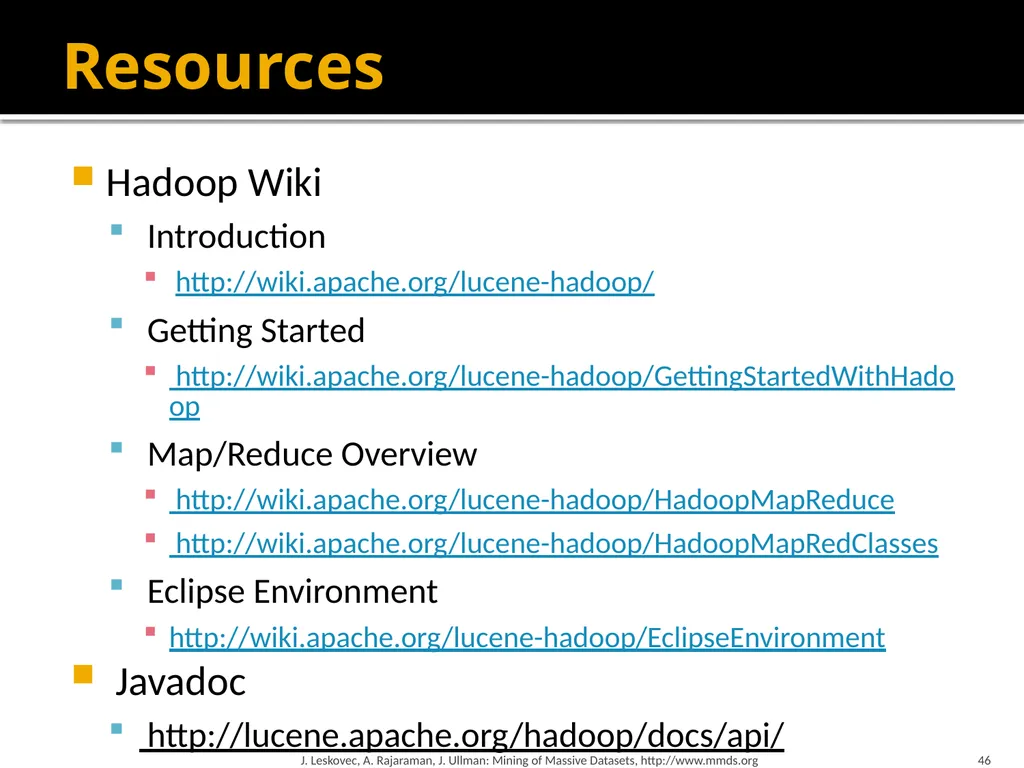
Resources Hadoop Wiki
Introduction
http://wiki.apache.org/lucene-hadoop/
Getting Started
http://wiki.apache.org/lucene-hadoop/GettingStartedWithHadoop
Map/Reduce Overview
http://wiki.apache.org/lucene-hadoop/HadoopMapReduce
http://wiki.apache.org/lucene-hadoop/HadoopMapRedClasses
Eclipse Environment
http://wiki.apache.org/lucene-hadoop/EclipseEnvironment
Javadoc
http://lucene.apache.org/hadoop/docs/api/ J. Leskovec, A. Rajaraman, J. Ullman: Mining of Massive Datasets, http://www.mmds.org 46<br>
Introduction
http://wiki.apache.org/lucene-hadoop/
Getting Started
http://wiki.apache.org/lucene-hadoop/GettingStartedWithHadoop
Map/Reduce Overview
http://wiki.apache.org/lucene-hadoop/HadoopMapReduce
http://wiki.apache.org/lucene-hadoop/HadoopMapRedClasses
Eclipse Environment
http://wiki.apache.org/lucene-hadoop/EclipseEnvironment
Javadoc
http://lucene.apache.org/hadoop/docs/api/ J. Leskovec, A. Rajaraman, J. Ullman: Mining of Massive Datasets, http://www.mmds.org 46<br>
47
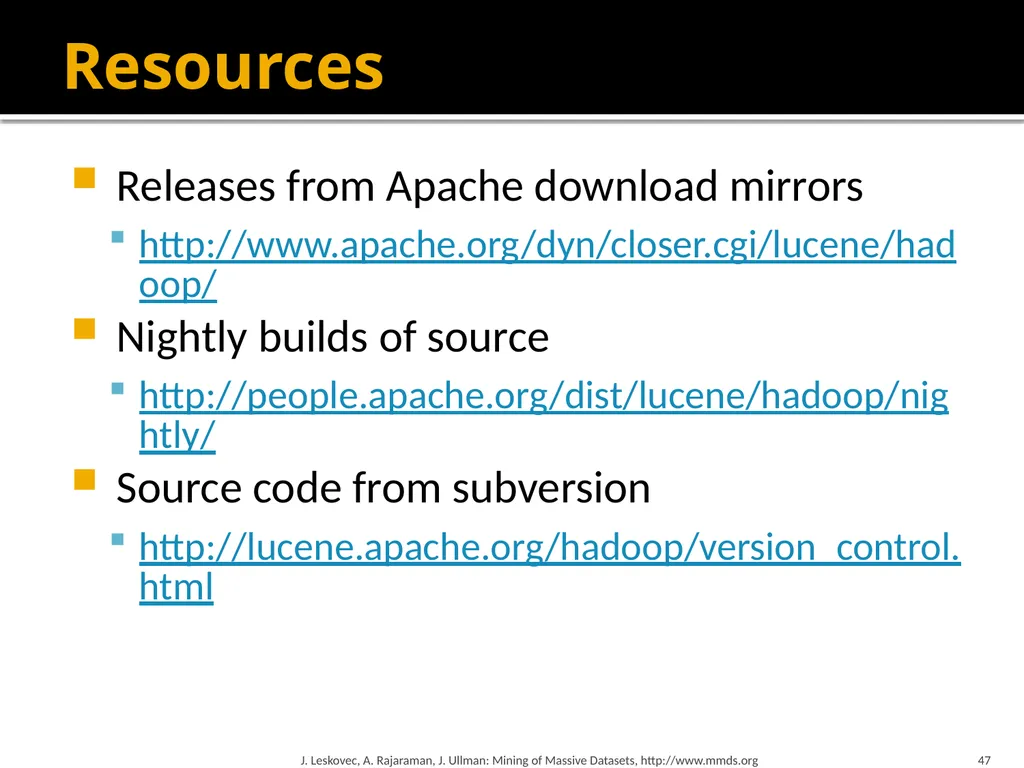
Resources Releases from Apache download mirrors
http://www.apache.org/dyn/closer.cgi/lucene/hadoop/
Nightly builds of source
http://people.apache.org/dist/lucene/hadoop/nightly/
Source code from subversion
http://lucene.apache.org/hadoop/version_control.html J. Leskovec, A. Rajaraman, J. Ullman: Mining of Massive Datasets, http://www.mmds.org 47<br>
http://www.apache.org/dyn/closer.cgi/lucene/hadoop/
Nightly builds of source
http://people.apache.org/dist/lucene/hadoop/nightly/
Source code from subversion
http://lucene.apache.org/hadoop/version_control.html J. Leskovec, A. Rajaraman, J. Ullman: Mining of Massive Datasets, http://www.mmds.org 47<br>
48
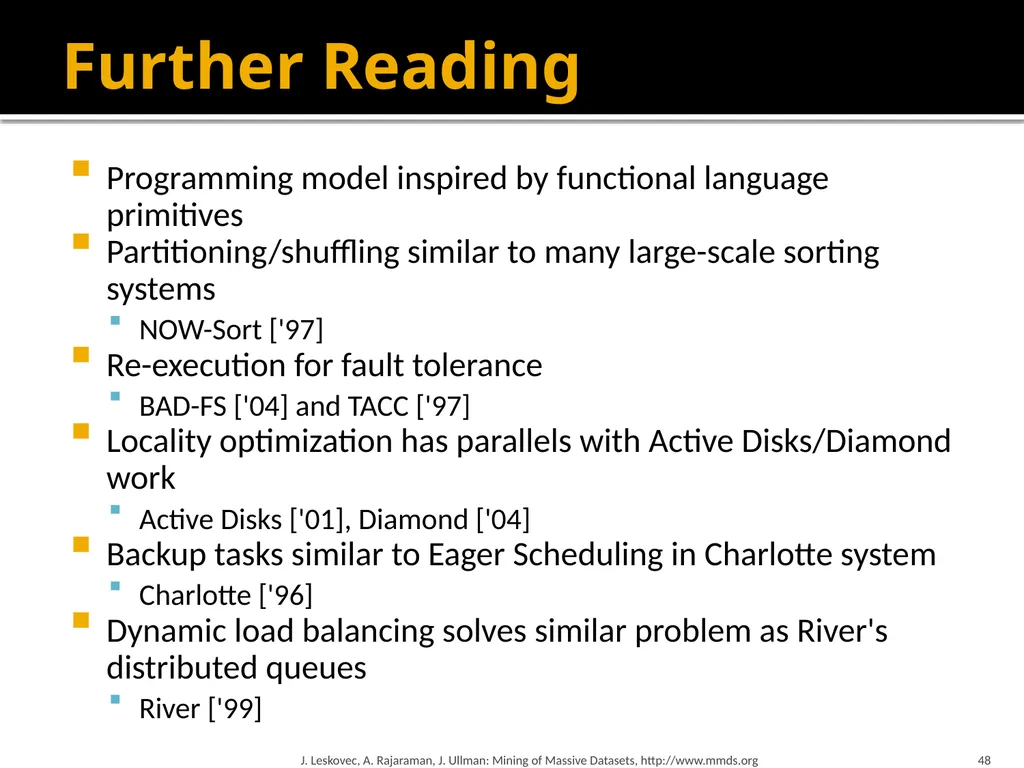
Further Reading Programming model inspired by functional language primitives
Partitioning/shuffling similar to many large-scale sorting systems
NOW-Sort ['97]
Re-execution for fault tolerance
BAD-FS ['04] and TACC ['97]
Locality optimization has parallels with Active Disks/Diamond work
Active Disks ['01], Diamond ['04]
Backup tasks similar to Eager Scheduling in Charlotte system
Charlotte ['96]
Dynamic load balancing solves similar problem as River's distributed queues
River ['99] J. Leskovec, A. Rajaraman, J. Ullman: Mining of Massive Datasets, http://www.mmds.org 48<br>
Partitioning/shuffling similar to many large-scale sorting systems
NOW-Sort ['97]
Re-execution for fault tolerance
BAD-FS ['04] and TACC ['97]
Locality optimization has parallels with Active Disks/Diamond work
Active Disks ['01], Diamond ['04]
Backup tasks similar to Eager Scheduling in Charlotte system
Charlotte ['96]
Dynamic load balancing solves similar problem as River's distributed queues
River ['99] J. Leskovec, A. Rajaraman, J. Ullman: Mining of Massive Datasets, http://www.mmds.org 48<br>