MARXISM Marxism as a theoretical system developed out of, and drew inspiration from, the writings of Karl Marx. Marxism as a codified body of thought came into existence only after Marxs death. It was the product of the attempt by later
"MARXISM Marxism as a theoretical system developed" is the property of its rightful owner. Permission is granted to
download and print the materials on this website for personal, non-commercial use only, and to display it
on your personal computer provided you do not modify the materials and that you retain all copyright
notices contained in the materials. By downloading content from our website, you accept the terms of this
agreement.
Presentation Transcript
01
MARXISM<br>
02
Marxism as a theoretical system developed out of, and drew inspiration from, the writings of Karl Marx. ‘Marxism’ as a codified body of thought came into existence only after Marx’s death. It was the product of the attempt by later Marxists.
Principles of Marxism
The Materialistic interpretation of history.
Dialectical Materialism.
Theory of Surplus value.
Theory of Alienation
Theory of class Struggle.
The Dictatorship of the proletariat
Classless and stateless society.<br>
03
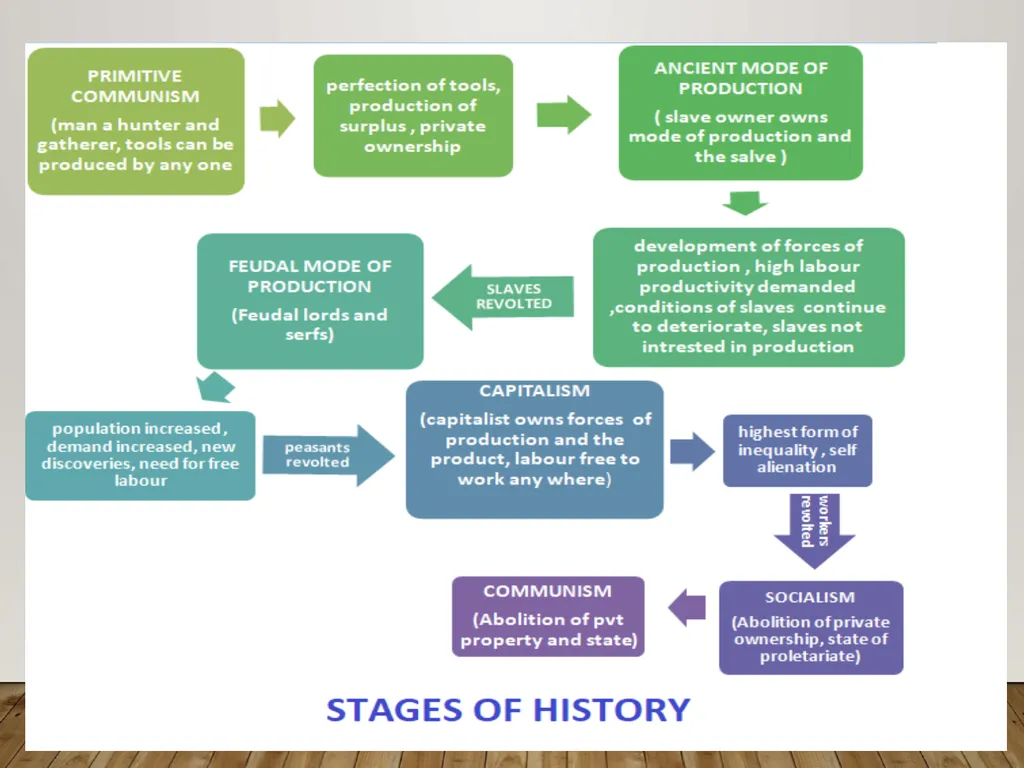
The Materialistic interpretation of history (HISTORICAL MATERIALISM) Marx interpretation of history is based on materialism.
According to him economic structure of society decide structures of society. the other All the social, political, intellectual relations, legal systems, outlooks, which emerge in the course of history are derived from the material conditions of life.
The progress and development is determined by the material conditions of social life. Change in production- relations call forth the change in the whole social system and political-order.<br>
04
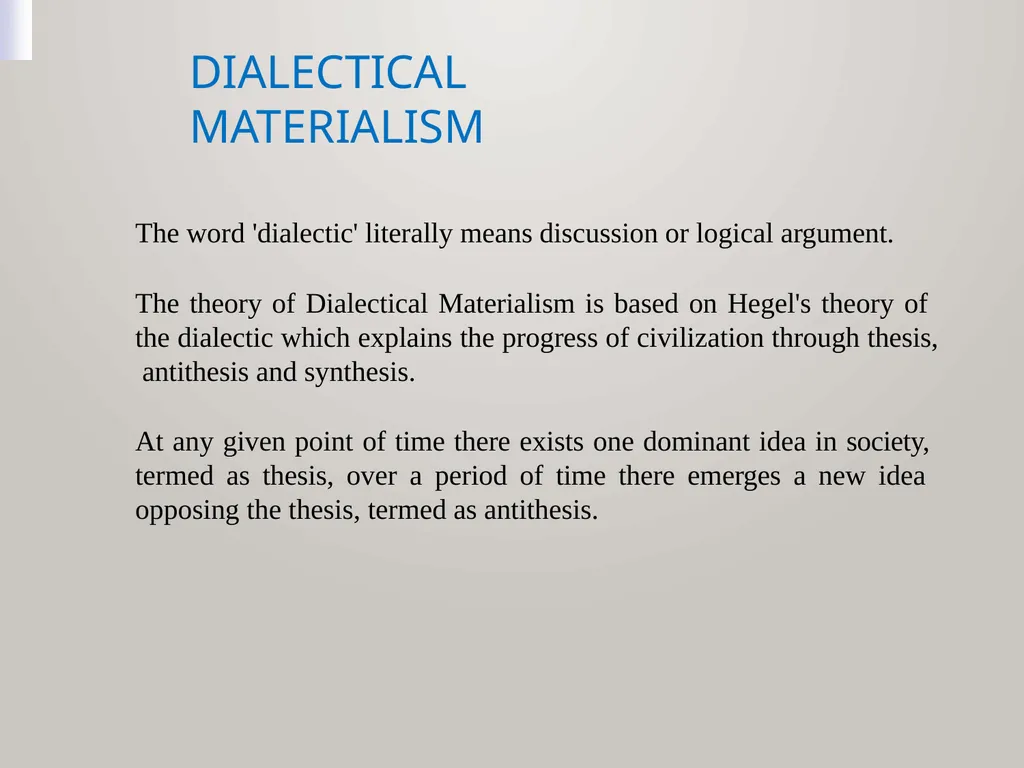
Dialectical Materialism The word 'dialectic' literally means discussion or logical argument.
The theory of Dialectical Materialism is based on Hegel's theory of the dialectic which explains the progress of civilization through thesis, antithesis and synthesis.
At any given point of time there exists one dominant idea in society, termed as thesis, over a period of time there emerges a new idea opposing the thesis, termed as antithesis.<br>
05
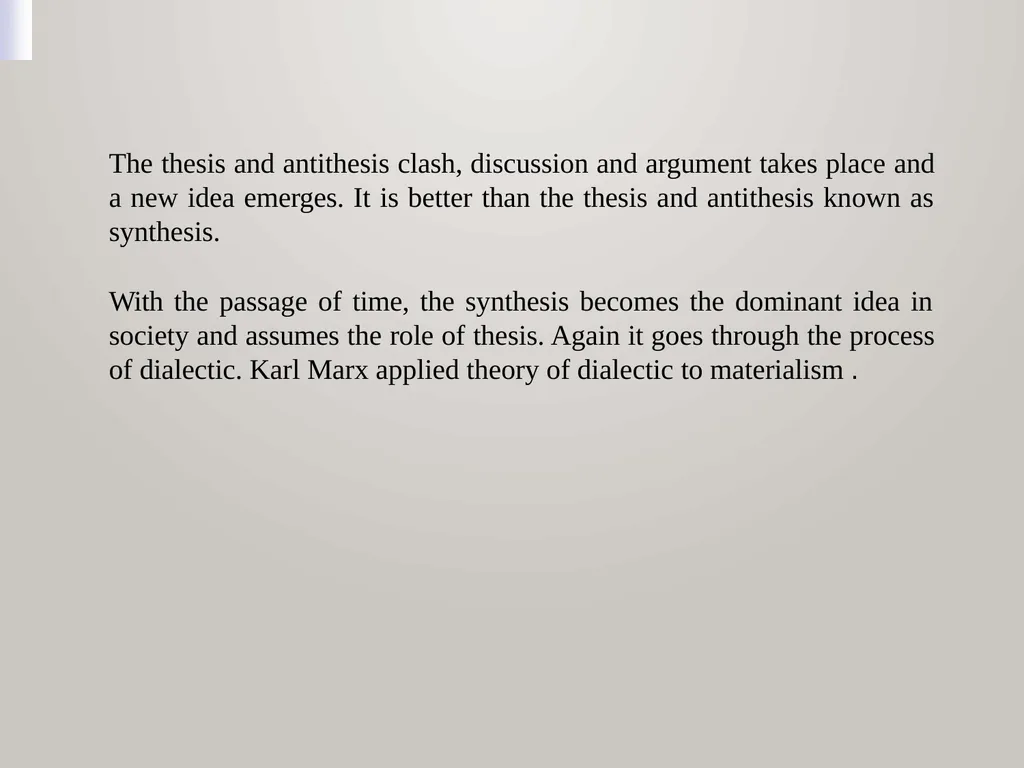
The thesis and antithesis clash, discussion and argument takes place and a new idea emerges. It is better than the thesis and antithesis known as synthesis.
With the passage of time, the synthesis becomes the dominant idea in society and assumes the role of thesis. Again it goes through the process of dialectic. Karl Marx applied theory of dialectic to materialism .<br>
06
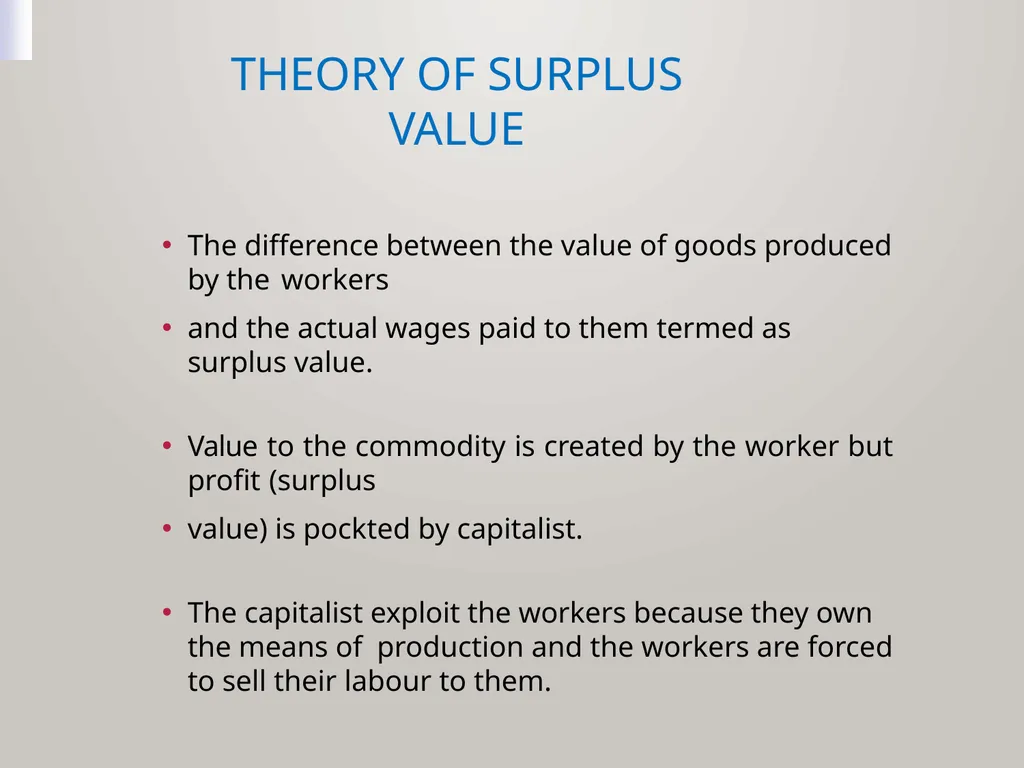
Theory of Surplus value The difference between the value of goods produced by the workers
and the actual wages paid to them termed as surplus value.
Value to the commodity is created by the worker but profit (surplus
value) is pockted by capitalist.
The capitalist exploit the workers because they own the means of production and the workers are forced to sell their labour to them.<br>
07
While employing them, they pay them the minimum wages, get more
work done by them.
According to Marx labour is the real productive factor but the worker does not receive a just share of the value.
To expose the injustice and exploitation under the capitalist system Marx explained the theory of surplus value.
This exploitation will serve as one of the reasons that motivates the proletariat to revolt against the Bourgeoisie, leading to a class war.<br>
08
Theory of Alienation The process whereby the worker is made to feel foreign to the
products of his/her own labor.
In capitalism, the proletariat works in order to live, in order to obtain the very means of life, which he can only achieve by selling his labour to a capitalist for a wage.
The worker is alienated from his/her product.
Because s/he no longer owns that product, which now belongs to the capitalist<br>
09
Capitalist has purchased the proletariat‘s labour power in exchange for exclusive ownership over the proletariat's products.
All profit accrued by the sale of those products goes to the capitalist.
The product of the workers’ labour is in a very real sense alien to the worker. It is not his/her product but the product of the capitalist.<br>
10
Theory of class STRUGGLE The Communist Manifesto, the Bible of the working class, starts with the statement "The history of all existing society is the history of the class struggles".
The struggle between the two opposing classes the class of oppressors and the class of the oppressed.
At every stage of social development a particular class got control on the means of production and exploited the rest.
Dominant class alone enjoyed freedom and used the state also as an instrument to preserve its economic power.<br>
11
In Capitalist system workers class are subjected to exploitation.
In the capitalist order the interest of the capitalist class is to maximise the profit, whereas the interest of the working class lies in the enhancement of wage.
Marx calls upon the working class to unite and overthrow the capitalist order.
TheWorking men of all countries, unite. Proletarians have nothing to loose but their chains They have a world to win.<br>
12
The Dictatorship of the Proletariat Marx believed that when the class war takes place, the proletariat will emerge victorious.
Although the purpose of the class war is to establish a stateless and classless society, this objective cannot be achieved until all state institutions such as the bureaucracy; judiciary, legislature, executive etc are abolished.
Hence before the abolition of the state, society would undergo a transitional period in which the proletariat assumed control on all aspects of state.
Proletariat dictatorship means power in the hands of the working people for building up a communist society.<br>
13
CLASSLESS AND STATELESS SOCIETY
Marx says that during the phase of dictatorship of the proletariat, the labour class would control the state's institutions and use them to destroy capitalism.
The proletariat would then use the state institutions to establish a
society based on economic and social justice.
Once this is achieved, the proletariat would renounce its dictatorship and all institutions of state would gradually cease to exist. This would eventually lead to the withering away of the state itself.<br>