
Massimo Guidolin & Daniel L. Thornton Federal


Description: Massimo Guidolin Daniel L. Thornton Federal Reserve Bank of St. Louis Predictions of Short-Term Rates and the Expectations Hypothesis of the Term Structure of Interest Rates The views are the authors and do not necessarily represent the
Related Topics
Download Presentation
"Massimo Guidolin & Daniel L. Thornton Federal" is the property of its rightful owner. Permission is granted to download and print the materials on this website for personal, non-commercial use only, and to display it on your personal computer provided you do not modify the materials and that you retain all copyright notices contained in the materials. By downloading content from our website, you accept the terms of this agreement.
Presentation Transcript
slide1. Massimo Guidolin & Daniel L. Thornton
Federal Reserve Bank of St. Louis Predictions of Short-Term Rates and the Expectations Hypothesis of the Term Structure of Interest Rates The views are the authors’ and do not necessarily represent the views of the Federal Reserve Bank of St. Louis or the Board of Governors of the Federal Reserve<br>
slide2. The expectations hypothesis (EH) of the term structure of interest rates---the proposition that the long-term rate is determined by the market's expectation of the short-term rate over the holding period of the long-term bond plus a constant risk premium---has been tested and rejected using a wide variety of interest rates, over a variety of sample periods, alternative monetary policy regimes, etc. Expectations Hypothesis<br>
slide3. Single-equation models most often used to test the EH may lead to spurious rejections of the hypothesis because of time-varying risk premia, non-rational expectations, peso problems, measurement errors, etc. However, none of these explanations appears to adequately account for the EH's failure (e.g., Fama, 1984; Mankiw and Miron, 1986; Backus, et al., 1989; Froot, 1989; Simon, 1990; Campbell and Shiller, 1991; Hardouvelis, 1994; McCallum, 1994; Campbell, 1995; Dotsey and Otrok, 1995; Roberds et al., 1996; Balduzzi, et al. 1997, 2001; Hodrick, and Marshall, 2001; Hsu and Kugler, 1997; Tzavalis and Wickens, 1997; Driffill et al., 1997; Bekaert, Hodrick, and Marshall, 1997b; Roberds and Whiteman, 1999; Bansal and Zhou, 2002; Dai and Singleton, 2002; and Kool and Thornton, 2004). Failure of the EH<br>
slide4. The evidence against the EH is even more damaging because (a) Bekaert, Hodrick, and Marshall (1997) show that the there is a positive small-sample bias in parameter estimates of these models due to the persistence of interest rates and (b) Thornton (2006) demonstrates that these single-equation models can yield results favorable to the EH even when the EH is false. Failure of the EH<br>
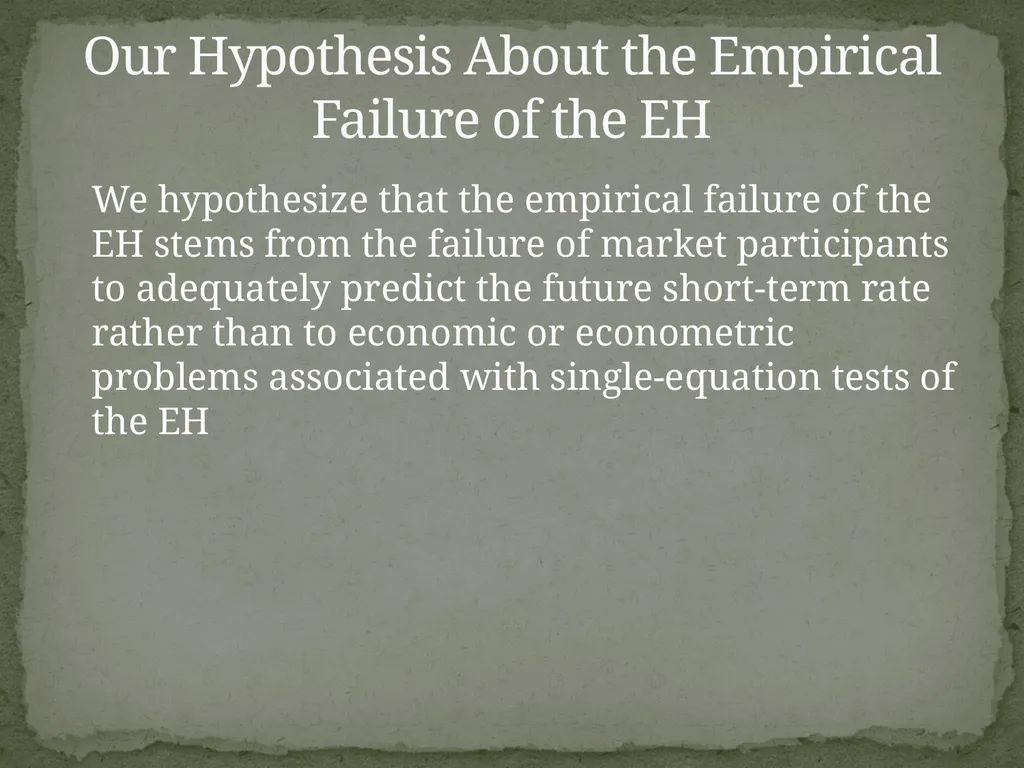
slide5. We hypothesize that the empirical failure of the EH stems from the failure of market participants to adequately predict the future short-term rate rather than to economic or econometric problems associated with single-equation tests of the EH Our Hypothesis About the Empirical Failure of the EH<br>
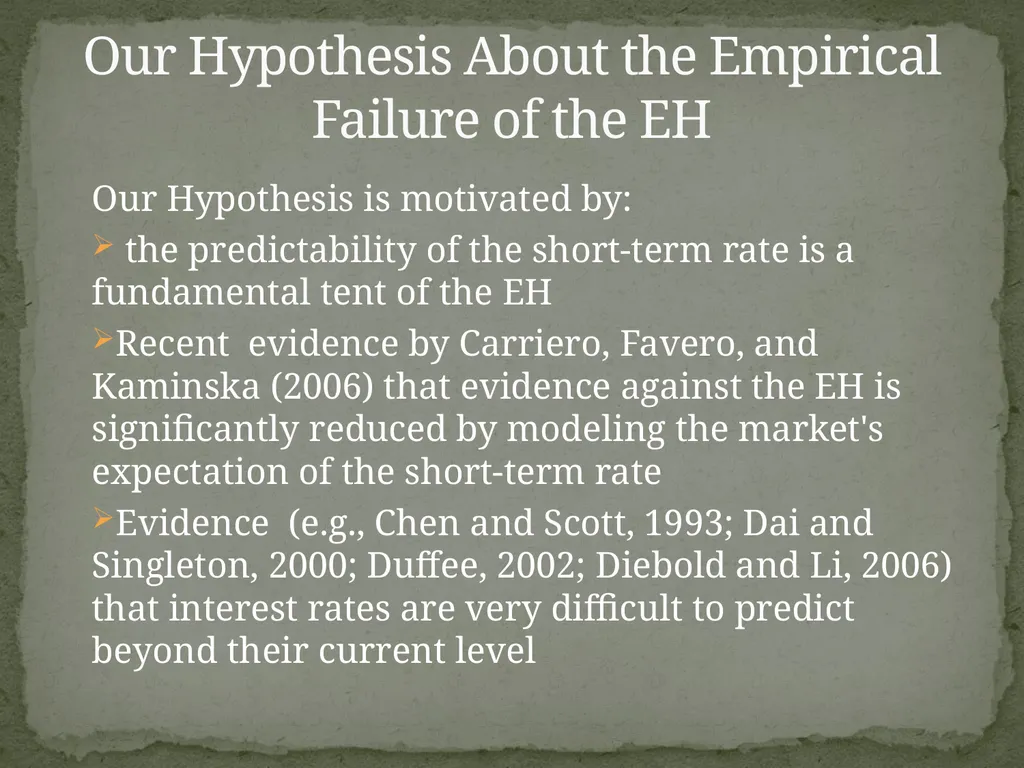
slide6. Our Hypothesis is motivated by:
the predictability of the short-term rate is a fundamental tent of the EH
Recent evidence by Carriero, Favero, and Kaminska (2006) that evidence against the EH is significantly reduced by modeling the market's expectation of the short-term rate
Evidence (e.g., Chen and Scott, 1993; Dai and Singleton, 2000; Duffee, 2002; Diebold and Li, 2006) that interest rates are very difficult to predict beyond their current level Our Hypothesis About the Empirical Failure of the EH<br>
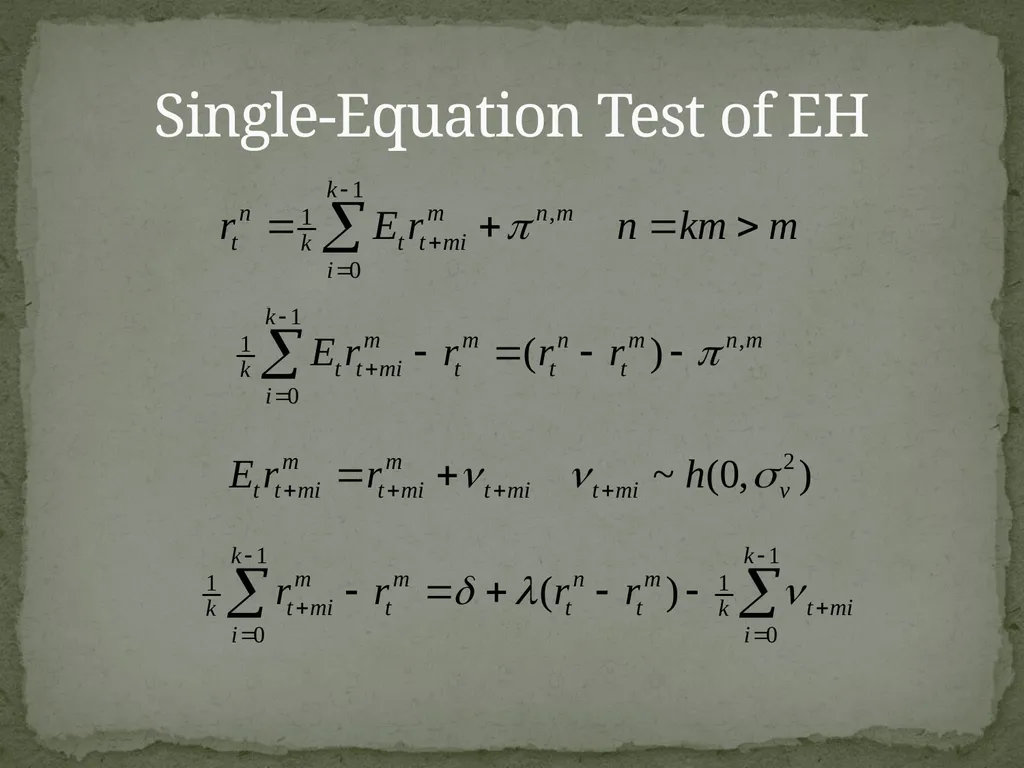
slide7. Single-Equation Test of EH<br>
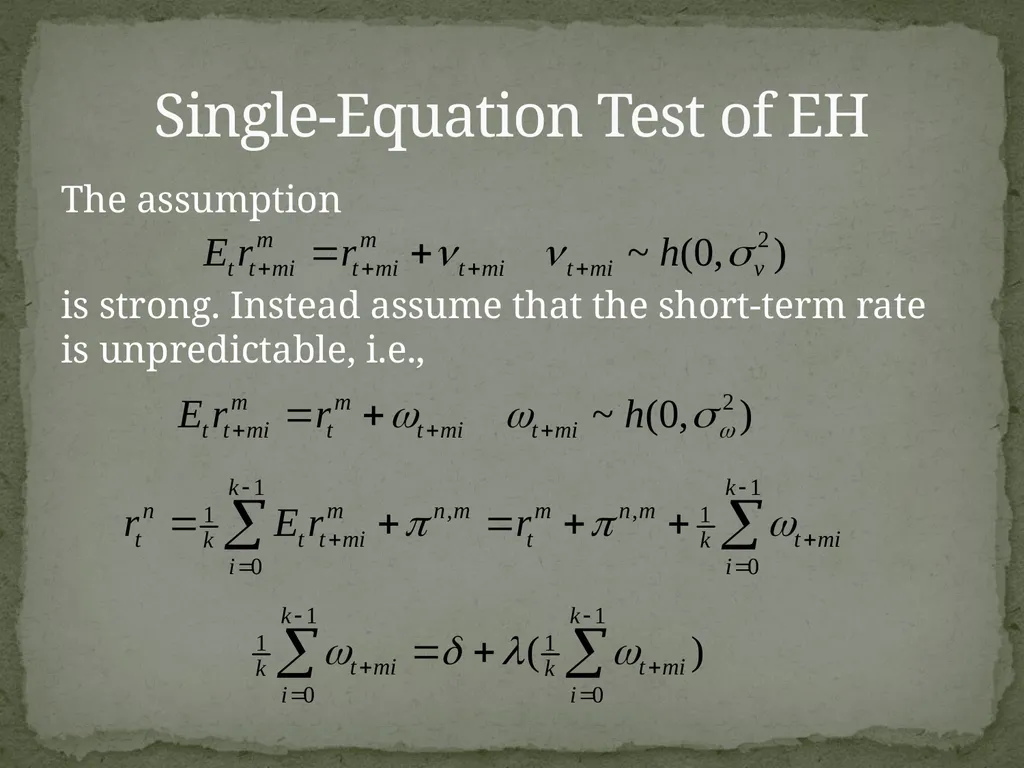
slide8. The assumption
is strong. Instead assume that the short-term rate is unpredictable, i.e., Single-Equation Test of EH<br>
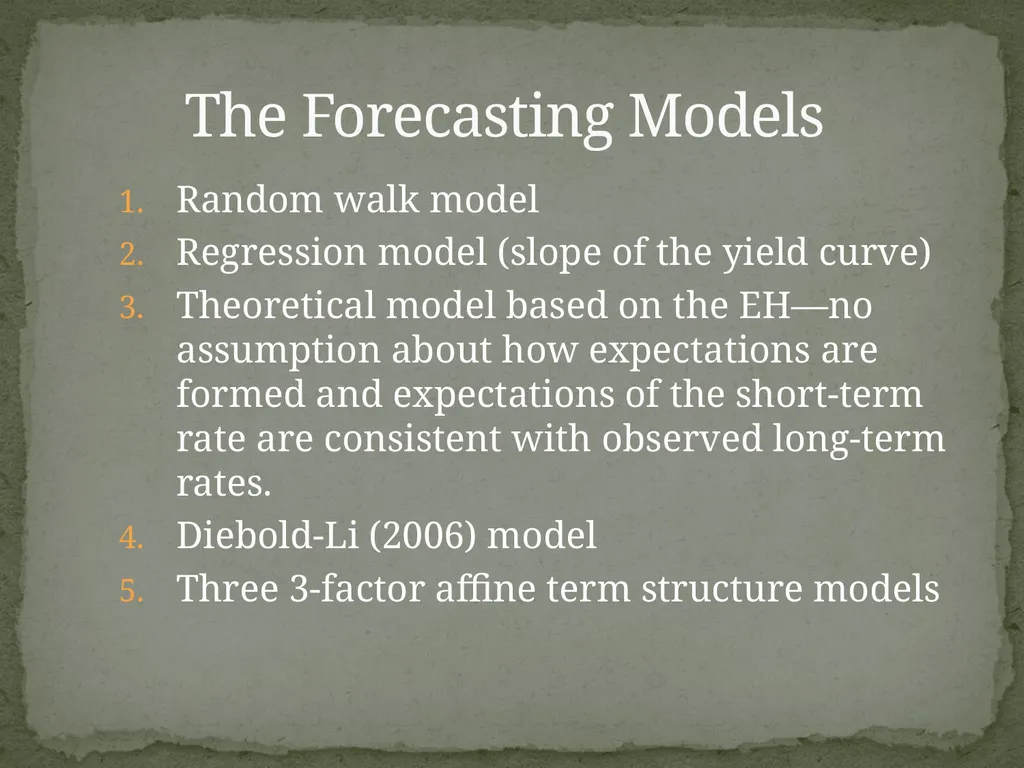
slide9. Random walk model
Regression model (slope of the yield curve)
Theoretical model based on the EH—no assumption about how expectations are formed and expectations of the short-term rate are consistent with observed long-term rates.
Diebold-Li (2006) model
Three 3-factor affine term structure models The Forecasting Models<br>
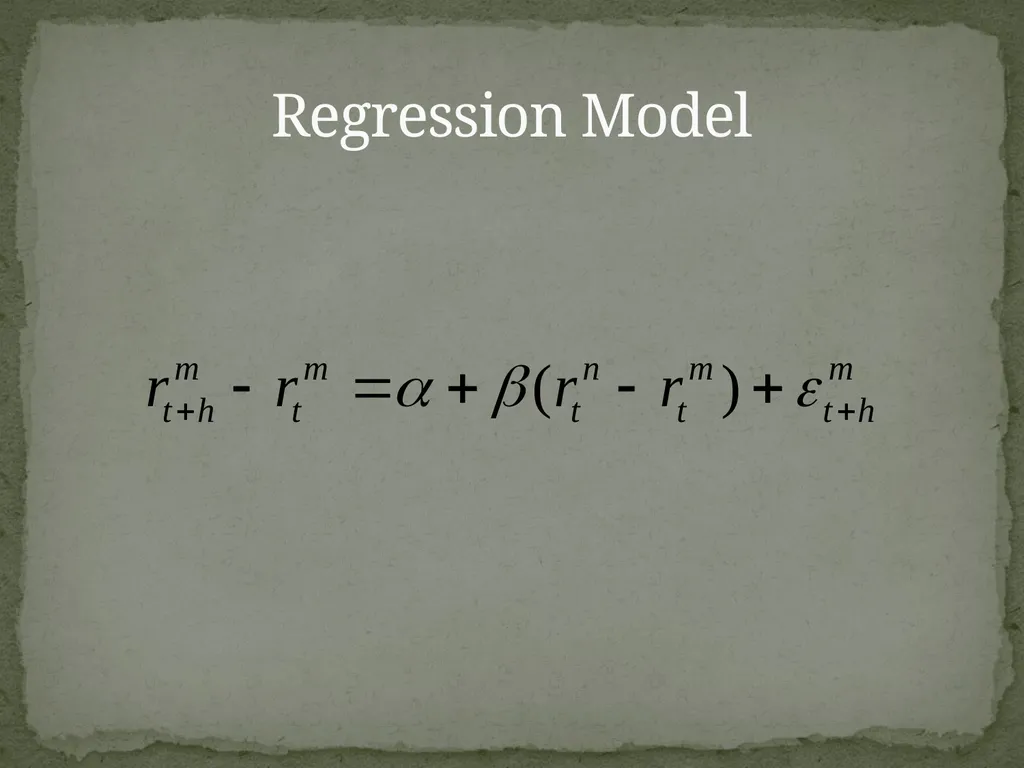
slide10. Regression Model<br>
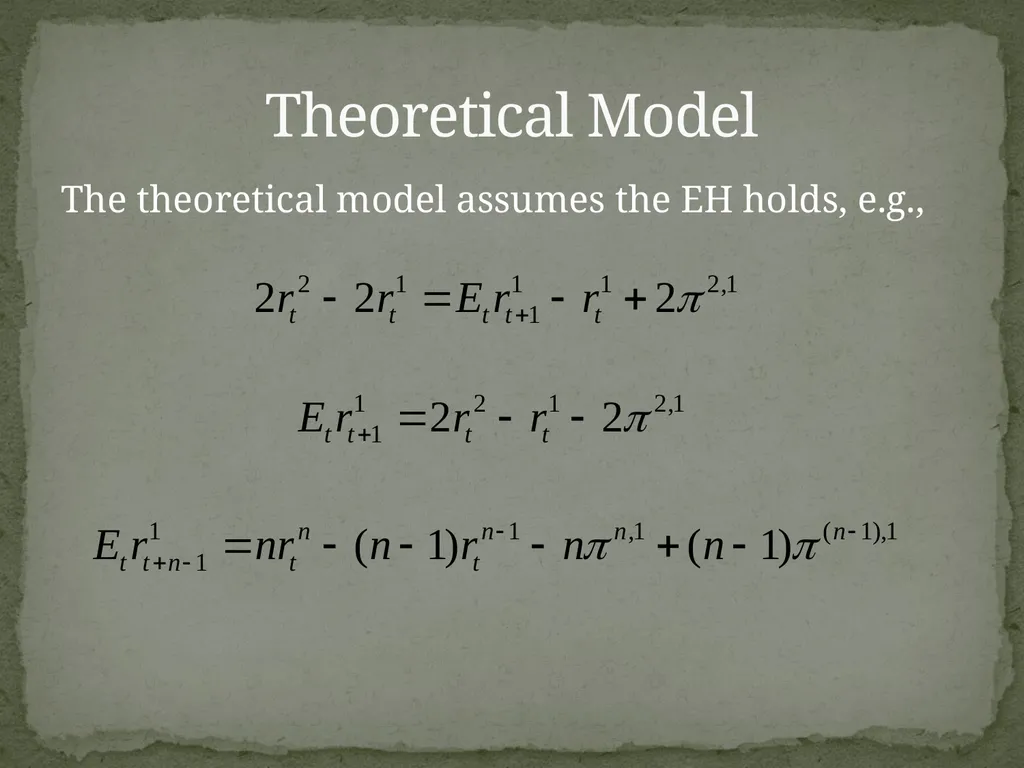
slide11. The theoretical model assumes the EH holds, e.g., Theoretical Model<br>
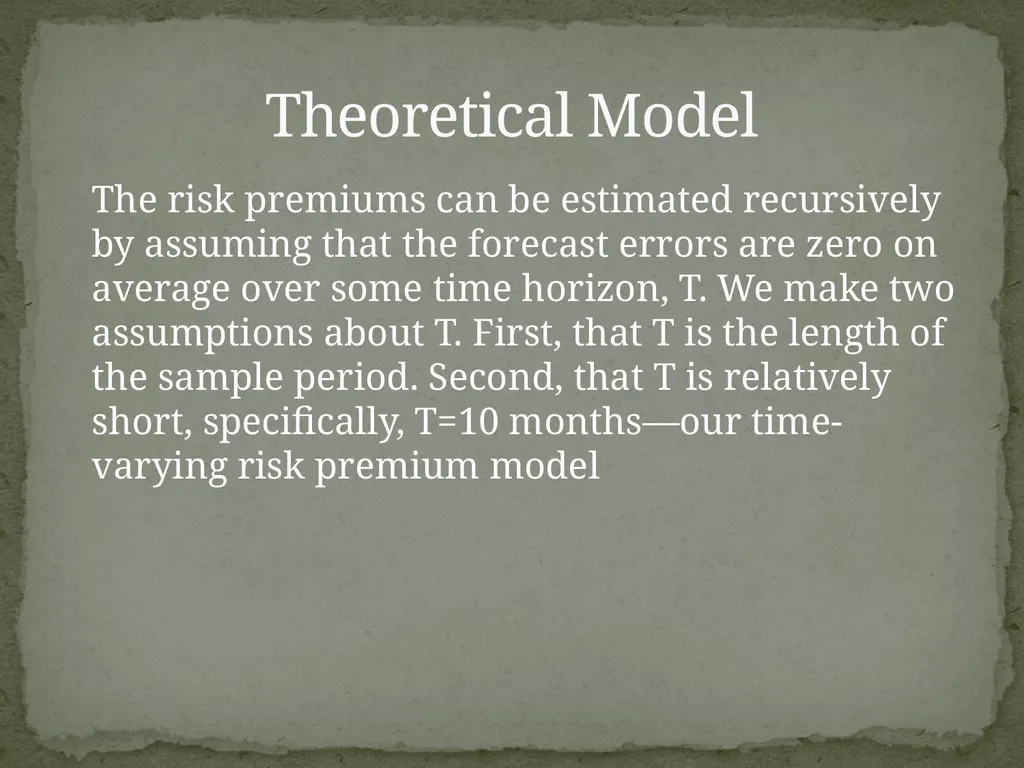
slide12. The risk premiums can be estimated recursively by assuming that the forecast errors are zero on average over some time horizon, T. We make two assumptions about T. First, that T is the length of the sample period. Second, that T is relatively short, specifically, T=10 months—our time-varying risk premium model Theoretical Model<br>
slide13. Diebold and Li (2006) use the three-factor Nelson and Siegel (1987, 1988) forward rate curve to approximate the yield curve, i.e., Diebold-Li Model<br>
slide14. We estimate three affine term structure models (a pure affine model, and two essentially affine models (Duffee, 2002) in both unrestricted and restricted forms Affine Term Structure Models<br>
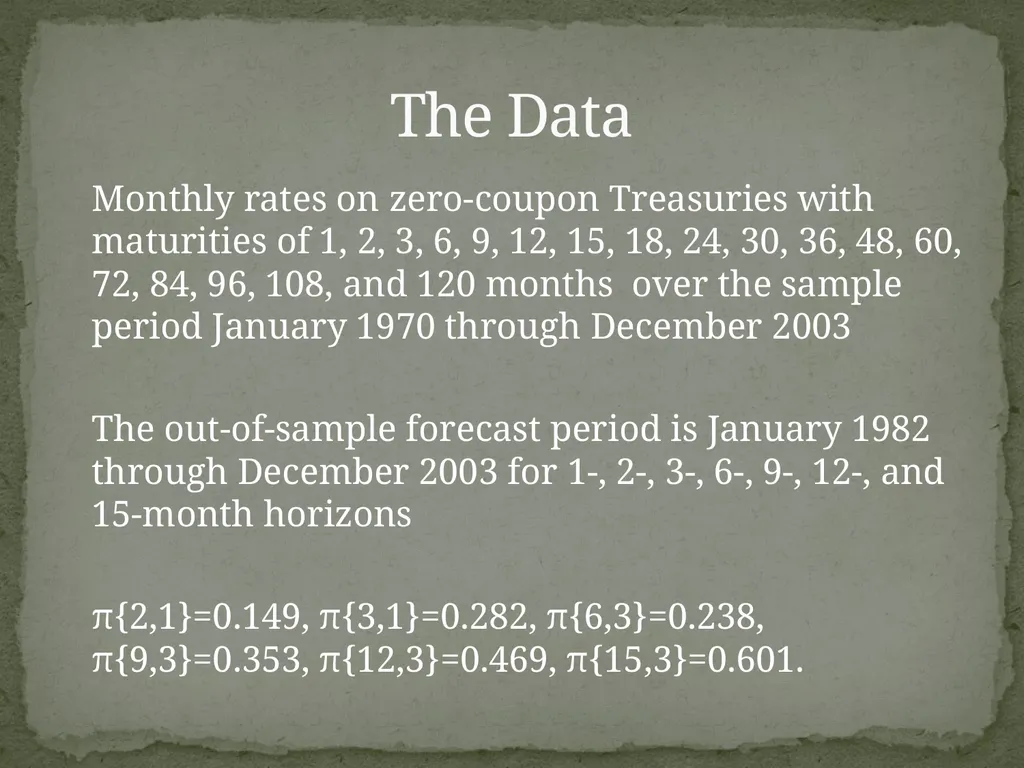
slide15. Monthly rates on zero-coupon Treasuries with maturities of 1, 2, 3, 6, 9, 12, 15, 18, 24, 30, 36, 48, 60, 72, 84, 96, 108, and 120 months over the sample period January 1970 through December 2003
The out-of-sample forecast period is January 1982 through December 2003 for 1-, 2-, 3-, 6-, 9-, 12-, and 15-month horizons
π{2,1}=0.149, π{3,1}=0.282, π{6,3}=0.238, π{9,3}=0.353, π{12,3}=0.469, π{15,3}=0.601. The Data<br>
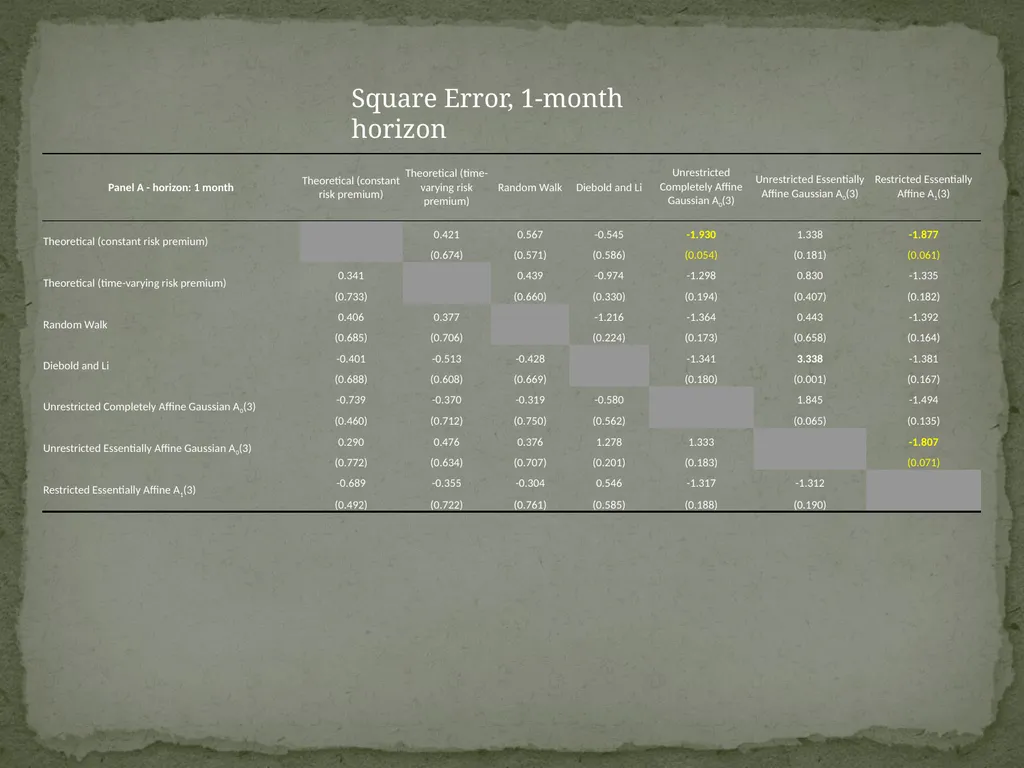
slide16. Square Error, 1-month horizon<br>
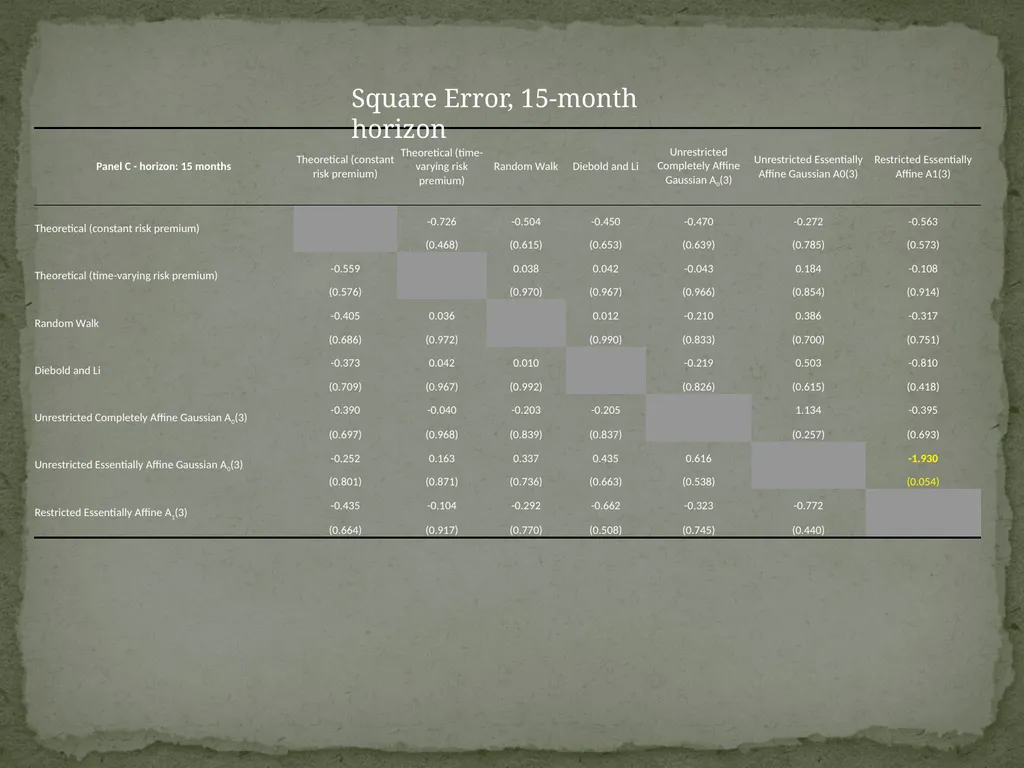
slide17. Square Error, 15-month horizon<br>
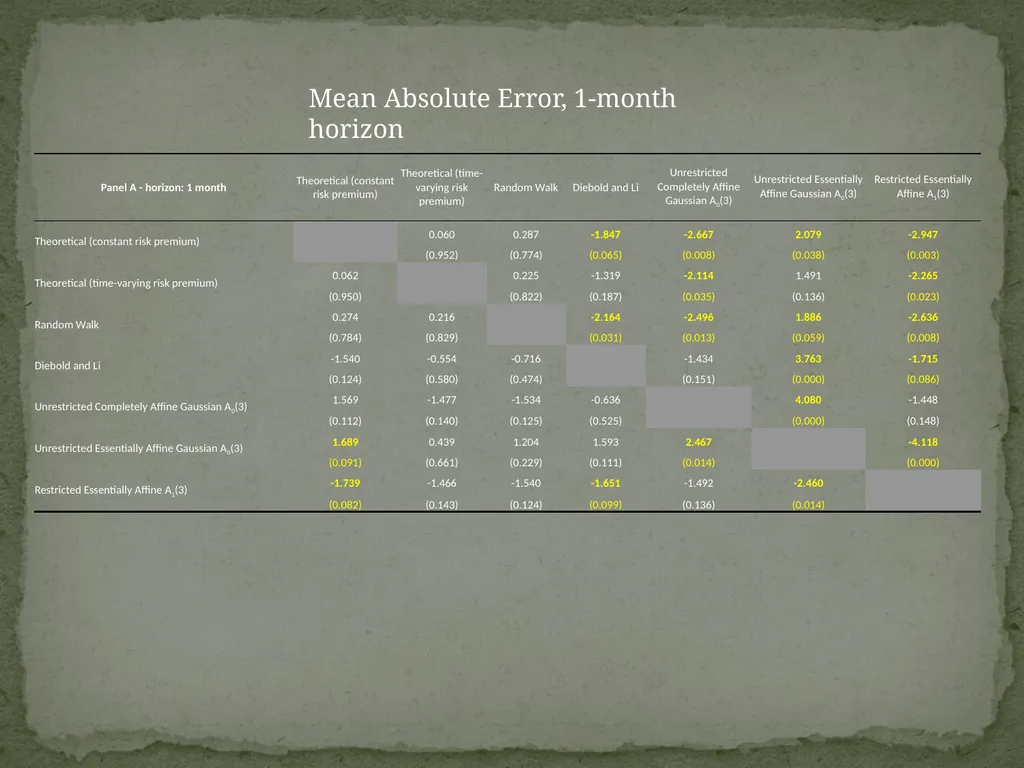
slide18. Mean Absolute Error, 1-month horizon<br>
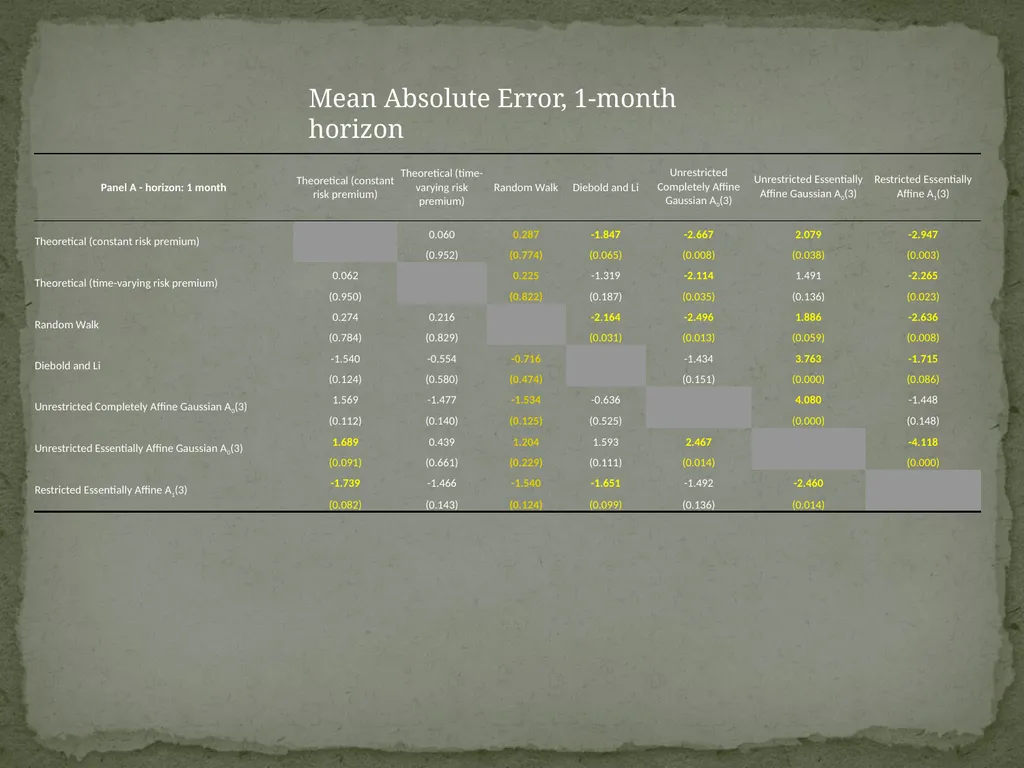
slide19. Mean Absolute Error, 1-month horizon<br>
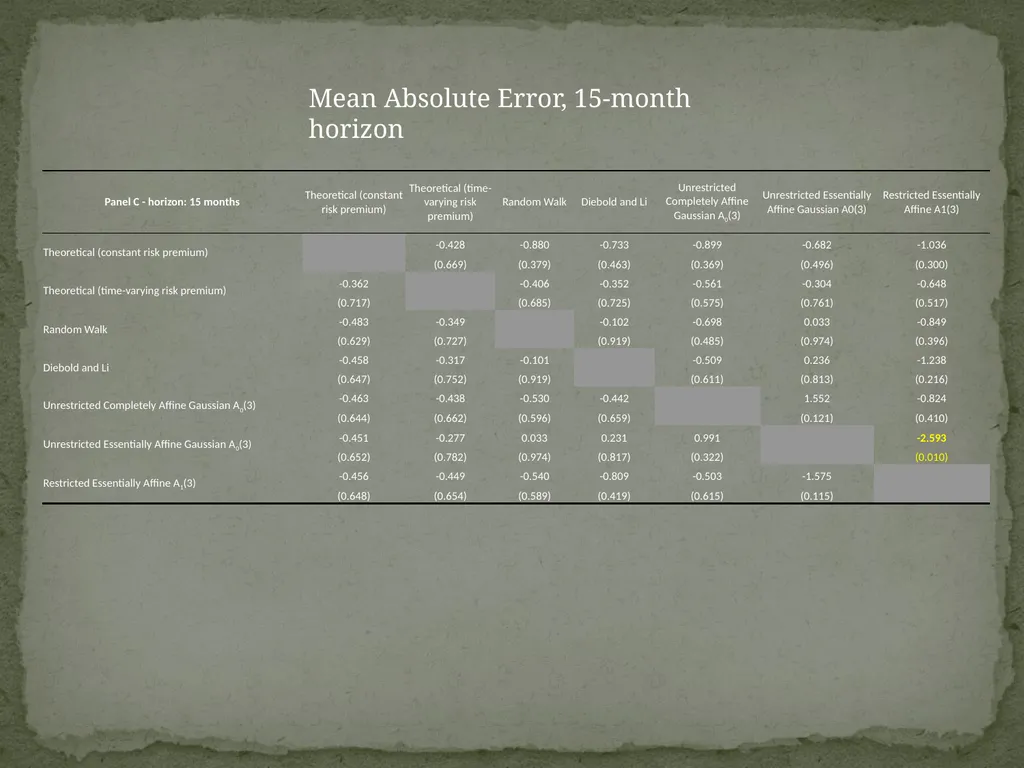
slide20. Mean Absolute Error, 15-month horizon<br>
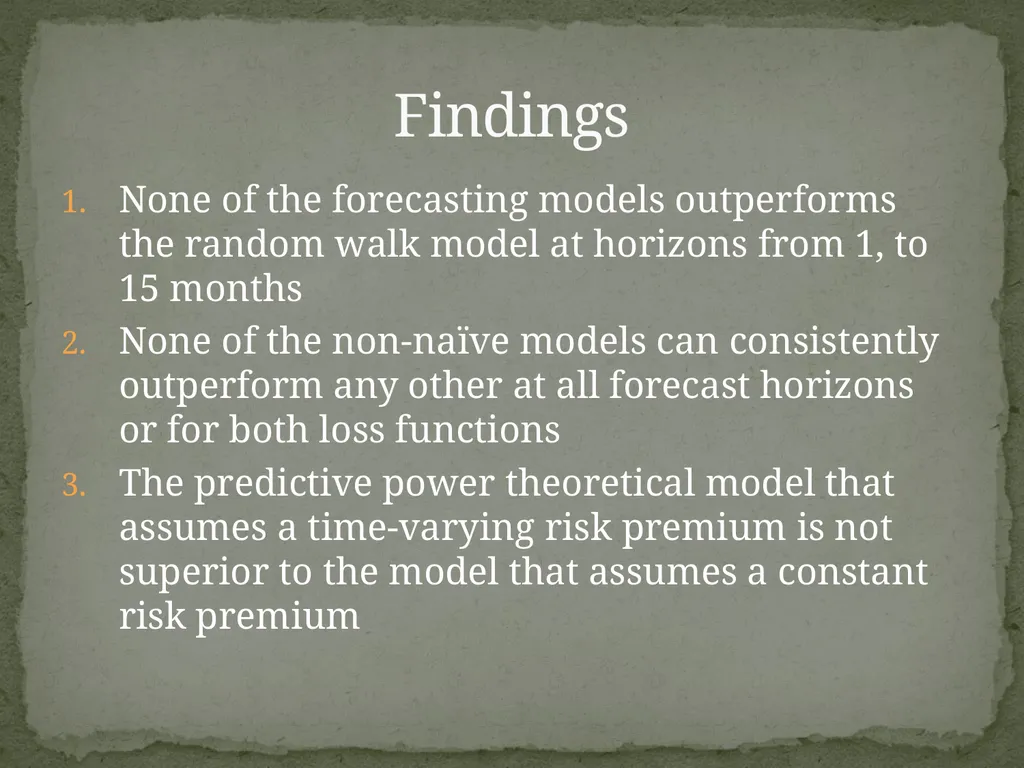
slide21. None of the forecasting models outperforms the random walk model at horizons from 1, to 15 months
None of the non-naïve models can consistently outperform any other at all forecast horizons or for both loss functions
The predictive power theoretical model that assumes a time-varying risk premium is not superior to the model that assumes a constant risk premium Findings<br>
slide22. The fact that models that incorporate considerable information about the structure of interest rates do no better than the naïve models or theoretical models that don’t suggests that information about the term structure is relatively unimportant for forecasting interest rates Implications<br>
slide23. Model that impose considerable structure and the no arbitrage condition do no better than those without these features suggests that neither structure or lack of arbitrage are very useful for forecasting short-term rates Implications<br>
slide24. The fact that our theoretical models forecast as well as non-naïve models suggests that long-term rates reflect market participants’ expectations for the future short-term rate to the extent that short-term rates can be forecast by such models.
However, the inability to forecast the short-term rate significant beyond its current level suggests that the EH may not be useful for market analysts and policymakers Implications<br>
slide25. The fact that forecasts based on a time-varying risk premium are not statistically inferior to those based on a constant risk premium suggests that the ubiquitous failure of the EH is not due to time variation in the risk premium as is often suggested but, rather, a consequence of the inability of market participants to predict future short-term rates Implications<br>
slide26. Finally, the perfect stochastic foresight assumption that is used to construct single-equation tests of the EH (and some multi-equation tests) is significantly at odds with the evidence presented here. This fact alone can account for the rejection of the null hypothesis with tests that are based on this assumption. Implications<br>
Federal Reserve Bank of St. Louis Predictions of Short-Term Rates and the Expectations Hypothesis of the Term Structure of Interest Rates The views are the authors’ and do not necessarily represent the views of the Federal Reserve Bank of St. Louis or the Board of Governors of the Federal Reserve<br>
slide2. The expectations hypothesis (EH) of the term structure of interest rates---the proposition that the long-term rate is determined by the market's expectation of the short-term rate over the holding period of the long-term bond plus a constant risk premium---has been tested and rejected using a wide variety of interest rates, over a variety of sample periods, alternative monetary policy regimes, etc. Expectations Hypothesis<br>
slide3. Single-equation models most often used to test the EH may lead to spurious rejections of the hypothesis because of time-varying risk premia, non-rational expectations, peso problems, measurement errors, etc. However, none of these explanations appears to adequately account for the EH's failure (e.g., Fama, 1984; Mankiw and Miron, 1986; Backus, et al., 1989; Froot, 1989; Simon, 1990; Campbell and Shiller, 1991; Hardouvelis, 1994; McCallum, 1994; Campbell, 1995; Dotsey and Otrok, 1995; Roberds et al., 1996; Balduzzi, et al. 1997, 2001; Hodrick, and Marshall, 2001; Hsu and Kugler, 1997; Tzavalis and Wickens, 1997; Driffill et al., 1997; Bekaert, Hodrick, and Marshall, 1997b; Roberds and Whiteman, 1999; Bansal and Zhou, 2002; Dai and Singleton, 2002; and Kool and Thornton, 2004). Failure of the EH<br>
slide4. The evidence against the EH is even more damaging because (a) Bekaert, Hodrick, and Marshall (1997) show that the there is a positive small-sample bias in parameter estimates of these models due to the persistence of interest rates and (b) Thornton (2006) demonstrates that these single-equation models can yield results favorable to the EH even when the EH is false. Failure of the EH<br>
slide5. We hypothesize that the empirical failure of the EH stems from the failure of market participants to adequately predict the future short-term rate rather than to economic or econometric problems associated with single-equation tests of the EH Our Hypothesis About the Empirical Failure of the EH<br>
slide6. Our Hypothesis is motivated by:
the predictability of the short-term rate is a fundamental tent of the EH
Recent evidence by Carriero, Favero, and Kaminska (2006) that evidence against the EH is significantly reduced by modeling the market's expectation of the short-term rate
Evidence (e.g., Chen and Scott, 1993; Dai and Singleton, 2000; Duffee, 2002; Diebold and Li, 2006) that interest rates are very difficult to predict beyond their current level Our Hypothesis About the Empirical Failure of the EH<br>
slide7. Single-Equation Test of EH<br>
slide8. The assumption
is strong. Instead assume that the short-term rate is unpredictable, i.e., Single-Equation Test of EH<br>
slide9. Random walk model
Regression model (slope of the yield curve)
Theoretical model based on the EH—no assumption about how expectations are formed and expectations of the short-term rate are consistent with observed long-term rates.
Diebold-Li (2006) model
Three 3-factor affine term structure models The Forecasting Models<br>
slide10. Regression Model<br>
slide11. The theoretical model assumes the EH holds, e.g., Theoretical Model<br>
slide12. The risk premiums can be estimated recursively by assuming that the forecast errors are zero on average over some time horizon, T. We make two assumptions about T. First, that T is the length of the sample period. Second, that T is relatively short, specifically, T=10 months—our time-varying risk premium model Theoretical Model<br>
slide13. Diebold and Li (2006) use the three-factor Nelson and Siegel (1987, 1988) forward rate curve to approximate the yield curve, i.e., Diebold-Li Model<br>
slide14. We estimate three affine term structure models (a pure affine model, and two essentially affine models (Duffee, 2002) in both unrestricted and restricted forms Affine Term Structure Models<br>
slide15. Monthly rates on zero-coupon Treasuries with maturities of 1, 2, 3, 6, 9, 12, 15, 18, 24, 30, 36, 48, 60, 72, 84, 96, 108, and 120 months over the sample period January 1970 through December 2003
The out-of-sample forecast period is January 1982 through December 2003 for 1-, 2-, 3-, 6-, 9-, 12-, and 15-month horizons
π{2,1}=0.149, π{3,1}=0.282, π{6,3}=0.238, π{9,3}=0.353, π{12,3}=0.469, π{15,3}=0.601. The Data<br>
slide16. Square Error, 1-month horizon<br>
slide17. Square Error, 15-month horizon<br>
slide18. Mean Absolute Error, 1-month horizon<br>
slide19. Mean Absolute Error, 1-month horizon<br>
slide20. Mean Absolute Error, 15-month horizon<br>
slide21. None of the forecasting models outperforms the random walk model at horizons from 1, to 15 months
None of the non-naïve models can consistently outperform any other at all forecast horizons or for both loss functions
The predictive power theoretical model that assumes a time-varying risk premium is not superior to the model that assumes a constant risk premium Findings<br>
slide22. The fact that models that incorporate considerable information about the structure of interest rates do no better than the naïve models or theoretical models that don’t suggests that information about the term structure is relatively unimportant for forecasting interest rates Implications<br>
slide23. Model that impose considerable structure and the no arbitrage condition do no better than those without these features suggests that neither structure or lack of arbitrage are very useful for forecasting short-term rates Implications<br>
slide24. The fact that our theoretical models forecast as well as non-naïve models suggests that long-term rates reflect market participants’ expectations for the future short-term rate to the extent that short-term rates can be forecast by such models.
However, the inability to forecast the short-term rate significant beyond its current level suggests that the EH may not be useful for market analysts and policymakers Implications<br>
slide25. The fact that forecasts based on a time-varying risk premium are not statistically inferior to those based on a constant risk premium suggests that the ubiquitous failure of the EH is not due to time variation in the risk premium as is often suggested but, rather, a consequence of the inability of market participants to predict future short-term rates Implications<br>
slide26. Finally, the perfect stochastic foresight assumption that is used to construct single-equation tests of the EH (and some multi-equation tests) is significantly at odds with the evidence presented here. This fact alone can account for the rejection of the null hypothesis with tests that are based on this assumption. Implications<br>