02
UNIT 2�Course Guidelines Fuzzy Logic:
Fuzzy set versus crisp set,
basic concepts of fuzzy sets,
membership functions,
basic operations on fuzzy sets and its properties.
Fuzzy relations versus Crisp relation. Fuzzy rule base system: Fuzzy propositions, fuzzy rules, fuzzy reasoning,
Fuzzy Inference Systems (FIS) Fuzzification & Defuzzification, Fuzzy decision making.
Applications of fuzzy logic.<br>
04
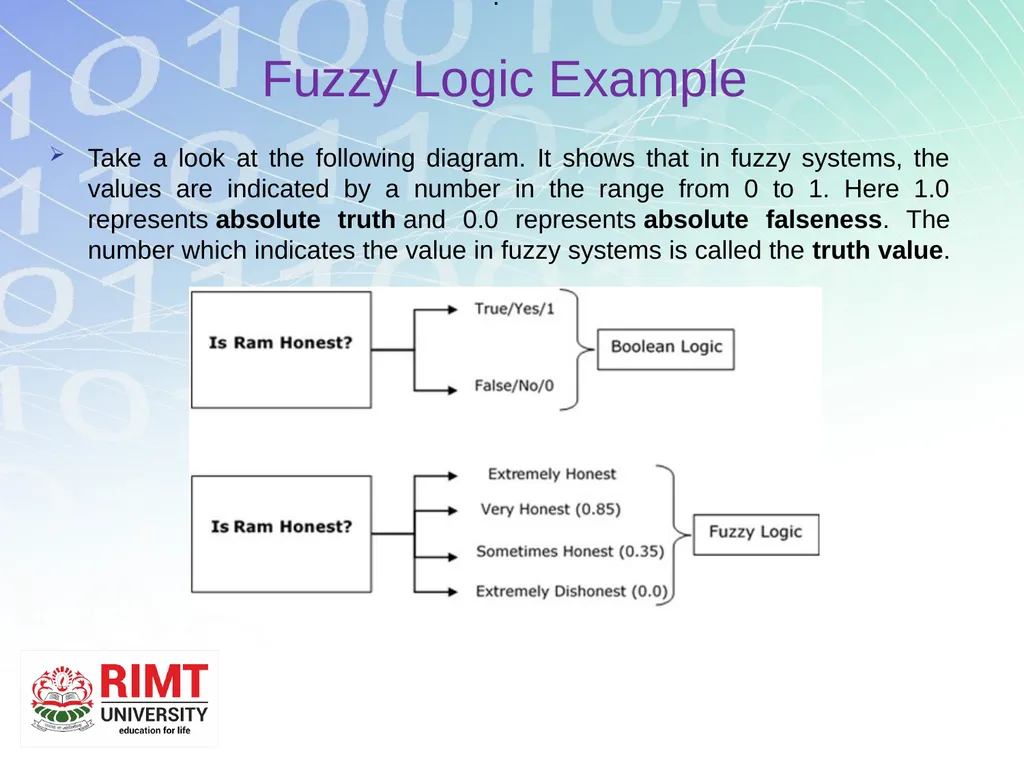
Fuzzy Logic Example Take a look at the following diagram. It shows that in fuzzy systems, the values are indicated by a number in the range from 0 to 1. Here 1.0 represents absolute truth and 0.0 represents absolute falseness. The number which indicates the value in fuzzy systems is called the truth value. .<br>
05
Example Cont. In other words, we can say that fuzzy logic is not logic that is fuzzy, but logic that is used to describe fuzziness. There can be numerous other examples like this with the help of which we can understand the concept of fuzzy logic.
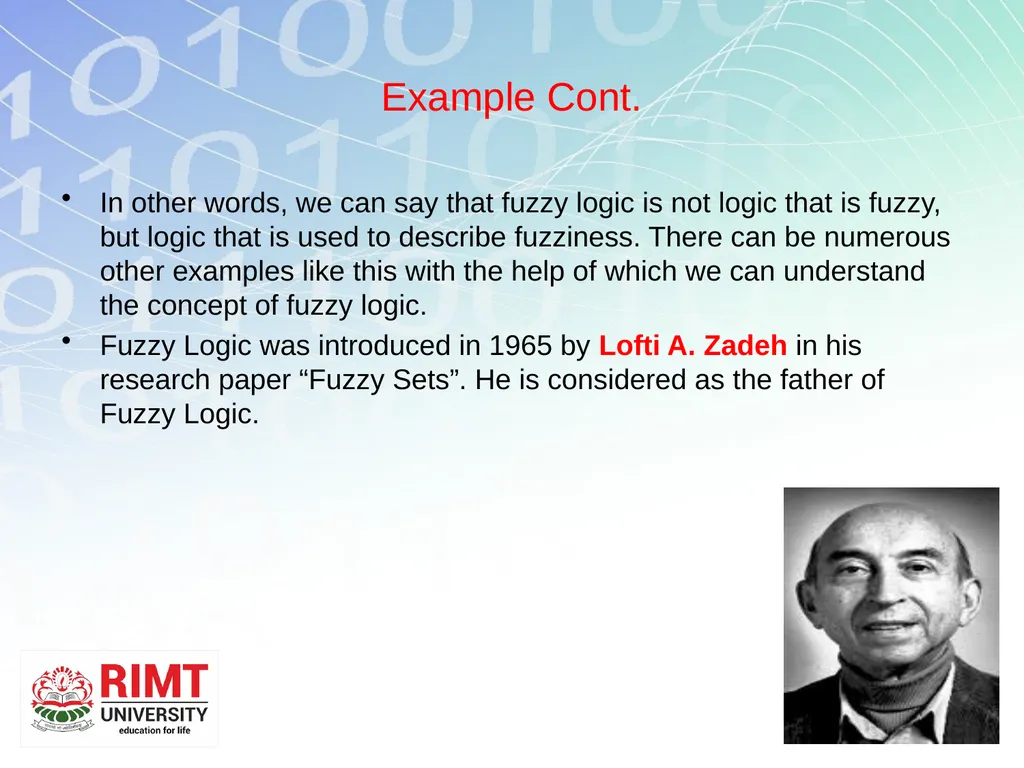
Fuzzy Logic was introduced in 1965 by Lofti A. Zadeh in his research paper “Fuzzy Sets”. He is considered as the father of Fuzzy Logic.<br>
06
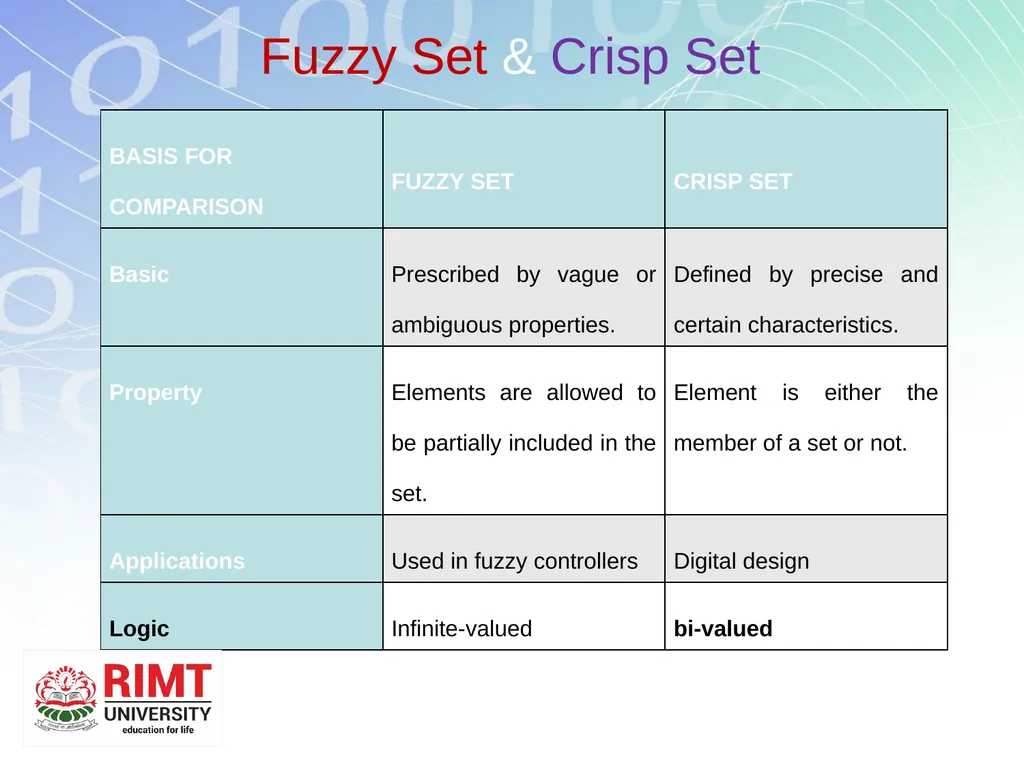
Fuzzy Set & Crisp Set<br>
07
Fuzzy Set & Crisp Set<br>
08
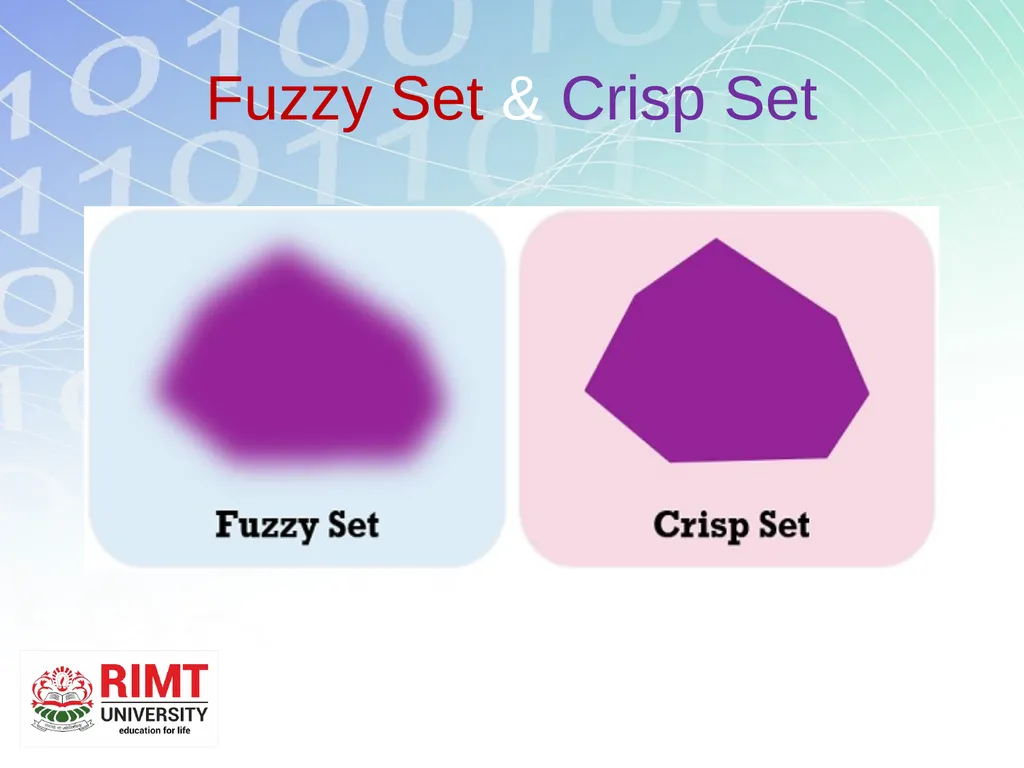
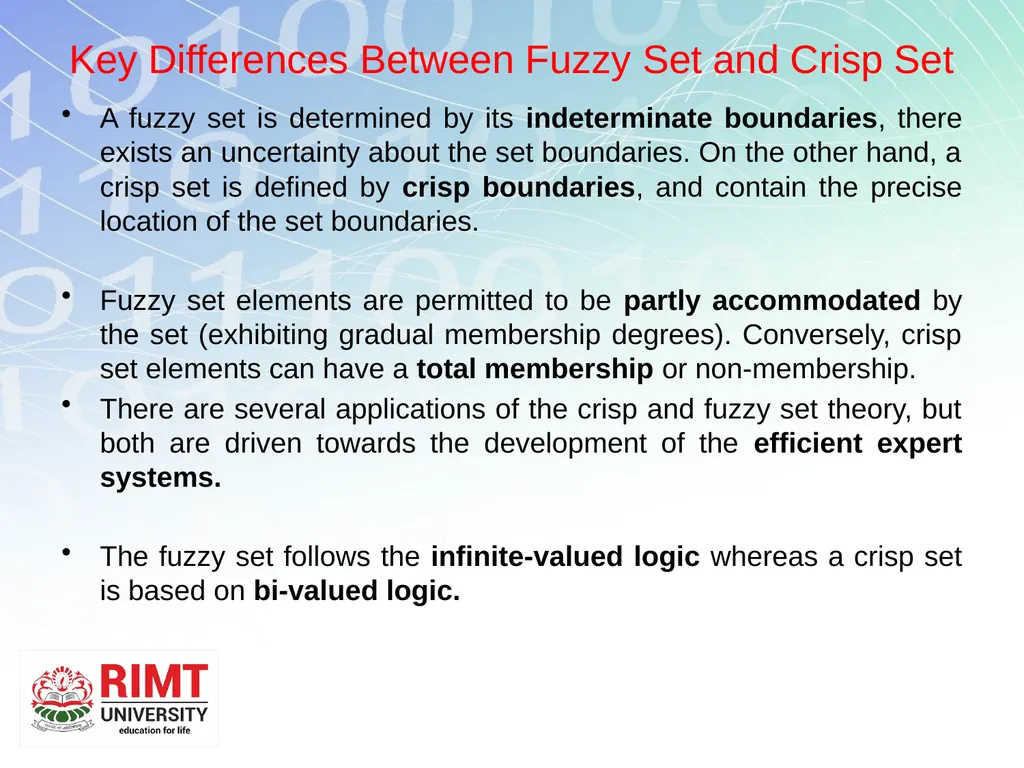
Key Differences Between Fuzzy Set and Crisp Set A fuzzy set is determined by its indeterminate boundaries, there exists an uncertainty about the set boundaries. On the other hand, a crisp set is defined by crisp boundaries, and contain the precise location of the set boundaries.
Fuzzy set elements are permitted to be partly accommodated by the set (exhibiting gradual membership degrees). Conversely, crisp set elements can have a total membership or non-membership.
There are several applications of the crisp and fuzzy set theory, but both are driven towards the development of the efficient expert systems.
The fuzzy set follows the infinite-valued logic whereas a crisp set is based on bi-valued logic.<br>
09
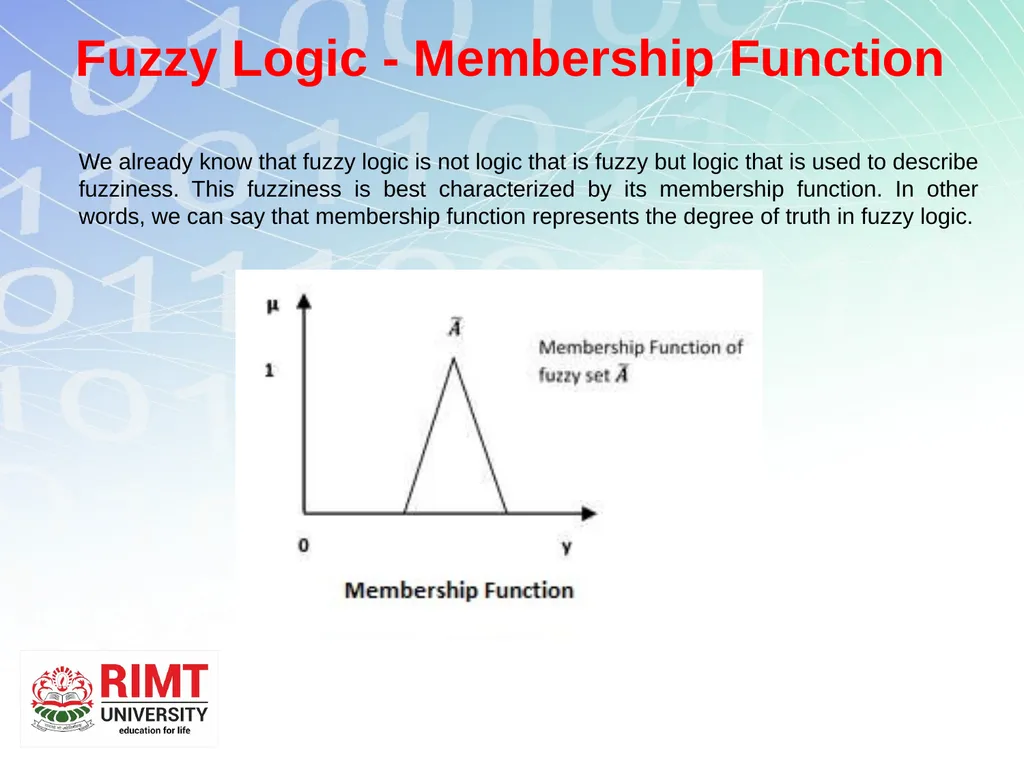
Fuzzy Logic - Membership Function We already know that fuzzy logic is not logic that is fuzzy but logic that is used to describe fuzziness. This fuzziness is best characterized by its membership function. In other words, we can say that membership function represents the degree of truth in fuzzy logic.<br>
10
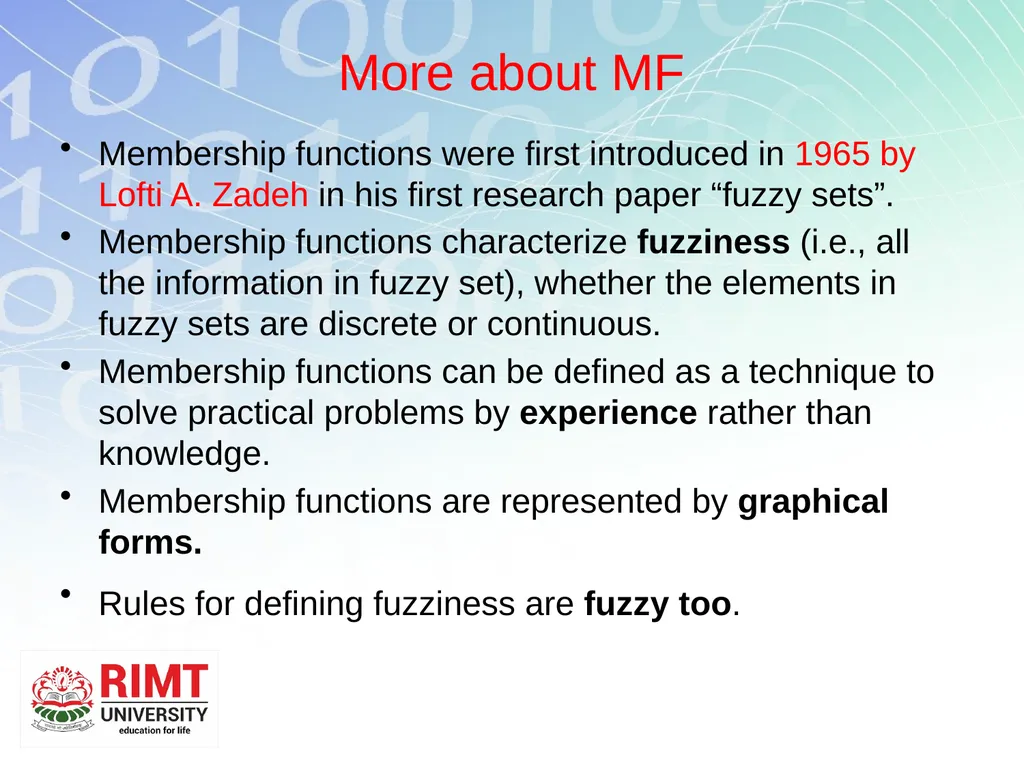
More about MF Membership functions were first introduced in 1965 by Lofti A. Zadeh in his first research paper “fuzzy sets”.
Membership functions characterize fuzziness (i.e., all the information in fuzzy set), whether the elements in fuzzy sets are discrete or continuous.
Membership functions can be defined as a technique to solve practical problems by experience rather than knowledge.
Membership functions are represented by graphical forms.
Rules for defining fuzziness are fuzzy too.<br>
11
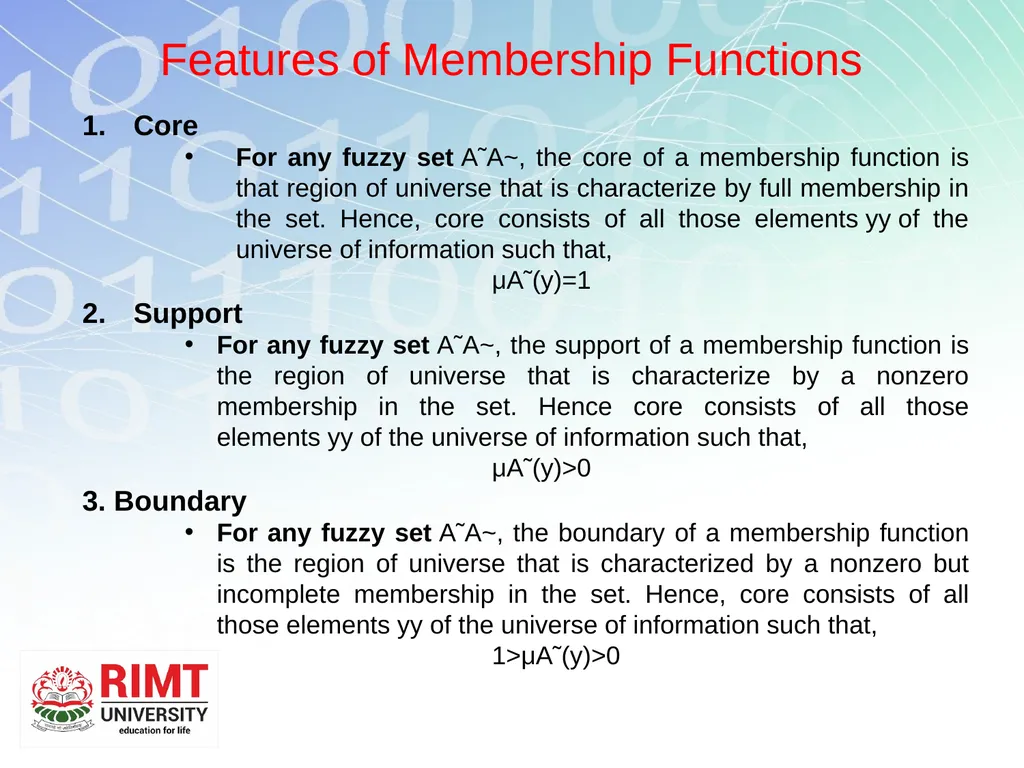
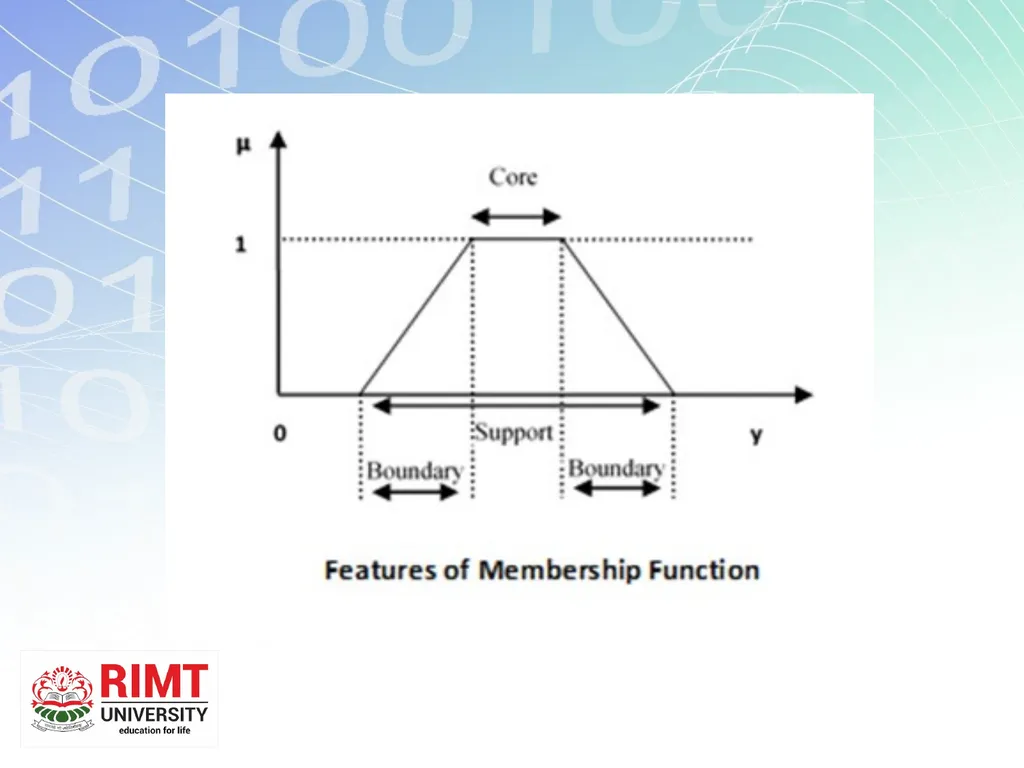
Features of Membership Functions Core
For any fuzzy set A˜A~, the core of a membership function is that region of universe that is characterize by full membership in the set. Hence, core consists of all those elements yy of the universe of information such that,
μA˜(y)=1
Support
For any fuzzy set A˜A~, the support of a membership function is the region of universe that is characterize by a nonzero membership in the set. Hence core consists of all those elements yy of the universe of information such that,
μA˜(y)>0
3. Boundary
For any fuzzy set A˜A~, the boundary of a membership function is the region of universe that is characterized by a nonzero but incomplete membership in the set. Hence, core consists of all those elements yy of the universe of information such that,
1>μA˜(y)>0<br>
12
Fuzzy Logic - Classical Set Theory Can be found and read PDF at my blog or reference the book as per given below:
“Discrete Mathematics (Schaum's Outlines) (SIE) Paperback – 1 Jul 2017 by
Seymour Lipschutz (Author), Marc Laras Lipson (Author), Varsha H. Patil (Author)”<br>
13
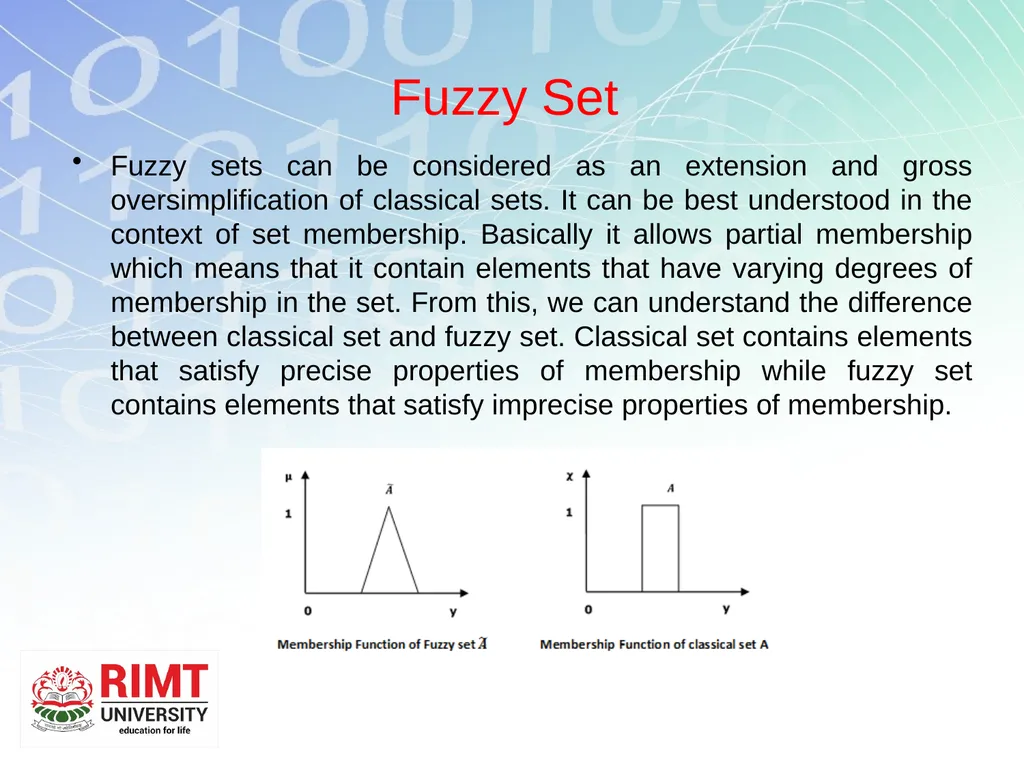
Fuzzy Set Fuzzy sets can be considered as an extension and gross oversimplification of classical sets. It can be best understood in the context of set membership. Basically it allows partial membership which means that it contain elements that have varying degrees of membership in the set. From this, we can understand the difference between classical set and fuzzy set. Classical set contains elements that satisfy precise properties of membership while fuzzy set contains elements that satisfy imprecise properties of membership.<br>
14
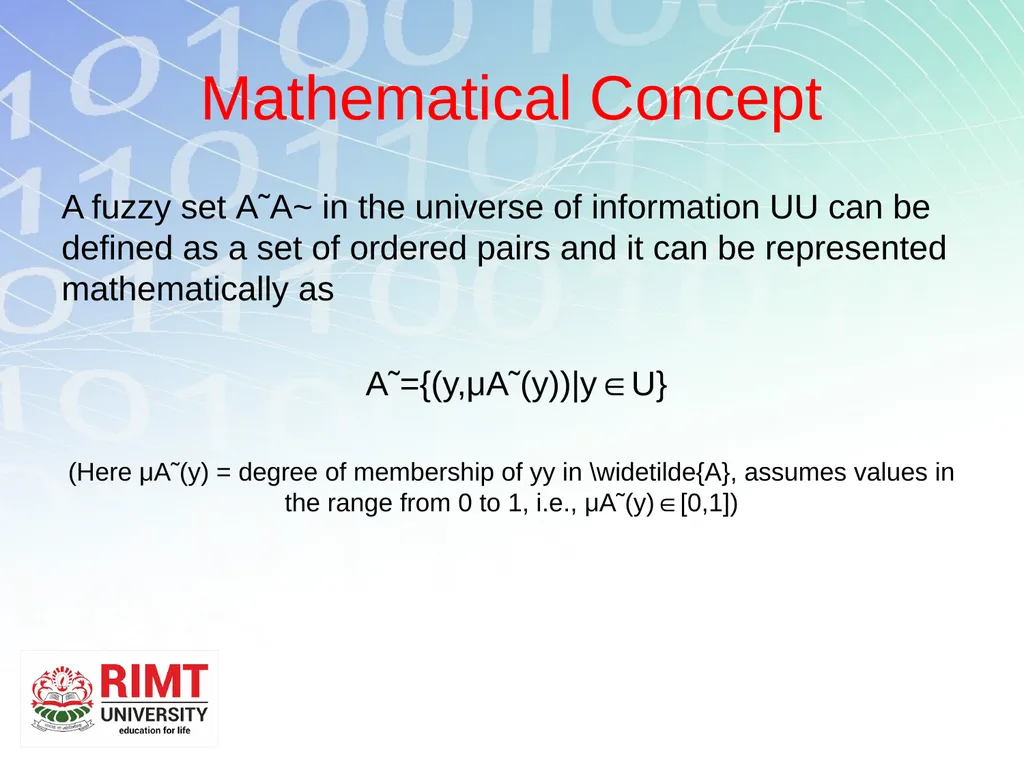
Mathematical Concept A fuzzy set A˜A~ in the universe of information UU can be defined as a set of ordered pairs and it can be represented mathematically as
A˜={(y,μA˜(y))|y∈U}
(Here μA˜(y) = degree of membership of yy in \widetilde{A}, assumes values in the range from 0 to 1, i.e., μA˜(y)∈[0,1])<br>
15
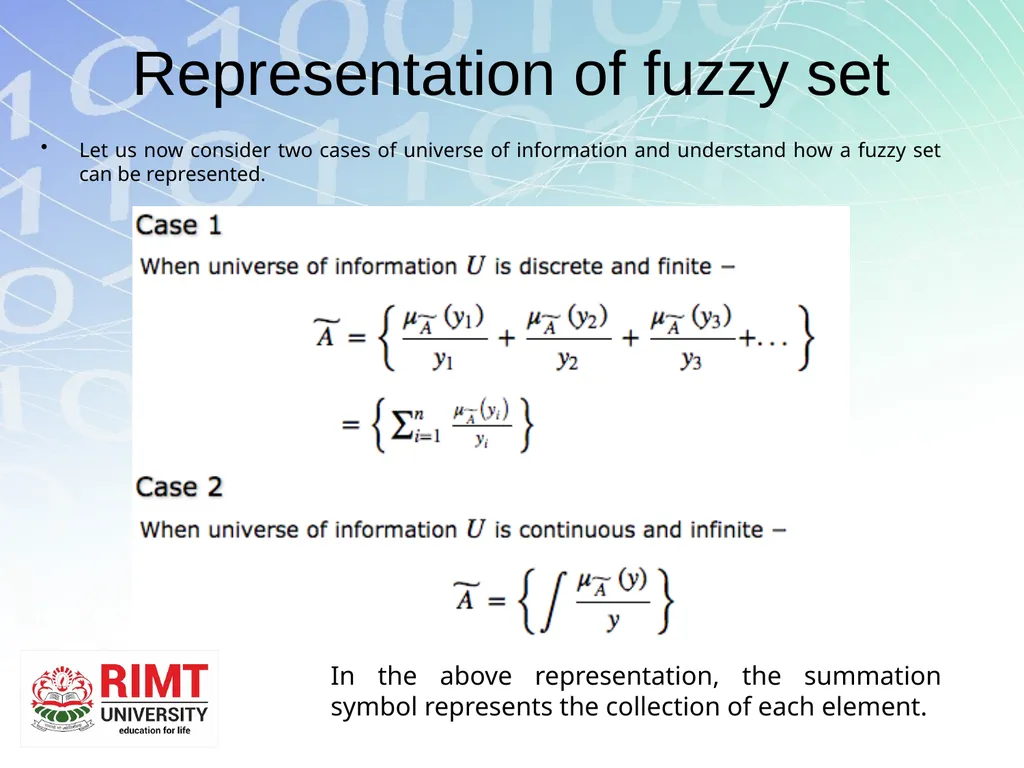
Representation of fuzzy set Let us now consider two cases of universe of information and understand how a fuzzy set can be represented. In the above representation, the summation symbol represents the collection of each element.<br>
16
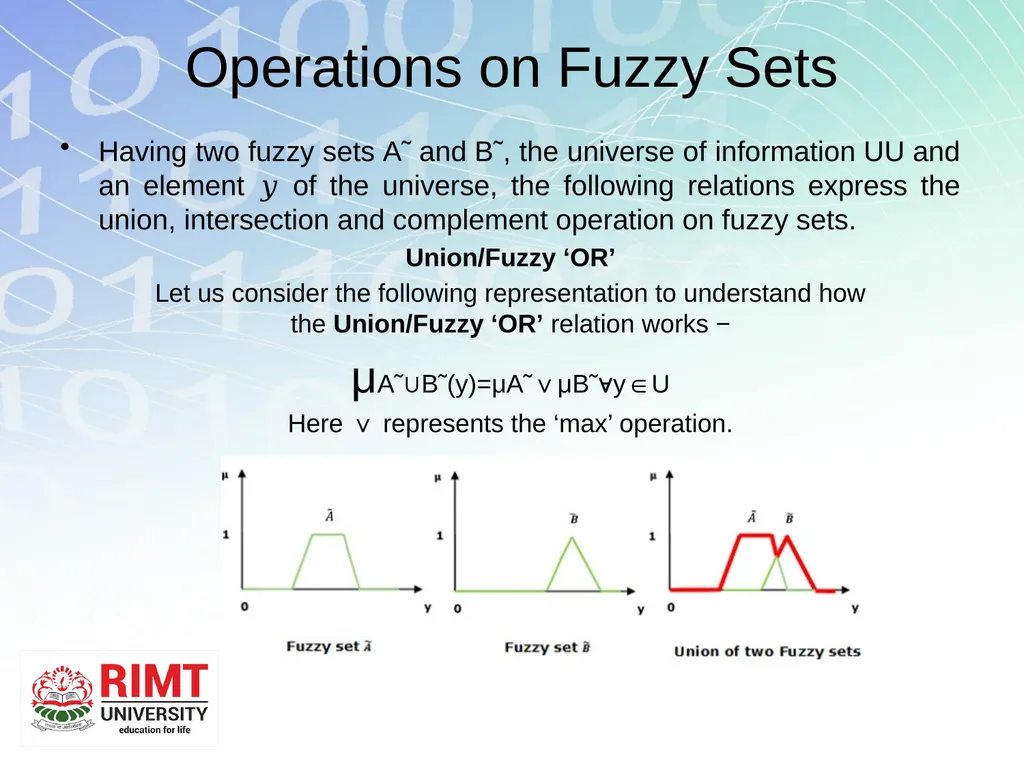
Operations on Fuzzy Sets Having two fuzzy sets A˜ and B˜, the universe of information UU and an element 𝑦 of the universe, the following relations express the union, intersection and complement operation on fuzzy sets.
Union/Fuzzy ‘OR’
Let us consider the following representation to understand how the Union/Fuzzy ‘OR’ relation works −
μA˜∪B˜(y)=μA˜∨μB˜∀y∈U
Here ∨ represents the ‘max’ operation.<br>
17
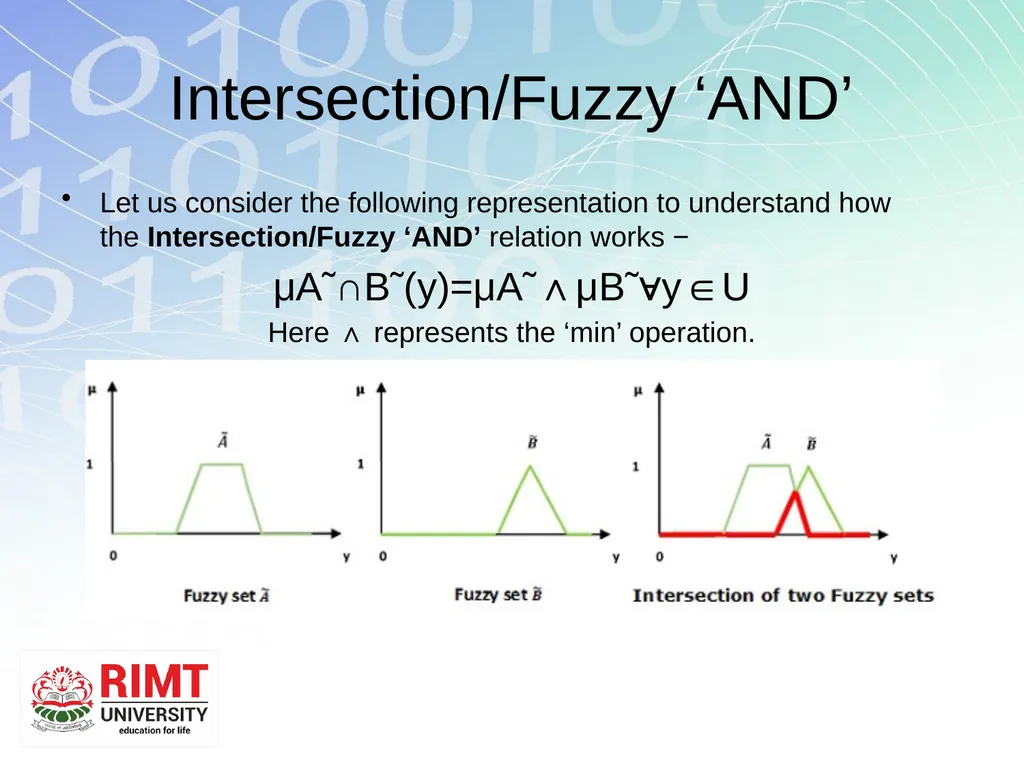
Intersection/Fuzzy ‘AND’ Let us consider the following representation to understand how the Intersection/Fuzzy ‘AND’ relation works −
μA˜∩B˜(y)=μA˜∧μB˜∀y∈U
Here ∧ represents the ‘min’ operation.<br>
18
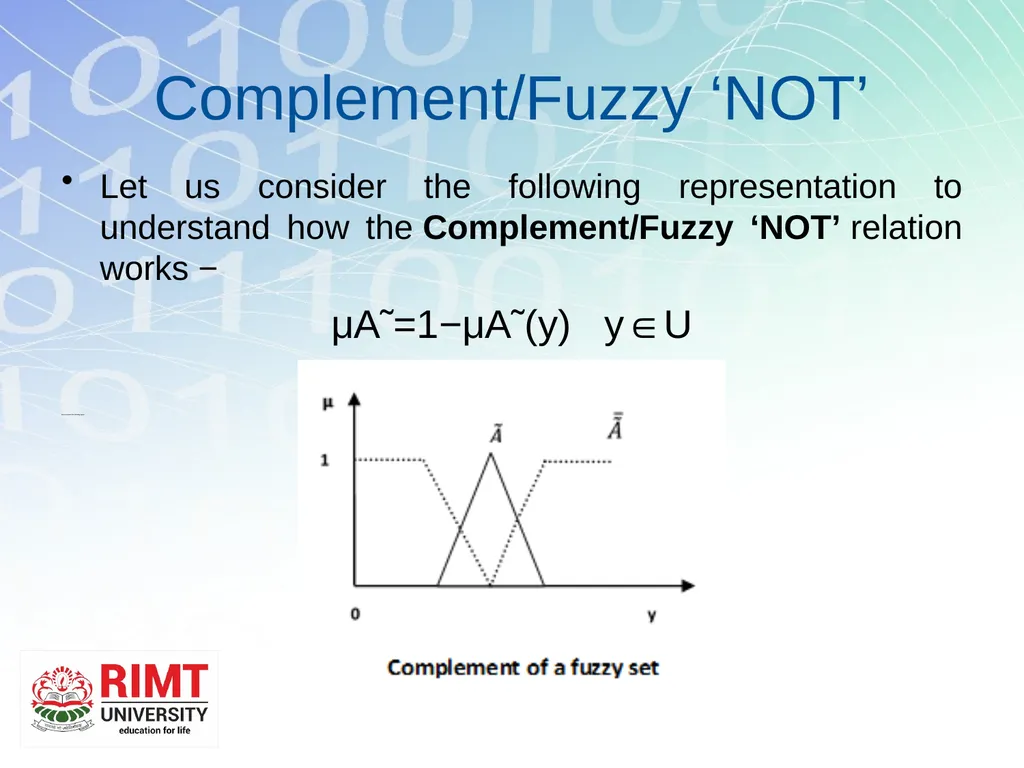
Complement/Fuzzy ‘NOT’ Let us consider the following representation to understand how the Complement/Fuzzy ‘NOT’ relation works −
μA˜=1−μA˜(y) y∈U�
Let us consider the following repres<br>
19
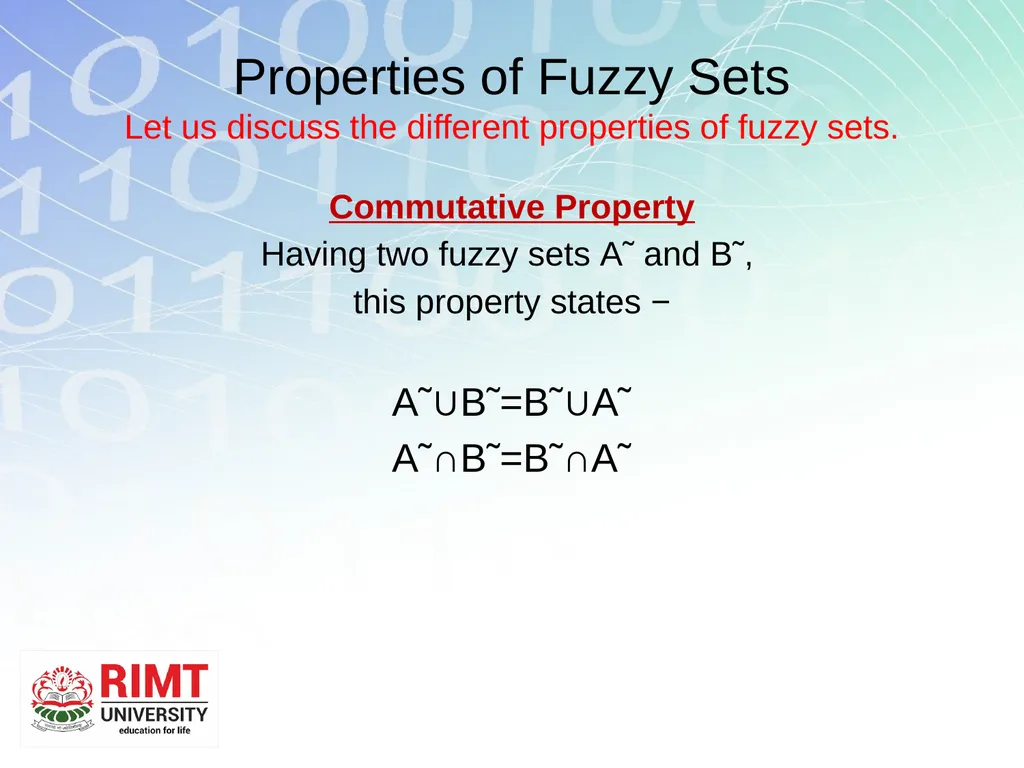
Properties of Fuzzy Sets�Let us discuss the different properties of fuzzy sets. Commutative Property
Having two fuzzy sets A˜ and B˜,
this property states −
A˜∪B˜=B˜∪A˜
A˜∩B˜=B˜∩A˜<br>
20
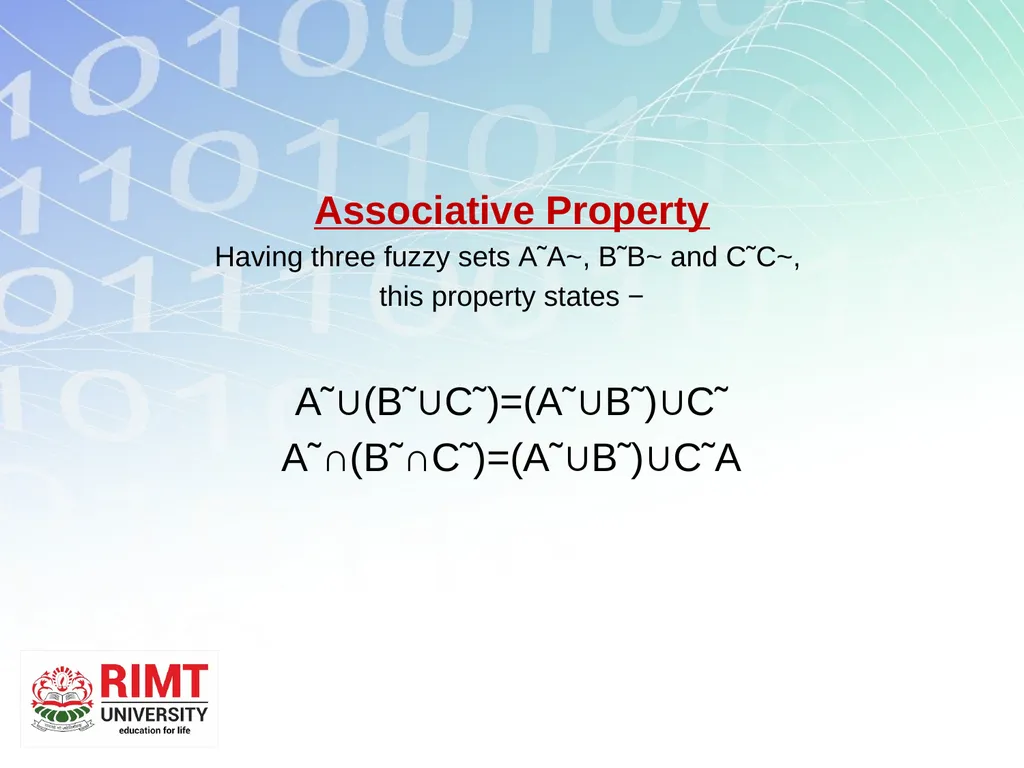
Associative Property
Having three fuzzy sets A˜A~, B˜B~ and C˜C~,
this property states −
A˜∪(B˜∪C˜)=(A˜∪B˜)∪C˜
A˜∩(B˜∩C˜)=(A˜∪B˜)∪C˜A<br>
21
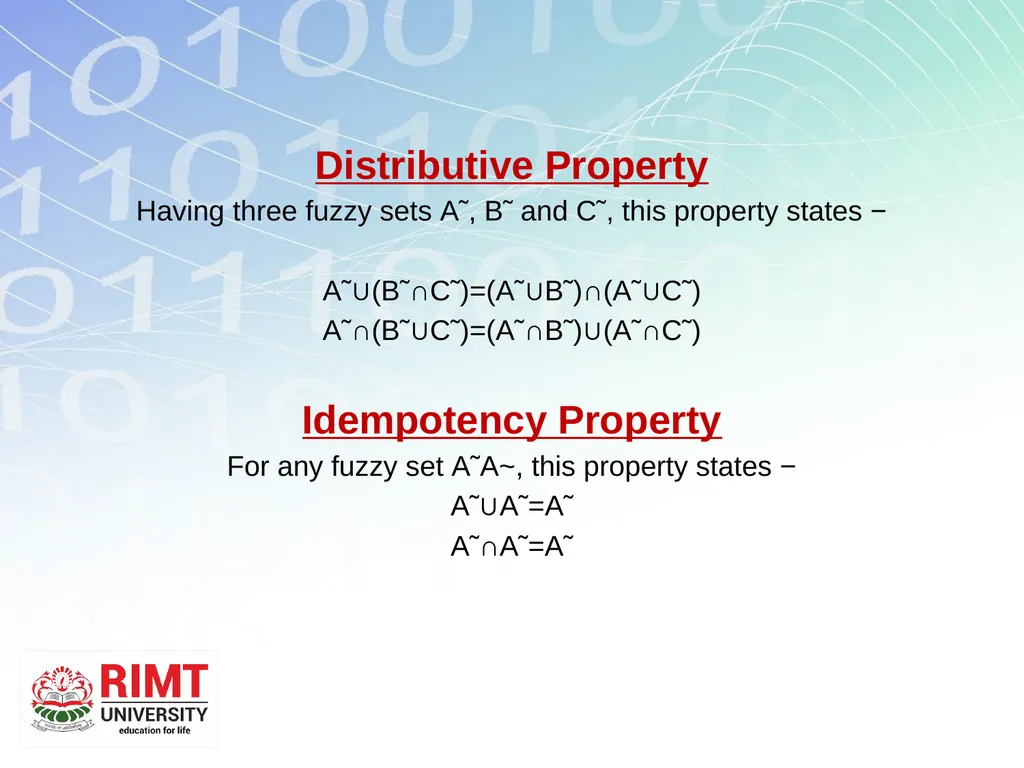
Distributive Property
Having three fuzzy sets A˜, B˜ and C˜, this property states −
A˜∪(B˜∩C˜)=(A˜∪B˜)∩(A˜∪C˜)
A˜∩(B˜∪C˜)=(A˜∩B˜)∪(A˜∩C˜)
Idempotency Property
For any fuzzy set A˜A~, this property states −
A˜∪A˜=A˜
A˜∩A˜=A˜<br>
22
Identity Property
For fuzzy set A˜ and universal set U, this property states −
A˜∪φ=A˜
A˜∩U=A˜
A˜∩φ=φ
A˜∪U=U
Transitive Property
Having three fuzzy sets A˜, B˜ and C˜, this property states −
If A˜⊆B˜⊆C˜,thenA˜⊆C˜
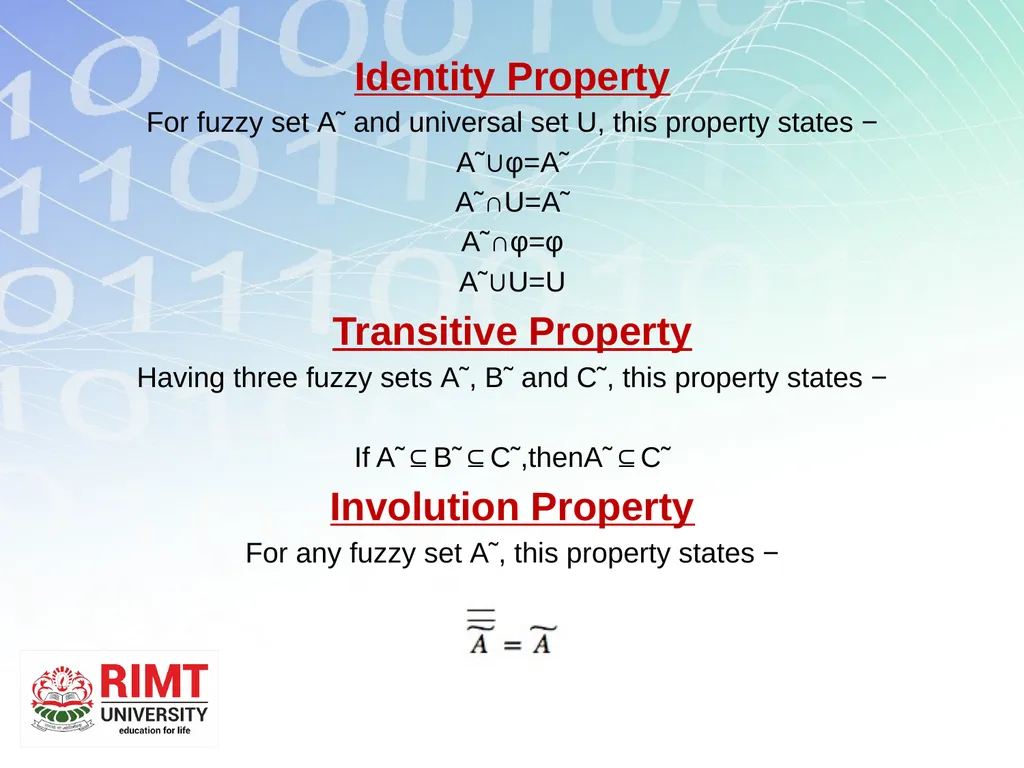
Involution Property
For any fuzzy set A˜, this property states −<br>
23
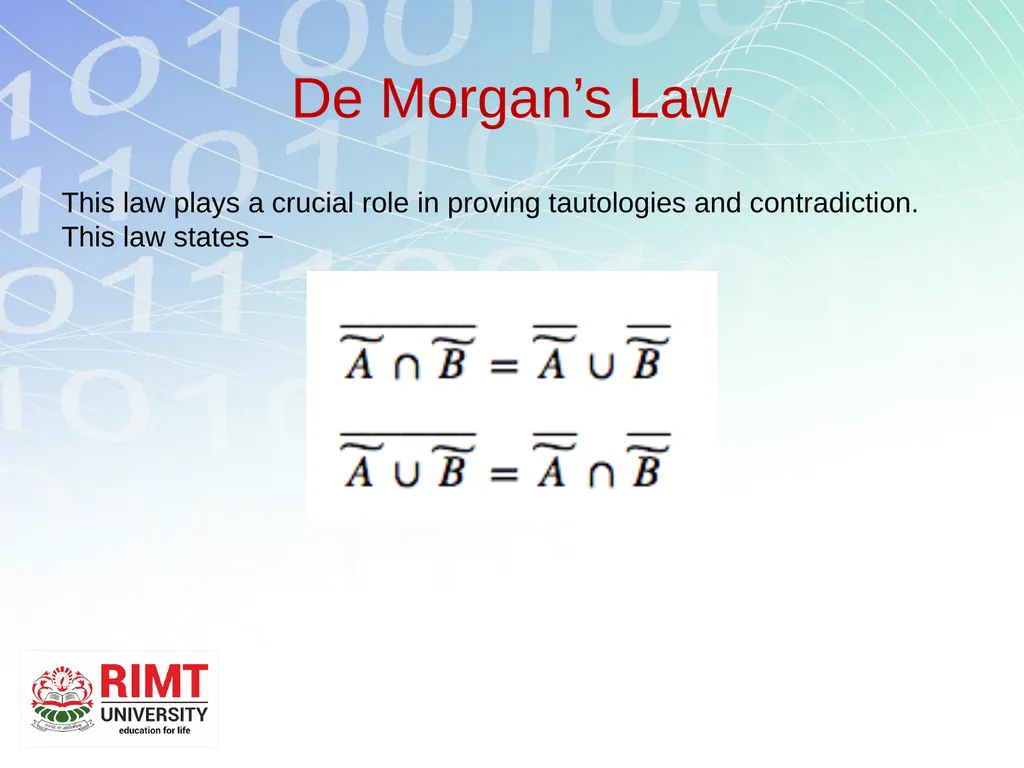
De Morgan’s Law This law plays a crucial role in proving tautologies and contradiction. This law states −<br>
24
References for this Course S.N. Sivanandam & S.N. Deepa, ‘Principles of Soft Computing’, 2nd Edn.,
Wiley Publications,
2008.
PPT & Notes from link provided<br>
25
Thank You You can download this PPT and Syllabus from below Link:
https://sureshkaswan.wordpress.com/
or contact me via Email/Phone:
sureshkaswan@rimt.ac.in
+91-7876444448<br>