
MATH 170 Project #9 Scarlitte Ponce Starlite Ponce

Description: MATH 170 Project 9 Scarlitte Ponce Starlite Ponce Cristina Hernandez Section 3.3 44 The Notation ! stands for the words there exists a unique. Thus for instance, ! x such that x is prime and x is even means that there is one and
Related Topics
Download Presentation
"MATH 170 Project #9 Scarlitte Ponce Starlite Ponce" is the property of its rightful owner. Permission is granted to download and print the materials on this website for personal, non-commercial use only, and to display it on your personal computer provided you do not modify the materials and that you retain all copyright notices contained in the materials. By downloading content from our website, you accept the terms of this agreement.
Presentation Transcript
slide1. MATH 170 Project #9
Scarlitte Ponce
Starlite Ponce
Cristina Hernandez<br>
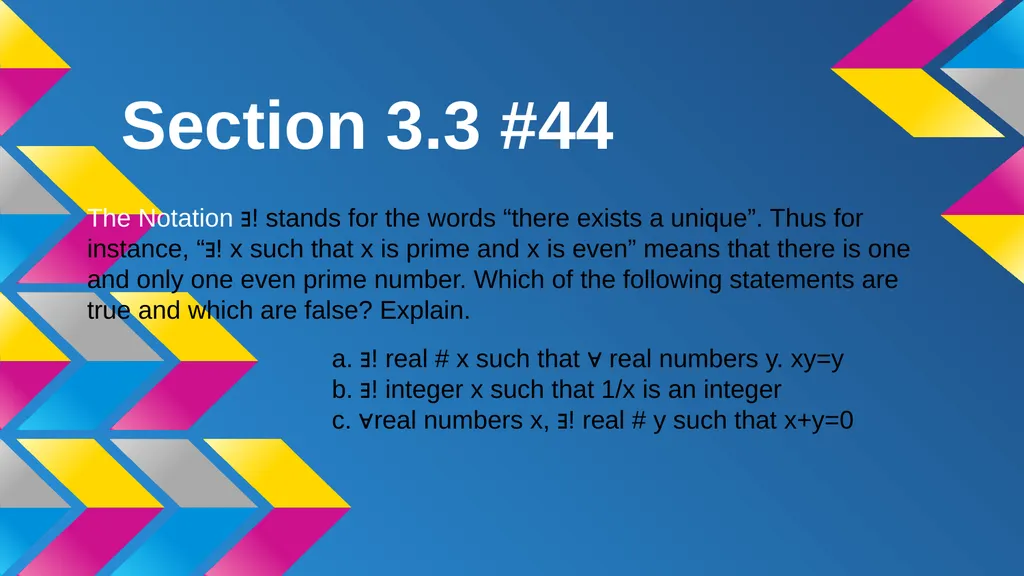
slide2. Section 3.3 #44 The Notation ∃! stands for the words “there exists a unique”. Thus for instance, “∃! x such that x is prime and x is even” means that there is one and only one even prime number. Which of the following statements are true and which are false? Explain. a. ∃! real # x such that ∀ real numbers y. xy=y
b. ∃! integer x such that 1/x is an integer
c. ∀real numbers x, ∃! real # y such that x+y=0<br>
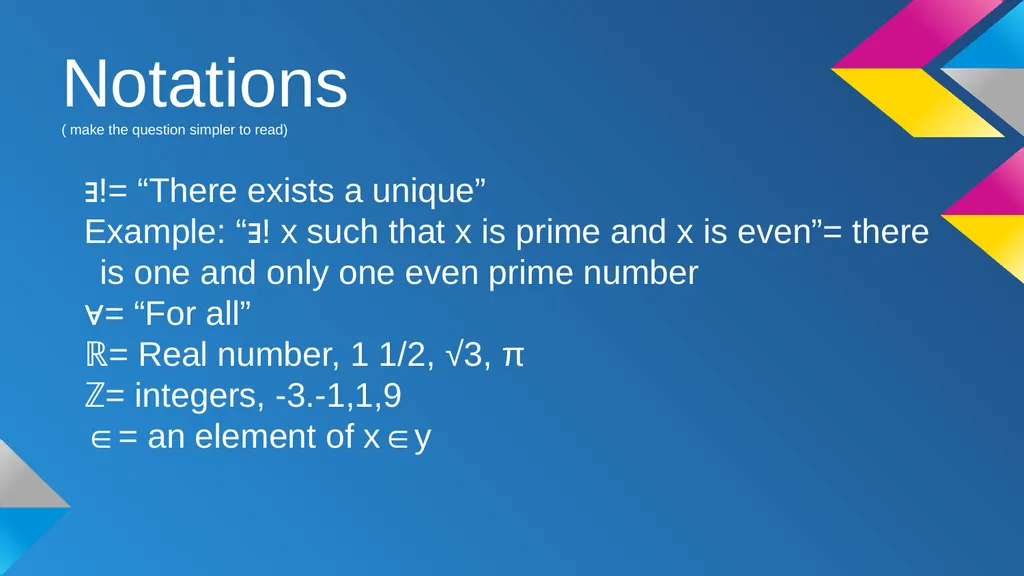
slide3. Notations
( make the question simpler to read) ∃!= “There exists a unique”
Example: “∃! x such that x is prime and x is even”= there is one and only one even prime number
∀= “For all”
ℝ= Real number, 1 1/2, √3, π
ℤ= integers, -3.-1,1,9
∈= an element of x∈y<br>
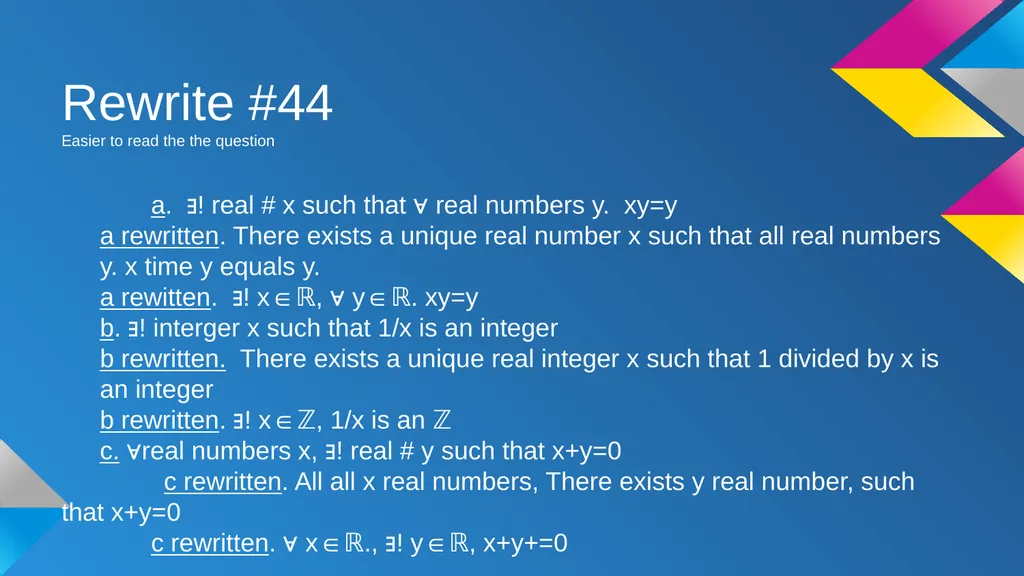
slide4. Rewrite #44
Easier to read the the question a. ∃! real # x such that ∀ real numbers y. xy=y
a rewritten. There exists a unique real number x such that all real numbers y. x time y equals y.
a rewitten. ∃! x∈ℝ, ∀ y∈ℝ. xy=y
b. ∃! interger x such that 1/x is an integer
b rewritten. There exists a unique real integer x such that 1 divided by x is an integer
b rewritten. ∃! x∈ℤ, 1/x is an ℤ
c. ∀real numbers x, ∃! real # y such that x+y=0
c rewritten. All all x real numbers, There exists y real number, such that x+y=0
c rewritten. ∀ x∈ℝ., ∃! y∈ℝ, x+y+=0<br>
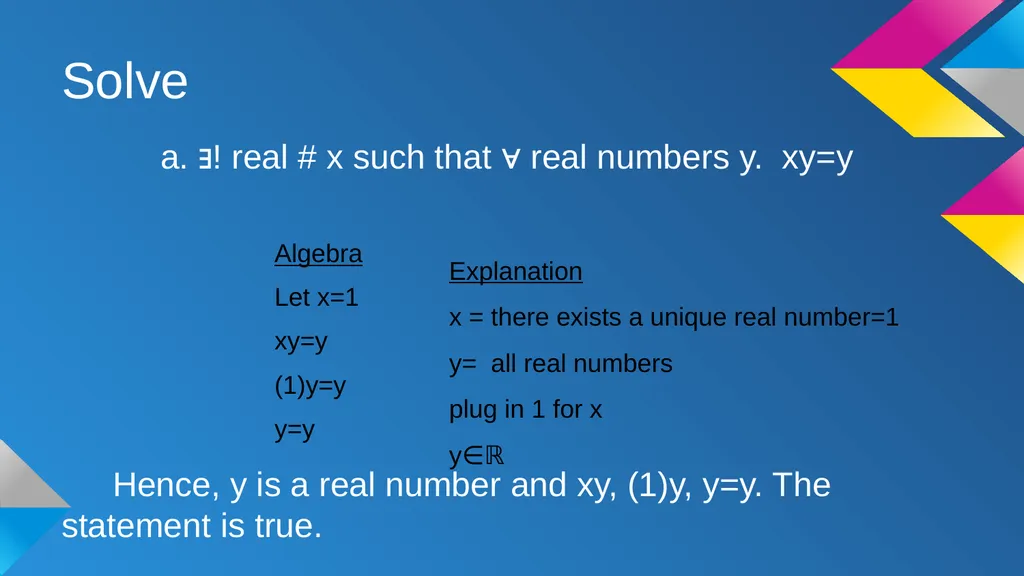
slide5. Solve a. ∃! real # x such that ∀ real numbers y. xy=y
Hence, y is a real number and xy, (1)y, y=y. The statement is true. Explanation
x = there exists a unique real number=1
y= all real numbers
plug in 1 for x
y∈ℝ Algebra
Let x=1
xy=y
(1)y=y
y=y<br>
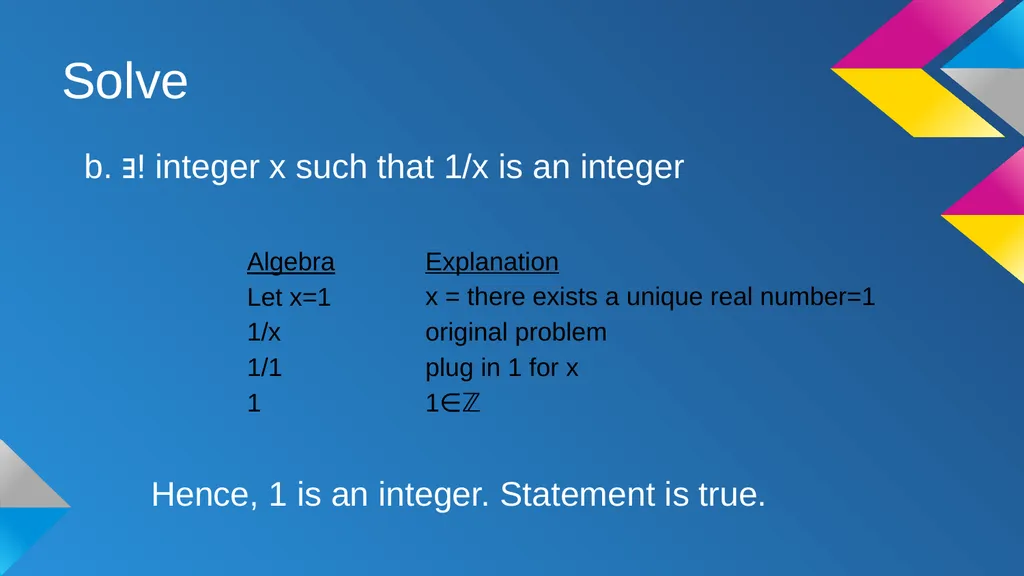
slide6. Solve b. ∃! integer x such that 1/x is an integer
Hence, 1 is an integer. Statement is true. Algebra
Let x=1
1/x
1/1
1 Explanation
x = there exists a unique real number=1
original problem
plug in 1 for x
1∈ℤ<br>
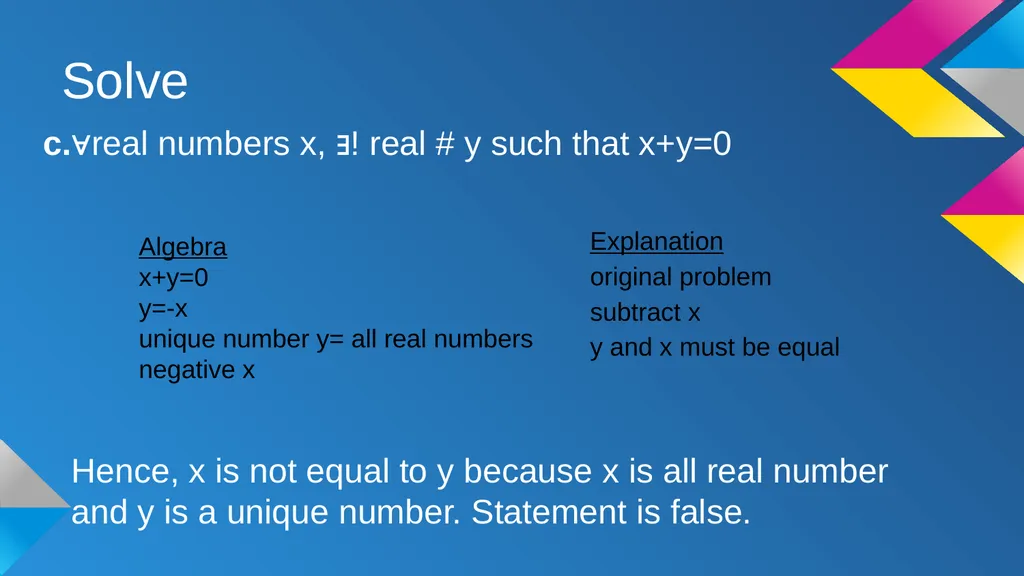
slide7. Solve Explanation
original problem
subtract x
y and x must be equal c.∀real numbers x, ∃! real # y such that x+y=0
Hence, x is not equal to y because x is all real number and y is a unique number. Statement is false. Algebra
x+y=0
y=-x
unique number y= all real numbers negative x<br>
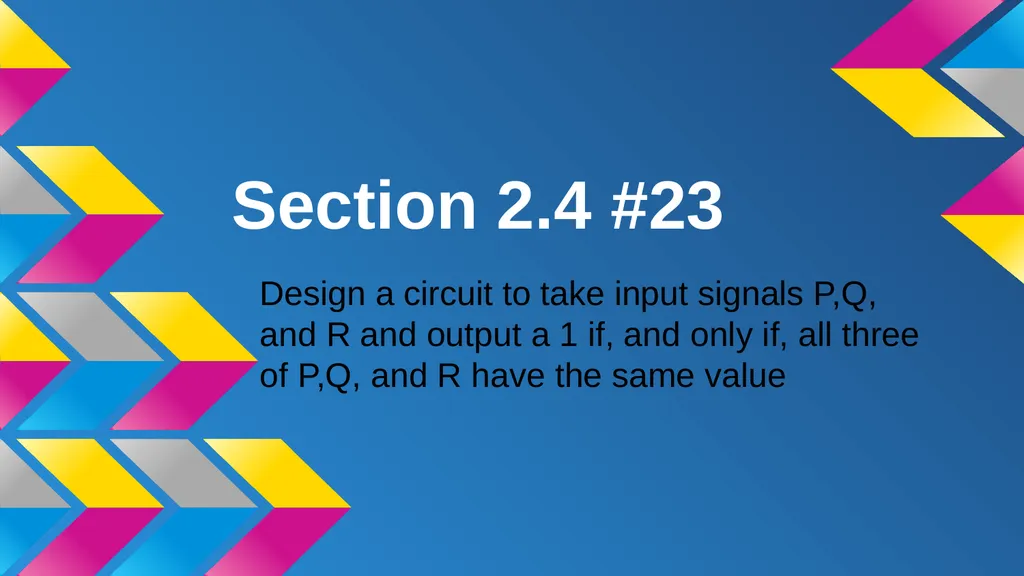
slide8. Section 2.4 #23 Design a circuit to take input signals P,Q, and R and output a 1 if, and only if, all three of P,Q, and R have the same value<br>
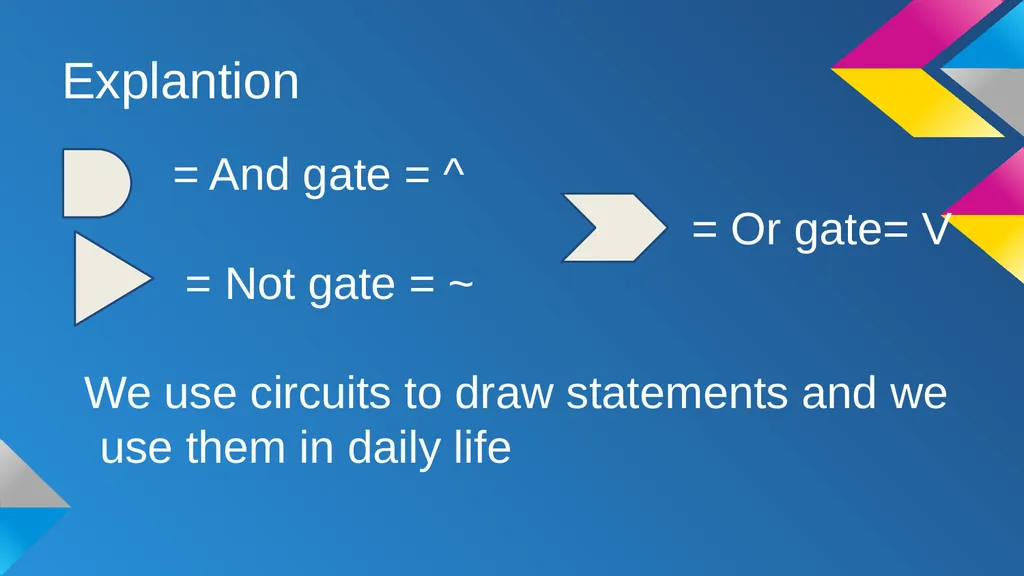
slide9. Explantion = And gate = ^
= Or gate= V
= Not gate = ~
We use circuits to draw statements and we use them in daily life<br>
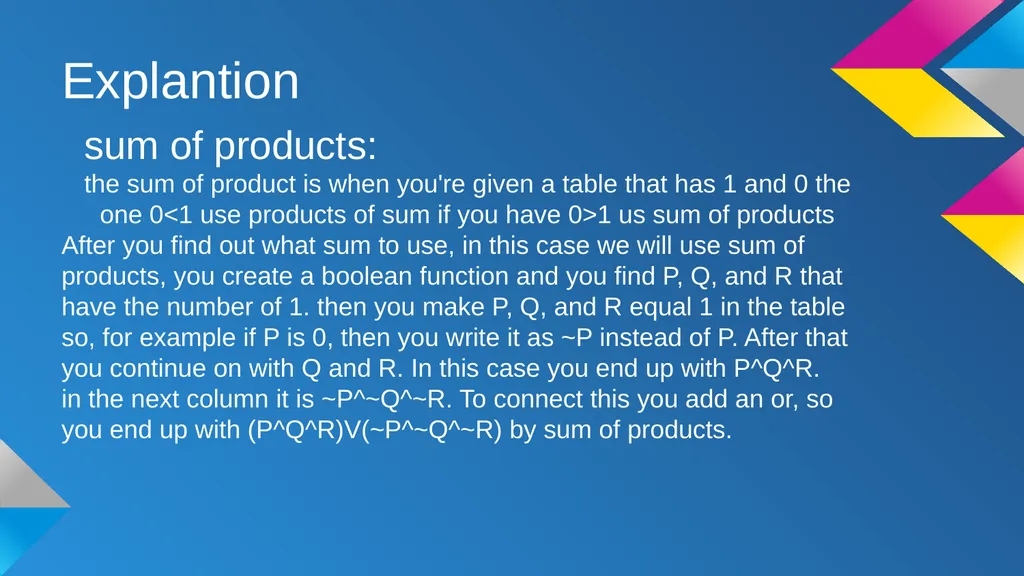
slide10. Explantion sum of products:
the sum of product is when you're given a table that has 1 and 0 the one 0<1 use products of sum if you have 0>1 us sum of products
After you find out what sum to use, in this case we will use sum of products, you create a boolean function and you find P, Q, and R that have the number of 1. then you make P, Q, and R equal 1 in the table so, for example if P is 0, then you write it as ~P instead of P. After that you continue on with Q and R. In this case you end up with P^Q^R. in the next column it is ~P^~Q^~R. To connect this you add an or, so you end up with (P^Q^R)V(~P^~Q^~R) by sum of products.<br>
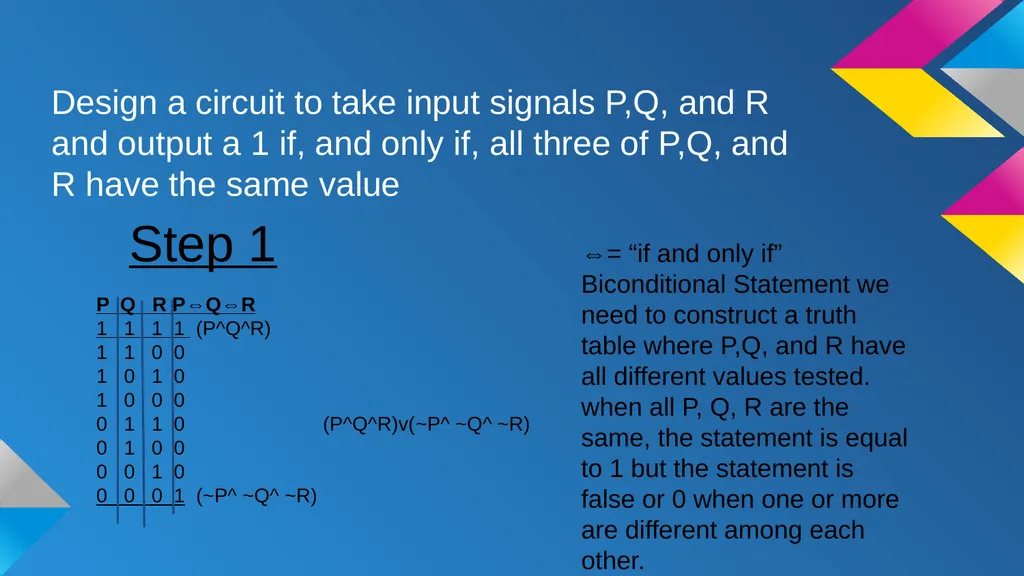
slide11. Design a circuit to take input signals P,Q, and R and output a 1 if, and only if, all three of P,Q, and R have the same value Step 1 P Q R P⇔Q⇔R
1 1 1 1 (P^Q^R)
1 1 0 0
1 0 1 0
1 0 0 0
0 1 1 0 (P^Q^R)v(~P^ ~Q^ ~R)
0 1 0 0
0 0 1 0
0 0 0 1 (~P^ ~Q^ ~R) ⇔= “if and only if”
Biconditional Statement we need to construct a truth table where P,Q, and R have all different values tested. when all P, Q, R are the same, the statement is equal to 1 but the statement is false or 0 when one or more are different among each other.<br>
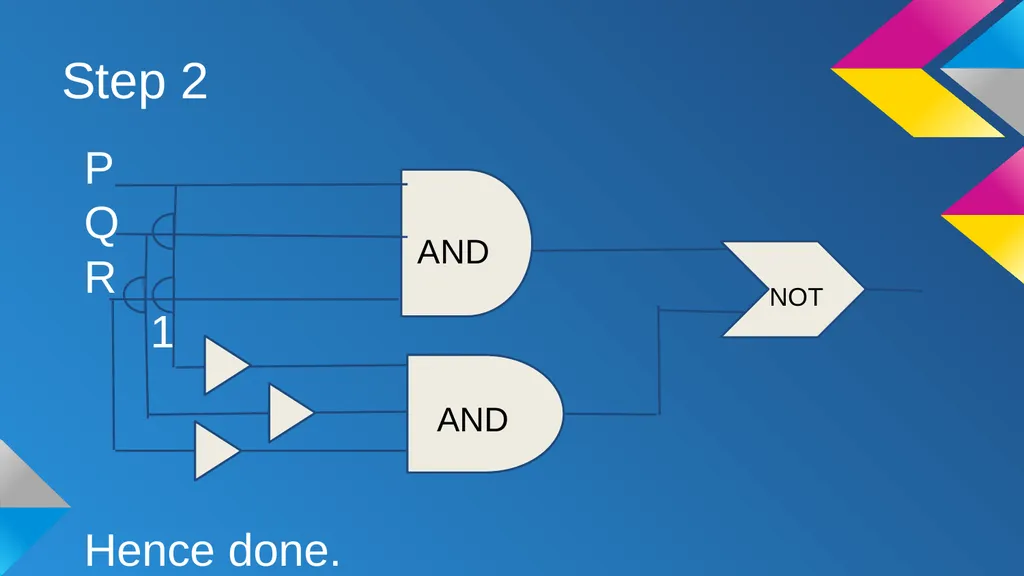
slide12. Step 2 P
Q
R 1
Hence done. AND AND NOT<br>
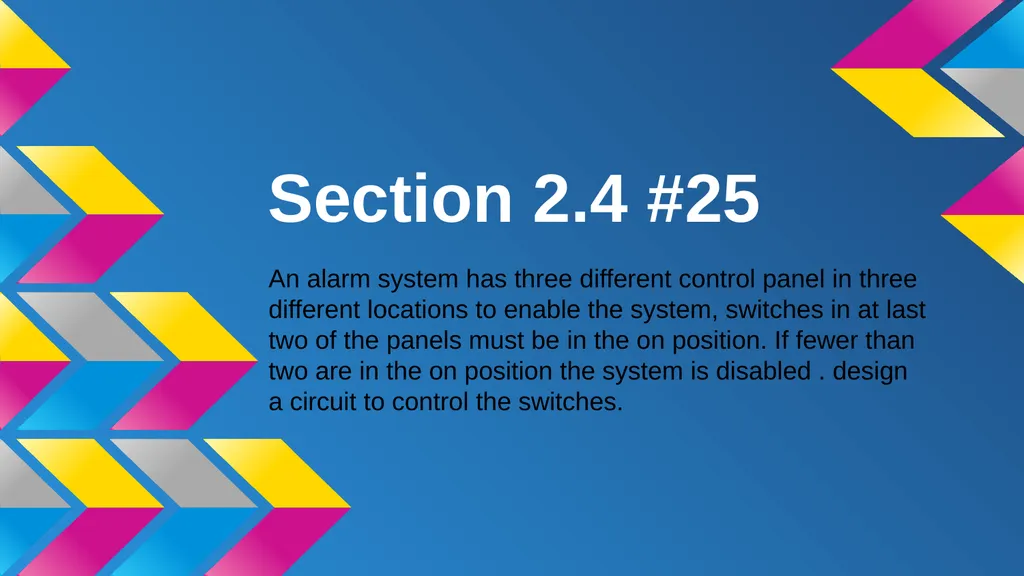
slide13. Section 2.4 #25 An alarm system has three different control panel in three different locations to enable the system, switches in at last two of the panels must be in the on position. If fewer than two are in the on position the system is disabled . design a circuit to control the switches.<br>
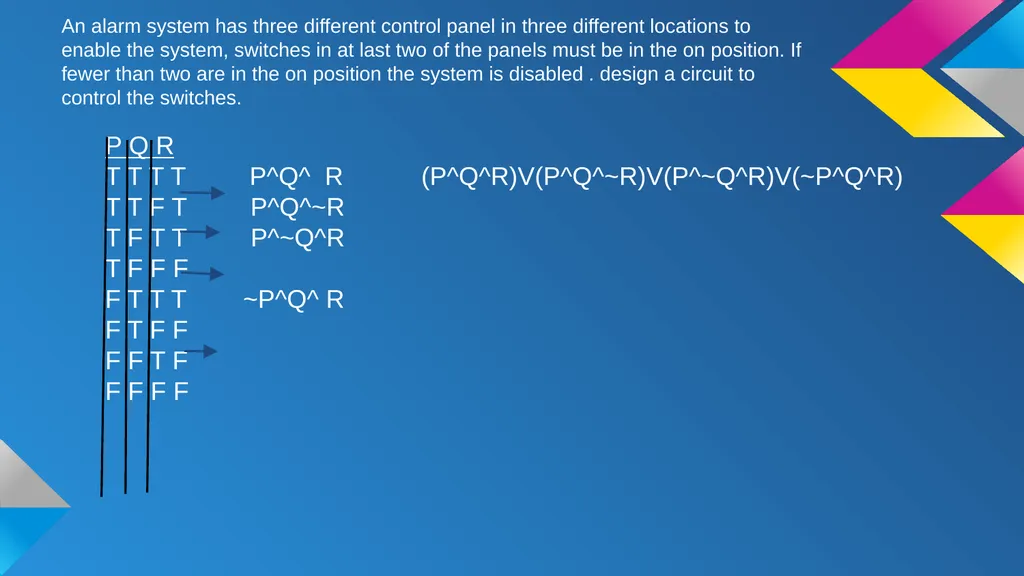
slide14. An alarm system has three different control panel in three different locations to enable the system, switches in at last two of the panels must be in the on position. If fewer than two are in the on position the system is disabled . design a circuit to control the switches. P Q R
T T T T P^Q^ R (P^Q^R)V(P^Q^~R)V(P^~Q^R)V(~P^Q^R)
T T F T P^Q^~R
T F T T P^~Q^R
T F F F
F T T T ~P^Q^ R
F T F F
F F T F
F F F F<br>
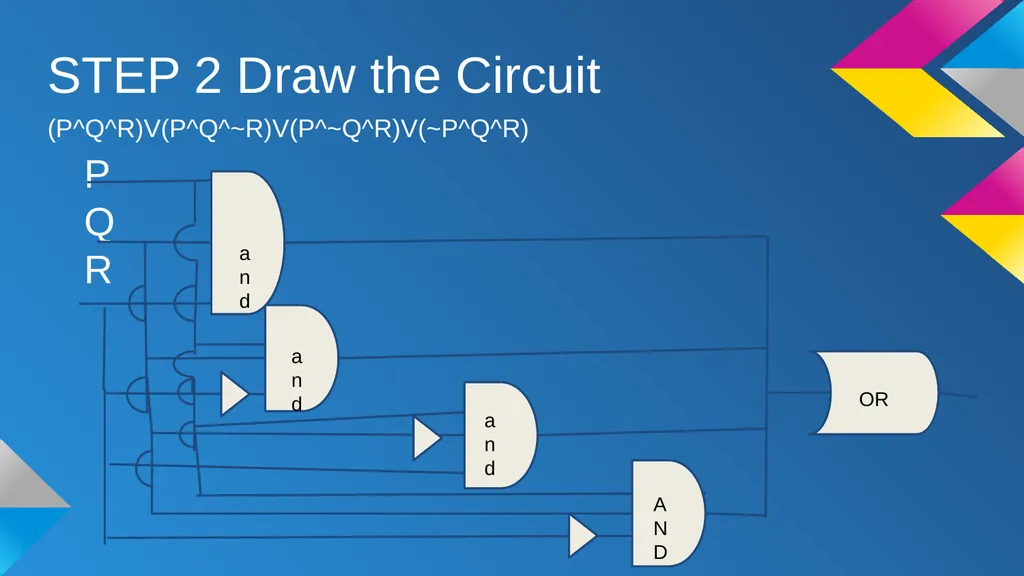
slide15. STEP 2 Draw the Circuit
(P^Q^R)V(P^Q^~R)V(P^~Q^R)V(~P^Q^R) P
Q
R and and and AND OR<br>
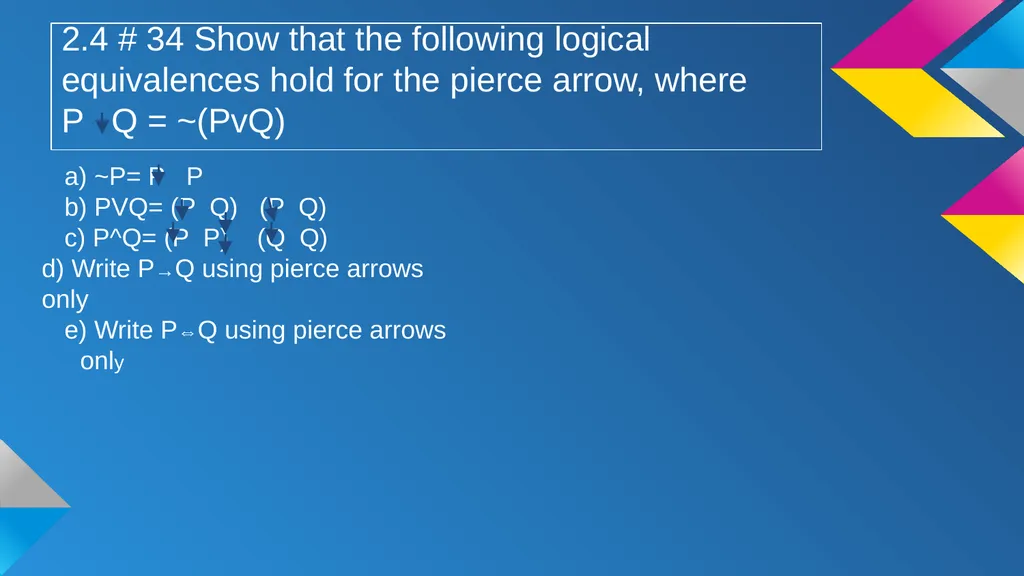
slide16. 2.4 # 34 Show that the following logical equivalences hold for the pierce arrow, where
P Q = ~(PvQ) a) ~P= P P
b) PVQ= (P Q) (P Q)
c) P^Q= (P P) (Q Q)
d) Write P→Q using pierce arrows only
e) Write P⇔Q using pierce arrows only<br>
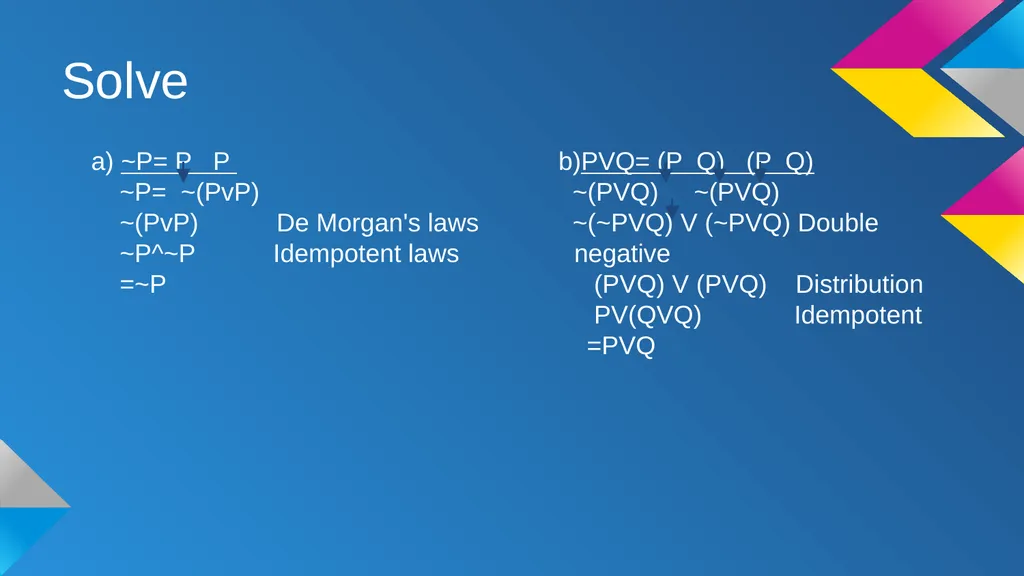
slide17. Solve a) ~P= P P
~P= ~(PvP)
~(PvP) De Morgan's laws
~P^~P Idempotent laws
=~P b)PVQ= (P Q) (P Q)
~(PVQ) ~(PVQ)
~(~PVQ) V (~PVQ) Double negative
(PVQ) V (PVQ) Distribution
PV(QVQ) Idempotent
=PVQ<br>
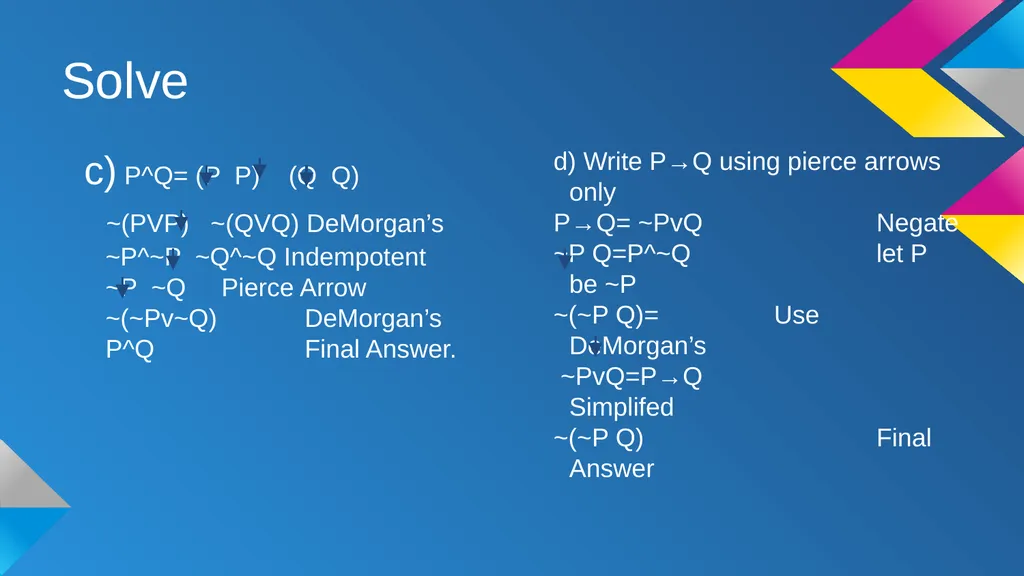
slide18. Solve c) P^Q= (P P) (Q Q)
~(PVP) ~(QVQ) DeMorgan’s
~P^~P ~Q^~Q Indempotent
~P ~Q Pierce Arrow
~(~Pv~Q) DeMorgan’s
P^Q Final Answer. d) Write P→Q using pierce arrows only
P→Q= ~PvQ Negate
~P Q=P^~Q let P be ~P
~(~P Q)= Use DeMorgan’s
~PvQ=P→Q Simplifed
~(~P Q) Final Answer<br>
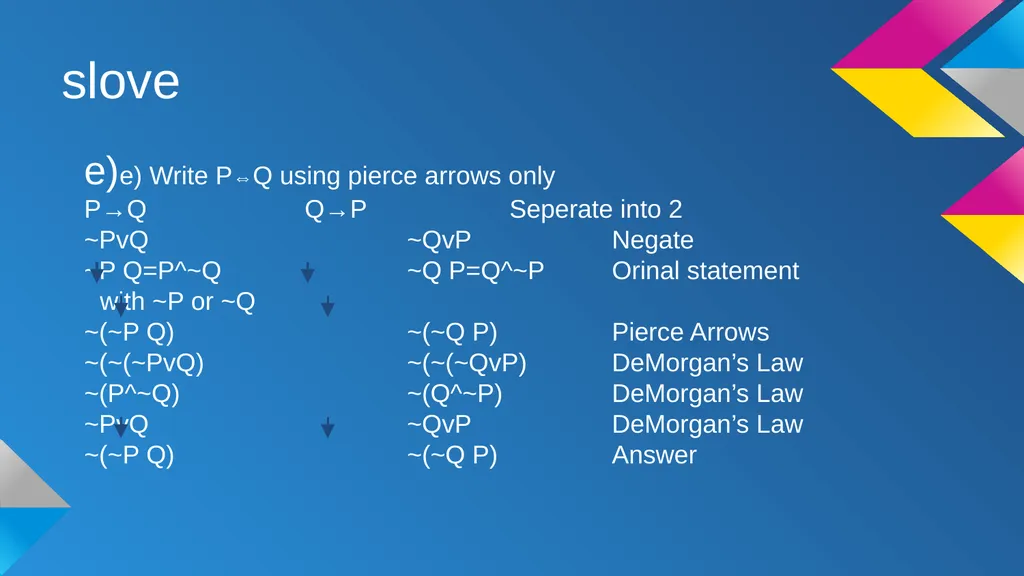
slide19. slove e)e) Write P⇔Q using pierce arrows only
P→Q Q→P Seperate into 2
~PvQ ~QvP Negate
~P Q=P^~Q ~Q P=Q^~P Orinal statement with ~P or ~Q
~(~P Q) ~(~Q P) Pierce Arrows
~(~(~PvQ) ~(~(~QvP) DeMorgan’s Law
~(P^~Q) ~(Q^~P) DeMorgan’s Law
~PvQ ~QvP DeMorgan’s Law
~(~P Q) ~(~Q P) Answer<br>
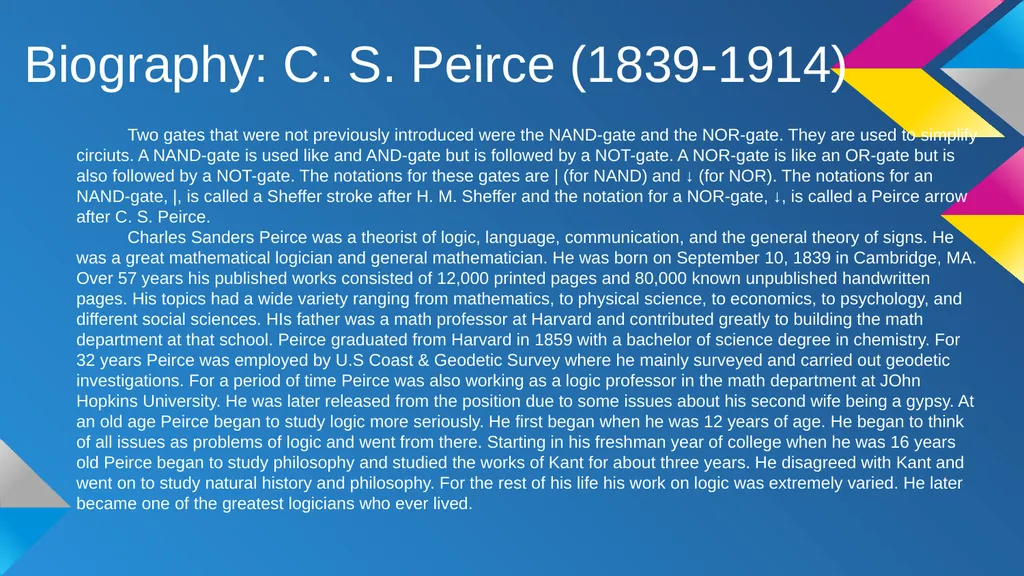
slide20. Biography: C. S. Peirce (1839-1914) Two gates that were not previously introduced were the NAND-gate and the NOR-gate. They are used to simplify circiuts. A NAND-gate is used like and AND-gate but is followed by a NOT-gate. A NOR-gate is like an OR-gate but is also followed by a NOT-gate. The notations for these gates are | (for NAND) and ↓ (for NOR). The notations for an NAND-gate, |, is called a Sheffer stroke after H. M. Sheffer and the notation for a NOR-gate, ↓, is called a Peirce arrow after C. S. Peirce.
Charles Sanders Peirce was a theorist of logic, language, communication, and the general theory of signs. He was a great mathematical logician and general mathematician. He was born on September 10, 1839 in Cambridge, MA. Over 57 years his published works consisted of 12,000 printed pages and 80,000 known unpublished handwritten pages. His topics had a wide variety ranging from mathematics, to physical science, to economics, to psychology, and different social sciences. HIs father was a math professor at Harvard and contributed greatly to building the math department at that school. Peirce graduated from Harvard in 1859 with a bachelor of science degree in chemistry. For 32 years Peirce was employed by U.S Coast & Geodetic Survey where he mainly surveyed and carried out geodetic investigations. For a period of time Peirce was also working as a logic professor in the math department at JOhn Hopkins University. He was later released from the position due to some issues about his second wife being a gypsy. At an old age Peirce began to study logic more seriously. He first began when he was 12 years of age. He began to think of all issues as problems of logic and went from there. Starting in his freshman year of college when he was 16 years old Peirce began to study philosophy and studied the works of Kant for about three years. He disagreed with Kant and went on to study natural history and philosophy. For the rest of his life his work on logic was extremely varied. He later became one of the greatest logicians who ever lived.<br>
slide21. Bibliography Epp, Susanna S. Discrete Mathematics with Applications. 4. Boston, MA: Brooks/Cole, 2011. 1-820. Print.
Burch, Robert, "Charles Sanders Peirce", The Stanford Encyclopedia of Philosophy (Summer 2013 Edition), Edward N. Zalta (ed.), URL = <http://plato.stanford.edu/archives/sum2013/entries/peirce/>.<br>
Scarlitte Ponce
Starlite Ponce
Cristina Hernandez<br>
slide2. Section 3.3 #44 The Notation ∃! stands for the words “there exists a unique”. Thus for instance, “∃! x such that x is prime and x is even” means that there is one and only one even prime number. Which of the following statements are true and which are false? Explain. a. ∃! real # x such that ∀ real numbers y. xy=y
b. ∃! integer x such that 1/x is an integer
c. ∀real numbers x, ∃! real # y such that x+y=0<br>
slide3. Notations
( make the question simpler to read) ∃!= “There exists a unique”
Example: “∃! x such that x is prime and x is even”= there is one and only one even prime number
∀= “For all”
ℝ= Real number, 1 1/2, √3, π
ℤ= integers, -3.-1,1,9
∈= an element of x∈y<br>
slide4. Rewrite #44
Easier to read the the question a. ∃! real # x such that ∀ real numbers y. xy=y
a rewritten. There exists a unique real number x such that all real numbers y. x time y equals y.
a rewitten. ∃! x∈ℝ, ∀ y∈ℝ. xy=y
b. ∃! interger x such that 1/x is an integer
b rewritten. There exists a unique real integer x such that 1 divided by x is an integer
b rewritten. ∃! x∈ℤ, 1/x is an ℤ
c. ∀real numbers x, ∃! real # y such that x+y=0
c rewritten. All all x real numbers, There exists y real number, such that x+y=0
c rewritten. ∀ x∈ℝ., ∃! y∈ℝ, x+y+=0<br>
slide5. Solve a. ∃! real # x such that ∀ real numbers y. xy=y
Hence, y is a real number and xy, (1)y, y=y. The statement is true. Explanation
x = there exists a unique real number=1
y= all real numbers
plug in 1 for x
y∈ℝ Algebra
Let x=1
xy=y
(1)y=y
y=y<br>
slide6. Solve b. ∃! integer x such that 1/x is an integer
Hence, 1 is an integer. Statement is true. Algebra
Let x=1
1/x
1/1
1 Explanation
x = there exists a unique real number=1
original problem
plug in 1 for x
1∈ℤ<br>
slide7. Solve Explanation
original problem
subtract x
y and x must be equal c.∀real numbers x, ∃! real # y such that x+y=0
Hence, x is not equal to y because x is all real number and y is a unique number. Statement is false. Algebra
x+y=0
y=-x
unique number y= all real numbers negative x<br>
slide8. Section 2.4 #23 Design a circuit to take input signals P,Q, and R and output a 1 if, and only if, all three of P,Q, and R have the same value<br>
slide9. Explantion = And gate = ^
= Or gate= V
= Not gate = ~
We use circuits to draw statements and we use them in daily life<br>
slide10. Explantion sum of products:
the sum of product is when you're given a table that has 1 and 0 the one 0<1 use products of sum if you have 0>1 us sum of products
After you find out what sum to use, in this case we will use sum of products, you create a boolean function and you find P, Q, and R that have the number of 1. then you make P, Q, and R equal 1 in the table so, for example if P is 0, then you write it as ~P instead of P. After that you continue on with Q and R. In this case you end up with P^Q^R. in the next column it is ~P^~Q^~R. To connect this you add an or, so you end up with (P^Q^R)V(~P^~Q^~R) by sum of products.<br>
slide11. Design a circuit to take input signals P,Q, and R and output a 1 if, and only if, all three of P,Q, and R have the same value Step 1 P Q R P⇔Q⇔R
1 1 1 1 (P^Q^R)
1 1 0 0
1 0 1 0
1 0 0 0
0 1 1 0 (P^Q^R)v(~P^ ~Q^ ~R)
0 1 0 0
0 0 1 0
0 0 0 1 (~P^ ~Q^ ~R) ⇔= “if and only if”
Biconditional Statement we need to construct a truth table where P,Q, and R have all different values tested. when all P, Q, R are the same, the statement is equal to 1 but the statement is false or 0 when one or more are different among each other.<br>
slide12. Step 2 P
Q
R 1
Hence done. AND AND NOT<br>
slide13. Section 2.4 #25 An alarm system has three different control panel in three different locations to enable the system, switches in at last two of the panels must be in the on position. If fewer than two are in the on position the system is disabled . design a circuit to control the switches.<br>
slide14. An alarm system has three different control panel in three different locations to enable the system, switches in at last two of the panels must be in the on position. If fewer than two are in the on position the system is disabled . design a circuit to control the switches. P Q R
T T T T P^Q^ R (P^Q^R)V(P^Q^~R)V(P^~Q^R)V(~P^Q^R)
T T F T P^Q^~R
T F T T P^~Q^R
T F F F
F T T T ~P^Q^ R
F T F F
F F T F
F F F F<br>
slide15. STEP 2 Draw the Circuit
(P^Q^R)V(P^Q^~R)V(P^~Q^R)V(~P^Q^R) P
Q
R and and and AND OR<br>
slide16. 2.4 # 34 Show that the following logical equivalences hold for the pierce arrow, where
P Q = ~(PvQ) a) ~P= P P
b) PVQ= (P Q) (P Q)
c) P^Q= (P P) (Q Q)
d) Write P→Q using pierce arrows only
e) Write P⇔Q using pierce arrows only<br>
slide17. Solve a) ~P= P P
~P= ~(PvP)
~(PvP) De Morgan's laws
~P^~P Idempotent laws
=~P b)PVQ= (P Q) (P Q)
~(PVQ) ~(PVQ)
~(~PVQ) V (~PVQ) Double negative
(PVQ) V (PVQ) Distribution
PV(QVQ) Idempotent
=PVQ<br>
slide18. Solve c) P^Q= (P P) (Q Q)
~(PVP) ~(QVQ) DeMorgan’s
~P^~P ~Q^~Q Indempotent
~P ~Q Pierce Arrow
~(~Pv~Q) DeMorgan’s
P^Q Final Answer. d) Write P→Q using pierce arrows only
P→Q= ~PvQ Negate
~P Q=P^~Q let P be ~P
~(~P Q)= Use DeMorgan’s
~PvQ=P→Q Simplifed
~(~P Q) Final Answer<br>
slide19. slove e)e) Write P⇔Q using pierce arrows only
P→Q Q→P Seperate into 2
~PvQ ~QvP Negate
~P Q=P^~Q ~Q P=Q^~P Orinal statement with ~P or ~Q
~(~P Q) ~(~Q P) Pierce Arrows
~(~(~PvQ) ~(~(~QvP) DeMorgan’s Law
~(P^~Q) ~(Q^~P) DeMorgan’s Law
~PvQ ~QvP DeMorgan’s Law
~(~P Q) ~(~Q P) Answer<br>
slide20. Biography: C. S. Peirce (1839-1914) Two gates that were not previously introduced were the NAND-gate and the NOR-gate. They are used to simplify circiuts. A NAND-gate is used like and AND-gate but is followed by a NOT-gate. A NOR-gate is like an OR-gate but is also followed by a NOT-gate. The notations for these gates are | (for NAND) and ↓ (for NOR). The notations for an NAND-gate, |, is called a Sheffer stroke after H. M. Sheffer and the notation for a NOR-gate, ↓, is called a Peirce arrow after C. S. Peirce.
Charles Sanders Peirce was a theorist of logic, language, communication, and the general theory of signs. He was a great mathematical logician and general mathematician. He was born on September 10, 1839 in Cambridge, MA. Over 57 years his published works consisted of 12,000 printed pages and 80,000 known unpublished handwritten pages. His topics had a wide variety ranging from mathematics, to physical science, to economics, to psychology, and different social sciences. HIs father was a math professor at Harvard and contributed greatly to building the math department at that school. Peirce graduated from Harvard in 1859 with a bachelor of science degree in chemistry. For 32 years Peirce was employed by U.S Coast & Geodetic Survey where he mainly surveyed and carried out geodetic investigations. For a period of time Peirce was also working as a logic professor in the math department at JOhn Hopkins University. He was later released from the position due to some issues about his second wife being a gypsy. At an old age Peirce began to study logic more seriously. He first began when he was 12 years of age. He began to think of all issues as problems of logic and went from there. Starting in his freshman year of college when he was 16 years old Peirce began to study philosophy and studied the works of Kant for about three years. He disagreed with Kant and went on to study natural history and philosophy. For the rest of his life his work on logic was extremely varied. He later became one of the greatest logicians who ever lived.<br>
slide21. Bibliography Epp, Susanna S. Discrete Mathematics with Applications. 4. Boston, MA: Brooks/Cole, 2011. 1-820. Print.
Burch, Robert, "Charles Sanders Peirce", The Stanford Encyclopedia of Philosophy (Summer 2013 Edition), Edward N. Zalta (ed.), URL = <http://plato.stanford.edu/archives/sum2013/entries/peirce/>.<br>