
Math self-efficacy judgment versus math learning
CM
Published · 1 slides · 0 views
1 / 1
Description
Math self-efficacy judgment versus math learning achievement Awolou Sossa, Yanna Chen, Dr. Sandie Han, New York City College of Technology, CUNY Fall 2013 Introduction The project examines the self-efficacy judgments made by students in
Related Topics
Share
Embed code
Download this presentation From Below
"Math self-efficacy judgment versus math learning" is the property of its rightful owner. Permission is granted to download and print the materials on this website for personal, non-commercial use only, and to display it on your personal computer provided you do not modify the materials and that you retain all copyright notices contained in the materials. By downloading content from our website, you accept the terms of this agreement.
Presentation Transcript
01
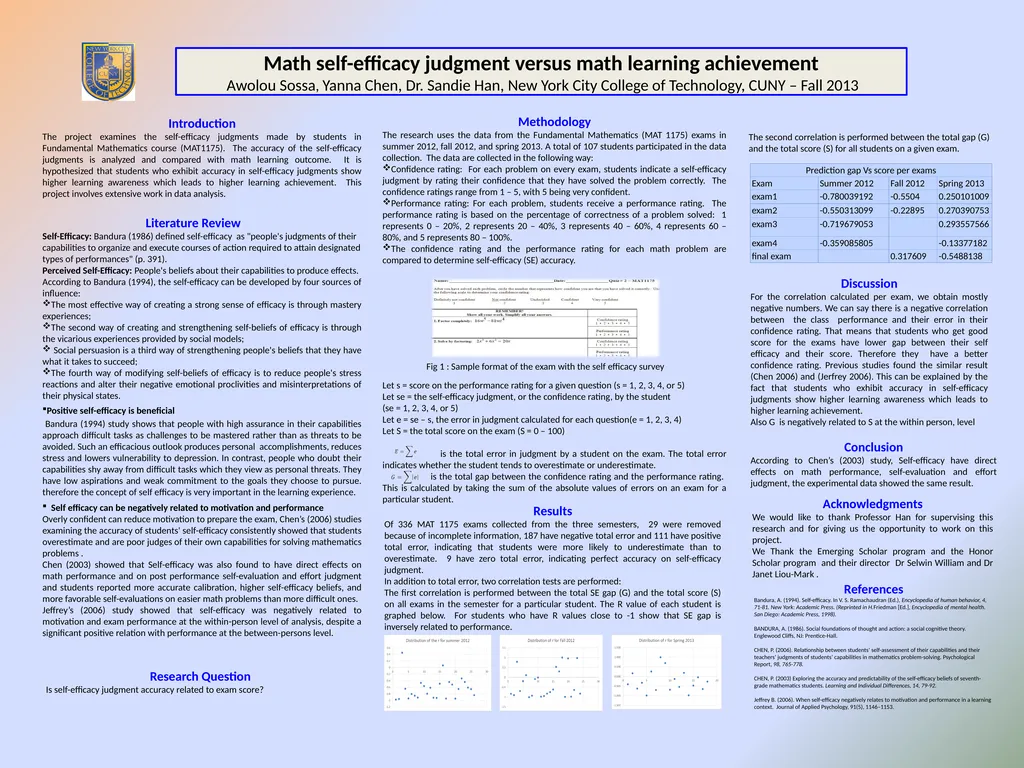
Math self-efficacy judgment versus math learning achievement
Awolou Sossa, Yanna Chen, Dr. Sandie Han, New York City College of Technology, CUNY – Fall 2013 Introduction
The project examines the self-efficacy judgments made by students in Fundamental Mathematics course (MAT1175). The accuracy of the self-efficacy judgments is analyzed and compared with math learning outcome. It is hypothesized that students who exhibit accuracy in self-efficacy judgments show higher learning awareness which leads to higher learning achievement. This project involves extensive work in data analysis. Literature Review Self-Efficacy: Bandura (1986) defined self-efficacy as "people's judgments of their capabilities to organize and execute courses of action required to attain designated types of performances" (p. 391).
Perceived Self-Efficacy: People's beliefs about their capabilities to produce effects.
According to Bandura (1994), the self-efficacy can be developed by four sources of influence:
The most effective way of creating a strong sense of efficacy is through mastery experiences;
The second way of creating and strengthening self-beliefs of efficacy is through the vicarious experiences provided by social models;
Social persuasion is a third way of strengthening people's beliefs that they have what it takes to succeed;
The fourth way of modifying self-beliefs of efficacy is to reduce people's stress reactions and alter their negative emotional proclivities and misinterpretations of their physical states.
Positive self-efficacy is beneficial
Bandura (1994) study shows that people with high assurance in their capabilities approach difficult tasks as challenges to be mastered rather than as threats to be avoided. Such an efficacious outlook produces personal accomplishments, reduces stress and lowers vulnerability to depression. In contrast, people who doubt their capabilities shy away from difficult tasks which they view as personal threats. They have low aspirations and weak commitment to the goals they choose to pursue. therefore the concept of self efficacy is very important in the learning experience.
Self efficacy can be negatively related to motivation and performance
Overly confident can reduce motivation to prepare the exam, Chen’s (2006) studies examining the accuracy of students' self-efficacy consistently showed that students overestimate and are poor judges of their own capabilities for solving mathematics problems .
Chen (2003) showed that Self-efficacy was also found to have direct effects on math performance and on post performance self-evaluation and effort judgment and students reported more accurate calibration, higher self-efficacy beliefs, and more favorable self-evaluations on easier math problems than more difficult ones.
Jeffrey’s (2006) study showed that self-efficacy was negatively related to motivation and exam performance at the within-person level of analysis, despite a significant positive relation with performance at the between-persons level. Methodology
The research uses the data from the Fundamental Mathematics (MAT 1175) exams in summer 2012, fall 2012, and spring 2013. A total of 107 students participated in the data collection. The data are collected in the following way:
Confidence rating: For each problem on every exam, students indicate a self-efficacy judgment by rating their confidence that they have solved the problem correctly. The confidence ratings range from 1 – 5, with 5 being very confident.
Performance rating: For each problem, students receive a performance rating. The performance rating is based on the percentage of correctness of a problem solved: 1 represents 0 – 20%, 2 represents 20 – 40%, 3 represents 40 – 60%, 4 represents 60 – 80%, and 5 represents 80 – 100%.
The confidence rating and the performance rating for each math problem are compared to determine self-efficacy (SE) accuracy.
Let s = score on the performance rating for a given question (s = 1, 2, 3, 4, or 5)
Let se = the self-efficacy judgment, or the confidence rating, by the student
(se = 1, 2, 3, 4, or 5)
Let e = se – s, the error in judgment calculated for each question(e = 1, 2, 3, 4)
Let S = the total score on the exam (S = 0 – 100)
is the total error in judgment by a student on the exam. The total error indicates whether the student tends to overestimate or underestimate.
is the total gap between the confidence rating and the performance rating. This is calculated by taking the sum of the absolute values of errors on an exam for a particular student. Discussion
For the correlation calculated per exam, we obtain mostly negative numbers. We can say there is a negative correlation between the class performance and their error in their confidence rating. That means that students who get good score for the exams have lower gap between their self efficacy and their score. Therefore they have a better confidence rating. Previous studies found the similar result (Chen 2006) and (Jerfrey 2006). This can be explained by the fact that students who exhibit accuracy in self-efficacy judgments show higher learning awareness which leads to higher learning achievement.
Also G is negatively related to S at the within person, level Conclusion
According to Chen’s (2003) study, Self-efficacy have direct effects on math performance, self-evaluation and effort judgment, the experimental data showed the same result. References
Bandura, A. (1994). Self-efficacy. In V. S. Ramachaudran (Ed.), Encyclopedia of human behavior, 4, 71-81. New York: Academic Press. (Reprinted in H.Friedman [Ed.], Encyclopedia of mental health. San Diego: Academic Press, 1998).
BANDURA, A. (1986). Social foundations of thought and action: a social cognitive theory. Englewood Cliffs, NJ: Prentice-Hall.
CHEN, P. (2006). Relationship between students’ self-assessment of their capabilities and their teachers’ judgments of students’ capabilities in mathematics problem-solving. Psychological Report, 98, 765-778.
CHEN, P. (2003) Exploring the accuracy and predictability of the self-efficacy beliefs of seventh- grade mathematics students. Learning and Individual Differences, 14, 79-92.
Jeffrey B. (2006). When self-efficacy negatively relates to motivation and performance in a learning context. Journal of Applied Psychology, 91(5), 1146–1153. Acknowledgments
We would like to thank Professor Han for supervising this research and for giving us the opportunity to work on this project.
We Thank the Emerging Scholar program and the Honor Scholar program and their director Dr Selwin William and Dr Janet Liou-Mark . Results
Of 336 MAT 1175 exams collected from the three semesters, 29 were removed because of incomplete information, 187 have negative total error and 111 have positive total error, indicating that students were more likely to underestimate than to overestimate. 9 have zero total error, indicating perfect accuracy on self-efficacy judgment.
In addition to total error, two correlation tests are performed:
The first correlation is performed between the total SE gap (G) and the total score (S) on all exams in the semester for a particular student. The R value of each student is graphed below. For students who have R values close to -1 show that SE gap is inversely related to performance. Fig 1 : Sample format of the exam with the self efficacy survey Research Question
Is self-efficacy judgment accuracy related to exam score? The second correlation is performed between the total gap (G) and the total score (S) for all students on a given exam.<br>
The project examines the self-efficacy judgments made by students in Fundamental Mathematics course (MAT1175). The accuracy of the self-efficacy judgments is analyzed and compared with math learning outcome. It is hypothesized that students who exhibit accuracy in self-efficacy judgments show higher learning awareness which leads to higher learning achievement. This project involves extensive work in data analysis. Literature Review Self-Efficacy: Bandura (1986) defined self-efficacy as "people's judgments of their capabilities to organize and execute courses of action required to attain designated types of performances" (p. 391).
Perceived Self-Efficacy: People's beliefs about their capabilities to produce effects.
According to Bandura (1994), the self-efficacy can be developed by four sources of influence:
The most effective way of creating a strong sense of efficacy is through mastery experiences;
The second way of creating and strengthening self-beliefs of efficacy is through the vicarious experiences provided by social models;
Social persuasion is a third way of strengthening people's beliefs that they have what it takes to succeed;
The fourth way of modifying self-beliefs of efficacy is to reduce people's stress reactions and alter their negative emotional proclivities and misinterpretations of their physical states.
Positive self-efficacy is beneficial
Bandura (1994) study shows that people with high assurance in their capabilities approach difficult tasks as challenges to be mastered rather than as threats to be avoided. Such an efficacious outlook produces personal accomplishments, reduces stress and lowers vulnerability to depression. In contrast, people who doubt their capabilities shy away from difficult tasks which they view as personal threats. They have low aspirations and weak commitment to the goals they choose to pursue. therefore the concept of self efficacy is very important in the learning experience.
Self efficacy can be negatively related to motivation and performance
Overly confident can reduce motivation to prepare the exam, Chen’s (2006) studies examining the accuracy of students' self-efficacy consistently showed that students overestimate and are poor judges of their own capabilities for solving mathematics problems .
Chen (2003) showed that Self-efficacy was also found to have direct effects on math performance and on post performance self-evaluation and effort judgment and students reported more accurate calibration, higher self-efficacy beliefs, and more favorable self-evaluations on easier math problems than more difficult ones.
Jeffrey’s (2006) study showed that self-efficacy was negatively related to motivation and exam performance at the within-person level of analysis, despite a significant positive relation with performance at the between-persons level. Methodology
The research uses the data from the Fundamental Mathematics (MAT 1175) exams in summer 2012, fall 2012, and spring 2013. A total of 107 students participated in the data collection. The data are collected in the following way:
Confidence rating: For each problem on every exam, students indicate a self-efficacy judgment by rating their confidence that they have solved the problem correctly. The confidence ratings range from 1 – 5, with 5 being very confident.
Performance rating: For each problem, students receive a performance rating. The performance rating is based on the percentage of correctness of a problem solved: 1 represents 0 – 20%, 2 represents 20 – 40%, 3 represents 40 – 60%, 4 represents 60 – 80%, and 5 represents 80 – 100%.
The confidence rating and the performance rating for each math problem are compared to determine self-efficacy (SE) accuracy.
Let s = score on the performance rating for a given question (s = 1, 2, 3, 4, or 5)
Let se = the self-efficacy judgment, or the confidence rating, by the student
(se = 1, 2, 3, 4, or 5)
Let e = se – s, the error in judgment calculated for each question(e = 1, 2, 3, 4)
Let S = the total score on the exam (S = 0 – 100)
is the total error in judgment by a student on the exam. The total error indicates whether the student tends to overestimate or underestimate.
is the total gap between the confidence rating and the performance rating. This is calculated by taking the sum of the absolute values of errors on an exam for a particular student. Discussion
For the correlation calculated per exam, we obtain mostly negative numbers. We can say there is a negative correlation between the class performance and their error in their confidence rating. That means that students who get good score for the exams have lower gap between their self efficacy and their score. Therefore they have a better confidence rating. Previous studies found the similar result (Chen 2006) and (Jerfrey 2006). This can be explained by the fact that students who exhibit accuracy in self-efficacy judgments show higher learning awareness which leads to higher learning achievement.
Also G is negatively related to S at the within person, level Conclusion
According to Chen’s (2003) study, Self-efficacy have direct effects on math performance, self-evaluation and effort judgment, the experimental data showed the same result. References
Bandura, A. (1994). Self-efficacy. In V. S. Ramachaudran (Ed.), Encyclopedia of human behavior, 4, 71-81. New York: Academic Press. (Reprinted in H.Friedman [Ed.], Encyclopedia of mental health. San Diego: Academic Press, 1998).
BANDURA, A. (1986). Social foundations of thought and action: a social cognitive theory. Englewood Cliffs, NJ: Prentice-Hall.
CHEN, P. (2006). Relationship between students’ self-assessment of their capabilities and their teachers’ judgments of students’ capabilities in mathematics problem-solving. Psychological Report, 98, 765-778.
CHEN, P. (2003) Exploring the accuracy and predictability of the self-efficacy beliefs of seventh- grade mathematics students. Learning and Individual Differences, 14, 79-92.
Jeffrey B. (2006). When self-efficacy negatively relates to motivation and performance in a learning context. Journal of Applied Psychology, 91(5), 1146–1153. Acknowledgments
We would like to thank Professor Han for supervising this research and for giving us the opportunity to work on this project.
We Thank the Emerging Scholar program and the Honor Scholar program and their director Dr Selwin William and Dr Janet Liou-Mark . Results
Of 336 MAT 1175 exams collected from the three semesters, 29 were removed because of incomplete information, 187 have negative total error and 111 have positive total error, indicating that students were more likely to underestimate than to overestimate. 9 have zero total error, indicating perfect accuracy on self-efficacy judgment.
In addition to total error, two correlation tests are performed:
The first correlation is performed between the total SE gap (G) and the total score (S) on all exams in the semester for a particular student. The R value of each student is graphed below. For students who have R values close to -1 show that SE gap is inversely related to performance. Fig 1 : Sample format of the exam with the self efficacy survey Research Question
Is self-efficacy judgment accuracy related to exam score? The second correlation is performed between the total gap (G) and the total score (S) for all students on a given exam.<br>