Mathematical Modelling in Finance -Puneet Prakash, IME 04-04-2014 1 MMF Overview MPT and Beta MMF Matched funding Emmanuel Derman (2011) There are no theories in finance... only imperfect models remain Metaphors, Models Theories ,
Related Topics
Share
Embed code
Download this presentation From Below
"Mathematical Modelling in Finance -Puneet Prakash," is the property of its rightful owner. Permission is granted to
download and print the materials on this website for personal, non-commercial use only, and to display it
on your personal computer provided you do not modify the materials and that you retain all copyright
notices contained in the materials. By downloading content from our website, you accept the terms of this
agreement.
Presentation Transcript
01
Mathematical Modelling in Finance -Puneet Prakash, IME 04-04-2014 1 MMF Overview MPT and Beta MMF Matched funding<br>
02
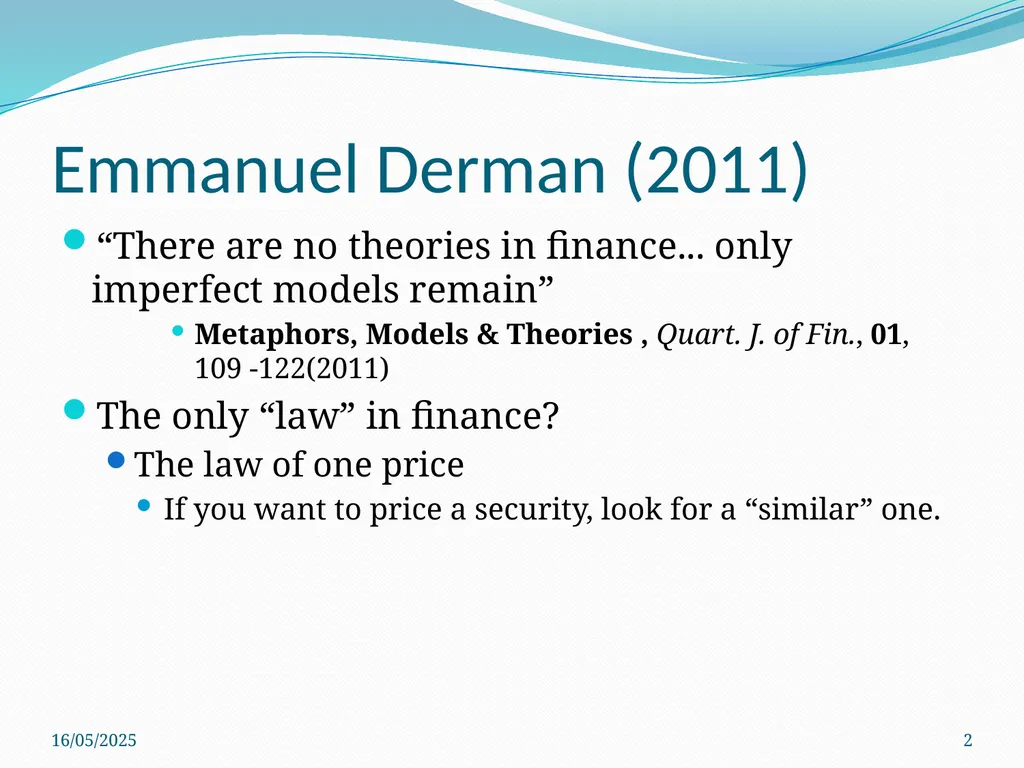
Emmanuel Derman (2011) “There are no theories in finance... only imperfect models remain”
Metaphors, Models & Theories , Quart. J. of Fin., 01, 109 -122(2011)
The only “law” in finance?
The law of one price
If you want to price a security, look for a “similar” one. 04-04-2014 2<br>
03
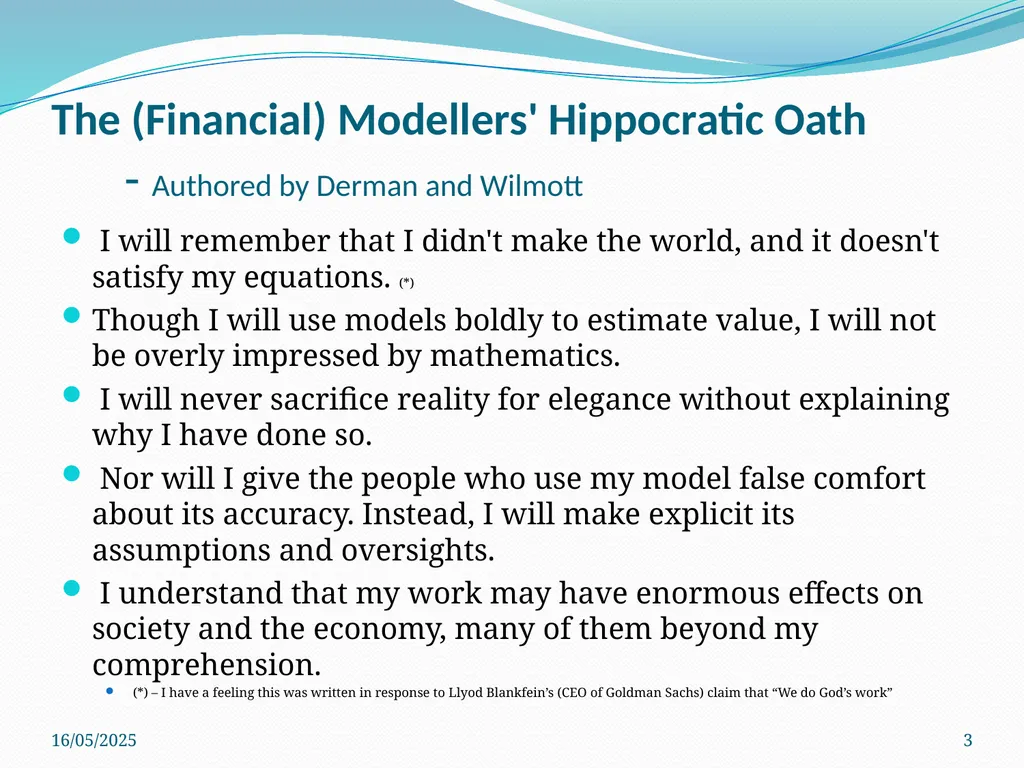
The (Financial) Modellers' Hippocratic Oath - Authored by Derman and Wilmott I will remember that I didn't make the world, and it doesn't satisfy my equations. (*)
Though I will use models boldly to estimate value, I will not be overly impressed by mathematics.
I will never sacrifice reality for elegance without explaining why I have done so.
Nor will I give the people who use my model false comfort about its accuracy. Instead, I will make explicit its assumptions and oversights.
I understand that my work may have enormous effects on society and the economy, many of them beyond my comprehension.
(*) – I have a feeling this was written in response to Llyod Blankfein’s (CEO of Goldman Sachs) claim that “We do God’s work” 04-04-2014 3<br>
04
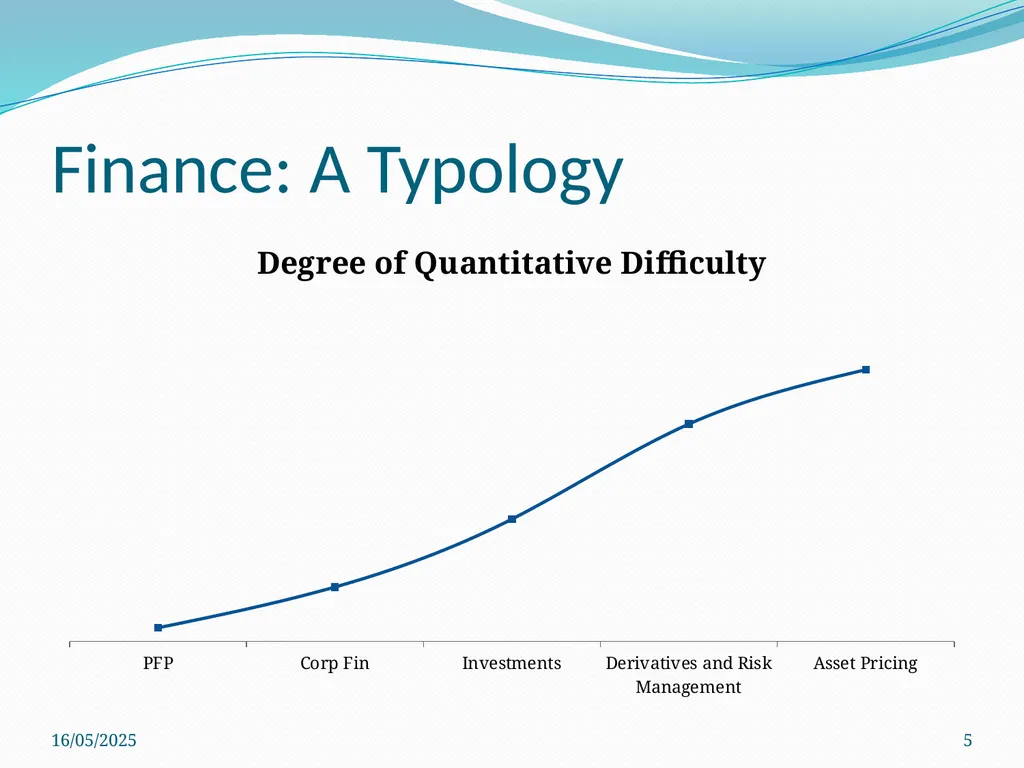
Why the brouhaha? Finance does require a certain degree of mathematical sophistication
It is NOT rocket science though 04-04-2014 4<br>
05
Finance: A Typology 04-04-2014 5<br>
06
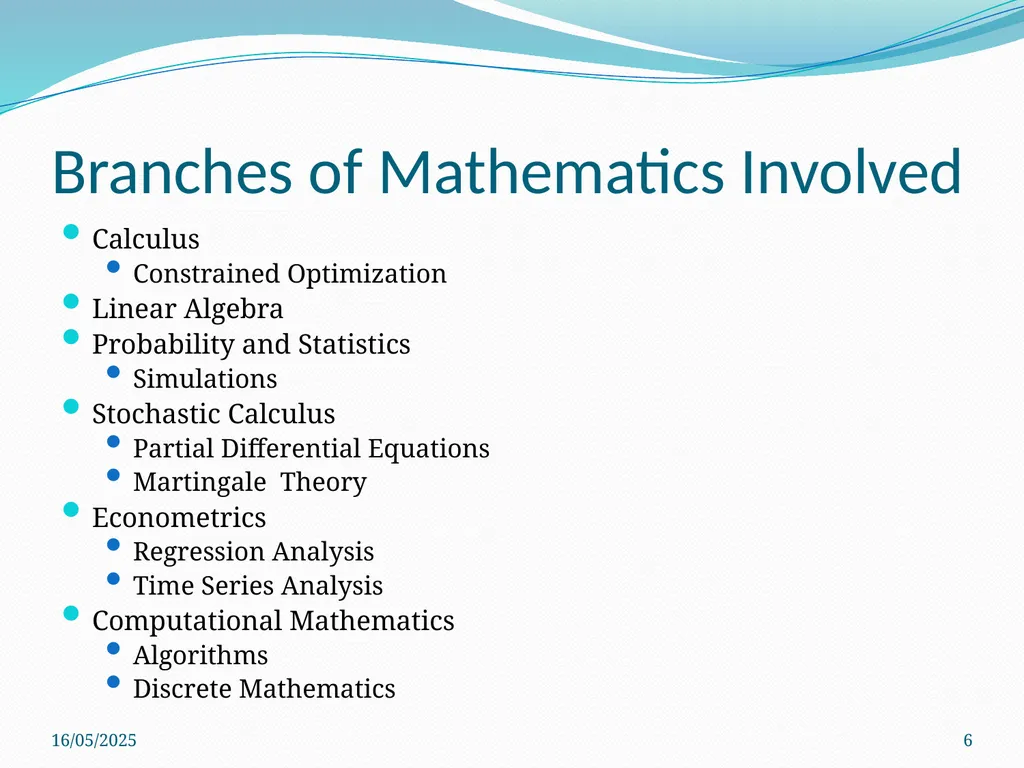
Branches of Mathematics Involved Calculus
Constrained Optimization
Linear Algebra
Probability and Statistics
Simulations
Stochastic Calculus
Partial Differential Equations
Martingale Theory
Econometrics
Regression Analysis
Time Series Analysis
Computational Mathematics
Algorithms
Discrete Mathematics 04-04-2014 6<br>
07
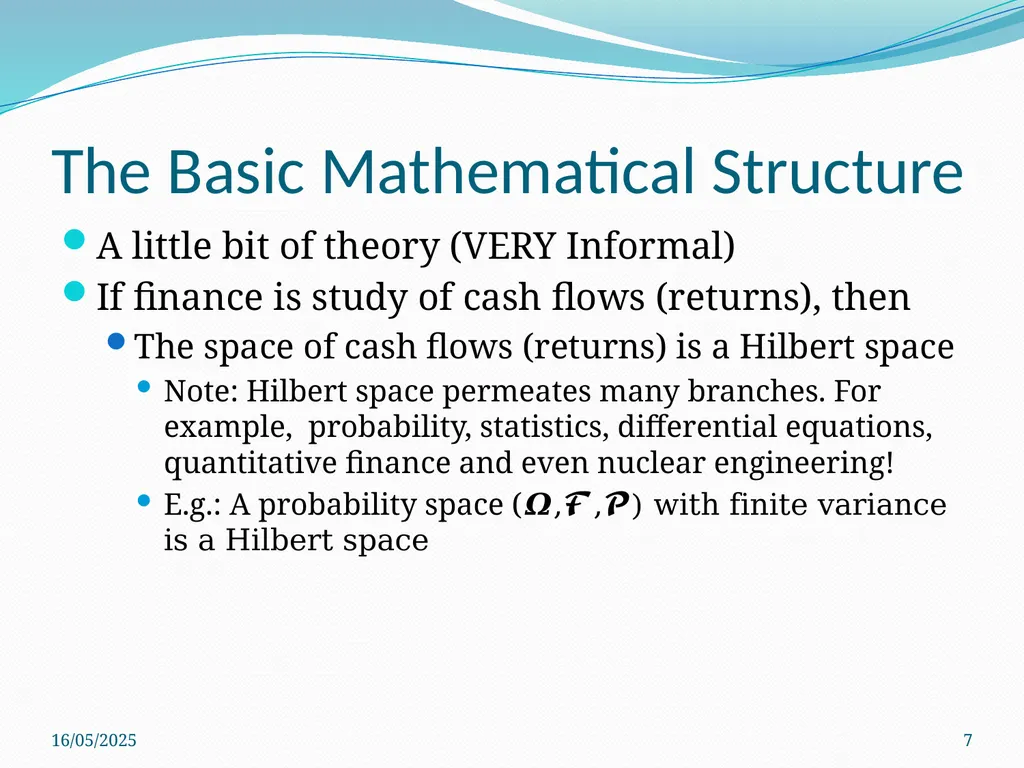
The Basic Mathematical Structure A little bit of theory (VERY Informal)
If finance is study of cash flows (returns), then
The space of cash flows (returns) is a Hilbert space
Note: Hilbert space permeates many branches. For example, probability, statistics, differential equations, quantitative finance and even nuclear engineering!
E.g.: A probability space (𝜴,𝓕,𝓟) with finite variance is a Hilbert space 04-04-2014 7<br>
08
Hilbert space A Hilbert space is a Banach space with an additional property that
An inner product is defined, and that the norm of an element is defined in terms of the inner product of the element with itself
Implications:
All properties of Banach spaces hold for Hilbert spaces
Projections of one element on another can be taken
Banach space? 04-04-2014 8<br>
09
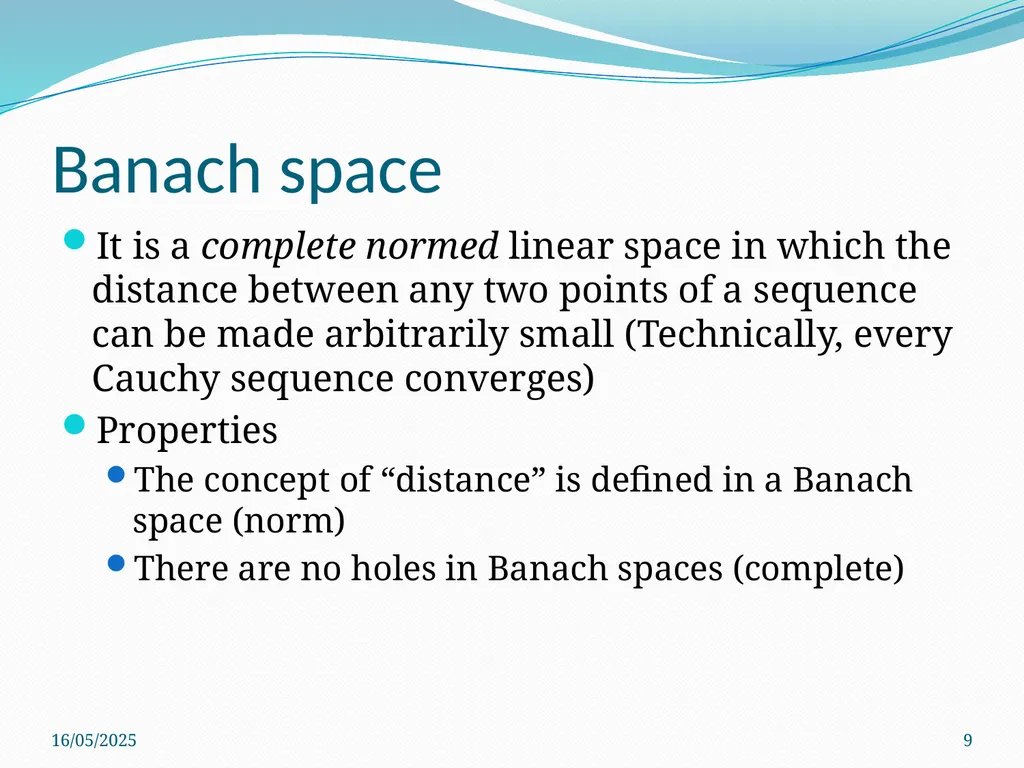
Banach space It is a complete normed linear space in which the distance between any two points of a sequence can be made arbitrarily small (Technically, every Cauchy sequence converges)
Properties
The concept of “distance” is defined in a Banach space (norm)
There are no holes in Banach spaces (complete) 04-04-2014 9<br>
10
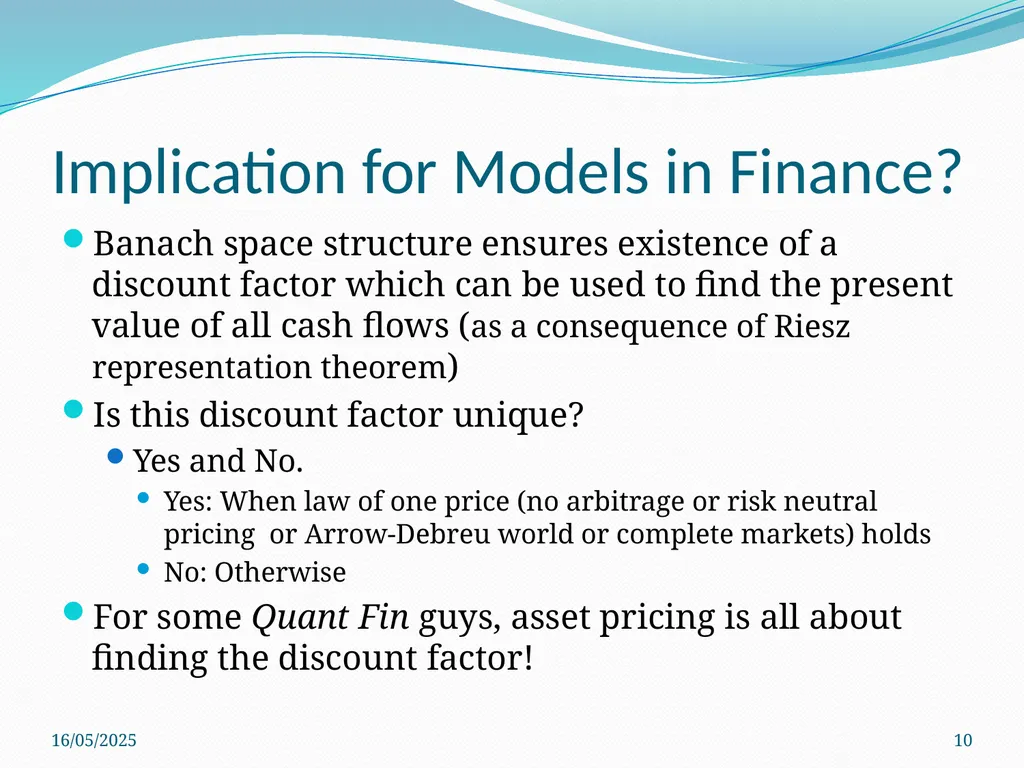
Implication for Models in Finance? Banach space structure ensures existence of a discount factor which can be used to find the present value of all cash flows (as a consequence of Riesz representation theorem)
Is this discount factor unique?
Yes and No.
Yes: When law of one price (no arbitrage or risk neutral pricing or Arrow-Debreu world or complete markets) holds
No: Otherwise
For some Quant Fin guys, asset pricing is all about finding the discount factor! 04-04-2014 10<br>
11
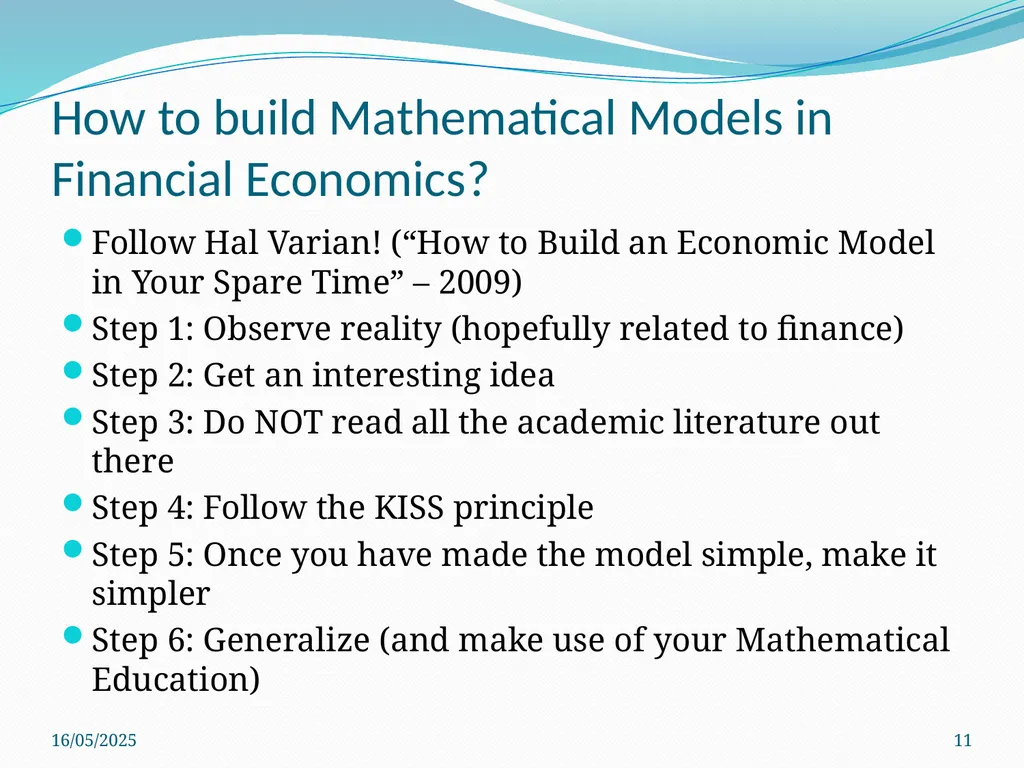
How to build Mathematical Models in Financial Economics? Follow Hal Varian! (“How to Build an Economic Model in Your Spare Time” – 2009)
Step 1: Observe reality (hopefully related to finance)
Step 2: Get an interesting idea
Step 3: Do NOT read all the academic literature out there
Step 4: Follow the KISS principle
Step 5: Once you have made the model simple, make it simpler
Step 6: Generalize (and make use of your Mathematical Education) 04-04-2014 11<br>
12
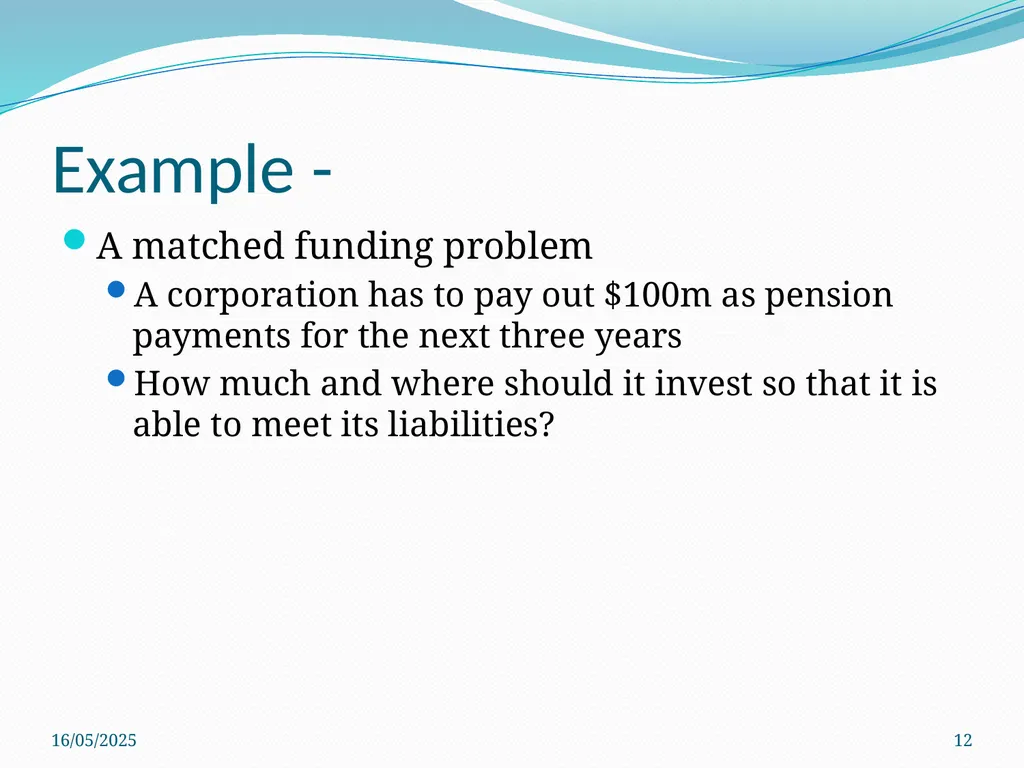
Example - A matched funding problem
A corporation has to pay out $100m as pension payments for the next three years
How much and where should it invest so that it is able to meet its liabilities? 04-04-2014 12<br>
13
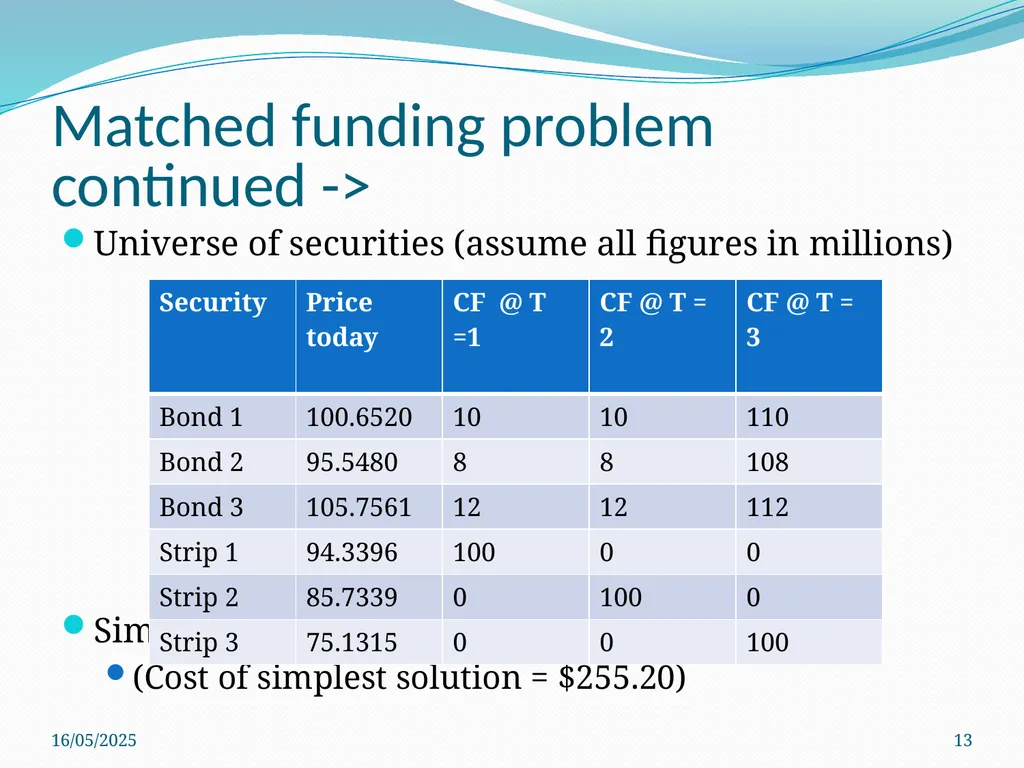
Matched funding problem continued -> Universe of securities (assume all figures in millions)
Simplest solution?
(Cost of simplest solution = $255.20) 04-04-2014 13<br>
14
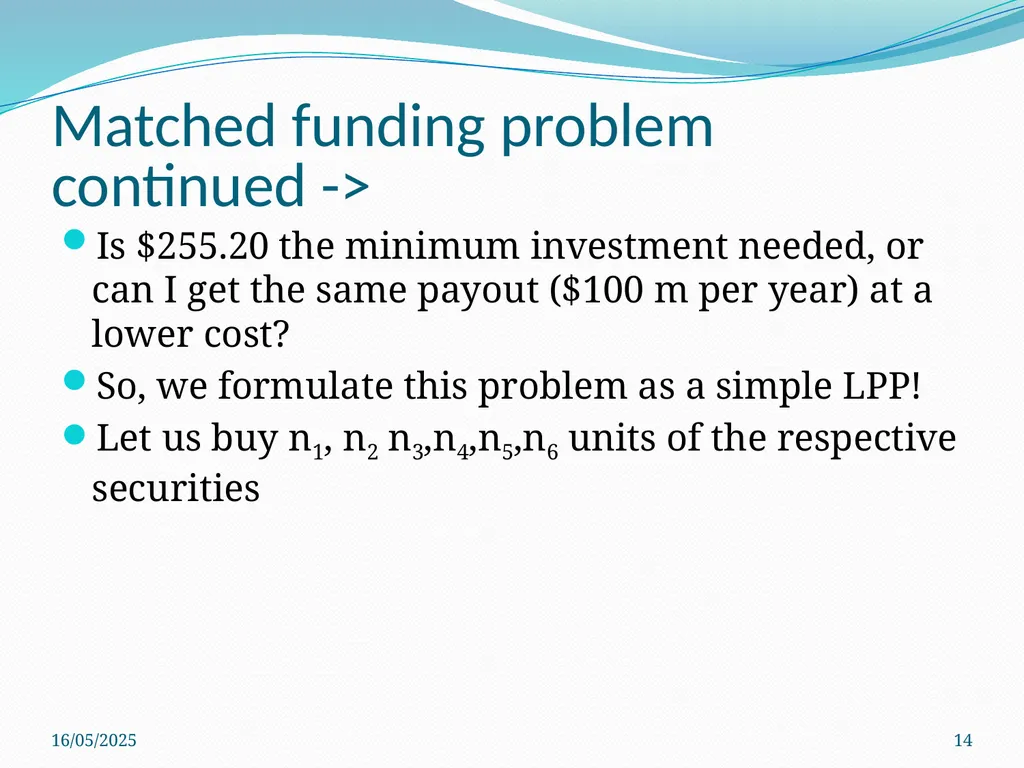
Matched funding problem continued -> Is $255.20 the minimum investment needed, or can I get the same payout ($100 m per year) at a lower cost?
So, we formulate this problem as a simple LPP!
Let us buy n1, n2 n3,n4,n5,n6 units of the respective securities 04-04-2014 14<br>
15
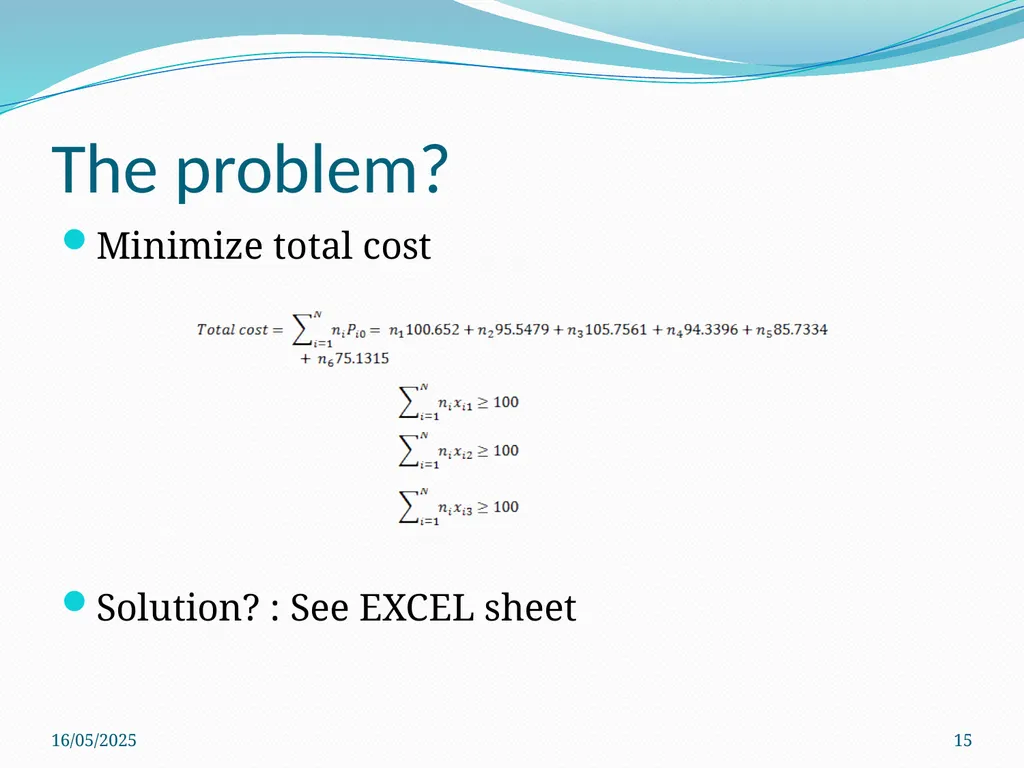
The problem? 04-04-2014 15 Minimize total cost
Solution? : See EXCEL sheet<br>
16
The Excel solution... ...costs exactly the same as the simplest solution?
Why?
Can one generalize the problem (add more reality to it)? 04-04-2014 16<br>
17
Another simple model: Example Markowitz portfolio problem: The famous risk-return relation of finance
The problem: Given ‘n’ risky assets how much does one invest in each, so that one generates maximum return at minimum risk. The problem is deeper than you think! It uses
Calculus
Statistics
Constrained Optimization 04-04-2014 17<br>
18
Questions to ask? How does one measure risk of each of the n assets?
If one invests a little in each, does the combined risk behaviour of the asset portfolio equals the sum of its parts?
One knows returns of each asset, but when combined into one portfolio, how does one get the return (not observed in the market, since it is one’s own creation!) 04-04-2014 18<br>