
Maximizing Your FAR Overhead Rate Scott Sutton,
FD
Published · 52 slides · 0 views
1 / 1


Description
Maximizing Your FAR Overhead Rate Scott Sutton, CPA, CDA, MSA and Ken Hedlund, CPA, CGMA Lesson Topics Categories of Cost Pools Cost Principles and Procedures Specific Costs Deferred Compensation Learning Outcomes After completing this
Related Topics
Share
Embed code
Download this presentation From Below
"Maximizing Your FAR Overhead Rate Scott Sutton," is the property of its rightful owner. Permission is granted to download and print the materials on this website for personal, non-commercial use only, and to display it on your personal computer provided you do not modify the materials and that you retain all copyright notices contained in the materials. By downloading content from our website, you accept the terms of this agreement.
Presentation Transcript
01
Maximizing Your FAR Overhead Rate Scott Sutton, CPA, CDA, MSA
and Ken Hedlund, CPA, CGMA<br>
and Ken Hedlund, CPA, CGMA<br>
02
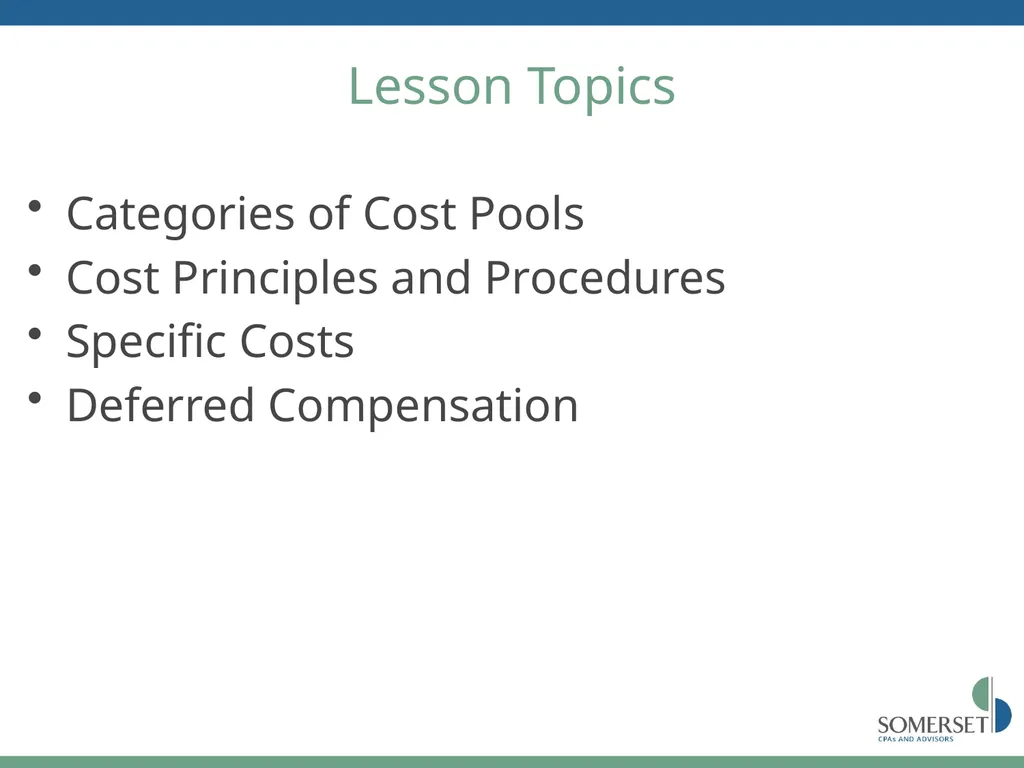
Lesson Topics Categories of Cost Pools
Cost Principles and Procedures
Specific Costs
Deferred Compensation<br>
Cost Principles and Procedures
Specific Costs
Deferred Compensation<br>
03
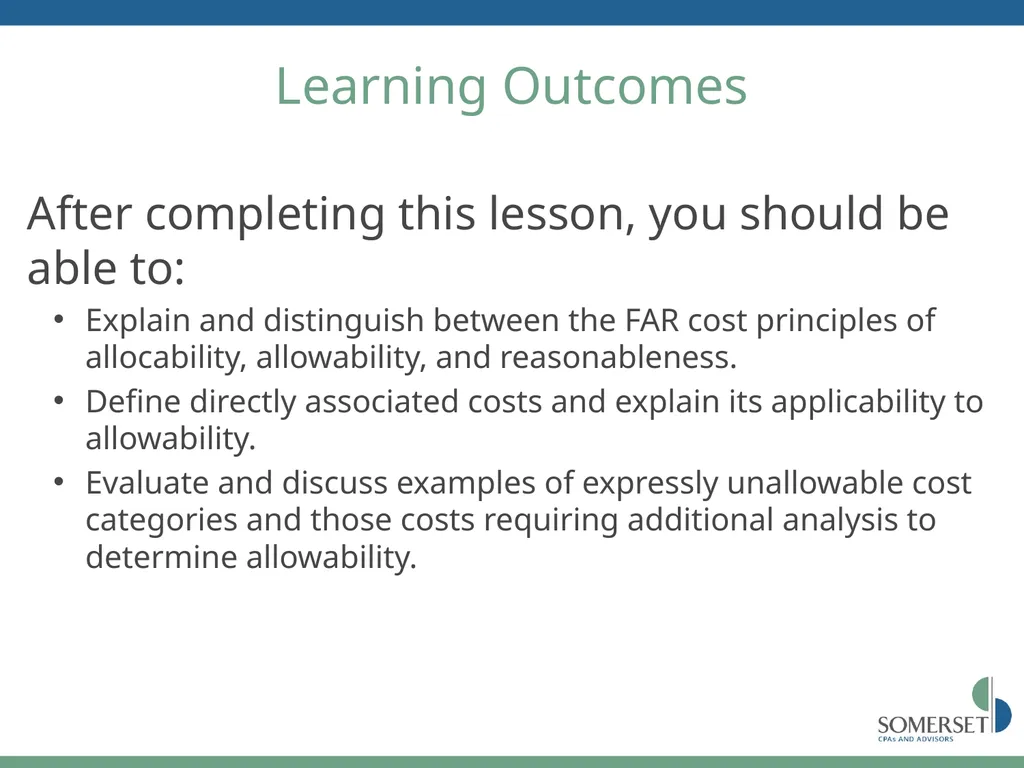
Learning Outcomes After completing this lesson, you should be able to:
Explain and distinguish between the FAR cost principles of allocability, allowability, and reasonableness.
Define directly associated costs and explain its applicability to allowability.
Evaluate and discuss examples of expressly unallowable cost categories and those costs requiring additional analysis to determine allowability.<br>
Explain and distinguish between the FAR cost principles of allocability, allowability, and reasonableness.
Define directly associated costs and explain its applicability to allowability.
Evaluate and discuss examples of expressly unallowable cost categories and those costs requiring additional analysis to determine allowability.<br>
04
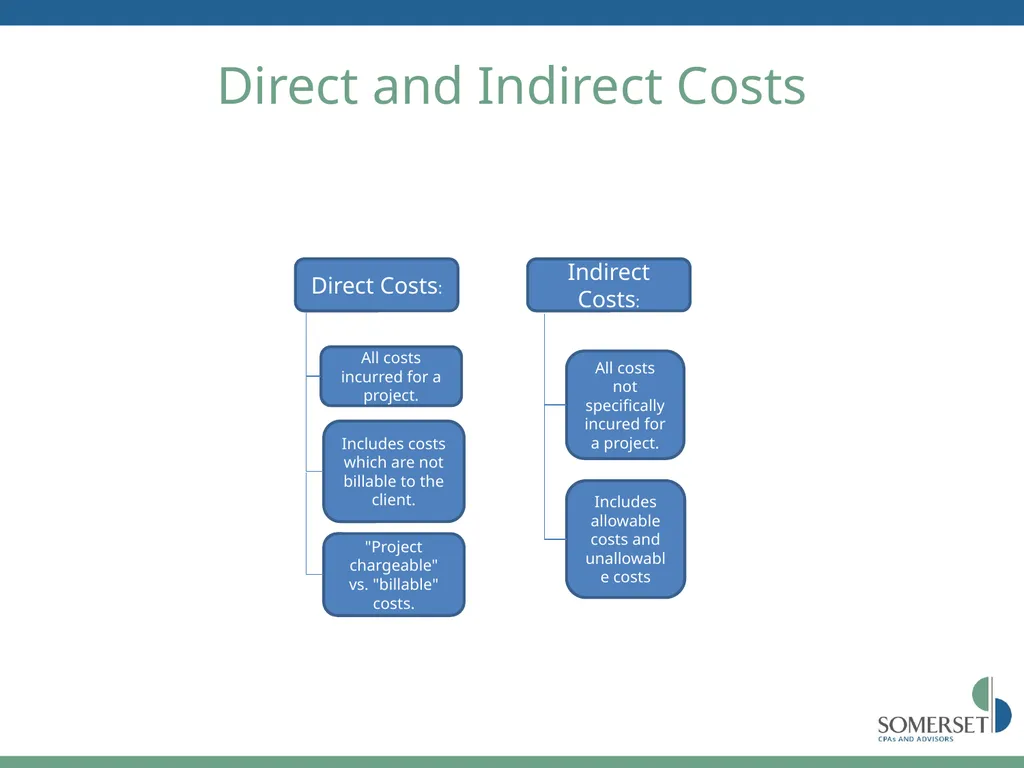
Direct and Indirect Costs<br>
05
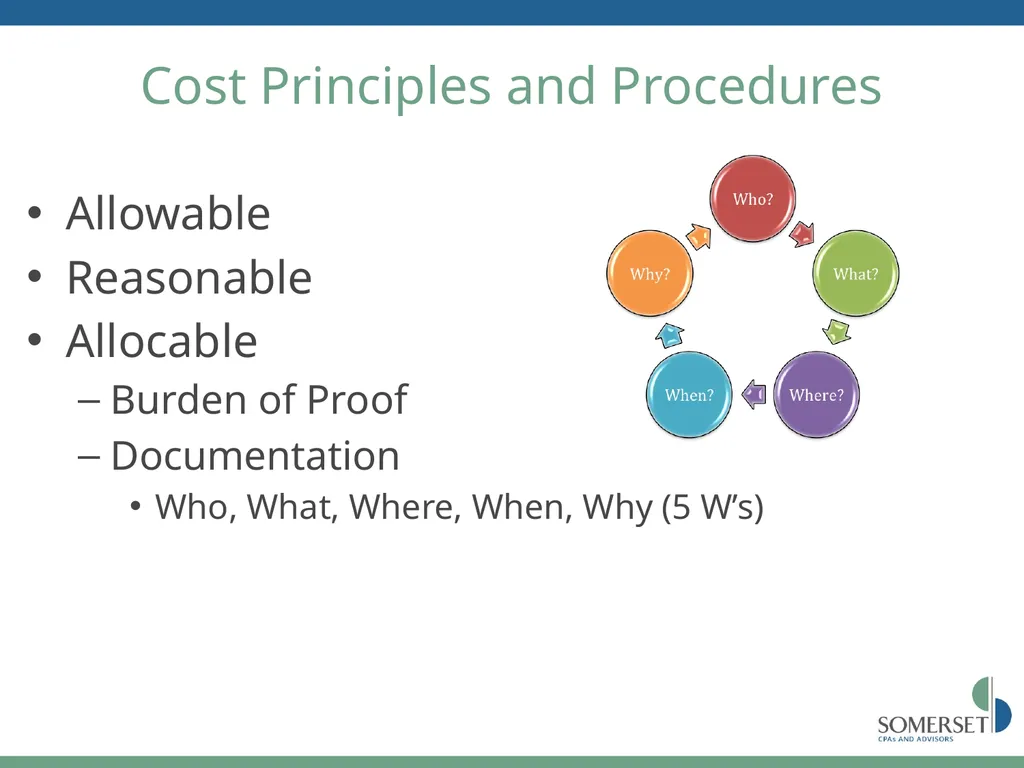
Cost Principles and Procedures Allowable
Reasonable
Allocable
Burden of Proof
Documentation
Who, What, Where, When, Why (5 W’s)<br>
Reasonable
Allocable
Burden of Proof
Documentation
Who, What, Where, When, Why (5 W’s)<br>
06
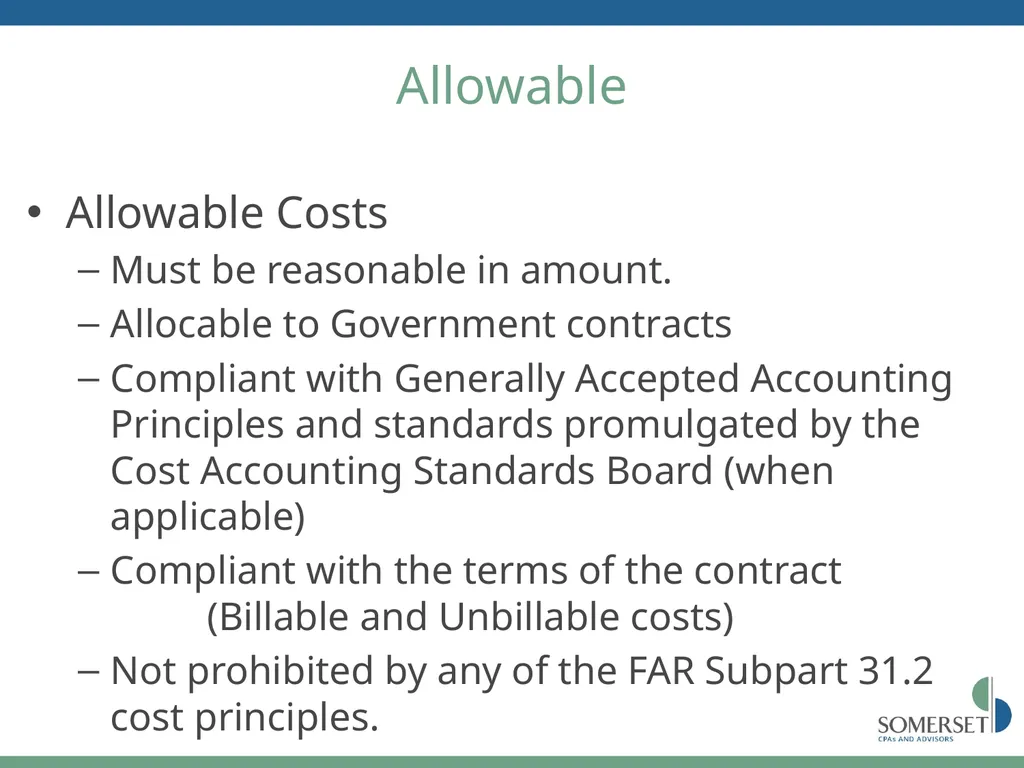
Allowable Allowable Costs
Must be reasonable in amount.
Allocable to Government contracts
Compliant with Generally Accepted Accounting Principles and standards promulgated by the Cost Accounting Standards Board (when applicable)
Compliant with the terms of the contract (Billable and Unbillable costs)
Not prohibited by any of the FAR Subpart 31.2 cost principles.<br>
Must be reasonable in amount.
Allocable to Government contracts
Compliant with Generally Accepted Accounting Principles and standards promulgated by the Cost Accounting Standards Board (when applicable)
Compliant with the terms of the contract (Billable and Unbillable costs)
Not prohibited by any of the FAR Subpart 31.2 cost principles.<br>
07
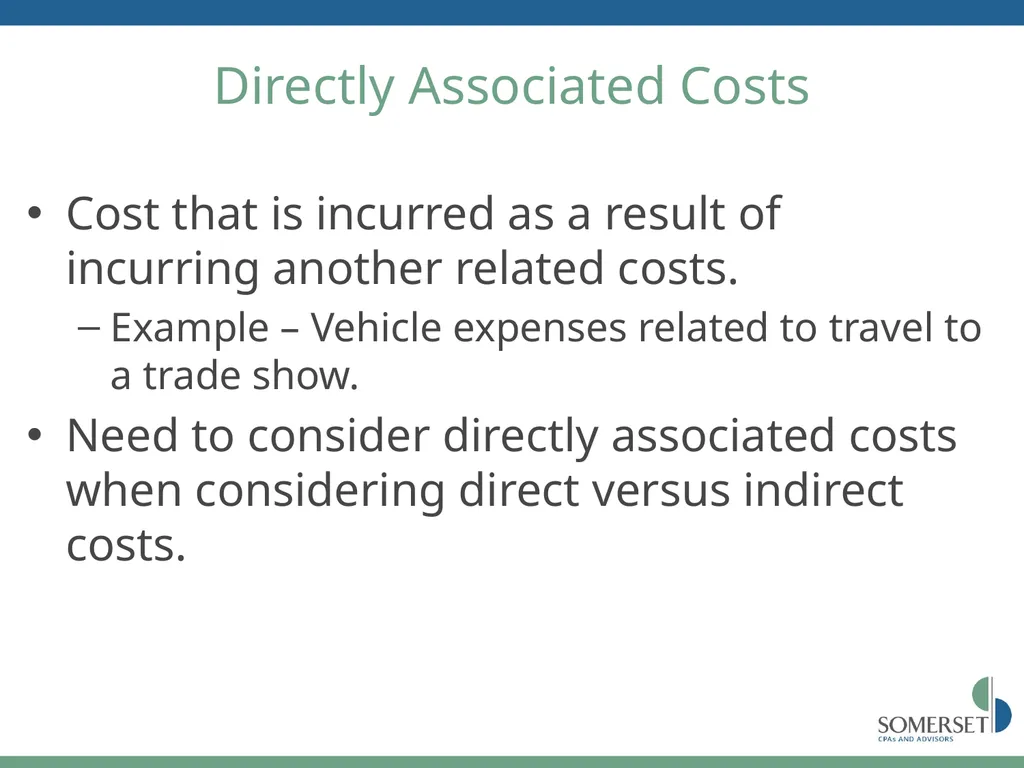
Directly Associated Costs Cost that is incurred as a result of incurring another related costs.
Example – Vehicle expenses related to travel to a trade show.
Need to consider directly associated costs when considering direct versus indirect costs.<br>
Example – Vehicle expenses related to travel to a trade show.
Need to consider directly associated costs when considering direct versus indirect costs.<br>
08
Reasonable FAR Part 31.201-3(a)
A cost is reasonable if, in its nature and amount, it does not exceed that which would be incurred by a prudent person in the conduct of competitive business.
Referred to as the “prudent person test”
No presumption of reasonableness shall be attached to the incurrence of costs by a contractor… if an initial review of the facts results in a challenge of a specific cost… the burden of proof shall be upon the contractor to establish such cost is reasonable.<br>
A cost is reasonable if, in its nature and amount, it does not exceed that which would be incurred by a prudent person in the conduct of competitive business.
Referred to as the “prudent person test”
No presumption of reasonableness shall be attached to the incurrence of costs by a contractor… if an initial review of the facts results in a challenge of a specific cost… the burden of proof shall be upon the contractor to establish such cost is reasonable.<br>
09
Allocability Allocating costs to direct or indirect, and if direct, to the appropriate project.
Key factor is “why was the cost incurred?”
Allocation based on the benefits received.
Be sure to document why cost was allocated in a certain manner.<br>
Key factor is “why was the cost incurred?”
Allocation based on the benefits received.
Be sure to document why cost was allocated in a certain manner.<br>
10
Allocability Costs that are allocable to a government contract will fall into one of three categories:
Costs incurred specifically for the contract
Costs that benefit both the contract and other work, and can be allocated in reasonable proportion based on the benefits received
Costs incurred for the overall operation of the business<br>
Costs incurred specifically for the contract
Costs that benefit both the contract and other work, and can be allocated in reasonable proportion based on the benefits received
Costs incurred for the overall operation of the business<br>
11
Documentation Requirements Support for business purpose
5 W’s
Who, What, When, Where, Why
Expense reports, company credit cards, and vendor invoices
Adequate documentation is necessary to support FAR Allowability<br>
5 W’s
Who, What, When, Where, Why
Expense reports, company credit cards, and vendor invoices
Adequate documentation is necessary to support FAR Allowability<br>
12
Significance of Overhead Rate During auditor testing of the indirect costs, sampling is used to verify the allowability and reasonableness.
Sampling provides a bases for the known error (allowability and reasonableness) that is extrapolated to the entire population.
Testing for the 5 W’s
Who, What, When, Where, Why<br>
Sampling provides a bases for the known error (allowability and reasonableness) that is extrapolated to the entire population.
Testing for the 5 W’s
Who, What, When, Where, Why<br>
13
Significance of Overhead Rates See Examples of Impact of Extrapolated Error on Overhead Rate<br>
14
Specific Indirect Costs<br>
15
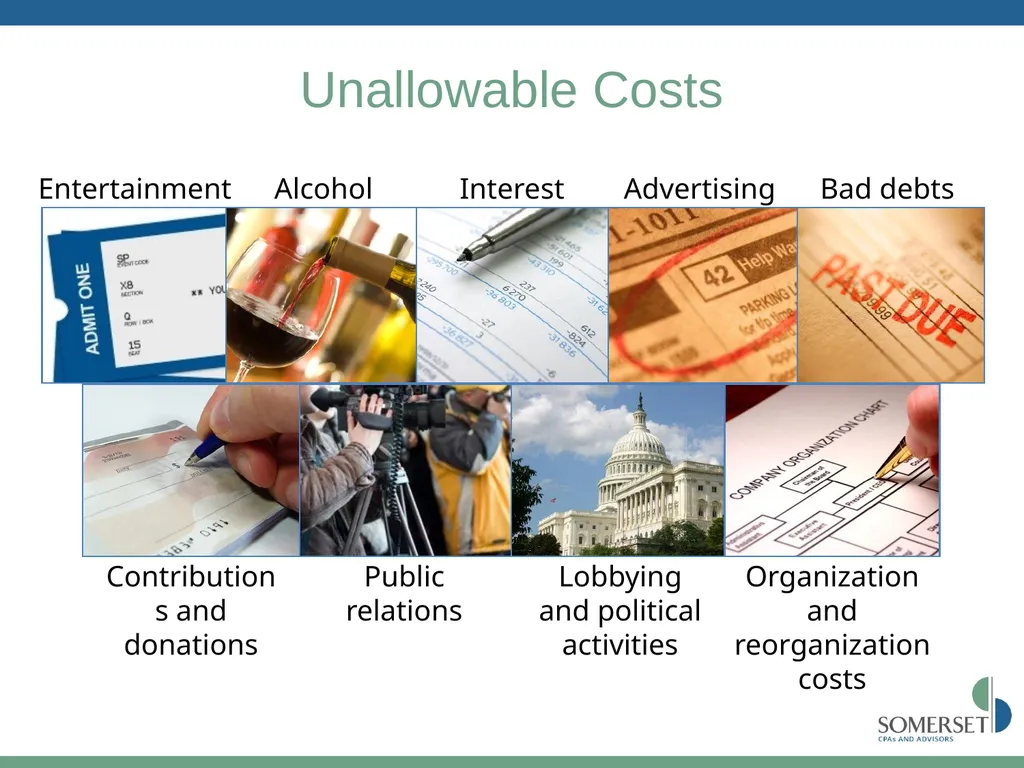
Unallowable Costs<br>
16
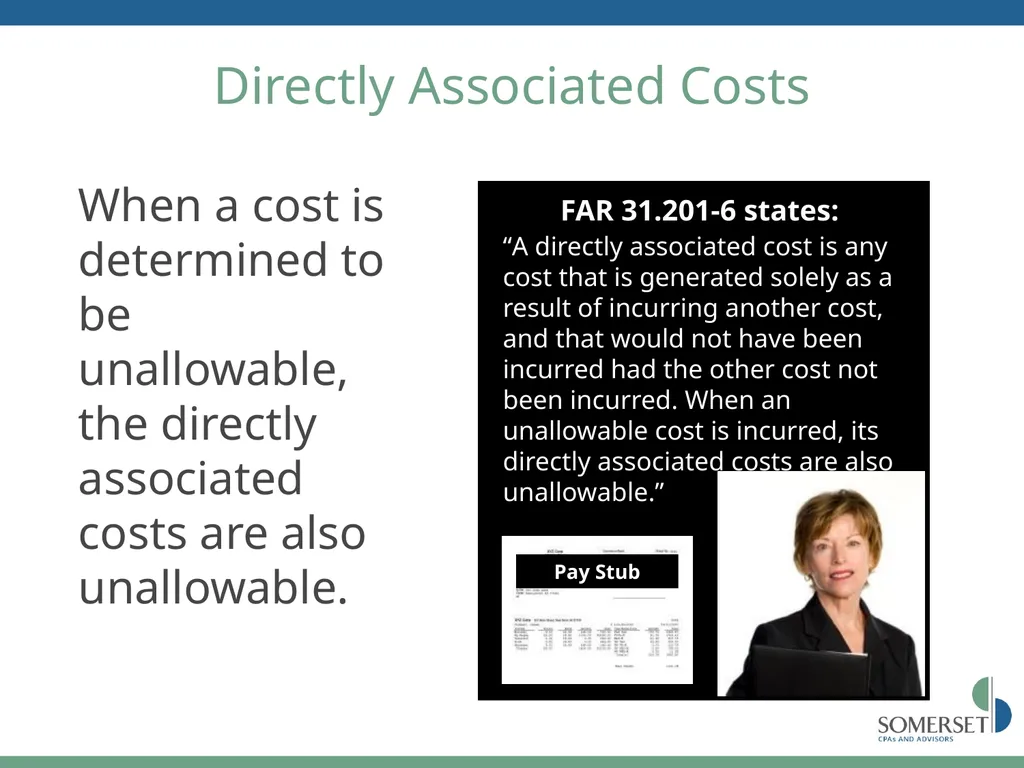
Directly Associated Costs When a cost is determined to be unallowable, the directly associated costs are also unallowable.<br>
17
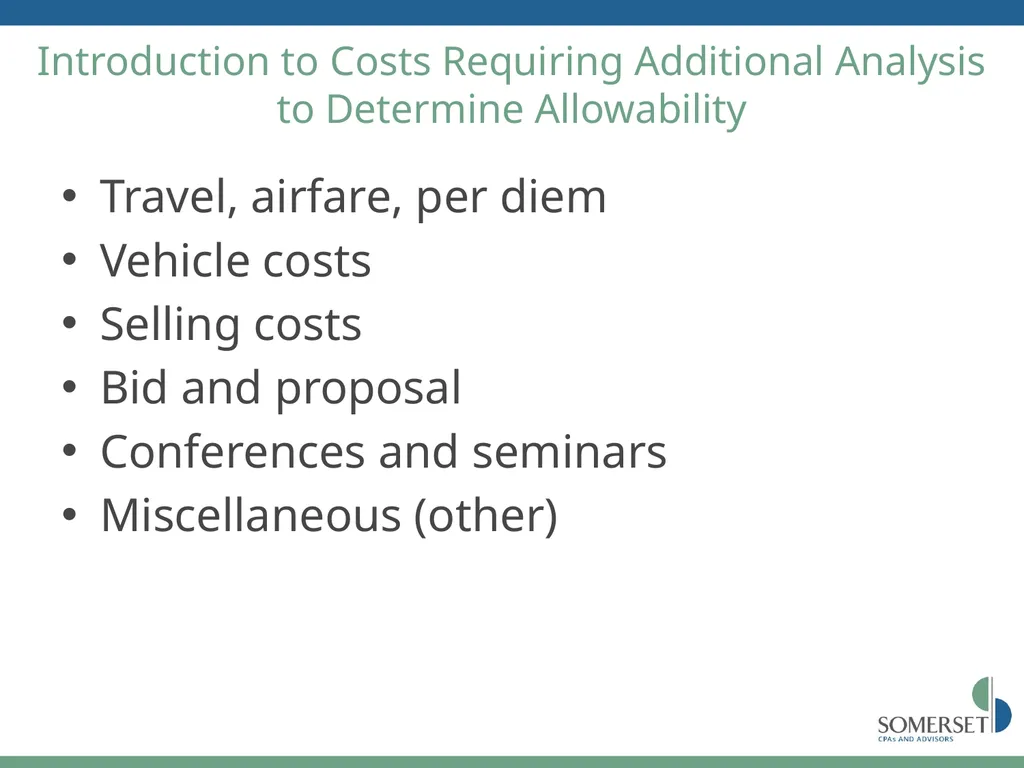
Introduction to Costs Requiring Additional Analysis to Determine Allowability Travel, airfare, per diem
Vehicle costs
Selling costs
Bid and proposal
Conferences and seminars
Miscellaneous (other)<br>
Vehicle costs
Selling costs
Bid and proposal
Conferences and seminars
Miscellaneous (other)<br>
18
Travel, Airfare, and Per Diem Allowability of travel costs
Lodging, meals, and incidentals
Transportation and airfare
Documentation
Especially the WHY FAR 31.205-46, 31.205-46(a)(7), 31.205-46(b), 31.205-46(c);
AASHTO Audit Guide Section 8.26<br>
Lodging, meals, and incidentals
Transportation and airfare
Documentation
Especially the WHY FAR 31.205-46, 31.205-46(a)(7), 31.205-46(b), 31.205-46(c);
AASHTO Audit Guide Section 8.26<br>
19
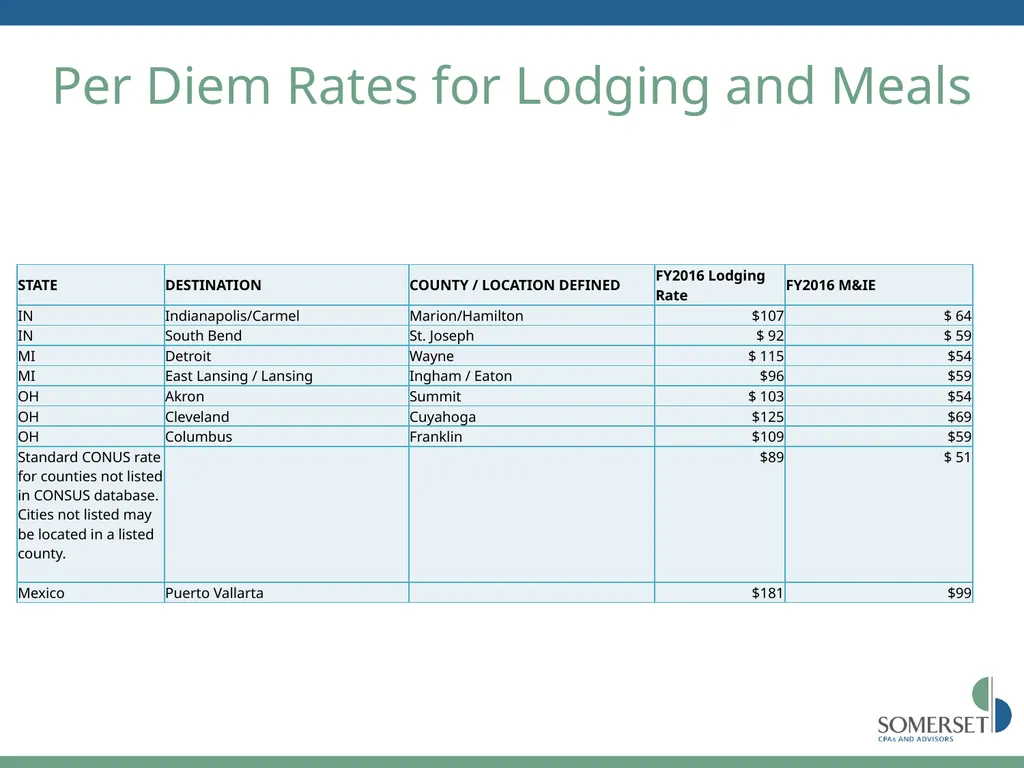
Per Diem Rates for Lodging and Meals<br>
20
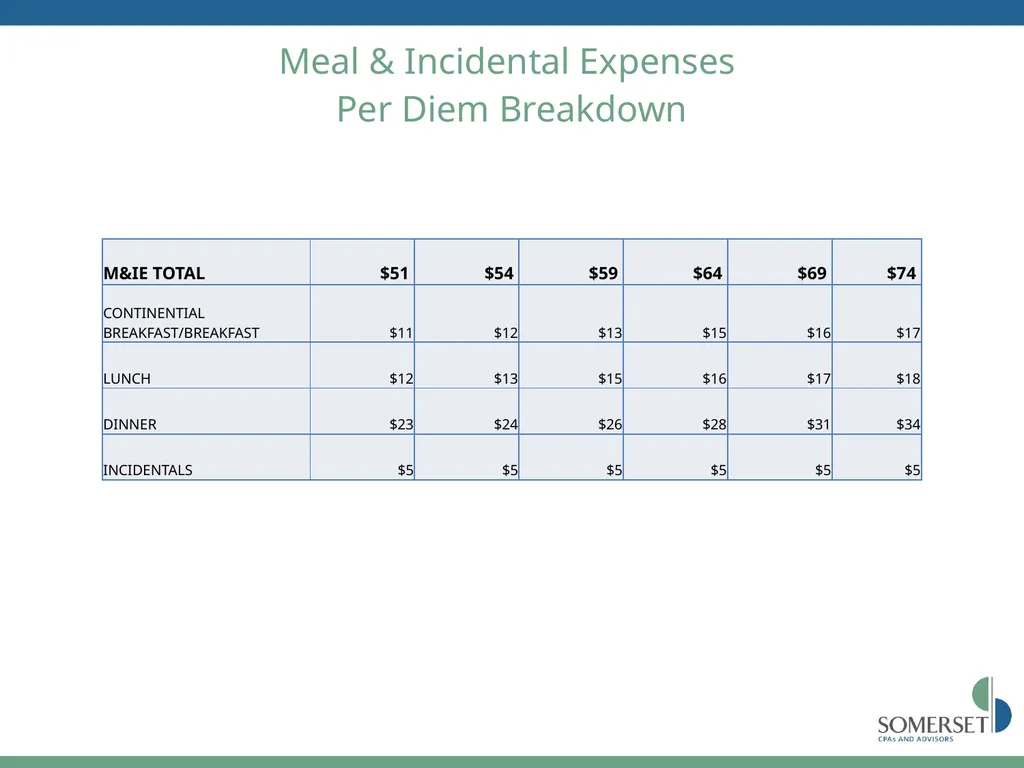
Meal & Incidental Expenses
Per Diem Breakdown<br>
21
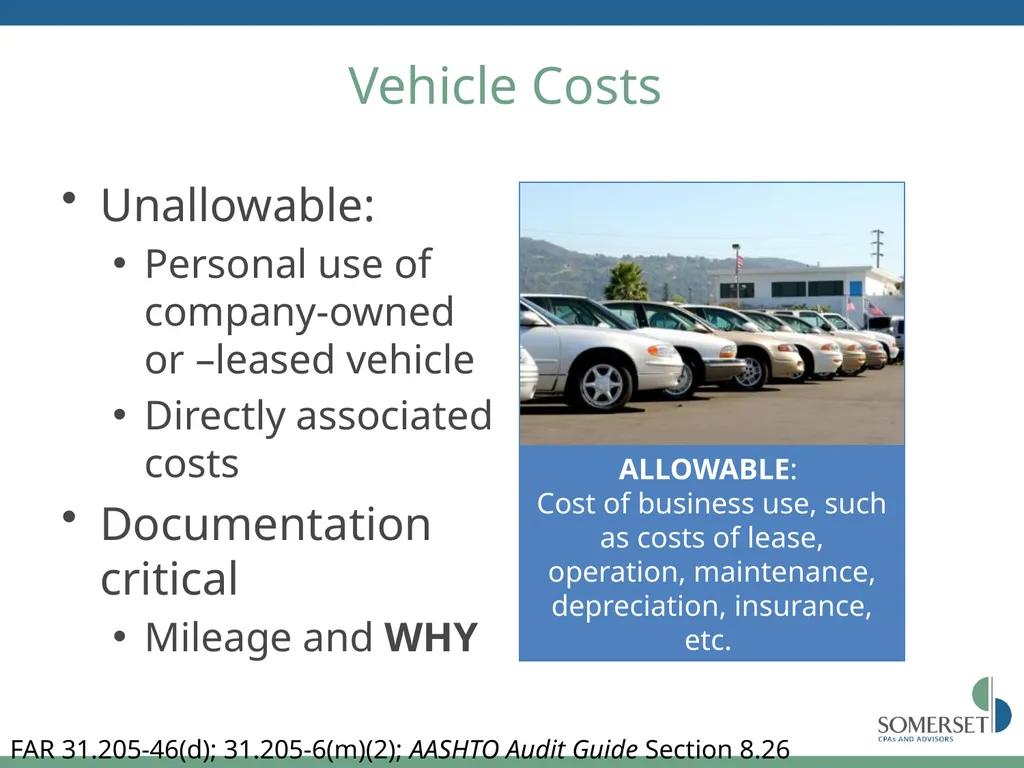
Vehicle Costs Unallowable:
Personal use of company-owned or –leased vehicle
Directly associated costs
Documentation critical
Mileage and WHY FAR 31.205-46(d); 31.205-6(m)(2); AASHTO Audit Guide Section 8.26<br>
Personal use of company-owned or –leased vehicle
Directly associated costs
Documentation critical
Mileage and WHY FAR 31.205-46(d); 31.205-6(m)(2); AASHTO Audit Guide Section 8.26<br>
22
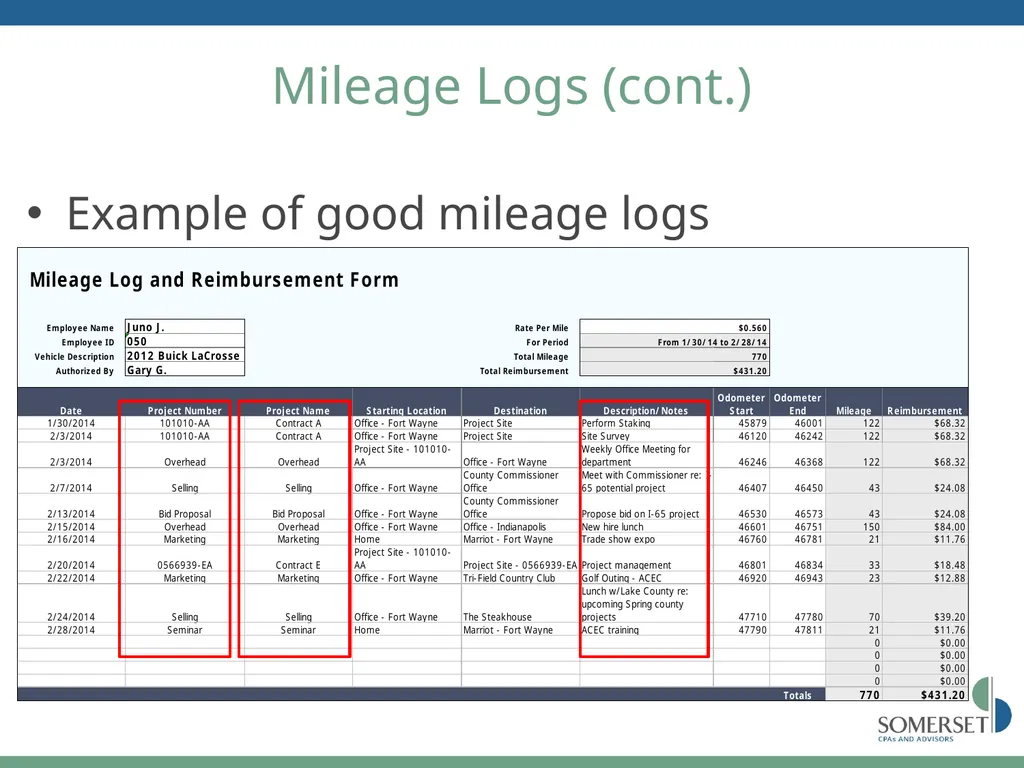
Mileage Logs Mileage on company owned/leased vehicles can be allowable under certain criteria.
Mileage logs must be kept on every vehicle the company owns or leases.
Mileage logs must have the 5 W’s (who, what, where, when and why) documented for proper determination of allowability.<br>
Mileage logs must be kept on every vehicle the company owns or leases.
Mileage logs must have the 5 W’s (who, what, where, when and why) documented for proper determination of allowability.<br>
23
Mileage Logs (cont.) Mileage is unallowable for the following:
Direct project work (Direct vs. Indirect)
Unallowable selling related activity
Personal use/commuting use
Political use (political fundraiser events)
Entertainment use (sporting events, golfing events, etc.)
Certain charity events<br>
Direct project work (Direct vs. Indirect)
Unallowable selling related activity
Personal use/commuting use
Political use (political fundraiser events)
Entertainment use (sporting events, golfing events, etc.)
Certain charity events<br>
24
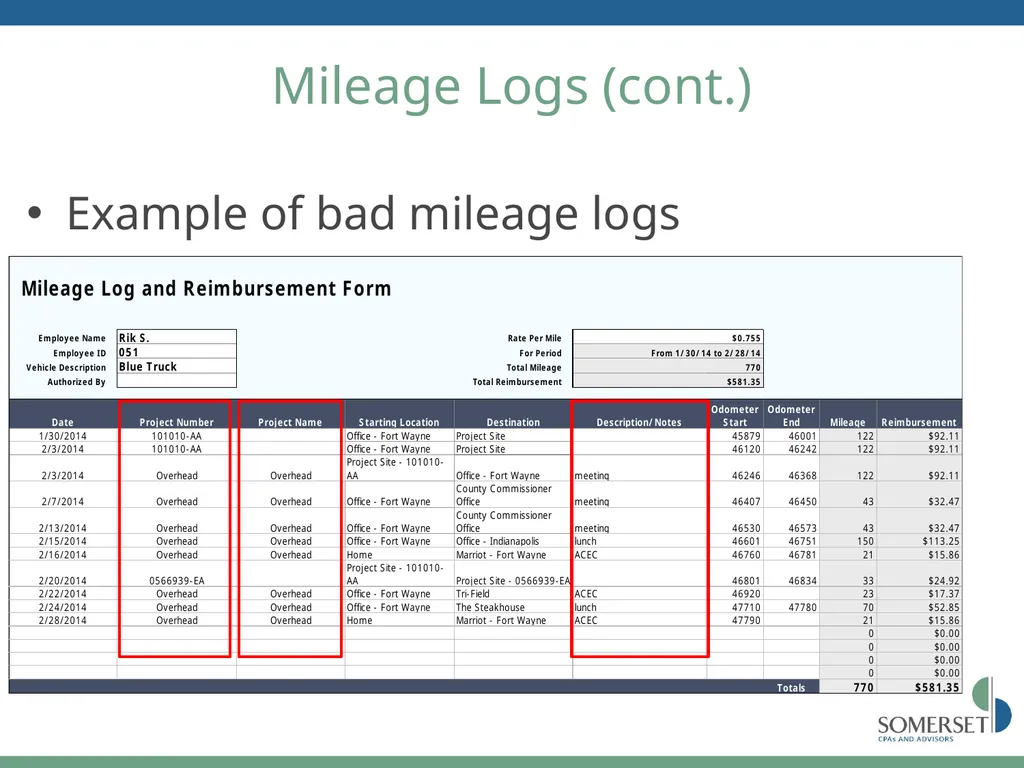
Mileage Logs (cont.) Example of bad mileage logs<br>
25
Mileage Logs (cont.) Example of good mileage logs<br>
26
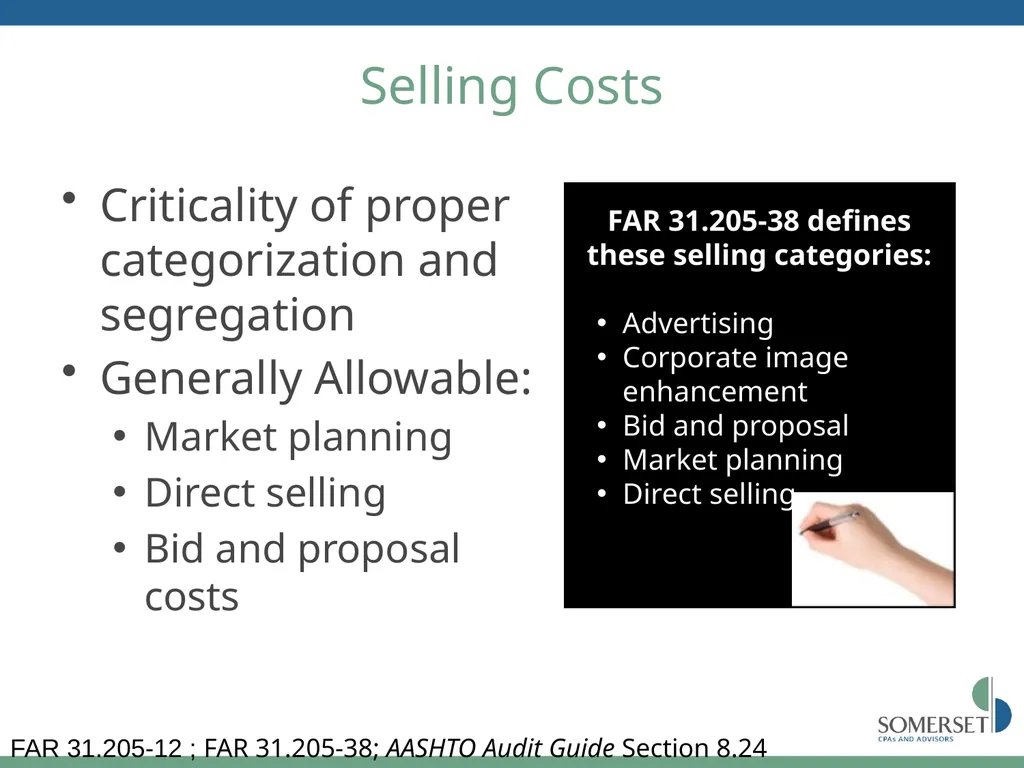
Selling Costs Criticality of proper categorization and segregation
Generally Allowable:
Market planning
Direct selling
Bid and proposal costs FAR 31.205-12 ; FAR 31.205-38; AASHTO Audit Guide Section 8.24<br>
Generally Allowable:
Market planning
Direct selling
Bid and proposal costs FAR 31.205-12 ; FAR 31.205-38; AASHTO Audit Guide Section 8.24<br>
27
Selling Expenses Generic term encompassing all efforts to market a consultant’s services.
Includes – advertising, public relations, bid and proposal, market planning and direct selling.<br>
Includes – advertising, public relations, bid and proposal, market planning and direct selling.<br>
28
Selling Expenses (cont.) Advertising is the use of media (conventions, exhibits, free goods, magazines, newspapers, outdoor advertising, radio, television, etc.) to promote sale of products or services. (FAR 31.201-1)
Only allowable advertising costs are those specifically required by contract, costs related to employee recruitment or costs to promote sales of services normally sold to the US government.<br>
Only allowable advertising costs are those specifically required by contract, costs related to employee recruitment or costs to promote sales of services normally sold to the US government.<br>
29
Selling Expenses (cont.) Public relations (PR) is maintaining, protecting, and enhancing the image of a concern or its products or maintaining or promoting reciprocal understanding and favorable relations with the public at large, or any segment of the public.
Allowable PR costs are those specifically required by contract, costs of responding to inquiries on company policies and activities, costs of participation in community service activities, and costs of plant tours and open houses (but not if designed to call favorable attention to the consultant and its activities.)<br>
Allowable PR costs are those specifically required by contract, costs of responding to inquiries on company policies and activities, costs of participation in community service activities, and costs of plant tours and open houses (but not if designed to call favorable attention to the consultant and its activities.)<br>
30
Selling Expenses (cont.) Public relations (cont.)
Unallowable activities include – activities whose primary purpose is to promote sale of products/services, messages calling favorable attention to the consultant, costs of trade shows which do not contain significant effort to promote export sales of products normally sold to the US government, costs of sponsoring meetings, conventions and other events when principal purpose is other than dissemination of technical information.<br>
Unallowable activities include – activities whose primary purpose is to promote sale of products/services, messages calling favorable attention to the consultant, costs of trade shows which do not contain significant effort to promote export sales of products normally sold to the US government, costs of sponsoring meetings, conventions and other events when principal purpose is other than dissemination of technical information.<br>
31
Selling Expenses (cont.) Public relations (cont.)
Other unallowable activities include –
Costs of corporate celebrations
Costs of promotional material designed to call attention to the consultant
Costs of souvenirs, imprinted clothing, buttons and other mementos provided to customers and public
Costs of memberships in civic and community organizations.<br>
Other unallowable activities include –
Costs of corporate celebrations
Costs of promotional material designed to call attention to the consultant
Costs of souvenirs, imprinted clothing, buttons and other mementos provided to customers and public
Costs of memberships in civic and community organizations.<br>
32
Selling Expenses (cont.) Bid and proposal costs are costs incurred in preparing, submitting and supporting bids and proposals (whether or not solicited) on potential contracts.
Allowable to the extent that they are reasonable.
Activities include – responding to RFP’s, developing technical and cost proposals, and project scoping prior to contract execution<br>
Allowable to the extent that they are reasonable.
Activities include – responding to RFP’s, developing technical and cost proposals, and project scoping prior to contract execution<br>
33
Selling Expenses (cont.) Market Planning – involves market research and analysis and generalized management planning concerned with development of consultant’s business.
Allowable to extent they are reasonable.<br>
Allowable to extent they are reasonable.<br>
34
Selling Expenses (cont.) Direct selling efforts are acts or actions to induce particular customers to purchase particular products or services of the consultant.
Characterized by person-to-person contact
Activities include:
Familiarizing a potential customer with consultant’s services, capabilities, etc.
Negotiations, demonstrations, liaison between customer and contractor personnel.
Meetings with current or prospective clients to discuss potential future work.
Allowable if amounts are reasonable.<br>
Characterized by person-to-person contact
Activities include:
Familiarizing a potential customer with consultant’s services, capabilities, etc.
Negotiations, demonstrations, liaison between customer and contractor personnel.
Meetings with current or prospective clients to discuss potential future work.
Allowable if amounts are reasonable.<br>
35
Selling Expenses (cont.) Allowable and unallowable selling expenses must be segregated per FAR.
Time input should provide ability to segregate unallowable selling efforts (time incurred) from allowable selling efforts.
Time input, expense report, and credit card receipts should include description of the 5 W’s – who, what, where, when, and why.<br>
Time input should provide ability to segregate unallowable selling efforts (time incurred) from allowable selling efforts.
Time input, expense report, and credit card receipts should include description of the 5 W’s – who, what, where, when, and why.<br>
36
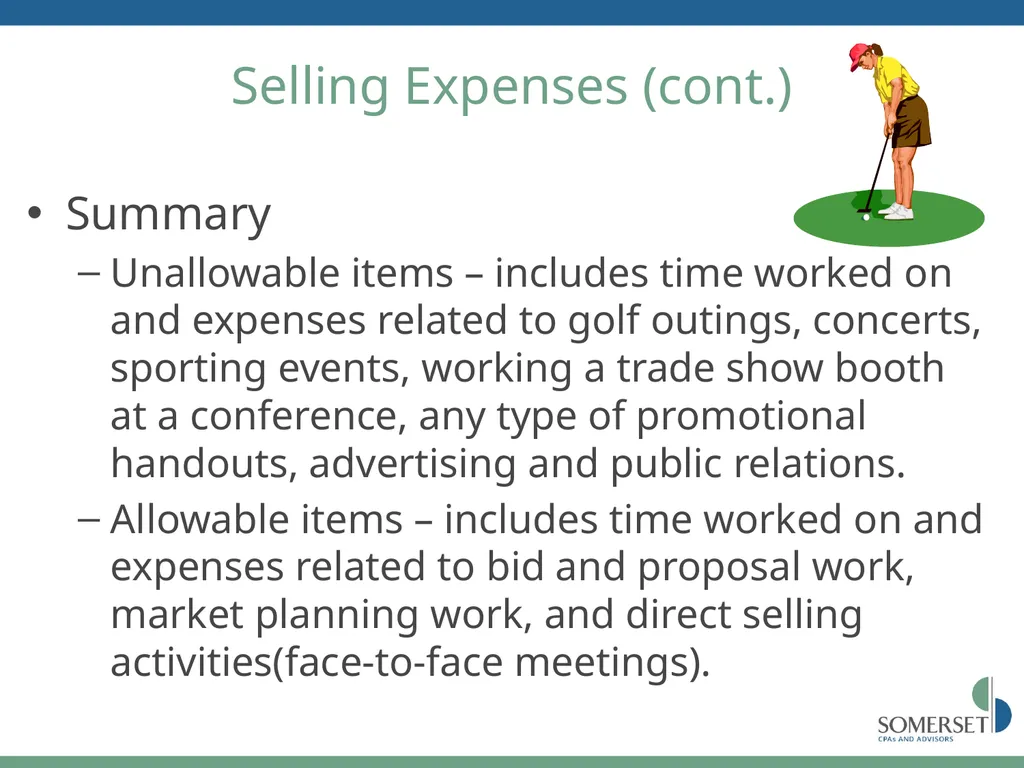
Selling Expenses (cont.) Summary
Unallowable items – includes time worked on and expenses related to golf outings, concerts, sporting events, working a trade show booth at a conference, any type of promotional handouts, advertising and public relations.
Allowable items – includes time worked on and expenses related to bid and proposal work, market planning work, and direct selling activities(face-to-face meetings).<br>
Unallowable items – includes time worked on and expenses related to golf outings, concerts, sporting events, working a trade show booth at a conference, any type of promotional handouts, advertising and public relations.
Allowable items – includes time worked on and expenses related to bid and proposal work, market planning work, and direct selling activities(face-to-face meetings).<br>
37
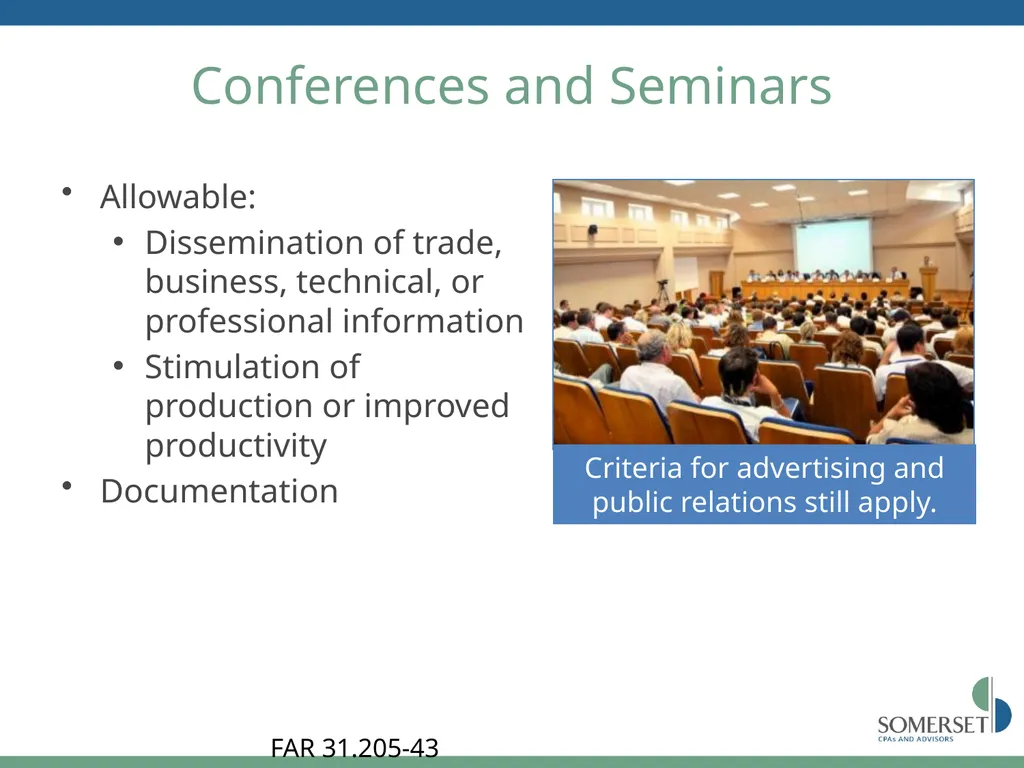
Conferences and Seminars Allowable:
Dissemination of trade, business, technical, or professional information
Stimulation of production or improved productivity
Documentation FAR 31.205-43<br>
Dissemination of trade, business, technical, or professional information
Stimulation of production or improved productivity
Documentation FAR 31.205-43<br>
38
Miscellaneous Pre-contract costs
(FAR 31.205-32)
Relocation costs (FAR 31.205-35)
Training and education costs (FAR 31.205-44) AASHTO Audit Guide Section 8.25<br>
Relocation costs (FAR 31.205-35)
Training and education costs (FAR 31.205-44) AASHTO Audit Guide Section 8.25<br>
39
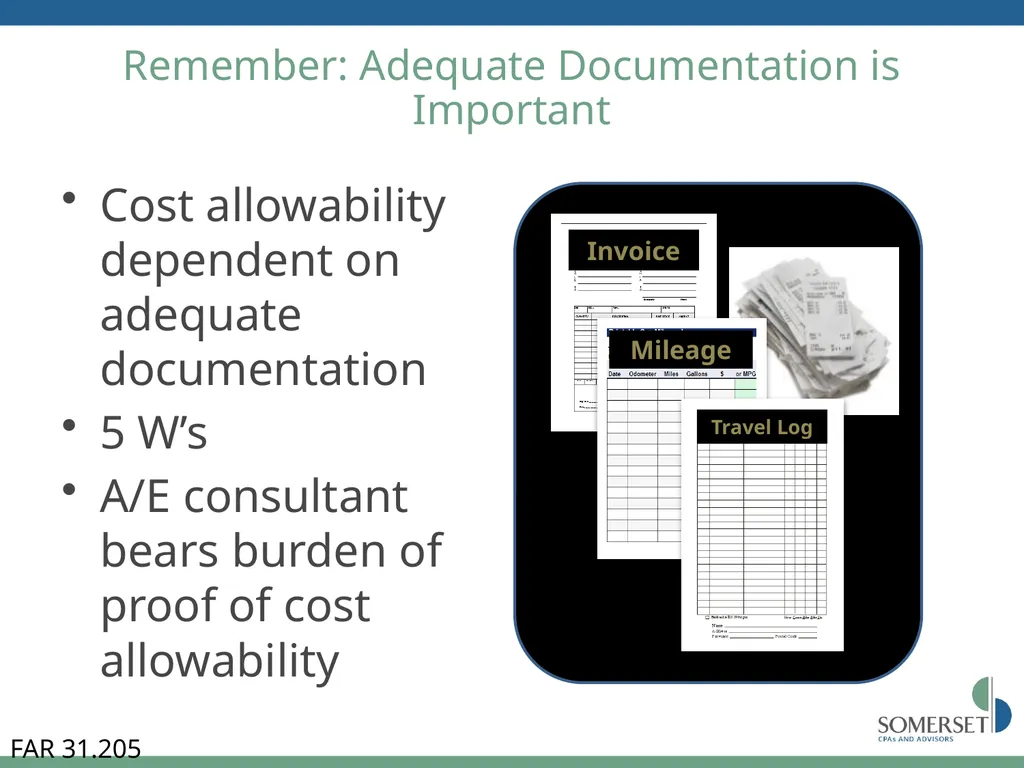
Remember: Adequate Documentation is Important Cost allowability dependent on adequate documentation
5 W’s
A/E consultant bears burden of proof of cost allowability FAR 31.205<br>
5 W’s
A/E consultant bears burden of proof of cost allowability FAR 31.205<br>
40
Lesson Summary What questions do you have about:
How the Company overhead rate is calculated and its impact to the Company.
Defining directly associated cost and explaining its applicability to allowability?
Evaluating examples of expressly unallowable cost categories and those requiring additional analysis to determine allowability?<br>
How the Company overhead rate is calculated and its impact to the Company.
Defining directly associated cost and explaining its applicability to allowability?
Evaluating examples of expressly unallowable cost categories and those requiring additional analysis to determine allowability?<br>
41
Examples<br>
42
Deferred Compensation and your Overhead Rate<br>
43
Attract, retain and reward top, key talent
Complete flexibility in design (customize to meet goals / needs)
In addition to compensation and cash bonuses (not a take away)
First and foremast reward for key employees for their contributions
Recognition of substantial contributions to the operations and financial success of the organization
Provide additional financial security as an inducement to remain employed with the corporation Discussion Points<br>
Complete flexibility in design (customize to meet goals / needs)
In addition to compensation and cash bonuses (not a take away)
First and foremast reward for key employees for their contributions
Recognition of substantial contributions to the operations and financial success of the organization
Provide additional financial security as an inducement to remain employed with the corporation Discussion Points<br>
44
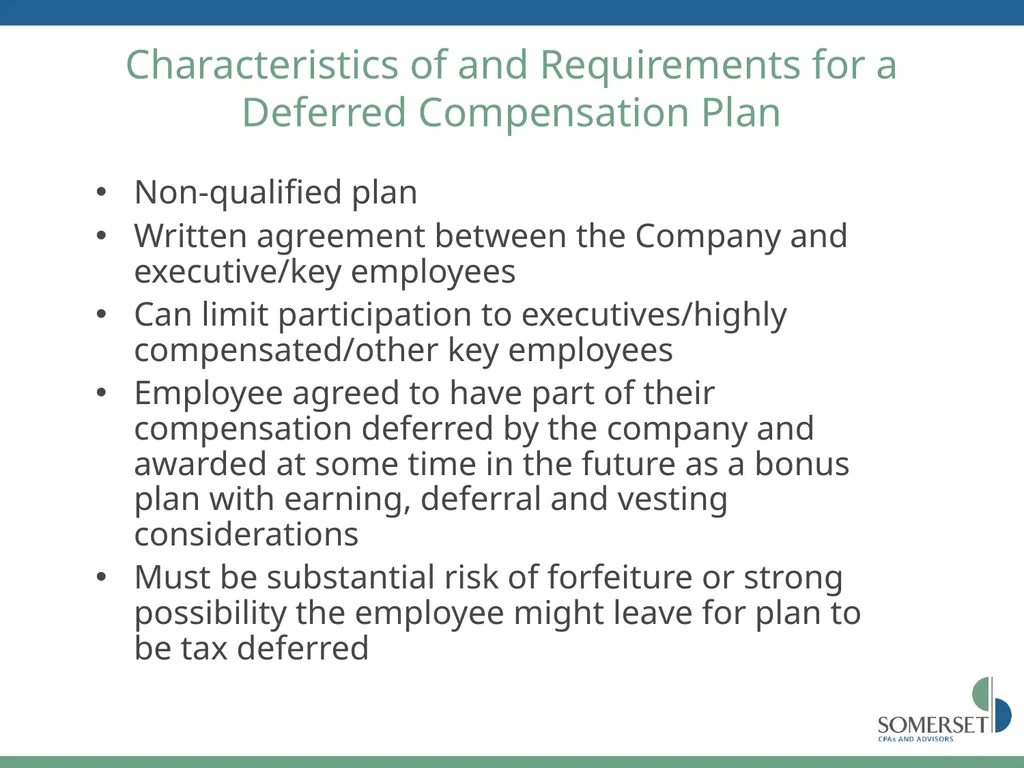
Non-qualified plan
Written agreement between the Company and executive/key employees
Can limit participation to executives/highly compensated/other key employees
Employee agreed to have part of their compensation deferred by the company and awarded at some time in the future as a bonus plan with earning, deferral and vesting considerations
Must be substantial risk of forfeiture or strong possibility the employee might leave for plan to be tax deferred Characteristics of and Requirements for a Deferred Compensation Plan<br>
Written agreement between the Company and executive/key employees
Can limit participation to executives/highly compensated/other key employees
Employee agreed to have part of their compensation deferred by the company and awarded at some time in the future as a bonus plan with earning, deferral and vesting considerations
Must be substantial risk of forfeiture or strong possibility the employee might leave for plan to be tax deferred Characteristics of and Requirements for a Deferred Compensation Plan<br>
45
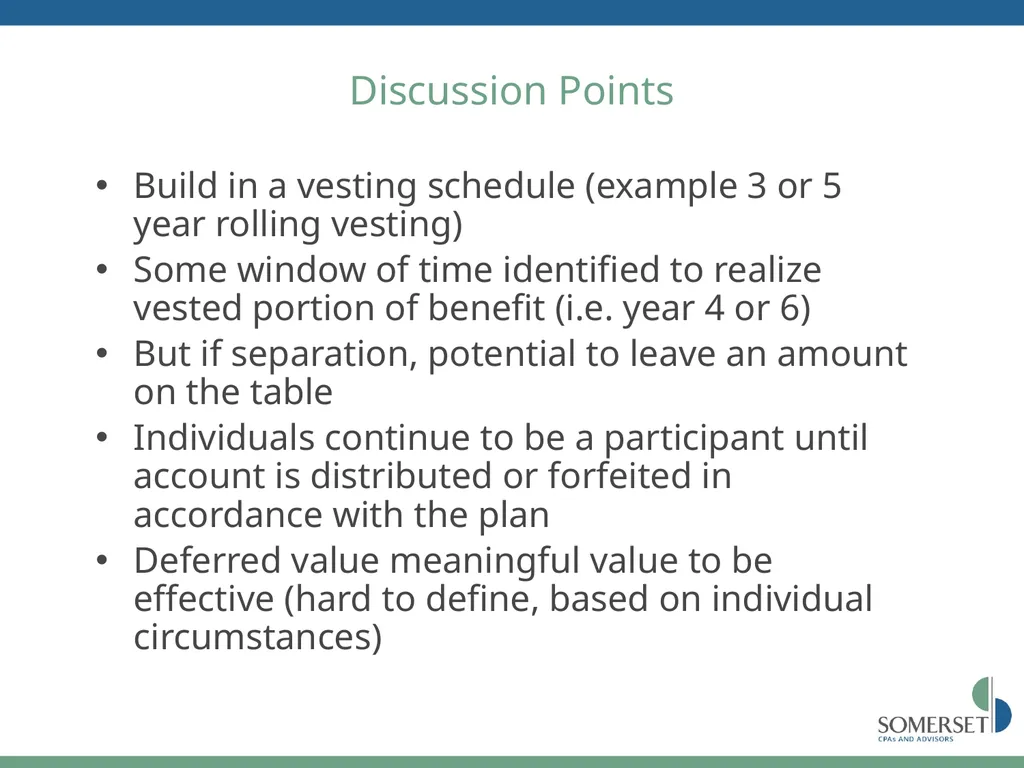
Build in a vesting schedule (example 3 or 5 year rolling vesting)
Some window of time identified to realize vested portion of benefit (i.e. year 4 or 6)
But if separation, potential to leave an amount on the table
Individuals continue to be a participant until account is distributed or forfeited in accordance with the plan
Deferred value meaningful value to be effective (hard to define, based on individual circumstances) Discussion Points<br>
Some window of time identified to realize vested portion of benefit (i.e. year 4 or 6)
But if separation, potential to leave an amount on the table
Individuals continue to be a participant until account is distributed or forfeited in accordance with the plan
Deferred value meaningful value to be effective (hard to define, based on individual circumstances) Discussion Points<br>
46
Fully vest on certain triggering events
i.e. Death
X years with the company and attend defined retirement age
Creating Deferred Compensation Pools:
Identify corporate performance needed
Identify personal CFI and KPIs for individual performance
Annual Statement Provided Annually (Pools Created, Interest/Growth, Vesting, Payout and Forfeiture) Discussion Points<br>
i.e. Death
X years with the company and attend defined retirement age
Creating Deferred Compensation Pools:
Identify corporate performance needed
Identify personal CFI and KPIs for individual performance
Annual Statement Provided Annually (Pools Created, Interest/Growth, Vesting, Payout and Forfeiture) Discussion Points<br>
47
Pre-determined criteria for participation (optional)
Predominately a performance based plan (handling of annual change between participants can vary to design)
Can have various levels of participation (A, B units, etc.)
Complete flexibility in design
Funding Formula (stock value, annual profitability)
Vesting Terms
Payout Terms Characteristics of and Requirements for a Deferred Compensation Plan<br>
Predominately a performance based plan (handling of annual change between participants can vary to design)
Can have various levels of participation (A, B units, etc.)
Complete flexibility in design
Funding Formula (stock value, annual profitability)
Vesting Terms
Payout Terms Characteristics of and Requirements for a Deferred Compensation Plan<br>
48
Obligation accrued on balance sheet, impact financials and ratios
Impacts financials, cash if funded, accrued liability, net profit, and equity
Impacts ratios, working capital, debt to equity, profitability and others
Obligation will have short term and long term components
Can pro-rate and net present value obligation as earned
Tax Considerations
Not deductible to Company or included in employee income until earned and paid for federal and state income tax
Special FICA / Medicare treatment when earned and not subject to substantial risk of forfeiture Characteristics of and Requirements for a Deferred Compensation Plan<br>
Impacts financials, cash if funded, accrued liability, net profit, and equity
Impacts ratios, working capital, debt to equity, profitability and others
Obligation will have short term and long term components
Can pro-rate and net present value obligation as earned
Tax Considerations
Not deductible to Company or included in employee income until earned and paid for federal and state income tax
Special FICA / Medicare treatment when earned and not subject to substantial risk of forfeiture Characteristics of and Requirements for a Deferred Compensation Plan<br>
49
Funding of obligation (optional but recommended)
Consideration of use of Rabbi Trust
Allows participant “limited” input over investment of funds (careful, need to avoid constructive receipt)
Level of protection from creditor claims in ordinary course of business (not company bankruptcy)
Subject to 409A regulations, tax code with detailed requirements, deferral elections, distributions, etc.
Thorough preparation of documents to protect Company Characteristics of and Requirements for a Deferred Compensation Plan<br>
Consideration of use of Rabbi Trust
Allows participant “limited” input over investment of funds (careful, need to avoid constructive receipt)
Level of protection from creditor claims in ordinary course of business (not company bankruptcy)
Subject to 409A regulations, tax code with detailed requirements, deferral elections, distributions, etc.
Thorough preparation of documents to protect Company Characteristics of and Requirements for a Deferred Compensation Plan<br>
50
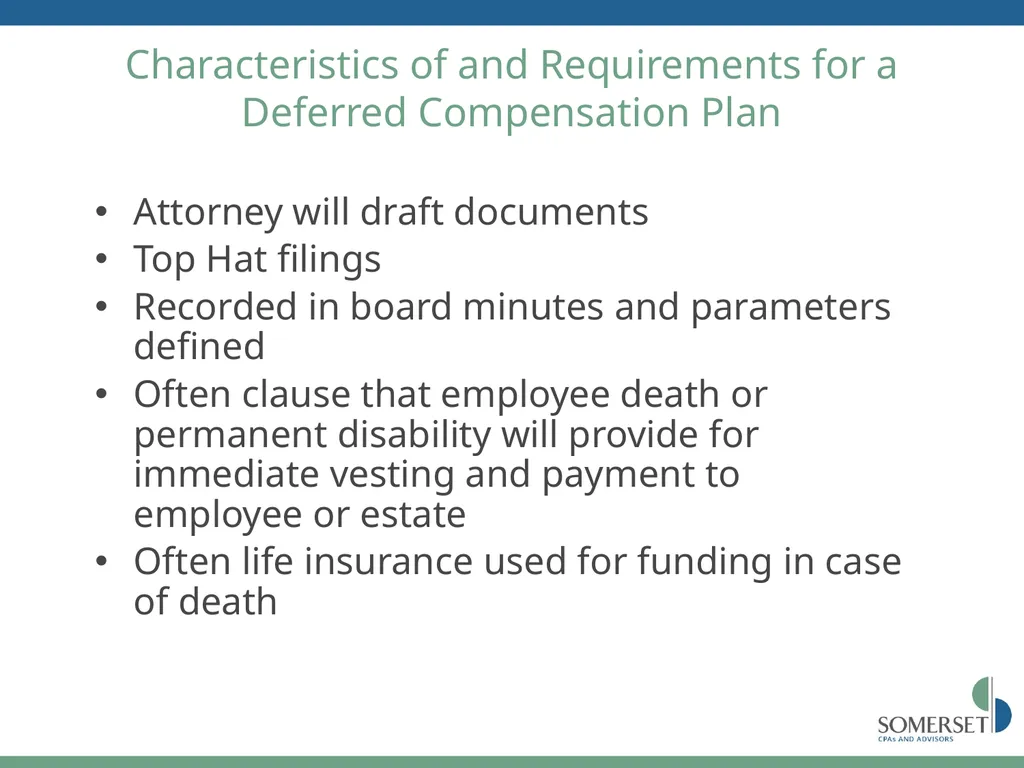
Attorney will draft documents
Top Hat filings
Recorded in board minutes and parameters defined
Often clause that employee death or permanent disability will provide for immediate vesting and payment to employee or estate
Often life insurance used for funding in case of death Characteristics of and Requirements for a Deferred Compensation Plan<br>
Top Hat filings
Recorded in board minutes and parameters defined
Often clause that employee death or permanent disability will provide for immediate vesting and payment to employee or estate
Often life insurance used for funding in case of death Characteristics of and Requirements for a Deferred Compensation Plan<br>
51
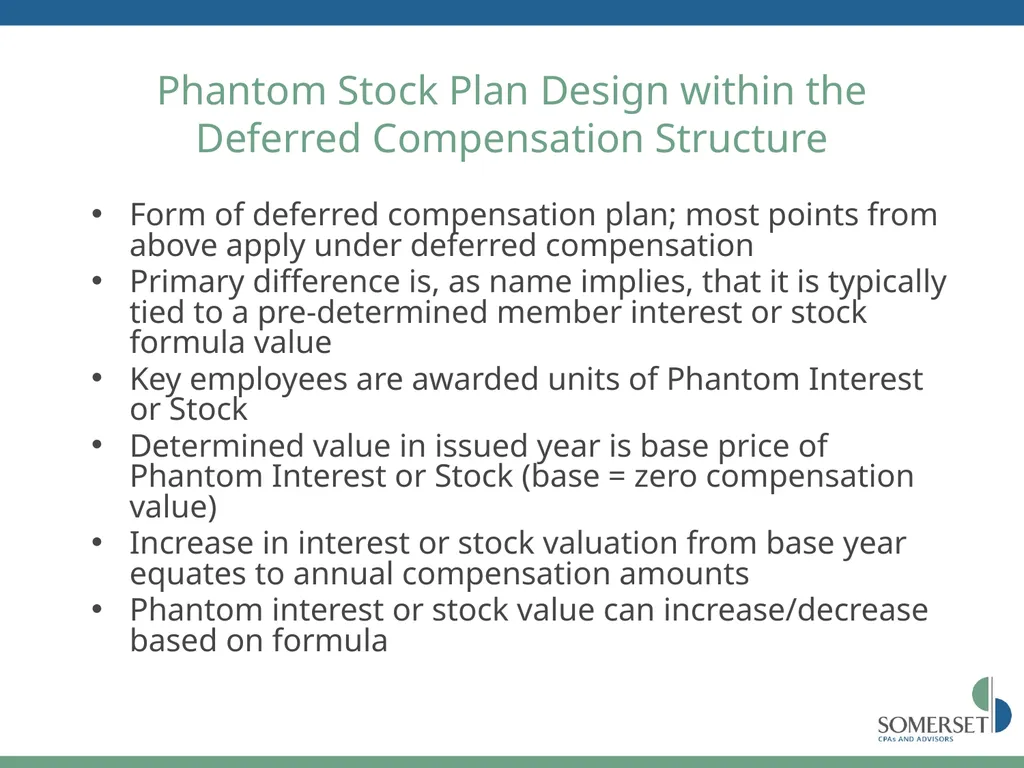
Form of deferred compensation plan; most points from above apply under deferred compensation
Primary difference is, as name implies, that it is typically tied to a pre-determined member interest or stock formula value
Key employees are awarded units of Phantom Interest or Stock
Determined value in issued year is base price of Phantom Interest or Stock (base = zero compensation value)
Increase in interest or stock valuation from base year equates to annual compensation amounts
Phantom interest or stock value can increase/decrease based on formula Phantom Stock Plan Design within the Deferred Compensation Structure<br>
Primary difference is, as name implies, that it is typically tied to a pre-determined member interest or stock formula value
Key employees are awarded units of Phantom Interest or Stock
Determined value in issued year is base price of Phantom Interest or Stock (base = zero compensation value)
Increase in interest or stock valuation from base year equates to annual compensation amounts
Phantom interest or stock value can increase/decrease based on formula Phantom Stock Plan Design within the Deferred Compensation Structure<br>
52
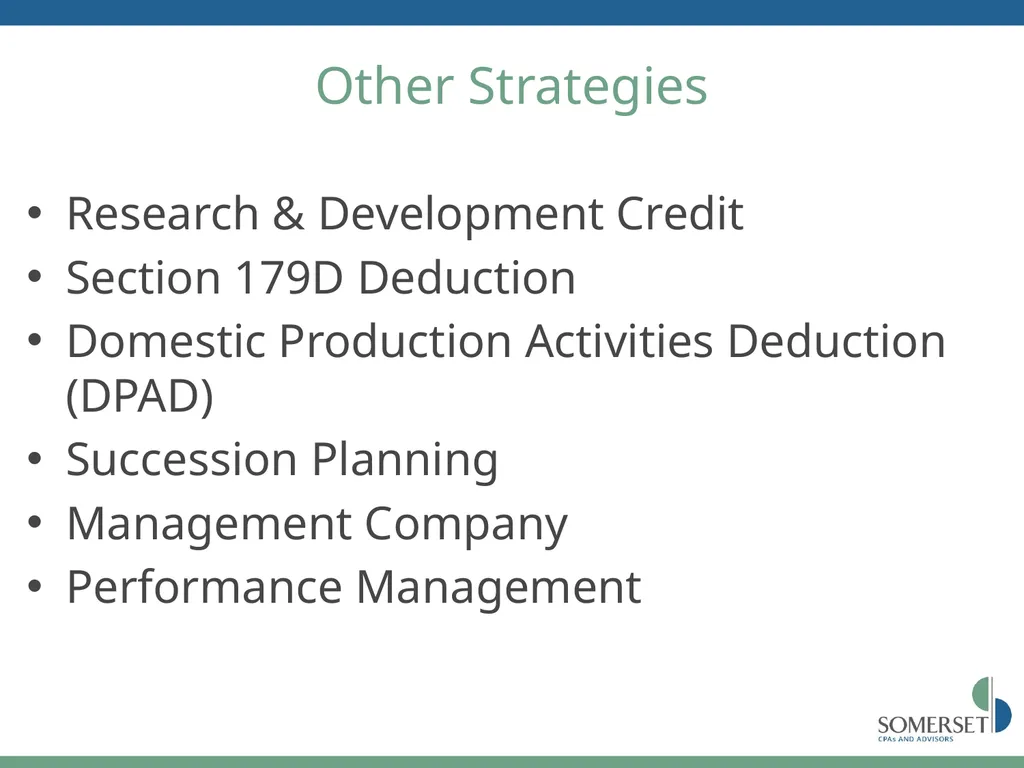
Other Strategies Research & Development Credit
Section 179D Deduction
Domestic Production Activities Deduction (DPAD)
Succession Planning
Management Company
Performance Management<br>
Section 179D Deduction
Domestic Production Activities Deduction (DPAD)
Succession Planning
Management Company
Performance Management<br>