
MCA 520: Graph Theory Instructor Neelima Gupta
Description: MCA 520: Graph Theory Instructor Neelima Gupta nguptacs.du.ac.in Table of Contents Walks, Trails and Paths Walks May have repeated Edges and Vertices. In case of multi-graph, we include the edges also. In a simple graph, we can omit the
Related Topics
Download Presentation
"MCA 520: Graph Theory Instructor Neelima Gupta" is the property of its rightful owner. Permission is granted to download and print the materials on this website for personal, non-commercial use only, and to display it on your personal computer provided you do not modify the materials and that you retain all copyright notices contained in the materials. By downloading content from our website, you accept the terms of this agreement.
Presentation Transcript
slide1. MCA 520: Graph Theory Instructor
Neelima Gupta
ngupta@cs.du.ac.in<br>
slide2. Table of Contents Walks, Trails and Paths<br>
slide3. Walks May have repeated Edges and Vertices.
In case of multi-graph, we include the edges also. In a simple graph, we can omit the edges and simply mention the sequence of vertices.
Closed Walk<br>
slide4. Trails No repeated edges but vertices may repeat.
Closed Trail<br>
slide5. Path Neither vertices nor edges repeat.
Definition:
we say that a u-v walk W contains a u-v path P if all the edges and vertices of P occur in W and in that order but not necessarily consecutive.
Similarly a closed walk W contains a cycle C if …..
Lemma: Every u-v walk contains a u-v path<br>
slide6. Odd/Even Walk Odd/Even walk : number of edges is odd/even
Lemma: Every closed odd walk contains an odd cycle.
Remark: A closed even walk need not even contain a cycle, it may simply repeat edges. But, if an edge e appears exactly once in a closed walk, then the walk contains a cycle through e.<br>
slide7. Even Graph A vertex is stb even(/odd) if its degree is even(/odd).
A graph is stb an even graph if all its vertices are even.<br>
slide8. Maximal Path A path in a graph is stb maximal if it is not contained in a longer path.
If a graph is finite, maximal path always exists.
If every vertex in a finite graph G has degree at least 2 then it contains a cycle.
This is not true if the graph is not finite.<br>
slide9. Connection Relation (u,v): u is stb connected to v ……
Symmetric, Reflexive, Transitive
Equivalence Relation
Equivalence Class: Connected Component<br>
slide10. Lemma: A graph with n vertices and k edges has at least n – k components.
Proof: A graph with no edges has n components. Adding an edges reduces the number of components by at most 1. Thus after adding k edges, number of components is at least n – k.<br>
slide11. Deleting an edge/vertex G – e: Deleting an edge does not delete its incident vertices.
G – v: Deleting a vertex delete its incident edges.
Thus deleting an edge may increase the number of components by at most 1.
Deleting a vertex v may increase the number of components by (more) at most deg(v) – 1.
Induced Graph G[T] = Graph that remains after deleting some vertices such that the set of remaining vertices is T. i.e.
G[T] = (T, E(T)), where E(T) = {(u, v):u,v are in T and (u,v) is an edge in G}
Every subgraph of a graph need not be an induced subgraph.<br>
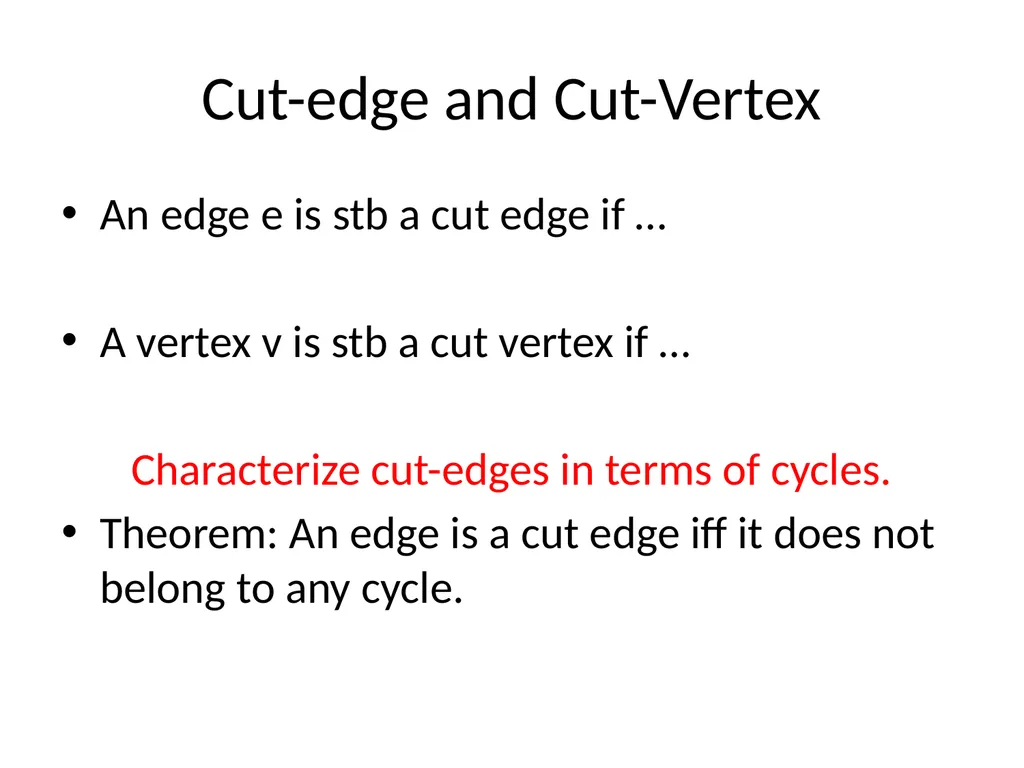
slide12. Cut-edge and Cut-Vertex An edge e is stb a cut edge if …
A vertex v is stb a cut vertex if …
Characterize cut-edges in terms of cycles.
Theorem: An edge is a cut edge iff it does not belong to any cycle.<br>
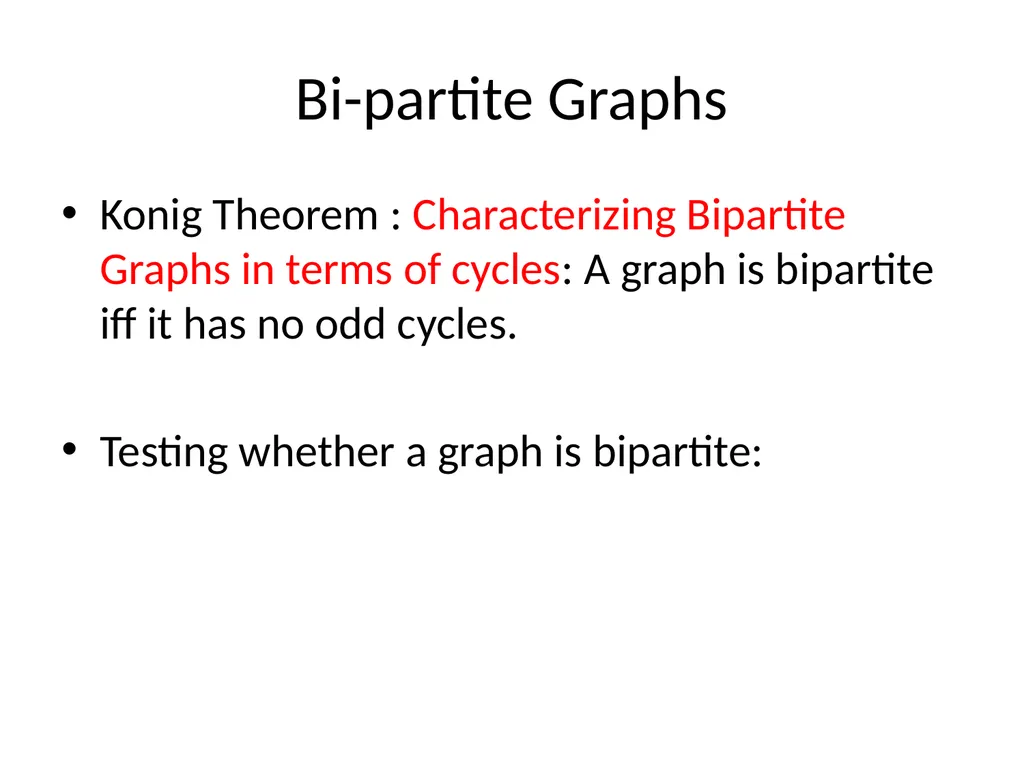
slide13. Bi-partite Graphs Konig Theorem : Characterizing Bipartite Graphs in terms of cycles: A graph is bipartite iff it has no odd cycles.
Testing whether a graph is bipartite:<br>
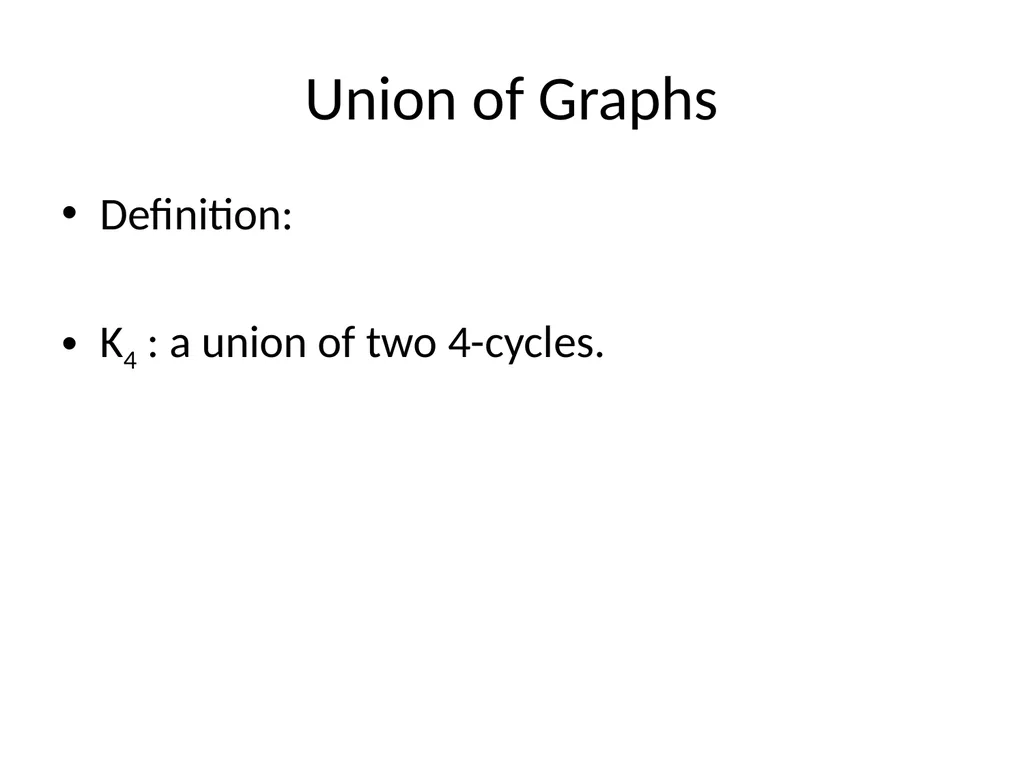
slide14. Union of Graphs Definition:
K4 : a union of two 4-cycles.<br>
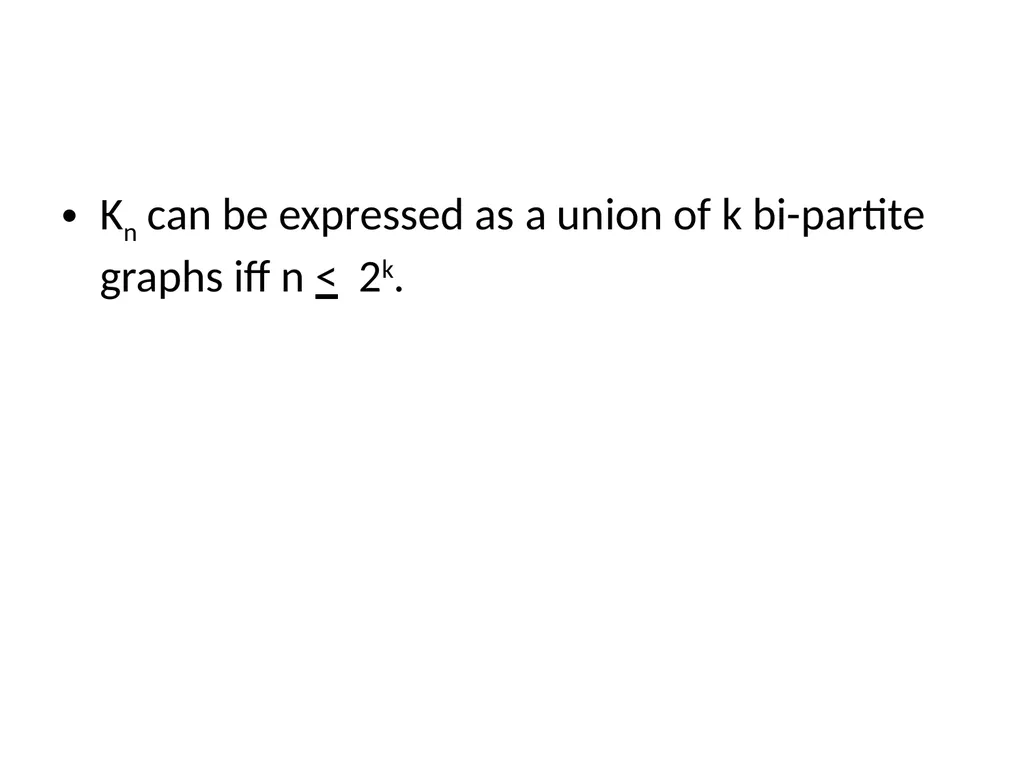
slide15. Kn can be expressed as a union of k bi-partite graphs iff n < 2k.<br>
slide16. Eulerian Circuits A graph is Eulerian if it has a closed trail containing all the edges.
A graph is Eulerian iff it has at most one non-trivial component and all its vertices have even degree.<br>
Neelima Gupta
ngupta@cs.du.ac.in<br>
slide2. Table of Contents Walks, Trails and Paths<br>
slide3. Walks May have repeated Edges and Vertices.
In case of multi-graph, we include the edges also. In a simple graph, we can omit the edges and simply mention the sequence of vertices.
Closed Walk<br>
slide4. Trails No repeated edges but vertices may repeat.
Closed Trail<br>
slide5. Path Neither vertices nor edges repeat.
Definition:
we say that a u-v walk W contains a u-v path P if all the edges and vertices of P occur in W and in that order but not necessarily consecutive.
Similarly a closed walk W contains a cycle C if …..
Lemma: Every u-v walk contains a u-v path<br>
slide6. Odd/Even Walk Odd/Even walk : number of edges is odd/even
Lemma: Every closed odd walk contains an odd cycle.
Remark: A closed even walk need not even contain a cycle, it may simply repeat edges. But, if an edge e appears exactly once in a closed walk, then the walk contains a cycle through e.<br>
slide7. Even Graph A vertex is stb even(/odd) if its degree is even(/odd).
A graph is stb an even graph if all its vertices are even.<br>
slide8. Maximal Path A path in a graph is stb maximal if it is not contained in a longer path.
If a graph is finite, maximal path always exists.
If every vertex in a finite graph G has degree at least 2 then it contains a cycle.
This is not true if the graph is not finite.<br>
slide9. Connection Relation (u,v): u is stb connected to v ……
Symmetric, Reflexive, Transitive
Equivalence Relation
Equivalence Class: Connected Component<br>
slide10. Lemma: A graph with n vertices and k edges has at least n – k components.
Proof: A graph with no edges has n components. Adding an edges reduces the number of components by at most 1. Thus after adding k edges, number of components is at least n – k.<br>
slide11. Deleting an edge/vertex G – e: Deleting an edge does not delete its incident vertices.
G – v: Deleting a vertex delete its incident edges.
Thus deleting an edge may increase the number of components by at most 1.
Deleting a vertex v may increase the number of components by (more) at most deg(v) – 1.
Induced Graph G[T] = Graph that remains after deleting some vertices such that the set of remaining vertices is T. i.e.
G[T] = (T, E(T)), where E(T) = {(u, v):u,v are in T and (u,v) is an edge in G}
Every subgraph of a graph need not be an induced subgraph.<br>
slide12. Cut-edge and Cut-Vertex An edge e is stb a cut edge if …
A vertex v is stb a cut vertex if …
Characterize cut-edges in terms of cycles.
Theorem: An edge is a cut edge iff it does not belong to any cycle.<br>
slide13. Bi-partite Graphs Konig Theorem : Characterizing Bipartite Graphs in terms of cycles: A graph is bipartite iff it has no odd cycles.
Testing whether a graph is bipartite:<br>
slide14. Union of Graphs Definition:
K4 : a union of two 4-cycles.<br>
slide15. Kn can be expressed as a union of k bi-partite graphs iff n < 2k.<br>
slide16. Eulerian Circuits A graph is Eulerian if it has a closed trail containing all the edges.
A graph is Eulerian iff it has at most one non-trivial component and all its vertices have even degree.<br>