
McKinsey 7S Framework (AGS Overview) Table of
TA
Published · 24 slides · 0 views
1 / 1




Description
McKinsey 7S Framework (AGS Overview) Table of Contents Introduction to the McKinsey 7S Model McKinsey 7S Framework Origin The 7 Factors of the McKinsey 7S Model Using McKinseys 7S Model for Change Management Other Ways to Use McKinseys 7S
Related Topics
Share
Embed code
Download this presentation From Below
"McKinsey 7S Framework (AGS Overview) Table of" is the property of its rightful owner. Permission is granted to download and print the materials on this website for personal, non-commercial use only, and to display it on your personal computer provided you do not modify the materials and that you retain all copyright notices contained in the materials. By downloading content from our website, you accept the terms of this agreement.
Presentation Transcript
01
McKinsey 7S Framework
(AGS Overview)<br>
(AGS Overview)<br>
02
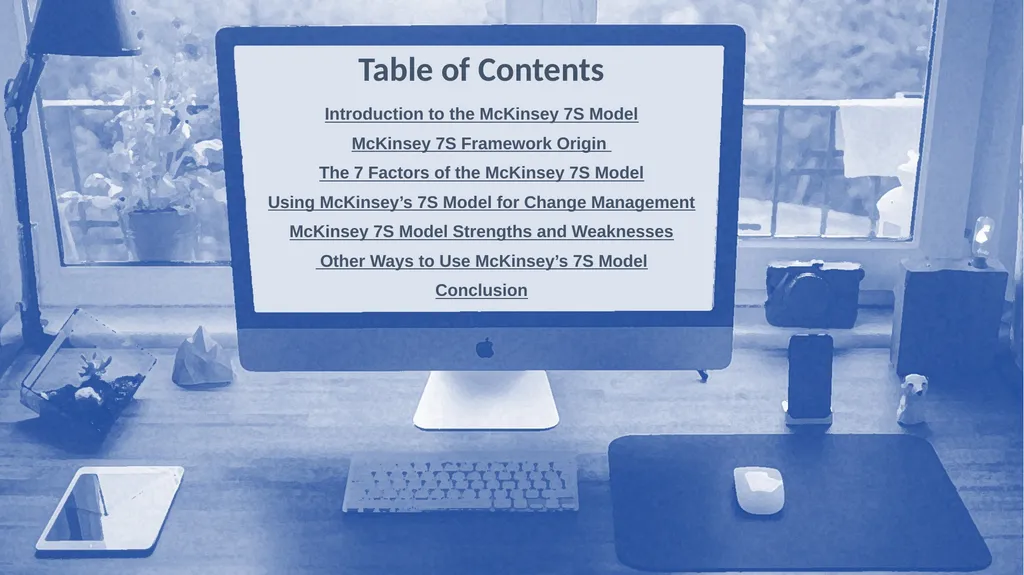
Table of Contents Introduction to the McKinsey 7S Model McKinsey 7S Framework Origin The 7 Factors of the McKinsey 7S Model Using McKinsey’s 7S Model for Change Management Other Ways to Use McKinsey’s 7S Model Conclusion McKinsey 7S Model Strengths and Weaknesses<br>
03
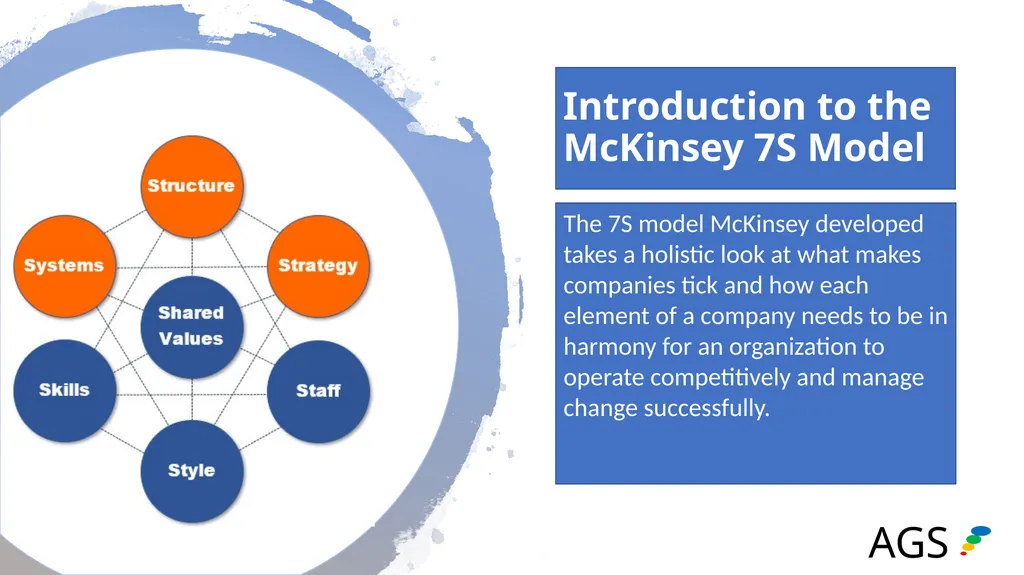
Introduction to the McKinsey 7S Model The 7S model McKinsey developed takes a holistic look at what makes companies tick and how each element of a company needs to be in harmony for an organization to operate competitively and manage change successfully. Tool<br>
04
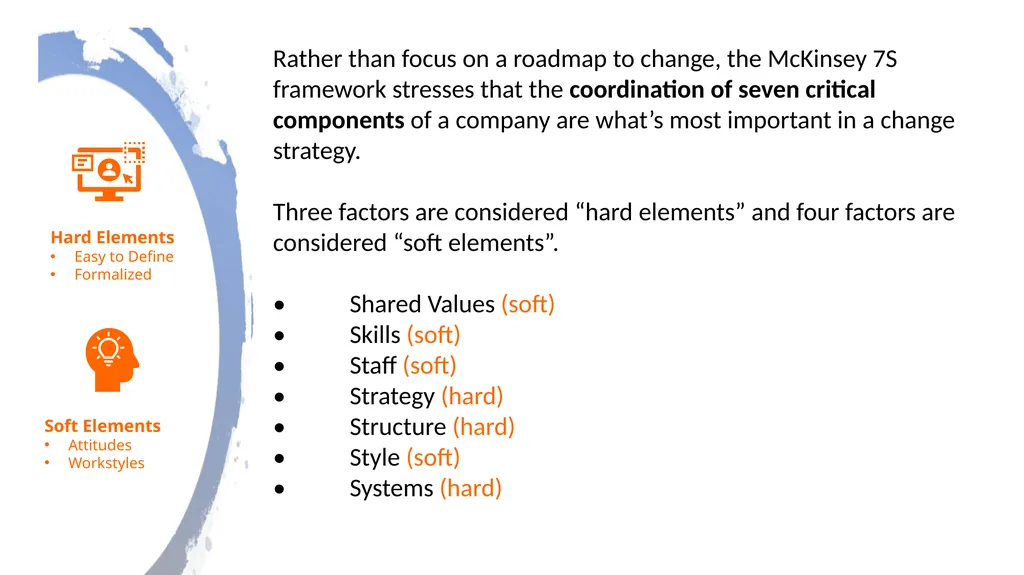
Rather than focus on a roadmap to change, the McKinsey 7S framework stresses that the coordination of seven critical components of a company are what’s most important in a change strategy.
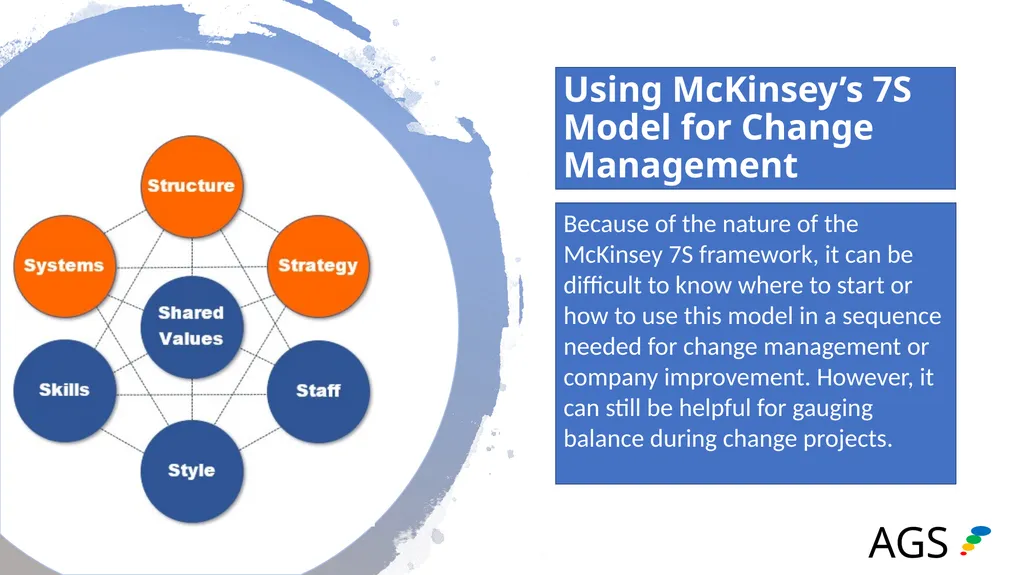
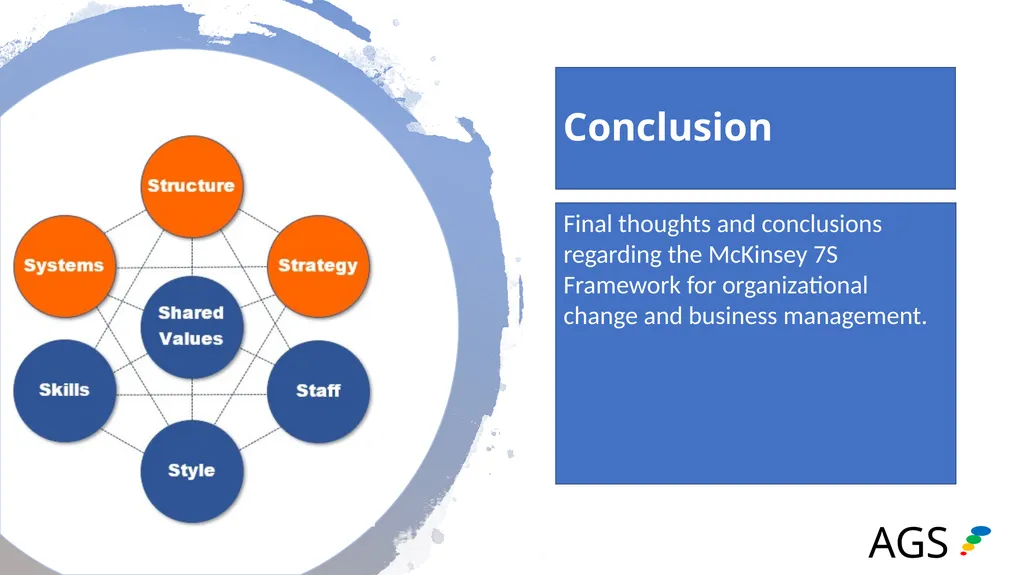
Three factors are considered “hard elements” and four factors are considered “soft elements”.
• Shared Values (soft)
• Skills (soft)
• Staff (soft)
• Strategy (hard)
• Structure (hard)
• Style (soft)
• Systems (hard) Hard Elements
Easy to Define
Formalized Soft Elements
Attitudes
Workstyles<br>
Three factors are considered “hard elements” and four factors are considered “soft elements”.
• Shared Values (soft)
• Skills (soft)
• Staff (soft)
• Strategy (hard)
• Structure (hard)
• Style (soft)
• Systems (hard) Hard Elements
Easy to Define
Formalized Soft Elements
Attitudes
Workstyles<br>
05
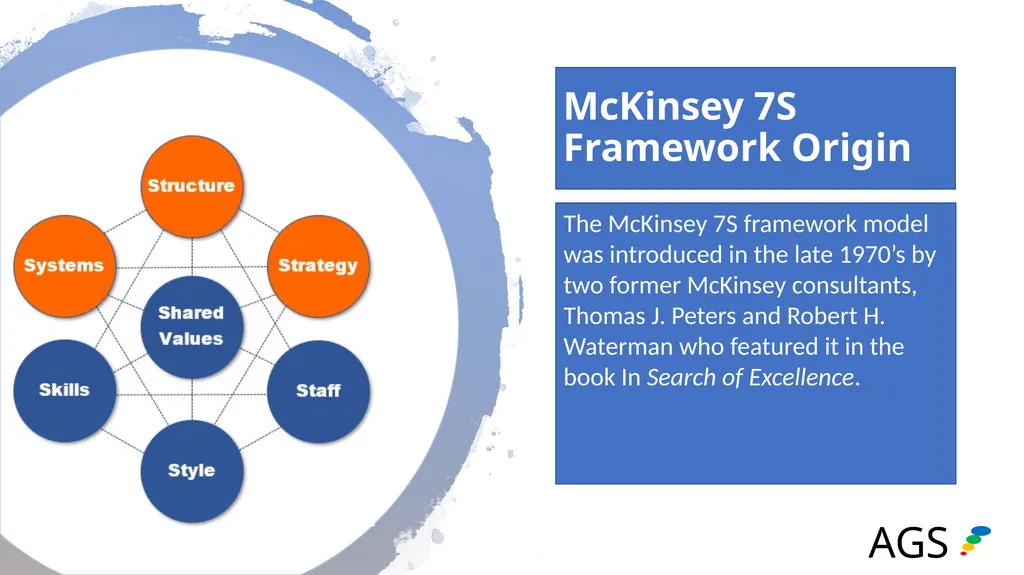
McKinsey 7S Framework Origin The McKinsey 7S framework model was introduced in the late 1970’s by two former McKinsey consultants, Thomas J. Peters and Robert H. Waterman who featured it in the book In Search of Excellence. Tool<br>
06
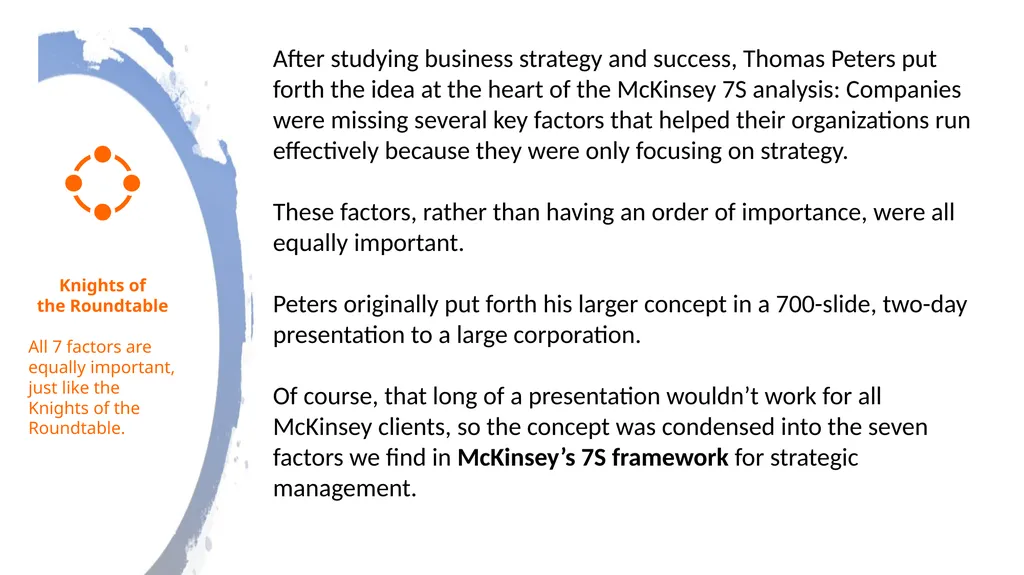
After studying business strategy and success, Thomas Peters put forth the idea at the heart of the McKinsey 7S analysis: Companies were missing several key factors that helped their organizations run effectively because they were only focusing on strategy.
These factors, rather than having an order of importance, were all equally important.
Peters originally put forth his larger concept in a 700-slide, two-day presentation to a large corporation.
Of course, that long of a presentation wouldn’t work for all McKinsey clients, so the concept was condensed into the seven factors we find in McKinsey’s 7S framework for strategic management. Knights of
the Roundtable
All 7 factors are equally important, just like the Knights of the Roundtable.<br>
These factors, rather than having an order of importance, were all equally important.
Peters originally put forth his larger concept in a 700-slide, two-day presentation to a large corporation.
Of course, that long of a presentation wouldn’t work for all McKinsey clients, so the concept was condensed into the seven factors we find in McKinsey’s 7S framework for strategic management. Knights of
the Roundtable
All 7 factors are equally important, just like the Knights of the Roundtable.<br>
07
The 7 Factors of the McKinsey 7S Model The McKinsey 7S framework provides you with several factors that need to be in alignment for your organization to be healthy and thrive. However, there is no specific order to address each element, you simply need to make sure they’re all addressed at some point in your project. Tool<br>
08
Shared Values
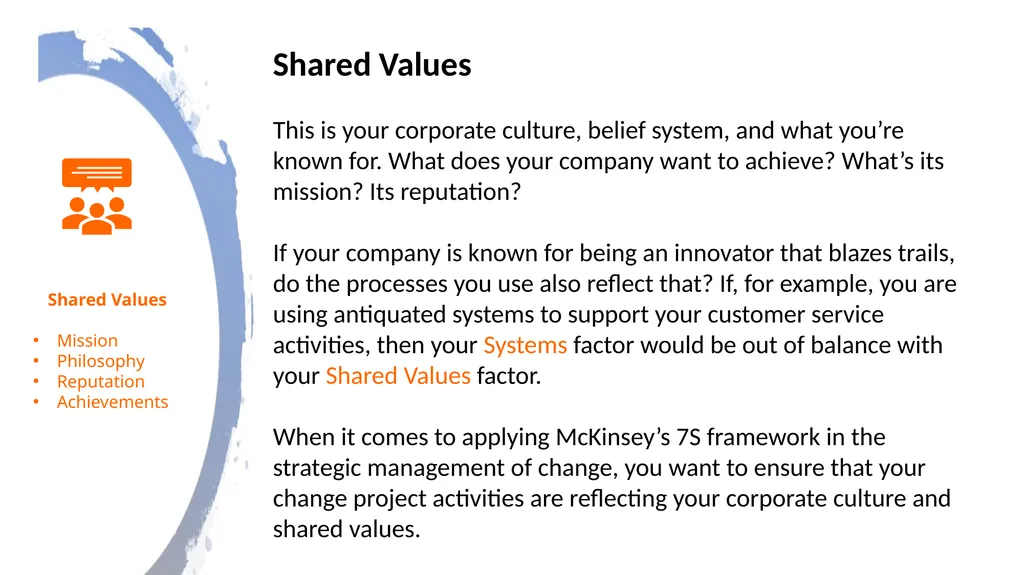
This is your corporate culture, belief system, and what you’re known for. What does your company want to achieve? What’s its mission? Its reputation?
If your company is known for being an innovator that blazes trails, do the processes you use also reflect that? If, for example, you are using antiquated systems to support your customer service activities, then your Systems factor would be out of balance with your Shared Values factor.
When it comes to applying McKinsey’s 7S framework in the strategic management of change, you want to ensure that your change project activities are reflecting your corporate culture and shared values. Shared Values
Mission
Philosophy
Reputation
Achievements<br>
This is your corporate culture, belief system, and what you’re known for. What does your company want to achieve? What’s its mission? Its reputation?
If your company is known for being an innovator that blazes trails, do the processes you use also reflect that? If, for example, you are using antiquated systems to support your customer service activities, then your Systems factor would be out of balance with your Shared Values factor.
When it comes to applying McKinsey’s 7S framework in the strategic management of change, you want to ensure that your change project activities are reflecting your corporate culture and shared values. Shared Values
Mission
Philosophy
Reputation
Achievements<br>
09
Skills
This area of the McKinsey 7S model includes both organizational skills and individual employee skills.
You want to ensure that your team has the skills necessary to keep you competitive. And in the case of a change project, provide proper employee training to give your team the skills needed for the new process.
Another part of this factor in the McKinsey change management framework is to decide which skills should be kept in house and which ones would be more efficient as outsourced skills. Skills
Employee
Organization
Outsourced<br>
This area of the McKinsey 7S model includes both organizational skills and individual employee skills.
You want to ensure that your team has the skills necessary to keep you competitive. And in the case of a change project, provide proper employee training to give your team the skills needed for the new process.
Another part of this factor in the McKinsey change management framework is to decide which skills should be kept in house and which ones would be more efficient as outsourced skills. Skills
Employee
Organization
Outsourced<br>
10
Staff
Your staff is another important element in the McKinsey 7S model. You have to ensure your staff is balanced and diverse, so you’ll have economies of scope.
Other important considerations are hiring practices, turnover, and staff policies that can help or hurt your business.
Example: If you’re a U.S. company expanding your operations to Singapore, the following would be Staff imbalances with other 7S factors of your business (Systems, Processes, Skills):
Hiring practices don’t include Singapore related job posting sites
No one on your team is familiar with the country
Phone systems don’t include local Singapore phone numbers Staff
A stakeholder analysis at the start of a change project can help you understand staff needs.<br>
Your staff is another important element in the McKinsey 7S model. You have to ensure your staff is balanced and diverse, so you’ll have economies of scope.
Other important considerations are hiring practices, turnover, and staff policies that can help or hurt your business.
Example: If you’re a U.S. company expanding your operations to Singapore, the following would be Staff imbalances with other 7S factors of your business (Systems, Processes, Skills):
Hiring practices don’t include Singapore related job posting sites
No one on your team is familiar with the country
Phone systems don’t include local Singapore phone numbers Staff
A stakeholder analysis at the start of a change project can help you understand staff needs.<br>
11
Strategy
McKinsey describes strategy and organization as “two sides of the same coin.” Your strategy is how you plan to move your company toward its goals, while also remaining adaptive.
When it comes to a change project, the strategy element in the McKinsey 7S example would be the detailed plan or change management roadmap you follow to get from your current state to your desired future state.
This roadmap strategy needs to be in alignment with all the other 6 factors within the McKinsey 7S framework. Strategy
How to move from Point A to Point B<br>
McKinsey describes strategy and organization as “two sides of the same coin.” Your strategy is how you plan to move your company toward its goals, while also remaining adaptive.
When it comes to a change project, the strategy element in the McKinsey 7S example would be the detailed plan or change management roadmap you follow to get from your current state to your desired future state.
This roadmap strategy needs to be in alignment with all the other 6 factors within the McKinsey 7S framework. Strategy
How to move from Point A to Point B<br>
12
Structure
The structure element in the McKinsey 7S framework refers to your classic organizational structure or chain of command. These are also known as authority relationships.
Who needs to sign off on a change communication? Who should you alert if your timeline is changing?
If your organization’s structure is complex, the answer to those questions might not be clear to employees managing a change. Structure
Reduce complexity
Define authority relationships<br>
The structure element in the McKinsey 7S framework refers to your classic organizational structure or chain of command. These are also known as authority relationships.
Who needs to sign off on a change communication? Who should you alert if your timeline is changing?
If your organization’s structure is complex, the answer to those questions might not be clear to employees managing a change. Structure
Reduce complexity
Define authority relationships<br>
13
Style
Style is related to culture but is more about a personal managerial style or the culture a certain department might operate under. For example, some departments may be more open to outside ideas than others.
Style is one of the more difficult areas of the McKinsey 7S analysis to get on top of, because it’s very personal, and changing people’s managerial styles requires helping them become more self-aware.
This is where you will run into: “But that’s the way we do it around here” and similar types of attitudes that are resistant to change.
Having a resistance management strategy can help you bring this factor into balance with the others. Style
Personal
Impacts staff
Can cause resistance
Can encourage support<br>
Style is related to culture but is more about a personal managerial style or the culture a certain department might operate under. For example, some departments may be more open to outside ideas than others.
Style is one of the more difficult areas of the McKinsey 7S analysis to get on top of, because it’s very personal, and changing people’s managerial styles requires helping them become more self-aware.
This is where you will run into: “But that’s the way we do it around here” and similar types of attitudes that are resistant to change.
Having a resistance management strategy can help you bring this factor into balance with the others. Style
Personal
Impacts staff
Can cause resistance
Can encourage support<br>
14
Systems
Systems refers both to the physical systems your team works with and the processes and workflows you have in place. What happens within your IT infrastructure after an order is placed at your company or how your HR department handles time-off requests are both systems.
You can think of the systems element of McKinsey’s 7S framework in strategic management as “how work gets done.”
When planning a change, you’ll want to ensure systems, including technology and processes, are aligned with the other six factors to drive efficiency and productivity. Systems
“How work gets done”
Physical systems
Workflows
Processes<br>
Systems refers both to the physical systems your team works with and the processes and workflows you have in place. What happens within your IT infrastructure after an order is placed at your company or how your HR department handles time-off requests are both systems.
You can think of the systems element of McKinsey’s 7S framework in strategic management as “how work gets done.”
When planning a change, you’ll want to ensure systems, including technology and processes, are aligned with the other six factors to drive efficiency and productivity. Systems
“How work gets done”
Physical systems
Workflows
Processes<br>
15
Using McKinsey’s 7S Model for Change Management Because of the nature of the McKinsey 7S framework, it can be difficult to know where to start or how to use this model in a sequence needed for change management or company improvement. However, it can still be helpful for gauging balance during change projects. Tool<br>
16
Steps for Using McKinsey 7S in Change Projects
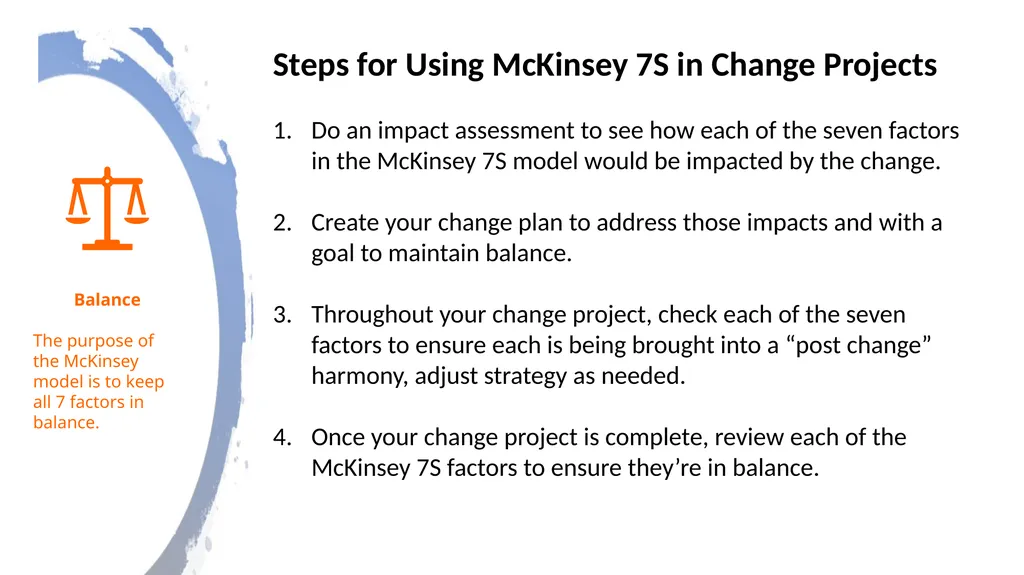
Do an impact assessment to see how each of the seven factors in the McKinsey 7S model would be impacted by the change.
Create your change plan to address those impacts and with a goal to maintain balance.
Throughout your change project, check each of the seven factors to ensure each is being brought into a “post change” harmony, adjust strategy as needed.
Once your change project is complete, review each of the McKinsey 7S factors to ensure they’re in balance. Balance
The purpose of the McKinsey model is to keep all 7 factors in balance.<br>
Do an impact assessment to see how each of the seven factors in the McKinsey 7S model would be impacted by the change.
Create your change plan to address those impacts and with a goal to maintain balance.
Throughout your change project, check each of the seven factors to ensure each is being brought into a “post change” harmony, adjust strategy as needed.
Once your change project is complete, review each of the McKinsey 7S factors to ensure they’re in balance. Balance
The purpose of the McKinsey model is to keep all 7 factors in balance.<br>
17
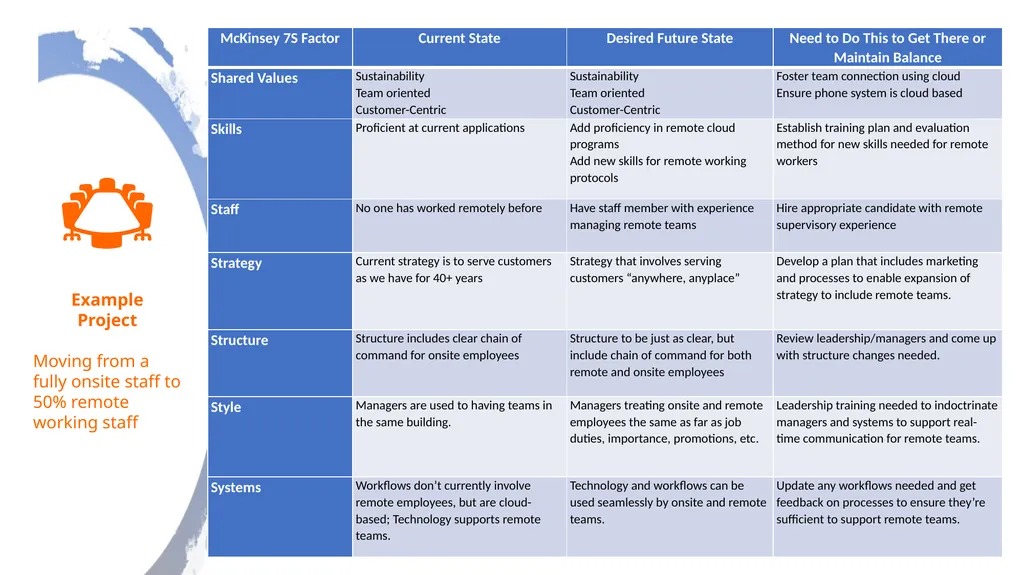
Example
Project
Moving from a fully onsite staff to 50% remote working staff<br>
Project
Moving from a fully onsite staff to 50% remote working staff<br>
18
McKinsey’s 7S Model Strengths & Weaknesses Is the McKinsey 7S model right for your change project? Some may find it flexible and holistic, while others may find it confusing and tedious. Tool<br>
19
McKinsey 7S Framework Advantages
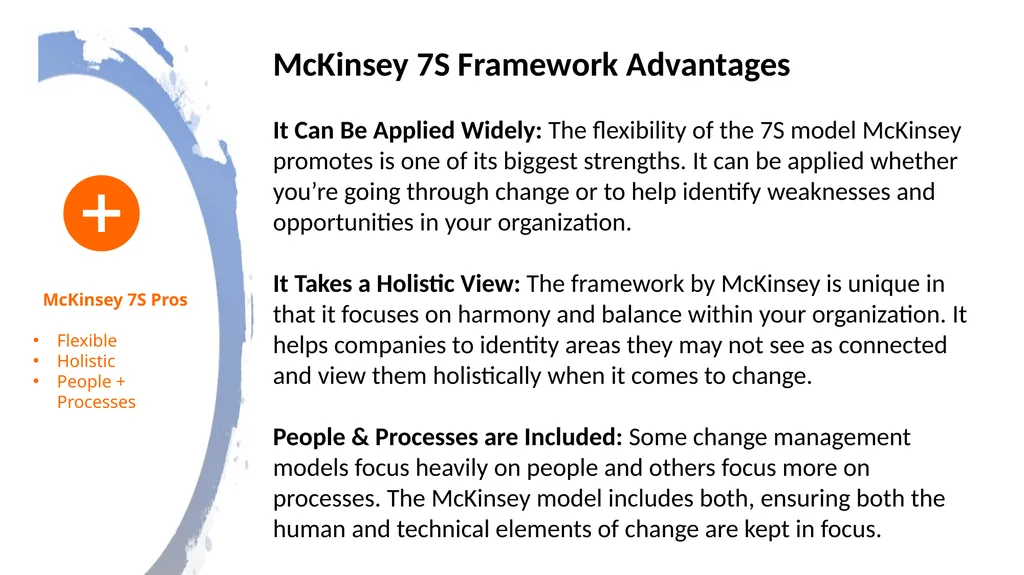
It Can Be Applied Widely: The flexibility of the 7S model McKinsey promotes is one of its biggest strengths. It can be applied whether you’re going through change or to help identify weaknesses and opportunities in your organization.
It Takes a Holistic View: The framework by McKinsey is unique in that it focuses on harmony and balance within your organization. It helps companies to identity areas they may not see as connected and view them holistically when it comes to change.
People & Processes are Included: Some change management models focus heavily on people and others focus more on processes. The McKinsey model includes both, ensuring both the human and technical elements of change are kept in focus. McKinsey 7S Pros
Flexible
Holistic
People + Processes<br>
It Can Be Applied Widely: The flexibility of the 7S model McKinsey promotes is one of its biggest strengths. It can be applied whether you’re going through change or to help identify weaknesses and opportunities in your organization.
It Takes a Holistic View: The framework by McKinsey is unique in that it focuses on harmony and balance within your organization. It helps companies to identity areas they may not see as connected and view them holistically when it comes to change.
People & Processes are Included: Some change management models focus heavily on people and others focus more on processes. The McKinsey model includes both, ensuring both the human and technical elements of change are kept in focus. McKinsey 7S Pros
Flexible
Holistic
People + Processes<br>
20
McKinsey 7S Framework Disadvantages
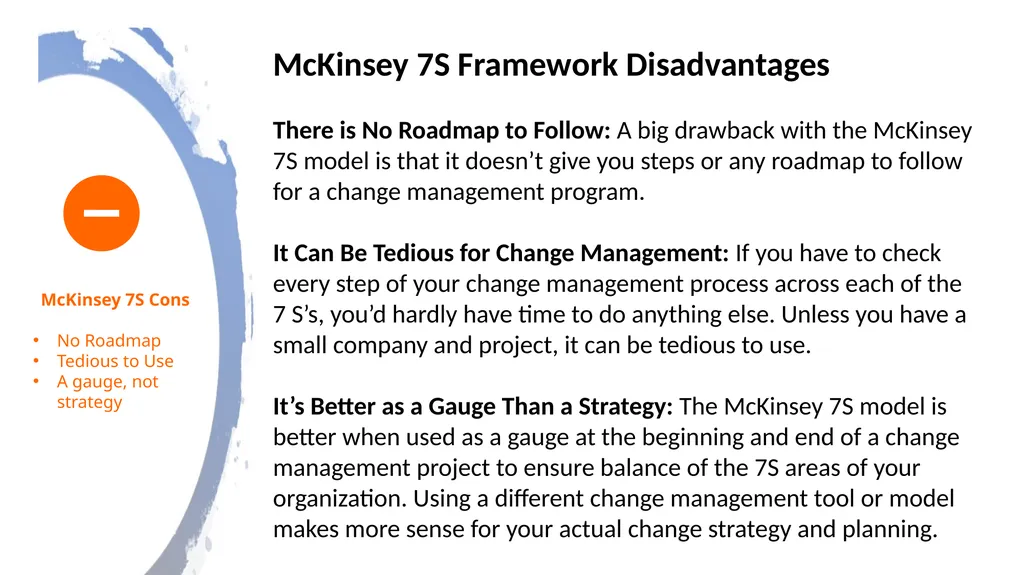
There is No Roadmap to Follow: A big drawback with the McKinsey 7S model is that it doesn’t give you steps or any roadmap to follow for a change management program.
It Can Be Tedious for Change Management: If you have to check every step of your change management process across each of the 7 S’s, you’d hardly have time to do anything else. Unless you have a small company and project, it can be tedious to use.
It’s Better as a Gauge Than a Strategy: The McKinsey 7S model is better when used as a gauge at the beginning and end of a change management project to ensure balance of the 7S areas of your organization. Using a different change management tool or model makes more sense for your actual change strategy and planning. McKinsey 7S Cons
No Roadmap
Tedious to Use
A gauge, not strategy<br>
There is No Roadmap to Follow: A big drawback with the McKinsey 7S model is that it doesn’t give you steps or any roadmap to follow for a change management program.
It Can Be Tedious for Change Management: If you have to check every step of your change management process across each of the 7 S’s, you’d hardly have time to do anything else. Unless you have a small company and project, it can be tedious to use.
It’s Better as a Gauge Than a Strategy: The McKinsey 7S model is better when used as a gauge at the beginning and end of a change management project to ensure balance of the 7S areas of your organization. Using a different change management tool or model makes more sense for your actual change strategy and planning. McKinsey 7S Cons
No Roadmap
Tedious to Use
A gauge, not strategy<br>
21
Other Ways to Use McKinsey’s 7S Model McKinsey’s framework in strategic management is a general methodology for checking that a business is in balance. It’s designed to be used for many different needs within an organization. Tool<br>
22
Other Ways to Use the McKinsey 7S Framework
The process of checking that each area of a company (the 7S factors) are in balance and harmony can be used to help a business beyond change management.
Here are some other ways it can be used:
Boost productivity and efficiency
Identify areas in a business holding the company back
Create a new business strategy
Align departments during mergers or acquisitions
Implement employee improvement strategies
Determine how to become more competitive
Uncover areas of opportunity McKinsey 7S
Framework
A gauge to check organizational health & look for opportunities.<br>
The process of checking that each area of a company (the 7S factors) are in balance and harmony can be used to help a business beyond change management.
Here are some other ways it can be used:
Boost productivity and efficiency
Identify areas in a business holding the company back
Create a new business strategy
Align departments during mergers or acquisitions
Implement employee improvement strategies
Determine how to become more competitive
Uncover areas of opportunity McKinsey 7S
Framework
A gauge to check organizational health & look for opportunities.<br>
23
Conclusion Final thoughts and conclusions regarding the McKinsey 7S Framework for organizational change and business management. Tool<br>
24
Conclusion: McKinsey 7S Framework
The McKinsey 7S framework is a powerful tool to look in depth at your organization and identify areas where it may not be operating in harmony. It offers a unique insight into seven key areas that other change models don’t explore in the same way.
The biggest problem with the 7S model is that it’s not well suited as a step-by-step strategy for change management. It’s much better when used as a gauge to “check the temperature” of your company.
It can be helpful to use alongside another change management model or tool to ensure your change project takes the 7S’s into consideration.
In general, it’s a helpful framework to gain deeper insight into the different moving parts of your organization. Need Help with Change Management?
It’s what we do!
Email us any time with questions at:
support@airiodion.com<br>
The McKinsey 7S framework is a powerful tool to look in depth at your organization and identify areas where it may not be operating in harmony. It offers a unique insight into seven key areas that other change models don’t explore in the same way.
The biggest problem with the 7S model is that it’s not well suited as a step-by-step strategy for change management. It’s much better when used as a gauge to “check the temperature” of your company.
It can be helpful to use alongside another change management model or tool to ensure your change project takes the 7S’s into consideration.
In general, it’s a helpful framework to gain deeper insight into the different moving parts of your organization. Need Help with Change Management?
It’s what we do!
Email us any time with questions at:
support@airiodion.com<br>