
Meaning, Thought, and Reality Introduction How is




Description: Meaning, Thought, and Reality Introduction How is it possible to, for example, that by uttering strings of sounds I can convey information to a listener about what is happening? How can we use language to describe the world? All languages
Related Topics
Download Presentation
"Meaning, Thought, and Reality Introduction How is" is the property of its rightful owner. Permission is granted to download and print the materials on this website for personal, non-commercial use only, and to display it on your personal computer provided you do not modify the materials and that you retain all copyright notices contained in the materials. By downloading content from our website, you accept the terms of this agreement.
Presentation Transcript
slide1. Meaning, Thought, and Reality<br>
slide2. Introduction<br>
slide3. How is it possible to, for example, that by uttering strings of sounds I can convey information to a listener about what is happening?
How can we use language to describe the world?
All languages allow speakers to describe or model aspects of what they perceive. In semantics the action of picking out or identifying individuals/ locations with words is called referring/denoting. To some linguists the two terms, denote and refer are synonymous. J. Saeed (2009: 23) gives two examples of proper names whose corresponding referents are easily recognizable
I saw Nelson Mandela on television last night.
We have just flown back from Paris.
The underlined words refer to/denote the famous character, respectively the capital of France, even if in some contexts they may be used to designate a person different from the character, or a locality other than the capital of France.<br>
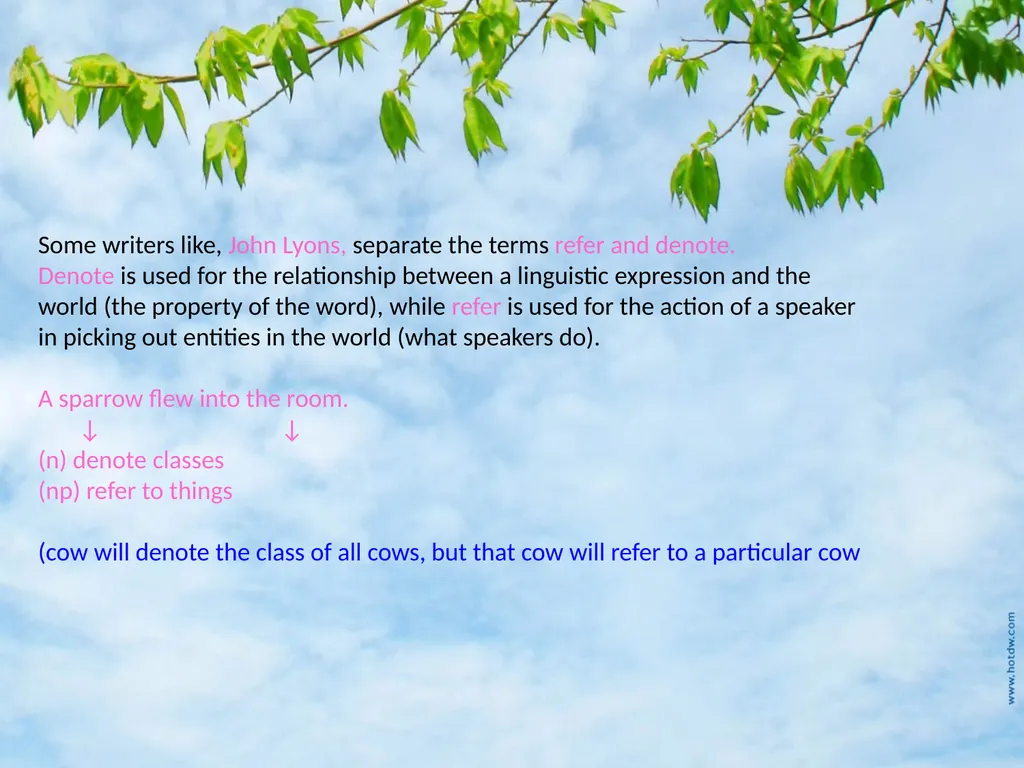
slide4. Some writers like, John Lyons, separate the terms refer and denote.
Denote is used for the relationship between a linguistic expression and the world (the property of the word), while refer is used for the action of a speaker in picking out entities in the world (what speakers do).
A sparrow flew into the room.
↓ ↓
(n) denote classes
(np) refer to things
(cow will denote the class of all cows, but that cow will refer to a particular cow<br>
slide5. Saeed (2003) argues that humans have the ability to identify or denote meanings by referring to identities in the world all around.
Lyons(1977) differentiates between the terms “referring” and “denotation” by pointing out that referring is what speakers do while denoting is a property of words.
Denotation in this sense is a stable relationship in a language which is not dependent on any one use of a word, while
Reference is a moment- by-moment relationship depending on the context: what entity somebody refers to by using the word sparrow depends on the context.<br>
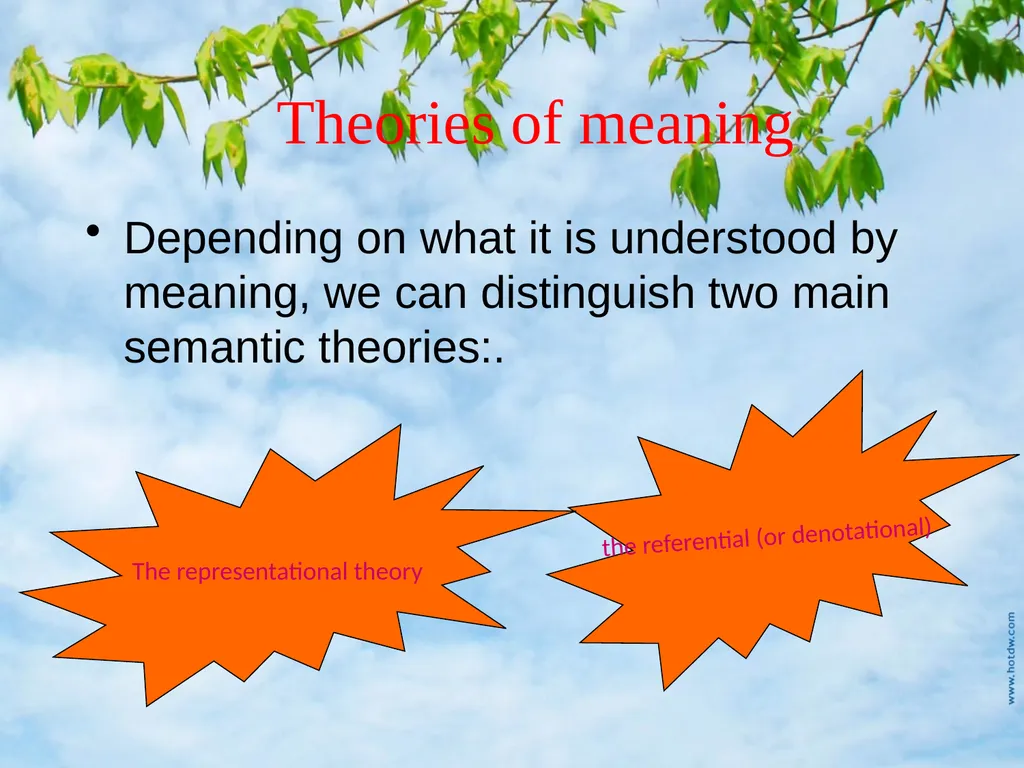
slide6. Depending on what it is understood by meaning, we can distinguish two main semantic theories:. Theories of meaning the referential (or denotational) The representational theory<br>
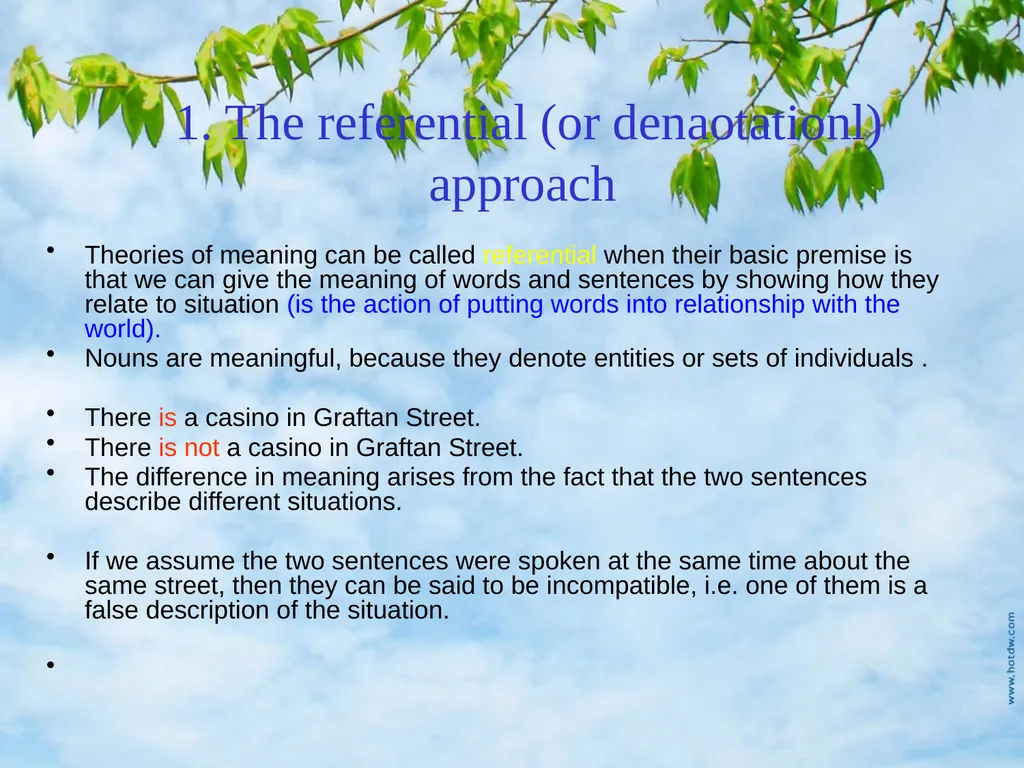
slide7. Theories of meaning can be called referential when their basic premise is that we can give the meaning of words and sentences by showing how they relate to situation (is the action of putting words into relationship with the world).
Nouns are meaningful, because they denote entities or sets of individuals .
There is a casino in Graftan Street.
There is not a casino in Graftan Street.
The difference in meaning arises from the fact that the two sentences describe different situations.
If we assume the two sentences were spoken at the same time about the same street, then they can be said to be incompatible, i.e. one of them is a false description of the situation. 1. The referential (or denaotationl) approach<br>
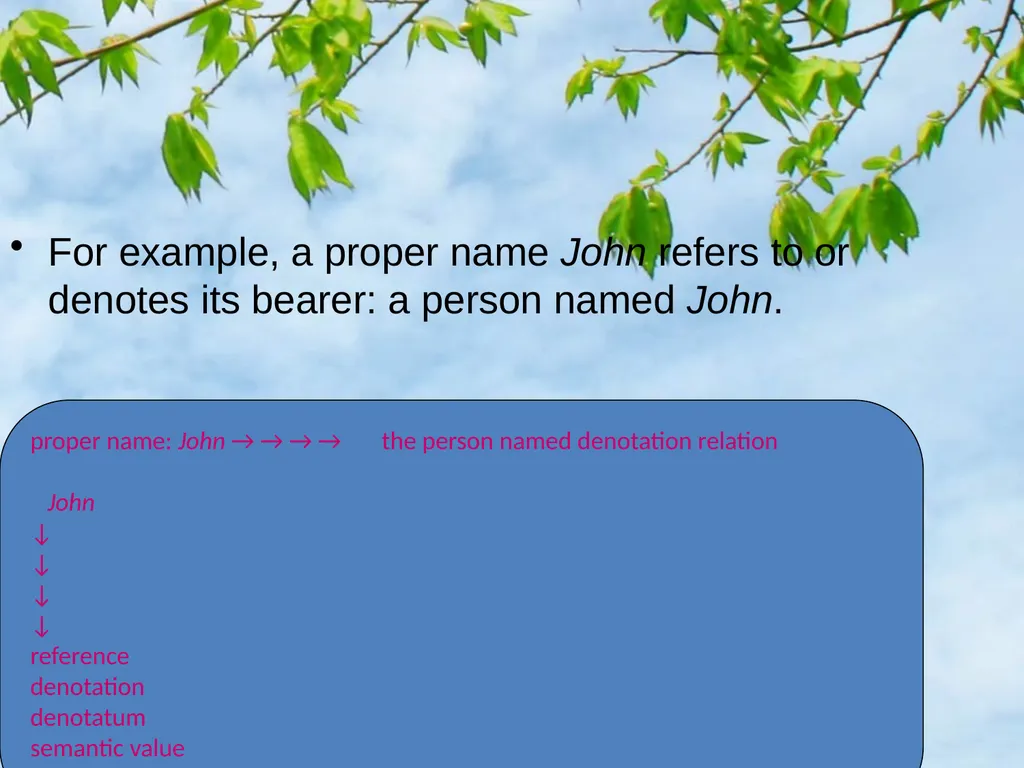
slide8. proper name: John → → → → the person named denotation relation
John
↓
↓
↓
↓
reference
denotation
denotatum
semantic value For example, a proper name John refers to or denotes its bearer: a person named John.<br>
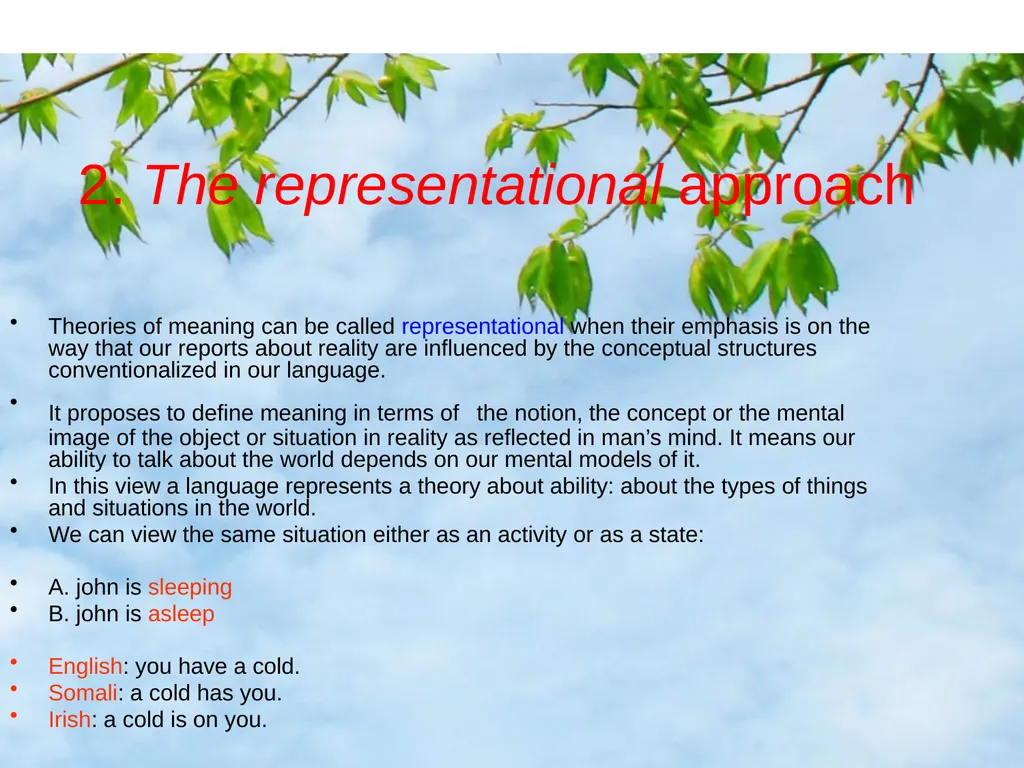
slide9. Theories of meaning can be called representational when their emphasis is on the way that our reports about reality are influenced by the conceptual structures conventionalized in our language.
It proposes to define meaning in terms of the notion, the concept or the mental image of the object or situation in reality as reflected in man’s mind. It means our ability to talk about the world depends on our mental models of it.
In this view a language represents a theory about ability: about the types of things and situations in the world.
We can view the same situation either as an activity or as a state:
A. john is sleeping
B. john is asleep
English: you have a cold.
Somali: a cold has you.
Irish: a cold is on you. 2. The representational approach<br>
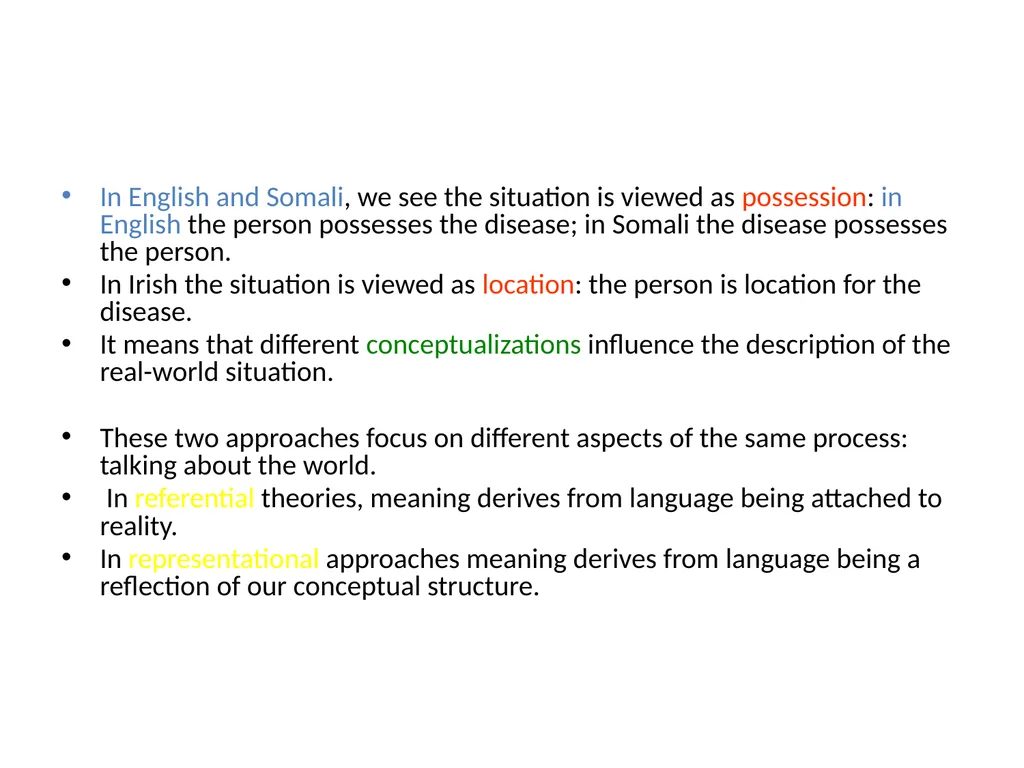
slide11. In English and Somali, we see the situation is viewed as possession: in English the person possesses the disease; in Somali the disease possesses the person.
In Irish the situation is viewed as location: the person is location for the disease.
It means that different conceptualizations influence the description of the real-world situation.
These two approaches focus on different aspects of the same process: talking about the world.
In referential theories, meaning derives from language being attached to reality.
In representational approaches meaning derives from language being a reflection of our conceptual structure.<br>
slide12. References<br>
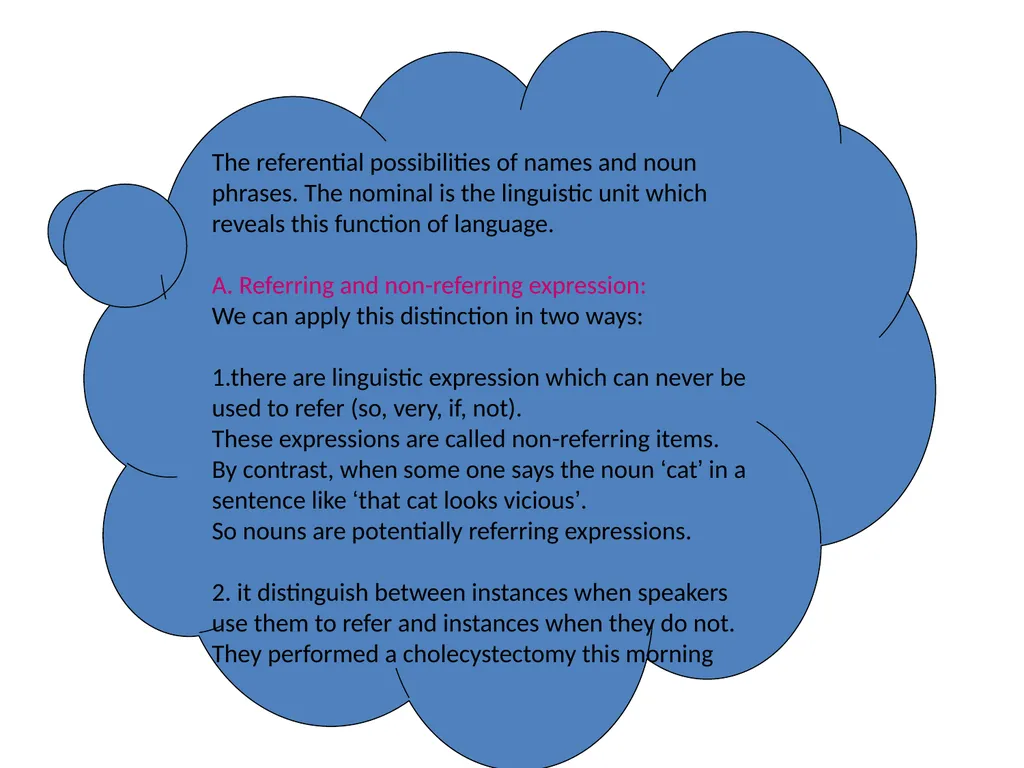
slide13. The referential possibilities of names and noun phrases. The nominal is the linguistic unit which reveals this function of language.
A. Referring and non-referring expression:
We can apply this distinction in two ways:
1.there are linguistic expression which can never be used to refer (so, very, if, not).
These expressions are called non-referring items. By contrast, when some one says the noun ‘cat’ in a sentence like ‘that cat looks vicious’.
So nouns are potentially referring expressions.
2. it distinguish between instances when speakers use them to refer and instances when they do not.
They performed a cholecystectomy this morning<br>
slide14. A cholecystectomy is a serious procedure.
The indefinite noun phrase is referring expression in the first sentence but not n the second where the nominal has a generic interpretation.
B. constant versus variable references:
Some expression will have the same referent across a range of utterances, e.g. the Eiffel Tower.
Such expression is described as having constant reference.
Other expressions have their reference totally dependent on context,
I wrote to you, such expression is said to have variable reference.
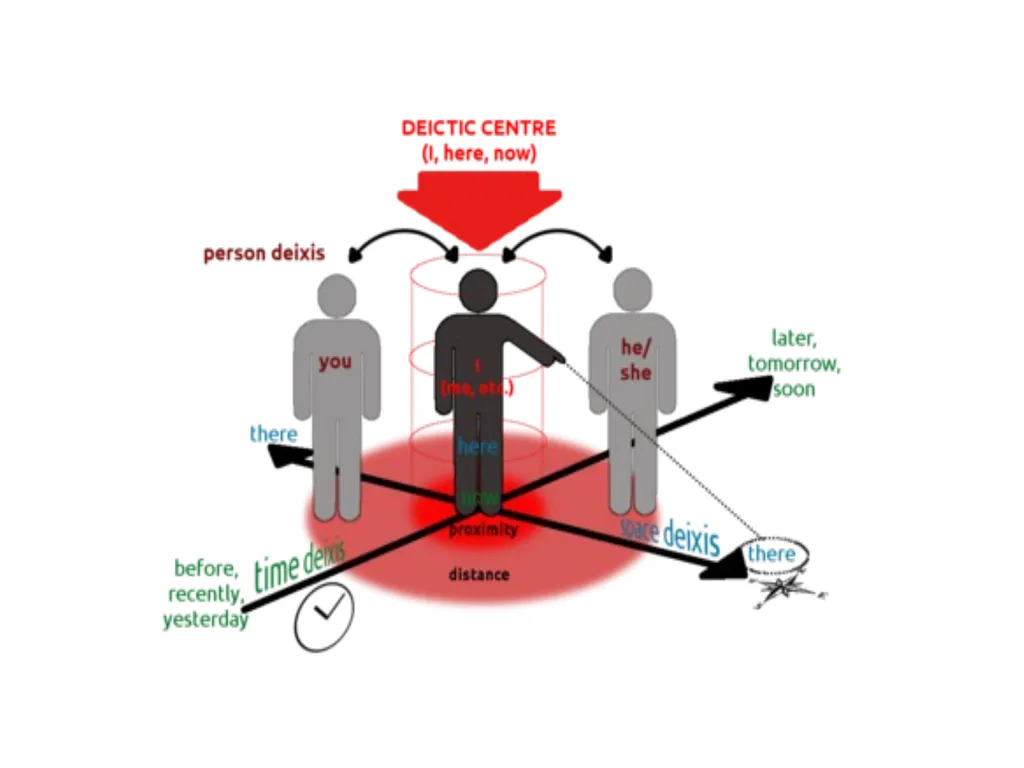
To identify who is being referred to by pronouns like she, you, etc. we need to know a lot about the context in which these words are uttered<br>
slide16. Names One important approach in nominals’ analysis is the description theory (Russel, Frege, Searle). A name is taken as a label or shorthand for knowledge about the referent, or for one or more definite descriptions in the terminology of philosophers. In this theory, understanding a name and identifying the referent are both dependent on associating the name with the right description.
e. g. Christopher Marlowe / the writer of the play Dr. Faustus / the Elizabethan playwright murdered in a Deptford tavern.<br>
slide17. Another interesting approach is the causal theory (Devitt, Sterelny, 1987) and based on the ideas of Kripke (1980) and Donnellan (1972). This theory is based on the idea that names are socially inherited or borrowed. There is a chain back to the original naming/ grounding. In some cases a name does not get attached to a single grounding. It may arise from a period of repeated uses. Sometimes there are competing names and one wins out. Mistakes can be made and subsequently fixed by public practice. This theory recognizes that speakers may use names with very little knowledge of the referent, so it stresses the role of social knowledge in the use of names.<br>
slide18. The simplest theory of meaning is to claim that semantics, i.e. that to give the meaning of a word one shows what it denotes. This theory would claim that reference picks out elements in the real world.
Such an approach might claim the following :
proper names denote individuals
common denote sets of individuals
verbs denote actions
adjectives denote properties of individuals
adverbs denote properties of actions
There are a number of problems with this simplest version as a theory of semantics.
many words have no meaning and it is difficult to find real-world referent for words like so, not, very.
many nominal expressions used by speakers do not have a referent that exists or has ever existed:
world war three might be about to start.
Expressions like these are meaningless if meaning is taken to be a relation between words and items in the real world.
when we are talking about things in the real world, there is not always a one-to-one correspondence between a linguistic expression and the item we want to identify.
Then in1981 Anwer El Sadat was assassinates
Then in 1981 the President of Egypt was assassinates Reference as a theory of meaning<br>
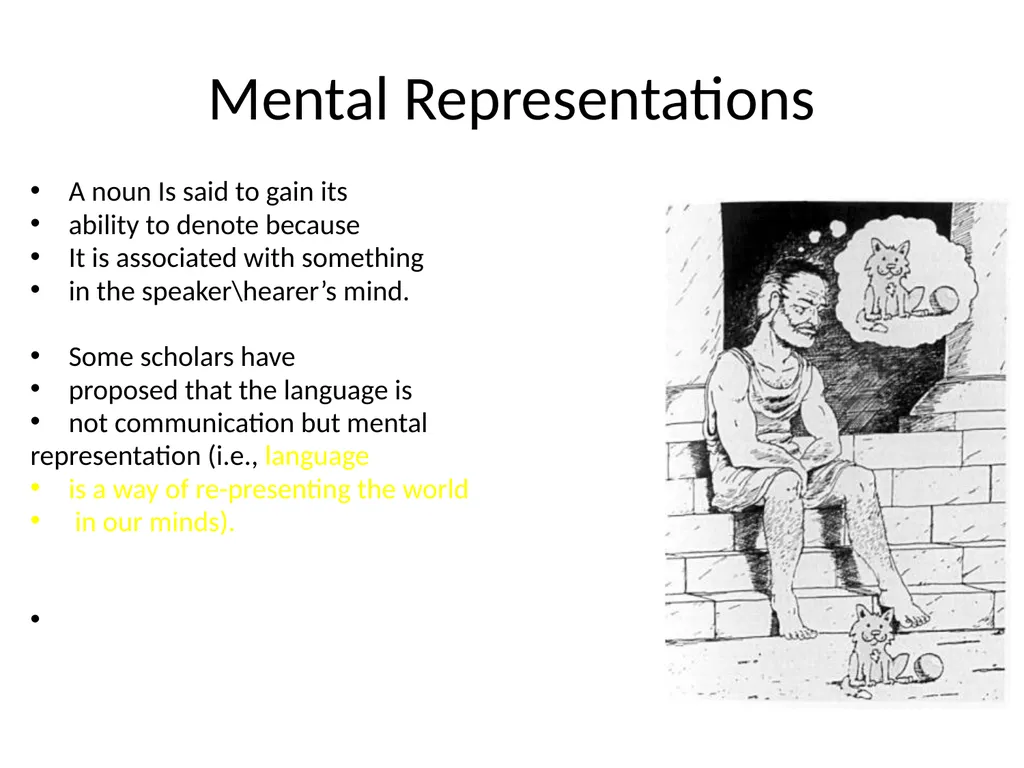
slide19. Mental Representations A noun Is said to gain its
ability to denote because
It is associated with something
in the speaker\hearer’s mind.
Some scholars have
proposed that the language is
not communication but mental
representation (i.e., language
is a way of re-presenting the world
in our minds).<br>
slide20. This gets us out of the problem of insisting everything we talk about exists in reality, but it raises the question of what these mental representations are.
One simple and old idea is that these mental representations are images.
The relationship between the mental representation (image) and the real-world entity would be one of resemblance. This might work for imaginary entities like Batman.
Do we think directly in language? Do we
think in images or perhaps there is another mode of thought? Introduction<br>
slide21. Because f the variation in images that different speakers might have of a common noun like car or horse, depending on their existence, this theory runs into series problems with common nouns.
Triangle:
One speaker may have a mental image of an equilateral triangle, another may have a mental image of a scalene triangle.
The most usual modification of the image theory is to hypothesize that the sense of some words is not visual but a more abstract element: a concept.
The advantages:
1. We can accept that a concept might be able to contain the non-visual features which make a dog a dog, democracy democracy, etc.
2. Linguists might be able to pass on some of the labour of describing concepts to psychologists rather than have to do it all themselves.
Some concepts might be simple and related to perceptual stimuli_ like water, sun, etc. others will be complex like Marriage.
The problem for many psychologists are still involved in investigating what concepts might be like.<br>
slide22. Concepts<br>
slide23. If we adopt the hypothesis that the meaning of a noun is a combination of its denotation and a conceptual element, then two basic questions about the conceptual element are:
1. what form can we assign to concepts?
2. how do children acquire them, along with their linguistic labels?
to answer these questions, we will concentrate on concepts that correspond to a single word, i.e. that are lexicalized.
Some concepts are described by phrases:
On the shopping channel, I saw a tool for compacting dead leaves into garden statuary.
The reason why some concepts are lexicalized and other not is useful.
We are designing a device for cooking food by microwaves.
This process of invention new concepts and new words or new senses of old words given to them is happening all the time.
Ex:
Phreaking: means gaining unauthorized access into telecommunications systems, for example to avoid paying telephone call charges.
Someone who does this is a phreaker.<br>
slide24. When children acquire concepts their concepts may differ from the concepts of adults. They operate with concepts that are quite different:
Underextending concepts (for a child dog can be only used for their pet, not the one next door)
Overextending concepts (a child uses daddy for every male adults, or cats, rabbits and other pets).
Or the concepts may be different, reflecting the fact that items in child’s world may have different occurrence than for an adult.<br>
slide25. One traditional approach to describing concepts is to define them by using sets of necessary and sufficient conditions.
Woman: it must contain the information necessary to decide when something in the world is a woman or not.
X is a woman if and only if L.
Where L is a list of attributes, like:
X is human; adult; female, etc.
The problem:
It seems to assume that if speakers share the same concept they will agree on the necessary and sufficient conditions: if something has them, it is an X; if not, not.
But it has proved difficult to set them up even for nouns which identify concrete and natural kinds like dog or cat.
The problem we face is that which of these is necessary?
Zebra: is an animal;
has four legs;
is striped;
is a herbivore, etc. Necessary and sufficient conditions<br>
slide26. Another argument against necessary and sufficient conditions as the basis for linguistic concepts is Putnam’s (1975) observations about ignorance ( we can use a name for a person or place knowing little or nothing about the referent).
Putnam’s examples include the tree names beech and elm: like Putnam, many English speakers can not distinguish between these two trees yet use the words regularly (that the concept that I associate with the word ‘elm’ has no difference from the concept that I associate with the word ‘beech).
In the 1970s Dutch elm disease killed a huge number of British elms.
‘gold’ and ‘platinum’. We can use the words without knowing very much about the referent.
A word that is referring to a concept composed of a set of necessary or sufficient conditions, or what amount to the same thing,
a definition.<br>
slide27. The idea is that natural kind terms, like names, are fixed by contact with examples of the kind. It means that speakers may receive or borrow the word without being exposed to the real thing, or knowing very much about its characteristics.
Philosophers like to use examples of metals like gold and silver. Any inability to identify correctly or define the substance silver does not prevent one from using the word silver.<br>
slide28. Prototypes The notion of prototypes (theoretical view of the nature of concepts ) is an influential proposal of Eleanor Rosch. The prototype view denies the existence of necessary-and-sufficient feature conditions, or definitions.
It helped in explaining the meaning of a certain word not in term of its feature but in terms of resemblance to the clearest exemplar.
Ex:
There are central or typical members of a category, such as Bird or Furniture, chair is a more central member of the category Furniture than lamb, for example.
Rosch’s experimental evidence is that speakers tend to agree more readily on typical members than on less typical members; they come to mind more quickly.
Similar work (e.g. Labov 1973) is that the boundaries between concepts can seem to speakers uncertain, or ‘fuzzy, rather than clearly defined.
In the prototype theory of concepts, (whether a whale is a mammal or fish) this might be explained by the fact that whales are not typical of the category MAMMAL, being far from the central prototype.<br>
slide29. There are number of interpretations of these typicality effects in the psychology literature:
1. some researchers have argued that the central prototype is an abstraction and this abstraction might be a set of characteristic features, to which we compare real items. (bird)
2. other researchers have proposed that we characterize our categories by exemplars, memories of actual typical birds, say sparrow, pigeons and hawks, and we compute the likelihood of something we meet being a bird on the basis of comparison with these memories of real birds.
3. another approach to typicality effects which is interesting because it sheds the light on the relationship between linguistic knowledge and encyclopedic knowledge. Charles Fillmore (1982b) and George Lakoff (1987) both make similar claims that speakers have folk theories about the world, based on their experience and rooted in their culture.
These theories are called frames by Fillmore and idealized cognitive models (ICMs) by Lakoff.<br>
slide30. They are not scientific theories or logically consistent definitions, but collections of cultural views Fillmore gives an example of how these folk theories might work by using the word bachelor.
Fillmore and Lakoff (1987:68-71), suggests that there is a division of our knowledge about the word bachelor:
1.Part is a dictionary-type definition (an unmarried man)( linguistic or semantic knowledge)
2.part is an encyclopedia-type entry of cultural knowledge about bachelorhood and marriage – the frame or ICM (real-world or general knowledge).
It is idealized model, a form of general knowledhe, which governs the use of the word bachelor and restrains us from applying it to celibate priests, or people living in isolation like Robinson Crusoe on his island or Tarazan living in the jungle.<br>
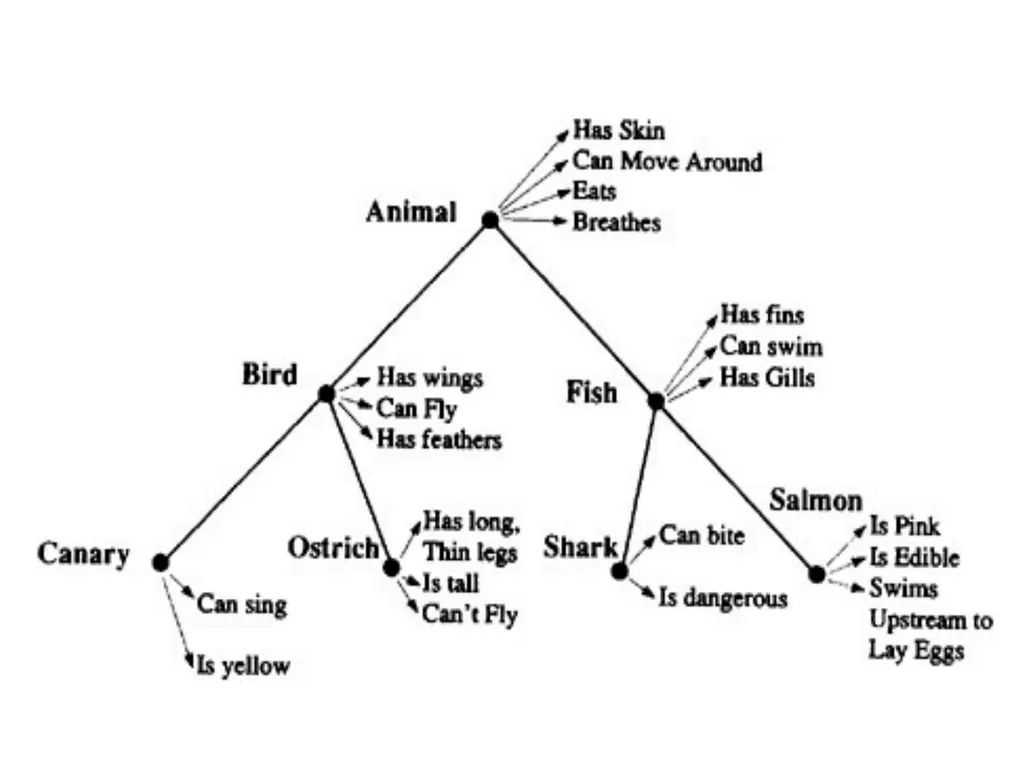
slide31. Relational nature of conceptual knowledge is an important issue. It suggests that the crucial element is not the amount of knowledge but its integration into existing knowledge. Thus, knowing that a carrot is a kind of vegetables, together with what you know about vegetables is enough to begin to understand the meaning of sentences containing the word, and thereby to start to gain extra knowledge about the concept.
Such relations between concepts have been used to motivate models of conceptual hierarchies in the cognitive psychology literature. A model based on defining attributes was proposed by Collins and Quillian (1969). Relations between concepts<br>
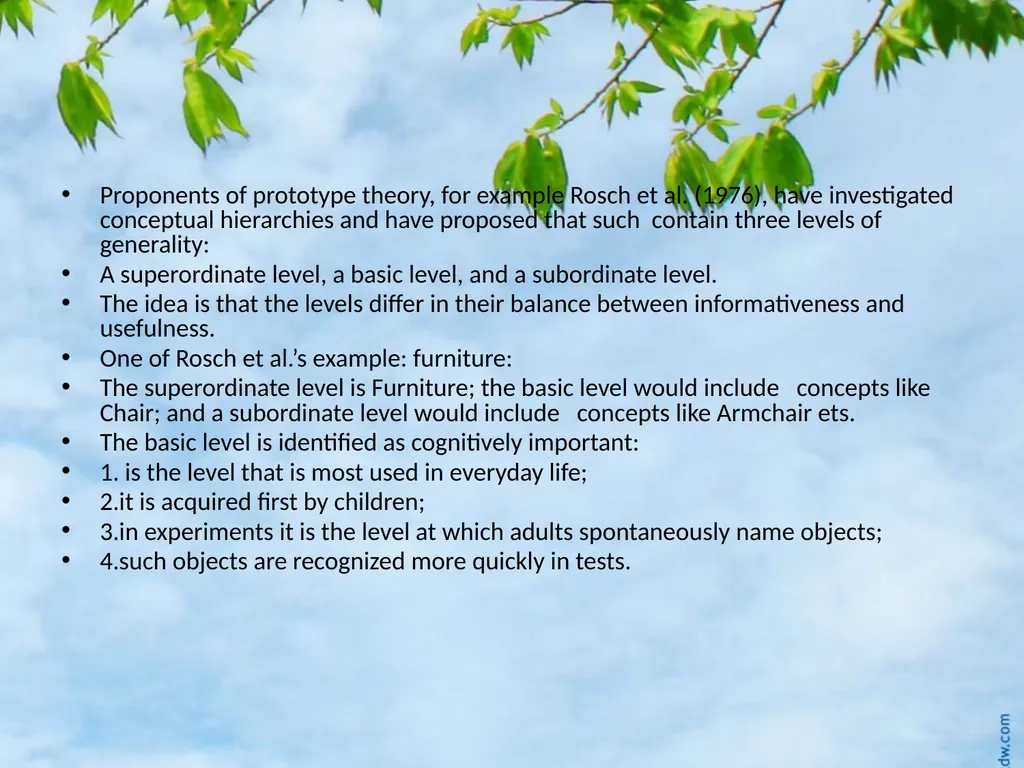
slide33. Proponents of prototype theory, for example Rosch et al. (1976), have investigated conceptual hierarchies and have proposed that such contain three levels of generality:
A superordinate level, a basic level, and a subordinate level.
The idea is that the levels differ in their balance between informativeness and usefulness.
One of Rosch et al.’s example: furniture:
The superordinate level is Furniture; the basic level would include concepts like Chair; and a subordinate level would include concepts like Armchair ets.
The basic level is identified as cognitively important:
1. is the level that is most used in everyday life;
2.it is acquired first by children;
3.in experiments it is the level at which adults spontaneously name objects;
4.such objects are recognized more quickly in tests.<br>
slide34. Acquiring concepts How do we acquire concepts?
One simple and intuitively satisfying theory is that we do it by ostensive definition. The idea is that children acquire concepts by being directed to examples in the world.
That is a dog or ‘look at the doggie!
The philosopher W. V. O. Quine has pointed out that ostensive (defining by example) is couched in language.
His example is of walking with someone whose language you do not know, who. When a rabbit runs past, says Gavagai.
To understand that you are being given a name you need to know sometng about the langage that the ostension takes place in.
In English, a sentence frame like ‘it’s a’ tells you this.
The point is that even ostensive definition depends on prior knowledge of some word meaning.<br>
slide35. Conclusion It is difficult to use reference as the whole of a theory of meaning.
There are two different approaches to our ability to talk about the reality.
There are three issues of the relationship between languages, thought and reality:<br>
slide37. References Saeed, J. I (2009) Semantics. Oxford: Blackwell.<br>
slide2. Introduction<br>
slide3. How is it possible to, for example, that by uttering strings of sounds I can convey information to a listener about what is happening?
How can we use language to describe the world?
All languages allow speakers to describe or model aspects of what they perceive. In semantics the action of picking out or identifying individuals/ locations with words is called referring/denoting. To some linguists the two terms, denote and refer are synonymous. J. Saeed (2009: 23) gives two examples of proper names whose corresponding referents are easily recognizable
I saw Nelson Mandela on television last night.
We have just flown back from Paris.
The underlined words refer to/denote the famous character, respectively the capital of France, even if in some contexts they may be used to designate a person different from the character, or a locality other than the capital of France.<br>
slide4. Some writers like, John Lyons, separate the terms refer and denote.
Denote is used for the relationship between a linguistic expression and the world (the property of the word), while refer is used for the action of a speaker in picking out entities in the world (what speakers do).
A sparrow flew into the room.
↓ ↓
(n) denote classes
(np) refer to things
(cow will denote the class of all cows, but that cow will refer to a particular cow<br>
slide5. Saeed (2003) argues that humans have the ability to identify or denote meanings by referring to identities in the world all around.
Lyons(1977) differentiates between the terms “referring” and “denotation” by pointing out that referring is what speakers do while denoting is a property of words.
Denotation in this sense is a stable relationship in a language which is not dependent on any one use of a word, while
Reference is a moment- by-moment relationship depending on the context: what entity somebody refers to by using the word sparrow depends on the context.<br>
slide6. Depending on what it is understood by meaning, we can distinguish two main semantic theories:. Theories of meaning the referential (or denotational) The representational theory<br>
slide7. Theories of meaning can be called referential when their basic premise is that we can give the meaning of words and sentences by showing how they relate to situation (is the action of putting words into relationship with the world).
Nouns are meaningful, because they denote entities or sets of individuals .
There is a casino in Graftan Street.
There is not a casino in Graftan Street.
The difference in meaning arises from the fact that the two sentences describe different situations.
If we assume the two sentences were spoken at the same time about the same street, then they can be said to be incompatible, i.e. one of them is a false description of the situation. 1. The referential (or denaotationl) approach<br>
slide8. proper name: John → → → → the person named denotation relation
John
↓
↓
↓
↓
reference
denotation
denotatum
semantic value For example, a proper name John refers to or denotes its bearer: a person named John.<br>
slide9. Theories of meaning can be called representational when their emphasis is on the way that our reports about reality are influenced by the conceptual structures conventionalized in our language.
It proposes to define meaning in terms of the notion, the concept or the mental image of the object or situation in reality as reflected in man’s mind. It means our ability to talk about the world depends on our mental models of it.
In this view a language represents a theory about ability: about the types of things and situations in the world.
We can view the same situation either as an activity or as a state:
A. john is sleeping
B. john is asleep
English: you have a cold.
Somali: a cold has you.
Irish: a cold is on you. 2. The representational approach<br>
slide11. In English and Somali, we see the situation is viewed as possession: in English the person possesses the disease; in Somali the disease possesses the person.
In Irish the situation is viewed as location: the person is location for the disease.
It means that different conceptualizations influence the description of the real-world situation.
These two approaches focus on different aspects of the same process: talking about the world.
In referential theories, meaning derives from language being attached to reality.
In representational approaches meaning derives from language being a reflection of our conceptual structure.<br>
slide12. References<br>
slide13. The referential possibilities of names and noun phrases. The nominal is the linguistic unit which reveals this function of language.
A. Referring and non-referring expression:
We can apply this distinction in two ways:
1.there are linguistic expression which can never be used to refer (so, very, if, not).
These expressions are called non-referring items. By contrast, when some one says the noun ‘cat’ in a sentence like ‘that cat looks vicious’.
So nouns are potentially referring expressions.
2. it distinguish between instances when speakers use them to refer and instances when they do not.
They performed a cholecystectomy this morning<br>
slide14. A cholecystectomy is a serious procedure.
The indefinite noun phrase is referring expression in the first sentence but not n the second where the nominal has a generic interpretation.
B. constant versus variable references:
Some expression will have the same referent across a range of utterances, e.g. the Eiffel Tower.
Such expression is described as having constant reference.
Other expressions have their reference totally dependent on context,
I wrote to you, such expression is said to have variable reference.
To identify who is being referred to by pronouns like she, you, etc. we need to know a lot about the context in which these words are uttered<br>
slide16. Names One important approach in nominals’ analysis is the description theory (Russel, Frege, Searle). A name is taken as a label or shorthand for knowledge about the referent, or for one or more definite descriptions in the terminology of philosophers. In this theory, understanding a name and identifying the referent are both dependent on associating the name with the right description.
e. g. Christopher Marlowe / the writer of the play Dr. Faustus / the Elizabethan playwright murdered in a Deptford tavern.<br>
slide17. Another interesting approach is the causal theory (Devitt, Sterelny, 1987) and based on the ideas of Kripke (1980) and Donnellan (1972). This theory is based on the idea that names are socially inherited or borrowed. There is a chain back to the original naming/ grounding. In some cases a name does not get attached to a single grounding. It may arise from a period of repeated uses. Sometimes there are competing names and one wins out. Mistakes can be made and subsequently fixed by public practice. This theory recognizes that speakers may use names with very little knowledge of the referent, so it stresses the role of social knowledge in the use of names.<br>
slide18. The simplest theory of meaning is to claim that semantics, i.e. that to give the meaning of a word one shows what it denotes. This theory would claim that reference picks out elements in the real world.
Such an approach might claim the following :
proper names denote individuals
common denote sets of individuals
verbs denote actions
adjectives denote properties of individuals
adverbs denote properties of actions
There are a number of problems with this simplest version as a theory of semantics.
many words have no meaning and it is difficult to find real-world referent for words like so, not, very.
many nominal expressions used by speakers do not have a referent that exists or has ever existed:
world war three might be about to start.
Expressions like these are meaningless if meaning is taken to be a relation between words and items in the real world.
when we are talking about things in the real world, there is not always a one-to-one correspondence between a linguistic expression and the item we want to identify.
Then in1981 Anwer El Sadat was assassinates
Then in 1981 the President of Egypt was assassinates Reference as a theory of meaning<br>
slide19. Mental Representations A noun Is said to gain its
ability to denote because
It is associated with something
in the speaker\hearer’s mind.
Some scholars have
proposed that the language is
not communication but mental
representation (i.e., language
is a way of re-presenting the world
in our minds).<br>
slide20. This gets us out of the problem of insisting everything we talk about exists in reality, but it raises the question of what these mental representations are.
One simple and old idea is that these mental representations are images.
The relationship between the mental representation (image) and the real-world entity would be one of resemblance. This might work for imaginary entities like Batman.
Do we think directly in language? Do we
think in images or perhaps there is another mode of thought? Introduction<br>
slide21. Because f the variation in images that different speakers might have of a common noun like car or horse, depending on their existence, this theory runs into series problems with common nouns.
Triangle:
One speaker may have a mental image of an equilateral triangle, another may have a mental image of a scalene triangle.
The most usual modification of the image theory is to hypothesize that the sense of some words is not visual but a more abstract element: a concept.
The advantages:
1. We can accept that a concept might be able to contain the non-visual features which make a dog a dog, democracy democracy, etc.
2. Linguists might be able to pass on some of the labour of describing concepts to psychologists rather than have to do it all themselves.
Some concepts might be simple and related to perceptual stimuli_ like water, sun, etc. others will be complex like Marriage.
The problem for many psychologists are still involved in investigating what concepts might be like.<br>
slide22. Concepts<br>
slide23. If we adopt the hypothesis that the meaning of a noun is a combination of its denotation and a conceptual element, then two basic questions about the conceptual element are:
1. what form can we assign to concepts?
2. how do children acquire them, along with their linguistic labels?
to answer these questions, we will concentrate on concepts that correspond to a single word, i.e. that are lexicalized.
Some concepts are described by phrases:
On the shopping channel, I saw a tool for compacting dead leaves into garden statuary.
The reason why some concepts are lexicalized and other not is useful.
We are designing a device for cooking food by microwaves.
This process of invention new concepts and new words or new senses of old words given to them is happening all the time.
Ex:
Phreaking: means gaining unauthorized access into telecommunications systems, for example to avoid paying telephone call charges.
Someone who does this is a phreaker.<br>
slide24. When children acquire concepts their concepts may differ from the concepts of adults. They operate with concepts that are quite different:
Underextending concepts (for a child dog can be only used for their pet, not the one next door)
Overextending concepts (a child uses daddy for every male adults, or cats, rabbits and other pets).
Or the concepts may be different, reflecting the fact that items in child’s world may have different occurrence than for an adult.<br>
slide25. One traditional approach to describing concepts is to define them by using sets of necessary and sufficient conditions.
Woman: it must contain the information necessary to decide when something in the world is a woman or not.
X is a woman if and only if L.
Where L is a list of attributes, like:
X is human; adult; female, etc.
The problem:
It seems to assume that if speakers share the same concept they will agree on the necessary and sufficient conditions: if something has them, it is an X; if not, not.
But it has proved difficult to set them up even for nouns which identify concrete and natural kinds like dog or cat.
The problem we face is that which of these is necessary?
Zebra: is an animal;
has four legs;
is striped;
is a herbivore, etc. Necessary and sufficient conditions<br>
slide26. Another argument against necessary and sufficient conditions as the basis for linguistic concepts is Putnam’s (1975) observations about ignorance ( we can use a name for a person or place knowing little or nothing about the referent).
Putnam’s examples include the tree names beech and elm: like Putnam, many English speakers can not distinguish between these two trees yet use the words regularly (that the concept that I associate with the word ‘elm’ has no difference from the concept that I associate with the word ‘beech).
In the 1970s Dutch elm disease killed a huge number of British elms.
‘gold’ and ‘platinum’. We can use the words without knowing very much about the referent.
A word that is referring to a concept composed of a set of necessary or sufficient conditions, or what amount to the same thing,
a definition.<br>
slide27. The idea is that natural kind terms, like names, are fixed by contact with examples of the kind. It means that speakers may receive or borrow the word without being exposed to the real thing, or knowing very much about its characteristics.
Philosophers like to use examples of metals like gold and silver. Any inability to identify correctly or define the substance silver does not prevent one from using the word silver.<br>
slide28. Prototypes The notion of prototypes (theoretical view of the nature of concepts ) is an influential proposal of Eleanor Rosch. The prototype view denies the existence of necessary-and-sufficient feature conditions, or definitions.
It helped in explaining the meaning of a certain word not in term of its feature but in terms of resemblance to the clearest exemplar.
Ex:
There are central or typical members of a category, such as Bird or Furniture, chair is a more central member of the category Furniture than lamb, for example.
Rosch’s experimental evidence is that speakers tend to agree more readily on typical members than on less typical members; they come to mind more quickly.
Similar work (e.g. Labov 1973) is that the boundaries between concepts can seem to speakers uncertain, or ‘fuzzy, rather than clearly defined.
In the prototype theory of concepts, (whether a whale is a mammal or fish) this might be explained by the fact that whales are not typical of the category MAMMAL, being far from the central prototype.<br>
slide29. There are number of interpretations of these typicality effects in the psychology literature:
1. some researchers have argued that the central prototype is an abstraction and this abstraction might be a set of characteristic features, to which we compare real items. (bird)
2. other researchers have proposed that we characterize our categories by exemplars, memories of actual typical birds, say sparrow, pigeons and hawks, and we compute the likelihood of something we meet being a bird on the basis of comparison with these memories of real birds.
3. another approach to typicality effects which is interesting because it sheds the light on the relationship between linguistic knowledge and encyclopedic knowledge. Charles Fillmore (1982b) and George Lakoff (1987) both make similar claims that speakers have folk theories about the world, based on their experience and rooted in their culture.
These theories are called frames by Fillmore and idealized cognitive models (ICMs) by Lakoff.<br>
slide30. They are not scientific theories or logically consistent definitions, but collections of cultural views Fillmore gives an example of how these folk theories might work by using the word bachelor.
Fillmore and Lakoff (1987:68-71), suggests that there is a division of our knowledge about the word bachelor:
1.Part is a dictionary-type definition (an unmarried man)( linguistic or semantic knowledge)
2.part is an encyclopedia-type entry of cultural knowledge about bachelorhood and marriage – the frame or ICM (real-world or general knowledge).
It is idealized model, a form of general knowledhe, which governs the use of the word bachelor and restrains us from applying it to celibate priests, or people living in isolation like Robinson Crusoe on his island or Tarazan living in the jungle.<br>
slide31. Relational nature of conceptual knowledge is an important issue. It suggests that the crucial element is not the amount of knowledge but its integration into existing knowledge. Thus, knowing that a carrot is a kind of vegetables, together with what you know about vegetables is enough to begin to understand the meaning of sentences containing the word, and thereby to start to gain extra knowledge about the concept.
Such relations between concepts have been used to motivate models of conceptual hierarchies in the cognitive psychology literature. A model based on defining attributes was proposed by Collins and Quillian (1969). Relations between concepts<br>
slide33. Proponents of prototype theory, for example Rosch et al. (1976), have investigated conceptual hierarchies and have proposed that such contain three levels of generality:
A superordinate level, a basic level, and a subordinate level.
The idea is that the levels differ in their balance between informativeness and usefulness.
One of Rosch et al.’s example: furniture:
The superordinate level is Furniture; the basic level would include concepts like Chair; and a subordinate level would include concepts like Armchair ets.
The basic level is identified as cognitively important:
1. is the level that is most used in everyday life;
2.it is acquired first by children;
3.in experiments it is the level at which adults spontaneously name objects;
4.such objects are recognized more quickly in tests.<br>
slide34. Acquiring concepts How do we acquire concepts?
One simple and intuitively satisfying theory is that we do it by ostensive definition. The idea is that children acquire concepts by being directed to examples in the world.
That is a dog or ‘look at the doggie!
The philosopher W. V. O. Quine has pointed out that ostensive (defining by example) is couched in language.
His example is of walking with someone whose language you do not know, who. When a rabbit runs past, says Gavagai.
To understand that you are being given a name you need to know sometng about the langage that the ostension takes place in.
In English, a sentence frame like ‘it’s a’ tells you this.
The point is that even ostensive definition depends on prior knowledge of some word meaning.<br>
slide35. Conclusion It is difficult to use reference as the whole of a theory of meaning.
There are two different approaches to our ability to talk about the reality.
There are three issues of the relationship between languages, thought and reality:<br>
slide37. References Saeed, J. I (2009) Semantics. Oxford: Blackwell.<br>