
Measles, mumps and rubella Prepared by the PHA
CS
Published · 49 slides · 0 views

1 / 1



Description
Measles, mumps and rubella Prepared by the PHA Immunisation team Contents 1. Signs and symptoms, mode of transmission, period of infectivity and epidemiology of measles, mumps and rubella. 2. MMR vaccine. 3. MMR vaccination schedule. 4.
Related Topics
Share
Embed code
Download this presentation From Below
"Measles, mumps and rubella Prepared by the PHA" is the property of its rightful owner. Permission is granted to download and print the materials on this website for personal, non-commercial use only, and to display it on your personal computer provided you do not modify the materials and that you retain all copyright notices contained in the materials. By downloading content from our website, you accept the terms of this agreement.
Presentation Transcript
01
Measles, mumps
and rubella Prepared by the PHA Immunisation team<br>
02
Contents 1. Signs and symptoms, mode of transmission, period of infectivity and epidemiology of measles, mumps and rubella.
2. MMR vaccine.
3. MMR vaccination schedule.
4. Contraindications, precautions and adverse reactions.<br>
2. MMR vaccine.
3. MMR vaccination schedule.
4. Contraindications, precautions and adverse reactions.<br>
03
Immunisation Department, Centre for Infections
© Health Protection Agency Measles Acute viral illness caused by a morbillivirus of the
paramyxovirus family.
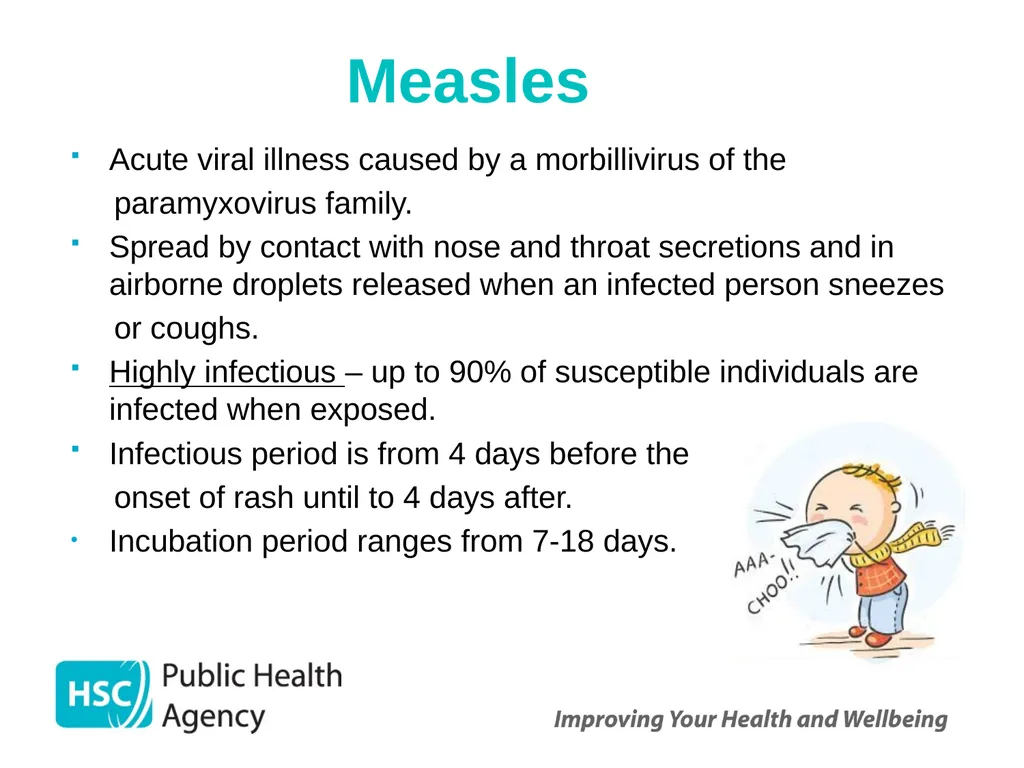
Spread by contact with nose and throat secretions and in airborne droplets released when an infected person sneezes
or coughs.
Highly infectious – up to 90% of susceptible individuals are infected when exposed.
Infectious period is from 4 days before the
onset of rash until to 4 days after.
Incubation period ranges from 7-18 days.<br>
04
Symptoms of measles The prodromal stage is characterised by the onset of fever, malaise, coryza, conjunctivitis and cough.
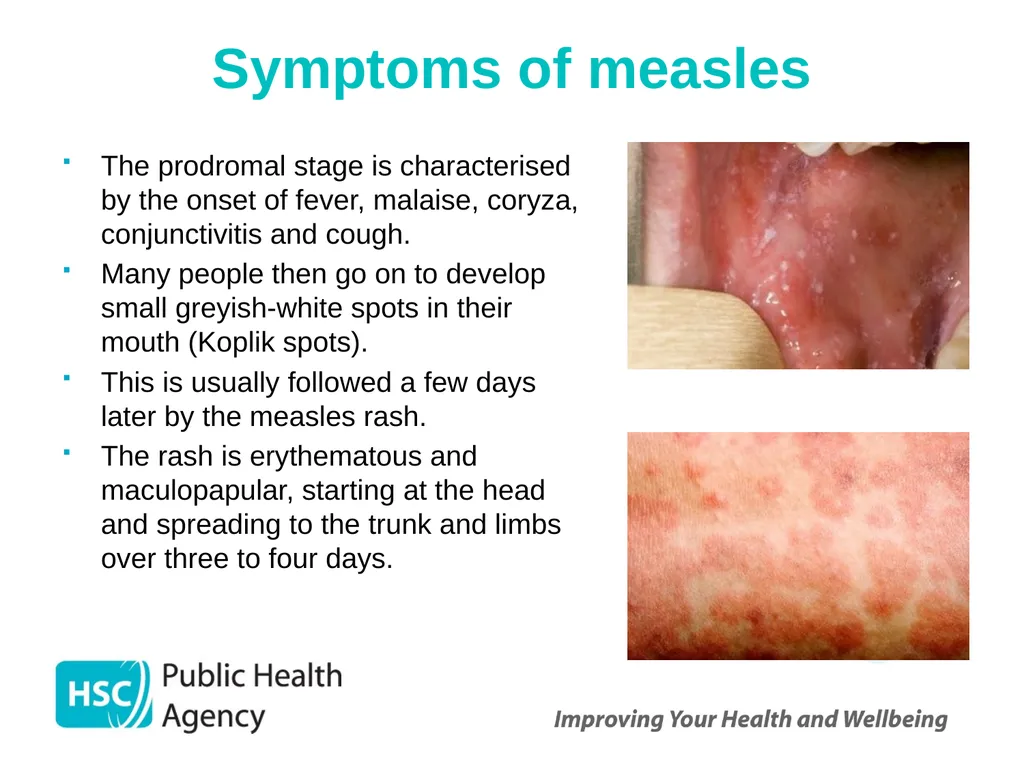
Many people then go on to develop small greyish-white spots in their mouth (Koplik spots).
This is usually followed a few days later by the measles rash.
The rash is erythematous and maculopapular, starting at the head and spreading to the trunk and limbs over three to four days.<br>
Many people then go on to develop small greyish-white spots in their mouth (Koplik spots).
This is usually followed a few days later by the measles rash.
The rash is erythematous and maculopapular, starting at the head and spreading to the trunk and limbs over three to four days.<br>
05
Immunisation Department, Centre for Infections
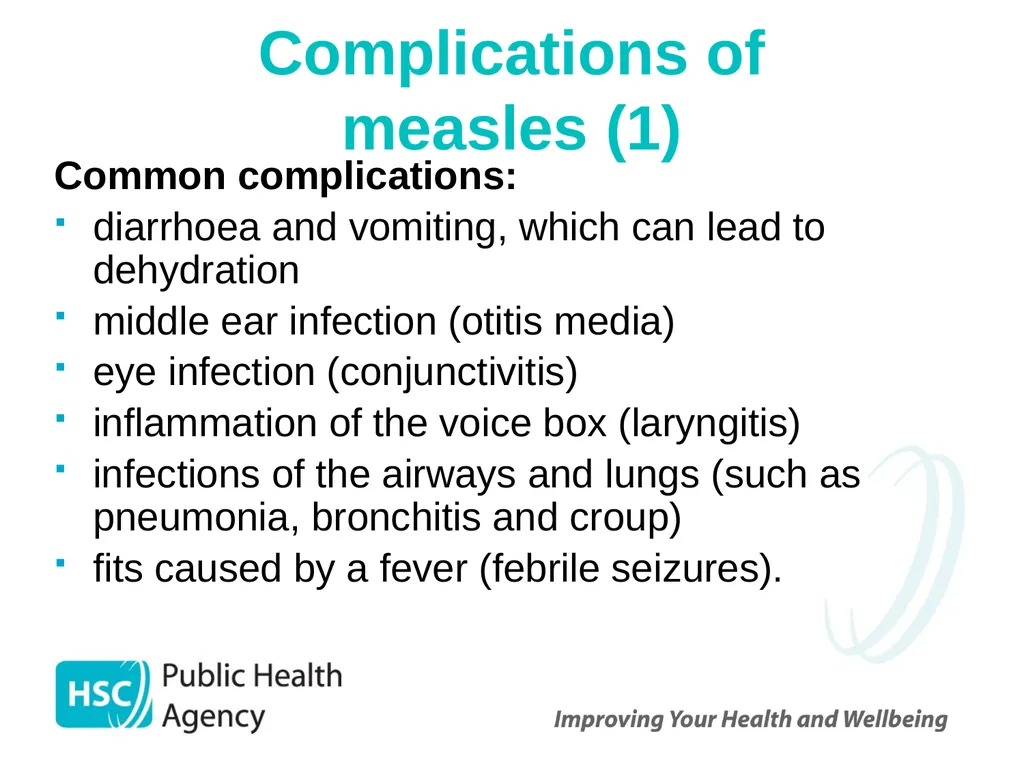
© Health Protection Agency Complications of measles (1) Common complications:
diarrhoea and vomiting, which can lead to dehydration
middle ear infection (otitis media)
eye infection (conjunctivitis)
inflammation of the voice box (laryngitis)
infections of the airways and lungs (such as pneumonia, bronchitis and croup)
fits caused by a fever (febrile seizures).<br>
06
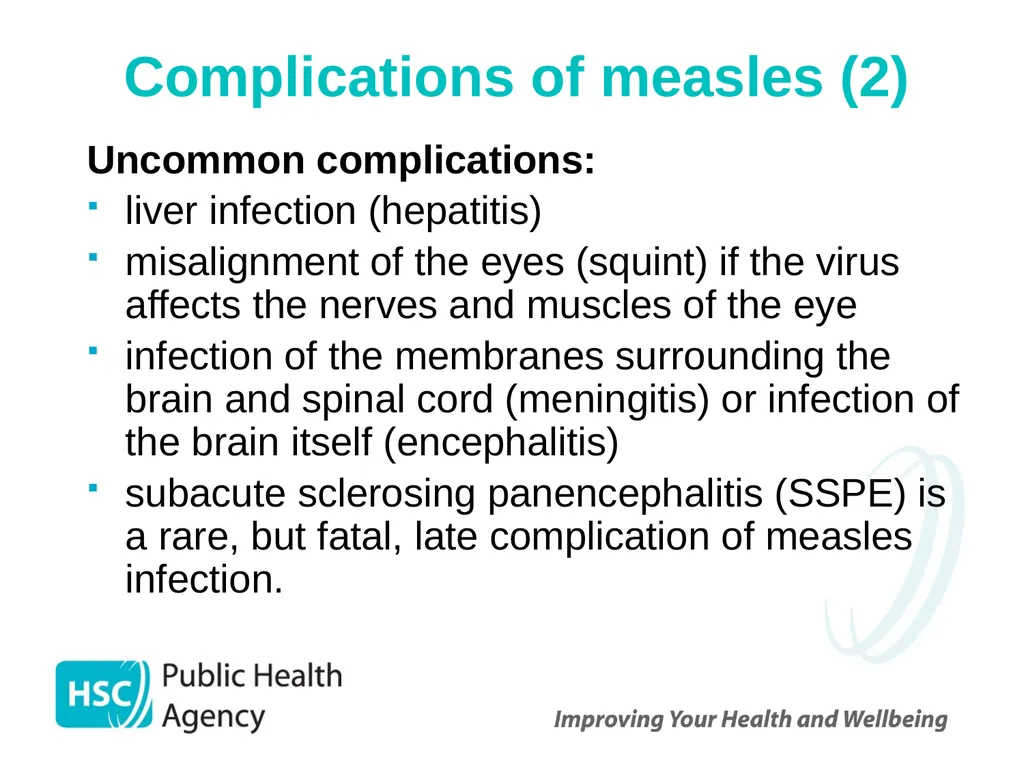
Complications of measles (2) Uncommon complications:
liver infection (hepatitis)
misalignment of the eyes (squint) if the virus affects the nerves and muscles of the eye
infection of the membranes surrounding the brain and spinal cord (meningitis) or infection of the brain itself (encephalitis)
subacute sclerosing panencephalitis (SSPE) is a rare, but fatal, late complication of measles infection.<br>
07
Measles in the United
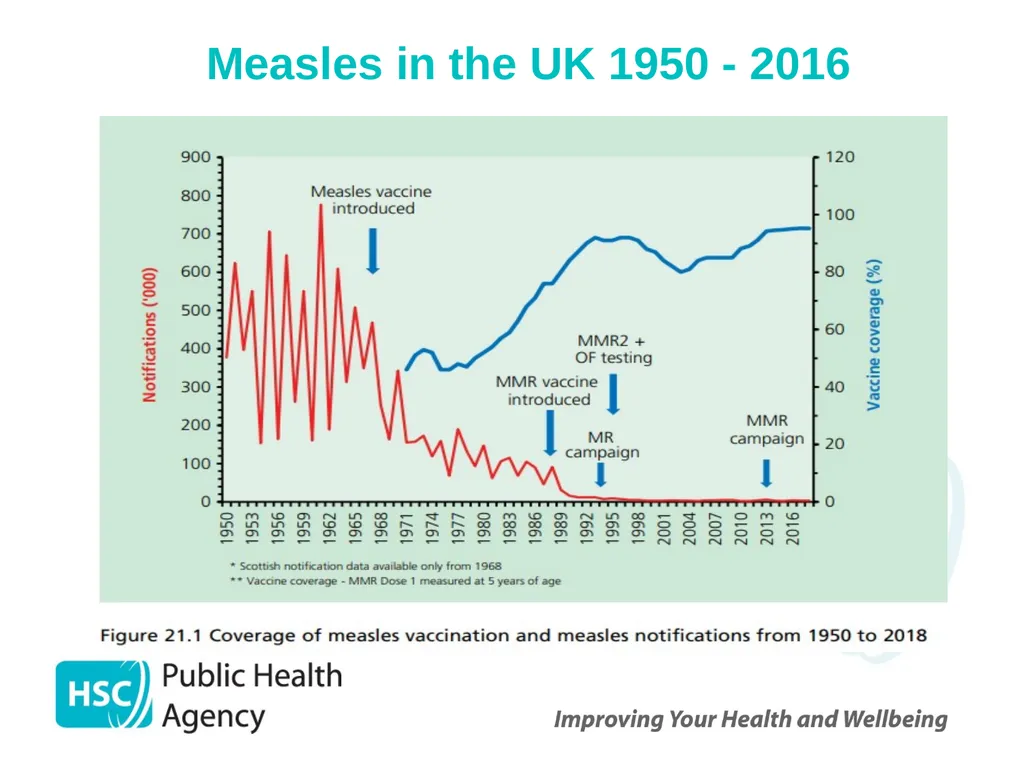
Kingdom (UK) Before the introduction of measles vaccine in 1968, annual notifications varied between 160,000 and 800,000, with peaks every two years, and around 100 deaths from acute measles occurred each year.
From 1968, measles vaccine coverage was sub-optimal and measles continued to circulate. This situation lasted until the late 1980s when combined measles-mumps-rubella vaccine (MMR) was introduced.<br>
From 1968, measles vaccine coverage was sub-optimal and measles continued to circulate. This situation lasted until the late 1980s when combined measles-mumps-rubella vaccine (MMR) was introduced.<br>
08
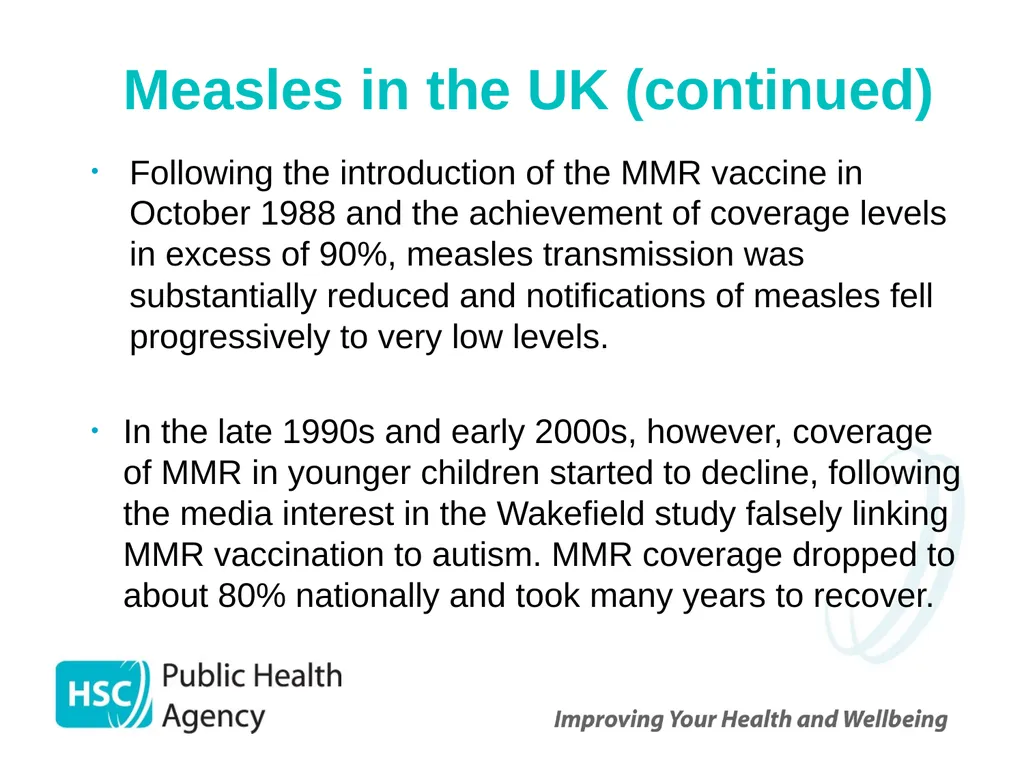
Measles in the UK (continued) Following the introduction of the MMR vaccine in October 1988 and the achievement of coverage levels in excess of 90%, measles transmission was substantially reduced and notifications of measles fell progressively to very low levels.
In the late 1990s and early 2000s, however, coverage of MMR in younger children started to decline, following the media interest in the Wakefield study falsely linking MMR vaccination to autism. MMR coverage dropped to about 80% nationally and took many years to recover.<br>
In the late 1990s and early 2000s, however, coverage of MMR in younger children started to decline, following the media interest in the Wakefield study falsely linking MMR vaccination to autism. MMR coverage dropped to about 80% nationally and took many years to recover.<br>
09
Measles in the UK 1950 - 2016<br>
10
Measles elimination in the UK Measles is highly infectious – the most infectious of all diseases transmitted through the respiratory route.
‘Herd immunity’ is particularly important for diseases of high infectivity, like measles, and for this reason, measles is a regional target for elimination and ultimately for eradication.
Eliminating measles and rubella is a core goal of the World Health Organization (WHO) European Vaccine Action Plan and an important part of global efforts to improve health and reduce inequalities.
In 2016, the WHO Regional Verification Committee (RVC) declared the UK had eliminated endemic measles.<br>
11
Measles elimination in the UK (continued) However, in 2018 there was a marked increase in the number of confirmed measles cases and the UK lost their elimination status.
The UK has never met the WHO target of 95% coverage with 2 doses of MMR vaccine needed to achieve and maintain measles elimination status.
Current MMR vaccine coverage in the routine childhood programme is the lowest it has been in a decade with about 10% of children not protected from measles by the time they are ready to start school.<br>
12
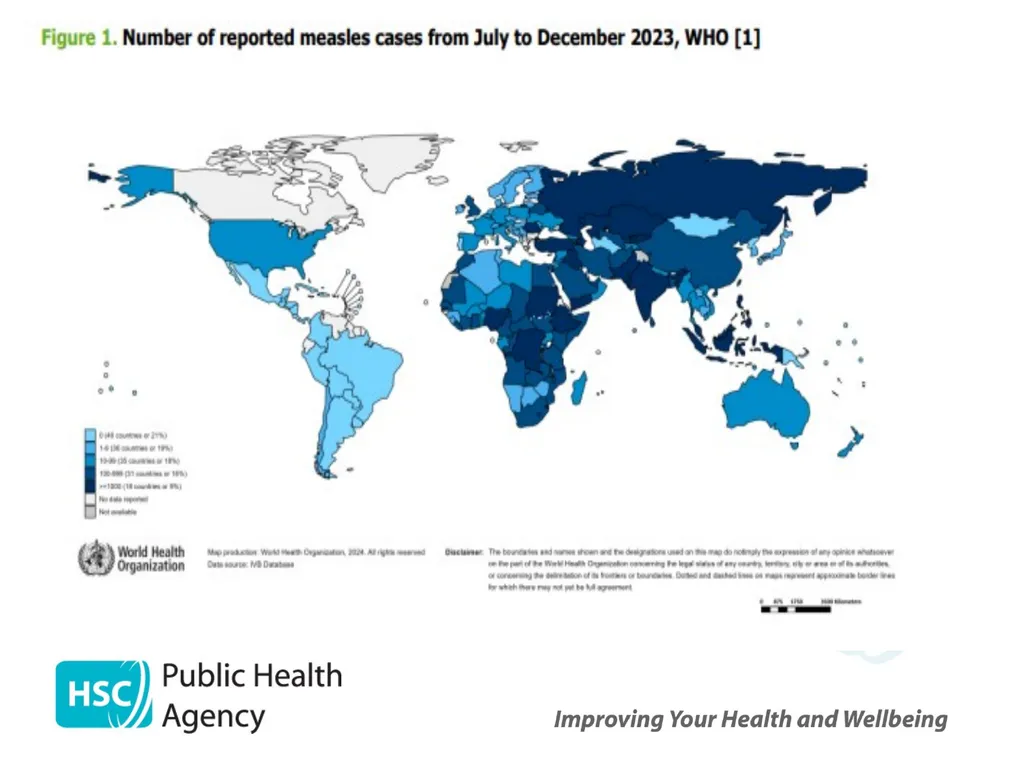
Measles surveillance 2023 Increase in cases across UK and RoI
Over 30,000 measles cases were reported by 40 of the 53 countries in the WHO European region between January and October 2023 (A 30-fold rise of measles cases in 2023 in the WHO European Region warrants urgent action and Measles on the rise in the EU/EEA - 16 February 2024 (europa.eu)).
In contrast, there were 941 cases reported in all of 2022
The WHO European Region provided a warning earlier in 2023 regarding a possible resurgence of measles across Europe and for countries to actively plan to catch up on vaccinations to prevent large scale outbreaks.
This resurgence of measles is largely attributed to declining rates of vaccination coverage across Europe.<br>
13
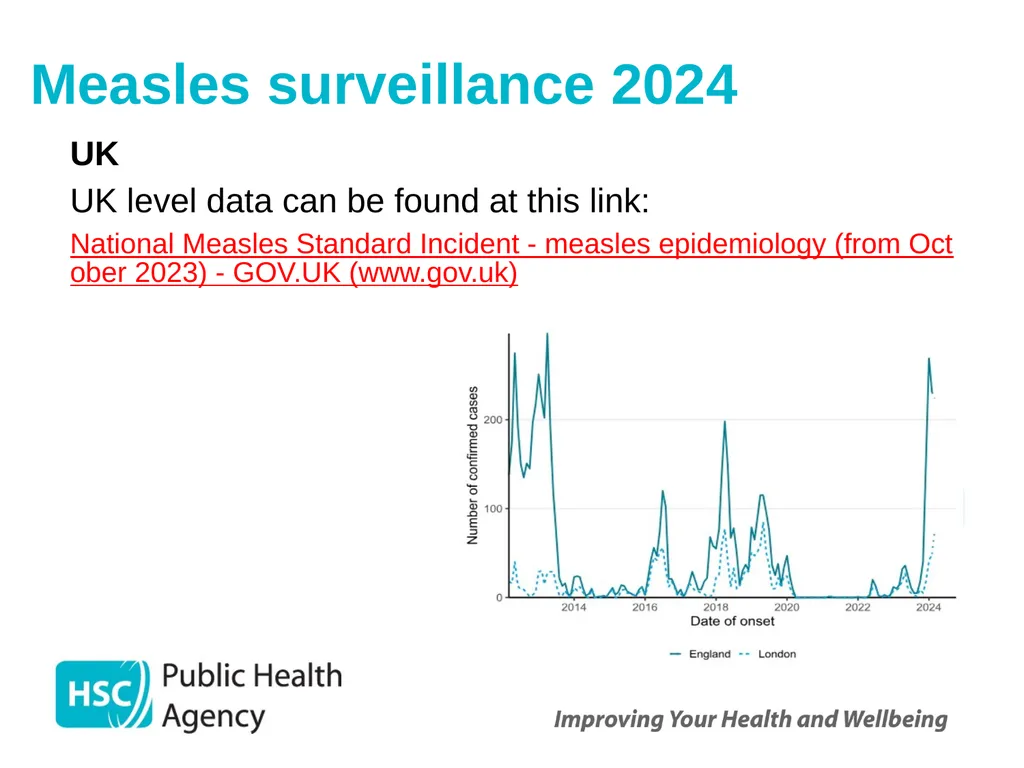
Measles surveillance 2024 UK
UK level data can be found at this link:
National Measles Standard Incident - measles epidemiology (from October 2023) - GOV.UK (www.gov.uk)<br>
UK level data can be found at this link:
National Measles Standard Incident - measles epidemiology (from October 2023) - GOV.UK (www.gov.uk)<br>
14
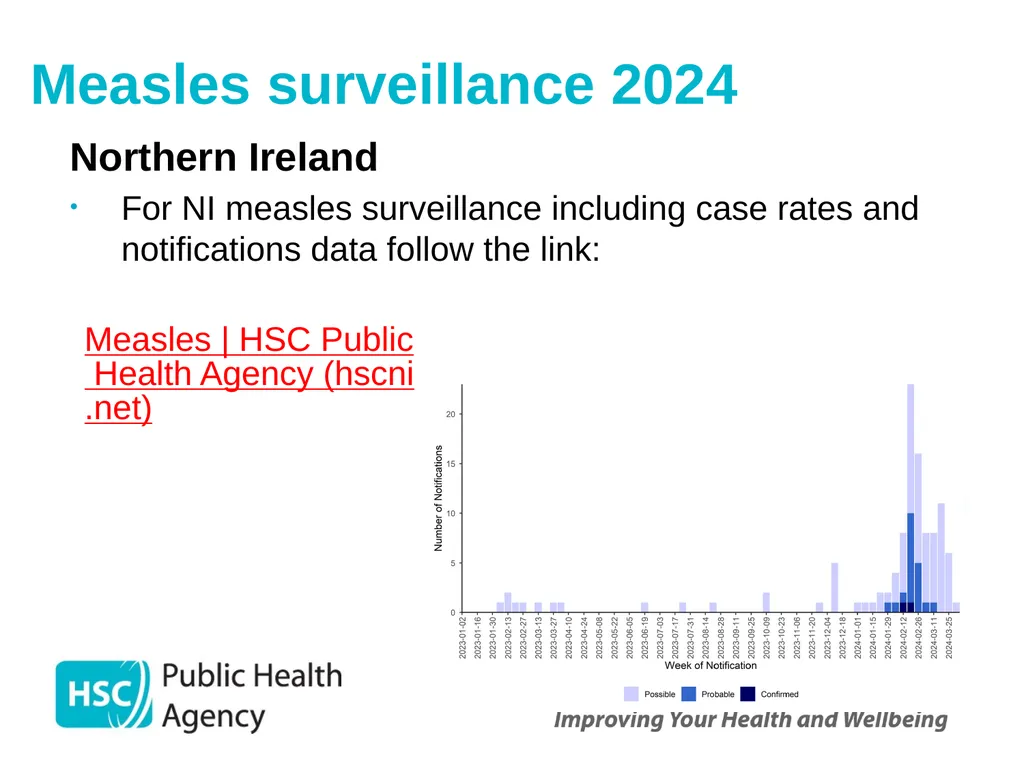
Measles surveillance 2024 Northern Ireland
For NI measles surveillance including case rates and notifications data follow the link: Measles | HSC Public Health Agency (hscni.net)<br>
For NI measles surveillance including case rates and notifications data follow the link: Measles | HSC Public Health Agency (hscni.net)<br>
15
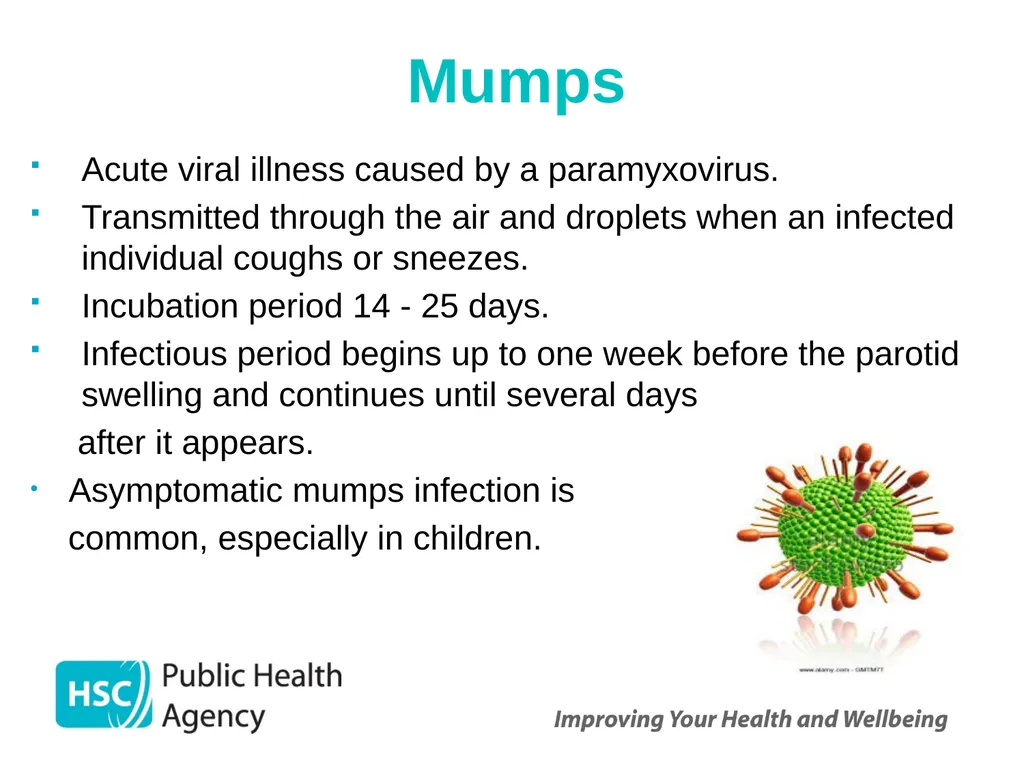
Mumps Acute viral illness caused by a paramyxovirus.
Transmitted through the air and droplets when an infected individual coughs or sneezes.
Incubation period 14 - 25 days.
Infectious period begins up to one week before the parotid swelling and continues until several days
after it appears.
Asymptomatic mumps infection is
common, especially in children.<br>
16
Immunisation Department, Centre for Infections
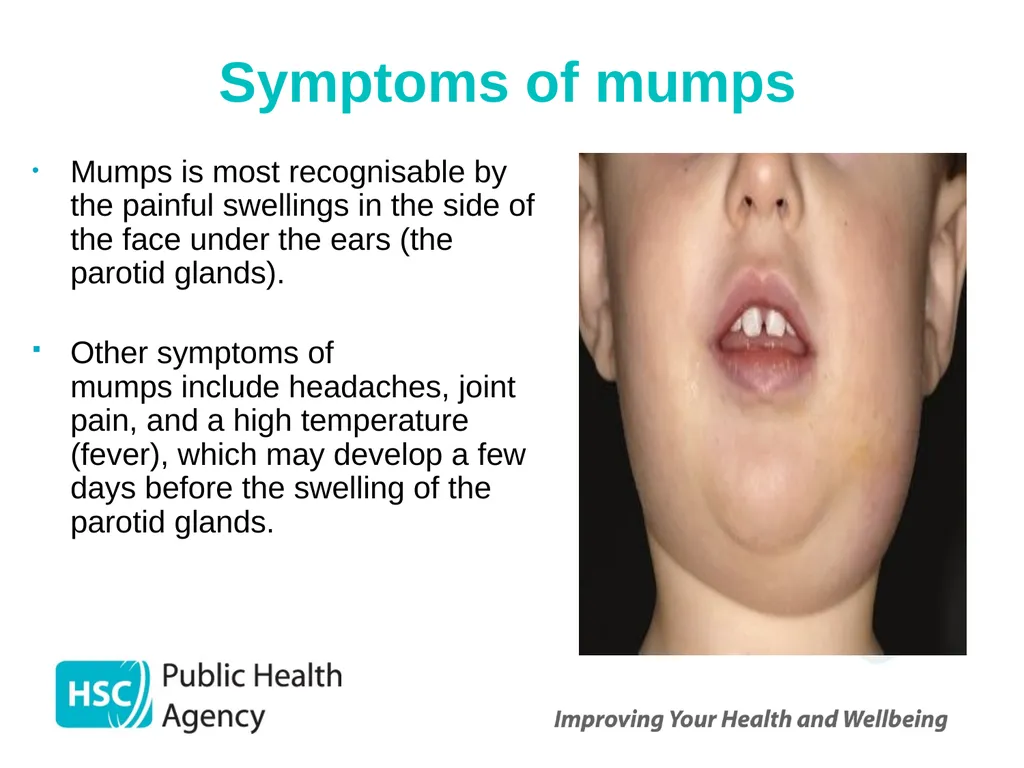
© Health Protection Agency Symptoms of mumps Mumps is most recognisable by the painful swellings in the side of the face under the ears (the parotid glands).
Other symptoms of mumps include headaches, joint pain, and a high temperature (fever), which may develop a few days before the swelling of the parotid glands.<br>
17
Complications of mumps Mumps frequently affects the nervous system and may be symptomatic or asymptomatic.
Neurological complications, including meningitis and encephalitis, may precede or follow parotitis (parotid swelling) and can also occur in its absence.
Other common complications are:
meningism (irritation of the meninges), often accompanied by headache, photophobia and neck stiffness
pancreatitis
oophoritis (inflammation of the ovaries)
orchitis (inflammation of the testes)
sensorineural deafness (bilateral or unilateral).<br>
18
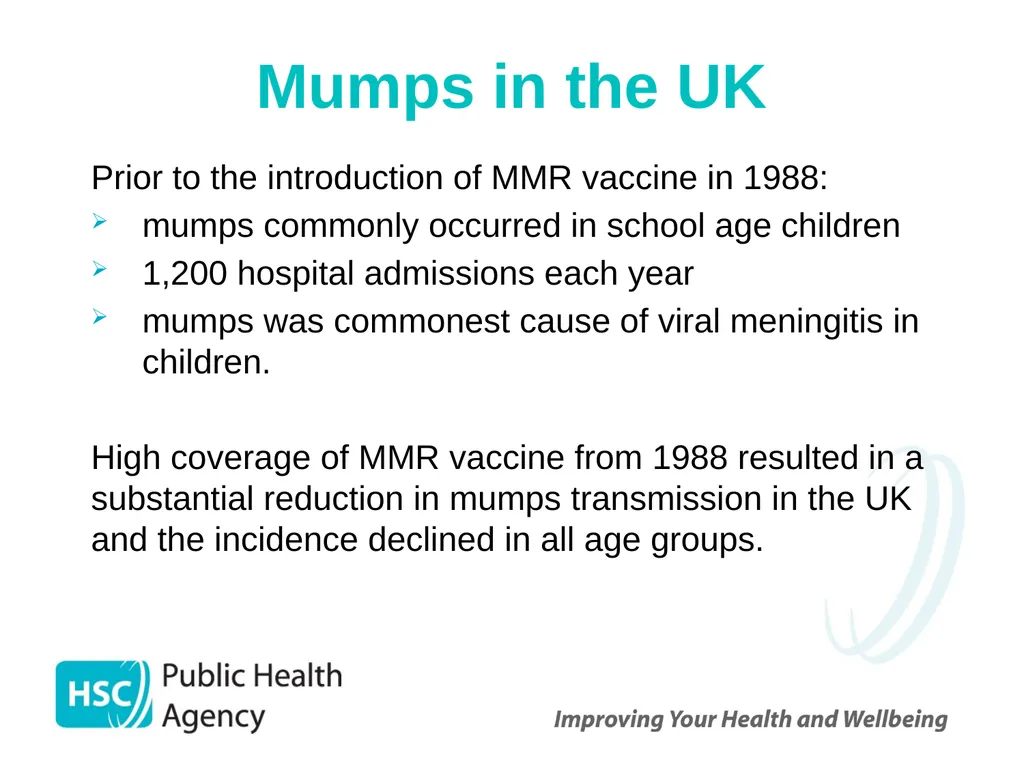
Mumps in the UK Prior to the introduction of MMR vaccine in 1988:
mumps commonly occurred in school age children
1,200 hospital admissions each year
mumps was commonest cause of viral meningitis in children.
High coverage of MMR vaccine from 1988 resulted in a substantial reduction in mumps transmission in the UK and the incidence declined in all age groups.<br>
mumps commonly occurred in school age children
1,200 hospital admissions each year
mumps was commonest cause of viral meningitis in children.
High coverage of MMR vaccine from 1988 resulted in a substantial reduction in mumps transmission in the UK and the incidence declined in all age groups.<br>
19
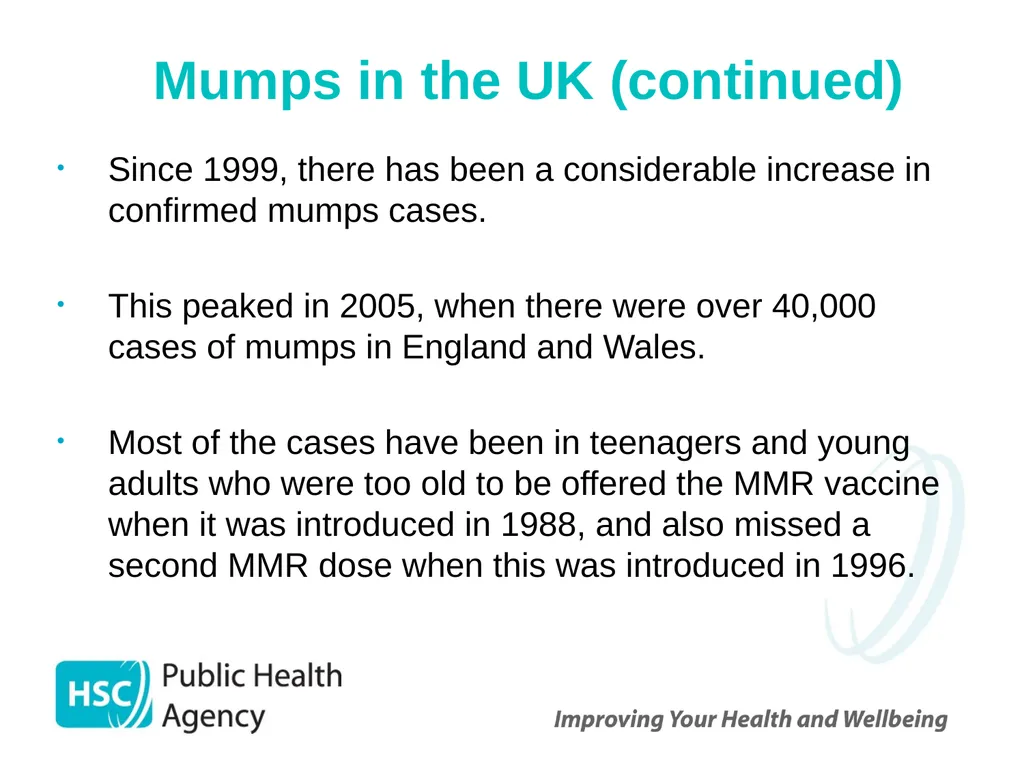
Mumps in the UK (continued) Since 1999, there has been a considerable increase in confirmed mumps cases.
This peaked in 2005, when there were over 40,000 cases of mumps in England and Wales.
Most of the cases have been in teenagers and young adults who were too old to be offered the MMR vaccine when it was introduced in 1988, and also missed a second MMR dose when this was introduced in 1996.<br>
This peaked in 2005, when there were over 40,000 cases of mumps in England and Wales.
Most of the cases have been in teenagers and young adults who were too old to be offered the MMR vaccine when it was introduced in 1988, and also missed a second MMR dose when this was introduced in 1996.<br>
20
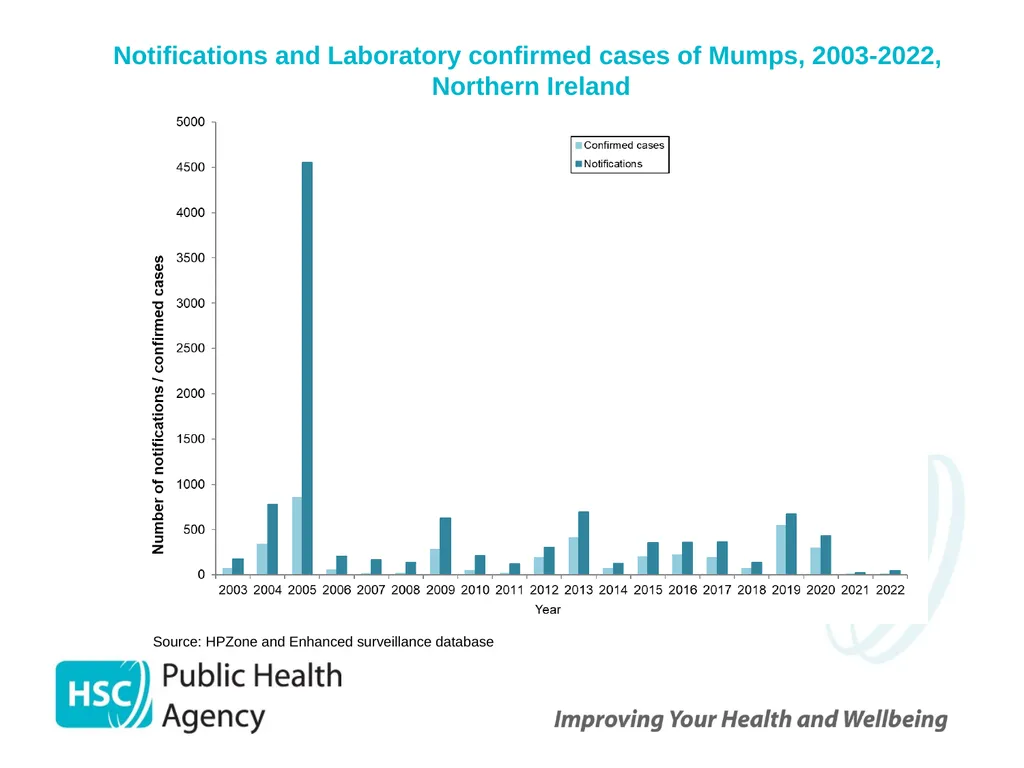
Notifications and Laboratory confirmed cases of Mumps, 2003-2022,
Northern Ireland Source: HPZone and Enhanced surveillance database<br>
21
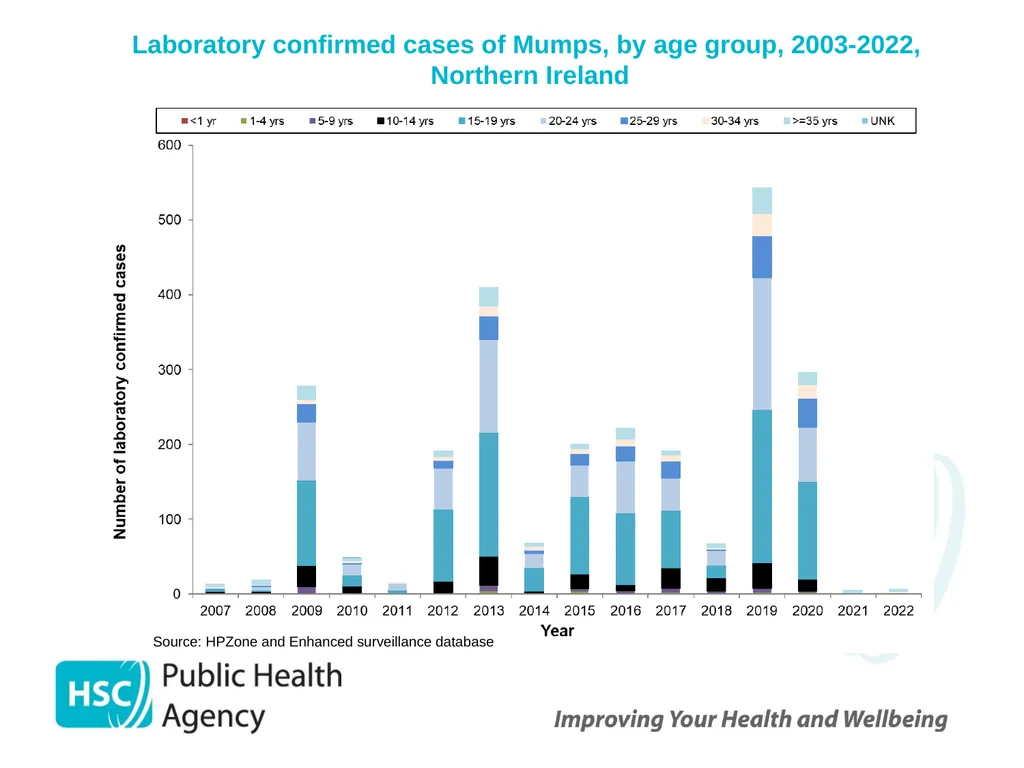
Laboratory confirmed cases of Mumps, by age group, 2003-2022,
Northern Ireland Source: HPZone and Enhanced surveillance database<br>
22
Immunisation Department, Centre for Infections
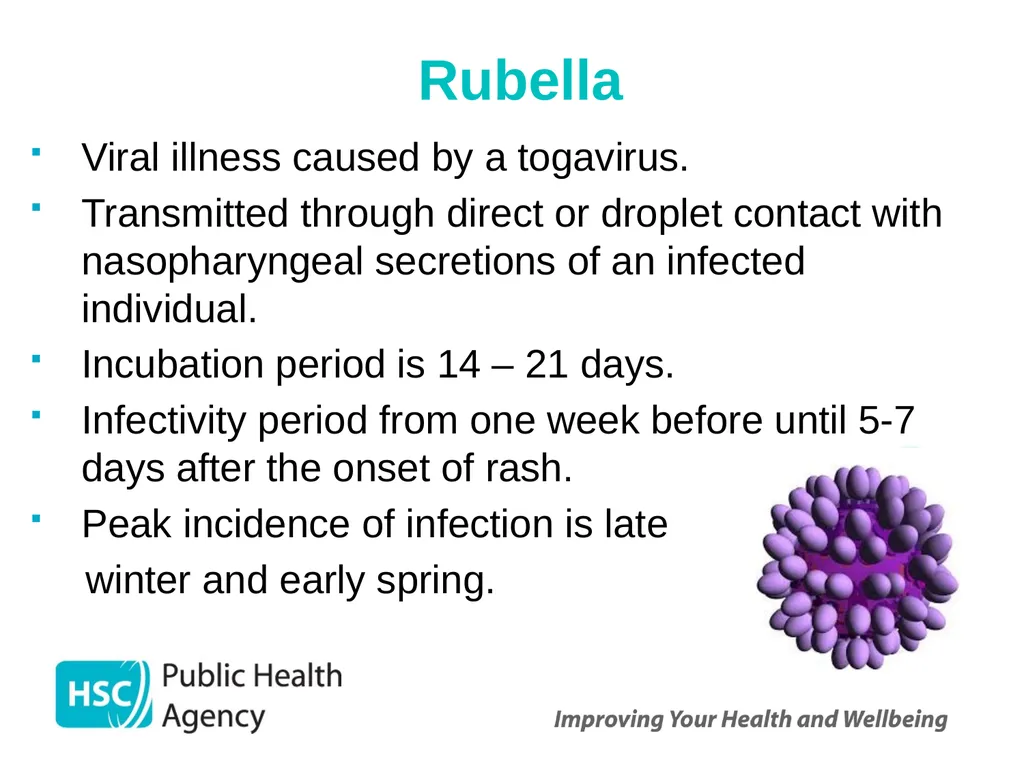
© Health Protection Agency Rubella Viral illness caused by a togavirus.
Transmitted through direct or droplet contact with nasopharyngeal secretions of an infected individual.
Incubation period is 14 – 21 days.
Infectivity period from one week before until 5-7 days after the onset of rash.
Peak incidence of infection is late
winter and early spring.<br>
23
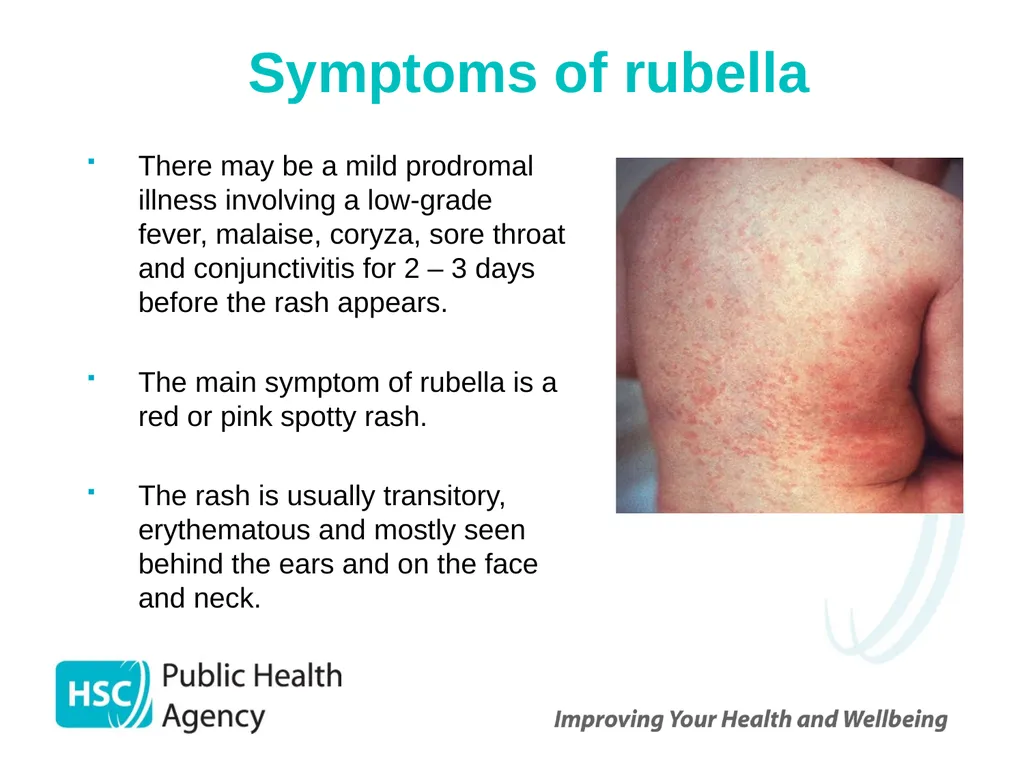
Symptoms of rubella There may be a mild prodromal illness involving a low-grade fever, malaise, coryza, sore throat and conjunctivitis for 2 – 3 days before the rash appears.
The main symptom of rubella is a red or pink spotty rash.
The rash is usually transitory, erythematous and mostly seen behind the ears and on the face and neck.<br>
The main symptom of rubella is a red or pink spotty rash.
The rash is usually transitory, erythematous and mostly seen behind the ears and on the face and neck.<br>
24
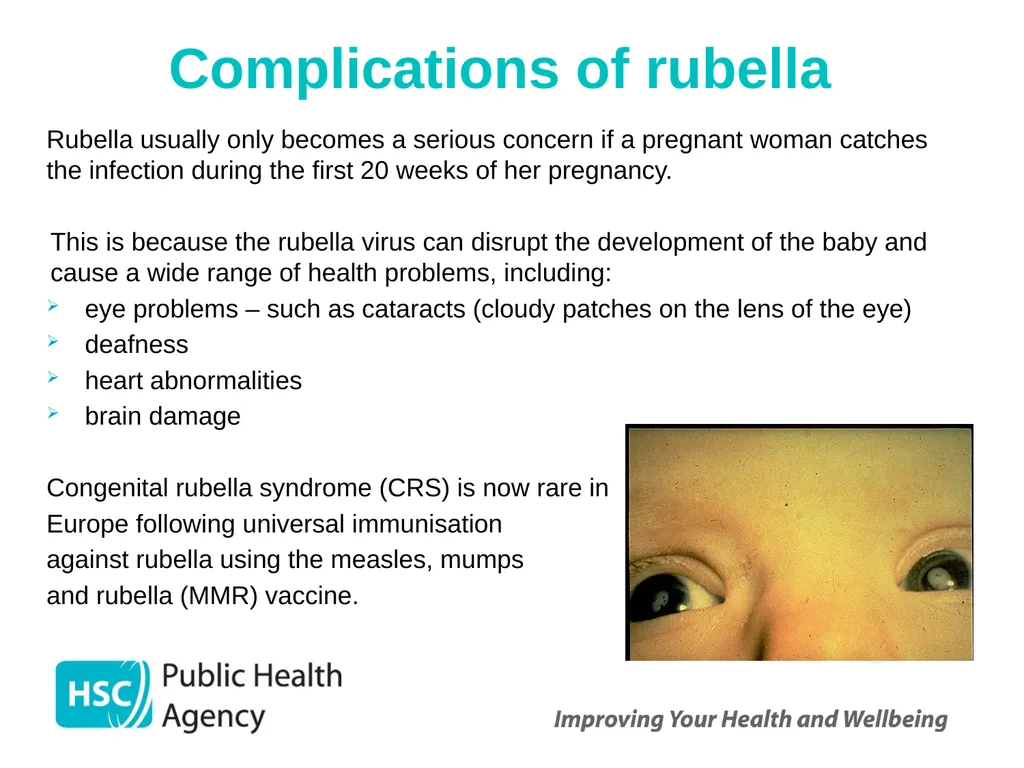
Complications of rubella Rubella usually only becomes a serious concern if a pregnant woman catches the infection during the first 20 weeks of her pregnancy.
This is because the rubella virus can disrupt the development of the baby and cause a wide range of health problems, including:
eye problems – such as cataracts (cloudy patches on the lens of the eye)
deafness
heart abnormalities
brain damage
Congenital rubella syndrome (CRS) is now rare in
Europe following universal immunisation
against rubella using the measles, mumps
and rubella (MMR) vaccine.<br>
25
Screening for rubella in pregnancy All pregnant women in Northern Ireland are offered screening in pregnancy to test for rubella immunity status.
Pregnant women who are found to be susceptible to rubella (i.e. rubella non-immune) should be offered immunisation with MMR after delivery.
MMR vaccine can be given to breastfeeding women.<br>
Pregnant women who are found to be susceptible to rubella (i.e. rubella non-immune) should be offered immunisation with MMR after delivery.
MMR vaccine can be given to breastfeeding women.<br>
26
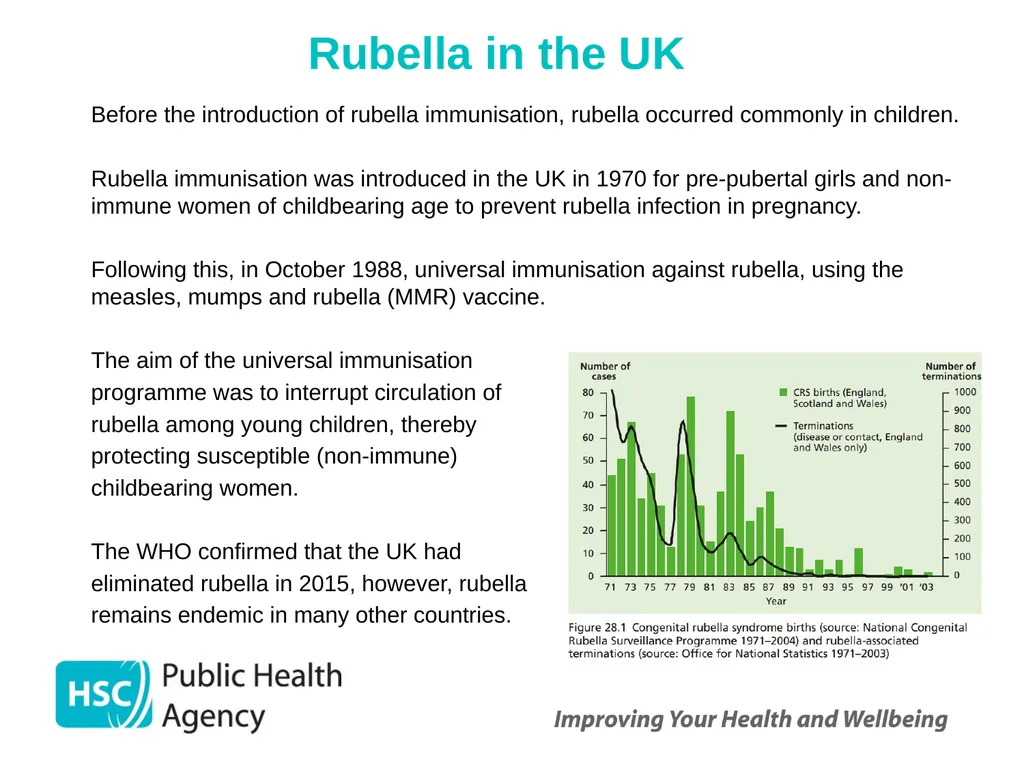
Rubella in the UK Before the introduction of rubella immunisation, rubella occurred commonly in children.
Rubella immunisation was introduced in the UK in 1970 for pre-pubertal girls and non-immune women of childbearing age to prevent rubella infection in pregnancy.
Following this, in October 1988, universal immunisation against rubella, using the measles, mumps and rubella (MMR) vaccine.
The aim of the universal immunisation
programme was to interrupt circulation of
rubella among young children, thereby
protecting susceptible (non-immune)
childbearing women.
The WHO confirmed that the UK had
eliminated rubella in 2015, however, rubella
remains endemic in many other countries.<br>
27
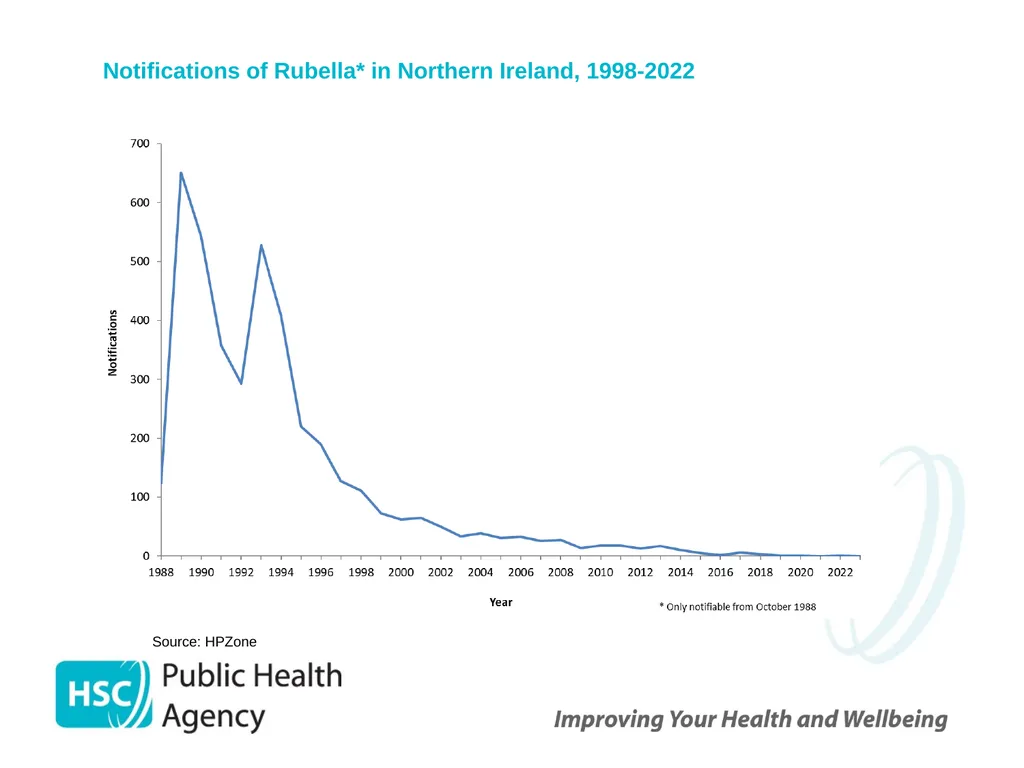
Notifications of Rubella* in Northern Ireland, 1998-2022 Source: HPZone<br>
28
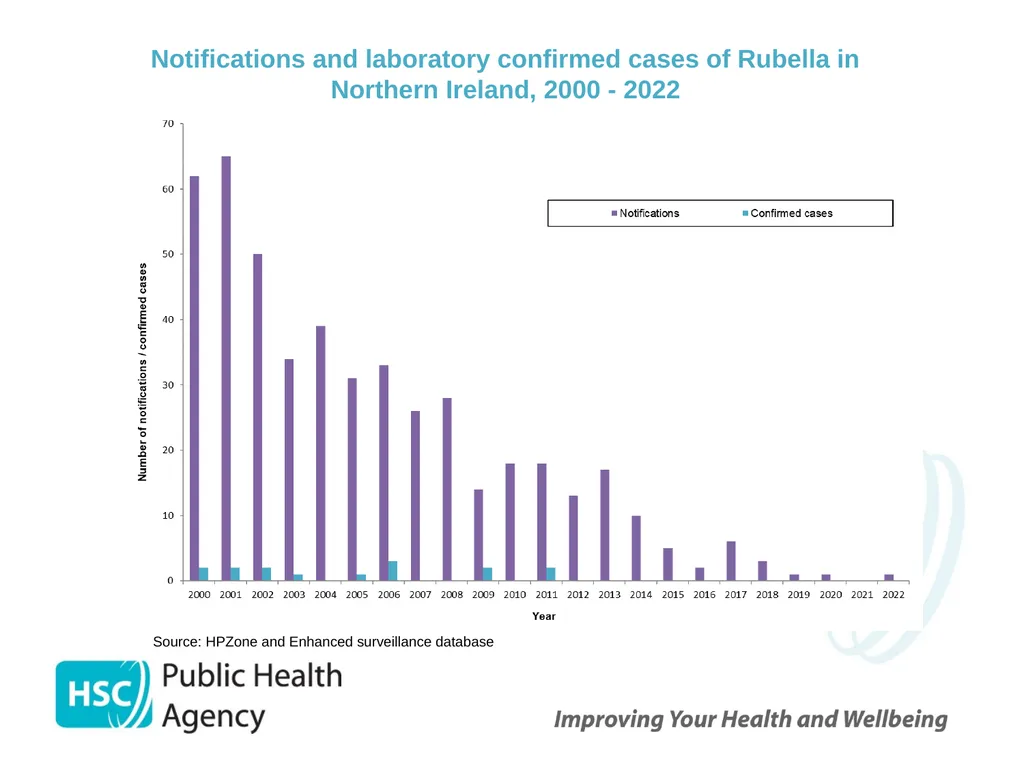
Notifications of Rubella* in Northern Ireland, 1988-2020* Notifications and laboratory confirmed cases of Rubella in Northern Ireland, 2000 - 2022 Source: HPZone and Enhanced surveillance database<br>
29
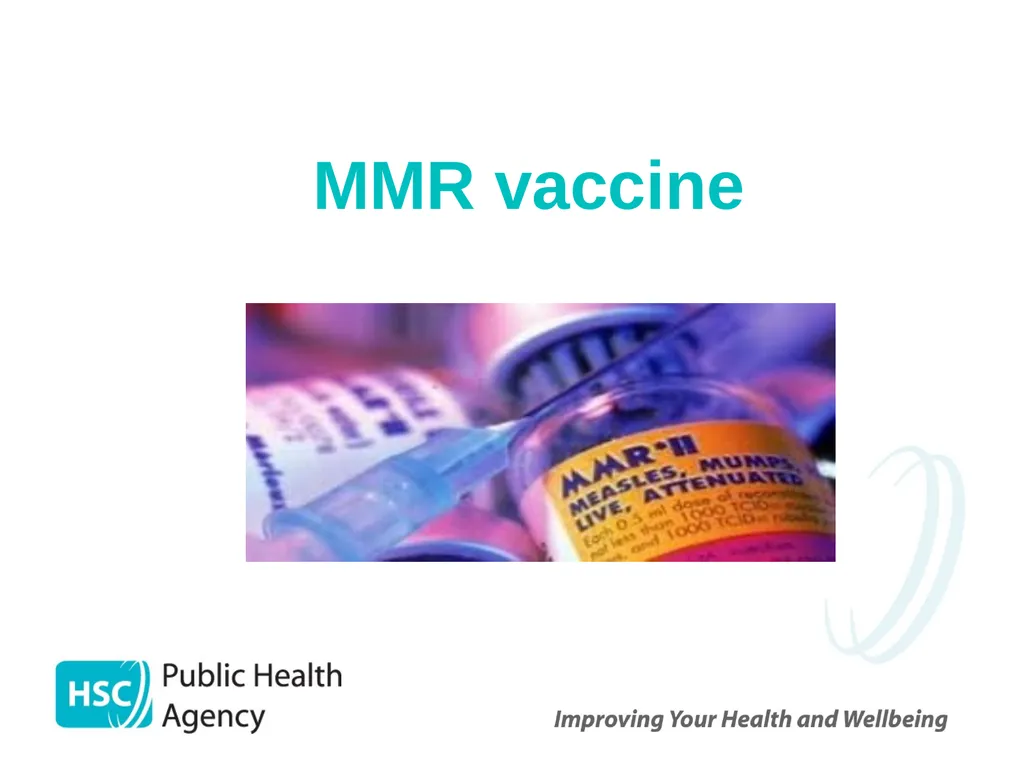
MMR vaccine<br>
30
MMR vaccine Measles, mumps and rubella (MMR) vaccine is only available as part of a combined product in the UK.
MMR:
is a live attenuated vaccine
was introduced in UK immunisation programmes in 1988
now used extensively around the world<br>
MMR:
is a live attenuated vaccine
was introduced in UK immunisation programmes in 1988
now used extensively around the world<br>
31
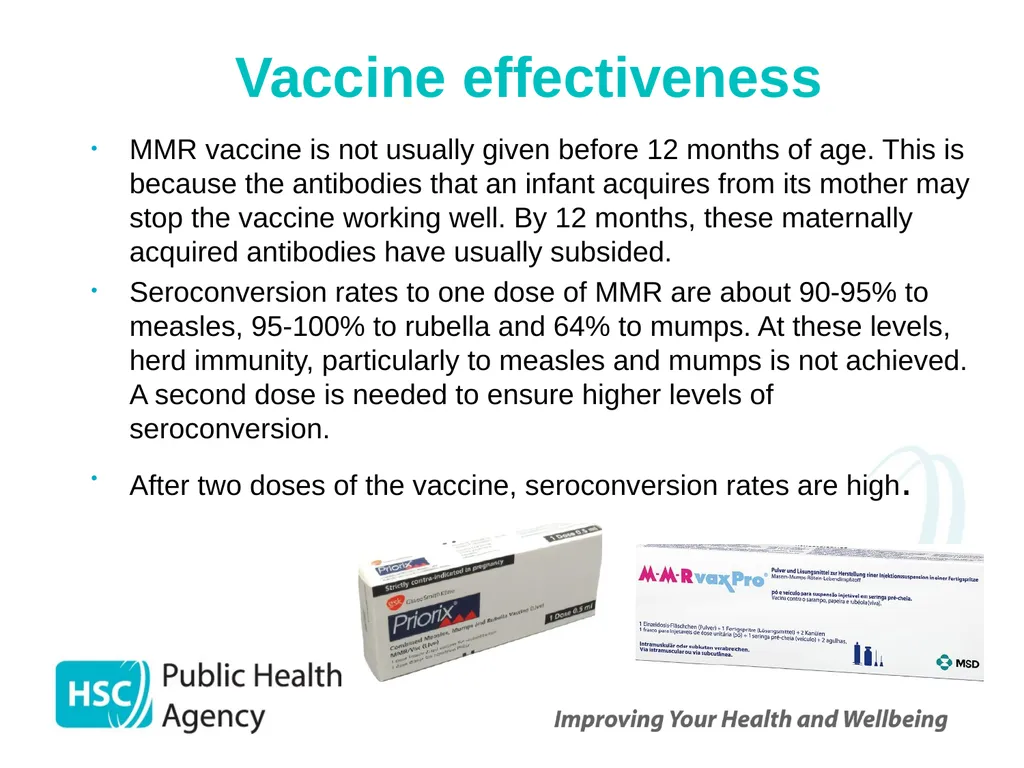
Current MMR vaccines There are two MMR vaccines available for use in Northern Ireland (NI):
M-M-RVaxPRO®
Priorix®.
MMR vaccine does not contain thiomersal or any other preservatives.
MMRVaxPRO contains gelatine of porcine origin as a stabiliser.<br>
M-M-RVaxPRO®
Priorix®.
MMR vaccine does not contain thiomersal or any other preservatives.
MMRVaxPRO contains gelatine of porcine origin as a stabiliser.<br>
32
Vaccination schedule (routine) 1st dose - 12 months
2nd dose - 3 years and 4 months
If a child is given the second dose at less than 15 months of age, then another routine dose (a third dose) should be given after 18 months of age in order to ensure full protection.
Note: doses of MMR given prior to 12 months of age should be discounted, and two further doses should be given as per routine schedule.<br>
33
Vaccination schedule Catch-up (1st-2nd birthday):
give one MMR and then wait until due 2nd routine dose at age 3 years 4 months (pre-school vaccines).
Catch-up (2nd-10th birthday):
give two MMRs at 4 week interval taking into consideration when pre-school vaccines are due.
The teenage (school-leaving) booster appointment is an opportunity to ensure that unimmunised or partially immunised children are offered MMR.
For those who have never had the MMR vaccine or those who have only had one dose of it, catch up vaccination is available at any age.
Don’t need to repeat doses given previously (after the age of one) - 2 dose schedule<br>
34
MMR vaccine and pregnancy MMR vaccine should not be given in pregnancy.
Pregnant women who are found to be susceptible to rubella (rubella non-immune) should be immunised with MMR after the birth.
Documented history of two MMR vaccines is evidence of adequate protection.
Effort should be made to ensure adequate protection prior to pregnancy.
If incomplete vaccination do not repeat doses already given, and leave minimum of 4 weeks between vaccines.
MMR vaccine can be given to breastfeeding women.
Women should be advised to avoid pregnancy for one month following vaccination with MMR.<br>
35
Vaccine effectiveness MMR vaccine is not usually given before 12 months of age. This is because the antibodies that an infant acquires from its mother may stop the vaccine working well. By 12 months, these maternally acquired antibodies have usually subsided.
Seroconversion rates to one dose of MMR are about 90-95% to measles, 95-100% to rubella and 64% to mumps. At these levels, herd immunity, particularly to measles and mumps is not achieved. A second dose is needed to ensure higher levels of seroconversion.
After two doses of the vaccine, seroconversion rates are high.<br>
36
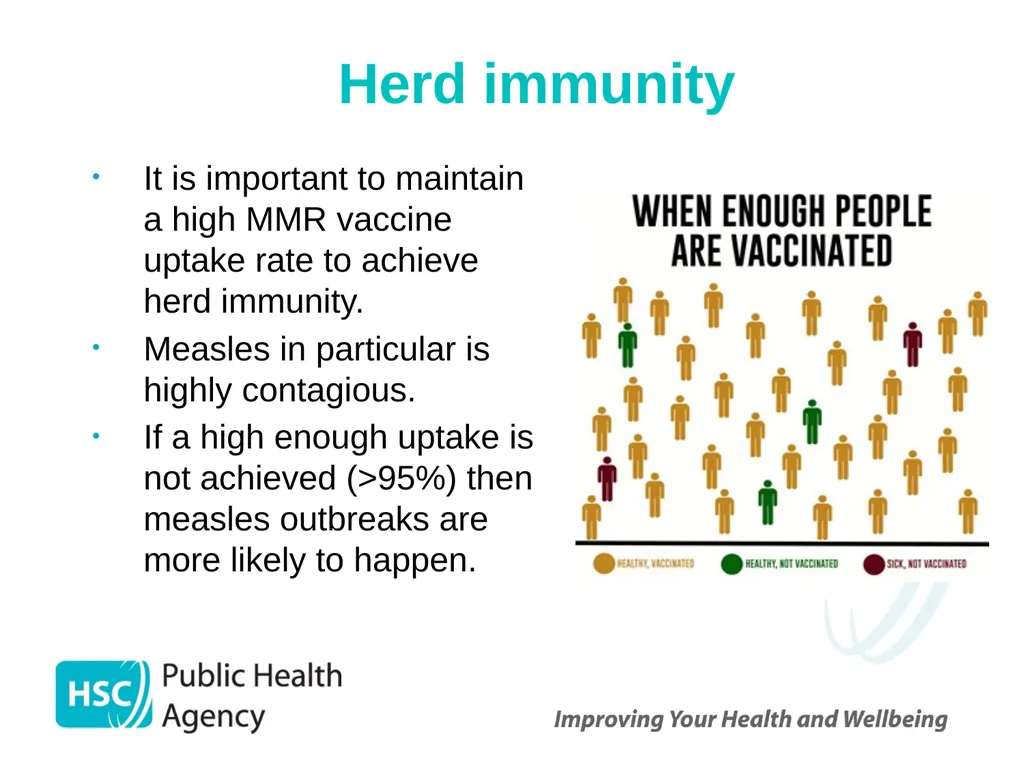
Herd immunity It is important to maintain a high MMR vaccine uptake rate to achieve herd immunity.
Measles in particular is highly contagious.
If a high enough uptake is not achieved (>95%) then measles outbreaks are more likely to happen.<br>
Measles in particular is highly contagious.
If a high enough uptake is not achieved (>95%) then measles outbreaks are more likely to happen.<br>
37
Contraindications There are very few individuals who cannot receive the MMR vaccine.
The vaccine should not be given to:
- those who are immunosuppressed
- those who have had a confirmed anaphylactic reaction to a previous dose of a measles, mumps or rubella containing vaccine
- those who have had a confirmed
anaphylactic reaction to neomycin or gelatin
- pregnant women.<br>
The vaccine should not be given to:
- those who are immunosuppressed
- those who have had a confirmed anaphylactic reaction to a previous dose of a measles, mumps or rubella containing vaccine
- those who have had a confirmed
anaphylactic reaction to neomycin or gelatin
- pregnant women.<br>
38
Egg allergy All children with egg allergy can receive the MMR vaccination.
Children who have had documented anaphylaxis to the vaccine itself should be assessed by an allergy specialist.<br>
Children who have had documented anaphylaxis to the vaccine itself should be assessed by an allergy specialist.<br>
39
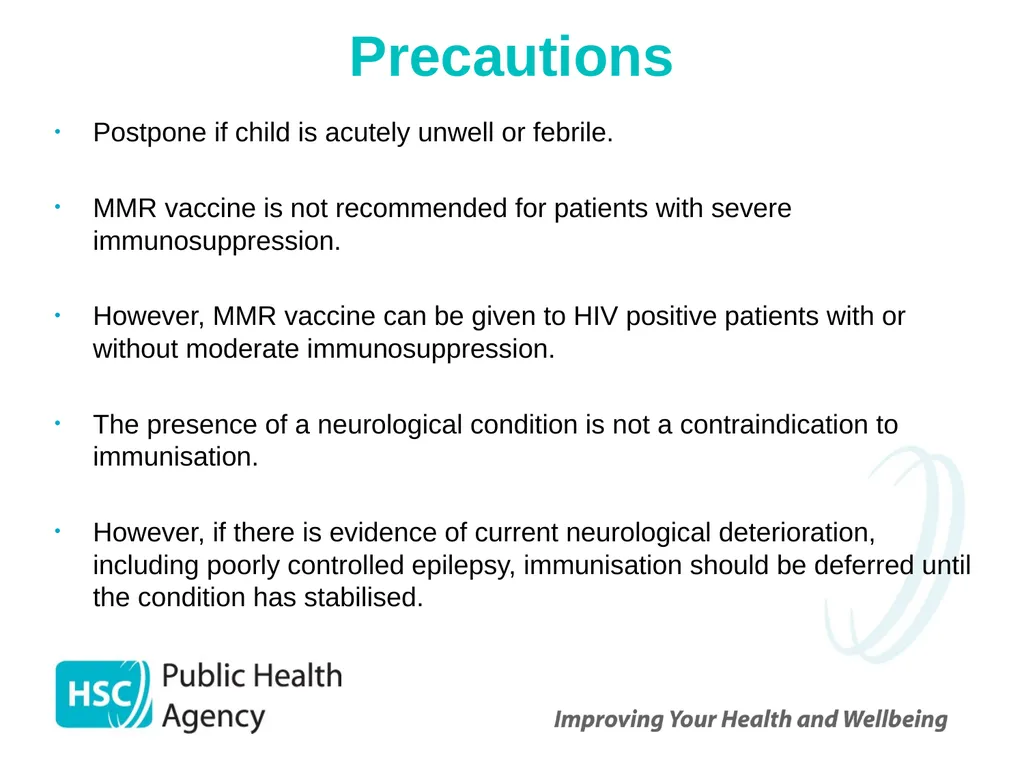
Precautions Postpone if child is acutely unwell or febrile.
MMR vaccine is not recommended for patients with severe immunosuppression.
However, MMR vaccine can be given to HIV positive patients with or without moderate immunosuppression.
The presence of a neurological condition is not a contraindication to immunisation.
However, if there is evidence of current neurological deterioration, including poorly controlled epilepsy, immunisation should be deferred until the condition has stabilised.<br>
40
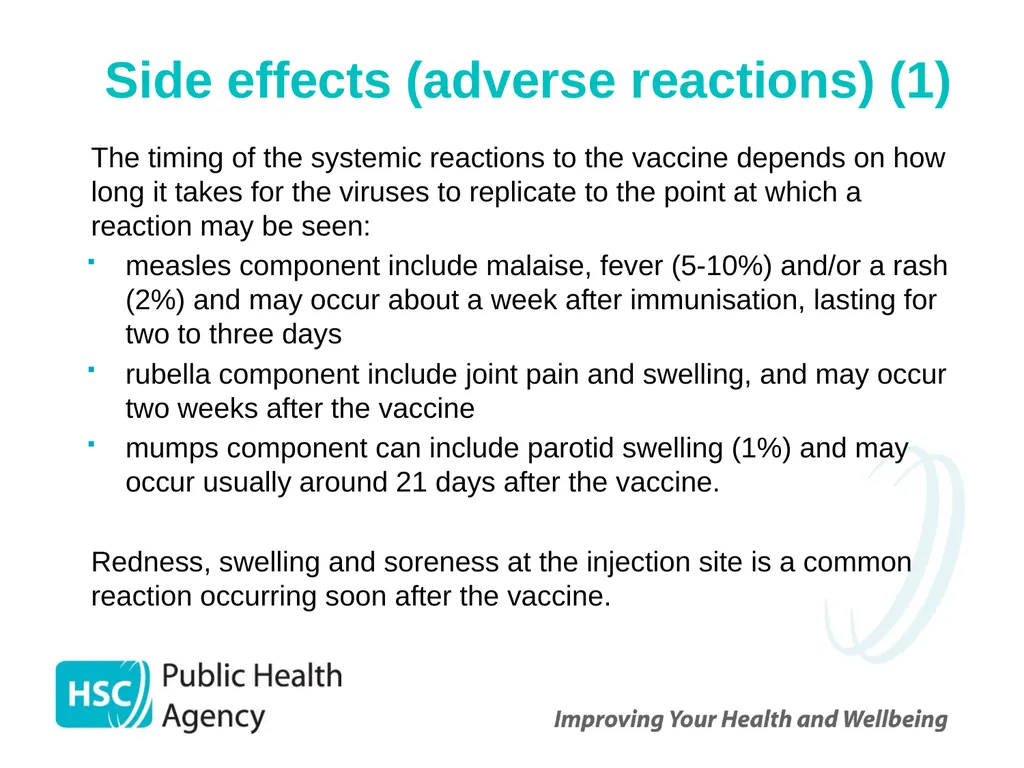
Side effects (adverse reactions) (1) The timing of the systemic reactions to the vaccine depends on how long it takes for the viruses to replicate to the point at which a reaction may be seen:
measles component include malaise, fever (5-10%) and/or a rash (2%) and may occur about a week after immunisation, lasting for two to three days
rubella component include joint pain and swelling, and may occur two weeks after the vaccine
mumps component can include parotid swelling (1%) and may occur usually around 21 days after the vaccine.
Redness, swelling and soreness at the injection site is a common reaction occurring soon after the vaccine.<br>
41
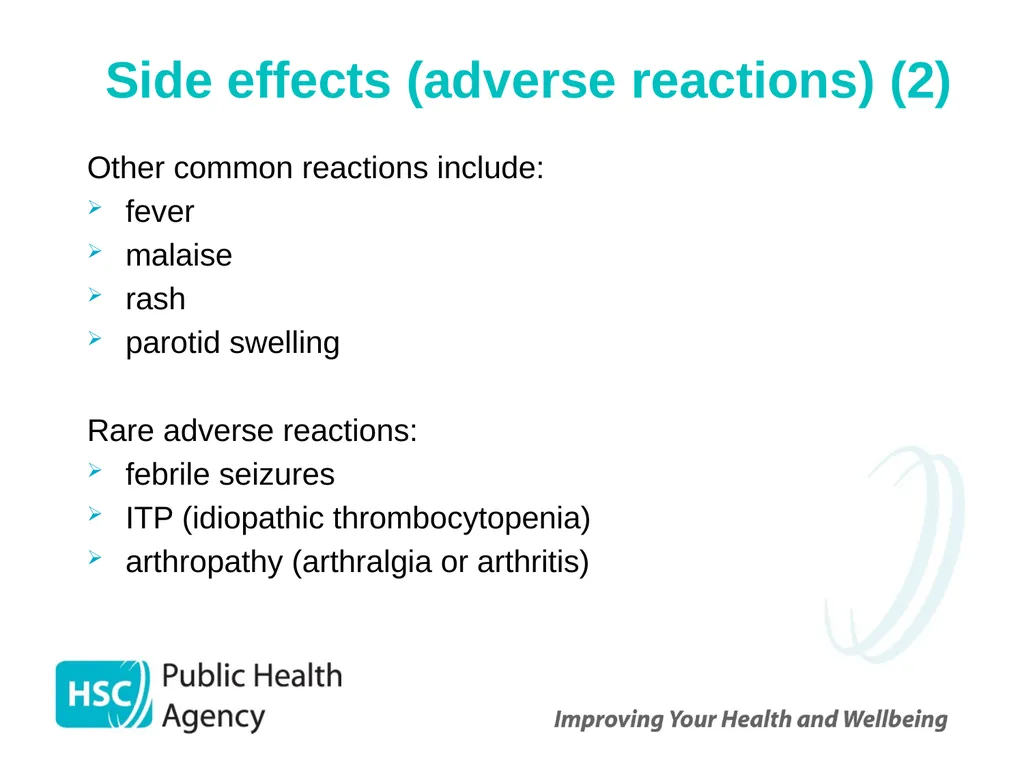
Side effects (adverse reactions) (2) Other common reactions include:
fever
malaise
rash
parotid swelling
Rare adverse reactions:
febrile seizures
ITP (idiopathic thrombocytopenia)
arthropathy (arthralgia or arthritis)<br>
fever
malaise
rash
parotid swelling
Rare adverse reactions:
febrile seizures
ITP (idiopathic thrombocytopenia)
arthropathy (arthralgia or arthritis)<br>
42
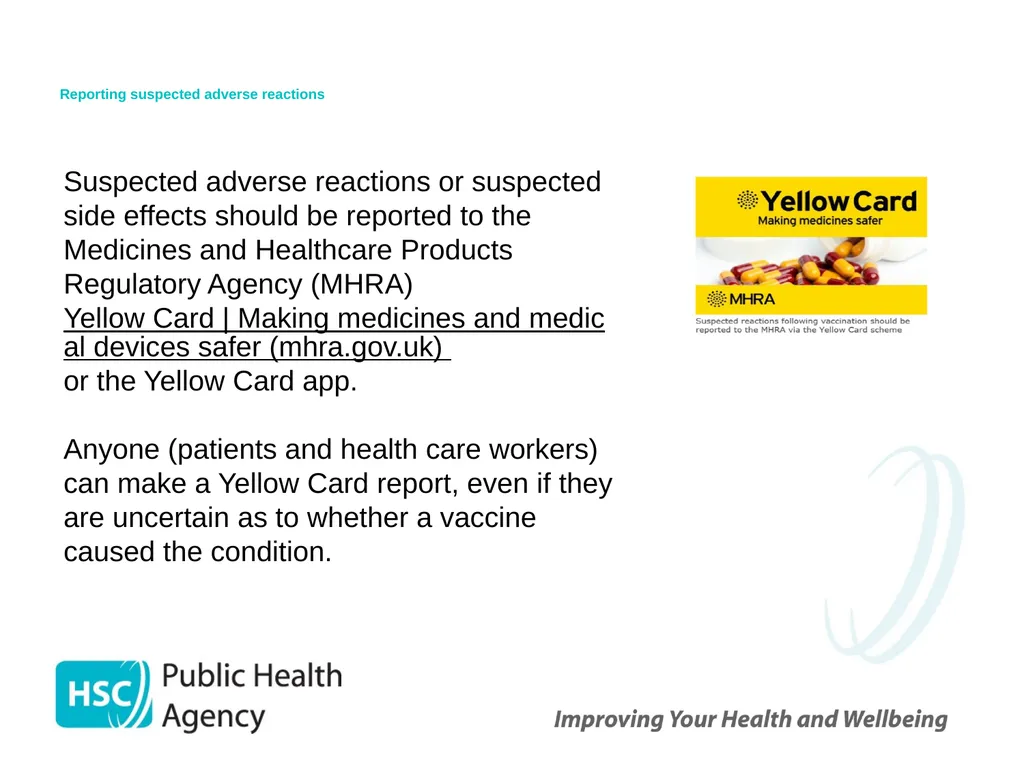
43 Reporting suspected adverse reactions Suspected adverse reactions or suspected side effects should be reported to the Medicines and Healthcare Products Regulatory Agency (MHRA) Yellow Card | Making medicines and medical devices safer (mhra.gov.uk) or the Yellow Card app.
Anyone (patients and health care workers) can make a Yellow Card report, even if they are uncertain as to whether a vaccine caused the condition.<br>
Anyone (patients and health care workers) can make a Yellow Card report, even if they are uncertain as to whether a vaccine caused the condition.<br>
43
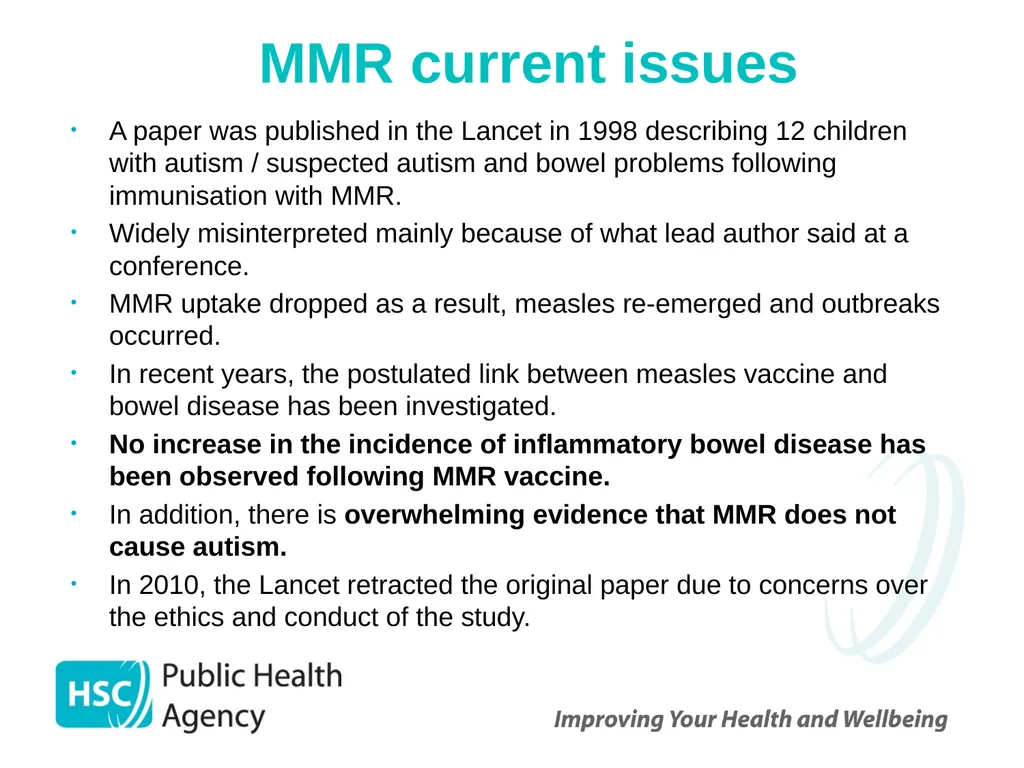
MMR current issues A paper was published in the Lancet in 1998 describing 12 children with autism / suspected autism and bowel problems following immunisation with MMR.
Widely misinterpreted mainly because of what lead author said at a conference.
MMR uptake dropped as a result, measles re-emerged and outbreaks occurred.
In recent years, the postulated link between measles vaccine and bowel disease has been investigated.
No increase in the incidence of inflammatory bowel disease has been observed following MMR vaccine.
In addition, there is overwhelming evidence that MMR does not cause autism.
In 2010, the Lancet retracted the original paper due to concerns over the ethics and conduct of the study.<br>
44
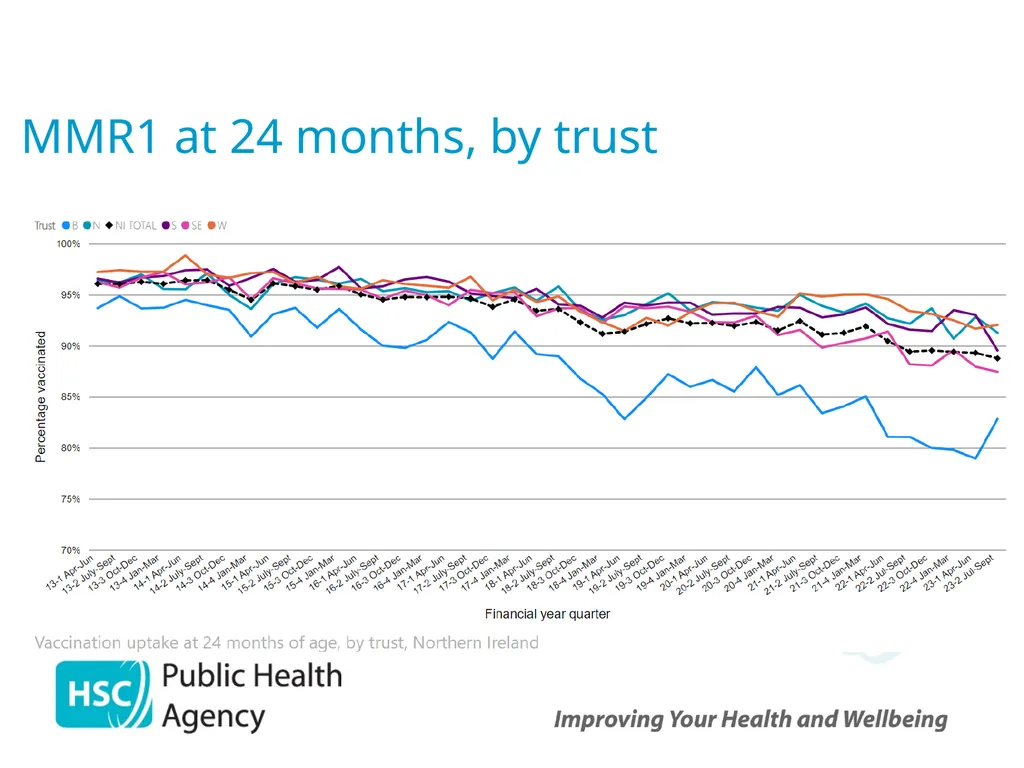
MMR1 at 24 months, by trust<br>
45
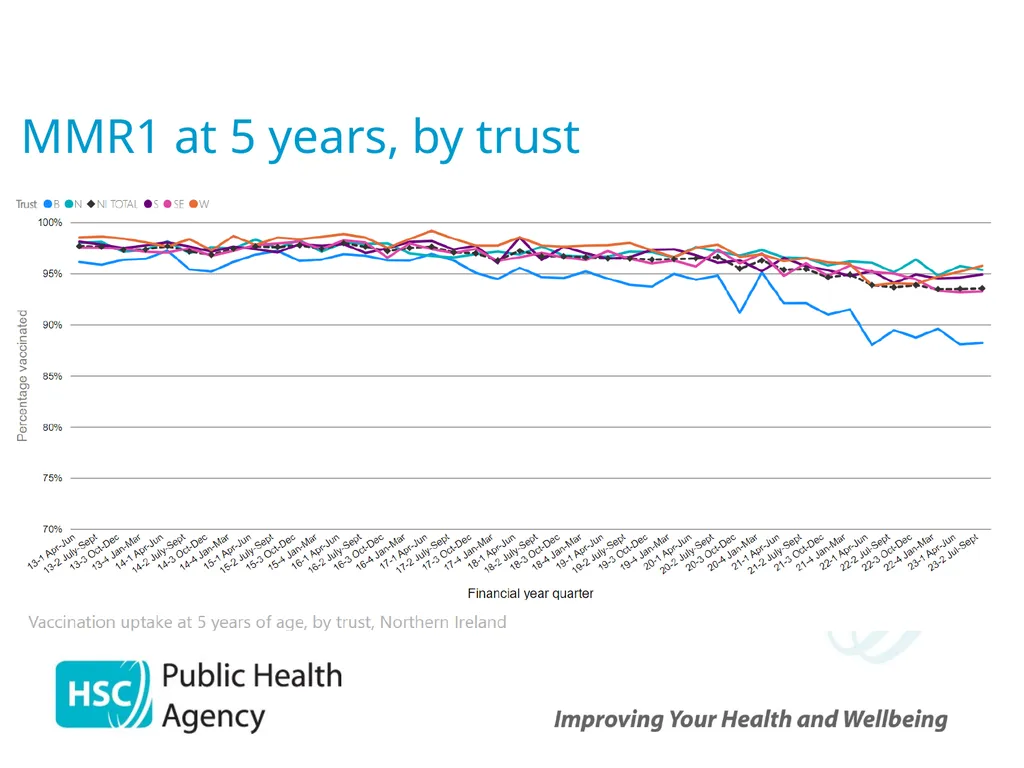
MMR1 at 5 years, by trust<br>
46
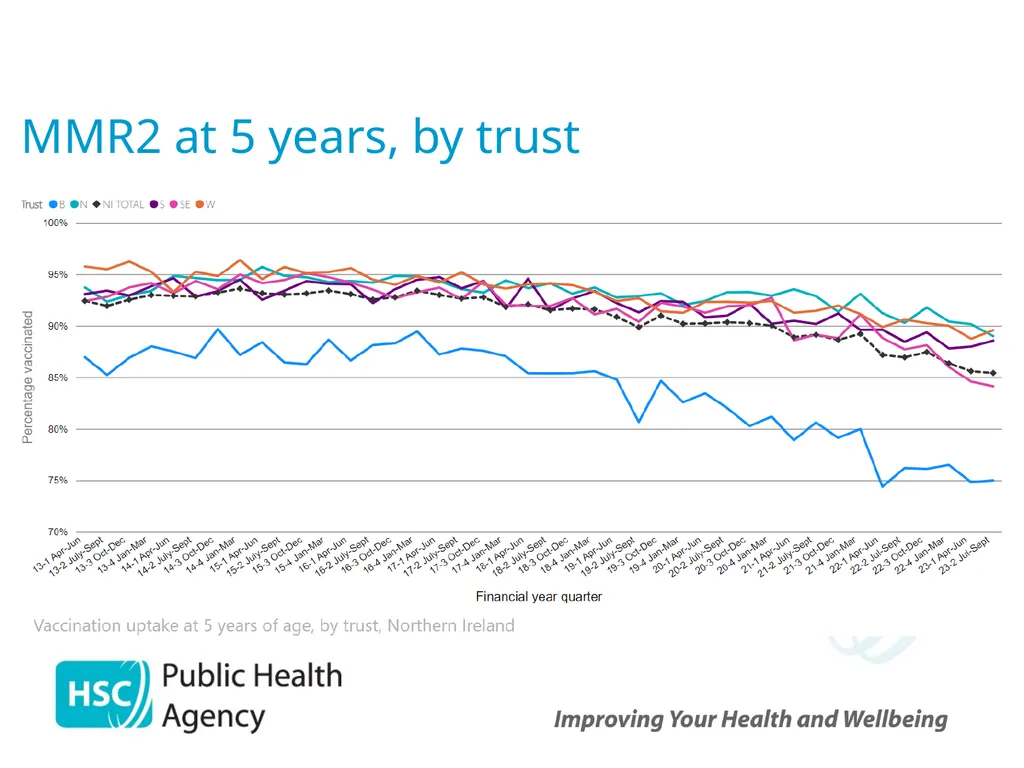
MMR2 at 5 years, by trust<br>
47
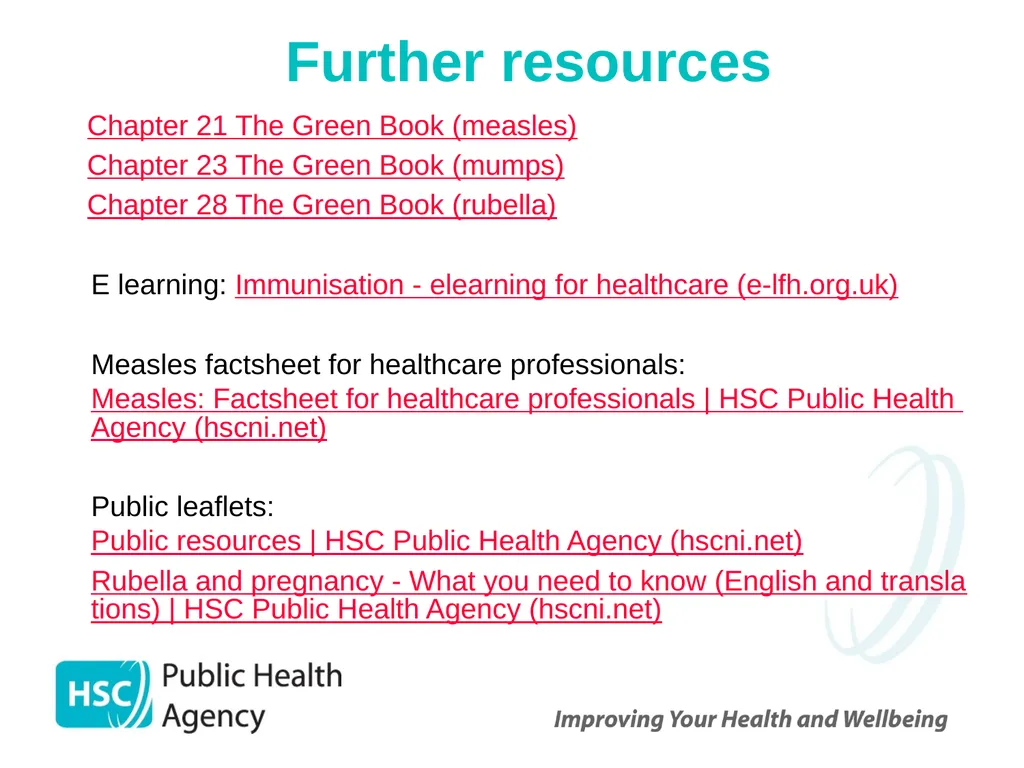
Further resources Chapter 21 The Green Book (measles)
Chapter 23 The Green Book (mumps)
Chapter 28 The Green Book (rubella)
E learning: Immunisation - elearning for healthcare (e-lfh.org.uk)
Measles factsheet for healthcare professionals: Measles: Factsheet for healthcare professionals | HSC Public Health Agency (hscni.net)
Public leaflets: Public resources | HSC Public Health Agency (hscni.net)
Rubella and pregnancy - What you need to know (English and translations) | HSC Public Health Agency (hscni.net)<br>
48
Questions For any queries which have not been addressed in the slide set or further resources, the PHA Immunisation team can be contacted at pha.immunisation@hscni.net<br>