
Measurable Skill Gains Performance Indicators
CM
Published · 51 slides · 0 views
1 / 1





Description
Measurable Skill Gains Performance Indicators Training Heather Pipkin November 4, 2021, Teams References 20 CFR 677.155(a)(1)(v) TEGL 10-16, Change 1 TEGL 14-18 TEGL 23-19 ADWS Policy No. WIOA 1-B 3.1 Updated 08272018 (Services for Adults
Related Topics
Share
Embed code
Download this presentation From Below
"Measurable Skill Gains Performance Indicators" is the property of its rightful owner. Permission is granted to download and print the materials on this website for personal, non-commercial use only, and to display it on your personal computer provided you do not modify the materials and that you retain all copyright notices contained in the materials. By downloading content from our website, you accept the terms of this agreement.
Presentation Transcript
01
Measurable Skill Gains Performance Indicators Training Heather Pipkin November 4, 2021, Teams<br>
02
References 20 CFR 677.155(a)(1)(v)
TEGL 10-16, Change 1
TEGL 14-18
TEGL 23-19
ADWS Policy No. WIOA 1-B 3.1 Updated 08/27/2018 (Services for Adults and Dislocated Workers)
ADWS Policy No. WIOA 1-B 3.2 Updated 08/27/2018 (Services for Youth)
ADWS Issuance PY19-08 (change 2) 2<br>
TEGL 10-16, Change 1
TEGL 14-18
TEGL 23-19
ADWS Policy No. WIOA 1-B 3.1 Updated 08/27/2018 (Services for Adults and Dislocated Workers)
ADWS Policy No. WIOA 1-B 3.2 Updated 08/27/2018 (Services for Youth)
ADWS Issuance PY19-08 (change 2) 2<br>
03
Objectives Learn the answers to the following:
When do I enter the MSG?
Which MSG do I use?
Where do I enter what information in AJL to get credit for the MSG?
How do I document the gain? 3<br>
When do I enter the MSG?
Which MSG do I use?
Where do I enter what information in AJL to get credit for the MSG?
How do I document the gain? 3<br>
04
Documentation Please refer to TEGL 23-19 for all lists of required documentation for the Measurable Skills Gains. 4<br>
05
WIOA title I-B - Who is in the measure for Adult/DLW? Participants in a WIOA title I Adult- or Dislocated Worker-funded or supported education and/or training program (including work-based training) that leads to a recognized postsecondary credential or employment
(PIRL 1811) 5<br>
(PIRL 1811) 5<br>
06
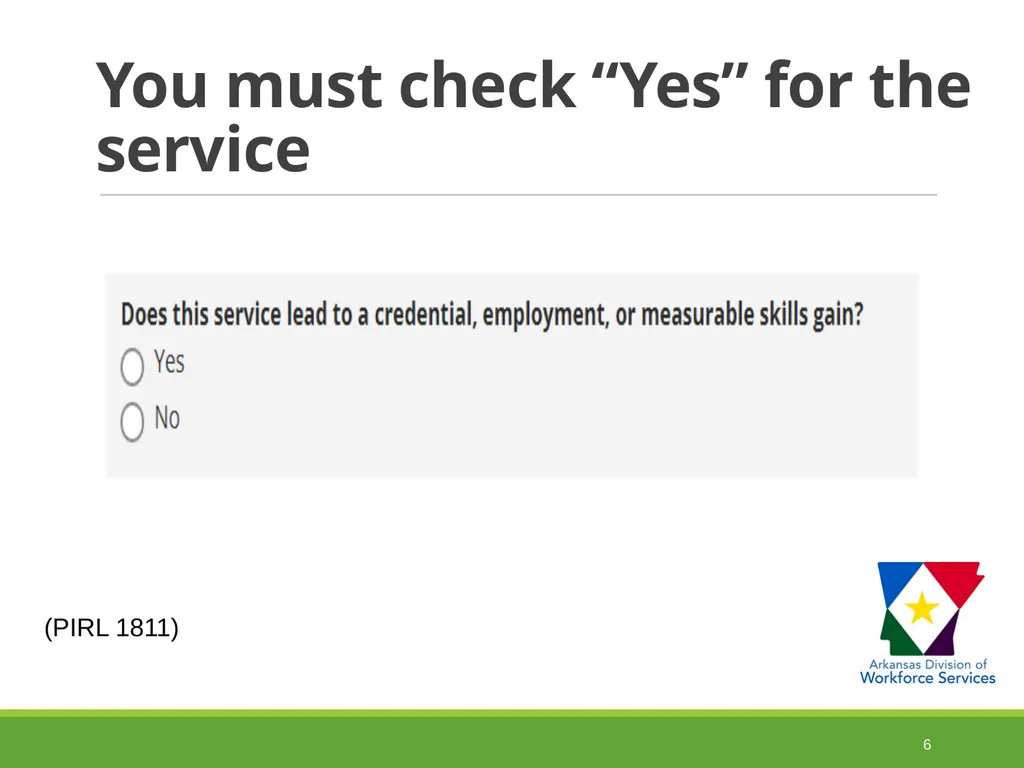
You must check “Yes” for the service 6 (PIRL 1811)<br>
07
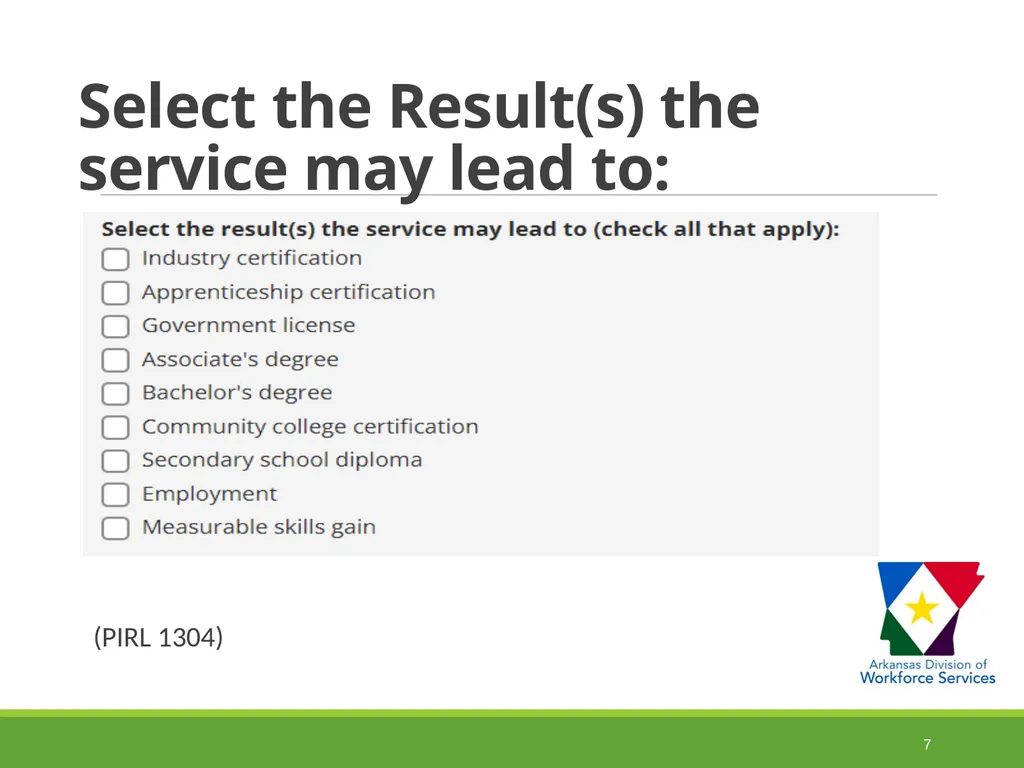
Select the Result(s) the service may lead to: 7 (PIRL 1304)<br>
08
QUESTIONS What TEGL do you refer to for the list of required documentation?
When do you enter the MSG’s?
What training services lead to an MSG? 8<br>
When do you enter the MSG’s?
What training services lead to an MSG? 8<br>
09
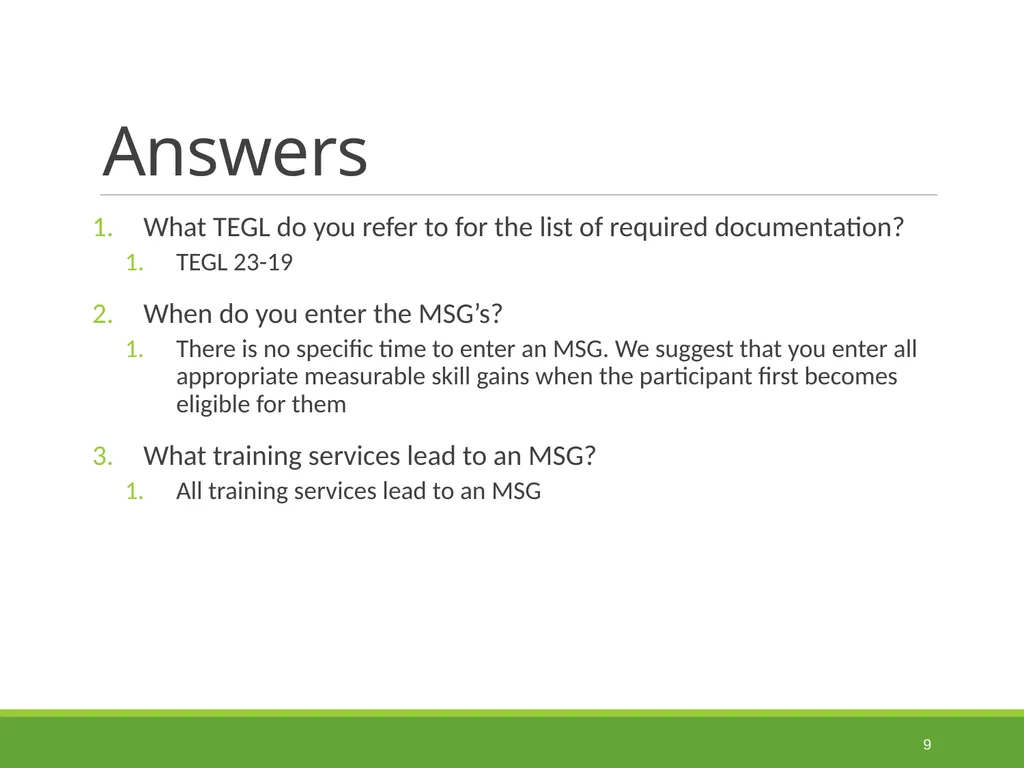
Answers What TEGL do you refer to for the list of required documentation?
TEGL 23-19
When do you enter the MSG’s?
There is no specific time to enter an MSG. We suggest that you enter all appropriate measurable skill gains when the participant first becomes eligible for them
What training services lead to an MSG?
All training services lead to an MSG 9<br>
TEGL 23-19
When do you enter the MSG’s?
There is no specific time to enter an MSG. We suggest that you enter all appropriate measurable skill gains when the participant first becomes eligible for them
What training services lead to an MSG?
All training services lead to an MSG 9<br>
10
WIOA title I-B - Who is in the measure? All in-school youth attending high school 10<br>
11
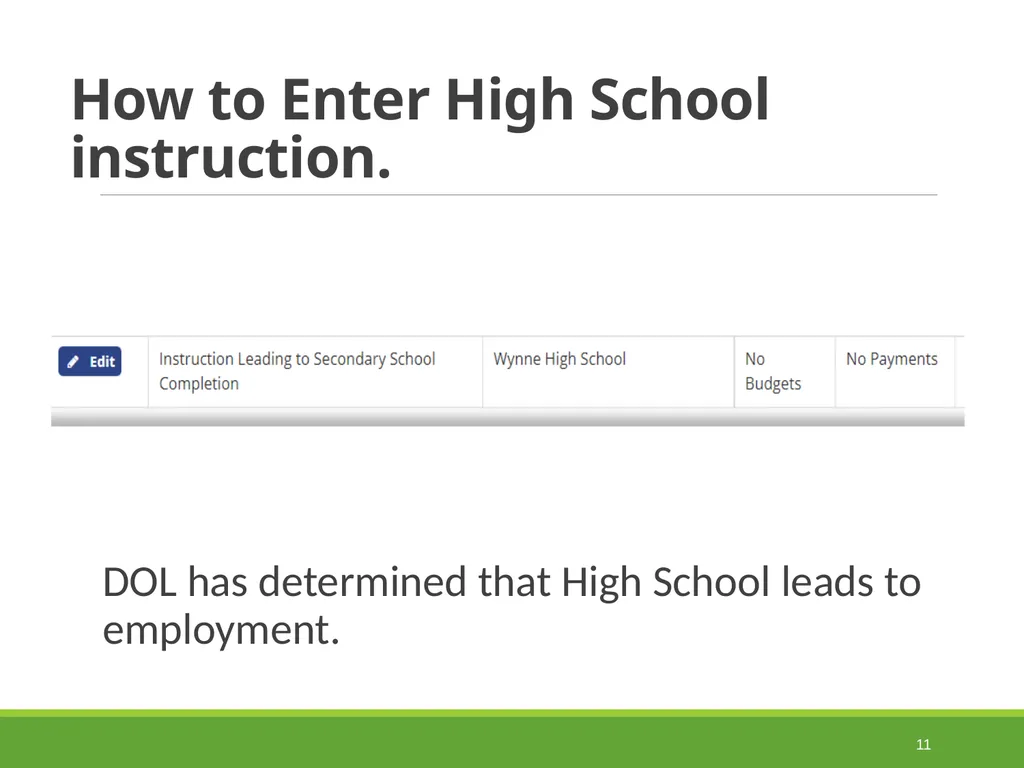
How to Enter High School instruction. DOL has determined that High School leads to employment. 11<br>
12
WIOA title I-B - Who is in the measure? OSY WIOA title I Out-of-School Youth participants who are in at least one of the following while participating in the Youth program
Occupational skills training
Secondary education at or above the 9th grade level
Postsecondary education
Title II-funded adult education at or above the 9th grade level
YouthBuild
Job Corps 12<br>
Occupational skills training
Secondary education at or above the 9th grade level
Postsecondary education
Title II-funded adult education at or above the 9th grade level
YouthBuild
Job Corps 12<br>
13
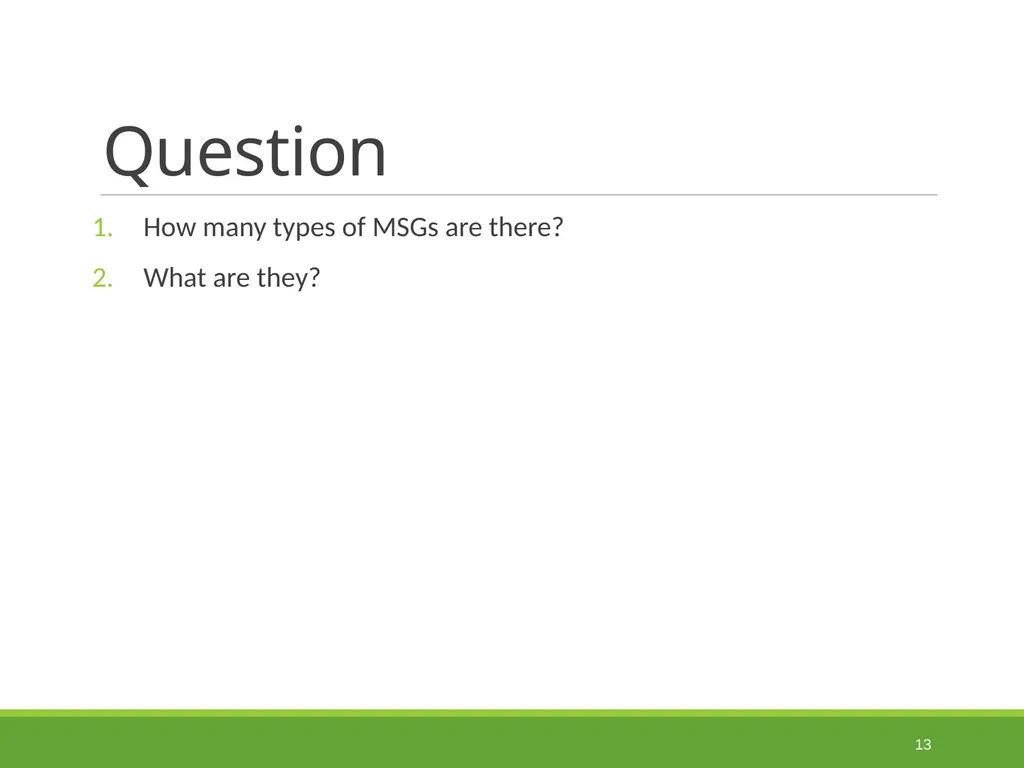
Question How many types of MSGs are there?
What are they? 13<br>
What are they? 13<br>
14
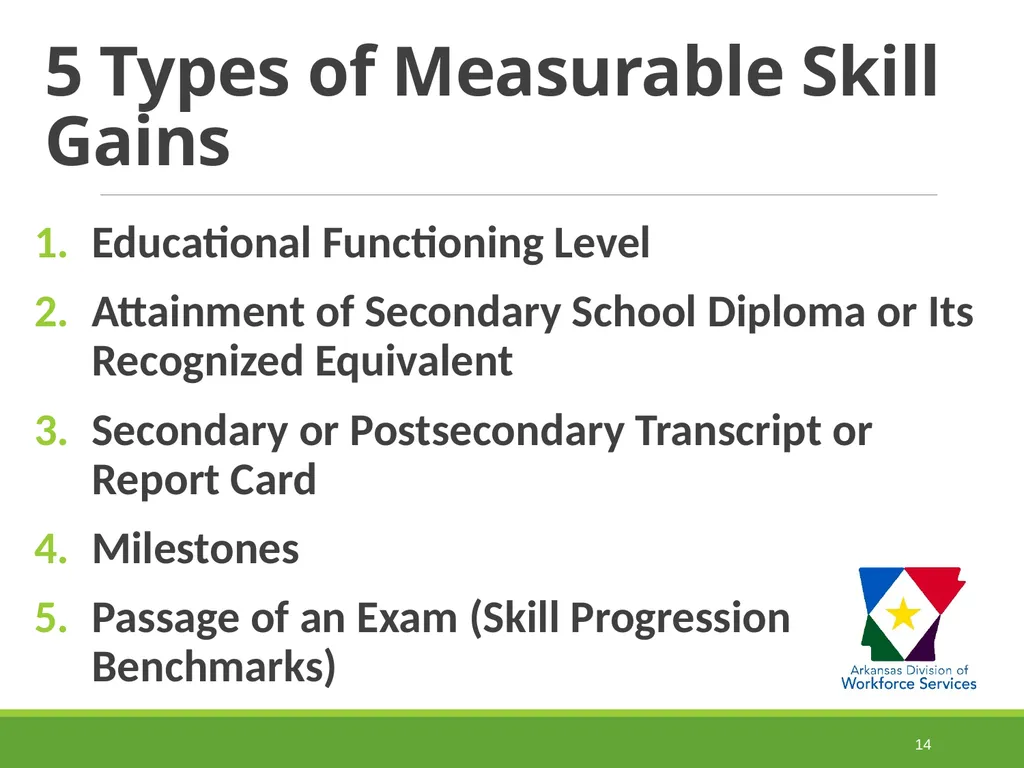
5 Types of Measurable Skill Gains Educational Functioning Level
Attainment of Secondary School Diploma or Its Recognized Equivalent
Secondary or Postsecondary Transcript or Report Card
Milestones
Passage of an Exam (Skill Progression Benchmarks) 14<br>
Attainment of Secondary School Diploma or Its Recognized Equivalent
Secondary or Postsecondary Transcript or Report Card
Milestones
Passage of an Exam (Skill Progression Benchmarks) 14<br>
15
1. Educational Functioning Level PIRL 1806<br>
16
Who is in the measure? Participant receiving education below the postsecondary level and are Basic Skills Deficient 16<br>
17
Goal for attainment: Increase 1 educational functioning level (pre-test/post-test)
Pretest/Posttest (using alternate versions 11 and 12 of TABE 11/12) 17<br>
Pretest/Posttest (using alternate versions 11 and 12 of TABE 11/12) 17<br>
18
Goal for attainment: Educational gain through credits or Carnegie units of an adult high school program 18<br>
19
Goal for attainment: Leave high school (or equivalent program) and enroll in postsecondary education during the PY (diploma or GED® not required) 19<br>
20
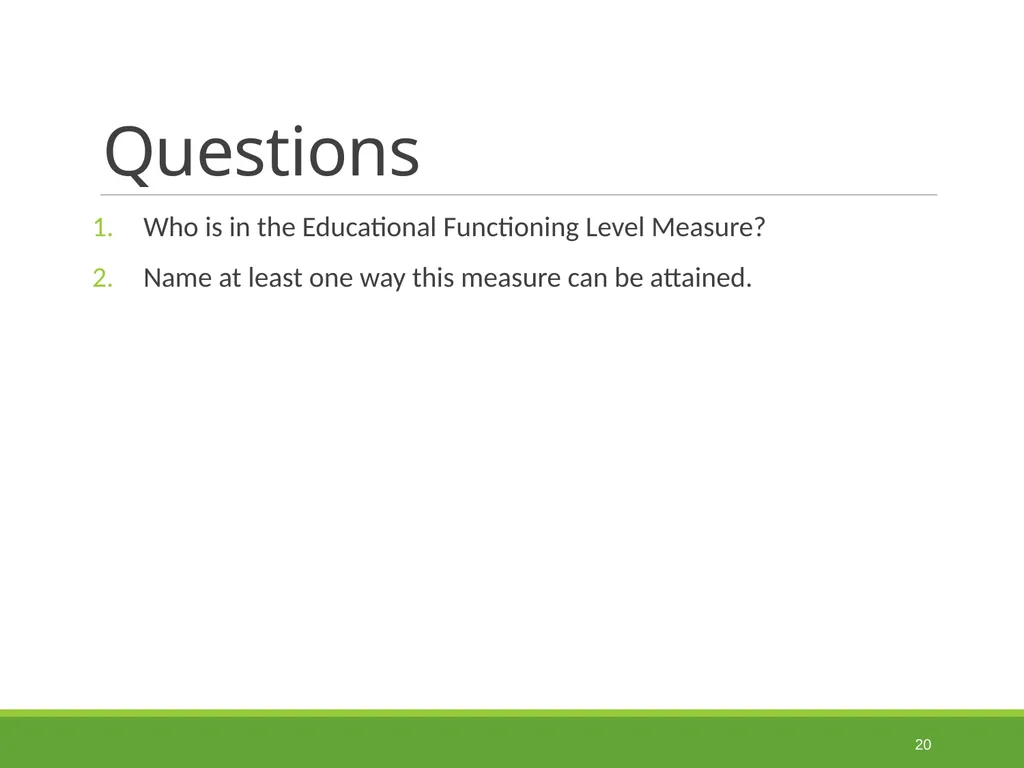
Questions Who is in the Educational Functioning Level Measure?
Name at least one way this measure can be attained. 20<br>
Name at least one way this measure can be attained. 20<br>
21
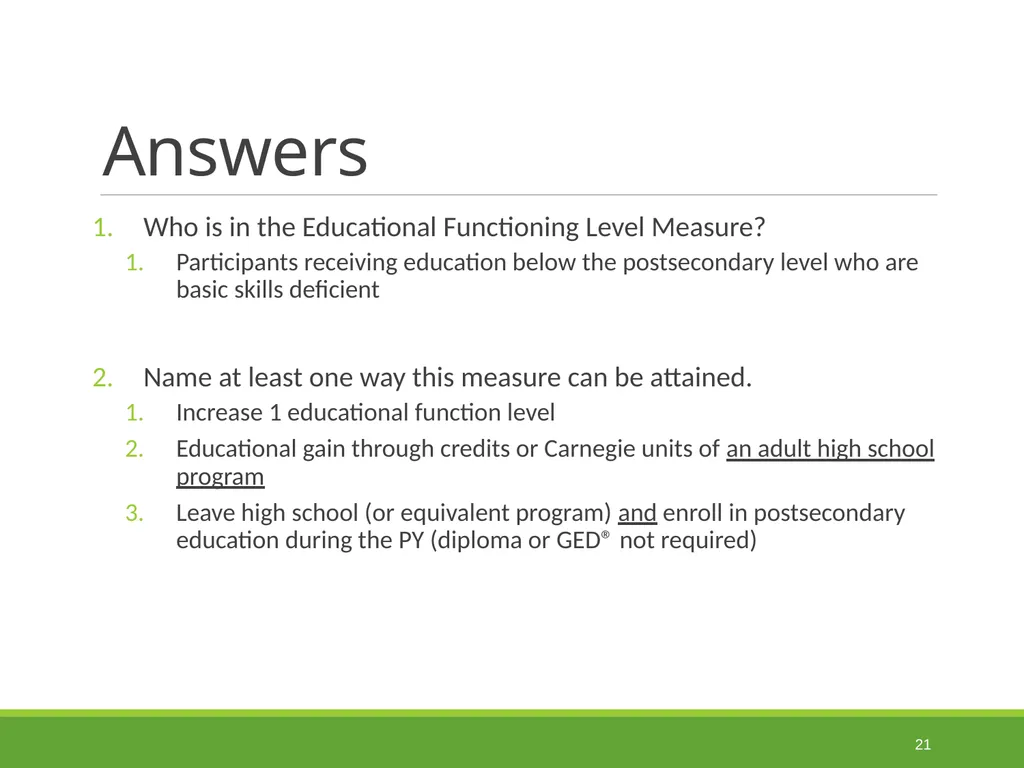
Answers Who is in the Educational Functioning Level Measure?
Participants receiving education below the postsecondary level who are basic skills deficient
Name at least one way this measure can be attained.
Increase 1 educational function level
Educational gain through credits or Carnegie units of an adult high school program
Leave high school (or equivalent program) and enroll in postsecondary education during the PY (diploma or GED® not required) 21<br>
Participants receiving education below the postsecondary level who are basic skills deficient
Name at least one way this measure can be attained.
Increase 1 educational function level
Educational gain through credits or Carnegie units of an adult high school program
Leave high school (or equivalent program) and enroll in postsecondary education during the PY (diploma or GED® not required) 21<br>
22
2. Attainment of Secondary School Diploma or Its Recognized Equivalent and date PIRL 1800 & 1801<br>
23
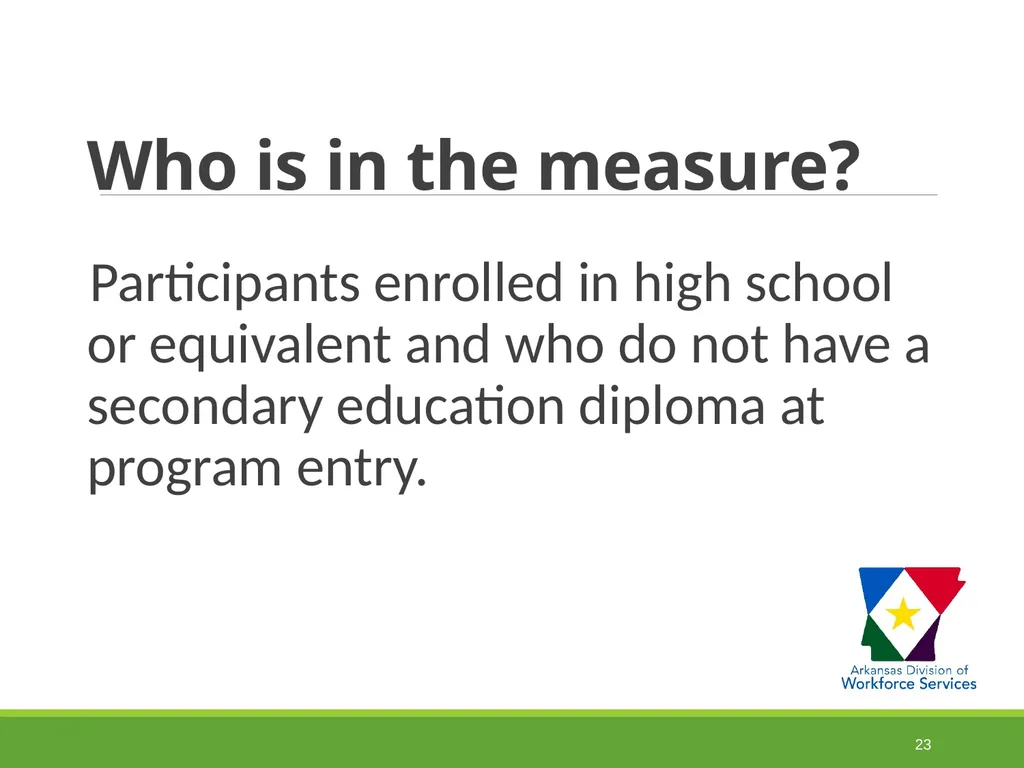
Who is in the measure? Participants enrolled in high school or equivalent and who do not have a secondary education diploma at program entry. 23<br>
24
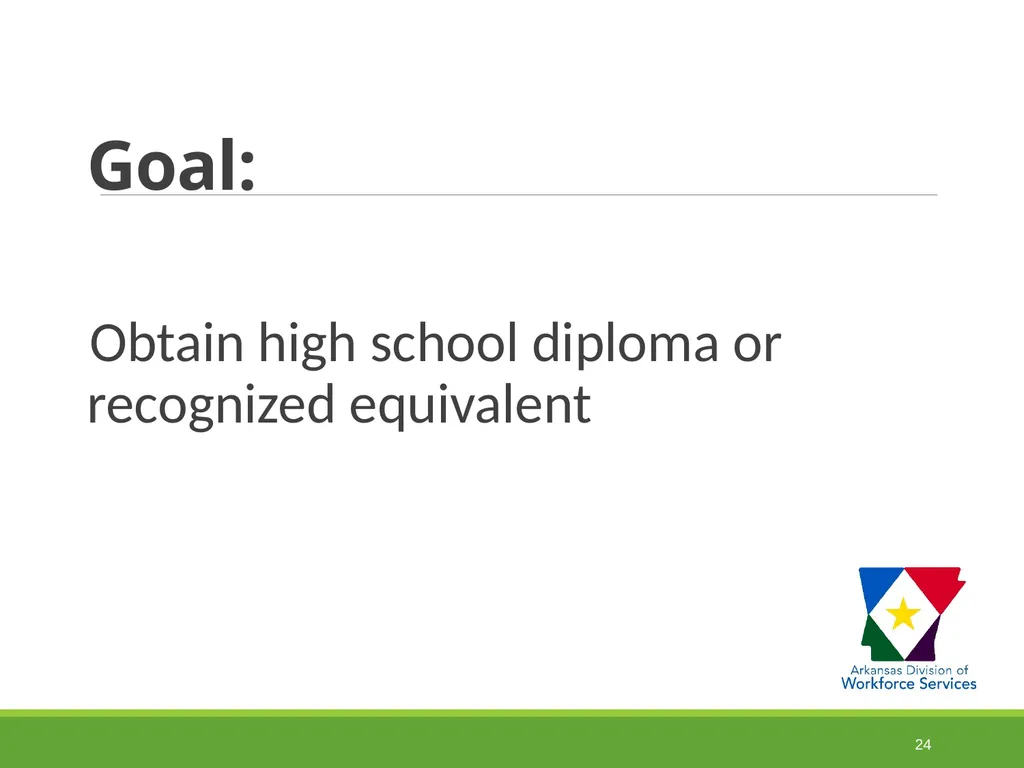
Goal: Obtain high school diploma or recognized equivalent 24<br>
25
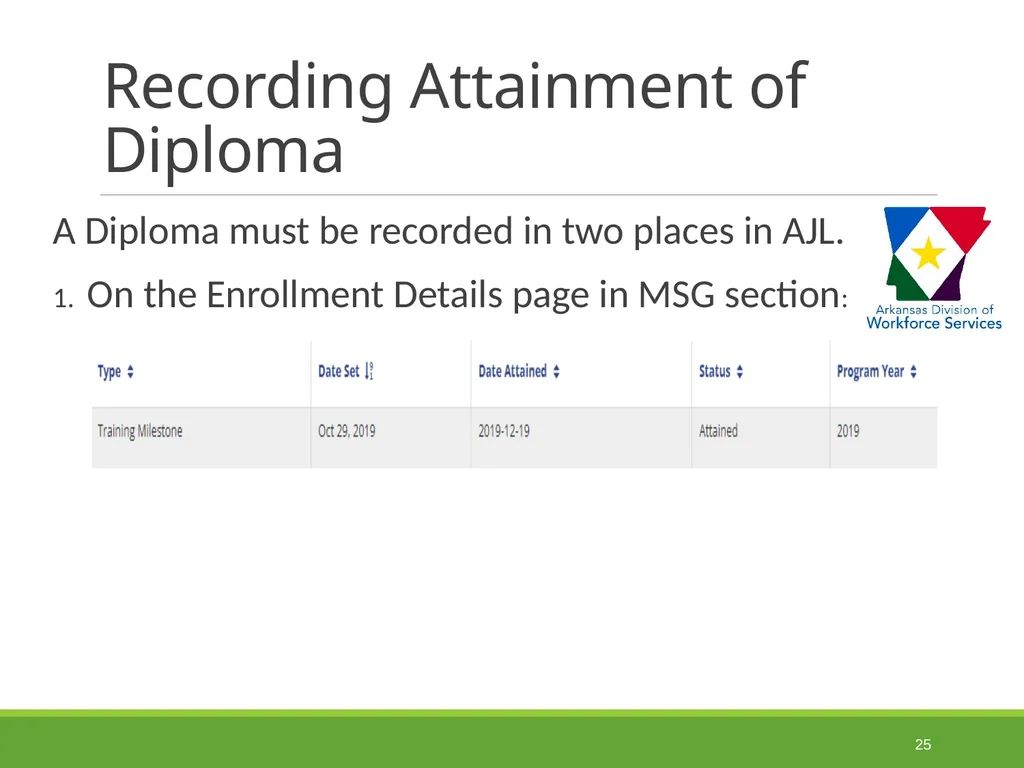
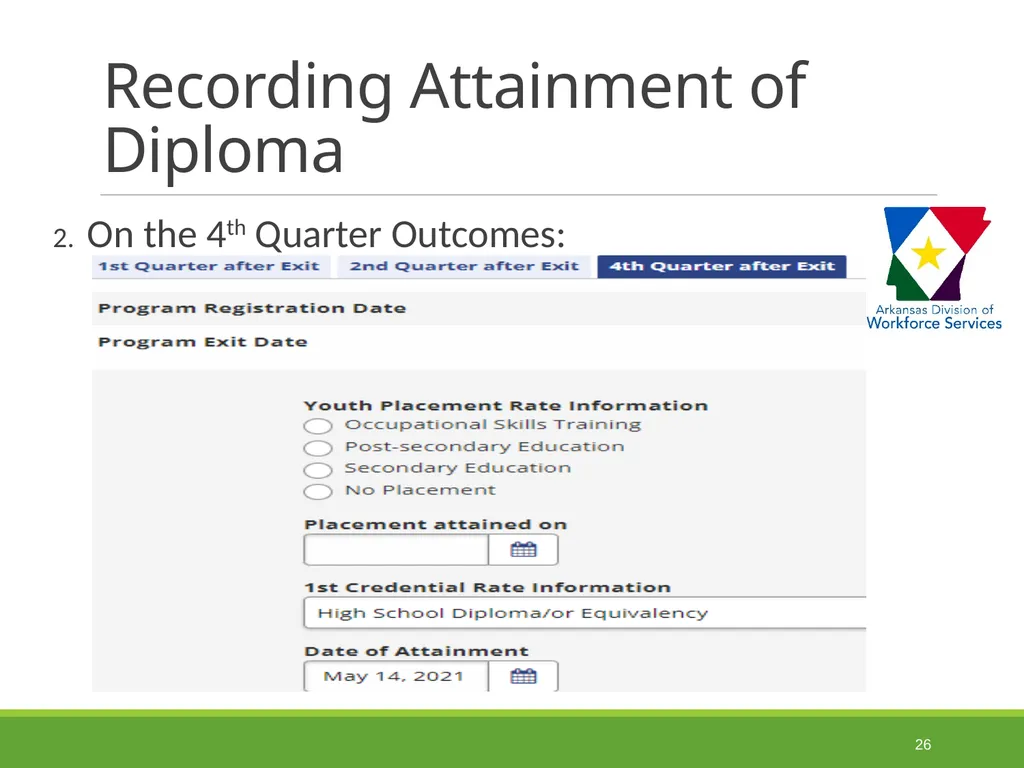
Recording Attainment of Diploma A Diploma must be recorded in two places in AJL.
1. On the Enrollment Details page in MSG section: 25<br>
1. On the Enrollment Details page in MSG section: 25<br>
26
Recording Attainment of Diploma 2. On the 4th Quarter Outcomes: 26<br>
27
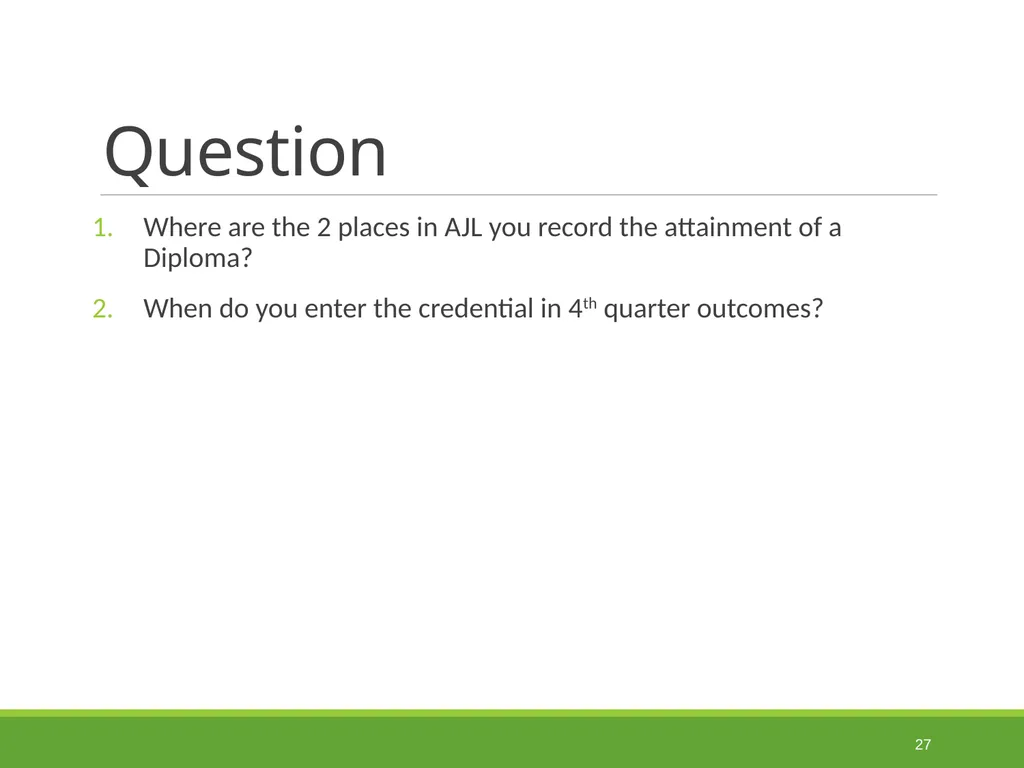
Question Where are the 2 places in AJL you record the attainment of a Diploma?
When do you enter the credential in 4th quarter outcomes? 27<br>
When do you enter the credential in 4th quarter outcomes? 27<br>
28
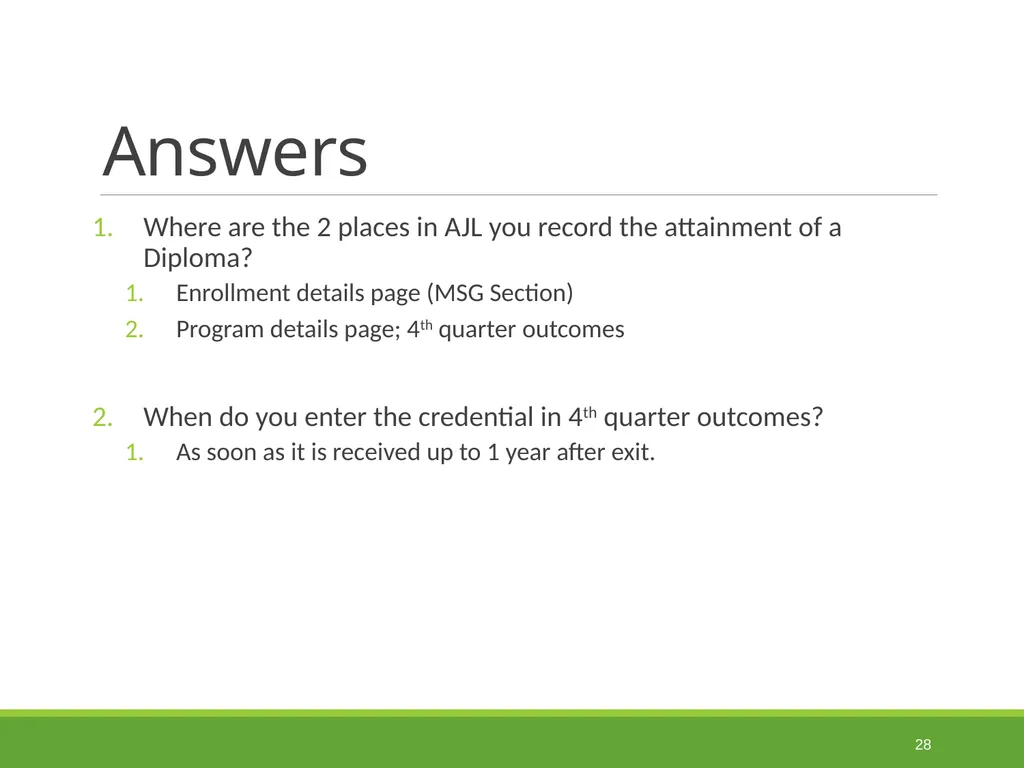
Answers Where are the 2 places in AJL you record the attainment of a Diploma?
Enrollment details page (MSG Section)
Program details page; 4th quarter outcomes
When do you enter the credential in 4th quarter outcomes?
As soon as it is received up to 1 year after exit. 28<br>
Enrollment details page (MSG Section)
Program details page; 4th quarter outcomes
When do you enter the credential in 4th quarter outcomes?
As soon as it is received up to 1 year after exit. 28<br>
29
3. Secondary or Postsecondary Transcript or Report Card PIRL 1808 & 1807<br>
30
Who is in the measure? Participants enrolled in high school (or equivalent) or postsecondary school
Enrolled at program entry or anytime during participation 30<br>
Enrolled at program entry or anytime during participation 30<br>
31
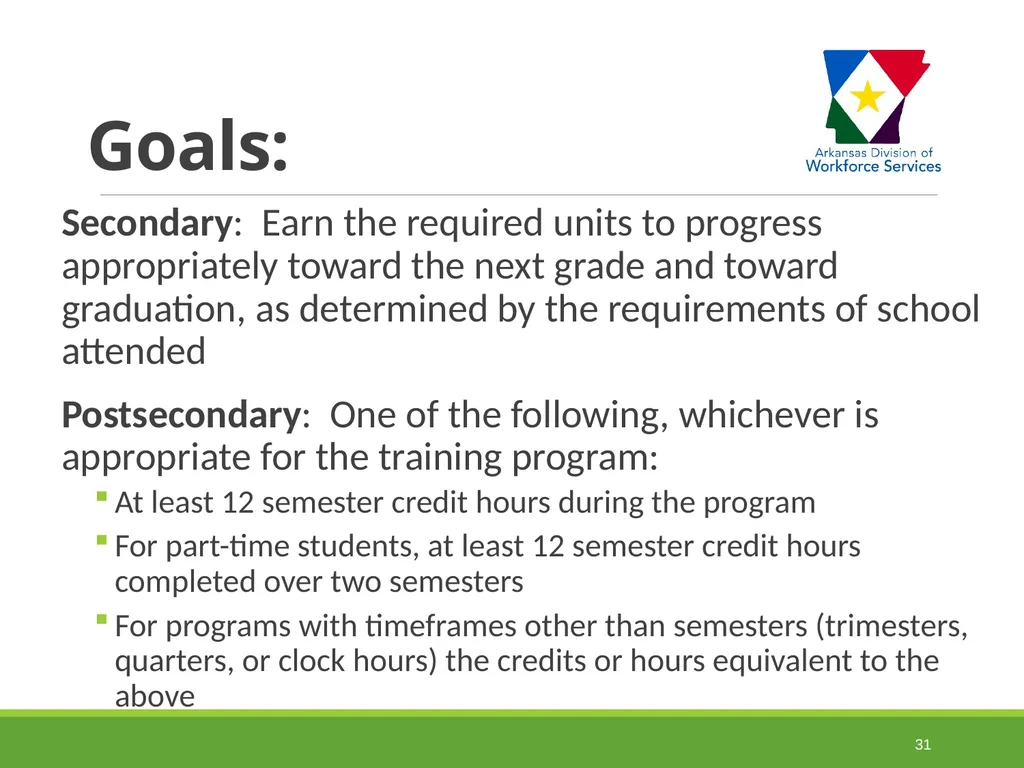
Goals: Secondary: Earn the required units to progress appropriately toward the next grade and toward graduation, as determined by the requirements of school attended
Postsecondary: One of the following, whichever is appropriate for the training program:
At least 12 semester credit hours during the program
For part-time students, at least 12 semester credit hours completed over two semesters
For programs with timeframes other than semesters (trimesters, quarters, or clock hours) the credits or hours equivalent to the above 31<br>
Postsecondary: One of the following, whichever is appropriate for the training program:
At least 12 semester credit hours during the program
For part-time students, at least 12 semester credit hours completed over two semesters
For programs with timeframes other than semesters (trimesters, quarters, or clock hours) the credits or hours equivalent to the above 31<br>
32
Question How many credit hours must a participant in postsecondary education have to attain the postsecondary transcript or report card measure?
How long does the participant have to attain this measure? 32<br>
How long does the participant have to attain this measure? 32<br>
33
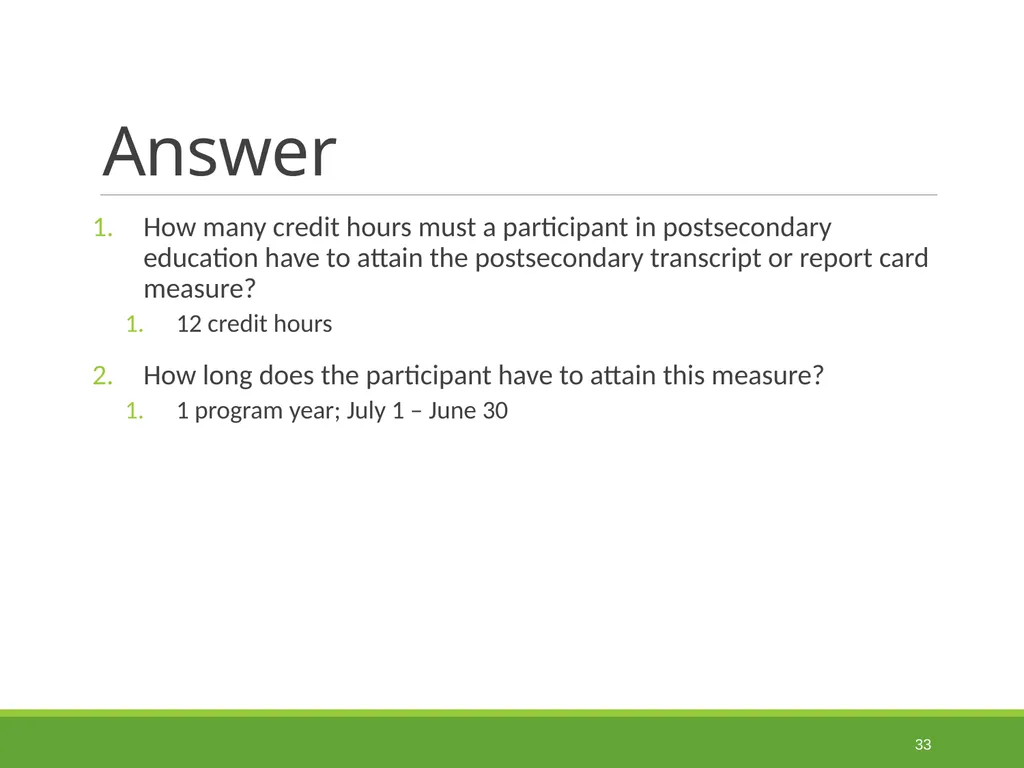
Answer How many credit hours must a participant in postsecondary education have to attain the postsecondary transcript or report card measure?
12 credit hours
How long does the participant have to attain this measure?
1 program year; July 1 – June 30 33<br>
12 credit hours
How long does the participant have to attain this measure?
1 program year; July 1 – June 30 33<br>
34
4. Milestones PIRL 1809<br>
35
Who is in the measure? 35 Participants enrolled in a work-based training<br>
36
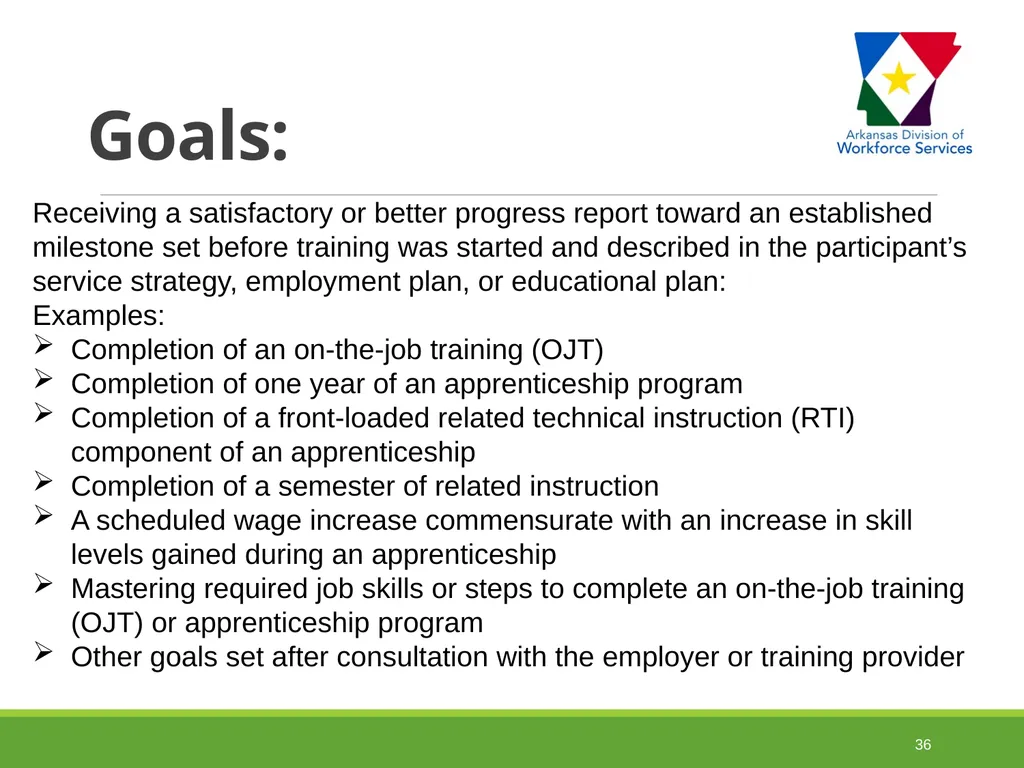
Goals: 36 Receiving a satisfactory or better progress report toward an established milestone set before training was started and described in the participant’s service strategy, employment plan, or educational plan:
Examples:
Completion of an on-the-job training (OJT)
Completion of one year of an apprenticeship program
Completion of a front-loaded related technical instruction (RTI) component of an apprenticeship
Completion of a semester of related instruction
A scheduled wage increase commensurate with an increase in skill levels gained during an apprenticeship
Mastering required job skills or steps to complete an on-the-job training (OJT) or apprenticeship program
Other goals set after consultation with the employer or training provider<br>
Examples:
Completion of an on-the-job training (OJT)
Completion of one year of an apprenticeship program
Completion of a front-loaded related technical instruction (RTI) component of an apprenticeship
Completion of a semester of related instruction
A scheduled wage increase commensurate with an increase in skill levels gained during an apprenticeship
Mastering required job skills or steps to complete an on-the-job training (OJT) or apprenticeship program
Other goals set after consultation with the employer or training provider<br>
37
5. Passage of an Exam (Skill Progression) PIRL 1810<br>
38
Who is in the measure? Participants enrolled in a program of training leading to technical and/or occupational skills 38<br>
39
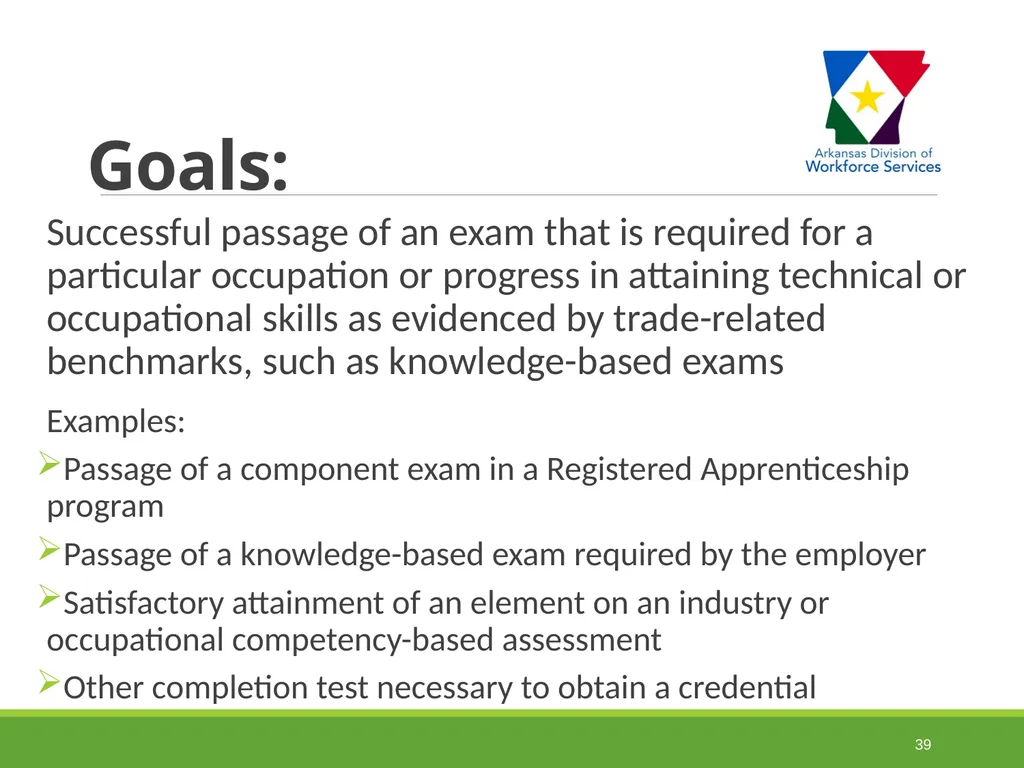
Goals: Successful passage of an exam that is required for a particular occupation or progress in attaining technical or occupational skills as evidenced by trade-related benchmarks, such as knowledge-based exams
Examples:
Passage of a component exam in a Registered Apprenticeship program
Passage of a knowledge-based exam required by the employer
Satisfactory attainment of an element on an industry or occupational competency-based assessment
Other completion test necessary to obtain a credential 39<br>
Examples:
Passage of a component exam in a Registered Apprenticeship program
Passage of a knowledge-based exam required by the employer
Satisfactory attainment of an element on an industry or occupational competency-based assessment
Other completion test necessary to obtain a credential 39<br>
40
Completion Document vs. License PIRL 1800; 1801; 1810
Type of credential & Date
Date of MSG Passage of Exam
Continued on next page 40<br>
Type of credential & Date
Date of MSG Passage of Exam
Continued on next page 40<br>
41
Completion Document vs. License continued Certificate of Completion, Certificate of Attendance, Certificate of Achievement, Certificate of Training do not meet the requirements for a recognized credential as stated by DOL in TEGL 10-16, Change 1, TEGL 15-10 and TEN 25-19, and including direct verbal information from DOL.
These documents recognize completion of the class/completion of a number of hours attending class. Particularly applicable to CNA, truck driving, and welding when the training is provided by a private school. These elements will not fail if allowable documentation is uploaded such as a license.
Continued on next page 41<br>
These documents recognize completion of the class/completion of a number of hours attending class. Particularly applicable to CNA, truck driving, and welding when the training is provided by a private school. These elements will not fail if allowable documentation is uploaded such as a license.
Continued on next page 41<br>
42
Completion Document vs. License Do not record this type of document in AJL in the Fourth Quarter Outcomes #1800 & #1801
Do not set or attain a Passage of Exam MSG #1810 in AJL on the basis of these types of documents
Do not upload this type of document in the AJL Uploader for Type of Recognized Credential and date #1800 & #1801
Do not upload this type of document in the AJL Uploader for Passage of an Exam MSG #1810 42<br>
Do not set or attain a Passage of Exam MSG #1810 in AJL on the basis of these types of documents
Do not upload this type of document in the AJL Uploader for Type of Recognized Credential and date #1800 & #1801
Do not upload this type of document in the AJL Uploader for Passage of an Exam MSG #1810 42<br>
43
Two-Year College vs Private School Some two-year colleges offer documents such as a Certificate of Proficiency or a Technical Certificate. This is a credential that is different from the completion documents mentioned above. There are particular requirements that apply to obtaining a two-year college credential such as earning credit hours, maintaining a certain GPA, and having a curriculum that is approved by the Higher Education Coordinating Board. These credentials are not issued for seat time in class. 43<br>
44
REMEMBER Record all skill goals that the participant has the criteria to meet.
Every program year.
Enter every activity on the S & T, even if you don’t provide it (especially school for in-school youth) and be sure to check if it leads to a credential (if appropriate), employment, and MSG 44<br>
Every program year.
Enter every activity on the S & T, even if you don’t provide it (especially school for in-school youth) and be sure to check if it leads to a credential (if appropriate), employment, and MSG 44<br>
45
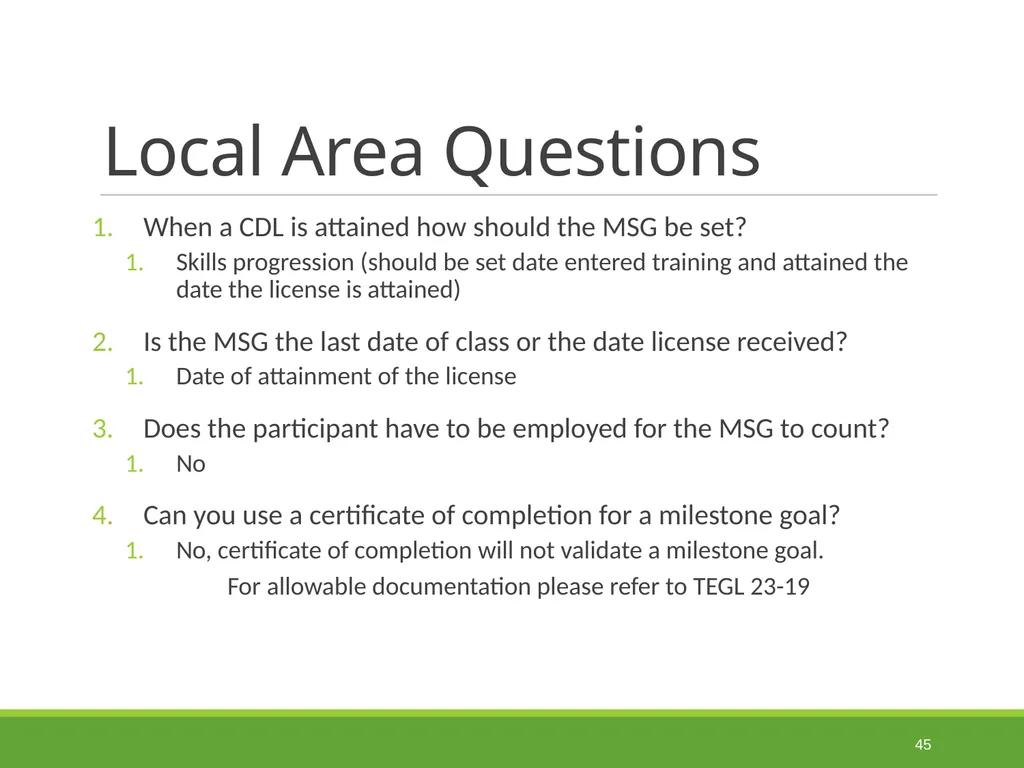
Local Area Questions When a CDL is attained how should the MSG be set?
Skills progression (should be set date entered training and attained the date the license is attained)
Is the MSG the last date of class or the date license received?
Date of attainment of the license
Does the participant have to be employed for the MSG to count?
No
Can you use a certificate of completion for a milestone goal?
No, certificate of completion will not validate a milestone goal.
For allowable documentation please refer to TEGL 23-19 45<br>
Skills progression (should be set date entered training and attained the date the license is attained)
Is the MSG the last date of class or the date license received?
Date of attainment of the license
Does the participant have to be employed for the MSG to count?
No
Can you use a certificate of completion for a milestone goal?
No, certificate of completion will not validate a milestone goal.
For allowable documentation please refer to TEGL 23-19 45<br>
46
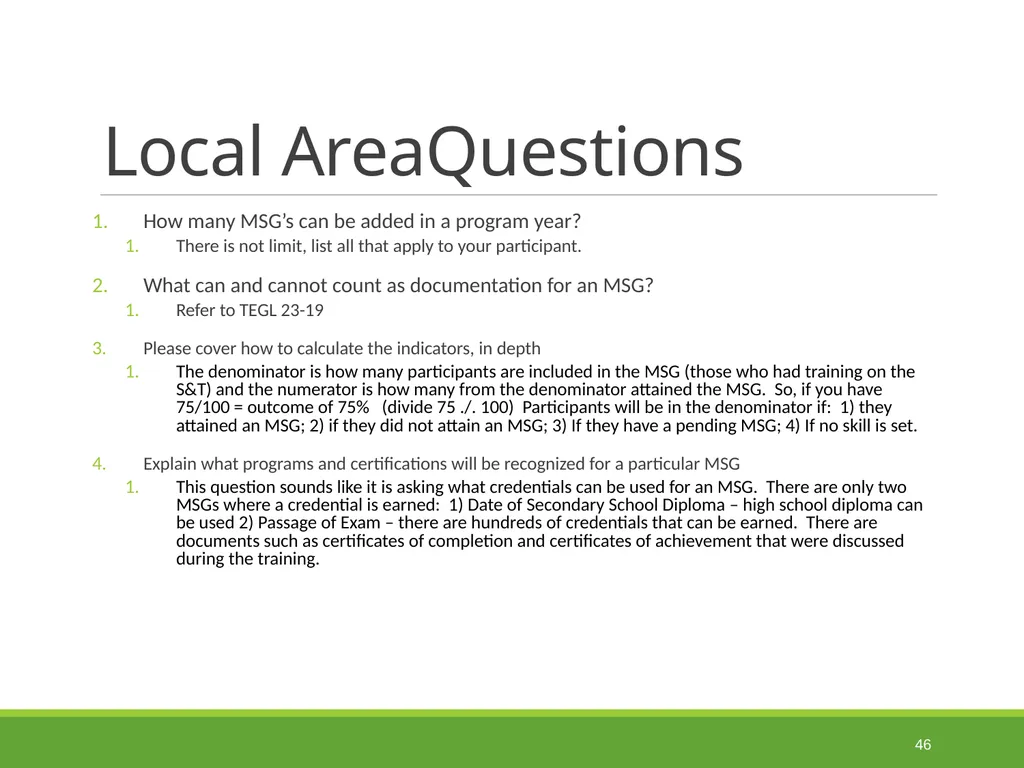
Local AreaQuestions How many MSG’s can be added in a program year?
There is not limit, list all that apply to your participant.
What can and cannot count as documentation for an MSG?
Refer to TEGL 23-19
Please cover how to calculate the indicators, in depth
The denominator is how many participants are included in the MSG (those who had training on the S&T) and the numerator is how many from the denominator attained the MSG. So, if you have 75/100 = outcome of 75% (divide 75 ./. 100) Participants will be in the denominator if: 1) they attained an MSG; 2) if they did not attain an MSG; 3) If they have a pending MSG; 4) If no skill is set.
Explain what programs and certifications will be recognized for a particular MSG
This question sounds like it is asking what credentials can be used for an MSG. There are only two MSGs where a credential is earned: 1) Date of Secondary School Diploma – high school diploma can be used 2) Passage of Exam – there are hundreds of credentials that can be earned. There are documents such as certificates of completion and certificates of achievement that were discussed during the training. 46<br>
There is not limit, list all that apply to your participant.
What can and cannot count as documentation for an MSG?
Refer to TEGL 23-19
Please cover how to calculate the indicators, in depth
The denominator is how many participants are included in the MSG (those who had training on the S&T) and the numerator is how many from the denominator attained the MSG. So, if you have 75/100 = outcome of 75% (divide 75 ./. 100) Participants will be in the denominator if: 1) they attained an MSG; 2) if they did not attain an MSG; 3) If they have a pending MSG; 4) If no skill is set.
Explain what programs and certifications will be recognized for a particular MSG
This question sounds like it is asking what credentials can be used for an MSG. There are only two MSGs where a credential is earned: 1) Date of Secondary School Diploma – high school diploma can be used 2) Passage of Exam – there are hundreds of credentials that can be earned. There are documents such as certificates of completion and certificates of achievement that were discussed during the training. 46<br>
47
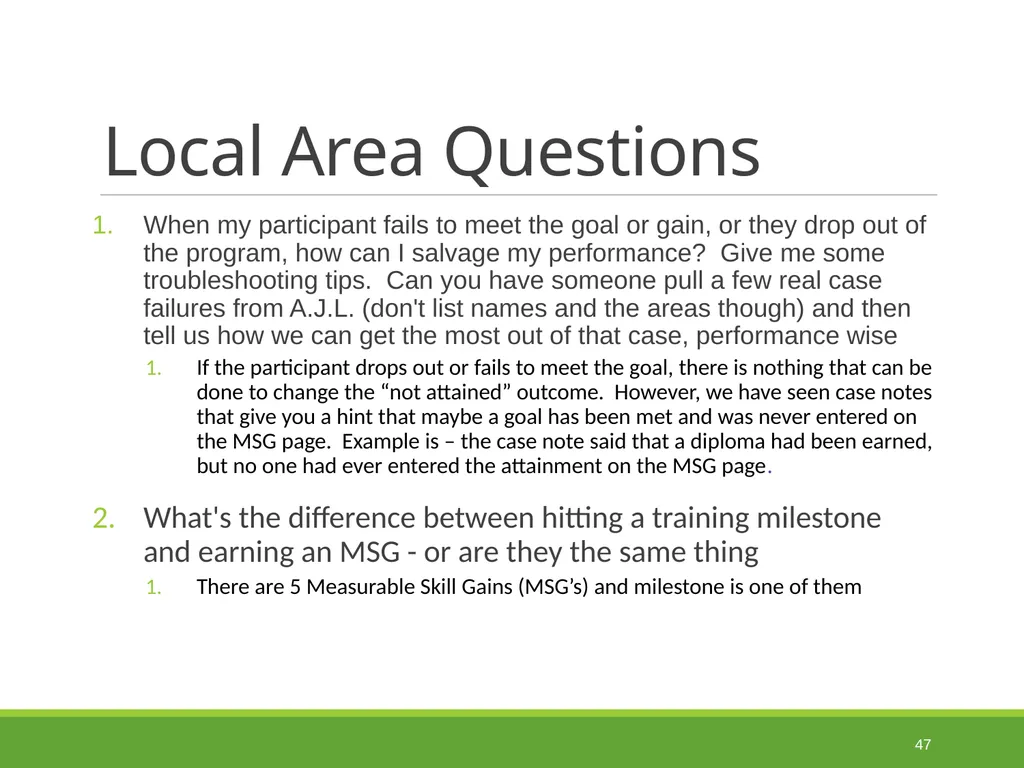
Local Area Questions When my participant fails to meet the goal or gain, or they drop out of the program, how can I salvage my performance? Give me some troubleshooting tips. Can you have someone pull a few real case failures from A.J.L. (don't list names and the areas though) and then tell us how we can get the most out of that case, performance wise
If the participant drops out or fails to meet the goal, there is nothing that can be done to change the “not attained” outcome. However, we have seen case notes that give you a hint that maybe a goal has been met and was never entered on the MSG page. Example is – the case note said that a diploma had been earned, but no one had ever entered the attainment on the MSG page.
What's the difference between hitting a training milestone and earning an MSG - or are they the same thing
There are 5 Measurable Skill Gains (MSG’s) and milestone is one of them 47<br>
If the participant drops out or fails to meet the goal, there is nothing that can be done to change the “not attained” outcome. However, we have seen case notes that give you a hint that maybe a goal has been met and was never entered on the MSG page. Example is – the case note said that a diploma had been earned, but no one had ever entered the attainment on the MSG page.
What's the difference between hitting a training milestone and earning an MSG - or are they the same thing
There are 5 Measurable Skill Gains (MSG’s) and milestone is one of them 47<br>
48
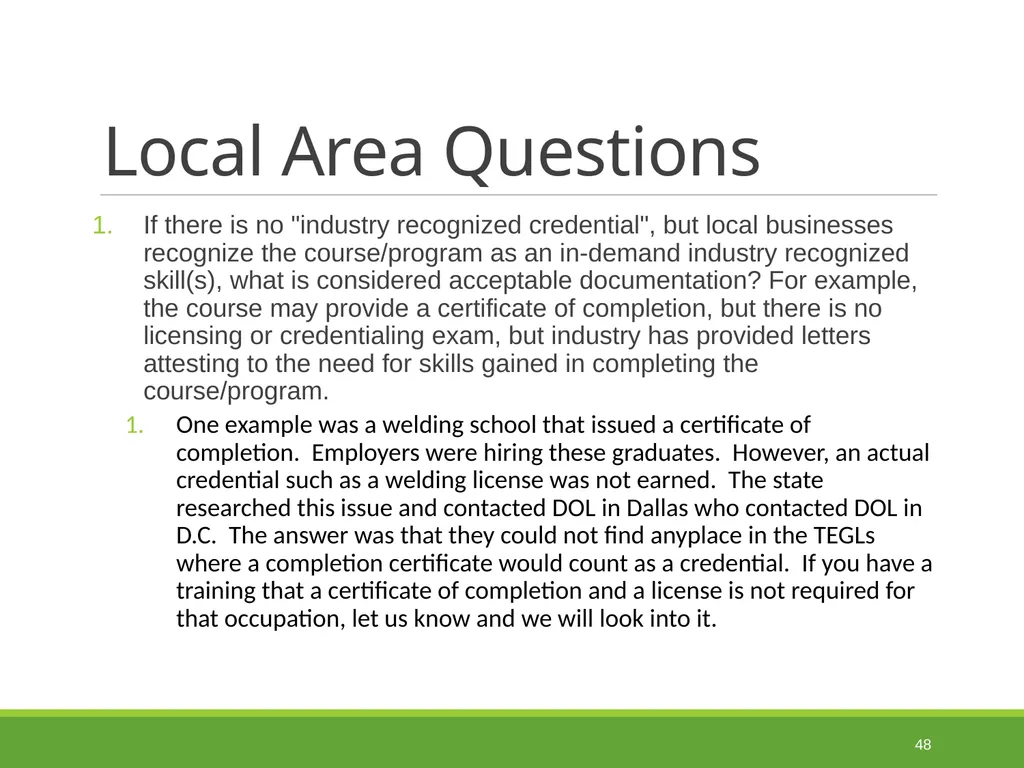
Local Area Questions If there is no "industry recognized credential", but local businesses recognize the course/program as an in-demand industry recognized skill(s), what is considered acceptable documentation? For example, the course may provide a certificate of completion, but there is no licensing or credentialing exam, but industry has provided letters attesting to the need for skills gained in completing the course/program.
One example was a welding school that issued a certificate of completion. Employers were hiring these graduates. However, an actual credential such as a welding license was not earned. The state researched this issue and contacted DOL in Dallas who contacted DOL in D.C. The answer was that they could not find anyplace in the TEGLs where a completion certificate would count as a credential. If you have a training that a certificate of completion and a license is not required for that occupation, let us know and we will look into it. 48<br>
One example was a welding school that issued a certificate of completion. Employers were hiring these graduates. However, an actual credential such as a welding license was not earned. The state researched this issue and contacted DOL in Dallas who contacted DOL in D.C. The answer was that they could not find anyplace in the TEGLs where a completion certificate would count as a credential. If you have a training that a certificate of completion and a license is not required for that occupation, let us know and we will look into it. 48<br>
49
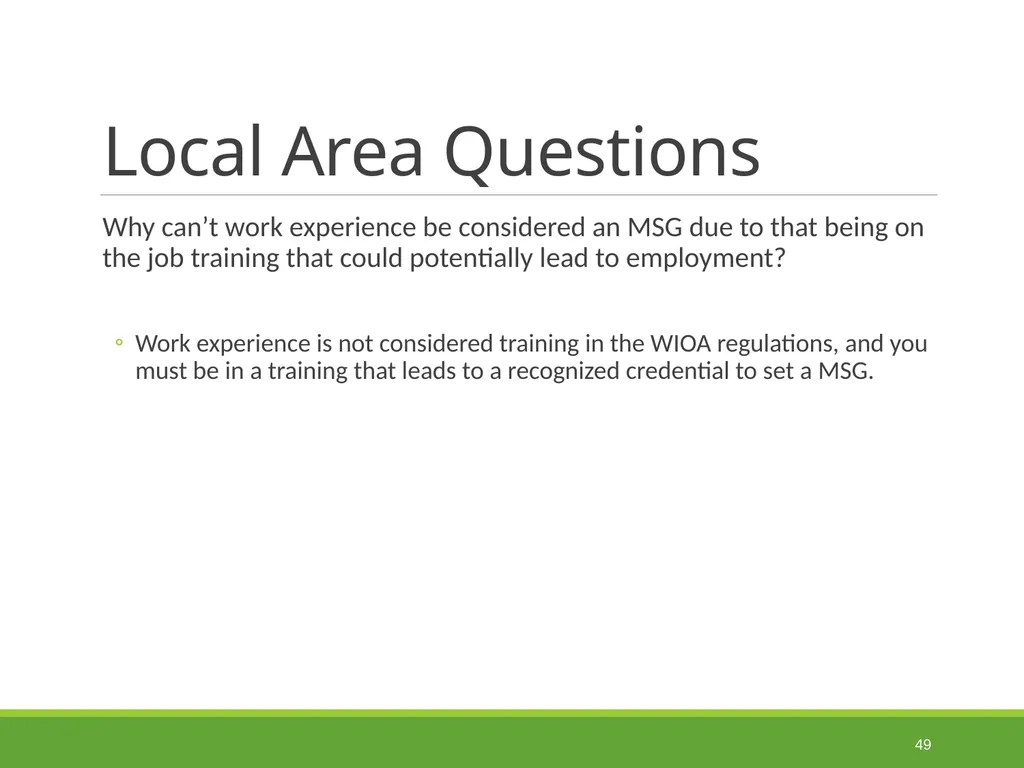
Local Area Questions Why can’t work experience be considered an MSG due to that being on the job training that could potentially lead to employment?
Work experience is not considered training in the WIOA regulations, and you must be in a training that leads to a recognized credential to set a MSG. 49<br>
Work experience is not considered training in the WIOA regulations, and you must be in a training that leads to a recognized credential to set a MSG. 49<br>
50
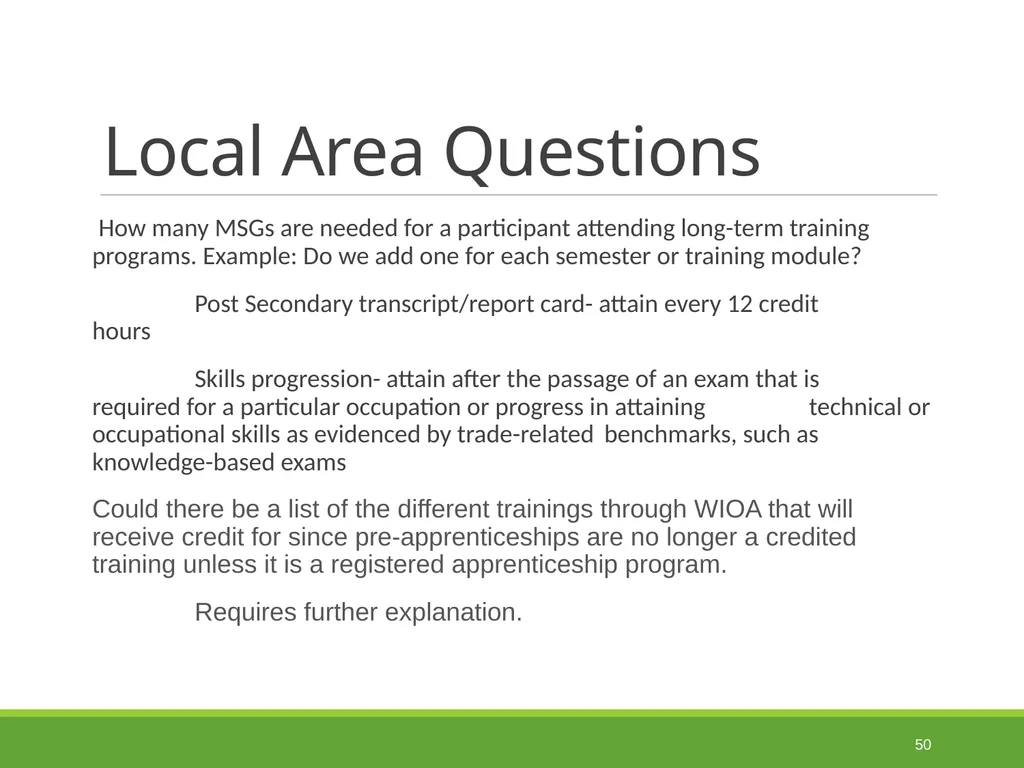
Local Area Questions How many MSGs are needed for a participant attending long-term training programs. Example: Do we add one for each semester or training module?
Post Secondary transcript/report card- attain every 12 credit hours
Skills progression- attain after the passage of an exam that is required for a particular occupation or progress in attaining technical or occupational skills as evidenced by trade-related benchmarks, such as knowledge-based exams
Could there be a list of the different trainings through WIOA that will receive credit for since pre-apprenticeships are no longer a credited training unless it is a registered apprenticeship program.
Requires further explanation. 50<br>
Post Secondary transcript/report card- attain every 12 credit hours
Skills progression- attain after the passage of an exam that is required for a particular occupation or progress in attaining technical or occupational skills as evidenced by trade-related benchmarks, such as knowledge-based exams
Could there be a list of the different trainings through WIOA that will receive credit for since pre-apprenticeships are no longer a credited training unless it is a registered apprenticeship program.
Requires further explanation. 50<br>
51
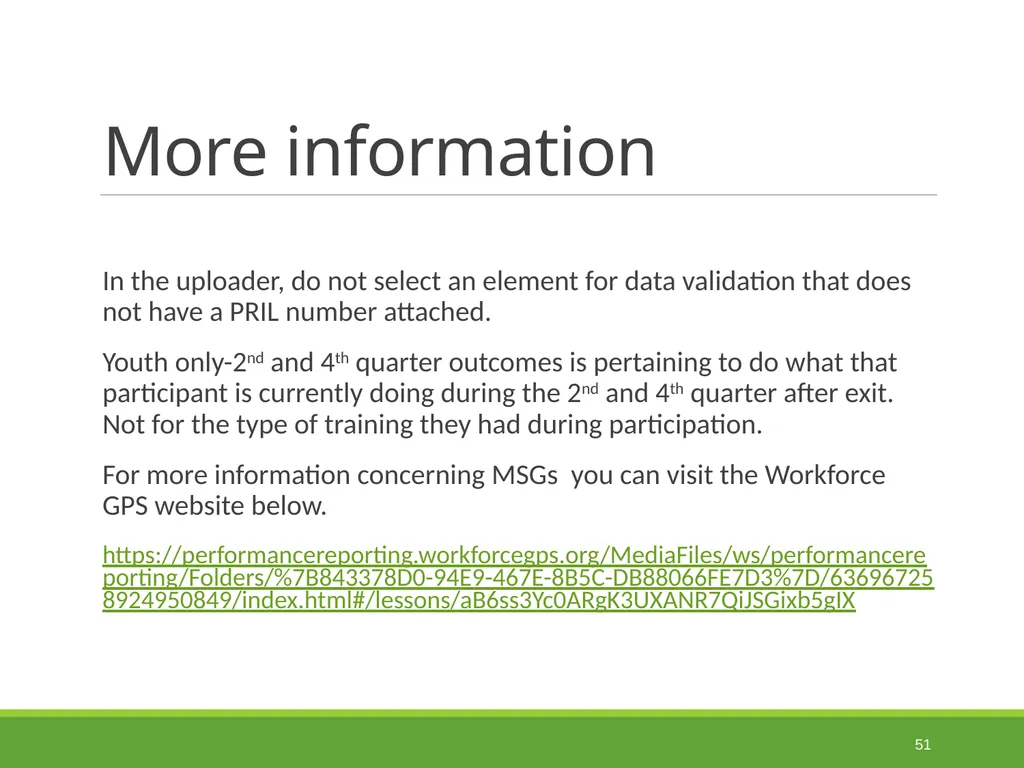
More information In the uploader, do not select an element for data validation that does not have a PRIL number attached.
Youth only-2nd and 4th quarter outcomes is pertaining to do what that participant is currently doing during the 2nd and 4th quarter after exit. Not for the type of training they had during participation.
For more information concerning MSGs you can visit the Workforce GPS website below.
https://performancereporting.workforcegps.org/MediaFiles/ws/performancereporting/Folders/%7B843378D0-94E9-467E-8B5C-DB88066FE7D3%7D/636967258924950849/index.html#/lessons/aB6ss3Yc0ARgK3UXANR7QiJSGixb5gIX 51<br>
Youth only-2nd and 4th quarter outcomes is pertaining to do what that participant is currently doing during the 2nd and 4th quarter after exit. Not for the type of training they had during participation.
For more information concerning MSGs you can visit the Workforce GPS website below.
https://performancereporting.workforcegps.org/MediaFiles/ws/performancereporting/Folders/%7B843378D0-94E9-467E-8B5C-DB88066FE7D3%7D/636967258924950849/index.html#/lessons/aB6ss3Yc0ARgK3UXANR7QiJSGixb5gIX 51<br>