Measurement and Application of BUG (Backlight, Uplight and Glare) Ratings for Outdoor Lighting Graeme G Lister and David M Keith CORM 2013, Gaithersburg, MD 1 The Earth at Night CORM 2013, Gaithersburg, MD 2 Outdoor Lighting CORM 2013,
"Measurement and Application of “BUG” (Backlight," is the property of its rightful owner. Permission is granted to
download and print the materials on this website for personal, non-commercial use only, and to display it
on your personal computer provided you do not modify the materials and that you retain all copyright
notices contained in the materials. By downloading content from our website, you accept the terms of this
agreement.
Presentation Transcript
01
Measurement and Application of “BUG” (Backlight, Uplight and Glare) Ratings for Outdoor Lighting Graeme G Lister and David M Keith CORM 2013, Gaithersburg, MD 1<br>
02
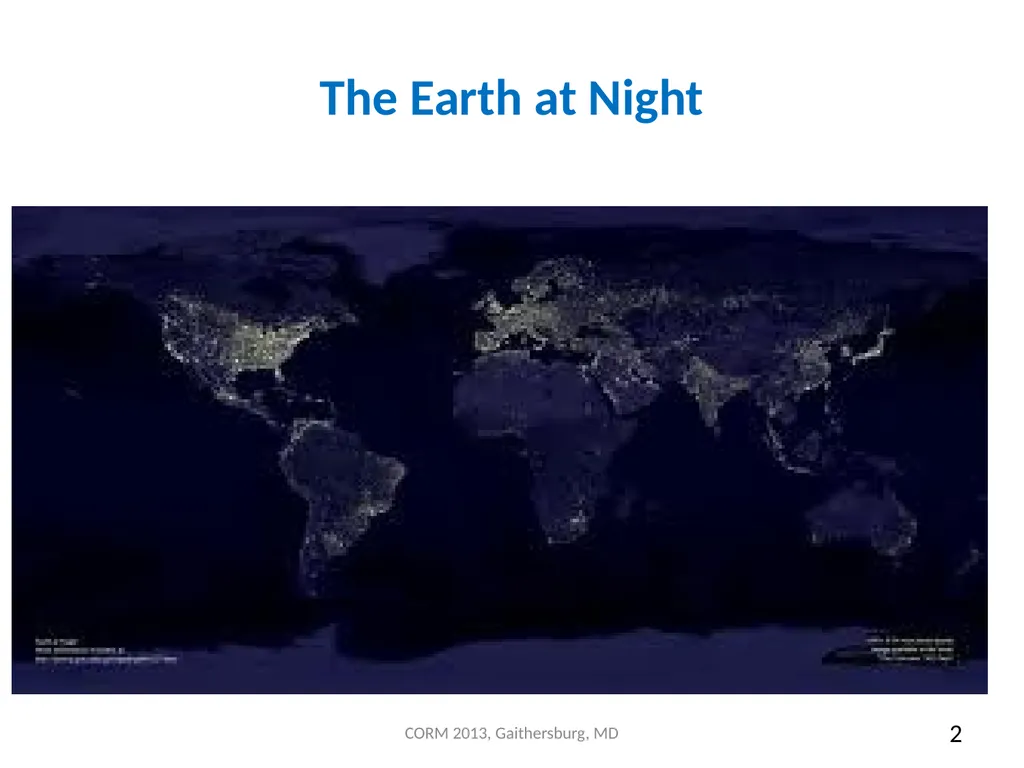
The Earth at Night CORM 2013, Gaithersburg, MD 2<br>
03
Outdoor Lighting CORM 2013, Gaithersburg, MD 3 Light for night time visual activities
Safety/Security
Improve lighting visibility on roadways
Enhance beauty of architecture, monuments etc.
Enhance social experience
Positive influence on municipal economy<br>
04
Potential Negative Aspects of Outdoor Lighting CORM 2013, Gaithersburg, MD 4 Nuisance for local residence
Light Pollution – Dark Sky, Astronomy
Glare
Disturbance of Natural Habitat
Contribution to Carbon Footprint<br>
05
Outdoor Lighting Design CORM 2013, Gaithersburg, MD 5 Luminaire Optics
Luminaire Location
Light where it is needed
Lighting Quality
Visual Tasks
Aesthetics
Safety
Security<br>
06
Outdoor Lighting Guidance CORM 2013, Gaithersburg, MD 6 JOINT IDA – IES MODEL LIGHTING ORDINANCE (MLO) IES Luminaire Classification System (LCS)
for Outdoor Luminaires
IES TM-15-11<br>
07
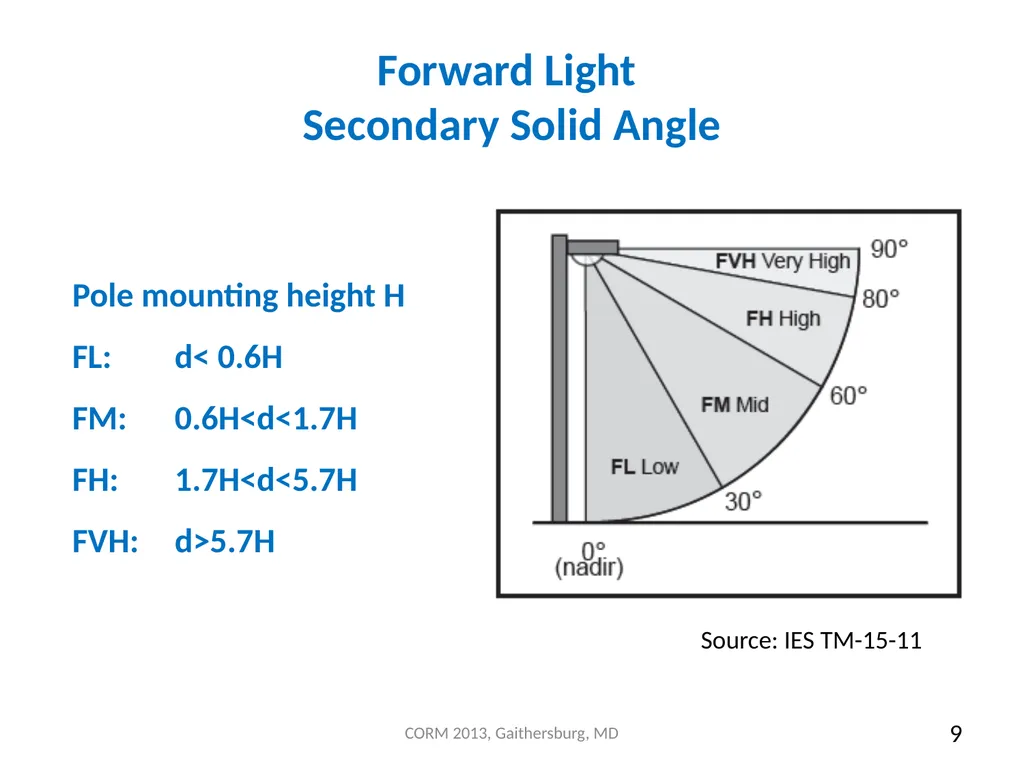
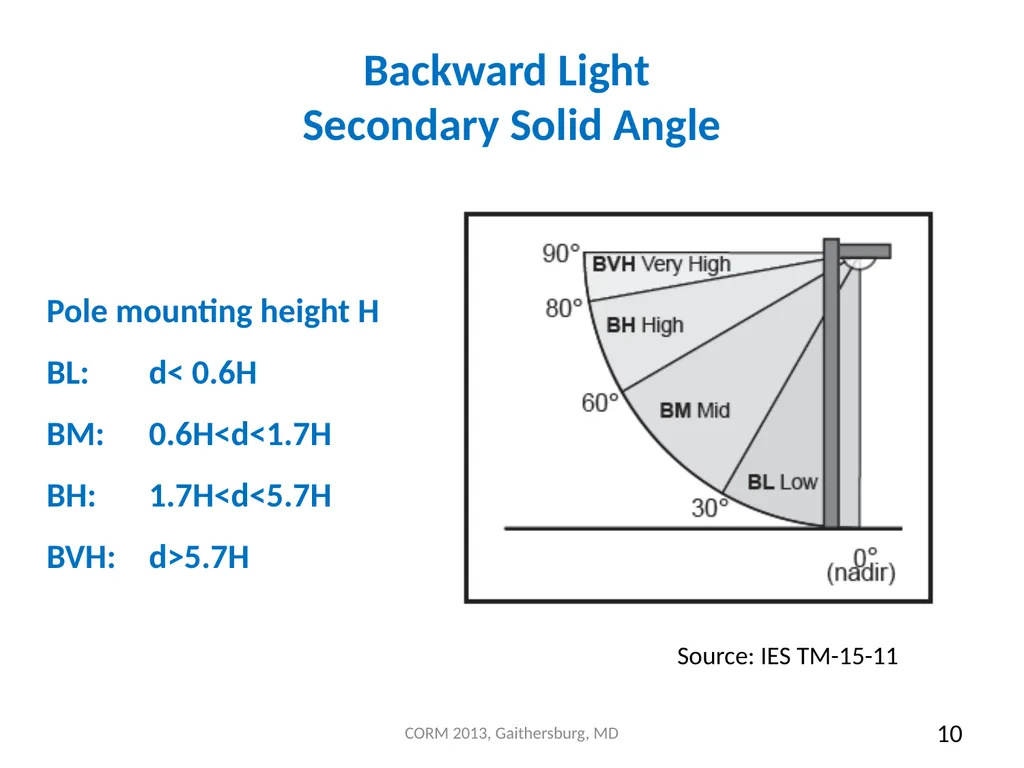
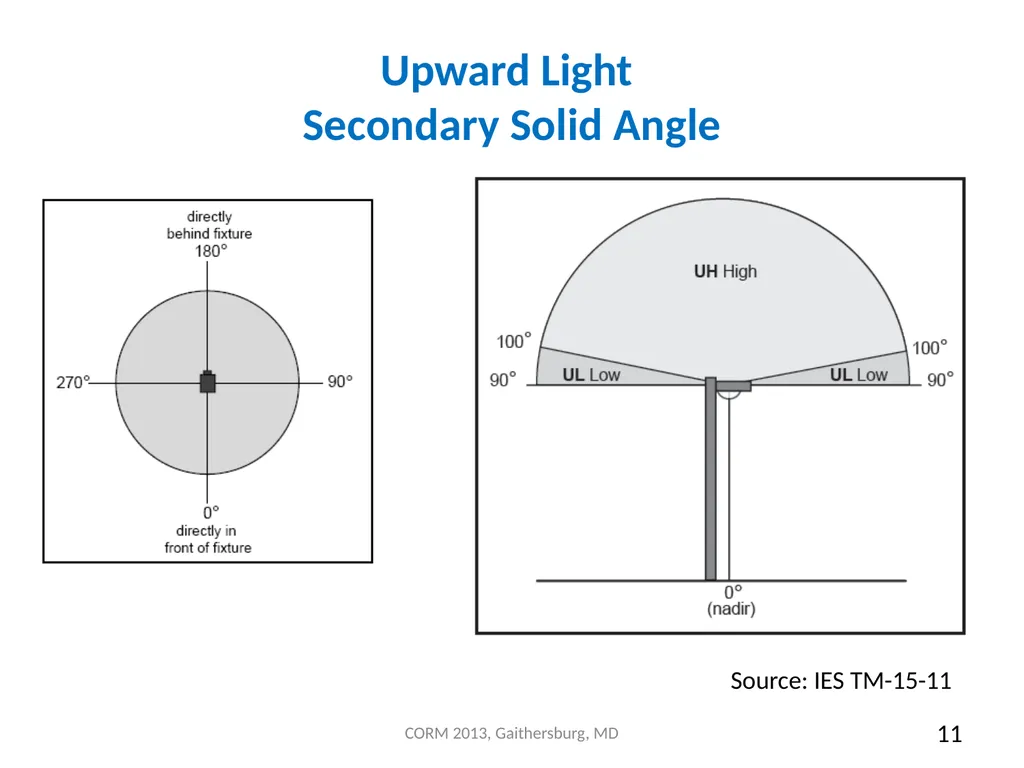
Luminaire Classification System (LCS) CORM 2013, Gaithersburg, MD 7 Defines standard solid angles for evaluation and comparison of outdoor luminaires
Uses existing photometric test data, easily incorporated into software tools
Enables designers to evaluate and compare lumen distribution for various types of luminaire optics LCS: LCS provides guidance in designing outdoor lighting projects, but cannot account for variations in eye response and perception<br>
08
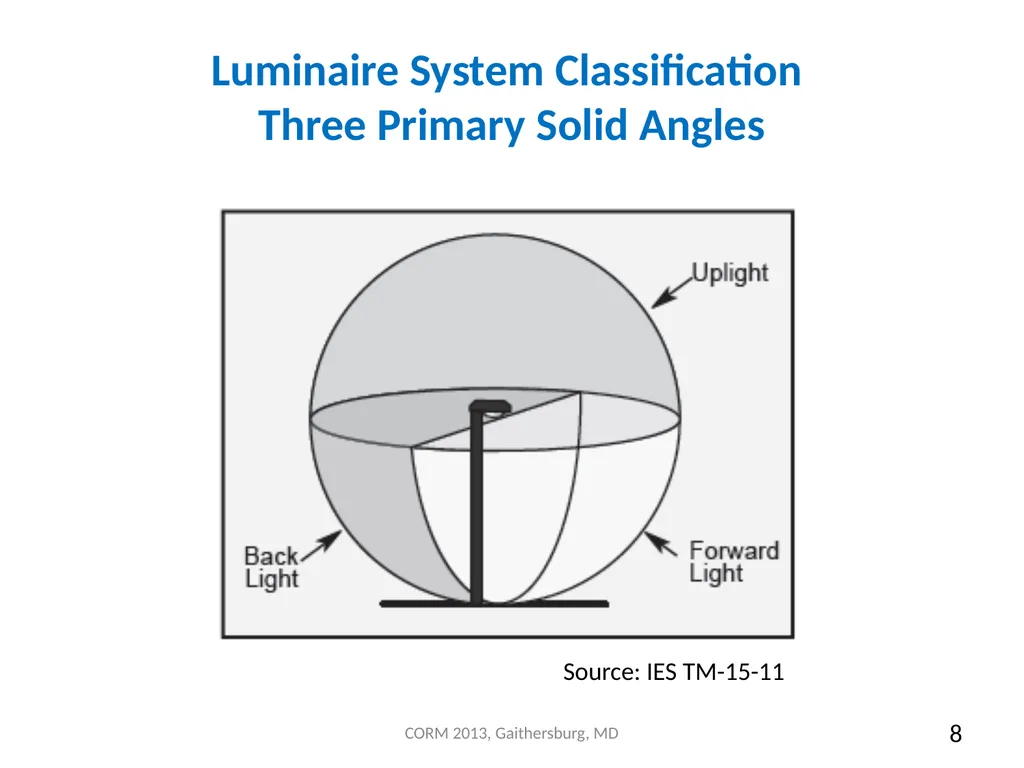
Luminaire System Classification Three Primary Solid Angles CORM 2013, Gaithersburg, MD 8 Source: IES TM-15-11<br>
Glare CORM 2013, Gaithersburg, MD 13 Luminance too high
Luminance ratio too high
- discomfort glare
- reduction in visual performance
Glare is in the eye of the beholder<br>
14
Discomfort Glare CORM 2013, Gaithersburg, MD 14 Luminance of the glare source
Size of the glare source
Position of the source in the field of view
Luminance of the background<br>
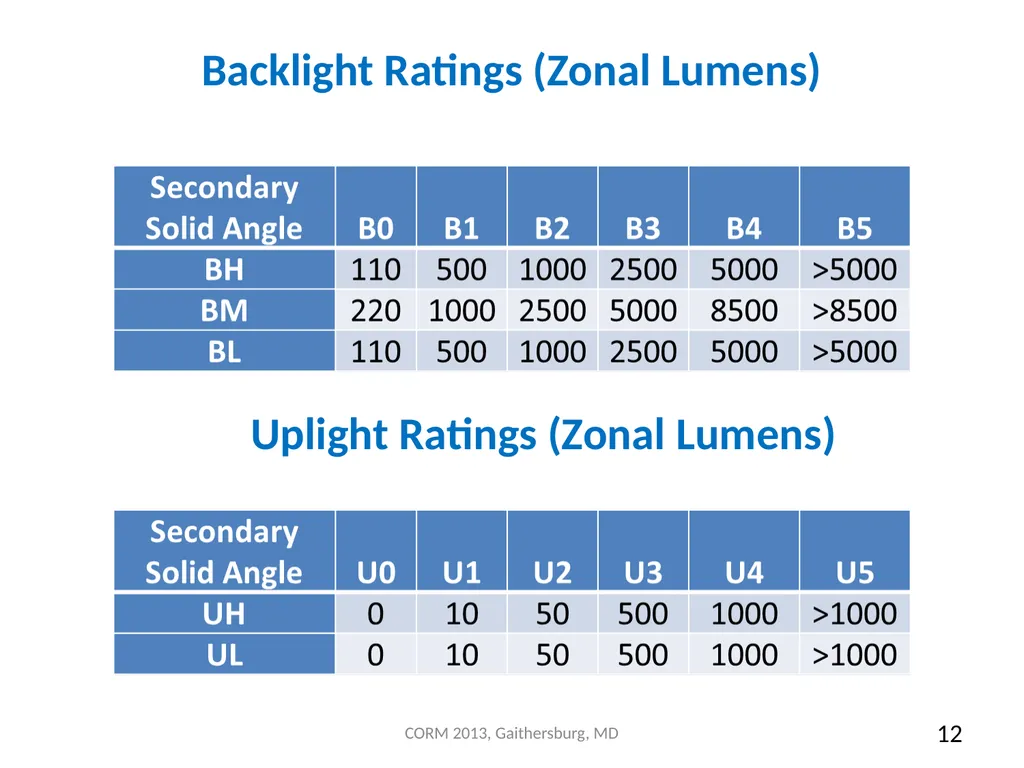
Photometry CORM 2013, Gaithersburg, MD 17 BUG ratings based on photometric data , measured in IES-approved manner (e.g. LM-35-02, HID and Incandescent)
Luminaire lumens calculated based on measured intensities in specific solid angles (separation 2.5 deg.) about the luminaire.
Rated power, <3% harmonics in wave form
Avoid stray light<br>
18
How Do We Measure Light? CORM 2013, Gaithersburg, MD 18 Quantity
Direction
Colour
Time<br>
19
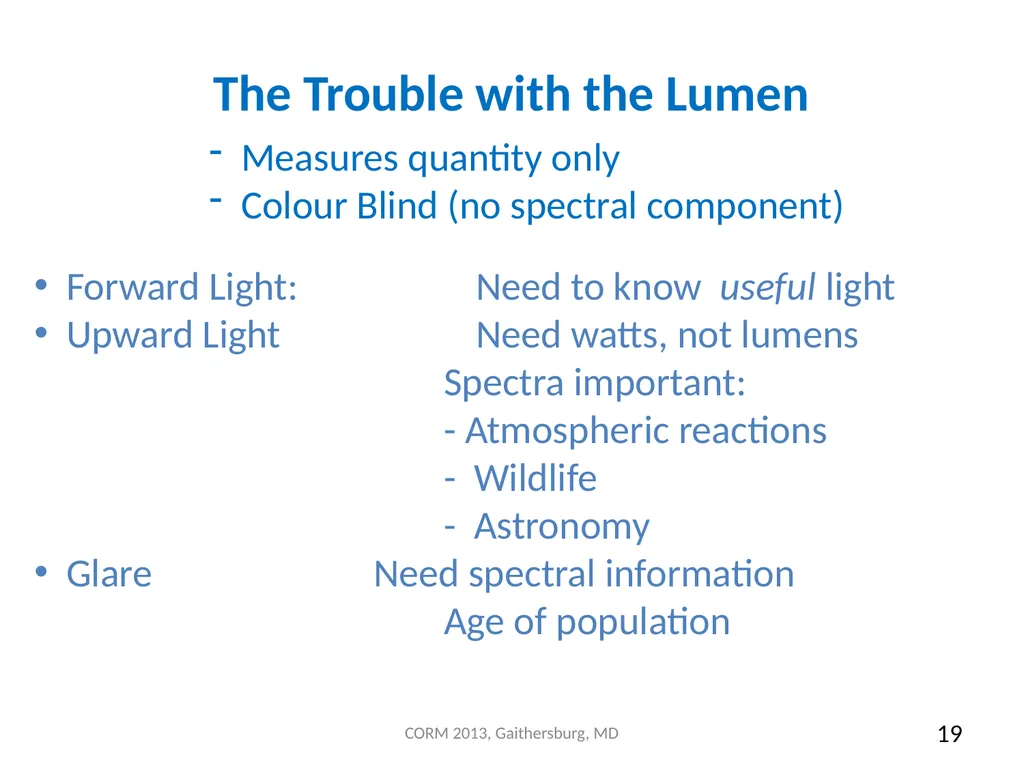
The Trouble with the Lumen CORM 2013, Gaithersburg, MD 19 Measures quantity only
Colour Blind (no spectral component) Forward Light: Need to know useful light
Upward Light Need watts, not lumens
Spectra important:
- Atmospheric reactions
- Wildlife
- Astronomy
Glare Need spectral information
Age of population<br>
20
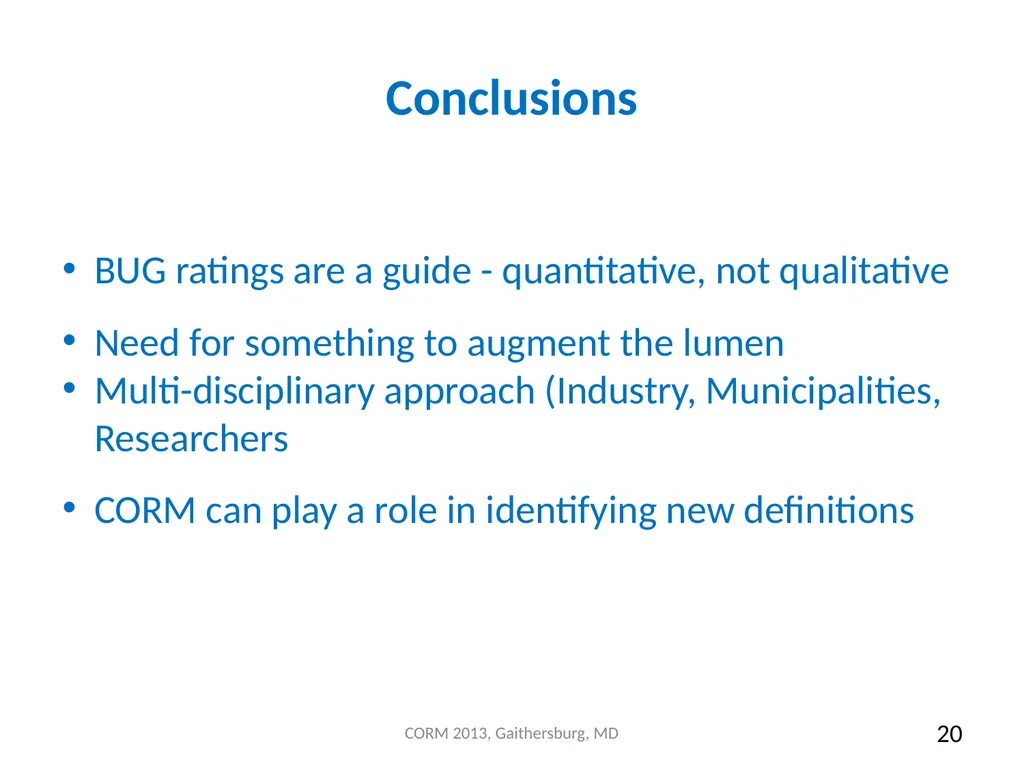
Conclusions CORM 2013, Gaithersburg, MD 20 BUG ratings are a guide - quantitative, not qualitative
Need for something to augment the lumen
Multi-disciplinary approach (Industry, Municipalities, Researchers
CORM can play a role in identifying new definitions<br>
21
Thanks to: CORM 2013, Gaithersburg, MD 21 CORM
David Keith
Ceravision
Ref:
Luminaire Classification System
For Outdoor Luminaires
IES TM-15-11<br>