
Mediation in Extensive-Form Games Brian Hu Zhang
AM
Published · 46 slides · 0 views

1 / 1




Description
Mediation in Extensive-Form Games Brian Hu Zhang Primarily based on: Zhang and Sandholm (NeurIPS 2022, to appear), Polynomial-Time Optimal Equilibria with a Mediator in Extensive-Form Games https:arxiv.orgabs2206.15395 Chicken
Related Topics
Share
Embed code
Download this presentation From Below
"Mediation in Extensive-Form Games Brian Hu Zhang" is the property of its rightful owner. Permission is granted to download and print the materials on this website for personal, non-commercial use only, and to display it on your personal computer provided you do not modify the materials and that you retain all copyright notices contained in the materials. By downloading content from our website, you accept the terms of this agreement.
Presentation Transcript
01
Mediation in
Extensive-Form Games Brian Hu Zhang
Primarily based on:
Zhang and Sandholm (NeurIPS 2022, to appear), "Polynomial-Time Optimal Equilibria with a Mediator in Extensive-Form Games" https://arxiv.org/abs/2206.15395<br>
Primarily based on:
Zhang and Sandholm (NeurIPS 2022, to appear), "Polynomial-Time Optimal Equilibria with a Mediator in Extensive-Form Games" https://arxiv.org/abs/2206.15395<br>
02
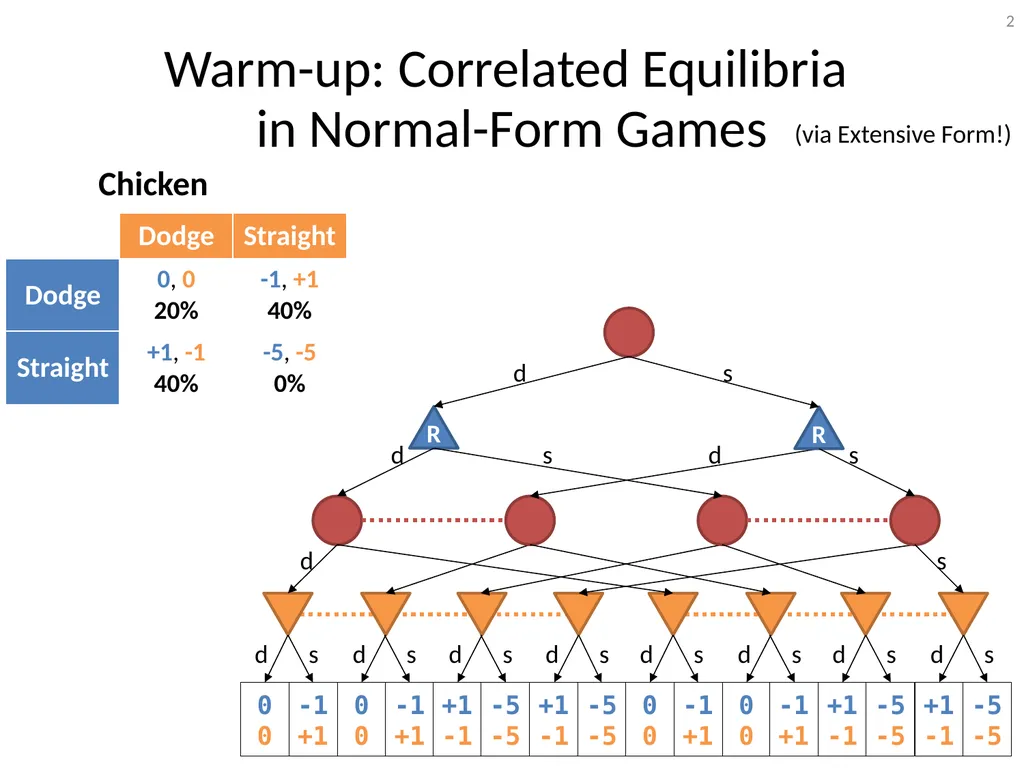
Chicken Warm-up: Correlated Equilibria
in Normal-Form Games (via Extensive Form!) 2<br>
03
Warm-up: Correlated Equilibria
in Normal-Form Games Chicken obedient strategy profile To find a correlated equilibrium: find a strategy for the mediator such that, in the game among the players that results from holding the mediator's strategy fixed, the obedient strategy profile is a Nash equilibrium. (via Extensive Form!) 3 0
0 -1
+1 C d s 0
0 -1
+1 C d s C d s C d s C d s C d s C d s C d s R R d s d s d s 0
0 -1
+1 0
0 -1
+1 +1
-1 -5
-5 +1
-1 -5
-5 d s +1
-1 -5
-5 +1
-1 -5
-5<br>
0 -1
+1 C d s 0
0 -1
+1 C d s C d s C d s C d s C d s C d s C d s R R d s d s d s 0
0 -1
+1 0
0 -1
+1 +1
-1 -5
-5 +1
-1 -5
-5 d s +1
-1 -5
-5 +1
-1 -5
-5<br>
04
Warm-up: Correlated Equilibria
in Normal-Form Games To find a correlated equilibrium: find a strategy for the mediator such that, in the game among the players that results from holding the mediator's strategy fixed, the obedient strategy profile is a Nash equilibrium. (via Extensive Form!) 4<br>
05
Warm-up: Correlated Equilibria
in Normal-Form Games To find a correlated equilibrium: find a strategy for the mediator such that, in the game among the players that results from holding the mediator's strategy fixed, the obedient strategy profile is a Nash equilibrium. (via Extensive Form!) 5<br>
06
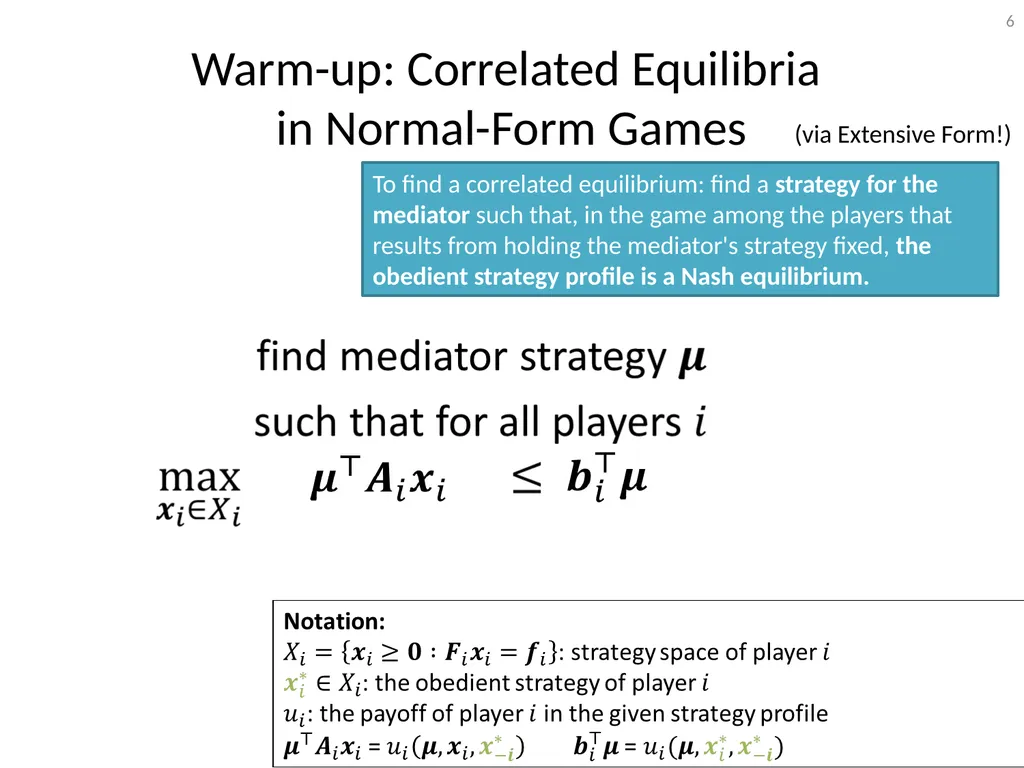
To find a correlated equilibrium: find a strategy for the mediator such that, in the game among the players that results from holding the mediator's strategy fixed, the obedient strategy profile is a Nash equilibrium. (via Extensive Form!) Warm-up: Correlated Equilibria
in Normal-Form Games 6<br>
07
Warm-up: Correlated Equilibria
in Normal-Form Games (via Extensive Form!) To find a correlated equilibrium: find a strategy for the mediator such that, in the game among the players that results from holding the mediator's strategy fixed, the obedient strategy profile is a Nash equilibrium. 7<br>
08
Warm-up: Correlated Equilibria
in Normal-Form Games (via Extensive Form!) To find a correlated equilibrium: find a strategy for the mediator such that, in the game among the players that results from holding the mediator's strategy fixed, the obedient strategy profile is a Nash equilibrium. This is a linear program! Solve it with any LP solver 8<br>
09
Can we generalize this idea to other useful problems? 9<br>
10
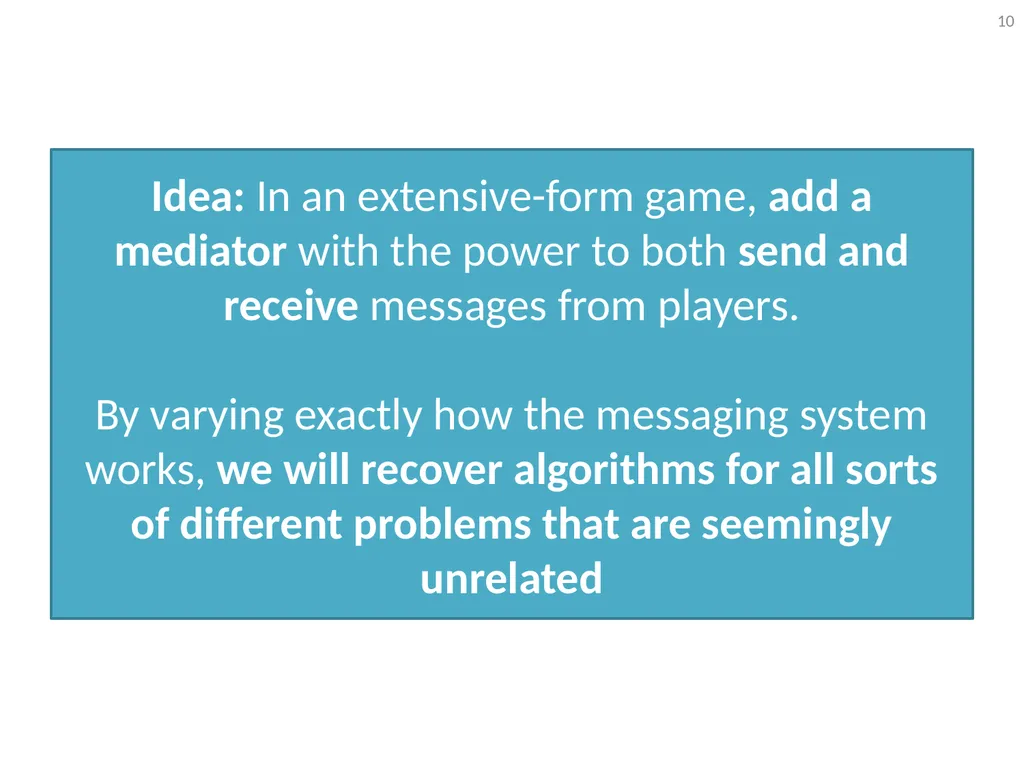
Idea: In an extensive-form game, add a mediator with the power to both send and receive messages from players.
By varying exactly how the messaging system works, we will recover algorithms for all sorts of different problems that are seemingly unrelated 10<br>
By varying exactly how the messaging system works, we will recover algorithms for all sorts of different problems that are seemingly unrelated 10<br>
11
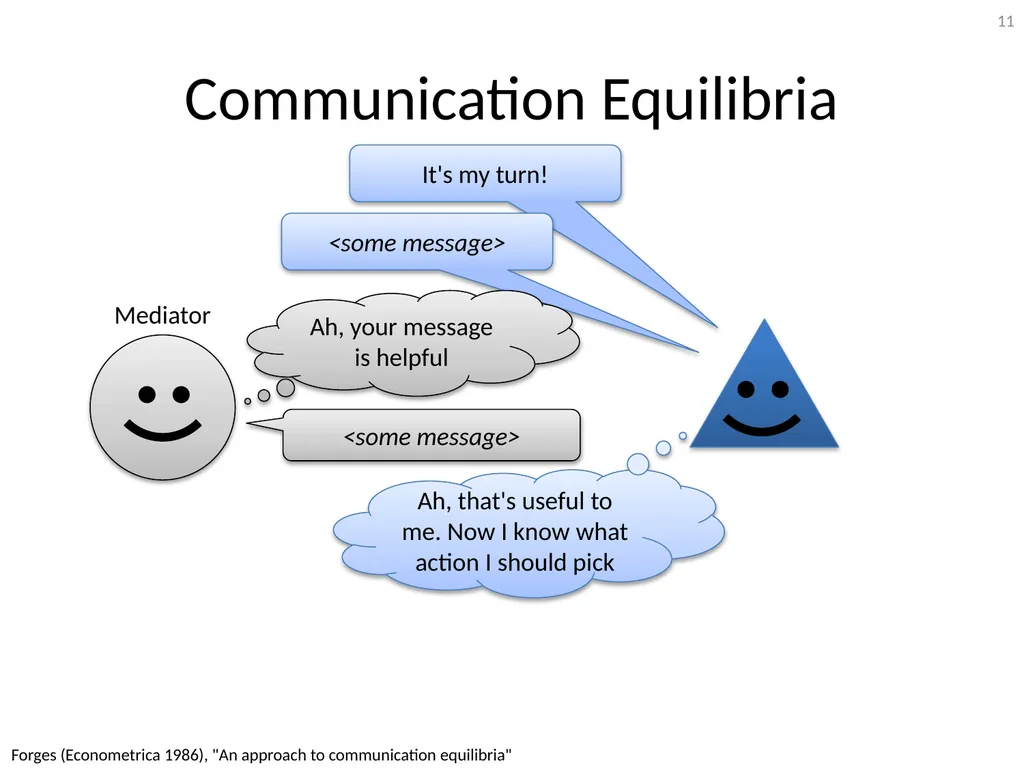
Communication Equilibria It's my turn! <some message> <some message> Ah, that's useful to me. Now I know what action I should pick Ah, your message is helpful Forges (Econometrica 1986), "An approach to communication equilibria" 11<br>
12
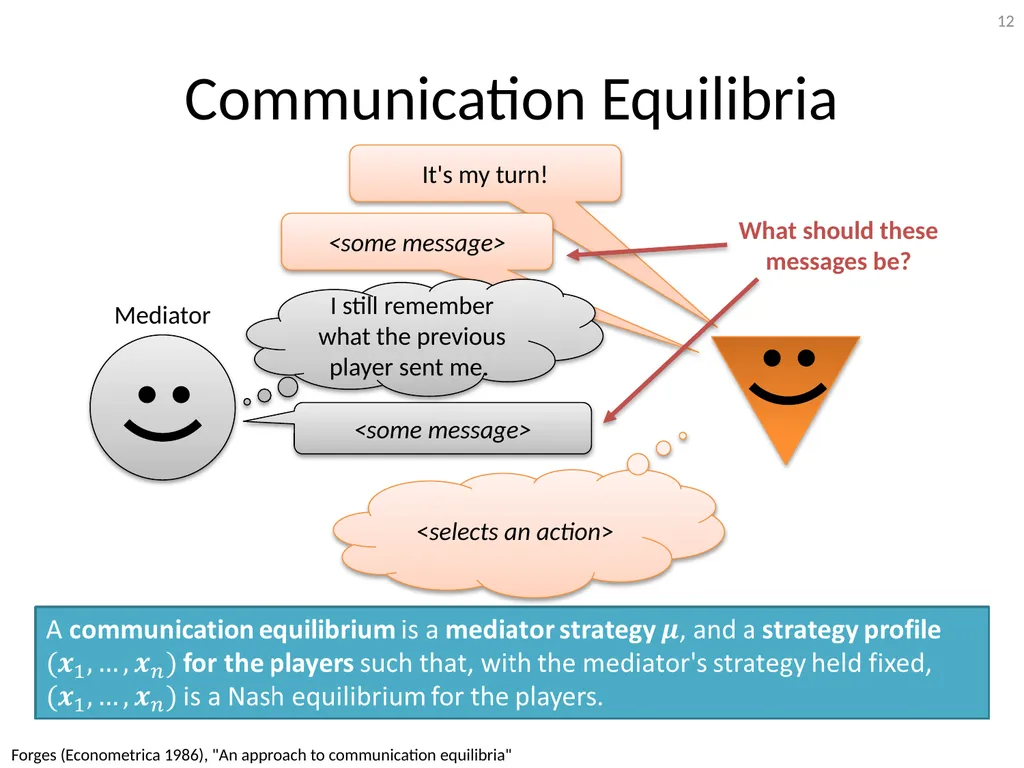
Communication Equilibria It's my turn! <some message> <some message> <selects an action> Forges (Econometrica 1986), "An approach to communication equilibria" 12 I still remember what the previous player sent me.<br>
13
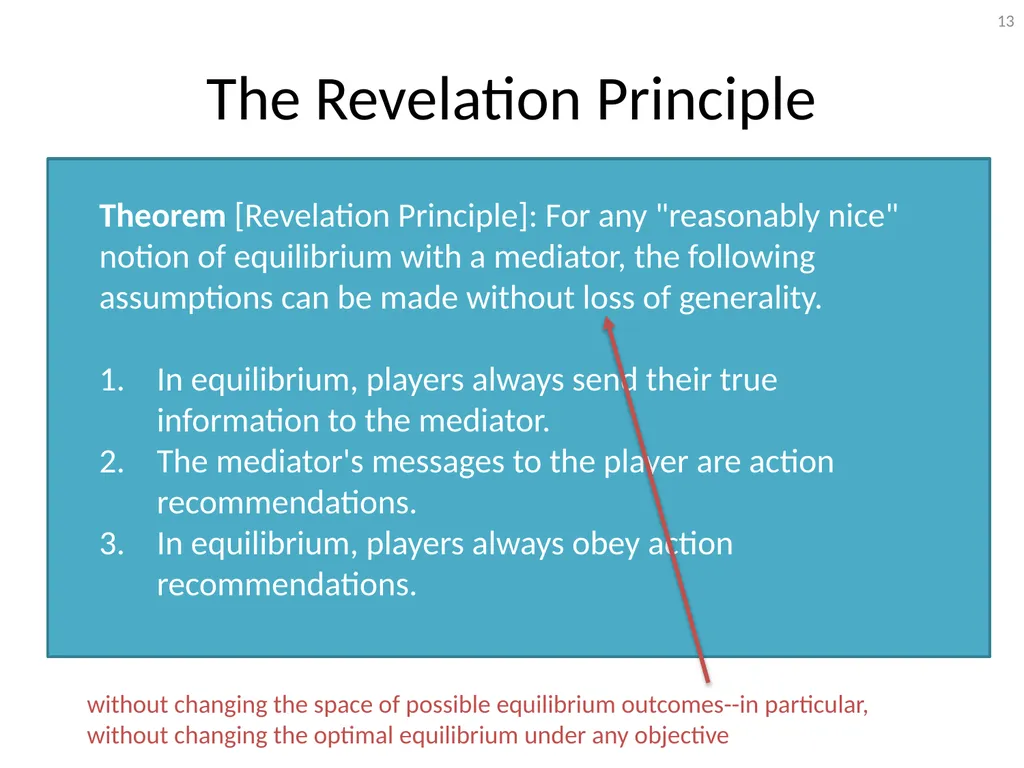
The Revelation Principle Theorem [Revelation Principle]: For any "reasonably nice" notion of equilibrium with a mediator, the following assumptions can be made without loss of generality.
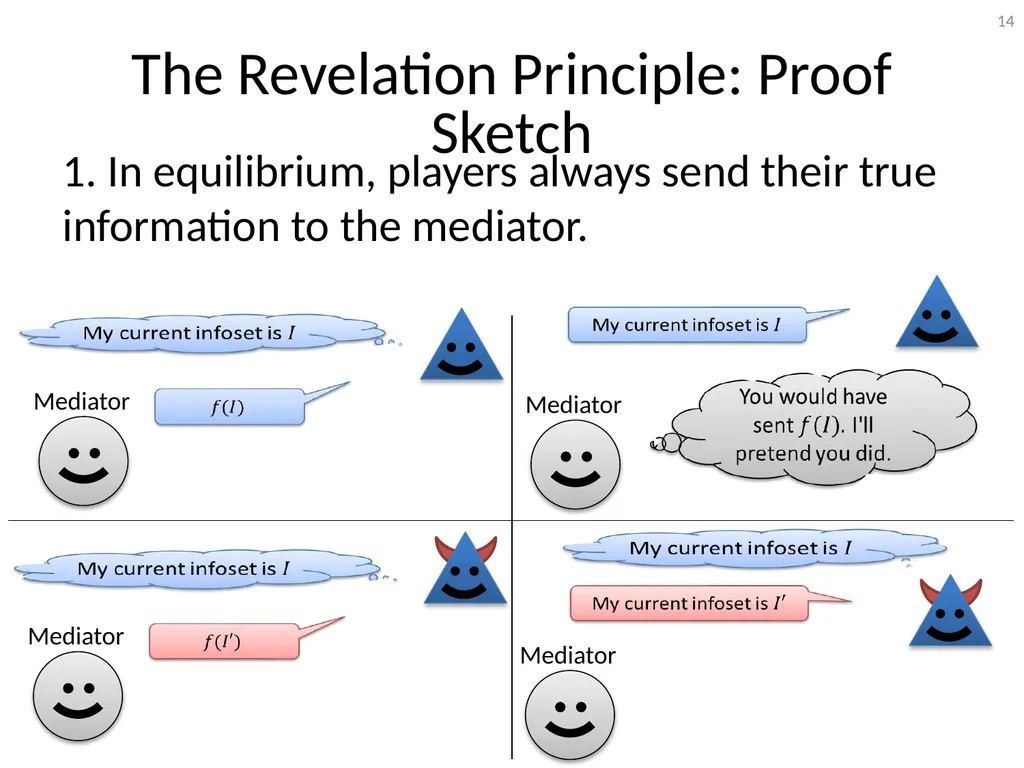
In equilibrium, players always send their true information to the mediator.
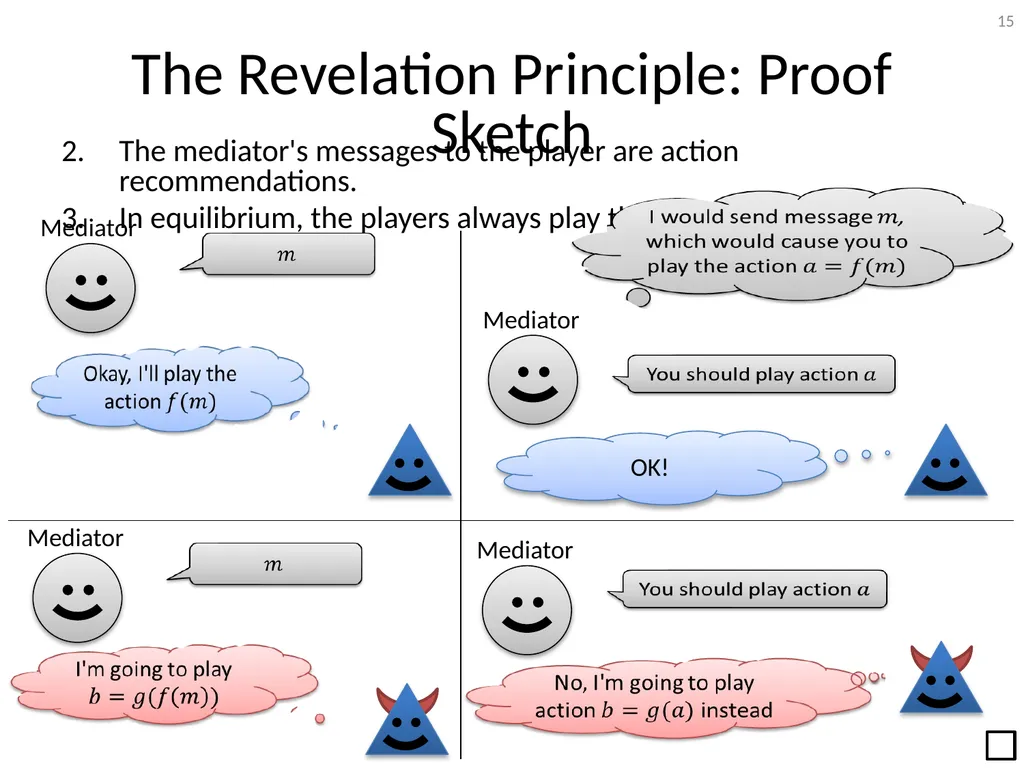
The mediator's messages to the player are action recommendations.
In equilibrium, players always obey action recommendations. 13<br>
In equilibrium, players always send their true information to the mediator.
The mediator's messages to the player are action recommendations.
In equilibrium, players always obey action recommendations. 13<br>
14
The Revelation Principle: Proof Sketch 1. In equilibrium, players always send their true information to the mediator. 14<br>
15
The Revelation Principle: Proof Sketch The mediator's messages to the player are action recommendations.
In equilibrium, the players always play the recommended actions. OK! 15<br>
In equilibrium, the players always play the recommended actions. OK! 15<br>
16
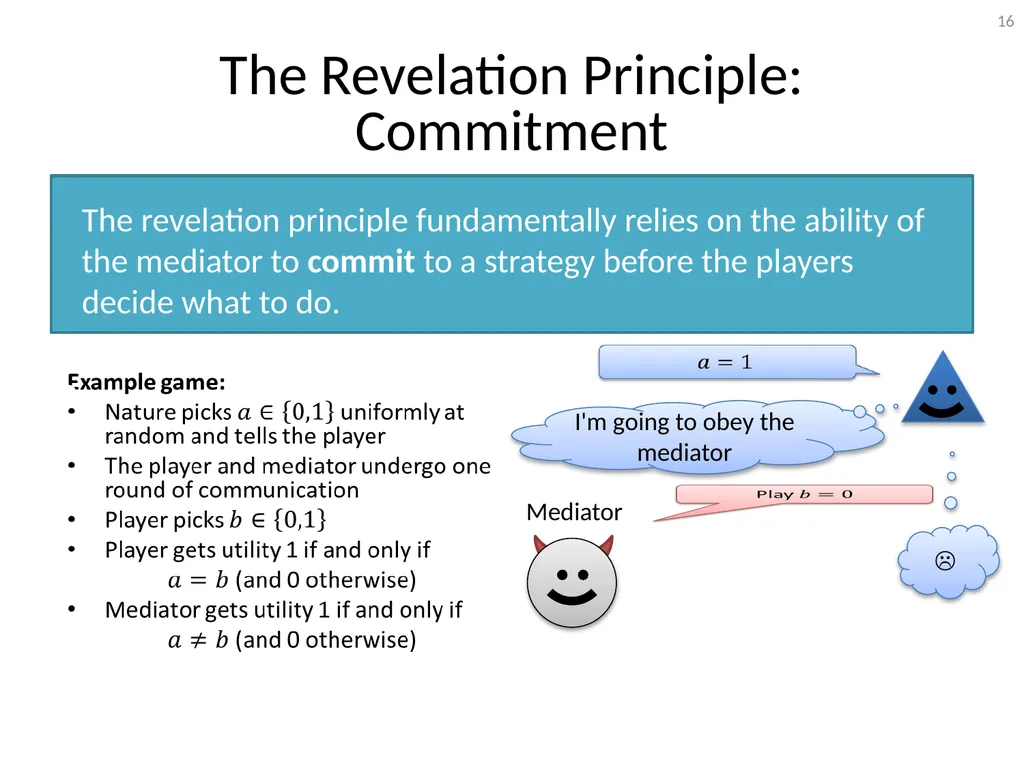
The Revelation Principle: Commitment 16 The revelation principle fundamentally relies on the ability of the mediator to commit to a strategy before the players decide what to do. I'm going to obey the mediator <br>
17
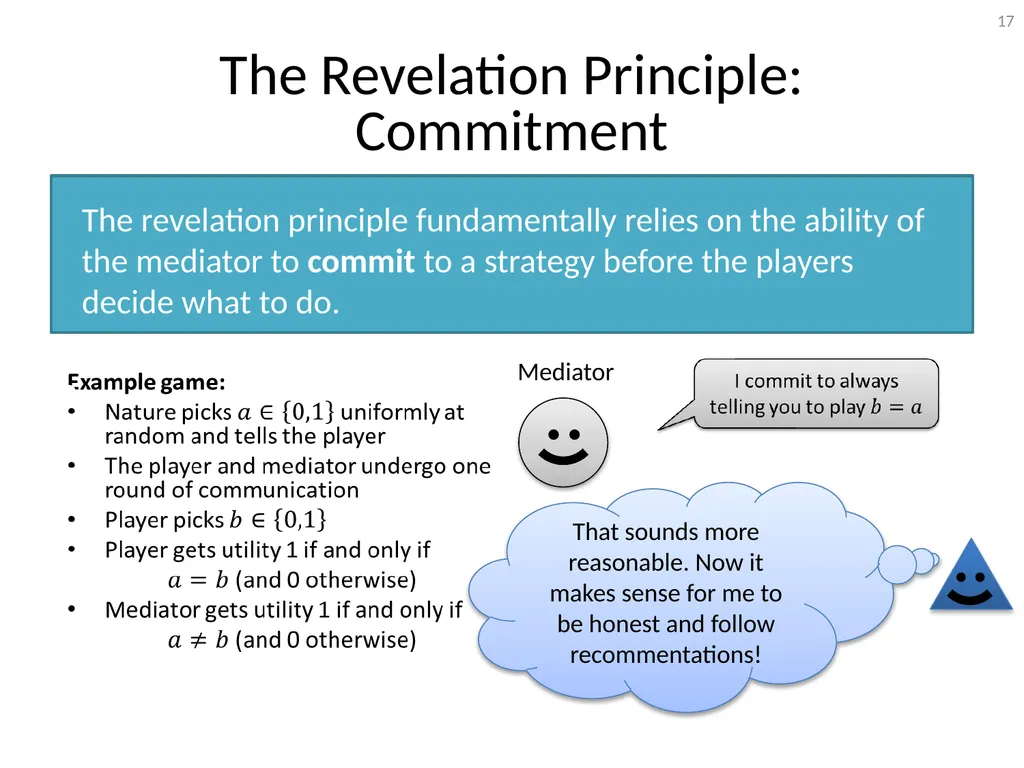
The Revelation Principle: Commitment 17 The revelation principle fundamentally relies on the ability of the mediator to commit to a strategy before the players decide what to do. That sounds more reasonable. Now it makes sense for me to be honest and follow recommentations!<br>
18
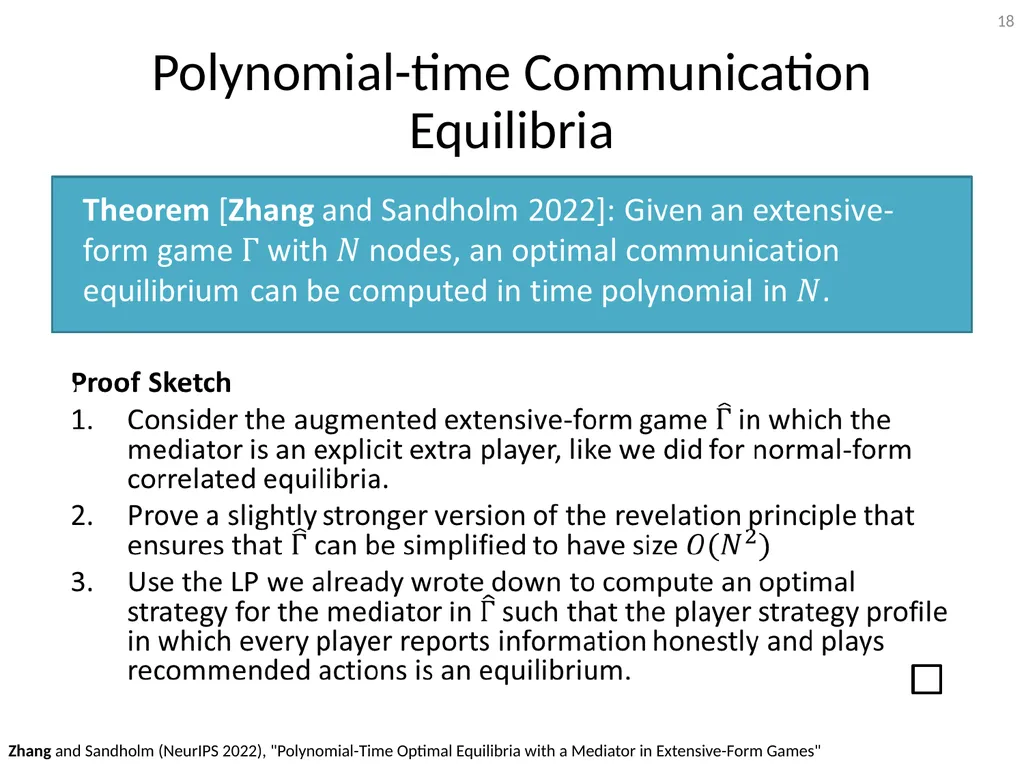
Polynomial-time Communication Equilibria Zhang and Sandholm (NeurIPS 2022), "Polynomial-Time Optimal Equilibria with a Mediator in Extensive-Form Games" 18<br>
19
Lots of related useful problems! Optimal correlated equilibria in normal-form games
Optimal mediated equilibrium
Optimal Bayesian persuasion (information design) in extensive-form games
Optimal automated mechanism design
Optimal extensive-form correlated equilibria in extensive-form games ✓ 19<br>
Optimal mediated equilibrium
Optimal Bayesian persuasion (information design) in extensive-form games
Optimal automated mechanism design
Optimal extensive-form correlated equilibria in extensive-form games ✓ 19<br>
20
Lots of related useful problems! Optimal correlated equilibria in normal-form games
Optimal mediated equilibrium
Optimal Bayesian persuasion (information design) in extensive-form games
Optimal automated mechanism design
Optimal extensive-form correlated equilibria in extensive-form games ✓ 20<br>
Optimal mediated equilibrium
Optimal Bayesian persuasion (information design) in extensive-form games
Optimal automated mechanism design
Optimal extensive-form correlated equilibria in extensive-form games ✓ 20<br>
21
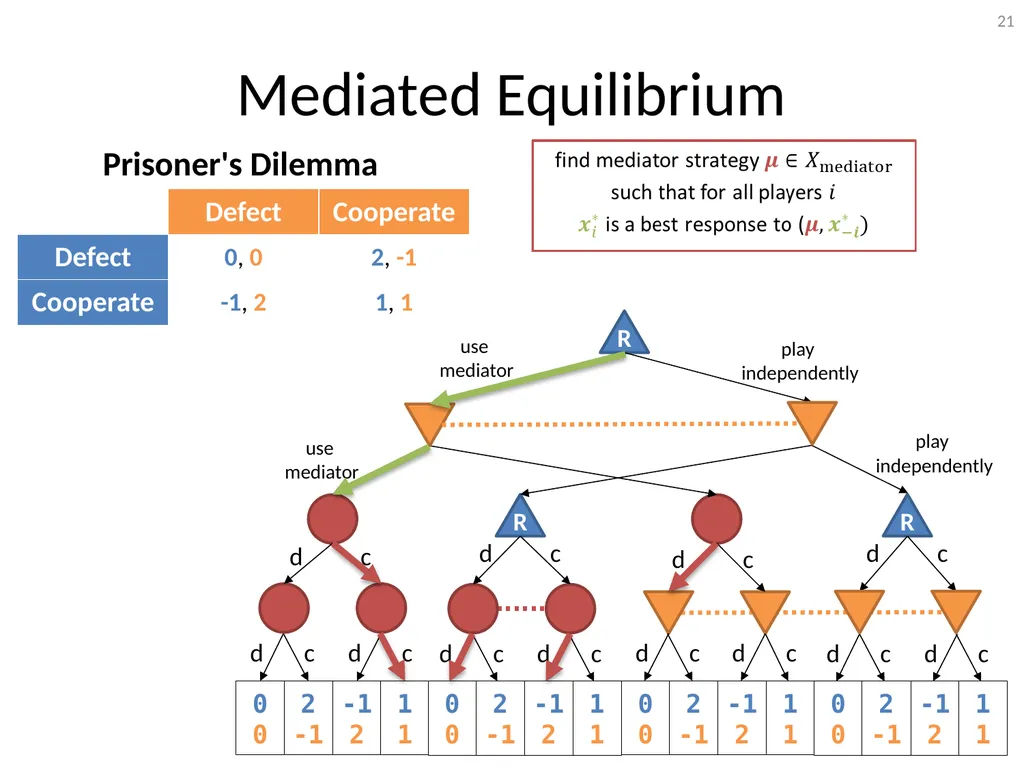
Prisoner's Dilemma Mediated Equilibrium 21 0
0 2
-1 d c -1
2 1
1 d c C d c C d c d c d c R C R d c d c d c 0
0 2
-1 -1
2 1
1 0
0 2
-1 -1
2 1
1 use
mediator play
independently use
mediator d c d c R d c 0
0 2
-1 -1
2 1
1 C play
independently C C<br>
0 2
-1 d c -1
2 1
1 d c C d c C d c d c d c R C R d c d c d c 0
0 2
-1 -1
2 1
1 0
0 2
-1 -1
2 1
1 use
mediator play
independently use
mediator d c d c R d c 0
0 2
-1 -1
2 1
1 C play
independently C C<br>
22
Lots of related useful problems! Optimal correlated equilibria in normal-form games
Optimal mediated equilibrium
Optimal Bayesian persuasion (information design)
Optimal automated mechanism design
Optimal extensive-form correlated equilibria in extensive-form games ✓ 22 ✓<br>
Optimal mediated equilibrium
Optimal Bayesian persuasion (information design)
Optimal automated mechanism design
Optimal extensive-form correlated equilibria in extensive-form games ✓ 22 ✓<br>
23
Information Design Kamenica and Gentzkow (American Economic Review 2011), "Bayesian Persuasion" 23<br>
24
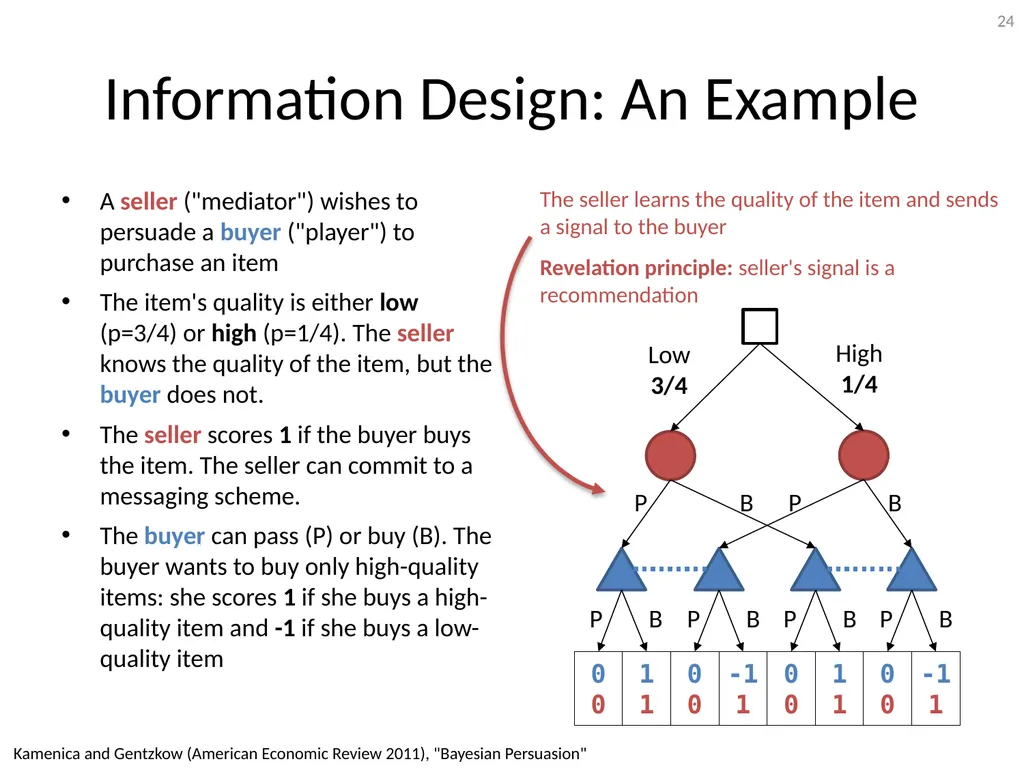
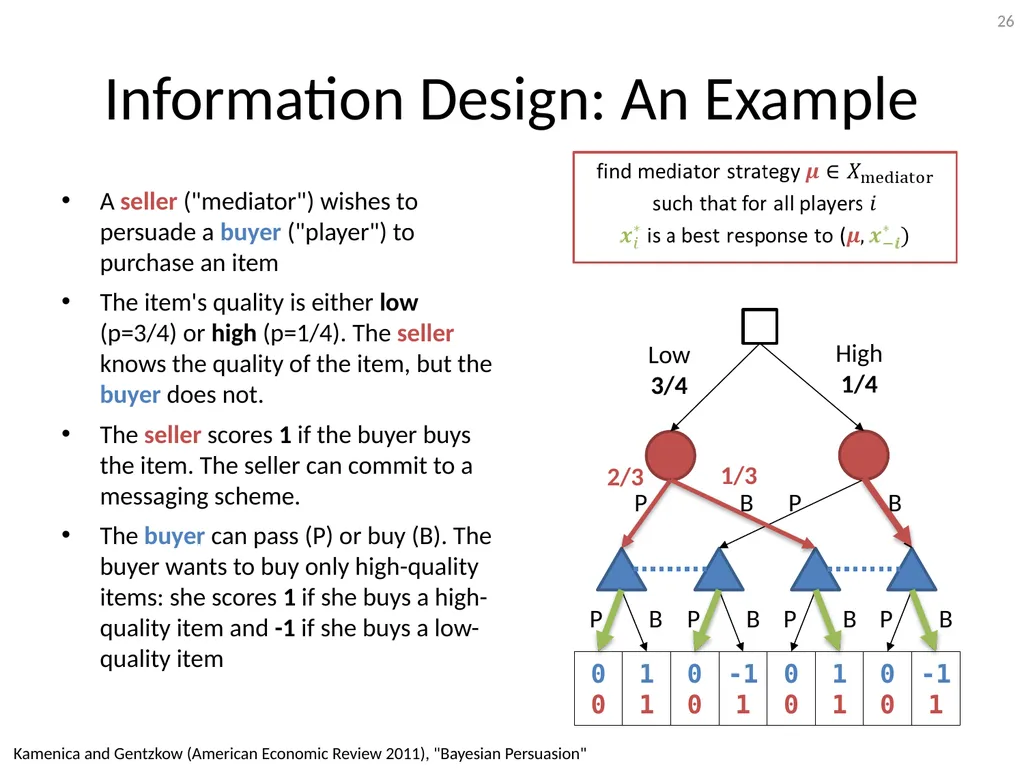
Information Design: An Example A seller ("mediator") wishes to persuade a buyer ("player") to purchase an item
The item's quality is either low (p=3/4) or high (p=1/4). The seller knows the quality of the item, but the buyer does not.
The seller scores 1 if the buyer buys the item. The seller can commit to a messaging scheme.
The buyer can pass (P) or buy (B). The buyer wants to buy only high-quality items: she scores 1 if she buys a high-quality item and -1 if she buys a low-quality item Kamenica and Gentzkow (American Economic Review 2011), "Bayesian Persuasion" 24 Revelation principle: seller's signal is a recommendation<br>
The item's quality is either low (p=3/4) or high (p=1/4). The seller knows the quality of the item, but the buyer does not.
The seller scores 1 if the buyer buys the item. The seller can commit to a messaging scheme.
The buyer can pass (P) or buy (B). The buyer wants to buy only high-quality items: she scores 1 if she buys a high-quality item and -1 if she buys a low-quality item Kamenica and Gentzkow (American Economic Review 2011), "Bayesian Persuasion" 24 Revelation principle: seller's signal is a recommendation<br>
25
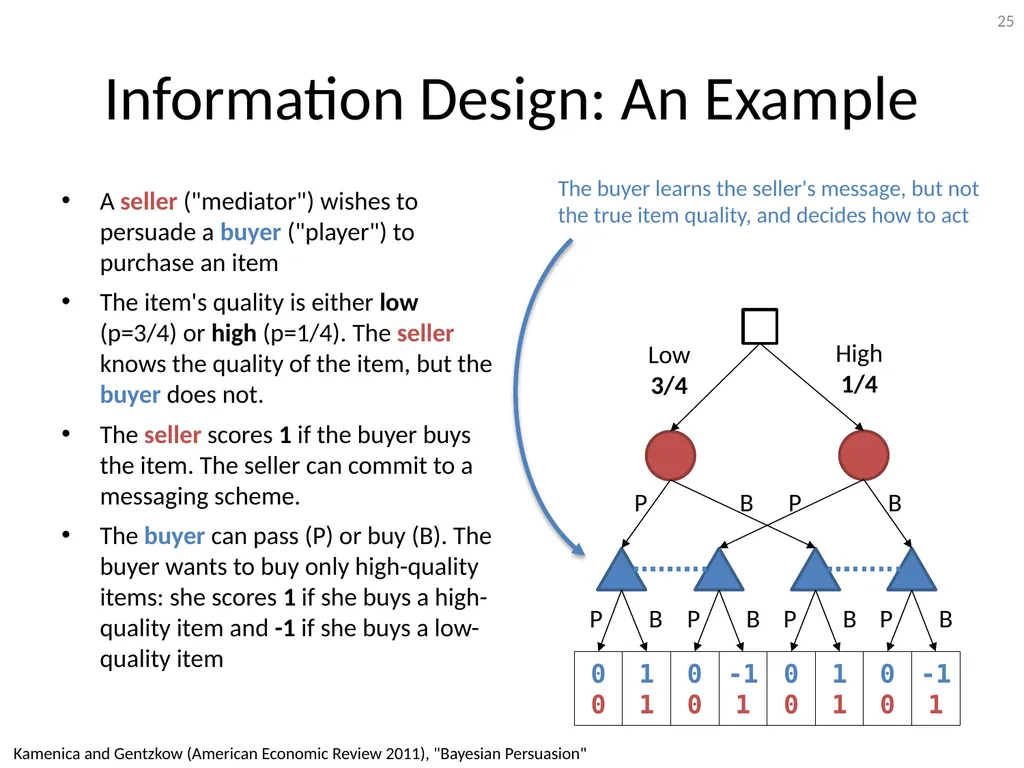
Information Design: An Example A seller ("mediator") wishes to persuade a buyer ("player") to purchase an item
The item's quality is either low (p=3/4) or high (p=1/4). The seller knows the quality of the item, but the buyer does not.
The seller scores 1 if the buyer buys the item. The seller can commit to a messaging scheme.
The buyer can pass (P) or buy (B). The buyer wants to buy only high-quality items: she scores 1 if she buys a high-quality item and -1 if she buys a low-quality item Kamenica and Gentzkow (American Economic Review 2011), "Bayesian Persuasion" 25<br>
The item's quality is either low (p=3/4) or high (p=1/4). The seller knows the quality of the item, but the buyer does not.
The seller scores 1 if the buyer buys the item. The seller can commit to a messaging scheme.
The buyer can pass (P) or buy (B). The buyer wants to buy only high-quality items: she scores 1 if she buys a high-quality item and -1 if she buys a low-quality item Kamenica and Gentzkow (American Economic Review 2011), "Bayesian Persuasion" 25<br>
26
Information Design: An Example A seller ("mediator") wishes to persuade a buyer ("player") to purchase an item
The item's quality is either low (p=3/4) or high (p=1/4). The seller knows the quality of the item, but the buyer does not.
The seller scores 1 if the buyer buys the item. The seller can commit to a messaging scheme.
The buyer can pass (P) or buy (B). The buyer wants to buy only high-quality items: she scores 1 if she buys a high-quality item and -1 if she buys a low-quality item Kamenica and Gentzkow (American Economic Review 2011), "Bayesian Persuasion" 26<br>
The item's quality is either low (p=3/4) or high (p=1/4). The seller knows the quality of the item, but the buyer does not.
The seller scores 1 if the buyer buys the item. The seller can commit to a messaging scheme.
The buyer can pass (P) or buy (B). The buyer wants to buy only high-quality items: she scores 1 if she buys a high-quality item and -1 if she buys a low-quality item Kamenica and Gentzkow (American Economic Review 2011), "Bayesian Persuasion" 26<br>
27
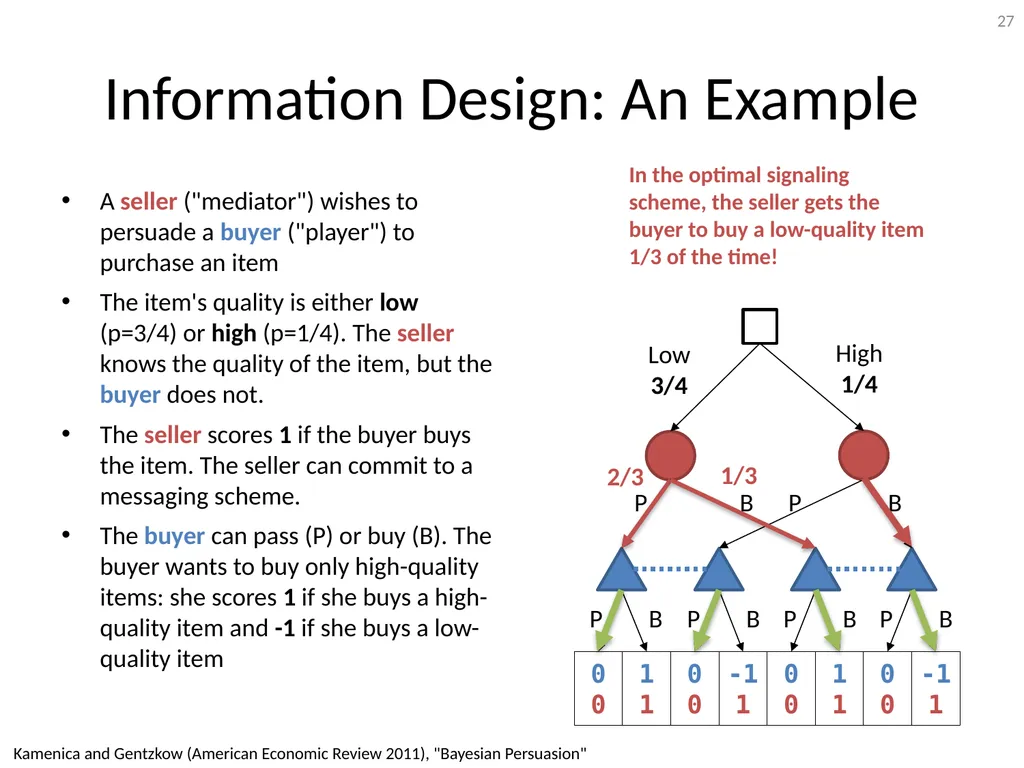
Information Design: An Example A seller ("mediator") wishes to persuade a buyer ("player") to purchase an item
The item's quality is either low (p=3/4) or high (p=1/4). The seller knows the quality of the item, but the buyer does not.
The seller scores 1 if the buyer buys the item. The seller can commit to a messaging scheme.
The buyer can pass (P) or buy (B). The buyer wants to buy only high-quality items: she scores 1 if she buys a high-quality item and -1 if she buys a low-quality item Kamenica and Gentzkow (American Economic Review 2011), "Bayesian Persuasion" 27 In the optimal signaling scheme, the seller gets the buyer to buy a low-quality item 1/3 of the time!<br>
The item's quality is either low (p=3/4) or high (p=1/4). The seller knows the quality of the item, but the buyer does not.
The seller scores 1 if the buyer buys the item. The seller can commit to a messaging scheme.
The buyer can pass (P) or buy (B). The buyer wants to buy only high-quality items: she scores 1 if she buys a high-quality item and -1 if she buys a low-quality item Kamenica and Gentzkow (American Economic Review 2011), "Bayesian Persuasion" 27 In the optimal signaling scheme, the seller gets the buyer to buy a low-quality item 1/3 of the time!<br>
28
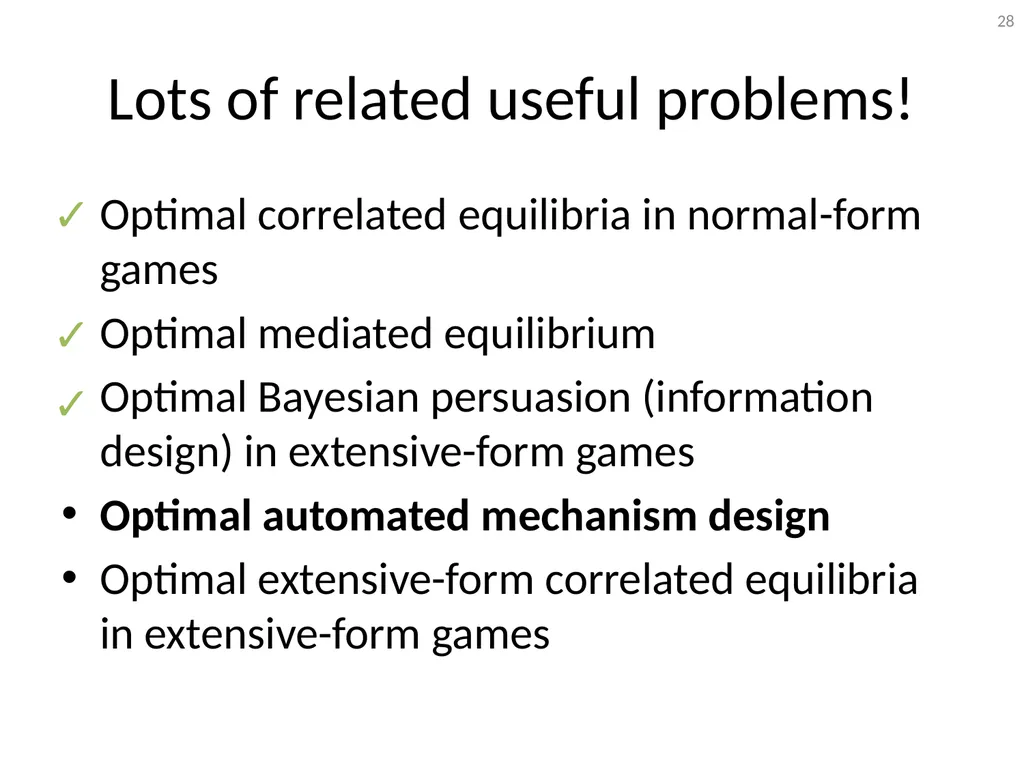
Lots of related useful problems! Optimal correlated equilibria in normal-form games
Optimal mediated equilibrium
Optimal Bayesian persuasion (information design) in extensive-form games
Optimal automated mechanism design
Optimal extensive-form correlated equilibria in extensive-form games ✓ ✓ 28 ✓<br>
Optimal mediated equilibrium
Optimal Bayesian persuasion (information design) in extensive-form games
Optimal automated mechanism design
Optimal extensive-form correlated equilibria in extensive-form games ✓ ✓ 28 ✓<br>
29
Mechanism Design 29<br>
30
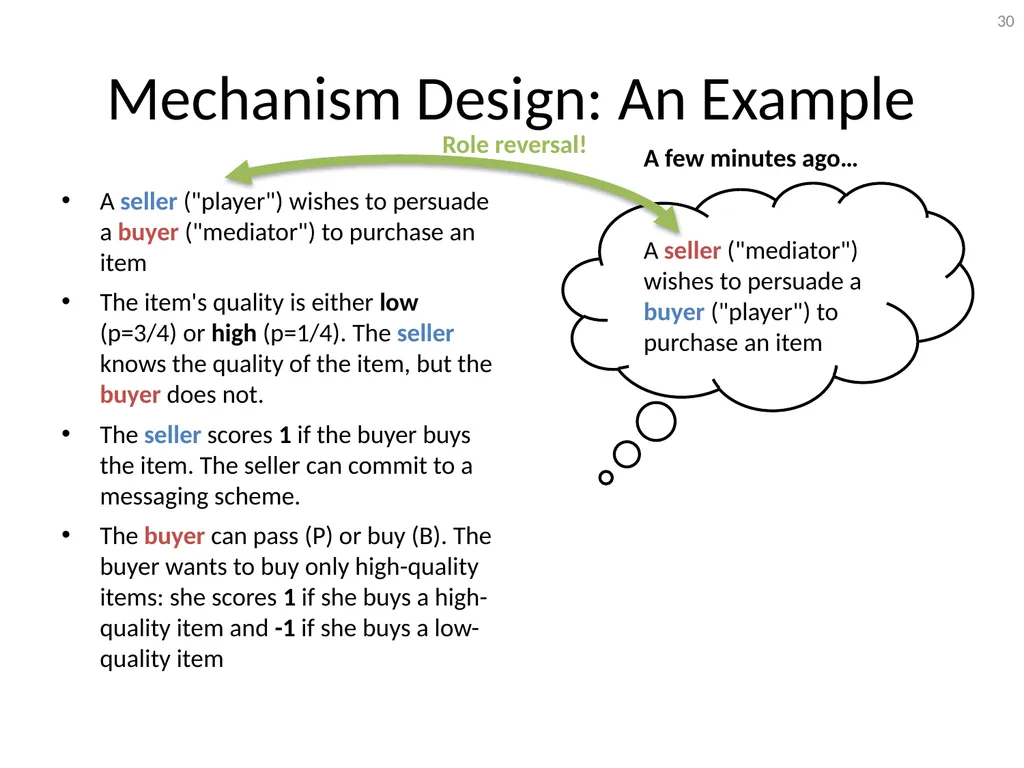
Mechanism Design: An Example A seller ("player") wishes to persuade a buyer ("mediator") to purchase an item
The item's quality is either low (p=3/4) or high (p=1/4). The seller knows the quality of the item, but the buyer does not.
The seller scores 1 if the buyer buys the item. The seller can commit to a messaging scheme.
The buyer can pass (P) or buy (B). The buyer wants to buy only high-quality items: she scores 1 if she buys a high-quality item and -1 if she buys a low-quality item 30<br>
The item's quality is either low (p=3/4) or high (p=1/4). The seller knows the quality of the item, but the buyer does not.
The seller scores 1 if the buyer buys the item. The seller can commit to a messaging scheme.
The buyer can pass (P) or buy (B). The buyer wants to buy only high-quality items: she scores 1 if she buys a high-quality item and -1 if she buys a low-quality item 30<br>
31
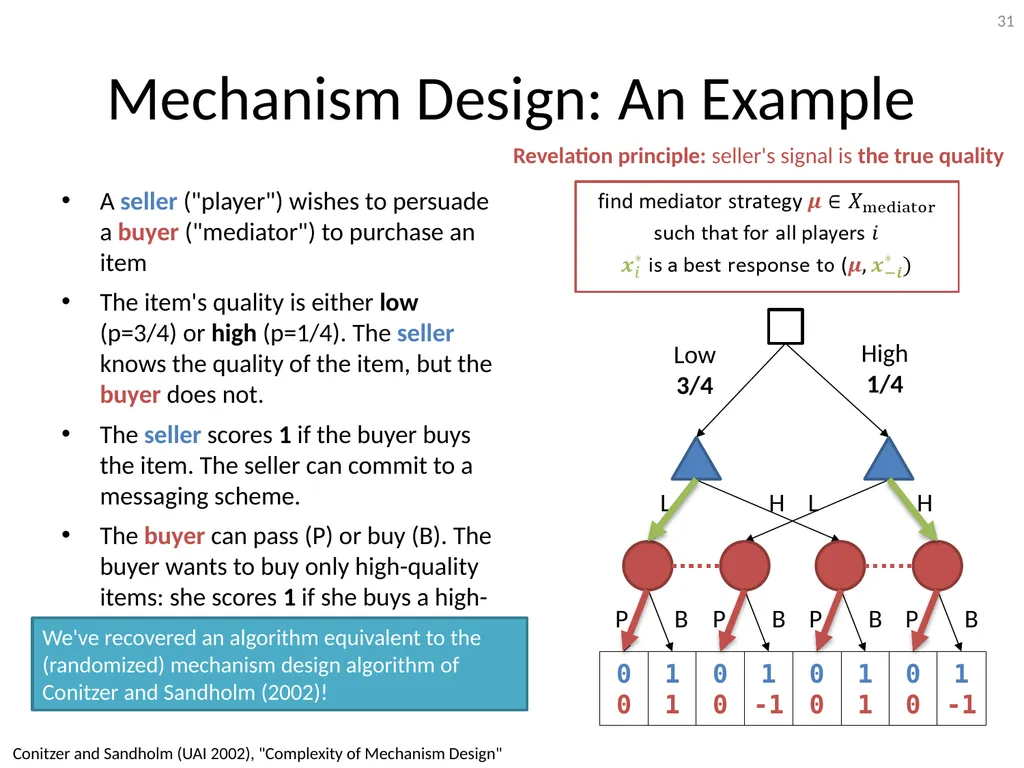
Mechanism Design: An Example A seller ("player") wishes to persuade a buyer ("mediator") to purchase an item
The item's quality is either low (p=3/4) or high (p=1/4). The seller knows the quality of the item, but the buyer does not.
The seller scores 1 if the buyer buys the item. The seller can commit to a messaging scheme.
The buyer can pass (P) or buy (B). The buyer wants to buy only high-quality items: she scores 1 if she buys a high-quality item and -1 if she buys a low-quality item 31 Revelation principle: seller's signal is the true quality Conitzer and Sandholm (UAI 2002), "Complexity of Mechanism Design" We've recovered an algorithm equivalent to the (randomized) mechanism design algorithm of Conitzer and Sandholm (2002)!<br>
The item's quality is either low (p=3/4) or high (p=1/4). The seller knows the quality of the item, but the buyer does not.
The seller scores 1 if the buyer buys the item. The seller can commit to a messaging scheme.
The buyer can pass (P) or buy (B). The buyer wants to buy only high-quality items: she scores 1 if she buys a high-quality item and -1 if she buys a low-quality item 31 Revelation principle: seller's signal is the true quality Conitzer and Sandholm (UAI 2002), "Complexity of Mechanism Design" We've recovered an algorithm equivalent to the (randomized) mechanism design algorithm of Conitzer and Sandholm (2002)!<br>
32
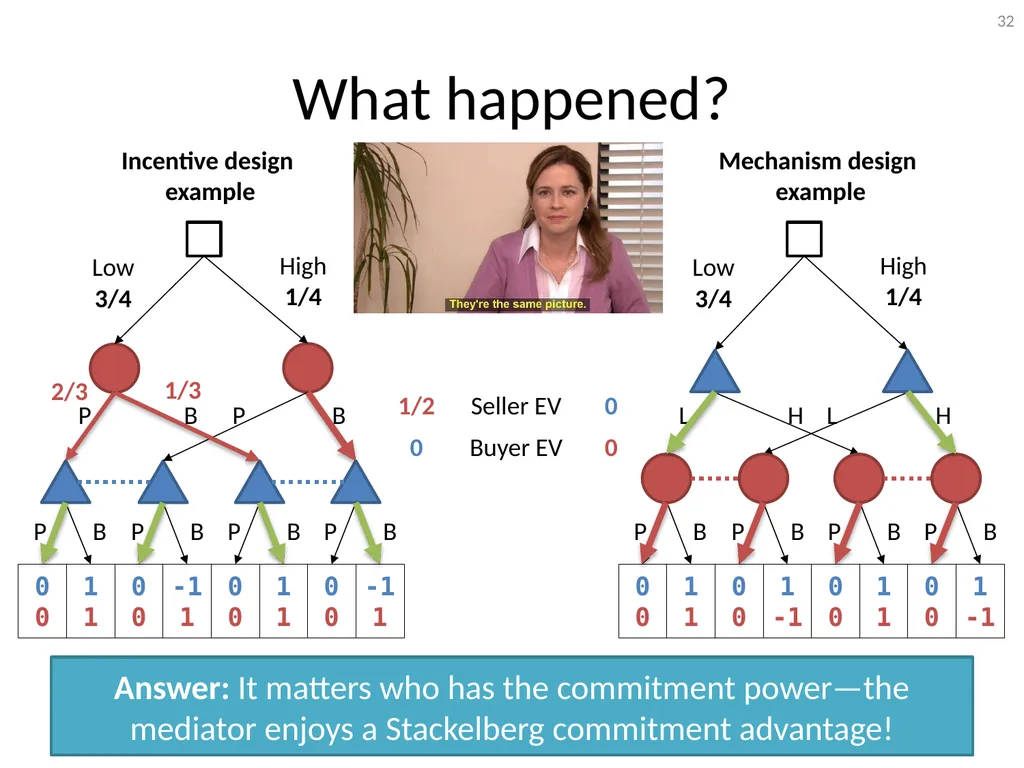
What happened? 32 Mechanism design
example Incentive design
example Answer: It matters who has the commitment power—the mediator enjoys a Stackelberg commitment advantage!<br>
example Incentive design
example Answer: It matters who has the commitment power—the mediator enjoys a Stackelberg commitment advantage!<br>
33
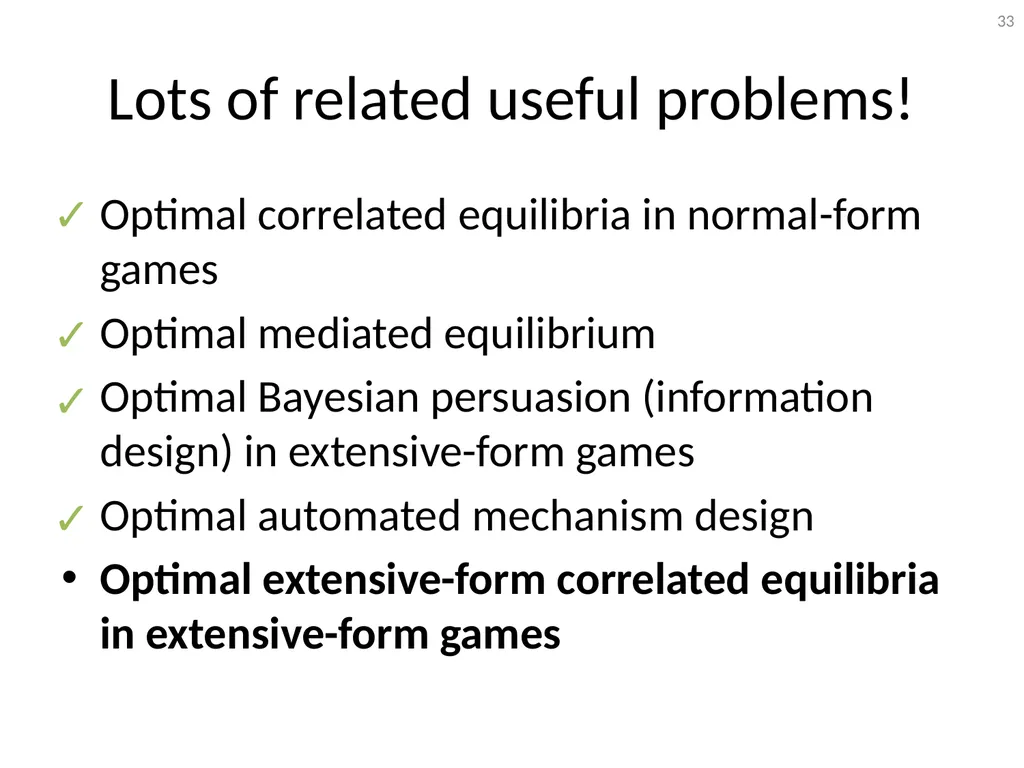
Lots of related useful problems! Optimal correlated equilibria in normal-form games
Optimal mediated equilibrium
Optimal Bayesian persuasion (information design) in extensive-form games
Optimal automated mechanism design
Optimal extensive-form correlated equilibria in extensive-form games ✓ ✓ ✓ 33 ✓<br>
Optimal mediated equilibrium
Optimal Bayesian persuasion (information design) in extensive-form games
Optimal automated mechanism design
Optimal extensive-form correlated equilibria in extensive-form games ✓ ✓ ✓ 33 ✓<br>
34
Extensive-Form Correlated Equilibria Imperfect-Recall Mediators 34<br>
35
Extensive-Form Correlated Equilibria Imperfect-Recall Mediators Problem: How do we optimize over the decision space of the mediator when the mediator has imperfect recall? 35<br>
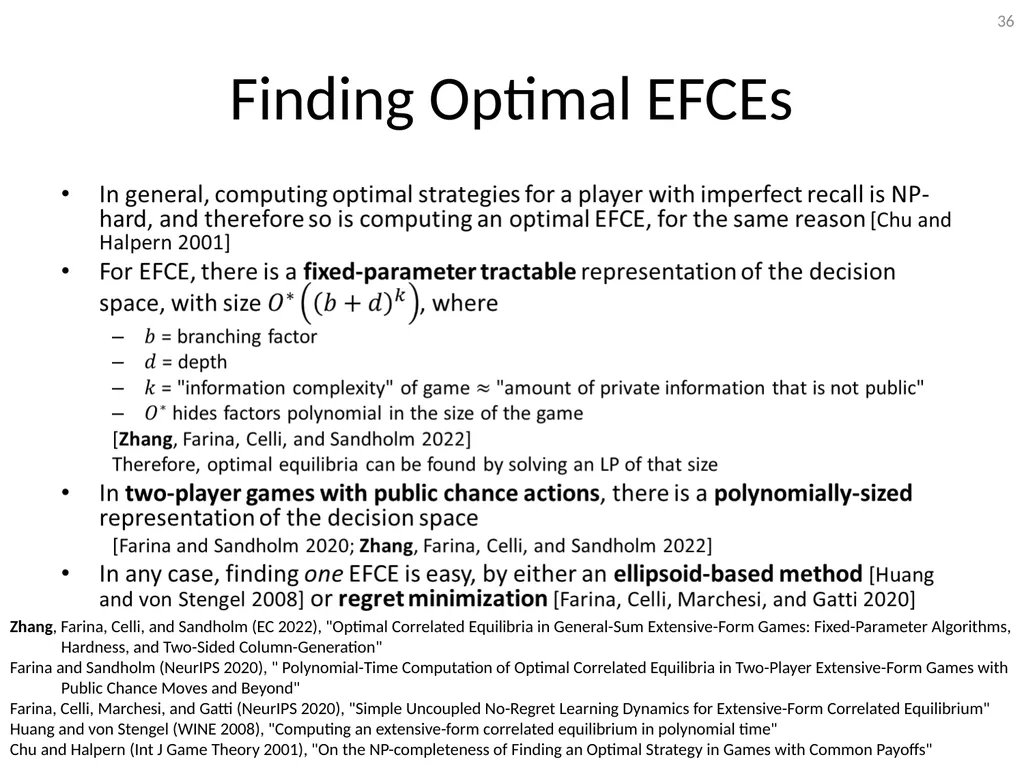
36
Finding Optimal EFCEs Zhang, Farina, Celli, and Sandholm (EC 2022), "Optimal Correlated Equilibria in General-Sum Extensive-Form Games: Fixed-Parameter Algorithms, Hardness, and Two-Sided Column-Generation"
Farina and Sandholm (NeurIPS 2020), " Polynomial-Time Computation of Optimal Correlated Equilibria in Two-Player Extensive-Form Games with Public Chance Moves and Beyond"
Farina, Celli, Marchesi, and Gatti (NeurIPS 2020), "Simple Uncoupled No-Regret Learning Dynamics for Extensive-Form Correlated Equilibrium"
Huang and von Stengel (WINE 2008), "Computing an extensive-form correlated equilibrium in polynomial time"
Chu and Halpern (Int J Game Theory 2001), "On the NP-completeness of Finding an Optimal Strategy in Games with Common Payoffs" 36<br>
Farina and Sandholm (NeurIPS 2020), " Polynomial-Time Computation of Optimal Correlated Equilibria in Two-Player Extensive-Form Games with Public Chance Moves and Beyond"
Farina, Celli, Marchesi, and Gatti (NeurIPS 2020), "Simple Uncoupled No-Regret Learning Dynamics for Extensive-Form Correlated Equilibrium"
Huang and von Stengel (WINE 2008), "Computing an extensive-form correlated equilibrium in polynomial time"
Chu and Halpern (Int J Game Theory 2001), "On the NP-completeness of Finding an Optimal Strategy in Games with Common Payoffs" 36<br>
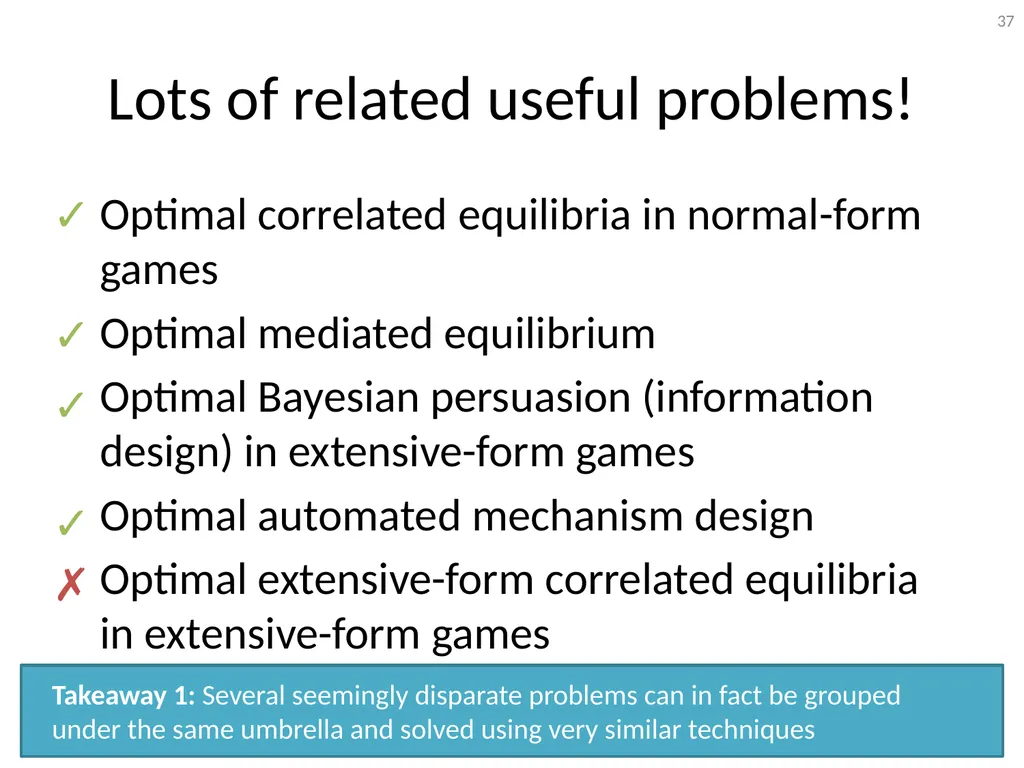
37
Lots of related useful problems! Optimal correlated equilibria in normal-form games
Optimal mediated equilibrium
Optimal Bayesian persuasion (information design) in extensive-form games
Optimal automated mechanism design
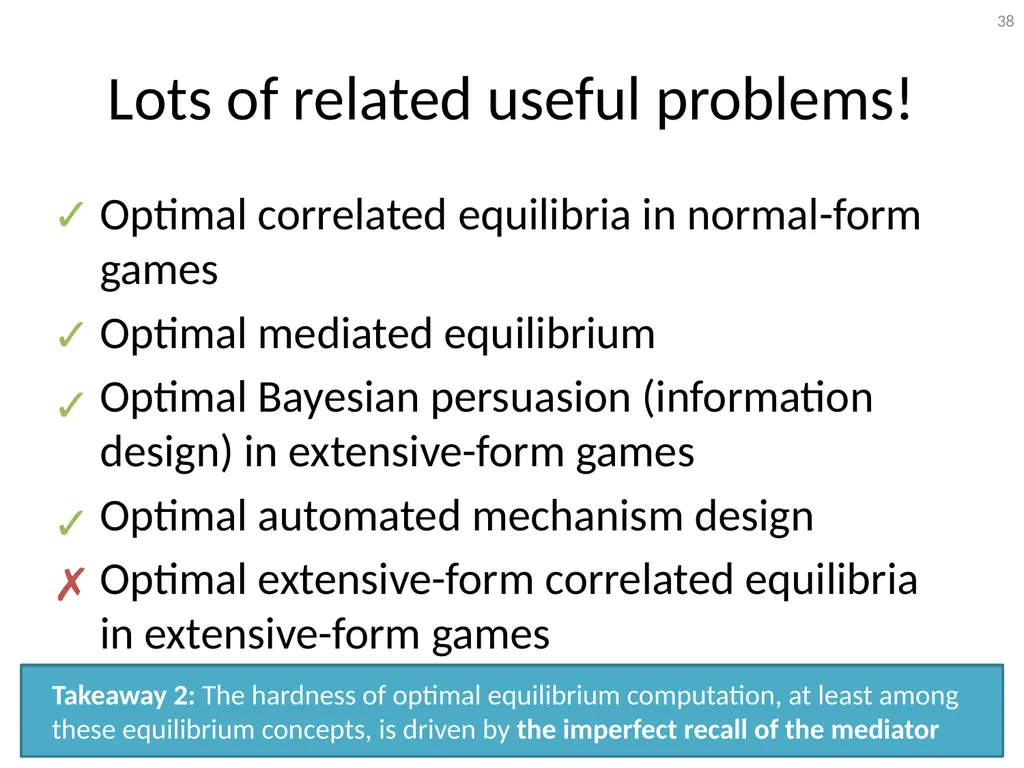
Optimal extensive-form correlated equilibria in extensive-form games ✓ ✓ ✓ ✗ 37 ✓ Takeaway 1: Several seemingly disparate problems can in fact be grouped under the same umbrella and solved using very similar techniques<br>
Optimal mediated equilibrium
Optimal Bayesian persuasion (information design) in extensive-form games
Optimal automated mechanism design
Optimal extensive-form correlated equilibria in extensive-form games ✓ ✓ ✓ ✗ 37 ✓ Takeaway 1: Several seemingly disparate problems can in fact be grouped under the same umbrella and solved using very similar techniques<br>
38
Lots of related useful problems! Optimal correlated equilibria in normal-form games
Optimal mediated equilibrium
Optimal Bayesian persuasion (information design) in extensive-form games
Optimal automated mechanism design
Optimal extensive-form correlated equilibria in extensive-form games ✓ ✓ ✓ ✗ Takeaway 2: The hardness of optimal equilibrium computation, at least among these equilibrium concepts, is driven by the imperfect recall of the mediator 38 ✓<br>
Optimal mediated equilibrium
Optimal Bayesian persuasion (information design) in extensive-form games
Optimal automated mechanism design
Optimal extensive-form correlated equilibria in extensive-form games ✓ ✓ ✓ ✗ Takeaway 2: The hardness of optimal equilibrium computation, at least among these equilibrium concepts, is driven by the imperfect recall of the mediator 38 ✓<br>
39
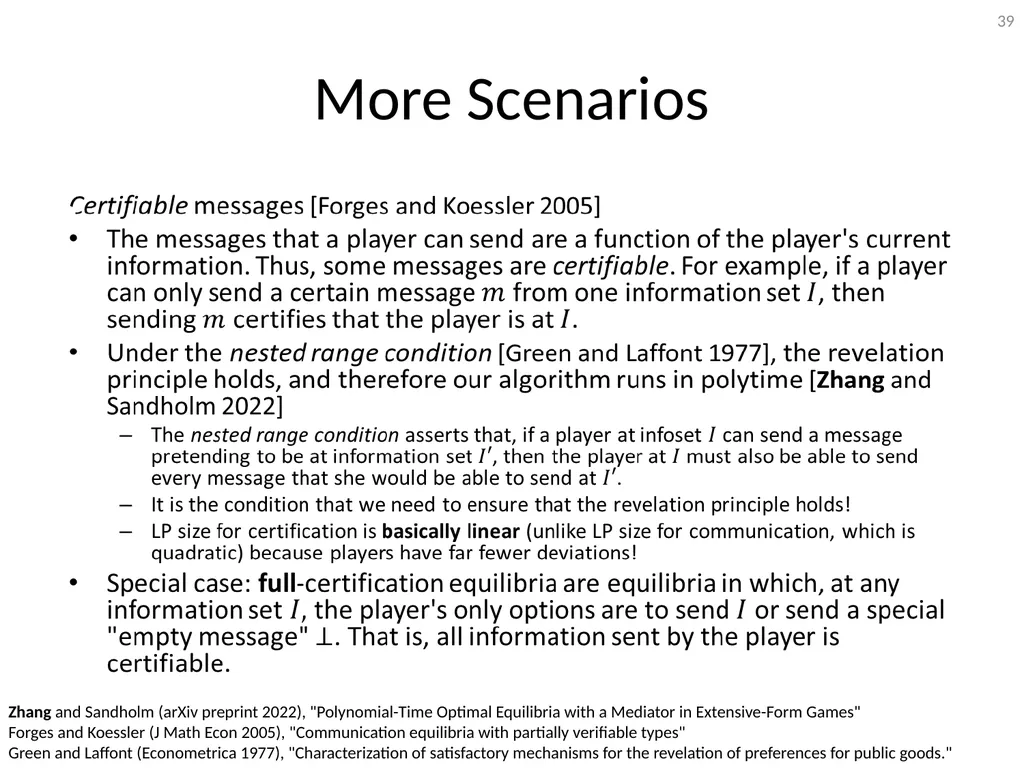
More Scenarios 39 Zhang and Sandholm (arXiv preprint 2022), "Polynomial-Time Optimal Equilibria with a Mediator in Extensive-Form Games"
Forges and Koessler (J Math Econ 2005), "Communication equilibria with partially verifiable types"
Green and Laffont (Econometrica 1977), "Characterization of satisfactory mechanisms for the revelation of preferences for public goods."<br>
Forges and Koessler (J Math Econ 2005), "Communication equilibria with partially verifiable types"
Green and Laffont (Econometrica 1977), "Characterization of satisfactory mechanisms for the revelation of preferences for public goods."<br>
40
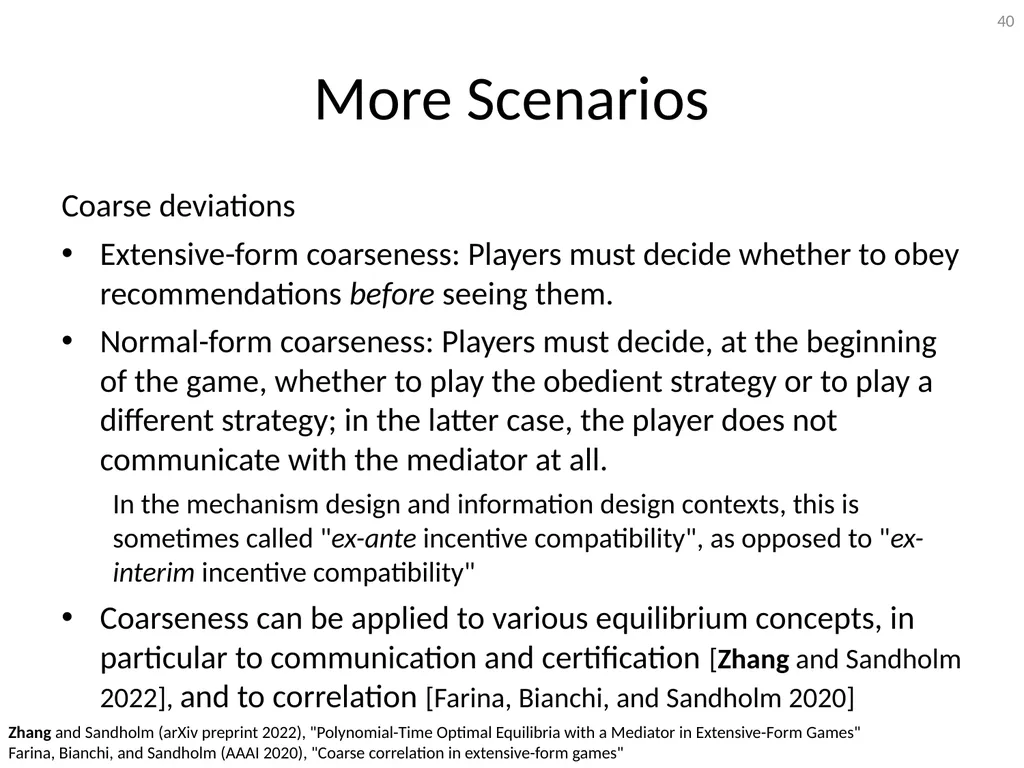
More Scenarios Coarse deviations
Extensive-form coarseness: Players must decide whether to obey recommendations before seeing them.
Normal-form coarseness: Players must decide, at the beginning of the game, whether to play the obedient strategy or to play a different strategy; in the latter case, the player does not communicate with the mediator at all.
In the mechanism design and information design contexts, this is sometimes called "ex-ante incentive compatibility", as opposed to "ex-interim incentive compatibility"
Coarseness can be applied to various equilibrium concepts, in particular to communication and certification [Zhang and Sandholm 2022], and to correlation [Farina, Bianchi, and Sandholm 2020] 40 Zhang and Sandholm (arXiv preprint 2022), "Polynomial-Time Optimal Equilibria with a Mediator in Extensive-Form Games"
Farina, Bianchi, and Sandholm (AAAI 2020), "Coarse correlation in extensive-form games"<br>
Extensive-form coarseness: Players must decide whether to obey recommendations before seeing them.
Normal-form coarseness: Players must decide, at the beginning of the game, whether to play the obedient strategy or to play a different strategy; in the latter case, the player does not communicate with the mediator at all.
In the mechanism design and information design contexts, this is sometimes called "ex-ante incentive compatibility", as opposed to "ex-interim incentive compatibility"
Coarseness can be applied to various equilibrium concepts, in particular to communication and certification [Zhang and Sandholm 2022], and to correlation [Farina, Bianchi, and Sandholm 2020] 40 Zhang and Sandholm (arXiv preprint 2022), "Polynomial-Time Optimal Equilibria with a Mediator in Extensive-Form Games"
Farina, Bianchi, and Sandholm (AAAI 2020), "Coarse correlation in extensive-form games"<br>
41
More Scenarios 41<br>
42
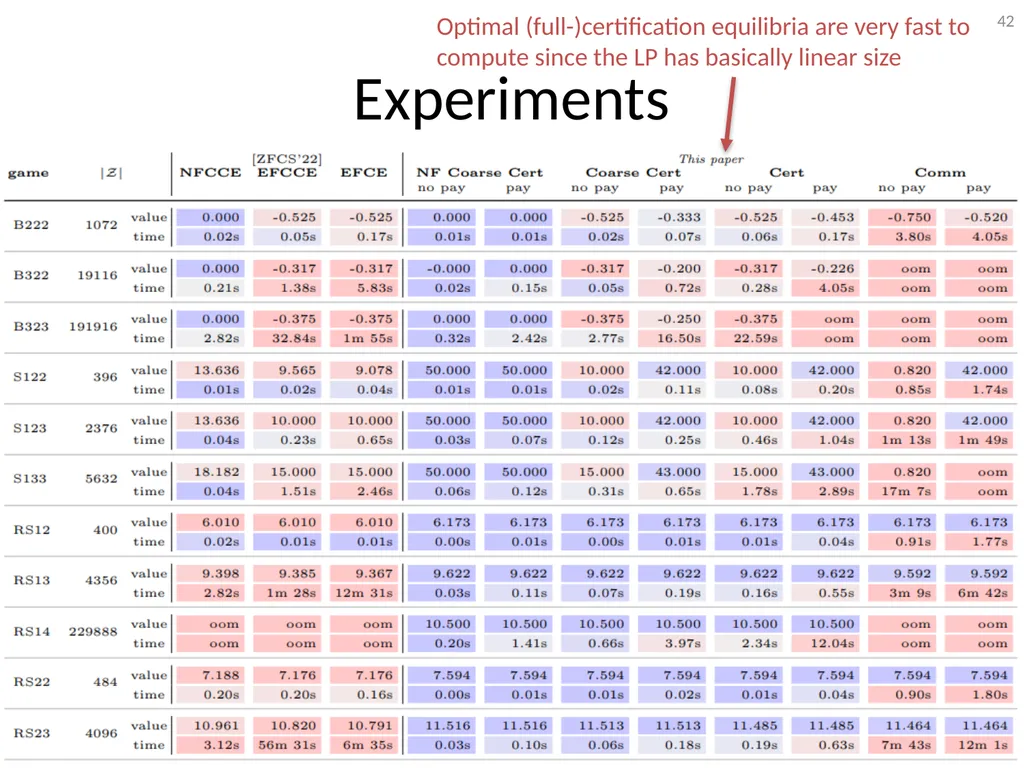
Experiments 42<br>
43
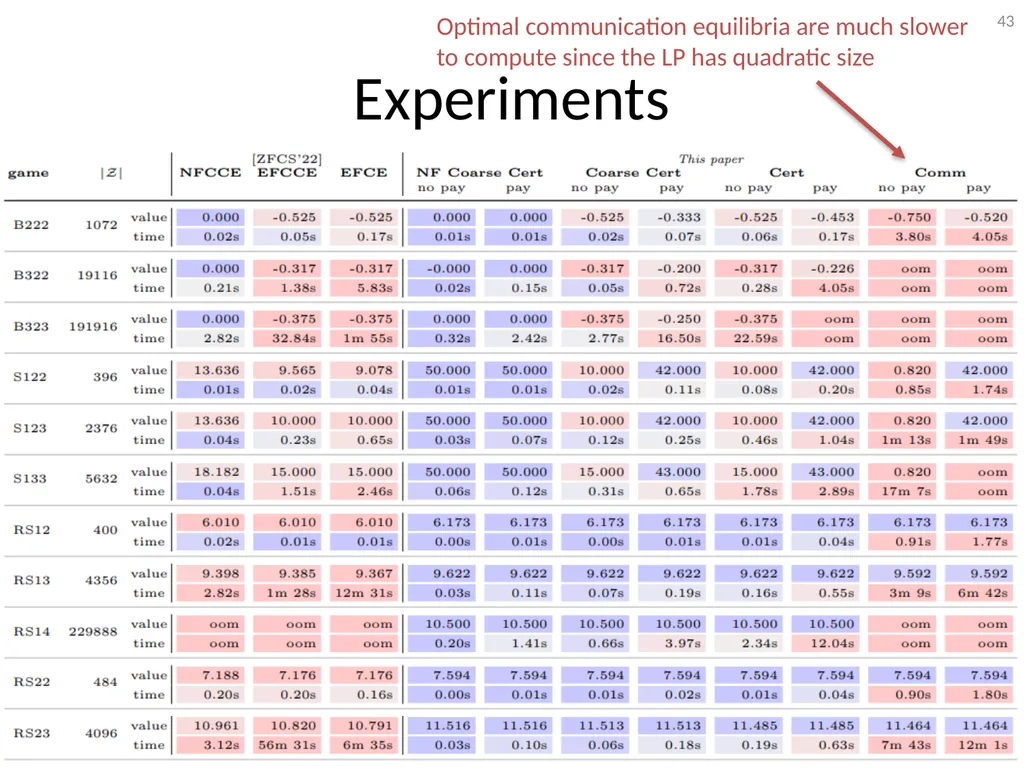
Experiments 43<br>
44
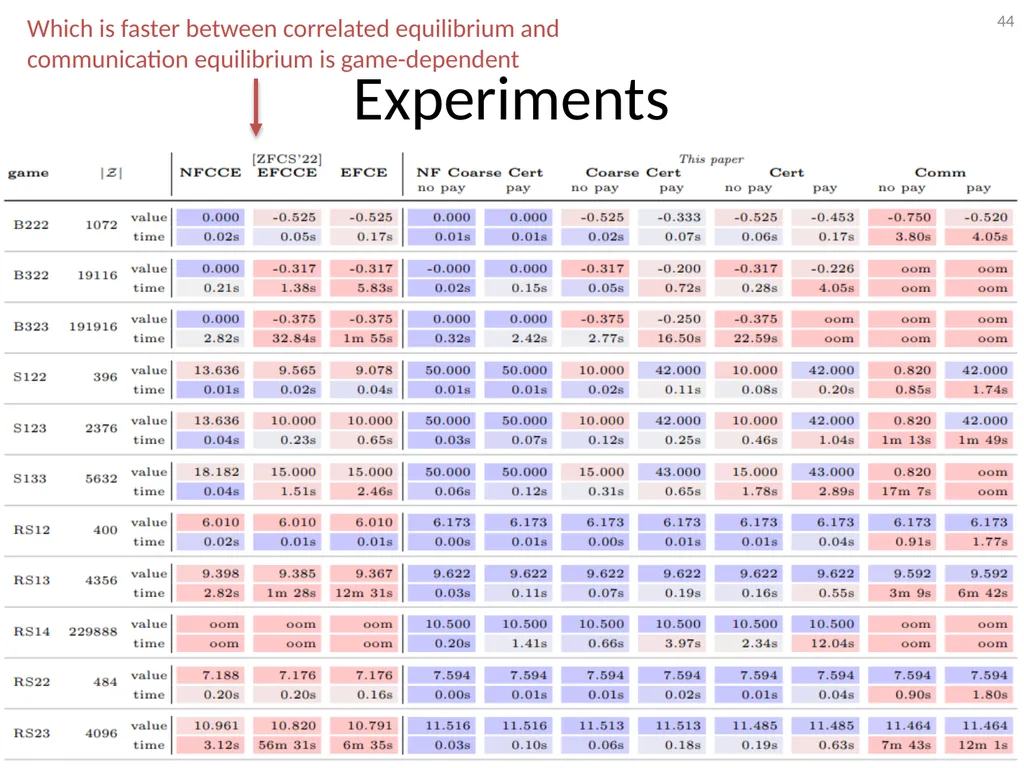
Experiments 44<br>
45
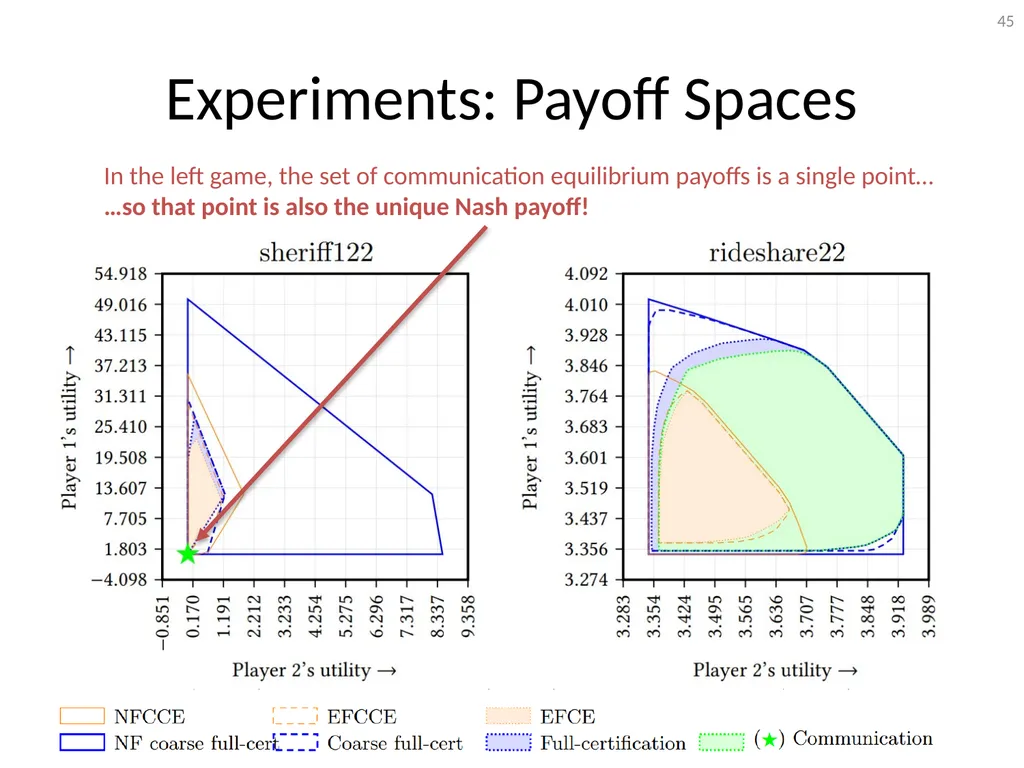
Experiments: Payoff Spaces 45<br>
46
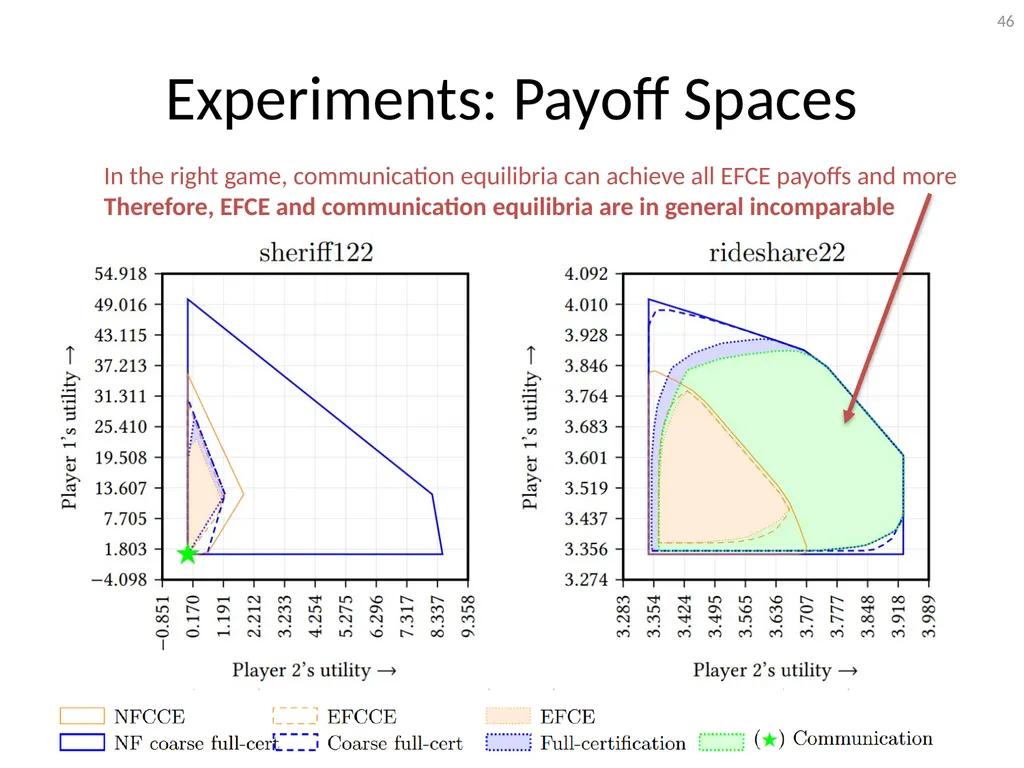
In the right game, communication equilibria can achieve all EFCE payoffs and more
Therefore, EFCE and communication equilibria are in general incomparable Experiments: Payoff Spaces 46<br>
Therefore, EFCE and communication equilibria are in general incomparable Experiments: Payoff Spaces 46<br>