
Medicare, Medigap, & Part D Joseph K. Morgan &
MS
Published · 70 slides · 0 views

1 / 1





Description
Medicare, Medigap, Part D Joseph K. Morgan Melissa Tower Blue Harbor Benefits Blue Harbor Benefits: Who Are We? One of the largest independent insurance brokerage offices in the Mid-Atlantic, servicing businesses of all sizes across the
Related Topics
Share
Embed code
Download this presentation From Below
"Medicare, Medigap, & Part D Joseph K. Morgan &" is the property of its rightful owner. Permission is granted to download and print the materials on this website for personal, non-commercial use only, and to display it on your personal computer provided you do not modify the materials and that you retain all copyright notices contained in the materials. By downloading content from our website, you accept the terms of this agreement.
Presentation Transcript
01
Medicare, Medigap,
& Part D Joseph K. Morgan & Melissa Tower
Blue Harbor Benefits<br>
Blue Harbor Benefits<br>
02
Blue Harbor Benefits: Who Are We? One of the largest independent insurance brokerage offices in the Mid-Atlantic, servicing businesses of all sizes across the country
We are licensed throughout the U.S. and broker through all major insurance carriers
Our staff averages 20+ years of industry experience and specializes in streamlining the complexities of the insurance world to help you make the best decision(s) for you and your family<br>
We are licensed throughout the U.S. and broker through all major insurance carriers
Our staff averages 20+ years of industry experience and specializes in streamlining the complexities of the insurance world to help you make the best decision(s) for you and your family<br>
03
What is Medicare?<br>
04
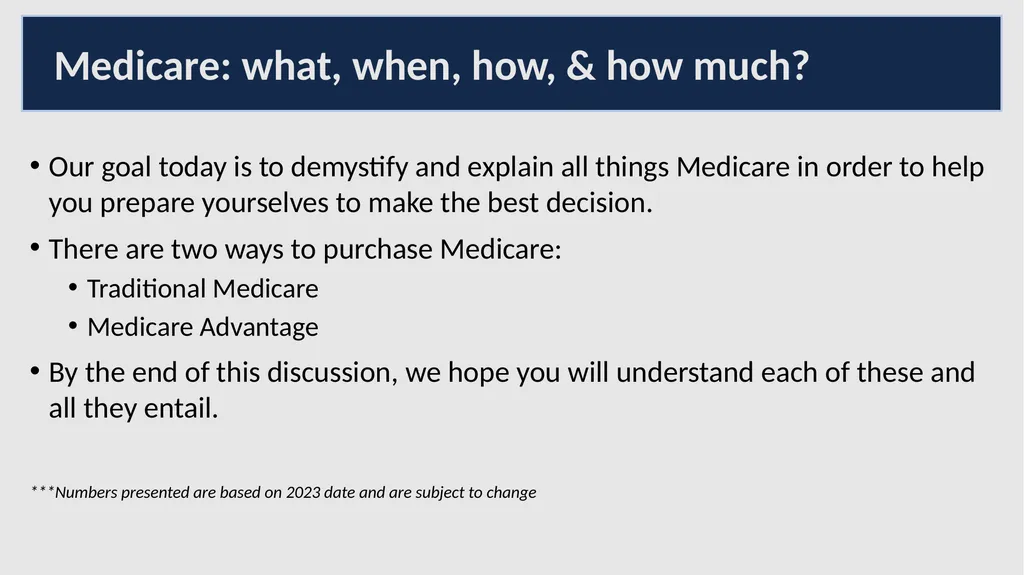
Our goal today is to demystify and explain all things Medicare in order to help you prepare yourselves to make the best decision.
There are two ways to purchase Medicare:
Traditional Medicare
Medicare Advantage
By the end of this discussion, we hope you will understand each of these and all they entail.
***Numbers presented are based on 2023 date and are subject to change Medicare: what, when, how, & how much?<br>
There are two ways to purchase Medicare:
Traditional Medicare
Medicare Advantage
By the end of this discussion, we hope you will understand each of these and all they entail.
***Numbers presented are based on 2023 date and are subject to change Medicare: what, when, how, & how much?<br>
05
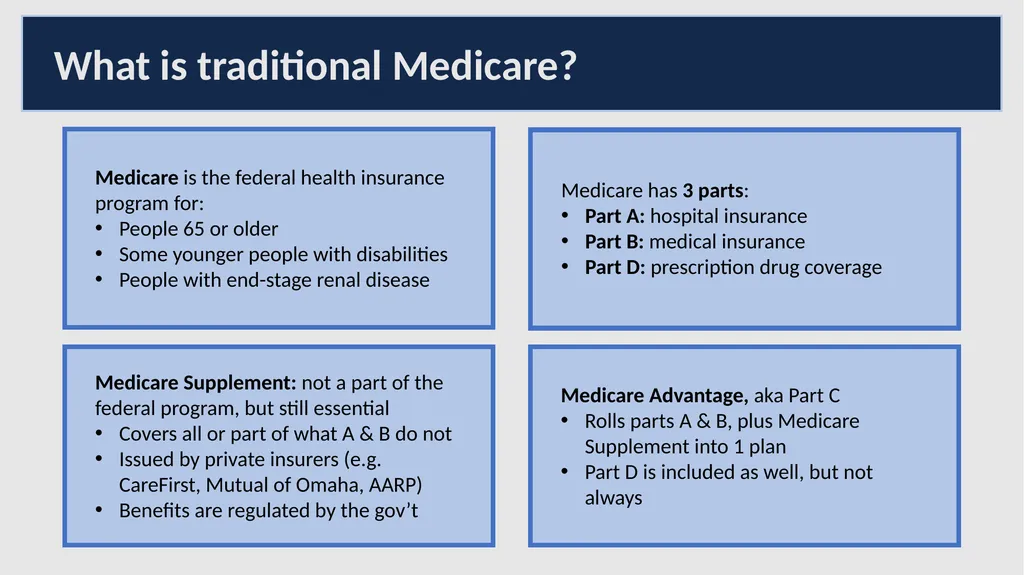
What is traditional Medicare?<br>
06
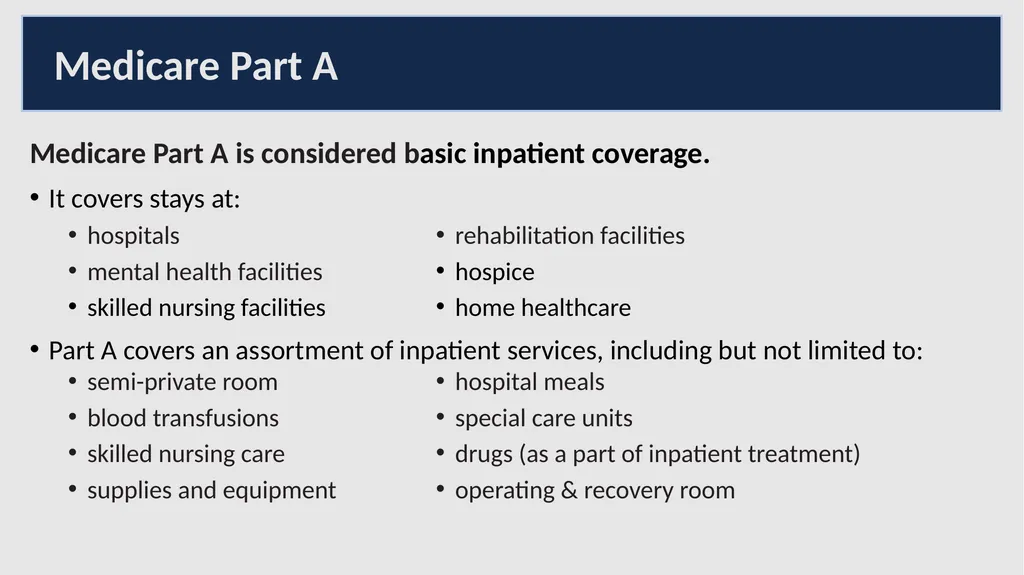
Medicare Part A is considered basic inpatient coverage.
It covers stays at:
hospitals
mental health facilities
skilled nursing facilities
Part A covers an assortment of inpatient services, including but not limited to:
Semi-private room
Blood transfusions
Skilled nursing care
supplies and equipment Medicare Part A rehabilitation facilities
hospice
home healthcare hospital meals
special care units
drugs (as a part of inpatient treatment)
operating & recovery room hospitals
mental health facilities
skilled nursing facilities semi-private room
blood transfusions
skilled nursing care
supplies and equipment<br>
It covers stays at:
hospitals
mental health facilities
skilled nursing facilities
Part A covers an assortment of inpatient services, including but not limited to:
Semi-private room
Blood transfusions
Skilled nursing care
supplies and equipment Medicare Part A rehabilitation facilities
hospice
home healthcare hospital meals
special care units
drugs (as a part of inpatient treatment)
operating & recovery room hospitals
mental health facilities
skilled nursing facilities semi-private room
blood transfusions
skilled nursing care
supplies and equipment<br>
07
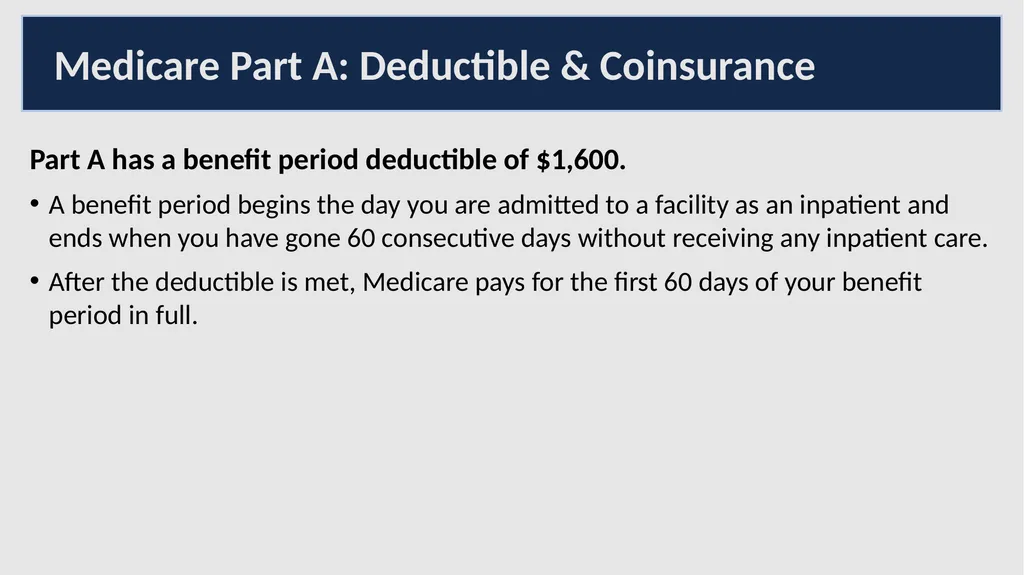
Part A has a benefit period deductible of $1,600.
A benefit period begins the day you are admitted to a facility as an inpatient and ends when you have gone 60 consecutive days without receiving any inpatient care.
After the deductible is met, Medicare pays for the first 60 days of your benefit period in full. Medicare Part A: Deductible & Coinsurance<br>
A benefit period begins the day you are admitted to a facility as an inpatient and ends when you have gone 60 consecutive days without receiving any inpatient care.
After the deductible is met, Medicare pays for the first 60 days of your benefit period in full. Medicare Part A: Deductible & Coinsurance<br>
08
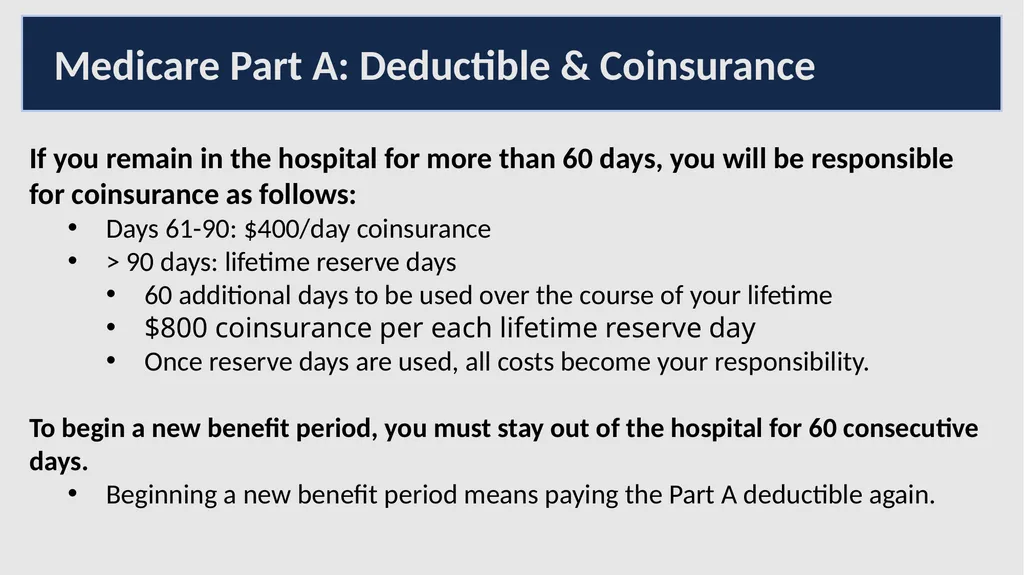
Medicare Part A: Deductible & Coinsurance If you remain in the hospital for more than 60 days, you will be responsible for coinsurance as follows:
Days 61-90: $400/day coinsurance
> 90 days: lifetime reserve days
60 additional days to be used over the course of your lifetime
$800 coinsurance per each lifetime reserve day
Once reserve days are used, all costs become your responsibility.
To begin a new benefit period, you must stay out of the hospital for 60 consecutive days.
Beginning a new benefit period means paying the Part A deductible again.<br>
Days 61-90: $400/day coinsurance
> 90 days: lifetime reserve days
60 additional days to be used over the course of your lifetime
$800 coinsurance per each lifetime reserve day
Once reserve days are used, all costs become your responsibility.
To begin a new benefit period, you must stay out of the hospital for 60 consecutive days.
Beginning a new benefit period means paying the Part A deductible again.<br>
09
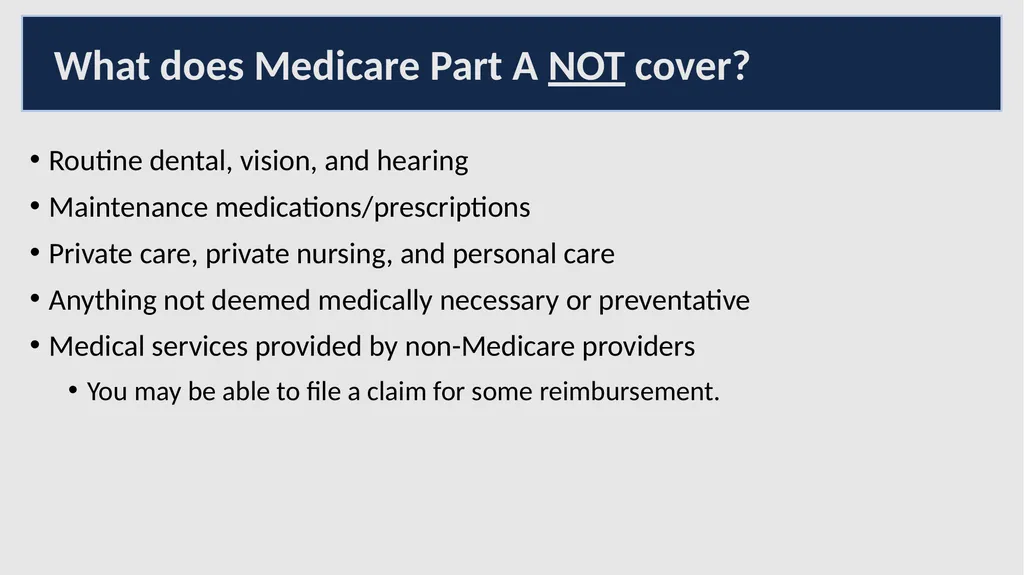
Routine dental, vision, and hearing
Maintenance medications/prescriptions
Private care, private nursing, and personal care
Anything not deemed medically necessary or preventative
Medical services provided by non-Medicare providers
You may be able to file a claim for some reimbursement. What does Medicare Part A NOT cover?<br>
Maintenance medications/prescriptions
Private care, private nursing, and personal care
Anything not deemed medically necessary or preventative
Medical services provided by non-Medicare providers
You may be able to file a claim for some reimbursement. What does Medicare Part A NOT cover?<br>
10
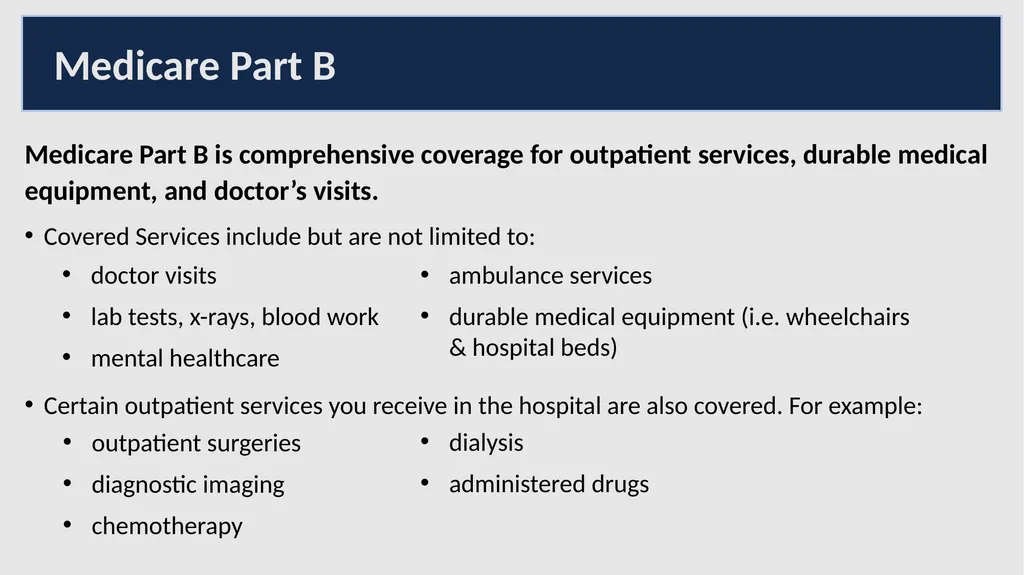
Medicare Part B is comprehensive coverage for outpatient services, durable medical equipment, and doctor’s visits.
Covered Services include but are not limited to:
Doctor visits
Lab tests, X-rays, Blood work
Mental healthcare
Certain outpatient services you receive in the hospital are also covered. For example:
Outpatient Surgeries
Diagnostic imaging
Chemotherapy Medicare Part B dialysis
administered drugs ambulance services
durable medical equipment (i.e. wheelchairs & hospital beds) doctor visits
lab tests, x-rays, blood work
mental healthcare outpatient surgeries
diagnostic imaging
chemotherapy<br>
Covered Services include but are not limited to:
Doctor visits
Lab tests, X-rays, Blood work
Mental healthcare
Certain outpatient services you receive in the hospital are also covered. For example:
Outpatient Surgeries
Diagnostic imaging
Chemotherapy Medicare Part B dialysis
administered drugs ambulance services
durable medical equipment (i.e. wheelchairs & hospital beds) doctor visits
lab tests, x-rays, blood work
mental healthcare outpatient surgeries
diagnostic imaging
chemotherapy<br>
11
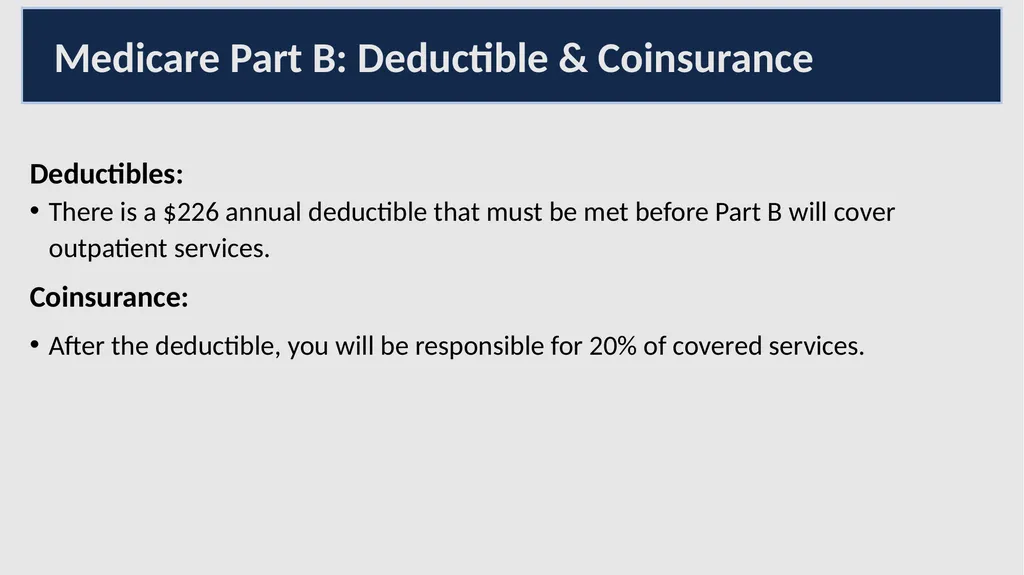
Medicare Part B: Deductible & Coinsurance Deductibles:
There is a $226 annual deductible that must be met before Part B will cover outpatient services.
Coinsurance:
After the deductible, you will be responsible for 20% of covered services.<br>
There is a $226 annual deductible that must be met before Part B will cover outpatient services.
Coinsurance:
After the deductible, you will be responsible for 20% of covered services.<br>
12
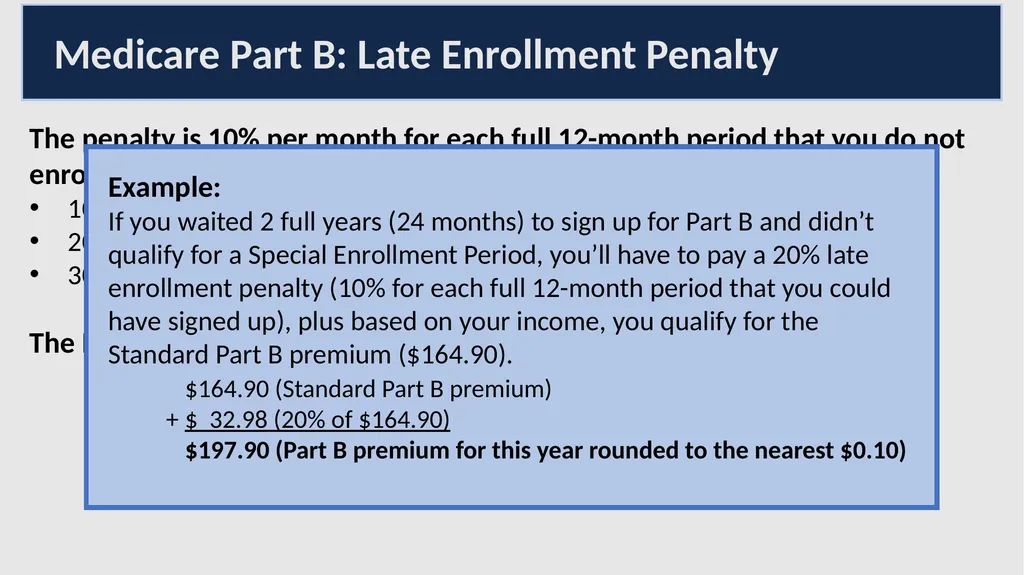
Medicare Part B: Late Enrollment Penalty The penalty is 10% per month for each full 12-month period that you do not enroll in Part B.
10% of base amount ($160.90) in the first year
20% of the base amount in the second year
30% of the base amount in the third year, etc.
The Late Enrollment Penalty NEVER goes away.<br>
10% of base amount ($160.90) in the first year
20% of the base amount in the second year
30% of the base amount in the third year, etc.
The Late Enrollment Penalty NEVER goes away.<br>
13
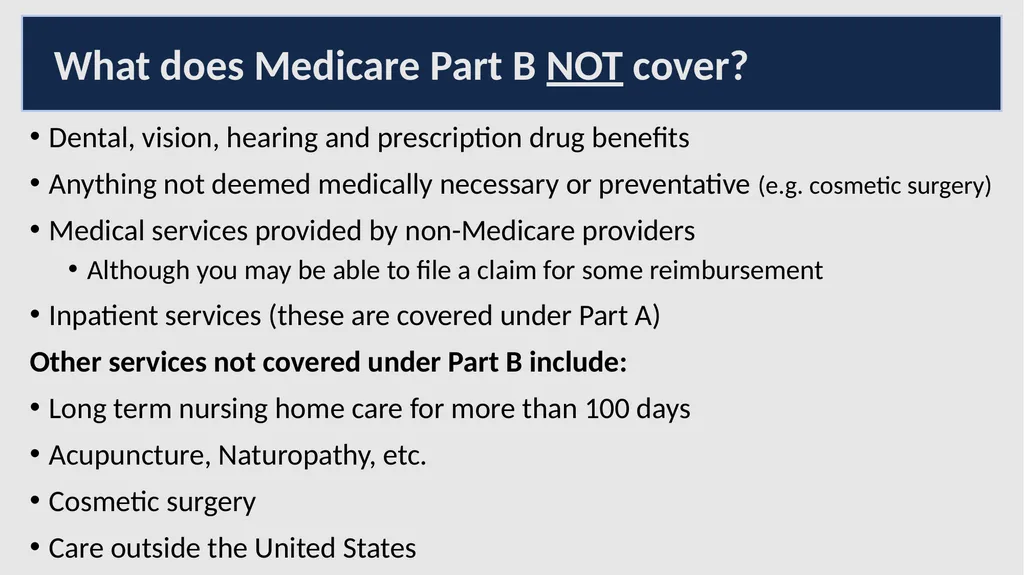
Dental, vision, hearing and prescription drug benefits
Anything not deemed medically necessary or preventative (e.g. cosmetic surgery)
Medical services provided by non-Medicare providers
Although you may be able to file a claim for some reimbursement
Inpatient services (these are covered under Part A)
Other services not covered under Part B include:
Long term nursing home care for more than 100 days
Acupuncture, Naturopathy, etc.
Cosmetic surgery
Care outside the United States What does Medicare Part B NOT cover?<br>
Anything not deemed medically necessary or preventative (e.g. cosmetic surgery)
Medical services provided by non-Medicare providers
Although you may be able to file a claim for some reimbursement
Inpatient services (these are covered under Part A)
Other services not covered under Part B include:
Long term nursing home care for more than 100 days
Acupuncture, Naturopathy, etc.
Cosmetic surgery
Care outside the United States What does Medicare Part B NOT cover?<br>
14
Medicare Part D is also known as Medicare’s prescription drug coverage
Coverage is sold by private insurance companies.
Coverage and rates vary based on the plan you choose. Medicare Part D<br>
Coverage is sold by private insurance companies.
Coverage and rates vary based on the plan you choose. Medicare Part D<br>
15
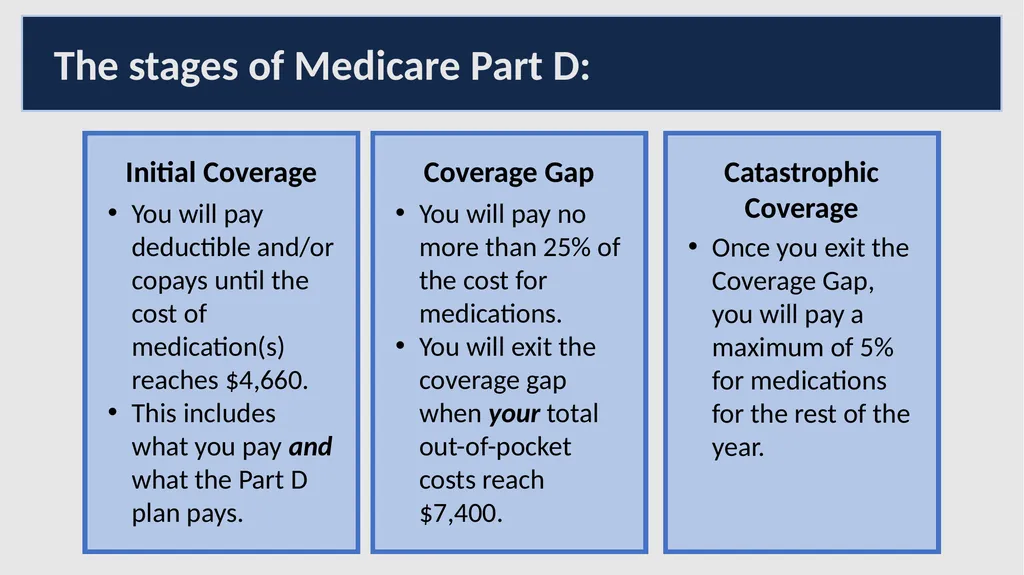
The stages of Medicare Part D:<br>
16
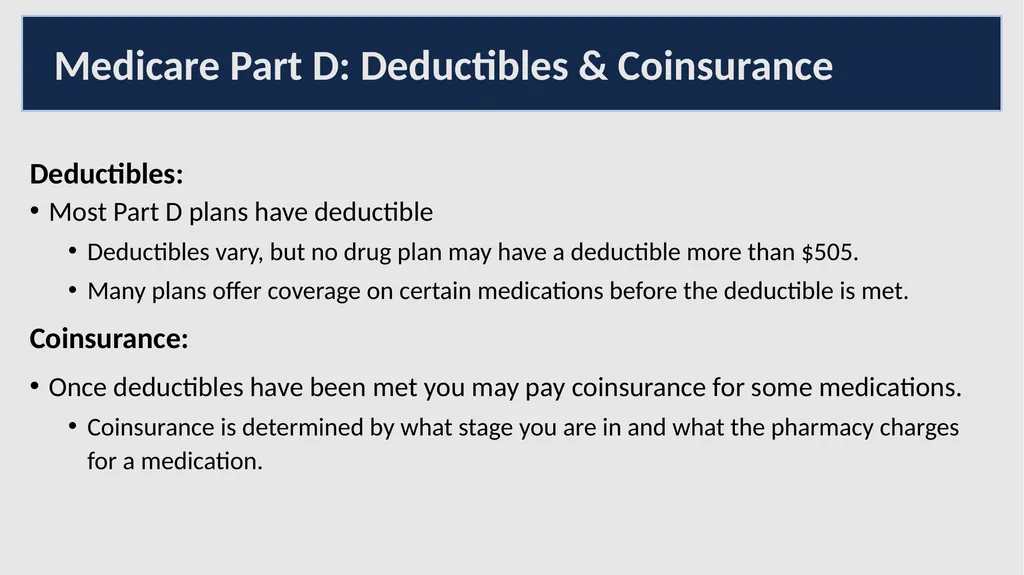
Deductibles:
Most Part D plans have deductible
Deductibles vary, but no drug plan may have a deductible more than $505.
Many plans offer coverage on certain medications before the deductible is met.
Coinsurance:
Once deductibles have been met you may pay coinsurance for some medications.
Coinsurance is determined by what stage you are in and what the pharmacy charges for a medication. Medicare Part D: Deductibles & Coinsurance<br>
Most Part D plans have deductible
Deductibles vary, but no drug plan may have a deductible more than $505.
Many plans offer coverage on certain medications before the deductible is met.
Coinsurance:
Once deductibles have been met you may pay coinsurance for some medications.
Coinsurance is determined by what stage you are in and what the pharmacy charges for a medication. Medicare Part D: Deductibles & Coinsurance<br>
17
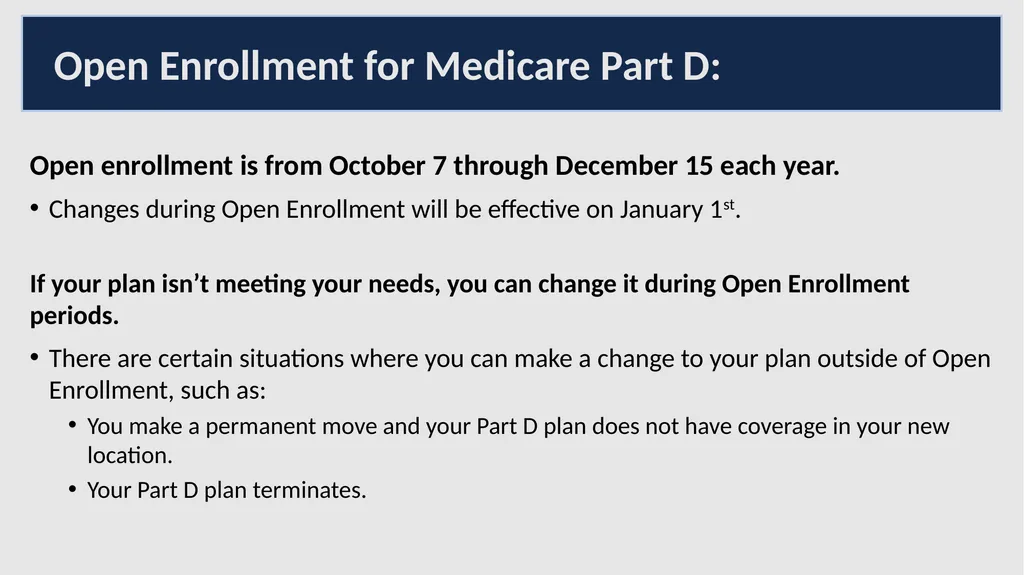
Open enrollment is from October 7 through December 15 each year.
Changes during Open Enrollment will be effective on January 1st.
If your plan isn’t meeting your needs, you can change it during Open Enrollment periods.
There are certain situations where you can make a change to your plan outside of Open Enrollment, such as:
You make a permanent move and your Part D plan does not have coverage in your new location.
Your Part D plan terminates. Open Enrollment for Medicare Part D:<br>
Changes during Open Enrollment will be effective on January 1st.
If your plan isn’t meeting your needs, you can change it during Open Enrollment periods.
There are certain situations where you can make a change to your plan outside of Open Enrollment, such as:
You make a permanent move and your Part D plan does not have coverage in your new location.
Your Part D plan terminates. Open Enrollment for Medicare Part D:<br>
18
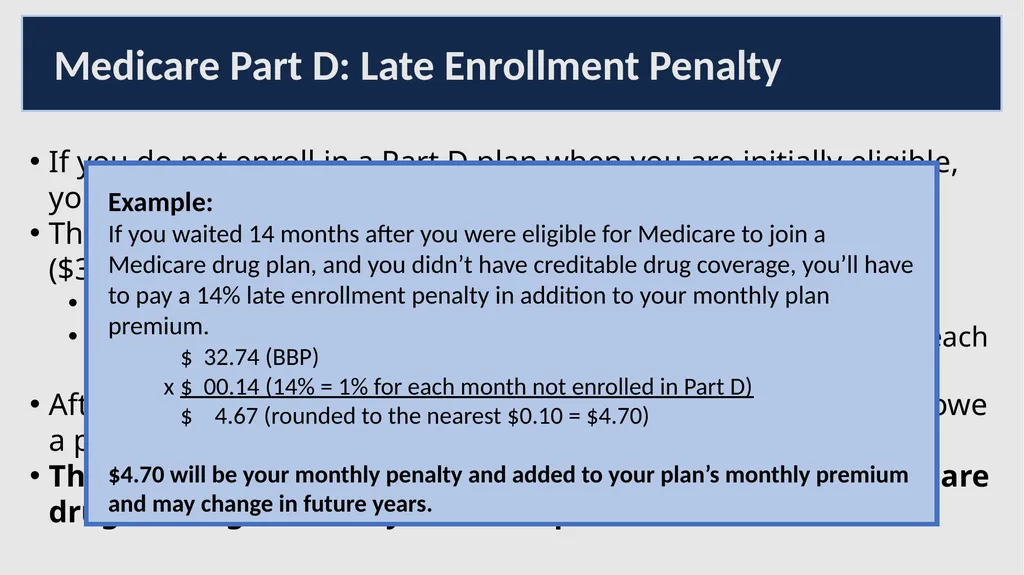
If you do not enroll in a Part D plan when you are initially eligible, you may be subject to late enrollment penalties.
The penalty is 1% of the National Base Beneficiary Premium ($32.74) for each month.
The penalty is not calculated using your actual premium.
NBBP changes each year. Your penalty amount may also change each year.
After you join a Medicare drug plan, the plan will tell you if you owe a penalty and what your premium will be.
This monthly penalty is added for as long as you have Medicare drug coverage, even if you switch plans. Medicare Part D: Late Enrollment Penalty<br>
The penalty is 1% of the National Base Beneficiary Premium ($32.74) for each month.
The penalty is not calculated using your actual premium.
NBBP changes each year. Your penalty amount may also change each year.
After you join a Medicare drug plan, the plan will tell you if you owe a penalty and what your premium will be.
This monthly penalty is added for as long as you have Medicare drug coverage, even if you switch plans. Medicare Part D: Late Enrollment Penalty<br>
19
The only way to waive Part D and avoid a fine is to have creditable drug coverage through your employer.
While many group plans offer creditable coverage while you are actively employed, you should verify this with your employer prior to turning 65.
If your employer’s drug coverage is not considered creditable, you may want to come off the employer plan and elect Medicare at your initial eligibility date to avoid Part D penalties.
Your employer should provide you with this information each year. Medicare Part D: Creditable Coverage<br>
While many group plans offer creditable coverage while you are actively employed, you should verify this with your employer prior to turning 65.
If your employer’s drug coverage is not considered creditable, you may want to come off the employer plan and elect Medicare at your initial eligibility date to avoid Part D penalties.
Your employer should provide you with this information each year. Medicare Part D: Creditable Coverage<br>
20
Over-the-counters medications
Prescription drugs not covered by Part D include:
ED meds
Cosmetic or hair growth meds
Vitamins
Fertility drugs What does Medicare Part D NOT cover?<br>
Prescription drugs not covered by Part D include:
ED meds
Cosmetic or hair growth meds
Vitamins
Fertility drugs What does Medicare Part D NOT cover?<br>
21
A Medicare supplement is insurance sold by private companies to help cover some or all of the costs not covered by Medicare.
E.g. deductibles, copayments, and coinsurance
Every Medicare Supplement policy must follow strict federal and state laws.
Insurance companies can only sell standardized policies identified in most states by letters.
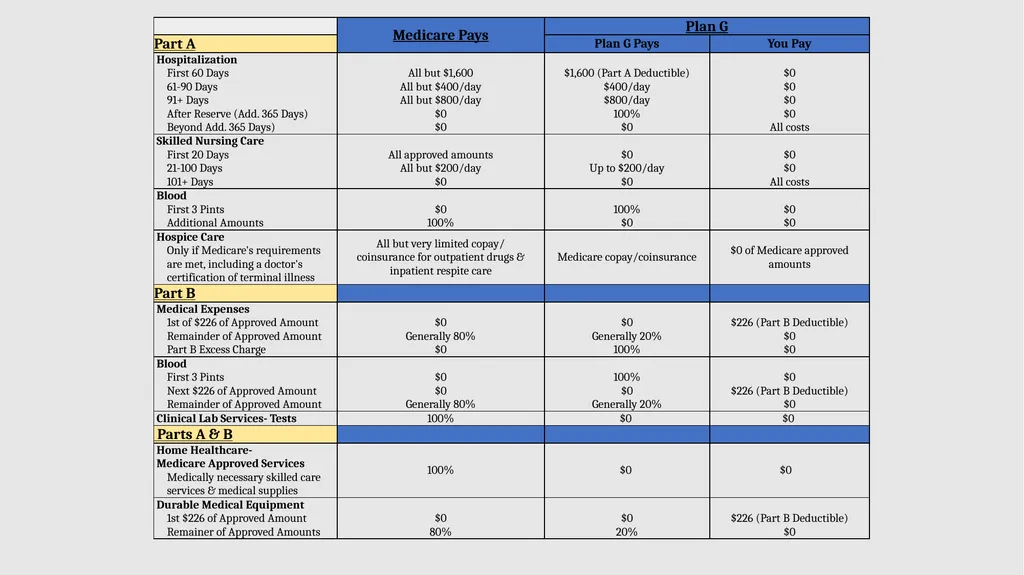
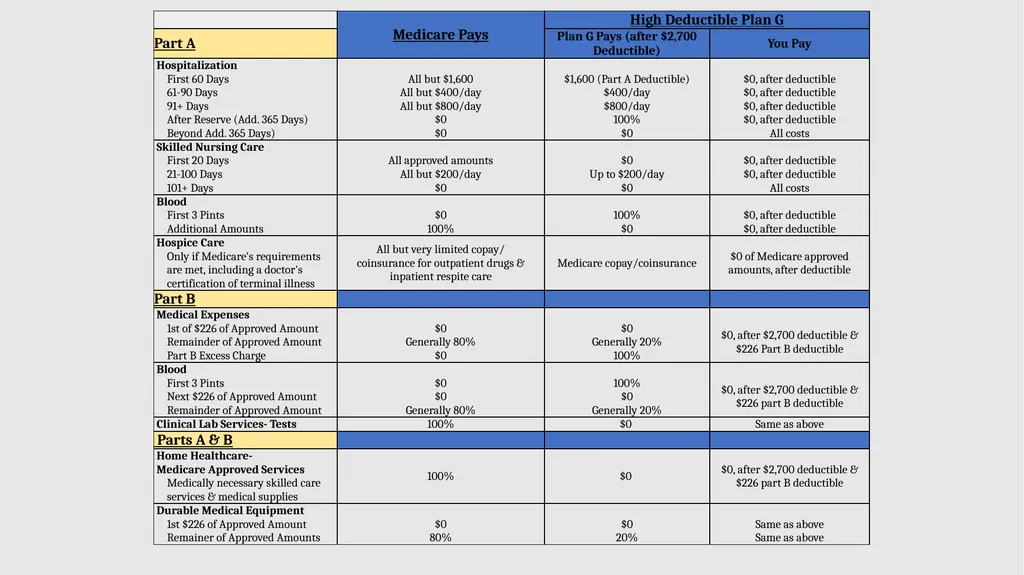
E.g. the most common plan sold in our area is Plan G; the benefits on Plan G must be the same no matter which carrier you select Medicare Supplement, aka Medigap<br>
E.g. deductibles, copayments, and coinsurance
Every Medicare Supplement policy must follow strict federal and state laws.
Insurance companies can only sell standardized policies identified in most states by letters.
E.g. the most common plan sold in our area is Plan G; the benefits on Plan G must be the same no matter which carrier you select Medicare Supplement, aka Medigap<br>
22
Medicare A and B pay the majority of costs. The supplement is the secondary payor and pays all or part of the remaining costs.
No networks
If the doctor/facility takes Medicare, the Medicare Supplement plan must pay.
Works anywhere in the country How does Medicare Supplement work?<br>
No networks
If the doctor/facility takes Medicare, the Medicare Supplement plan must pay.
Works anywhere in the country How does Medicare Supplement work?<br>
23
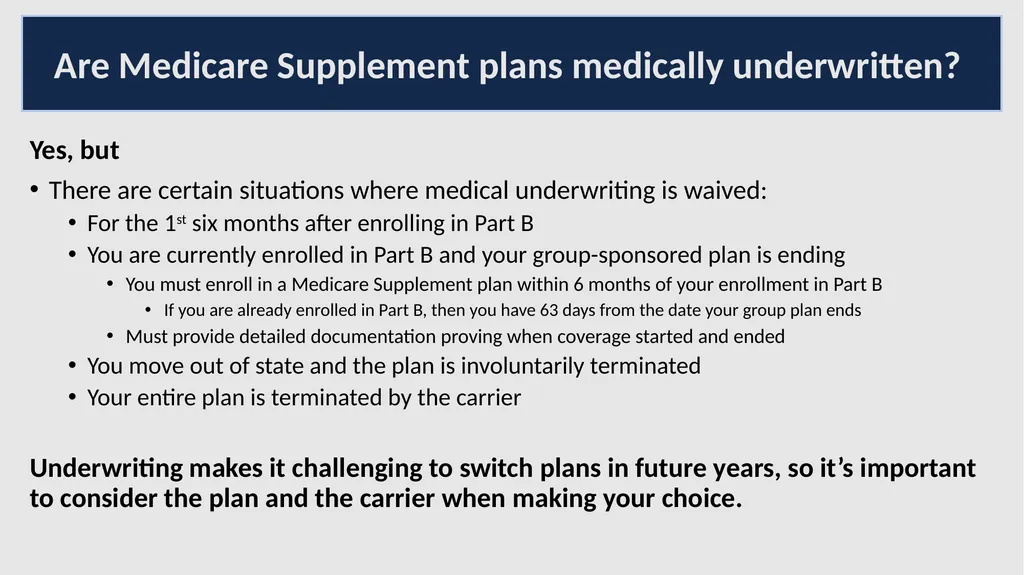
Yes, but
There are certain situations where medical underwriting is waived:
For the 1st six months after enrolling in Part B
You are currently enrolled in Part B and your group-sponsored plan is ending
You must enroll in a Medicare Supplement plan within 6 months of your enrollment in Part B
If you are already enrolled in Part B, then you have 63 days from the date your group plan ends
Must provide detailed documentation proving when coverage started and ended
You move out of state and the plan is involuntarily terminated
Your entire plan is terminated by the carrier
Underwriting makes it challenging to switch plans in future years, so it’s important to consider the plan and the carrier when making your choice. Are Medicare Supplement plans medically underwritten?<br>
There are certain situations where medical underwriting is waived:
For the 1st six months after enrolling in Part B
You are currently enrolled in Part B and your group-sponsored plan is ending
You must enroll in a Medicare Supplement plan within 6 months of your enrollment in Part B
If you are already enrolled in Part B, then you have 63 days from the date your group plan ends
Must provide detailed documentation proving when coverage started and ended
You move out of state and the plan is involuntarily terminated
Your entire plan is terminated by the carrier
Underwriting makes it challenging to switch plans in future years, so it’s important to consider the plan and the carrier when making your choice. Are Medicare Supplement plans medically underwritten?<br>
24
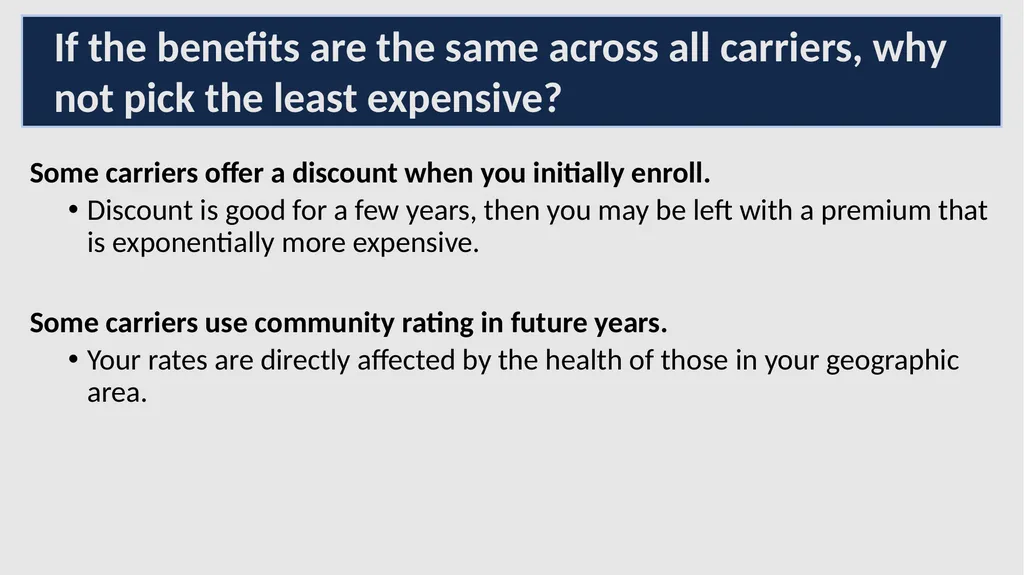
Some carriers offer a discount when you initially enroll.
Discount is good for a few years, then you may be left with a premium that is exponentially more expensive.
Some carriers use community rating in future years.
Your rates are directly affected by the health of those in your geographic area. If the benefits are the same across all carriers, why not pick the least expensive?<br>
Discount is good for a few years, then you may be left with a premium that is exponentially more expensive.
Some carriers use community rating in future years.
Your rates are directly affected by the health of those in your geographic area. If the benefits are the same across all carriers, why not pick the least expensive?<br>
25
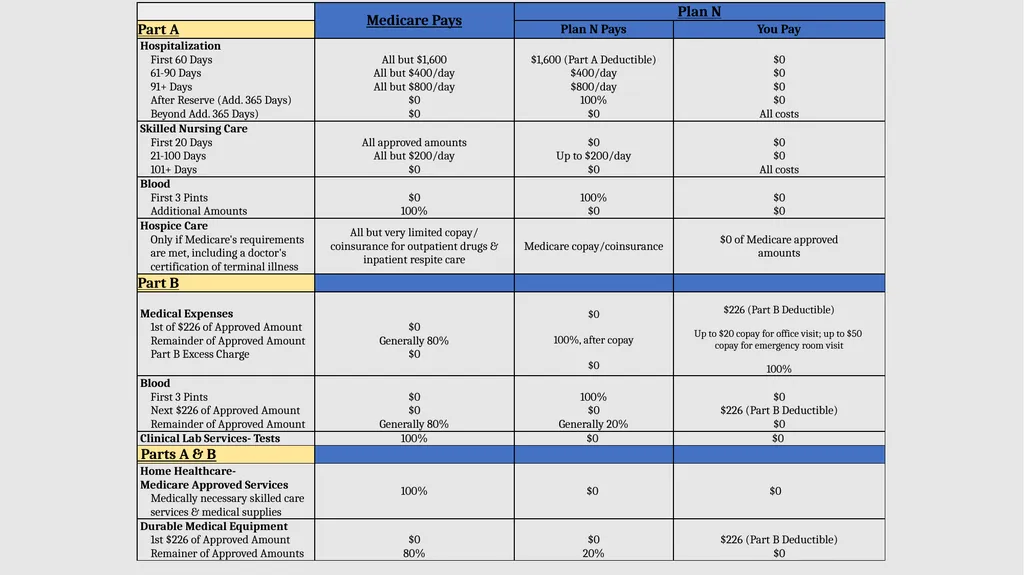
The following slides show three Medicare Supplement plans that we recommend based on benefits and costs. Medicare Supplement: Coverage, Deductibles, &
Coinsurance<br>
Coinsurance<br>
26
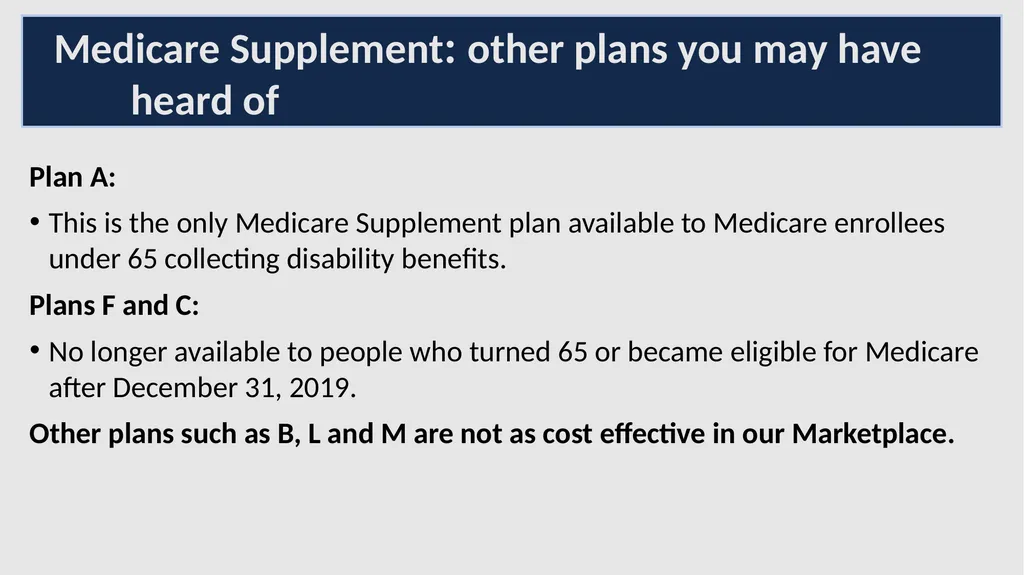
Plan A:
This is the only Medicare Supplement plan available to Medicare enrollees under 65 collecting disability benefits.
Plans F and C:
No longer available to people who turned 65 or became eligible for Medicare after December 31, 2019.
Other plans such as B, L and M are not as cost effective in our Marketplace. Medicare Supplement: other plans you may have
heard of<br>
This is the only Medicare Supplement plan available to Medicare enrollees under 65 collecting disability benefits.
Plans F and C:
No longer available to people who turned 65 or became eligible for Medicare after December 31, 2019.
Other plans such as B, L and M are not as cost effective in our Marketplace. Medicare Supplement: other plans you may have
heard of<br>
27
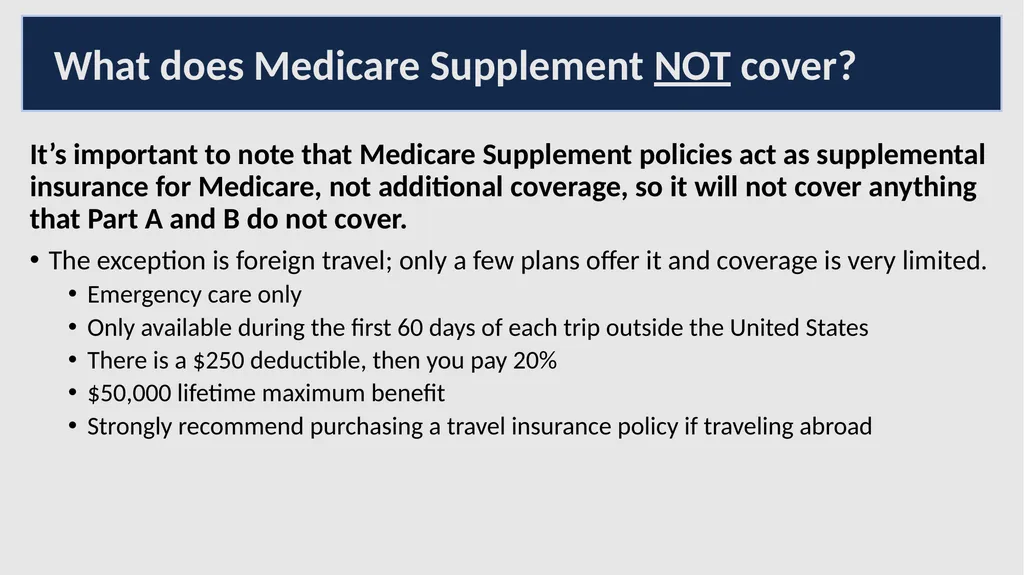
It’s important to note that Medicare Supplement policies act as supplemental insurance for Medicare, not additional coverage, so it will not cover anything that Part A and B do not cover.
The exception is foreign travel; only a few plans offer it and coverage is very limited.
Emergency care only
Only available during the first 60 days of each trip outside the United States
There is a $250 deductible, then you pay 20%
$50,000 lifetime maximum benefit
Strongly recommend purchasing a travel insurance policy if traveling abroad What does Medicare Supplement NOT cover?<br>
The exception is foreign travel; only a few plans offer it and coverage is very limited.
Emergency care only
Only available during the first 60 days of each trip outside the United States
There is a $250 deductible, then you pay 20%
$50,000 lifetime maximum benefit
Strongly recommend purchasing a travel insurance policy if traveling abroad What does Medicare Supplement NOT cover?<br>
28
Depending on the premium amount you pay and the benefits, you may decide to delay your enrollment in Medicare. Here are some things to consider:
If your employer has over 20 employees (TEFRA):
Your group plan will be the primary insurer and Medicare pays secondary
If your employer has under 20 employees (non-TEFRA):
Medicare pays primary and your employer plan pays secondary Employer Group Plans & Medicare<br>
If your employer has over 20 employees (TEFRA):
Your group plan will be the primary insurer and Medicare pays secondary
If your employer has under 20 employees (non-TEFRA):
Medicare pays primary and your employer plan pays secondary Employer Group Plans & Medicare<br>
29
COBRA & Medicare Parts A, B, & D COBRA cannot be used in lieu of Medicare Part A, B, or D.
If you are eligible for Medicare A & B, you have 8 months from the date of the COBRA triggering event to enroll.
You have 2 months after you enroll in A & B to enroll in Part D.
If you have Medicare first and then become eligible for COBRA, you can have both.
Medicare will always pay primary, COBRA pays second.
COBRA is rarely considered creditable coverage for Part D, so if you stay on COBRA for more than 63 days, you may incur a late entry penalty when you enroll in Part D
If you have COBRA first and then become eligible for Medicare, your COBRA coverage should end.
You will need to enroll in Medicare to avoid late entry fees.
This may not be automatic so you should reach out to your COBRA administrator.
***Note: similar rules apply if you are subject to MD State Continuation (small group version of COBRA)<br>
If you are eligible for Medicare A & B, you have 8 months from the date of the COBRA triggering event to enroll.
You have 2 months after you enroll in A & B to enroll in Part D.
If you have Medicare first and then become eligible for COBRA, you can have both.
Medicare will always pay primary, COBRA pays second.
COBRA is rarely considered creditable coverage for Part D, so if you stay on COBRA for more than 63 days, you may incur a late entry penalty when you enroll in Part D
If you have COBRA first and then become eligible for Medicare, your COBRA coverage should end.
You will need to enroll in Medicare to avoid late entry fees.
This may not be automatic so you should reach out to your COBRA administrator.
***Note: similar rules apply if you are subject to MD State Continuation (small group version of COBRA)<br>
30
Scenarios<br>
31
If you enroll in Medicare Part A and/or B, you can no longer contribute to your HSA.
While you can continue to spend from your HSA, you cannot set up or contribute to an HSA in any month that you are enrolled in Medicare.
Do you need to stop contributing to an HSA six months before your enrollment in Medicare?
If you are 6 months past your full retirement age and also signing up for Social Security retirement benefits, then yes.
Social Security will give you 6 months of “back pay” in retirement benefits. This means that your enrollment in Part A will also be backdated by 6 months.
HSA Money can be used to pay Part B, Part D and Medicare Advantage premiums. It cannot be used to pay for Medicare Supplement HSAs, Medicare, & Social Security<br>
While you can continue to spend from your HSA, you cannot set up or contribute to an HSA in any month that you are enrolled in Medicare.
Do you need to stop contributing to an HSA six months before your enrollment in Medicare?
If you are 6 months past your full retirement age and also signing up for Social Security retirement benefits, then yes.
Social Security will give you 6 months of “back pay” in retirement benefits. This means that your enrollment in Part A will also be backdated by 6 months.
HSA Money can be used to pay Part B, Part D and Medicare Advantage premiums. It cannot be used to pay for Medicare Supplement HSAs, Medicare, & Social Security<br>
32
When should
I enroll in Medicare?<br>
33
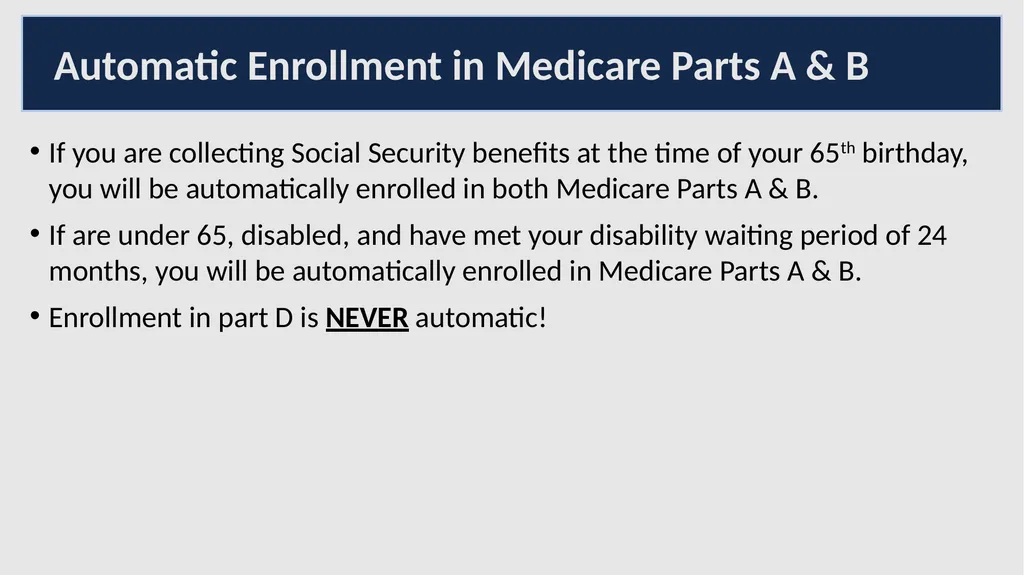
Automatic Enrollment in Medicare Parts A & B If you are collecting Social Security benefits at the time of your 65th birthday, you will be automatically enrolled in both Medicare Parts A & B.
If are under 65, disabled, and have met your disability waiting period of 24 months, you will be automatically enrolled in Medicare Parts A & B.
Enrollment in part D is NEVER automatic!<br>
If are under 65, disabled, and have met your disability waiting period of 24 months, you will be automatically enrolled in Medicare Parts A & B.
Enrollment in part D is NEVER automatic!<br>
34
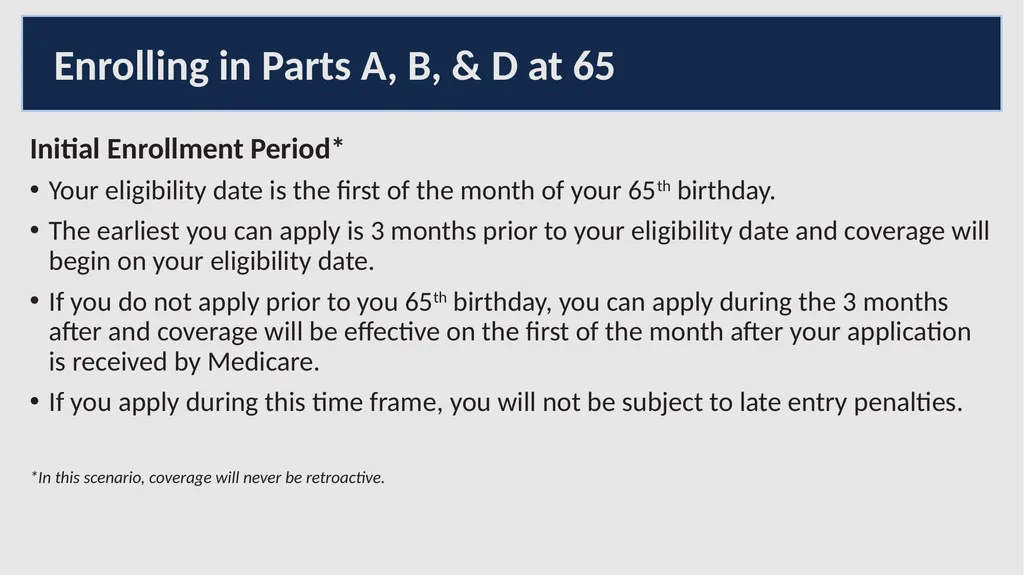
Initial Enrollment Period*
Your eligibility date is the first of the month of your 65th birthday.
The earliest you can apply is 3 months prior to your eligibility date and coverage will begin on your eligibility date.
If you do not apply prior to you 65th birthday, you can apply during the 3 months after and coverage will be effective on the first of the month after your application is received by Medicare.
If you apply during this time frame, you will not be subject to late entry penalties.
*In this scenario, coverage will never be retroactive. Enrolling in Parts A, B, & D at 65<br>
Your eligibility date is the first of the month of your 65th birthday.
The earliest you can apply is 3 months prior to your eligibility date and coverage will begin on your eligibility date.
If you do not apply prior to you 65th birthday, you can apply during the 3 months after and coverage will be effective on the first of the month after your application is received by Medicare.
If you apply during this time frame, you will not be subject to late entry penalties.
*In this scenario, coverage will never be retroactive. Enrolling in Parts A, B, & D at 65<br>
35
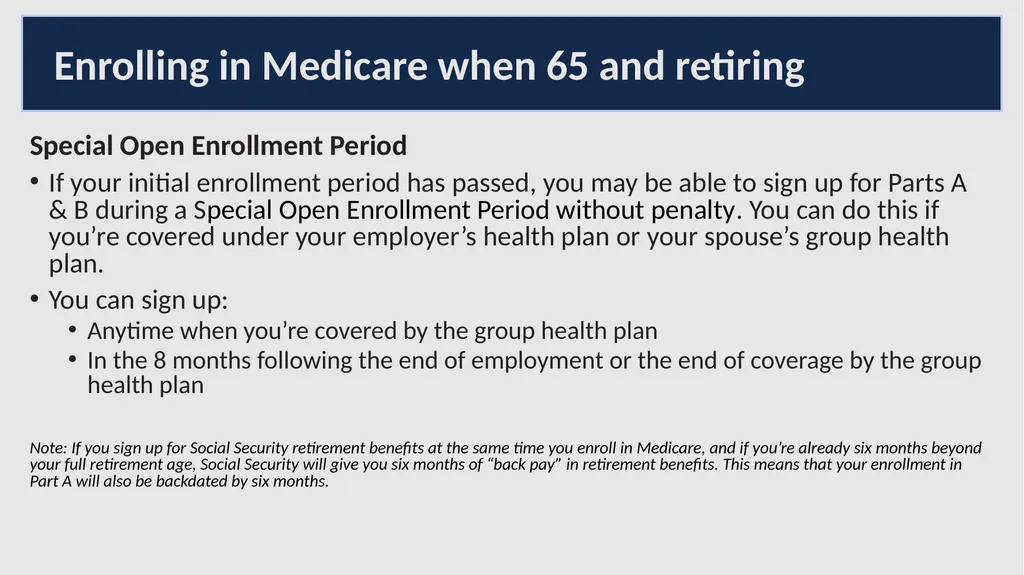
Special Open Enrollment Period
If your initial enrollment period has passed, you may be able to sign up for Parts A & B during a Special Open Enrollment Period without penalty. You can do this if you’re covered under your employer’s health plan or your spouse’s group health plan.
You can sign up:
Anytime when you’re covered by the group health plan
In the 8 months following the end of employment or the end of coverage by the group health plan
Note: If you sign up for Social Security retirement benefits at the same time you enroll in Medicare, and if you’re already six months beyond your full retirement age, Social Security will give you six months of “back pay” in retirement benefits. This means that your enrollment in Part A will also be backdated by six months. Enrolling in Medicare when 65 and retiring<br>
If your initial enrollment period has passed, you may be able to sign up for Parts A & B during a Special Open Enrollment Period without penalty. You can do this if you’re covered under your employer’s health plan or your spouse’s group health plan.
You can sign up:
Anytime when you’re covered by the group health plan
In the 8 months following the end of employment or the end of coverage by the group health plan
Note: If you sign up for Social Security retirement benefits at the same time you enroll in Medicare, and if you’re already six months beyond your full retirement age, Social Security will give you six months of “back pay” in retirement benefits. This means that your enrollment in Part A will also be backdated by six months. Enrolling in Medicare when 65 and retiring<br>
36
General Enrollment Period
Runs from January 1 through March 31 each year
During this time, you can sign up for Parts A and B if both of the following are true:
You didn’t sign up when you were initially eligible (during initial enrollment).
A Special Enrollment Period does not apply.
If you enroll during general enrollment, your coverage will begin on July 1.
Late enrollment penalty will apply Oops, you forgot to enroll in Parts A & B! What now?!<br>
Runs from January 1 through March 31 each year
During this time, you can sign up for Parts A and B if both of the following are true:
You didn’t sign up when you were initially eligible (during initial enrollment).
A Special Enrollment Period does not apply.
If you enroll during general enrollment, your coverage will begin on July 1.
Late enrollment penalty will apply Oops, you forgot to enroll in Parts A & B! What now?!<br>
37
Enrolling in Part D at 65 or when retiring Initial Enrollment Period
You should enroll in Part D within 63 days of enrolling in Part B to avoid late entrant penalties.<br>
You should enroll in Part D within 63 days of enrolling in Part B to avoid late entrant penalties.<br>
38
Oops, you forgot to enroll in Part D! What now?! If you did not enroll in a Part D plan when you were initially eligible:
Open enrollment runs from October 15 to December 7 each year.
Coverage will begin on January 1
A late enrollment penalty will apply for the months that you were not enrolled in a creditable Part D drug plan.<br>
Open enrollment runs from October 15 to December 7 each year.
Coverage will begin on January 1
A late enrollment penalty will apply for the months that you were not enrolled in a creditable Part D drug plan.<br>
39
We recommend you enroll in a Medicare Supplement Plan so the effective date coincides with your enrollment in Medicare.
To avoid underwriting you must enroll within 6 months after your enrollment in a Part B plan.
Can you still enroll in a Medicare Supplement Plan outside of this six-month period?
YES, but if you are not enrolled in an employer plan you may face underwriting restrictions:
Coverage can be denied
Premiums can be increased
Waiting periods can be implemented before your coverage takes effect
Coverage for your pre-existing condition can be excluded When should you enroll in a Medicare Supplement plan?<br>
To avoid underwriting you must enroll within 6 months after your enrollment in a Part B plan.
Can you still enroll in a Medicare Supplement Plan outside of this six-month period?
YES, but if you are not enrolled in an employer plan you may face underwriting restrictions:
Coverage can be denied
Premiums can be increased
Waiting periods can be implemented before your coverage takes effect
Coverage for your pre-existing condition can be excluded When should you enroll in a Medicare Supplement plan?<br>
40
How do
I enroll in Medicare?<br>
41
How to enroll in Medicare Parts A & B You have several ways to enroll in Medicare Parts A & B
Online:
Visit SocialSecurity.gov to begin enrollment
By phone:
Call SSA at 1(800)772-1213 (or 1(800)325-0718 for TTY), Mon-Fri, 7 A.M. - 7 P.M.
In person:
Visit your local SSA office; you can find it through the SSA office locator
By mail:
Send a letter to your local SSA office with your name, your social security number, and the date you’d like to enroll; they will send you the necessary information and any additional requests for enrolling
If you already receive benefits from SSA or RRB, you’ll be automatically enrolled in Medicare.<br>
Online:
Visit SocialSecurity.gov to begin enrollment
By phone:
Call SSA at 1(800)772-1213 (or 1(800)325-0718 for TTY), Mon-Fri, 7 A.M. - 7 P.M.
In person:
Visit your local SSA office; you can find it through the SSA office locator
By mail:
Send a letter to your local SSA office with your name, your social security number, and the date you’d like to enroll; they will send you the necessary information and any additional requests for enrolling
If you already receive benefits from SSA or RRB, you’ll be automatically enrolled in Medicare.<br>
42
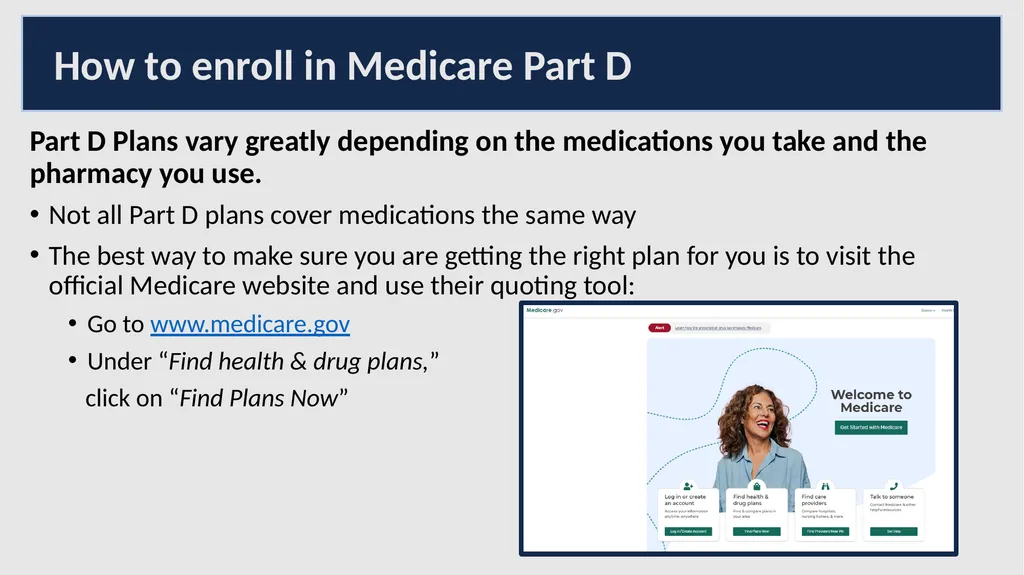
How to enroll in Medicare Part D Part D Plans vary greatly depending on the medications you take and the pharmacy you use.
Not all Part D plans cover medications the same way
The best way to make sure you are getting the right plan for you is to visit the official Medicare website and use their quoting tool:
Go to www.medicare.gov
Under “Find health & drug plans,”
click on “Find Plans Now”<br>
Not all Part D plans cover medications the same way
The best way to make sure you are getting the right plan for you is to visit the official Medicare website and use their quoting tool:
Go to www.medicare.gov
Under “Find health & drug plans,”
click on “Find Plans Now”<br>
43
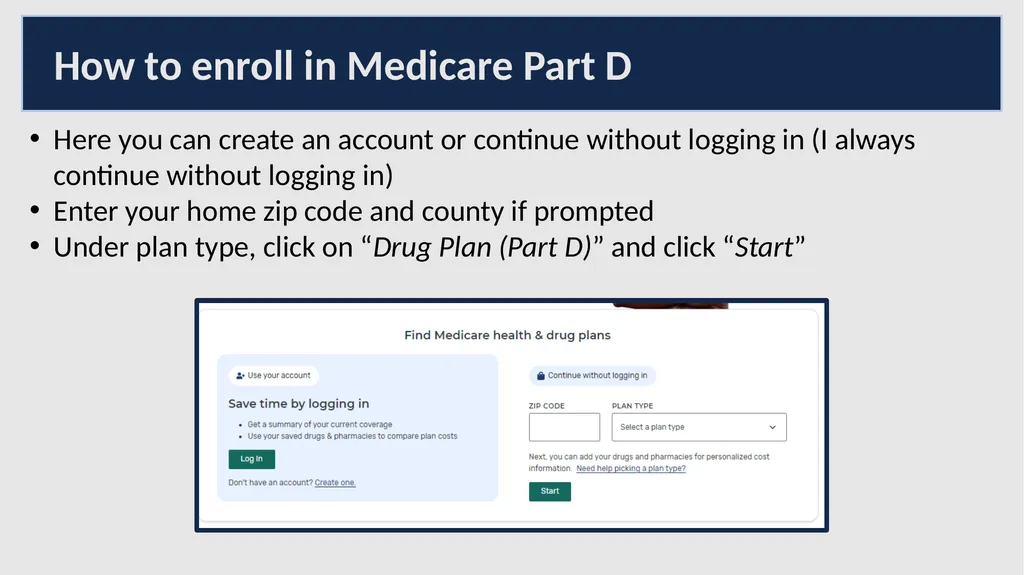
Here you can create an account or continue without logging in (I always continue without logging in)
Enter your home zip code and county if prompted
Under plan type, click on “Drug Plan (Part D)” and click “Start” How to enroll in Medicare Part D<br>
Enter your home zip code and county if prompted
Under plan type, click on “Drug Plan (Part D)” and click “Start” How to enroll in Medicare Part D<br>
44
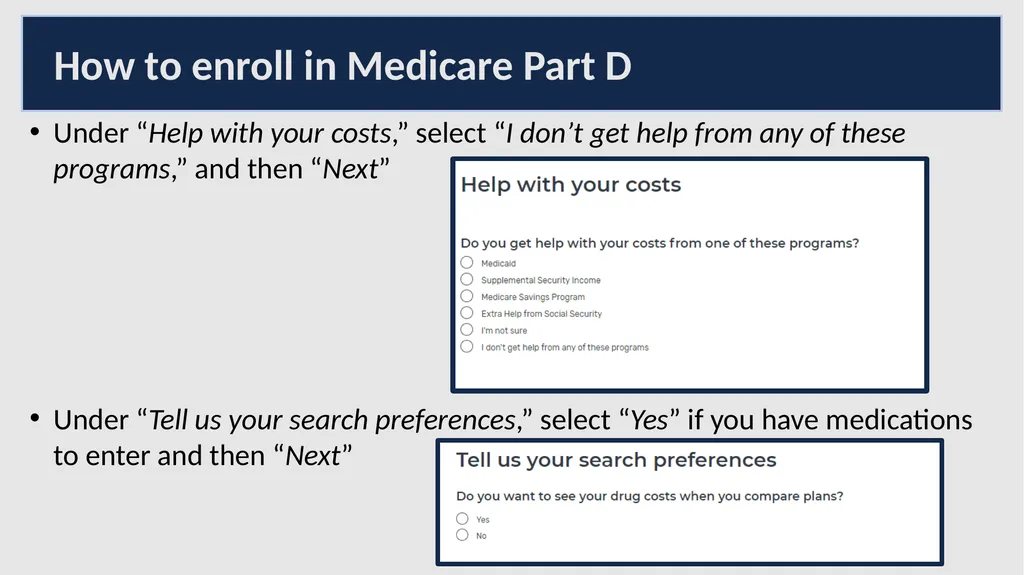
Under “Help with your costs,” select “I don’t get help from any of these programs,” and then “Next”
Under “Tell us your search preferences,” select “Yes” if you have medications to enter and then “Next” How to enroll in Medicare Part D<br>
Under “Tell us your search preferences,” select “Yes” if you have medications to enter and then “Next” How to enroll in Medicare Part D<br>
45
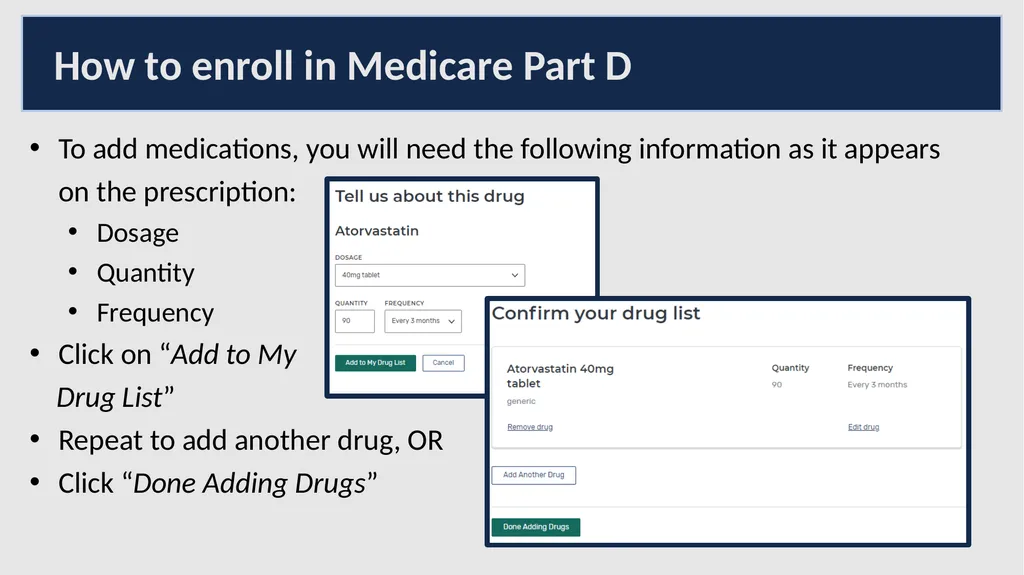
To add medications, you will need the following information as it appears on the prescription:
Dosage
Quantity
Frequency
Click on “Add to My
Drug List”
Repeat to add another drug, OR
Click “Done Adding Drugs” How to enroll in Medicare Part D<br>
Dosage
Quantity
Frequency
Click on “Add to My
Drug List”
Repeat to add another drug, OR
Click “Done Adding Drugs” How to enroll in Medicare Part D<br>
46
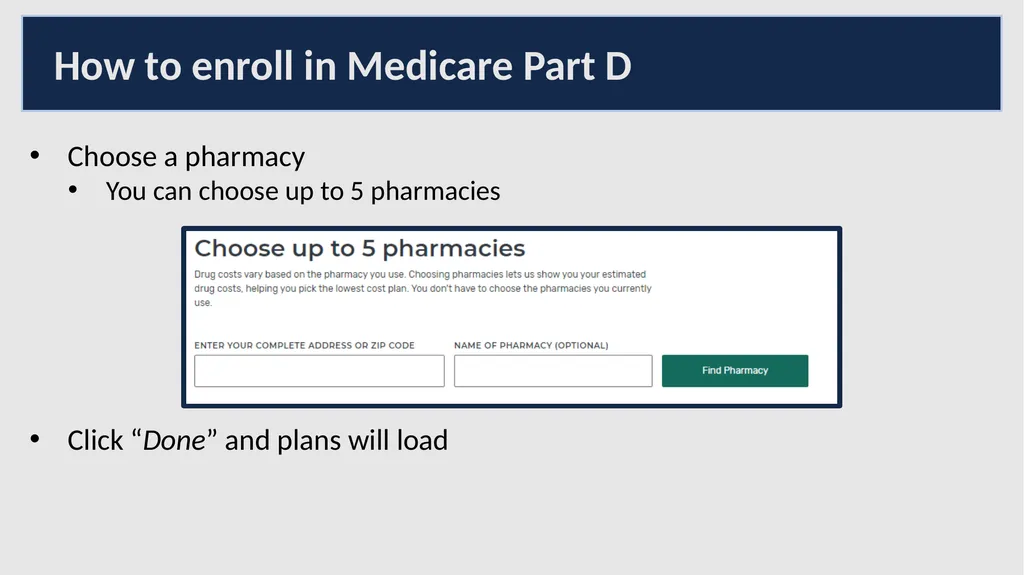
Choose a pharmacy
You can choose up to 5 pharmacies
Click “Done” and plans will load How to enroll in Medicare Part D<br>
You can choose up to 5 pharmacies
Click “Done” and plans will load How to enroll in Medicare Part D<br>
47
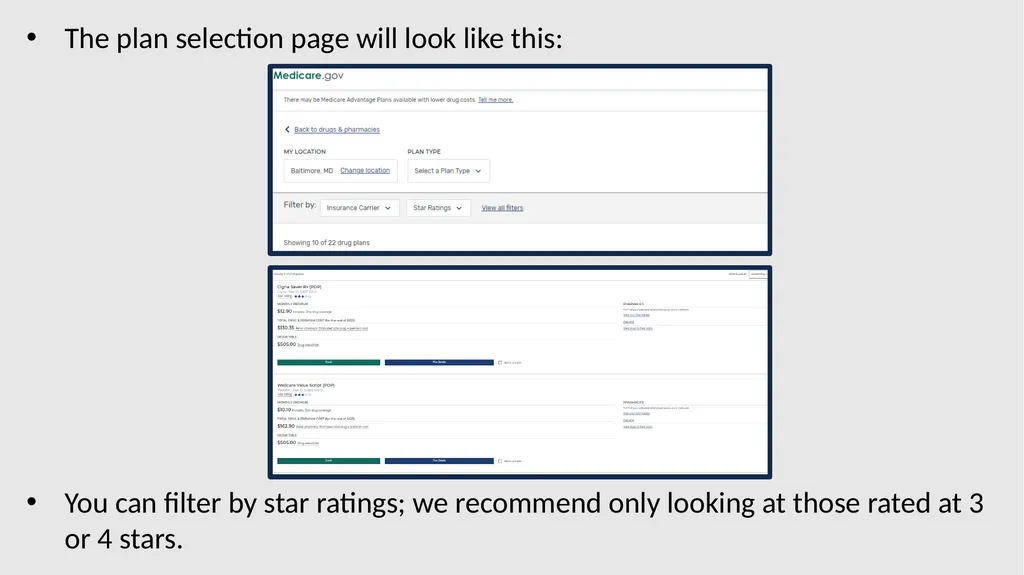
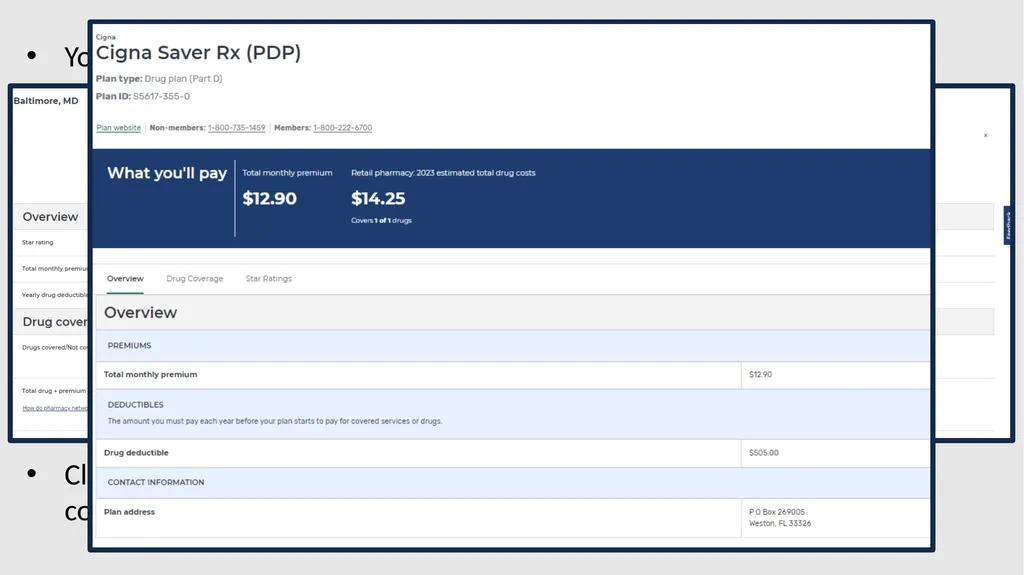
The plan selection page will look like this:
You can filter by star ratings; we recommend only looking at those rated at 3 or 4 stars.<br>
You can filter by star ratings; we recommend only looking at those rated at 3 or 4 stars.<br>
48
You can compare up to 3 plans at a time, side-by-side:
Click on “Plan Details” for a more in-depth description of a plan and for contact information to enroll<br>
Click on “Plan Details” for a more in-depth description of a plan and for contact information to enroll<br>
49
Once you choose your plan there are several ways to enroll:
Call the carrier directly
Call Social Security
Enroll online through the carrier website How to enroll in Medicare Part D<br>
Call the carrier directly
Call Social Security
Enroll online through the carrier website How to enroll in Medicare Part D<br>
50
How do I enroll in Medicare Supplement? Choose the Medicare Supplement plan you want based on the coverage you need.
Choose the carrier you want based on cost and reputation of the carrier.
Many carriers have online applications that are quick and easy to fill out.
Some carriers will allow you to enroll over the phone.<br>
Choose the carrier you want based on cost and reputation of the carrier.
Many carriers have online applications that are quick and easy to fill out.
Some carriers will allow you to enroll over the phone.<br>
51
How much does
Medicare cost?<br>
52
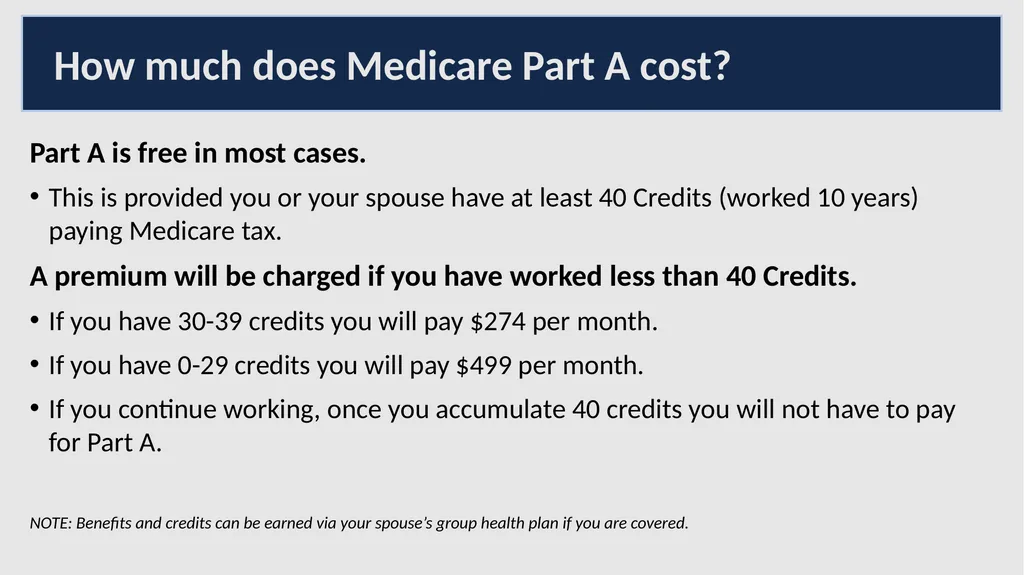
How much does Medicare Part A cost? Part A is free in most cases.
This is provided you or your spouse have at least 40 Credits (worked 10 years) paying Medicare tax.
A premium will be charged if you have worked less than 40 Credits.
If you have 30-39 credits you will pay $274 per month.
If you have 0-29 credits you will pay $499 per month.
If you continue working, once you accumulate 40 credits you will not have to pay for Part A.
NOTE: Benefits and credits can be earned via your spouse’s group health plan if you are covered.<br>
This is provided you or your spouse have at least 40 Credits (worked 10 years) paying Medicare tax.
A premium will be charged if you have worked less than 40 Credits.
If you have 30-39 credits you will pay $274 per month.
If you have 0-29 credits you will pay $499 per month.
If you continue working, once you accumulate 40 credits you will not have to pay for Part A.
NOTE: Benefits and credits can be earned via your spouse’s group health plan if you are covered.<br>
53
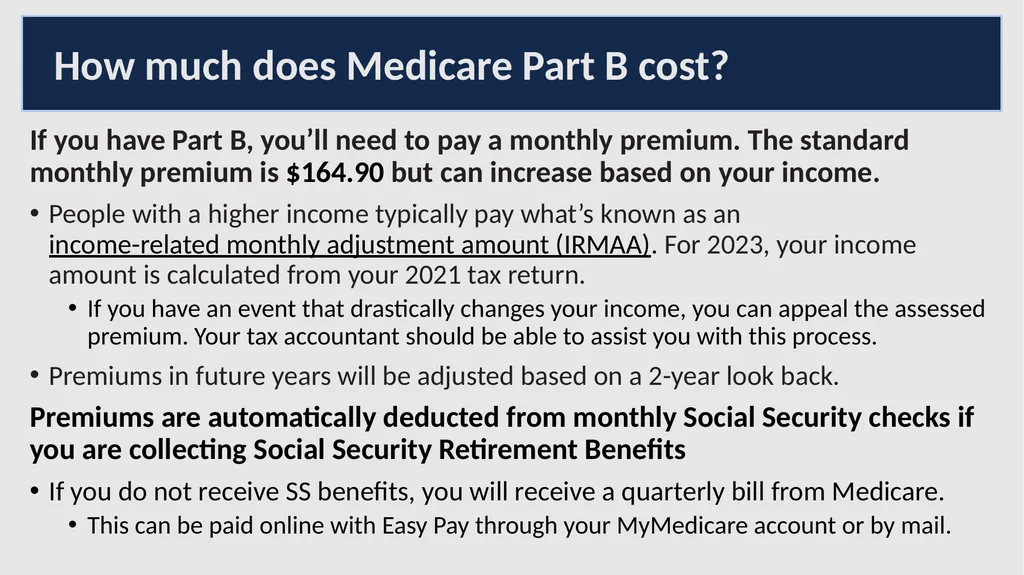
How much does Medicare Part B cost? If you have Part B, you’ll need to pay a monthly premium. The standard monthly premium is $164.90 but can increase based on your income.
People with a higher income typically pay what’s known as an income-related monthly adjustment amount (IRMAA). For 2023, your income amount is calculated from your 2021 tax return.
If you have an event that drastically changes your income, you can appeal the assessed premium. Your tax accountant should be able to assist you with this process.
Premiums in future years will be adjusted based on a 2-year look back.
Premiums are automatically deducted from monthly Social Security checks if you are collecting Social Security Retirement Benefits
If you do not receive SS benefits, you will receive a quarterly bill from Medicare.
This can be paid online with Easy Pay through your MyMedicare account or by mail.<br>
People with a higher income typically pay what’s known as an income-related monthly adjustment amount (IRMAA). For 2023, your income amount is calculated from your 2021 tax return.
If you have an event that drastically changes your income, you can appeal the assessed premium. Your tax accountant should be able to assist you with this process.
Premiums in future years will be adjusted based on a 2-year look back.
Premiums are automatically deducted from monthly Social Security checks if you are collecting Social Security Retirement Benefits
If you do not receive SS benefits, you will receive a quarterly bill from Medicare.
This can be paid online with Easy Pay through your MyMedicare account or by mail.<br>
54
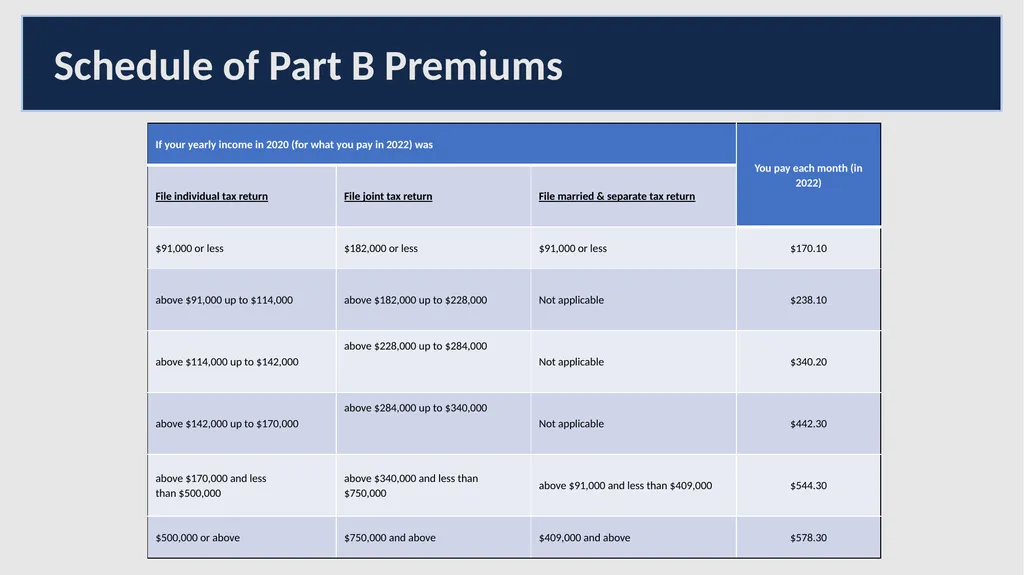
Schedule of Part B Premiums<br>
55
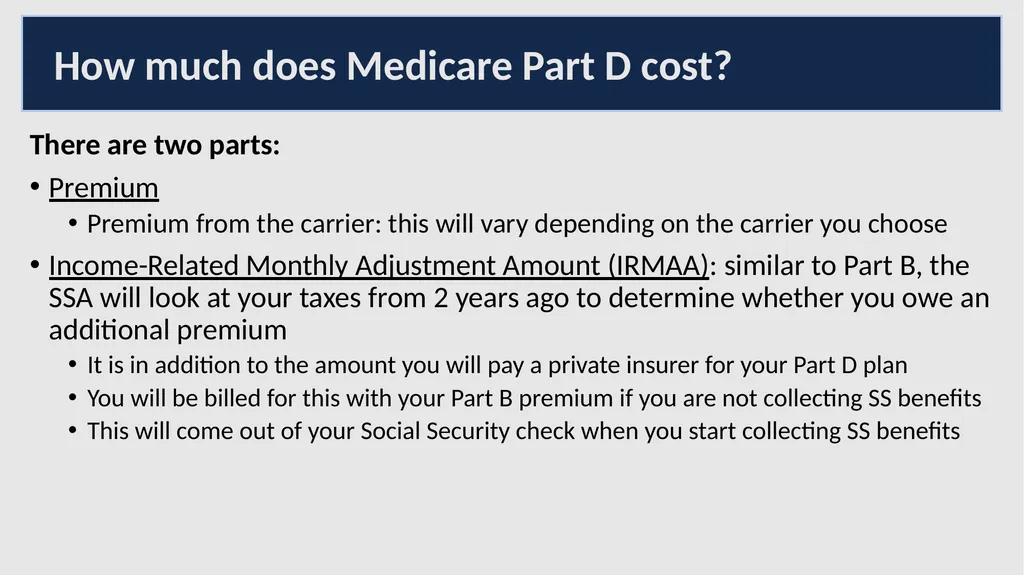
How much does Medicare Part D cost? There are two parts:
Premium
Premium from the carrier: this will vary depending on the carrier you choose
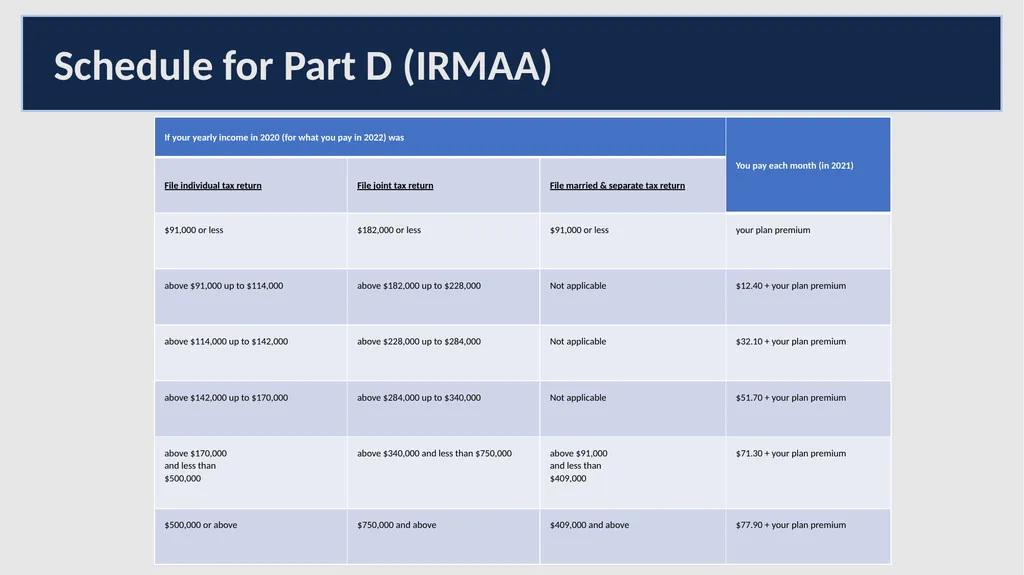
Income-Related Monthly Adjustment Amount (IRMAA): similar to Part B, the SSA will look at your taxes from 2 years ago to determine whether you owe an additional premium
It is in addition to the amount you will pay a private insurer for your Part D plan
You will be billed for this with your Part B premium if you are not collecting SS benefits
This will come out of your Social Security check when you start collecting SS benefits<br>
Premium
Premium from the carrier: this will vary depending on the carrier you choose
Income-Related Monthly Adjustment Amount (IRMAA): similar to Part B, the SSA will look at your taxes from 2 years ago to determine whether you owe an additional premium
It is in addition to the amount you will pay a private insurer for your Part D plan
You will be billed for this with your Part B premium if you are not collecting SS benefits
This will come out of your Social Security check when you start collecting SS benefits<br>
56
Schedule for Part D (IRMAA)<br>
57
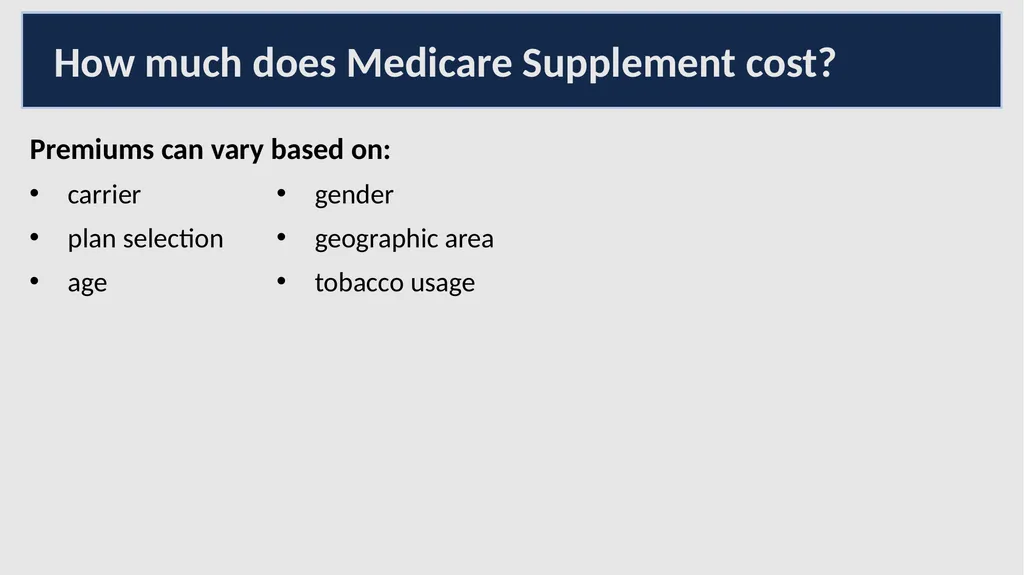
How much does Medicare Supplement cost? Premiums can vary based on:
Carrier
Plan selection
Age gender
geographic area
tobacco usage carrier
plan selection
age<br>
Carrier
Plan selection
Age gender
geographic area
tobacco usage carrier
plan selection
age<br>
58
Medicare Advantage<br>
59
Rolls all the pieces of Medicare (A, B and D) into one plan
May also provide coverage for what Medicare does not cover
Most, but not all, Medicare Advantage Plans include Part D/drug coverage
Many plans have value-added benefits (e.g. dental, vision, & hearing)
Monthly premiums tend to be low, but out-of-pocket costs tend to be high
Deductibles
Copays
Medical underwriting is never required to enroll
Enrollment restricted to certain times
Network driven plans (i.e. HMOs & PPOs)
Deductibles and copays differ from plan to plan
Plans need to be individually evaluated for the best fit What is Medicare Advantage? Paying out of pocket for doctors that don’t participate Deductibles
Copays<br>
May also provide coverage for what Medicare does not cover
Most, but not all, Medicare Advantage Plans include Part D/drug coverage
Many plans have value-added benefits (e.g. dental, vision, & hearing)
Monthly premiums tend to be low, but out-of-pocket costs tend to be high
Deductibles
Copays
Medical underwriting is never required to enroll
Enrollment restricted to certain times
Network driven plans (i.e. HMOs & PPOs)
Deductibles and copays differ from plan to plan
Plans need to be individually evaluated for the best fit What is Medicare Advantage? Paying out of pocket for doctors that don’t participate Deductibles
Copays<br>
60
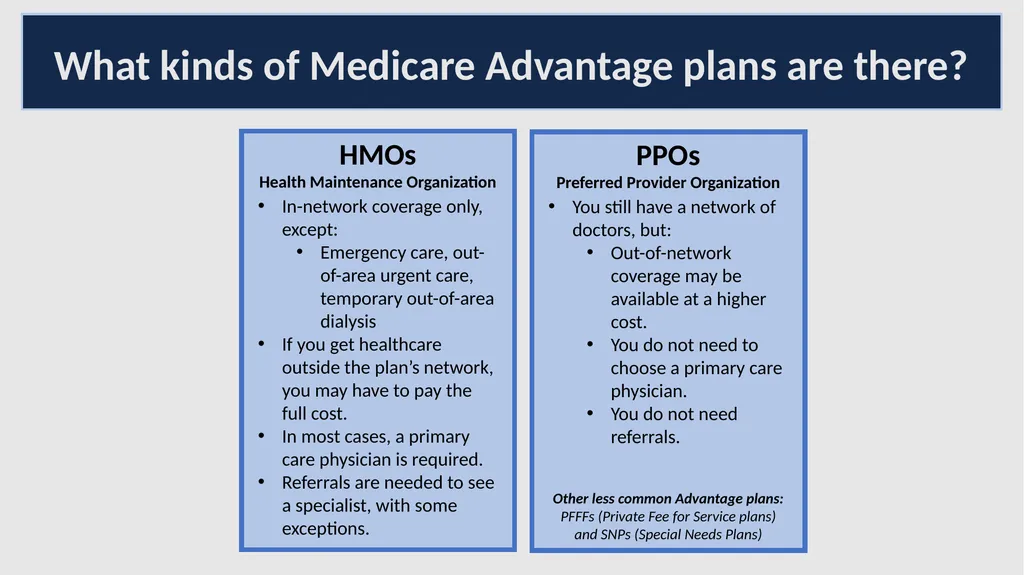
What kinds of Medicare Advantage plans are there? Other less common Advantage plans: PFFFs (Private Fee for Service plans) and SNPs (Special Needs Plans)<br>
61
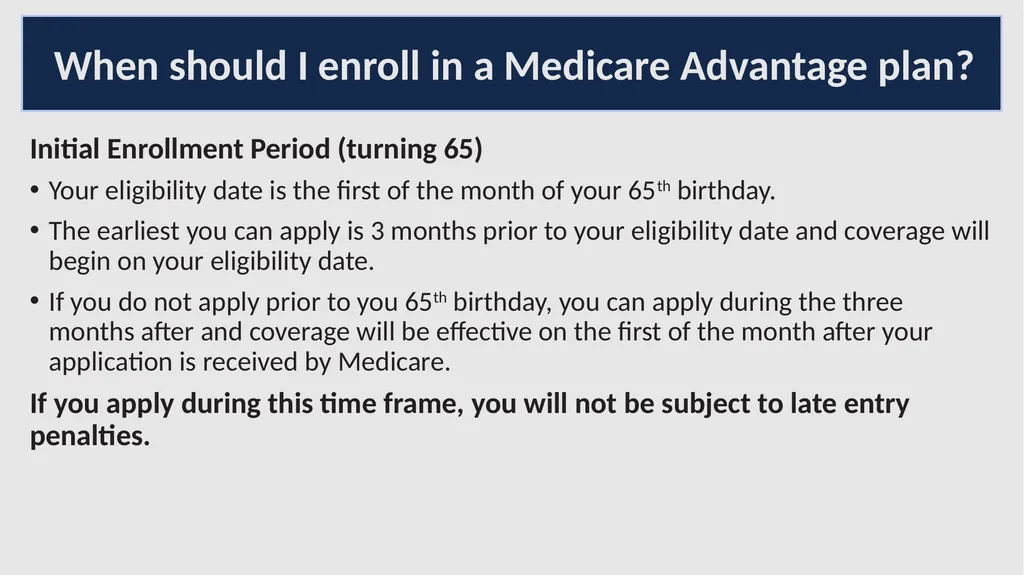
When should I enroll in a Medicare Advantage plan? Initial Enrollment Period (turning 65)
Your eligibility date is the first of the month of your 65th birthday.
The earliest you can apply is 3 months prior to your eligibility date and coverage will begin on your eligibility date.
If you do not apply prior to you 65th birthday, you can apply during the three months after and coverage will be effective on the first of the month after your application is received by Medicare.
If you apply during this time frame, you will not be subject to late entry penalties.<br>
Your eligibility date is the first of the month of your 65th birthday.
The earliest you can apply is 3 months prior to your eligibility date and coverage will begin on your eligibility date.
If you do not apply prior to you 65th birthday, you can apply during the three months after and coverage will be effective on the first of the month after your application is received by Medicare.
If you apply during this time frame, you will not be subject to late entry penalties.<br>
62
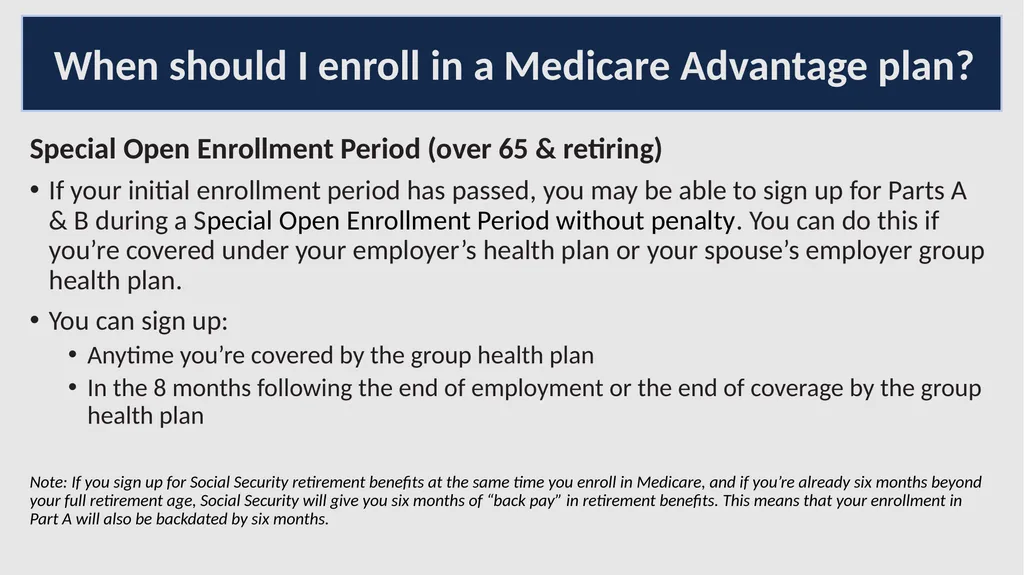
When should I enroll in a Medicare Advantage plan? Special Open Enrollment Period (over 65 & retiring)
If your initial enrollment period has passed, you may be able to sign up for Parts A & B during a Special Open Enrollment Period without penalty. You can do this if you’re covered under your employer’s health plan or your spouse’s employer group health plan.
You can sign up:
Anytime you’re covered by the group health plan
In the 8 months following the end of employment or the end of coverage by the group health plan
Note: If you sign up for Social Security retirement benefits at the same time you enroll in Medicare, and if you’re already six months beyond your full retirement age, Social Security will give you six months of “back pay” in retirement benefits. This means that your enrollment in Part A will also be backdated by six months.<br>
If your initial enrollment period has passed, you may be able to sign up for Parts A & B during a Special Open Enrollment Period without penalty. You can do this if you’re covered under your employer’s health plan or your spouse’s employer group health plan.
You can sign up:
Anytime you’re covered by the group health plan
In the 8 months following the end of employment or the end of coverage by the group health plan
Note: If you sign up for Social Security retirement benefits at the same time you enroll in Medicare, and if you’re already six months beyond your full retirement age, Social Security will give you six months of “back pay” in retirement benefits. This means that your enrollment in Part A will also be backdated by six months.<br>
63
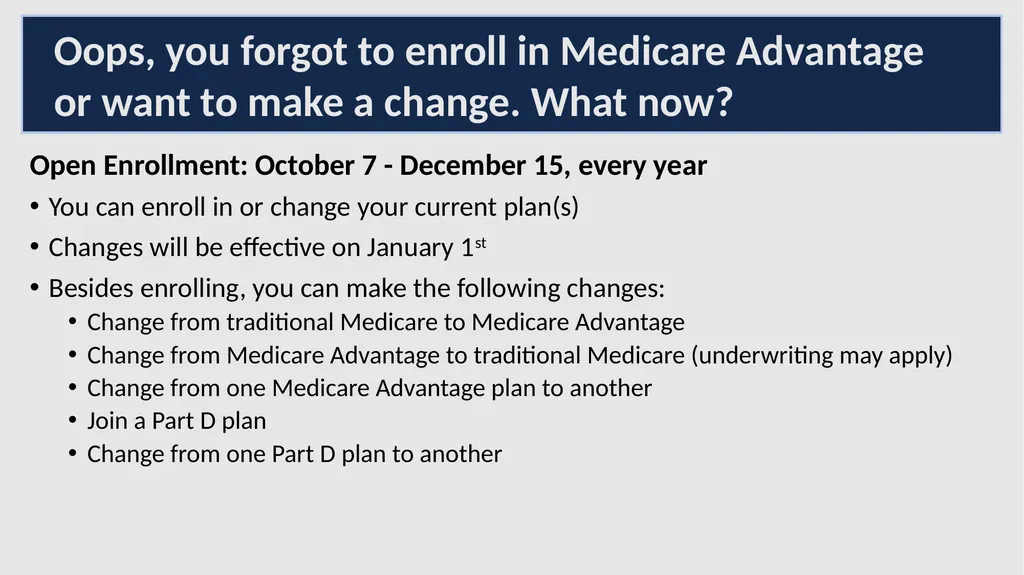
Open Enrollment: October 7 - December 15, every year
You can enroll in or change your current plan(s)
Changes will be effective on January 1st
Besides enrolling, you can make the following changes:
Change from traditional Medicare to Medicare Advantage
Change from Medicare Advantage to traditional Medicare (underwriting may apply)
Change from one Medicare Advantage plan to another
Join a Part D plan
Change from one Part D plan to another Oops, you forgot to enroll in Medicare Advantage or want to make a change. What now?<br>
You can enroll in or change your current plan(s)
Changes will be effective on January 1st
Besides enrolling, you can make the following changes:
Change from traditional Medicare to Medicare Advantage
Change from Medicare Advantage to traditional Medicare (underwriting may apply)
Change from one Medicare Advantage plan to another
Join a Part D plan
Change from one Part D plan to another Oops, you forgot to enroll in Medicare Advantage or want to make a change. What now?<br>
64
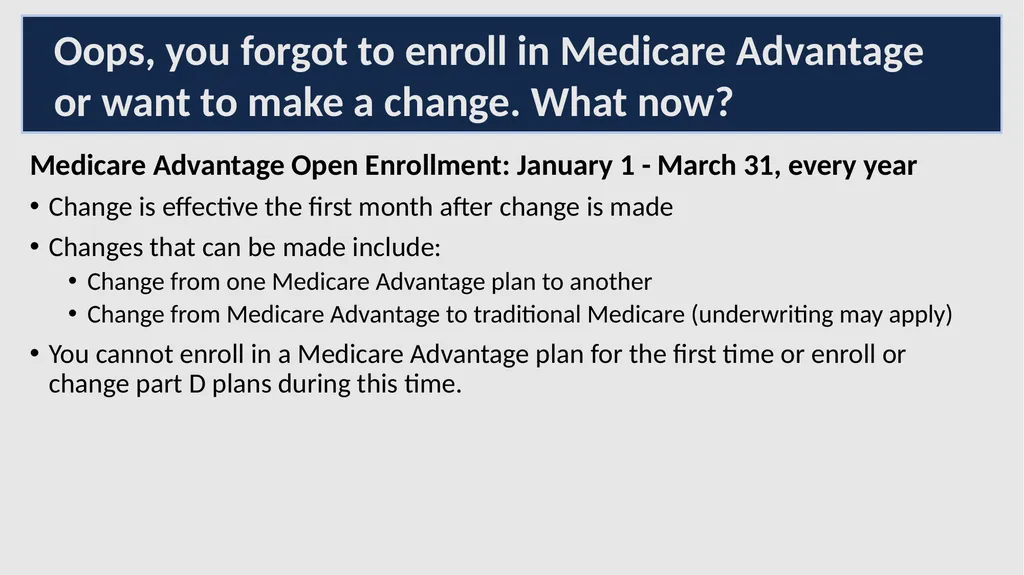
Medicare Advantage Open Enrollment: January 1 - March 31, every year
Change is effective the first month after change is made
Changes that can be made include:
Change from one Medicare Advantage plan to another
Change from Medicare Advantage to traditional Medicare (underwriting may apply)
You cannot enroll in a Medicare Advantage plan for the first time or enroll or change part D plans during this time. Oops, you forgot to enroll in Medicare Advantage or want to make a change. What now?<br>
Change is effective the first month after change is made
Changes that can be made include:
Change from one Medicare Advantage plan to another
Change from Medicare Advantage to traditional Medicare (underwriting may apply)
You cannot enroll in a Medicare Advantage plan for the first time or enroll or change part D plans during this time. Oops, you forgot to enroll in Medicare Advantage or want to make a change. What now?<br>
65
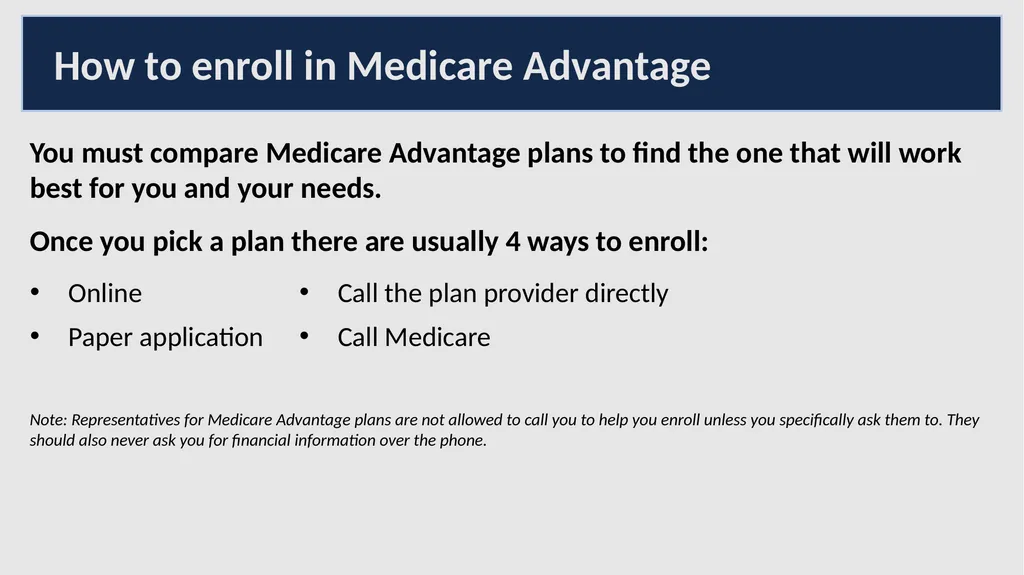
How to enroll in Medicare Advantage You must compare Medicare Advantage plans to find the one that will work best for you and your needs.
Once you pick a plan there are usually 4 ways to enroll:
Online
Paper application
Note: Representatives for Medicare Advantage plans are not allowed to call you to help you enroll unless you specifically ask them to. They should also never ask you for financial information over the phone. Call the plan provider directly
Call Medicare Online
Paper application<br>
Once you pick a plan there are usually 4 ways to enroll:
Online
Paper application
Note: Representatives for Medicare Advantage plans are not allowed to call you to help you enroll unless you specifically ask them to. They should also never ask you for financial information over the phone. Call the plan provider directly
Call Medicare Online
Paper application<br>
66
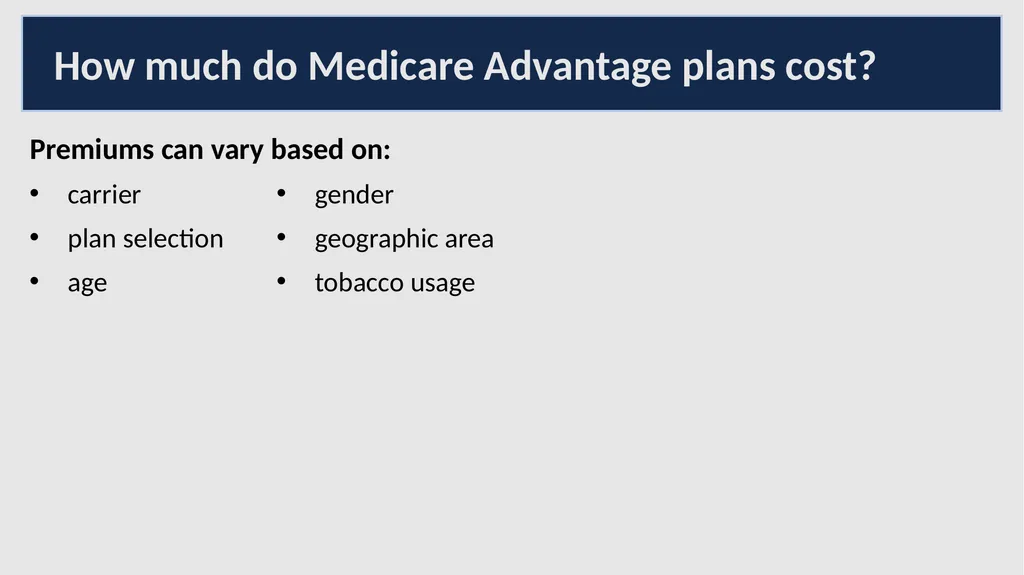
How much do Medicare Advantage plans cost? Premiums can vary based on:
Carrier
Plan selection
Age gender
geographic area
tobacco usage carrier
plan selection
age<br>
Carrier
Plan selection
Age gender
geographic area
tobacco usage carrier
plan selection
age<br>
67
We are happy
to field any questions you may have!<br>
to field any questions you may have!<br>