Medicine Reconciliation Catherine Wilson Pharmacist Helen Muller - Technician Medicine reconciliation Medicine reconciliation is an evidence-based process, which has been demonstrated to significantly reduce medication errors caused by
"Medicine Reconciliation Catherine Wilson –" is the property of its rightful owner. Permission is granted to
download and print the materials on this website for personal, non-commercial use only, and to display it
on your personal computer provided you do not modify the materials and that you retain all copyright
notices contained in the materials. By downloading content from our website, you accept the terms of this
agreement.
Presentation Transcript
01
Medicine Reconciliation Catherine Wilson – Pharmacist Helen Muller - Technician<br>
02
Medicine reconciliation Medicine reconciliation is an evidence-based process, which has been demonstrated to significantly reduce medication errors caused by incomplete or insufficient documentation of medicine related information.
It is the process of collecting, comparing and communicating the most accurate list of all medications, allergies and adverse drug reactions (ADRs) for a patient
Any discrepancies are then documented and reconciled.
A key to its success lies in accurate communication of medicine related information between healthcare practitioners.<br>
03
Why do it? There are often changes to a patient's medicines when their care is handed over to other health professionals
Examples include admission to hospital, transfer between wards or discharge from hospital.
Some of these medicine changes are unintentional due to poor information and some are intentional but not clearly documented.
Both types of change can result in medication errors and/or patient harm.<br>
04
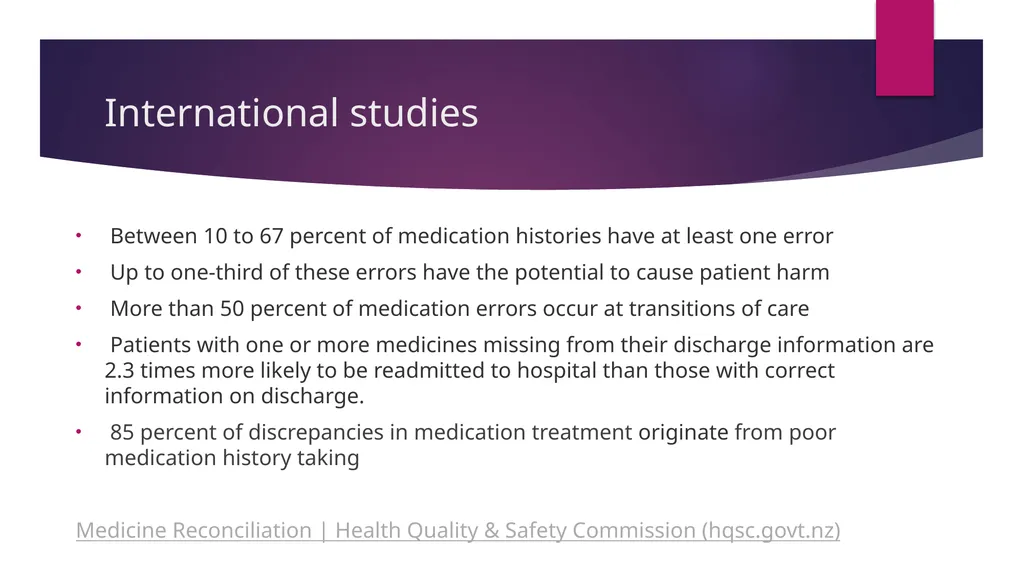
International studies Between 10 to 67 percent of medication histories have at least one error
Up to one-third of these errors have the potential to cause patient harm
More than 50 percent of medication errors occur at transitions of care
Patients with one or more medicines missing from their discharge information are 2.3 times more likely to be readmitted to hospital than those with correct information on discharge.
85 percent of discrepancies in medication treatment originate from poor medication history taking
Medicine Reconciliation | Health Quality & Safety Commission (hqsc.govt.nz)<br>
05
Medicine reconciliation standards www.hqsc.govt.nz/assets/Our-work/System-safety/Reducing-harm/Medicines/Publications-resources/Medication_Rec_Standard_v3.pdf<br>
06
Who can do medicine reconciliation?<br>
07
Steps Collect
Compare
Communicate<br>
08
Collect Minimum of two sources
A primary source will be one of the minimum sources used where possible.
Talk to the patient (or their carer)!
Consult and confirm with the patient the secondary and tertiary source information.
Information provided by sources should cover at least a period of six weeks prior to the present day.
Written sources of information should not be used if older than three months.<br>
09
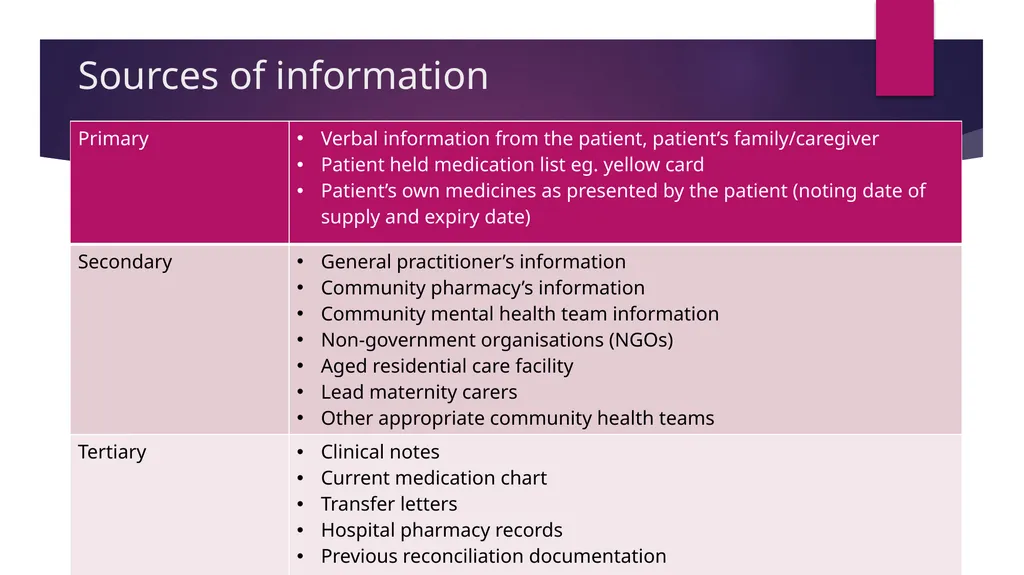
Sources of information<br>
10
Medicine details Medicine name (generic name)
Medicine dose and units
Frequency of administration
Route(s) of administration
If there are specified individualised times for the medicines to be administered
Supplemental information to aid decision making eg. indication for PRN medicines, recently discontinued medicines, adherence issues.<br>
11
Remember…. Inhalers, eye drops, creams etc
Patients may not think of these as medicines
Short courses of medicines such as antibiotics and steroids
If a patient has their medicines with them – do they have the patient’s name on them, how old are they?
Does the patient buy over the counter medicines?
Do they use complementary/alternative medicines or Rongoa?
There might be a difference between medicines prescribed, medicines dispensed, medicines taken<br>
12
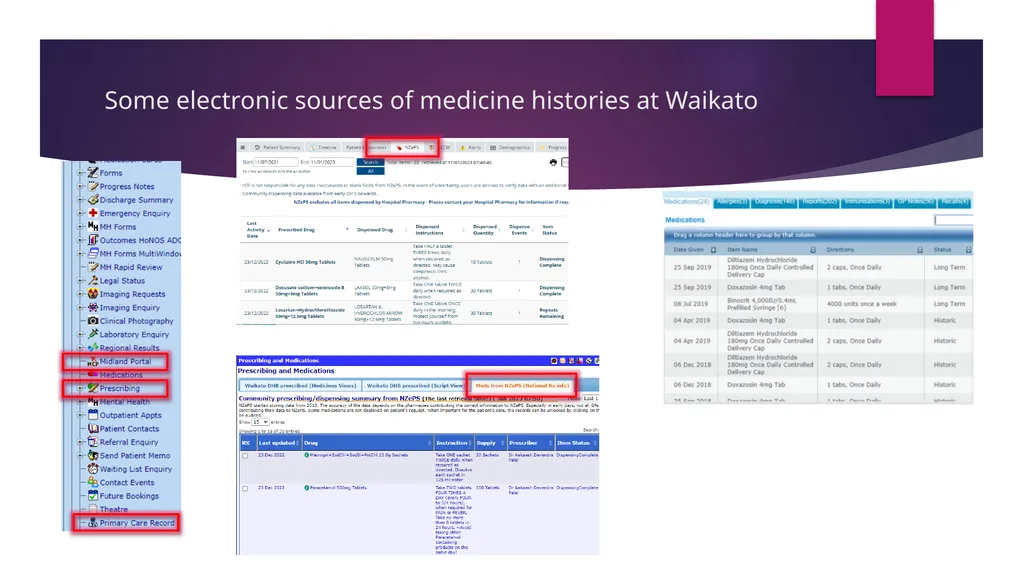
Some electronic sources of medicine histories at Waikato<br>
13
Compare Compare the collected medicines, allergies and ADR list to the prescribed medicines, allergies and ADRs (at admission, transfer and discharge) to identify any differences.<br>
14
Information to share with the pharmacist Any perceived medication errors
Anything that could result in patient harm
Anything the patient tells you that could cause harm
Final medicines reconciliation form<br>
15
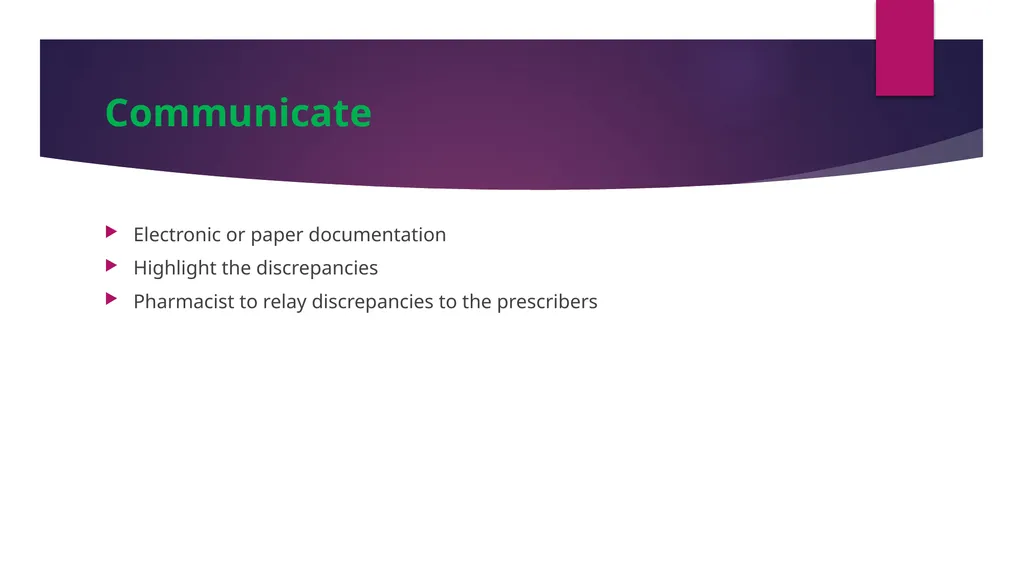
Communicate Electronic or paper documentation
Highlight the discrepancies
Pharmacist to relay discrepancies to the prescribers<br>
16
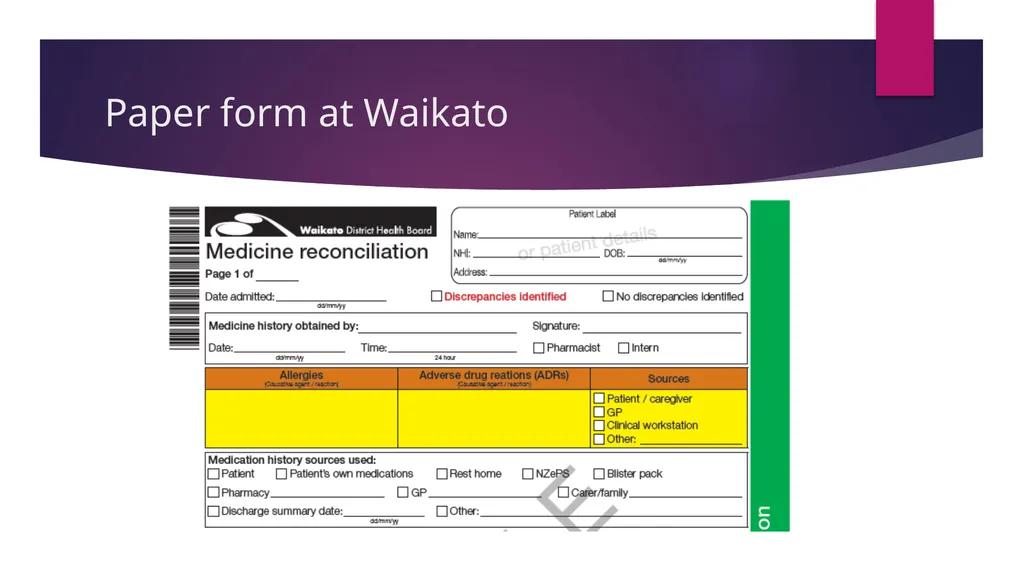
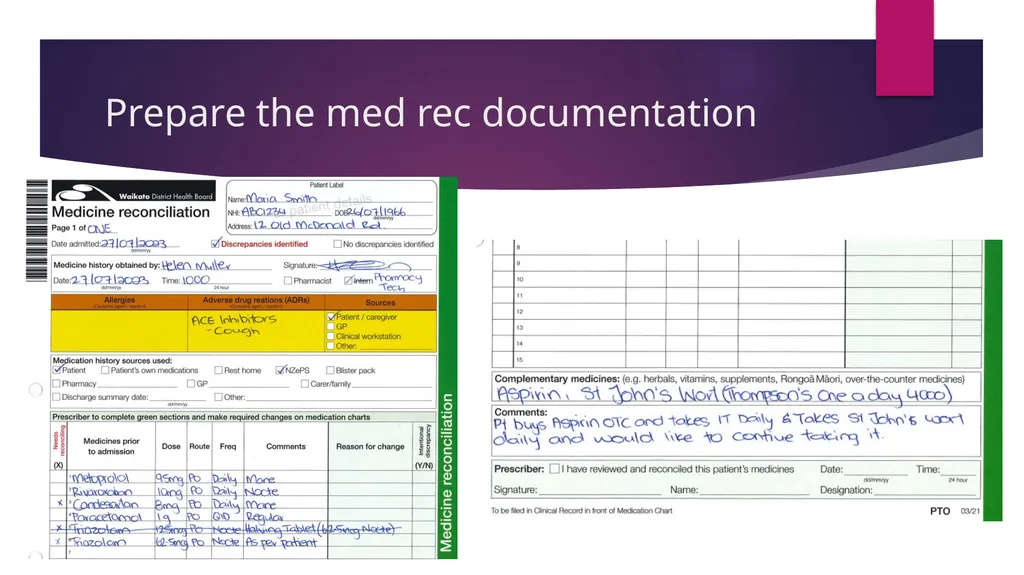
Paper form at Waikato<br>
17
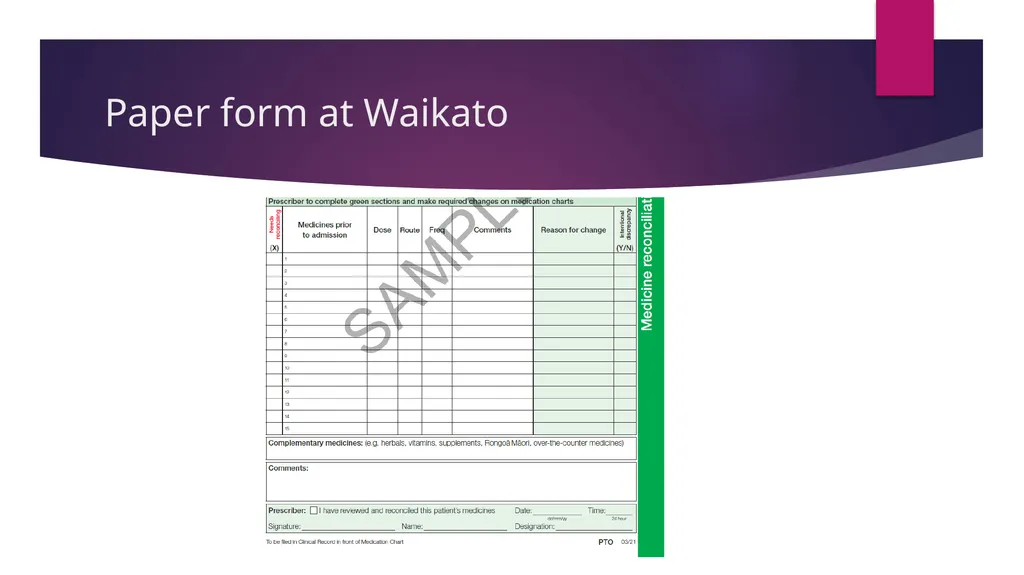
Paper form at Waikato<br>
18
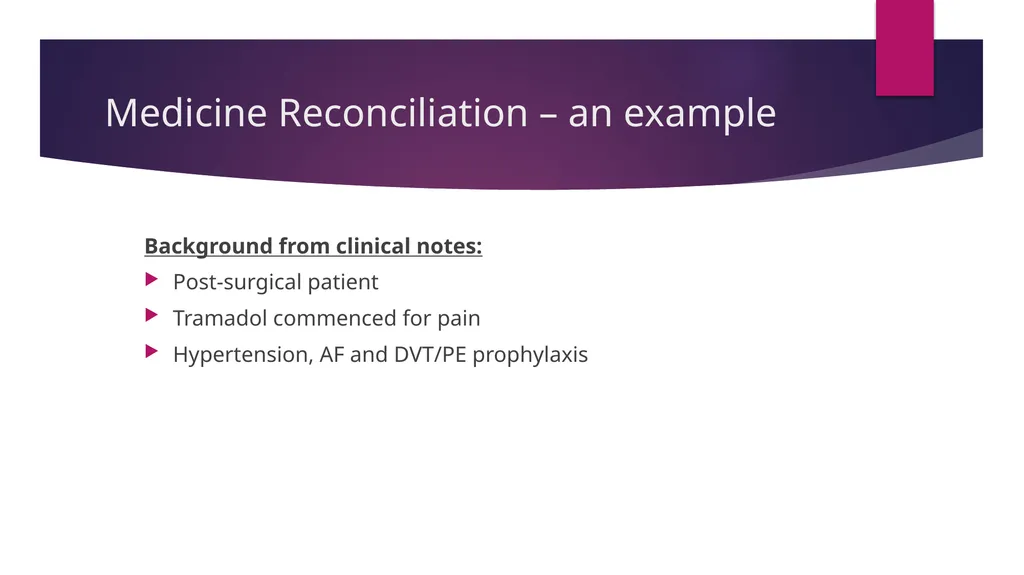
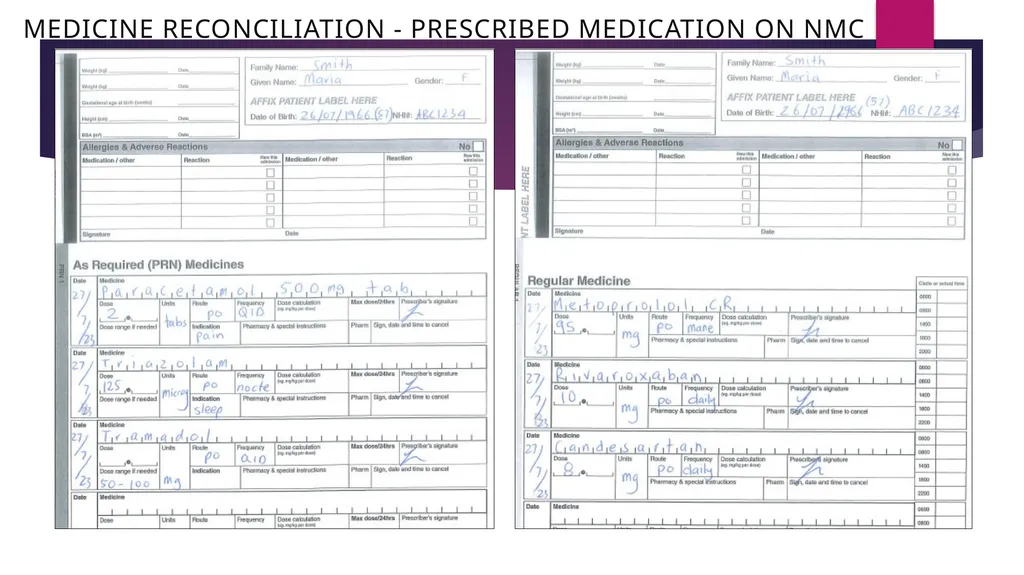
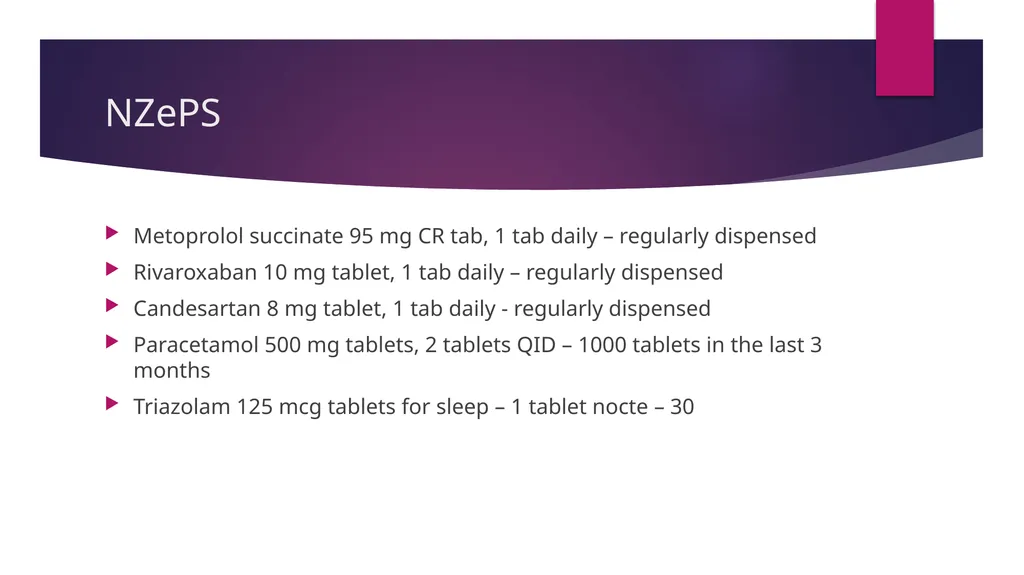
Medicine Reconciliation – an example Background from clinical notes:
Post-surgical patient
Tramadol commenced for pain
Hypertension, AF and DVT/PE prophylaxis<br>
19
Medicine Reconciliation - prescribed medication on NMC<br>
Other useful resources, references Jessica Nand and Dr Mark Beale talk about medicine reconciliation in NZ | Health Quality & Safety Commission (hqsc.govt.nz)
Medicine Reconciliation | Health Quality & Safety Commission (hqsc.govt.nz)