Metacognition Higher Order Thinking Skills Blooms Taxonomy What is Blooms Taxonomy? SynthesisCreation Evaluation Analysis Application Comprehension Knowledge Higher Order Thinking 7 Survival Skills for the 21st Century (The Global
"Metacognition & Higher Order Thinking Skills" is the property of its rightful owner. Permission is granted to
download and print the materials on this website for personal, non-commercial use only, and to display it
on your personal computer provided you do not modify the materials and that you retain all copyright
notices contained in the materials. By downloading content from our website, you accept the terms of this
agreement.
Presentation Transcript
01
Metacognition & Higher Order Thinking Skills Bloom’s Taxonomy<br>
02
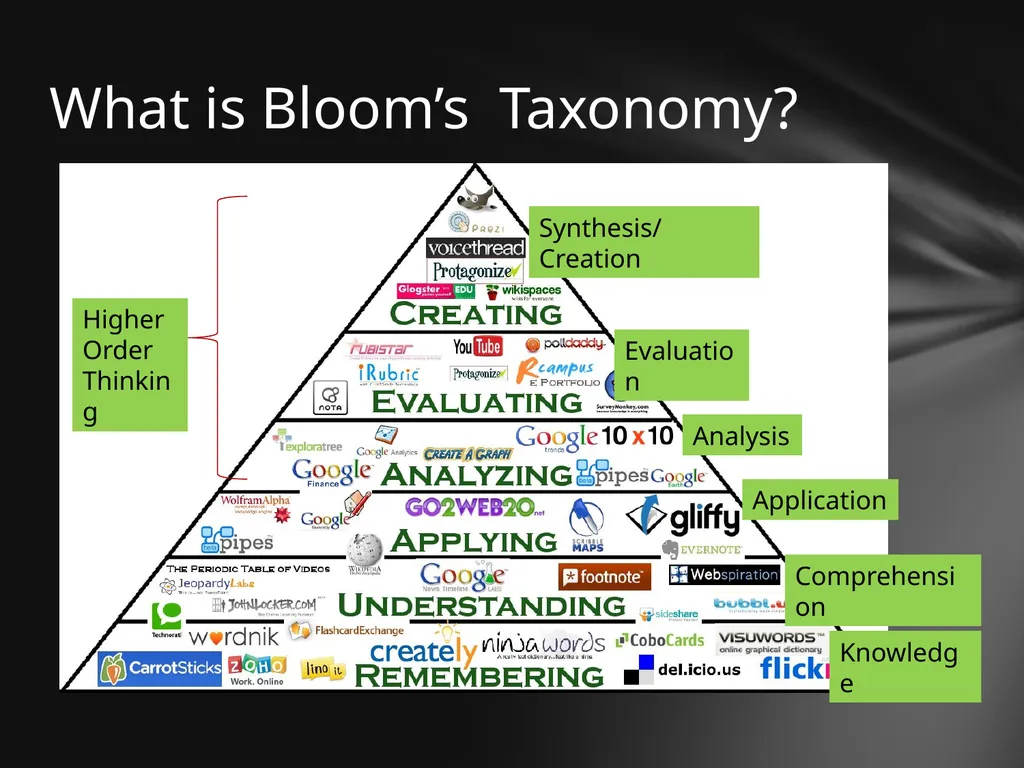
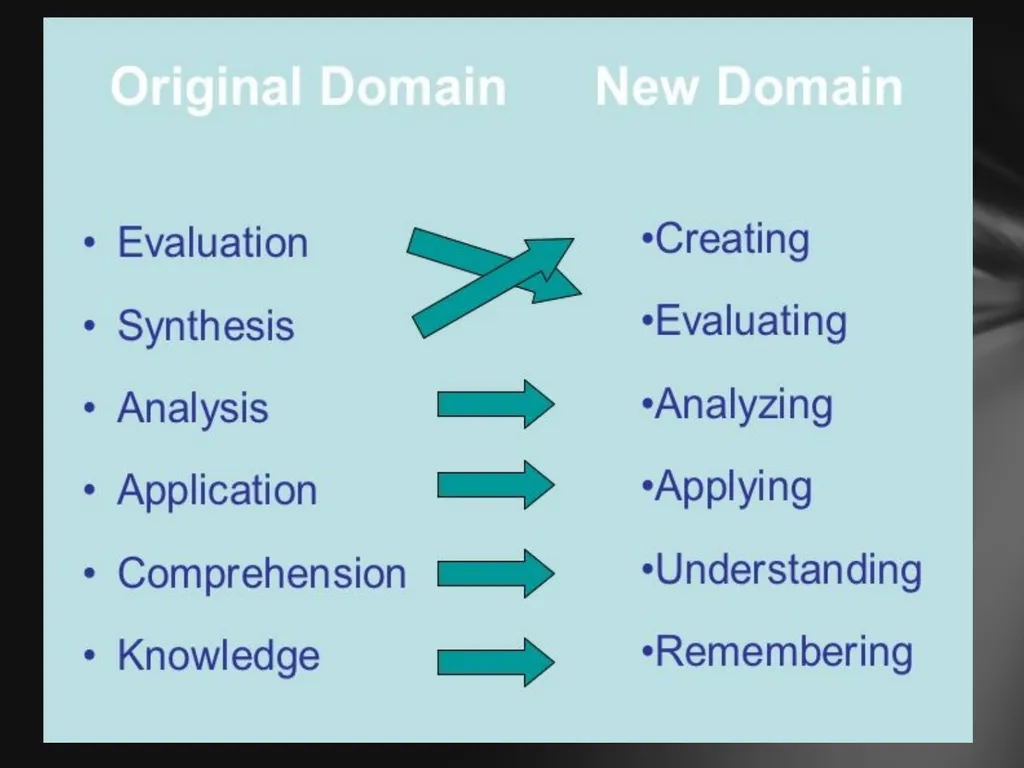
What is Bloom’s Taxonomy? Synthesis/Creation Evaluation Analysis Application Comprehension Knowledge Higher
Order
Thinking<br>
03
7 Survival Skills for the 21st Century
(The Global Achievement Gap by Tony Wagner)
#1: Critical Thinking and Problem Solving
Defined: The ability to ask good questions. Why is Bloom’s Taxonomy important to me?<br>
04
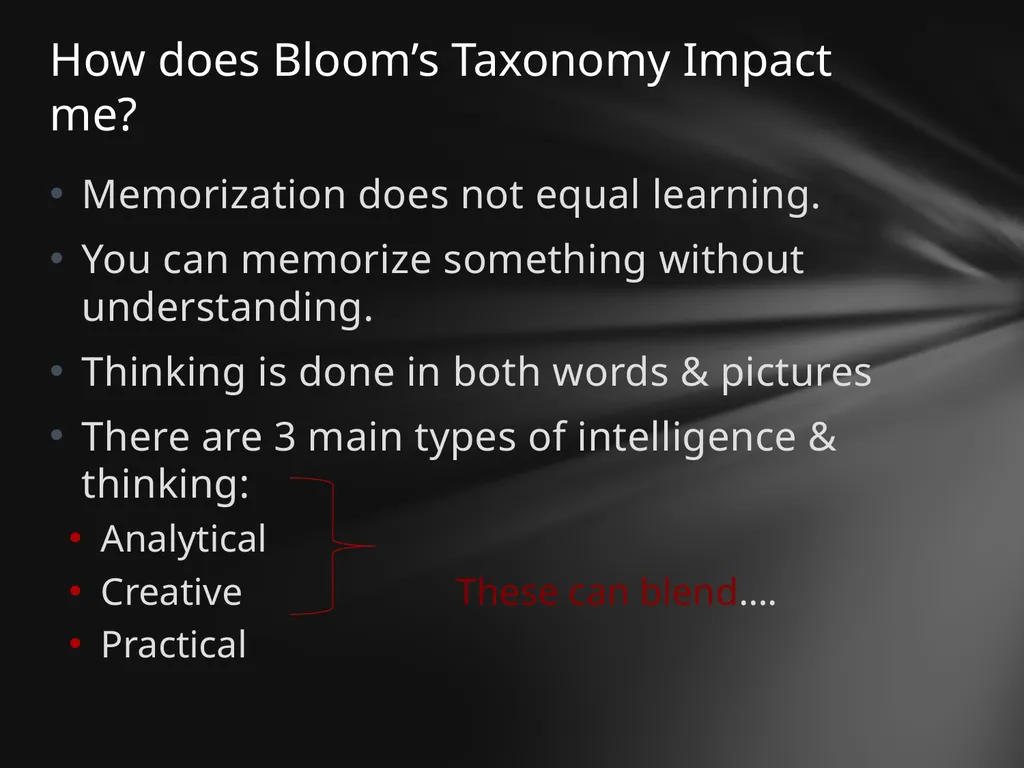
Memorization does not equal learning.
You can memorize something without understanding.
Thinking is done in both words & pictures
There are 3 main types of intelligence & thinking:
Analytical
Creative These can blend….
Practical How does Bloom’s Taxonomy Impact me?<br>
05
You can improve your thinking skills by understanding the processes involved in thinking.
Metacognition = thinking about thinking. Metacognition<br>
06
No memorization
We must do something with the facts we discover
This is where Bloom’s Taxonomy comes in…. Higher Order Thinking<br>
07
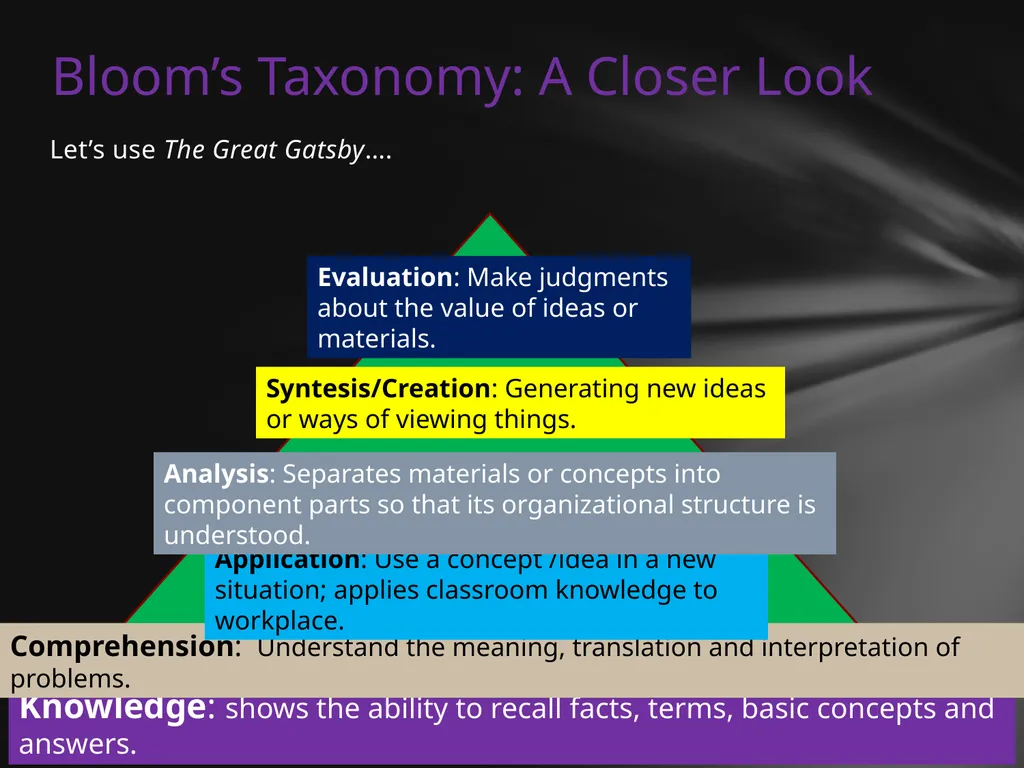
Let’s use The Great Gatsby…. Bloom’s Taxonomy: A Closer Look Knowledge: shows the ability to recall facts, terms, basic concepts and answers. Comprehension: Understand the meaning, translation and interpretation of problems. Application: Use a concept /idea in a new situation; applies classroom knowledge to workplace. Analysis: Separates materials or concepts into component parts so that its organizational structure is understood. Syntesis/Creation: Generating new ideas or ways of viewing things. Evaluation: Make judgments about the value of ideas or materials.<br>
08
Let’s use The Great Gatsby…. Bloom’s Taxonomy in Action Knowledge: How does Nick described Gatsby in Chapter 1? Comprehension: How would you summarize the conversation between Gatsby and Tom in the hotel in Chapter 7? Application: Predict what would happen if Daisy had shown up at one of Gatsby’s parties ? Analysis: Compare and contrast the women in Gatsby: Daisy, Jordan, and Myrtle? Synthesis/Creation: Create an alternate ending where Gatsby is not murdered. Evaluation: First, critique Tom’s character and then defend his actions.<br>
09
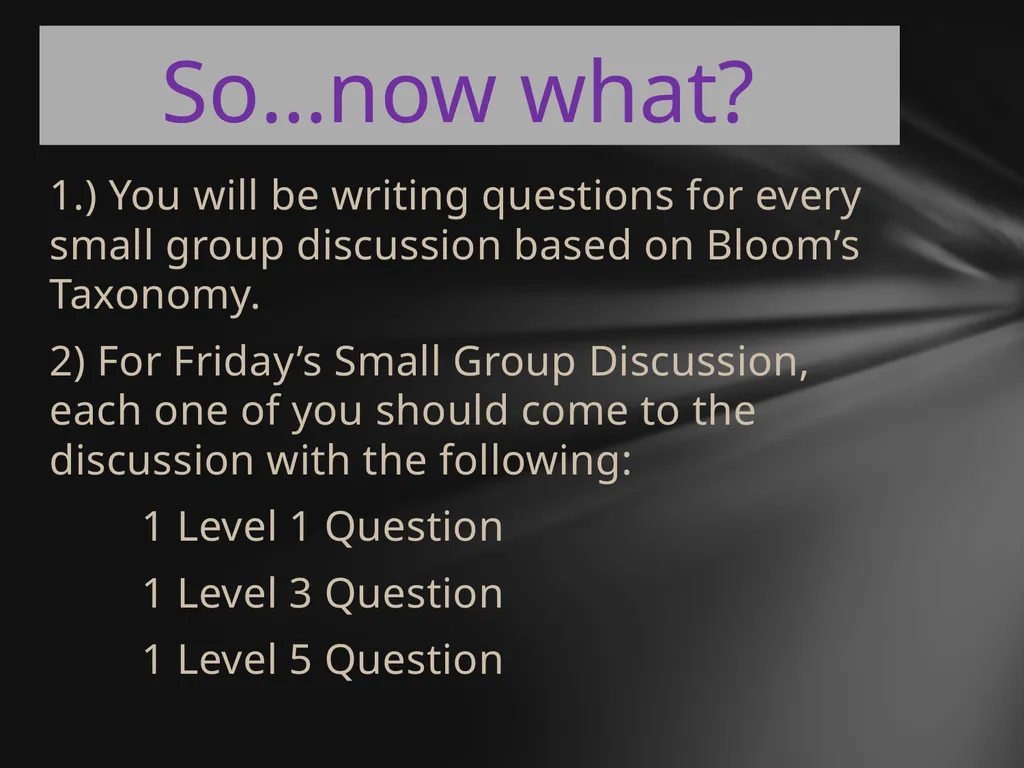
1.) You will be writing questions for every small group discussion based on Bloom’s Taxonomy.
2) For Friday’s Small Group Discussion, each one of you should come to the discussion with the following:
1 Level 1 Question
1 Level 3 Question
1 Level 5 Question So…now what?<br>
10
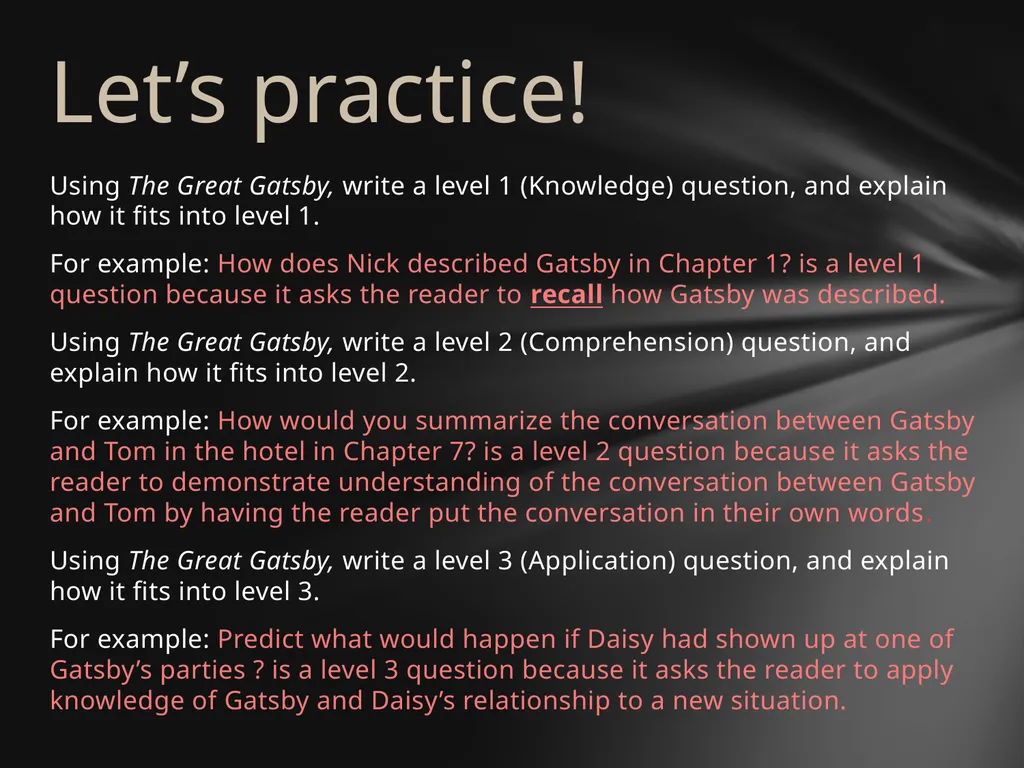
Using The Great Gatsby, write a level 1 (Knowledge) question, and explain how it fits into level 1.
For example: How does Nick described Gatsby in Chapter 1? is a level 1 question because it asks the reader to recall how Gatsby was described.
Using The Great Gatsby, write a level 2 (Comprehension) question, and explain how it fits into level 2.
For example: How would you summarize the conversation between Gatsby and Tom in the hotel in Chapter 7? is a level 2 question because it asks the reader to demonstrate understanding of the conversation between Gatsby and Tom by having the reader put the conversation in their own words.
Using The Great Gatsby, write a level 3 (Application) question, and explain how it fits into level 3.
For example: Predict what would happen if Daisy had shown up at one of Gatsby’s parties ? is a level 3 question because it asks the reader to apply knowledge of Gatsby and Daisy’s relationship to a new situation. Let’s practice!<br>
11
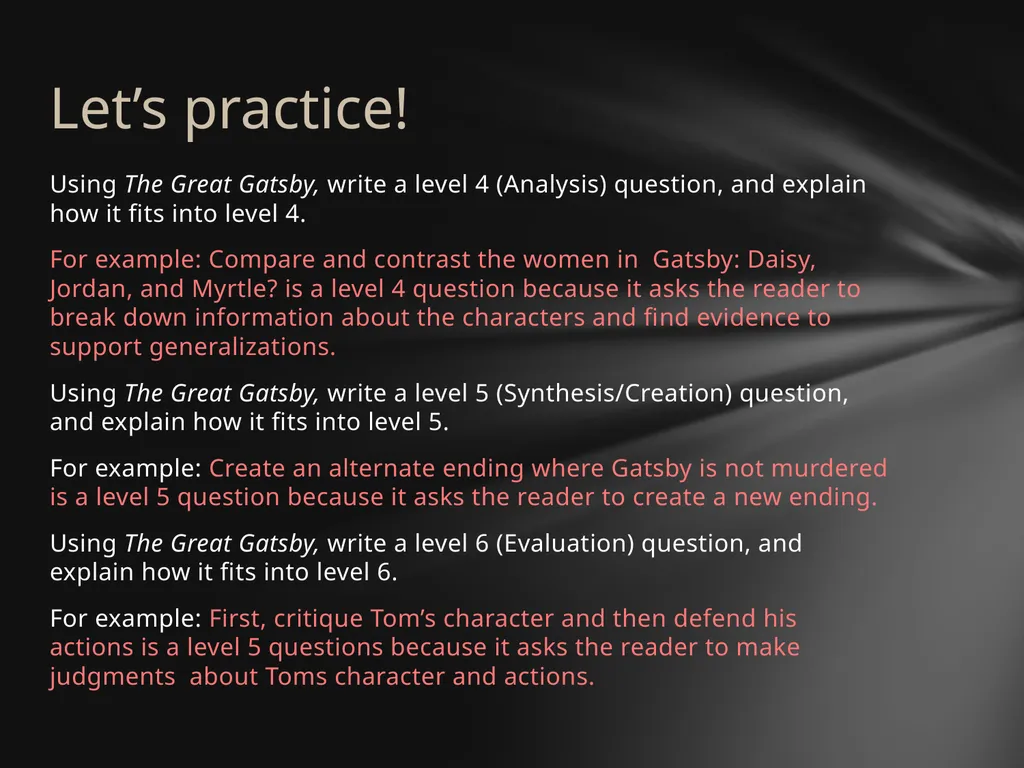
Using The Great Gatsby, write a level 4 (Analysis) question, and explain how it fits into level 4.
For example: Compare and contrast the women in Gatsby: Daisy, Jordan, and Myrtle? is a level 4 question because it asks the reader to break down information about the characters and find evidence to support generalizations.
Using The Great Gatsby, write a level 5 (Synthesis/Creation) question, and explain how it fits into level 5.
For example: Create an alternate ending where Gatsby is not murdered is a level 5 question because it asks the reader to create a new ending.
Using The Great Gatsby, write a level 6 (Evaluation) question, and explain how it fits into level 6.
For example: First, critique Tom’s character and then defend his actions is a level 5 questions because it asks the reader to make judgments about Toms character and actions. Let’s practice!<br>