
Metal Casting Visit for more Learning Resources
YM
Published · 77 slides · 0 views

1 / 1





Description
Metal Casting Visit for more Learning Resources Identify and select proper manufacturing process for a specific component. CO METAL CASTING History of Casting Why Casting? Basic casting process Basic terms used in casting Steps in casting
Related Topics
Share
Embed code
Download this presentation From Below
"Metal Casting Visit for more Learning Resources" is the property of its rightful owner. Permission is granted to download and print the materials on this website for personal, non-commercial use only, and to display it on your personal computer provided you do not modify the materials and that you retain all copyright notices contained in the materials. By downloading content from our website, you accept the terms of this agreement.
Presentation Transcript
01
Metal Casting Visit for more Learning Resources<br>
02
Identify and select proper manufacturing process for a specific component. CO<br>
03
METAL CASTING History of Casting
Why Casting?
Basic casting process
Basic terms used in casting
Steps in casting process<br>
Why Casting?
Basic casting process
Basic terms used in casting
Steps in casting process<br>
04
Introduction A process based on the property of liquid to take up the shape of the vessel containing it.
A cavity of desired shape is made, contained in a mold.
Carried out in a foundry.<br>
A cavity of desired shape is made, contained in a mold.
Carried out in a foundry.<br>
05
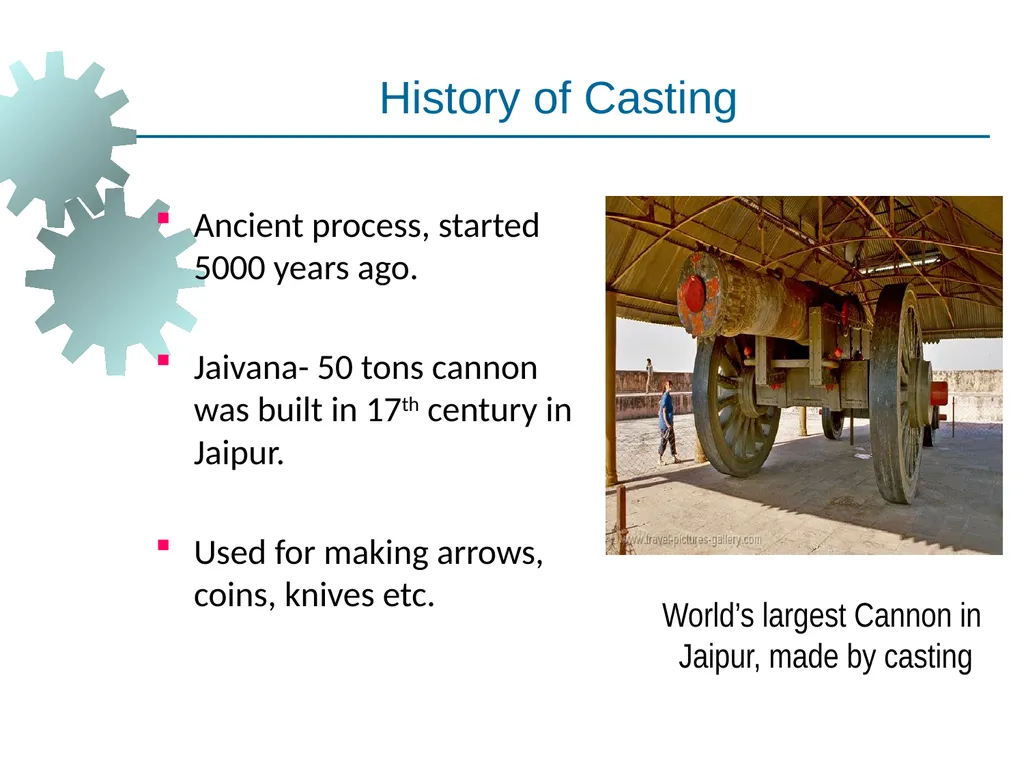
History of Casting Ancient process, started 5000 years ago.
Jaivana- 50 tons cannon was built in 17th century in Jaipur.
Used for making arrows, coins, knives etc. World’s largest Cannon in
Jaipur, made by casting<br>
Jaivana- 50 tons cannon was built in 17th century in Jaipur.
Used for making arrows, coins, knives etc. World’s largest Cannon in
Jaipur, made by casting<br>
06
Why Casting? A job of 5m diameter and 10m length.
A job with a hole of 2m diameter, made of very hard material.
Parts of very complicated shapes.<br>
A job with a hole of 2m diameter, made of very hard material.
Parts of very complicated shapes.<br>
07
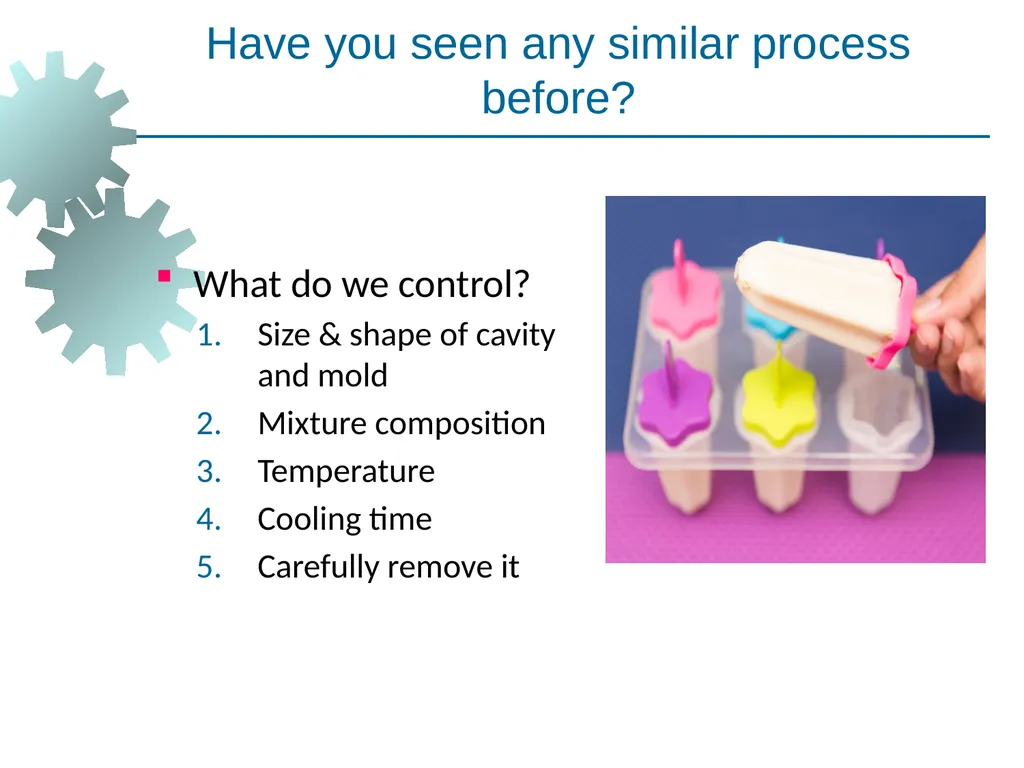
Have you seen any similar process before? What do we control?
Size & shape of cavity and mold
Mixture composition
Temperature
Cooling time
Carefully remove it<br>
Size & shape of cavity and mold
Mixture composition
Temperature
Cooling time
Carefully remove it<br>
08
Requirement for Casting? Cavity of desired shape- Mold
Molten metal
Proper channel to fill the molten metal<br>
Molten metal
Proper channel to fill the molten metal<br>
09
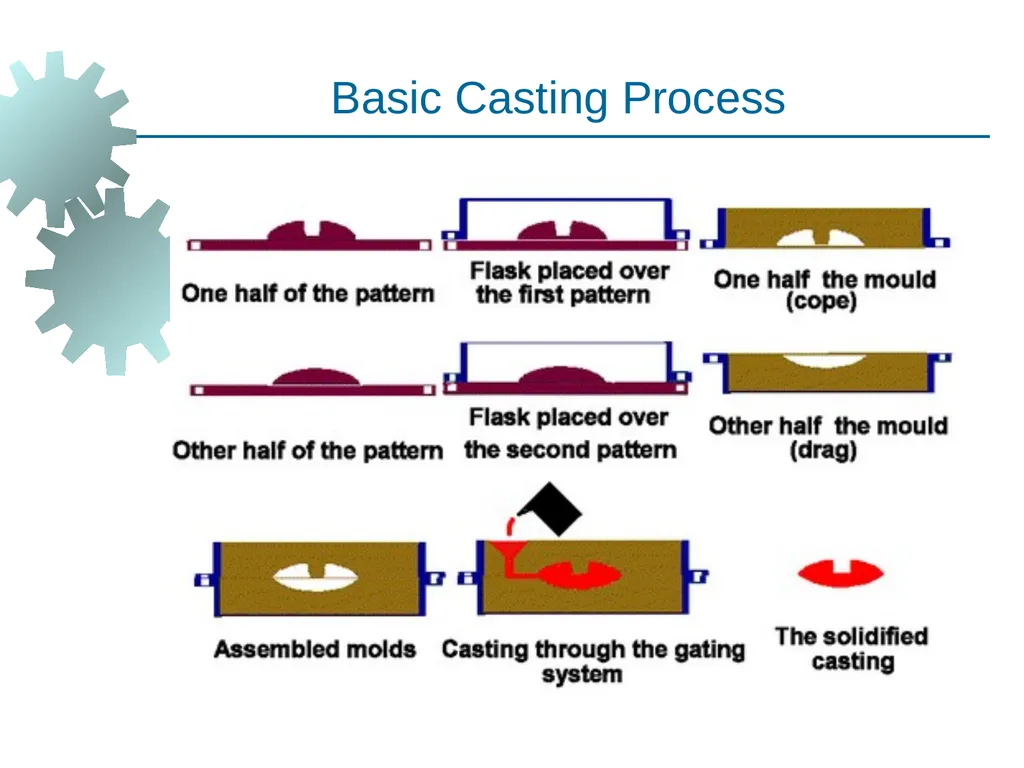
Basic Casting Process<br>
10
Basic Casting Process<br>
11
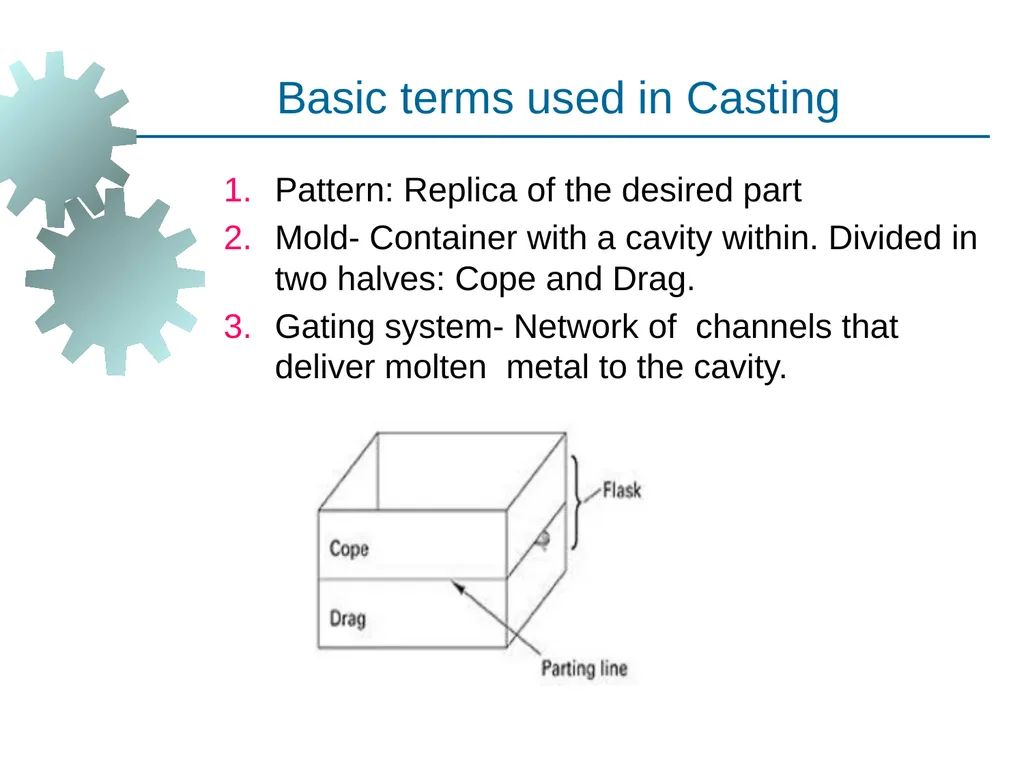
Basic terms used in Casting Pattern: Replica of the desired part
Mold- Container with a cavity within. Divided in two halves: Cope and Drag.
Gating system- Network of channels that deliver molten metal to the cavity.<br>
Mold- Container with a cavity within. Divided in two halves: Cope and Drag.
Gating system- Network of channels that deliver molten metal to the cavity.<br>
12
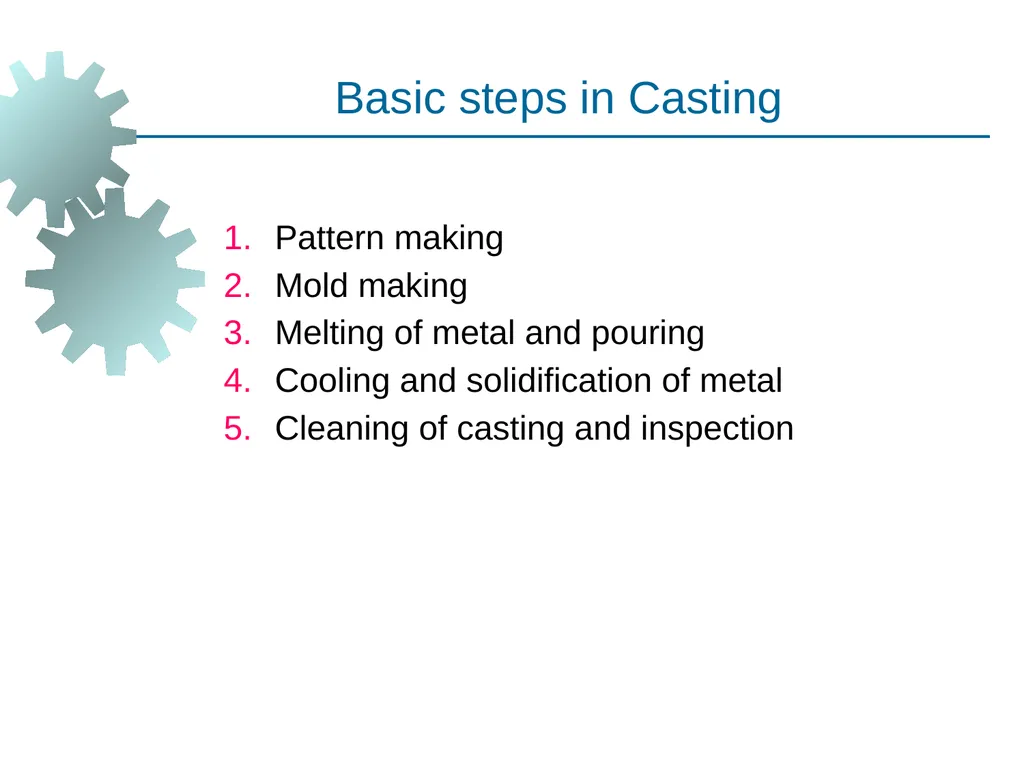
Basic steps in Casting Pattern making
Mold making
Melting of metal and pouring
Cooling and solidification of metal
Cleaning of casting and inspection<br>
Mold making
Melting of metal and pouring
Cooling and solidification of metal
Cleaning of casting and inspection<br>
13
Pattern Replica of the desired product
Has somehow different dimensions than the actual part to be manufactured
Used to form the mold cavity
Materials used
Types of patterns
Pattern Allowances<br>
Has somehow different dimensions than the actual part to be manufactured
Used to form the mold cavity
Materials used
Types of patterns
Pattern Allowances<br>
14
Pattern Materials Requirements:
Easily shaped, worked, machined and joined
Resistant to wear and corrosion
Resistant to chemical action
Dimensionally stable
Easily available and economical<br>
Easily shaped, worked, machined and joined
Resistant to wear and corrosion
Resistant to chemical action
Dimensionally stable
Easily available and economical<br>
15
Pattern Materials Wood:
Easy availability, low weight and low cost
Can be easily shaped
More than 90% castings use wood patterns
Absorbs moisture. So, distortions and dimensional changes occur
Relatively lower life, hence suitable for small quantity production<br>
Easy availability, low weight and low cost
Can be easily shaped
More than 90% castings use wood patterns
Absorbs moisture. So, distortions and dimensional changes occur
Relatively lower life, hence suitable for small quantity production<br>
16
Pattern Materials 2. Metal:
Used for large quantity production and for closer dimensional tolerances
Longer life
Aluminum is mostly used.
Other metals: cast iron, brass etc.<br>
Used for large quantity production and for closer dimensional tolerances
Longer life
Aluminum is mostly used.
Other metals: cast iron, brass etc.<br>
17
Pattern Materials 3. Plastic:
Low weight, easier formability, smooth surfaces and durability
Do not absorb moisture. So, dimensionally stable
Corrosion resistance<br>
Low weight, easier formability, smooth surfaces and durability
Do not absorb moisture. So, dimensionally stable
Corrosion resistance<br>
18
Pattern Materials 4. Polystyrene:
Changes to gaseous state on heating
Disposable Patterns. Hence, suitable for single casting.
When molten metal is poured into cavity, polystyrene transforms to gaseous state.
Used mostly for small and complicated shaped castings.<br>
Changes to gaseous state on heating
Disposable Patterns. Hence, suitable for single casting.
When molten metal is poured into cavity, polystyrene transforms to gaseous state.
Used mostly for small and complicated shaped castings.<br>
19
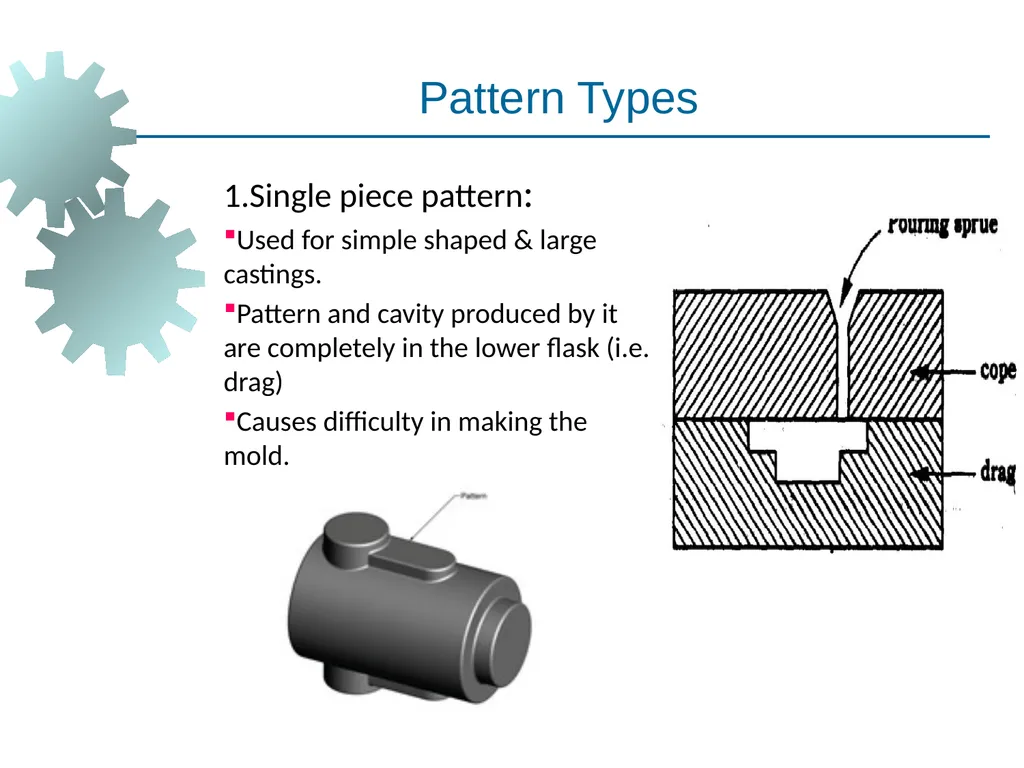
Pattern Types 1.Single piece pattern:
Used for simple shaped & large castings.
Pattern and cavity produced by it are completely in the lower flask (i.e. drag)
Causes difficulty in making the mold.<br>
Used for simple shaped & large castings.
Pattern and cavity produced by it are completely in the lower flask (i.e. drag)
Causes difficulty in making the mold.<br>
20
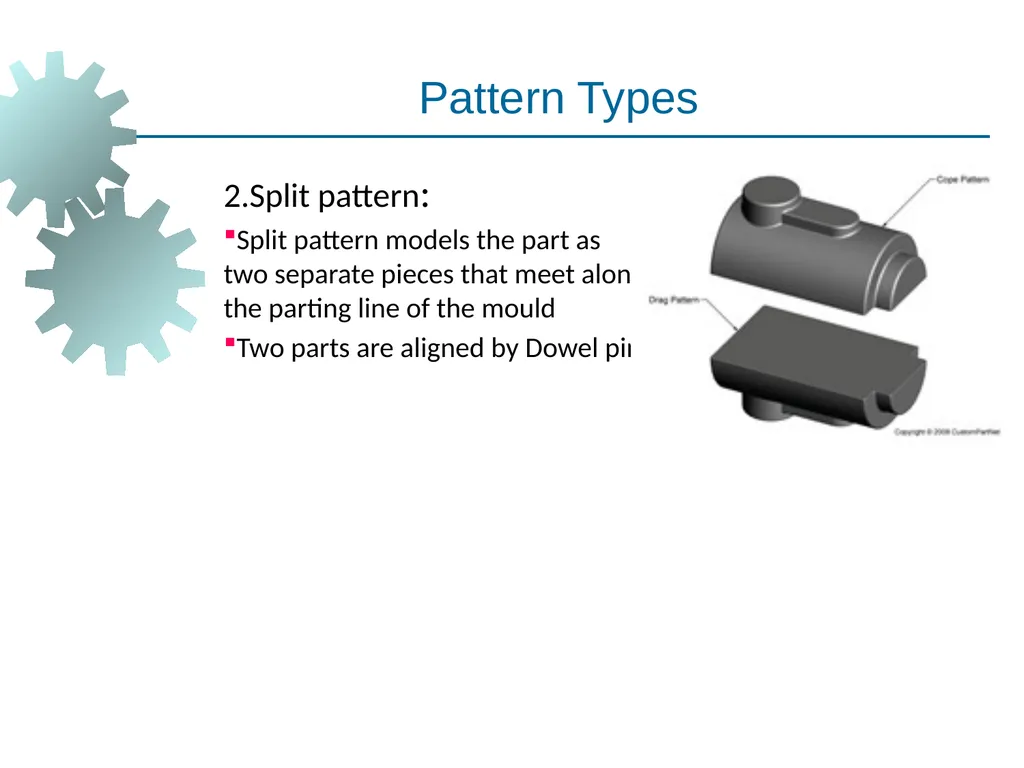
Pattern Types 2.Split pattern:
Split pattern models the part as two separate pieces that meet along the parting line of the mould
Two parts are aligned by Dowel pin.<br>
Split pattern models the part as two separate pieces that meet along the parting line of the mould
Two parts are aligned by Dowel pin.<br>
21
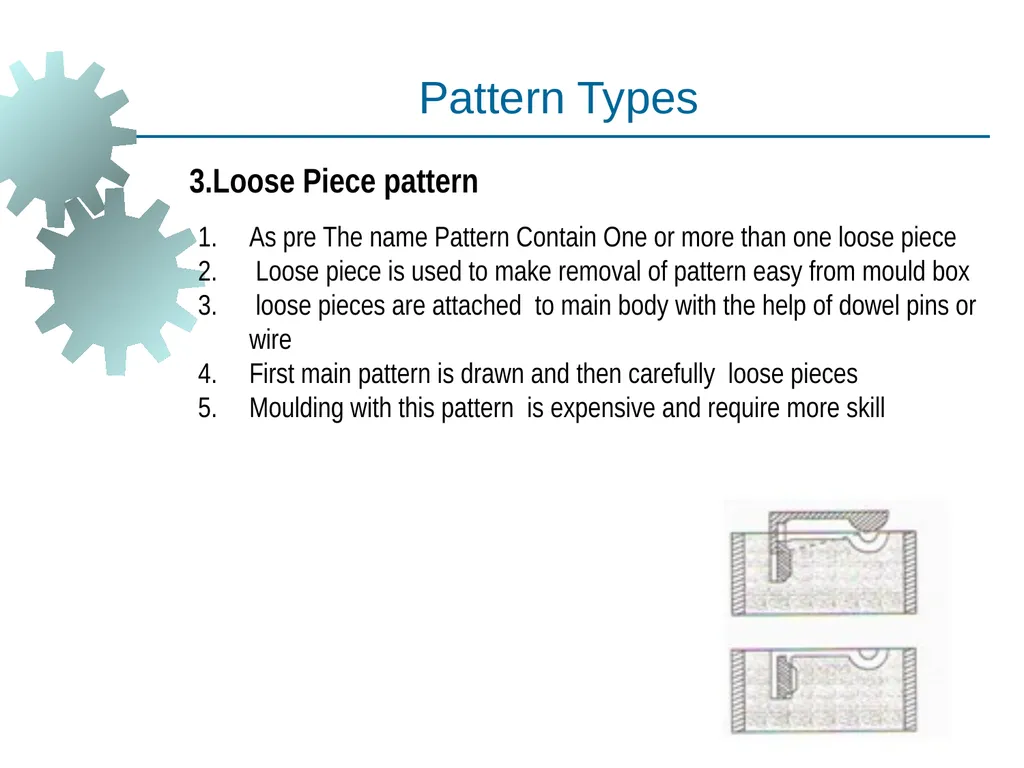
Pattern Types As pre The name Pattern Contain One or more than one loose piece
Loose piece is used to make removal of pattern easy from mould box
loose pieces are attached to main body with the help of dowel pins or wire
First main pattern is drawn and then carefully loose pieces
Moulding with this pattern is expensive and require more skill 3.Loose Piece pattern<br>
Loose piece is used to make removal of pattern easy from mould box
loose pieces are attached to main body with the help of dowel pins or wire
First main pattern is drawn and then carefully loose pieces
Moulding with this pattern is expensive and require more skill 3.Loose Piece pattern<br>
22
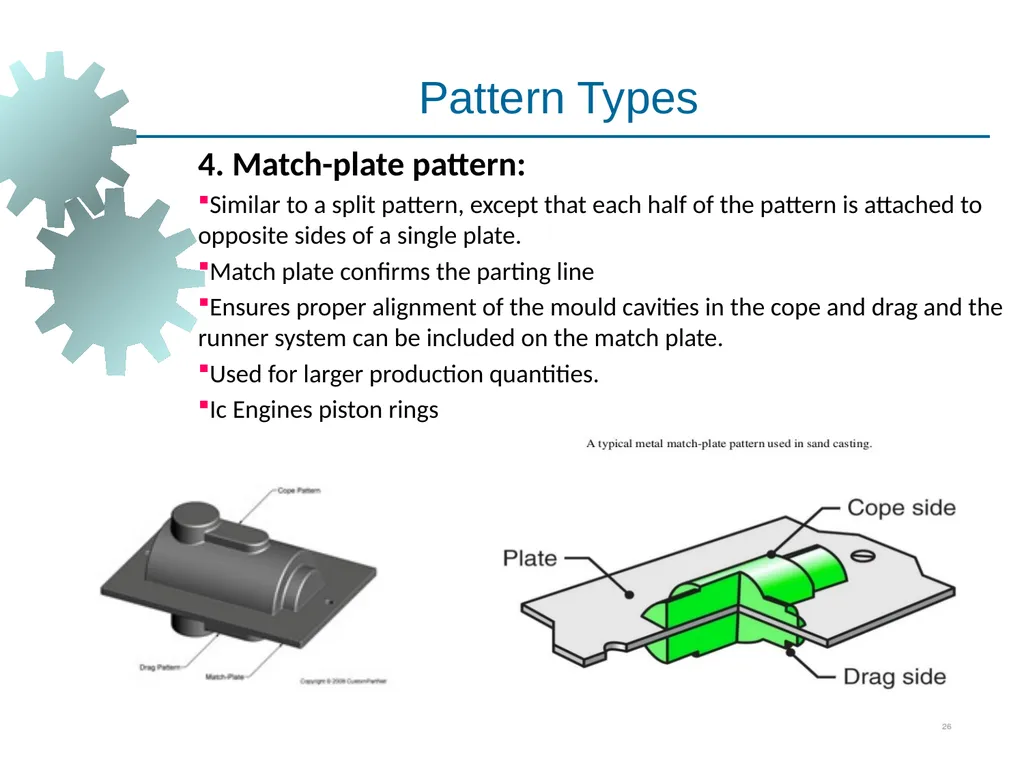
Pattern Types 4. Match-plate pattern:
Similar to a split pattern, except that each half of the pattern is attached to opposite sides of a single plate.
Match plate confirms the parting line
Ensures proper alignment of the mould cavities in the cope and drag and the runner system can be included on the match plate.
Used for larger production quantities.
Ic Engines piston rings<br>
Similar to a split pattern, except that each half of the pattern is attached to opposite sides of a single plate.
Match plate confirms the parting line
Ensures proper alignment of the mould cavities in the cope and drag and the runner system can be included on the match plate.
Used for larger production quantities.
Ic Engines piston rings<br>
23
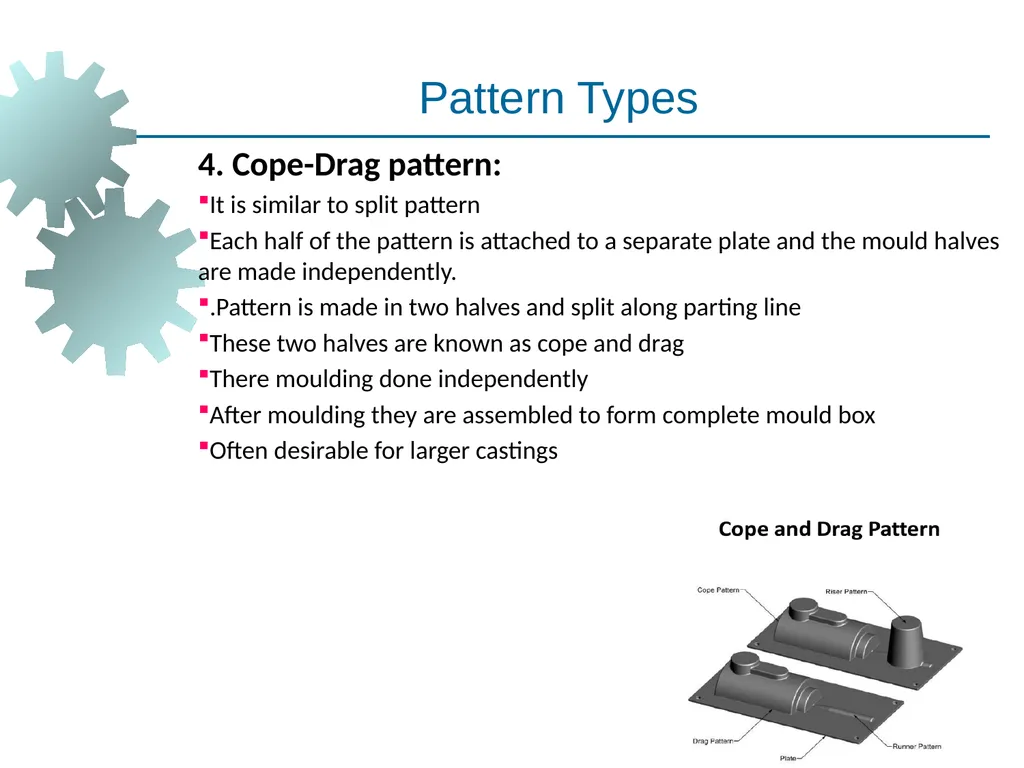
Pattern Types 4. Cope-Drag pattern:
It is similar to split pattern
Each half of the pattern is attached to a separate plate and the mould halves are made independently.
.Pattern is made in two halves and split along parting line
These two halves are known as cope and drag
There moulding done independently
After moulding they are assembled to form complete mould box
Often desirable for larger castings<br>
It is similar to split pattern
Each half of the pattern is attached to a separate plate and the mould halves are made independently.
.Pattern is made in two halves and split along parting line
These two halves are known as cope and drag
There moulding done independently
After moulding they are assembled to form complete mould box
Often desirable for larger castings<br>
24
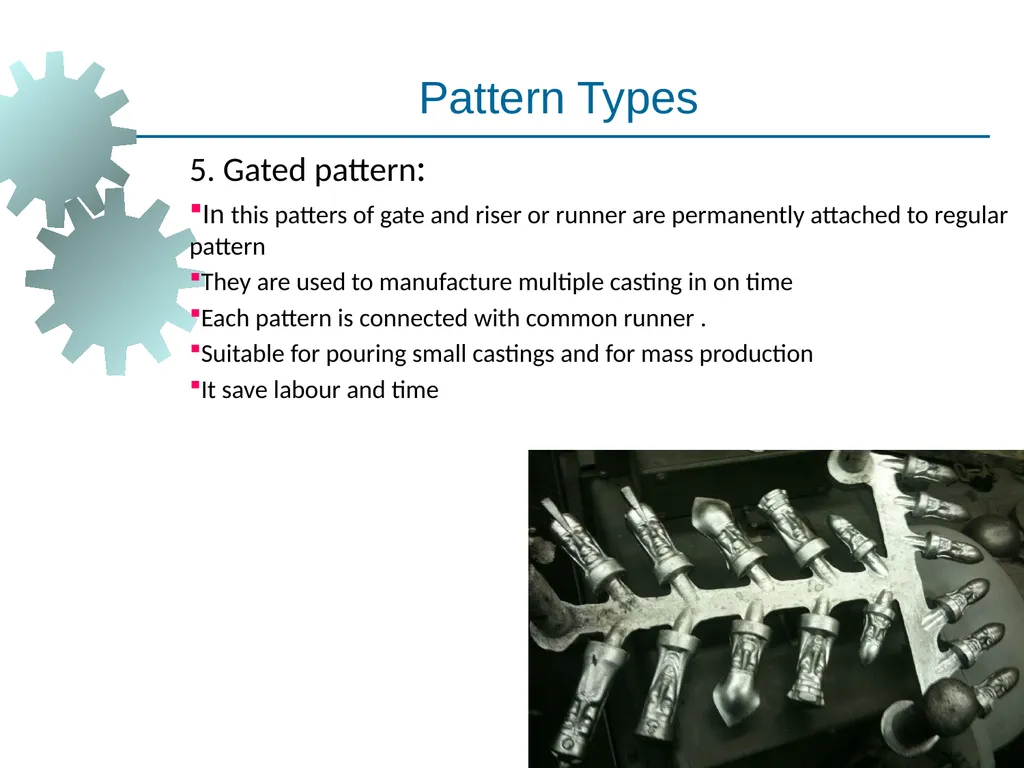
Pattern Types 5. Gated pattern:
In this patters of gate and riser or runner are permanently attached to regular pattern
They are used to manufacture multiple casting in on time
Each pattern is connected with common runner .
Suitable for pouring small castings and for mass production
It save labour and time<br>
In this patters of gate and riser or runner are permanently attached to regular pattern
They are used to manufacture multiple casting in on time
Each pattern is connected with common runner .
Suitable for pouring small castings and for mass production
It save labour and time<br>
25
Pattern Allowances Shrinkage or contraction allowance
Draft or taper allowance
Machining or finish allowance
Distortion or camber allowance
Rapping allowance<br>
Draft or taper allowance
Machining or finish allowance
Distortion or camber allowance
Rapping allowance<br>
26
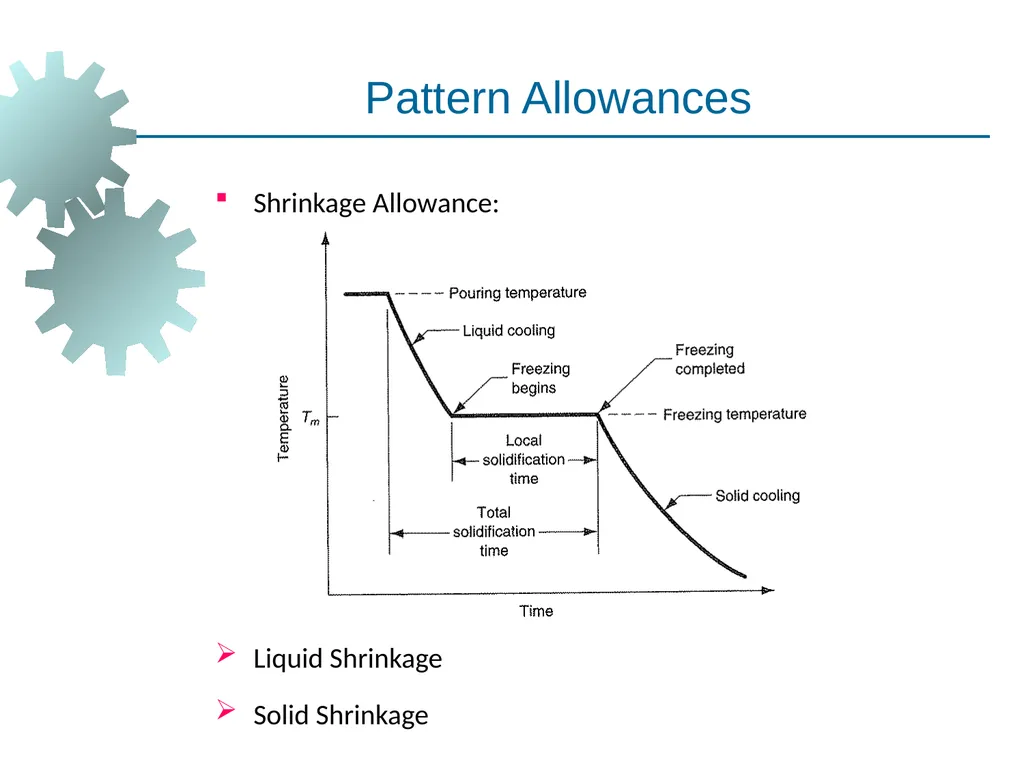
Pattern Allowances Shrinkage Allowance:
Liquid Shrinkage
Solid Shrinkage<br>
Liquid Shrinkage
Solid Shrinkage<br>
27
Pattern Allowances<br>
28
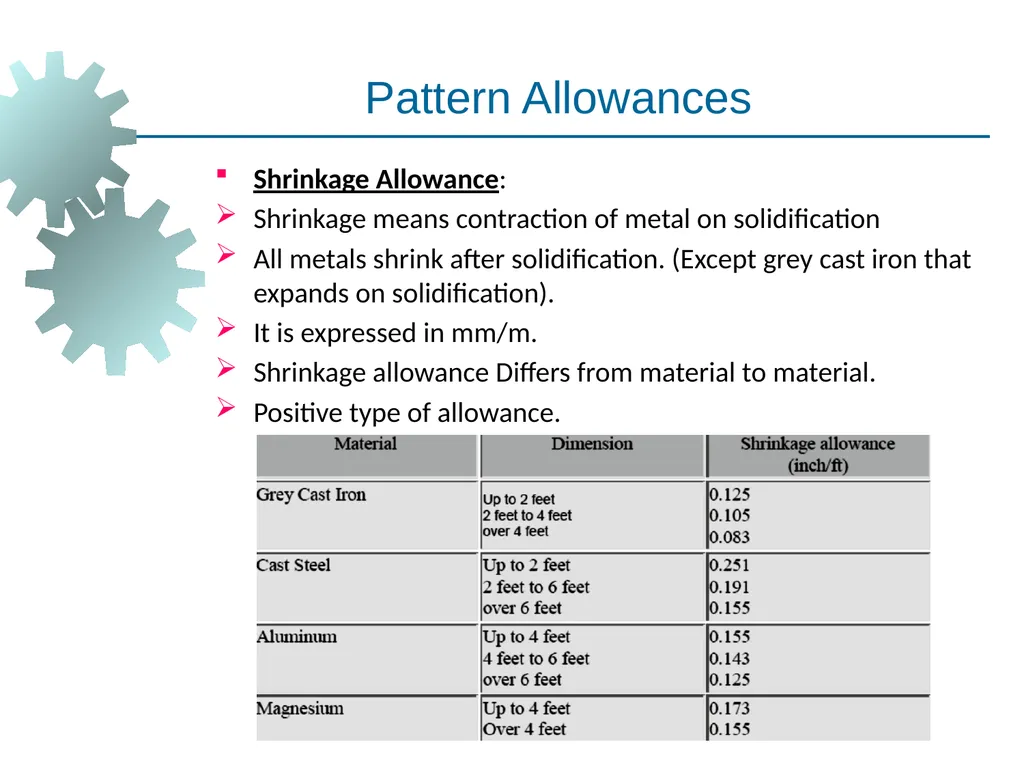
Pattern Allowances Shrinkage Allowance:
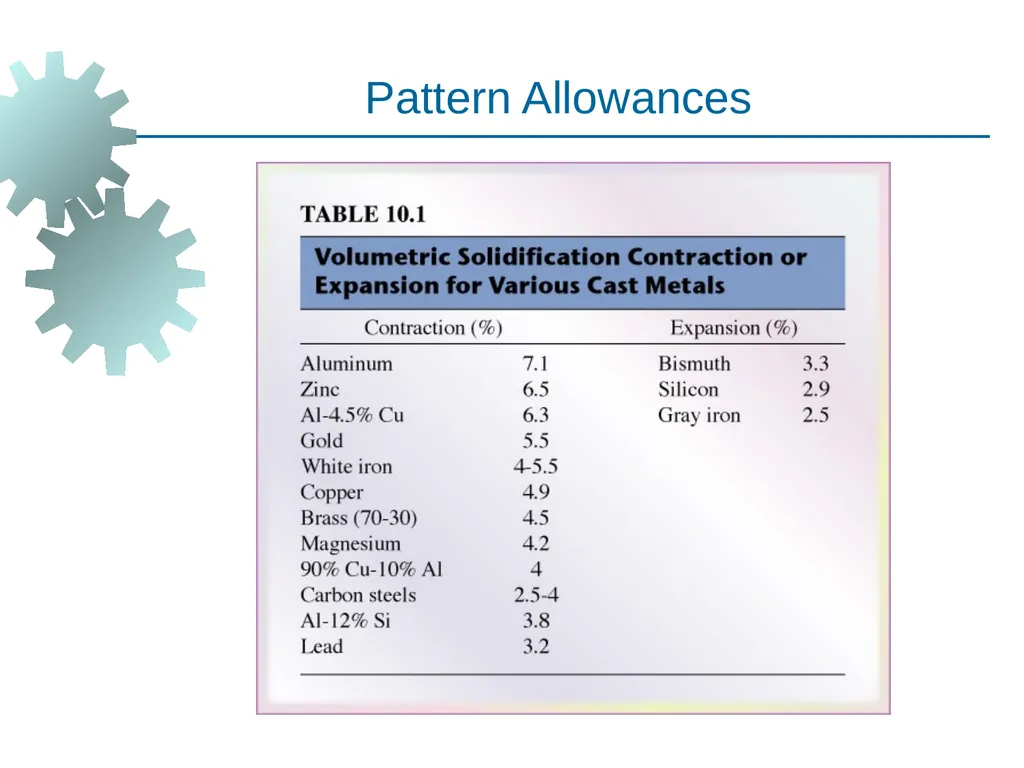
Shrinkage means contraction of metal on solidification
All metals shrink after solidification. (Except grey cast iron that expands on solidification).
It is expressed in mm/m.
Shrinkage allowance Differs from material to material.
Positive type of allowance.<br>
Shrinkage means contraction of metal on solidification
All metals shrink after solidification. (Except grey cast iron that expands on solidification).
It is expressed in mm/m.
Shrinkage allowance Differs from material to material.
Positive type of allowance.<br>
29
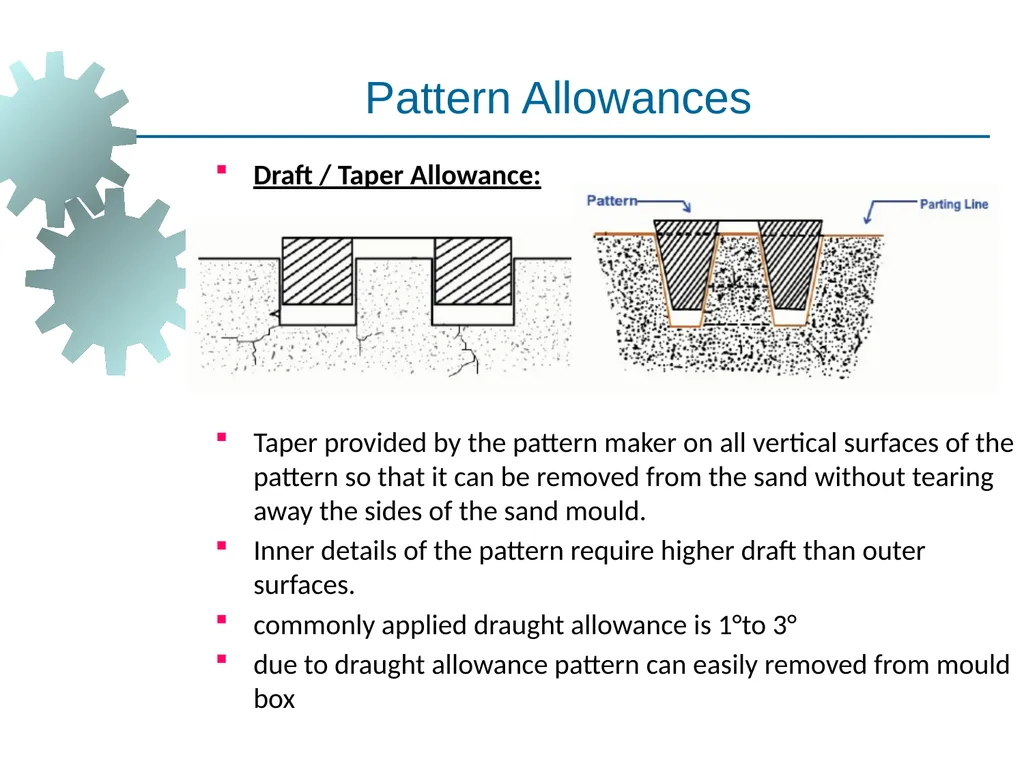
Pattern Allowances Draft / Taper Allowance:
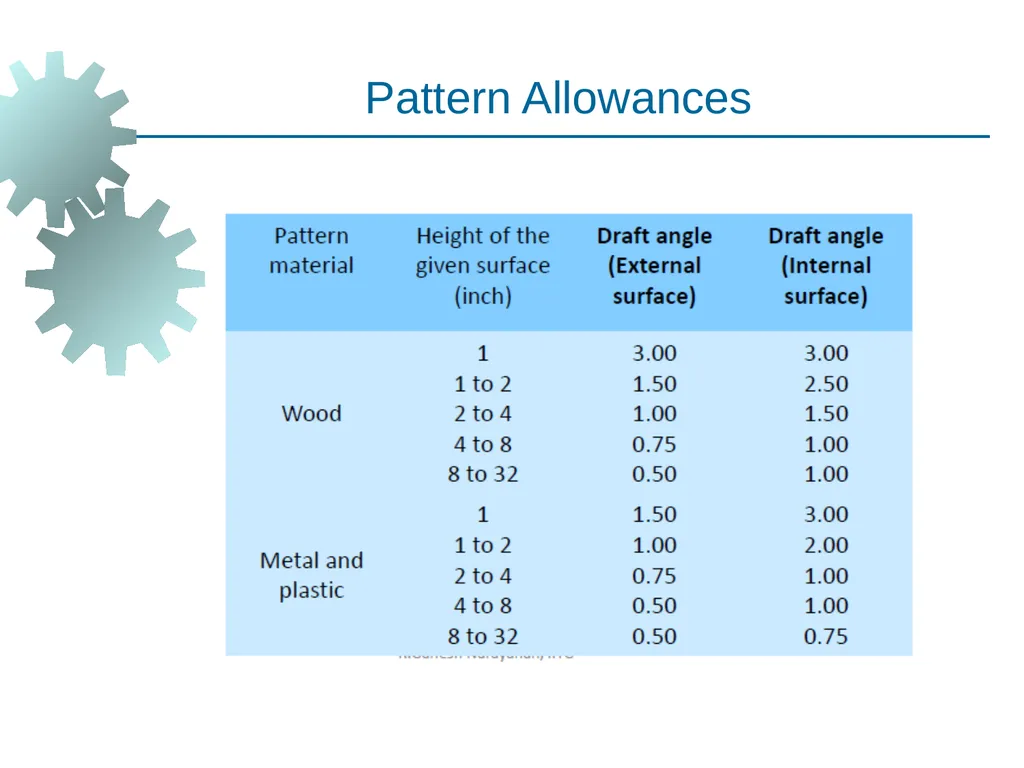
Taper provided by the pattern maker on all vertical surfaces of the pattern so that it can be removed from the sand without tearing away the sides of the sand mould.
Inner details of the pattern require higher draft than outer surfaces.
commonly applied draught allowance is 1°to 3°
due to draught allowance pattern can easily removed from mould box<br>
Taper provided by the pattern maker on all vertical surfaces of the pattern so that it can be removed from the sand without tearing away the sides of the sand mould.
Inner details of the pattern require higher draft than outer surfaces.
commonly applied draught allowance is 1°to 3°
due to draught allowance pattern can easily removed from mould box<br>
30
Pattern Allowances Draft / Taper Allowance:
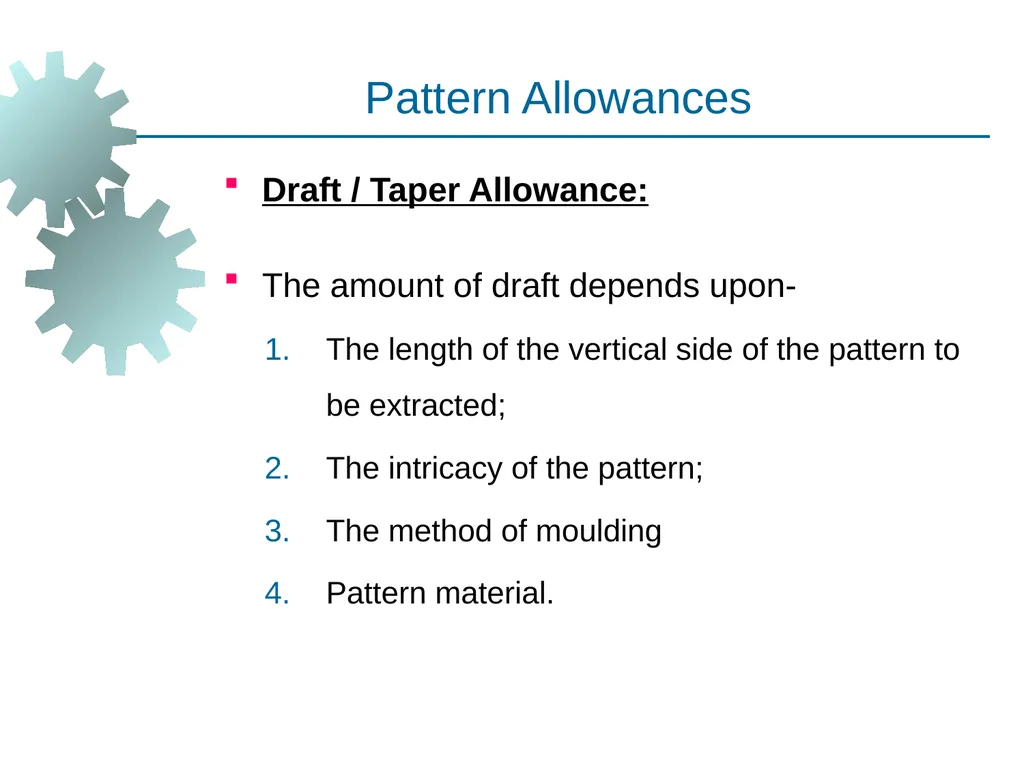
The amount of draft depends upon-
The length of the vertical side of the pattern to be extracted;
The intricacy of the pattern;
The method of moulding
Pattern material.<br>
The amount of draft depends upon-
The length of the vertical side of the pattern to be extracted;
The intricacy of the pattern;
The method of moulding
Pattern material.<br>
31
Pattern Allowances<br>
32
Pattern Allowances Machining / Finishing Allowance:
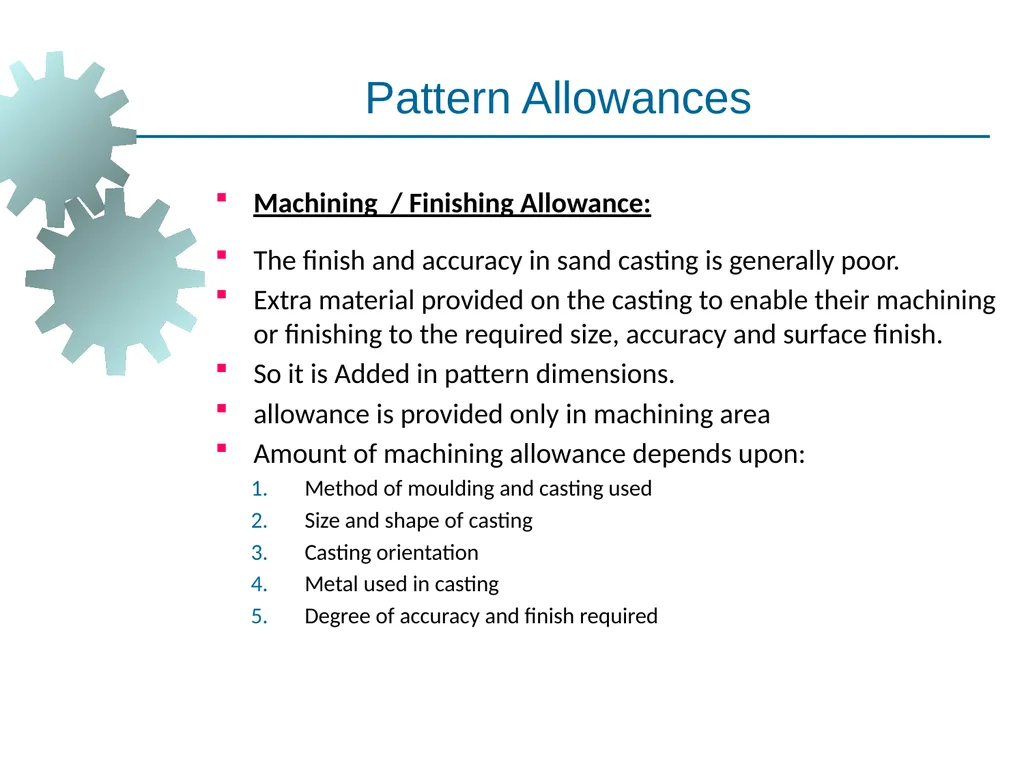
The finish and accuracy in sand casting is generally poor.
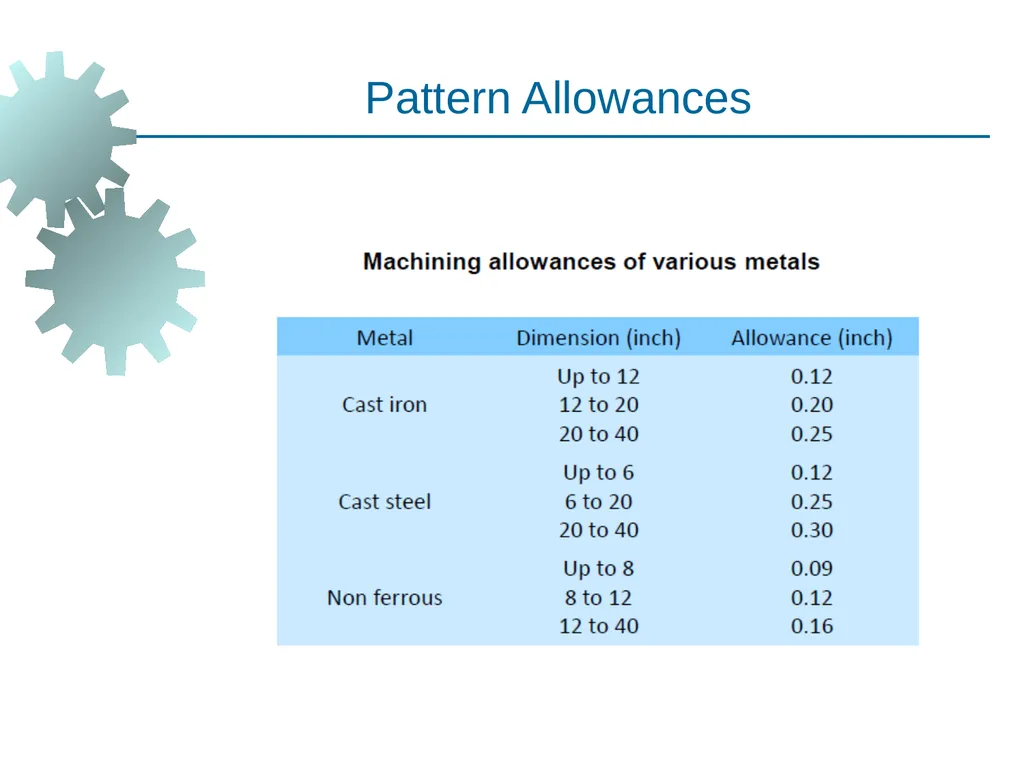
Extra material provided on the casting to enable their machining or finishing to the required size, accuracy and surface finish.
So it is Added in pattern dimensions.
allowance is provided only in machining area
Amount of machining allowance depends upon:
Method of moulding and casting used
Size and shape of casting
Casting orientation
Metal used in casting
Degree of accuracy and finish required<br>
The finish and accuracy in sand casting is generally poor.
Extra material provided on the casting to enable their machining or finishing to the required size, accuracy and surface finish.
So it is Added in pattern dimensions.
allowance is provided only in machining area
Amount of machining allowance depends upon:
Method of moulding and casting used
Size and shape of casting
Casting orientation
Metal used in casting
Degree of accuracy and finish required<br>
33
Pattern Allowances<br>
34
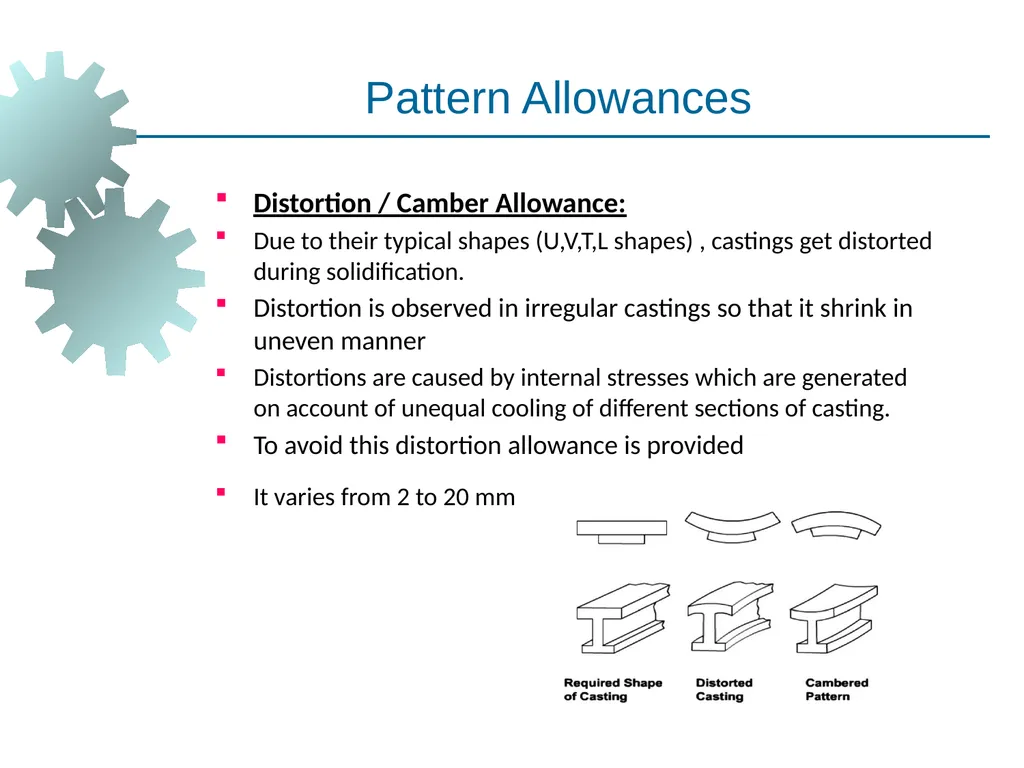
Pattern Allowances Distortion / Camber Allowance:
Due to their typical shapes (U,V,T,L shapes) , castings get distorted during solidification.
Distortion is observed in irregular castings so that it shrink in uneven manner
Distortions are caused by internal stresses which are generated on account of unequal cooling of different sections of casting.
To avoid this distortion allowance is provided
It varies from 2 to 20 mm<br>
Due to their typical shapes (U,V,T,L shapes) , castings get distorted during solidification.
Distortion is observed in irregular castings so that it shrink in uneven manner
Distortions are caused by internal stresses which are generated on account of unequal cooling of different sections of casting.
To avoid this distortion allowance is provided
It varies from 2 to 20 mm<br>
35
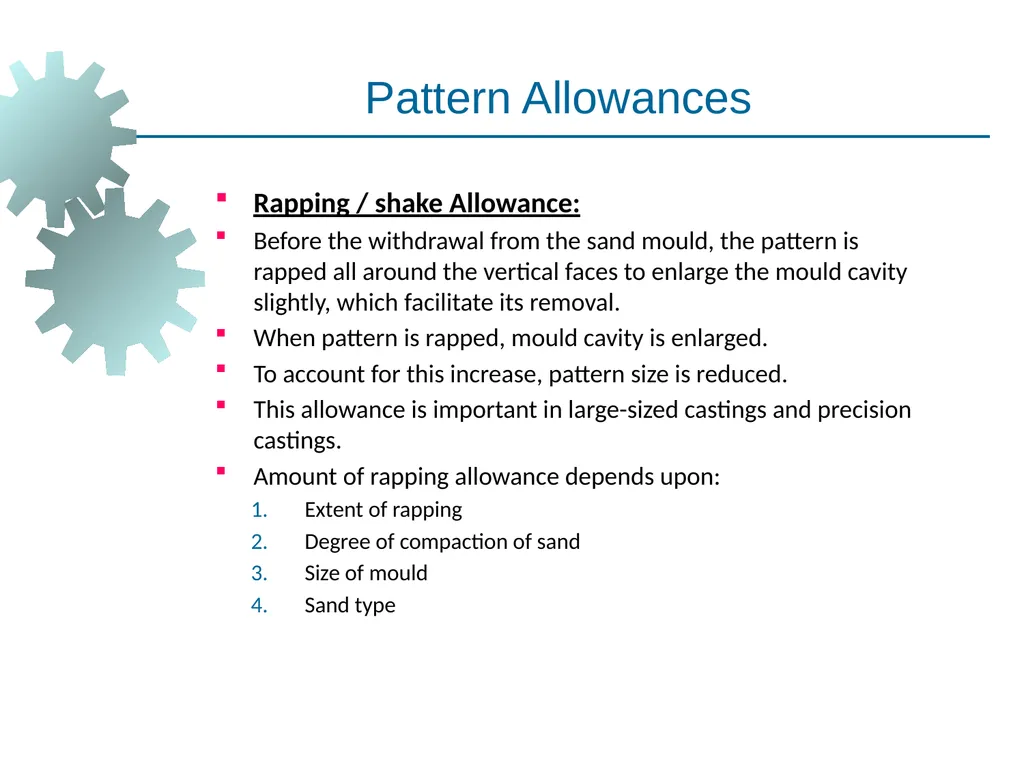
Pattern Allowances Rapping / shake Allowance:
Before the withdrawal from the sand mould, the pattern is rapped all around the vertical faces to enlarge the mould cavity slightly, which facilitate its removal.
When pattern is rapped, mould cavity is enlarged.
To account for this increase, pattern size is reduced.
This allowance is important in large-sized castings and precision castings.
Amount of rapping allowance depends upon:
Extent of rapping
Degree of compaction of sand
Size of mould
Sand type<br>
Before the withdrawal from the sand mould, the pattern is rapped all around the vertical faces to enlarge the mould cavity slightly, which facilitate its removal.
When pattern is rapped, mould cavity is enlarged.
To account for this increase, pattern size is reduced.
This allowance is important in large-sized castings and precision castings.
Amount of rapping allowance depends upon:
Extent of rapping
Degree of compaction of sand
Size of mould
Sand type<br>
36
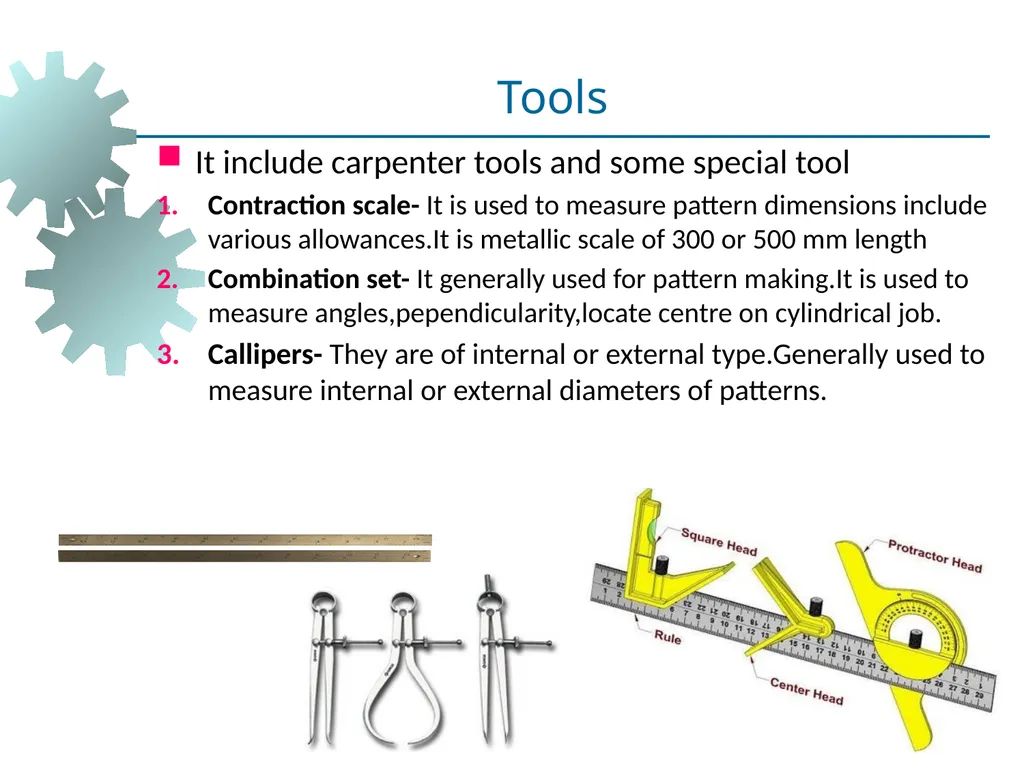
It include carpenter tools and some special tool
Contraction scale- It is used to measure pattern dimensions include various allowances.It is metallic scale of 300 or 500 mm length
Combination set- It generally used for pattern making.It is used to measure angles,pependicularity,locate centre on cylindrical job.
Callipers- They are of internal or external type.Generally used to measure internal or external diameters of patterns. Tools<br>
Contraction scale- It is used to measure pattern dimensions include various allowances.It is metallic scale of 300 or 500 mm length
Combination set- It generally used for pattern making.It is used to measure angles,pependicularity,locate centre on cylindrical job.
Callipers- They are of internal or external type.Generally used to measure internal or external diameters of patterns. Tools<br>
37
Ratchet brace- This is used to drill holes in horizontal and vertical plane.
Wheel brace- It produce only small holes. It can drill small holes accurately nd quickly.
Back saw and plane- They are used for Curtin and parting operations. Tools<br>
Wheel brace- It produce only small holes. It can drill small holes accurately nd quickly.
Back saw and plane- They are used for Curtin and parting operations. Tools<br>
38
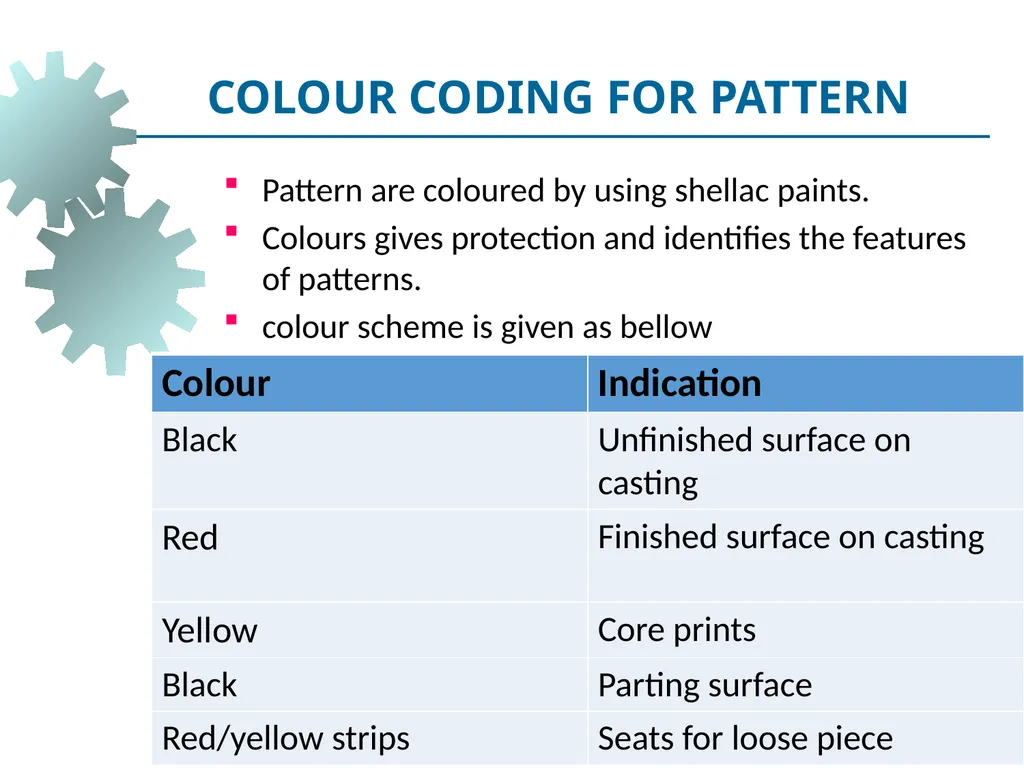
Pattern are coloured by using shellac paints.
Colours gives protection and identifies the features of patterns.
colour scheme is given as bellow COLOUR CODING FOR PATTERN<br>
Colours gives protection and identifies the features of patterns.
colour scheme is given as bellow COLOUR CODING FOR PATTERN<br>
39
COLOUR CODING FOR PATTERN<br>
40
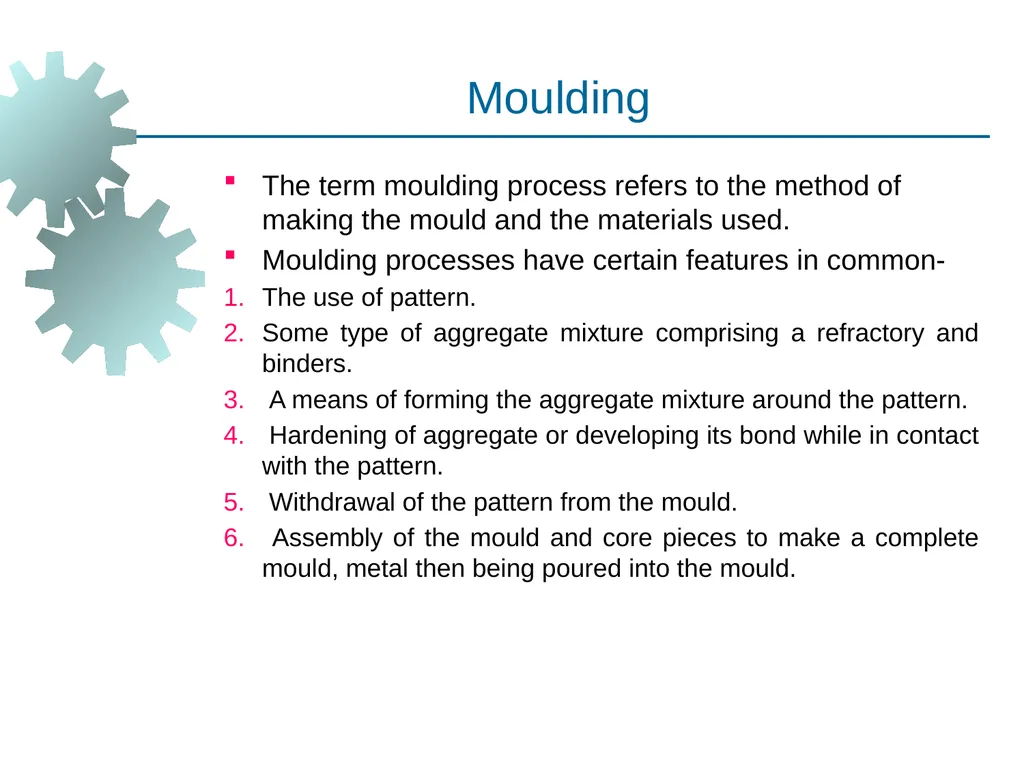
Moulding The term moulding process refers to the method of making the mould and the materials used.
Moulding processes have certain features in common-
The use of pattern.
Some type of aggregate mixture comprising a refractory and binders.
A means of forming the aggregate mixture around the pattern.
Hardening of aggregate or developing its bond while in contact with the pattern.
Withdrawal of the pattern from the mould.
Assembly of the mould and core pieces to make a complete mould, metal then being poured into the mould.<br>
Moulding processes have certain features in common-
The use of pattern.
Some type of aggregate mixture comprising a refractory and binders.
A means of forming the aggregate mixture around the pattern.
Hardening of aggregate or developing its bond while in contact with the pattern.
Withdrawal of the pattern from the mould.
Assembly of the mould and core pieces to make a complete mould, metal then being poured into the mould.<br>
41
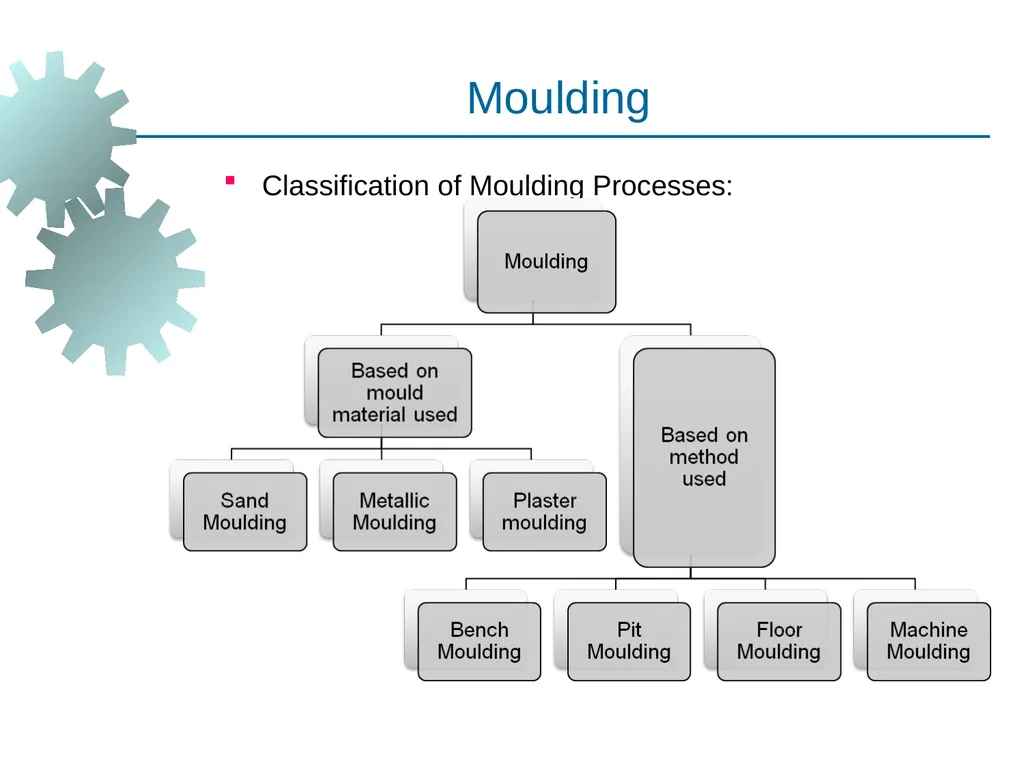
Moulding Classification of Moulding Processes:<br>
42
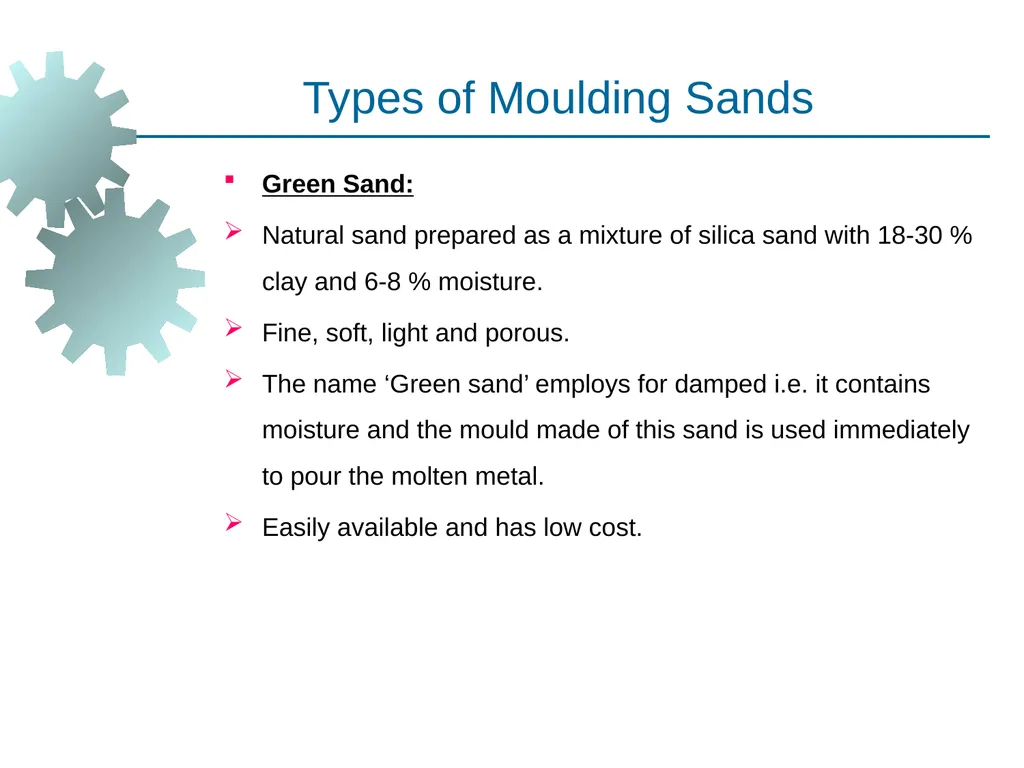
Types of Moulding Sands Green Sand:
Natural sand prepared as a mixture of silica sand with 18-30 % clay and 6-8 % moisture.
Fine, soft, light and porous.
The name ‘Green sand’ employs for damped i.e. it contains moisture and the mould made of this sand is used immediately to pour the molten metal.
Easily available and has low cost.<br>
Natural sand prepared as a mixture of silica sand with 18-30 % clay and 6-8 % moisture.
Fine, soft, light and porous.
The name ‘Green sand’ employs for damped i.e. it contains moisture and the mould made of this sand is used immediately to pour the molten metal.
Easily available and has low cost.<br>
43
Types of Moulding Sands Dry Sand:
Green sand that has been dried or baked in between 250° to 550° in suitable oven after the making mould and cores, is called dry sand.
More strength, rigidity and thermal stability.
Suitable for larger castings.<br>
Green sand that has been dried or baked in between 250° to 550° in suitable oven after the making mould and cores, is called dry sand.
More strength, rigidity and thermal stability.
Suitable for larger castings.<br>
44
Types of Moulding Sands Parting Sand:
It is used to keep away the green sand from sticking to the pattern and to allow the sand on the parting surface of the flasks to separate without clinging.
It is free from clay and is dry.
It is washed and non sticky sand<br>
It is used to keep away the green sand from sticking to the pattern and to allow the sand on the parting surface of the flasks to separate without clinging.
It is free from clay and is dry.
It is washed and non sticky sand<br>
45
Types of Moulding Sands Core Sand:
Used to make core.
Should be stronger than the moulding sand.
It is made by mixing core linseed oil with silica sand,
It is also called as soil sand<br>
Used to make core.
Should be stronger than the moulding sand.
It is made by mixing core linseed oil with silica sand,
It is also called as soil sand<br>
46
It usually contains burnt facing sand, moulding sand and clay.
It is old and repeatedly used sand and used for baking facing sand
It is filled behind the facing sand in the mould box or flask. Backing sand<br>
It is old and repeatedly used sand and used for baking facing sand
It is filled behind the facing sand in the mould box or flask. Backing sand<br>
47
It is mixture of floor sand and new moulding sand with suitable binder and moisture.
It is used next to the parting surface and comes in contact with molten metal when poured into the mould
It is used around a pattern to cover it upto 2.5 to 5cm Facing sand<br>
It is used next to the parting surface and comes in contact with molten metal when poured into the mould
It is used around a pattern to cover it upto 2.5 to 5cm Facing sand<br>
48
Properties of Moulding Sand Refractoriness:
The ability of moulding sand to withstand high temperatures without breaking down or fusing.
The degree of refractoriness depends on SiO2 content and shape & grain size of the particle.
To enhance the proporty, sand should have lower percentage of lime, magnesia, alkali, oxides of metals.
Refractoriness is measured by Sinter point rather than its melting point. ( At sintering temperature, the moulding sand adheres to the casting)<br>
The ability of moulding sand to withstand high temperatures without breaking down or fusing.
The degree of refractoriness depends on SiO2 content and shape & grain size of the particle.
To enhance the proporty, sand should have lower percentage of lime, magnesia, alkali, oxides of metals.
Refractoriness is measured by Sinter point rather than its melting point. ( At sintering temperature, the moulding sand adheres to the casting)<br>
49
Properties of Moulding Sand 2. Permeability:
Also referred as porosity, is the property of sand allow the escape of any air, gases or moisture present or generated in the mould when the molten metal is poured into it.
Liquid metals cause evolution of gases due to their reaction with moulding sand ingredients.
Permeability is a function of:
Grain size
Grain shape
Moisture and clay contents in the moulding sand.<br>
Also referred as porosity, is the property of sand allow the escape of any air, gases or moisture present or generated in the mould when the molten metal is poured into it.
Liquid metals cause evolution of gases due to their reaction with moulding sand ingredients.
Permeability is a function of:
Grain size
Grain shape
Moisture and clay contents in the moulding sand.<br>
50
Properties of Moulding Sand 3. Cohesiveness:
Also referred to as the strength of sand.
It is property of moulding sand by virtue which the sand grain particles interact and attract each other within the moulding sand.
Moulding sand should be capable of withstanding the compressive and erosive force exerted by liquid metal while filling the cavity.
Low strength mouldings result in defective castings.
It depends upon the grain size, sand particle shape and size, moisture content and density,
strength inversely affect the porosity<br>
Also referred to as the strength of sand.
It is property of moulding sand by virtue which the sand grain particles interact and attract each other within the moulding sand.
Moulding sand should be capable of withstanding the compressive and erosive force exerted by liquid metal while filling the cavity.
Low strength mouldings result in defective castings.
It depends upon the grain size, sand particle shape and size, moisture content and density,
strength inversely affect the porosity<br>
51
Properties of Moulding Sand 4. Flowability:
It is the ability of the sand to get compacted and behave like a fluid.
It will flow uniformly to all portions of pattern when rammed and distribute the ramming pressure evenly all around in all directions.
In general, flow ability increases with decrease in green strength, an, decrease in grain size.
flow ability also varies with moisture and clay content.
It is also called as plasticity fluidity.<br>
It is the ability of the sand to get compacted and behave like a fluid.
It will flow uniformly to all portions of pattern when rammed and distribute the ramming pressure evenly all around in all directions.
In general, flow ability increases with decrease in green strength, an, decrease in grain size.
flow ability also varies with moisture and clay content.
It is also called as plasticity fluidity.<br>
52
Properties of Moulding Sand 5. Adhesiveness:
It is property of moulding sand to get stick or adhere with foreign material such sticking of moulding sand with inner wall of moulding box.
It helps the sand to retain the mould cavity and stay in the box.<br>
It is property of moulding sand to get stick or adhere with foreign material such sticking of moulding sand with inner wall of moulding box.
It helps the sand to retain the mould cavity and stay in the box.<br>
53
Properties of Moulding Sand 6. Collapsibility:
After solidification of the molten metal, the casting is required to be removed from the mould.
If the moulding sand is easily collapsible, free contraction of the metal as well as easy removal of the casting is possible.
If the sand is not collapsible, it will strongly adhere to the casting, becoming very hard to separate after metal solidification.<br>
After solidification of the molten metal, the casting is required to be removed from the mould.
If the moulding sand is easily collapsible, free contraction of the metal as well as easy removal of the casting is possible.
If the sand is not collapsible, it will strongly adhere to the casting, becoming very hard to separate after metal solidification.<br>
54
Core is metal or sand body, which is set into the prepared mould before closing or pouring it .
These are used to produce holes, projections, cavities in casting.
core is kept on seat in the mould box prepared by pattern.
Projection is made in mould box during moulding process.
these projections made on mould box are known as core print. Core and core print<br>
These are used to produce holes, projections, cavities in casting.
core is kept on seat in the mould box prepared by pattern.
Projection is made in mould box during moulding process.
these projections made on mould box are known as core print. Core and core print<br>
55
Horizontal core.
vertical core.
Balanced core.
Cover core.
Drop core. Types of cores<br>
vertical core.
Balanced core.
Cover core.
Drop core. Types of cores<br>
56
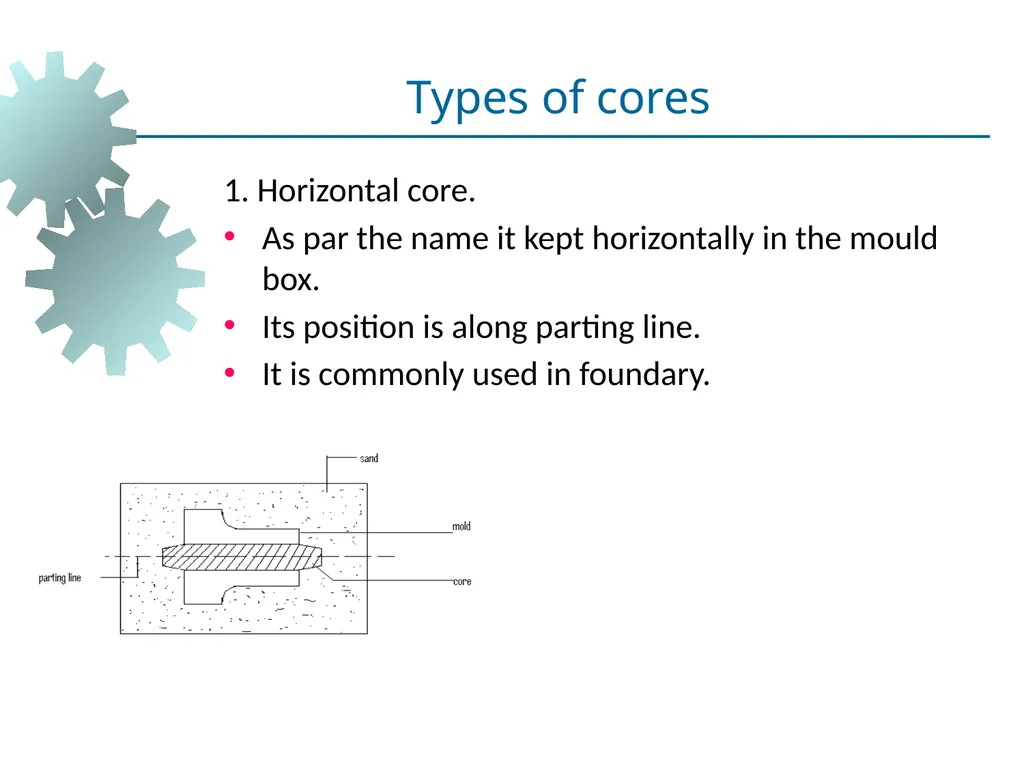
1. Horizontal core.
As par the name it kept horizontally in the mould box.
Its position is along parting line.
It is commonly used in foundary. Types of cores<br>
As par the name it kept horizontally in the mould box.
Its position is along parting line.
It is commonly used in foundary. Types of cores<br>
57
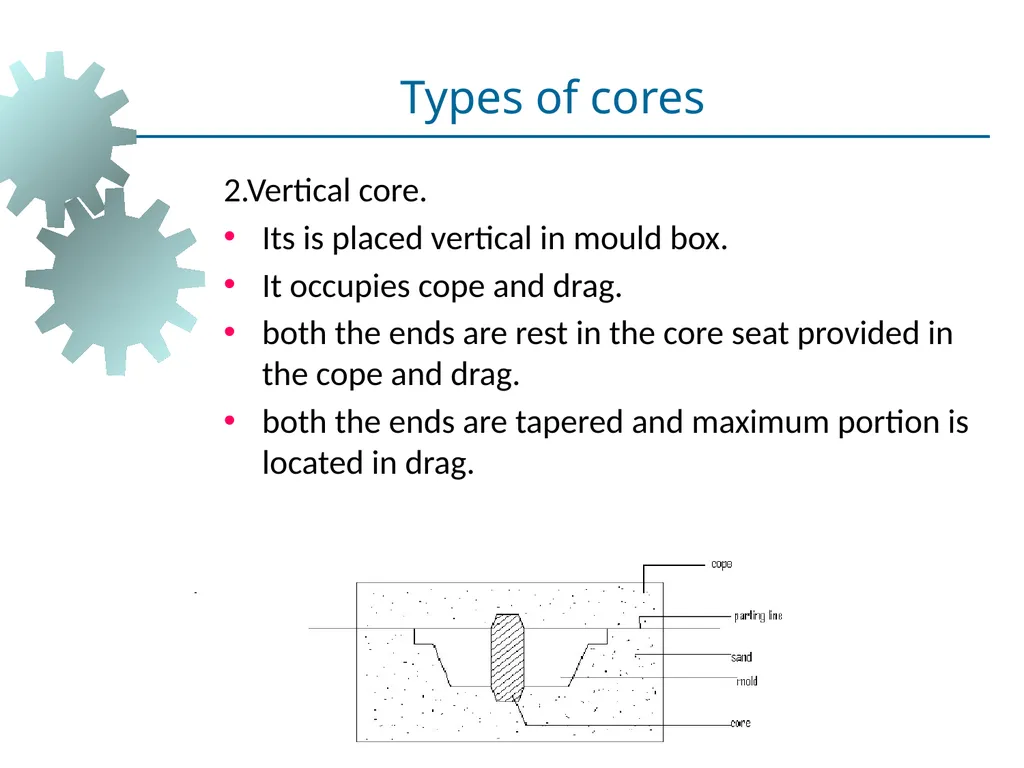
2.Vertical core.
Its is placed vertical in mould box.
It occupies cope and drag.
both the ends are rest in the core seat provided in the cope and drag.
both the ends are tapered and maximum portion is located in drag. Types of cores<br>
Its is placed vertical in mould box.
It occupies cope and drag.
both the ends are rest in the core seat provided in the cope and drag.
both the ends are tapered and maximum portion is located in drag. Types of cores<br>
58
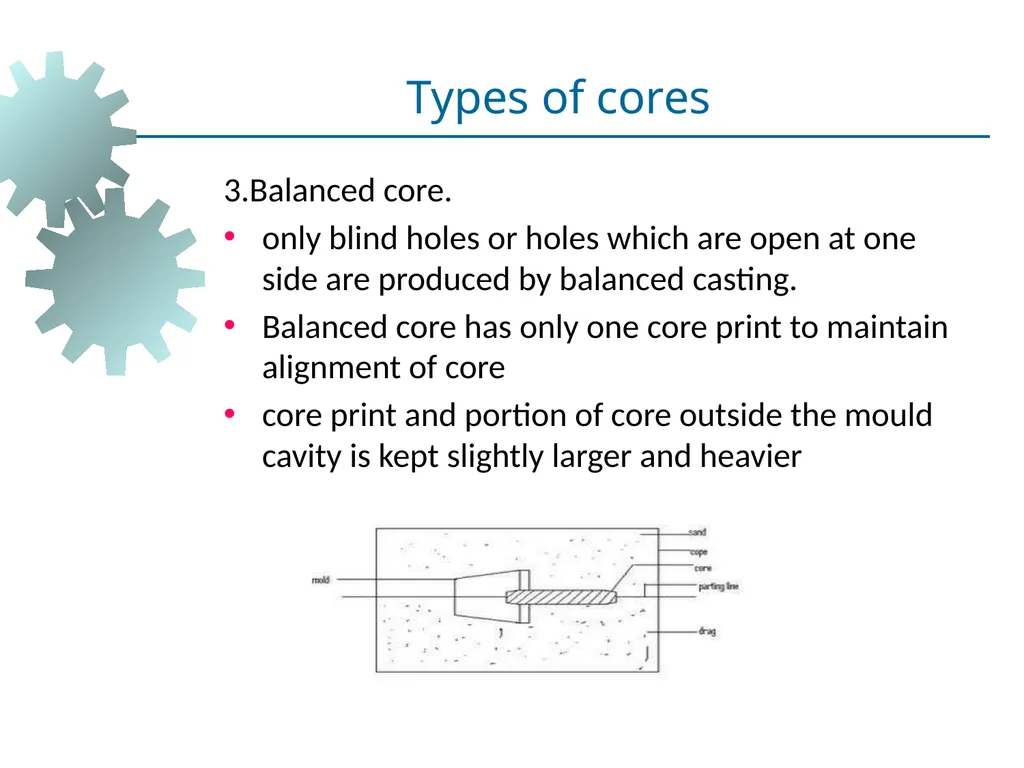
3.Balanced core.
only blind holes or holes which are open at one side are produced by balanced casting.
Balanced core has only one core print to maintain alignment of core
core print and portion of core outside the mould cavity is kept slightly larger and heavier Types of cores<br>
only blind holes or holes which are open at one side are produced by balanced casting.
Balanced core has only one core print to maintain alignment of core
core print and portion of core outside the mould cavity is kept slightly larger and heavier Types of cores<br>
59
It is supported on drag and completely moulded in drag
Core serve as cover for the mould Cover core<br>
Core serve as cover for the mould Cover core<br>
60
It is used to produce holes in casting above or bellow the parting line.
taper is provided to side of core for way placement Drop core<br>
taper is provided to side of core for way placement Drop core<br>
61
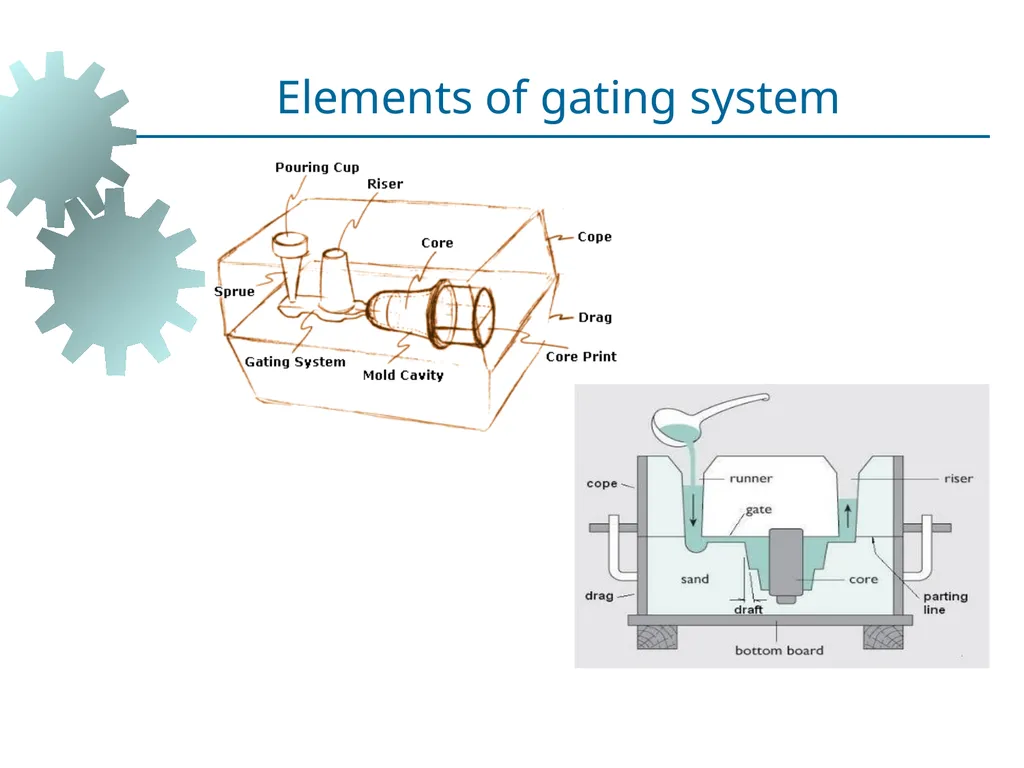
Elements of gating system<br>
62
Bench moulding
In this method small mould are made upon bench
It is used to manufactured the green sand and dry sand mould.
loose piece patterns are used for moulding.
Ramming is done manually.
Slow process and requires labours.
it is having types
Two box moulding.
Three box moulding.
stacked moulding. Types of moulding<br>
In this method small mould are made upon bench
It is used to manufactured the green sand and dry sand mould.
loose piece patterns are used for moulding.
Ramming is done manually.
Slow process and requires labours.
it is having types
Two box moulding.
Three box moulding.
stacked moulding. Types of moulding<br>
63
It is used for medium and part casting.
It is carried out on the floor.
In this moulding floor is act as drag and cope is rammed.
It is time consuming.
It requires labour.
green sand and dry sand mould are made by this method
It is also called as bending.
Ex.wheels,pulleys,plates with ribs etc Floor moulding<br>
It is carried out on the floor.
In this moulding floor is act as drag and cope is rammed.
It is time consuming.
It requires labour.
green sand and dry sand mould are made by this method
It is also called as bending.
Ex.wheels,pulleys,plates with ribs etc Floor moulding<br>
64
It is used for large casting manufacturing.
Pit is dug in the floor of foundry with bed of charcoal placed at the bottom of pit to help the escape of gases.
cope is placed over the pit to complete the assembly.
Sand is rammed and wall of pit are bricklined and plastered with Liam sand.
Moulds are baked before pouring.
Gates , runner, riser, pouring basin are made in cope.
crane are used to lift the cope and position over drag. Pit moulding<br>
Pit is dug in the floor of foundry with bed of charcoal placed at the bottom of pit to help the escape of gases.
cope is placed over the pit to complete the assembly.
Sand is rammed and wall of pit are bricklined and plastered with Liam sand.
Moulds are baked before pouring.
Gates , runner, riser, pouring basin are made in cope.
crane are used to lift the cope and position over drag. Pit moulding<br>
65
It is suitable for large production
It consist of following steps
Ramming of sand by jolting,squeezing in mould.
Rolling of mould through 180°.
Drawing of pattern from the mould by raising or lowering mould halves.
Types of machines used for making moulds are
Jolt moulding machine.
Jolt squeeze machine
sand slinger Machine moulding<br>
It consist of following steps
Ramming of sand by jolting,squeezing in mould.
Rolling of mould through 180°.
Drawing of pattern from the mould by raising or lowering mould halves.
Types of machines used for making moulds are
Jolt moulding machine.
Jolt squeeze machine
sand slinger Machine moulding<br>
66
Centrifugal casting.
In this process mould is poured and allowed to solidify during revolving.
Due to rotation of mould the poured metal is subjected to centrifugal force.
Centrifugal force is allowed molten metal to flow in the mould cavity.
Dence metal is deposited on periphery of mould and start sophistication.
Lighter slag, oxides, inclusions are get separated and moves towards centre. Types of Casting Methods<br>
In this process mould is poured and allowed to solidify during revolving.
Due to rotation of mould the poured metal is subjected to centrifugal force.
Centrifugal force is allowed molten metal to flow in the mould cavity.
Dence metal is deposited on periphery of mould and start sophistication.
Lighter slag, oxides, inclusions are get separated and moves towards centre. Types of Casting Methods<br>
67
There is no use of gates runner and riser.
The axis of rotation may be horizontal or vertical.
Applications
Pipes , cylinder liners, bearings, bushes, gears fly wheels, gun barrels etc. Centrifugal casting<br>
The axis of rotation may be horizontal or vertical.
Applications
Pipes , cylinder liners, bearings, bushes, gears fly wheels, gun barrels etc. Centrifugal casting<br>
68
This process is used for smooth surface finish
It consist of dump box which is partially filled with silica and thermoelectric resin.
Then dump box is sealed with metallic pattern which is preheated about 250°c.
When dump box is inverted mixture is get melted and forms the shell on pattern plate.
Shell thickness varies from 5mm to 8mm.
These two shells joint togather to form complete mould. Shell moulding<br>
It consist of dump box which is partially filled with silica and thermoelectric resin.
Then dump box is sealed with metallic pattern which is preheated about 250°c.
When dump box is inverted mixture is get melted and forms the shell on pattern plate.
Shell thickness varies from 5mm to 8mm.
These two shells joint togather to form complete mould. Shell moulding<br>
69
Applications.
small pulleys ,motor housing, fan blades, cylinders, cylinder heads, break drums. Shell moulding<br>
small pulleys ,motor housing, fan blades, cylinders, cylinder heads, break drums. Shell moulding<br>
70
It is also known as lost wax casting precision casting.
This method is used for manufacturing jewellry,dental goods.
It involves following steps.
Making of wax pattern sometimes mercury or plastic may be used.
provide wax made gates, runners, riser to the pattern.
Complete wax pattern put in box and filled with liquid mould material.
liquid around wax pattern solidifies and form mould
Then mould is heated to 150°to 800°c to remove wax Investment casting<br>
This method is used for manufacturing jewellry,dental goods.
It involves following steps.
Making of wax pattern sometimes mercury or plastic may be used.
provide wax made gates, runners, riser to the pattern.
Complete wax pattern put in box and filled with liquid mould material.
liquid around wax pattern solidifies and form mould
Then mould is heated to 150°to 800°c to remove wax Investment casting<br>
71
Applications.
surgical instruments.
vanes and blades for gas turbine.
costume jewellery.
valve bodies.
Reciprocating slides for cloth cutting machine. Investment casting<br>
surgical instruments.
vanes and blades for gas turbine.
costume jewellery.
valve bodies.
Reciprocating slides for cloth cutting machine. Investment casting<br>
72
Following are the casting defects arises during faulty processes in casting.
Blow holes.
Pin holes.
Shift.
Short runs.
Hot tears.
cold shuts. Casting defects<br>
Blow holes.
Pin holes.
Shift.
Short runs.
Hot tears.
cold shuts. Casting defects<br>
73
Blow holes are spherical, flattened or elongated cavities present in the casting .They are formed due to following reasons.
Reasons.
Rapid evolution of gas from mould.
Lack of porosity in mould box.
Excess moisture in sand.
Hard ramming of sand.
Remedies
Moulds and cores are properly vanted.
Avoid hard ramming.
Proper amount of moisture in sand.
Proper grain size of sand. Blow holes<br>
Reasons.
Rapid evolution of gas from mould.
Lack of porosity in mould box.
Excess moisture in sand.
Hard ramming of sand.
Remedies
Moulds and cores are properly vanted.
Avoid hard ramming.
Proper amount of moisture in sand.
Proper grain size of sand. Blow holes<br>
74
Pin holes are small holes of less than 2mm diameter which are on surface or bellow the surface of casting.
Causes.
High pouring temperature.
Gas dissolved in molted metal.
gases are not removed properly from molted metal.
Sand with higher moisture content.
Remedies.
Maintain pouring temperature.
increase flux proportion.
reducing moisture content in sand.
Effective regarding. Pinholes<br>
Causes.
High pouring temperature.
Gas dissolved in molted metal.
gases are not removed properly from molted metal.
Sand with higher moisture content.
Remedies.
Maintain pouring temperature.
increase flux proportion.
reducing moisture content in sand.
Effective regarding. Pinholes<br>
75
It is external defect arises due to mis allotment parts of casting.
Causes.
Core displacement.
Misalignment of cope and drag.
warn out or burn out of clamping pins.
Misalignment of two halves of pattern.
Remedies.
Repair or replacement of dowel pins.
Proper alignment of pattern.
Proper alignment of cope and drag.
Repair clamping pins. Shift<br>
Causes.
Core displacement.
Misalignment of cope and drag.
warn out or burn out of clamping pins.
Misalignment of two halves of pattern.
Remedies.
Repair or replacement of dowel pins.
Proper alignment of pattern.
Proper alignment of cope and drag.
Repair clamping pins. Shift<br>
76
It is also called as Morin.
when cavity in mould is filled incompletely then short run introduces.
Causes.
Insufficient metal supply.
lack of fluidity in molten Merkel.
Molten metal temp is low.
faulty gating system.
Remedies.
Adjust pouring temp.
Adjust rate of pouring.
Modifications in gating system. Short run<br>
when cavity in mould is filled incompletely then short run introduces.
Causes.
Insufficient metal supply.
lack of fluidity in molten Merkel.
Molten metal temp is low.
faulty gating system.
Remedies.
Adjust pouring temp.
Adjust rate of pouring.
Modifications in gating system. Short run<br>
77
It is also called as pulls or hot crack.
They may be internal or external.
They having dark blue in appearance on surface.
Causes.
Lack of compatibility of core.
high temp of casting metal.
incorrect design of batting system.
Lack of fillets and corner redii.
Remedies.
Improved design of casting.
Improved compatibility.
Proper solidification.
correct pouring temp. Hot tears For more detail contact us<br>
They may be internal or external.
They having dark blue in appearance on surface.
Causes.
Lack of compatibility of core.
high temp of casting metal.
incorrect design of batting system.
Lack of fillets and corner redii.
Remedies.
Improved design of casting.
Improved compatibility.
Proper solidification.
correct pouring temp. Hot tears For more detail contact us<br>