01
Methods Introduction Score on treatment compliance with guidelines For more information�Patrick Bukoma, p.bukoma@malariaconsortium.org
Malaria Consortium
Development House, 56-64 Leonard Street, London, EC2A 4LT
www.malariaconsortium.org 1Patric Patrick1, 1David S. Odongo, 1Viola Nampera, 1Peter Miliang, 1Ruth Kigozi, 1Jane I. Nabakooza, 1Julius K. Kuule, 1JB Bwanika, 1Sam S. Gudoi, 2Peter E. Thomas, 3Kassahun Belay, 3Gloria Sebikaari, 4Mame K. Niang, 4James K Tibenderana,
1 US Pressident’s Malaria Inititaitive MAPD Project, 2US President’s Malaria Initiative, US Agency for International Development, Kampala, Uganda, 3Centers for Disease Control and Prevention, Atlanta, GA, USA 30329 4 Uganda National Malaria Control Program, Kampala, Uganda 5 Malaria Consortium, London, UK 6Health Information Division of, Ministry of Health, Kampala, Uganda Factors associated with severe malaria deaths: lessons from mortality audit conducted in health facilities in Uganda Acknowledgements
Uganda Ministry of Health .
Health Facility Staff working in USAID’s malaria Action program districts
The Presidents Malaria Initiative. The Malaria is among the leading causes of morbidity and mortality in Uganda. The National Malaria Control Programme reported confirmed malaria incidence rate of 191 cases/1,000 population and a mortality rate of 9 deaths/100,000 population in its Annual Report 2019. In WHO’s World Malaria Report 2018, Uganda was among the 17 countries that contributed to almost 80% of the global deaths due to malaria. In 2016, Ministry of Health (MoH) adopted clinical audit guidelines to improve quality of severe malaria management in health facilities aiming to achieve ‘near zero’ deaths by June 2020. Between 2017 and 2019, to help strengthen severe malaria management, the US President’s Malaria Initiative supported Malaria Action Program for Districts to conduct a criteria-based review—based on MoH malaria guidelines in hospitals and health centres, seeking to identify factors associated with malaria deaths in health facilities. Purposive sample of two Regional Referral Hospitals (RRH) and one Health Centre (HC) that reported highest deaths in the national Health Management Information System.
Validated data quality: compared numbers in reports to in registers
A retrospective criteria-based review of health facility systems and case management practices,: clinical notes, treatment & supportive care as recorded in medical records, i.e. In-patient Admission Forms, In-patient Registers & Laboratory Report Forms.
Qualitative assessment of case management practices using Mortality Audit Form adapted from WHO Line Listing and National Vector Borne Disease Programme of India Forms. Overall, data quality was poor – 62% accuracy of in-patient and out-patient registers and 30% accuracy of the HMIS report
56 deaths with diagnosis of malaria were identified from in-patient registers instead of the reported 43, reflecting poor data quality with 23% under reporting of deaths
Overall, patients knowledge of diagnosis, treatment and when to return was 64%, while 94.% patient were satisfied with services
Only 34 deaths (61%) had laboratory test result for malaria; of which 26 (76%) were positive result confirming malaria Results Conclusion Mortality could be associated with weak systems for quality management of severe malaria patients.
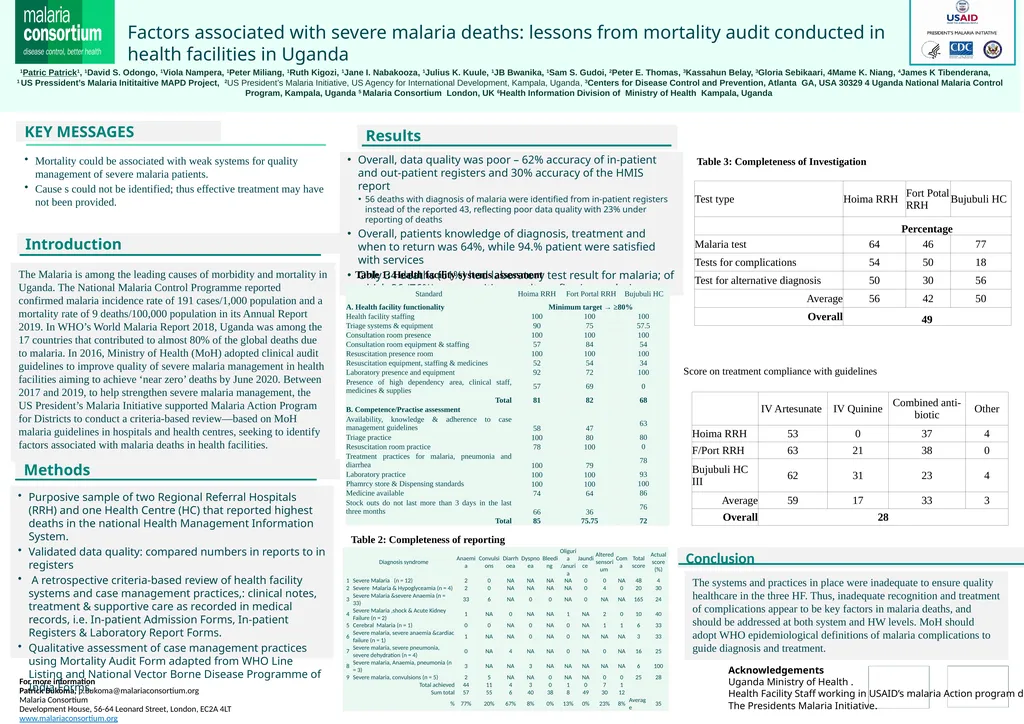
Cause s could not be identified; thus effective treatment may have not been provided. KEY MESSAGES Table 3: Completeness of Investigation Table 1: Health facility systems assessment Table 2: Completeness of reporting The systems and practices in place were inadequate to ensure quality healthcare in the three HF. Thus, inadequate recognition and treatment of complications appear to be key factors in malaria deaths, and should be addressed at both system and HW levels. MoH should adopt WHO epidemiological definitions of malaria complications to guide diagnosis and treatment.<br>