
Michigan Revised Lead and Copper Rule CWS

Description: Michigan Revised Lead and Copper Rule CWS Implementation Experience Michigan Department of Environment, Great Lakes, and Energy Drinking Water and Environmental Health Division Drinking Water and Environmental Health Division Eric Oswald,
Related Topics
Download Presentation
"Michigan Revised Lead and Copper Rule CWS" is the property of its rightful owner. Permission is granted to download and print the materials on this website for personal, non-commercial use only, and to display it on your personal computer provided you do not modify the materials and that you retain all copyright notices contained in the materials. By downloading content from our website, you accept the terms of this agreement.
Presentation Transcript
slide1. Michigan Revised Lead and Copper Rule
CWS Implementation Experience Michigan Department of Environment, Great Lakes, and Energy
Drinking Water and Environmental Health Division<br>
slide2. Drinking Water and Environmental Health Division Eric Oswald, Director
George Kristian, Assistant Director
Kris Philip, Community Water Supply Section
Brandon Onan, Lead and Copper Unit<br>
slide3. Topics Summary of Michigan rule revisions
2019/2020 Data Outcomes
Implementation Challenges/Experiences
Questions/Discussion<br>
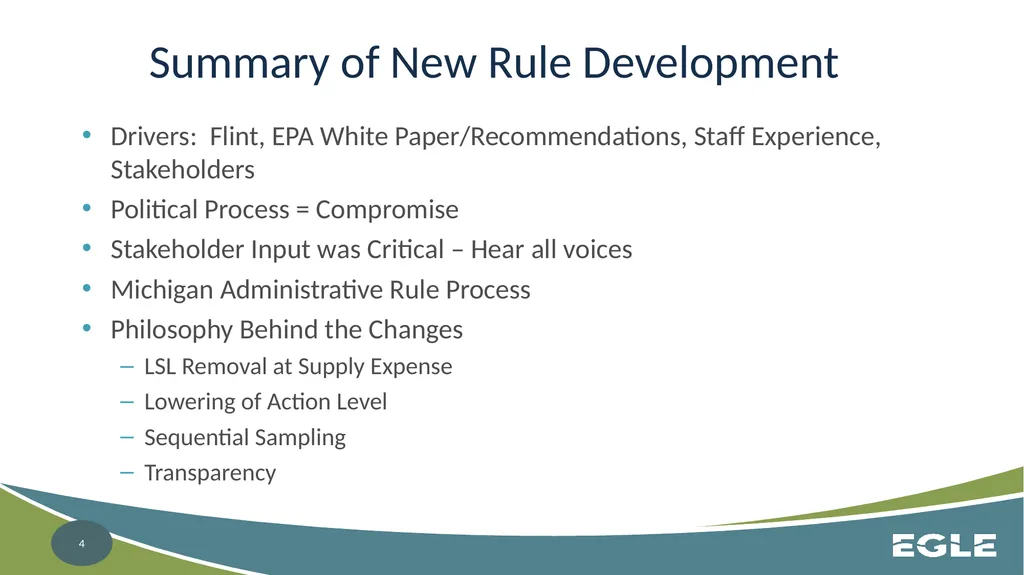
slide4. Summary of New Rule Development Drivers: Flint, EPA White Paper/Recommendations, Staff Experience, Stakeholders
Political Process = Compromise
Stakeholder Input was Critical – Hear all voices
Michigan Administrative Rule Process
Philosophy Behind the Changes
LSL Removal at Supply Expense
Lowering of Action Level
Sequential Sampling
Transparency<br>
slide5. Michigan Lead and Copper Rule Reduces Lead AL from 15 to 12 ppb on January 1, 2025
Eliminates Copper w/ Lead Solder Criteria in Tiers 1 and 2
Updated Sampling Pools
1st and 5th Liter Samples at LSL Sites – Use Highest Result
Limits Tap Monitoring Reduction in Systems with OCCT
Distribution System Materials Inventories (DSMI)
LSL Replacement – 5% Annual Average
Continuity of CCT
Enhanced Transparency<br>
slide6. Sampling<br>
slide7. Updated Sample Site Tiering Criteria Criteria for identifying sampling sites updated to further focus on high lead risk
Tier 1 and Tier 2 include only sites with lead service lines (LSL) or interior lead plumbing
Sites with copper plumbing with lead solder now Tier 3
Supplies required to update and submit sampling pools to reflect the revised criteria<br>
slide8. Updated Sampling Protocol Sites with LSL: 1st AND 5th liter sample required
1st liter represents water in premise plumbing
5th liter better represents water in contact with the LSL (based on an average home configuration)
Sites without LSL: 1st liter sample
Only the highest lead result and highest copper result from each site are used in 90th percentile calculation
Pre-stagnation flushing and aerator removal/cleaning prohibited in anticipation of compliance sampling<br>
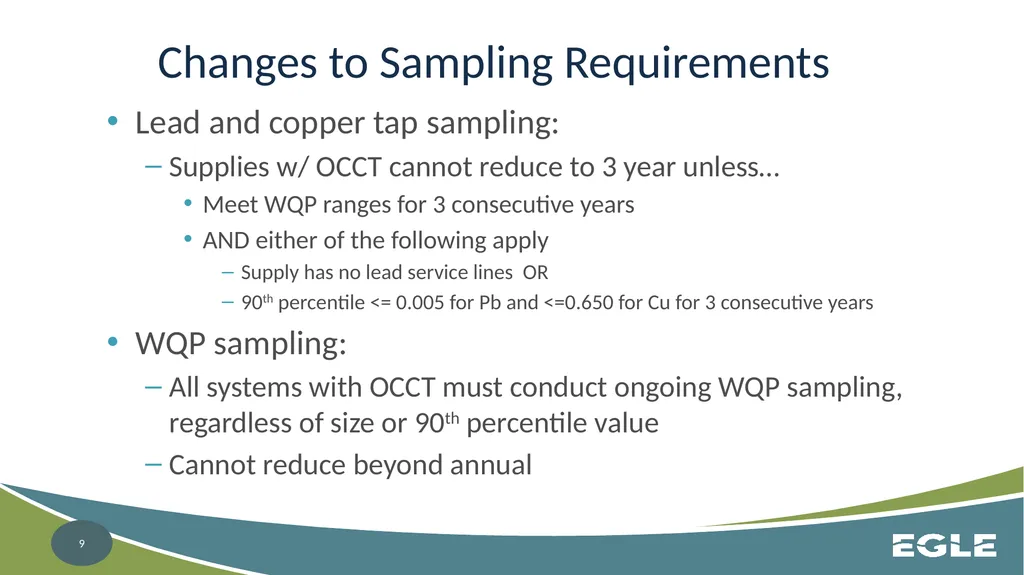
slide9. Changes to Sampling Requirements Lead and copper tap sampling:
Supplies w/ OCCT cannot reduce to 3 year unless…
Meet WQP ranges for 3 consecutive years
AND either of the following apply
Supply has no lead service lines OR
90th percentile <= 0.005 for Pb and <=0.650 for Cu for 3 consecutive years
WQP sampling:
All systems with OCCT must conduct ongoing WQP sampling, regardless of size or 90th percentile value
Cannot reduce beyond annual<br>
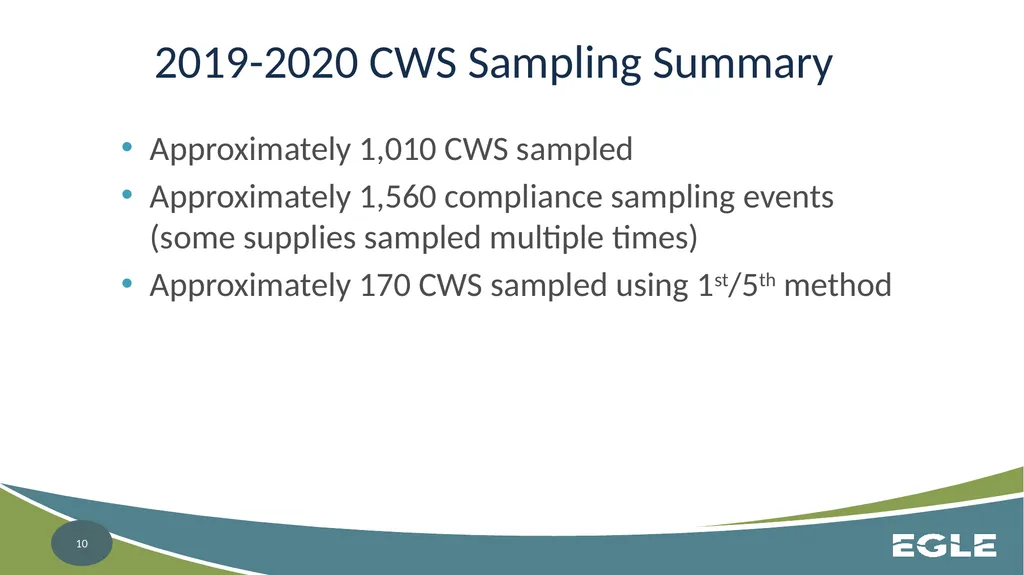
slide10. 2019-2020 CWS Sampling Summary Approximately 1,010 CWS sampled
Approximately 1,560 compliance sampling events (some supplies sampled multiple times)
Approximately 170 CWS sampled using 1st/5th method<br>
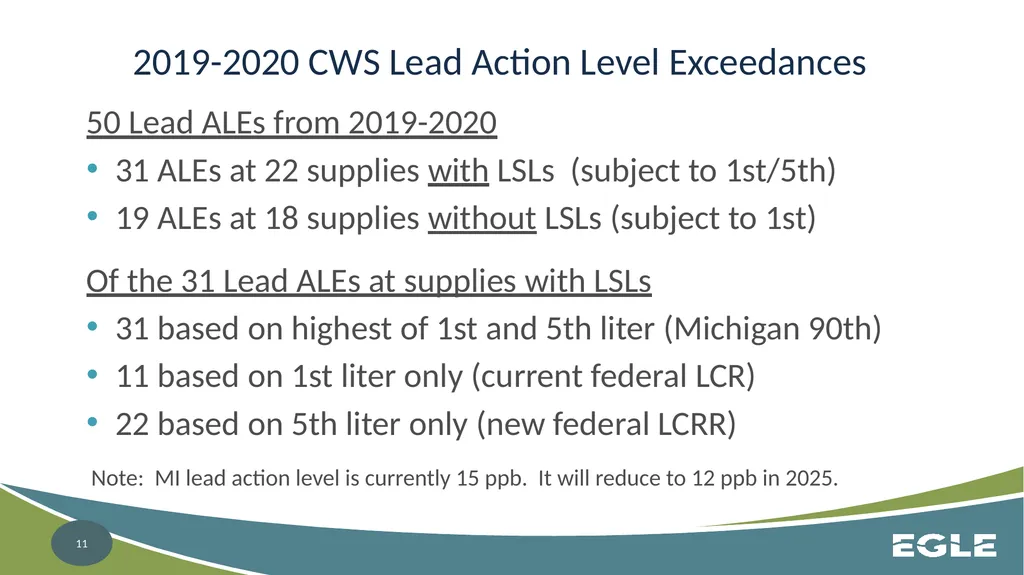
slide11. 2019-2020 CWS Lead Action Level Exceedances 50 Lead ALEs from 2019-2020
31 ALEs at 22 supplies with LSLs (subject to 1st/5th)
19 ALEs at 18 supplies without LSLs (subject to 1st)
Of the 31 Lead ALEs at supplies with LSLs
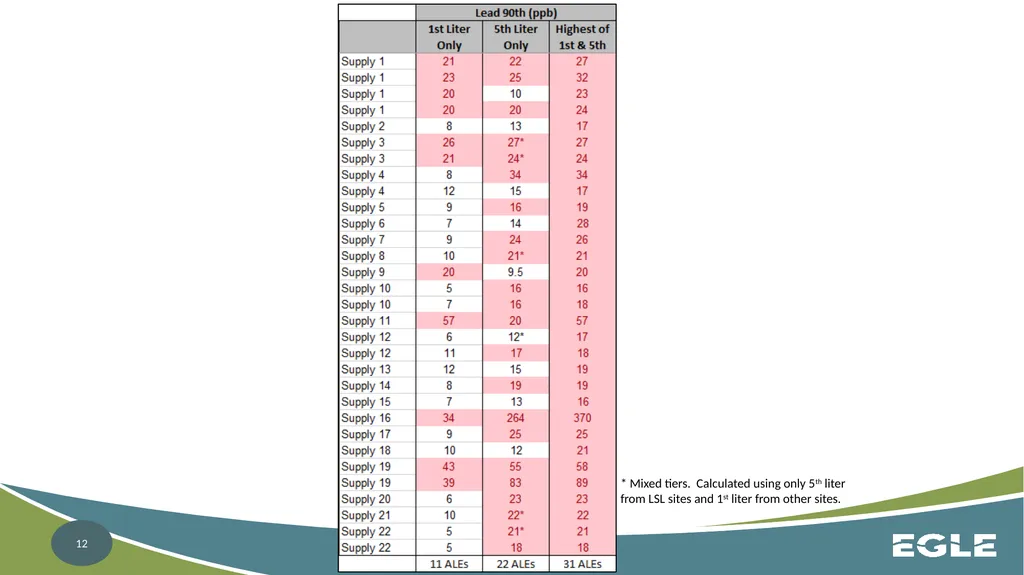
31 based on highest of 1st and 5th liter (Michigan 90th)
11 based on 1st liter only (current federal LCR)
22 based on 5th liter only (new federal LCRR)
Note: MI lead action level is currently 15 ppb. It will reduce to 12 ppb in 2025.<br>
slide12. * Mixed tiers. Calculated using only 5th liter from LSL sites and 1st liter from other sites.<br>
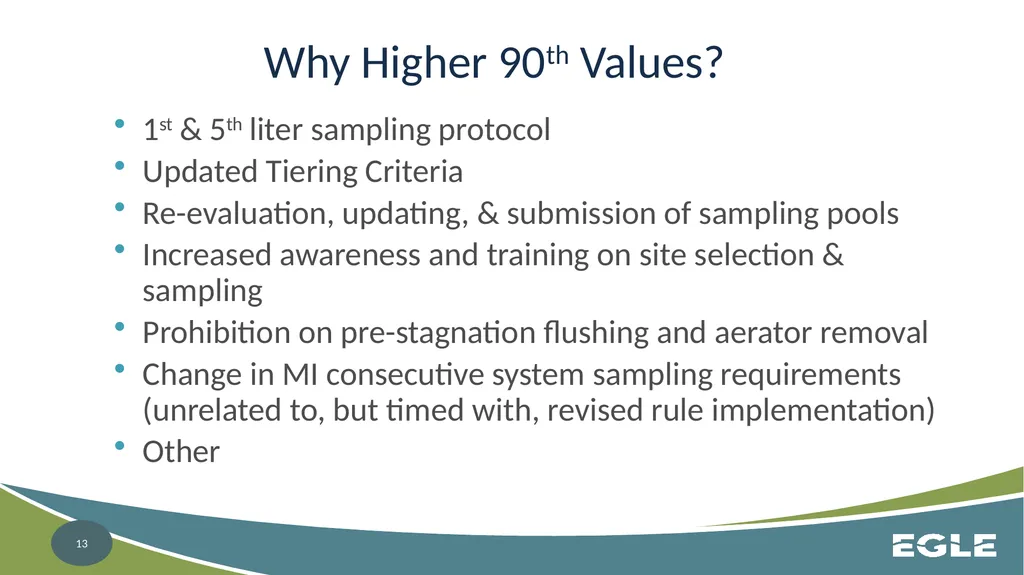
slide13. Why Higher 90th Values? 1st & 5th liter sampling protocol
Updated Tiering Criteria
Re-evaluation, updating, & submission of sampling pools
Increased awareness and training on site selection & sampling
Prohibition on pre-stagnation flushing and aerator removal
Change in MI consecutive system sampling requirements (unrelated to, but timed with, revised rule implementation)
Other<br>
slide14. Inventories & Service Line Replacement<br>
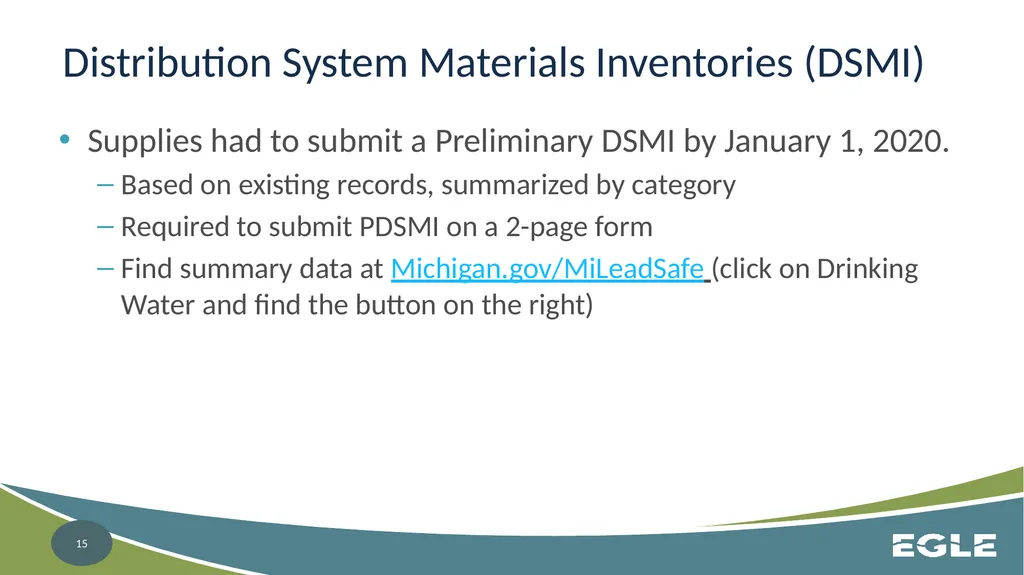
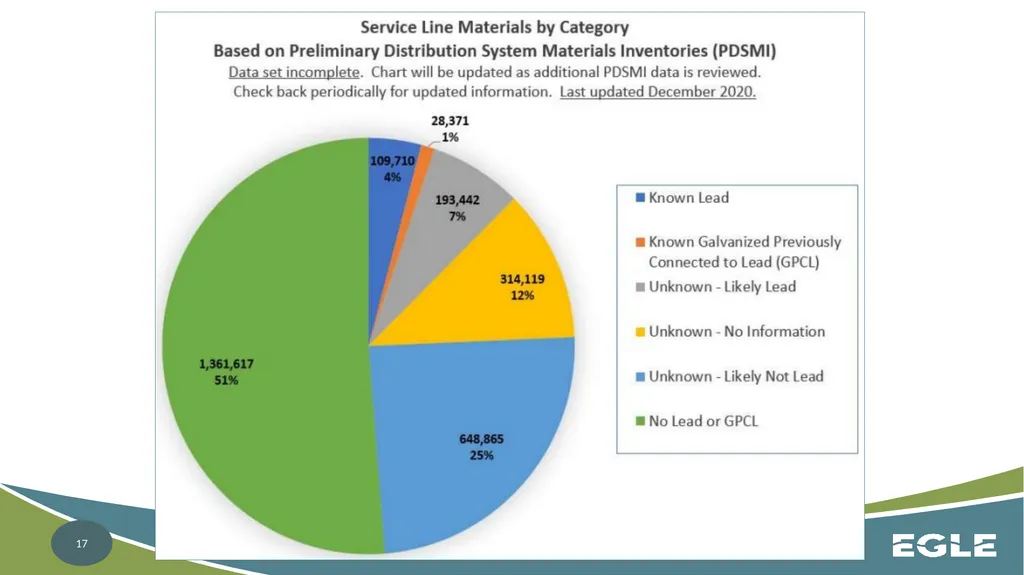
slide15. Distribution System Materials Inventories (DSMI) Supplies had to submit a Preliminary DSMI by January 1, 2020.
Based on existing records, summarized by category
Required to submit PDSMI on a 2-page form
Find summary data at Michigan.gov/MiLeadSafe (click on Drinking Water and find the button on the right)<br>
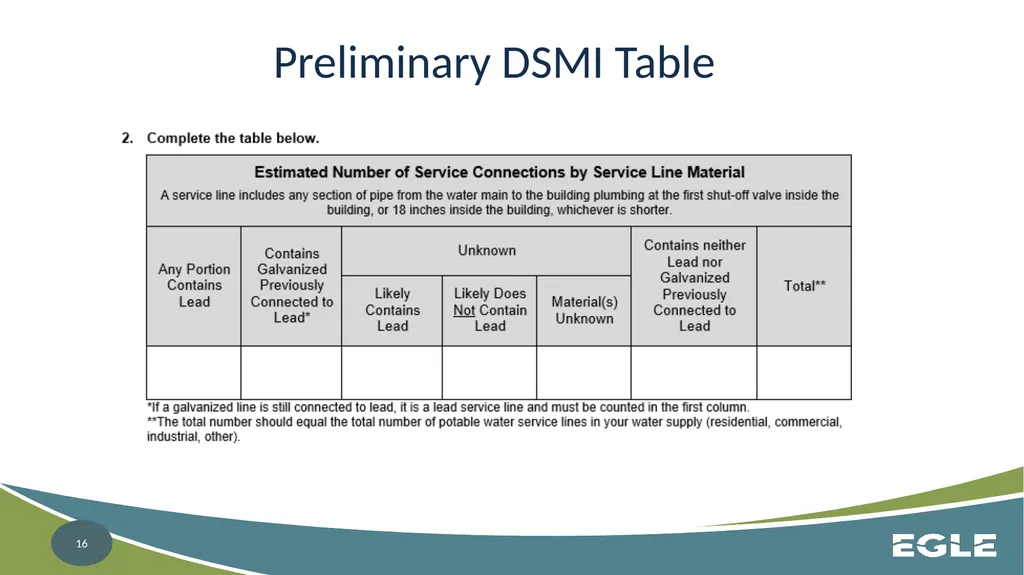
slide16. Preliminary DSMI Table<br>
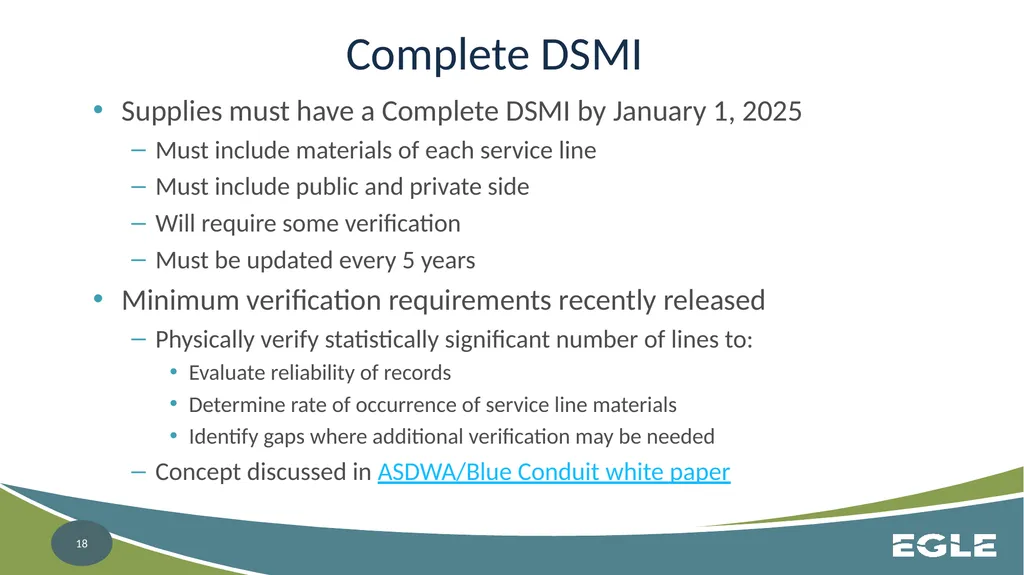
slide18. Complete DSMI Supplies must have a Complete DSMI by January 1, 2025
Must include materials of each service line
Must include public and private side
Will require some verification
Must be updated every 5 years
Minimum verification requirements recently released
Physically verify statistically significant number of lines to:
Evaluate reliability of records
Determine rate of occurrence of service line materials
Identify gaps where additional verification may be needed
Concept discussed in ASDWA/Blue Conduit white paper<br>
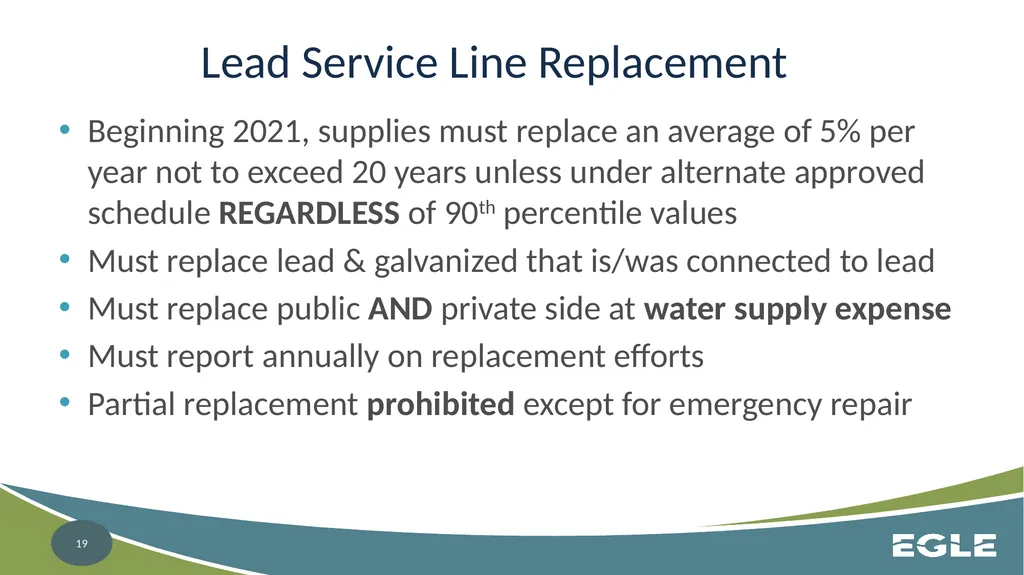
slide19. Lead Service Line Replacement Beginning 2021, supplies must replace an average of 5% per year not to exceed 20 years unless under alternate approved schedule REGARDLESS of 90th percentile values
Must replace lead & galvanized that is/was connected to lead
Must replace public AND private side at water supply expense
Must report annually on replacement efforts
Partial replacement prohibited except for emergency repair<br>
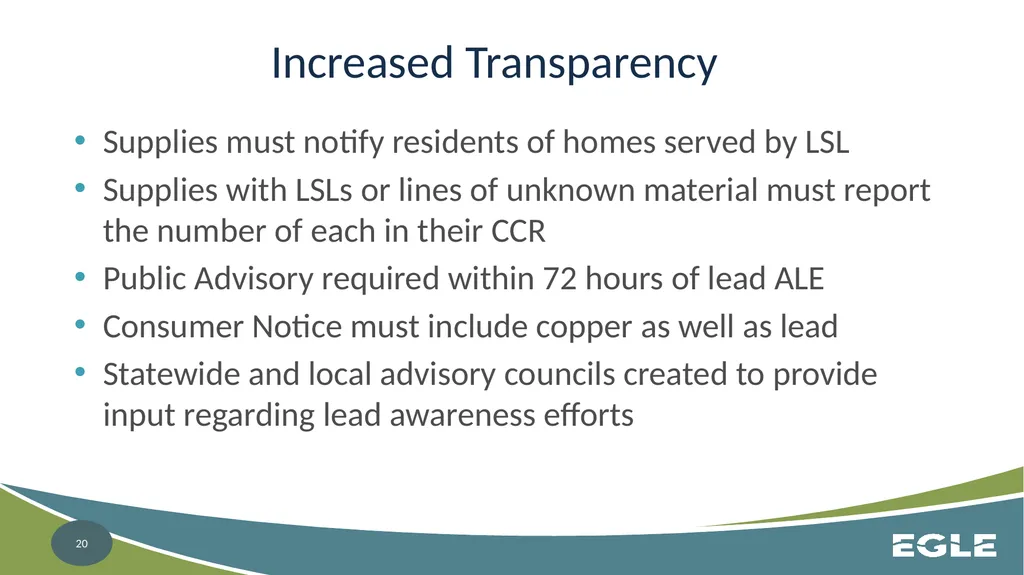
slide20. Increased Transparency Supplies must notify residents of homes served by LSL
Supplies with LSLs or lines of unknown material must report the number of each in their CCR
Public Advisory required within 72 hours of lead ALE
Consumer Notice must include copper as well as lead
Statewide and local advisory councils created to provide input regarding lead awareness efforts<br>
slide21. Implementation Experiences<br>
slide22. Challenges Complexity of rules; education of water operators
Change in sampling methodology
Gaps in knowledge about service line materials
Logistics of full LSLR (avoiding “temporary” partials)
Resources to assist supplies with LSLR requirements
Messaging rule changes to the public (what changed and why; why are we seeing more ALEs in Michigan)<br>
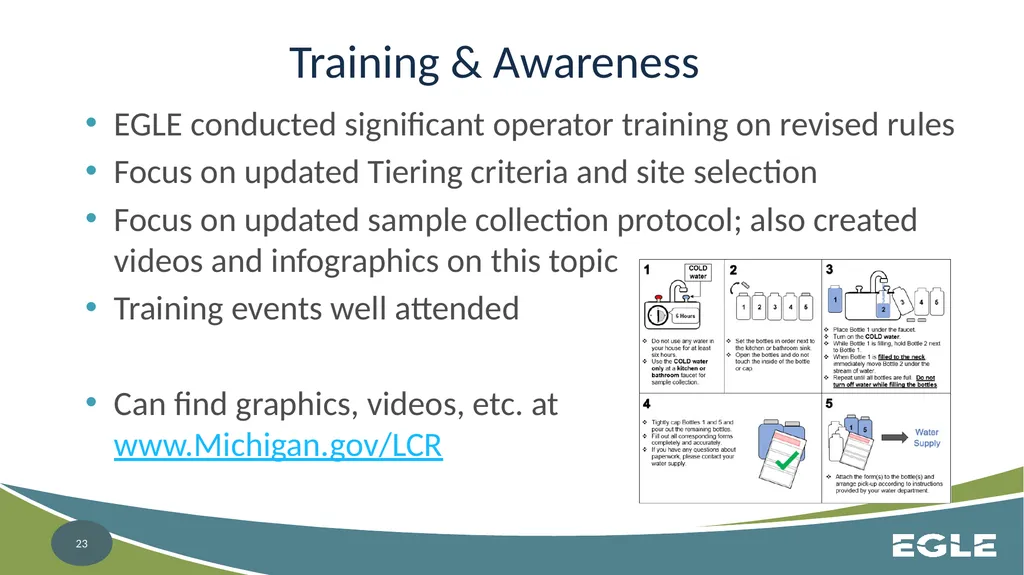
slide23. Training & Awareness EGLE conducted significant operator training on revised rules
Focus on updated Tiering criteria and site selection
Focus on updated sample collection protocol; also created videos and infographics on this topic
Training events well attended
Can find graphics, videos, etc. at www.Michigan.gov/LCR<br>
slide24. Other Efforts Coordination w/ Dept of Health and Human Services (DHHS)
Can assist w/ investigative sampling
Messaging and communication
Provision of filters
Staff participation at public meetings following lead ALEs
Voluntary school sampling program<br>
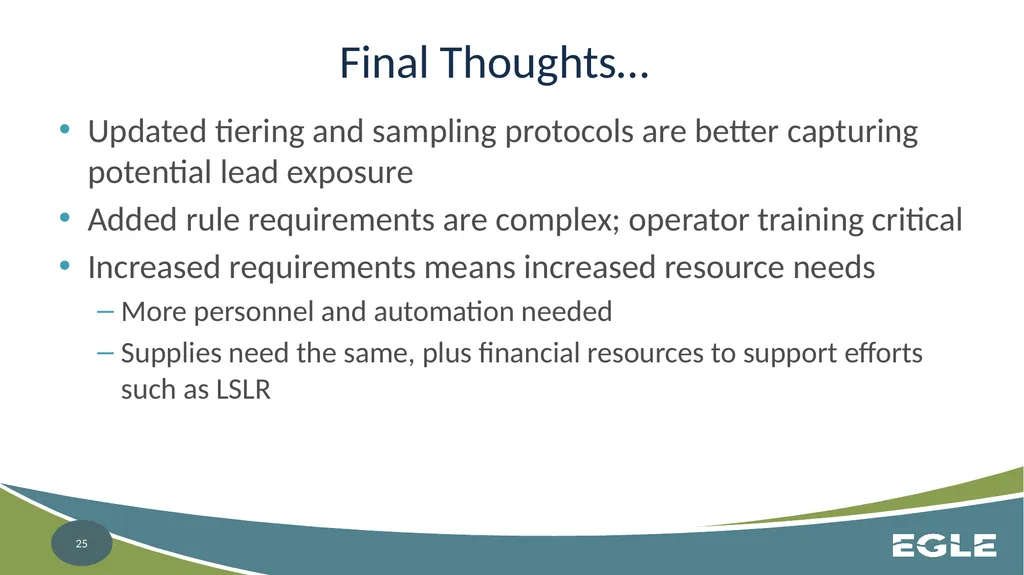
slide25. Final Thoughts… Updated tiering and sampling protocols are better capturing potential lead exposure
Added rule requirements are complex; operator training critical
Increased requirements means increased resource needs
More personnel and automation needed
Supplies need the same, plus financial resources to support efforts such as LSLR<br>
slide26. Michigan Department of
Environment, Great Lakes, and Energy General information about lead: Michigan.gov/MiLeadSafe
Information for water operators: Michigan.gov/lcr<br>
Drinking Water and Environmental Health Division<br>
slide2. Drinking Water and Environmental Health Division Eric Oswald, Director
George Kristian, Assistant Director
Kris Philip, Community Water Supply Section
Brandon Onan, Lead and Copper Unit<br>
slide3. Topics Summary of Michigan rule revisions
2019/2020 Data Outcomes
Implementation Challenges/Experiences
Questions/Discussion<br>
slide4. Summary of New Rule Development Drivers: Flint, EPA White Paper/Recommendations, Staff Experience, Stakeholders
Political Process = Compromise
Stakeholder Input was Critical – Hear all voices
Michigan Administrative Rule Process
Philosophy Behind the Changes
LSL Removal at Supply Expense
Lowering of Action Level
Sequential Sampling
Transparency<br>
slide5. Michigan Lead and Copper Rule Reduces Lead AL from 15 to 12 ppb on January 1, 2025
Eliminates Copper w/ Lead Solder Criteria in Tiers 1 and 2
Updated Sampling Pools
1st and 5th Liter Samples at LSL Sites – Use Highest Result
Limits Tap Monitoring Reduction in Systems with OCCT
Distribution System Materials Inventories (DSMI)
LSL Replacement – 5% Annual Average
Continuity of CCT
Enhanced Transparency<br>
slide6. Sampling<br>
slide7. Updated Sample Site Tiering Criteria Criteria for identifying sampling sites updated to further focus on high lead risk
Tier 1 and Tier 2 include only sites with lead service lines (LSL) or interior lead plumbing
Sites with copper plumbing with lead solder now Tier 3
Supplies required to update and submit sampling pools to reflect the revised criteria<br>
slide8. Updated Sampling Protocol Sites with LSL: 1st AND 5th liter sample required
1st liter represents water in premise plumbing
5th liter better represents water in contact with the LSL (based on an average home configuration)
Sites without LSL: 1st liter sample
Only the highest lead result and highest copper result from each site are used in 90th percentile calculation
Pre-stagnation flushing and aerator removal/cleaning prohibited in anticipation of compliance sampling<br>
slide9. Changes to Sampling Requirements Lead and copper tap sampling:
Supplies w/ OCCT cannot reduce to 3 year unless…
Meet WQP ranges for 3 consecutive years
AND either of the following apply
Supply has no lead service lines OR
90th percentile <= 0.005 for Pb and <=0.650 for Cu for 3 consecutive years
WQP sampling:
All systems with OCCT must conduct ongoing WQP sampling, regardless of size or 90th percentile value
Cannot reduce beyond annual<br>
slide10. 2019-2020 CWS Sampling Summary Approximately 1,010 CWS sampled
Approximately 1,560 compliance sampling events (some supplies sampled multiple times)
Approximately 170 CWS sampled using 1st/5th method<br>
slide11. 2019-2020 CWS Lead Action Level Exceedances 50 Lead ALEs from 2019-2020
31 ALEs at 22 supplies with LSLs (subject to 1st/5th)
19 ALEs at 18 supplies without LSLs (subject to 1st)
Of the 31 Lead ALEs at supplies with LSLs
31 based on highest of 1st and 5th liter (Michigan 90th)
11 based on 1st liter only (current federal LCR)
22 based on 5th liter only (new federal LCRR)
Note: MI lead action level is currently 15 ppb. It will reduce to 12 ppb in 2025.<br>
slide12. * Mixed tiers. Calculated using only 5th liter from LSL sites and 1st liter from other sites.<br>
slide13. Why Higher 90th Values? 1st & 5th liter sampling protocol
Updated Tiering Criteria
Re-evaluation, updating, & submission of sampling pools
Increased awareness and training on site selection & sampling
Prohibition on pre-stagnation flushing and aerator removal
Change in MI consecutive system sampling requirements (unrelated to, but timed with, revised rule implementation)
Other<br>
slide14. Inventories & Service Line Replacement<br>
slide15. Distribution System Materials Inventories (DSMI) Supplies had to submit a Preliminary DSMI by January 1, 2020.
Based on existing records, summarized by category
Required to submit PDSMI on a 2-page form
Find summary data at Michigan.gov/MiLeadSafe (click on Drinking Water and find the button on the right)<br>
slide16. Preliminary DSMI Table<br>
slide18. Complete DSMI Supplies must have a Complete DSMI by January 1, 2025
Must include materials of each service line
Must include public and private side
Will require some verification
Must be updated every 5 years
Minimum verification requirements recently released
Physically verify statistically significant number of lines to:
Evaluate reliability of records
Determine rate of occurrence of service line materials
Identify gaps where additional verification may be needed
Concept discussed in ASDWA/Blue Conduit white paper<br>
slide19. Lead Service Line Replacement Beginning 2021, supplies must replace an average of 5% per year not to exceed 20 years unless under alternate approved schedule REGARDLESS of 90th percentile values
Must replace lead & galvanized that is/was connected to lead
Must replace public AND private side at water supply expense
Must report annually on replacement efforts
Partial replacement prohibited except for emergency repair<br>
slide20. Increased Transparency Supplies must notify residents of homes served by LSL
Supplies with LSLs or lines of unknown material must report the number of each in their CCR
Public Advisory required within 72 hours of lead ALE
Consumer Notice must include copper as well as lead
Statewide and local advisory councils created to provide input regarding lead awareness efforts<br>
slide21. Implementation Experiences<br>
slide22. Challenges Complexity of rules; education of water operators
Change in sampling methodology
Gaps in knowledge about service line materials
Logistics of full LSLR (avoiding “temporary” partials)
Resources to assist supplies with LSLR requirements
Messaging rule changes to the public (what changed and why; why are we seeing more ALEs in Michigan)<br>
slide23. Training & Awareness EGLE conducted significant operator training on revised rules
Focus on updated Tiering criteria and site selection
Focus on updated sample collection protocol; also created videos and infographics on this topic
Training events well attended
Can find graphics, videos, etc. at www.Michigan.gov/LCR<br>
slide24. Other Efforts Coordination w/ Dept of Health and Human Services (DHHS)
Can assist w/ investigative sampling
Messaging and communication
Provision of filters
Staff participation at public meetings following lead ALEs
Voluntary school sampling program<br>
slide25. Final Thoughts… Updated tiering and sampling protocols are better capturing potential lead exposure
Added rule requirements are complex; operator training critical
Increased requirements means increased resource needs
More personnel and automation needed
Supplies need the same, plus financial resources to support efforts such as LSLR<br>
slide26. Michigan Department of
Environment, Great Lakes, and Energy General information about lead: Michigan.gov/MiLeadSafe
Information for water operators: Michigan.gov/lcr<br>